Search Results: "bod"

5 February 2013

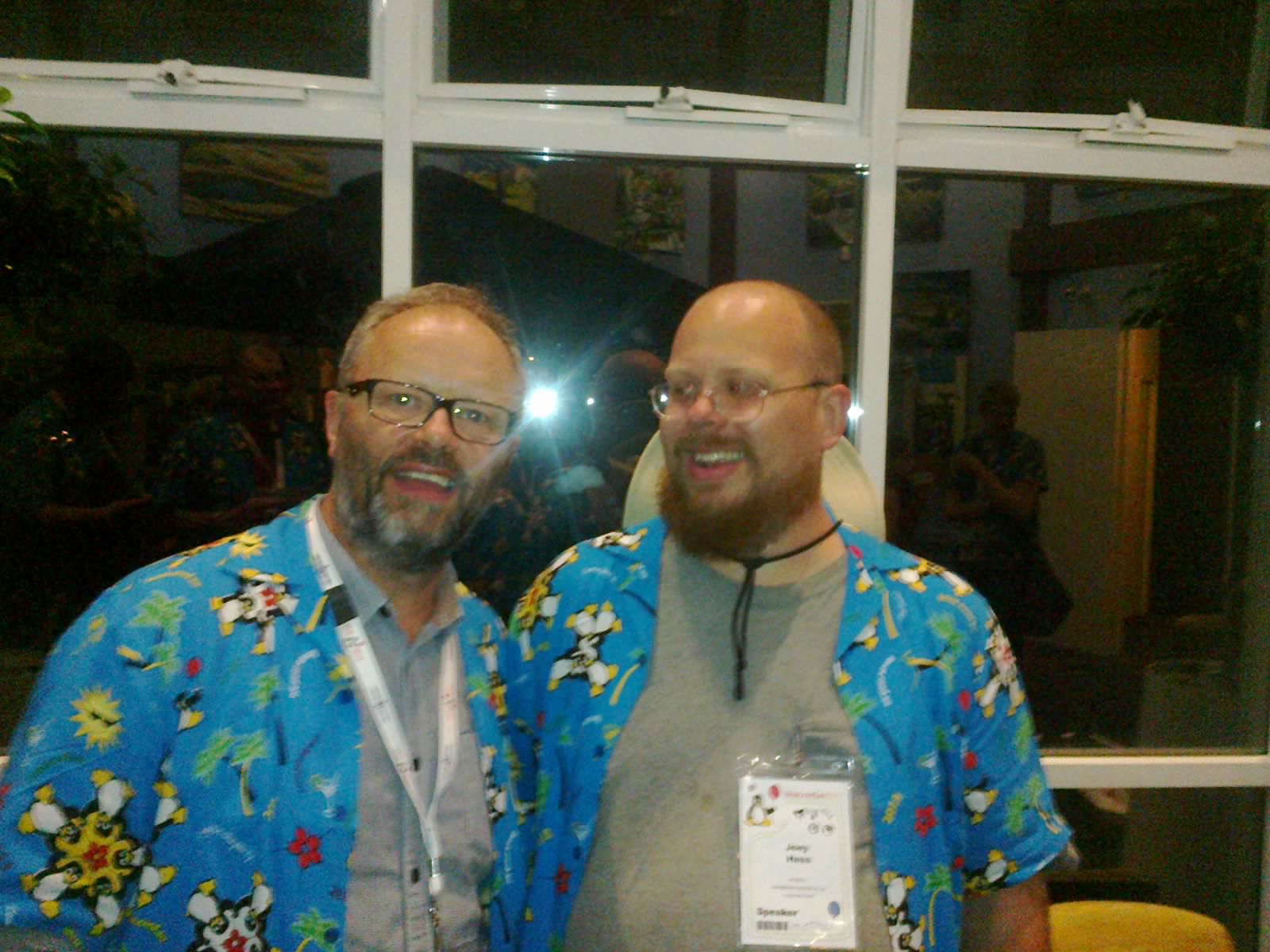
Joey Hess: LCA2013 wrapup

After 27 hours of travel, I'm finally back from my first Linux.conf.au. This was a great conference! Some of my favorite highlights:
My git-annex talk went ok, despite technical problems with the video output, which the video team did a great job of working around. The first demo went well, and the Q&A was excellent. The demo of the git-annex assistant webapp was marred by, apparently, a bad build of the webapp -- which I ironically used rather than my usual development build because I assumed it'd be less likely to fail. At least I may have a way to reproduce that hang somewhat reliably now, so I can get on with debugging it. I will be redoing a demo of the webapp as a screencast.
Here are some of the best talks I attended. (I have quite a lot more queued up to watch still, and had to cut several due to space.) Click titles for videos, or browse all the videos.

4 February 2013

Matthew Garrett: Don't like Secure Boot? Don't buy a Chromebook.

(Edit: It's been suggested that the title of this could give the wrong impression. "Don't like Secure Boot? That's not a reason to buy a Chromebook" may have been better)


People are, unsurprisingly, upset that Microsoft have imposed UEFI Secure Boot on the x86 market. A situation in which one company gets to determine which software will boot on systems by default is obviously open to abuse. What's more surprising is that many of the people who are upset about this are completely fine with encouraging people to buy Chromebooks.

Out of the box, Chromebooks are even more locked down than Windows 8 machines. The Chromebook firmware validates the kernel, and the kernel verifies the filesystem. Want to run a version of Chrome you've built yourself? Denied. Thankfully, Google have provided a way around this - you can (depending on the machine) either flip a physical switch or perform a special keystroke in the firmware to disable the validation. Doing so deletes all your data in the process, in order to avoid the situation where a physically present attacker wants to steal your data or backdoor your system unnoticed, but after that it'll boot any OS you want. The downside is that you've lost the security that you previously had. If a remote attacker manages to replace your kernel with a backdoored one, the firmware will boot it anyway. Want the same level of security as the stock firmware? You can't. There's no way for you to install your own signing keys, and Google won't sign third party binaries. Chromebooks are either secure and running Google's software, or insecure and running your software.

Much like Chromebooks, Windows 8 certified systems are required to permit the user to disable Secure Boot. In contrast to Chromebooks, Windows 8 certified systems are required to permit the user to install their own keys. And, unlike Google, Microsoft will sign alternative operating systems. Windows 8 certified systems provide greater user freedom than Chromebooks.

Some people don't like Secure Boot because they don't trust Microsoft. If you trust Google more, then a Chromebook is a reasonable choice. But some people don't like Secure Boot because they see it as an attack on user freedom, and those people should be willing to criticise Google's stance. Unlike Microsoft, Chromebooks force the user to choose between security and freedom. Nobody should be forced to make that choice.

(Updated to add that some Chromebooks have a software interface for disabling validation)

comment count unavailable comments

Raphaël Hertzog: My Free Software Activities in January 2013

This is my monthly summary of my free software related activities. If you re among the people who made a donation to support my work (84.25 , thanks everybody!), then you can learn how I spent your money. Otherwise it s just an interesting status update on my various projects. Debian Packaging In one of my customer projects, I had to use libwebsockets and since it was not packaged for Debian, I filed a Request For Package (RFP #697671). I discovered a fork of this library on github and decided to mail the original author and the author of the fork to learn a bit more about the reason of the fork. It turns out that they miscommunicated and that the original author was interested by most of the improvements. The fork still exists but the important fixes and most of the improvements have been merged (and he released a version 1.0 after that!). Furthermore the original author setup a bug tracker to better organize the project and so that the author of the fork can submit patches and be sure that they won t be forgotten (as it happened in the past). I spend quite some time discussing with both parties but at the end I m pleased to see that good progress has been made (although nobody stepped up to maintain this package in Debian). I packaged zim 0.59 (an important bugfix release) and wordpress 3.5.1 (with several security fixes). I updated the dpkg-dev squeeze backports to version 1.16.9~bpo60+1 on request of Daniel Schepler. This backport led me to file #698133 on kgb-client because the bot literally spammed the #debian-dpkg IRC channel for multiple hours by resending old commit notices that got merged in the squeeze-backports branch. BTW, they need help to get this issue fixed. I updated python-django-registration to fix a compatibility issue with python3-sphinx (see #697721 for details). Misc Debian Stuff Serious bug with salt. I filed a grave bug on salt (#697747 ) and prepared the upload to fix the issue on request of the maintainer. In the mean time, the maintainer orphaned the package. Franklin G. Mendoza already announced its willingness to take over but this package deserves multiple maintainers since this is a good piece of software that is getting more and more popular. net-retriever and alternate keyrings. I filed a wishlist bug (#698618) on net-retriever to request a way for derivatives to use another keyring package (i.e. not debian-archive-keyring-udeb) without having to fork net-retriever. Linux 3.7 on armel/armhf. I helped the kernel maintainers to fix the 3.7 kernel on armel/armhf by reporting on IRC the results of successive failing kernel rebuilds on those architectures (this kernel version is only in experimental). Carl9170 firmware. I also pinged the kernels maintainers about a missing firmware for the carl9170 driver (already reported in #635840) and Ben Hutchings took care of re-activating its inclusion in upstream s linux-firmware.git and then uploaded firmware-free 3.2 to Debian. Thanks Ben! New QA team member. And to finish with the miscellaneous stuff, I helped Holger Levsen to be added to the qa group so that he could integrate his awesome work on automated QA checks with Jenkins. Debian France Preparation for Solutions Linux. The people organizing the village of associations in the Solutions Linux conference have asked all organizations to apply for a booth if they wanted one. Last year Carl Chenet took care of organizing this and this time we had to find someone else. I made multiple call for volunteers (on the mailing list, on my blog) without much success but I finally managed to convince Tanguy Ortolo to take care of this. Thank you Tanguy! Get in touch with treasurer who disappeared. During the transition with the former Debian France officers, it has been said that Aur lien G r me another former treasurer of Debian France had entirely disappeared together with some papers that he never gave to his successor. I didn t want to give up on this without at least trying to get in touch by myself so after multiple tries (over IRC, phone, and snail mail), and some weeks without answers, he got back to me, explaining that he s currently in a foreign country and that he will take care of that next time that he comes in France. \o/ New website in preparation. Replacing the single-page website webpage with a more comprehensive website is an important goal. Alexandre Delano provided a basic ikiwiki setup inspired by dsa.debian.org. I cleaned it and integrated it in a git repository on our machine. There s thus a new test website on http://france.debian.net/test/. Tanguy Ortolo and Fernando Lagrange immeditaly made some small improvements but since then nobody stepped up to further complete the website. I ll try to do this in February and put the new website in production. Paypal and handling of members. We installed a paypal plugin in galette so that members can renew their membership online. I asked Christian Bayle to try it out and we found some issues that I reported upstream and that got fixed. But this is only the first step, we want to go much further and automate all the membership handling, from membership renewal mail reminders up to integration in the accounting system. To this end, I filed some new tickets in the Galette tracker and completed some that were already opened: #490, #368 and #394. We requested a quote for those tickets and Debian France is going to fund the work on those tickets so that we have a 100% free software solution for our needs. Thanks See you next month for a new summary of my activities.

No comment Liked this article? Click here. My blog is Flattr-enabled.

2 February 2013

Richard Hartmann: Release Critical Bug report for Week 05

This is the "too late because FOSDEM" edition. On the plus side, we will be ready to release Squeeze next week... The UDD bugs interface currently knows about the following release critical bugs: How do we compare to the Squeeze release cycle?
Week Squeeze Wheezy Diff
43 284 (213+71) 468 (332+136) +184 (+119/+65)
44 261 (201+60) 408 (265+143) +147 (+64/+83)
45 261 (205+56) 425 (291+134) +164 (+86/+78)
46 271 (200+71) 401 (258+143) +130 (+58/+72)
47 283 (209+74) 366 (221+145) +83 (+12/+71)
48 256 (177+79) 378 (230+148) +122 (+53/+69)
49 256 (180+76) 360 (216+155) +104 (+36/+79)
50 204 (148+56) 339 (195+144) +135 (+47/+90)
51 178 (124+54) 323 (190+133) +145 (+66/+79)
52 115 (78+37) 289 (190+99) +174 (+112/+62)
1 93 (60+33) 287 (171+116) +194 (+111/+83)
2 82 (46+36) 271 (162+109) +189 (+116/+73)
3 25 (15+10) 249 (165+84) +224 (+150/+74)
4 14 (8+6) 244 (176+68) +230 (+168/+62)
5 2 (0+2) 224 (132+92) +222 (+132/+90)
6 release!
Graphical overview of bug stats thanks to azhag:

31 January 2013

Russ Allbery: Consensus failure

As most people reading this have probably seen, xkcd found a particularly entertaining Wikipedia argument. (It is all true. There are at least 40,000 words arguing over whether to capitalize an "i" in a page title. I went and looked last night and spent several hours following the conversation.) This is, of course, funny, and I'm sure lots of people went away smiling at an excellent example of bikeshed painting on the Internet. But I think it's rather more serious than it appears to be. In fact, I would go so far as to say that it is a visible manifestation of a deeply-rooted problem that is the core of why I personally refuse to contribute to Wikipedia in any way that requires me to invest non-trivial time or become a member of that community. To explain that statement requires a bit of background. One of the very first services I found when I joined the Internet in 1993 was Usenet. Originally, I talked about comics collecting and then Magic: The Gathering, but I eventually ended up involved in Usenet governance. I spent more than ten years deeply invested in Usenet hierarchy administration; roughly, the process of agreeing on names for and sometimes moderators for global Usenet discussion groups, as well as all the supporting infrastructure for Usenet news server administrators to agree upon and share articles in those groups. Usenet newsgroup creation was, throughout that period, a consensus-driven process. There was a voting system that was used to measure consensus, but the voting system was largely designed to ensure that rough consensus existed (it was heavily skewed towards not changing anything). We took great pride in that fact. I'm sure that one could find many articles from me proudly championing the concept of a consensus-based decision-making process against many alternatives. That means I was also there when the toxic flaws at the heart of a consensus-based process completely destroyed it and, as a side effect, destroyed the community of people who had formed around it. I will never again invest my time and energy in a community that operates solely via a consensus process unless that community is small enough that consensus can actually work (which means not much more than twenty people). Consensus decision-making in large groups destroys communities and hurts people. These sorts of extended arguments on Wikipedia are not rare anomolies. They happen with some frequency; just by going through the debate xkcd references and looking at pointers, you can easily find others (Sega Genesis, cat ownership vs. companionship, endless notability debates... there are many). They look funny from outside, but from inside they're hugely demoralizing. Even when they don't get heated and spill over into personal animosity (and if they don't do that, you're lucky), they consume astonishingly vast quantities of time exactly not the resource that you want to be squandering in volunteer projects. And they do so without giving back anything emotionally. I know these arguments very well. One of the most contentious and angry arguments in the history of Usenet newsgroup creation was the argument over whether, when breaking up a group into multiple more focused groups, to rename the original group to end in *.misc or leave its existing name. This argument went on for years and led to deep, lingering hatred between the participants. It's the same sort of thing. These arguments happen in the way that they happen because there is toxic waste at the center of Wikipedia's governance process. And that toxic waste hurts people, wastes their time, and destroys their willingness to volunteer. It undermines community, which is sad and ironic because the whole point of consensus decision-making is to create, support, and empower community. But it doesn't work. It doesn't work for two very simple but very closely-related reasons: it's impossible to ever end an argument, and there is no incentive for anyone to shut up. As a result, it is nearly impossible to get the decision-making to cohere into something that is timely, consistent, unambiguous, and final. These are not optional requirements of a decision-making process. Without them, people will lose faith in the decision-making process itself, and some people will learn that, as long as they never stop talking about something, they can prolong the debate indefinitely and possibly eventually get their way. Now, of course, I'm deeply involved and invested in Debian. And on the surface, it may look like Debian also uses a consensus-based decision-making process. But while Debian decision-making has some problems, it's much healthier for a few reasons that are useful to examine:
  1. Individual packages in Debian are not managed by consensus, but rather fall under the authority of the package maintainer, who is either a single person or a small team. (Consensus works in small teams; it's great if the number of people involved is five or less.) This drastically limits the number of decisions that are subject to a large-scale consensus process. Nearly all decisions in Debian are made directly by the person doing the work, and only in exceptional circumstances can some larger process be invoked. This, on the surface, sounds like it could be similar to Wikipedia, but note that appeals to a larger process are much rarer in Debian than they are in Wikipedia. There is a strong bias in favor of letting the person working on the package do their job however they want to do it. This is more social than structural, but it's a core value (and we should be very careful about changing it). As a result, Debian operates less by mass consensus and more as a federation of semi-autonomous fiefdoms. This sounds worse: it sounds authoritarian and non-democratic. But it's significantly more functional, and it doesn't waste people's time.
  2. On appeal, and for broader questions that necessarily cut across multiple packages, there are several people in Debian who are perceived as having clear authority to make timely and relatively final decisions, who are almost never overruled, and who can therefore effectively end arguments. These include core teams like ftp-master or the release team, formal appeal bodies like the Technical Committee, and the Debian Project Leader. Not all of this ability is written in black and white in the governance process, but that's not the important part; the important part is that it works in practice to provide timely, consistent, unambiguous, and final decisions most of the time. (Some parts work better than others, and we do struggle with timely, but I've seen much, much worse.)
  3. There is a well-established ultimate appeal (a General Resolution), the ultimate appeal process is very specific and concrete, there is little or no ambiguity or human interpretation involved in analyzing the results, it is time-limited, and it's almost universally respected. Everyone abides by the result of a GR if matters get to that point, and while it's theoretically possible to propose another GR immediately to overturn the first one, this doesn't happen in practice. There's also substantial pushback against invoking the GR process for anything that isn't really important.
We still occasionally devolve into endless discussion, usually on some technical topic that cuts across the distribution and usually when the options haven't cohered enough for any authority to make a useful decision (often because it's too early for it to be possible to make a final decision). Those cases, such as the recurring systemd vs. upstart discussion, are still quite frustrating. But they're also relatively rare and largely ignorable because they have to be about just the right sort of issue. Wikipedia has these sorts of arguments all the time, and they're much less ignorable, because consensus is invoked for every minor dispute on any page in the entire project. You have to participate in endless consensus process or risk having your work undone, reverted, or removed. We would all like all decisions to be made by consensus, since we don't want anyone in a volunteer project to lose (and because we all love to convince other people we're right). And for small teams, consensus is wonderful. But that's precisely because governance in small teams is very easy; humans are naturally adapted for decision-making in small teams and have a huge variety of natural tools, tendencies, and abilities devoted to making those sorts of decisions. You rarely need any formal decision-making process; most decisions will just happen. You need a decision-making process when enough people are involved that mutual social pressure can't bring a dispute to resolution, and when you're in that situation, consensus is a horrible process. Due to my past experiences, I'm almost certainly at the extreme in dislike of consensus processes. Most people are not going to refuse to participate in communities solely on that basis. But be aware that 40,000 words of discussion about something that an outsider will not consider particularly important is not an accidental phenomenon. It's not something that just happens randomly on the Internet. It's an effect, and symptom, of a governance process, or lack thereof, and it's something that you can do something about if you want to.

30 January 2013

James Morrison: Testing email receive for appengine

It's not too obvious how to test email receive handlers in Appengine. The important observation is that the handlers take HTTP POSTs with multipart/form-data encoded data. In python you can build an email to be handled with the following code:
from email.message import Message 

def test_email(self):
body = Message()
body.add_header('to', 'test-unknown@other-app.com')
body.add_header('from', 'test@app.com')
body.add_header('Content-Type', 'multipart/alternative', boundary=self.boundary)
text = Message()
text['content-type'] = 'text/plain'
text.set_payload('I am I! Don Quixote! The man of La Mancha!')
body.attach(text)

post(payload=body.as_string())

27 January 2013

Jan Wagner: Fixing muninlite for up interfaces without link

Usually I'm monitoring stuff with Icinga (Nagios in the past). But for my small network, I primary needed monitoring of bandwidth. In our commercial environment we are using a closed source software for accounting traffic. There is also a license for testing purpose with a reduced number of sensors available. But I'm neither running windows in this network nor feeling happy with this. Cacti is a bit bloated for this small network and zabbix is (caused by what?) removed in wheezy, beside that I'm not getting the concept behind it. So I thought I could give munin a try and on the first view it doesn't look so bad. Monitoring my half dozens openwrt devices works like a charm by installing muninlite just the package. One central part of the network is a QNAP TS-459 Pro+, hosting a BackupPC and TimeMachine service, proving SMB/AFS data store and running SqueezeBox Server for another half dozen streaming devices. Unfortunately there is no optware package to provide a munin node. So I just copied the shell script of muninlite and the xinet config over from an openwrt device. At first it looked not bad, but than munin wasn't able to collect the data. After a while I realized, that munin was failing when collecting the network informations. A look into the muninlite script revealed that it was failing when trying to discover the interface speed of eth1 via ethtool. In my setup the QNAP is just connected with with one network interface, the second one is unconnected. Unfortunately all network interfaces on QNAP devices are up and therefore listed in /proc/net/dev where muninlite is discovering the network interfaces:
[~] # grep '^ *\(ppp\ eth\ wlan\ ath\ ra\ ipsec\ tap\ br-\)\([^:]\)\ 1,\ :' /proc/net/dev   cut -f1 -d:   sed 's/ //g
> s/\-/_/g'
eth1
eth0
Let's look into it:
[~] # ethtool eth0  grep Speed:
    Speed: 1000Mb/s
[~] # ethtool eth0  grep "Link detected:"
    Link detected: yes
[~] # ethtool eth1  grep Speed:
    Speed: Unknown! (65535)
[~] # ethtool eth1  grep "Link detected:"
    Link detected: no
Maybe you see .. the interface eth1 is up but has no link, so there is no speed negotiated and muninlite is failing. Thus I hacked the scripted and now it's working like a charme.
<notextile><figure class="code"><figcaption> (muninlite_fix-unused-up_interface.diff) download</figcaption>
1
2
3
4
5
6
7
8
9
10
11
12
13
14
15
16
17
18
19
20
21
22
23
24
25
26
27
28
29
30
31
32
33
34
35
36
37
38
39
40
41
42
43
44
45
46
47
48
49
50
51
--- /opt/sbin/munin-node.orig	2013-01-27 15:13:51.869007214 +0100
+++ /opt/sbin/munin-node	2013-01-27 16:11:20.536006950 +0100
@@ -133,7 +133,7 @@
   if [ -n "$(which ethtool)" ]; then
 	if [ -x "$(which ethtool)" ]; then
   		if ethtool $1   grep -q Speed; then
-    			MAX=$(($(ethtool $1   grep Speed   sed -e 's/[[:space:]]\ 1,\ / /g' -e 's/^ //' -e 's/M.*//'   cut -d\  -f2) * 1000000))
+    			MAX=$(($(ethtool $1   grep Speed   sed -e 's/[[:space:]]\ 1,\ / /g' -e 's/^ //' -e 's/M.*//'   sed -e 's/Unknown\!/0/'   cut -d\  -f2) * 1000000))
     			echo "up.max $MAX"
     			echo "down.max $MAX"
 		fi
@@ -535,19 +535,31 @@
     for INTER in $(grep '^ *\(ppp\ eth\ wlan\ ath\ ra\ ipsec\ tap\ br-\)\([^:]\)\ 1,\ :' /proc/net/dev   cut -f1 -d:   sed 's/ //g
 s/\-/_/g');
     do
-      INTERRES=$(echo $INTER   sed 's/\./VLAN/')
-      RES="$RES if_$INTERRES"
-      eval "fetch_if_$ INTERRES ()   fetch_if $INTER $@;  ;"
-      eval "config_if_$ INTERRES ()   config_if $INTER $@;  ;"
+      if [ -n "$(which ethtool)" ]; then
+        if [ -x "$(which ethtool)" ]; then
+          if [ -n "$(ethtool $INTER   grep 'Link detected: yes')" ]; then
+            INTERRES=$(echo $INTER   sed 's/\./VLAN/')
+            RES="$RES if_$INTERRES"
+            eval "fetch_if_$ INTERRES ()   fetch_if $INTER $@;  ;"
+            eval "config_if_$ INTERRES ()   config_if $INTER $@;  ;"
+          fi
+        fi
+      fi
     done
   elif [ "$PLUG" = "if_err_" ]; then
     for INTER in $(grep '^ *\(ppp\ eth\ wlan\ ath\ ra\ ipsec\ tap\ br-\)\([^:]\)\ 1,\ :' /proc/net/dev   cut -f1 -d:   sed 's/ //g
 s/\-/_/g');
     do
-      INTERRES=$(echo $INTER   sed 's/\./VLAN/')
-      RES="$RES if_err_$INTERRES"
-      eval "fetch_if_err_$ INTERRES ()   fetch_if_err $INTER $@;  ;"
-      eval "config_if_err_$ INTERRES ()   config_if_err $INTER $@;  ;"
+      if [ -n "$(which ethtool)" ]; then
+        if [ -x "$(which ethtool)" ]; then
+          if [ -n "$(ethtool $INTER   grep 'Link detected: yes')" ]; then
+            INTERRES=$(echo $INTER   sed 's/\./VLAN/')
+            RES="$RES if_err_$INTERRES"
+            eval "fetch_if_err_$ INTERRES ()   fetch_if_err $INTER $@;  ;"
+            eval "config_if_err_$ INTERRES ()   config_if_err $INTER $@;  ;"
+          fi
+        fi
+      fi
     done
   elif [ "$PLUG" = "netstat" ]; then
     if netstat -s >/dev/null 2>&1; then
</figure></notextile>

25 January 2013

Richard Hartmann: Release Critical Bug report for Week 04

The UDD bugs interface currently knows about the following release critical bugs: How do we compare to the Squeeze release cycle?
Week Squeeze Wheezy Diff
43 284 (213+71) 468 (332+136) +184 (+119/+65)
44 261 (201+60) 408 (265+143) +147 (+64/+83)
45 261 (205+56) 425 (291+134) +164 (+86/+78)
46 271 (200+71) 401 (258+143) +130 (+58/+72)
47 283 (209+74) 366 (221+145) +83 (+12/+71)
48 256 (177+79) 378 (230+148) +122 (+53/+69)
49 256 (180+76) 360 (216+155) +104 (+36/+79)
50 204 (148+56) 339 (195+144) +135 (+47/+90)
51 178 (124+54) 323 (190+133) +145 (+66/+79)
52 115 (78+37) 289 (190+99) +174 (+112/+62)
1 93 (60+33) 287 (171+116) +194 (111/+83)
2 82 (46+36) 271 (162+109) +189 (+116/+73)
3 25 (15+10) 249 (165+84) +224 (+150/+74)
4 14 (8+6) 244 (176+68) +230 (+168/+62)
5 2 (0+2)
6 release!
Graphical overview of bug stats thanks to azhag:

23 January 2013

Joey Hess: in Sydney

After arriving yesterday, and doing the obligatory jetlagged wander around Circular Quay to the Opera House, I crashed for 15 hours sleep and seem reasonably well over the jetlag now. I'm staying near Central Station, which is great because it's very convenient to transport and there's lots of cheap ethnic food.
view down my street
Today I took the ferry over to Manly Beach. I had to get in some in swimming of course, although today was cloudy and only in the 80's (F). That was ok, but the really nice bit was walking over to Shelly Beach and up along the sandstone cliffs near North Head. Highlight was finding a small gotto high on the cliff, with some beautiful sandstone filigree overhead, that seemed carved by water (but probably really by wind), and contained a shady bench overlooking the Pacific. Great place to enjoy a lunch of crusty bread and salami if you're ever in the area. Topped off a great day with a random trip to Neutral Bay (the D&Der in me liked the name, and why not, ferries are free) and a wander through the Royal Botanic Gardens. I'm hoping to spend either Thursday or Friday at a co-working or hackerspace in Sydney, but I don't know where yet. Any locals have ideas?

22 January 2013

Jon Dowland: HD audio and more archiving

Having obtained a respectable set of headphones last year, I started pondering about high definition music. Could I hear the difference between a track mixed at CD quality, 16 bit samples / 44.1kHz sample rate, and the same track mixed at a higher bit or sample rate? A number of artists have made HD audio releases available in a variety of formats, most of which are now obsolete (see: SACD, DVD-Audio) and/or hard to demux to something more modern. However some artists have made digital HD audio releases. The last two Nine Inch Nails records were released in HD and are more readily available.
These releases also had nice per-track embedded art These releases also had nice per-track embedded art
"Ghosts - " had a standard-quality digital release but a high quality Blu-Ray release was also available, commercially. All versions were Creative Commons licensed, so people have legimitely demuxed the Blu Ray release and made it available in other formats. One was uploaded to archive.org, although it sadly lacks precise lineage information: "The Slip" was released in HD audio digitally. However, I noticed that nobody had uploaded the HD release to archive.org, and having developed an interest in archiving, I did: I tried performing some listening tests on my desktop computer, which has an M-Audio "Audiophile" 24/96 PCI sound card. However, in non-blind tests, I failed to distinguish the SD and HD versions of these songs. A friend suggested that despite the card's quoted rates, the signal-to-noise ratio was such that you wouldn't get high enough fidelity to play 24/96 properly. I can only take their word for it My preferred music player can only decode 24/44.1 but I recently learned that my phone, an Apple iPhone, can decode up to 24 bit, 48kHz. I decided to downsample the above two releases in order to try further listening tests on my phone. I uploaded both to archive.org: So far in non-blind tests I have not noticed a particular difference. Whether it's my equipment, my ears, these particular tracks or whether HD audio being audibly better than CD quality is a myth, I am not sure yet. I'm planning to do some proper ABX testing of various lossy codecs and bitrates prior to a major CD ripping exercise, so I may try proper ABX testing of HD audio at the same time. (I'm collecting together past and future log posts about archiving under the tag 'archiving').

Julien Danjou: Extending Swift with middleware: example with ClamAV

In this article, I'm going to explain you how you can extend Swift, the OpenStack Object Storage project, so it performs extra action on files at upload or at download time. We're going to build an anti-virus filter inside Swift. The goal is to refuse uploaded data if they contain a virus. To help us with virus analyses, we'll use ClamAV. WSGI, paste and middleware
In a pipeline, a black cat can become a white cat with the help of some middleware.
To do our content analysis, the best place to hook in the Swift architecture is at the beginning of every request, on swift-proxy, before the file is actually stored on the cluster. Swift proxy uses, like many other OpenStack projects, paste to build his HTTP architecture. Paste uses WSGI and provides an architecture based on a pipeline. The pipeline is composed of a succession of middleware, ending with one application. Each middleware has the chance to look at the request or at the response, can modify it, and then pass it to the following middleware. The latest component of the pipeline is the real application, and in this case, the Swift proxy server. If you've already deployed Swift, you encountered a default pipeline in the swift-proxy.conf configuration file:
[pipeline:main]
pipeline = catch_errors healthcheck cache ratelimit tempauth proxy-logging proxy-server

This is a really basic pipeline with a few middleware. The first one catches error, the second one is in charge to return 200 OK response if you send a GET /healthcheck request on your proxy server. The third one is in charge of caching, the fourth one is used for rate limiting, the fifth for authentication, the sixth one for logging, and the final one is the actual proxy server, in charge of proxying the request to the account, container, or object servers (the others components of Swift). Of course, we could remove or add any of the middleware here at our convenience. Be aware that the order matters: for example, if you put healthcheck after tempauth, you won't be able to access the /healthcheck URL without being authenticated! ClamAV
If you don't know ClamAV, it's an antivirus engine designed for detecting trojans, viruses, malware and other malicious threats. Wwe're going to use it to scan every incoming file. To build the middleware, we'll use the Python binding pyclamd. The API is quite simple, see:
>>> import pyclamd
>>> pyclamd.init_unix_socket('/var/run/clamav/clamd.ctl')
>>> print pyclamd.scan_stream(pyclamd.EICAR)
'stream': 'Eicar-Test-Signature(44d88612fea8a8f36de82e1278abb02f:68)'
>>> print pyclamd.scan_stream("safe!")
None

Anatomy of a WSGI middleware Your WSGI middleware should consist of a callable object. Usually this is done with a class implementing the __call__ method. Here's a basic boilerplate:
class SwiftClamavMiddleware(object):
"""Middleware doing virus scan for Swift."""

def __init__(self, app, conf):
# app is the final application
self.app = app

def __call__(self, env, start_response):
return self.app(env, start_response)


def filter_factory(global_conf, **local_conf):
conf = global_conf.copy()
conf.update(local_conf)

def clamav_filter(app):
return SwiftClamavMiddleware(app, conf)
return clamav_filter

I'm not going to expand more on why this is built this way, but if you want to have more info on this kind of filter middleware, you can read their documentation on Paste. This middleware will just do nothing as it is. It's going to simply pass all requests it receives to the final application, and returns the result. Testing our basic middleware
Now is a really good time to add unit tests. I hope you didn't think we were going to write code without some tests, right? It's really easy to test a middleware, as we're going to use WebOb for that.
import unittest
from webob import Request


class FakeApp(object):
def __call__(self, env, start_response):
return Response(body="FAKE APP")(env, start_response)


class TestSwiftClamavMiddleware(unittest.TestCase):

def setUp(self):
self.app = SwiftClamavMiddleware(FakeApp(), )

def test_simple_request(self):
resp = Request.blank('/',
environ=
'REQUEST_METHOD': 'GET',
).get_response(self.app)
self.assertEqual(resp.body, "FAKE APP")

We create a FakeApp class, that represents a fake WSGI application. You could also use a real application, or write a fake application looking like the one you want to test. It'll require more time, but your tests will be closer to the reality. Here we write the simplest test we can for our middleware. We're just sending a GET / request to it, so it passes the request to the final application and returns the result. It is transparent, it does nothing. Now, with that solid base we'll able to add more features and test these features incrementally. Plugging ClamAV in With our base ready, we can start thinking about how to plug ClamAV in. What we want to check here, is the content of the file when it's uploaded. If we refer to the OpenStack object storage API , a file upload is done via a PUT request, so we're going to limit the check to that kind of requests. Obviously, more checks could be added, but we'll keep things simple here for the sake of comprehensibility. With WSGI, the content of the request is available in env['wsgi.input'] as an object implementing a file interface. We'll scan that stream with ClamAV to check for viruses.
import pyclamd
from webob import Response


class SwiftClamavMiddleware(object):
"""Middleware doing virus scan for Swift."""

def __init__(self, app, conf):
pyclamd.init_unix_socket('/var/run/clamav/clamd.ctl')
# app is the final application
self.app = app

def __call__(self, env, start_response):
if env['REQUEST_METHOD'] == "PUT":
# We have to read the whole content in memory because pyclamd
# forces us to, but this is a bad idea if the file is huge.
scan = pyclamd.scan_stream(env['wsgi.input'].read())
if scan:
return Response(status=403,
body="Virus %s detected" % scan['stream'],
content_type="text/plain")(env, start_response)
return self.app(env, start_response)


def filter_factory(global_conf, **local_conf):
conf = global_conf.copy()
conf.update(local_conf)

def clamav_filter(app):
return SwiftClamavMiddleware(app, conf)
return clamav_filter

That's it. We only check for PUT requests and if there's a virus in the file, we return a 403 Forbidden error with the name of the detected virus, bypassing entirely the rest of the middleware chain and the application handling. Then, we can simply test it.
import unittest
from cStringIO import StringIO
from webob import Request, Response


class FakeApp(object):
def __call__(self, env, start_response):
return Response(body="FAKE APP")(env, start_response)


class TestSwiftClamavMiddleware(unittest.TestCase):
def setUp(self):
self.app = SwiftClamavMiddleware(FakeApp(), )

def test_put_empty(self):
resp = Request.blank('/v1/account/container/object',
environ=
'REQUEST_METHOD': 'PUT',
).get_response(self.app)
self.assertEqual(resp.body, "FAKE APP")

def test_put_no_virus(self):
resp = Request.blank('/v1/account/container/object',
environ=
'REQUEST_METHOD': 'PUT',
'wsgi.input': StringIO('foobar')
).get_response(self.app)
self.assertEqual(resp.body, "FAKE APP")

def test_put_virus(self):
resp = Request.blank('/v1/account/container/object',
environ=
'REQUEST_METHOD': 'PUT',
'wsgi.input': StringIO(pyclamd.EICAR)
).get_response(self.app)
self.assertEqual(resp.status_code, 403)

The first test test_put_empty simulates an empty PUT request. The second one, test_put_no_virus simulates a regular PUT request but with a simple file containing no virus. Finally, the third and last test simulates the upload of a virus using the EICAR test file. This is a special test file that is recognized as a virus, even if it's not real one. Very handy for testing virus detection software! Configuring Swift proxy Our middleware is ready! We can configure Swift's proxy server to use it. We need to add the following lines to our swift-proxy.conf to teach it how to load the filter:
[filter:clamav]
paste.filter_factory = swiftclamav:clamav_filter

We'll assume that our Python modules is named swiftclamava here. Now that we've defined our filter and how to load it, we can use it in our pipeline:
[pipeline:main]
pipeline = catch_errors healthcheck cache ratelimit tempauth clamav proxy-logging proxy-server

Just before reaching the proxy-server, and after the user being authenticated, the content will be scanned for viruses. It's important here to put this after authentication for example, because otherwise we may scan content that will get rejected by the authtemp module, thus scanning for nothing! Beyond scanning And voil , we now have a simple middleware testing uploaded content and refusing infected files. We could enhance it with various other things, like configuration handling, but I'll let that as an exercise for the interested readers. We didn't exploited it here, but note that you can also manipulate request headers and modify them if needed. For example, we could have added a header X-Object-Meta-Scanned-By: ClamAV to indicates that the file has been scanned by ClamAV. You should now be able to build your own middleware doing whatever you want with uploaded data. Happy hacking!

Russ Allbery: Review: Fantasy & Science Fiction, March/April 2011

Review: Fantasy & Science Fiction, March/April 2011
Editor: Gordon van Gelder
Issue: Volume 120, No. 3 & 4
ISSN: 1095-8258
Pages: 258
Charles de Lint's book review column sticks with the sorts of things he normally reviews: urban and contemporary fantasy and young adult. Predictably, I didn't find that much of interest. But I was happy to see that not all the reviews were positive, and he talked some about how a few books didn't work. I do prefer seeing a mix of positive and negative (or at least critical) reviews. James Sallis's review column focuses entirely on Henry Kuttner and C.L. Moore (by way of reviewing a collection). I'm always happy to see this sort of review. But between that and de Lint's normal subject matter, this issue of F&SF was left without any current science fiction reviews, which was disappointing. Lucius Shepard's movie review column features stunning amounts of whining, even by Shepard's standards. The topic du jour is how indie films aren't indie enough, mixed with large amounts of cane-shaking and decrying of all popular art. I find it entertaining that the F&SF film review column regularly contains exactly the sort of analysis that one expects from literary gatekeepers who are reviewing science fiction and fantasy. Perhaps David Langford should consider adding an "As We See Others" feature to Ansible cataloging the things genre fiction fans say about popular movies. "Scatter My Ashes" by Albert E. Cowdrey: The protagonist of this story is an itinerant author who has been contracted to write a family history (for $100K, which I suspect is a bit of tongue-in-cheek wish fulfillment) and has promptly tumbled into bed with his employer. But he is somewhat serious about the writing as well, and is poking around in family archives and asking relatives about past details. There is a murder (maybe) in the family history, not to mention some supernatural connections. Those familiar with Cowdrey's writing will recognize the mix of historical drama, investigation, and the supernatural. Puzzles are, of course, untangled, not without a bit of physical danger. Experienced fantasy readers will probably guess at some of the explanation long before the protagonist does. Like most Cowdrey, it's reliably entertaining, but I found it a bit thin. (6) "A Pocketful of Faces" by Paul Di Filippo: Here's a bit of science fiction, and another mystery, this time following the basic model of a police procedural. The police in this case are enforcing laws around acceptable use of "faces" in a future world where one can clone someone's appearance from their DNA and then mount it on a programmable android. As you might expect from that setup, the possibilities are lurid, occasionally disgusting, and inclined to give the police nightmares. After some scene-setting, the story kicks in with the discovery of the face of a dead woman who, at least on the surface, no one should have any motive to clone. There were a few elements of the story that were a bit too disgusting for me, but the basic mystery plot was satisfying. I thought the ending was a let-down, however. Di Filippo tries to complicate the story and, I thought, went just a little too far, leaving motives and intent more confusing than illuminating. (6) "The Paper Menagerie" by Ken Liu: Back to fantasy, this time using a small bit of magic to illustrate the emotional conflicts and difficulties of allegiance for second-generation immigrants. Jack is the son of an American farther and a Chinese mother who was a mail-order bride. He's young at the start of the story and struggling with the embarassment and humiliation that he feels at his mother's history and the difficulties he has blending in with other kids, leading to the sort of breathtaking cruelty that comes so easily from teenagers who are too self-focused and haven't yet developed adult empathy. I found this very hard to read. The magic is beautiful, personal, and very badly damaged by the cruelty in ways that can never really be fixed. It's a sharp reminder of the importance of being open-hearted, but it's also a devastating reminder that the lesson is normally learned too late. Not the story to read if you're prone to worrying about how you might have hurt other people. (6) "The Evening and the Morning" by Sheila Finch: This long novella is about a third of the issue and is, for once, straight science fiction, a somewhat rare beast in F&SF these days. It's set in the far future, among humans who are members of the Guild of Xenolinguists and among aliens called the Venatixi, and it's about an expedition back to the long-abandoned planet of Earth. I had a lot of suspension of disbelief problems with the setup here. While Earth has mostly dropped out of memory, there's a startling lack of curiosity about its current condition among the humans. Finch plays some with transportation systems and leaves humanity largely dependent on other races to explain the failure to return to Earth, but I never quite bought it. It was necessary to set up the plot, which is an exploration story with touches of first contact set on an Earth that's become alien to the characters, but it seemed remarkably artificial to me. But, putting that aside, I did get pulled into the story. Its emotional focus is one of decline and senescence, a growing sense of futility, that's halted by exploration, mystery, and analysis. The question of what's happened on Earth is inherently interesting and engaging, and the slow movement of the story provides opportunities to build up to some eerie moments. The problem, continuing a theme for this issue, is the ending. Some of the reader's questions are answered, but most of the answers are old, well-worn paths in science fiction. The emotional arc of the story is decidedly unsatisfying, at least to me. I think I see what Finch was trying to do: there's an attempted undermining of the normal conclusion of this sort of investigation to make a broader point about how to stay engaged in the world. But it lacked triumph and catharsis for me, partly because the revelations that we get are too pedestrian for the build-up they received. It's still an interesting story, but I don't think it entirely worked. (6) "Night Gauntlet" by Walter C. DeBill, Jr., et al.: The full list of authors for this story (Walter C. DeBill, Jr., Richard Gavin, Robert M. Price, W.H. Pugmire, Jeffrey Thomas, and Don Webb) provides one with the first clue that it's gone off the rails. Collaborative storytelling, where each author tries to riff off the work of the previous author while spinning the story in a different direction, is something that I think works much better orally, particularly if you can watch facial expressions while the authors try to stump each other. In written form, it's a recipe for a poorly-told story. That's indeed what we get here. The setup is typical Cthulhu mythos stuff: a strange scientist obsessed with conspiracy theories goes insane, leaving behind an office with a map of linkages between apparently unrelated places. The characters in the story also start going insane for similar reasons, leading up to a typical confrontation with things man was not meant to know, or at least pay attention to. If you like that sort of thing, you may like this story better than I did, but I thought it was shallow and predictable. (3) "Happy Ending 2.0" by James Patrick Kelly: More fantasy, this time of the time travel variety. (I call it fantasy since there's no scientific explanation for the time travel and it plays a pure fantasy role in the story.) That's about as much as I can say without giving away the plot entirely (it's rather short). I can see what Kelly was going for, and I think he was largely successful, but I'm not sure how to react to it. The story felt like it reinforced some rather uncomfortable stereotypes about romantic relationships, and the so-called happy ending struck me as the sort of situation that was going to turn very nasty and very uncomfortable about five or ten pages past where Kelly ended the story. (5) "The Second Kalandar's Tale" by Francis Marion Soty: The main question I have about this story is one that I can't answer without doing more research than I feel like doing right now: how much of this is original to Soty and how much if it is straight from Burton's translation of One Thousand and One Nights. Burton is credited for the story, so I suspect quite a lot of this is from the original. Whether one would be better off just reading the original, or if Soty's retelling adds anything substantial, are good questions that I don't have the background to answer. Taken as a stand-alone story, it's not a bad one. It's a twisting magical adventure involving a djinn, a captive woman, some rather predictable fighting over the woman, and then a subsequent adventure involving physical transformation and a magical battle reminiscent of T.H. White. (Although I have quite likely reversed the order of inspiration if as much of this is straight from Burton as I suspect.) Gender roles, however, are kind of appalling, despite the presence of a stunningly powerful princess, due to the amount of self-sacrifice expected from every woman in the story. Personally, I don't think any of the men in the story are worth anywhere near the amount of loyalty and bravery that the women show. Still, it was reasonably entertaining throughout, in exactly the way that I would expect a One Thousand and One Nights tale to be. Whether there's any point in reading it instead of the original is a question I'll leave to others. (7) "Bodyguard" by Karl Bunker: This is probably the best science fiction of the issue. The first person protagonist is an explorer living with an alien race, partly in order to flee the post-singularity world of uploaded minds and apparent stagnation that Earth has become. It's a personal story that uses his analysis of alien mindsets (and his interaction with his assigned alien bodyguard) to flesh out his own desires, emotional background, and reactions to the world. There are some neat linguistic bits here that I quite enjoyed, although I wish they'd been developed at even more length. (The alien language is more realistic than it might sound; there are some human languages that construct sentences in a vaguely similar way.) It's a sad, elegiac story, but it grew on me. (7) "Botanical Exercises for Curious Girls" by Kali Wallace: One has to count this story as science fiction as well, although for me it had a fantasy tone because the scientific world seems to play by fantasy rules from the perspective of the protagonist. Unpacking that perspective is part of the enjoyment of the story. At the start, she seems to be a disabled girl who is being cared for by a strange succession of nurses who vary by the time of day, but as the story progresses, it becomes clear that something much stranger is going on. There are moments that capture a sense of wonder, reinforced by the persistantly curious and happy narrative voice, but both are undercut by a pervasive sense of danger and dread. This is a light story written about rather dark actions. My biggest complaint with the story is that it doesn't so much end as wander off into the sunset. It set up conflict within a claustrophobic frame, so I can understand the thematic intent of breaking free of that frame, but in the process I felt like the story walked away from all of the questions and structure that it created and ended in a place that felt less alive with potential than formless and oddly pointless. I think I wanted it to stay involved and engaged with the environment it had created. (6) "Ping" by Dixon Wragg: I probably should just skip this, since despite the table of contents billing and the full title introduction, it's not a story. It's a two-line joke. But it's such a bad two-line joke that I had to complain about it. I have no idea why F&SF bothered to reprint it. (1) "The Ifs of Time" by James Stoddard: This certainly fits with the Arabian Nights story in this issue. The timekeeper of a vast and rambling castle (think Gormenghast taken to the extreme) wanders into a story-telling session in a distant part of the castle. The reader gets to listen to four (fairly good) short stories about time, knowledge, and memory, told in four very different genres. All of this does relate to why the timekeeper is there, and the frame story is resolved by the end, but the embedded stories are the best part; each of them is interesting in a different way, and none of them outlast their welcome. This was probably the strongest story of this issue. (7) Rating: 6 out of 10

Eddy Petri&#537;or: (Rsnapshot) backup and security - I see problems

In my previous post I was asking for suggestions for backup solutions that would be open/free software, do backups over the network to a local HDD, be cross platform to allow Windows and Linux clients and not be too CPU/memory hungry (on the server).

Several people suggested rsnapshot, BackupPC, areca-backup, and rsync. Thank you for all your suggestions, you have been a tremendous help. I have decided to give rsnapshot a try since it was suggested to me that it would actually do what is supposed to do for Windows clients, too (which was initially my perceived show stopper for rsnapshot).

Still, when getting to the implementation, I was a little disappointed by the very permissive access that needs to be provided on the client machines, since the backup is initiated from the backup server. Even the so called more secure suggested solutions seem way too permissive for my taste, since losing the control over the backup system means basically giving total access to the data from all client machines, which is quite a big problem in my opinion.

The data-transfer mechanism employed by rsnapshot is simply
  1. S ==(connects and reads all data)==> C
  2. S stores data in the final storage area
Am I the only one seeing a problem with this idea? If the server can connect to all your client machines and read all areas as it pleases, even if you restrict it to some directories, the data is already compromised when the backup server is compromised (think .ssh private keys, files with wireless network passwords and so on; I won't say card information - you don't keep credit/debit card information on your computer, or at least not in plain text, do you?).

What I would consider a better alternative would be a server-initiated dialogue which goes a little like this (S is server, C is client, '=' represent connections via ssh):
  1. S ---(requests backup initiation procedure)---> C
  2. S waits for a defined period of time that C connects back to send (already encrypted) data; if it doesn't arrive, it aborts
  3. S <===(sends encrypted data to be backed up)=== C
  4. S <-(signals the completion of data transfer)-- C
  5. S stores the data in the final storage area
This way, the server can allow access from the clients only in designated areas (even a chroot is possible) from designated clients, access can even be provided only after a port knocking procedure and only during the backup time frame (since the server initiates the negotiation, it can expect only then the knocks, but only then), so the server is quite well secured. The connection to the server can even be done through an unprivileged account, it can even be one account per client machine which can be limited to a scponly shell, if you care for that level of security.

On the other hand, the client information is secure since it can be encrypted directly on the client machine and sent only after encryption, the client machine can decide and control what it sends, while the backup server can only store what the client provides. Also, if the server is compromised, the clients' data and system aren't compromised at all, since the data is on the backup machine, but is encrypted with a key only known on the client (and a backup copy of it can be stored somewhere safe).

I am aware this approach can be problematic for permission (user/group preservation), but it doesn't happen if there is a local <-> remote user mapping or simply the numeric IDs are kept.

I am also aware this means smarter clients and might mean the Windows machine might not be able to implement this completely, but a little more security than "here is all my data" can still be achieved, can't it?

What do other people think? Am I insane or paranoid?

I think I can implement this type of protocol in some scripts (at least one for server and one for clients) and use the backup_script feature of rsnapshot to keep this clean and nice within rsnapshot.

What might prove problematic with this approach is that rsync spedup is lost (might be?) because the copy is done to a temporary directory which, I assume, is empty, so tough luck. Another problem seems to be that every time the backup is done, the client has to encrypt each of the files to backup, which seems to be a real performance penalty, especially if the data to be backed up is quite large.

Is there an encryption layer that does this automatically at file level in the same/similar manner that LUKS does for entire block devices? Having the right file names, but with scrambled/encrypted contents seems to be the ideal solution from this PoV.

Thanks for reading and possible suggestions you might point me to.

P.S.: I just thought of this, if there was an encryption layer implemented with fuse which is mounted in some directory on the client machine, the default rsnapshot mechanism could actually work, and this would mitigate the data accessibility issue and the performance issue since that file system could be contained within a chroot and the encryption/scrambling would be done transparently on the client, so no data is plainly accessible. Does anybody know such a FUSE implementation that does on-the-fly file encryption?

P.P.S.: EncFS does exactly what I want with its --reverse option which is exactly designed for this purpose:
Normally EncFS provides a plaintext view of data on demand. Normally it stores enciphered data and displays plaintext data. With --reverse it takes as source plaintext data and produces enciphered data on-demand. This can be useful for creating remote encrypted backups, where you do not wish to keep the local files unencrypted.
Great!

20 January 2013

Russ Allbery: Review: How I Proposed to My Wife

Review: How I Proposed to My Wife, by John Scalzi
Publisher: Subterranean
Copyright: 2007
ISBN: 1-59606-480-3
Format: Kindle
Pages: 25
How I Proposed to My Wife: An Alien Sex Story is really a novelette, which I would normally give a paragraph review in a larger collection. But it was independently published and is independently purchasable, so it gets its own page. I read this as part of the Subterranean Scalzi Super Bundle, which collects a bunch of Scalzi's independently-published short fiction. It was originally a chapbook that accompanied Subterranean #4. Those familiar with Scalzi's other work should expect something more like Agent to the Stars than the Old Man's War series. The first-person protagonist is a new writer for New World Man think the sort of glossy magazine you see in supermarket racks. Every issue, they do an alien story; this issue, they decide to do an article on alien courtship and, of course, assign the new writer to it. Most of the story is a mildly entertaining series of arranged dates in which Charlie has somewhat awkward conversations with various aliens about how their date protocols work, and then ends up in situations that are sexual to the aliens but mostly just bizarre and embarassing. If you've read any other Scalzi humor, you know what to expect: good-natured, light, mild parody with a touch of slapstick. There is, of course, a twist that gets the story to the point foreshadowed in the title. I didn't find it particularly believable, but you don't read this story for its complex and realistic world-building. The ending joke, which is back onto the firmer ground of purely human romantic conventions, is probably the funniest moment in the story. If you like Scalzi's humor, you probably won't regret spending the $1 that the story currently costs on Amazon. (You can also still get it on a shareware basis direct from Scalzi, but given that the minimum useful donation is 30 cents, it's probably easier to just buy from Amazon unless you don't want Amazon's format or DRM.) On the other hand, you probably also won't regret forgetting this story exists and going on with the rest of your life. Rating: 6 out of 10

18 January 2013

Richard Hartmann: Release Critical Bug report for Week 03

The UDD bugs interface currently knows about the following release critical bugs: How do we compare to the Squeeze release cycle?
Week Squeeze Wheezy Diff
43 284 (213+71) 468 (332+136) +184 (+119/+65)
44 261 (201+60) 408 (265+143) +147 (+64/+83)
45 261 (205+56) 425 (291+134) +164 (+86/+78)
46 271 (200+71) 401 (258+143) +130 (+58/+72)
47 283 (209+74) 366 (221+145) +83 (+12/+71)
48 256 (177+79) 378 (230+148) +122 (+53/+69)
49 256 (180+76) 360 (216+155) +104 (+36/+79)
50 204 (148+56) 339 (195+144) +135 (+47/+90)
51 178 (124+54) 323 (190+133) +145 (+66/+79)
52 115 (78+37) 289 (190+99) +174 (+112/+62)
1 93 (60+33) 287 (171+116) +194 (111/+83)
2 82 (46+36) 271 (162+109) +189 (+116/+73)
3 25 (15+10) 249 (165+84) +224 (150/+74)
4 14 (8+6)
5 2 (0+2)
6 release!
Graphical overview of bug stats thanks to azhag:

Ingo Juergensmann: Progress of m68k port

A few weeks ago on Christmas Wouter and I blogged about the successful reinstallation of m68k buildds after a very long period of years of inactivity. This even got us mentioned on Slashdot. It's been now roughly 3 weeks since then and we made some sort of progress:

Debian-ports.org shows now that we're from 20% keeping up to about 60% keeping up. The installed packages went from ~1900 to about 3800 and we even triggered 200 packages from BD-uninstallable to Needs-Build:

  wanna-build statistics - Fri Jan 18 06:52:36 CET 2013
  -----------------------------------------------------
Distribution unstable:
---------------------
Installed       :  3868 (buildd_m68k-ara5: 488, buildd_m68k-arrakis: 20,
                         buildd_m68k-elgar: 106, buildd_m68k-vivaldi: 80,
                         tg: 1412, unknown: 1761, wouter: 1)
Needs-Build     :  3500
Building        :    26 (buildd_m68k-ara5: 1, buildd_m68k-elgar: 1,
                         buildd_m68k-vivaldi: 1, tg: 23)
Built           :     0
Uploaded        :     1 (tg: 1)
Failed          :    34 (buildd_m68k-ara5: 17, tg: 17)
Dep-Wait        :     4 (tg: 4)
Reupload-Wait   :     0
Install-Wait    :     0
Failed-Removed  :     0
Dep-Wait-Removed:     0
BD-Uninstallable:  2320
Auto-Not-For-Us :   188
Not-For-Us      :     9
total           :  9975
 38.78% (3868) up-to-date,  38.79% (3869) including uploaded
 35.09% (3500) need building
  0.26% ( 26) currently building
  0.00% (  0) already built, but not uploaded
  0.38% ( 38) failed/dep-wait
  0.00% (  0) old failed/dep-wait
 23.26% (2320) not installable, because of missing build-dep
  1.88% (188) need porting or cause the buildd serious grief (Auto)
  0.09% (  9) need porting or cause the buildd serious grief
So, overall we're performing fine. The mention on Slashdot even brought up new donors of hardware. Someone offered SCSI/SCA disks up to 73 GB in size and another person even offered several Amigas, from which we'll using a Amiga 2000 with Blizzard 2060 accellerator card as a new buildd. This leads me to a medium-sized drawback: we actually have several Amigas with a Blizzard 2060 as buildds. Unfortunately there's no SCSI driver in current kernels for that kind of hardware. This results in the effect that we can't use as many machines as we could. Currently we are using 3 active buildds and some Aranym VMs running on Thorsten Glasers hosts. We could add 4 more buildds when there would be a working SCSI driver. So, if anyone likes to contribute to the m68k port and loves kernel hacking, this would be a great way to help us. :-)
Kategorie:

Russ Allbery: Review: Soulless

Review: Soulless, by Gail Carriger
Series: Parasol Protectorate #1
Publisher: Orbit
Copyright: October 2009
ISBN: 0-316-07165-X
Format: Kindle
Pages: 357
Alexia Tarabotti is a spinster in London society in the time of Queen Victoria. She is possessed of a hopelessly overwrought and society-focused mother, two half-sisters whose only thoughts are for fashion and gossip, a mixed Italian heritage, an unpopular body shape and complexion, and a secret. In a world in which vampire hives, werewolf packs, and the occasional ghost are out of hiding and openly participating in society, and where the Bureau of Unnatural Registry (headed by a particularly intimidating werewolf who is also an earl) keeps track of the undead, Alexia is something still rarer, and not entirely acceptable. She is preternatural, able to draw the supernatural out of the undead with a touch. She has no soul. In Carriger's Victorian urban fantasy, laced with a gentle helping of steampunk, vampires, werewolves, and ghosts all have similar conditions. All three are undead; even the change for werewolves happens after normal death. But the change doesn't happen to everyone killed by the corresponding type of undead. The requirements are quite exacting and include the quantity of soul in the person being changed. Only those with a surfeit of soul, too much to stay dead, can be successfully changed. Vampires and werewolves both are surrounded by hopeful humans, called drones and clavigers respectively, who hope to be transformed and gain immortality. But no one can tell in advance how much soul someone has. Alexia is the precise opposite of the undead. Rather than a surfeit of soul, she has none at all, a condition inherited from her father but unknown to the rest of her family. Her kind, the preternatural, make up the vampire and werewolf hunters of legend, called soul-suckers, curse-breakers, and exorcists by the supernatural set. She's viewed with great suspicion by most, but with fascination by some for her ability to revert them to humanity with physical contact. Not that this has been helpful in finding a husband, or, really, for much of anything else in her life. Soulless opens with Alexia being accousted by a rogue vampire in the library, where she went for refuge from a private ball. Not only does he not know who she is, despite every hive in the area telling all of their new vampires about her, but he doesn't seem to even know what a preternatural is, and she has to kill him with her parasol. That is the first unusual occurance in an escalating mystery involving new vampires appearing from nowhere, loner vampires and werewolves disappearing, and a truly prodigious use of chloroform. Not to mention quite a few encounters with Lord Maccon, Earl of Woolsey, the Alpha werewolf who runs the Bureau of Unnatural Registry. The start of Soulless feels a bit uneven and stilted until the story gets moving and the reader gets used to Carriger's voice. It's written in the style of a comedy of manners and takes delight in long words and a semi-formal style. For example:
The vampire recovered his equanimity quickly enough. He reared away from Alexia, knocking over a nearby tea trolley. Physical contact broken, his fangs reappeared. Clearly not the sharpest of prongs, he then darted forward from the neck like a serpent, diving in for another chomp. "I say!" said Alexia to the vampire. "We have not even been introduced!"
Sometimes this works. Sometimes it doesn't. The frequency with which it works seemed to me to increase as the book went along. The best thing this book has going for it is the character of Alexia Tarabotti. Rather than the typical kick-ass female protagonist of a modern urban fantasy novel, Alexia is not cynical, battle-hardened, or courageously sarcastic. Her attitude for most of the book is something closer to bemusement crossed with exasperation. She sees herself as an outsider, has largely given up on fitting into any sort of proper society, and has little use for the expectations of her family. But she's still embedded within her culture, still shocked (at least momentarily) by breaches in etiquette, and quite able to fit in, if a bit uncomfortably. Her delightfully logical tone and constant open-minded self-analysis is what made this book for me. The plot is fairly straightforward (and has a bit too much anti-science flavor for me). The romance angle, which is reasonably obvious from early on in the book, was entertaining mostly in Alexia's combination of thoughtful analysis (based in part on her father's extensive and not entirely acceptable library) and runaway physical reactions, although I thought the latter was slightly overdone. But all the elements of the story improve noticably towards the end of the book. I was unenthused by the halfway point, but by the time I finished Soulless, I decided I would probably read the sequel. This is more in the enjoyably fun reading pile than a book that I would go to great effort to acquire, and it has a somewhat rocky start, but I enjoyed it and would mildly recommend it. Followed by Changeless. Rating: 7 out of 10

17 January 2013

Craig Small: Pre-selecting ToscaWidgets jqgrid values in TurboGears

My Turbogears project has recently reached an important milestone; one of the back-end processes now runs pretty much continuously and the plugins it use (or at least the ones I can see) are also working. That means I can turn to the front-end which displays the data the back-end collected. For some of the data I am using a ToscaWidgets (or TW2) widget called a jqGridWidget which is a very nice jquery device that separates the presentation and data using a json query. I ve mentioned previously about how to get a jqGridWidget working but left the pre-filtering out until now. This meant that my grid showed all the items in the database, not just the ones I wanted to see, but it was a start. Now this widget displays things called Attributes which are basically children of another model called Hosts. Basically, Attributes are things you want to check or track about a Host. My widget used to show all Attributes but often on a Host screen, I want to see its hosts only. So, this is how I got my widget to behave; I m not sure this is THE CORRECT way of doing it, but it does work. First, in the Hosts controller you need to create the widget and pass along the host_id that the controller has obtained. I was not able to use the sub-classing trick you see in some TW2 documentation but actually make a widget instance.
class HostsController(BaseController):
    # other stuff here
    class por2(portlets.Portlet):
        title = 'Host Attributes'
        widget = AttributeGrid()
        widget.host_id = host_id
Next, the prepare() method in the Widget needs to get hold of the host_id and put it into the postData list. I needed to do it before calling super() because the options become one long string in the sub-class.
class AttributeGrid(jqgrid.jqGridWidget):
    def prepare(self, **kw):
        if self.host_id is not None:
            self.options['postData'] =  'hostid': self.host_id 
        super(AttributeGrid, self).prepare()
This means the jqgrid when it asks for its JSON data will include the hostid parameter as well. We need that method to see the host ID so we can filter the database access. Finally in the JSON method for the Attribute we pick up and filter on the hostid.
    @expose('json')
    @validate(validators= 'hostid':validators.Int() )
    def jqsumdata(self, hostid=0, page=1, rows=1, *args, **kw):
        conditions = []
        if hostid &gt; 0:
            conditions.append(model.Attribute.host_id == hostid)
        attributes =model.DBSession.query(model.Attribute).filter(and_(*conditions))
From there you run through the attributes variable and build your JSON reply.

Matthew Garrett: Experiences with depression

I've been lucky in life. I've known several people who've killed themselves, but I've been friendly with them rather than friends with them. Their deaths have saddened me, but haven't left giant gaping holes that I have trouble imagining filling. I've also been lucky in that I'm not especially predisposed towards depression, and even luckier that the one serious episode I had ended well. That luck means I'm not qualified to speak authoritatively on the topic, but this seems like a good time to share. Most of 2002 wasn't great for me. Many of my friends had graduated and moved away. My PhD, which was what I'd spent the past few years of my life working towards, was going horribly wrong. The girl I liked didn't like me. Lots of individual small things that didn't fundamentally matter, but which build up into overall feelings of isolation and failure at life. I was spending an increasing number of days not leaving bed and not talking to people. It wasn't that I couldn't have fun - socialising was still pleasurable, and I didn't actively avoid people, but it was always tempered with the knowledge that this was temporary and I'd be returning to the unhappiness afterwards. I couldn't see any sequence of events that would turn my life around and restore my happiness. This was how life was, and this was how life was going to be. I'd irrevocably fucked up, and this was my future. Looking back, what strikes me is how reasonable this seemed. I could point at specific things that were making me unhappy, and nobody could argue that it was unreasonable to be unhappy about them. There wasn't any point in speaking to people about it, because what would they be able to do except agree that I was justifiably unhappy? I thought about suicide. Not seriously, because overall life still seemed worthwhile, but I could conceive of a level of further unhappiness that would make it seem like the best choice. I don't think it would ever have occured to me to speak to someone about it first. It seemed like it would be the same argument - I'm justifiably unhappy, I already feel like I'm letting my friends down, what could they do other than tell me that my feelings are wrong or make me feel even more guilty? So, when I saw exhortions for people to speak to someone if they felt suicidal, it seemed like they were talking to people who hadn't thought this through as well as me. It felt like I'd thought this all through carefully and rationally and come to a completely logical decision. If changes in circumstances and further consideration made it seem like suicide was the better choice, that would be because it was the better choice. Maybe other people weren't thinking about this as logically as I was. Maybe they'd have their minds changed by speaking to a friend or a professional. I wouldn't. Of course, with hindsight I was rationalising the way I already felt rather than making entirely rational decisions. I could have rationalised myself to death even though there were (in my case) straightforward ways to make my life better. In any case, I've no idea how close I ever got to that point. Things were at their worst in August - by September I had a new job and new house, and things just got better from there. In the end, the friends I was convinced could do nothing for me ended up giving me the opportunity to find gainful employment and made sure I had somewhere to live. Without them, things might have been different. As it was, I spent less than nine months depressed and it was still the most hellish experience of my life. The thought of returning to that state is terrifying. I was lucky. I might not be again. There's no terribly good moral here. If I'd known more about depression beforehand, I might have been able to identify what was happening to me and seek professional help. Other than that, I didn't learn anything about how to avoid or deal with depression. The experience didn't make me a better person. I've no advice for people in the same situation. The only thing I gained from it all was the realisation that if I'd felt any worse and knew that this was what I faced for the rest of my life, death might not have been the worst choice I had. Depression is a huge social problem and we deal with it badly. We refuse to talk about it, and when we do talk about it we mostly limit ourselves to platitudes about how things will get better or placing the blame on depressed people for not wanting to talk to those around them. Sometimes it doesn't get better. Sometimes talking to those around you will make things worse. People need to be aware of what the effects of depression are and get better at identifying it in others, rather than assuming that they'll be able to ask for help themselves. Society as a whole needs to be better at ensuring that professional support is there for people who need it. And, unless we can make massive improvements in our understanding of the causes of depression and effective mechanisms for countering it, we need to accept that it will cost us friends. Let's redirect the anger we feel at their choice to avoid a lifetime of misery into anger at the society that still hasn't done everything it can to help them.

comment count unavailable comments

Russell Coker: Cooling Phones

According to the bureau of meteorology today is 39C. But mad dogs and Ingressmen go out in the midday sun, so I took advantage of some spare time to capture a couple of portals. After that my phone battery was apparently at 46C and my phone refused to charge. It seems that in addition to the range of hardened phone cases we need some cooling cases for phones. A case that contained a substance with a melting point of 39C wouldn t melt from body heat but would set an upper limit on the phone temperature. A peltier device probably wouldn t work as it would take too much power (and the batteries supplying the power would produce more heat). I think that the phones with an aluminium back are the best design. Aluminium is light, reflective (unlike the black plastic which is so common), and conducts heat better than most things. A phone shell made of copper probably isn t viable due to copper being dense and soft. Another problem is the need for third party cases to protect against damage. If the phone companies designed phones to be solid, rubbery at the edges (to bounce not break) and so that the screen didn t touch the surface when the phone is face down then we could avoid phone cases which also act as thermal insulation. I am a bit disappointed in Samsung. I could understand Nokia making phones that don t survive the heat well, but I don t think that Korea is that much cooler than Australia. A phone that works well on the hottest day of summer in Seoul should do better than my Galaxy S3.

Next.

Previous.