Search Results: "bab"

5 December 2013

Steve Kemp: Belated updates

Today I should have been heading down to York, to attend the Bytemark Christmas party. Instead I'm here in Edinburgh, because wind/storms basically shutdown the rail network in Scotland for the morning. Technically I could have probably made it, but only belatedly and only at a huge cost to my sanity. The train-station was insane with stranded people, and there seemed no guarantee the recently-revived service would continue. So instead I'm sulking at home. I had a lot of other things scheduled to do in York/London today/tomorrow, for reasons that will become apparent next week, so to say I'm annoyed is an understatement. In happier news I'm not dead.
Walking to work this morning was horrific, there was so much wind 70-100mph, that I counldn't actually cross a bridge, on Ocean Drive, because I just kept getting blown into the road. (Yeah, that's a road that is very close to the coast. Driving wind. Horrible rain. Storming sea. Fun.)
I ended up retracing my steps, and taking a detour. (PS. My boots leaked.) Not a good day. Enjoy some software instead - a trivial HTTP / XMPP bridge.

3 December 2013

Russell Coker: Preferring Not To

I ve just read Bartleby the Scrivener which is a short story about a scrivener who refused to work saying I d prefer not to . It reminded me of some situations in the computer industry. I ve never seen a single case where someone preferred not to work when everyone around them (colleagues and management) wanted them to work. But then the incidence of having an entire team and management wanting to work efficiently isn t nearly as common as one might imagine. In some cases it s desired that someone not work, such as a former colleague who was hired as a sysadmin but did nothing but change backup tapes (a few hours work per week). Not having him login as root improved the general reliability of the servers but it was fortunate that we never needed to restore from backups One time I had a colleague who preferred to spend most of his time in the office searching the Internet for videos of street fights. I have often told colleagues that I would prefer them to work, but in the case of a guy who s only hobby is street-fighting I decided to let it go. Managing people can be difficult, particularly for someone who doesn t like disagreements. Some managers that I ve reported to seemed to prefer not to manage in an apparent attempt to avoid disputes. One time when I complained about a colleague not even having a suitable computer to permit doing any work a manager responded with the rhetorical question what do you expect me to do? . That manager didn t do any annual reviews of staff for over a year, he only eventually did some reviews because he was told that his scheduled promotion was on hold until he got them done. I got the impression that at least two levels of management preferred not to work at that company. Sometimes it just gets weird though, such as the occasion when I was the only member of a team and the manager who was supposedly managing no-one but me never seemed to have time to have a meeting with me. But he didn t want me to bypass him and talk directly to other people in the company, so he preferred not to work and not to have anyone else do his job. Most of the companies that I ve worked for in a full-time capacity didn t seem to have any effective technical interviews (note that I ve mostly worked for financial companies and ISPs not free software companies). So it seems that anyone with minimal computer skills who wants a well paying job could just send out a CV to a bunch of recruiting agencies, get interviewed by enough companies to eventually hit one without a technical interview process and then find a job that doesn t require work. Depression The Wikipedia page about Bartleby the Scrivener [2] suggests that Bartleby was depressed. I wonder how much of the lack of performance I ve witnessed has been due to depression. There appears to be a strong correlation between work environments that cause depression and people preferring not to work. Maybe managers should be considering how to make work less depressing to try and get more effective employees (in terms of quality and quantity of work). One example of this is the sysadmin team death spiral I ve witnessed where no-one can automate solving problems (EG by cron jobs to manage resource usage and analysis tools to find minor problems before they become major problems) because everyone is dedicated to fixing things that break needlessly (EG systems crashing due to lack of disk space). When people start getting control over recurring problems and automating things then the work becomes increasingly about solving problems and less about implementing the same manual processes every day/week and it s more fun and effective for everyone. At the BoF on depression at LCA 2013 one delegate stated that many companies have people in HR who can arrange support for depressed employees. Apparently if you are depressed and you work for a company that s large enough to have a HR department then it can be beneficial to talk to HR about it. That probably works well in the case where an employee is depressed but the company is working well. But in the case where the company isn t working well it seems unlikely to help. David Graeber wrote an interesting article about Bullshit Jobs [3]. He goes a bit far, I don t think that late night pizza delivery is a bullshit job and actuaries are useful to society. But his points about the existence of useless jobs are reasonable. Management Levels I sometimes wonder whether there is some benefit in establishing social norms about working and then having management take little interest in how it happens. If a team works well together then management could just set deadlines (which would be negotiated with employees who know what s possible) and let the team work out how to do it. Then instead of having one manager for each team of ~10 people who theoretically tracks what everyone is doing you could have one manager for a dozen teams who just tracks overall team performance essentially remove a layer of management. Valve is famous for having no formal management structure and for getting things done, unfortunately that apparently allows school-style cliques to block actions [4]. But I think that the Valve experiment is useful and provides some ideas that can be used by other companies. Maybe if instead of requiring consensus of the entire company for hiring decisions they only required consensus of the team things would have worked better. Of course another down-side to such things is that hierarchical management can be good for avoiding discrimination and bullying. The article I cited about Valve compares it to high-school. It could be that Valve employees were all nice people who only hired other nice people. But if similar systems were implemented in many companies then some would surely end up being like a typical high school with all the bullying and mistreatment of minority groups that entails. Michael O. Church wrote an interesting article in which he divides employees into four categories, loser , clueless , psychopaths , and technocrats (note that he didn t invent the first three names) [5]. In his model the clueless category includes most middle-management. I think that there are some problems with Michael s model and I m not arguing for a technocracy (which is how this post might be interpreted in terms of his ideas). But I think he demonstrates some of the real problems in the way companies are managed and in his model the losers prefer not to work as long as they can get paid. Conclusion I don t have any good solutions to these problems to offer. It seems that the best we can hope for is incremental change to make work less depressing, to have the minimal amount of management, and to avoid bullshit jobs .

2 December 2013

Thorsten Glaser: Neo900

I ve did something I surely will (financially) regret, next year, and designated the Neo900 to be the successor to my PocketPC, due to the latter having only 64 MiB RAM and Geocaching applications being quite hungry. It s got a lovely hardware keyboard, a pen display like the PocketPC (as opposed to the wishy-washy displays that Android and iPhone have), not only GPS but also GLONASS, fully free software with mostly free firmware (I m okay with that, mostly), a Ctrl key (useful in ssh and locally and my text editor; ^I is Tab, so it s useful in shell, too), WLAN, UMTS (I don t think I need LTE and would rather it have the more RAM), USB host (OTG), and lots of other nice features. In short, it s a tinkerable device: one I can not only hack at, but also hack on. Since I use a dumbphone for mobile phone anyway (pro: separate battery from the toy PocketPC/Smartphone we re talking two+ weeks of battery time when using it here, and easier use and less bugs, and a reliable fallback when I tinker too much ), this is perfect for me. I m reposting this in the wlog mostly because it s an interesting technical and OSS project, and because if 1000 people want one it will get less expensive for all of us (while here shameless plug any sponsors willing to contribute some EUR so I don t ruin myself with this, in exchange for services of some kind?). I ll probably run Debian on it (unless it goes systemd), maybe in a chroot if the native OS has functionality needed that I can t simply put into packages; they say Maemo has much better power management, but considering most use will have GPS, GLONASS and backlight on, battery isn t going to last long anyway or maybe even native I ve been wanting to know what this freesmartphone stuff my m68k (Atari VM) buildd has been happily compiling, anyway and some sort of Geocaching application (ideally a cross between something online, CacheWolf and an offline OSM (with most of Europe, but uninteresting tags stripped) and possibly access to the GS Live API but nevertheless supporting TC, NC, OC, gpsgames too), and my usual mksh(1), GNU screen, jupp(1), lynx(1), ssh(1) toolchain.) Delivery is expected for mid to end of 2014, but once it s there I ll keep you informed

30 November 2013

Russell Coker: Links November 2013

Shanley wrote an insightful article about microagressions and management [1]. It s interesting to read that and think of past work experiences, even the best managers do it. Bill Stone gave an inspiring TED talk about exploring huge caves, autonamous probes to explore underground lakes (which can be used on Europa) and building a refuelling station on the Moon [2]. Simon Lewis gave an interesting TED talk about consciousness and the technology needed to help him recover from injuries sustained in a serious car crash [3]. Paul Wayper wrote an interesting article about reforming the patent system [4]. He also notes that the patent system is claimed to be protecting the mythical home inventor when it s really about patent trolls (and ex-inventors who work for them). This is similar to the way that ex-musicians work for organisations that promote extreme copyright legislation. Amanda Palmer gave an interesting TED talk about asking for donations/assistance, and the interactions between musicians and the audience [5]. Some part of this are NSFW. Hans Rakers wrote a useful post about how to solve a Dovecot problem with too many files open [6]. His solution was for a Red Hat based system, for Debian you can do the same but by editing /etc/init.d/dovecot. The use of the /proc/N/limits file was interesting, I ve never had a cause to deliberately use that file before. Krebs on Security has an interesting article about Android malware being used to defeat SMS systems to prevent bank fraud [7]. Apparently an infected PC will instruct the user to install an Android app to complete the process. Rick Falkvinge wrote an interesting article about how to apply basic economics terminology to so-called Intellectual Property [8]. Matthew Garrett wrote an interesting post about the way that Ubuntu gets a better result than Debian and Fedora because it has clear fixed goals [9]. He states that many people regard Fedora as a playground to produce a range of niche derivatives , probably a large portion of the Fedora and Debian developers consider this a feature not a bug. Ming Thein wrote an interesting article about the demise of the DSLR [10]. Bruce Schneier wrote an interesting post on the detention of David Miranda by the British authorities [11]. It s mostly speculation as to why they would do such a thing (which seems to go against their own best interests) and whether the NSA even knows which documents Edward Snowden copied. Jaclyn Friedman wrote an interesting article on Mens Rights Movements (MRAs) and how they are bad for MEN as well as for women [12]. Rodney S. Tucker wrote an insightful article for the IEEE about the NBN [13]. Basically the Liberal party are going to spend most of the tax money needed for a full NBN but get a significantly less than the full benefit. Lauren Drell wrote an interesting article for Mashable about TellSpec, a portable spectrometer that communicates with an Android phone to analyse food for allergens [14]. I guess this will stop schools from banning phones. Katie McDonough wrote an interesting article for Salon about the Pope s statements about the problems with unchecked capitalism [15]. His ideas are really nothing new to anyone who has read the Bible and read the news. It seems to me that the most newsworthy part of this is that most Christian leaders don t make similar statements. Daniel Leidert wrote an interesting post about power saving when running Debian on a HP Microserver [16]. Most of it is relevant to other AMD64 hardware too, I ll have to investigate the PCIE ASPM and spin down options on some of my systems that are mostly idle.

29 November 2013

Steve Kemp: A difficult day

Today was my last day working at Bytemark, and I found it a lot harder than expected. For better or worse I finished earlier than expected; having been gradually removing my accounts and privileges over the past few weeks I'd revoked my OpenVPN key this morning. Mid-afternoon my openvpn connection tried to renegotiate session keys, or similar, and failed. So I stopped work a few hours early. That meant I managed to avoid sending my "goodbye world" email, which is probably for the best - after all a lovely company, lovely people, and a good environment, what can you say besides things that are lovely? I think I largely wrapped things up neatly, and I'm pleased that one of my photos is hanging on the office wall. (I look forward to seeing that actually, I've only rarely made canvas prints.) The only other thing of note this week has been the sharp rise in blogspam I've detected. Black Friday alive and well, on the internets ..

Axel Beckert: PDiffs are still useful

probably just not as default. I do agree with Richi and with Michael that disabling PDiffs by default gives the big majority of Debian Testing or Unstable users a speedier package list update. I m though not sure, if disabling PDiffs by default would Additionally I want to remind you that PDiffs per se are nothing bad and should be continued to be supported: So yes, disabling PDiffs by default is probably ok, but the feature must be kept available for those who haven t 100 MBit/s fibre connection into their homes or are sitting just one hop away from the next Debian mirror (like me at work :-). Oh, and btw., for the very same reasons I m also a big fan of debdelta which is approximately the same as PDiffs, just not for package lists but for binary packages. Using debdelta I was able to speed up my download rates over EDGE to up to virtual 100 kB/s, i.e. by factor four (depending on the packages). Just imagine a LibreOffice minor update at 15 kB/s average download rate. ;-) And all these experiences were not made with a high-performance CPU but with the approximately 5 year old Intel Atom processor of my ASUS EeePC 900A. So I used PDiffs and debdelta even despite having a slight performance penalty on applying the diffs and deltas.

27 November 2013

Steinar H. Gunderson: Stockfish

The open-source chess program Stockfish recently climbed to the top of the TCEC rating lists. Even though it does not seem likely to win the actual TCEC tournament (it is 15.5 11.5 down in the 48-game superfinal against Komodo, a closed-source commercial program, after winning 4, losing 8 and drawing 15), this is a tremendeous achievement. This is not only because it is highly unusual that the strongest chess program is open-source (it's naturally hard to keep a competitive edge when everybody can see your secrets!), but also because it is a mere 9000 lines of C++ code. (This is without a GUI; it interfaces through a standardized protocol known as UCI.) In comparison, Crafty, a far weaker open-source program, is about four times that, GNU Chess is above 40000, and I seem to recall that the Deep Blue program was something like 65000 lines (in addition to, of course, all the code for the ASIC chess chips it contained, and stood for the majority of its chess strength!). So, the development team is really to be commended. It should also be said that TCEC is testing the latest beta versions of most of these engines and while Stockfish is developed in the open, on GitHub, the latest versions of e.g. Komodo and Houdini are private. (This is probably one of the reasons why Stockfish is slightly lower on e.g. the CCRL list, which also computes chess program rating lists by playing games between them.) Now, why does anyone care? Only a very small handful of players would be able to score even a draw against any of these programs in a 10-game match, so does it really matter which one we choose? Or is this some obscure pissing contest? The answer, of course, is that these engines are not primarily useful for competitive play; they are useful for analysis. Almost any player, right down from beginners to the very top players, can benefit from having someone stronger than them look at their games (or others' games!) and say where things went wrong. (Somehow analyzing losses always seem more instructive than analyzing wins. Nobody ever got better by winning, as the saying goes.) And the better a program is at playing chess, the more likely is its analysis to be correct. Of course, for the weaker players, a chess coach is likely to produce much more understandable guidance ( this creates a weak square on c7 is much more palatable than after these 18 moves here, white is 0.48 pawns stronger than you, so this was a bad move , and engines produce the latter sort of output), but they are always available, incredibly strong, and cost much less than a coach. :-) They also add a lot to the otherwise quite hard-to-comprehend activity of watching high-level human players; while the computers do not understand every kind of position equally well, they at least provide some sort of objective verdict on which player has the upper hand, something which can be really hard to discern unless you have very strong players around for commentary. So, in trying to improve my skills a bit, I've been analyzing my games with engines for a while, and recently I've switched from Rybka to Stockfish. (Rybka, a closed-source program, used to be the clear leader of the pack, but after a huge amount of drama involving accusations of who has copied code from who, it seems no longer to be actively developed, and Stockfish is now somewhat stronger.) This, unfortunately, brings me to the things I don't like too much about Stockfish; it seems to behave more erratically than Rybka did in interactive analysis mode. Its score jumps a lot more around when I move something (worse at remember the analysis from the previous position?), and sometimes, it changes its mind a lot when I move back and forth between moves maybe the huge selectivity that makes chess engines so strong these days also make them behave less usefully when only looking at a move for a few seconds. So, even though Stockfish is a fantastic chess engine, and will only get better in the future, maybe I'll go back to Rybka at some point. But then again, maybe I should then check out Komodo or any of the other engines out there or maybe talk to someone who actually knows chess, that would help a lot, too =)

Timo Jyrinki: Workaround for setting Full RGB when Intel driver's Automatic setting does not work

Background I upgraded from Linux 3.8 to 3.11 among with newer Mesa, X.Org and Intel driver recently and I found a small workaround was needed because of upstream changes.

The upstream change was the Add "Automatic" mode for "Broadcast RGB" property, and defaulting to the Automatic. This is a sensible default, since many (most?) TVs default to the more limited 16-235, and continuing to default to Full from the driver side would mean wrong colors on the TV. I've set my screen to support the full 0-255 range available to not cut the amount of available shades of colors down.

Unfortunately it seems the Automatic setting does not work for my HDMI input, ie blacks become grey since the driver still outputs the more limited range. Maybe there could be something to improve on the driver side, but I'd guess it's more about my 2008 Sony TV actually having a mode that the standard suggests limited range for. I remember the TV did default to limited range, so maybe the EDID data from TV does not change when setting the RGB range to Full.

I hope the Automatic setting works to offer full range on newer screens and the modes they have, but that's probably up to the manufacturers and standards.

Below is an illustration of the correct setting on my Haswell CPU. When the Broadcast RGB is left to its default Automatic setting, the above image is displayed. When set to Full, the image below with deeper blacks is seen instead. I used manual settings on my camera so it's the same exposure.


Workaround For me the workaround has evolved to the following so far. Create a /etc/X11/Xsession.d/95fullrgb file:

if [ "$(/usr/bin/xrandr -q --prop   grep 'Broadcast RGB: Full'   wc -l)" = "0" ] ; then
/usr/bin/xrandr --output HDMI3 --set "Broadcast RGB" "Full"
fi
And since I'm using lightdm, adding the following to /etc/lightdm/lightdm.conf means the flicker only happens once during bootup:

display-setup-script=/etc/X11/Xsession.d/95fullrgb

Important: when using the LightDM setting, enable executable bits (chmod +x) to /etc/X11/Xsession.d/95fullrgb for it to work. Obviously also check your output, for me it was HDMI3.

If there is no situation where it'd set back to "Limited 16:235" setting on its own, the display manager script should be enough and having it in /etc/X11/Xsession.d is redundant and slows login time down. I think for me it maybe went from 2 seconds to 3 seconds since executing xrandr query is not cheap.
Misc Note that unrelated to Full range usage, the Limited range at the moment behaves incorrectly on Haswell until the patch in bug #71769 is accepted. That means, the blacks are grey in Limited mode even if the screen is also set to Limited.

I'd prefer there would be a kernel parameter for the Broadcast RGB setting, although my Haswell machine does boot so fast I don't get to see too many seconds of wrong colors...

23 November 2013

Russell Coker: Failures of Intelligence Agencies

There s been an ongoing news issue related to the NSA that I m not going to directly comment on, Charles Stross has one of the more interesting comments about it [1]. One of his major points is that any success at government secrecy relies on the type of work environment that existed 40+ years ago. Corporatism has killed government secrecy now it s a matter of time before corporate whistle-blowers start seriously leaking documents. One article that Charles links to is an interesting and insightful blog post Adam Curtis wrote for the BBC about the many failures of MI5 [2]. I think that everyone is aware of their biggest failures but from Adam s article it seems that they have only failed and never succeeded in anything. I wonder whether ASIO is any better, it s probably not (the Wikipedia page notes the involvement of MI5 in creating ASIO). It seems that the best way of achieving the goals of ASIO and MI5 would be to disband those organisations and assign regular police to do such work, after all it s been proven that British police are better at catching spies than MI5.

22 November 2013

Vincent Sanders: Error analysis is the sweet spot for improvement

Although Don Norman was discussing designers attitude to user errors I assert the same is true for programmers when we use static program analysis tools.

The errors, or rather defects in the jargon, that a static analysis tools produce can be considered low cost well formed bug reports available very early in the development process.

When I say low cost it is because they can be found by a machine without a user or fellow developer wasting their time finding them. Well formed comes because the machine can describe exactly how it came to the logical deduction leading to the defect.
IntroductionStatic analysis is in general terms using the computer to examine a program for logic errors beyond those of pure syntax before it is executed. Examining a running program for defects is known as dynamic program analysis and while a powerful tool in its own right is not the topic of discussion.

This analysis has historically been confined to compiled languages as their compilers already had the Abstract Syntax Tree (AST) of the code available for analysis. As an example the C language (released in 1972) had the lint tool (released in 1979) based on the PCC compiler.

Practical early compilers (I am generalising here as the 19070s were a time of white hot innovation in computing and examples of just about any innovation in the field could probably be found) were pretty primitive and produced executables which were less good than hand written assembler output. Due to practical constraints the progress of optimising compilers was not as rapid as might be desired so static analysis was largely used as an external process.

Before progressing I ought to explain why I just mixed the concept of an optimising compiler and static analysis. The act of optimisation within those compilers requires program analysis, from which they can generate defect reports which we all know and love as compiler warnings, also explaining why many warnings only appear at higher optimisation levels where deeper analysis is required.

The attentive reader may now enquire as to why we would need external analysis tools when our compilers already perform the task. The answer stems from the issue that a compiler is trying to reconcile many desirable traits including:
The slow progress in creating optimising compilers initially centred around the problem of getting the compiled output in a reasonable time to allow for a practical edit-compile-run-debug cycle although the issues more recently have moved more towards the compiler implementation costs.

Because the output generation time is still a significant factor compilers limit the level of static analysis performed to that strictly required to produce good output. In standard operation optimising compilers do not do the extended analysis necessary to find all the defects that might be detectable.

An example: compiling one 200,000 line C program with the clang (v3.3) compiler producing x86 instruction binaries at optimisation level 2 takes 70 seconds but using the clang based scan-build static analysis tool took 517 seconds or more than seven times as long.
Using static analysis
As already described warnings are a by-product of an optimising compilers analysis and most good programmers will endeavour to remove all warnings from a project. Thus almost all programmers are already using static analysis to some degree.

The external analysis tools available can produce many more defect reports than the compiler alone as long as the developer is prepared to wait for the output. Because of this delay static analysis is often done outside the usual developers cycle and often integrated into a projects Continuous Integration (CI) system.

The resulting defects are usually presented as annotated source code with a numbered list of logical steps which shows how the defect can present. For example the steps might highlight where a line of code allocates memory from the heap and then an exit path where no reference to the allocated memory is kept resulting in a resource leak.

Once the analysis has been performed and a list of defects generated the main problem with this technology rears its ugly head, that of so called "false positives". The analysis is fundamentally an undecidable problem (it is a variation of the halting problem) and relies on algorithms to generate approximate solutions. Because of this some of the identified defects are erroneous.

The level of erroneous defect reports varies depending on the codebase being analysed and how good the analysis tool being used is. It is not uncommon to see false positive rates, even with the best tools, in excess of 10%

Good tools allow for this and provide ways to supply additional context through model files or hints in the source code to suppress the incorrect defect reports. This is analogous to using asserts to explicitly constrain variable values or a type cast to suppress a type warning.

Even once the false positives have been dealt with there comes the problem of defects which while they may be theoretically possible take so many steps to achieve that their probability is remote at best. These defects are often better categorized as a missing constraint and the better analysis tools generate fewer than the more naive implementations.

An issue with some defect reports is that often defects will appear in a small number of modules within programs, generally where the developers already know the code is of poor quality, thus not adding useful knowledge about a project.

As with all code quality tools static analysis can be helpful but is not a panacea code may be completely defect free but still fail to function correctly.
Defect DensityA term that is often used as a metric for code quality is the defect density. This is nothing more than the ratio of defect to thousands of lines of code e.g. a defect density of 0.9 means that there is approximately one defect found in every 1100 lines of code.

The often quoted industry average defect density value is 1, as with all software metrics this can be a useful indicator but should not be used without understanding.

The value will be affected by improvements in the tool as well as how lines of code are counted so is exceptionally susceptible to gaming and long term trends must be treated with scepticism.
Practical examplesI have integrated two distinct static analysis tools into the development workflow for the NetSurf project which I shall present as case studies. These examples show a good open source solution and a commercial offering highlighting the issues with each.

Several other solutions, both open source and commercial, exist many of which have been examined and discarded as either impractical or proving less useful than those selected. However the investigation was not comprehensive and only considered what was practical for the project at the time.
clangThe clang project is a frontend to the LLVM project providing an optimising compiler for the C, C++ and objective C languages. As part of this project the compiler has been enhanced to run a collection of "checkers" which implement various methods of analysis on the code being compiled.

The "scan-build" tool is provided to make the using these features straightforward. This tool generates defect reports as a series of html files which show the analysis results.


NetSurf CI system scan-build overview
Because the scan-build takes in excess of eight minutes on powerful hardware the NetSurf developers are not going to run this tool themselves as a matter of course. To get the useful output without the downsides it was decided to integrate the scan into the CI system code quality checks.

NetSurf CI system scan-build result list
Whenever a git commit happens to the mainline branch and the standard check build completes successfully on all target architectures the scan is performed and the results are published as a list of defects.

The list is accessible directly through the CI interface and also incorporates a trend graph showing how many defects were detected in each build.

A scan-build report showing an extremely unlikely path to a defect
Each defect listed has a detail link which reveals the full analysis and logic necessary to cause the defect to occur.

Unfortunately even NetSurf which is a relatively small piece of software (around 200,000 lines of code at time of writing) causes 107 defects to be emitted by scan-build.

All but 25 of the defects are however "Dead Store" where the code has a value assigned but is never checked. These errors are simply not interesting to the developers and are occurring in code generated by a tool.

Of the remaining defects identified the majority are false positives and several (like the example in the image above) are simply improbable requiring a large number of steps to reach.

This shows up the main problem with the scan-build tool in that there is no way to suppress certain checks, mark defects as erroneous or avoid false positives using a model file. This reduces the usefulness of these builds because the developers all need to remember that this list of defects is not relevant.

Most of the NetSurf developers know that the project currently has 107 outstanding issues and if a code change or tool improvement were to change that value we have to manually work through the defect list one by one to check what had changed.
CoverityThe coverity SAVE tool is a commercial offering from a company founded in the Computer Systems Laboratory at Stanford University in Palo Alto, California. The results of the original novel research has produced a good solution which improved on analysis tools previously available.

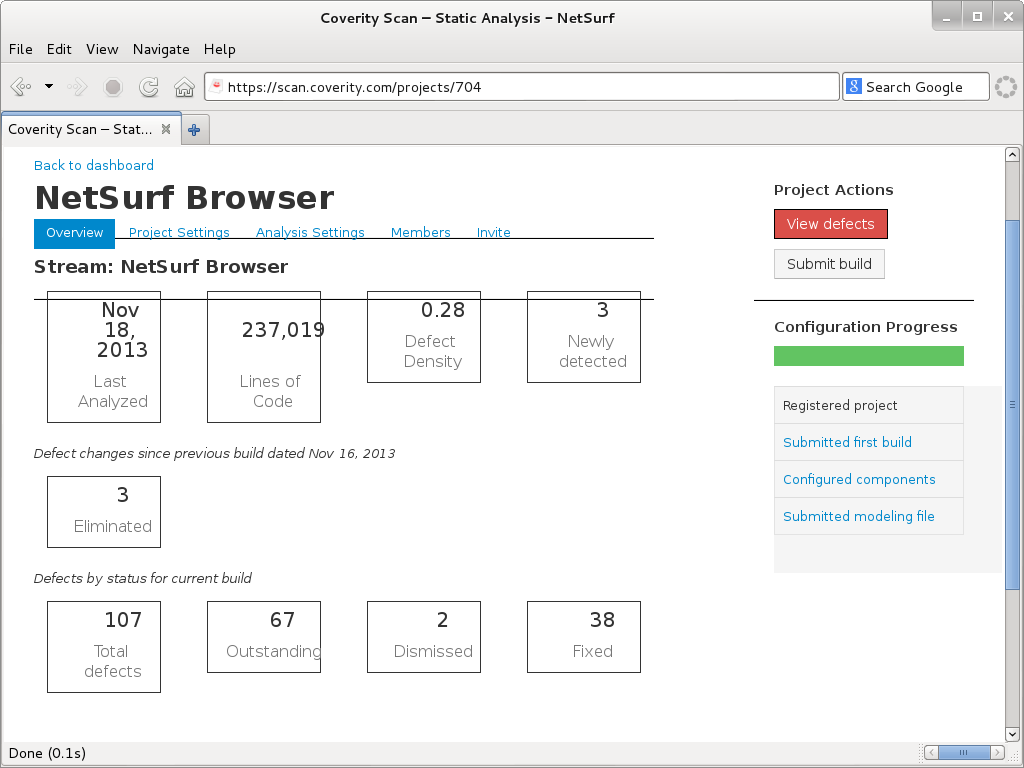
Coverity Interface showing summary of NetSurf analysis. Layout issues are a NetSurf bug
The company hosts a gratis service for open source projects, they even provide scans for the Linux kernel so project size does not appear to be an issue.

The challenges faced integrating the coverity tool into the build process differed from clang however the issue of execution time remained and the CI service was used.

The coverity scanning tool is a binary executable which collects data on the build which is then submitted to the coverity service to be analysed. This tool obviously relies upon the developer running the executable to trust coverity to some degree.

A basic examination of the binary was performed and determined the executable was not establishing network connections or performing and observably undesirable behaviour. From this investigation the decision was made that running the tool inside a sandbox environment on a CI build slave was safe. The CI system also submits the collected results in a compressed form directly to the coverity scan service.

Care must be taken to only submit builds according to the services Acceptable Use Policy which limits the submission frequency of NetSurf scans to every other day. To ensure the project stays within the rules the build performed by the CI system is manually controlled and confined to a subset of NetSurf developers.
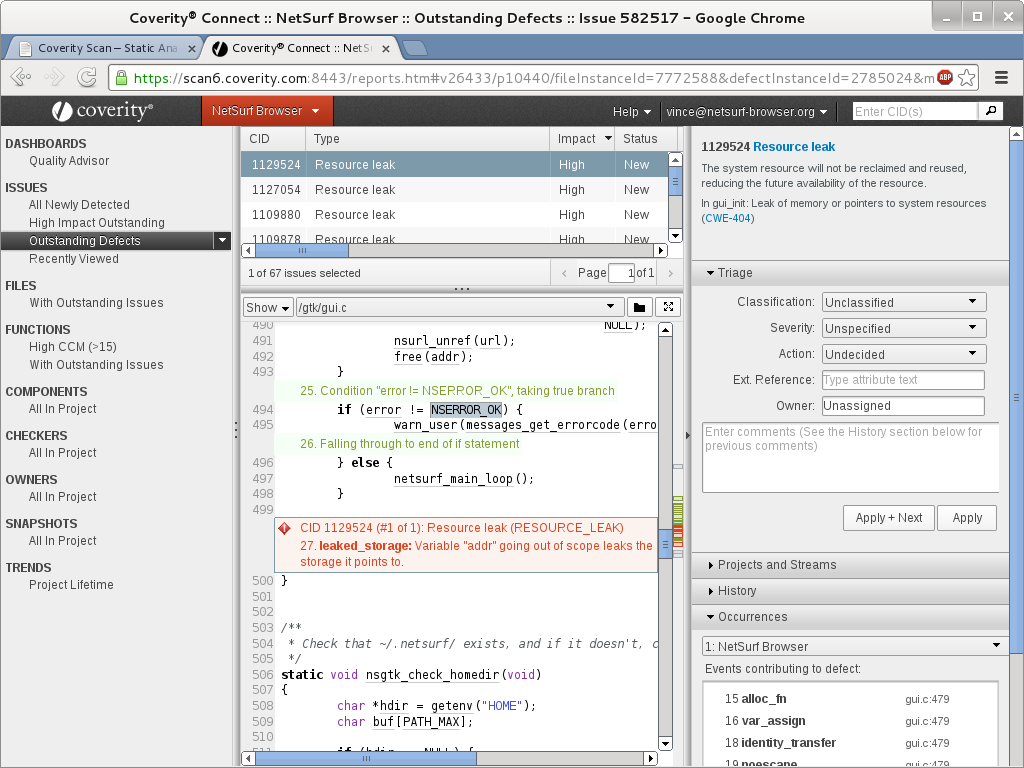
Coverity connect defect management console for NetSurfThe results are presented using the coverity connect web technology based defect management tool. Access to the coverity connect interface is controlled by a user management system which precludes publicly publishing the results within the CI system.

Unfortunately NetSurf itself does not currently have good enough JavaScript DOM bindings to support this interface so another browser must be used to view it.

Despite the drawbacks the quality of the analysis results is greatly superior to the clang solution. The false positive rate is very low while finding many real issues which had not been previously detected.

The analysis can be enhanced by use of collection configuration and modelling files which remove intended constructions from consideration reducing the false positive rate to very low levels. The ability to easily and persistently suppress false positives through the web interface is also available.

The false positive management capabilities coupled with a user interface that makes understanding the defect path simple make this solution very practical and indeed the NetSurf developers have removed over 50 actual issues within a relatively short period since the introduction of the tool.

Not all of those defects could be considered serious but they had the effect of encouraging deeper inspection of some very dubious smelling source.
ConclusionsThe principle conclusions of implementing and using static analysis have been:

When I started looking at this technology I was somewhat dubious about its usefulness but I have definitely changed my mind. It is a useful addition to any non-trivial project and the return on time and effort should be repaid handsomely in all but already perfect code (if you believe you have such code I have a bridge to sell you).

Russ Allbery: Review: The Pathway to Awesomeness

Review: The Pathway to Awesomeness, by Mark Forster
Publisher: Hyperink
Copyright: October 2013
ASIN: B00FXGXMPQ
Format: Kindle
Pages: 97
Mark Forster is probably my favorite time management (or, if you prefer, attention management) writer. The place to start with Forster if you're not familiar with him is Do It Tomorrow, not here. Unlike the other books by him I've reviewed, this is just an edited collection of blog posts presented in a convenient ebook form, without even an ISBN number. But if you've read his books (at least the ones that aren't out of print and cost a fortune), this is a convenient way to not have to trawl back through his blog and read the articles in a more convenient fashion. For me, it was also an easy way to give him a bit of money for his blog. Unless you have a similar motive, I don't think the content to price ratio is worth it. But I think everything is still up at Get Everything Done in case anything here strikes your fancy. As with most blog compilations, The Pathway to Awesomeness (I really hate that title) is composed of a whole bunch of fairly short articles, rarely more than three pages each, vaguely collected by topic. The first few are rather general and focused on the normal self-help platitudes that try to build up your sense that you're in control of your own life. But Forster doesn't take too long to get to what he's best at: short ideas, mental tools, interesting tricks, and simple techniques. Even more so than his books, due to the nature of this collection, there's a huge variety here, which means you can probably find something that strikes a chord no matter what attention management problem you've been running into. That's one of the main reasons why I prefer his writing: he tries to provide a giant toolbox instead of a single, streamlined System For Everyone. The other thing I like about Forster is that he is much more blunt than many authors about the biggest problem I have with attention management: trying to do more than anyone could possibly do given the available time. There are some more essays here about that, and several of them are quite good. I think my favorite is the short essay in which he points out how often people decide to do some task for a particular reason, and then get so engrossed in the performance of that task that they forget the original reason, risking sinking far more energy into that task than is actually warranted. Like a lot of Forster's observations, it's obvious in retrospect, but he has a way of phrasing those observation so that they shake the right thing loose in my head and let me re-evaluate something I was doing. Regular readers of Forster's blog know that he loves playing around with different simple to-do list management systems. Unfortunately, none of those are here, so don't pick this up expecting a collection of articles about Superfocus, Autofocus, etc. It makes sense given the topic of this collection, which is more general advice rather than systems, but this collection is so short that I wish he'd added a section on system development. I would have enjoyed reading a collection of all of his miniature systems together in one place and showing how he tweaked and changed them over time, particularly if he'd added some discussion of why he made each change and what goals he was trying to meet with each system. Ah well. If you aren't already familiar with Forster, there's no point in this, but if you are, I got a few new tidbits out of it and will probably skim through it a few more times. Buying it is mostly an exercise in putting money in the tip jar, and his writing is much less polished here (and more prone to cliches), but I still enjoyed reading through it. Rating: 7 out of 10

21 November 2013

Russ Allbery: Small but lovely haul

A few things for which I'd been waiting for quite some time were released, so there was another book order. Allie Brosh Hyperbole and a Half (graphic novel)
Jacqueline Carey Dark Currents (sff)
Debra Dunbar A Demon Bound (sff)
Nicola Griffith Hild (historical)
Ursula K. Le Guin The Unreal and the Real, Volume 1 (sff)
Ursula K. Le Guin The Unreal and the Real, Volume 2 (sff)
Ken Stern With Charity for All (non-fiction) I'm trying to buy fewer books given how many I have and haven't read, and also because I've been on a gaming tear recently and there are only so many hours in the day. Unfortunately, playing a lot of video games means reading fewer books. So I'm trying for quality rather than quantity, and this particular order has one of the best densities of hopefully good books as anything I've ordered in a while. For those who aren't familiar with Allie Brosh, Hyperbole and a Half is one of the most brilliant blogs that I've ever read, and this is a collection plus new stories and new illustrations. I specifically got the hardcover, which is beautiful and very high-quality. I've been waiting for Hild for years since Griffith started talking about writing it on her blog, and now I have the lovely hardcover in my hands. That's probably going to be Christmas reading. The Le Guin is a two-volume hardcover collection of Le Guin's personal favorites from her large lifetime oeuvre of short fiction.

Petter Reinholdtsen: All drones should be radio marked with what they do and who they belong to

Drones, flying robots, are getting more and more popular. The most know ones are the killer drones used by some government to murder people they do not like without giving them the chance of a fair trial, but the technology have many good uses too, from mapping and forest maintenance to photography and search and rescue. I am sure it is just a question of time before "bad drones" are in the hands of private enterprises and not only state criminals but petty criminals too. The drone technology is very useful and very dangerous. To have some control over the use of drones, I agree with Daniel Suarez in his TED talk "The kill decision shouldn't belong to a robot", where he suggested this little gem to keep the good while limiting the bad use of drones:
Each robot and drone should have a cryptographically signed I.D. burned in at the factory that can be used to track its movement through public spaces. We have license plates on cars, tail numbers on aircraft. This is no different. And every citizen should be able to download an app that shows the population of drones and autonomous vehicles moving through public spaces around them, both right now and historically. And civic leaders should deploy sensors and civic drones to detect rogue drones, and instead of sending killer drones of their own up to shoot them down, they should notify humans to their presence. And in certain very high-security areas, perhaps civic drones would snare them and drag them off to a bomb disposal facility. But notice, this is more an immune system than a weapons system. It would allow us to avail ourselves of the use of autonomous vehicles and drones while still preserving our open, civil society.
The key is that every citizen should be able to read the radio beacons sent from the drones in the area, to be able to check both the government and others use of drones. For such control to be effective, everyone must be able to do it. What should such beacon contain? At least formal owner, purpose, contact information and GPS location. Probably also the origin and target position of the current flight. And perhaps some registration number to be able to look up the drone in a central database tracking their movement. Robots should not have privacy. It is people who need privacy.

20 November 2013

Matt Zimmerman: Scaling Human Systems: Management

This is part 6 in a series on organizational design and growth.
The change from a business that the owner-entrepreneur can run with helpers to a business that requires management is a sweeping change. [...] One can compare the two kinds of business to two different kinds of organism: the insect, which is held together by a tough, hard skin, and the vertebrate animal, which has a skeleton. Land animals that are supported by a hard skin cannot grow beyond a few inches in size. To be larger, animals must have a skeleton. Yet the skeleton has not evolved out of the hard skin of the insect; for it is a different organ with different antecedents. Similarly, management becomes necessary when an organization reaches a certain size and complexity. But management, while it replaces the hard-skin structure of the owner-entrepreneur, is not its successor. It is, rather, its replacement. Peter Drucker
What it means Management is the art of enabling people to cooperate in achieving shared goals. I ve written elsewhere about what management is not. Management is a multifaceted discipline which is centered on people and the environment in which they work. Why it s important In very small organizations, management can be comparatively easy, and happen somewhat automatically, especially between people who have worked together before. But as organizations grow, management becomes a first-class concern, requiring dedicated practice and a higher degree of skill. Without due attention to management, coordination becomes excessively difficult, working systems are outgrown and become strained, and much of the important work described in this series just won t happen. Management is part of the infrastructure of the organization, and specifically the part which enables it to adapt and change as it grows. Old Status Quo People generally just do stuff , meaning there is little conscious understanding of the system in which people are working. If explicit managers exist, their jobs are poorly understood. Managers themselves may be confused or uncertain about what their purpose is, particularly if they are in such a role for the first time. The organization itself has probably developed more through accretion than deliberate design. New Status Quo People work within systems which help coordinate their work. These systems are consciously designed, explicitly communicated, and changed as often as necessary. Managers guide and coordinate the development and continuous improvement of these systems. The role of managers in the organization is broadly understood, and managers receive the training, support and coaching they need to be successful. Behaviors that help Obstacles that stand in our way

18 November 2013

Daniel Pocock: $75,000 to explore free software during maternity leave?

A number of countries offer women various social benefits during maternity leave. A new scheme in Australia promises to give virtually all women one hundred percent of their salary (capped at a whopping $12,500 per month) and extend maternity leave to 6 months. Some believe it has been funded by abolishing fibre-to-the-home, but that is another topic... This is a dramatic upgrade - in both cash and time - from the existing scheme where women have 18 weeks leave at the minimum wage. In Australia, the "minimum wage" figure is a fantasy, well below the real cost of living. In practice, the existing scheme and economic pressure force many women back into their job in less than 18 weeks. The new scheme with a one hundred percent salary replacement eliminates much of that pressure. Many European countries offer women some payment that pays the real cost of living, for example, EUR 2,400 per month in France. That is more than the minimum wage in Australia, enough to cover food, clothing and rent in most French cities. Australia's new system, in comparison, will give women on high salaries enough cash to immediately hire a nanny and other discretionary expenses that will maintain their lifestyle as much as they can within reason while dealing with a new baby. The cap is 300% higher than in France and it is 100% wage replacement, whereas many European schemes only give women a percentage of their salary. For this reason, many people have described it as the "Rolls Royce" of maternity pay. Just who are the women in these higher salary brackets? It is hardly any surprise that many of them are in IT and engineering professions. The upper salary range of the new maternity leave scheme appears to squarely match with the cashflows of female software developers, web designers, project managers and potentially many other professionals with a background in science or engineering. Many women worry about being out of the workforce for too long and the potential impact on their skills and professional networks. In computing jobs, technology can change a lot in 6 months. There are many men and women who enjoy computing in their free time as much as in their job. For female developers with this time out of the office, the world's most comfortable maternity leave scheme could be an opportunity to spend a little time exploring the free software world. Just to be clear, I'm not suggesting that women should be reaching for the laptop when they first go into labor and getting plugged in to the web before the umbilical cord has been severed. Some people find technology to be a rewarding pursuit throughout their whole life, while others simply see it as a job. For those who find free software interesting, some may simply pursue something creative that has no relation to the IT projects in their job, some may bring some new experiences back to their job. Others may choose to reconsider their career, performing free software development work on a freelance basis rather than going back to an office environment. The "Rolls Royce" maternity pay scheme could provide a comfortable buffer for them as they evaluate their next steps and make such decisions.

Russ Allbery: Review: Anathem

Review: Anathem, by Neal Stephenson
Publisher: William Morrow
Copyright: 2008
ISBN: 0-06-147409-6
Format: Hardcover
Pages: 935
Fraa Erasmas is a little less than twenty years old and is an avout of the decade math of the Concent of Saunt Edhar. As Anathem opens, he's approaching his first apert. All of those words are left for the reader to puzzle out for themselves, unless you cheat and read the glossary (which I would recommend doing only with caution, but more on that in a moment), since Erasmas, the first-person narrator of this story, writes (mostly) as if the reader is familiar with the mathic world and its concepts. Translated into English, it means that Erasmas was brought into something akin to a scientific monastery (the "math") at around the age of nine and has been there for ten years, since his math is a decade math and therefore remains closed to all outside (s cular) ideas and contact for periods of ten years at a time. He is still a student there, not yet declaring allegiance to one of the chapters. That's something that he will be expected to do after the first apert. Every ten years, the decade math opens its doors to the outside world for a period of ten days (apert), and the fraas and suurs can leave the math and travel through the outside world as they wish. The start of Anathem is an exercise in alienation and reorientation. Stephenson has constructed a complex society with a long history and its own specific technical jargon and throws the reader into it with a minimum of orientation. Despite being familiar with SF novels that use this technique, I did read the preface and recommend that other readers do as well unless they particularly love piecing together a world from hints and clues. The timeline, in particular, was invaluable and something I referred to throughout the story. But even with the preface, you should expect to read the first part of Anathem interpolating meanings from context or just letting things slip past until you later come to understand them. A lot of people bounce off of Anathem here, and it's one of the reasons why I'd been postponing reading it (the other being that it's a substantial doorstop and I wanted to give it my undivided attention). But it's really not as bad as I feared. One gets a feel for the terms fairly quickly, and the more difficult ones Stephenson defines as he goes with excerpts from a dictionary of the mathic world. I found it slightly disorienting for a chapter or two, and then it started growing on me. The terminology is sometimes different just for the sake of being different (jeejahs are indistinguishable from smartphones for all practical purposes), but usually the invented words provide either important links to the past of the constructed world of Arbre or are technical terms that add precision and clarity once you know their meanings. It can be a little bit frustrating to remember the mapping of famous theories and theorems to the Orth names, but only mildly. (And Diax's Rake is so useful of a name for something that English doesn't name that I may start using it myself.) This is also why I recommend against reading the glossary. The definitions of terms are linked to important parts of history, which are, in turn, linked to important parts of the plot, and the glossary therefore risks spoilers. I liked having the term introduced by the frequent dictionary excerpts scattered through the chapters, and enjoyed the feeling of the terminology unfolding with the plot. The glossary is there if you really get lost, but I think the experienced SF reader (particularly if you have enough history background to pick up on the obvious parallels and start mapping bits to Greece, Rome, the Catholic Church, etc.) will be able to navigate the language without that much difficulty. I also stopped caring about the terminology because the story is so engrossing that it pulled me right into the book, closed over me, and made Erasmas's world feel real, precious, and fascinating. Whether that's going to be true of other people is a surprisingly difficult question, and one that I'll try to tackle as part of this review. But I will say up-front that I think this is the best book that Stephenson has ever written, even better than Snow Crash, despite some undeniable flab and one extremely irritating choice. Anathem is, at its heart, a novel about the scientific method. I think it's the first book by Stephenson that elegantly mingles his tendencies (and obsessions) as a writer with the interests (and obsessions) of the characters and makes the whole novel feel coherent. All of Stephenson's books are prone to discursive infodumps, but they've usually had to be shoehorned in around the characters. Even with the Baroque Cycle, a series full of natural philosophers, the digressions are jammed in around the plot like the filling of an over-packed box and frequently stick out at odd angles or dribble out on the floor. With Anathem, Stephenson has populated a book full of characters who have completely believable and engrossing reasons to digress into scientific debate and analysis, can put them into dialogue and thereby avoid some of the strain of the infodump, and (most importantly) largely restrains himself from narrative digressions via first-person narration and careful attention to when the characters themselves would follow the same digression. In short, this is a book full of very smart and very well-educated people who figure things out from first principles using agreed-upon theory, thrown into an unknown and dangerous situation that requires a great deal of deep thinking, science, engineering, and philosophy. All of Stephenson's quirks are still here, on prominent display, but rarely have I ever seen a better match of writer, characters, plot, and world background than this book. I would go so far as to say that, if you don't like this book, you're unlikely to like any long Stephenson. I haven't said a lot about the plot. Erasmas's apert is only the first part, and barely touches on any significant plot elements. It's mostly there to set some groundwork, introduce characters, and get the reader oriented. I'm not going to say much more, since the way the novel transitions from routine to unusual to emergency, and the resulting scramble to understand the emergency, is the heart and soul of this book and should not be spoiled. (I spoiled myself slightly by reading some analysis that I shouldn't have and regretted it, although it wasn't too much of a problem.) This is one of Stephenson's best-plotted novels. It develops slowly enough for the reader (and the characters) to think hard about it and make some good and bad guesses, but fast enough to stay engrossing. Most of it is very well-paced provided that you find the background of science and philosophy of science interesting. (If you don't, this is probably not a book you're going to enjoy.) I say "most of it" because, as mentioned earlier, this book is a bit flabby. There are a couple of sections where the theory and analysis are pushed aside by exigent circumstances and more action-oriented plot elements, both of which reminded me that Stephenson is very bad at writing action sequences and both of which I wished were shorter. And there are a couple of sections where Erasmas is getting oriented to a new situation or working up the courage to do something where I wished he'd get on with it already. But for a novel of nearly 1,000 pages, the amount of tension and reader interest Stephenson maintained for me was quite impressive. But as good as the plot is, the best part of this book is its full-bore, no-apologies embrace of understanding things. This is a book about making sense of the world, and about what it means to make sense of the world, and how you go about it, and what preconditions are required to do so. It is not, contrary to so much science fiction, a book about knowing things. The people who are already experts appear in this book, but generally only in the context of figuring out new things they've not previously been exposed to. Rather, it's a book about learning things, the thrill that comes from applying theory to understand something new, and the satisfaction of working through something from first principles or previously-established theory, arriving at testable predictions, and then testing them. It's the first novel I've read that captures some of the joy and delight that I got from reading George Gamow's One Two Three... Infinity as a child. Stephenson novels have always been about showing the reader neat things he learned, but I think previous books relied on the reader to bring their own enthusiasm. Anathem, at least for me, goes a step farther and uses the passion and approach of its characters to create that enthusiasm. It's one of those books that I not only enjoyed but went away from feeling like it made me a better person in some subtle but detectable way. Sadly, this is also where the irritating part comes in. I'm going to be very careful and indirect here, since the details are all extremely significant spoilers. You may want to skip to the last paragraph of this review if you want to avoid any knowledge about the end of Anathem. Stephenson pulls several rabbits out of the hat in this book, but most of them are well-defended and nicely handled bits of misdirection. There are a few where I thought the science or engineering was dubious, but even those are usually backed with enough hand-waving about Arbre technology that I could swallow it enough for the purposes of this book. (The timeline here is very helpful in allowing one to write off a few things as unknown technology.) But he puts, at the core of the plot, one of the most scientifically dubious bits of the whole book, and there's simply no avoiding that by the end of the story. Now, this doesn't mean that he just expects the reader to swallow it. Much of Anathem is a carefully-constructed defense of the bits he uses for the plot, and the defense is not half-bad within his fictional world. There are substantial in-book justifications for believing these techniques will work on Arbre even if they wouldn't in our scientific domain. So it's not so much the plausibility that bothered me; the idea is at least as plausible as some of the FTL drive concepts that I've swallowed without complaint. I do hold Anathem to a higher standard because the book is about science in a way that most science fiction isn't, but even with that, I think Stephenson mostly managed to dance across the thin ice he built. The problem is more subtle but more serious: if taken seriously on its own terms, the approach Stephenson takes to the plot destroys science in his universe. I can't really say more than that, since all of the details are huge spoilers, but the more I thought about it, the more irritated and annoyed I got. Anathem is otherwise a brilliant defense of the scientific method, and it felt like Stephenson injected a poison pill in the center of it, leading necessarily to a world where the scientific method no longer works. This does not happen on camera, or even between the pages of the book; you have to think about the implications for a while before you realize that's what happened. But once you do, it's a bitter pill to swallow, and it's hard to escape the feeling that it fundamentally undermines Stephenson's whole project here. And, to make it worse (although also oddly better in a way), I think it was unnecessary. He would have had to reconstruct the ending, but I can't shake the feeling that there were ways to write the ending, even maintaining the same character strengths, without having to pull that particular rabbit out of the hat. Because I think it's, in the end, unnecessary, I was still able to enjoy the whole book, including the ending, despite this, but while the rest of Anathem is a wholehearted 10, that choice knocked a full point off my impression of the book. It's profoundly irritating precisely because Stephenson did such an excellent job with the rest of it. But, that said, this book is still exceptional. I think it's the book that Stephenson was meant to write. Not only did he get the overall construction nearly perfect, he gets so many of the details right, from the history (which for a while I thought was merely clever, once I started seeing the correspondences that moved it out of the realm of pure invention, but which transitioned back to profound with later revelations in the book) to the language to the way that he excerpted some theoretic digressions into very well-done appendices. If you've ever thought of a theory as beautiful, or like reading about smart people debating the nature of understanding and knowledge, I cannot recommend this book too highly. Despite the highly irritating flaw at its center, and despite a few sections that show Stephenson is not a well-rounded writer, I think it's brilliant. Rating: 9 out of 10

16 November 2013

Russ Allbery: Review: Blue Remembered Earth

Review: Blue Remembered Earth, by Alastair Reynolds
Series: Poseidon's Children #1
Publisher: Ace
Copyright: January 2012
Printing: June 2012
ISBN: 0-441-02071-2
Format: Hardcover
Pages: 505
Geoffrey Akinya is one heir to the vast Akinya business empire, which straddles the solar system and has created vast riches from exploration and mining. He wants nothing to do with it. His passion is elephants: long and methodical study of wild herds in Africa, including a slow and careful investigation into their thought processes. His obnoxious and superior cousins have a passion for business and finance and can have the running of the company for all he cares. But Geoffrey's grandmother Eunice, the family matriarch and driving force behind much of their business expansion, has died. Her ashes are brought back to Africa from the Winter Palace in orbit around the Moon where she lived out her final days and scattered in a family ceremony. And, shortly thereafter, Geoffrey's cousins convince him to investigate a safe-deposit box left on the Moon by Eunice to ensure that it doesn't contain anything damaging to the family. What it contains is the first step in a puzzle. Despite himself, Geoffrey and his sister Sunday an artist and family black sheep who lives in a region of the Moon that is one of the sole holdouts against the ubiquitous monitoring common in the rest of the inhabited solar system are slowly pulled into unraveling that puzzle. This leads them into an uneasy alliance with one of the major political forces in the solar system and some startling revelations about their grandmother's actual plans. Blue Remembered Earth is another entry in the currently-popular sub-genre of solar system SF. Interstellar travel is still a dream, but a combination of improved technology, suspended animation, and heavy use of robots and robotic factories has let humans slowly expand into more of the solar system. On Earth, powers have risen and fallen, and the leap into the solar system coincided with a surging and powerful Africa. Extensive undersea colonization has established a new international consortium of sea-floor countries, and Earth politics have realigned into a diplomatic and business struggle between surface and oceanic nations. Unusually for this sort of fiction, most characters of significance in this story are African. The United States and Europe have quietly disappeared in the way that all non-US countries tend to in most other SF. Reynolds doesn't do very much with this setup (and the characters don't seem distinctly African to me). It's just there as the unremarked normal. I liked that. I kind of wish more of African culture had come through in the story, but there are enough SF novels with an assumed and unremarked white (and usually US) future that an assumed and unremarked black African culture is a nice change of pace. I picked up this book in part because it was described as a better 2312. That's a fairly accurate summary (although only helpful to those who have read Kim Stanley Robinson's novel). The scope and setting are similar, although Reynolds's future cuts back on the scope of off-world human colonization, relies more heavily on robotics, and keeps the power base on Earth. Both books are structured as a mystery, although in Blue Remembered Earth that mystery is deliberately planted for the characters. Reynolds is nowhere near as good at set pieces as Robinson, sadly. There's nothing here at the level of some of the scenes on Mercury in 2312. But he is much better at plotting and characterization, and Blue Remembered Earth tells a coherent story with increasing tension and a satisfying ending. Reynolds here uses an interesting strategy for spinning a mystery out of pieces of knowledge and discovery: set the discovery process prior to the novel, use protagonists who were unaware of it, and turn the details into a mystery that they have to investigate. This is an interesting way to address the problem that most discovery processes are slow and not particularly dramatic. It is artificial Eunice creates the plot for the novel but that worked for me. By the end of the book, I think I understand her reasons for doing so, and both Geoffrey and Sunday have good reasons to not be aware of any of the details before they start following the clues that Eunice leaves behind. The mystery of course sends Geoffrey and Sunday on a bit of a tour of the solar system as well as a tour of the past of their family business and the politics of the present. Here, Reynolds draws on an old SF idea: a conflict between groups that want to mechanize space exploration and groups that want to adapt humans for space. Long-time SF readers will be familiar with this approach, and I don't think Reynolds does anything startlingly new with it, but I thought it was a well-executed side plot. And, for once, an SF author realizes that Earth's oceans are as compelling of a place for that conflict to play out as outer space. There are, of course, significant mysteries to be uncovered, but it takes much of the book before those revelations start (even if one of them is almost spoiled in the dust jacket summary). The story up until that point is driven by character, particularly Geoffrey's stubborn annoyance at the rest of his family and his complete lack of interest in being the protagonist of a novel. I should probably warn here that many of the Amazon reviews disliked this book because of the characters, particularly Geoffrey. Apparently he comes across to some as whiny, resentful, and annoying. I, however, didn't have this reaction at all, possibly in part because I wholeheartedly share his opinion of both big business and his cousins. I thoroughly enjoyed reading an SF novel whose main characters are not driven either typical capitalist motives or a desire for personal exploration, but instead are pulled into the plot through a sense of loyalty and an inability to get out of the way of the problem. I also liked the way Reynolds manages to broaden and deepen the reader's appreciation for the characters as the story unfolds, and even salvages some characters I thought were unsalvageable. The last third of the book features some excellent plot twists and some very nicely-handled revelations. This is apparently the first book of a trilogy, and I had a suspicion at the end of the book that sequels were coming, but I think it stands on its own quite well. Most of the questions raised by the plot are resolved by the end of the book, and those that remain are of a size that other books have left unanswered intentionally. Despite not reaching the same moments of awe-inspiring beauty, and despite more workman-like descriptions, the stronger plot and more interesting characters do make Blue Remembered Earth a better 2312 for me. Given that 2312 won a Nebula, that's saying something (although I don't agree with that award). It's a bit deliberate in its pacing, and the plot built around a constructed puzzle can feel a bit artificial, but I think it's a solid and satisfying near-space SF novel. Followed by On the Steel Breeze. Rating: 7 out of 10

14 November 2013

Russ Allbery: rra-c-util 4.11

This is my collection of helper libraries and utilities that I use for most of my C-based software (and some Perl bits as well). Most of the changes in this release are improvements to the Autoconf macros, primarily based on feedback from Julien LIE and reconciliation with the macros used in INN. The major backward-incompatible change is that RRA_LIB_KRB5 and friends now define HAVE_KRB5 (to match the name) and set rra_use_KRB5, and similarly RRA_LIB_OPENSSL and friends define HAVE_OPENSSL and set rra_use_OPENSSL. Any packages that use these macros will probably need some updates. There are also a couple other fixes for RRA_LIB_KRB5 and RRA_LIB_KRB5_OPTIONAL: both now work for packages that do not use Automake, and the optional version does not fail if com_err couldn't be found. Similarly, RRA_LIB_OPENSSL_OPTIONAL no longer aborts if libcrypto couldn't be found and both OpenSSL macros probe for libdl first unless --enable-reduced-depends is used. Finally, RRA_LIB_OPENSSL properly restores the default CPPFLAGS, LDFLAGS, and LIBS after the library probes. Also in this release, all uses of asprintf, snprintf, and related functions check the return status, since POSIX allows these functions to fail for reasons other than memory allocation failure. xasprintf and xvasprintf distinguish between memory allocation failure and other failures and report better error messages, and the vasprintf replacement properly preserves errno if snprintf fails. portable/socket.h also defines EAI_ADDRFAMILY, which is obsolete but which some software needs to check, to EAI_FAMILY if it's not defined so that the check can be done unconditionally. You can get the latest version from the rra-c-util distribution page.

Tanguy Ortolo: Using Wine with sound under Debian testing (Jessie)

If you are using Wine under Debian testing with PulseAudio, you probably noticed that you cannot get sound playback any more. This is because: Loudspeaker icon
  1. Wine uses ALSA, which uses a plugin to play through PulseAudio;
  2. Wine being in 32 bits, all that has to be installed in i386 versions;
  3. recent versions of libasound2-plugins depend on libavcodec54 which depends on libopus0 which is not multiarch-capable and thus cannot be installed in both i386 and amd64 versions;
  4. libopus0:amd64 cannot be reasonably removed to install only libopus0:i386 because many multimedia software depend on it (in other words: try that and you will end removing VLC and everything similar too).
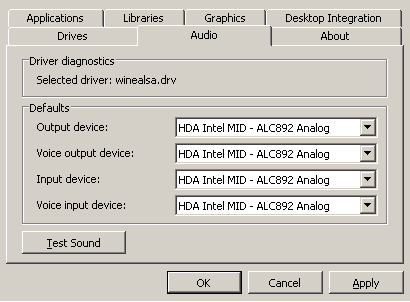
No need to despair though, as there are several ways to work around that problem until the maintainer of libasound2-plugins has converted it to multiarch.Use ALSA directly Since the problem is that Wine tries to use the ALSA PulseAudio plugin which is not available in 32 bits, the most direct solution is to configure it not to use it. Run winecfg, go to the audio tab and manually select your audio devices, which will then be used directly with ALSA without trying to use the PulseAudio plugin.
Screenshot of winecfg

Wine configuration

Downgrade ALSA plugins Since the problem is caused by a dependency chain that only exists with the testing (Jessie) version of the libasound2-plugins package, another solution is to downgrade it to a previous version. To do that, make sure you have enabled the Debian repositories for both the stable (Wheezy) and testing (Jessie) in /etc/apt/sources.list: deb http://ftp.fr.debian.org/debian/ jessie main deb http://security.debian.org/ jessie/updates main contrib non-free deb http://ftp.fr.debian.org/debian/ wheezy main deb http://security.debian.org/ wheezy/updates main contrib non-free Then, forcefully install the stable version of libasound2-plugins for both i386 and amd64: # apt-get install libasound2-plugins:i386/stable \ libasound2-plugins:amd64/stable

Russ Allbery: Review: Water Logic

Review: Water Logic, by Laurie J. Marks
Series: Elemental Logic #3
Publisher: Small Beer Press
Copyright: 2007
ISBN: 1-931520-23-2
Format: Trade paperback
Pages: 332
Water Logic is the third book in the Elemental Logic series, starting with Fire Logic. As with Earth Logic, it's best to read all three books in close temporal proximity, since Water Logic offers little recap of what happened in the previous books and relies on a large cast of characters who are not reintroduced. It's also hard to review without spoilers for the previous books. Earth Logic ended with a monumental shift in Shaftal politics, and half of Water Logic is deeply concerned with the implications of that shift and where Shaftal should go from here. Karis and Zanja are, of course, deeply involved, but much of the political story is told from the perspective of the character introduced in Earth Logic, and from the perspective of another earth blood, Meriseth. Water bloods haven't been seen much so far in the series. Water magic is about repeated patterns and the malleability of time, and the plot of Water Logic eventually entangles Zanja in events far in the past of Shaftal. This proceeds in parallel with more of Marks's excellent analysis of the meaning of war and peace, diplomacy, cooperation, multiculturalism, adaptation, and empathy. The two sides of the book do to some extent reinforce each other, but the connections are tricky and less obvious. Parts of this book are excellent. Wars are complicated and powerful, and don't end easily. The mutual incomprehension and mutual (if intermittant) struggle for understanding between the natives of Shaftal and the Sainnites is beautifully presented. I particularly loved Mariseth's approach throughout the book. Earth bloods are perhaps Marks's best invention, and seeing another (besides Karis) at work, with the same stubborn patience but with different tactics and different levels of power, was a delight. I feel like reading, and thinking about, Seth's decisions makes me a better person. As with the previous books, though, parts of Water Logic are a bit boring, or at least don't seem to coherently move in a conclusive direction. Zanja has long journeys across the landscape as well as several adventures after she's grabbed by water logic that seem only distantly connected to the rest of the story. Marks does pull this mostly together in the end, and I could detect other thematic linkages while mulling the book over after finishing it, but the book feels a bit disjointed while reading it. And there are some elements, such as the cowdogs, that are neat bits of world-building but that seem tossed in just because they're neat and don't feel strongly connected to the plot. The other complaint I have, which would probably have been lessened by reading the books closer together, is that the cast is a bit too large. All of Karis's extended family are, of course, still around, which I found more confusing than helpful. Named and important characters keep popping in and then disappearing, with no introduction and no help for the reader who doesn't remember the exact details of their roles from previous books. It's a bit frustrating, and it makes the book feel a bit cluttered, although it does a great job of showing the dynamics of a large and comfortable family. (Marks shows the dynamics of family webs with multiple adults better than any other fantasy author I know.) Karis is a bit more sidelined in this book, casting her in the role of force of nature, and I think that works well. It took me a bit to warm to Zanja again, but by the end of the book I was greatly enjoying her sections. But the star, for me, is Seth. Even though some of her segments should have been the boring parts of the book, since they were mostly concerned with quitodian issues, they were the parts I wanted to read about. I was very touched by the ending, even if I think a bit too much authorial hand-waving was required. There is material left for a sequel at the end of Water Logic, including a villain who has yet to fully appear, but it's currently not clear whether Air Logic will ever materialize. But, as with Earth Logic, Water Logic provides a satisfying ending and leaves the world in a stable enough place that I didn't feel cheated out of the end of the story. I think Fire Logic remains the strongest book of this series, but Water Logic is very much worth reading if you've read the previous books. Unfortunately, the books apparently didn't sell well, so this book is from a small press instead of Tor. You may have to order it on-line instead of finding it a local bookstore. But the whole series is very much worth reading. It's a refreshingly original take on fantasy and is much more thoughtful about human relationships and politics than most fantasy works. Rating: 7 out of 10

Next.

Previous.