Search Results: "ana"

19 March 2017

Dirk Eddelbuettel: Rcpp 0.12.10: Some small fixes

The tenth update in the 0.12.* series of Rcpp just made it to the main CRAN repository providing GNU R with by now over 10,000 packages. Windows binaries for Rcpp, as well as updated Debian packages will follow in due course. This 0.12.10 release follows the 0.12.0 release from late July, the 0.12.1 release in September, the 0.12.2 release in November, the 0.12.3 release in January, the 0.12.4 release in March, the 0.12.5 release in May, the 0.12.6 release in July, the 0.12.7 release in September, the 0.12.8 release in November, and the 0.12.9 release in January --- making it the fourteenth release at the steady and predictable bi-montly release frequency. Rcpp has become the most popular way of enhancing GNU R with C or C++ code. As of today, 975 packages on CRAN depend on Rcpp for making analytical code go faster and further. That is up by sixtynine packages over the two months since the last release -- or just over a package a day! The changes in this release are almost exclusively minor bugfixes and enhancements to documentation and features: James "coatless" Balamuta rounded out the API, I aki Ucar fixed a bug concerning one-character output, Jeroen Ooms allowed for finalizers on XPtr objects, Nathan Russell corrected handling of lower (upper) triangular matrices, Dan Dillon and I dealt with Intel compiler quirks for his algorithm.h header, and I added a C++17 plugin along with some (overdue!) documentation regarding the various C++ standards that are supported by Rcpp (which is in essence whatever your compiler supports, i.e., C++98, C++11, C++14 all the way to C++17 but always keep in mind what CRAN and different users may deploy).

Changes in Rcpp version 0.12.10 (2017-03-17)
  • Changes in Rcpp API:
    • Added new size attribute aliases for number of rows and columns in DataFrame (James Balamuta in #638 addressing #630).
    • Fixed single-character handling in Rstreambuf (I aki Ucar in #649 addressing #647).
    • XPtr gains a parameter finalizeOnExit to enable running the finalizer when R quits (Jeroen Ooms in #656 addressing #655).
  • Changes in Rcpp Sugar:
    • Fixed sugar functions upper_tri() and lower_tri() (Nathan Russell in #642 addressing #641).
    • The algorithm.h file now accomodates the Intel compiler (Dirk in #643 and Dan in #645 addressing issue #640).
  • Changes in Rcpp Attributes
    • The C++17 standard is supported with a new plugin (used eg for g++-6.2).
  • Changes in Rcpp Documentation:
    • An overdue explanation of how C++11, C++14, and C++17 can be used was added to the Rcpp FAQ.

Thanks to CRANberries, you can also look at a diff to the previous release. As always, even fuller details are on the Rcpp Changelog page and the Rcpp page which also leads to the downloads page, the browseable doxygen docs and zip files of doxygen output for the standard formats. A local directory has source and documentation too. Questions, comments etc should go to the rcpp-devel mailing list off the R-Forge page.

This post by Dirk Eddelbuettel originated on his Thinking inside the box blog. Please report excessive re-aggregation in third-party for-profit settings.

Petter Reinholdtsen: Free software archive system Nikita now able to store documents

The Nikita Noark 5 core project is implementing the Norwegian standard for keeping an electronic archive of government documents. The Noark 5 standard document the requirement for data systems used by the archives in the Norwegian government, and the Noark 5 web interface specification document a REST web service for storing, searching and retrieving documents and metadata in such archive. I've been involved in the project since a few weeks before Christmas, when the Norwegian Unix User Group announced it supported the project. I believe this is an important project, and hope it can make it possible for the government archives in the future to use free software to keep the archives we citizens depend on. But as I do not hold such archive myself, personally my first use case is to store and analyse public mail journal metadata published from the government. I find it useful to have a clear use case in mind when developing, to make sure the system scratches one of my itches. If you would like to help make sure there is a free software alternatives for the archives, please join our IRC channel (#nikita on irc.freenode.net) and the project mailing list. When I got involved, the web service could store metadata about documents. But a few weeks ago, a new milestone was reached when it became possible to store full text documents too. Yesterday, I completed an implementation of a command line tool archive-pdf to upload a PDF file to the archive using this API. The tool is very simple at the moment, and find existing fonds, series and files while asking the user to select which one to use if more than one exist. Once a file is identified, the PDF is associated with the file and uploaded, using the title extracted from the PDF itself. The process is fairly similar to visiting the archive, opening a cabinet, locating a file and storing a piece of paper in the archive. Here is a test run directly after populating the database with test data using our API tester:
~/src//noark5-tester$ ./archive-pdf mangelmelding/mangler.pdf
using arkiv: Title of the test fonds created 2017-03-18T23:49:32.103446
using arkivdel: Title of the test series created 2017-03-18T23:49:32.103446
 0 - Title of the test case file created 2017-03-18T23:49:32.103446
 1 - Title of the test file created 2017-03-18T23:49:32.103446
Select which mappe you want (or search term): 0
Uploading mangelmelding/mangler.pdf
  PDF title: Mangler i spesifikasjonsdokumentet for NOARK 5 Tjenestegrensesnitt
  File 2017/1: Title of the test case file created 2017-03-18T23:49:32.103446
~/src//noark5-tester$
You can see here how the fonds (arkiv) and serie (arkivdel) only had one option, while the user need to choose which file (mappe) to use among the two created by the API tester. The archive-pdf tool can be found in the git repository for the API tester. In the project, I have been mostly working on the API tester so far, while getting to know the code base. The API tester currently use the HATEOAS links to traverse the entire exposed service API and verify that the exposed operations and objects match the specification, as well as trying to create objects holding metadata and uploading a simple XML file to store. The tester has proved very useful for finding flaws in our implementation, as well as flaws in the reference site and the specification. The test document I uploaded is a summary of all the specification defects we have collected so far while implementing the web service. There are several unclear and conflicting parts of the specification, and we have started writing down the questions we get from implementing it. We use a format inspired by how The Austin Group collect defect reports for the POSIX standard with their instructions for the MANTIS defect tracker system, in lack of an official way to structure defect reports for Noark 5 (our first submitted defect report was a request for a procedure for submitting defect reports :). The Nikita project is implemented using Java and Spring, and is fairly easy to get up and running using Docker containers for those that want to test the current code base. The API tester is implemented in Python.

Clint Adams: Measure once, devein twice

Ophira lived in a wee house in University Square, Tampa. It had one floor, three bedrooms, two baths, a handful of family members, a couple pets, some plants, and an occasional staring contest. Mauricio lived in Lowry Park North, but Ophira wasn t allowed to go there because Mauricio was afraid that someone would tell his girlfriend. Ophira didn t like Mauricio s girlfriend and Mauricio s girlfriend did not like Ophira. Mauricio did not bring his girlfriend along when he and Ophira went to St. Pete Beach. They frolicked in the ocean water, and attempted to have sex. Mauricio and Ophira were big fans of science, so Somewhat quickly they concluded that it is impossible to have sex underwater, and absconded to Ophira s car to have sex therein. I hate Mauricio s girlfriend, Ophira told Amit on the telephone. She s not even pretty. Hey, listen, said Amit. I m going to a wedding on Captiva. Oh, my family used to go to Captiva every year. There s bioluminescent algae and little crabs and stuff. Yeah? Do you want to come along? You could pick me up at the airport. Why would I want to go to a wedding? Well, it s on the beach and they re going to have a bouncy castle. A bouncy castle Are you serious? Yes. Well, okay. Amit prepared to go to the wedding and Ophira became terse then unresponsive. After he landed at RSW, he called Ophira, but instead of answering the phone she startled and fell out of her chair. Amit arranged for other transportation toward the Sanibel Causeway. Ophira bit her nails for a few hours, then went to her car and drove to Cape Coral. Ophira cruised around Cape Coral for a while, until she spotted a teenager cleaning a minivan. She parked her car and approached him. Whatcha doing? asked Ophira, pretending to chew on imaginary gum. The youth slid the minivan door open. I m cleaning, he said hesitantly. Didn t your parents teach you not to talk to strangers? I could do all kinds of horrible things to you. They conversed for a bit. She recounted a story of her personal hero, a twelve-year-old girl who seduced and manipulated older men into ruin. She rehashed the mysteries of Mauricio s girlfriend. She waxed poetic on her love of bouncy castles. The youth listened, hypnotized. What s your name, kid? Ophira yawned. Arjun, he replied. How old are you? Arjun thought about it. 15, he said. Hmm, Ophira stroked her chin. Can you sneak me into your room so that your parents never find out about it? Arjun s eyes went wide. MEANWHILE, on Captiva Island, Amit had learned that even though the Tenderly had multiple indoor jacuzzis, General Fitzpatrick and Mrs. Fitzpatrick had decided it prudent to have sex in the hot tub on the deck; that the execution of this plan had somehow necessitated a lengthy cleaning process before the hot tub could be used again; that that s why workmen were cleaning the hot tub; and that the Fitzpatrick children had gotten General Fitzpatrick and Mrs. Fitzpatrick to agree to not do that again, with an added suggestion that they not be seen doing anything else naked in public. A girl walked up to Amit. Hey, I heard you lost your plus-one. Are you here alone? What a loser! she giggled nervously, then stared. Leave me alone, Darlene, sighed Amit. Darlene s face reddened as she spun on her heels and stormed over to Lisette. Oh my god, did you see that? I practically threw myself at him and he was abusive toward me. He probably has all the classic signs of being an abuser. Did you hear about that girl he dated in Ohio? I bet I know why that ended. Oh really? said Lisette distractedly, looking Amit up and down. So he s single now? Darlene glared at Lisette as Amit wandered back outside to stare at the hot tub. Hey kid, said Ophira, bring me some snacks. I don t bring food into my room, said Arjun. It attracts pests. Is that what your parents told you? scoffed Ophira. Don t be such a wuss. Three minutes later, Ophira was finishing a bag of paprika puffs. These are great, Arjun! Where do you get these? My cousin sends them from Europe, he explained. Now get me a diet soda. Amit strolled along the beach, then yelped. What s biting my legs? he cried out. Those are sand fleas, said Nessarose. What are sand fleas? asked Amit incredulously. Nessarose rolled her eyes. Stop being a baby and have a drink. After the sun went down, Amit began to notice the crabs, and this made him drink more. When everyone was soused, General Fitzpatrick announced that they were going for a swim in the Gulf, in direct contravention of safety guidelines. Most of the guests were wise enough to refuse, but an eightsome swam out, occasionally stopping to slap the algae, but continuing until they reached the sandbar that General Fitzpatrick correctly claimed was there. Then screams echoed through the night as all the jellyfish attacked everyone invading their sandbar. The crestfallen swimming party eventually made it back to shore. Pee on the jellyfish sting, commanded Nessarose. It s the best cure. No! shouted General Fitzpatrick s daughter. Urine makes it worse. Things quickly escalated from Nessarose and General Fitzpatrick s daughter screaming at each other to the beach dividing into three factions: those siding with Nessarose, those siding with General Fitzpatrick s daughter, and those who had no idea what was going on. General Fitzpatrick had no interest in any of this, and went straight to bed. It s getting late, kid, said Ophira. I m taking your bed. What? squeaked Arjun. Look, said Ophira, your bed is small and there isn t room for both of us. You may sleep on the floor if you re quiet and don t bother me. What? squeaked Arjun. Are you deaf, kid? Ophira grunted and then went to bed. Arjun blinked in confusion, then tried to fall asleep on the floor, without much success. Ophira got up in the morning and said, Before I go, I want to teach you a valuable lesson. What? groaned Arjun, getting to his feet. You should be careful talking to strangers. Now, I told you that I could do horrible things to you, so this is not my fault; it s yours, she announced, then sucker-punched him in the gut. Ophira climbed out the window as Arjun doubled over. As the ceremony began, only a small minority of the wedding party was visibly suffering from jellyfish stings, which may or may not have helped with ignoring the sand fleas. The ceremony ended shortly thereafter, and now that marriage had been accomplished, everyone turned their attention to food and drink and swimming less irresponsibly than the night before. Guests that needed to return home sooner departed in waves and Amit started to appreciate the more peaceful environment. He heard the deck door slide open behind him and turned his attention away from the hot tub. Hey, mofo, Ophira shouted as strode stylishly out onto the deck. Where s this bouncy castle? Amit blinked in surprise. That was yesterday. You missed it. Oh, she frowned. So I met this South Slav guy with a really sexy forehead, and I need some advice. I don t know if I should call him or wait. Amit pointed to the hot tub and told her the story of General Fitzpatrick and Mrs. Fitzpatrick and the hot tub. What? said Ophira. How could they have sex underwater? What do you mean? asked Amit. Well, it s impossible, she replied.
Posted on 2017-03-19
Tags: mintings

18 March 2017

Vincent Sanders: A rose by any other name would smell as sweet

Often I end up dealing with code that works but might not be of the highest quality. While quality is subjective I like to use the idea of "code smell" to convey what I mean, these are a list of indicators that, in total, help to identify code that might benefit from some improvement.

Such smells may include:
I am most certainly not alone in using this approach and Fowler et al have covered this subject in the literature much better than I can here. One point I will raise though is some programmers dismiss code that exhibits these traits as "legacy" and immediately suggest a fresh implementation. There are varying opinions on when a rewrite is the appropriate solution from never to always but in my experience making the old working code smell nice is almost always less effort and risk than a re-write.
TestsWhen I come across smelly code, and I decide it is worthwhile improving it, I often discover the biggest smell is lack of test coverage. Now do remember this is just one code smell and on its own might not be indicative, my experience is smelly code seldom has effective test coverage while fresh code often does.

Test coverage is generally understood to be the percentage of source code lines and decision paths used when instrumented code is exercised by a set of tests. Like many metrics developer tools produce, "coverage percentage" is often misused by managers as a proxy for code quality. Both Fowler and Marick have written about this but sufficient to say that for a developer test coverage is a useful tool but should not be misapplied.

Although refactoring without tests is possible the chances for unintended consequences are proportionally higher. I often approach such a refactor by enumerating all the callers and constructing a description of the used interface beforehand and check that that interface is not broken by the refactor. At which point is is probably worth writing a unit test to automate the checks.

Because of this I have changed my approach to such refactoring to start by ensuring there is at least basic API code coverage. This may not yield the fashionable 85% coverage target but is useful and may be extended later if desired.

It is widely known and equally widely ignored that for maximum effectiveness unit tests must be run frequently and developers take action to rectify failures promptly. A test that is not being run or acted upon is a waste of resources both to implement and maintain which might be better spent elsewhere.

For projects I contribute to frequently I try to ensure that the CI system is running the coverage target, and hence the unit tests, which automatically ensures any test breaking changes will be highlighted promptly. I believe the slight extra overhead of executing the instrumented tests is repaid by having the coverage metrics available to the developers to aid in spotting areas with inadequate tests.
ExampleA short example will help illustrate my point. When a web browser receives an object over HTTP the server can supply a MIME type in a content-type header that helps the browser interpret the resource. However this meta-data is often problematic (sorry that should read "a misleading lie") so the actual content must be examined to get a better answer for the user. This is known as mime sniffing and of course there is a living specification.

The source code that provides this API (Linked to it rather than included for brevity) has a few smells:
While some of these are obvious the non-use of the global string table and the API complexity needed detailed knowledge of the codebase, just to highlight how subjective the sniff test can be. There is also one huge air freshener in all of this which definitely comes from experience and that is the modules author. Their name at the top of this would ordinarily be cause for me to move on, but I needed an example!

First thing to check is the API use

$ git grep -i -e mimesniff_compute_effective_type --or -e mimesniff_init --or -e mimesniff_fini
content/hlcache.c: error = mimesniff_compute_effective_type(handle, NULL, 0,
content/hlcache.c: error = mimesniff_compute_effective_type(handle,
content/mimesniff.c:nserror mimesniff_init(void)
content/mimesniff.c:void mimesniff_fini(void)
content/mimesniff.c:nserror mimesniff_compute_effective_type(llcache_handle *handle,
content/mimesniff.h:nserror mimesniff_compute_effective_type(struct llcache_handle *handle,
content/mimesniff.h:nserror mimesniff_init(void);
content/mimesniff.h:void mimesniff_fini(void);
desktop/netsurf.c: ret = mimesniff_init();
desktop/netsurf.c: mimesniff_fini();

This immediately shows me that this API is used in only a very small area, this is often not the case but the general approach still applies.

After a little investigation the usage is effectively that the mimesniff_init API must be called before the mimesniff_compute_effective_type API and the mimesniff_fini releases the initialised resources.

A simple test case was added to cover the API, this exercised the behaviour both when the init was called before the computation and not. Also some simple tests for a limited number of well behaved inputs.

By changing to using the global string table the initialisation and finalisation API can be removed altogether along with a large amount of global context and pre-processor macros. This single change removes a lot of smell from the module and raises test coverage both because the global string table already has good coverage and because there are now many fewer lines and conditionals to check in the mimesniff module.

I stopped the refactor at this point but were this more than an example I probably would have:
ConclusionThe approach examined here reduce the smell of code in an incremental, testable way to improve the codebase going forward. This is mainly necessary on larger complex codebases where technical debt and bit-rot are real issues that can quickly overwhelm a codebase if not kept in check.

This technique is subjective but helps a programmer to quantify and examine a piece of code in a structured fashion. However it is only a tool and should not be over applied nor used as a metric to proxy for code quality.

16 March 2017

Raphaël Hertzog: Freexian s report about Debian Long Term Support, February 2017

A Debian LTS logoLike each month, here comes a report about the work of paid contributors to Debian LTS. Individual reports In January, about 154 work hours have been dispatched among 13 paid contributors. Their reports are available: Evolution of the situation The number of sponsored hours increased slightly thanks to Bearstech and LiHAS joining us. The security tracker currently lists 45 packages with a known CVE and the dla-needed.txt file 39. The number of open issues continued its slight increase, this time it could be explained by the fact that many contributors did not spend all the hours allocated (for various reasons). There s nothing worrisome at this point. Thanks to our sponsors New sponsors are in bold.

No comment Liked this article? Click here. My blog is Flattr-enabled.

14 March 2017

Keith Packard: Valve

Consulting for Valve in my spare time Valve Software has asked me to help work on a couple of Linux graphics issues, so I'll be doing a bit of consulting for them in my spare time. It should be an interesting diversion from my day job working for Hewlett Packard Enterprise on Memory Driven Computing and other fun things. First thing on my plate is helping support head-mounted displays better by getting the window system out of the way. I spent some time talking with Dave Airlie and Eric Anholt about how this might work and have started on the kernel side of that. A brief synopsis is that we'll split off some of the output resources from the window system and hand them to the HMD compositor to perform mode setting and page flips. After that, I'll be working out how to improve frame timing reporting back to games from a composited desktop under X. Right now, a game running on X with a compositing manager can't tell when each frame was shown, nor accurately predict when a new frame will be shown. This makes smooth animation rather difficult.

John Goerzen: Parsing the GOP s Health Insurance Statistics

There has been a lot of noise lately about the GOP health care plan (AHCA) and the differences to the current plan (ACA or Obamacare). A lot of statistics are being misinterpreted. The New York Times has an excellent analysis of some of this. But to pick it apart, I want to highlight a few things: Many Republicans are touting the CBO s estimate that, some years out, premiums will be 10% lower under their plan than under the ACA. However, this carries with it a lot of misleading information. First of all, many are spinning this as if costs would go down. That s not the case. The premiums would still rise they would just have risen less by the end of the period than under ACA. That also ignores the immediate spike and throwing millions out of the insurance marketplace altogether. Now then, where does this 10% number come from? First of all, you have to understand the older people are substantially more expensive to the health system, and therefore more expensive to insure. ACA limited the price differential from the youngest to the oldest people, which meant that in effect some young people were subsidizing older ones on the individual market. The GOP plan removes that limit. Combined with other changes in subsidies and tax credits, this dramatically increases the cost to older people. For instance, the New York Times article cites a CBO estimate that the price an average 64-year-old earning $26,500 would need to pay after using a subsidy would increase from $1,700 under Obamacare to $14,600 under the Republican plan. They further conclude that these exceptionally high rates would be so unaffordable to older people that the older people will simply stop buying insurance on the individual market. This means that the overall risk pool of people in that market is healthier, and therefore the average price is lower. So, to sum up: the reason that insurance premiums under the GOP plan will rise at a slightly slower rate long-term is that the higher-risk people will be unable to afford insurance in the first place, leaving only the cheaper people to buy in.

13 March 2017

Sean Whitton: Initial views of 5th edition DnD

I ve been playing in a 5e campaign for around two months now. In the past ten days or so I ve been reading various source books and Internet threads regarding the design of 5th edition. I d like to draw some comparisons and contrasts between 5th edition, and the 3rd edition family of games (DnD 3.5e and Paizo s Pathfinder, which may be thought of as 3.75e). The first thing I d like to discuss is that wizards and clerics are no longer Vancian spellcasters. In rules terms, this is the idea that individual spells are pieces of ammunition. Spellcasters have a list of individual spells stored in their heads, and as they cast spells from that list, they cross off each item. Barring special rules about spontaneously converting prepared spells to healing spells, for clerics, the only way to add items back to the list is to take a night s rest. Contrast this with spending points from a pool of energy in order to use an ability to cast a fireball. Then the limiting factor on using spells is having enough points in your mana pool, not having further castings of the spell waiting in memory. One of the design goals of 5th edition was to reduce the dominance of spellcasters at higher levels of play. The article to which I linked in the previous paragraph argues that this rebalancing requires the removal of Vancian magic. The idea, to the extent that I ve understood it, is that Vancian magic is not an effective restriction on spellcaster power levels, so it is to be replaced with other restrictions adding new restrictions while retaining the restrictions inherent in Vancian magic would leave spellcasters crippled. A further reason for removing Vancian magic was to defeat the so-called five minute adventuring day . The compat ability of a party that contains higher level Vancian spellcasters drops significantly once they ve fired off their most powerful combat spells. So adventuring groups would find themselves getting into a fight, and then immediately retreating to fully rest up in order to get their spells back. This removes interesting strategic and roleplaying possibilities involving the careful allocation of resources, and continuing to fight as hit points run low. There are some other related changes. Spell components are no longer used up when casting a spell. So you can use one piece of bat guano for every fireball your character ever casts, instead of each casting requiring a new piece. Correspondingly, you can use a spell focus, such as a cool wand, instead of a pouch full of material components since the pouch never runs out, there s no mechanical change if a wizard uses an arcane focus instead. 0th level spells may now be cast at will (although Pathfinder had this too). And there are decent 0th level attack spells, so a spellcaster need not carry a crossbow or shortbow in order to have something to do on rounds when it would not be optimal to fire off one of their precious spells. I am very much in favour of these design goals. The five minute adventuring day gets old fast, and I want it to be possible for the party to rely on the cool abilities of non-spellcasters to deal with the challenges they face. However, I am concerned about the flavour changes that result from the removal of Vancian magic. These affect wizards and clerics differently, so I ll take each case in turn. Firstly, consider wizards. In third edition, a wizard had to prepare and cast Read Magic (the only spell they could prepare without a spellbook), and then set about working through their spellbook. This involved casting the spells they wanted to prepare, up until the last few triggering words or gestures that would cause the effect of the spell to manifest. They would commit these final parts of the spell to memory. When it came to casting the spell, the wizard would say the final few words and make the required gestures, and bring out relevant material components from their component pouch. The completed spell would be ripped out of their mind, to manifest its effect in the world. We see that the casting of a spell is a highly mentally-draining activity it rips the spell out of the caster s memory! not to be undertaken lightly. Thus it is natural that a wizard would learn to use a crossbow for basic damage-dealing. Magic is not something that comes very naturally to the wizard, to be deployed in combat as readily as the fighter swings their sword. They are not a superhero or video game character, pew pew ing their way to victory. This is a very cool starting point upon which to roleplay an academic spellcaster, not really available outside of tabletop games. I see it as a distinction between magical abilities and real magic. Secondly, consider clerics. Most of the remarks in the previous paragraph apply, suitably reworked to be in terms of requesting certain abilities from the deity to whom the cleric is devoted. Additionally, there is the downgrading of the importance of the cleric s healing magic in 5th edition. Characters can heal themselves by taking short and long rests. Previously, natural healing was very slow, so a cleric would need to convert all their remaining magic to healing spells at the end of the day, and hope that it was enough to bring the party up to fighting shape. Again, this made the party of adventurers seem less like superheroes or video game characters. Magic had a special, important and unique role, that couldn t be replaced by the abilities of other classes.
There are some rules in the back of the DMG Slow Natural Healing , Healing Kit Dependency , Lingering Wounds which can be used to make healing magic more important. I m not sure how well they would work without changes to the cleric class.
I would like to find ways to restore the feel and flavour of Vancian clerics and wizards to 5th edition, without sacrificing the improvements that have been made that let other party members do cool stuff too. I hope it is possible to keep magic cool and unique without making it dominate the game. It would be easy to forbid the use of arcane foci, and say that material component pouches run out if the party do not visit a suitable marketplace often enough. This would not have a significant mechanical effect, and could enhance roleplaying possibilities. I am not sure how I could deal with the other issues I ve discussed without breaking the game. The second thing I would like to discuss is bounded accuracy. Under this design principle, the modifiers to dice rolls grow much more slowly. The gain of hit points remains unbounded. Under third edition, it was mechanically impossible for a low-level monster to land a hit on a higher-level adventurer, rendering them totally useless even in overwhelming numbers. With bounded accuracy, it s always possible for a low-level monster to hit a PC, even if they do insigificant damage. That means that multiple low-level monsters pose a threat. This change opens up many roleplaying opportunities by keeping low-level character abilities relevant, as well as monster types that can remain involves in stories without giving them implausible new abilities so they don t fall far behind the PCs. However, I m a little worried that it might make high level player characters feel a lot less powerful to play. I want to cease a be a fragile adventurer and become a world-changing hero at later levels, rather than forever remain vulnerable to the things that I was vulnerable to at the start of the game. This desire might just be the result of the video games which I played growing up. In the JRPGs I played and in Diablo II, enemies in earlier areas of the map were no threat at all once you d levelled up by conquering higher-level areas. My concerns about bounded accuracy might just be that it clashes with my own expectations of how fantasy heroes work. A good DM might be able to avoid these worries entirely. The final thing I d like to discuss is the various simplifications to the rules of 5th edition, when it is compared with 3rd edition and Pathfinder. Attacks of opportunity are only provoked when leaving a threatened square; you can go ahead and cast a spell when in melee with someone. There is a very short list of skills, and party members are much closer to each other in skills, now that you can t pump more and more ranks into one or two abilities. Feats as a whole are an optional rule. At first I was worried about these simplifications. I thought that they might make character building and tactics in combat a lot less fun. However, I am now broadly in favour of all of these changes, for two reasons. Firstly, they make the game so much more accessible, and make it far more viable to play without relying on a computer program to fill in the boxes on your character sheet. In my 5th edition group, two of us have played 3rd edition games, and the other four have never played any tabletop games before. But nobody has any problems figuring out their modifiers because it is always simply your ability bonus or penalty, plus your proficiency bonus if relevant. And advantage and disadvantage is so much more fun than getting an additional plus or minus two. Secondly, these simplifications downplay the importance of the maths, which means it is far less likely to be broken. It is easier to ensure that a smaller core of rules is balanced than it is to keep in check a larger mass of rules, constantly being supplemented by more and more addon books containing more and more feats and prestige classes. That means that players make their characters cool by roleplaying them in interesting ways, not making them cool by coming up with ability combos and synergies in advance of actually sitting down to play. Similarly, DMs can focus on flavouring monsters, rather than writing up longer stat blocks. I think that this last point reflects what I find most worthwhile about tabletop RPGs. I like characters to encounter cool NPCs and cool situations, and then react in cool ways. I don t care that much about character creation. (I used to care more about this, but I think it was mainly because of interesting options for magic items, which hasn t gone away.) The most important thing is exercising group creativity while actually playing the game, rather than players and DMs having to spend a lot of time preparing the maths in advance of playing. Fifth edition enables this by preventing the rules from getting in the way, because they re broken or overly complex. I think this is why I love Exalted: stunting is vital, and there is social combat. I hope to be able to work out a way to restore Vancian magic, but even without that, on balance, fifth edition seems like a better way to do group storytelling about fantasy heroes. Hopefully I will have an opportunity to DM a 5th edition campaign. I am considering disallowing all homebrew and classes and races from supplemental books. Stick to the well-balanced core rules, and do everything else by means of roleplaying and flavour. This is far less gimmicky, if more work for unimaginative players (such as myself!). Some further interesting reading:

12 March 2017

Iustin Pop: A recipe for success

It is said that with age comes wisdom. I would be happy for that to be true, because today I must have been very very young then. For example, if you want to make a long bike ride in order to hit some milestone, like your first metric century, it is not indicated to follow ANY of the following points: For bonus points, if you somehow manage to reach the third peak in the above ride, and have mostly only flat/down to the destination, do the following: be so glad you're done with climbing, that you don't pay attention to the map and start a wrong descent, on a busy narrow road, so that you can't stop immediately as you realise you've lost the track; it will cost you only an extra ~80 meters of height towards the end of the ride. Which are pretty cheap, since all the food is gone and the water almost as well, so the backpack is light. Right. However, if you do follow all the above, you're rewarded with a most wonderful thing for the second half of the ride: your will receive a +5 boost on your concentration skill. You will be able to focus on, and think about a single thing for hours at a time, examining it (well, its contents) in minute detail. Plus, when you get home and open that thing I mean, of course, the FRIDGE with all the wonderful FOOD it contains everything will taste MAGICAL! You can now recoup the roughly 1500 calories deficit on the ride, and finally no longer feel SO HUNGRY. That's all. Strava said "EXTREME" suffer score, albeit less than 20% points in the red, which means I was just slugging through the ride (total time confirms it), like a very very very old man. But definitely not a wise one.

Mike Hommey: When the memory allocator works against you

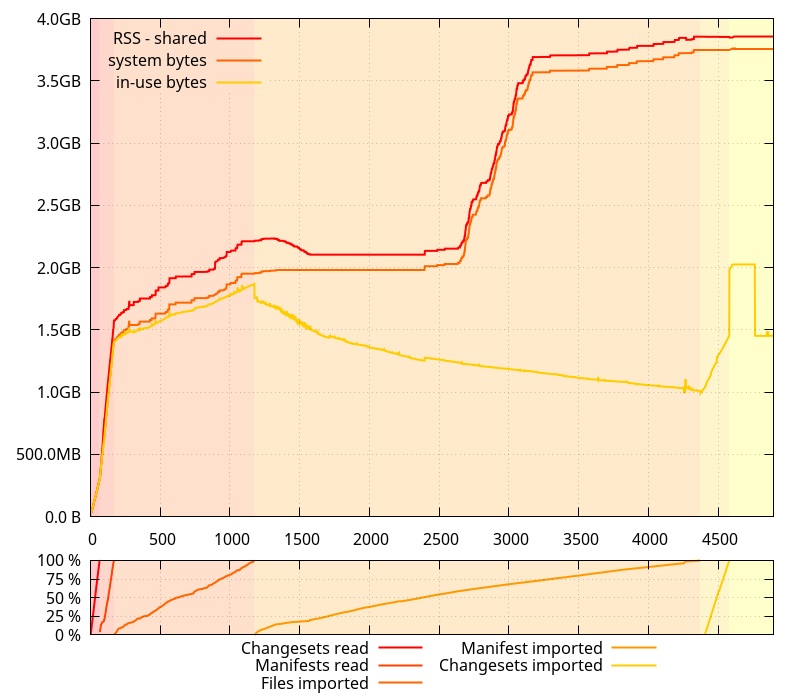
Cloning mozilla-central with git-cinnabar requires a lot of memory. Actually too much memory to fit in a 32-bits address space. I hadn t optimized for memory use in the first place. For instance, git-cinnabar keeps sha-1s in memory as hex values (40 bytes) rather than raw values (20 bytes). When I wrote the initial prototype, it didn t matter that much, and while close(ish) to the tipping point, it didn t require more than 2GB of memory at the time. Time passed, and mozilla-central grew. I suspect the recent addition of several thousands of commits and files has made things worse. In order to come up with a plan to make things better (short or longer term), I needed data. So I added some basic memory resource tracking, and collected data while cloning mozilla-central. I must admit, I was not ready for what I witnessed. Follow me for a tale of frustrations (plural). I was expecting things to have gotten worse on the master branch (which I used for the data collection) because I am in the middle of some refactoring and did many changes that I was suspecting might have affected memory usage. I wasn t, however, expecting to see the clone command using 10GB(!) memory at peak usage across all processes. (Note, those memory sizes are RSS, minus shared ) It also was taking an unexpected long time, but then, I hadn t cloned a large repository like mozilla-central from scratch in a while, so I wasn t sure if it was just related to its recent growth in size or otherwise. So I collected data on 0.4.0 as well. Less time spent, less memory usage ok. There s definitely something wrong on master. But wait a minute, that slope from ~2GB to ~4GB on the git-remote-hg process doesn t actually make any kind of sense. I mean, I d understand it if it were starting and finishing with the Import manifest phase, but it starts in the middle of it, and ends long before it finishes. WTH? First things first, since RSS can be a variety of things, I checked /proc/$pid/smaps and confirmed that most of it was, indeed, the heap. That s the point where you reach for Google, type something like python memory profile and find various tools. One from the results that I remembered having used in the past is guppy s heapy. Armed with pdb, I broke execution in the middle of the slope, and tried to get memory stats with heapy. SIGSEGV. Ouch. Let s try something else. I reached out to objgraph and pympler. SIGSEGV. Ouch again. Tried working around the crashes for a while (too long while, retrospectively, hindsight is 20/20), and was somehow successful at avoiding them by peaking at a smaller set of objects. But whatever I did, despite being attached to a process that had 2.6GB RSS, I wasn t able to find more than 1.3GB of data. This wasn t adding up. It surely didn t help that getting to that point took close to an hour each time. Retrospectively, I wish I had investigated using something like Checkpoint/Restore in Userspace. Anyways, after a while, I decided that I really wanted to try to see the whole picture, not smaller peaks here and there that might be missing something. So I resolved myself to look at the SIGSEGV I was getting when using pympler, collecting a core dump when it happened. Guess what? The Debian python-dbg package does not contain the debug symbols for the python package. The core dump was useless. Since I was expecting I d have to fix something in python, I just downloaded its source and built it. Ran the command again, waited, and finally got a backtrace. First Google hit for the crashing function? The exact (unfixed) crash reported on the python bug tracker. No patch. Crashing code is doing:
((f)->f_builtins != (f)->f_tstate->interp->builtins)
And (f)->f_tstate is NULL. Classic NULL deref. Added a guard (assessing it wouldn t break anything). Ran the command again. Waited. Again. SIGSEGV. Facedesk. Another crash on the same line. Did I really use the patched python? Yes. But this time (f)->f_tstate->interp is NULL. Sigh. Same player, shoot again. Finally, no crash but still stuck on only 1.3GB accounted for. Ok, I know not all python memory profiling tools are entirely reliable, let s try heapy again. SIGSEGV. Sigh. No debug info on the heapy module, where the crash happens. Sigh. Rebuild the module with debug info, try again. The backtrace looks like heapy is recursing a lot. Look at %rsp, compare with the address space from /proc/$pid/maps. Confirmed. A stack overflow. Let s do ugly things and increase the stack size in brutal ways. Woohoo! Now heapy tells me there s even less memory used than the 1.3GB I found so far. Like, half less. Yeah, right. I m not clear on how I got there, but that s when I found gdb-heap, a tool from Red Hat s David Malcolm, and the associated talk Dude, where s my RAM? A deep dive into how Python uses memory (slides). With a gdb attached, I would finally be able to rip python s guts out and find where all the memory went. Or so I thought. The gdb-heap tool only found about 600MB. About as much as heapy did, for that matter, but it could be coincidental. Oh. Kay. I don t remember exactly what went through my mind then, but, since I was attached to a running process with gdb, I typed the following on the gdb prompt:
gdb> call malloc_stats()
And that s when the truth was finally unvealed: the memory allocator was just acting up the whole time. The ouput was something like:
Arena 0:
system bytes    =  some number above (but close to) 2GB
in use bytes    =  some number above (but close to) 600MB
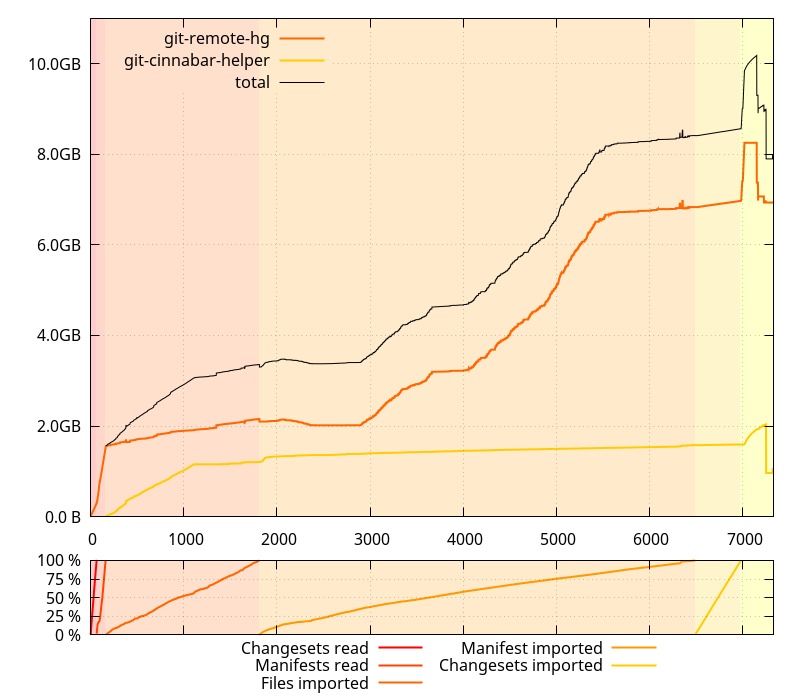
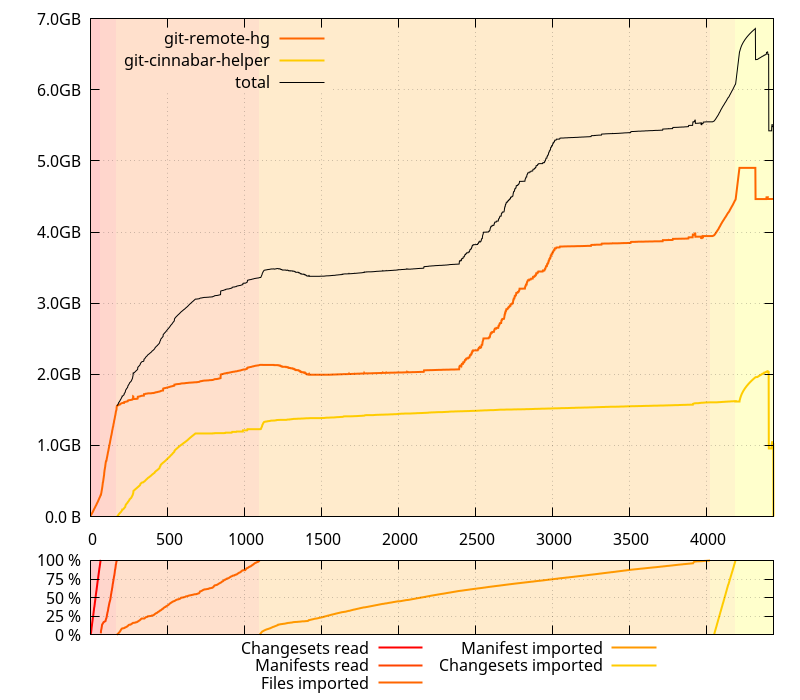
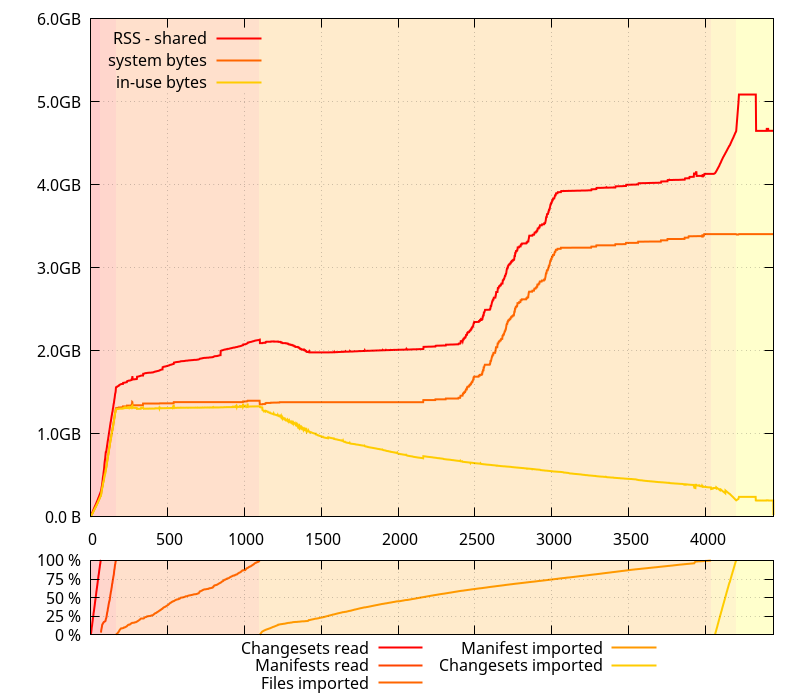
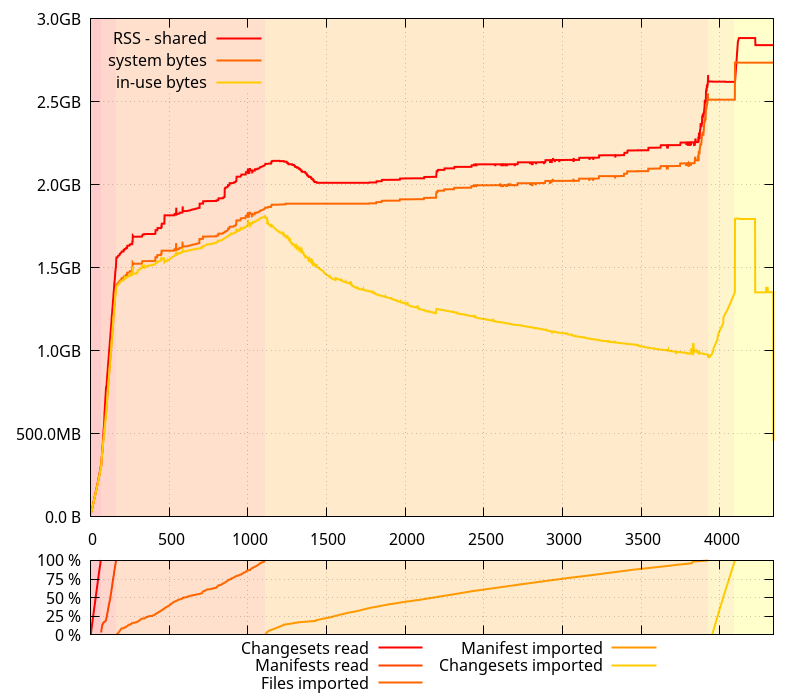
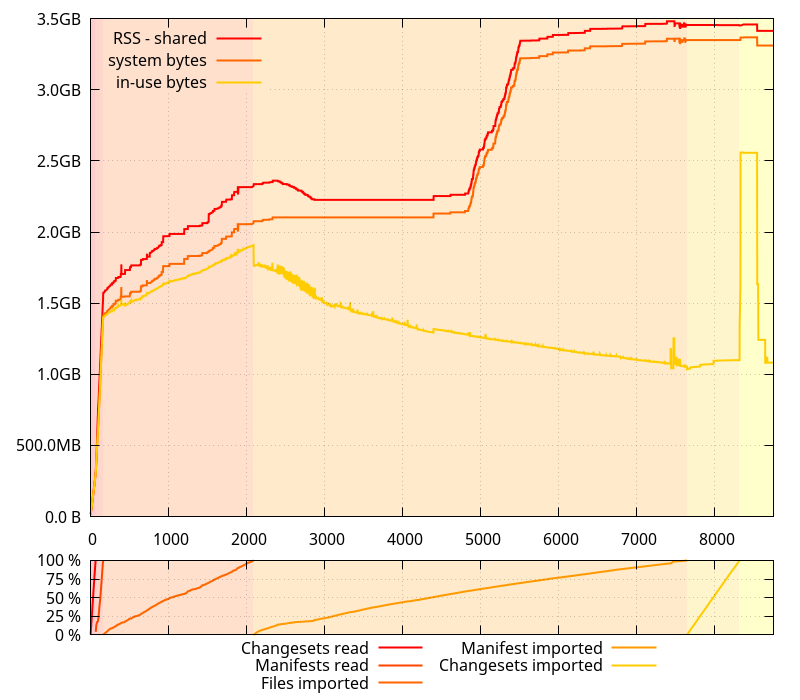
Yes, the glibc allocator was just telling it had allocated 600MB of memory, but was holding onto 2GB. I must have found a really bad allocation pattern that causes massive fragmentation. One thing that David Malcolm s talk taught me, though, is that python uses its own allocator for small sizes, so the glibc allocator doesn t know about them. And, roughly, adding the difference between RSS and what glibc said it was holding to to the use bytes it reported somehow matches the 1.3GB I had found so far. So it was time to see how those things evolved in time, during the entire clone process. I grabbed some new data, tracking the evolution of system bytes and in use bytes . There are two things of note on this data: In fact, the latter is exactly how git-cinnabar is supposed to work: It reads changesets and manifests chunks, and holds onto them while importing files. Then it throws away those manifests and changesets chunks one by one while it imports them. There is, however, some extra bookkeeping that requires some additional memory, but it s expected to be less memory consuming than keeping all the changesets and manifests chunks in memory. At this point, I thought a possible explanation is that since both python and glibc are mmap()ing their own arenas, they might be intertwined in a way that makes things not go well with the allocation pattern happening during the Import manifest phase (which, in fact, allocates and frees increasingly large buffers for each manifest, as manifests grow in size in the mozilla-central history). To put the theory at work, I patched the python interpreter again, making it use malloc() instead of mmap() for its arenas. Aha! I thought. That definitely looks much better. Less gap between what glibc says it requested from the system and the RSS size. And, more importantly, no runaway increase of memory usage in the middle of nowhere. I was preparing myself to write a post about how mixing allocators could have unintended consequences. As a comparison point, I went ahead and ran another test, with the python allocator entirely disabled, this time. Heh. It turns out glibc was acting up all alone. So much for my (plausible) theory. (I still think mixing allocators can have unintended consequences.) (Note, however, that the reason why the python allocator exists is valid: without it, the overall clone took almost 10 more minutes) And since I had been getting all this data with 0.4.0, I gathered new data without the python allocator with the master branch. This paints a rather different picture than the original data on that branch, with much less memory use regression than one would think. In fact, there isn t much difference, except for the spike at the end, which got worse, and some of the noise during the Import manifests phase that got bigger, implying larger amounts of temporary memory used. The latter may contribute to the allocation patterns that throw glibc s memory allocator off. It turns out tracking memory usage in python 2.7 is rather painful, and not all the tools paint a complete picture of it. I hear python 3.x is somewhat better in that regard, and I hope it s true, but at the moment, I m stuck with 2.7. The most reliable tool I ve used here, it turns out, is pympler. Or rebuilding the python interpreter without its allocator, and asking the system allocator what is allocated. With all this data, I now have some defined problems to tackle, some easy (the spike at the end of the clone), and some less easy (working around glibc allocator s behavior). I have a few hunches as to what kind of allocations are causing the runaway increase of RSS. Coincidentally, I m half-way through a refactor of the code dealing with manifests, and it should help dealing with the issue. But that will be the subject of a subsequent post.

10 March 2017

Mart n Ferrari: SunCamp happening again this May!

As I announced in mailing lists a few days ago, the Debian SunCamp (DSC2017) is happening again this May. SunCamp different to most other Debian events. Instead of a busy schedule of talks, SunCamp focuses on the hacking and socialising aspect, without making it just a Debian party/vacation.
DSC2016 - Hacking and discussing
The idea is to have 4 very productive days, staying in a relaxing and comfy environment, working on your own projects, meeting with your team, or presenting to fellow Debianites your most recent pet project.
DSC2016 - Tincho talking about Prometheus
We have tried to make this event the simplest event possible, both for organisers and attendees. There will be no schedule, except for the meal times at the hotel. But these can be ignored too, there is a lovely bar that serves snacks all day long, and plenty of restaurants and caf s around the village. DSC2016 - Hacking and discussing The SunCamp is an event to get work done, but there will be time for relaxing and socialising too.
DSC2016 - Well deserved siesta
DSC2016 - Playing P tanque
Do you fancy a hack-camp in a place like this? Swimming pool Caf Caf  terrace One of the things that makes the event simple, is that we have negotiated a flat price for accommodation that includes usage of all the facilities in the hotel, and optionally food. We will give you a booking code, and then you arrange your accommodation as you please, you can even stay longer if you feel like it! The rooms are simple but pretty, and everything has been renovated very recently. Room Room view We are not preparing a talks programme, but we will provide the space and resources for talks if you feel inclined to prepare one. You will have a huge meeting room, divided in 4 areas to reduce noise, where you can hack, have team discussions, or present talks. Hacklab Hacklab Do you want to see more pictures? Check the full gallery
Debian SunCamp 2017 Hotel Anabel, LLoret de Mar, Province of Girona, Catalonia, Spain May 18-21, 2017

Tempted already? Head to the wikipage and register now, it is only 2 months away! Please try to reserve your room before the end of March. The hotel has reserved a number of rooms for us until that time. You can reserve a room after March, but we can't guarantee the hotel will still have free rooms. Comment

9 March 2017

Arturo Borrero Gonz lez: Netfilter in GSoC 2017

logo Great news! The Netfilter project has been elected by Google to be a mentoring organization in this year Google Summer of Code program. Following the pattern of the last years, Google seems to realise and support the importance of this software project in the Linux ecosystem. I will be proudly mentoring some student this 2017 year, along with Eric Leblond and of course Pablo Neira. The focus of the Netfilter project has been in nftables for the last years, and the students joining our community will likely work on the new framework. For prospective students: there is an ideas document which you must read. The policy in the Netfilter project is to encourage students to send patches before they are elected to join us. Therefore, a good starting point is to subscribe to the mailing lists, download the git code repositories, build by hand the projects (compilation) and look at the bugzilla (registration required). Due to this type of internships and programs, I believe is interesting to note the ascending involvement of women in the last years. I can remember right now: Ana Rey (@AnaRB), Shivani Bhardwaj (@tuxish), Laura Garc a and Elise Lennion (blog). On a side note, Debian is not participating in GSoC this year :-(

8 March 2017

Antoine Beaupr : An update to GitHub's terms of service

On February 28th, GitHub published a brand new version of its Terms of Service (ToS). While the first draft announced earlier in February didn't generate much reaction, the new ToS raised concerns that they may break at least the spirit, if not the letter, of certain free-software licenses. Digging in further reveals that the situation is probably not as dire as some had feared. The first person to raise the alarm was probably Thorsten Glaser, a Debian developer, who stated that the "new GitHub Terms of Service require removing many Open Source works from it". His concerns are mainly about section D of the document, in particular section D.4 which states:
You grant us and our legal successors the right to store and display your Content and make incidental copies as necessary to render the Website and provide the Service.
Section D.5 then goes on to say:
[...] You grant each User of GitHub a nonexclusive, worldwide license to access your Content through the GitHub Service, and to use, display and perform your Content, and to reproduce your Content solely on GitHub as permitted through GitHub's functionality

ToS versus GPL The concern here is that the ToS bypass the normal provisions of licenses like the GPL. Indeed, copyleft licenses are based on copyright law which forbid users from doing anything with the content unless they comply with the license, which forces, among other things, "share alike" properties. By granting GitHub and its users rights to reproduce content without explicitly respecting the original license, the ToS may allow users to bypass the copyleft nature of the license. Indeed, as Joey Hess, author of git-annex, explained :
The new TOS is potentially very bad for copylefted Free Software. It potentially neuters it entirely, so GPL licensed software hosted on Github has an implicit BSD-like license
Hess has since removed all his content (mostly mirrors) from GitHub. Others disagree. In a well-reasoned blog post, Debian developer Jonathan McDowell explained the rationale behind the changes:
My reading of the GitHub changes is that they are driven by a desire to ensure that GitHub are legally covered for the things they need to do with your code in order to run their service.
This seems like a fair point to make: GitHub needs to protect its own rights to operate the service. McDowell then goes on to do a detailed rebuttal of the arguments made by Glaser, arguing specifically that section D.5 "does not grant [...] additional rights to reproduce outside of GitHub". However, specific problems arise when we consider that GitHub is a private corporation that users have no control over. The "Services" defined in the ToS explicitly "refers to the applications, software, products, and services provided by GitHub". The term "Services" is therefore not limited to the current set of services. This loophole may actually give GitHub the right to bypass certain provisions of licenses used on GitHub. As Hess detailed in a later blog post:
If Github tomorrow starts providing say, an App Store service, that necessarily involves distribution of software to others, and they put my software in it, would that be allowed by this or not? If that hypothetical Github App Store doesn't sell apps, but licenses access to them for money, would that be allowed under this license that they want to my software?
However, when asked on IRC, Bradley M. Kuhn of the Software Freedom Conservancy explained that "ultimately, failure to comply with a copyleft license is a copyright infringement" and that the ToS do outline a process to deal with such infringement. Some lawyers have also publicly expressed their disagreement with Glaser's assessment, with Richard Fontana from Red Hat saying that the analysis is "basically wrong". It all comes down to the intent of the ToS, as Kuhn (who is not a lawyer) explained:
any license can be abused or misused for an intent other than its original intent. It's why it matters to get every little detail right, and I hope Github will do that.
He went even further and said that "we should assume the ambiguity in their ToS as it stands is favorable to Free Software". The ToS are in effect since February 28th; users "can accept them by clicking the broadcast announcement on your dashboard or by continuing to use GitHub". The immediacy of the change is one of the reasons why certain people are rushing to remove content from GitHub: there are concerns that continuing to use the service may be interpreted as consent to bypass those licenses. Hess even hosted a separate copy of the ToS [PDF] for people to be able to read the document without implicitly consenting. It is, however, unclear how a user should remove their content from the GitHub servers without actually agreeing to the new ToS.

CLAs When I read the first draft, I initially thought there would be concerns about the mandatory Contributor License Agreement (CLA) in section D.5 of the draft:
[...] unless there is a Contributor License Agreement to the contrary, whenever you make a contribution to a repository containing notice of a license, you license your contribution under the same terms, and agree that you have the right to license your contribution under those terms.
I was concerned this would establish the controversial practice of forcing CLAs on every GitHub user. I managed to find a post from a lawyer, Kyle E. Mitchell, who commented on the draft and, specifically, on the CLA. He outlined issues with wording and definition problems in that section of the draft. In particular, he noted that "contributor license agreement is not a legal term of art, but an industry term" and "is a bit fuzzy". This was clarified in the final draft, in section D.6, by removing the use of the CLA term and by explicitly mentioning the widely accepted norm for licenses: "inbound=outbound". So it seems that section D.6 is not really a problem: contributors do not need to necessarily delegate copyright ownership (as some CLAs require) when they make a contribution, unless otherwise noted by a repository-specific CLA. An interesting concern he raised, however, was with how GitHub conducted the drafting process. A blog post announced the change on February 7th with a link to a form to provide feedback until the 21st, with a publishing deadline of February 28th. This gave little time for lawyers and developers to review the document and comment on it. Users then had to basically accept whatever came out of the process as-is. Unlike every software project hosted on GitHub, the ToS document is not part of a Git repository people can propose changes to or even collaboratively discuss. While Mitchell acknowledges that "GitHub are within their rights to update their terms, within very broad limits, more or less however they like, whenever they like", he sets higher standards for GitHub than for other corporations, considering the community it serves and the spirit it represents. He described the process as:
[...] consistent with the value of CYA, which is real, but not with the output-improving virtues of open process, which is also real, and a great deal more pleasant.
Mitchell also explained that, because of its position, GitHub can have a major impact on the free-software world.
And as the current forum of preference for a great many developers, the knock-on effects of their decisions throw big weight. While GitHub have the wheel and they ve certainly earned it for now they can do real damage.
In particular, there have been some concerns that the ToS change may be an attempt to further the already diminishing adoption of the GPL for free-software projects; on GitHub, the GPL has been surpassed by the MIT license. But Kuhn believes that attitudes at GitHub have begun changing:
GitHub historically had an anti-copyleft culture, which was created in large part by their former and now ousted CEO, Preston-Warner. However, recently, I've seen people at GitHub truly reach out to me and others in the copyleft community to learn more and open their minds. I thus have a hard time believing that there was some anti-copyleft conspiracy in this ToS change.

GitHub response However, it seems that GitHub has actually been proactive in reaching out to the free software community. Kuhn noted that GitHub contacted the Conservancy to get its advice on the ToS changes. While he still thinks GitHub should fix the ambiguities quickly, he also noted that those issues "impact pretty much any non-trivial Open Source and Free Software license", not just copylefted material. When reached for comments, a GitHub spokesperson said:
While we are confident that these Terms serve the best needs of the community, we take our users' feedback very seriously and we are looking closely at ways to address their concerns.
Regardless, free-software enthusiasts have other concerns than the new ToS if they wish to use GitHub. First and foremost, most of the software running GitHub is proprietary, including the JavaScript served to your web browser. GitHub also created a centralized service out of a decentralized tool (Git). It has become the largest code hosting service in the world after only a few years and may well have become a single point of failure for free software collaboration in a way we have never seen before. Outages and policy changes at GitHub can have a major impact on not only the free-software world, but also the larger computing world that relies on its services for daily operation. There are now free-software alternatives to GitHub. GitLab.com, for example, does not seem to have similar licensing issues in its ToS and GitLab itself is free software, although based on the controversial open core business model. The GitLab hosting service still needs to get better than its grade of "C" in the GNU Ethical Repository Criteria Evaluations (and it is being worked on); other services like GitHub and SourceForge score an "F". In the end, all this controversy might have been avoided if GitHub was generally more open about the ToS development process and gave more time for feedback and reviews by the community. Terms of service are notorious for being confusing and something of a legal gray area, especially for end users who generally click through without reading them. We should probably applaud the efforts made by GitHub to make its own ToS document more readable and hope that, with time, it will address the community's concerns.
Note: this article first appeared in the Linux Weekly News.

Clint Adams: Oh, little boy, pick up the pieces

Chris sat in the window seat in the row behind his parents. Actually he also sat in half of his neighbor s seat. His neighbor was uncomfortable but said nothing and did not attempt to lower the armrest to try to contain his girth. His parents were awful human beings: selfish, self-absorbed and controlling. Chris, his dad would say, look out the window! His dad was the type of officious busybody who would snitch on you at work for not snitching on someone else. What? Chris would reply, after putting down The Handmaid s Tale and removing one of his earbuds. Then his dad would insist that it was very important that he look out the window to see a very important cloud or glacial landform. Chris would comply and then return to his book and music. Chris, his mom would say, you need to review our travel itinerary. His mom cried herself to sleep when she heard that Nigel Stock died, gave up on ever finding True Love, and resolved to achieve a husband and child instead. What? Chris would reply, after putting down The Handmaid s Tale and removing one of his earbuds. Then his mom would insist that it was very important that review photos and prose regarding their managed tour package in Costa Rica, because he wouldn t want to show up there unprepared. Chris would passive-aggressively stare at each page of the packet, then hand it back to his mother. It was already somewhat clear that due to delays in taking off they would be missing their connecting flight to Costa Rica. About of the passengers on the aeroplane were also going to Costa Rica, and were discussing the probable missed connection amongst themselves and with the flight staff. Chris s parents were oblivious to all of this, despite being native speakers of English. Additionally, just as they were unaware of what other people were discussing, they imagined that no one else could hear their private family discussions. Everyone on the plane missed their connecting flights. Chris s parents continued to be terrible human beings.
Posted on 2017-03-08
Tags: etiamdisco

Matthew Garrett: The Internet of Microphones

So the CIA has tools to snoop on you via your TV and your Echo is testifying in a murder case and yet people are still buying connected devices with microphones in and why are they doing that the world is on fire surely this is terrible?

You're right that the world is terrible, but this isn't really a contributing factor to it. There's a few reasons why. The first is that there's really not any indication that the CIA and MI5 ever turned this into an actual deployable exploit. The development reports[1] describe a project that still didn't know what would happen to their exploit over firmware updates and a "fake off" mode that left a lit LED which wouldn't be there if the TV were actually off, so there's a potential for failed updates and people noticing that there's something wrong. It's certainly possible that development continued and it was turned into a polished and usable exploit, but it really just comes across as a bunch of nerds wanting to show off a neat demo.

But let's say it did get to the stage of being deployable - there's still not a great deal to worry about. No remote infection mechanism is described, so they'd need to do it locally. If someone is in a position to reflash your TV without you noticing, they're also in a position to, uh, just leave an internet connected microphone of their own. So how would they infect you remotely? TVs don't actually consume a huge amount of untrusted content from arbitrary sources[2], so that's much harder than it sounds and probably not worth it because:

YOU ARE CARRYING AN INTERNET CONNECTED MICROPHONE THAT CONSUMES VAST QUANTITIES OF UNTRUSTED CONTENT FROM ARBITRARY SOURCES

Seriously your phone is like eleven billion times easier to infect than your TV is and you carry it everywhere. If the CIA want to spy on you, they'll do it via your phone. If you're paranoid enough to take the battery out of your phone before certain conversations, don't have those conversations in front of a TV with a microphone in it. But, uh, it's actually worse than that.

These days audio hardware usually consists of a very generic codec containing a bunch of digital analogue converters, some analogue digital converters and a bunch of io pins that can basically be wired up in arbitrary ways. Hardcoding the roles of these pins makes board layout more annoying and some people want more inputs than outputs and some people vice versa, so it's not uncommon for it to be possible to reconfigure an input as an output or vice versa. From software.

Anyone who's ever plugged a microphone into a speaker jack probably knows where I'm going with this. An attacker can "turn off" your TV, reconfigure the internal speaker output as an input and listen to you on your "microphoneless" TV. Have a nice day, and stop telling people that putting glue in their laptop microphone is any use unless you're telling them to disconnect the internal speakers as well.

If you're in a situation where you have to worry about an intelligence agency monitoring you, your TV is the least of your concerns - any device with speakers is just as bad. So what about Alexa? The summary here is, again, it's probably easier and more practical to just break your phone - it's probably near you whenever you're using an Echo anyway, and they also get to record you the rest of the time. The Echo platform is very restricted in terms of where it gets data[3], so it'd be incredibly hard to compromise without Amazon's cooperation. Amazon's not going to give their cooperation unless someone turns up with a warrant, and then we're back to you already being screwed enough that you should have got rid of all your electronics way earlier in this process. There are reasons to be worried about always listening devices, but intelligence agencies monitoring you shouldn't generally be one of them.

tl;dr: The CIA probably isn't listening to you through your TV, and if they are then you're almost certainly going to have a bad time anyway.

[1] Which I have obviously not read
[2] I look forward to the first person demonstrating code execution through malformed MPEG over terrestrial broadcast TV
[3] You'd need a vulnerability in its compressed audio codecs, and you'd need to convince the target to install a skill that played content from your servers

comment count unavailable comments

7 March 2017

Bits from Debian: New Debian Developers and Maintainers (January and February 2017)

The following contributors got their Debian Developer accounts in the last two months: The following contributors were added as Debian Maintainers in the last two months: Congratulations!

Daniel Stender: Remotely deploy a WSGI application (as a Debian package) with Ansible

This is a mini workshop as an introduction into using Ansible for the administration of Debian systems. As an example it s shown how this configuration management tool can be used to remotely set up a simple WSGI application running on an Apache web server on a Debian installation to make it available on the net. The application which is used as an example is httpbin by Runscope. This is an useful HTTP request service for the development of web software or any other purposes which features a number of specific endpoints that can be used for different testing matters. For example, the address http://<address>/user-agent of httpbin returns the user agent identification of the client program which has been used to query it (that s taken from the header of the request). There are official instances of this request server running on the net, like the one at http://httpbin.org/. WSGI is a widespread standard for programming web application in Python, and httpbin is implemented in Python using the Flask web framework. The basis of the workshop is a simple base installation of an up-to-date Debian 8 Jessie on a demonstration host, and the latest official release of that is 8.7. As a first step, the installation has to be switched over to the testing branch of Debian, because the Debian packages of httpbin are comparatively new and are going to be introduced into the stable branch of the archive the first time with the upcoming major release number 9 Stretch . After that, the Apache packages which are needed to make it available (apache2 and libapache2-mod-wsgi other web servers of course could be used instead), and which are not part of a base installation, are installed from the archive. The web server then gets launched remotely, and the httpbin package will be also pulled and the service is going to be integrated into Apache to run on that. To achieve that, two configuration files must be deployed on the target system, and a few additional operations are needed to get everything working together. Every step is preconfigured within Ansible so that the whole process could be launched by a single command on the control node, and could be run on a single or a number of comparable target machines automatically and reproducibly. If a server is needed for trying this workshop out, straightforward cloud server instances are available on the net for example at DigitalOcean, but let me underline this there are other cloud providers which offer the same things, too! If it s needed for experiments or other purposes only for a limited time, low priced droplets are available here which are billed by the hour. After being registered, the machine(s) which is/are wanted could be set up easily over the web interface (choose Debian 8.7 as OS), but there are also command line clients available like doctl (which is not yet available as a Debian package). For the convenient use of a droplet the user should generate a SSH key pair on the local machine, first:
$ ssh-keygen -t rsa -b 4096 -C "john@doe.com" -f ~/.ssh/mykey
The public part of the key ~/.ssh/mykey.pub then can be uploaded into the user account before the droplet is going to be created, it then could be integrated automatically. There is a good introduction on the whole process available in the excellent tutorial series serversforhackers.com, here. Ansible then can use the SSH keypair to login into a droplet without the need to type in the password every time. On a cloud server like this carrying a Debian base system, the examples in this workshop can be tried well. Ansible works client-less and doesn t need to be installed on the remote system but only on the control node, however a Python 2.7 interpreter is needed there (the base system of DigitalOcean includes that). For that Ansible can do anything on them, remote servers which are going to be controlled must be added to /etc/ansible/hosts. This is a configuration file in the INI format for DNS names and IP addresses. For a flexible organisation of the server inventory it s possible to group hosts here, IP ranges could be given, and optional variables can be used among other useful things (the default file contains a couple of examples). One or a couple of servers (in Ansible they are called hosts ) on which something particular is going to be happening (like httpbin is going to be installed) could be added like this (the group name is arbitrary):
[httpbin]
192.0.2.0
Whether Ansible could communicate with the hosts in the group and actually can operate on them can be verified by just pinging them like this:
$ ansible httpbin -m ping -u root --private-key=~/.ssh/mykey
192.0.2.0   SUCCESS =>  
    "changed": false, 
    "ping": "pong"
 
The command succeeded well, so it appears there isn t no significant problem regarding this machine. The return value changed:false indicates that there haven t been any changes on that host as a result of the execution of this command. Next to ping there are several other modules which could be used with the command line tool ansible the same way, and these modules are actually something like the core components of Ansible. The module shell for example can be used to execute shell commands on the remote machine like uname to get some system information returned from the server:
$ ansible httpbin -m shell -a "uname -a" -u root --private-key=~/.ssh/mykey
192.0.2.0   SUCCESS   rc=0 >>
Linux debian-512mb-fra1-01 3.16.0-4-amd64 #1 SMP Debian 3.16.36-1+deb8u2 (2016-10-19) x86_64 GNU/Linux
In the same way, the module apt could be used to remotely install packages. But with that there s no major advantage over other software products that offer a similar functionality, and using those modules on the command line is just the basics of Ansible usage. Playbooks in Ansible are YAML scripts for the manipulation of the registered hosts in /etc/ansible/hosts. Different tasks can be defined here for successive processing, like a simple playbook for changing the package source from stable to testing for example goes like this:
---
 - hosts: httpbin
   tasks:
   - name: remove "jessie" package source
     apt_repository: repo='deb http://mirrors.digitalocean.com/debian jessie main' state=absent
   - name: add "testing" package source
     apt_repository: repo='deb http://httpredir.debian.org/debian testing main contrib non-free' state=present
   - name: upgrade packages
     apt: update_cache=yes upgrade=dist
First, like used with the CLI tool ansible above, the targeted host group httpbin is chosen. The default user root and the SSH key could be fixed here, too, to spare the need to give them on the command line. Then there are three tasks defined to get worked down consecutively: With the module apt_repository the preset package source jessie is removed from /etc/apt/sources.list. Then, a new package source for the testing archive gets added to /etc/apt/sources.list.d/ by using the same module (by the way, mirrors.digitalocean.org also provides testing, though, and that might be faster). After that, the apt module is used to upgrade the package inventory (it performs apt-get dist-upgrade), after an update of the package cache has taken place (by running apt-get update) A playbook like this (the filename is arbitrary, but commonly carries the suffix .yml) can be run by the CLI tool ansible-playbook, like this:
$ ansible-playbook httpbin.yml -u root --private-key=~/.ssh/mykey
Ansible then works down the individual plays of the tasks on the remote server(s) top-down, and due to a high speed net connection and SSD block device hardware the change of the system to being a Debian Testing base installation only takes around a minute to complete in the cloud. While working, Ansible puts out status reports for the individual operations. If certain changes on the base system have been taken place already like when a playbook is run through one more time, the modules of course sense that and return just the information that the system haven t been changed because it s already there what have been wanted to change to. Beyond the basic playbook which is shown here there are more advanced features like register and when available to bind the execution of a play to the error-free result of a previous one. The apt module then can be used in the playbook to install the three needed binary packages one after another:
   - name: install apache2
     apt: pkg=apache2 state=present
   - name: install mod_wsgi
     apt: pkg=libapache2-mod-wsgi state=present
   - name: install httpbin
     apt: pkg=python-httpbin state=present
The Debian packages are configured in a way that the Apache web server is running immediately after installation, and the Apache module mod_wsgi is automatically integrated. If that would be otherwise desired, there are Ansible modules available for operating on Apache which can reverse this if that is wanted. By the way, after the package have been installed the httpbin server can be launched with python -m httpbin.core, but this runs only a mini web server which is not suitable for productive use. To get httpbin running on the Apache web server two configuration files are needed. They could be set up in the project directory on the control node and then uploaded onto the remote machine with another Ansible module. The file httpbin.wsgi (the name is again arbitrary) contains only a single line which is the starter for the WSGI application to run:
from httpbin import app as application
The module copy can be used to deploy that script on the host, while the target folder /var/www/httpbin must be set up before that by the module file. In addition to that, a separate user account like httpbin (the name is also arbitrary but picked up in the other config file) is needed to run it, and the module user can set this up. The demonstrational playbook continues, and the plays which are performing these three operations are going like this:
   - name: mkdir /var/www/httpbin
     file: path=/var/www/httpbin state=directory
   - name: set up user "httpbin"
     user: name=httpbin
   - name: copy WSGI starter
     copy: src=httpbin.wsgi dest=/var/www/httpbin/httpbin.wsgi owner=httpbin group=httpbin mode=0644 
Another configuration script httpbin.conf is needed for Apache on the remote server to include the WSGI application httpbin running as a virtual host. It goes like this:
<VirtualHost *>
 WSGIDaemonProcess httpbin user=httpbin group=httpbin threads=5
 WSGIScriptAlias / /var/www/httpbin/httpbin.wsgi
 <Directory /var/www/httpbin>
  WSGIProcessGroup httpbin
  WSGIApplicationGroup % GLOBAL 
  Order allow,deny
  Allow from all
 </Directory>
</VirtualHost>
This file needs to be copied into the folder /etc/apache2/sites-available on the host, which already exists when the apache2 package is installed. The remaining operations which are missing to get anything running together are: The default welcome screen of Apache blocks anything else and should be disabled by Apache s CLI tool a2dissite. And after that, the new virtual host needs to be activated with the complementary tool a2ensite both could be run remotely by the module command. Then the Apache server on the remote machine must be restarted to read in the new configuration. You ve guessed it already, that s all easy to perform with Ansible:
   - name: deploy configuration script
     copy: src=httpbin.conf dest=/etc/apache2/sites-available owner=root group=root mode=0644
   - name: deactivate default welcome screen
     command: a2dissite 000-default.conf
     
   - name: activate httpbin virtual host
     command: a2ensite httpbin.conf
   - name: restart Apache
     service: name=apache2 state=restarted 
That s it. After this playbook has been performed by Ansible on a (or several) freshly set up remote Debian base installation completely, then the httpbin request server is available running on the Apache web server and could be queried from anywhere by a web browser, or for example by curl:
$ curl http://192.0.2.0/user-agent
 
  "user-agent": "curl/7.50.1"
 
With the broad set of Ansible modules and the playbooks a lot of tasks can be accomplished like the example problem which has been explained here. But the range of functions of Ansible however is still even more comprehensive, but to discuss that would have blown the frame of this blog post. For example the playbooks offer more advanced features like event handler which can be used for recurring operations like the restart of Apache in more extensive projects. And beyond playbooks, templates could be set up in the roles which can behave differently on selected machine groups Ansible uses Jinja2 as template engine for that. And the scope of functions of the basic modules could be expanded by employing external tools. To drop a word on why it could be useful in certain situations to run own instances of the httpbin request server instead of using the official ones which are provided on the net by Runscope: Like some people would prefer to run a private instance for example in the local network instead of querying the one on the internet. Or for some development reasons a couple or even a large number of identical instances might be needed Ansible is ideal for setting them up automatically. Anyway, the Javascript bindings to the tracking services like Google Analytics in httpbin/templates/trackingscripts.html are patched out in the Debian package. That could be another reason to prefer to set up an own instance on a Debian server.

5 March 2017

Julien Viard de Galbert: Raspberry Pi 3 as desktop computer

For about six months I ve been using a Raspberry Pi 3 as my desktop computer at home. The overall experience is fine, but I had to do a few adjustments.
First was to use KeePass, the second to compile gcc for cross-compilation (ie use buildroot).
KeePass I m using KeePass + KeeFox to maintain my passwords on the various websites (and avoid reusing the same everywhere).
For this to work on the Raspberry Pi, one need to use mono from Xamarin:
sudo apt-key adv --keyserver hkp://keyserver.ubuntu.com:80 --recv-keys 3FA7E0328081BFF6A14DA29AA6A19B38D3D831EF
echo "deb http://download.mono-project.com/repo/debian wheezy main"   sudo tee /etc/apt/sources.list.d/mono-xamarin.list
sudo apt-get update
sudo apt-get upgrade
sudo apt-get install mono-runtime
The install instruction comes from mono-project and the initial pointer was found on raspberrypi forums, stackoverflow and Benny Michielsen s blog.
And for some plugin to work I think I had to apt-get install mono-complete. Compiling gcc Using the Raspberry Pi 3, I recovered an old project based on buildroot for the raspberry pi 2. And just for building the tool-chain I had a few issues. First the compilation would stop during mnp compilation:
 /usr/bin/gcc -std=gnu99 -c -DHAVE_CONFIG_H -I. -I.. -D__GMP_WITHIN_GMP -I.. -DOPERATION_divrem_1 -O2 -Wa,--noexecstack tmp-divrem_1.s -fPIC -DPIC -o .libs/divrem_1.o
tmp-divrem_1.s: Assembler messages:
tmp-divrem_1.s:129: Error: selected processor does not support ARM mode  mls r1,r4,r8,r11'
tmp-divrem_1.s:145: Error: selected processor does not support ARM mode  mls r1,r4,r8,r11'
tmp-divrem_1.s:158: Error: selected processor does not support ARM mode  mls r1,r4,r8,r11'
tmp-divrem_1.s:175: Error: selected processor does not support ARM mode  mls r1,r4,r3,r8'
tmp-divrem_1.s:209: Error: selected processor does not support ARM mode  mls r11,r4,r12,r3'
Makefile:768: recipe for target 'divrem_1.lo' failed
make[]: *** [divrem_1.lo] Error 1
I Googled the error and found this post on the Raspberry Pi forum not really helpful
But I finally found an explanation on Jan Hrach s page on the subject.
The raspbian distribution is still optimized for the first Raspberry Pi so basically the compiler is limited to the old raspberypi instructions. While I was compiling gcc for a Raspberry Pi 2 so needed the extra ones. The proposed solution is to basically update raspbian to debian proper. While this is a neat idea, I still wanted to get some raspbian specific packages (like the kernel) but wanted to be sure that everything else comes from debian. So I did some apt pinning. First I experienced that pinning is not sufficient so when updating source.list with plain debian Jessie, make sure to add theses lines before the raspbian lines:
# add official debian jessie (real armhf gcc)
deb http://ftp.fr.debian.org/debian/ jessie main contrib non-free
deb-src http://ftp.fr.debian.org/debian/ jessie main
deb http://security.debian.org/ jessie/updates main
deb-src http://security.debian.org/ jessie/updates main
deb http://ftp.fr.debian.org/debian/ jessie-updates main
deb-src http://ftp.fr.debian.org/debian/ jessie-updates main
Then run the following to get the debian gpg keys, but don t yet upgrade your system:
apt update
apt install debian-archive-keyring
Now, let s add the pinning.
First if you were using APT::Default-Release "stable"; in your apt.conf (as I did) remove it. It does not mix well with fine grained pinning we will then implement. Then, fill your /etc/apt/preferences file with the following:
# Debian
Package: *
Pin: release o=Debian,a=stable,n=jessie
Pin-Priority: 700
# Raspbian
Package: *
Pin: release o=Raspbian,a=stable,n=jessie
Pin-Priority: 600
Package: *
Pin: release o=Raspberry Pi Foundation,a=stable,n=jessie
Pin-Priority: 600
# Mono
Package: *
Pin: release v=7.0,o=Xamarin,a=stable,n=wheezy,l=Xamarin-Stable,c=main
Pin-Priority: 800
Note: You can use apt-cache policy (no parameter) to debug pinning.
The pinning above is mainly based on the origin field of the repositories (o=)
Finally you can upgrade your system:
apt update 
apt-cache policy gcc 
rm /var/cache/apt/archives/* 
apt upgrade 
apt-cache policy gcc
Note: Removing the cache ensure we download the packages from debian as raspbian is using the exact same naming but we now they are not compiled with a real armhf tool-chain. Second issue with gcc The build stopped on recipe for target 's-attrtab' failed. There are many references on the web, that one was easy, it just need more memory, so I added some swap on the external SSD I was already using to work on buildroot. Conclusion That s it for today, not bad considering my last post was more that 3 years ago

Shirish Agarwal: To say or not to say

Voltaire For people who are visually differently-abled, the above reads To learn who rules over you, simply find out who you are not allowed to criticize Voltaire wrote this either in late 16th century or early 17th century and those words were as apt in those times, as it is in these turbulent times as well. Update 05/03 According to @bla these words are attributable to a neo-nazi and apparently a child abuser. While I don t know the context in which it was shared, it describes the environment in which we are perfectly. Please see his comment for a link and better understanding. The below topic requires a bit of maturity, so if you are easily offended, feel free not to read further. While this week-end I was supposed to share about the recent Science Day celebrations that we did last week Science Day celebrations at GMRT Would explore it probably next week. This week the attempt is to share thoughts which had been simmering at the back of my mind for more than 2 weeks or more and whose answers are not clear to me. My buttons were pressed when Martin f. Kraft shared about a CoC violation and the steps taken therein. While it is easy to say with 20:20 hind-sight to say that the gentleman acted foolishly, I don t really know the circumstances to pass the judgement so quickly. In reality, while I didn t understand the joke in itself, I have to share some background by way of anecdotes as to why it isn t so easy for me to give a judgement call. a. I don t know the topics chosen by stand-up comedians in other countries, in India, most of the stand-up acts are either about dating or sex or somewhere in-between, which is lovingly given the name Leela (dance of life) in Indian mythology. I have been to several such acts over the years at different events, different occasions and 99.99% of the time I would see them dealing with pedophilia, necrophilia and all sorts of deviants in sexuality and people laughing wildly, but couple of times when the comedian shared the term sex with people, educated, probably more than a few world-travelled middle to higher-middle class people were shocked into silence. I had seen this not in once but 2-3 times in different environments and was left wondering just couple of years back Is sex such a bad word that people get easily shocked ? Then how is it that we have 1.25 billion + people in India. There had to be some people having sex. I don t think that all 1.25 billion people are test-tube babies. b. This actually was what lead to my quandary last year when my sharing of My Experience with Debian which I had carefully prepared for newbies, seeing seasoned debian people, I knew my lame observations wouldn t cut ice with them and hence had to share my actual story which involved a bit of porn. I was in two minds whether or not to say it till my eyes caught a t-shirt on which it was said We make porn or something to that effect. That helped me share my point. c. Which brings me to another point, it seems it is becoming increasingly difficult to talk about anything either before apologizing to everyone and not really knowing who will take offence at what and what the repercussions might be. In local sharings, I always start with a blanket apology that if I say something that offends you, please let me know afterwards so I can work on it. As the term goes You can t please everyone and that is what happens. Somebody sooner or later would take offence at something and re-interpret it in ways which I had not thought of. Charlie Chaplin - King of self-deprecating humor From the little sharings and interactions I have been part of, I find people take offence at the most innocuous things. For instance, one of the easy routes of not offending anyone is to use self-deprecating humour (or so I thought) either of my race, caste, class or even my issues with weight and each of the above would offend somebody. Charlie Chaplin didn t have those problems. If somebody is from my caste, I m portraying the caste in a certain light, a certain slant. If I m talking about weight issues, then anybody who is like me (fat) feels that the world is laughing at them rather than at me or they will be discriminated against. While I find the last point a bit valid, it leaves with me no tools and no humour. I neither have the observational powers or the skills that Kapil Sharma has and have to be me. While I have no clue what to do next, I feel the need to also share why humour is important in any sharing.- a. Break When any speaker uses humour, the idea is to take a break from a serious topic. It helps to break the monotony of the talk especially if the topic is full of jargon talk and new concepts. A small comedic relief brings the attendees attention back to the topic as it tends to wander in a long monotonous talk. b. Bridge Some of the better speakers use one or more humourous anecdote to explain and/or bridge the chasm between two different concepts. Some are able to produce humour on the fly while others like me have to rely on tried and tested methods. There is one another thing as well, humour is seems to be a mixture of social, cultural and political context and its very easy to have it back-fired upon you. For instance, I attempted humour on refugees, probably not the best topic to try humour in the current political climate, and predictably, it didn t go down well. I had to share and explain about Robin Williams slightly dark yet humorous tale in Moscow on the Hudson The film provides comedy and pathos in equal measure. You are left identifying with Vladimir Ivanoff (Robin Williams character) especially in the last scene where he learns of his grand-mother dying and he remembers her and his motherland, Russia and plays a piece on his saxophone as a tribute both to his grand-mother and the motherland. Apparently, in the height of the cold war, if a Russian defected to United States (land of Satan and other such terms used) you couldn t return to Russia. The movie, seen some years back left a deep impact on me. For all the shortcomings and ills that India has, even if I could, would and could I be happy anywhere else ? The answers are not so easy. With most NRI s (Non-Resident Indians) who emigrated for good did it not so much for themselves but for their children. So the children would hopefully have a better upbringing, better facilities, better opportunities than they would have got here. I talked to more than a few NRI s and while most of them give standardized answers, talking awhile and couple of beers or their favourite alcohol later, you come across deeply conflicted human beings whose heart is in India and their job, profession and money interests compel them to be in the country where they are serving. And Indian movies further don t make it easy for the Indian populace when trying to integrate into a new place. Some of the biggest hits of yesteryear s were about having the distinct Indian culture in their new country while the message of most countries is integration. I know of friends who are living in Germany who have to struggle through their German in order to be counted as a citizen, the same I guess is true of other countries as well, not just the language but the customs as well. They also probably struggle with learning more than one language and having an amalgamation of values which somehow they and their children have to make sense of. I was mildly shocked last week to learn that Mishi Choudary had to train people in the U.S. to differentiate between Afghan turban styles of wearing and the Punjabi style of wearing the turban. A simple search on Afghani turban and Punjabi turban reveals that there are a lot of differences between the two cultures. In fact, the way they talk, the way they walk, there are lots that differentiate the two cultures. The second shocking video was of an African-American man racially abusing an Indian-American girl. At first, I didn t believe it till I saw the video on facebook. My point through all that is it seems humour, that clean, simple exercise which brings a smile to you and uplifts the spirit doesn t seem to be as easy as it once was. Comments, suggestions, criticisms all are welcome.
Filed under: Miscellenous Tagged: #Elusive, #Fear, #hind-sight, #Humour, #immigrant, #integration, #Mishi Choudary, #refugee, #Robin Williams, #self-deprecating, #SFLC, #two-minds

3 March 2017

Michal &#268;iha&#345;: Weblate 2.12

Weblate 2.12 has been released today, few days behind schedule. It brings improved screenshots management, better search and replace features or improved import. Many of the new features were already announced in previous post, where you can find more details about them. Full list of changes: If you are upgrading from older version, please follow our upgrading instructions. You can find more information about Weblate on https://weblate.org, the code is hosted on Github. If you are curious how it looks, you can try it out on demo server. You can login there with demo account using demo password or register your own user. Weblate is also being used on https://hosted.weblate.org/ as official translating service for phpMyAdmin, OsmAnd, Aptoide, FreedomBox, Weblate itself and many other projects. Should you be looking for hosting of translations for your project, I'm happy to host them for you or help with setting it up on your infrastructure. Further development of Weblate would not be possible without people providing donations, thanks to everybody who have helped so far! The roadmap for next release is just being prepared, you can influence this by expressing support for individual issues either by comments or by providing bounty for them.

Filed under: Debian English phpMyAdmin SUSE Weblate 0 comments

Next.

Previous.