Review:
The Death of Bees, by Lisa O'Donnell
| Publisher: |
HarperCollins |
| Copyright: |
2012 |
| Printing: |
2013 |
| ISBN: |
0-06-220984-1 |
| Format: |
Hardcover |
| Pages: |
309 |
This is the first definite hit from my Powell's
Indiespensable
subscription, and a good example of why I subscribe. I never would have
read or even heard of this book without it, and I thoroughly enjoyed it.
Marnie and Nellie are sisters living in a housing estate in Glasgow's
Maryhill district. Neither of their parents ever held regular jobs,
although one does quickly learn their father had been earning money
distributing drugs. The story opens, rather shockingly, with the death of
both parents: their father smothered in his bed, and their mother, a day
later, after refusing to notify anyone of their father's death, by hanging
herself in the garden shed.
In fear of being taken by social services and then separated, particularly
given Nellie's unusual way of interacting with the world (she talks, and
writes, like a woman in the 1950s trying to sound high-class), the girls
bury both bodies in the back garden and tell everyone their parents just
went on an unannounced trip without them. It wouldn't be the first time.
Marnie is 15 and a year away from being legally an adult, at which point
she can take custody of Nellie (who is 12) and keep them together. In the
meantime, they just have to keep their parents' deaths secret and figure
out how to keep food on the table and social services away.
Their next-door neighbor is a formerly-closeted older gay man named Lennie
who is known as the neighborhood pervert after he was arrested getting a
blow job from an underage male prostitute. Both girls are quite
understandably suspicious of him, but he's also the first person to notice
that something is wrong and to start trying to help. The book is told in
many short chapters, each written by one of Marnie, Nellie, or Lennie in
their own voice.
You might have guessed from the plot summary that this book needs a few
warnings, but I want to emphasize that more. This is a book that opens
with decaying corpses, including a few rather-too-vivid images from its
transport and from Marnie's later (unnamed) post-traumatic stress. Marnie
is quite sexually active, and both girls have had a nasty background full
of things that I preferred not to think too much about. Most of the worst
bits are only alluded to and are kept off-camera, but there's still quite
a lot of background nastiness and desperation here.
The Death of
Bees is blunt and forthright to the point that it repeatedly made me
cringe, and that sort of thing usually doesn't bother me in books.
That said, this is not a horror novel, even though it contains horror.
You could describe it as darkly comic, although none of the comedy is the
sort that makes one laugh, except perhaps in startled surprise. The
adjectives that come to mind are fierce, compassionate, empathetic, tough,
and courageous. The author is completely on the side of the three
protagonists, all of whom are deeply hurt in their own ways but all of
whom are trying as hard as they can to support each other. I have rarely
read a book that made me care as much about the characters. It's the kind
of story that makes one want to passionately defend them, particularly
once the one real villain, in the form of a do-gooding outsider, makes his
appearance.
And the reader and the author aren't alone. One of the things I loved
about this book is that it doesn't artificially isolate the characters.
Marnie has friends, and while Marnie doesn't always notice for Marnie,
this is just her life, and many things of significance to the reader are
just more of daily life for her this book is full of unexpected acts of
small kindness. The surrounding characters are themselves all dealing
with their own troubles and not in a great position to help anyone, and
yet somehow they manage. Even Nellie, who has a great deal of difficulty
interacting with other people her own age, gets unexpected help from
people she thinks can't stand her. I think it's very telling that about
the only character here who is entirely unsympathetic is the one who
claims to be the most moral and virtuous.
Unfortunately, from my perspective, this book has one major flaw: the
ending. Thankfully, the ending isn't bad; if it were, it would have
completely destroyed my enjoyment of the book. By the time one gets
through this story, having something bad happen to these girls would break
your heart. The ending does deliver the necessary catharsis, but it is
far, far too short. O'Donnell builds up tension mercilessly, pushing the
story down a path that's clearly desperately wrong for both of the girls,
and doesn't let the story climax happen until about ten pages from the
end. We get all of a page or two of denouement, and then the novel is
over.
I am, admittedly, a "Scouring of the Shire" sort of person. I like long
denouements, particularly if I've gone through hell with the characters.
I like getting to spend some happy time with them. But even for those who
don't enjoy that as much as I do, I think this ending was too short.
O'Donnell does an amazing job building sympathy and empathy throughout the
story, and I didn't want to have to fill in all of the happily ever after
from my own imagination. Maybe it would have been hard to do without
getting too sentimental or without dulling some of the sharp edges of the
story, but I would have really appreciated another ten pages. As is, it
felt like the novel abruptly and unceremoniously dumped me out on the
ground.
But, that aside, this is an excellent character story. It's one that I
would be careful about recommending; parts of it are extremely dark and
nasty, and you have to take Marnie on her own terms for the story to
work. But it's beautifully written and thoroughly engaging, and I'm very
glad to have read it.
Rating: 8 out of 10


 Responsive web design is a techinique for offering the optimal user experience across different browser devices without the overhead of separate "mobile" sites or native applications.
Whilst there are hundreds of browser plugins that can make it easier to test responsive websites by resizing your browser window, this can also be achieved with a scriptable window manager such as


 This is my monthly summary of my free software related activities. If you re among the people who
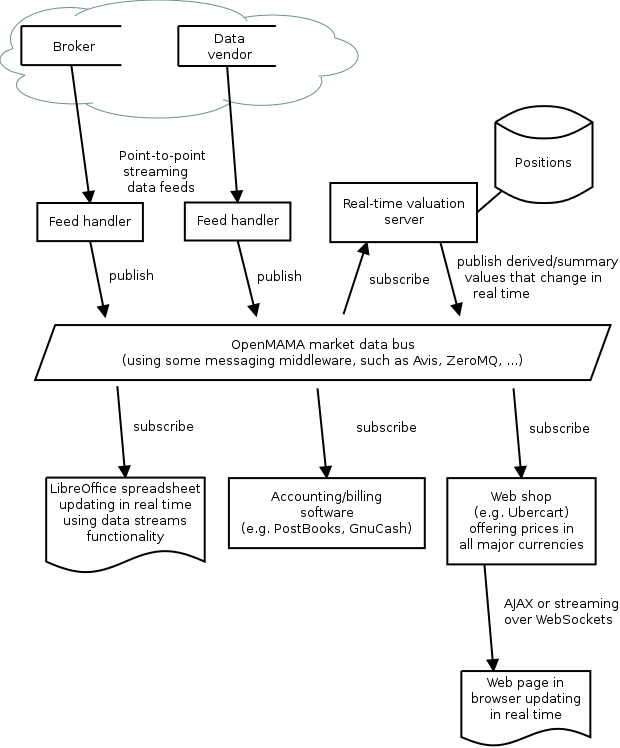 All these components may be running on a single host or they may be distributed across different servers and workstations in a LAN. The OpenMAMA market data bus ties them together.
External data sources
These are external sources of data. These could be currency trading firms, stock brokers, bullion dealers or even Bitcoin exchanges. Some exchanges don't provide data services directly to the general public and they distribute their price data through third-party data vendors such as Reuters and Bloomberg.
Feed handlers
The feed handlers manage the connections to external data sources. These are typically daemon processes that implement the wire protocols used by the external vendors for transmitting data over the public internet or a leased line. They typically use a point-to-point topology such as TCP connections.
The feed handlers publish the data into the market data bus.
In practice, the feed handler may be a proprietary application provided by the data vendor or it may simply be a
 Accounting/billing software
There are many free accounting applications today, including
 no exciting achievements but I still try to keep an eye on RC bugs:
 Earlier this year the blog had its tenth anniversary. I had meant to
celebrate the occassion by revamping the site and blog a little.
Having set up the