Search Results: "tar"

25 April 2021

Junichi Uekawa: Got a new machine Lenovo ThinkCenter M75s gen2, and installed Debian on it.

Got a new machine Lenovo ThinkCenter M75s gen2, and installed Debian on it. I wanted to try out the ryzen CPU. I haven't used a physical x86-64 Debian desktop machine since I threw away my Athlon 64 machine (dx5150), so that's like 15 years? Since then my main devices were macbooks and virtual machines (on GCE and Sakura) and raspberry pi. I got buster installed just fine. Finding the right keystrokes after boot was challenging because the graphical UI doesn't say anything. For BIOS set up to disable secure boot (F1 to enter set up: I wanted to play with kernel) and finding the keystroke to choose the boot disk (F10 to enter the dialog; I needed to choose the one labeled USB CD drive although I put in a USB SD card reader with installer image). The installation went fine for console, but getting X up was tricky, the support for the graphics (Renoir) part of the chip was added in kernel 5.5. Bullseye was 4.19 and I wasn't too comfortable with just updating the kernel. I ended up going for dist-upgrade to Bullseye. With Bullseye default kernel 5.10, X started without problems. So far I only tried out Emacs.

Dominique Dumont: An improved GUI for cme and Config::Model

I ve finally found the time to improve the GUI of my pet project: cme (aka Config::Model). Several years ago, I stumbled on a usability problem on the GUI. Some configuration (like OpenSsh or Systemd) feature a lot of configuration parameters. Which means that the GUI displays all these parameters, so finding a specfic parameter might be challenging:
To workaround this problem, I ve added a Filter widget in 2018 which did more or less the job, but it suffered from several bugs which made its behavior confusing. This is now fixed. The Filter widget is now working in a more consistent way. In the example below, I ve typed IdentityFile (1) in the Filter widget to show the identityFile used for various hosts (2):
Which is quite good, but some hosts use the default identity file so no value show up in the GUI. You can then click on hide empty value checkbox to show only the hosts that use a specific identity file:
I hope that this new behavior of the Filter box will make this project more useful. The improved GUI was released with Config::Model::TkUI 1.374. This new version is available on CPAN and on Debian/experimental). It will be released on Debian/unstable once the next Debian version is out. All the best

Russ Allbery: Review: Learning React

Review: Learning React, by Alex Banks & Eve Porcello
Publisher: O'Reilly
Copyright: June 2020
ISBN: 1-4920-5172-1
Format: Trade paperback
Pages: 287
My first JavaScript project was a React frontend to a REST service. As part of that project, I read two books: JavaScript: The Definitive Guide to learn the language foundation and this book to learn the framework on top of it. This was an unintentional experiment in the ways programming books can approach the topic. I commented in my review of JavaScript: the Definitive Guide that it takes the reference manual approach to the language. Learning React is the exact opposite. It's goal-driven, example-heavy, and has a problem and solution structure. The authors present a sample application, describe some desired new feature or deficiency in it, and then introduce the specific React technique that solves that problem. There is some rewriting of previous examples using more sophisticated techniques, but most chapters introduce new toy applications along with new parts of the React framework. The best part of this book is its narrative momentum, so I think the authors were successful at their primary goal. The first eight chapters of the book (more on the rest of the book in a moment) feel like a whirlwind tour where one concept flows naturally into the next and one's questions while reading about one technique are often answered in the next section. I thought the authors tried too hard in places and overdid the enthusiasm, but it's very readable in a way that I think may appeal to people who normally find programming books dry. Learning React is also firm and definitive about the correct way to use React, which may appeal to readers who only want to learn the preferred way of using the framework. (For example, React class components are mentioned briefly, mostly to tell the reader not to use them, and the rest of the book only uses functional components.) I had two major problems with this book, however. The first is that this breezy, narrative style turns out to be awful when one tries to use it as a reference. I read through most of this book with both enjoyment and curiosity, sat down to write a React component, and immediately struggled to locate the information I needed. Everything felt logically connected when I was focusing on the problems the authors introduced, but as soon as I started from my own problem, the structure of the book fell apart. I had to page through chapters to locate some nugget buried in the text, or re-read sections of the book to piece together which motivating problem my code was most similar to. It was a frustrating experience. This may be a matter of learning style, since this is why I prefer programming books with a reference structure. But be warned that I can't recommend this book as a reference while you're programming, nor does it prepare you to use the official React documentation as a reference. The second problem is less explicable and less defensible. I don't know what happened with O'Reilly's copy-editing for this book, but the code snippets are a train wreck. The Amazon reviews are full of people complaining about typos, syntax errors, omitted code, and glaring logical flaws, and they are entirely correct. It's so bad that I was left wondering if a very early, untested draft of the examples was somehow substituted into the book at the last minute by mistake. I'm not the sort of person who normally types code in from a book, so I don't care about a few typos or obvious misprints as long as the general shape is correct. The general shape was not correct. In a few places, the code is so completely wrong and incomplete that even combined with the surrounding text I was unable to figure out what it was supposed to be. It's possible this is fixed in a later printing (I read the June 2020 printing of the second edition), but otherwise beware. The authors do include a link to a GitHub repository of the code samples, which are significantly different than what's printed in the book, but that repository is incomplete; many of the later chapter examples are only links to JavaScript web sandboxes, which bodes poorly for the longevity of the example code. And then there's chapter nine of this book, which I found entirely baffling. This is a direct quote from the start of the chapter:
This is the least important chapter in this book. At least, that's what we've been told by the React team. They didn't specifically say, "this is the least important chapter, don't write it." They've only issued a series of tweets warning educators and evangelists that much of their work in this area will very soon be outdated. All of this will change.
This chapter is on suspense and error boundaries, with a brief mention of Fiber. I have no idea what I'm supposed to do with this material as a reader who is new to React (and thus presumably the target audience). Should I use this feature? When? Why is this material in the book at all when it's so laden with weird stream-of-consciousness disclaimers? It's a thoroughly odd editorial choice. The testing chapter was similarly disappointing in that it didn't answer any of my concrete questions about testing. My instinct with testing UIs is to break out Selenium and do integration testing with its backend, but the authors are huge fans of unit testing of React applications. Great, I thought, this should be interesting; unit testing seems like a poor fit for UI code because of how artificial the test construction is, but maybe I'm missing some subtlety. Convince me! And then the authors... didn't even attempt to convince me. They just asserted unit testing is great and explained how to write trivial unit tests that serve no useful purpose in a real application. End of chapter. Sigh. I'm not sure what to say about this book. I feel like it has so many serious problems that I should warn everyone away from it, and yet the narrative introduction to React was truly fun to read and got me excited about writing React code. Even though the book largely fell apart as a reference, I still managed to write a working application using it as my primary reference, so it's not all bad. If you like the problem and solution style and want a highly conversational and informal tone (that errs on the side of weird breeziness), this may still be the book for you. Just be aware that the code examples are a trash fire, so if you learn from examples, you're going to have to chase them down via the GitHub repository and hope that they still exist (or get a later edition of the book where this problem has hopefully been corrected). Rating: 6 out of 10

Antoine Beaupr : Lost article ideas

I wrote for LWN for about two years. During that time, I wrote (what seems to me an impressive) 34 articles, but I always had a pile of ideas in the back of my mind. Those are ideas, notes, and scribbles lying around. Some were just completely abandoned because they didn't seem a good fit for LWN. Concretely, I stored those in branches in a git repository, and used the branch name (and, naively, the last commit log) as indicators of the topic. This was the state of affairs when I left:
remotes/private/attic/novena                    822ca2bb add letter i sent to novena, never published
remotes/private/attic/secureboot                de09d82b quick review, add note and graph
remotes/private/attic/wireguard                 5c5340d1 wireguard review, tutorial and comparison with alternatives
remotes/private/backlog/dat                     914c5edf Merge branch 'master' into backlog/dat
remotes/private/backlog/packet                  9b2c6d1a ham radio packet innovations and primer
remotes/private/backlog/performance-tweaks      dcf02676 config notes for http2
remotes/private/backlog/serverless              9fce6484 postponed until kubecon europe
remotes/private/fin/cost-of-hosting             00d8e499 cost-of-hosting article online
remotes/private/fin/kubecon                     f4fd7df2 remove published or spun off articles
remotes/private/fin/kubecon-overview            21fae984 publish kubecon overview article
remotes/private/fin/kubecon2018                 1edc5ec8 add series
remotes/private/fin/netconf                     3f4b7ece publish the netconf articles
remotes/private/fin/netdev                      6ee66559 publish articles from netdev 2.2
remotes/private/fin/pgp-offline                 f841deed pgp offline branch ready for publication
remotes/private/fin/primes                      c7e5b912 publish the ROCA paper
remotes/private/fin/runtimes                    4bee1d70 prepare publication of runtimes articles
remotes/private/fin/token-benchmarks            5a363992 regenerate timestamp automatically
remotes/private/ideas/astropy                   95d53152 astropy or python in astronomy
remotes/private/ideas/avaneya                   20a6d149 crowdfunded blade-runner-themed GPLv3 simcity-like simulator
remotes/private/ideas/backups-benchmarks        fe2f1f13 review of backup software through performance and features
remotes/private/ideas/cumin                     7bed3945 review of the cumin automation tool from WM foundation
remotes/private/ideas/future-of-distros         d086ca0d modern packaging problems and complex apps
remotes/private/ideas/on-dying                  a92ad23f another dying thing
remotes/private/ideas/openpgp-discovery         8f2782f0 openpgp discovery mechanisms (WKD, etc), thanks to jonas meurer
remotes/private/ideas/password-bench            451602c0 bruteforce estimates for various password patterns compared with RSA key sizes
remotes/private/ideas/prometheus-openmetrics    2568dbd6 openmetrics standardizing prom metrics enpoints
remotes/private/ideas/telling-time              f3c24a53 another way of telling time
remotes/private/ideas/wallabako                 4f44c5da talk about wallabako, read-it-later + kobo hacking
remotes/private/stalled/bench-bench-bench       8cef0504 benchmarking http benchmarking tools
remotes/private/stalled/debian-survey-democracy 909bdc98 free software surveys and debian democracy, volunteer vs paid work
Wow, what a mess! Let's see if I can make sense of this:

Attic Those are articles that I thought about, then finally rejected, either because it didn't seem worth it, or my editors rejected it, or I just moved on:
  • novena: the project is ooold now, didn't seem to fit a LWN article. it was basically "how can i build my novena now" and "you guys rock!" it seems like the MNT Reform is the brain child of the Novena now, and I dare say it's even cooler!
  • secureboot: my LWN editors were critical of my approach, and probably rightly so - it's a really complex subject and I was probably out of my depth... it's also out of date now, we did manage secureboot in Debian
  • wireguard: LWN ended up writing extensive coverage, and I was biased against Donenfeld because of conflicts in a previous project

Backlog Those were articles I was planning to write about next.
  • dat: I already had written Sharing and archiving data sets with Dat, but it seems I had more to say... mostly performance issues, beaker, no streaming, limited adoption... to be investigated, I guess?
  • packet: a primer on data communications over ham radio, and the cool new tech that has emerged in the free software world. those are mainly notes about Pat, Direwolf, APRS and so on... just never got around to making sense of it or really using the tech...
  • performance-tweaks: "optimizing websites at the age of http2", the unwritten story of the optimization of this website with HTTP/2 and friends
  • serverless: god. one of the leftover topics at Kubecon, my notes on this were thin, and the actual subject, possibly even thinner... the only lie worse than the cloud is that there's no server at all! concretely, that's a pile of notes about Kubecon which I wanted to sort through. Probably belongs in the attic now.

Fin Those are finished articles, they were published on my website and LWN, but the branches were kept because previous drafts had private notes that should not be published.

Ideas A lot of those branches were actually just an empty commit, with the commitlog being the "pitch", more or less. I'd send that list to my editors, sometimes with a few more links (basically the above), and they would nudge me one way or the other. Sometimes they would actively discourage me to write about something, and I would do it anyways, send them a draft, and they would patiently make me rewrite it until it was a decent article. This was especially hard with the terminal emulator series, which took forever to write and even got my editors upset when they realized I had never installed Fedora (I ended up installing it, and I was proven wrong!)

Stalled Oh, and then there's those: those are either "ideas" or "backlog" that got so far behind that I just moved them out of the way because I was tired of seeing them in my list.
  • stalled/bench-bench-bench benchmarking http benchmarking tools, a horrible mess of links, copy-paste from terminals, and ideas about benchmarking... some of this trickled out into this benchmarking guide at Tor, but not much more than the list of tools
  • stalled/debian-survey-democracy: "free software surveys and Debian democracy, volunteer vs paid work"... A long standing concern of mine is that all Debian work is supposed to be volunteer, and paying explicitly for work inside Debian has traditionally been frowned upon, even leading to serious drama and dissent (remember Dunc-Tank)? back when I was writing for LWN, I was also doing paid work for Debian LTS. I also learned that a lot (most?) Debian Developers were actually being paid by their job to work on Debian. So I was confused by this apparent contradiction, especially given how the LTS project has been mostly accepted, while Dunc-Tank was not... See also this talk at Debconf 16. I had hopes that this study would show the "hunch" people have offered (that most DDs are paid to work on Debian) but it seems to show the reverse (only 36% of DDs, and 18% of all respondents paid). So I am still confused and worried about the sustainability of Debian.

What do you think? So that's all I got. As people might have noticed here, I have much less time to write these days, but if there's any subject in there I should pick, what is the one that you would find most interesting? Oh! and I should mention that you can write to LWN! If you think people should know more about some Linux thing, you can get paid to write for it! Pitch it to the editors, they won't bite. The worst that can happen is that they say "yes" and there goes two years of your life learning to write. Because no, you don't know how to write, no one does. You need an editor to write. That's why this article looks like crap and has a smiley. :)

23 April 2021

Matthew Garrett: An accidental bootsplash

Back in 2005 we had Debconf in Helsinki. Earlier in the year I'd ended up invited to Canonical's Ubuntu Down Under event in Sydney, and one of the things we'd tried to design was a reasonable graphical boot environment that could also display status messages. The design constraints were awkward - we wanted it to be entirely in userland (so we didn't need to carry kernel patches), and we didn't want to rely on vesafb[1] (because at the time we needed to reinitialise graphics hardware from userland on suspend/resume[2], and vesa was not super compatible with that). Nothing currently met our requirements, but by the time we'd got to Helsinki there was a general understanding that Paul Sladen was going to implement this.

The Helsinki Debconf ended being an extremely strange event, involving me having to explain to Mark Shuttleworth what the physics of a bomb exploding on a bus were, many people being traumatised by the whole sauna situation, and the whole unfortunate water balloon incident, but it also involved Sladen spending a bunch of time trying to produce an SVG of a London bus as a D-Bus logo and not really writing our hypothetical userland bootsplash program, so on the last night, fueled by Koff that we'd bought by just collecting all the discarded empty bottles and returning them for the deposits, I started writing one.

I knew that Debian was already using graphics mode for installation despite having a textual installer, because they needed to deal with more complex fonts than VGA could manage. Digging into the code, I found that it used BOGL - a graphics library that made use of the VGA framebuffer to draw things. VGA had a pre-allocated memory range for the framebuffer[3], which meant the firmware probably wouldn't map anything else there any hitting those addresses probably wouldn't break anything. This seemed safe.

A few hours later, I had some code that could use BOGL to print status messages to the screen of a machine booted with vga16fb. I woke up some time later, somehow found myself in an airport, and while sitting at the departure gate[4] I spent a while staring at VGA documentation and worked out which magical calls I needed to make to have it behave roughly like a linear framebuffer. Shortly before I got on my flight back to the UK, I had something that could also draw a graphical picture.

Usplash shipped shortly afterwards. We hit various issues - vga16fb produced a 640x480 mode, and some laptops were not inclined to do that without a BIOS call first. 640x400 worked basically everywhere, but meant we had to redraw the art because circles don't work the same way if you change the resolution. My brief "UBUNTU BETA" artwork that was me literally writing "UBUNTU BETA" on an HP TC1100 shortly after I'd got the Wacom screen working did not go down well, and thankfully we had better artwork before release.

But 16 colours is somewhat limiting. SVGALib offered a way to get more colours and better resolution in userland, retaining our prerequisites. Unfortunately it relied on VM86, which doesn't exist in 64-bit mode on Intel systems. I ended up hacking the X.org x86emu into a thunk library that exposed the same API as LRMI, so we could run it without needing VM86. Shockingly, it worked - we had support for 256 colour bootsplashes in any supported resolution on 64 bit systems as well as 32 bit ones.

But by now it was obvious that the future was having the kernel manage graphics support, both in terms of native programming and in supporting suspend/resume. Plymouth is much more fully featured than Usplash ever was, but relies on functionality that simply didn't exist when we started this adventure. There's certainly an argument that we'd have been better off making reasonable kernel modesetting support happen faster, but at this point I had literally no idea how to write decent kernel code and everyone should be happy I kept this to userland.

Anyway. The moral of all of this is that sometimes history works out such that you write some software that a huge number of people run without any idea of who you are, and also that this can happen without you having any fucking idea what you're doing.

Write code. Do crimes.

[1] vesafb relied on either the bootloader or the early stage kernel performing a VBE call to set a mode, and then just drawing directly into that framebuffer. When we were doing GPU reinitialisation in userland we couldn't guarantee that we'd run before the kernel tried to draw stuff into that framebuffer, and there was a risk that that was mapped to something dangerous if the GPU hadn't been reprogrammed into the same state. It turns out that having GPU modesetting in the kernel is a Good Thing.

[2] ACPI didn't guarantee that the firmware would reinitialise the graphics hardware, and as a result most machines didn't. At this point Linux didn't have native support for initialising most graphics hardware, so we fell back to doing it from userland. VBEtool was a terrible hack I wrote to try to re-execute the system's graphics hardware through a range of mechanisms, and it worked in a surprising number of cases.

[3] As long as you were willing to deal with 640x480 in 16 colours

[4] Helsinki-Vantaan had astonishingly comfortable seating for time

comment count unavailable comments

22 April 2021

Russell Coker: HP ML350P Gen8

I m playing with a HP Proliant ML350P Gen8 server (part num 646676-011). For HP servers ML means tower (see the ProLiant Wikipedia page for more details [1]). For HP servers the generation indicates how old the server is, Gen8 was announced in 2012 and Gen10 seems to be the current generation. Debian Packages from HP
wget -O /usr/local/hpePublicKey2048_key1.pub https://downloads.linux.hpe.com/SDR/hpePublicKey2048_key1.pub
echo "# HP RAID" >> /etc/apt/sources.list
echo "deb [signed-by=/usr/local/hpePublicKey2048_key1.pub] http://downloads.linux.hpe.com/SDR/downloads/MCP/Debian/ buster/current non-free" >> /etc/apt/sources.list
The above commands will setup the APT repository for Debian/Buster. See the HP Downloads FAQ [2] for more information about their repositories. hponcfg This package contains the hponcfg program that configures ILO (the HP remote management system) from Linux. One noteworthy command is hponcfg -r to reset the ILO, something you should do before selling an old system. ssacli This package contains the ssacli program to configure storage arrays, here are some examples of how to use it:
# list controllers and show slot numbers
ssacli controller all show
# list arrays on controller identified by slot and give array IDs
ssacli controller slot=0 array all show
# show details of one array
ssacli controller slot=0 array A show
# show all disks on one controller
ssacli controller slot=0 physicaldrive all show
# show config of a controller, this gives RAID level etc
ssacli controller slot=0 show config
# delete array B (you can immediately pull the disks from it)
ssacli controller slot=0 array B delete
# create an array type RAID0 with specified drives, do this with one drive per array for BTRFS/ZFS
ssacli controller slot=0 create type=arrayr0 drives=1I:1:1
When a disk is used in JBOD mode just under 33MB will be used at the end of the disk for the RAID metadata. If you have existing disks with a DOS partition table you can put it in a HP array as a JBOD and it will work with all data intact (GPT partition table is more complicated). When all disks are removed from the server the cooling fans run at high speed, this would be annoying if you wanted to have a diskless workstation or server using only external storage. ssaducli This package contains the ssaducli diagnostic utility for storage arrays. The SSD wear gauge report doesn t work for the 2 SSDs I tested it on, maybe it only supports SAS SSDs not SATA SSDs. It doesn t seem to do anything that I need. storcli This package contains both 32bit and 64bit versions of the MegaRAID utility and deletes whichever one doesn t match the installation in the package postinst, so it fails debsums checks etc. The MegaRAID utility is for a different type of RAID controller to the Smart Storage Array (AKA SSA) that the other utilities work with. As an aside it seems that there are multiple types of MegaRAID controller, the management program from the storcli package doesn t work on a Dell server with MegaRAID. They should have made separate 32bit and 64bit versions of this package. Recommendations Here is HP page for downloading firmware updates (including security updates) [3], you have to login first and have a warranty. This is legal but poor service. Dell servers have comparable prices (on the second hand marker) and comparable features but give free firmware updates to everyone. Dell have overall lower quality of Debian packages for supporting utilities, but a wider range of support so generally Dell support seems better in every way. Dell and HP hardware seems of equal quality so overall I think it s best to buy Dell. Suggestions for HP Finding which of the signing keys to use is unreasonably difficult. You should get some HP employees to sign the HP keys used for repositories with their personal keys and then go to LUG meetings and get their personal keys well connected to the web of trust. Then upload the HP keys to the public key repositories. You should also use the same keys for signing all versions of the repositories. Having different keys for the different versions of Debian wastes people s time. Please provide firmware for all users, even if they buy systems second hand. It is in your best interests to have systems used long-term and have them run securely. It is not in your best interests to have older HP servers perform badly. Having all the fans run at maximum speed when power is turned on is a standard server feature. Some servers can throttle the fan when the BIOS is running, it would be nice if HP servers did that. Having ridiculously loud fans until just before GRUB starts is annoying.

Shirish Agarwal: The Great Train Robbery

I had a twitter fight few days back with a gentleman and the article is a result of that fight. Sadly, I do not know the name of the gentleman as he goes via a psuedo name and then again I ve not taken permission from him to quote him in either way. So I will just state the observations I was able to make from the conversations we had. As people who read this blog regularly would know, I am and have been against Railway Privatization which is happening in India. And will be sharing some of the case studies from other countries as to how it panned out for them.

UK Railways
How Privatization Fails : Railways
The Above video is by a gentleman called Shaun who basically shared that privatization as far as UK is concerned is nothing but monopolies and while there are complex reasons for the same, the design of the Railways is such that it will always be a monopoly structure. At the most what you can do is have several monopolies but that is all that can happen. The idea of competition just cannot happen. Even the idea that subsidies will be less or/and trains will run on time is far from fact. Both of these facts have been checked and found to be truthful by fullfact.org. It is and argued that UK is small and perhaps it doesn t have the right conditions. It is probably true but still we do deserve to have a glance at the UK railway map.
UK railway map with operatorsUK railway map with operators
The above map is copyrighted to Map Marketing where you could see it today . As can be seen above most companies had their own specified areas. Now if you had looked at the facts then you would have seen that UK fares have been higher. In fact, an oldish article from Metro (a UK publication) shares the same. In fact, UK nationalized its railways effectively as many large rail operators were running in red. Even Scotland is set to nationalised back in March 2022. Remember this is a country which hasn t seen inflation go upwards of 5% in nearly a decade. The only outlier was 2011 where they indeed breached the 5% mark. So from this, what we see is Private Gains and Private Gains Public Losses perhaps seem fit. But then maybe we didn t use the right example. Perhaps Japan would be better. They have bullet trains while UK is still thinking about it. (HS2).

Japanese Railway Below is the map of Japanese Railway
Railway map of Japan with private ownership courtesy Wikimedia commons
Japan started privatizing its railway in 1987 and to date it has not been fully privatized. And on top of it, amount as much as 24 trillion of the long-term JNR debt was shouldered by the government at the expense of taxpayers of Japan while also reducing almost 1/4th of it employees. To add to it, while some parts of Japanese Railways did make profits, many of them made profits by doing large-scale non-railway business mostly real estate of land adjacent to railway stations. In many cases, it seems this went all the way up to 60% of the revenue. The most profitable has been the Shinkansen though. And while it has been profitable, it has not been without safety scandals over the years, the biggest in recent years was the 2005 Amagasaki derailment. What was interesting to me was the Aftermath, while the Wikipedia page doesn t share much, I had read at the time and probably could be found how a lot of ordinary people stood up to the companies in a country where it is a known fact that most companies are owned by the Yakuza. And this is a country where people are loyal to their corporation or company no matter what. It is a strange culture to west and also here in India where people change jobs on drop of hat, although nowadays we have record unemployment. So perhaps Japan too does not meet our standard as it doesn t do competition with each other but each is a set monopoly in those regions. Also how much subsidy is there or not is not really transparent.

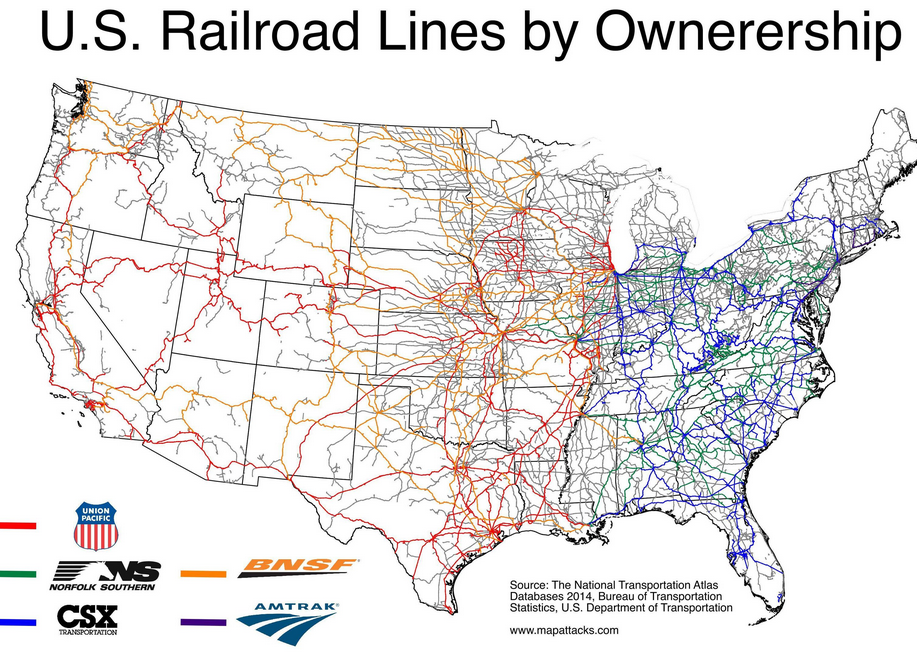
U.S. Railways Last, but not the least I share the U.S. Railway map. This is provided by A Mr. Tom Alison on reddit on channel maporn. As the thread itself is archived and I do not know the gentleman concerned, nor have taken permission for the map, hence sharing the compressed version


U.S. Railway lines with the different owners
Now the U.S. Railways is and has always been peculiar as unlike the above two the U.S. has always been more of a freight network. Probably, much of it has to do that in the 1960 s when oil was cheap, the U.S. made zillions of roadways and romanticized the road trip and has been doing it ever since. Also the creation of low-cost airlines definitely didn t help the railways to have more passenger services, in fact the opposite. There are and have been smaller services and attempts of privatization in both New Zealand and Australia and both have been failures. Please see papers in that regard. My simple point is this, as can be seen above, there have been various attempts at privatization of railways and most of them have been a mixed bag. The only one which comes close to what we think as good is Japanese but that also used a lot of public debt which we don t know what will happen on next. Also for higher-speed train services like a bullet train or whatever, you need to direct, no hair pen bends. In fact, a good talk on the topic is the TBD podcast which while it talks about hyperloop, the same questions is and would be asked if were to do in India. Another thing to be kept in mind is that the Japanese have been exceptional builders and this is because they have been forced to. They live in a seismically active zone which made Fukushima disaster a reality but at the same time, their buildings are earthquake-resistant. Standard Disclaimer The above is a simplified version of things. I could have added in financial accounts but that again has no set pattern. For e.g. some Railways use accrual, some use cash and some use hybrid. I could have also shared in either the guage or electrification but all have slightly different standards, although uniguage is something that all Railways aspire for and electrification is again something that all Railways want although in many cases it just isn t economically feasible.

Indian Railways Indian Railways itself recently made the move from Cash to Accrual couple of years back. In-between for a couple of years, it was hybrid. The sad part is and was you can now never measure against past performance in the old way because it is so different. Hence, whether the Railways will be making a loss or a profit, we would come to know only much later. Also, most accountants don t know the new system well, so it is gonna take more time, how much unknown. Sadly, what GOI did a few years back is merge the Railway budget into the Union Budget. Of course, the excuse they gave is too many pressures of new trains, while the truth is, by doing this, they decreased transparency about the whole thing. For e.g. for the last few years, the only state which had significant work being done is in U.P. (Uttar Pradesh) and a bit in Goa, although that is has been protested time and again. I being from the neighborly state of Maharashtra , and have been there several times. Now it does feels all like a dream, going to Goa :(.

Covid news Now before I jump on the news, I should share the movie Virus (2019) which was made by the talented Aashiq Abu. Even though, am not a Malayalee, I still have enjoyed many of his movies simply because he is a terrific director and Malayalam movies, at least most of them have English subtitles and lot of original content.. Interestingly, unlike the first couple of times when I saw it a couple of years back. The first time I saw it, I couldn t sleep a wink for a week. Even the next time, it was heavy. I had shared the movie with mum, and even she couldn t see it in one go. It is and was that powerful Now maybe because we are headlong in the pandemic, and the madness is all around us. There are two terms that helped me though understand a great deal of what is happening in the movie, the first term was altered sensorium which has been defined here. The other is saturation or to be more precise oxygen saturation . This term has also entered the Indian twitter lexicon quite a bit as India has started running out of oxygen. Just today Delhi High Court did an emergency hearing on the subject late at night. Although there is much to share about the mismanagement of the center, the best piece on the subject has been by Miss Priya Ramani. Yup, the same lady who has won against M.J. Akbar and this is when Mr. Akbar had 100 lawyers for this specific case. It would be interesting to see what happens ahead. There are however few things even she forgot in her piece, For e.g. reverse migration i.e. from urban to rural migration started again. Two articles from different entities sharing a similar outlook.Sadly, the right have no empathy or feeling for either the poor or the sick. Even the labor minister Santosh Gangwar s statement that around 1.04 crores were the only people who walked back home. While there is not much data, however some work/research has been done on migration to cites that the number could be easily 10 times as much. And this was in the lockdown of last year. This year, again the same issue has re-surfaced and migrants learning lessons started leaving cities. And I m ashamed to say I think they are doing the right thing. Most State Governments have not learned lessons nor have they done any work to earn the trust of migrants. This is true of almost all state Governments. Last year, just before the lockdown was announced, me and my friend spent almost 30k getting a cab all the way from Chennai to Pune, how much we paid for the cab, how much we bribed the various people just so we could cross the state borders to return home to our anxious families. Thankfully, unlike the migrants, we were better off although we did make a loss. I probably wouldn t be alive if I were in their situation as many didn t. That number is still in the air undocumented deaths  Vaccine issues Currently, though the issue has been the Vaccine and the pricing of the same. A good article to get a summation of the issues outlined has been shared on Economist. Another article that goes to the heart of the issue is at scroll. To buttress the argument, the SII chairman had shared this few weeks back
Adar Poonawala talking to Vishnu Som on Left, right center, 7th April 2021.
So, a licensee manufacturer wants to make super-profits during the pandemic. And now, as shared above they can very easily do it. Even the quotes given to nearby countries is smaller than the quotes given to Indian states

Prices of AstraZeneca among various states and countries.
The situation around beds, vaccines, oxygen, anything is so dire that people could go to any lengths to save their loved ones. Even if they know if a certain medicine doesn t work. For e.g. Remdesivir, 5 WHO trials have concluded that it doesn t increase mortality. Heck, even AIIMS chief said the same. But both doctors and relatives desperation to cling on hope has made Remdesivir as a black market drug with unoffical prices hovering anywhere between INR 14k/- to INR30k/- per vial. One of the executives of a top firm was also arrested in Gujarat. In Maharashtra, the opposition M.P. came to the rescue of the officials of Bruick pharms in Mumbai. Sadly, this strange affliction to the party in the center is also there in my extended family. At one end, they will heap praise on Mr. Modi, at the same time they can t get wait to get fast out of India. Many of them have settled in horrors of horror Dubai, as it is the best place to do business, get international schools for the young ones at decent prices, cheaper or maybe a tad more than what they paid in Delhi or elsewhere. Being an Agarwal or a Gupta makes it easier to compartmentalize both things. Ease of doing business, 5 days flat to get a business registered, up and running. And the paranoia is still there. They won t talk on the phone about him because they are afraid they may say something which comes back to bite them. As far as their decision to migrate, can t really blame them. If I were 20-25 yeas younger and my mum were in a better shape than she is, we probably would have migrated as well, although would have preferred Europe than anywhere else.

Internet Freedom and Aarogya Setu App.


Internet Freedom had shared the chilling effects of the Aarogya Setu App. This had also been shared by FSCI in the past, and recently had their handle being banned on Twitter. This was also apparent in a legal bail order which the high court judge gave. While I won t go into the merits and demerits of the bail order, it is astounding for the judge to say that the accused, even though he would be on bail install an app. so he can be surveilled. And this is a high court judge, such a sad state of affairs. We seem to be putting up new lows every day when it comes to judicial jurisprudence. One interesting aspect of the whole case was shared by Aishwarya Iyer. She shared a story that she and her team worked on quint which raises questions on the quality of the work done by Delhi Police. This is of course, up to Delhi Police to ascertain the truth of the matter because unless and until they are able to tie in the PMO s office in for a leak or POTUS s office it hardly seems possible. For e.g. the dates when two heads of state can meet each other would be decided by the secretaries of the two. Once the date is known, it would be shared with the press while at the same time some sort of security apparatus would kick in place. It is incumbent, especially on the host to take as much care as he can of the guest. We all remember that World War 1 (the war to end all wars) started due to the murder of Archduke Ferdinand.

As nobody wants that, the best way is to make sure that a political murder doesn t happen on your watch. Now while I won t comment on what it would be, it would be safe to assume that it would be z+ security along with higher readiness. Especially if it as somebody as important as POTUS. Now, it would be quite a reach for Delhi Police to connect the two dates. They either will have to get creative with the dates or some other way. Otherwise, with practically no knowledge in the public domain, they can t work in limbo. In either case, I do hope the case comes up for hearing soon and we see what the Delhi Police says and contends in the High Court about the same. At the very least, it would be irritating for them to talk of the dates unless they can contend some mass conspiracy which involves the PMO (and would bring into question the constant vetting done by the Intelligence dept. of all those who work in PMO). And this whole case is to kind of shelter to the Delhi riots which happened in which majorly the Muslims died but their deaths lay unaccounted till date

Conclusion In Conclusion, I would like to share a bit of humor because right now the atmosphere is humorless, both with authoritarian tendencies of the Central Govt. and the mass mismanagement of public health which they now have left to the state to do as they fit. The peice I am sharing is from arre, one of my goto sites whenever I feel low.

19 April 2021

Ian Jackson: Otter - a game server for arbitrary board games

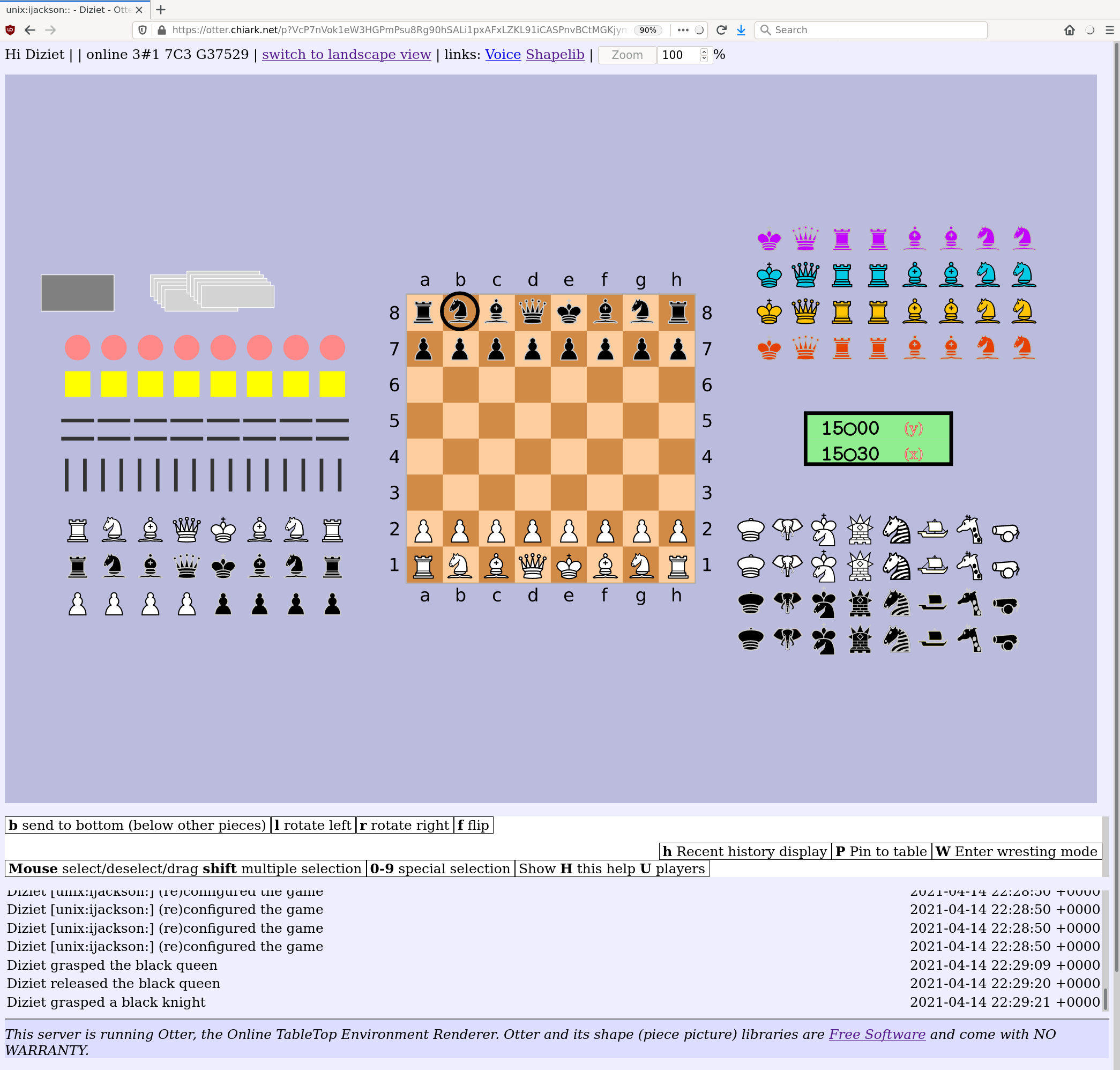
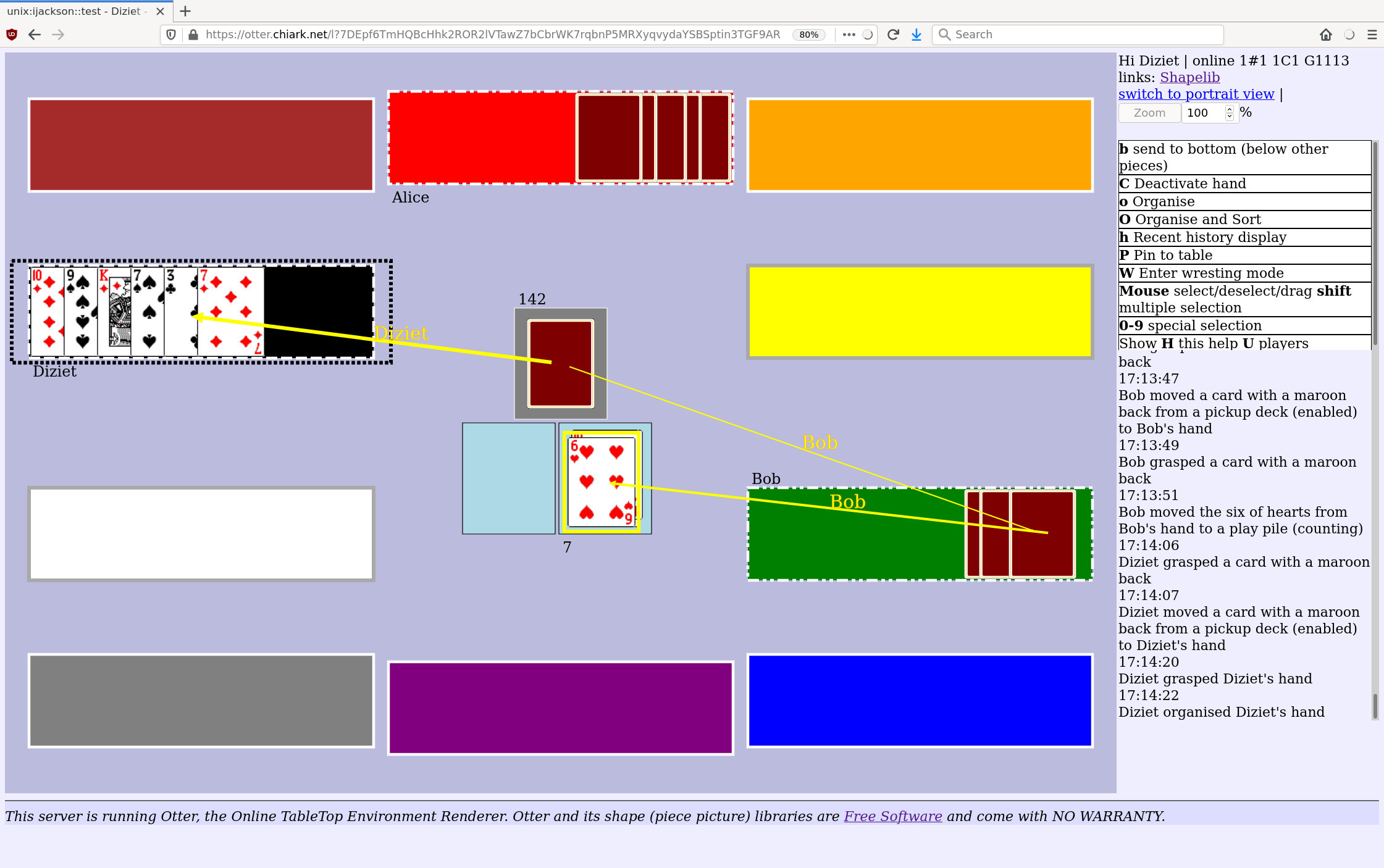
One of the things that I found most vexing about lockdown was that I was unable to play some of my favourite board games. There are online systems for many games, but not all. And online systems cannot support games like Mao where the players make up the rules as we go along. I had an idea for how to solve this problem, and set about implementing it. The result is Otter (the Online Table Top Environment Renderer). We have played a number of fun games of Penultima with it, and have recently branched out into Mao. The Otter is now ready to be released! More about Otter (cribbed shamelessly from the README) Otter, the Online Table Top Environment Renderer, is an online game system. But it is not like most online game systems. It does not know (nor does it need to know) the rules of the game you are playing. Instead, it lets you and your friends play with common tabletop/boardgame elements such as hands of cards, boards, and so on. So it s something like a tabletop simulator (but it does not have any 3D, or a physics engine, or anything like that). This means that with Otter: Installation and usage Otter is fully functional, but the installation and account management arrangements are rather unsophisticated and un-webby. And there is not currently any publicly available instance you can use to try it out. Users on chiark will find an instance there. Other people who who are interested in hosting games (of Penultima or Mao, or other games we might support) will have to find a Unix host or VM to install Otter on, and will probably want help from a Unix sysadmin. Otter is distributed via git, and is available on Salsa, Debian's gitlab instance. There is documentation online. Future plans I have a number of ideas for improvement, which go off in many different directions. Quite high up on my priority list is making it possible for players to upload and share game materials (cards, boards, pieces, and so on), rather than just using the ones which are bundled with Otter itself (or dumping files ad-hoc on the server). This will make it much easier to play new games. One big reason I wrote Otter is that I wanted to liberate boardgame players from the need to implemet their game rules as computer code. The game management and account management is currently done with a command line tool. It would be lovely to improve that, but making a fully-featured management web ui would be a lot of work. Screenshots! (Click for the full size images.)

comment count unavailable comments

18 April 2021

Russell Coker: IMA/EVM Certificates

I ve been experimenting with IMA/EVM. Here is the Sourceforge page for the upstream project [1]. The aim of that project is to check hashes and maybe public key signatures on files before performing read/exec type operations on them. It can be used as the next logical step from booting a signed kernel with TPM. I am a long way from getting that sort of thing going, just getting the kernel to boot and load keys is my current challenge and isn t helped due to the lack of documentation on error messages. This blog post started as a way of documenting the error messages so future people who google errors can get a useful result. I am not trying to document everything, just help people get through some of the first problems. I am using Debian for my work, but some of this will apply to other distributions (particularly the kernel error messages). The Debian distribution has the ima-evm-utils but no other support for IMA/EVM. To get this going in Debian you need to compile your own kernel with IMA support and then boot it with kernel command-line options to enable IMA, in recent kernels that includes lsm=integrity as a mandatory requirement to prevent a kernel Oops after mounting the initrd (there is already a patch to fix this). If you want to just use IMA (not get involved in development) then a good option would be to use RHEL (here is their documentation) [2] or SUSE (here is their documentation) [3]. Note that both RHEL and SUSE use older kernels so their documentation WILL lead you astray if you try and use the latest kernel.org kernel. The Debian initrd I created a script named /etc/initramfs-tools/hooks/keys with the following contents to copy the key(s) from /etc/keys to the initrd where the kernel will load it/them. The kernel configuration determines whether x509_evm.der or x509_ima.der (or maybe both) is loaded. I haven t yet worked out which key is needed when.
#!/bin/bash
mkdir -p $ DESTDIR /etc/keys
cp /etc/keys/* $ DESTDIR /etc/keys
Making the Keys
#!/bin/sh
GENKEY=ima.genkey
cat << __EOF__ >$GENKEY
[ req ]
default_bits = 1024
distinguished_name = req_distinguished_name
prompt = no
string_mask = utf8only
x509_extensions = v3_usr
[ req_distinguished_name ]
O =  hostname 
CN =  whoami  signing key
emailAddress =  whoami @ hostname 
[ v3_usr ]
basicConstraints=critical,CA:FALSE
#basicConstraints=CA:FALSE
keyUsage=digitalSignature
#keyUsage = nonRepudiation, digitalSignature, keyEncipherment
subjectKeyIdentifier=hash
authorityKeyIdentifier=keyid
#authorityKeyIdentifier=keyid,issuer
__EOF__
openssl req -new -nodes -utf8 -sha1 -days 365 -batch -config $GENKEY \
                -out csr_ima.pem -keyout privkey_ima.pem
openssl x509 -req -in csr_ima.pem -days 365 -extfile $GENKEY -extensions v3_usr \
                -CA ~/kern/linux-5.11.14/certs/signing_key.pem -CAkey ~/kern/linux-5.11.14/certs/signing_key.pem -CAcreateserial \
                -outform DER -out x509_evm.der
To get the below result I used the above script to generate a key, it is the /usr/share/doc/ima-evm-utils/examples/ima-genkey.sh script from the ima-evm-utils package but changed to use the key generated from kernel compilation to sign it. You can copy the files in the certs directory from one kernel build tree to another to have the same certificate and use the same initrd configuration. After generating the key I copied x509_evm.der to /etc/keys on the target host and built the initrd before rebooting.
[    1.050321] integrity: Loading X.509 certificate: /etc/keys/x509_evm.der
[    1.092560] integrity: Loaded X.509 cert 'xev: etbe signing key: 99d4fa9051e2c178017180df5fcc6e5dbd8bb606'
Errors Here are some of the kernel error messages I received along with my best interpretation of what they mean. [ 1.062031] integrity: Loading X.509 certificate: /etc/keys/x509_ima.der
[ 1.063689] integrity: Problem loading X.509 certificate -74 Error -74 means -EBADMSG, which means there s something wrong with the certificate file. I have got that from /etc/keys/x509_ima.der not being in der format and I have got it from a der file that contained a key pair that wasn t signed.
[    1.049170] integrity: Loading X.509 certificate: /etc/keys/x509_ima.der
[    1.093092] integrity: Problem loading X.509 certificate -126
Error -126 means -ENOKEY, so the key wasn t in the file or the key wasn t signed by the kernel signing key.
[    1.074759] integrity: Unable to open file: /etc/keys/x509_evm.der (-2)
Error -2 means -ENOENT, so the file wasn t found on the initrd. Note that it does NOT look at the root filesystem. References

Junichi Uekawa: Rewrote my pomodoro technique timer.

Rewrote my pomodoro technique timer. I've been iterating on how I operate and focus. Too much focus exhausts me. I'm trying out Focusmate's method of 50 minutes of focus time and 10 minutes of break. Here is a web app that tries to start the timer at the hour and starts break at the last 10 minutes.

17 April 2021

Chris Lamb: Tour d'Orwell: Wallington

Previously in George Orwell travel posts: Sutton Courtenay, Marrakesh, Hampstead, Paris, Southwold & The River Orwell. Wallington is a small village in Hertfordshire, approximately fifty miles north of London and twenty-five miles from the outskirts of Cambridge. George Orwell lived at No. 2 Kits Lane, better known as 'The Stores', on a mostly-permanent basis from 1936 to 1940, but he would continue to journey up from London on occasional weekends until 1947. His first reference to The Stores can be found in early 1936, where Orwell wrote from Lancashire during research for The Road to Wigan Pier to lament that he would very much like "to do some work again impossible, of course, in the [current] surroundings":
I am arranging to take a cottage at Wallington near Baldock in Herts, rather a pig in a poke because I have never seen it, but I am trusting the friends who have chosen it for me, and it is very cheap, only 7s. 6d. a week [ 20 in 2021].
For those not steeped in English colloquialisms, "a pig in a poke" is an item bought without seeing it in advance. In fact, one general insight that may be drawn from reading Orwell's extant correspondence is just how much he relied on a close network of friends, belying the lazy and hagiographical picture of an independent and solitary figure. (Still, even Orwell cultivated this image at times, such as in a patently autobiographical essay he wrote in 1946. But note the off-hand reference to varicose veins here, for they would shortly re-appear as a symbol of Winston's repressed humanity in Nineteen Eighty-Four.) Nevertheless, the porcine reference in Orwell's idiom is particularly apt, given that he wrote the bulk of Animal Farm at The Stores his 1945 novella, of course, portraying a revolution betrayed by allegorical pigs. Orwell even drew inspiration for his 'fairy story' from Wallington itself, principally by naming the novel's farm 'Manor Farm', just as it is in the village. But the allusion to the purchase of goods is just as appropriate, as Orwell returned The Stores to its former status as the village shop, even going so far as to drill peepholes in a door to keep an Orwellian eye on the jars of sweets. (Unfortunately, we cannot complete a tidy circle of references, as whilst it is certainly Napoleon Animal Farm's substitute for Stalin who is quoted as describing Britain as "a nation of shopkeepers", it was actually the maraisard Bertrand Bar re who first used the phrase). "It isn't what you might call luxurious", he wrote in typical British understatement, but Orwell did warmly emote on his animals. He kept hens in Wallington (perhaps even inspiring the opening line of Animal Farm: "Mr Jones, of the Manor Farm, had locked the hen-houses for the night, but was too drunk to remember to shut the pop-holes.") and a photograph even survives of Orwell feeding his pet goat, Muriel. Orwell's goat was the eponymous inspiration for the white goat in Animal Farm, a decidedly under-analysed character who, to me, serves to represent an intelligentsia that is highly perceptive of the declining political climate but, seemingly content with merely observing it, does not offer any meaningful opposition. Muriel's aesthetic of resistance, particularly in her reporting on the changes made to the Seven Commandments of the farm, thus rehearses the well-meaning (yet functionally ineffective) affinity for 'fact checking' which proliferates today. But I digress. There is a tendency to "read Orwell backwards", so I must point out that Orwell wrote several other works whilst at The Stores as well. This includes his Homage to Catalonia, his aforementioned The Road to Wigan Pier, not to mention countless indispensable reviews and essays as well. Indeed, another result of focusing exclusively on Orwell's last works is that we only encounter his ideas in their highly-refined forms, whilst in reality, it often took many years for concepts to fully mature we first see, for instance, the now-infamous idea of "2 + 2 = 5" in an essay written in 1939. This is important to understand for two reasons. Although the ostentatiously austere Barnhill might have housed the physical labour of its writing, it is refreshing to reflect that the philosophical heavy-lifting of Nineteen Eighty-Four may have been performed in a relatively undistinguished North Hertfordshire village. But perhaps more importantly, it emphasises that Orwell was just a man, and that any of us is fully capable of equally significant insight, with to quote Christopher Hitchens "little except a battered typewriter and a certain resilience."
The red commemorative plaque not only limits Orwell's tenure to the time he was permanently in the village, it omits all reference to his first wife, Eileen O'Shaughnessy, whom he married in the village church in 1936.
Wallington's Manor Farm, the inspiration for the farm in Animal Farm. The lower sign enjoins the public to inform the police "if you see anyone on the [church] roof acting suspiciously". Non-UK-residents may be surprised to learn about the systematic theft of lead.

Steve Kemp: Having fun with CP/M on a Z80 single-board computer.

In the past, I've talked about building a Z80-based computer. I made some progress towards that goal, in the sense that I took the initial (trivial steps) towards making something: But then I stalled, repeatedly, at designing an interface to RAM and ROM, so that it could actually do something useful. Over the lockdown I've been in two minds about getting sucked back down the rabbit-hole, so I compromised. I did a bit of searching on tindie, and similar places, and figured I'd buy a Z80-based single board computer. My requirements were minimal: With those goals there were a bunch of boards to choose from, rc2014 is the standard choice - a well engineered system which uses a common backplane and lets you build mini-boards to add functionality. So first you build the CPU-card, then the RAM card, then the flash-disk card, etc. Over-engineered in one sense, extensible in another. (There are some single-board variants to cut down on soldering overhead, at a cost of less flexibility.) After a while I came across https://8bitstack.co.uk/, which describes a simple board called the the Z80 playground. The advantage of this design is that it loads code from a USB stick, making it easy to transfer files to/from it, without the need for a compact flash card, or similar. The downside is that the system has only 64K RAM, meaning it cannot run CP/M 3, only 2.2. (CP/M 3.x requires more RAM, and a banking/paging system setup to swap between pages.) When the system boots it loads code from an EEPROM, which then fetches the CP/M files from the USB-stick, copies them into RAM and executes them. The memory map can be split so you either have ROM & RAM, or you have just RAM (after the boot the ROM will be switched off). To change the initial stuff you need to reprogram the EEPROM, after that it's just a matter of adding binaries to the stick or transferring them over the serial port. In only a couple of hours I got the basic stuff working as well as I needed: I had some fun with a CP/M emulator to get my hand back in things before the board arrived, and using that I tested my first "real" assembly language program (cls to clear the screen), as well as got the hang of using the wordstar keyboard shortcuts as used within the turbo pascal environment. I have some plans for development: Nothing major, but fun changes that won't be too difficult to implement. Since CP/M 2.x has no concept of sub-directories you end up using drives for everything, I implemented a "search-path" so that when you type "FOO" it will attempt to run "A:FOO.COM" if there is no file matching on the current-drive. That's a nicer user-experience at all. I also wrote some Z80-assembly code to search all drives for an executable, if not found in current drive and not already qualified. Remember CP/M doesn't have a concept of sub-directories) that's actually pretty useful:
  B>LOCATE H*.COM
  P:HELLO   COM
  P:HELLO2  COM
  G:HITCH   COM
  E:HYPHEN  COM
I've also written some other trivial assembly language tools, which was surprisingly relaxing. Especially once I got back into the zen mode of optimizing for size. I forked the upstream repository, mostly to tidy up the contents, rather than because I want to go into my own direction. I'll keep the contents in sync, because there's no point splitting a community even further - I guess there are fewer than 100 of these boards in the wild, probably far far fewer!

16 April 2021

Dirk Eddelbuettel: Announcing Introductions to Emacs Speaks Statistics

A new website containing introductory videos and slide decks is now available for your perusal at ess-intro.github.io. It provides a series of introductions to the excellent Emacs Speaks Statistics (ESS) mode for the Emacs editor. This effort started following my little tips, tricks, tools and toys series of short videos and slide decks for the command-line and R, broadly-speaking . Which I had mentioned to friends curious about Emacs, and on the ess-help mailing list. And lo and behold, over the fall and winter sixteen of us came together in one GitHub org and are now proud to present the initial batch of videos about first steps, installing, using with spaceemacs, customizing, and org-mode with ESS. More may hopefully fellow, the group is open and you too can join: see the main repo and its wiki. This is in fact the initial announcement post, so it is flattering that we have already received over 350 views, four comments and twenty-one likes. We hope it proves to be a useful starting point for some of you. The Emacs editor is quite uniquely powerful, and coupled with ESS makes for a rather nice environment for programming with data, or analysing, visualising, exploring, data. But we are not zealots: there are many editors and environments under the sun, and most people are perfectly happy with their choice, which is wonderful. We also like ours, and sometimes someone asks tell me more or how do I start . We hope this series satisifies this initial curiousity and takes it from here. With that, my thanks to Fr d ric, Alex, Tyler and Greg for the initial batch, and for everybody else in the org who chipped in with comments and suggestion. We hope it grows from here, so happy Emacsing with R from us!

15 April 2021

Ian Jackson: Dreamwidth blocking many RSS readers and aggregators

There is a serious problem with Dreamwidth, which is impeding access for many RSS reader tools. This started at around 0500 UTC on Wednesday morning, according to my own RSS reader cron job. A friend found #43443 in the DW ticket tracker, where a user of a minority web browser found they were blocked. Local tests demonstrated that Dreamwidth had applied blocking by the HTTP User-Agent header, and were rejecting all user-agents not specifically permitted. Today, this rule has been relaxed and unknown user-agents are permitted. But user-agents for general http client libraries are still blocked. I'm aware of three unresolved tickets about this: #43444 #43445 #43447 We're told there by a volunteer member of Dreamwidth's support staff that this has been done deliberately for "blocking automated traffic". I'm sure the volunteer is just relaying what they've been told by whoever is struggling to deal with what I suppose is probably a spam problem. But it's still rather unsatisfactory. I have suggested in my own ticket that a good solution might be to apply the new block only to posting and commenting (eg, maybe, by applying it only to HTTP POST requests). If the problem is indeed spam then that ought to be good enough, and would still let RSS readers work properly. I'm told that this new blocking has been done by "implementing" (actually, configuring or enabling) "some AWS rules for blocking automated traffic". I don't know what facilities AWS provides. This kind of helplessness is of course precisely the kind of thing that the Free Software movement is against and precisely the kind of thing that proprietary services like AWS produce. I don't know if this blog entry will appear on planet.debian.org and on other people's reader's and aggregators. I think it will at least be seen by other Dreamwidth users. I thought I would post here in the hope that other Dreamwidth users might be able to help get this fixed. At the very least other Dreamwidth blog owners need to know that many of their readers may not be seeing their posts at all. If this problem is not fixed I will have to move my blog. One of the main points of having a blog is publishing it via RSS. RSS readers are of course based on general http client libraries and many if not most RSS readers have not bothered to customise their user-agent. Those are currently blocked.

comment count unavailable comments

14 April 2021

Russell Coker: Basics of Linux Kernel Debugging

Firstly a disclaimer, I m not an expert on this and I m not trying to instruct anyone who is aiming to become an expert. The aim of this blog post is to help someone who has a single kernel issue they want to debug as part of doing something that s mostly not kernel coding. I welcome comments about the second step to kernel debugging for the benefit of people who need more than this (which might include me next week). Also suggestions for people who can t use a kvm/qemu debugger would be good. Below is a command to run qemu with GDB. It should be run from the Linux kernel source directory. You can add other qemu options for a blog device and virtual networking if necessary, but the bug I encountered gave an oops from the initrd so I didn t need to go further. The nokaslr is to avoid address space randomisation which deliberately makes debugging tasks harder (from a certain perspective debugging a kernel and compromising a kernel are fairly similar). Loading the bzImage is fine, gdb can map that to the different file it looks at later on.
qemu-system-x86_64 -kernel arch/x86/boot/bzImage -initrd ../initrd-$KERN_VER -curses -m 2000 -append "root=/dev/vda ro nokaslr" -gdb tcp::1200
The command to run GDB is gdb vmlinux , when at the GDB prompt you can run the command target remote localhost:1200 to connect to the GDB server port 1200. Note that there is nothing special about port 1200, it was given in an example I saw and is as good as any other port. It is important that you run GDB against the vmlinux file in the main directory not any of the several stripped and packaged files, GDB can t handle a bzImage file but that s OK, it ends up much the same in RAM. When the target remote command is processed the kernel will be suspended by the debugger, if you are looking for a bug early in the boot you may need to be quick about this. Using qemu-system-x86_64 instead of kvm slows things down and can help in that regard. The bug I was hunting happened 1.6 seconds after kernel load with KVM and 7.8 seconds after kernel load with qemu. I am not aware of all the implications of the kvm vs qemu decision on debugging. If your bug is a race condition then trying both would be a good strategy. After the target remote command you can debug the kernel just like any other program. If you put a breakpoint on print_modules() that will catch the operation of printing an Oops which can be handy.

13 April 2021

Fran ois Marier: Deleting non-decryptable restic snapshots

Due to what I suspect is disk corruption error due to a faulty RAM module or network interface on my GnuBee, my restic backup failed with the following error:
$ restic check
using temporary cache in /var/tmp/restic-tmp/restic-check-cache-854484247
repository b0b0516c opened successfully, password is correct
created new cache in /var/tmp/restic-tmp/restic-check-cache-854484247
create exclusive lock for repository
load indexes
check all packs
check snapshots, trees and blobs
error for tree 4645312b:
  decrypting blob 4645312b443338d57295550f2f4c135c34bda7b17865c4153c9b99d634ae641c failed: ciphertext verification failed
error for tree 2c3248ce:
  decrypting blob 2c3248ce5dc7a4bc77f03f7475936041b6b03e0202439154a249cd28ef4018b6 failed: ciphertext verification failed
Fatal: repository contains errors
I started by locating the snapshots which make use of these corrupt trees:
$ restic find --tree 4645312b
repository b0b0516c opened successfully, password is correct
Found tree 4645312b443338d57295550f2f4c135c34bda7b17865c4153c9b99d634ae641c
 ... path /usr/include/boost/spirit/home/support/auxiliary
 ... in snapshot 41e138c8 (2021-01-31 08:35:16)
Found tree 4645312b443338d57295550f2f4c135c34bda7b17865c4153c9b99d634ae641c
 ... path /usr/include/boost/spirit/home/support/auxiliary
 ... in snapshot e75876ed (2021-02-28 08:35:29)
$ restic find --tree 2c3248ce
repository b0b0516c opened successfully, password is correct
Found tree 2c3248ce5dc7a4bc77f03f7475936041b6b03e0202439154a249cd28ef4018b6
 ... path /usr/include/boost/spirit/home/support/char_encoding
 ... in snapshot 41e138c8 (2021-01-31 08:35:16)
Found tree 2c3248ce5dc7a4bc77f03f7475936041b6b03e0202439154a249cd28ef4018b6
 ... path /usr/include/boost/spirit/home/support/char_encoding
 ... in snapshot e75876ed (2021-02-28 08:35:29)
and then deleted them:
$ restic forget 41e138c8 e75876ed
repository b0b0516c opened successfully, password is correct
[0:00] 100.00%  2 / 2 files deleted
$ restic prune 
repository b0b0516c opened successfully, password is correct
counting files in repo
building new index for repo
[13:23] 100.00%  58964 / 58964 packs
repository contains 58964 packs (1417910 blobs) with 278.913 GiB
processed 1417910 blobs: 0 duplicate blobs, 0 B duplicate
load all snapshots
find data that is still in use for 20 snapshots
[1:15] 100.00%  20 / 20 snapshots
found 1364852 of 1417910 data blobs still in use, removing 53058 blobs
will remove 0 invalid files
will delete 942 packs and rewrite 1358 packs, this frees 6.741 GiB
[10:50] 31.96%  434 / 1358 packs rewritten
hash does not match id: want 9ec955794534be06356655cfee6abe73cb181f88bb86b0cd769cf8699f9f9e57, got 95d90aa48ffb18e6d149731a8542acd6eb0e4c26449a4d4c8266009697fd1904
github.com/restic/restic/internal/repository.Repack
    github.com/restic/restic/internal/repository/repack.go:37
main.pruneRepository
    github.com/restic/restic/cmd/restic/cmd_prune.go:242
main.runPrune
    github.com/restic/restic/cmd/restic/cmd_prune.go:62
main.glob..func19
    github.com/restic/restic/cmd/restic/cmd_prune.go:27
github.com/spf13/cobra.(*Command).execute
    github.com/spf13/cobra/command.go:852
github.com/spf13/cobra.(*Command).ExecuteC
    github.com/spf13/cobra/command.go:960
github.com/spf13/cobra.(*Command).Execute
    github.com/spf13/cobra/command.go:897
main.main
    github.com/restic/restic/cmd/restic/main.go:98
runtime.main
    runtime/proc.go:204
runtime.goexit
    runtime/asm_amd64.s:1374
As you can see above, the prune command failed due to a corrupt pack and so I followed the process I previously wrote about and identified the affected snapshots using:
$ restic find --pack 9ec955794534be06356655cfee6abe73cb181f88bb86b0cd769cf8699f9f9e57
before deleting them with:
$ restic forget 031ab8f1 1672a9e1 1f23fb5b 2c58ea3a 331c7231 5e0e1936 735c6744 94f74bdb b11df023 dfa17ba8 e3f78133 eefbd0b0 fe88aeb5 
repository b0b0516c opened successfully, password is correct
[0:00] 100.00%  13 / 13 files deleted
$ restic prune
repository b0b0516c opened successfully, password is correct
counting files in repo
building new index for repo
[13:37] 100.00%  60020 / 60020 packs
repository contains 60020 packs (1548315 blobs) with 283.466 GiB
processed 1548315 blobs: 129812 duplicate blobs, 4.331 GiB duplicate
load all snapshots
find data that is still in use for 8 snapshots
[0:53] 100.00%  8 / 8 snapshots
found 1219895 of 1548315 data blobs still in use, removing 328420 blobs
will remove 0 invalid files
will delete 6232 packs and rewrite 1275 packs, this frees 36.302 GiB
[23:37] 100.00%  1275 / 1275 packs rewritten
counting files in repo
[11:45] 100.00%  52822 / 52822 packs
finding old index files
saved new indexes as [a31b0fc3 9f5aa9b5 db19be6f 4fd9f1d8 941e710b 528489d9 fb46b04a 6662cd78 4b3f5aad 0f6f3e07 26ae96b2 2de7b89f 78222bea 47e1a063 5abf5c2d d4b1d1c3 f8616415 3b0ebbaa]
remove 23 old index files
[0:00] 100.00%  23 / 23 files deleted
remove 7507 old packs
[0:08] 100.00%  7507 / 7507 files deleted
done
And with 13 of my 21 snapshots deleted, the checks now pass:
$ restic check
using temporary cache in /var/tmp/restic-tmp/restic-check-cache-407999210
repository b0b0516c opened successfully, password is correct
created new cache in /var/tmp/restic-tmp/restic-check-cache-407999210
create exclusive lock for repository
load indexes
check all packs
check snapshots, trees and blobs
no errors were found
This represents a significant amount of lost backup history, but at least it's not all of it.

Shirish Agarwal: what to write

First up, I am alive and well. I have been receiving calls from friends for quite sometime but now that I have become deaf, it is a pain and the hearing aids aren t all that useful. But moreover, where we have been finding ourselves each and every day sinking lower and lower feels absurd as to what to write and not write about India. Thankfully, I ran across this piece which does tell in far more detail than I ever could. The only interesting and somewhat positive news I had is from south of India otherwise sad days, especially for the poor. The saddest story is that this time Covid has reached alarming proportions in India and surprise, surprise this time the villain for many is my state of Maharashtra even though it hasn t received its share of GST proceeds for last two years and this was Kerala s perspective, different state, different party, different political ideology altogether.
Kerala Finance Minister Thomas Issac views on GST, October 22, 2020 Indian Express.
I briefly also share the death of somewhat liberal Film censorship in India unlike Italy which abolished film censorship altogether. I don t really want spend too much on how we have become No. 2 in Covid cases in the world and perhaps death also. Many people still believe in herd immunity but don t really know what it means. So without taking too much time and effort, bid adieu. May post when I m hopefully emotionally feeling better, stronger

12 April 2021

Russell Coker: Yama

I ve just setup the Yama LSM module on some of my Linux systems. Yama controls ptrace which is the debugging and tracing API for Unix systems. The aim is to prevent a compromised process from using ptrace to compromise other processes and cause more damage. In most cases a process which can ptrace another process which usually means having capability SYS_PTRACE (IE being root) or having the same UID as the target process can interfere with that process in other ways such as modifying it s configuration and data files. But even so I think it has the potential for making things more difficult for attackers without making the system more difficult to use. If you put kernel.yama.ptrace_scope = 1 in sysctl.conf (or write 1 to /proc/sys/kernel/yama/ptrace_scope) then a user process can only trace it s child processes. This means that strace -p and gdb -p will fail when run as non-root but apart from that everything else will work. Generally strace -p (tracing the system calls of another process) is of most use to the sysadmin who can do it as root. The command gdb -p and variants of it are commonly used by developers so yama wouldn t be a good thing on a system that is primarily used for software development. Another option is kernel.yama.ptrace_scope = 3 which means no-one can trace and it can t be disabled without a reboot. This could be a good option for production servers that have no need for software development. It wouldn t work well for a small server where the sysadmin needs to debug everything, but when dozens or hundreds of servers have their configuration rolled out via a provisioning tool this would be a good setting to include. See Documentation/admin-guide/LSM/Yama.rst in the kernel source for the details. When running with capability SYS_PTRACE (IE root shell) you can ptrace anything else and if necessary disable Yama by writing 0 to /proc/sys/kernel/yama/ptrace_scope . I am enabling mode 1 on all my systems because I think it will make things harder for attackers while not making things more difficult for me. Also note that SE Linux restricts SYS_PTRACE and also restricts cross-domain ptrace access, so the combination with Yama makes things extra difficult for an attacker. Yama is enabled in the Debian kernels by default so it s very easy to setup for Debian users, just edit /etc/sysctl.d/whatever.conf and it will be enabled on boot.

Russell Coker: Storage Trends 2021

The Viability of Small Disks Less than a year ago I wrote a blog post about storage trends [1]. My main point in that post was that disks smaller than 2TB weren t viable then and 2TB disks wouldn t be economically viable in the near future. Now MSY has 2TB disks for $72 and 2TB SSD for $245, saving $173 if you get a hard drive (compared to saving $240 10 months ago). Given the difference in performance and noise 2TB hard drives won t be worth using for most applications nowadays. NVMe vs SSD Last year NVMe prices were very comparable for SSD prices, I was hoping that trend would continue and SSDs would go away. Now for sizes 1TB and smaller NVMe and SSD prices are very similar, but for 2TB the NVMe prices are twice that of SSD presumably partly due to poor demand for 2TB NVMe. There are also no NVMe devices larger than 2TB on sale at MSY (a store which caters to home stuff not special server equipment) but SSDs go up to 8TB. It seems that NVMe is only really suitable for workstation storage and for cache etc on a server. So SATA SSDs will be around for a while. Small Servers There are a range of low end servers which support a limited number of disks. Dell has 2 disk servers and 4 disk servers. If one of those had 8TB SSDs you could have 8TB of RAID-1 or 24TB of RAID-Z storage in a low end server. That covers the vast majority of servers (small business or workgroup servers tend to have less than 8TB of storage). Larger Servers Anandtech has an article on Seagates roadmap to 120TB disks [2]. They currently sell 20TB disks using HAMR technology Currently the biggest disks that MSY sells are 10TB for $395, which was also the biggest disk they were selling last year. Last year MSY only sold SSDs up to 2TB in size (larger ones were available from other companies at much higher prices), now they sell 8TB SSDs for $949 (4* capacity increase in less than a year). Seagate is planning 30TB disks for 2023, if SSDs continue to increase in capacity by 4* per year we could have 128TB SSDs in 2023. If you needed a server with 100TB of storage then having 2 or 3 SSDs in a RAID array would be much easier to manage and faster than 4*30TB disks in an array. When you have a server with many disks you can expect to have more disk failures due to vibration. One time I built a server with 18 disks and took disks from 2 smaller servers that had 4 and 5 disks. The 9 disks which had been working reliably for years started having problems within weeks of running in the bigger server. This is one of the many reasons for paying extra for SSD storage. Seagate is apparently planning 50TB disks for 2026 and 100TB disks for 2030. If that s the best they can do then SSD vendors should be able to sell larger products sooner at prices that are competitive. Matching hard drive prices is not required, getting to less than 4* the price should be enough for most customers. The Anandtech article is worth reading, it mentions some interesting features that Seagate are developing such as having 2 actuators (which they call Mach.2) so the drive can access 2 different tracks at the same time. That can double the performance of a disk, but that doesn t change things much when SSDs are more than 100* faster. Presumably the Mach.2 disks will be SAS and incredibly expensive while providing significantly less performance than affordable SATA SSDs. Computer Cases In my last post I speculated on the appearance of smaller cases designed to not have DVD drives or 3.5 hard drives. Such cases still haven t appeared apart from special purpose machines like the NUC that were available last year. It would be nice if we could get a new industry standard for smaller power supplies. Currently power supplies are expected to be almost 5 inches wide (due to the expectation of a 5.25 DVD drive mounted horizontally). We need some industry standards for smaller PCs that aren t like the NUC, the NUC is very nice, but most people who build their own PC need more space than that. I still think that planning on USB DVD drives is the right way to go. I ve got 4PCs in my home that are regularly used and CDs and DVDs are used so rarely that sharing a single DVD drive among all 4 wouldn t be a problem. Conclusion I m tempted to get a couple of 4TB SSDs for my home server which cost $487 each, it currently has 2*500G SSDs and 3*4TB disks. I would have to remove some unused files but that s probably not too hard to do as I have lots of old backups etc on there. Another possibility is to use 2*4TB SSDs for most stuff and 2*4TB disks for backups. I m recommending that all my clients only use SSDs for their storage. I only have one client with enough storage that disks are the only option (100TB of storage) but they moved all the functions of that server to AWS and use S3 for the storage. Now I don t have any clients doing anything with storage that can t be done in a better way on SSD for a price difference that s easy for them to afford. Affordable SSD also makes RAID-1 in workstations more viable. 2 disks in a PC is noisy if you have an office full of them and produces enough waste heat to be a reliability issue (most people don t cool their offices adequately on weekends). 2 SSDs in a PC is no problem at all. As 500G SSDs are available for $73 it s not a significant cost to install 2 of them in every PC in the office (more cost for my time than hardware). I generally won t recommend that hard drives be replaced with SSDs in systems that are working well. But if a machine runs out of space then replacing it with SSDs in a RAID-1 is a good choice. Moore s law might cover SSDs, but it definitely doesn t cover hard drives. Hard drives have fallen way behind developments of most other parts of computers over the last 30 years, hopefully they will go away soon.

11 April 2021

Jelmer Vernooij: The upstream ontologist

The Debian Janitor is an automated system that commits fixes for (minor) issues in Debian packages that can be fixed by software. It gradually started proposing merges in early December. The first set of changes sent out ran lintian-brush on sid packages maintained in Git. This post is part of a series about the progress of the Janitor. The upstream ontologist is a project that extracts metadata about upstream projects in a consistent format. It does this with a combination of heuristics and reading ecosystem-specific metadata files, such as Python s setup.py, rust s Cargo.toml as well as e.g. scanning README files.

Supported Data Sources It will extract information from a wide variety of sources, including:
Supported Fields Fields that it currently provides include:
  • Homepage: homepage URL
  • Name: name of the upstream project
  • Contact: contact address of some sort of the upstream (e-mail, mailing list URL)
  • Repository: VCS URL
  • Repository-Browse: Web URL for viewing the VCS
  • Bug-Database: Bug database URL (for web viewing, generally)
  • Bug-Submit: URL to use to submit new bugs (either on the web or an e-mail address)
  • Screenshots: List of URLs with screenshots
  • Archive: Archive used - e.g. SourceForge
  • Security-Contact: e-mail or URL with instructions for reporting security issues
  • Documentation: Link to documentation on the web:
  • Wiki: Wiki URL
  • Summary: one-line description of the project
  • Description: longer description of the project
  • License: Single line license description (e.g. GPL 2.0 ) as declared in the metadata[1]
  • Copyright: List of copyright holders
  • Version: Current upstream version
  • Security-MD: URL to markdown file with security policy
All data fields have a certainty associated with them ( certain , confident , likely or possible ), which gets set depending on how the data was derived or where it was found. If multiple possible values were found for a specific field, then the value with the highest certainty is taken.
Interface The ontologist provides a high-level Python API as well as two command-line tools that can write output in two different formats: For example, running guess-upstream-metadata on dulwich:
 % guess-upstream-metadata
 <string>:2: (INFO/1) Duplicate implicit target name: "contributing".
 Name: dulwich
 Repository: https://www.dulwich.io/code/
 X-Security-MD: https://github.com/dulwich/dulwich/tree/HEAD/SECURITY.md
 X-Version: 0.20.21
 Bug-Database: https://github.com/dulwich/dulwich/issues
 X-Summary: Python Git Library
 X-Description:  
   This is the Dulwich project.
   It aims to provide an interface to git repos (both local and remote) that
   doesn't call out to git directly but instead uses pure Python.
 X-License: Apache License, version 2 or GNU General Public License, version 2 or later.
 Bug-Submit: https://github.com/dulwich/dulwich/issues/new
Lintian-Brush lintian-brush can update DEP-12-style debian/upstream/metadata files that hold information about the upstream project that is packaged as well as the Homepage in the debian/control file based on information provided by the upstream ontologist. By default, it only imports data with the highest certainty - you can override this by specifying the uncertain command-line flag.
[1]Obviously this won t be able to describe the full licensing situation for many projects. Projects like scancode-toolkit are more appropriate for that.

Next.

Previous.