Search Results: "edd"

26 October 2010

Julian Andres Klode: simple code clang creates 1600x faster executable than gcc

The following program, compiled with clang 1.1, runs 500 times faster than the gcc4.5-compiled code (in both cases with -O2):
#include <stdio.h>
#define len 1000000000L
unsigned long f(unsigned long a, unsigned long b) __attribute__((noinline));
int main()
 
    printf("%lu\n", f(0, 2*len));
    return 0;
 
unsigned long f(unsigned long a, unsigned long b)
 
    unsigned long sum = 0;
    for (; a < b; a++)
        sum += a;
    return sum;
 
Now, I would be interested to see what s happening here. I took a look at the assembler code both compilers create, but the only thing I found out so far is that gcc s assembly is easier to understand 50 lines (gcc) vs 134 lines (clang). If someone knows the answer, please tell me. Also see http://lwn.net/Articles/411776/ for a C++ version that calls f() via boost::thread. Update: I also reported a bug at http://gcc.gnu.org/bugzilla/show_bug.cgi?id=46186.
Filed under: General

22 October 2010

Julian Andres Klode: FAIL: Arch Linux switch python executable to Python 3

Today, I got an email from an user of one of my Python scripts asking why the script t does not work on Arch Linux anymore. As it turns out, the Arch Linux team decided to switch /usr/bin/python to Python 3.0 and use python2 for Python 2.X versions. By doing this, they decided to make their distribution incompatible to almost any Python script in the world. Arch Linux s decision to diverge from the rest of the world that uses python for Python 2.X and python3 for Python 3.X is stupid. And doing this without updating reverse dependencies beforehand and thus breaking packages in their own distribution is insane. In the end this means that if you use Arch Linux, you should consider switching to a distribution that does things the right way: Debian. You can also switch to Ubuntu, that s normally just a bit less right (= faster). But using a distribution that does those crazy things in such an irresponsible way is really insane. Really, how can they be so stupid in the Arch world?
Filed under: Python

21 October 2010

Matt Zimmerman: Looking forward to UDS for Ubuntu 11.04 (Natty)

For some time now, we ve been gearing up to begin development on Ubuntu 11.04. While some folks have been putting the finishing touches on the 10.10 release, and bootstrapping the infrastructure for 11.04, others have been meeting with Canonical stakeholders, coordinating community brainstorm sessions, and otherwise collecting information about what our priorities should be in the next cycle. We re using what we ve learned to plan the Ubuntu Developer Summit next week in Orlando, where we ll refine these ideas into a plan for the cycle. We re organizing UDS a little bit differently this time, with the main program divided into the following tracks to reflect the key considerations for Ubuntu today: You can click on the links above for a preview of the schedule for the week, with links to more detailed blueprints which will develop during and following UDS. If you ll be joining us in person, then I ll see you there! If not, be sure to review Laura s guide on how to participate remotely.

20 October 2010

Julian Andres Klode: The Three Levels of Package Management

In today s Linux distributions, there are usually two to three levels of package management. In this blog post, I will explain the three levels of package management. 1. Local (dpkg, rpm) The first level of package management is the local level. This level consists of package management tools that install and/or remove packages via package archives such as .deb or .rpm files and a database of the local s system state. 2. Connected (APT, YUM, Smart) The second level of package management is the connected level. In this level, tools are fetching packages and information about them from (remote) locations known as repositories or sources . A level 2 package manager is usually built on top of a level 1 package manager, for example, APT uses dpkg but there are also cases where one tool is both, such as opkg. 3. Abstract (PackageKit, Smart) A level 3 package manager is a tool that supports different level 1 package managers via one generic interface. It may be implemented on top of a level 2 package manager (PackageKit), or may be implemented directly in level 2 (Smart). Conclusion: Merge Level 2 and 3 Most level 2 package managers share a great deal of tasks, such as solving dependency problems. Merging level 2 package management and level 3 package management would enable us to reduce the number of dependency problem solvers and combine our efforts into a few package managers. Such an implementation would need to be written in C and support all common level 1 package managers in order to be successful. As some might have guessed, this is what I plan to do with the project codenamed APT2, although work is not progressing very fast. PS: Back from vacation I spent the more than the complete last week in (mostly rainy) Corfu, Greece and am now getting back to my usual development stuff. I have already processed my news & blogs backlog (1000+ messages) and will now start with my email backlog, so don t be angry if the answer to your email takes some time.
Filed under: APT2, General

Matt Zimmerman: Ubuntu and Qt

I like to think that in the Ubuntu project, we re pragmatic about technology. This means keeping an open mind, considering alternatives, and evaluating them objectively. It means bearing in mind the needs of the user, and measuring ourselves based on how well we solve their problems (not merely our own). It is in this spirit that I have been thinking about Qt recently. We want to make it fast, easy and painless to develop applications for Ubuntu, and Qt is an option worth exploring for application developers. In thinking about this, I ve realized that there is quite a bit of commonality between the strengths of Qt and some of the new directions in Ubuntu: Overall, I think Qt has a lot to offer people who want to develop applications for (and on) Ubuntu, particularly now. It already powers popular cross-platform applications like VLC, not to mention the entire Kubuntu distribution. I missed it when this happened last year, but Qt is now available under either the LGPL 2.1 or the GPL 3.0, which should make it suitable for virtually any Ubuntu application. It has strong commercial backing as well as a large developer community. No single solution will meet all developers needs, of course, and Ubuntu supports multiple toolkits and frameworks for this reason, but Qt seems like a great tool to have in our toolbox for the road ahead.

18 October 2010

Dirk Eddelbuettel: RProtoBuf 0.2.1

A fresh minor release of RProtoBuf, now at version 0.2.1, has appeared earlier today on CRAN. RProtoBuf provides GNU R bindings for the Google Protobuf data encoding library used and released by Google. This releases extends the recent 0.2.0 release of RProtoBuf with a patch for raw bytes serialization which Koert Kuipers kindly contributed. This helps RProtoBuf for RPC communication where raw bytes are often a preferred form. As always, there is more information at the RProtoBuf page which has a draft package vignette, a 'quick' overview vignette and a unit test summary vignette. Questions, comments etc should go to the rprotobuf mailing list off the RProtoBuf page at R-Forge.

17 October 2010

Dirk Eddelbuettel: RPostgreSQL 0.1-7

After a somewhat long hiatus, RPostgreSQL version 0.1-7 has now been released to CRAN. RPostgreSQL connects R to PostgreSQL database systems using the standard DBI interface. This version fixes a number of issues that had been compiled in the issue tracker on the project site at Google Code. Tomoaki Nishiyama, who joined our small development group for his package a few weeks ago, was instrumental in a number of these fixes, with assistance from Joe Conway. The relevant NEWS file entry follows below:
Version 0.1-7 -- 2010-10-17
    o   Several potential buffer overruns were fixed
    o   dbWriteTable now writes a data.frame to database through a network
        connection rather than a temporary file. Note that row_names may be
        changed in future releases.  Also, passing in filenames instead of
        data.frame is not supported at this time. 
    o   When no host is specified, a connection to the PostgreSQL server 
        is made via UNIX domain socket (just like psql does)
    o   Table and column names are case sensitive, and identifiers are escaped
        or quoted appropriately, so that any form of table/column names can be
        created, searched, or removed, including upper-, lower- and mixed-case.
    o   nullOk in dbColumnInfo has a return value of NA when the column does
        not correspond to a column in the table. The utility of nullOk is
        doubtful but not removed at this time.
    o   Correct Windows getpid() declaration (with thanks to Brian D. Ripley)
    o   A call of as.POSIXct() with a time format string wrongly passed to TZ
        has been corrected; this should help with intra-day timestamps (with
        thanks to Steve Eick)
    o   Usage of tmpdir has been improved on similarly to Linux (with thanks
        to Robert McGehee)
More information is on the my RPostgreSQL page, and on project site at Google Code.

16 October 2010

Dirk Eddelbuettel: RcppArmadillo 0.2.8

Version 0.2.8 of RcppArmadillo is now on CRAN. This updates the included Armadillo template library to version 0.9.90 which Conrad released two few days ago. RcppArmadillo makes it easy to write highly efficient and highly readable C++ code for linear algebra (based on Armadillo) in R extensions (using Rcpp for the interface). The short NEWS file extract follows, also containing Conrad's entry for 0.9.90::
    o   Upgraded to Armadillo 0.9.90 "Water Dragon":
         * Added unsafe_col()
         * Speedups and bugfixes in lu()
         * Minimisation of pedantic compiler warnings
    o   Switched NEWS and ChangeLog between inst/ and the top-level directory
        so that NEWS (this file) gets installed with the package
More information is on the RcppArmadillo page. Questions, comments etc should go to the rcpp-devel mailing list off the R-Forge page.

Vincent Sanders: Coming to terms

Yesterday was not a great day. One of the family's cats died.

Molly just after she arrived 26th September 2000
Molly, for that was her name, came to us the week Melodie and I moved into our first house together. September 15th 2000, in the middle of the fuel protests which were raging at the time, we hired a van and moved in.

Most people would have considered that enough for one week! We happened to be in Halifax on the Sunday afternoon at the supermarket and decided to visit the RSPCA because somehow we decided what our new home needed was a cat.

On that day a decade ago we saw Molly and Lucy, a pair of cats who needed a new home as their previous owners had a baby who was allergic to them. I still recall them skulking at the back of their cage in the cattery, Lucy who was reluctant to come down of a perch to be petted and Molly looking generally unhappy. No-one else wanted this misfit pair because they were already both over 5 years old, the warden despairing of ever finding them a home.

Of course they were obviously the right animals for us! ;-) So by the end of the week we had taken them home. Molly immediately showed how things were going to be by shredding her way out of the RSPCA provided double walled cardboard carrier. To the day she died she detested being placed inside a carrier, funny that.

Melodie and Molly in the snow 28th December 2000
By the end of the year, when the snow came, the cats ruled the house and we were all happy together.

Little did we realise that soon in the summer of 2001 there would be another arrival to the family.

Molly with Melodie and Alex 2001
The arrival of our first child in June 2001 was a complete change in all our lives but we all managed to settle back into a routine. Although the banishment of the cats from upstairs remained a point of disagreement for a long time.

As Alex grew up the cats learned that feeding times for Alex could result in all manner of things falling from above. Soon Alex was mobile which resulted in different lessons on cats being sharp objects if not treated with respect. In February 2003 our family grew once more with the arrival of Joshua. The cats, now used to infants, took this in their stride.

Molly in Febuary 2004 hiding on a windowsill
While still about day to day the cats are not captured on camera so often form this point on.

Over the forthcoming months they ensured they were out of reach of the newborn and the precocious toddler.

By the time of Joshuas first birthday in 2004 Molly had taken to hiding "out of the way" as much as possible but remained as affectionate as ever.

Molly in a box March 2007
As the children grew up and life progressed Molly became ever more at home and developed the odd aggravating trait like taking clean washing off airers and dragging it out the window, through the cat flap and upstairs so she could sleep on it!

She still enjoyed participating in claiming boxes and defending them vigorously though!

The kids took on the job of feeding the cats which made their bond closer ensuring they were greeted by happy cats sitting lookout as they came home from school each day.

Molly continued to be a good companion and an infuriating self centred animal like all good cats.
Molly asleep in the kitchen sink
Then on Tuesday evening our Neighbour knocked on our front door. They gave us the news that one of our cats had been run over and taken to the Vet. I immediately went to the back door and called and shook the treat box.

Lucy came running, but molly did not. We rang the vets who confirmed they had molly (we had them electronically tagged back in Halifax) and that they advised we did not come and see her until they had chance to asses her and deal with the shock.

As the days progressed her prognosis improved and then sank. She had a broken jaw, broken teeth, a dislocated hip, extensive bruising and something was definitely wrong with her kidney function.

Thursday evening the whole family went to see her and she purred and seemed happy to see us, she looked as bad as I feared though and somehow I knew there and then that this was probably goodbye. The children stroked her and petted her for a while and we left with an odd sadness, oh and to the sound of molly trying to gouge the veterinary nurse.

Yesterday she was due to have surgery to fix her jaw and hip...Alas when she was anaesthetised and x-rayed once more it became evident the hip was not just dislocated but her femur was fractured and there was additional damage. So just after midday came the call to ask what we wanted to do. The vet could attempt the repairs but due to her age and the other complications it was probably futile. So with heavy heart we agreed the best thing was not to revive her and she died a short time later.

I shall miss her morning greetings, her demands for attention, her sleeping in odd places and her companionship. I keep calling for her at meal times forgetting she will never come. I think Lucy is upset too, after spending their lives together her friend is gone and I cannot explain that to her.

So that is the end of Molly, a good cat.


15 October 2010

Enrico Zini: Award winning code

Award winning code Me and Yuwei had a fun day at hhhmcr (#hhhmcr) and even managed to put together a prototype that won the first prize \o/ We played with the gmp24 dataset kindly extracted from Twitter by Michael Brunton-Spall of the Guardian into a convenient JSON dataset. The idea was to find ways of making it easier to look at the data and making sense of it. This is the story of what we did, including the code we wrote. The original dataset has several JSON files, so the first task was to put them all together:
#!/usr/bin/python
# Merge the JSON data
# (C) 2010 Enrico Zini <enrico@enricozini.org>
# License: WTFPL version 2 (http://sam.zoy.org/wtfpl/)
import simplejson
import os
res = []
for f in os.listdir("."):
    if not f.startswith("gmp24"): continue
    data = open(f).read().strip()
    if data == "[]": continue
    parsed = simplejson.loads(data)
    res.extend(parsed)
print simplejson.dumps(res)
The results however were not ordered by date, as GMP had to use several accounts to twit because Twitter was putting Greather Manchester Police into jail for generating too much traffic. There would be quite a bit to write about that, but let's stick to our work. Here is code to sort the JSON data by time:
#!/usr/bin/python
# Sort the JSON data
# (C) 2010 Enrico Zini <enrico@enricozini.org>
# License: WTFPL version 2 (http://sam.zoy.org/wtfpl/)
import simplejson
import sys
import datetime as dt
all_recs = simplejson.load(sys.stdin)
all_recs.sort(key=lambda x: dt.datetime.strptime(x["created_at"], "%a %b %d %H:%M:%S +0000 %Y"))
simplejson.dump(all_recs, sys.stdout)
I then wanted to play with Tf-idf for extracting the most important words of every tweet:
#!/usr/bin/python
# tfifd - Annotate JSON elements with Tf-idf extracted keywords
#
# Copyright (C) 2010  Enrico Zini <enrico@enricozini.org>
#
# This program is free software: you can redistribute it and/or modify
# it under the terms of the GNU General Public License as published by
# the Free Software Foundation, either version 3 of the License, or
# (at your option) any later version.
#
# This program is distributed in the hope that it will be useful,
# but WITHOUT ANY WARRANTY; without even the implied warranty of
# MERCHANTABILITY or FITNESS FOR A PARTICULAR PURPOSE.  See the
# GNU General Public License for more details.
#
# You should have received a copy of the GNU General Public License
# along with this program.  If not, see <http://www.gnu.org/licenses/>.
import sys, math
import simplejson
import re
# Read all the twits
records = simplejson.load(sys.stdin)
# All the twits by ID
byid = dict(((x["id"], x) for x in records))
# Stopwords we ignore
stopwords = set(["by", "it", "and", "of", "in", "a", "to"])
# Tokenising engine
re_num = re.compile(r"^\d+$")
re_word = re.compile(r"(\w+)")
def tokenise(tweet):
    "Extract tokens from a tweet"
    for tok in tweet["text"].split():
        tok = tok.strip().lower()
        if re_num.match(tok): continue
        mo = re_word.match(tok)
        if not mo: continue
        if mo.group(1) in stopwords: continue
        yield mo.group(1)
# Extract tokens from tweets
tokenised = dict(((x["id"], list(tokenise(x))) for x in records))
# Aggregate token counts
aggregated =  
for d in byid.iterkeys():
    for t in tokenised[d]:
        if t in aggregated:
            aggregated[t] += 1
        else:
            aggregated[t] = 1
def tfidf(doc, tok):
    "Compute TFIDF score of a token in a document"
    return doc.count(tok) * math.log(float(len(byid)) / aggregated[tok])
# Annotate tweets with keywords
res = []
for name, tweet in byid.iteritems():
    doc = tokenised[name]
    keywords = sorted(set(doc), key=lambda tok: tfidf(doc, tok), reverse=True)[:5]
    tweet["keywords"] = keywords
    res.append(tweet)
simplejson.dump(res, sys.stdout)
I thought this was producing a nice summary of every tweet but nobody was particularly interested, so we moved on to adding categories to tweet. Thanks to Yuwei who put together some useful keyword sets, we managed to annotate each tweet with a place name (i.e. "Stockport"), a social place name (i.e. "pub", "bank") and a social category (i.e. "man", "woman", "landlord"...) The code is simple; the biggest work in it was the dictionary of keywords:
#!/usr/bin/python
# categorise - Annotate JSON elements with categories
#
# Copyright (C) 2010  Enrico Zini <enrico@enricozini.org>
# Copyright (C) 2010  Yuwei Lin <yuwei@ylin.org>
#
# This program is free software: you can redistribute it and/or modify
# it under the terms of the GNU General Public License as published by
# the Free Software Foundation, either version 3 of the License, or
# (at your option) any later version.
#
# This program is distributed in the hope that it will be useful,
# but WITHOUT ANY WARRANTY; without even the implied warranty of
# MERCHANTABILITY or FITNESS FOR A PARTICULAR PURPOSE.  See the
# GNU General Public License for more details.
#
# You should have received a copy of the GNU General Public License
# along with this program.  If not, see <http://www.gnu.org/licenses/>.
import sys, math
import simplejson
import re
# Electoral wards from http://en.wikipedia.org/wiki/List_of_electoral_wards_in_Greater_Manchester
placenames = ["Altrincham", "Sale West",
"Altrincham", "Ashton upon Mersey", "Bowdon", "Broadheath", "Hale Barns", "Hale Central", "St Mary", "Timperley", "Village",
"Ashton-under-Lyne",
"Ashton Hurst", "Ashton St Michael", "Ashton Waterloo", "Droylsden East", "Droylsden West", "Failsworth East", "Failsworth West", "St Peter",
"Blackley", "Broughton",
"Broughton", "Charlestown", "Cheetham", "Crumpsall", "Harpurhey", "Higher Blackley", "Kersal",
"Bolton North East",
"Astley Bridge", "Bradshaw", "Breightmet", "Bromley Cross", "Crompton", "Halliwell", "Tonge with the Haulgh",
"Bolton South East",
"Farnworth", "Great Lever", "Harper Green", "Hulton", "Kearsley", "Little Lever", "Darcy Lever", "Rumworth",
"Bolton West",
"Atherton", "Heaton", "Lostock", "Horwich", "Blackrod", "Horwich North East", "Smithills", "Westhoughton North", "Chew Moor", "Westhoughton South",
"Bury North",
"Church", "East", "Elton", "Moorside", "North Manor", "Ramsbottom", "Redvales", "Tottington",
"Bury South",
"Besses", "Holyrood", "Pilkington Park", "Radcliffe East", "Radcliffe North", "Radcliffe West", "St Mary", "Sedgley", "Unsworth",
"Cheadle",
"Bramhall North", "Bramhall South", "Cheadle", "Gatley", "Cheadle Hulme North", "Cheadle Hulme South", "Heald Green", "Stepping Hill",
"Denton", "Reddish",
"Audenshaw", "Denton North East", "Denton South", "Denton West", "Dukinfield", "Reddish North", "Reddish South",
"Hazel Grove",
"Bredbury", "Woodley", "Bredbury Green", "Romiley", "Hazel Grove", "Marple North", "Marple South", "Offerton",
"Heywood", "Middleton",
"Bamford", "Castleton", "East Middleton", "Hopwood Hall", "Norden", "North Heywood", "North Middleton", "South Middleton", "West Heywood", "West Middleton",
"Leigh",
"Astley Mosley Common", "Atherleigh", "Golborne", "Lowton West", "Leigh East", "Leigh South", "Leigh West", "Lowton East", "Tyldesley",
"Makerfield",
"Abram", "Ashton", "Bryn", "Hindley", "Hindley Green", "Orrell", "Winstanley", "Worsley Mesnes",
"Manchester Central",
"Ancoats", "Clayton", "Ardwick", "Bradford", "City Centre", "Hulme", "Miles Platting", "Newton Heath", "Moss Side", "Moston",
"Manchester", "Gorton",
"Fallowfield", "Gorton North", "Gorton South", "Levenshulme", "Longsight", "Rusholme", "Whalley Range",
"Manchester", "Withington",
"Burnage", "Chorlton", "Chorlton Park", "Didsbury East", "Didsbury West", "Old Moat", "Withington",
"Oldham East", "Saddleworth",
"Alexandra", "Crompton", "Saddleworth North", "Saddleworth South", "Saddleworth West", "Lees", "St James", "St Mary", "Shaw", "Waterhead",
"Oldham West", "Royton",
"Chadderton Central", "Chadderton North", "Chadderton South", "Coldhurst", "Hollinwood", "Medlock Vale", "Royton North", "Royton South", "Werneth",
"Rochdale",
"Balderstone", "Kirkholt", "Central Rochdale", "Healey", "Kingsway", "Littleborough Lakeside", "Milkstone", "Deeplish", "Milnrow", "Newhey", "Smallbridge", "Firgrove", "Spotland", "Falinge", "Wardle", "West Littleborough",
"Salford", "Eccles",
"Claremont", "Eccles", "Irwell Riverside", "Langworthy", "Ordsall", "Pendlebury", "Swinton North", "Swinton South", "Weaste", "Seedley",
"Stalybridge", "Hyde",
"Dukinfield Stalybridge", "Hyde Godley", "Hyde Newton", "Hyde Werneth", "Longdendale", "Mossley", "Stalybridge North", "Stalybridge South",
"Stockport",
"Brinnington", "Central", "Davenport", "Cale Green", "Edgeley", "Cheadle Heath", "Heatons North", "Heatons South", "Manor",
"Stretford", "Urmston",
"Bucklow-St Martins", "Clifford", "Davyhulme East", "Davyhulme West", "Flixton", "Gorse Hill", "Longford", "Stretford", "Urmston",
"Wigan",
"Aspull New Springs Whelley", "Douglas", "Ince", "Pemberton", "Shevington with Lower Ground", "Standish with Langtree", "Wigan Central", "Wigan West",
"Worsley", "Eccles South",
"Barton", "Boothstown", "Ellenbrook", "Cadishead", "Irlam", "Little Hulton", "Walkden North", "Walkden South", "Winton", "Worsley",
"Wythenshawe", "Sale East",
"Baguley", "Brooklands", "Northenden", "Priory", "Sale Moor", "Sharston", "Woodhouse Park"]
# Manual coding from Yuwei
placenames.extend(["City centre", "Tameside", "Oldham", "Bury", "Bolton",
"Trafford", "Pendleton", "New Moston", "Denton", "Eccles", "Leigh", "Benchill",
"Prestwich", "Sale", "Kearsley", ])
placenames.extend(["Trafford", "Bolton", "Stockport", "Levenshulme", "Gorton",
"Tameside", "Blackley", "City centre", "Airport", "South Manchester",
"Rochdale", "Chorlton", "Uppermill", "Castleton", "Stalybridge", "Ashton",
"Chadderton", "Bury", "Ancoats", "Whalley Range", "West Yorkshire",
"Fallowfield", "New Moston", "Denton", "Stretford", "Eccles", "Pendleton",
"Leigh", "Altrincham", "Sale", "Prestwich", "Kearsley", "Hulme", "Withington",
"Moss Side", "Milnrow", "outskirt of Manchester City Centre", "Newton Heath",
"Wythenshawe", "Mancunian Way", "M60", "A6", "Droylesden", "M56", "Timperley",
"Higher Ince", "Clayton", "Higher Blackley", "Lowton", "Droylsden",
"Partington", "Cheetham Hill", "Benchill", "Longsight", "Didsbury",
"Westhoughton"])
# Social categories from Yuwei
soccat = ["man", "woman", "men", "women", "youth", "teenager", "elderly",
"patient", "taxi driver", "neighbour", "male", "tenant", "landlord", "child",
"children", "immigrant", "female", "workmen", "boy", "girl", "foster parents",
"next of kin"]
for i in range(100):
    soccat.append("%d-year-old" % i)
    soccat.append("%d-years-old" % i)
# Types of social locations from Yuwei
socloc = ["car park", "park", "pub", "club", "shop", "premises", "bus stop",
"property", "credit card", "supermarket", "garden", "phone box", "theatre",
"toilet", "building site", "Crown court", "hard shoulder", "telephone kiosk",
"hotel", "restaurant", "cafe", "petrol station", "bank", "school",
"university"]
extras =   "placename": placenames, "soccat": soccat, "socloc": socloc  
# Normalise keyword lists
for k, v in extras.iteritems():
    # Remove duplicates
    v = list(set(v))
    # Sort by length
    v.sort(key=lambda x:len(x), reverse=True)
# Add keywords
def add_categories(tweet):
    text = tweet["text"].lower()
    for field, categories in extras.iteritems():
        for cat in categories:
            if cat.lower() in text:
                tweet[field] = cat
                break
    return tweet
# Read all the twits
records = (add_categories(x) for x in simplejson.load(sys.stdin))
simplejson.dump(list(records), sys.stdout)
All these scripts form a nice processing chain: each script takes a list of JSON records, adds some bit and passes it on. In order to see what we have so far, here is a simple script to convert the JSON twits to CSV so they can be viewed in a spreadsheet:
#!/usr/bin/python
# Convert the JSON twits to CSV
# (C) 2010 Enrico Zini <enrico@enricozini.org>
# License: WTFPL version 2 (http://sam.zoy.org/wtfpl/)
import simplejson
import sys
import csv
rows = ["id", "created_at", "text", "keywords", "placename"]
writer = csv.writer(sys.stdout)
for rec in simplejson.load(sys.stdin):
    rec["keywords"] = " ".join(rec["keywords"])
    rec["placename"] = rec.get("placename", "")
    writer.writerow([rec[row] for row in rows])
At this point we were coming up with lots of questions: "were there more reports on women or men?", "which place had most incidents?", "what were the incidents involving animals?"... Time to bring Xapian into play. This script reads all the JSON tweets and builds a Xapian index with them:
#!/usr/bin/python
# toxapian - Index JSON tweets in Xapian
#
# Copyright (C) 2010  Enrico Zini <enrico@enricozini.org>
#
# This program is free software: you can redistribute it and/or modify
# it under the terms of the GNU General Public License as published by
# the Free Software Foundation, either version 3 of the License, or
# (at your option) any later version.
#
# This program is distributed in the hope that it will be useful,
# but WITHOUT ANY WARRANTY; without even the implied warranty of
# MERCHANTABILITY or FITNESS FOR A PARTICULAR PURPOSE.  See the
# GNU General Public License for more details.
#
# You should have received a copy of the GNU General Public License
# along with this program.  If not, see <http://www.gnu.org/licenses/>.
import simplejson
import sys
import os, os.path
import xapian
DBNAME = sys.argv[1]
db = xapian.WritableDatabase(DBNAME, xapian.DB_CREATE_OR_OPEN)
stemmer = xapian.Stem("english")
indexer = xapian.TermGenerator()
indexer.set_stemmer(stemmer)
indexer.set_database(db)
data = simplejson.load(sys.stdin)
for rec in data:
    doc = xapian.Document()
    doc.set_data(str(rec["id"]))
    indexer.set_document(doc)
    indexer.index_text_without_positions(rec["text"])
    # Index categories as categories
    if "placename" in rec:
        doc.add_boolean_term("XP" + rec["placename"].lower())
    if "soccat" in rec:
        doc.add_boolean_term("XS" + rec["soccat"].lower())
    if "socloc" in rec:
        doc.add_boolean_term("XL" + rec["socloc"].lower())
    db.add_document(doc)
db.flush()
# Also save the whole dataset so we know where to find it later if we want to
# show the details of an entry
simplejson.dump(data, open(os.path.join(DBNAME, "all.json"), "w"))
And this is a simple command line tool to query to the database:
#!/usr/bin/python
# xgrep - Command line tool to query the GMP24 tweet Xapian database
#
# Copyright (C) 2010  Enrico Zini <enrico@enricozini.org>
#
# This program is free software: you can redistribute it and/or modify
# it under the terms of the GNU General Public License as published by
# the Free Software Foundation, either version 3 of the License, or
# (at your option) any later version.
#
# This program is distributed in the hope that it will be useful,
# but WITHOUT ANY WARRANTY; without even the implied warranty of
# MERCHANTABILITY or FITNESS FOR A PARTICULAR PURPOSE.  See the
# GNU General Public License for more details.
#
# You should have received a copy of the GNU General Public License
# along with this program.  If not, see <http://www.gnu.org/licenses/>.
import simplejson
import sys
import os, os.path
import xapian
DBNAME = sys.argv[1]
db = xapian.Database(DBNAME)
stem = xapian.Stem("english")
qp = xapian.QueryParser()
qp.set_default_op(xapian.Query.OP_AND)
qp.set_database(db)
qp.set_stemmer(stem)
qp.set_stemming_strategy(xapian.QueryParser.STEM_SOME)
qp.add_boolean_prefix("place", "XP")
qp.add_boolean_prefix("soc", "XS")
qp.add_boolean_prefix("loc", "XL")
query = qp.parse_query(sys.argv[2],
    xapian.QueryParser.FLAG_BOOLEAN  
    xapian.QueryParser.FLAG_LOVEHATE  
    xapian.QueryParser.FLAG_BOOLEAN_ANY_CASE  
    xapian.QueryParser.FLAG_WILDCARD  
    xapian.QueryParser.FLAG_PURE_NOT  
    xapian.QueryParser.FLAG_SPELLING_CORRECTION  
    xapian.QueryParser.FLAG_AUTO_SYNONYMS)
enquire = xapian.Enquire(db)
enquire.set_query(query)
count = 40
matches = enquire.get_mset(0, count)
estimated = matches.get_matches_estimated()
print "%d/%d results" % (matches.size(), estimated)
data = dict((str(x["id"]), x) for x in simplejson.load(open(os.path.join(DBNAME, "all.json"))))
for m in matches:
    rec = data[m.document.get_data()]
    print rec["text"]
print "%d/%d results" % (matches.size(), matches.get_matches_estimated())
total = db.get_doccount()
estimated = matches.get_matches_estimated()
print "%d results over %d documents, %d%%" % (estimated, total, estimated * 100 / total)
Neat! Now that we have a proper index that supports all sort of cool things, like stemming, tag clouds, full text search with complex queries, lookup of similar documents, suggest keywords and so on, it was just fair to put together a web service to share it with other people at the event. It helped that I had already written similar code for apt-xapian-index and dde before. Here is the server, quickly built on bottle. The very last line starts the server and it is where you can configure the listening interface and port.
#!/usr/bin/python
# xserve - Make the GMP24 tweet Xapian database available on the web
#
# Copyright (C) 2010  Enrico Zini <enrico@enricozini.org>
#
# This program is free software: you can redistribute it and/or modify
# it under the terms of the GNU General Public License as published by
# the Free Software Foundation, either version 3 of the License, or
# (at your option) any later version.
#
# This program is distributed in the hope that it will be useful,
# but WITHOUT ANY WARRANTY; without even the implied warranty of
# MERCHANTABILITY or FITNESS FOR A PARTICULAR PURPOSE.  See the
# GNU General Public License for more details.
#
# You should have received a copy of the GNU General Public License
# along with this program.  If not, see <http://www.gnu.org/licenses/>.
import bottle
from bottle import route, post
from cStringIO import StringIO
import cPickle as pickle
import simplejson
import sys
import os, os.path
import xapian
import urllib
import math
bottle.debug(True)
DBNAME = sys.argv[1]
QUERYLOG = os.path.join(DBNAME, "queries.txt")
data = dict((str(x["id"]), x) for x in simplejson.load(open(os.path.join(DBNAME, "all.json"))))
prefixes =   "place": "XP", "soc": "XS", "loc": "XL"  
prefix_desc =   "place": "Place name", "soc": "Social category", "loc": "Social location"  
db = xapian.Database(DBNAME)
stem = xapian.Stem("english")
qp = xapian.QueryParser()
qp.set_default_op(xapian.Query.OP_AND)
qp.set_database(db)
qp.set_stemmer(stem)
qp.set_stemming_strategy(xapian.QueryParser.STEM_SOME)
for k, v in prefixes.iteritems():
    qp.add_boolean_prefix(k, v)
def make_query(qstring):
    return qp.parse_query(qstring,
        xapian.QueryParser.FLAG_BOOLEAN  
        xapian.QueryParser.FLAG_LOVEHATE  
        xapian.QueryParser.FLAG_BOOLEAN_ANY_CASE  
        xapian.QueryParser.FLAG_WILDCARD  
        xapian.QueryParser.FLAG_PURE_NOT  
        xapian.QueryParser.FLAG_SPELLING_CORRECTION  
        xapian.QueryParser.FLAG_AUTO_SYNONYMS)
@route("/")
def index():
    query = urllib.unquote_plus(bottle.request.GET.get("q", ""))
    out = StringIO()
    print >>out, '''
<html>
<head>
<title>Query</title>
<script src="http://ajax.googleapis.com/ajax/libs/jquery/1.4.2/jquery.min.js"></script>
<script type="text/javascript">
$(function() 
    $("#queryfield")[0].focus()
 )
</script>
</head>
<body>
<h1>Search</h1>
<form method="POST" action="/query">
Keywords: <input type="text" name="query" value="%s" id="queryfield">
<input type="submit">
<a href="http://xapian.org/docs/queryparser.html">Help</a>
</form>''' % query
    print >>out, '''
<p>Example: "car place:wigan"</p>

<p>Available prefixes:</p>

<ul>
'''
    for pfx in prefixes.keys():
        print >>out, "<li><a href='/catinfo/%s'>%s - %s</a></li>" % (pfx, pfx, prefix_desc[pfx])
    print >>out, '''
</ul>
'''
    oldqueries = []
    if os.path.exists(QUERYLOG):
        total = db.get_doccount()
        fd = open(QUERYLOG, "r")
        while True:
            try:
                q = pickle.load(fd)
            except EOFError:
                break
            oldqueries.append(q)
        fd.close()
        def print_query(q):
            count = q["count"]
            print >>out, "<li><a href='/query?query=%s'>%s (%d/%d %.2f%%)</a></li>" % (urllib.quote_plus(q["q"]), q["q"], count, total, count * 100.0 / total)
        print >>out, "<p>Last 10 queries:</p><ul>"
        for q in oldqueries[:-10:-1]:
            print_query(q)
        print >>out, "</ul>"
        # Remove duplicates
        oldqueries = dict(((x["q"], x) for x in oldqueries)).values()
        print >>out, "<table>"
        print >>out, "<tr><th>10 queries with most results</th><th>10 queries with least results</th></tr>"
        print >>out, "<tr><td>"
        print >>out, "<ul>"
        oldqueries.sort(key=lambda x:x["count"], reverse=True)
        for q in oldqueries[:10]:
            print_query(q)
        print >>out, "</ul>"
        print >>out, "</td><td>"
        print >>out, "<ul>"
        nonempty = [x for x in oldqueries if x["count"] > 0]
        nonempty.sort(key=lambda x:x["count"])
        for q in nonempty[:10]:
            print_query(q)
        print >>out, "</ul>"
        print >>out, "</td></tr>"
        print >>out, "</table>"
    print >>out, '''
</body>
</html>'''
    return out.getvalue()
@route("/query")
@route("/query/")
@post("/query")
@post("/query/")
def query():
    query = bottle.request.POST.get("query", bottle.request.GET.get("query", ""))
    enquire = xapian.Enquire(db)
    enquire.set_query(make_query(query))
    count = 40
    matches = enquire.get_mset(0, count)
    estimated = matches.get_matches_estimated()
    total = db.get_doccount()
    out = StringIO()
    print >>out, '''
<html>
<head><title>Results</title></head>
<body>
<h1>Results for "<b>%s</b>"</h1>
''' % query
    if estimated == 0:
        print >>out, "No results found."
    else:
        # Give as results the first 30 documents; also use them as the key
        # ones to use to compute relevant terms
        rset = xapian.RSet()
        for m in enquire.get_mset(0, 30):
            rset.add_document(m.document.get_docid())
        # Compute the tag cloud
        class NonTagFilter(xapian.ExpandDecider):
            def __call__(self, term):
                return not term[0].isupper() and not term[0].isdigit()
        cloud = []
        maxscore = None
        for res in enquire.get_eset(40, rset, NonTagFilter()):
            # Normalise the score in the interval [0, 1]
            weight = math.log(res.weight)
            if maxscore == None: maxscore = weight
            tag = res.term
            cloud.append([tag, float(weight) / maxscore])
        max_weight = cloud[0][1]
        min_weight = cloud[-1][1]
        cloud.sort(key=lambda x:x[0])
        def mklink(query, term):
            return "/query?query=%s" % urllib.quote_plus(query + " and " + term)
        print >>out, "<h2>Tag cloud</h2>"
        print >>out, "<blockquote>"
        for term, weight in cloud:
            size = 100 + 100.0 * (weight - min_weight) / (max_weight - min_weight)
            print >>out, "<a href='%s' style='font-size:%d%%; color:brown;'>%s</a>" % (mklink(query, term), size, term)
        print >>out, "</blockquote>"
        print >>out, "<h2>Results</h2>"
        print >>out, "<p><a href='/'>Search again</a></p>"
        print >>out, "<p>%d results over %d documents, %.2f%%</p>" % (estimated, total, estimated * 100.0 / total)
        print >>out, "<p>%d/%d results</p>" % (matches.size(), estimated)
        print >>out, "<ul>"
        for m in matches:
            rec = data[m.document.get_data()]
            print >>out, "<li><a href='/item/%s'>%s</a></li>" % (rec["id"], rec["text"])
        print >>out, "</ul>"
        fd = open(QUERYLOG, "a")
        qinfo = dict(q=query, count=estimated)
        pickle.dump(qinfo, fd)
        fd.close()
    print >>out, '''
<a href="/">Search again</a>

</body>
</html>'''
    return out.getvalue()
@route("/item/:id")
@route("/item/:id/")
def show(id):
    rec = data[id]
    out = StringIO()
    print >>out, '''
<html>
<head><title>Result %s</title></head>
<body>
<h1>Raw JSON record for twit %s</h1>
<pre>''' % (rec["id"], rec["id"])
    print >>out, simplejson.dumps(rec, indent=" ")
    print >>out, '''
</pre>
</body>
</html>'''
    return out.getvalue()
@route("/catinfo/:name")
@route("/catinfo/:name/")
def catinfo(name):
    prefix = prefixes[name]
    out = StringIO()
    print >>out, '''
<html>
<head><title>Values for %s</title></head>
<body>
''' % name
    terms = [(x.term[len(prefix):], db.get_termfreq(x.term)) for x in db.allterms(prefix)]
    terms.sort(key=lambda x:x[1], reverse=True)
    freq_min = terms[0][1]
    freq_max = terms[-1][1]
    def mklink(name, term):
        return "/query?query=%s" % urllib.quote_plus(name + ":" + term)
    # Build tag cloud
    print >>out, "<h1>Tag cloud</h1>"
    print >>out, "<blockquote>"
    for term, freq in sorted(terms[:20], key=lambda x:x[0]):
        size = 100 + 100.0 * (freq - freq_min) / (freq_max - freq_min)
        print >>out, "<a href='%s' style='font-size:%d%%; color:brown;'>%s</a>" % (mklink(name, term), size, term)
    print >>out, "</blockquote>"
    print >>out, "<h1>All terms</h1>"
    print >>out, "<table>"
    print >>out, "<tr><th>Occurrences</th><th>Name</th></tr>"
    for term, freq in terms:
        print >>out, "<tr><td>%d</td><td><a href='/query?query=%s'>%s</a></td></tr>" % (freq, urllib.quote_plus(name + ":" + term), term)
    print >>out, "</table>"
    print >>out, '''
</body>
</html>'''
    return out.getvalue()
# Change here for bind host and port
bottle.run(host="0.0.0.0", port=8024)
...and then we presented our work and ended up winning the contest. This was the story of how we wrote this set of award winning code.

Lior Kaplan: Recognizing apt-get output in a youtube movie

It seems that during a daily upgrade for packages in Debian unstable gave me the ability to recognize the apt-get output with just glimpsing on screen. That was exactly what happened to me when I watched Bits in pieces on you tube. In one of the scenes there s a text running up on the screen, and new rows are added at the bottom. After about two seconds after the scene I had to jump back and pause to verify if I spotted the output correctly. And it seems I was right. You re welcome to watch the movie, and notice the output at 3:06. I wonder what else does Debian puts in my subconscious
Filed under: Debian GNU/Linux

Dirk Eddelbuettel: Rcpp 0.8.7

With the scheduled R release of version 2.12.0 this morning, we have just uploaded version 0.8.7 of Rcpp to CRAN; Debian will follow shortly once the autobuilders have processed R 2.12.0 This Rcpp release depends on R 2.12.0 as two things have changed. First, we play along with change in R concerning the ordering of inheritance for time classes. But secondly, and more importantly, we support in Rcpp the corresponding change R itself which brings the new ReferenceClasses. Here is corresponding bit from R's NEWS file for R 2.12.0:
    o A facility for defining reference-based S4 classes (in the OOP
      style of Java, C++, etc.) has been added experimentally to
      package methods; see ?ReferenceClasses.
[...]
    o An experimental new programming model has been added to package
      methods for reference (OOP-style) classes and methods.  See
      ?ReferenceClasses.
This was made possible in large part by code committed by John Chambers (whom we had welcomed recently as a co-author to Rcpp) building on the changes he made to R 2.12.0 itself, as well on the work Romain had done with 'Rcpp Modules'. The R help page for ReferenceClasses carries a reference (bad pun) to Rcpp 0.8.7 so these two releases do go together. This should be a lot of fun over the next little while: S3, S4, and now ReferenceClasses. We also made a number of internal changes some of which leads to speed-ups and internal improvement. The NEWS entry follows below:
0.8.7   2010-10-15
    o   As of this version, Rcpp depends on R 2.12 or greater as it interfaces 
        the new reference classes (see below) and also reflects the POSIXt class
        reordering both of which appeared with R version 2.12.0
    o   new Rcpp::Reference class, that allows internal manipulation of R 2.12.0
        reference classes. The class exposes a constructor that takes the name
        of the target reference class and a field(string) method that implements
        the proxy pattern to get/set reference fields using callbacks to the 
        R operators "$" and "$<-" in order to preserve the R-level encapsulation
    o   the R side of the preceding item allows methods to be written
        in R as per ?ReferenceClasses, accessing fields by name and
        assigning them using "<<-".  Classes extracted from modules
        are R reference classes.  They can be subclassed in R, and/or R methods
        can be defined using the $methods(...) mechanism.
    o   internal performance improvements for Rcpp sugar as well as an added
        'noNA()' wrapper to omit tests for NA values -- see the included
        examples in inst/examples/convolveBenchmarks for the speedups
    o   more internal performance gains with Functions and Environments
As always, even fuller details are in Rcpp Changelog page and the Rcpp page which also leads to the downloads, the browseable doxygen docs and zip files of doxygen output for the standard formats. A local directory has source and documentation too. Questions, comments etc should go to the rcpp-devel mailing list off the R-Forge page

13 October 2010

Robert Millan: About ZFS in Squeeze

The bad news is that you won t be able to use ZFS as your root filesystem in Debian Squeeze with the official installer. The blocker is missing support in GNU Parted. Unfortunately the patch I sent in August wasn t integrated in time for the freeze (and still isn t, but there s no hurry now, it ll hopefully be there for Wheezy). The good news is that all fixes required for the installed system (including ZFS userland utilities and GRUB) made it and are already in Squeeze. As a result, the unofficial installer I built in September will (unless something weird happens) continue to work during Squeeze life cycle. Note that although the installer itself is modified, it installs a pristine Debian GNU/kFreeBSD system from official packages. Hope this is helpful to you if you plan on deploying ZFS in your organization and the other approaches don t fit well enough with your needs.

11 October 2010

Dirk Eddelbuettel: Chicago Marathon 2010

It's the Monday of the Columbus Day weekend here, so I must have been running a Chicago Marathon yesterday. Indeed -- the 34th annual Chicago Marathon took place yesterday but everything was about its 10/10/10 date. The symmetric set of numbers was in all advertisements, posters, street signs, on our bibs, the medals, the (nice, for once) race shirt. Everywhere, and yes, I will admit that it was also part of the reason I finally registered earlier in the year shortly before the race sold out. This was the sixth time I ran this race (and my 14th marathon overall). And I still can't run this course all that well: never got a Boston qualification here. As I had mentioned when I blogged about my third Boston Marathon earlier in the year and the recent Chicago Half-Marathon, I have had some recurrent issue with a sore achilles which limited my running throughout the year. It had gotten better but a quick summary of the miles in my running log showed that I had been running only about 80% of the training miles I had in prior years. And not a single 20-miler. I knew I'd have to pay for that. Plus, as so often, the weather. Not quite as hot as the record-heat of 2007. But close enough: high 60s at the start and high 70s or even low 80s towards the end. But I have to compliment to the race organisers. The race was very well organised (following the experience of 2007) with extra water stops, extra sponges handed out at several spots (!!) and very good communication when during the race the alert level was raised to yellow given the heat and humidity. The searchable results now show a fair number of non-finishers, but at least nobody seems to have died. But it looked ugly on the course. I think I ran by three or four sets of paramedics assisting runners who were 'down and out'.. So how did I do? Fair, I suppose -- I ran pretty well for sixteen miles, then needed a first short walking break and continued to run well towards and past the 18 mile waterstop where a bunch of friends and fellow Oak Park runners were helping. But not long after that, I crumbled and needed to alternate walking and running for most of the remainder. With that I came in at 3:41:41, or a 8:28 min/mile pace. And which is by two seconds slower than the previous 'worst' from 2007. But heck, at least it's still more than three minutes faster than Dubya in Houston in 1993 ... I also got beat by a few local running friends as well as by Chicago's own marathon juggler. So there. Maybe I'll train a bit more next time.

7 October 2010

Eddy Petri&#537;or: Under the weather...

I've been having a cold for a week now. Horrible. My plans of jogging regularly have been messed with by this inconvenience. I hate caughing.

6 October 2010

Lior Kaplan: a very good day for bidi in openoffice.org

As a follow up on my report from last month about bidi status in openoffice.org 3.3, today was a very good day for bidi in openoffice.org. The short story: two important bugs were fixed for 3.3, and we now have the bidi keyword for IssueZilla system. It began with the fix to a cosmetic bug in the openoffice.org main screen which caused the icons to repaint improperly. While this isn t critical at all, it just looks really bad to have it on the main screen. And I don t want people to get the wrong impression. Thanks you Philipp Lohmann for fixing #97556.
Costmetic bug in oo.org RTL UI

Costmetic bug in oo.org RTL UI

The second bug was that AutoFilter isn t working for RTL sheets (regards whether the UI is LTR or RTL). This issue was reported yesterday and got fixed in 24 hours. Thank you Niklas Nebel for fixing #114944. It took us longer to isolate the bug than to get a patch for it. I wish this will happen more (: For closing, and in response to the bidi meta issue, a new keyword was created in the issuezilla: bidi. Till now, there was a bidi sub component in the UI, but this isn t always helpful as sometimes it s better to report against the actual component. The keyword will help us to better tag the issues for easy listing. The thank you list is long, as there were more than a few people behind the scenes today. I ll only mention Netanel, my partner to the Hebrew l10n team.
Filed under: Israeli Community, LibreOffice, Openoffice.org Tagged: bidi, openoffice

Luca Falavigna: Introducing projectb

Many people know Ultimate Debian Database already, and do use of it to create useful QA tools, or other Debian related activities. There is another database which is widely used by all of us, every day, and runs behind the scenes without being noticed. It is called projectb, the huge database of the Debian archive. projectb is the place where dak stores all the information it needs to run the archive (including but not limited to source packages, related binaries, suite definitions and associations, overrides, and so on), and it tells dak to hit you with a REJECT if you try to upload a package twice, or if you do something The Wrong Way. OK OK, it eventually allows your packages to be accepted too, sometimes it also behaves good :) projectb is hosted on ftp-master.debian.org. Most fellow Debian Developers cannot login over there because access is restricted to FTP and Release people only, but can enjoy its clone on merkel.debian.org [1]. Please note that clone is synced on a regular basis, but it could be a little bit not up-to-date with the very latest changes. Just run the following: psql -d projectb -p 5433 Now that you have access to it, you could want look at its structure to start looking at it. I just provide a couple of trivial examples of what you can do with it, your imagination is the limit [2] ;) This query displays which dpkg version known suites ship:
SELECT s.source, max(s.version) AS version, su.suite_name AS suite
FROM source s
JOIN src_associations sa ON sa.source = s.id
JOIN suite su ON su.id = sa.suite
WHERE s.source = 'dpkg'
GROUP BY s.source, su.suite_name
ORDER BY version;
This query displays changelog entries for debhelper which versions are greater than 8:
SELECT changelog
FROM changelogs
WHERE source = 'debhelper'
AND version > '8';
Working with projectb means working with real Debian archive data, so you are sure to always get solid information. You can also experience a limited (but functional) dak session on merkel. You cannot do much, data is read-only, but this is not a limit for a couple of commands. The most interesting is dak rm, where you can simulate a package removal, and discover reverse dependencies in advance, to save some work to your lovely FTP Team ;) Just run the following:
dak rm -n -R -m "Don't worry, it's a Dry Run" your_behated_package Wait a little bit, and you will be prompted with removal report. Just remember to always use -n and -R flags, though. Want even more? Join FTP Team, and you will given the chance to learn a lot more about Debian! DISCLAIMER: if you plan to write a tool, or perform an activity which relies on current projectb implementation, PLEASE TALK TO FTP TEAM FIRST. Internal structure can change a lot over times, and it is way better let FTP Team to handle exporting/parsing its data for day-by-day tasks. [1] This is probably supposed to change, as merkel is going to be decommissioned soon. [2] If you need a new feature, just talk to FTP Team.

Luca Falavigna: Deb-o-Matic updates

I recently invested some time to work on several cool features in Deb-o-Matic.
I plan to release 0.9 version soon, so I wanted something new for its users ;) I merged some patches by Alessio Treglia, who implemented a couple of nice things: Then, I worked on some changes I really wanted to have: Now that the big part of the planned features is committed, I am going to test them to spot major issues, and add some minor improvements to have a shiny release :) Last but not least, your help is appreciated to complete translations! There are really a few strings to process, and several languages are already half-completed, so if you can spend five minutes (or even less!), I will be grateful ;)

4 October 2010

Iustin Pop: ICFP 2010 short report

I've recently returned from ICFP 2010 (International conference on functional programming). This was the second time I went there, and like last year, it was a very interesting conference. This year, I've even managed to do one keysigning with a fellow Debian Developer (hello Sylvain!) While there were many talks, I only mention a few key ones, that I have found very cool. Note: I'm a layman in this field. The text below is my own interpretation of the talks and contains many errors and wrong facts corrections are welcome! Workshop on ML I wasn't present at this workshop, but other people pointed me to this very cool talk: Mirage project The abstract, to be found at http://www.cs.rit.edu/~mtf/ml2010/program.html#Program (search for Mirage), says:
Our framework, dubbed Mirage, extends the Objective Caml language with I/O extensions and a custom runtime to emit binaries that execute as a paravirtual operating system directly under Xen. The custom run-time is significantly simpler than a general-purpose operating system, with a static single-process 64-bit address space, and "zero-copy" I/O that works directly with the OCaml garbage collector. As a result, Mirage applications exhibit significant performance speedups for I/O and memory handling versus the same code running under Linux/Xen.
It's extremely interesting, IMHO. You write your code as a more-or-less normal OCaml program, but you compile it with this special tool-chain, and you boot it directly on ton of Xen, as a domU, without the intermediate OS. The project Git repo is at http://github.com/avsm/mirage, and that links a bit older presentation (http://anil.recoil.org/papers/2010-hotcloud-lamp.pdf) which IMHO is a required read for anyone interested in cloud-related stuff. ICFP proper ICFP, the main conference, is as usual, full of math, designed to scare people away. Err, I mean, designed to tell about new developments in this field. The papers are gathered in this reddit post: http://www.reddit.com/r/haskell/comments/dji4v/papers_from_icfp_2010/. XenServer The paper http://anil.recoil.org/papers/2010-icfp-xen.pdf describes the XenServer project, and more specifically the management interface, which is written entirely in OCaml, by a team of ~10 people. They also have a bit of bin-packing code (http://xenbits.xen.org/xapi/xen-api.hg?file/95b9e4f1b9dd/ocaml/xapi/binpack.ml), but much simpler than the ganeti-htools project on which I'm working (no balancing or similar). On the other hand, it is interesting to see that they committed themselves to write the entire management suite in OCaml, as opposed to our Python plus just a few bits of Haskell. I envy them, very much so ;) The fun tidbit was how stable they found the OCaml tool-chain. In three years, they had just one bug related to this (the tool-chain), a segfault due to wrong formatting code in the handling path of a seldom-triggered Python exception, which led to a %s to be translated as is to C code, which meant printf got the wrong specifiers. So in an OCaml project, a serious bug was due to lack of type checking in string formatting in a Python component :) Overall I have found interesting parallels between their experience and my own with Haskell; from is this language/tool-chain stable enough for use to concerns about using FP for a significant project (but of course, orders of magnitude difference between their case and mine). Super-compilation There were two papers on this topic; one at ICFP proper and one at the Haskell symposium. If I understood things right, super-compilation is the opposite of lazy evaluation. But let's start a bit back. First, programs written in a functional languages contain many pure function. Pure functions, being side-effect-free, exhibit many interesting properties, and one of them is that they permit decoupling of the computation of a value from the declaration of such computation. One technique derived from this is lazy computations. Lazy computation means that even though you write y = sin(x) + 1, the actual call to sin and the increment is not actually done until you need the actual value of y (not just for storing it in y, that is). Super-compilation is the opposite of this. While laziness postpones doing a computation to as late as possible, in the hope it won't be needed at all, super-compilation runs the actual computation way ahead of time, even before the program starts, that is at compile time. Since programs use input data at runtime, which is not known at compile time, the trick is to pre-compute as much as possible at this stage, given incomplete information; and the papers showed that it's possible to pre-compute much more than you'd usually believe. Optimising compilers already do some form of CAF (constant applicative form) optimisation, but the techniques presented in both papers are going beyond simple CAFs. The details are in the papers, and are complicated, but one simple example is converting this:
ones = map inc [1..]
(note that is an infinite list, and you don't want to fully compute that at any time, neither at compile nor at runtime), into:
ones = [2..]
The details on how this is done depend on the exact super-compilation implementation, and not all implementations can do the same optimisations, but in the presentations at this ICFP the idea was to split things into static/non-static parts, and build on that, or to do partial evaluation, etc. The result is that super-compilation shows significant increases in speed (in some synthetic benchmarks up to 80%), with a few benchmarks not being sped up at all, but most are. The downside is an explosion in code size, as many more things are pre-computed. Still, as a research topic, this is very interesting. My own paper Surprisingly, it seems I survived giving my talk (just an experience report, not actually fancy stuff like the rest). Either the people actually found it interesting (less likely), or they were very polite (more probably). Anyway, the paper is on the papers page (shameless self-promotion) (if you care). Haskell symposium This is co-located with ICFP, and is more practical than ICFP (which is, as I said, way too much math). The papers are again available on reddit: http://www.reddit.com/r/haskell/comments/dkzn4/papers_from_the_haskell_symposium_2010/. Orc: Concurrent Orchestration in Haskell How to easily write code for synchronising concurrent work? As an example, how complicated is to solve this problem:
[from the Orc literature] we might wish to contact two airlines simultaneously seeking price quotes. If either quote comes back below a threshold price, say $300, then let's buy a ticket immediately. On the other hand if both quotes exceed the threshold, then buy the cheapest ticket. Additionally, buy a ticket if the other airline does not give a timely quote, or notify the user if neither airline provides a timely quote.
Now, in my experience, this would require manual management and synchronisation of threads, and for example in Python the early abort of querying the price from airline B if airline A returned a good price would be non-trivial; in addition, adding two extra conditions would be again not a simple composition of rules. In Orc however, it takes all of 10 lines of code to do this, safely. I won't copy the code here, see the paper for details, or the API docs. And the best part is, this is just a cabal install orc away! I'll be very interested to see how I can use this in practice, as it is seems indeed a very powerful library. Nikola: Embedding Compiled GPU Functions in Haskell Interesting project. Using almost 100% Haskell code, and it marshalls the data to/from the GPU; in the example given, the performance is as good as hand-written CUDA code of course, this doesn't happen in all cases. It it's interesting how they manage to compile the GPU-related code to actual object code at Haskell compile time, which makes it transparent for the user. Given the prevalence of high-speed GPUs, this could be a nice way to utilise them without learning yet another language (or two, since NVidia and ATI have different stacks). They've also developed some interesting techniques (e.g. manual control of sharing, to prevent inlining) as part of their project. Scalable Event Handling for GHC This is a paper co-authored by Johan Tibell of Google Switzerland and Bryan O'Sullivan of Real World Haskell fame. Very interesting serving 20K QPS from a Haskell process while having 16K+ idle clients connected:
[ ] the performance of the epoll back end does not begin to fall off significantly until we have 50,000 idle connections open.
The talk started with the idea that we're on the path to serving 10 clients from a single machine, and how to improve Haskell's I/O manager to achieve (almost) 10 concurrent clients. The slides (which I don't have a link for) were a bit more cool on numbers than the paper. Oh, and this will come with GHC 7.0, for free :) An LLVM Backend For GHC The eternal fight to get better than the C backend in other words, to not have to translate Haskell to C It is interesting to see how many languages target LLVM nowadays, as opposed to plain old C via gcc. A fun trivia item was that, according to the author, there are many features in LLVM that are not actually used by 90% of the languages targeting it (e.g. the garbage collector) (if I heard correctly in the talk). The results are interesting, although not too much overall speedup is gained; this seems to be due to the hard-to-optimise Cmm intermediate language inside GHC. In any case, a few benchmarks get more than 10% speedup, even in the current form. This will also come in GHC 7.0, although not enabled by default; probably needs to mature some more Conclusion I've enjoyed this conference a lot, and I've learned a lot from it. Given that many of the talks are about research topics, it's harder to apply them in day-to-day work, but I think the pay-offs will be long term rather than immediate.

Dirk Eddelbuettel: More BLAS, BLASter, BLAStest: Updates on gcbd

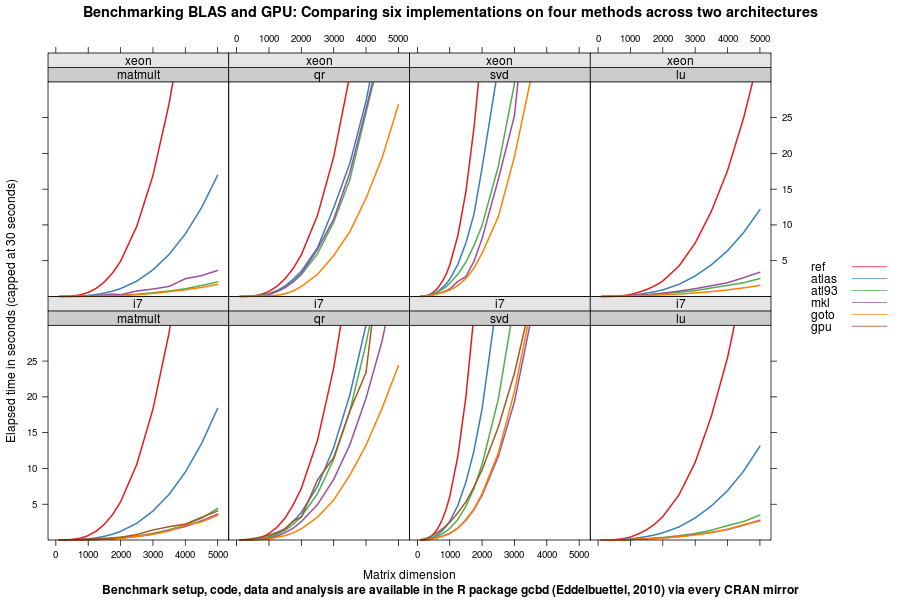
Following up on my initial post announcing gcbd, here is a brief note on a new version. The initial post announced version 0.2.2 which was the first CRAN version of gcbd. I updated to 0.2.3 when I made the aforementioned first blog post about gcbd with the lattice plot of the BLAS and GPU benchmark results across six different implementations (from reference BLAS to two Atlas versions, Goto, MKL and a GPU-based one). There is now a new version 0.2.4 of gcbd on CRAN. I revised the paper ever so slightly based on some more feedback, and focussed the results sections by concentrating on just the log-axes lattice blot and the corresponding lattice plot of raw results---where the y-axis is capped at 30 seconds: GPU/CPU Benchmark Results in levels This chart--in levels rather than using logarithmic axes is done here--nicely illustrates just how large the performance difference can be for for matrix multiplication and LU decomposition. QR and SVD are closer but accelerated BLAS libraries still win. GPUs can be compelling for some tasks and large sizes. More discussion is still available in the paper which is also included in the gcbd package for R.

Next.

Previous.
