Search Results: "beh"

24 August 2010

Gunnar Wolf: Posts explaining DebConf

Just echoing what happens in Planet Debian for people who follow my blog (or any other planet where it is syndicated) and is interested in DebConf processes I'm specially thinking about people interested in preparing a bid for hosting a future DebConf, as well as people organizing hacking conferences who are interesed in understanding how DebConf works: Richard Darst, a.k.a. our very invaluable MrBeige, started a series of posts describing various processes of DebConf organization. He explicitly asked me for comments while this series was still in planning/wiki stage, but I failed miserably at doing so ;-) So at least I'll publicize his work, linking from here:
  1. DebConf and Debian: Introductory message, basically outlining (Richard's view on) the relation between Debian and DebConf. This is not yet a clear thing It seems we are converging on the fact that DebConf *is* part of Debian, but there are several things to clear before it is viewed as a done deal.
  2. Timeline of a DebConf: Running a DebConf as a local team is not (just) becoming crazy for two weeks, leaving life behind ans working hard for having your friends and peers in your hometown. It is an interesting full two year process, with different phases and aspects for the work. Richard has been involved as an organizer for the last two years, and he summarizes the main periods here.
  3. What is the DebConf team?: We talk about the localteam and the globalteam as if those terms make any sense. Then again, we have had people as part of localteam who live in different countries... What does this mean? What are the tasks of the teams? How do you join? What kind of work is expected from you? What is the real difference between the teams, if there is any?
  4. The DebConf selection process: How does the next year's venue selected? How is this "contest" held? When do you have to submit your proposal? How is it ranked/judged/decided? As I have told several people, the first document you should check is always the location checklist (also linked from Richard's text), but having this timeline will surely help you know what to expect.
I don't know if MrBeige is planning further parts for this series; if the past four were interesting, you should check on his weblog.

23 August 2010

Patrick Schoenfeld: Why do I use facebook and co?

Recently I blogged a serious complain about Facebook marketing practices.
I must note, that, while writing this, this is still a standing fact.
And it somehow leads me to the question why I use facebook (and similar portals like Xing or Meinvz at all) at all.

I would say that I'm a person, who values security. Probably I need to, because my job involves security aspects, even if its only to protect data.
Additionally I value privacy. I would never go onto a toilet in a glass case, where everybody could watch me doing my business.
The idea to keep the door to my flat open all the time would trigger all alarm bells inside of me.
But on the other hand I have a blog on which I write about technical topics, and personal topics. Like the death of my grandma or how my neighbours disturb me. And I use Facebook. And MeinVZ.

I'm well aware of how this makes it easier to trace me. How this could be used against me, if I happen to search for a job. Aware of the everlasting memorization of the internet who will keep this.. eventually forever.
And I have friends who have a serious antipathy against this and probably would never use such a portal at all.
So why do I use it?

That I started using that portals were some kind of peer pressure. I'm a person who likes beeing "thereby" and I like beeing present. Many of my friends were already using those portals and so I followed an invitation to use it, too. But I did think about several points:

I came to the conclusion that there are pros and cons for and against using these services. And I found that I can live with the cons due to the convenience they bring to me. And that I could always stop using them.

However: That does not mean that I have to "Eat or die" what they serve.

Oh and on a side note: I found "Facebook, Br ste und die Currywurst" to be an interesting article about the topic. Its a recommended reading, although only for the people who understand German.

21 August 2010

Adnan Hodzic: DebConf10 Summary & DebConf11 invitation

DebConf10 ended 2 weeks ago, I m back in Bosnia and I needed some time to recalculate everything that happened to me in last month Smile This was my third time in NYC, and NYC as a city never left me empty handed, in every possible sense! And am seriously considering option of moving back one day, whether to get my Masters/phD or just do work we ll see what future holds for me Cute DebConf10 I was in organization team for DebConf10, but if you put me aside, what s particularly interesting is that there was a total number of 7 Bosnians on DebConf10, two of which were government officials. I must note this wasn t our complete team, and what s most important of all is that they all pretty much volunteered as much as they could, of course, besides good will to help Debian, but also to at least somehow prepare themselves for organization of DebConf11. It s also worth noting that this was their first DebConf, and I as a leader of the team must say I m proud on how well they performed. I m sure by being highly active in volunteering they have learned as much as they could when it comes to how it s done and were able to see good and bad sides of DebConf10 organization team. Of course, I d also like to thank DebConf10 team for their superb work, perfect Venue selection, their hospitality and being incredibly friendly and helpful to all of us. As I said in one of my lectures, it s kinda unwritten rule that every next DebConf has to top the previous one, and that being said it s going to be almost impossible to compete with this year bid, but being Bosnians we re up for the challenge Wink My DebConf10 Pictures: Semi-private album FaceBook public link (no registration required) DebConf11 DebConf10 was busy period for all of us, but I don t want to start complaining since even though we ve done enormous amounts of work so far, the real challenge lays ahead of us. With DebConf10 behind us, the thing we should process now is it s our turn now, we re next Grin Before anything, I d like to thank Government of Republika Srpska for their full financial support, which was one of the preconditions to even get this bid. With their full support + sponsors, we ll be able to get great amount for sponsorships, for you to come to Banja Luka from the most remote places, and also in case you need visa for them to help you in getting one. Government support is just too precious in any way you want to take it. We would also like to invite you to DebConf11 in Bosnia (Banja Luka) next summer, we also invite all of you to our communication channels (mailing list, irc) since we would really like to get involved as many people as we can. Besides all of you enjoying DebConf11 next year, we would like you to help us in giving directions since we re a young team Nerd Besides Debian people, I d like to invite anyone who think he/she could help, or want to get involved, especially individuals/organizations/LUG from whole region! It s also important to stress that in all of our communication means, we do speak English, so please do not hesitate if you have any sort of question/suggestion/whatever. For those interested in next DebConf11, most important page you should follow is our wiki page, where you can find all information and which we keep updated in timely manner: http://wiki.debconf.org/wiki/DebConf11/BanjaLuka Communication/Links Languages we officially support are: English, Bosnian, Serbian and Croatian Mailing list:
http://lists.debconf.net/mailman/listinfo/debconf11-bosnia IRC:
#debconf11-bosnia on irc.debian.org / irc.oftc.net Twitter:
#debconf11 tag
http://twitter.com/absinthesyringe (shameless self promotion Cool ) Facebook:
Official DebConf11 FaceBook group DebConf10 Adnan Hodzic DebConf11 in Bosnia (Introduction and Invitation):
Lecture video high quality (205mb)

See you next year! Party

20 August 2010

MJ Ray: Respond to the European Consultation on Library RFID

As you may remember, our co-op is working on various RFID (radio tags instead of barcodes, basically) extensions for Koha. One of the main ethical concerns about RFID is privacy if done wrong, it could become quite easy to see what books from which libraries someone has in their bag, without their consent and without physical contact. If borrower cards themselves become RFID-enabled, you might even obtain their personal data pretty easily, although I m not aware of any libraries in practice who put any personal data onto the borrower card tags yet. On 12 May 2009, the European Commission Recommended privacy and data protection in all RFID applications. That was followed by EU Mandate M436 for the European Standards Organisations (ESO) to develop standards to support that recommandation. Phase 1 started last March and has delivered a document RFID-DTR07044v006-draft (PDF). Phase 2 will build on that to produce formal standards for signage, privacy impact assessments and so on. EDItEUR are replying to that draft on behalf of the library sector and have sent me their draft response RFID_LibrarySectorCommentsDTR-07044-1 as a PDF. It s worth opening those two side-by-side to read through. If you can help improve the combined response, please send feedback to the email address in the Library Sector PDF by 6 September. If you d like to make your own response, you have until 15 September to reply to the ESO PDF using their template. By the way, does the ESO PDF look jaggy to anyone else? It looks like ghostscript can t anti-alias the text.

Riku Voipio: (unnofficial) Bits from ARM porters

Quite a few things have happened recently in the Debian/ARM land

ARM and Canonical have generously provided us with bunch of fast armel machines. Four of these are now as buildd's, bringing the total of armel buildd's to 7. In other words, armel should no longer lag behind other architectures when building unstable packages.

One of machines, abel.debian.org has been setup as a porter box. It is faster (around 3x) than the older porterbox (agricola). All Debian Developers have access to the porterboxes.

The new buildds have allowed us to enable more suites. Thanks to Philipp Kerns work, armel builds now experimental, lenny-volatile, lenny-backports as well as unstable/non-free. Especially if you are using stable Debian, access to backports and volatile should make life happier :)

Finally, the next big thing is Hardfloat ARM port, effort being lead by Konstantinos Margaritis. This doesn't mean that the armel port is going away. Majority of ARM cpus sold are still without FPU, so the softloaf port (armel) will still have a long life ahead. Meanwhile, the armhf port will provide a more optimal platform for people with bleeding edge ARM cores (ARMv7 + vfp). Some people have been unhappy with the new proposed new port, and various alternatives have been proposed. However, armhf is currently the only solution being actively worked on.

Update: thank canonical too

19 August 2010

Steve Kemp: You are in a maze of twisty little passages, all alike

Debian package building scripts consist of several inter-related tools, which are documented well with manpages, but not in the code itself. Should you have some free time I urge you to take a peak at the source code of dpkg-buildpackage, debsign, and debuild. They work. They work well, but they're not shining examples of clear code are they? Given that they work, and that they are complex I'm not sure I'm interested in improving things, but I do have a personal desire to run something like:
debuild -sa --output=/tmp/results/
What would that do? Instead of placing the resulting package in the parent directory, which is what we have by default, it would place them in the named directory. However looking over the code I see that there are too many places where "../$file" is hardwired. e.g. Take a look at dpkg-buildpackage and you see:
my $chg = "../$pva.changes";
..
open OUT, '>', $chg or syserr(_g('write changes file'));
If you change that to the simple code below it works - but suddenly debsign fails to find the file:
my $dir = $ENV 'OUTPUT'    "..";
my $chg = $dir . "/" . $pva . ".changes";
Ugh. I guess I can come up with some hack to index files in the parent, run a build process, and move the only new files into place. But that's sleazy at best, and still doesn't solve the problem that we have tools which we rely upon which are .. unfriendly to changes.
I thought I could handle this via:
debuild \
 --post-dpkg-buildpackage-hook="move-changes-contents /tmp/output/ ../%p_%v_ dpkg-architecture -qDEB_HOST_ARCH .changes" \
 --no-tgz-check -sa -us -uc
(Here "move-changes-contents" would read the given .changes file and move both it and the contents listed in it to the specified directory.) Unfortunately %v corresponds to the package version - which isn't the same as the version in the .changes filename. (i.e. epochs are stripped out.)
ObQuote: I am the servant of the power behind the Nothing - The Neverending Story.

18 August 2010

Steve Kemp: As promised a new blogspam.net

A while back I mentioned that I was going to be updating and overhauling the blogspam.net service. That process is now almost complete. A couple of nights ago I overhauled the website, and today I've finally commited my last (planned) change to the repository for the purposes of migration. I started reworking the code a week or so ago, but as of this evening the code in the repository is the code the server is actually running. The previous codebase was functional but a little hasty - and was implemented before I switched to per-UID server-hosting - so there was a need to clean things up and make sure permissions and similar niggles were checked. The new, modular, codebase requires no root access, and will store all state (logs & transient caches) in a clean extensible fasion. The code is also much more flexible making use of Module::Pluggable rather than Class::Pluggable. This allowed me to overhaul the API of the plugins (primarily to add an expire method such that each plugin has a well-defined means to expire any state they may maintain). Module::Pluggable is a great module - allows me to treat plugins as first class objects, which wasn't the case with C::P. Since all the code behind the service is Perl it is also now available on CPAN in addition to the mercurial repository where it is developed.. I see that the server is getting pretty popular these days, used by the likes of embedders.org, publiclive.com, & etc. It doesn't hurt that ikiwiki, identi.ca, and other people include support in their distributions these days. Me? I mostly use it on debian-administration.org where it does a great job. ObQuote: What's the name of that thing that if I eat it real fast, it's free? - Whip It.

17 August 2010

Steve McIntyre: Debian at seventeen

Happy birthday Debian! Thanks to all my fellow Debian contributors for all your work on making the best OS there is. And especially thanks to the people who worked on the birthday surprise for us all yesterday - excellent work! During the couple of years I was DPL, I received messages of thanks on behalf of the project many many times, whether by email or in person. I was happy to accept and pass on a lot of those messages, as I know they mean a lot to people working hard in a volunteer project. Now due to thanks.debian.net, there'a an easier way for people to voice their gratitude directly to the individual people and teams that are working on Debian. Awesome! Although it'd also be nice if we could have the wiki back without balloons now we're after the 16th... *grin* Reminder: if you'd like to share in the birthday celebrations (and the beer!), there's still time to come along to the Debian BBQ I'm hosting at the end of the month in Cambridge, UK. See the OMGWTFBBQ wiki page for more details.

Joey Hess: old house

An old house, theoretically empty, but still filled with the cruft of its history. Here an old classroom-style pencil sharpener mounted on a wall. In a kitchen cabinet, a plastic bag of dried fish of unknown provenance. Old books. Somewhere, a moldering, out of tune piano. How does this make you feel? Maybe depressed, or urgently needing to wipe it all clean and repaint? Myself, as long as the previous inhabitants are people whose heads I don't mind getting into, I like this environment. I will carve out my own part of it, clean and reorganise that, but generally leave the rest as-is.
It's weird that, if we were talking not about houses, but software, I'd probably bulldoze it down, compost it, grow trees from it, and start over.
This house has the added complication of a solar power system that has accreted broken parts and workarounds over the years. So far I don't understand the original design, let alone what it developed into! I'm spending a few days here now just to try to learn how it behaves -- how long can I run my laptop and forgetfully leave lights on before the battery bank reaches unsafe levels? Am I even measuring the level of the right battery bank? (Why does this incoming solar power display still read 21, in the middle of the night?) I haven't been in this situation since spring of 2001. And then I only had to contend with no running water, and dialup. Now I also have to deal with limited power. Interesting times.

16 August 2010

John Goerzen: Family updates

As you probably know from reading my recent blog posts, we spent a week in New York City. Despite some behavior issues from Jacob, it was a good trip. Oliver took his first unassisted step in our hotel room there. As I wrote, the boys both loved the subway. I didn t have as much time to go out and see things as Terah and Oliver did, but I did visit the Cathedral of St. John the Divine, which was near Columbia University, as well as Grand Central Terminal. Both were impressive and worth the visit. When we got home, Jacob stood on our porch teary-eyed and sad. He wanted to go back to New York and ride more subways. He had been all excited about the airplane ride, but it maybe hadn t occurred to him that we were leaving New York for good, not just taking a trip within the city like on the subway. He was mopey for the rest of the day. But he spent a couple of hours spending a little time on many of his favorite activities at home pulling out toys we hadn t taken with us, using his favorite pillow, playing with the cats, or just soaking in being back home. I think he was happy to be home, even though he would deny it. Saturday we had a busy day, and towards suppertime, Jacob requested a picnic. So we had a picnic. It was starting to cool off outside finally, so we ate at the picnic table on our back porch. It was fun to be outside even the keeping the cats off our plates part. (I eventually let them lick the plates after we were done with them.)

Russell Coker: The Gift of Fear

I have just read The Gift of Fear and Other Survival Signals that Protect Us From Violence by Gavin de Becker. Like many self-help books it has a concept that can be described in a paragraph and explained in a few pages. The rest of the book shares anecdotes that help the reader understand the concept, but which are also interesting for people who get it from the first chapter. When I read the book I considered the majority of the content to be interesting stuff added to pad it out to book size because the concept seemed easy enough to get from the start, but from reading some of the reviews I get the impression that 375 pages of supporting material aren t enough to convince some people maybe this is something that you will either understand from the first few chapters or never understand at all. Gavin s writing is captivating, he has written a book about real violent crime in a style that is more readable than many detective novels, from the moment I finished the first chapter I spent all my spare time reading it. I was a little disappointed at the lack of detailed statistics, but when someone has done all the statistical analysis chooses to provide the results in the form of anecdotes rather than statistics I m prepared to tolerate that especially when the anecdotes are so interesting. I spent quite a bit of time reading the Wikipedia pages relating to some of the people and incidents that are mentioned in this book. The basic concepts of his book are to cease worrying about silly things like airline terrorists (passengers won t surrender now so that s not going to work again) and to instead take note of any real fear. For example if you are doing the same things you usually do but suddenly feel afraid then you should carefully consider what you might have subconsciously noticed that makes you feel afraid and what you can do about it. This isn t going to change my behavior much as I have mostly been doing what the book recommends for a long time. I think that everyone should read this book.

10 August 2010

Gunnar Wolf: Back home, back from DebConf And, hopefully, cleaner than ever!

So, DebConf time is over once again. The two weeks worth of fifty weeks waiting are left behind once again, and it's back to get back to normal. DebConf was great Yes, it always is, and that's what we are all saying, but hey - Seriously! Being in the same building than 300 crazed developers is always fun, and it's always better than last year's fun. A good highlight this year is that, given the number of Free Software and Free Culture groups that exist in USA's north-eastern coast, we had the opportunity to join a large crowd which has never been part of DebConf. Also, I must agree that the USA bid for DebConf was aiming to attract as many Debian people (developers, maintainers, or just happy users) which had not yet been to a DebConf before as possible. And it was a great success! I finally met several people I have long read in the mailing lists, in blogs or in IRC. A much higher proportion than usual, I'd venture to say. Another interesting phenomenon /methinks is that this year's DebCamp started much more staffed than usual: I arrived on the first day, Sunday 25, and there were ~40 people there already; I don't have the actual numbers, but we quickly grew, and the number started to stabilize past mid-week, only to (sharply) rise in the weekend, in time for DebianDay and DebConf start. Great time! But, they say, nobody can go to the USA without buying some sweet toys, right? Well, being the proud owner of six very hairy cats, I have thought into entering the looming and weaving industry... But cat hair, while abundant, I have heard is untreadable... Maybe due to the indisciplined, natural and independent personality of the cats (catonality should I say?)... So I had two choices: Clean up my home quite often, or live in a literally hairy mess. Enter choice #3: The Roomba! I had been waiting to buy this thing for several years, as they refuse to send to Mexico or charge Mexican cards. So, I walked across Manhattan and got my very own robot cleaner! For my further surprise, although I have not yet tried it (I don't even have a suitable cable yet), I found this: Yay, the Roomba is actually hackable (via a 7 pin miniDIN serial port)! Wikipedia says that:
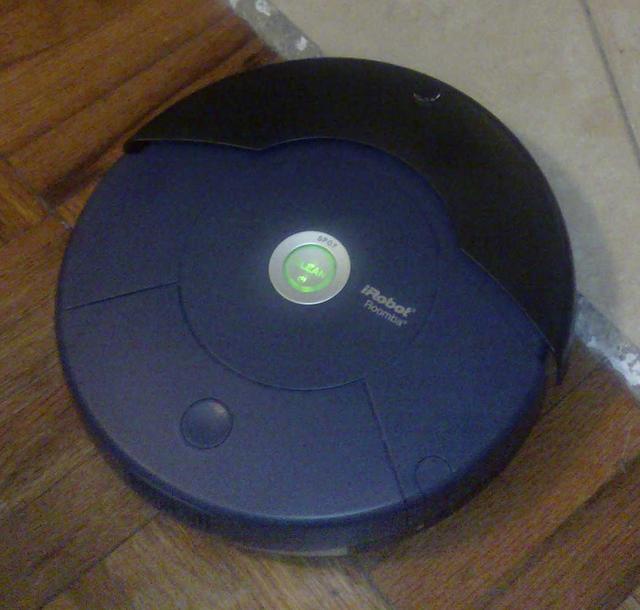
Roomba comes with a Mini-DIN TTL serial interface, which is incompatible with standard PC/Mac serial ports and cables, both electrically and physically. However, third-party adapters are available to access the Roomba's computer via Bluetooth, USB, or RS-232 (PC/Mac serial). New, 500-series, and 410/420 series Roombas upgraded with the OSMO hacker device allow the user to monitor Roomba's many sensors and modify its behavior. The Roomba Open Interface (formerly "Roomba Serial Command Interface") API allows programmers and roboticists to create their own enhancements to Roomba. ( )
My first impressions? Well, the Roomba lazily charged its battery throughout the day today, and was hungry and ready when I arrived home. It is a but louder than what I expected, and of course my cats were not thrilled by the presence of a eighth animated and apparently sentient being at home. Their initial reaction was of course to be verrry alert of the thing. Twelve eyes were constantly pointing at the Roomba while mine alternated between them. As they measured the thing's speed and (I guess) inferred its movement patterns, they started escaping upstairs A flat, round thing with no legs to be seen will not likely be able to climb the stairs. And they were completely right. At first, only Chupchic remained downstairs. After a bit, I went up to show them the Roomba didn't jump on us to eat our brains, and after a bit, Santa and Macusa joined. The Roomba roombed for maybe 90 minutes (this space is large, and decided it was enough... And slowly, the rest of them started coming down. I would not say Roomba's cleaning is perfect, of course. Its room discovery algorithm is funny, and it even seems it's based on the mere chance of covering most (never all) of the space it has to clean. I had, of course, not fully studied it (after a single run, how could I?). It does make a honestly good attempt at cleaning under coaches, chairs and tables. It collected a fair amount of dust (on a house that seemed quite clean to me, I cannot imagine what would happen on a messy one). I have not yet played with the virtual walls (infrared transmitters which limit rooms as if a door was closed), but given the size of this house (and that I don't want it to clean around the cats' designated bathroom area), I guess I will end up using them regularly. During DebConf, I heard one bad (stupid useless noisy thing) and two very good (it has radically changed my life) comments on the Roomba. I hope to shift the balance towards 3/4 and not towards 2/2! Anyways... Thanks to each and every one of you. DebConf is great. Always great. Always a success. I cannot even thank specific teams. Debian Rules, and DebConf Rocks!

9 August 2010

Gustavo Noronha Silva: WebKitGTK+ and the Web Inspector

When I started working on WebKitGTK+ I was a web developer, writing IT applications using Python and Django, and building features for content portals running Plone (argh). Even though I was an Epiphany user ever since it was forked off Galeon, I still had to use Firefox for my work, because I couldn t really live without Firebug. It should come as no surprise, then, that one of my first patches to WebKitGTK+ was actually making the awesome Web Inspector work in our port. After the initial support, though, not a lot has been done to further improve it, partly because it was already good enough for many uses, partly because I somehow started doing non-web development again ;). These last weeks, through my R&D efforts in Collabora, I have been able to push Web Inspector features and integration a bit further. A simple change that boosts the Inspector s usability quite a bit is having the nodes that are being hovered highlighted. Along with that, the ability to attach the inspector to Epiphany s window should make it easier to use for poking the DOM. The Web Inspector has a number of settings that control its behaviour. Since, for instance, enabling javascript debugging may slow down javascript performance, the inspector usually has it disabled by default, and provides a button to enable it. It also provides an option for always enabling that feature, but that does not work right now, because we are not saving/restoring the relevant settings. A solution to that is in the works using the GSettings infrastructure that was recently merged into glib. Here s a simple screencast, showing these improvements in action (click the video to check it out in full size): <video controls="controls" src="http://kov.eti.br/media/webkit/inspector.ogv" width="400"></video>

5 August 2010

Matt Zimmerman: DebConf 10: Day 3

How We Can Be the Silver Lining of the Cloud (Eben Moglen) Eben s talk was on the same topic as his Internet Society talk in February, which I had downloaded and watched some time ago. He challenges the free software community to develop the software to power the freedom box , a small, efficient and inexpensive personal server. Such a system would put users more in control of their online lives, give them better protection for it under the law, and provide a platform for many new federated services. It sounds like a very interesting project, which I d like to write more about. Statistical Machine Learning Analysis of Debian Mailing Lists (Hanna Wallach) Hanna is bringing together her interests in machine learning and free software by using machine learning techniques to analyze of publicly available data from free software communities. In doing so, she hopes to develop tools for studying the patterns of collaboration, innovation and other behavior in these communities. Her methodology uses statistical topic models, which infer the topic of a document based on the occurrence of topical words, to group Debian mailing list posts by topic. Her example analyzed posts from the debian-project and debian-women mailing lists, inferring a set of topics and categorizing all of the posts according to which topic(s) were represented in them. Using this data, she could plot over time the frequency of discussion of each topic, which revealed interesting patterns. The audience quickly zoned in on practical applications for things like flamewar and troll detection. Debian Derivatives BoF (Matt Zimmerman) I organized this discussion session to share perspectives on Debian derivatives, in particular how we can improve cooperation between derivatives and Debian itself. The room was a bit hard to find, so attendance was relatively small, but this turned out to be a plus. With a smaller group, we were able to get acquainted with each other, and everyone participated. Unsurprisingly, there were many more representatives from Ubuntu than other derivatives, and I was concerned that Ubuntu would dominate the discussion. It did, but I tried to draw out perspectives from other derivatives where possible. On the whole, the tone was positive and constructive. This may be due in part to people self-selecting for the BoF, but I think there is a lot of genuine goodwill between Debian and Ubuntu. Stefano Zacchiroli took notes in Gobby during the session, which I expect he will post somewhere public when he has a chance.

4 August 2010

Gerfried Fuchs: The Good, The Bad and The Ugly

Debian always was known for its communication "style". There were even shirts sold in memory of Espy Klecker with a quote he is known for: Morons. I'm surrounded by morons. Yes, I bought me one of those shirts too in the early days. And there were the talks that promoted Debian as a place to have Good flamewar training. And people considered that to be the fun part. After some years it got tiring. It got stressful. It got annoying. Bad feelings popped up, stirred you into the next flamewar, and it went down the gutter from there. It was almost becoming impossible to not be the target of a flamewar when one was doing more than just basic maintenance. Snide and extreme terse responses became the standard. In the end people are starting to give up and leave. The Ugly thing about this is that human resources are crucial. They aren't endless and can't be replaced as easily as broken hardware, especially when capable people or when people leave who invested an enormous amount of their spare time and effort. And given that a fair amount of people do put their heart into Debian, it feels like a small suicide to them and the public thinking about leaving is meant as a call for help which wasn't and isn't given. The solution to this death swirl? I'm not sure. When one looks over the edge of the plate and ignores for a moment all the bad feelings they one might have built up against Ubuntu because of their success and possibility to find new contributors on a regular basis one is able to find a much friendlier and productive environment there. This might be attributed to the Code of Conduct about which I wrote about last year already and which is an extremely well intended and useful document (the point I raised in there is already solved for a while, so I became a MOTU). And even if it might be hard to follow it at times, Mark Shuttleworth reminds and encourages its contributors to stick to these principles even in tough times. The result? When following the planets, one finds on Planet Ubuntu a very good rate of blog posts on things that had been done, compared to the good rate of blog posts of rants on Planet Debian. And even though people regularly complain about the communication style within Debian, the answers of this year's DPL candidates to the question about a code of conduct for Debian were rather rather disappointing. So it is just well too understandable that people go the path that hurts themself, take a cut and leave the project behind in its mess. For myself? I'm not too far from that point on a regular basis, and I can understand those who did the final step only too well. Regular abuse, especially when doing stuff that others neglect on a regular basis but needs to be done anyway, being belittled on that grounds and not being taken serious and getting disrespectful responses isn't improving the situation. It happens to way too many people, and the only thing that still keeps me on tracks is that I do not want to give in yet, that I don't think that it would improve Debian to leave the grounds to various destructive people. On the other hand, there is only so much abuse one can take...
ObTitle: Ennio Morricone - The Good, The Bad and The Ugly

/debian permanent link Comments: 5

Gerfried Fuchs: The Good, The Bad and The Ugly

Debian always was known for its communication "style". There were even shirts sold in memory of Espy Klecker with a quote he is known for: Morons. I'm surrounded by morons. Yes, I bought me one of those shirts too in the early days. And there were the talks that promoted Debian as a place to have Good flamewar training. And people considered that to be the fun part. After some years it got tiring. It got stressful. It got annoying. Bad feelings popped up, stirred you into the next flamewar, and it went down the gutter from there. It was almost becoming impossible to not be the target of a flamewar when one was doing more than just basic maintenance. Snide and extreme terse responses became the standard. In the end people are starting to give up and leave. The Ugly thing about this is that human resources are crucial. They aren't endless and can't be replaced as easily as broken hardware, especially when capable people or when people leave who invested an enormous amount of their spare time and effort. And given that a fair amount of people do put their heart into Debian, it feels like a small suicide to them and the public thinking about leaving is meant as a call for help which wasn't and isn't given. The solution to this death swirl? I'm not sure. When one looks over the edge of the plate and ignores for a moment all the bad feelings they one might have built up against Ubuntu because of their success and possibility to find new contributors on a regular basis one is able to find a much friendlier and productive environment there. This might be attributed to the Code of Conduct about which I wrote about last year already and which is an extremely well intended and useful document (the point I raised in there is already solved for a while, so I became a MOTU). And even if it might be hard to follow it at times, Mark Shuttleworth reminds and encourages its contributors to stick to these principles even in tough times. The result? When following the planets, one finds on Planet Ubuntu a very good rate of blog posts on things that had been done, compared to the good rate of blog posts of rants on Planet Debian. And even though people regularly complain about the communication style within Debian, the answers of this year's DPL candidates to the question about a code of conduct for Debian were rather rather disappointing. So it is just well too understandable that people go the path that hurts themself, take a cut and leave the project behind in its mess. For myself? I'm not too far from that point on a regular basis, and I can understand those who did the final step only too well. Regular abuse, especially when doing stuff that others neglect on a regular basis but needs to be done anyway, being belittled on that grounds and not being taken serious and getting disrespectful responses isn't improving the situation. It happens to way too many people, and the only thing that still keeps me on tracks is that I do not want to give in yet, that I don't think that it would improve Debian to leave the grounds to various destructive people. On the other hand, there is only so much abuse one can take...
ObTitle: Ennio Morricone - The Good, The Bad and The Ugly

/debian permanent link Comments: 8 Flattr this

Tim Retout: For future reference

I have a relatively new laptop, and have spent some time today fixing some of the rough edges in my setup. (One day I'll throw all the config files into git, or something, but not yet.)

1 August 2010

Rapha&#235;l Hertzog: First Flattr FOSS Suggestions

Flattr FLOSS LogoThe Flattr FOSS project is quite young so very few free software are currently listed in the dedicated directories. It s still advocacy time: if there are free software that you d like to flattr, please tell them and point them to Flattr FOSS. It s too early for any conclusion, but the feedback from users is good and it looks like that people using flattr to support free software are more generous than the average flattr user. You re great people! :-) Anyway, it s time for me to give a few suggestions of projects to flattr.
  1. My first recommendation is Project Hamster, it s a time-tracking application for GNOME but it has come a long way thanks to the work of Toms Bau is. I use everyday and it rocks.
  2. My second recommendation is verallt, it s a Firefox extension that allows usage of Flattr even in places where it was not designed to be used: forums, mailing list archives, etc. The persons using Flattr just put [Flattr=20693] in their signature and the Firefox extension automatically replaces this text with a real Flattr button ready to be clicked. Thanks to Paul Da Silva for the nice idea and the first implementation!
  3. My third recommendation is Mustard, it s a StatusNet client for the Android platform. More concretely you can install it on your Android phone to send updates to identi.ca while traveling. I have no Android phone but Mustard seems to be popular among owners of such phones!
  4. My fourth recommendation is moreutils from Joey Hess. It s set of unix (command line) tools that nobody else thought of writing when unix was young (according to Joey himself). They are all very useful, I use more or less regularly isutf8 (verify if a file is UTF-8 compliant), combine (logical operations on lines of two files), pee (send standard input to two programs, very useful in git hooks when you want to run two programs that both consume the same data), sponge (ever tried grep -v foo file >file and lost your data? now you can use grep -v foo file sponge file ). And Joey is a long time Debian developer who has truly shaped Debian, he s behind several major Debian projects (debconf, debian-installer, debhelper, ). Big kudos to him!
  5. My last recommendation is to flattr Andreas Gohr for his work as dokuwiki lead developer. There s no flattr button on dokuwiki s website but you ll find some in Andreas blog, just pick a dokuwiki related article like this one: Dokuwiki Birthday Bughunting Weekend. Dokuwiki is a simple wiki that works without any database (the pages are stored in flat files) and it s even commonly used to setup simple websites thanks to the numerous themes available.
Okay, that s it for this month. I ll try to keep a broad panel of software (desktop, command line, mobile, web, etc.). Since I have promoted a GNOME desktop application, I would like to be able to promote a KDE or XFCE application next month but I did not discover any KDE/XFCE project using Flattr do you know any? Please share in the comments if you find some. Also I wonder if you have decided of a flattr strategy Personally I m likely to flattr my favorites projects/persons each month and to flattr a few other occasionally as I discover them. What s your own strategy? Flattr this Share/Bookmark 4 comments Support my work

31 July 2010

Aigars Mahinovs: Debcamp 10 the early days

After I finished an re-read my epic post describing my first day and a half at Debconf10 I suddenly realised that if I continue to describe the rest of 13 days here in such style and verbosity this would become a book, a boring one at that, so I decided to limit myself to 2 posts for Debcamp and then a post a day for the Debconf. But about the first half of the Debcamp week there are things that are as usual and there are things that are not. Let s start with the usual bits: more people arriving every day, evening parties are getting more and more fun and wild (or so people say) and the Internet and power at the hacklabs magically becomes more and more reliable day by day, the cabling mess grows organically trying to spread out evenly and not overload any individual socket, extension cords with non-local plugs appear and spread the load some more, people stress out, volunteer, crash out and repeat. All in all nothing can stop the freight train of few hundred Debian developers determined to have fun. With out own DFSG-free definition of fun. (But this year we appear to be running very close to the edge on volunteers if we run out of those, there will be a train-wreck, so please volunteer!) Now off to the unusual stuff. The City is well it is cool and very, very impressive. It is not terribly different to me at least I am used to such structure of the city: grid based layout of the downtown city (with some parks) and then branching out to separate, but different across-the-river districts and then sprawling out to slightly chaotic suburbs. Riga is very much like New York in the design. The difference is that New York is 10-20 times larger: the areas are 10 times larger, the buildings are 3-4 times higher on average, the streets are 2-3 times wider and yet have more traffic and there are far, far more shops, shows and restaurants. Also there is the subway. It is a great thing in that it hides the size of the city take a bus downtown once, to find out what I mean it takes ages to drive the distance that takes 20 minutes on the subway. I like this city, I am getting a feeling, that I could live here without much problem for me. So far I ve only had this feeling in Riga and Berlin. On the other hand this is USA. I ve so far only encountered one bad thing about it, but it is a pretty big one food. Basically all food that I ve tried so far in the USA has been crap. It was tasty salt, sugars and fat took care on my brain thinking it s food, but underneath that it was pretty crap: there was no texture, no content, no soul. The John Jay cafeteria where we are eating lunch and dinner is better than the most other options, because it is an all-you-can-eat buffet where you can choose your poison and it was also the place where I had the best piece of food in USA so far a slice of pepperoni pizza, that had a bit of taste behind the fat. Also, surprisingly, the fast food options (McDonalds, Burger King, ) are better than the equivalents in Europe, far better. In fact the fast food is cheap and in some cases tastes better than regular food, so there is no wonder why people might prefer it in some situations. So it is easy to see how people just accept shoving bland fast food or bland all-you-can-eat food into their mouths and not think much about it and thus become fat and put undue stress on their health. I expect the average weight of Debian developers to increase by 5 kg by the end of the conference. If you want to prove me wrong, running with bubulle would help you a lot with that. Events downtown. New York is a huge city with a lot of events going on every day, so everyone should be able to find something of interest for them. For me it was the free tickets for tapeings of The Daily Show and The Colbert Report. I got into both of those and for me The Colbert Report was by far the better experience. For one you can not get into Daily Show without a ticket (some tickets show up on the web site on the morning of the shoot around 11am), while 18 people from the stand-by list at Colbert Report got in. At The Daily Show you stand in a live line with ticket holders in one line and stand-by line separate. If you have tickets and arrive around 3pm you should be fine any later than that and you risk to be standing outside even with a ticket. You find that out around 4.30pm when they hand out physical tickets you have one, you get in. If not you might rush over to Colbert Report where a more humane system is used a staffer takes down your name and email on a numbered list and then you can walk around until 5.30pm then they let the ticket holders in and after that call the names of stand-by people that get in. The Colbert Report studio is brighter, more colourful and closer to the action, also it is very rare that cameras block the view from the audience (which is common on The Daily Show). It might have also been my luck when I got on the most boring The Daily Show episode I can remember, ever. The best joke was a woman asking John is she could get a ticket for her friend in August. The warm-up act and crowd control at The Colbert Report was also way better: Colbert staff was hyper, security was ever-present, warm-up was funnier and very engaging (he grilled me for several minutes and I replied making the audience laugh very hard explaining that Latvia was like India of Eastern Europe in regards to IT exports) and Colbert himself was very gracious talking to us out-of-character before the show for a good 10 minutes. Location, location, location. The talk rooms and event rooms and hacklabs are spread out across multiple buildings and there is a lot of other activities going on in those buildings besides Debconf, so moving between place might be confusing for the first day or two. Also the rooms are quite dark that might cause a noise problem for me and the video team as we ll have to up the sensitivity settings on our gear. The video team is working on fixing that by throwing a bit more light on to the speakers. Elevators are wicked fast, but can also be confusing, because the ground floor is on a different number for different buildings it can be G, 1 or even 4. Usually on campus there is a star next to the level with the exit. The dorms. I am in the Carman building and it looks like its interior has not been updated since it was built large ceramic bricks with very visible gaps (for the interior walls), raise-to-open windows, huge aircon fans that take up the whole bottom of the window, plumbing from the 60ies (at least). The security is weird on one hand you have to give your room card to the guard when entering the building, but on the other hand the room cleaning crew can simply forget to close your door after they are done. Like this Thursday I returned to the dorm just before lunch only to find the door of my room open. No one was around and nothing was missing, but it s still worrying. In any case I am steadily uploading photos from Debconf 10 to my Flickr page and new stuff should show up every day.

30 July 2010

Lucas Nussbaum: Debcamp+Debconf again!

As I did since 2007, I will be attending Debconf again this year. I have been quite busy recently, and am lagging behind in some of my Debian work, so I plan to use Debconf to get stuff done, not just socialize and attend talks. Here is my TODO list, basically by order of willingness to do the work . It s probably too much for 9 days, so don t hesitate to talk to me if you want to help with some items.

Next.

Previous.