
Search Results: "bab"

21 December 2013

Daniel Kahn Gillmor: Kevin M. Igoe should step down from CFRG Co-chair

I've said recently that pervasive surveillance is wrong. I don't think anyone from the NSA should have a leadership position in the development or deployment of Internet communications, because their interests are at odds with the interest of the rest of the Internet. But someone at the NSA is in exactly such a position. They ought to step down. Here's the background: The Internet Research Task Force (IRTF) is a body tasked with research into underlying concepts, themes, and technologies related to the Internet as a whole. They act as a research organization that cooperates and complements the engineering and standards-setting activities of the Internet Engineering Task Force (IETF). The IRTF is divided into issue-specific research groups, each of which has a Chair or Co-Chairs who have "wide discretion in the conduct of Research Group business", and are tasked with organizing the research and discussion, ensuring that the group makes progress on the relevant issues, and communicating the general sense of the results back to the rest of the IRTF and the IETF. One of the IRTF's research groups specializes in cryptography: the Crypto Forum Research Group (CFRG). There are two current chairs of the CFRG: David McGrew <mcgrew@cisco.com> and Kevin M. Igoe <kmigoe@nsa.gov>. As you can see from his e-mail address, Kevin M. Igoe is affiliated with the National Security Agency (NSA). The NSA itself actively tries to weaken cryptography on the Internet so that they can improve their surveillance, and one of the ways they try to do so is to "influence policies, standards, and specifications". On the CFRG list yesterday, Trevor Perrin requested the removal of Kevin M. Igoe from his position as Co-chair of the CFRG. Trevor's specific arguments rest heavily on the technical merits of a proposed cryptographic mechanism called Dragonfly key exchange, but I think the focus on Dragonfly itself is the least of the concerns for the IRTF. I've seconded Trevor's proposal, and asked Kevin directly to step down and to provide us with information about any attempts by the NSA to interfere with or subvert recommendations coming from these standards bodies. Below is my letter in full:
From: Daniel Kahn Gillmor <dkg@fifthhorseman.net>
To: cfrg@ietf.org, Kevin M. Igoe <kmigoe@nsa.gov>
Date: Sat, 21 Dec 2013 16:29:13 -0500
Subject: Re: [Cfrg] Requesting removal of CFRG co-chair
On 12/20/2013 11:01 AM, Trevor Perrin wrote:
> I'd like to request the removal of Kevin Igoe from CFRG co-chair.
Regardless of the conclusions that anyone comes to about Dragonfly
itself, I agree with Trevor that Kevin M. Igoe, as an employee of the
NSA, should not remain in the role of CFRG co-chair.
While the NSA clearly has a wealth of cryptographic knowledge and
experience that would be useful for the CFRG, the NSA is apparently
engaged in a series of attempts to weaken cryptographic standards and
tools in ways that would facilitate pervasive surveillance of
communication on the Internet.
The IETF's public position in favor of privacy and security rightly
identifies pervasive surveillance on the Internet as a serious problem:
https://www.ietf.org/media/2013-11-07-internet-privacy-and-security.html
The documents Trevor points to (and others from similar stories)
indicate that the NSA is an organization at odds with the goals of the IETF.
While I want the IETF to continue welcoming technical insight and
discussion from everyone, I do not think it is appropriate for anyone
from the NSA to be in a position of coordination or leadership.
----
Kevin, the responsible action for anyone in your position is to
acknowledge the conflict of interest, and step down promptly from the
position of Co-Chair of the CFRG.
If you happen to also subscribe to the broad consensus described in the
IETF's recent announcement -- that is, if you care about privacy and
security on the Internet -- then you should also reveal any NSA activity
you know about that attempts to subvert or weaken the cryptographic
underpinnings of IETF protocols.
Regards,
	--dkg
I'm aware that an abdication by Kevin (or his removal by the IETF chair) would probably not end the NSA's attempts to subvert standards bodies or weaken encryption. They could continue to do so by subterfuge, for example, or by private influence on other public members. We may not be able to stop them from doing this in secret, and the knowledge that they may do so seems likely to cast a pall of suspicion over any IETF and IRTF proceedings in the future. This social damage is serious and troubling, and it marks yet another cost to the NSA's reckless institutional disregard for civil liberties and free communication. But even if we cannot rule out private NSA influence over standards bodies and discussion, we can certainly explicitly reject any public influence over these critical communications standards by members of an institution so at odds with the core principles of a free society. Kevin M. Igoe, please step down from the CFRG Co-chair position. And to anyone (including Kevin) who knows about specific attempts by the NSA to undermine the communications standards we all rely on: please blow the whistle on this kind of activity. Alert a friend, a colleague, or a journalist. Pervasive surveillance is an attack on all of us, and those who resist it are heroes.

Niels Thykier: Getting out of the way

I have decided to step down as main maintainer of Lintian and pass the baton to Bastien Roucari s. This is actually fairly old news, since I announced this almost a month ago. However, I was not very vocal about it until now (so do not be surprised if you had not heard of this before). In the past month, I never once regretted having stepped down. If anything, I should probably have done it a bit earlier. Beyond the lack of motivation, I also realised that I had become an all talk and no do -maintainer. The kind that I have been advocating against publicly. This may sound weird to a lot of people, who knows me as the Lintian guy or Mr. Lintian (or whatever Lintian-related nickname people gave me). But the fact is that Bastien has done more for Lintian in the past month than I have in the past two. Despite stepping down as main developer, I have not left Lintian completely. I am still around for helping/explaining, uploading and keeping lintian.debian.org running.

Christian Perrier: [life] Running update December 21st 2013

Last time I blogged about my running activities was after DebConf 13 in Switzerland, back in August. At that time, I just completed two great moutain races in one month (Mont-Blanc Marathon, then EDF Cenis Tour, one being 42km and 2500m positive climb and the other one being 50km and 2700m). EDF Cenis Tour was my best result overall in a trail race, being ranked 40th out of more than 300 runners and 3rd in my age category (men 50-59). So, in late August, I was preparing for my "autumn challenge", a succession of 3 long distance races in a row: Quite a challenge, indeed, to run 3 long distance events in a row, with only 3 weeks between them. Preparation for all this was mostly piling up kilometers over kilometers. First in road and flat training, when the goal was the marathon. So, after piking to 471 kilometers in August (more than 15km/day), I ran 452 in September and again 420 in October. During that preparation, I also broke my personal best in half-marathon, down to 1h34. I therefore was perfectly fit for the Toulouse Marathon and, indeed, unsurprisingly, I achieved my first goal by breaking my personal best down to.....3h25' and a few seconds. Really a great achievement and something that gives me a little hope of being able to qualify for Boston Marathon (though chances are a bit low again: I can apply because I'm below 3h30 but the chances that I get a seat are not very big). Recovery from the marathon was easy, thanks to the big preparation and then the second race came very quickly: Le Puy-Firminy. My third participation to this night race, organised by a cousin of mine. I completed the first one in 9h15....then, last year, the second one in 8h25. And, this year, well......7h15 and 26th out of over 200 runners. Huge, great and stunning performance for me, really. Everything went so well that I can't remember any moment where I had any doubt. And I will indeed remember the last kilometer ran along with my sister (who is also a runner) and where she.....couldn't follow me while I was sprinting at about 14km/h after 68 kilometers. Definitely my best race this year. And then came the last challenge: Saint lyon. If you never saw it, you have no idea. While Le Puy-Firminy features 200 runners and 150 walkers over 68 kilometers, this one features 6000 runners for 75 kilometers. Six THOUSAND. The vision of a light snake, kilometers long, over the hills in St-Etienne neighbourhood, was stunning. Moreover, we ran that one, with snow, ice and cold (down to -10 C at the highest point of the race). So, here, the goal was running with my friend and share the joy of the race with her, all along...and eventually beat her personal best on this race (11h15 last year, while the race was 5km shorter). We made it really well, despite the crowd and the fact that it doesn't allow running one's real speed. Despite the ice and snow that makes downhills really.....interesting. Despite dolors I had in my legs at the end of the race. We completed the race in 10h38, quite away from our secret goal (9h30) but that one was really ambitious...:-). And we crossed the finish line together, hand in hand, for the third time of our running life. And we shared tears at the end of the race. And we shared many great moments over that week-end. Moments that let one remember what the definition of "friendship" is. I found my "running sister" in Sabine and this is something we really appreciate and is hard to explain. All this would make a great conclusion if.....I hadn't injured my leg with this accumulation. Indeed, as one might expect after such a hard challenge, I discovered during the days that followed the last race, that I have a fatigue fracture on my left tibia. As a consequence, I need to stop running for about 6 weeks....which you can understand is kinda hard for me. But, guess what? I'm allowed to bike...:-). So, well, I repaired my old moutain bike and now, I'm biking instead of running...:-) Finally, 2013 has been my greatest running year, again. 4700 kilometers ran over the year, nearly 13km/day in average. 14 races (3 road races and 11 trail races). 463 hours spent running and 72,000meters climbed (about 8 Sagarmatha, aka Everest, climbed). 2 Personal Best performances. 2 long distance races which I ran in more than 1 hour less then last year. 2 new moutain races. And first running injury...:-) 2014 will be different. I will run again some races I alreay ran such as Paris 80km Ecotrail or Le Puy Firminy (4th time in a row). But I also hope to be able to run one of the Ultra Tour du Mont-Blanc races in late August in Chamonix (need to be picked up at the bib lottery for this to happen). And probably some other interesting challenges such as running the Paris Marathon dressed as SpongeBob....one week after running the 80km Ecotrail....:-) But you'll see that in my next running update, of course. Merry New Year and Happy Christmas!

Christian Perrier: So, what's up with bubulle in Debian?

This is the end of the year and time for me to look back and summarize what happened to my Debian life during 2013. In short, it clearly seems that this year is the "year after peak of involvment" year. Up to 2010 included, my involvment in Debian constantly increased. 2011 and 2012 have seen some kind of stagnation with still some high involvment in some areas (i18n obviously, DebConf-related stuff, font packaging...) but already some reduction in others (D-I for instance...where the overall involvment of Debian developers is nos quite low, Kibi excepted). But, clearly, in 2013, something changed. And, indeed, it's easy to see what happened. In 2007, I started to motivate myself to resume my practice of sports (I used to be a well-trained volleyball player back in 80's) and I started running. More and more and more and more. 992km in 2008, 1700km in 2009 (and my first marathon), 2200km in 2010 (and my first ultras), 2500km in 2011 (and my first 80km), 2900km in 2012 (and more ultras) and....about 4700km in 2013 (with many many firsts). What changed is now obvious. Running and sports (and related activites such as a lot of socializing with other runners) took over free software activities. Last summer and autumn made it clear, indeed. While I was attending my 10th DebConf in a row (I think we're very few people to have achieved this), it was not my summer's "peak". I spent some great time in Switzerland, still enjoyed a lot meeting again with old and new friends from all over the world. I did some good hacking and achived quite some good things over there. But, still, that was not what I will keep from this summer because.....I had two great moutain races in July and August and *this* is what I'll keep. So, here we are: I'm reducing my involvment in Debian, obviously. Some things are handed over to other people, formally or informally. Some other things will indeed wait for someone to pick them up....or might slowly die as it sometimes happens in this project. I will very probably not attend DebConf14 in Portland even though I have been among the people who were enthusiastic when we picked that bid. But the dates conflict with the Ultra Tour du Mont-Blanc races in Chamonix, where I'll hopefully try to complete my first "over 100km" race in moutains. I will probably decline being part of the Debconf bids team for DC15 as well as the sponsoring team. I nearly stopped working on Samba packages and will not attend SambaXP in May. That's my challenge now. I don't want to completely quit this project and it's indeed harder than it seems, when one's involvment is going down. I'm currently trying to find the right balance to still stay involved in what has been a great part of my life in the last 15-20 years. For instance, I'll try to successfully mentor two applicants from the Outreach Program for Women. Or still continue to work occasionnally on font packages. Or still continue to manage D-I i18n. But you'll be seeing (and hearing) me less. The challenge is to still continue seeing and hearing me about Debian and free software and it's indeed less easy than it seems. I hope I'll succeed.

20 December 2013

Riku Voipio: Replicant on Galaxy S3

I recently got my self and Galaxy S3 for testing out Replicant, an android image made out of only open source components. Why Galaxy S3? It is well supported in Replicant, almost every driver is already open source. The hardware specs are acceptable, 1.4Ghz quad core, 1GB ram, microsd, and all the peripheral chips one expects for a phone. Galaxy S3 has sold insanely (50 million units supposedly), meaning I won't run out of accessories and aftermarket spare parts any time soon. The massive installed base also means a huge potential user community. S3 is still available as new, with two years of warranty. Why notWhile the S3 is still available new, it is safe to assume production is ending already - 1.5 year old product is ancient history in mobile world! It remains to be seen how much the massive user base will defend against the obsolescence. Upstream kernel support for "old" cpu is open question, replicant is still basing kernel on vendor kernel. Bootloader is unlocked, but it can't be changed due to trusted^Wtreacherous computing, preventing things like boot from sd card. Finally, not everything is open source, the GPU (mali) driver while being reverse engineered, is taking it's time - and the GPS hasn't been reversed yet. Installing replicant Before install, from the original installation, you might want to take a copy of firmware files (since replicant won't provide them). enable developer mode on the S3 and:
sudo apt-get install android-tools
mkdir firmware
adb pull /system/vendor/firmware/
adb pull /system/etc/wifi
After then, just follow official replicant install guide for S3. If you don't mind closed source firmwares, post-install you need to push the firmware files back:

adb shell
mount -o remount,rw /system
adb push . /system/vendor/firmware
Here was my first catch, the wifi firmwares from jelly bean based image were not compatible with older ICS based replicant. Using replicant
Booting to replicant is fast, few seconds to the pin screen. You are treated with the standard android lockscreen, usual slide/pin/pattern options are available. Basic functions like phone, sms and web browsing have icons from the homescreen and work without a hitch. Likewise camera seems to work, really the only smartphone feature missing is GPS. Sidenote - this image looks a LOT better on the S3 than on my thinkpad. No wonder people are flocking to phones and tablets when laptop makers use such crappy components.
The grid menu has the standard android AOSP opensource applications in the ICS style menu with the extra of f-droid icon - which is the installer for open source applications. F-droid is it's own project that complements replicant project by maintaining a catalog of Free Software.
F-droid brings hundreds of open source applications not only for replicant, but for any other android users, including platforms with android compatibility, such as Jolla's Sailfish OS. Of course f-droid client is open source, like the f-droid server (in Debian too). F-droid server is not just repository management, it can take care of building and deploying android apps.
The WebKit based android browser renders web sites without issues, and if you are not happy with, you can download Firefox from f-droid. Many websites will notice you are mobile, and provide mobile web sites, which is sometimes good and sometimes annoying. Worse, some pages detect you are android and only offer you to load their closed android app for viewing the page. OTOH I am already viewing their closed source website, so using closed source app to view it isn't much worse. This keyboard is again the android standard one, but for most unixy people the hacker's keyboard with arrow buttons and ctrl/alt will probably be the one you want. Closing thoughts While using replicant has been very smooth, the lack of GPS is becoming a deal-breaker. I could just copy the gpsd from cyanogen, like some have done, but it kind of beats the purpose of having replicant on the phone. So it might be that I move back to cyanogen, unless I find time to help reverse engineering the BCM4751 GPS.

Matthew Palmer: I am officially smarter than the Internet

Yes, the title is just a scootch self-aggrandising, but I m rather chuffed with myself at the moment, so please forgive me. It all started with my phone (a regular Samsung Galaxy S3) suddenly refusing to boot, stuck at the initial splash screen ( Samsung Galaxy SIII GT-I9300 ). After turning it off and on again a few times (I know my basic problem-solving strategies) and clearing the cache, I decided to start looking deeper. In contrast to pretty much every other Android debugging experience ever, I almost immediately found a useful error message in the recovery system:
E:Failed to mount /efs (Invalid Argument)
Excellent! , thought I. An error message. Google will tell me how to fix this! Nope. The combined wisdom of the Internet, distilled from a great many poorly-spelled forum posts, unhelpful blog posts, and thoroughly pointless articles, was simple: You re screwed. Send it back for service. I tried that. Suffice it to say that I will never, ever buy anything from Kogan ever again. I have learnt my lesson. Trying to deal with their support people was an exercise in frustration, and ultimately fruitless. In the end, I decided I d have some fun trying to fix it myself after all, it s a failure at the base Linux level. I know a thing or two about troubleshooting Linux, if I do say so myself. If I really couldn t fix it, I d just go buy a new phone. It turned out be relatively simple. Here s the condensed version of my notes, in case someone wants to follow in my footsteps. If you d like expansion, feel free to e-mail me. Note that these instructions are specifically for my Galaxy S3 (GT-I9300), but should work with some degree of adaptation on pretty much any Android phone, as far as I can determine, within the limits of the phone s willingness to flash a custom recovery.
  1. Using heimdall, flash the TeamWin recovery onto your phone (drop into download mode first hold VolDown+Home+Power):
    heimdall flash --recovery twrp.img
    
  2. Boot into recovery (VolUp+Home+Power), select Advanced -> Terminal , and take an image of the EFS partition onto the external SD card you should have already in the phone:
    dd if=/dev/block/mmcblk0p3 of=/external_sd/efs.img
    
  3. Shutdown the phone, mount the SD card on your computer, then turn your EFS partition image into a loopback device and fsck it:
    sudo losetup -f .../efs.img
    sudo fsck -f /dev/loop0
    
    With a bit of luck, the partition won t be a complete write-off and you ll be able to salvage the contents of the files, if not the exact filesystem structure. Incidentally, if the filesystem was completely stuffed, you could get someone else s EFS partition and change the IMEI and MAC addresses and you d probably be golden, but that would quite possibly be illegal or something, so don t do that.
  4. Now comes the fun part putting the filesystem back together. After fscking, mount the image somewhere on your computer:
    mount /dev/loop0 /mnt
    
    In my case, I had about a dozen files living in lost+found, and I figured that wasn t a positive outcome. I did try, just in case, writing the fsck d filesystem image back to the phone, in the hope that it just needed to mount the filesystem to boot, but no dice. Instead, I had to find out where these lost soul^Wfiles were supposed to live. Luckily, a colleague of mine also has an S3 (the ever-so-slightly-different GT-I9300T), and he was kind enough to let me take a copy of his EFS partition, and use that as a file location template. Using a combination of file sizes, permissions/ownerships, and inode numbers (I knew the -i option to ls would come in handy someday!), I was able to put all the lost files back where they should be.
  5. Unmount all those EFS filesystems, losetup -d /dev/loop0, and put the fixed up EFS partition image back onto your SD card for the return trip to the phone.
  6. Now, with a filesystem image that looks reasonable, it s time to write it back onto the phone and see what happens. Copy it onto the SD card, boot up into recovery again, get a shell, and a bit more dd:
    dd if=/external_sd/efs.img of=/dev/block/mmcblk0p3
    
  7. With a bit of luck, your phone may just boot back up now. In my case, I d done so many other things to my phone trying to get it back up and running (including flashing custom ROMs and what have you) that I needed to flash Cyanogen, boot it, and wait at the boot screen for about 15 minutes (I shit you not, 15 minutes of Gah is my phone going to work?!? ) before it came up and lo! I had a working phone again. And about 27 SMSes. Sigh, back to work
So, yeah, neener-neener to the collected wisdom of the tubes. I fixed my EFS partition, and in the great, grand scheme of things, it wasn t even all that difficult. For any phone which (a) allows you to flash a custom recovery and (b) you can find another of the same model to play with, EFS corruption doesn t necessarily mean a fight with tech support. Incidentally, if you happen to have an S3 exhibiting this problem, but you re not comfortable fiddling with it, I m happy to put your EFS back together again if you pay shipping both ways. It s about a 5 minute job now I know how to do it. E-mail me.

16 December 2013

Erich Schubert: Java Hotspot Compiler - a heavily underappreciated technology

When I had my first contacts with Java, probably around Java 1.1 or Java 1.2, it felt all clumsy and slow. And this is still the reputation that Java has to many developers: bloated source code and slow performance.
The last years I've worked a lot with Java; it would not have been my personal first choice, but as this is usually the language the students know best, it was the best choice for this project, the data mining framework ELKI.
I've learned a lot on Java since, also on debugging and optimizing Java code. ELKI contains a number of tasks that require a good number chrunching performance; something where Java particularly had the reputation of being slow.
I must say, this is not entirely fair. Sure, the pure matrix multiplication performance of Java is not up to Fortran (BLAS libraries are usually implemented in Fortran, and many tools such as R or NumPy will use them for the heavy lifting). But there are other tasks than matrix multiplication, too!
There is a number of things where Java could be improved a lot. Some of this will be coming with Java 8, others is still missing. I'd particularly like to see native BLAS support and multi-valued on-stack returns (to allow intrinsic sincos, for example).

In this post, I want to emphasize that usually the Hotspot compiler does an excellent job.
A few years ago, I have always been laughing at those that claimed "Java code can even be faster than C code"; because the Java JVM is written in C. Having had a deeper look at what the hotspot compiler does, I'm now saying: I'm not surprised that quite often, reasonably good Java code outperforms reasonably good C code.
In fact, I'd love to see a "hotspot" optimizer for C.
So what is it what makes Hotspot so fast? In my opinion, the key ingredient to hotspot performance is aggressive inlining. And this is exactly why "reasonably well written" Java code can be faster than C code written at a similar level.
Let me explain this at an example. Assuming we want to compute a pariwise distance matrix; but we want the code to be able to support arbitrary distance functions. The code will roughly look like this (not heavily optimized):
for (int i = 0; i < size; i++)  
  for (int j = i + 1; j < size; j++)  
    matrix[i][j] = computeDistance(data[i], data[j]);
   
 
In C, if you want to be able to choose computeDistance at runtime, you would likely make it a function pointer, or in C++ use e.g. boost::function or a virtual method. In Java, you would use an interface method instead, i.e. distanceFunction.distance().
In C, your compiler will most likely emit a jmp *%eax instruction to jump to the method to compute the distance; with virtual methods in C++, it would load the target method from the vtable and then jmp there. Technically, it will likely be a "register-indirect absolute jump". Java will, however, try to inline this code at runtime, i.e. it will often insert the actual distance function used at the location of this call.
Why does this make a difference? CPUs have become quite good at speculative execution, prefetching and caching. Yet, it can still pay off to save those jmps as far as I can tell; and if it is just to allow the CPU to apply these techniques to predict another branch better. But there is also a second effect: the hotspot compiler will be optimizing the inlined version of the code, whereas the C compiler has to optimize the two functions independently (as it cannot know they will be only used in this combination).
Hotspot can be quite aggressive there. It will even inline and optimize when it is not 100% sure that these assumptions are correct. It will just add simple tests (e.g. adding some type checks) and jump back to the interpreter/compiler when these assumptions fail and then reoptimize again.
You can see the inlining effect in Java when you use the -Xcomp flag, telling the Java VM to compile everything at load time. It cannot do as much speculative inlining there, as it does not know which method will be called and which class will be seen. Instead, it will have to compile the code using virtual method invocations, just like C++ would use for executing this. Except that in Java, every single method will be virtual (in C++, you have to be explicit). You will likely see a substantial performance drop when using this flag, it is not recommended to use. Instead, let hotspot perform its inlining magic. It will inline a lot by default - in particular tiny methods such as getters and setters.
I'd love to see something similar in C or C++. There are some optimizations that can only be done at runtime, not at compile time. Maybe not even at linking time; but only with runtime type information, and that may also change over time (e.g. the user first computes a distance matrix for Euclidean distance, then for Manhattan distance).

Don't get me wrong. I'm not saying Java is perfect. There are a lot of common mistakes, such as using java.util.Collections for primitive types, which comes at a massive memory cost and garbage collection overhead. The first thing to debug when optimizing Java applications is to check for memory usage overhead. But all in all, good Java code can indeed perform well, and may even outperform C code, due to the inlining optimization I just discussed; in particular on large projects where you cannot fine-tune inlining in C anymore.

Sometimes, Hotspot may also fail. Which is largely why I've been investigating these issues recently. In ELKI 0.6.0 I'm facing a severe performance regression with linear scans (which is actually the simpler codepath, not using indexes but using a simple loop as seen above). I had this with 0.5.0 before, but back then I was able to revert back to an earlier version that still performed good (even though the code was much more redundant). This time, I would have had to revert a larger refactoring that I wanted to keep, unfortunately.
Because the regression was quite severe - from 600 seconds to 1500-2500 seconds (still clearly better than -Xcomp) - I first assumed I was facing an actual programming bug. Careful inspection down to the assembler code produced by the hotspot VM did not reveal any such error. Then I tried Java 8, and the regression was gone.
So apparently, it is not a programming error, but Java 7 failed at optimizing it remotely as good as it did with the previous ELKI version!
If you are an Java guru, interested at tracking down this regression, feel free to contact me. It's in an open source project, ELKI. I'd be happy to have good performance even for linear-scans, and Java 7. But I don't want to waste any more hours on this, but instead plan to move on to Java 8 for other reasons (lambda expressions, which will greatly reduce the amount of glue coded needed), too. Plus, Java 8 is faster in my benchmarks.

15 December 2013

Russell Coker: Dell PowerEdge T110

In June 2008 I received a Dell PowerEdge T105 server to run in my home for a client [1]. That system has run well for over 5 years for the purposes of my client and also as my own home fileserver and as a workstation. But now it s getting a bit old, while it was still basically working the cooling fans were getting noisy, faster systems are available, and it was crashing occasionally which could have been due to hardware or software. On the 7th of November I got a new Dell PowerEdge T110. It s got a i3-3220 CPU (speed of 4218 according to cpubenchmark.net) which is a lot better than the AMD 1212 (speed of 982). It takes up to 4*3.5 SATA disks (as opposed to 2 disks) and has more options for memory expansion. Next time I run out of disk space I ll add another RAID-1 pair of disks instead of buying new disks. Generally this system is much the same as the one it replaces. It s a cheap server which unfortunately lacks sound hardware and usable video hardware. Sound is a problem I already solved with USB speakers but for the new system I bought a PCIe video card. Fortunately the system has PCIe*16 sockets (which apparently only have PCIe*8 wires) which avoids the problem I had in the past trying to obtain a suitable video card. The crashes turned out to be due to BTRFS and now that I ve made some tweaks everything is running well. I ll probably buy another Dell PowerEdge in about 5 years time.

13 December 2013

Keith Packard: xserver-warnings

Cleaning up X server warnings So I was sitting in the Narita airport with a couple of other free software developers merging X server patches. One of the developers was looking over my shoulder while the X server was building and casually commented on the number of warnings generated by the compiler. I felt like I had invited someone into my house without cleaning for months embarrassed and ashamed that we d let the code devolve into this state. Of course, we ve got excuses the X server code base is one of the oldest pieces of regularly used free software in existence. It was started before ANSI-C was codified. No function prototypes, no const , no void * , no enums or stdint.h. There may be a few developers out there who remember those days (fondly, of course), but I think most of us are glad that our favorite systems language has gained a lot of compile-time checking in the last 25 years. We ve spent time in the past adding function prototypes and cleaning up other warnings, but there was never a point at which the X server compiled without any warnings. More recently, we ve added a pile of new warning flags when compiling the X server which only served to increase the number of warnings dramatically. The current situation With the master branch of the X server and released versions of the dependencies, we generate 1047 warnings in the default build. -Wcast-qual considered chatty The GCC flag, -Wcast-qual, complains when you cast a pointer and change the const qualifier status. A very common thing for the X server to do is declare pointers as const to mark them as immutable once assigned. Often, the relevant data is actually constructed once at startup in allocated memory and stored to the data structure. During server reset, that needs to be freed, but free doesn t take a const pointer, so we cast to (void *), which -Wcast-qual then complains about. Loudly. Of the 1047 warnings, 380 of them are generated by this one warning flag. I ve gone ahead and just disabled it in util/macros for now. String constants are a pain The X server uses string constants to initialize defaults for font paths, configuration options, font names along with a host of other things. These end up getting stored in variables that can also take allocated storage. I ve gone ahead and declared the relevant objects as const and then fixed the code to suit. I don t have a count of the number of warnings these changes fixed; they were scattered across dozens of X server directories, and I was fixing one directory at a time, but probably more than half of the remaining warnings were of this form. And a host of other warnings Fixing the rest of the warnings was mostly a matter of stepping through them one at a time and actually adjusting the code. Shadowed declarations, unused values, redundant declarations and missing printf attributes were probably the bulk of them though. Changes to external modules Instead of just hacking the X server code, I ve created patches for other modules where necessary to fix the problems in the right place. Getting the bits In case it wasn t clear, the X server build now generates zero warnings on my machine. I m hoping that this will also be true for other people. Patches are available at:
xserver - git://people.freedesktop.org/~keithp/xserver warning-fixes
fontsproto - git://people.freedesktop.org/~keithp/fontsproto fontsproto-next
mesa/drm - git://people.freedesktop.org/~keithp/drm warning-fixes
util/macros - already upstream on master
Keeping our house clean Of course, these patches are all waiting until 1.15 ships so that we don t accidentally break something important. However, once they re merged, I ll be bouncing any patches which generate warnings on my system, and if other people find warnings when they build, I ll expect them to send patches as well. Now to go collect the tea cups in my office and get them washed along with the breakfast dishes so I won t be embarrassed if some free software developers show up for lunch today.

Daniel Kahn Gillmor: OpenPGP Key IDs are not useful

Fingerprints and Key IDsOpenPGPv4 fingerprints are made from an SHA-1 digest over the key's public key material, creation date, and some boilerplate. SHA-1 digests are 160 bits in length. The "long key ID" of a key is the last 64 bits of the key's fingerprint. The "short key ID" of a key is the last 32 bits of the key's fingerprint. You can see both of the key IDs as a hash in and of themselves, as "32-bit truncated SHA-1" is a sort of hash (albeit not a cryptographically secure one). I'm arguing here that short Key IDs and long Key IDs are actually useless, and we should stop using them entirely where we can do so. We certainly should not be exposing normal human users to them. (Note that I am not arguing that OpenPGP v4 fingerprints themselves are cryptographically insecure. I do not believe that there are any serious cryptographic risks currently associated with OpenPGP v4 fingerprints. This post is about Key IDs specifically, not fingerprints.)Key IDs have serious problemsAsheesh pointed out two years ago that OpenPGP short key IDs are bad because they are trivial to replicate. This is called a preimage attack against the short key ID (which is just a truncated fingerprint). Today, David Leon Gil demonstrated that a collision attack against the long key ID is also trivial. A collision attack differs from a preimage attack in that the attacker gets to generate two different things that both have the same digest. Collision attacks are easier than preimage attacks because of the birthday paradox. dlg's colliding keys are not a surprise, but hopefully the explicit demonstration can serve as a wakeup call to help us improve our infrastructure. So this is not a way to spoof a specific target's long key ID on its own. But it indicates that it's more of a worry than most people tend to think about or plan for. And remember that for a search space as small as 64-bits (the long key ID), if you want to find a pre-image against any one of 2k keys, your search is actually only in a (64-k)-bit space to find a single pre-image. The particularly bad news: gpg doesn't cope well with the two keys that have the same long key ID:
0 dkg@alice:~$ gpg --import x
gpg: key B8EBE1AF: public key "9E669861368BCA0BE42DAF7DDDA252EBB8EBE1AF" imported
gpg: Total number processed: 1
gpg:               imported: 1  (RSA: 1)
0 dkg@alice:~$ gpg --import y
gpg: key B8EBE1AF: doesn't match our copy
gpg: Total number processed: 1
2 dkg@alice:~$ 
This probably also means that caff (from the signing-party package) will also choke when trying to deal with these two keys. I'm sure there are other OpenPGP-related tools that will fail in the face of two keys with matching 64-bit key IDs. We should not use Key IDs I am more convinced than ever that key IDs (both short and long) are actively problematic to real-world use of OpenPGP. We want two things from a key management framework: unforgability, and human-intelligible handles. Key IDs fail at both. So reasonable tools should not expose either short or long key IDs to users, or use them internally if they can avoid them. They do not have any properties we want, and in the worst case, they actively mislead people or lead them into harm. What reasonable tool should do that? How to replace Key IDs If we're not going to use Key IDs, what should we do instead? For anything human-facing, we should be using human-intelligible things like user IDs and creation dates. These are trivial to forge, but people can relate to them. This is better than offering the user something that is also trivial to forge, but that people cannot relate to. The job of any key management UI should be to interpret the cryptographic assurances provided by the certifications and present that to the user in a comprehensible way. For anything not human-facing (e.g. key management data storage, etc), we should be using the full key itself. We'll also want to store the full fingerprint as an index, since that is used for communication and key exchange (e.g. on calling cards). There remain parts of the spec (e.g. PK-ESK, Issuer subpackets) that make some use of the long key ID in ways that provide some measure of convenience but no real cryptographic security. We should fix the spec to stop using those, and either remove them entirely, or replace them with the full fingerprints. These fixes are not as urgent as the user-facing changes or the critical internal indexing fixes, though. Key IDs are not useful. We should stop using them.Tags: collision, crypto, gpg, openpgp, pgp, security

Tanguy Ortolo: Pure Sensia digital and Internet radio receiver: good idea, bad design

Thanks to a corporate reward program, I just got a Pure Sensia digital and Internet radio receiver: basically, it is a device able to play streams from FM, DAB, HTTP and USB sticks. In overall, it works fine, and it has a remote controller, so it makes a nice addition to my home equipment, but it has what I consider a major flaw, which I suspect to have been designed on purpose.For playing streams from FM or DAB, the process is rather simple: you select a frequency and it plays, nothing else is involved. I did not try USB yet but it should be similar: you select a file or a playlist and it plays it. But for HTTP streams, it is quite different: you select a stream from a the Pure Connect directory which is a list of HTTP streaming services maintained by the manufacturer Pure. This raises three concerns:
  1. If all HTTP stream access is made from that remote directory, it probably means Pure knows, and possibly logs, every stream you listen to. That is not acceptable.
  2. What will happen when that service is shut down? Not if it is shut down, mind you, but when it is, because it will, since I never heard of any company keeping a service forever, or any company lasting forever itself actually. Well, here is what will happen: all these digital and Internet radio receivers will become digital but not Internet radio receiver. That is not acceptable: when you buy a radio receiver, you buy a device, not a service of indefinite term.
  3. What do you do if you want to listen to an HTTP stream which is not listed on Pure's directory? Answer of Pure's support: you can add custom streams by URL to your Pure account's favourites. Well, good try, but that is not enough or rather, that is too much: requiring a Pure account to do that, is an artificial restriction, which suffers from exactly the same flaw as the Pure directory. And letting a single company know every Internet stream you listen to is not acceptable either.
Considering that flaw, here is my overall comment about that radio receiver: it is based on a good idea, and it has a good overall design, but it implements it in a precarious way. If you buy one of these things, you should know that you are not buying a complete digital and Internet radio receiver but only a digital radio receiver with some Internet features with privacy concerns, which will work for a time and one day stop working on Pure's decision.

10 December 2013

Dimitri John Ledkov: Hi! My name is... (what?) My name is... (who?) My name is... Slim Shady

On the 21st of November I have become a British citizen, and on the 9th of December I have changed my name by signing a statutory declaration with the following clauses:
I absolutely and entirely renounce, relinquish and abandon the use of my former name of Dmitrijs edkovs and assume, adopt and determine to take and use from the date hereof the new name of Dimitri John Ledkov in substitution for my former name of Dmitrijs edkovs.
I shall at all times hereafter, in all records, deeds, documents and other writings and in all actions and proceedings, as well as in all dealings and transactions and on all occasions whatsoever, use and subscribe my new name of Dimitri John Ledkov in substitution for my former name of Dmitrijs edkovs so relinquished to the intent that I may hereafter be called, known and identified by the new name of Dimitri John Ledkov and not by my former name of Dmitrijs edkovs.
I authorise and require all persons, at all times, to identify, describe and address me by my new name of Dimitri John Ledkov. I make this solemn declaration conscientiously, believing the same to be true and by virtue of the provisions of the Statutory Declarations Act 1835.
Now I need to get new passport, IDs and change my name pretty much everywhere. I have started the ball rolling and hopefully I'll be known by my new name everywhere soon enough.

Regards,

Dimitri.

Dirk Eddelbuettel: RcppArmadillo 0.3.930.1

A new Armadillo release 3.930 came out a few days ago, with a very nice set of changes (see below). I rolled this into RcppArmadillo 0.3.930.0. However, one of these changes revealed that R shipped only the standard SVD for complex-valued matrices, and not the more performant divide-and-conquer approach. So in R builds using the default built-in Lapack, at least one CRAN package no longer built. After some back and forth, Conrad put some branching in the library to fall back to the standard SVD, and I added a built-time configuration test for an appropriate preprocessor directive used by the fallback code. This is now on which is now on CRAN and in Debian as RcppArmadillorelease 0.3.930.1, and Conrad will probably update the Armadillo page as well (though the fix is only needed with R's builtin Rlapack). Also of note is that R Core already added the missing Fortran routine zgesdd to R 3.1.0 (aka "R-devel") so this issue goes away with the next release. Also of note, I wrote up a short Rcpp Gallery post illustrating the performance gains available from divide-and-conquer SVD. The complete list of changes is below.
Changes in RcppArmadillo version 0.3.930.1 (2013-12-09)
  • Upgraded to Armadillo release Version 3.930.1
    • Armadillo falls back to standard complex svd if the more performant divide-and-conquer variant is unavailable
  • Added detection for Lapack library and distinguish between R's own version (withhout zgesdd) and system Lapack; a preprocessor define is set accordingly
Changes in RcppArmadillo version 0.3.930.0 (2013-12-06)
  • Upgraded to Armadillo release Version 3.930 ("Dragon's Back")
    • added divide-and-conquer variant of svd_econ(), for faster SVD
    • added divide-and-conquer variant of pinv(), for faster pseudo-inverse
    • added element-wise variants of min() and max()
    • added size() based specifications of submatrix view sizes
    • added randi() for generating matrices with random integer values
    • added more intuitive specification of sort direction in sort() and sort_index()
    • added more intuitive specification of method in det(), .i(), inv() and solve()
    • added more precise timer for the wall_clock class when using C++11
  • New unit tests for complex matrices and vectors
Courtesy of CRANberries, there is also a diffstat report for the most recent release As always, more detailed information is on the RcppArmadillo page. Questions, comments etc should go to the rcpp-devel mailing list off the R-Forge page.

This post by Dirk Eddelbuettel originated on his Thinking inside the box blog. Please report excessive re-aggregation in third-party for-profit settings.

9 December 2013

John Goerzen: Delicious Holiday Recipes

I ve come up with some new favorites this season. The boys and Laura were around for all three, and I am happy to report there were many kitchen smiles over these! From-Scratch Hot Chocolate There s something about hot chocolate made from scratch, with chocolate melted into milk, instead of a powder stirred in. It takes quite a bit more time, and probably has more calories, but it is quite delicious. The key to a delicious result where milk is concerned is to take things slow and keep stirring. You don t want the chocolate to scorch at the bottom of the pan. Heating up the milk before the chocolate should help things mix in more easily as well. The basis for this recipe was here, and it called for 2 cups milk and 2 cups half-and-half. I trust my heavy whipping cream was fine! <grin> There are also some other variations on that site. This nearly made my little cast iron kettle overflow, so next time I made a 3/4 recipe. Hot Spiced Cider We put up a Christmas tree yesterday, so I thought hot spiced cider would be perfect for the occasion. I went searching for recipes, and many of them called for cloves (which have to be sifted out later or put in a spice bag). I wasn t going to have time to delay two boys from setting up a Christmas tree long enough for that, so I found this basic recipe to work well. However, I, as usual, made some modifications ;-) Mmmmm . yum . Turkey or Chicken Noodle Soup The annual what to do with all that leftover turkey quest strikes again. I like chicken noodle soup, so why not a turkey noodle soup done the same way? Here s what I used, roughly, in my large 6-quart cast iron cooking pot (aka Dutch oven ): Start with the broth, onion, basil, oregano, pepper, and bay leaf. Heat up the mixture and add the vegetables. Bring it to boiling, then add the uncooked noodles. Return to boiling, then reduce heat, cover, and simmer for 8 minutes. Add the turkey or chicken and diced tomatoes, and simmer until hot enough to serve. The nice thing about soups is that they freeze well and make great winter leftovers. This recipe makes quite a lot of soup; you may wish to halve it. This recipe was adapted from one in a Better Homes & Gardens cookbook.

8 December 2013

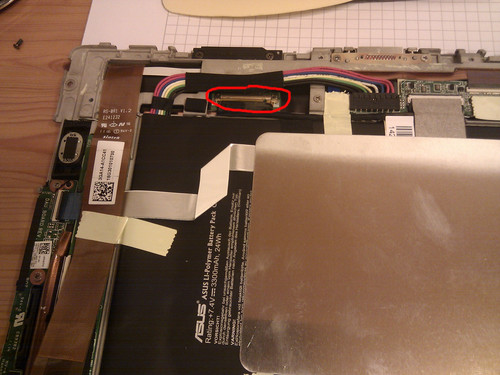
Christoph Berg: TF101 flickering and a loose cable

My ASUS Transformer TF101 had suddenly started flickering in all sorts of funny colors some weeks ago. As tapping it gently on the table in the right angle made the problem go away temporarily, it was clear the problem was about a loose cable, or some other hardware connection issue. As I needed to go on a business trip the other day, I didn't look up the warranty expiration day until later that week. Then, Murphy struck: the tablet was now 2 years + 1 day old! Calling ASUS, some friendly guy there suggested I still tried to get ASUS to accept it for warranty, because the tablet had been with them last year for 5 days, so if they added that, it would still be within the warranty period. I filled out the RMA form, but one hour later the reply was they rejected it because it was out of warranty. Another guy on the phone then said they would probably only do the adding if it had been with them for maybe 10 days, or actually really 30 days, or whatever. Some googling suggested that the loose cable theory was indeed worth a try, so I took it apart. Thanks to a forum post I could then locate the display connector and fix it. Putting the case back together was actually harder than disassembling it because some plastic bits got stuck, but now everything is back to normal.
Russell Coker: A Basic Income for Australia

There has been a lot of discussion recently about the concept of a Basic Income (Wikipedia), largely due to the efforts to change the Swiss constitution to provide a Basic Income [1]. The concept of a Basic Income is that residents get a fixed payment without having to be sick, disabled, looking for work, or eligible for other forms of social security. A Basic Income wouldn t replace all other forms of social security, one of the most obvious examples is that sick people will often need money for medical care in additional to living expenses. Also I believe that it shouldn t be means tested in any way. I think that one of the problems with current payment schemes is that there are complex eligibility criteria which require effort for the applicant and for government agencies to prevent accidental or fraudulent over-payment. The tax rates could be raised slightly to make it revenue neutral. Newstart In Australia the main form of social security for unemployed people at the moment is called Newstart [2]. Currently Newstart payments range from a maximum of $501 per fortnight for a single person ($13,026 per annum), to a maximum of $699.90 per fortnight for someone who is a carer. The Newstart payments start to decrease if the recipient earns more than $62 per fortnight. The minimum wage in Australia is $16.37 per hour for permanent work or $20.30 for casual work [3]. So if someone works for more than 3 hours at a casual rate (and I can t imagine 4 hours a fortnight being anything other than casual) then their Newstart payments will decrease. The payment decreases are fairly significant, for every dollar that is earned about 50 cents will be deducted from the payments. That s a great incentive to either avoid opportunities to do part-time work or to do cash-only work that s outside the tax system. The most obvious way of implementing a Basic Income would be to replace Newstart. Then anyone who is in that situation would be free to just not get a job which would be OK IMHO as people who don t want to work probably wouldn t do a good job if the government forced them to get a job. People who are unemployed who want to work could work as much as they want and scale up according to what their employer asks and how much money they need. Currently the full-time minimum wage is $622.20 per week (I m not sure exactly how they get that from $16.37). That s almost 2.5* the Newstart allowance for a single person (but less than twice the Newstart allowance for a carer). While Newstart (and the other forms of social security) don t provide a great income, it seems that the difference between Newstart and the minimum wage isn t that great particularly when you consider that working involves some expenses for travel etc. There doesn t seem to be a great financial incentive for someone to leave Newstart and get a minimum wage job. People Who Want Social Security Some people think it s great to get government payments while others find it embarrassing to need such payments and won t necessarily apply if they are eligible. I think that the current system of forcing people to apply for social security is a way of discouraging people who find themselves unexpectedly in a difficult situation but doesn t discourage people who are happy not to work. This seems to effectively reduce the incidence of payments to the people who most tax-payers would regard as the most worthy recipients. Economics Charles Stross wrote about some ideas related to this [4]. He suggests that as the workforce participation has been steadily reducing due to technology we should move to a social model that isn t based around working to live but working to buy luxuries that aren t covered by the Basic Income. One of the many economic changes related to a Basic Income is that the minimum wage could be smaller than it might otherwise be. For example if the minimum wage was decreased by the same amount that the Basic Income provided then the minimum income would remain the same while employers would pay less, this would affect the viability of certain types of contract work web sites if they were subject to minimum wage laws (currently they just ignore the minimum wage laws by paying based on job completion instead of hours worked). I don t think that the minimum wage should decrease that much though, currently employers are able to run viable businesses with the minimum wage laws and I don t think that a Basic Income should be used as a way of helping corporations avoid paying their employees. If we had a Basic Income then there s many ways that it could be used to stabilise the economy. If people could pay their rent even if they lost their job then a down-turn in one area of the economy wouldn t immediately affect other areas. Also if rent payments were deducted automatically from an account used to receive the Basic Income then landlords would be more likely to rent to poor people as they could be guaranteed to receive rent payments (it would be easy to have a contractual agreement for rent to take priority and have bank computers enforce that). The Implementation Problem I don t think that my idea would have any significant negative effects. It wouldn t decrease government revenues if tax was adjusted accordingly. It wouldn t make people stop working as people who don t want to work already avoid it. It would help people who are out of work to get work by reducing the barriers to entry in terms of paperwork and of unreasonable cuts to Newstart making it bad value to take part time work. I think that the big problem with implementing it is people who want to prevent poor people from having opportunities. They want to reduce social security and minimum wages even though such changes will in the long run only give less tax revenue and greater expense in law enforcement. It seems rather ironic that such hostility often comes from people at the low end of the middle class whos jobs are most likely to be at risk from new technology. As on-going technological development reduces the number of workers that are required to keep things running we need to have some form of payment to the people who aren t doing enough work to survive. A decent Basic Income is a much better option than giving Newstart payments and forcing a significant portion of the population into a degrading search for jobs that don t exist. As that s the inevitable future I think we should make political changes to deal with it sooner rather than later. However a Basic Income might be implemented now it s surely going to be a lot better than what might happen if we wait until the majority of the population are unemployed before doing something about it.

Russell Coker: A Better University

I previously wrote about the financial value of a university degree [1], my general conclusion is that the value is decreasing for most fields of employment that don t have a legal requirement for a degree. In the past I wrote about some ideas for a home university [2], basically extending the home-schooling concept to a university level. I recently read John Scalzi s post about being poor [3], many of the comments address the difficulty of getting to college and how it impacts career possibilities. From reading that it seems that my ideas about a home university are mostly based around what middle-class people can afford. Also getting a job afterwards will probably be a lot easier for someone who was born into the middle classes. It seems to me that a large part of the problem with the university system is the expectation that they will both provide for academic research and train people for jobs. Dr. David Helfand has some great ideas for running a university to give the higher education that a university is supposed to provide rather than the work training that most universities actually provide [4]. His ideas aren t theoretical, they have been implemented and proven to work. Note that Dr Helfand s talk starts slowly, the second half is the best (for those of you with short attention spans). The fact that most people think of a university degree in terms of getting a job seems to be a failure of the university system to fulfill it s original aim. If Dr Helfand s ideas take off then it would really address the problem of universities not educating people. But that still leaves the issue of job training. Is a Degree Mandatory? I think that to some degree people expect that a university degree is necessary job training even when it isn t. I wonder what would happen if it was generally agreed that the right thing to do was to search for a job between the end of high school and the start of university, then anyone who got a suitable offer could defer their university course and see what career success they could achieve without it. When I was at school the general idea was that after completing year 12 everyone just had a holiday until the start of university as the entire point of school was to get into university. While hiring managers prefer candidates who have degrees they also prefer to hire people who will accept a lower salary, so hiring an 18yo with no degree may give better value than a 21yo who has a degree. I believe that making university degrees more accessible has reduced inequality which is a good thing. But making degrees mandatory (which is widely believed by high school students and thus is the situation that they have to deal with) contributes to greater inequality. While university doesn t cost much by middle-class standards it is still expensive for poor people. If a university degree wasn t considered to be mandatory then the number of people employed to teach at a university level would be smaller. This would hopefully mean that the average skill of university lecturers would increase (I hope that the least skillful lecturers would be the ones to find work elsewhere).

John Goerzen: Results with btrfs and zfs

The recent news that openSUSE considers btrfs safe for users prompted me to consider using it. And indeed I did. I was already familiar with zfs, so considered this a good opportunity to experiment with btrfs. btrfs makes an intriguing filesystem for all sorts of workloads. The benefits of btrfs and zfs are well-documented elsewhere. There are a number of features btrfs has that zfs lacks. For instance: The feature set of ZFS that btrfs lacks is well-documented elsewhere, but there are a few odd btrfs missteps: btrfs would be fine if it worked reliably. I should say at the outset that I have never lost any data due to it, but it has caused enough kernel panics that I ve lost count. I several times had a file that produced a panic when I tried to delete it, several times when it took more than 12 hours to unmount a btrfs filesystem, behaviors where hardlink-heavy workloads take days longer to complete than on zfs or ext4, and that s just the ones I wrote about. I tried to use btrfs balance to change the metadata allocation on the filesystem, and never did get it to complete; it seemed to go into an endless I/O pattern after the first 1GB of metadata and never got past that. I didn t bother trying the live migration of data from one disk to another on this filesystem. I wanted btrfs to work. I really, really did. But I just can t see it working. I tried it on my laptop, but had to turn of CoW on my virtual machine s disk because of the rm bug. I tried it on my backup devices, but it was unusable there due to being so slow. (Also, the hardlink behavior is broken by default and requires btrfstune -r. Yipe.) At this point, I don t think it is really all that worth bothering with. I think the SuSE decision is misguided and ill-informed. btrfs will be an awesome filesystem. I am quite sure it will, and will in time probably displace zfs as the most advanced filesystem out there. But that time is not yet here. In the meantime, I m going to build a Debian Live Rescue CD with zfsonlinux on it. Because I don t ever set up a system I can t repair.

7 December 2013

Hideki Yamane: I was in Mini DebConf in Taiwan 2013

I've done GPG key sign for Mini DebConf in Taiwan 2013 participates, and written an article for Japanese magazine, Software Design 2014/Jan. This means, my short trip has been ended, at last.


In this event, I've talked about "local community" for Debian, a bit (PDF/ODF are in Debian Wiki).
Local Community for Debian (2013 Taiwan miniDebConf) from Hideki Yamane

Probably you know, most of Debian contributors are in Euro/America(North and South), not in Asia. But there are lots of talented people. It means: there is huge possibility for Debian :)


I hope we Asian Debian people unite and publish its community work more, and do "DebConf in Asia" - in the future.

5 December 2013

Daniel Kahn Gillmor: The legal utility of deniability in secure chat

This Monday, I attended a workshop on Multi-party Off the Record Messaging and Deniability hosted by the Calyx Institute. The discussion was a combination of legal and technical people, looking at how the characteristics of this particular technology affect (or do not affect) the law. This is a report-back, since I know other people wanted to attend. I'm not a lawyer, but I develop software to improve communications security, I care about these questions, and I want other people to be aware of the discussion. I hope I did not misrepresent anything below. I'd be happy if anyone wants to offer corrections. BackgroundOff the Record Messaging (OTR) is a way to secure instant messaging (e.g. jabber/XMPP, gChat, AIM). The two most common characteristics people want from a secure instant messaging program are:
Authentication
Each participant should be able to know specifically who the other parties are on the chat.
Confidentiality
The content of the messages should only be intelligible to the parties involved with the chat; it should appear opaque or encrypted to anyone else listening in. Note that confidentiality effectively depends on authentication -- if you don't know who you're talking to, you can't make sensible assertions about confidentiality.
As with many other modern networked encryption schemes, OTR relies on each user maintaining a long-lived "secret key", and publishing a corresponding "public key" for their peers to examine. These keys are critical for providing authentication (and by extension, for confidentiality). But OTR offers several interesting characteristics beyond the common two. Its most commonly cited characteristics are "forward secrecy" and "deniability".
Forward secrecy
Assuming the parties communicating are operating in good faith, forward secrecy offers protection against a special kind of adversary: one who logs the encrypted chat, and subsequently steals either party's long-term secret key. Without forward secrecy, such an adversary would be able to discover the content of the messages, violating the confidentiality characteristic. With forward secrecy, this adversary is be stymied and the messages remain confidential.
Deniability
Deniability only comes into play when one of the parties is no longer operating in good faith (e.g. their computer is compromised, or they are collaborating with an adversary). In this context, if Alice is chatting with Bob, she does not want Bob to be able to cryptographically prove to anyone else that she made any of the specific statements in the conversation. This is the focus of Monday's discussion. To be clear, this kind of deniability means Alice can correctly say "you have no cryptographic proof I said X", but it does not let her assert "here is cryptographic proof that I did not say X" (I can't think of any protocol that offers the latter assertion). The opposite of deniability is a cryptographic proof of origin, which usually runs something like "only someone with access to Alice's secret key could have said X."
The traditional two-party OTR protocol has offered both forward secrecy and deniability for years. But deniability in particular is a challenging characteristic to provide for group chat which is the domain of Multi-Party OTR (mpOTR). You can read some past discussion about the challenges of deniability in mpOTR (and why it's harder when there are more than two people chatting) from the otr-users mailing list. If you're not doing anything wrong... The discussion was well-anchored by a comment from another participant who cheekily asked "If you're not doing anything wrong, why do you need to hide your chat at all, let alone be able to deny it?" The general sense of the room was that we'd all heard this question many times, from many people. There are lots of problems with the ideas behind the question from many perspectives. But just from a legal perspective, there are at least two problems with the way this question is posed: In these situations, people confront real risk from the law. If we care about these people, we need to figure out if we can build systems to help them reduce that legal risk (of course we also need to fix broken laws, and the legal environment in general, but those approaches were out of scope for this discussion). The Legal Utility of Deniability Monday's meeting was called specifically because it wasn't clear how much real-world usefulness there is in the "deniability" characteristic, and whether this feature is worth the development effort and implementation tradeoffs required. In particular, the group was interested in deniability's utility in legal contexts; many (most?) people in the room were lawyers, and it's also not clear that deniability has much utility outside of a formal legal setting. If your adversary isn't constrained by some rule of law, they probably won't care at all whether there is a cryptographic proof or not that you wrote a particular message (In retrospect, one possible exception is exposure in the media, but we did not discuss that scenario). Places of possible usefulness So where might deniability come in handy during civil litigation or a criminal trial? Presumably the circumstance is that a piece of a chat log is offered as incriminating evidence, and the defendant is trying to deny something that they appear to have said in the log. This denial could take place in two rather different contexts: during rules over admissibility of evidence, or (once admitted) in front of a jury. In legal wrangling over admissibility, apparently a lot of horse-trading can go on -- each side concedes some things in exchange for the other side conceding other things. It appears that cryptographic proof of origin (that is, a lack of deniability) on the chat logs themselves might reduce the amount of leverage a defense lawyer can get from conceding or arguing strongly over that piece of evidence. For example, if the chain of custody of a chat transcript is fuzzy (i.e. the transcript could have been mishandled or modified somehow before reaching trial), then a cryptographic proof of origin would make it much harder for the defense to contest the chat transcript on the grounds of tampering. Deniability would give the defense more bargaining power. In arguing about already-admitted evidence before a jury, deniability in this sense seems like a job for expert witnesses, who would need to convince the jury of their interpretation of the data. There was a lot of skepticism in the room over this, both around the possibility of most jurors really understanding what OTR's claim of deniability actually means, and on jurors' ability to distinguish this argument from a bogus argument presented by an opposing expert witness who is willing to lie about the nature of the protocol (or who misunderstands it and passes on their misunderstanding to the jury). The complexity of the tech systems involved in a data-heavy prosecution or civil litigation are themselves opportunities for lawyers to argue (and experts to weigh in) on the general reliability of these systems. Sifting through the quantities of data available and ensuring that the appropriate evidence is actually findable, relevant, and suitably preserved for the jury's inspection is a hard and complicated job, with room for error. OTR's deniability might be one more element in a multi-pronged attack on these data systems. These are the most compelling arguments for the legal utility of deniability that I took away from the discussion. I confess that they don't seem particularly strong to me, though some level of "avoiding a weaker position when horse-trading" resonates with me. What about the arguments against its utility? Limitations The most basic argument against OTR's deniability is that courts don't care about cryptographic proof for digital evidence. People are convicted or lose civil cases based on unsigned electronic communications (e.g. normal e-mail, plain chat logs) all the time. OTR's deniability doesn't provide any legal cover stronger than trying to claim you didn't write a given e-mail that appears to have originated from your account. As someone who understands the forgeability of e-mail, i find this overall situation troubling, but it seems to be where we are. Worse, OTR's deniability doesn't cover whether you had a conversation, just what you said in that conversation. That is, Bob can still cryptographically prove to an adversary (or before a judge or jury) that he had a communication with someone controlling Alice's secret key (which is probably Alice); he just can't prove that Alice herself said any particular part of the conversation he produces. Additionally, there are runtime tradeoffs depending on how the protocol manages to achieve these features. For example, forward secrecy itself requires an additional round trip or two when compared to authenticated, encrypted communications without forward secrecy (a "round trip" is a message from Alice to Bob followed by a message back from Bob to Alice). Getting proper deniability into the mpOTR spec might incur extra latency (imagine having to wait 60 seconds after everyone joins before starting a group chat, or a pause in the chat of 15 seconds when a new member joins) or extra computational power (meaning that they might not work well on slower/older devices) or an order of magnitude more bandwidth (meaning that chat might not work at all on a weak connection). There could also simply be complexity that makes it harder to correctly implement a protocol with deniability than an alternate protocol without deniability. Incorrectly-implemented software can put its users at risk. I don't know enough about the current state of mpOTR to know what the specific tradeoffs are for the deniability feature, but it's clear there will be some. Who decides whether the tradeoffs are worth the feature? Other kinds of deniability Further weakening the case for the legal utility of OTR's deniability, there seem to be other ways to get deniability in a legal context over a chat transcript. There are deniability arguments that can be made from outside the protocol. For example, you can always claim someone else took control of your computer while you were asleep or using the bathroom or eating dinner, or you can claim that your computer had a virus that exported your secret key and it must have been used by someone else. If you're desperate enough to sacrifice your digital identity, you could arrange to have your secret key published, at which point anyone can make signed statements with it. Having forward secrecy makes it possible to expose your secret key without exposing the content of your past communications to any listener who happened to log them. Conclusion My takeaway from the discussion is that the legal utility of OTR's deniability is non-zero, but quite low; and that development energy focused on deniability is probably only justified if there are very few costs associated with it. Several folks pointed out that most communications-security tools are too complicated or inconvenient to use for normal people. If we have limited development energy to spend on securing instant messaging, usability and ubiquity would be a better focus than this form of deniability. Secure chat systems that take too long to make, that are too complex, or that are too cumbersome are not going to be adopted. But this doesn't mean people won't chat at all -- they'll just use cleartext chat, or maybe they'll use supposedly "secure" protocols with even worse properties: for example, without proper end-to-end authentication (permitting spoofing or impersonation by the server operator or potentially by anyone else); with encryption that is reversible by the chatroom operator or flawed enough to be reversed by any listener with a powerful computer; without forward secrecy; or so on. As a demonstration of this, we heard some lawyers in the room admit to using Skype to talk with their clients even though they know it's not a safe communications channel because their clients' adversaries might have access to the skype messaging system itself. My conclusion from the meeting is that there are a few particular situations where deniability could be useful legally, but that overall, it is not where we as a community should be spending our development energy. Perhaps in some future world where all communications are already authenticated, encrypted, and forward-secret by default, we can look into improving our protocols to provide this characteristic, but for now, we really need to work on usability, popularization, and wide deployment. Thanks Many thanks to Nick Merrill for organizing the discussion, to Shayana Kadidal and Stanley Cohen for providing a wealth of legal insight and legal experience, to Tom Ritter for an excellent presentation of the technical details, and to everyone in the group who participated in the interesting and lively discussion. Tags: chat, deniability, otr, security

Next.

Previous.
