Lucas Nussbaum: Ubuntu divergence
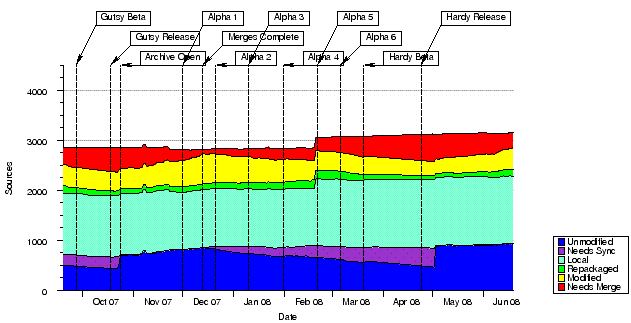
 in main:
in universe:
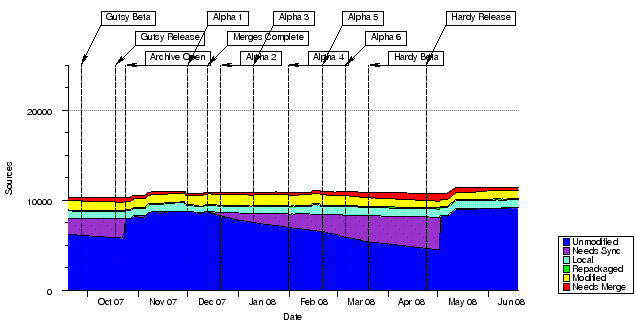 Those graphs (found on http://merges.ubuntu.com/) show the number of unmodified vs modified packages in Ubuntu main and universe. Interesting.
in main:
Those graphs (found on http://merges.ubuntu.com/) show the number of unmodified vs modified packages in Ubuntu main and universe. Interesting.
 Or configuring LS COLORS
After successfully Theming Emacs, I decoded to
turn my efforts to providing more copacetic colors in other aspects
of my working environment. I ll write more about my effort to write
my own color theme for fvwm when it is closer to
being done. For now, I ll concentrate on ANSI Colors in XTerms,
and how one may theme those. The old Tektronics (or ANSI) terminals
had 8 colors, namely, black, red, green, yellow, blue, magenta,
cyan, and white. These colors had a normal, and a
bright mode. The default set of colors is OK, but is not
optimal, since they have to work on both dark and light
backgrounds; however, I use mostly dark background colors.
 Given that, I set to design my own colors, using fully laturated
colors, with a base luminosity of 70, and equally spaced in chroma
and used the same saturation and chroma, but a luminosity of 80,
for the bright set. This results in a pleasant pastely set of
colors, which are e4asy on the eyes, when used on very dark
backgrounds. The configuration can be seen in XTerm. I set the colors for
rxvt as well as xterm. Now, the most noticeable
effect of these changes is if using the color option for ls,
therefore the next thing to do was to configure the colors used by
ls using a utility dedicated for that task, namely,
dircolors. By trial and error, I modified the default
configuration provided by dircolors and ended up with
dir colors, with the
results as you see.
 The Linux Plumbers Conference[1] now has a call for papers, with registration also being open. Why is this important? Because it's the first conference aimed at getting together developers from all walks of the Linux world and fixing the core infrastructural problems. Ever looked at a kernel interface and wondered how the christ any userspace programmer was supposed to use it? Ever looked at a desktop application and wondered what kind of $2 crack they were on when they wrote it? Here's your chance to find out or get it fixed.
 Well I'm back and ready to do some fun work.
In the meantime it seems that at least one of my crash-fixes, from the prior public bugfixing, has been uploaded:
I'm still a little bit frustrated that some of the other patches I made (to different packages) were ignored, but I guess I shouldn't be too worried. They'll get fixed sooner or later regardless of whether it was "my" fix.
In other news I've been stalling a little on the Debian Administration website.
There are a couple of reasonable articles in the submissions queue - but nothing really special. I can't help thinking that the next article being a nice round number of 600 deserves something good/special/unique? hard to quantify, but definitely something I'm thinking. I guess I leave it while the weekend and if nothing presents itself I'll just go dequeue the pending pieces.
In other news I've managed to migrate the mail scanning service into a nicely split architecture - with minimal downtime.
I'm pleased that:
 On the testing and unstable systems that i run, i occasionally get a disturbing "there are N newly obsolete packages" message. For example
[0 root@squeak ~]# aptitude update
Hit http://cmrg.fifthhorseman.net unstable Release.gpg
 [...]
Get:42 http://ftp.us.debian.org unstable/main [2077kB]
Fetched 15.2MB in 57s (262kB/s)
Reading package lists... Done
Updating debtags database...... Done
Current status: 3 updates [+3], 1136 new [-21212].
There are 1804 newly obsolete packages.
[255 root@squeak ~]#
Usually, i can fix this with another
aptitude update. Does this mean i've hit a mirror at an inopportune time? Or do i have apt mis-configured somehow? Other people have documented this before, and casual conversation with friends lets me know it's not just me. If this is due to some inconsistency at the mirrors (particularly for suites with rolling updates?), is there some way to engineer the mirror transfers so that this doesn't happen? For example (i have no idea how this stuff is done, so i'm just making this up):  The newspapers brought good news bits in the last two days.
P blico
reports on
Paco Rivi re's
ongoing quest
to get a refund for the extra money he had to pay for a Windows licence when
he bought a laptop. Paco is a well known member of the
Ubuntu Catalan community and has been
battling for this common-sense right for 3 years. The trial took place last
Monday, and hopefully he'll be able to report some good news soon.
In totally unrelated news, the Valencian caveman
Juan Garc a Sentandreu,
leader of the right-wing Coalici n Valenciana party, was arrested yesterday,
for still
not too clear
reasons. Being one of the biggest enemies of my language, and having a long
record of violent attacks to cultural entities and other political parties in
Val ncia, I can't say I pitty him at all. I hope he had fun sleeping with
the yonkis in the central police station last night. :)
 Another year has past and another edition of the Official Ubuntu
Book has been finished and will be released soon. Over the last two
years, the two previous editions of the book have grown along-side
Ubuntu. The book has continued to sell very well, received almost
universally favorable reviews, and been translated into more than half a
dozen languages
While Jono Bacon has mostly been pulled into other projects, Corey
Burger stepped up to help play the major supporting role in this version
of the book's production. The whole text was updated to reflect changes
in Ubuntu over the last year including a major rewrite of the chapter on
Kubuntu and important work on the Edubuntu chapter. If you use either,
you'll understand that there's plenty of churn to report.
In a sort of experiment, Barnes and Noble will also be selling a custom
edition with an extra chapter by Matthew Helmke on the Ubuntu
Forums which I hope to include in the next edition of the book. It's
an excellent introduction to the best support resource Ubuntu has to
offer that I hope many beginners -- the group that always been the
book's audience -- will find useful.
You can pre-order the custom edition from B&N or get the book from
Amazon or many other sources.
Like all previous editions, the book is licensed under the Creative
Commons Attribution ShareAlike license and soft-copies should be up
on the publisher's website once the book is released. Please support
commercial free culture publishing by buying a copy if you find the
book useful.
As I mentioned a couple weeks ago, I'm giving a talk about my
Revealing Errors project tonight at the Boston Linux Unix
meeting. It will be at MIT in E51-351. More information is on the
BLU website.
Revealings Errors is a very different kind of project from what I've
done. Please show up if you can. I'd love support, feedback,
suggestions, and the like.
 Andrew asks about Linux-friendly eSATA controllers. A long time ago, I also looked for some - but basically no one seems to know about that, or will try to rip your eyes for it.


 I maintain a bunch of SSL certificates, mostly signed by my own site authority. Too many not to automate, but not enough to warrant heavy machinery. Here's how I do it.
The configuration files
Each certificate needs a config to describe what's in it. I create each of these and name it with a .cnf suffix. Here's an example:
[ req ]
prompt                  = no
distinguished_name      = server_distinguished_name
[ server_distinguished_name ]
commonName              = server.usefulinc.com
stateOrProvinceName     = England
countryName             = GB
emailAddress            = edd@usefulinc.com
organizationName        = Useful Information Company
organizationalUnitName  = Hosting
[ req_extensions ]
subjectAltName=edd@usefulinc.com
issuerAltName=issuer:copy
nsCertType            = server
[ x509_extensions ]
subjectAltName=edd@usefulinc.com
issuerAltName=issuer:copy
nsCertType            = server
Let's say this config is server.cnf. I then just type make server.pem to generate the corresponding certificate and key, signed by my local certificate authority. As I don't want to attend the startup of every service, I ensure the key is password-less. The Makefile rules Here are the makefile steps I use to generate and sign keys.
.SUFFIXES: .pem .cnf
.cnf.pem:
        OPENSSL_CONF=$< openssl req -newkey rsa:1024 -keyout tempkey.pem -keyform PEM -out tempreq.pem -outform PEM
        openssl rsa <tempkey.pem >  basename $< .cnf _key.pem
        chmod 400  basename $< .cnf _key.pem
        OPENSSL_CONF=./usefulCA/openssl.cnf openssl ca -in tempreq.pem -out  basename $< .cnf _crt.pem
        rm -f tempkey.pem tempreq.pem
        cat  basename $< .cnf _key.pem  basename $< .cnf _crt.pem > $@
        chmod 400 $@
        ln -sf $@  openssl x509 -noout -hash < $@ .0
The resultant files are:
.SUFFIXES: .pem .cnf .reqcnf .csr
.reqcnf.csr:
        OPENSSL_CONF=$< openssl req -newkey rsa:1024 -keyout  basename $< .reqcnf .key -keyform PEM -out  basename $< .reqcnf .csr -outform PEM
And finally, a rule I use to sign incoming certificate requests from other systems:
.csr.pem:
        OPENSSL_CONF=./usefulCA/openssl.cnf openssl ca -in $< -out  basename $< .csr _crt.pem
I offer these without warranty in the hope they might be useful to somebody. They're not much more than a transcription of a how-to into a makefile, but it's just enough technology to ensure creating certificates isn't a big nuisance.
Further reading
 If you re trying to blow up an airplane, and you re hip and plan
to use liquids to take down the silver bird, the following tips may
be useful to you:


 Newegg.com just had a special on 750Gb Seagate SATA drives, so I thought it
might be a good opportunity to replace my 400Gb IDE drives with ones that
can be connected to the host by something less ghetto than IDE to USB 2.0
adapters. Who knows? I might even lash out on some kind of enclosure,
instead of sitting them on cork trivets on top of the computer they're
attached to.
So once the drives turn up, all I'll need to do is replace the PCI 4 port
USB 2.0 controller with a PCI 4 port eSATA controller.
I'm a total SATA ignoramus, so if anyone has any suggestions on what's good,
or what to avoid, shoot me an email.

  (1:55)
  [artemis] sudo dpkg --purge ion3 ion3-scripts
 [sudo] password for madcoder:
 (Reading database ... 126510 files and directories currently installed.)
 Removing ion3-scripts ...
 Purging configuration files for ion3-scripts ...
 Removing ion3 ...
 Purging configuration files for ion3 ...
 dpkg - warning: while removing ion3, directory  /etc/X11/ion3' not empty so not removed.
 dpkg - warning: while removing ion3, directory  /usr/lib/ion3/lc' not empty so not removed.
 Processing triggers for menu ...
 Processing triggers for man-db ...
 sudo dpkg --purge ion3 ion3-scripts  1,25s user 1,19s system 12% cpu 19,539 total
AAAAAAAAAAAAAAHHHHHHHHHHHHHHHHHHHHHHHHH I feel better now. I'm right now a proud awesome-3-git user. The current git version has 90% of what I used in ion3. I mostly mis tabs, but I'm almost already used not to have them anymore, tiling is way better after all, and there are pure lua implementations of those around, just the current one are not nice enough (IMHO) but it can only improve. Another missing feature is autocompletion in the launch command / ssh to / ... menus. But I assume this would not really be hard to add. OTOH there are already things that I like better in awesome: it's easier to extend than ion3, the widgets are a fantastic idea, it uses antialiased fonts, and so on. And layouts are a really clever idea for sure. See here to see what it can look like.

This means: if you just hit the key, it does the Right Thing (Esc, as if I were on a real unixy keyboard). If you hold Shift and press the key, it also does the Right Thing (~, as if I were on a PC). But what to do about , or Shift-Esc, which are no longer possible? We make them the alternate graphs (just old down AltGr. I think the xkb option to put this on right Alt is "grp:switch"). I honestly use those two infrequently enough that I don't care about having to remember the extra bucky. (I tend to type $(cmd) in the shell, and not cmd , because I use the former in scripts and I always found the latter harder to read. I suppose I would care more if I used Lisp or Haskell or...) What I like most about this solution is that it lets me use the same muscle memory on all my hardware. Never mind weird Esc positions; laptop vendors still can't agree on the correct order of Fn and Control. But you don't have to care if you put Control on Caps Lock. Same idea. It does feel a bit like cheating, but it has made my wrists far more comfortable. Oh, and to wean myself off the key way out in the corner:keycode 49 = Escape asciitilde grave Escape
Now the question, of course (getting back to Joey), is what would happen if my "new" Escape key broke. I guess I'd have to keep the laptop at home and plug in my Happy Hacking Keyboard :-)keycode 9 = NoSymbol
 !?!?!?!?!?
 Why does it even ask me?
Updated: because I had set signed.applets.codebase_principal_support in about:config to true to be able to pay my taxes online. I have set it back to false, and now the box doesn’t appear anymore.
Next.
