Search Results: "ron"

27 October 2017

Sam Hartman: How Can Debian Turn Disagreement into Something that Makes us Stronger

Recently, when asked to engage with the Debian Technical Committee, a maintainer chose to orphan their package rather than discuss the issue brought before the committee. In another decision earlier this year, a maintainer orphaned their package indicating a lack of respect for the approach being taken and the process. Unfortunately, this joins an ever longer set of issues where people walk away from the TC process disheartened and upset.

For me personally the situations where maintainers walked away from the process were hard. People I respect and admire were telling me that they were unwilling to participate in our dispute resolution process. In one case the maintainer explicitly did not respect a process I had been heavily involved in. As someone who values understanding and build a team, I feel disappointed and hurt thinking about this.

Unfortunately, I don't feel much better when I consider several of the other issues brought before the TC. In a number of cases, the process has concluded, but it feels like a pyrrhic victory. We have an answer, but often we never reached an understanding of one of the key stakeholder's positions. People are sufficiently disappointed or frustrated that they reduce their involvement. That is, the answer is not one they can live with. Sometimes, I'm not even sure that answering the question was worth the cost.

My initial suspicion as I begin to consider issues that have come before the TC in the last few years is that as a necessary consequence of how the TC operates, we will drive a significant chunk of those who come to us away from our community. I will not be part of that. If I end up eventually agreeing with this suspicion, I will either work to improve the TC process or find a different way to contribute to the project that is more aligned with my goals.


Our Community is More Important than Technical Correctness I firmly believe that Debian's strength is its community. Distributions, upstreams, free-software advocates, corporate interests, and everything in between work together. Because we are working on a concrete product,we actually have to understand how our needs conflict and compliment each other. Also, like any organization, our ability to get things done is dependent on our contributors and the time we all put in.

I cannot think of anything more harmful we can do than drive away a constructive contributor. Technical quality is important: many of us will eventually go away if quality drops too much. However, Debian itself can be improved incrementally. Yes, new people do join Debian. However, it takes a lot of new people to make up for a situation where everyone involved is frustrated, and some leave and tell their friends to stay away from Debian.

When a Disagreement Reaches the TC When a disagreement reaches the TC, we know a few things. First, people have not have not been able to resolve it on their own. Second, the disagreement is important enough to at least one of the parties to ask for outside help.

If the TC were to simply announce a decision, it is very likely that at least one party would feel frustrated and disappointed. If the decision is important to someone it almost always means that they care about the outcome. If previous efforts have not reached agreement then there is an outcome that is undesired. While it's possible under the constitution that two parties could bring an issue to the TC mutually where the dynamics could be different, this does not happen in practice.

When we "lose" When a decision making process decides to select one of my undesired outcomes, I have strong negative feelings. First, there is the technical result itself. Because of an adverse decision it is generally harder for me to do my technical work, or some ethical position or group I care about is disadvantaged. However, the strongest feelings are related to needs about my place in the community, not a direct response to the technical decision. I worry about whether issues I care about will be valued in the future; I would likely feel weary or scared thinking of contributing in an environment where issues that matter to me aren't going to be considered. I tend to feel frustrated if my position was not adequately considered this time around.

Often, the strongest feelings do not stem from how I am impacted by the decision itself. Thus, if my more general needs are addressed, I will feel a lot better about not having my preferred outcome selected. Confidence that my position was understood is the single biggest factor in being able to accept the result. If the community took the time to understand me, then I have confidence that I am valued. I can advocate for change and be part of the ongoing discussion. If I understand the other positions then I can understand that the position was not arbitrary. Understanding the other positions is also a prerequisite to seeing how things I value were considered, especially when the tradeoff did not ultimately favor these values.

My conversations with others about their experience with conflict suggest my feelings and needs are common.


However, the TC focuses almost exclusively on the technical matter before it. I don't think the TC has done a good job of actually understanding maintainers or the people bringing issues to us. Especially when we're fairly sure we understand what the ultimate decision will be, we focus on getting to that decision. Of course part of actually understanding someone is considering what they have to say. Even when you have high confidence in an outcome, if you want someone to feel understood, you do have to listen at a point where you can consider what they bring forward.

Frustration of Being Questioned

On the other side, it's frustrating to have your decisions questioned. Reviewing a decision takes time. Even if the TC agrees with a maintainer, asking that maintainer to sit through a long process can create frustrations as deep as any I discussed in the previous section.

So the process is doubly bad for maintainers. Someone can bring up an issue which requires precious time. Then if the TC decides against the maintainer, we have all the problems I discussed previously.

I acknowledge this. A good process must respect the maintainer's time. However, it must respect the community members who disagree with maintainers. Everyone who brings an issue to the TC is a developer. They have contributed significantly to our community and are part of our team. Yes, we need to protect the process against abuse. But in a very real sense if we aren't willing to consider an issue and we aren't willing to engage with someone, understand why they think the issue should be considered, and work until they understand why we made our decision, we are saying we do not respect them enough to take that time. We should expect that to drive people away.

I wonder if the solution here involves a two phase process. During the first phase we work with someone bringing an issue to us until we understand it. We either engage the maintainer at that point, spend the time to help the person bringing an issue to us understand why we are not engaging the maintainer, or have decided the issue is abusive of the processs/misdirected. For this to work maintainers would have to trust us enough to actually be willing to sit back and not spend a lot of their time.

Sam, It's Just Personalities

One criticism I've heard as I discuss this is that a lot of the negative feelings surround interpersonal conflict and are personality conflicts. Yes, personalities matter. Yes, we re still healing from the Systemd discussion.

However, as a community, I think we need to figure out how we respect the inevitable personality conflicts. I can think of one or two developers I'm still upset with years after an issue. It happens. Perhaps if I were a maintainer when one of these developers raised a concern with my packages, I could ask that someone else be a primary advocate for an issue. Similarly, if a developer wanted to address an issue with me as a maintainer but would prefer not to deal with me, perhaps we could figure out some way that we could see if someone else shared the concern.

Dropping a Package is Sometimes an Answer

My concerns were sparked by instances where a maintainer dropped a package rather than interact with the TC. Sometimes that can be a healthy step in a transition. At Debconf this year, Enrico Zini gave a talk on consent culture in Debian. One of the key points of his talk is that we can find over time that what we're being asked to do in Debian is no longer consistent with our boundaries. If it isn t helping us move forward if it isn t fun then it is likely time to stop.

In that sense, approaching disagreement can be a great time to take stock and ask whether we still enjoy maintaining a package. If we don t, then stepping aside and letting others take it on can be a great way that we and they can be happier. I don t really think that s what happened in these instances though. Based on comments made to me, this sounded more like a lack of faith in being treated well or in our ability as a committee.

Even so, Enrico s talk applies in a number of ways here. He suggests that the approach we should take when someone is done and steps away is to thank then. I couldn t agree more. From the depth of my heart I offer thanks: Thank you for taking care of yourself and stepping away when it is no longer fun. Thank you for all the effort you have put into these packages. I hope to work with you on great things in the future.

26 October 2017

Russell Coker: Anarchy in the Office

Some of the best examples I ve seen of anarchy working have been in corporate environments. This doesn t mean that they were perfect or even as good as a theoretical system in which a competent manager controlled everything, but they often worked reasonably well. In a well functioning team members will encourage others to do their share of the work in the absence of management. So when the manager disappears (doesn t visit the team more than once a week and doesn t ask for any meaningful feedback on how things are going) things can still work out. When someone who is capable of doing work isn t working then other people will suggest that they do their share. If resources for work (such as a sufficiently configured PC for IT work) aren t available then they can be found (abandoned PCs get stripped and the parts used to upgrade the PCs that need it most). There was one time where a helpdesk worker who was about to be laid off was assigned to the same office as me (apparently making all the people in his group redundant took some time). So I started teaching him sysadmin skills, assigned work to him, and then recommended that my manager get him transferred to my group. That worked well for everyone. One difficult case is employees who get in the way of work being done, those who are so incompetent that they break enough things to give negative productivity. One time when I was working in Amsterdam I had two colleagues like that, it turned out that the company had no problem with employees viewing porn at work so no-one asked them to stop looking at porn. Having them paid to look at porn 40 hours a week was much better than having them try to do work. With anarchy there s little option to get rid of bad people, so just having them hang out and do no work was the only option. I m not advocating porn at work (it makes for a hostile work environment), but managers at that company did worse things. One company I worked for appeared (from the non-management perspective) to have a management culture of doing no work. During my time there I did two annual reviews in two weeks, and the second was delayed by over 6 months. The manager in question only did the reviews at that time because he was told he couldn t be promoted until he got the backlog of reviews done, so apparently being more than a year behind in annual reviews was no obstacle to being selected for promotion. On one occasion I raised the issue of a colleague who had done no work for over a year (and didn t even have a PC to do work) with that manager, his response was what do you expect me to do ! I expected him to do anything other than blow me off when I reported such a serious problem! But in spite of that strictly work-optional culture enough work was done and the company was a leader in it s field. There has been a lot of research into the supposed benefits of bonuses etc which usually turn out to reduce productivity. Such research is generally ignored presumably because the people who are paid the most are the ones who get to decide whether financial incentives should be offered so they choose the compensation model for the company that benefits themselves. But the fact that teams can be reasonably productive when some people are paid to do nothing and most people have their work allocated by group consensus rather than management plan seems to be a better argument against the typical corporate management. I think it would be interesting to try to run a company with an explicit anarchic management and see how it compares to the accidental anarchy that so many companies have. The idea would be to have minimal management that just does the basic HR tasks (preventing situations of bullying etc), a flat pay rate for everyone (no bonuses, pay rises, etc) and have workers decide how to spend money for training, facilities, etc. Instead of having middle managers you would have representatives elected from each team to represent their group to senior management. PS Australia has some of the strictest libel laws in the world. Comments that identify companies or people are likely to be edited or deleted.

25 October 2017

Russ Allbery: Review: Clean Sweep

Review: Clean Sweep, by Ilona Andrews
Series: Innkeeper Chronicles #1
Publisher: NYLA
Copyright: 2013
ISBN: 1-62517-343-1
Format: Kindle
Pages: 228
Dina owns a bed and breakfast in a small town in Texas. As the book opens, her neighbor's dogs are being killed by some beast. As far as Dina is concerned, this should be the problem of the local werewolf, given that this is his territory, and she takes him to task for apparently doing nothing about it. The werewolf doesn't take that well, nor wants to admit to being a werewolf, and reacts by threatening Dina. Given Dina's position and the nature of her bed and breakfast, that turns out to be ill-advised. At this point, you're doubtless thinking urban fantasy, and you're not exactly wrong. You're probably also thinking love interest, and you're not entirely wrong there either. The dead dogs are, of course, an early warning sign of an evil monster who has moved into the area and whose violence may escalate. And if I mention that a vampire shows up later in the story and the werewolf and vampire dislike each other at first sight, you'll probably start rolling your eyes. But this also isn't quite what it looks like on the surface. I'm going to gleefully spoil what you find out about a fifth of the way into the book, since it's what got me to buy this book: neither the werewolves nor the vampires are magical creatures. They're aliens. Werewolves are bio-engineered soldiers; vampires are members of a militaristic order with advanced technology and almost imperceptible circulatory systems. And Dina doesn't truly have a bed and breakfast. She maintains an inn: a refuge for aliens traveling on Earth, part of the secrecy that keeps them out of the eyes of normal humans, and an institution sworn to neutrality in local problems. Dina is straining the last part. The alien creatures who are hunting and killing her neighbors' pets aren't exactly threatening the inn, but she's not willing to stand idly by while her neighbors are threatened. It's a dangerous path, since her inn is struggling already. Failure to prioritize correctly and protect her guests might lower her inn's rating, possibly fatally. She's also without a guide ever since her parents (prominent innkeepers themselves) mysteriously disappeared. But she does have an inn. It may be a weaker one, coaxed out of dormancy and desperately in need of more visitors, but it still has considerable technological resources and other abilities that are indistinguishable from magic. It's also sentient, although more like a large animal than a person, and it knows its innkeeper. This is a light, straightforward sort of book that does not take itself particularly seriously, as you might have guessed. It is very aware of the conventions of urban fantasy and is both following them and intentionally poking fun at them. The authors (Ilona Andrews is a husband and wife writing team) play an impish game of wedging fantasy tropes into a science fiction framework, preserving much of the outward appearance while playing with the explanations. I particularly liked the clannish reworking of vampires into a sort of crusader knight, which works considerably better than it has any right to. Clean Sweep is at its best when the story seems to be going down well-trodden urban fantasy paths and then takes an abrupt right turn into science fiction: Dina going through a dimensional gate to an interstellar marketplace to stock up on weapons, for instance. Also, it has a sentient house. This is one of my favorite story elements ever, provided that the story isn't horror (which is all too often the case with sentient houses, but which is not at all the case here). I found the early parts of this book, during which Sean is insulting Dina and Dina is unimpressed but not doing anything about it, rather tedious. Thankfully, once Dina finally loses her patience and knocks some sense into him it gets a lot better. It never becomes great literature, but sometimes that's a feature. If you're in the mood for some urban fantasy with an adequate, if hand-waved, re-spun science fiction justification and an uncomplicated and loyal sentient house, I can wholeheartedly recommend Clean Sweep. I liked it better than I had expected to. Followed by Sweep in Peace. Rating: 7 out of 10

24 October 2017

Daniel Silverstone: Introducing the car

For many years now, I have been driving a diesel based VW Passat Estate. It has served me very well and been as reliable as I might have hoped given how awful I am with cars. Sadly Gunther was reaching the point where it was going to cost more per year to maintain than the car was worth, and also I've been being more and more irked by not having a car from the future. I spent many months doing spreadsheets, trying to convince myself I could somehow afford a Tesla of some variety. Sadly I never quite managed it. As such I set my sights on the more viable BEVs such as the Nissan Leaf. For a while, nothing I saw was something I wanted. I am quite unusual it seems, in that I don't want a car which is a "Look at me, I'm driving an electric car" fashion statement. I felt like I'd never get something which looked like a normal car, but happened to be a BEV. Then along came the Hyundai Ioniq. Hybrid, Plug-in Hybrid, and BEV all looking basically the same, and not in-your-face-special. I began to covet. Eventually I caved and arranged a test drive of an Ioniq plug-in hybrid because the BEV was basically on 9 month lead. I enjoyed the drive and was instantly very sad because I didn't want a plug-in hybrid, I wanted a BEV. Despondent, I left the dealership and went home. I went online and found a small number of second-hand Ioniq BEVs but as I scrolled through the list, none seemed to be of the right trim level. Then, just as I was ready to give up hope, I saw a new listing, no photo, of the right thing. One snag, it was 200 miles away. No matter, I rang the place, confirmed it was available, and agreed to sleep on the decision. The following morning, I hadn't decided to not buy, so I called them up, put down a deposit to hold the car until I could test drive it, and then began the long and awkward process of working out how I would charge the car given I have no off-street parking so I can't charge at home. (Yeah yeah, you'd think I'd have checked that first, but no I'm just not that sensible). Over the week I convinced myself I could do it, I ordered RFID cards for various schemes, signed up with a number of services, and then, on Friday last week, I drove down to a hotel near the dealership and had a fitful night's sleep. I rocked up to the dealership exactly as they opened for business, shook the hand of the very helpful salesman who had gone through the purchase process with me over the phone during the week, and got to see the car. Instant want coursed through me as I sat in it and decided "Yes, this somehow feels right". I took the car for about a 45 minute test drive just to see how it felt relative to the plug-in hybrid I'd driven the week before and it was like night and day. The BEV felt so much better to drive. I was hooked. Back to the dealership and we began the paperwork. Emptying Gunther of all of the bits and bobs scattered throughout his nooks and crannies took a while and gave me a chance to say goodbye to a car which, on reflection, had actually been a pleasure to own, even when its expensive things went wrong, more than once. But once I'd closed the Passat for the last time, and handed the keys over, it was quite a bittersweet moment as the salesman drove off in what still felt like my car, despite (by this point) it not being so. Sitting in the Ioniq though, I headed off for the 200 mile journey back home. With about 90% charge left after the test drive, I had two stops planned at rapid chargers and I headed toward my first. Unfortunately disaster struck, the rapid (50KW) charger refused to initialise, and I ended up with my car on the slower (7KW) charger to get enough juice into it to drive on to the next rapid charger enabled service station. When I got the message that my maximum charge period (45m) had elapsed, I headed back to the car to discover I couldn't persuade it to unlock from the car. Much hassle later, and an AA man came and together we learned that it takes 2 to tango, one to pull the emergency release in the boot, the other to then unplug the cable. Armed with this knowledge, I headed on my way to a rapid charger I'd found on the map which wasn't run by the same company. Vainly hoping that this would work better, I plugged the car in, set the charger going, and headed into the adjacent shop for a rest break. I went back to the car about 20 minutes later to see the charger wasn't running. Horror of horrors. I imagined maybe some nasty little oik had pressed 'stop' so I started the charger up again, and sat in the car to read my book. After about 3 minutes, the charge stopped. Turns out that charger was slightly iffy and couldn't cope with the charge current and kept emergency-stopping as a result. The lovely lady I spoke to about it directed me to a nearby (12 miles or so, easily done with the charge I had) charger in the grounds of a gorgeous chateau hotel. That one worked perfectly and I filled up. I drove on to my second planned stop and that charge went perfectly too. In fact, every charge since has gone flawlessly. So perhaps my baptism of failed charges has hardened me to the problems with owning a BEV. I've spent the past few days trying different charge points around Manchester enjoying my free charge capability, and trying different names for the car before I finally settled on which is a reasonable Korean boy's name (since the car is Korean I even got to set that as the bluetooth ID) and it's roughly pronounced sock/gin which are two wonderful things in life. I'm currently sat in a pub, eating a burger, enjoying myself while suckles on the teat of "free" electricity to make up for the fact that I've developed a non-trivial habit of leaving Audi drivers in the dust at traffic lights. Further updates may happen as I play with Android Auto and other toys in an attempt to eventually be able to ask the car to please "freeze my buttocks" (a feature it has in the form of air-conditioned seats.)

Reproducible builds folks: Reproducible Builds: Weekly report #130

Here's what happened in the Reproducible Builds effort between Sunday October 15 and Saturday October 21 2017: Past events Upcoming events New York University sessions A three week session will be held at New York University to work on reproducibilty issues in conjunction with the reproducible builds community. Students from the Application Security course will be working for two weeks to work on the reproducible builds effort. Packages reviewed and fixed, and bugs filed The following reproducible builds-related NMUs were accepted: Patches sent upstream: Reviews of unreproducible packages 41 package reviews have been added, 119 have been updated and 54 have been removed in this week, adding to our knowledge about identified issues. 2 issue types were removed as they were fixed: Weekly QA work During our reproducibility testing, FTBFS bugs have been detected and reported by: diffoscope development strip-nondeterminism development Version 0.039-1 was uploaded to unstable by Chris Lamb. It included contributions already covered by posts of the previous weeks, including: reprotest development tests.reproducible-builds.org Website updates Misc. This week's edition was written by Bernhard M. Wiedemann, Chris Lamb, Holger Levsen, Santiago Torres & reviewed by a bunch of Reproducible Builds folks on IRC & the mailing lists.

Russ Allbery: Review: Raven Stratagem

Review: Raven Stratagem, by Yoon Ha Lee
Series: Machineries of Empire #2
Publisher: Solaris
Copyright: 2017
ISBN: 1-78618-046-4
Format: Kindle
Pages: 400
Raven Stratagem is the sequel to Ninefox Gambit and will make very little sense if you've not read the previous book. In fact, I'll add a rare warning, one that I wish I'd had and followed: you need to be deeply familiar with the details of the end of Ninefox Gambit or large chunks of this book will make no sense. I read the previous book earlier this year, but my memory of some of the specifics of the ending had slipped, and I ended up having to skim the ending of the previous book several times. Consider re-reading that bit before starting this book if you share my lack of memory for plot specifics and it's been more than a few months. I unfortunately can't provide a plot summary, since there's almost nothing I can say about the plot that doesn't spoil Ninefox Gambit. It is basically the story that you would expect from the very end of Ninefox Gambit, though, although the way it's carried out is not quite as dramatic as I was expecting. I wanted to like this book a great deal. Ninefox Gambit introduced a beautiful magitech system, but it was otherwise mostly setup and one extended battle. Its ending promised engagement with larger universe politics, and prospects of doing something about the deep unfairness of the current political system. I was hoping this book would contain the payoff of that escalation. It does deliver on that payoff, but something about it didn't quite work for me. The best description I've been able to come up with is that Raven Stratagem skitters. Some of this is an increase in the number of viewpoint characters, which made it harder for me to get into a reading rhythm with any of them. But most of it, I think, is that the characters have so many layers of deception, emotional shielding, weariness, and resignation that it's hard to find the true emotional beats of the story except in retrospect. I kept bouncing off surfaces, so many different and conflicting surfaces. This book is full of people who are not being honest with each other, or sometimes with themselves, and who are pretending to motives they don't really have. As a reader, I wanted to be placed in a privileged position where I could experience the character emotions even when they were lying about them. For good or ill, Raven Stratagem doesn't do that. There was also something about the dramatic structure of the story that didn't work for me. When describing the book to a friend, I said that the main plot climax was off-camera. In skimming the book again for this review, I found that wasn't the case, but it still felt that way. I think that's because, despite some event build-up, the emotional build-up wasn't in place for me, so I wasn't ready as a reader for the climax when it came. The build-up to the climax is partly sacrificed to keep the secrecy of a couple of long-awaited revelations. I very much enjoyed those revelations (one satisfying one was set up with Cheris's behavior at the start of Ninefox Gambit), but I wanted the catharsis of the climax as well. As written, the strongest emotional hit was from a somewhat ancillary climax, and that involved characters who mattered considerably less to me than Cheris. The climax also involves quite a lot of hand-waving. While some of that is expected in magitech, I would have liked to understand the mechanisms of what happened, not just the effects. Lee introduces several new viewpoint characters here, including two very contrasting Kel. I warmed to them by the end of the book, but I liked Cheris as a viewpoint character considerably better than either of them. Both of them spend most of this book in conditions of varying powerlessness; Cheris, despite difficult circumstances, was at least driving the plot. I can kind of see why Lee picked the viewpoint characters he did, but I still feel grumbly about it. I would have loved to have a servitor as a primary viewpoint character in this story. All that said, I'm still glad I read this book. The climax is satisfying, as is the growing respect of the characters and the growing realization of just how the universe is being changed. I wanted more of that on camera rather than being held for dramatic surprise, but I still savored it when it happened. The mechanisms of the Hexarchate, particularly formation instinct, are considerably creepier than Ninefox Gambit reveals, which is saying something, and yet oddly logical in their own magitech way. I liked all the pieces; I just wanted them to have more emotional oomph and momentum. Instead, I felt like I was bringing my own emotion to the story rather than letting the story sweep me away, which meant being more analytical and less engrossed than I prefer to be in a novel. I'm still going to read the third book, though. By the end of Raven Stratagem, Lee has set most of the scenery on fire, and I want to see what sort of world rises from the flames. Rating: 6 out of 10

23 October 2017

Patrick Schoenfeld: Testing javascript in a dockerized rails application with rspec-rails

The other day I wanted to add support for tests of javascript functionality in a (dockerized) rails application using rspec-rails. Since rails 5.1 includes system tests with niceties like automatically taking a screenshot on failed tests, I hoped for a way to benefit from this
features without changing to another test framework. Lucky me only recently the authors of rspec-rails added support for so-called system specs. There is not much documentation so far (but there are a lot of useful information in the corresponding bug report #1838 and a friendly guy named Thomas Walpole (@twalpole) is helpfully answering to questions in that issue. To make things a little bit more complicated: the application in question is usually running in a docker container and thus the tests of the application are also run in a docker container. I didn t want to change this, so here is what it took me to get this running. Overview Let s see what we want to achieve exactly: From a technical point of view, we will have the application under test (AUT) and the tests in one container (let s call it: web) and we will need another container running a javascript-capable browser (let s call it browser). Thus we need the tests to drive a remote running browser (at least when running in a docker environment) which needs to access the application under a different address than usually. Namely an address reachable by the chrome-container, since it will not be reachable via 127.0.0.1 as is (rightfully) assumed by default. If we want Warden authentication stubbing to work (as we do, since our application uses Devise) and transactional fixtures as well (e.g. rails handling database cleanup between tests without database_cleaner gem) we also need to ensure that the application server is being started by the tests and the tests are actually run against that server. Otherwise we might run into problems. Getting the containers ready Assuming you already have a container setup (and are using docker-compose like we do) there is not that much to change on the docker front. Basically you need to add a new service called chrome and point it to an appropriate image and add a link to it in your existing web-container. I ve decided to use standalone-chrome for the browser part, for which there are docker images provided by the selenium project (they also have images for other browsers). Kudos for that.
...
services:
  chrome:
    image: selenium/standalone-chrome
   
  web:
   
    links:
      - chrome
The link ensures that the chrome instance is available before we run the tests and that the the web-container is able to resolve the name of this container. Unfortunately this is not true for the other way round, so we need some magic in our test code to find out the ip-address of the web-container. More to this later. Other than that, you probably want to configure a volume for you to be able to access the screenshots, which get saved to tmp/screenshots
in the application directory. Preparing the application for running system tests There is a bit more to do on the application side. The steps are roughly:
  1. Add necessary depends / version constraints
  2. Register a driver for the remote chrome
  3. Configure capybara to use the appropriate host for your tests (and your configured driver)
  4. Add actual tests with type: :system and js: true
Let s walk them through. Add necessary depends What we need is the following: The required features are already part of 3.7.0, but this version is the version I used and it contains a bugfix, which may or may not be relevant. One comment about the rails version: for the tests to properly work it s viable to have puma use certain settings. In rails 5.1.4 (the version released, at time of writing this) uses the settings from config/puma.rb which most likely collides with the necessary settings. You can ensure these settings yourself or use rails from branch 5-1-stable which includes this change. I decided for the latter and pinned my Gemfile to the then current commit. Register a driver for the remote chrome To register the required driver, you ll have to add some lines to your rails_helper.rb:
if ENV['DOCKER']
  selenium_url =
      "http://chrome:4444/wd/hub"
  Capybara.register_driver :selenium_remote do  app 
    Capybara::Selenium::Driver.new(app,
         :url => selenium_url, :browser => :remote, desired_capabilities: :chrome )
  end
end
Note that I added those lines conditionally (since I still want to be able to use a local chrome via chromedriver) if an environment variable DOCKER is set. We defined that environment variable in our Dockerfile and thus you might need to adapt this to your case. Also note that the selenium_url is hard-coded. You could very well take a different approach, e.g. using an externally specified SELENIUM_URL, but ultimately the requirement is that the driver needs to know that the chrome instance is running on host chrome, port 4444 (the containers default). Configure capybara to use the appropriate host and driver The next step is to ensure that javascript-requiring system tests are actually run with the given driver and use the right host. To achieve that we need to add a before-hook to the corresponding tests or we can configure rspec accordingly to always include such a hook by modifying the rspec-configuration in rails_helper.rb like this:
RSpec.configure do  config 
  ...
  config.before(:each, type: :system, js: true) do
    if ENV['DOCKER']
      driven_by :selenium_remote
      ip = Socket.ip_address_list.detect addr  addr.ipv4_private?  .ip_address
      host! "http://# ip :# Capybara.server_port "
    else
      driven_by :headless_chrome
    end
  end
Note the part with the ip-address: it tries to find an IPv4 private address for the web-container (the container running the tests) to ensure the chrome-container uses this address to access the application. The Capybara.server_port is important here, since it will correspond to the puma instance launched by the tests. That heuristic (first ipv4 private address) works for us at the moment, but it might not work for you. It is basically a workaround to the fact that I couldn t get web resolvable for the chrome container which may be fixable on the docker side, but I was to lazy to further investigate that. If you change it: Just make sure the host! method uses an URI pointing to an address of the web-container that is reachable to the chrome-container. Define tests with type: :system and js: true Last but certainly not least, you need actual tests of the required type and with or without js: true. This can be achieved by creating tests files starting like this:
RSpec.feature "Foobar", type: :system, js: true do
Since the new rspec-style system tests are based around the feature-specs which used to be around previously, the rest of the tests is exactly like it is described for feature specs. Run the tests To run the tests a commandline like the following should do: docker-compose run web rspec It won t make a big noise about running the tests against chrome, unless something fails. In that case you ll see a message telling you where the screenshot has been placed. Troubleshooting Below I add some hints about problems I ve seen during configuring that: Test failing, screenshot shows login screen In that case puma might be configured wrongly or you are not using transactional fixtures. See the hints above about the rails version to use which also includes some pointers to helpful explanations. Note that rspec-rails by default does not output the puma startup output as it clutters the tests. For debugging purposes it might be helpful to change that by adding the following line to your tests:
ActionDispatch::SystemTesting::Server.silence_puma = false
Error message: Unable to find chromedriver This indicates that your driver is not configured properly, because the default for system tests is to be driven_by selenium, which tries to spawn an own chrome instance and is suitable for non-dockerized tests. Check if your tests are marked as js: true (if you followed the instructions above) and that you properly added the before-hook to your rspec-configuration. Collisions with VCR If you happen to have tests that make use of the vcr gem you might see it complaining about not knowing what to do with the requests between the driver and the chrome instance. You can fix this, by telling VCR to ignore that requests, by adding a line where you configured VCR:
VCR.configure do  config 
# required so we don't collide with capybara tests
config.ignore_hosts 'chrome'
...

22 October 2017

Dirk Eddelbuettel: linl 0.0.1: linl is not Letter

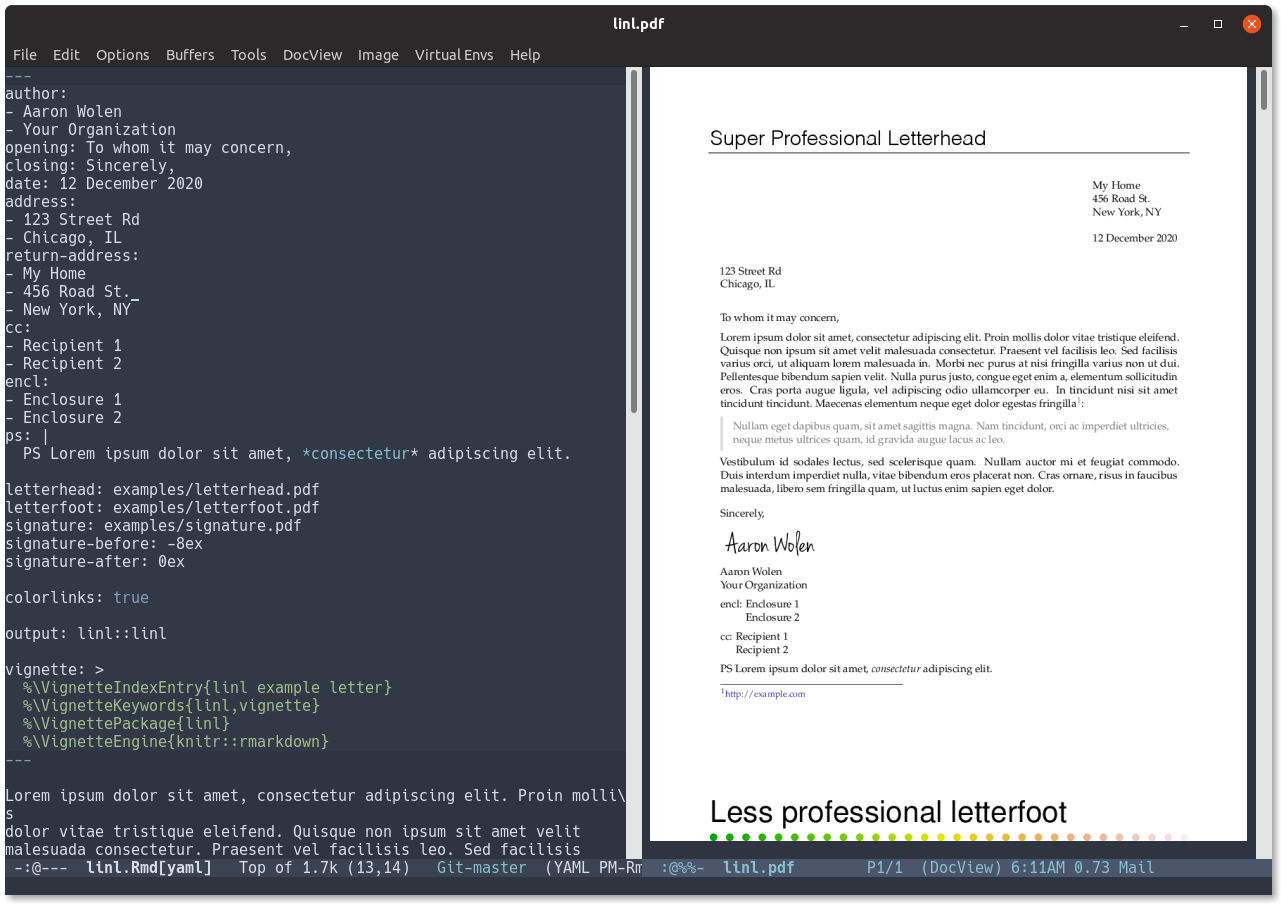
Aaron Wolen and I are pleased to announce the availability of the initial 0.0.1 release of our new linl package on the CRAN network. It provides a simple-yet-powerful Markdown---and RMarkdown---wrapper the venerable LaTeX letter class. Aaron had done the legwork in the underlying pandoc-letter repository upon which we build via proper rmarkdown integration. The package also includes a LaTeX trick or two: optional header and signature files, nicer font, better size, saner default geometry and more. See the following screenshot which shows the package vignette---itself a simple letter---along with (most of) its source:
The initial (short) NEWS entry follows:

Changes in tint version 0.0.1 (2017-10-17)
  • Initial CRAN release

The date is a little off; it took a little longer than usual for the good folks at CRAN to process the initial submission. We expect future releases to be more timely. For questions or comments use the issue tracker off the GitHub repo.

This post by Dirk Eddelbuettel originated on his Thinking inside the box blog. Please report excessive re-aggregation in third-party for-profit settings.

Steinar H. Gunderson: Introducing Narabu, part 3: Parallel structure

Narabu is a new intraframe video codec. You probably want to read part 1 and part 2 first. Now having a rough idea of how the GPU works, it's obvious that we need our codec to split the image into a lot of independent chunks to be parallel; we're aiming for about a thousand chunks. We'll also aim for a format that's as simple as possible; other people can try to push the frontiers on research, I just want something that's fast, reasonably good, and not too hard to implement. First of all, let's look at JPEG. It works by converting the image to Y'CbCr (usually with subsampled chroma), split each channel into 8x8 blocks, DCT them, quantize and then use Huffman coding to encode those coefficients. This is a very standard structure, and JPEG, despite being really old by now, is actually hard to beat, so let's use that as a template. But we probably can't use JPEG wholesale. Why? The answer is that the Huffman coding is just too serial. It's all just one stream, and without knowing where the previous symbol ends, we don't know where to start decoding the next. You can partially solve this by having frequent restart markers, but these reduce coding efficiency, and there's no index of them; you'd have to make a parallel scan for them, which is annoying. So we'll need to at least do something about the entropy coding. Do we need to change anything else to reach our ~1000 parallel target? 720p is the standard video target these days; the ~1M raw pixels would be great if we could do all of them independently, but we obviously can't, since DCT is not independent per pixel (that would sort of defeat the purpose). However, there are 14,400 DCT blocks (8x8), so we can certainly do all the DCTs in parallel. Quantization after that is trivially parallelizable, at least as long as we don't aim for trellis or the likes. So indeed, it's only entropy coding that we need to worry about. Since we're changing entropy coding anyway, I picked rANS, which is confusing but has a number of neat properties; it's roughly as expensive as Huffman coding, but has an efficiency closer to that of arithmetic encoding, and you can switch distributions for each symbol. It requires a bit more calculation, but GPUs have plenty of ALUs (a typical recommendation is 10:1 calculation to memory access), so that should be fine. I picked a pretty common variation with 32-bit state and 8-bit I/O, since 64-bit arithmetic is not universally available on GPUs (I checked a variation with 64-bit state and 32-bit I/O, but it didn't really matter much for speed). Fabian Giesen has described how you can actually do rANS encoding and decoding in parallel over a warp, but I've treated it as a purely serial operation. I don't do anything like adaptation, though; each coefficient is assigned to one out of four rANS static distributions that are signaled at the start of each stream. (Four is a nice tradeoff between coding efficiency, L1 cache use and the cost of transmitting the distributions themselves. I originally used eight, but a bit of clustering showed it was possible to get it down to four at basically no extra cost. JPEG does a similar thing, with separate Huffman codes for AC and DC coefficients. And I've got separate distributions for luma and chroma, which also makes a lot of sense.) The restart cost of rANS is basically writing the state to disk; some of that we would need to write even without a restart, and there are ways to combine many such end states for less waste (I'm not using them), but let's be conservative and assume we waste all of it for each restart. At 150 Mbit/second for 720p60, the luma plane of one frame is about 150 kB. 10% (15 kB) sounds reasonable to sacrifice to restarts, which means we can have about 3750 of them, or one for each 250th pixel or so. (3750 restarts also means 3750 independent entropy coding streams, so we're still well above our 1000 target.) So the structure is more or less clear; we'll DCT the blocks in parallel (since an 8x8 block can be expressed as 8 vertical DCTs and then 8 horizontal DCTs, we can even get 8-way parallelism there), and then encode at least 250 coefficients into an rANS stream. I've chosen to let a stream encompass a single coefficient from each of 320 DCT blocks instead of all coefficients from 5 DCT blocks; it's sort of arbitrary and might be a bit unintuitive, but it feels more natural, especially since you don't need to switch rANS distributions for each coefficient. So that's a lot of rambling for a sort-of abstract format. Next time we'll go into how decoding works. Or encoding. I haven't really made up my mind yet.

Sean Whitton: Debian Policy call for participation -- October 2017

Here s are some of the bugs against the Debian Policy Manual. In particular, there really are quite a few patches needing seconds from DDs. Consensus has been reached and help is needed to write a patch: #759316 Document the use of /etc/default for cron jobs #761219 document versioned Provides #767839 Linking documentation of arch:any package to arch:all #770440 policy should mention systemd timers #773557 Avoid unsafe RPATH/RUNPATH #780725 PATH used for building is not specified #793499 The Installed-Size algorithm is out-of-date #810381 Update wording of 5.6.26 VCS-* fields to recommend encryption #823256 Update maintscript arguments with dpkg >= 1.18.5 #833401 virtual packages: dbus-session-bus, dbus-default-session-bus #835451 Building as root should be discouraged #838777 Policy 11.8.4 for x-window-manager needs update for freedesktop menus #845715 Please document that packages are not allowed to write outside thei #853779 Clarify requirements about update-rc.d and invoke-rc.d usage in mai #874019 Note that the -e argument to x-terminal-emulator works like #874206 allow a trailing comma in package relationship fields Wording proposed, awaiting review from anyone and/or seconds by DDs: #688251 Built-Using description too aggressive #737796 copyright-format: support Files: paragraph with both abbreviated na #756835 Extension of the syntax of the Packages-List field. #786470 [copyright-format] Add an optional License-Grant field #810381 Update wording of 5.6.26 VCS-* fields to recommend encryption #835451 Building as root should be discouraged #845255 Include best practices for packaging database applications #846970 Proposal for a Build-Indep-Architecture: control file field #850729 Documenting special version number suffixes #864615 please update version of posix standard for scripts (section 10.4) #874090 Clarify wording of some passages #874095 copyright-format: Use the synopsis term established in the de Merged for the next release: #683495 perl scripts: #!/usr/bin/perl MUST or SHOULD? #877674 [debian-policy] update links to the pdf and other formats of the do #878523 [PATCH] Spelling fixes

20 October 2017

Raphaël Hertzog: Freexian s report about Debian Long Term Support, September 2017

A Debian LTS logoLike each month, here comes a report about the work of paid contributors to Debian LTS. Individual reports In August, about 170 work hours have been dispatched among 13 paid contributors. Their reports are available: Evolution of the situation The number of sponsored hours is the same as last month. But we have a new sponsor in the pipe. The security tracker currently lists 52 packages with a known CVE and the dla-needed.txt file 49. The number of packages with open issues decreased slightly compared to last month but we re not yet back to the usual situation. Thanks to our sponsors New sponsors are in bold.

No comment Liked this article? Click here. My blog is Flattr-enabled.

19 October 2017

Daniel Pocock: FOSDEM 2018 Real-Time Communications Call for Participation

FOSDEM is one of the world's premier meetings of free software developers, with over five thousand people attending each year. FOSDEM 2018 takes place 3-4 February 2018 in Brussels, Belgium. This email contains information about:
  • Real-Time communications dev-room and lounge,
  • speaking opportunities,
  • volunteering in the dev-room and lounge,
  • related events around FOSDEM, including the XMPP summit,
  • social events (the legendary FOSDEM Beer Night and Saturday night dinners provide endless networking opportunities),
  • the Planet aggregation sites for RTC blogs
Call for participation - Real Time Communications (RTC) The Real-Time dev-room and Real-Time lounge is about all things involving real-time communication, including: XMPP, SIP, WebRTC, telephony, mobile VoIP, codecs, peer-to-peer, privacy and encryption. The dev-room is a successor to the previous XMPP and telephony dev-rooms. We are looking for speakers for the dev-room and volunteers and participants for the tables in the Real-Time lounge. The dev-room is only on Sunday, 4 February 2018. The lounge will be present for both days. To discuss the dev-room and lounge, please join the FSFE-sponsored Free RTC mailing list. To be kept aware of major developments in Free RTC, without being on the discussion list, please join the Free-RTC Announce list. Speaking opportunities Note: if you used FOSDEM Pentabarf before, please use the same account/username Real-Time Communications dev-room: deadline 23:59 UTC on 30 November. Please use the Pentabarf system to submit a talk proposal for the dev-room. On the "General" tab, please look for the "Track" option and choose "Real Time Communications devroom". Link to talk submission. Other dev-rooms and lightning talks: some speakers may find their topic is in the scope of more than one dev-room. It is encouraged to apply to more than one dev-room and also consider proposing a lightning talk, but please be kind enough to tell us if you do this by filling out the notes in the form. You can find the full list of dev-rooms on this page and apply for a lightning talk at https://fosdem.org/submit Main track: the deadline for main track presentations is 23:59 UTC 3 November. Leading developers in the Real-Time Communications field are encouraged to consider submitting a presentation to the main track. First-time speaking? FOSDEM dev-rooms are a welcoming environment for people who have never given a talk before. Please feel free to contact the dev-room administrators personally if you would like to ask any questions about it. Submission guidelines The Pentabarf system will ask for many of the essential details. Please remember to re-use your account from previous years if you have one. In the "Submission notes", please tell us about:
  • the purpose of your talk
  • any other talk applications (dev-rooms, lightning talks, main track)
  • availability constraints and special needs
You can use HTML and links in your bio, abstract and description. If you maintain a blog, please consider providing us with the URL of a feed with posts tagged for your RTC-related work. We will be looking for relevance to the conference and dev-room themes, presentations aimed at developers of free and open source software about RTC-related topics. Please feel free to suggest a duration between 20 minutes and 55 minutes but note that the final decision on talk durations will be made by the dev-room administrators based on the received proposals. As the two previous dev-rooms have been combined into one, we may decide to give shorter slots than in previous years so that more speakers can participate. Please note FOSDEM aims to record and live-stream all talks. The CC-BY license is used. Volunteers needed To make the dev-room and lounge run successfully, we are looking for volunteers:
  • FOSDEM provides video recording equipment and live streaming, volunteers are needed to assist in this
  • organizing one or more restaurant bookings (dependending upon number of participants) for the evening of Saturday, 4 February
  • participation in the Real-Time lounge
  • helping attract sponsorship funds for the dev-room to pay for the Saturday night dinner and any other expenses
  • circulating this Call for Participation (text version) to other mailing lists
Related events - XMPP and RTC summits The XMPP Standards Foundation (XSF) has traditionally held a summit in the days before FOSDEM. There is discussion about a similar summit taking place on 2 February 2018. XMPP Summit web site - please join the mailing list for details. Social events and dinners The traditional FOSDEM beer night occurs on Friday, 2 February. On Saturday night, there are usually dinners associated with each of the dev-rooms. Most restaurants in Brussels are not so large so these dinners have space constraints and reservations are essential. Please subscribe to the Free-RTC mailing list for further details about the Saturday night dinner options and how you can register for a seat. Spread the word and discuss If you know of any mailing lists where this CfP would be relevant, please forward this email (text version). If this dev-room excites you, please blog or microblog about it, especially if you are submitting a talk. If you regularly blog about RTC topics, please send details about your blog to the planet site administrators:
Planet site Admin contact
All projects Free-RTC Planet (http://planet.freertc.org) contact planet@freertc.org
XMPP Planet Jabber (http://planet.jabber.org) contact ralphm@ik.nu
SIP Planet SIP (http://planet.sip5060.net) contact planet@sip5060.net
SIP (Espa ol) Planet SIP-es (http://planet.sip5060.net/es/) contact planet@sip5060.net
Please also link to the Planet sites from your own blog or web site as this helps everybody in the free real-time communications community. Contact For any private queries, contact us directly using the address fosdem-rtc-admin@freertc.org and for any other queries please ask on the Free-RTC mailing list. The dev-room administration team:

18 October 2017

Joey Hess: extending Scuttlebutt with Annah

This post has it all. Flotillas of sailboats, peer-to-peer wikis, games, and de-frogging. But, I need to start by talking about some tech you may not have heard of yet... So, how could these be combined together, and what might the result look like? Well, I could start by posting a Scuttlebutt message that defines what True is. And another Scuttlebutt message defining False. And then, another Scuttlebutt message to define the AND function, which would link to my messages for True and False. Continue this until I've built up enough Annah code to write some almost useful programs. Annah can't do any IO on its own (though it can model IO similarly to how Haskell does), so for programs to be actually useful, there needs to be Scuttlebutt client support. The way typing works in Annah, a program's type can be expressed as a Scuttlebutt link. So a Scuttlebutt client that wants to run Annah programs of a particular type can pick out programs that link to that type, and will know what type of data the program consumes and produces. Here are a few ideas of what could be built, with fairly simple client-side support for different types of Annah programs... This kind of extensibility in a peer-to-peer system is exciting! With these new systems, we can consider lessons from the world wide web and replicate some of the good parts, while avoiding the bad. Javascript has been both good and bad for the web. The extensibility is great, and yet it's a neverending security and privacy nightmare, and it ties web pages ever more tightly to programs hidden away on servers. I believe that Annah combined with Scuttlebutt will comprehensively avoid those problems. Shall we build it?
This exploration was sponsored by Jake Vosloo on Patreon.

17 October 2017

Reproducible builds folks: Reproducible Builds: Weekly report #129

Here's what happened in the Reproducible Builds effort between Sunday October 8 and Saturday October 14 2017: Upcoming events Reproducible work in other projects Pierre Pronchery reported that that he has built the foundations for doing more reproducibility work in NetBSD. Packages fixed Upstream bugs and patches: Reproducibility non-maintainer uploads in Debian: QA fixes in Debian: Reviews of unreproducible packages 6 package reviews have been added, 30 have been updated and 37 have been removed in this week, adding to our knowledge about identified issues. Weekly QA work During our reproducibility testing, FTBFS bugs have been detected and reported by: diffoscope development reprotest development Version 0.7.3 was uploaded to unstable by Ximin Luo. It included contributions already covered by posts of the previous weeks, as well as new ones: Misc. This week's edition was written by Ximin Luo, Chris Lamb and Holger Levsen & reviewed by a bunch of Reproducible Builds folks on IRC & the mailing lists.

Jonathan Dowland: Electric Dreams

No spoilers, for those who have yet to watch it... Channel 4 have been broadcasting a new 10-part series called Electric Dreams, based on some of the short fiction of Philip K Dick. The series was commissioned after Channel 4 lost Black Mirror to Netflix, perhaps to try and find something tonally similar. Electric Dreams is executive-produced by Brian Cranston, who also stars in one of the episodes yet to broadcast. I've read all of PKD's short fiction1 but it was a long time ago so I have mostly forgotten the stories upon which the series is based. I've quite enjoyed going back and re-reading them after watching the corresponding episodes to see what changes they've made. In some cases the changes are subtle or complementary, in other cases they've whittled the original story right out and installed a new one inside the shell. A companion compilation has been published with just the relevant short stories in it, and from what I've seen browsing it in a book shop it also contains short introductions which might be worth a read. Things started strong with The Hood Maker, which my wife also enjoyed, although she was disappointed to realise we wouldn't be revisiting those characters in the future. The world-building was strong enough that it seemed like a waste for a single episode. My favourite episode of those broadcast so far was The Commuter, starring Timothy Spall. The changes made were complementary and immensely expanded the emotional range of the story. In some ways, a key aspect of the original story was completely inverted, which I found quite funny: my original take on Dick's story was Dick implying a particular outcome was horrific, whereas it becomes desirable in the TV episode.
Episode 4, *Crazy Diamond* Episode 4, Crazy Diamond
One of the stories most hollowed-out was Sales Pitch which was the basis for Tony Grisoni s episode Crazy Diamond, starring Steve Buscemi and Sidse Babett Knudsen. Buscemi was good but Knudsen totally stole every frame she was in. Fans of the cancelled Channel 4 show Utopia should enjoy this one: both were directed by Marc Munden and the directing, photography and colour balance really recall it. The last episode broadcast was Real Life directed by Ronald D Moore of Battlestar Galactica reboot fame and starring Anna Paquin. Like Sales Pitch it bears very little resemblance to the original story. It played around with similar ideas explored in a lot of Sci-Fi movies and TV shows but left me a little flat; I didn't think it contributed much that I hadn't seen before. I was disappointed that there was a relatively conclusive ending. There was a subversive humour in the Dick short that was completely lost in the retelling. The world design seemed pretty generic. I'm looking forward to Autofac, which is one of the shorts I can remember particularly enjoying.

  1. as collected in the 5 volumes of The Collected Stories of Philip K Dick, although I don't doubt there are some stragglers that were missed out when that series was compiled.

Antoine Beaupr : A comparison of cryptographic keycards

An earlier article showed that private key storage is an important problem to solve in any cryptographic system and established keycards as a good way to store private key material offline. But which keycard should we use? This article examines the form factor, openness, and performance of four keycards to try to help readers choose the one that will fit their needs. I have personally been using a YubiKey NEO, since a 2015 announcement on GitHub promoting two-factor authentication. I was also able to hook up my SSH authentication key into the YubiKey's 2048 bit RSA slot. It seemed natural to move the other subkeys onto the keycard, provided that performance was sufficient. The mail client that I use, (Notmuch), blocks when decrypting messages, which could be a serious problems on large email threads from encrypted mailing lists. So I built a test harness and got access to some more keycards: I bought a FST-01 from its creator, Yutaka Niibe, at the last DebConf and Nitrokey donated a Nitrokey Pro. I also bought a YubiKey 4 when I got the NEO. There are of course other keycards out there, but those are the ones I could get my hands on. You'll notice none of those keycards have a physical keypad to enter passwords, so they are all vulnerable to keyloggers that could extract the key's PIN. Keep in mind, however, that even with the PIN, an attacker could only ask the keycard to decrypt or sign material but not extract the key that is protected by the card's firmware.

Form factor The Nitrokey Pro, YubiKey NEO (worn out), YubiKey 4, and FST-01 The four keycards have similar form factors: they all connect to a standard USB port, although both YubiKey keycards have a capacitive button by which the user triggers two-factor authentication and the YubiKey 4 can also require a button press to confirm private key use. The YubiKeys feel sturdier than the other two. The NEO has withstood two years of punishment in my pockets along with the rest of my "real" keyring and there is only minimal wear on the keycard in the picture. It's also thinner so it fits well on the keyring. The FST-01 stands out from the other two with its minimal design. Out of the box, the FST-01 comes without a case, so the circuitry is exposed. This is deliberate: one of its goals is to be as transparent as possible, both in terms of software and hardware design and you definitely get that feeling at the physical level. Unfortunately, that does mean it feels more brittle than other models: I wouldn't carry it in my pocket all the time, although there is a case that may protect the key a little better, but it does not provide an easy way to hook it into a keyring. In the group picture above, the FST-01 is the pink plastic thing, which is a rubbery casing I received along with the device when I got it. Notice how the USB connectors of the YubiKeys differ from the other two: while the FST-01 and the Nitrokey have standard USB connectors, the YubiKey has only a "half-connector", which is what makes it thinner than the other two. The "Nano" form factor takes this even further and almost disappears in the USB port. Unfortunately, this arrangement means the YubiKey NEO often comes loose and falls out of the USB port, especially when connected to a laptop. On my workstation, however, it usually stays put even with my whole keyring hanging off of it. I suspect this adds more strain to the host's USB port but that's a tradeoff I've lived with without any noticeable wear so far. Finally, the NEO has this peculiar feature of supporting NFC for certain operations, as LWN previously covered, but I haven't used that feature yet. The Nitrokey Pro looks like a normal USB key, in contrast with the other two devices. It does feel a little brittle when compared with the YubiKey, although only time will tell how much of a beating it can take. It has a small ring in the case so it is possible to carry it directly on your keyring, but I would be worried the cap would come off eventually. Nitrokey devices are also two times thicker than the Yubico models which makes them less convenient to carry around on keyrings.

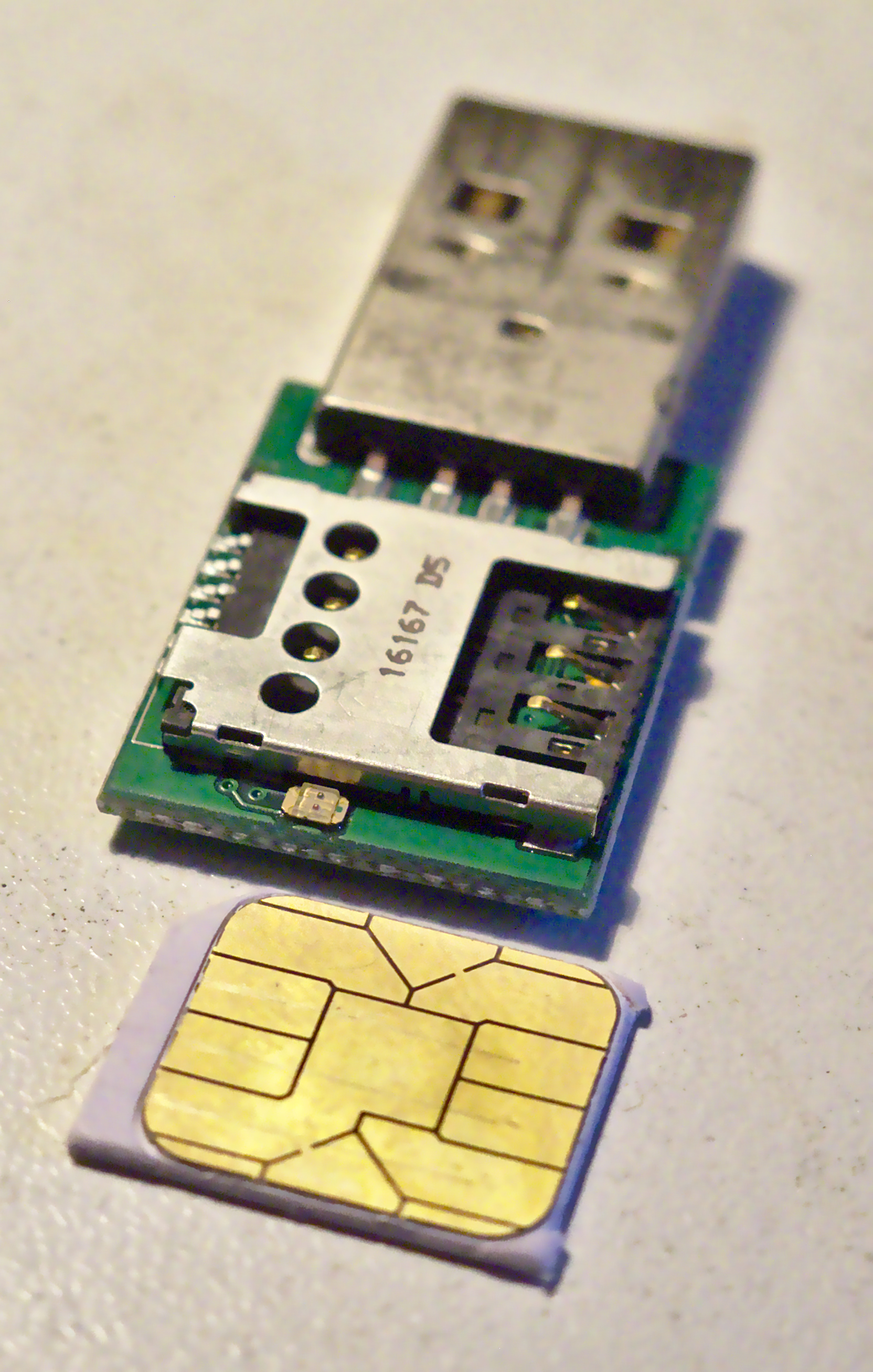
Open and closed designs The FST-01 is as open as hardware comes, down to the PCB design available as KiCad files in this Git repository. The software running on the card is the Gnuk firmware that implements the OpenPGP card protocol, but you can also get it with firmware implementing a true random number generator (TRNG) called NeuG (pronounced "noisy"); the device is programmable through a standard Serial Wire Debug (SWD) port. The Nitrokey Start model also runs the Gnuk firmware. However, the Nitrokey website announces only ECC and RSA 2048-bit support for the Start, while the FST-01 also supports RSA-4096. Nitrokey's founder Jan Suhr, in a private email, explained that this is because "Gnuk doesn't support RSA-3072 or larger at a reasonable speed". Its devices (the Pro, Start, and HSM models) use a similar chip to the FST-01: the STM32F103 microcontroller. Nitrokey Pro with STM32F103TBU6 MCU Nitrokey also publishes its hardware designs, on GitHub, which shows the Pro is basically a fork of the FST-01, according to the ChangeLog. I opened the case to confirm it was using the STM MCU, something I should warn you against; I broke one of the pins holding it together when opening it so now it's even more fragile. But at least, I was able to confirm it was built using the STM32F103TBU6 MCU, like the FST-01. Nitrokey back side But this is where the comparison ends: on the back side, we find a SIM card reader that holds the OpenPGP card that, in turn, holds the private key material and does the cryptographic operations. So, in effect, the Nitrokey Pro is really a evolution of the original OpenPGP card readers. Nitrokey confirmed the OpenPGP card featured in the Pro is the same as the one shipped by the Free Software Foundation Europe (FSFE): the BasicCard built by ZeitControl. Those cards, however, are covered by NDAs and the firmware is only partially open source. This makes the Nitrokey Pro less open than the FST-01, but that's an inevitable tradeoff when choosing a design based on the OpenPGP cards, which Suhr described to me as "pretty proprietary". There are other keycards out there, however, for example the SLJ52GDL150-150k smartcard suggested by Debian developer Yves-Alexis Perez, which he prefers as it is certified by French and German authorities. In that blog post, he also said he was experimenting with the GPL-licensed OpenPGP applet implemented by the French ANSSI. But the YubiKey devices are even further away in the closed-design direction. Both the hardware designs and firmware are proprietary. The YubiKey NEO, for example, cannot be upgraded at all, even though it is based on an open firmware. According to Yubico's FAQ, this is due to "best security practices": "There is a 'no upgrade' policy for our devices since nothing, including malware, can write to the firmware." I find this decision questionable in a context where security updates are often more important than trying to design a bulletproof design, which may simply be impossible. And the YubiKey NEO did suffer from critical security issue that allowed attackers to bypass the PIN protection on the card, which raises the question of the actual protection of the private key material on those cards. According to Niibe, "some OpenPGP cards store the private key unencrypted. It is a common attitude for many smartcard implementations", which was confirmed by Suhr: "the private key is protected by hardware mechanisms which prevent its extraction and misuse". He is referring to the use of tamper resistance. After that security issue, there was no other option for YubiKey NEO users than to get a new keycard (for free, thankfully) from Yubico, which also meant discarding the private key material on the key. For OpenPGP keys, this may mean having to bootstrap the web of trust from scratch if the keycard was responsible for the main certification key. But at least the NEO is running free software based on the OpenPGP card applet and the source is still available on GitHub. The YubiKey 4, on the other hand, is now closed source, which was controversial when the new model was announced last year. It led the main Linux Foundation system administrator, Konstantin Ryabitsev, to withdraw his endorsement of Yubico products. In response, Yubico argued that this approach was essential to the security of its devices, which are now based on "a secure chip, which has built-in countermeasures to mitigate a long list of attacks". In particular, it claims that:
A commercial-grade AVR or ARM controller is unfit to be used in a security product. In most cases, these controllers are easy to attack, from breaking in via a debug/JTAG/TAP port to probing memory contents. Various forms of fault injection and side-channel analysis are possible, sometimes allowing for a complete key recovery in a shockingly short period of time.
While I understand those concerns, they eventually come down to the trust you have in an organization. Not only do we have to trust Yubico, but also hardware manufacturers and designs they have chosen. Every step in the hidden supply chain is then trusted to make correct technical decisions and not introduce any backdoors. History, unfortunately, is not on Yubico's side: Snowden revealed the example of RSA security accepting what renowned cryptographer Bruce Schneier described as a "bribe" from the NSA to weaken its ECC implementation, by using the presumably backdoored Dual_EC_DRBG algorithm. What makes Yubico or its suppliers so different from RSA Security? Remember that RSA Security used to be an adamant opponent to the degradation of encryption standards, campaigning against the Clipper chip in the first crypto wars. Even if we trust the Yubico supply chain, how can we trust a closed design using what basically amounts to security through obscurity? Publicly auditable designs are an important tradition in cryptography, and that principle shouldn't stop when software is frozen into silicon. In fact, a critical vulnerability called ROCA disclosed recently affects closed "smartcards" like the YubiKey 4 and allows full private key recovery from the public key if the key was generated on a vulnerable keycard. When speaking with Ars Technica, the researchers outlined the importance of open designs and questioned the reliability of certification:
Our work highlights the dangers of keeping the design secret and the implementation closed-source, even if both are thoroughly analyzed and certified by experts. The lack of public information causes a delay in the discovery of flaws (and hinders the process of checking for them), thereby increasing the number of already deployed and affected devices at the time of detection.
This issue with open hardware designs seems to be recurring topic of conversation on the Gnuk mailing list. For example, there was a discussion in September 2017 regarding possible hardware vulnerabilities in the STM MCU that would allow extraction of encrypted key material from the key. Niibe referred to a talk presented at the WOOT 17 workshop, where Johannes Obermaier and Stefan Tatschner, from the Fraunhofer Institute, demonstrated attacks against the STMF0 family MCUs. It is still unclear if those attacks also apply to the older STMF1 design used in the FST-01, however. Furthermore, extracted private key material is still protected by user passphrase, but the Gnuk uses a weak key derivation function, so brute-forcing attacks may be possible. Fortunately, there is work in progress to make GnuPG hash the passphrase before sending it to the keycard, which should make such attacks harder if not completely pointless. When asked about the Yubico claims in a private email, Niibe did recognize that "it is true that there are more weak points in general purpose implementations than special implementations". During the last DebConf in Montreal, Niibe explained:
If you don't trust me, you should not buy from me. Source code availability is only a single factor: someone can maliciously replace the firmware to enable advanced attacks.
Niibe recommends to "build the firmware yourself", also saying the design of the FST-01 uses normal hardware that "everyone can replicate". Those advantages are hard to deny for a cryptographic system: using more generic components makes it harder for hostile parties to mount targeted attacks. A counter-argument here is that it can be difficult for a regular user to audit such designs, let alone physically build the device from scratch but, in a mailing list discussion, Debian developer Ian Jackson explained that:
You don't need to be able to validate it personally. The thing spooks most hate is discovery. Backdooring supposedly-free hardware is harder (more costly) because it comes with greater risk of discovery. To put it concretely: if they backdoor all of them, someone (not necessarily you) might notice. (Backdooring only yours involves messing with the shipping arrangements and so on, and supposes that you specifically are of interest.)
Since that, as far as we know, the STM microcontrollers are not backdoored, I would tend to favor those devices instead of proprietary ones, as such a backdoor would be more easily detectable than in a closed design. Even though physical attacks may be possible against those microcontrollers, in the end, if an attacker has physical access to a keycard, I consider the key compromised, even if it has the best chip on the market. In our email exchange, Niibe argued that "when a token is lost, it is better to revoke keys, even if the token is considered secure enough". So like any other device, physical compromise of tokens may mean compromise of the key and should trigger key-revocation procedures.

Algorithms and performance To establish reliable performance results, I wrote a benchmark program naively called crypto-bench that could produce comparable results between the different keys. The program takes each algorithm/keycard combination and runs 1000 decryptions of a 16-byte file (one AES-128 block) using GnuPG, after priming it to get the password cached. I assume the overhead of GnuPG calls to be negligible, as it should be the same across all tokens, so comparisons are possible. AES encryption is constant across all tests as it is always performed on the host and fast enough to be irrelevant in the tests. I used the following:
  • Intel(R) Core(TM) i3-6100U CPU @ 2.30GHz running Debian 9 ("stretch"/stable amd64), using GnuPG 2.1.18-6 (from the stable Debian package)
  • Nitrokey Pro 0.8 (latest firmware)
  • FST-01, running Gnuk version 1.2.5 (latest firmware)
  • YubiKey NEO OpenPGP applet 1.0.10 (not upgradable)
  • YubiKey 4 4.2.6 (not upgradable)
I ran crypto-bench for each keycard, which resulted in the following:
Algorithm Device Mean time (s)
ECDH-Curve25519 CPU 0.036
FST-01 0.135
RSA-2048 CPU 0.016
YubiKey-4 0.162
Nitrokey-Pro 0.610
YubiKey-NEO 0.736
FST-01 1.265
RSA-4096 CPU 0.043
YubiKey-4 0.875
Nitrokey-Pro 3.150
FST-01 8.218
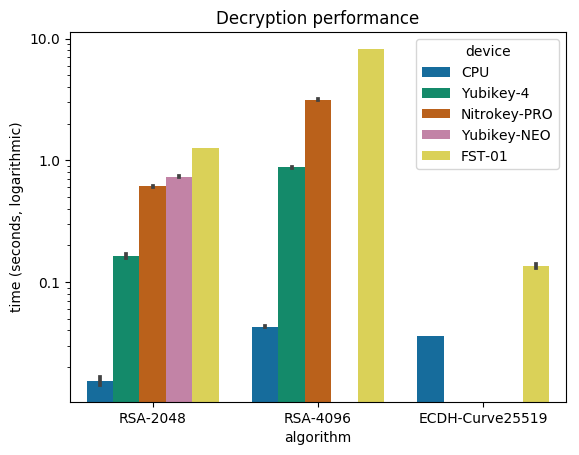
Decryption graph There we see the performance of the four keycards I tested, compared with the same operations done without a keycard: the "CPU" device. That provides the baseline time of GnuPG decrypting the file. The first obvious observation is that using a keycard is slower: in the best scenario (FST-01 + ECC) we see a four-fold slowdown, but in the worst case (also FST-01, but RSA-4096), we see a catastrophic 200-fold slowdown. When I presented the results on the Gnuk mailing list, GnuPG developer Werner Koch confirmed those "numbers are as expected":
With a crypto chip RSA is much faster. By design the Gnuk can't be as fast - it is just a simple MCU. However, using Curve25519 Gnuk is really fast.
And yes, the FST-01 is really fast at doing ECC, but it's also the only keycard that handles ECC in my tests; the Nitrokey Start and Nitrokey HSM should support it as well, but I haven't been able to test those devices. Also note that the YubiKey NEO doesn't support RSA-4096 at all, so we can only compare RSA-2048 across keycards. We should note, however, that ECC is slower than RSA on the CPU, which suggests the Gnuk ECC implementation used by the FST-01 is exceptionally fast. In discussions about improving the performance of the FST-01, Niibe estimated the user tolerance threshold to be "2 seconds decryption time". In a new design using the STM32L432 microcontroller, Aurelien Jarno was able to bring the numbers for RSA-2048 decryption from 1.27s down to 0.65s, and for RSA-4096, from 8.22s down to 3.87s seconds. RSA-4096 is still beyond the two-second threshold, but at least it brings the FST-01 close to the YubiKey NEO and Nitrokey Pro performance levels. We should also underline the superior performance of the YubiKey 4: whatever that thing is doing, it's doing it faster than anyone else. It does RSA-4096 faster than the FST-01 does RSA-2048, and almost as fast as the Nitrokey Pro does RSA-2048. We should also note that the Nitrokey Pro also fails to cross the two-second threshold for RSA-4096 decryption. For me, the FST-01's stellar performance with ECC outshines the other devices. Maybe it says more about the efficiency of the algorithm than the FST-01 or Gnuk's design, but it's definitely an interesting avenue for people who want to deploy those modern algorithms. So, in terms of performance, it is clear that both the YubiKey 4 and the FST-01 take the prize in their own areas (RSA and ECC, respectively).

Conclusion In the above presentation, I have evaluated four cryptographic keycards for use with various OpenPGP operations. What the results show is that the only efficient way of storing a 4096-bit encryption key on a keycard would be to use the YubiKey 4. Unfortunately, I do not feel we should put our trust in such closed designs so I would argue you should either stick with 2048-bit encryption subkeys or keep the keys on disk. Considering that losing such a key would be catastrophic, this might be a good approach anyway. You should also consider switching to ECC encryption: even though it may not be supported everywhere, GnuPG supports having multiple encryption subkeys on a keyring: if one algorithm is unsupported (e.g. GnuPG 1.4 doesn't support ECC), it will fall back to a supported algorithm (e.g. RSA). Do not forget your previously encrypted material doesn't magically re-encrypt itself using your new encryption subkey, however. For authentication and signing keys, speed is not such an issue, so I would warmly recommend either the Nitrokey Pro or Start, or the FST-01, depending on whether you want to start experimenting with ECC algorithms. Availability also seems to be an issue for the FST-01. While you can generally get the device when you meet Niibe in person for a few bucks (I bought mine for around \$30 Canadian), the Seeed online shop says the device is out of stock at the time of this writing, even though Jonathan McDowell said that may be inaccurate in a debian-project discussion. Nevertheless, this issue may make the Nitrokey devices more attractive. When deciding on using the Pro or Start, Suhr offered the following advice:
In practice smart card security has been proven to work well (at least if you use a decent smart card). Therefore the Nitrokey Pro should be used for high security cases. If you don't trust the smart card or if Nitrokey Start is just sufficient for you, you can choose that one. This is why we offer both models.
So far, I have created a signing subkey and moved that and my authentication key to the YubiKey NEO, because it's a device I physically trust to keep itself together in my pockets and I was already using it. It has served me well so far, especially with its extra features like U2F and HOTP support, which I use frequently. Those features are also available on the Nitrokey Pro, so that may be an alternative if I lose the YubiKey. I will probably move my main certification key to the FST-01 and a LUKS-encrypted USB disk, to keep that certification key offline but backed up on two different devices. As for the encryption key, I'll wait for keycard performance to improve, or simply switch my whole keyring to ECC and use the FST-01 or Nitrokey Start for that purpose.
[The author would like to thank Nitrokey for providing hardware for testing.] This article first appeared in the Linux Weekly News.

16 October 2017

Gustavo Noronha Silva: Who knew we still had low-hanging fruits?

Earlier this month I had the pleasure of attending the Web Engines Hackfest, hosted by Igalia at their offices in A Coru a, and also sponsored by my employer, Collabora, Google and Mozilla. It has grown a lot and we had many new people this year. Fun fact: I am one of the 3 or 4 people who have attended all of the editions of the hackfest since its inception in 2009, when it was called WebKitGTK+ hackfest \o/ 20171002_204405 It was a great get together where I met many friends and made some new ones. Had plenty of discussions, mainly with Antonio Gomes and Google s Robert Kroeger, about the way forward for Chromium on Wayland. We had the opportunity of explaining how we at Collabora cooperated with igalians to implemented and optimise a Wayland nested compositor for WebKit2 to share buffers between processes in an efficient way even on broken drivers. Most of the discussions and some of the work that led to this was done in previous hackfests, by the way! 20171002_193518 The idea seems to have been mostly welcomed, the only concern being that Wayland s interfaces would need to be tested for security (fuzzed). So we may end up going that same route with Chromium for allowing process separation between the UI and GPU (being renamed Viz, currently) processes. On another note, and going back to the title of the post, at Collabora we have recently adopted Mattermost to replace our internal IRC server. Many Collaborans have decided to use Mattermost through an Epiphany Web Application or through a simple Python application that just shows a GTK+ window wrapping a WebKitGTK+ WebView. 20171002_101952 Some people noticed that when the connection was lost Mattermost would take a very long time to notice and reconnect its web sockets were taking a long, long time to timeout, according to our colleague Andrew Shadura. I did some quick searching on the codebase and noticed WebCore has a NetworkStateNotifier interface that it uses to get notified when connection changes. That was not implemented for WebKitGTK+, so it was likely what caused stuff to linger when a connection hiccup happened. Given we have GNetworkMonitor, implementation of the missing interfaces required only 3 lines of actual code (plus the necessary boilerplate)! screenshot-from-2017-10-16-11-13-39 I was surprised to still find such as low hanging fruit in WebKitGTK+, so I decided to look for more. Turns out WebCore also has a notifier for low power situations, which was implemented only by the iOS port, and causes the engine to throttle some timers and avoid some expensive checks it would do in normal situations. This required a few more lines to implement using upower-glib, but not that many either! That was the fun I had during the hackfest in terms of coding. Mostly I had fun just lurking in break out sessions discussing the past, present and future of tech such as WebRTC, Servo, Rust, WebKit, Chromium, WebVR, and more. I also beat a few challengers in Street Fighter 2, as usual. I d like to say thanks to Collabora, Igalia, Google, and Mozilla for sponsoring and attending the hackfest. Thanks to Igalia for hosting and to Collabora for sponsoring my attendance along with two other Collaborans. It was a great hackfest and I m looking forward to the next one! See you in 2018 =)

15 October 2017

Norbert Preining: TeX Live Manager: JSON output

With the development of TLCockpit continuing, I found the need for and easy exchange format between the TeX Live Manager tlmgr and frontend programs like TLCockpit. Thus, I have implemented JSON output for the tlmgr info command. While the format is not 100% stable I might change some thing I consider it pretty settled. The output of tlmgr info --data json is a JSON array with JSON objects for each package requested (default is to list all).
[ TLPackageObj, TLPackageObj, ... ]
The structure of the JSON object TLPackageObj reflects the internal Perl hash. Guaranteed to be present keys are name (String) and avilable (Boolean). In case the package is available, there are the following further keys sorted by their type: A rather long example showing the output for the package latex, formatted with json_pp and having the list of files and the long description shortened:
[
    
      "installed" : true,
      "doccontainerchecksum" : "5bdfea6b85c431a0af2abc8f8df160b297ad73f6a324ca88df990f01f24611c9ae80d2f6d12c7b3767308fbe3de3fca3d11664b923ea4080fb13fd056a1d0c3d",
      "docfiles" : [
         "texmf-dist/doc/latex/base/README.txt",
         ....
         "texmf-dist/doc/latex/base/webcomp.pdf"
      ],
      "containersize" : 163892,
      "depends" : [
         "luatex",
         "pdftex",
         "latexconfig",
         "latex-fonts"
      ],
      "runsize" : 414,
      "relocated" : false,
      "doccontainersize" : 12812184,
      "srcsize" : 752,
      "revision" : 43813,
      "srcfiles" : [
         "texmf-dist/source/latex/base/alltt.dtx",
         ....
         "texmf-dist/source/latex/base/utf8ienc.dtx"
      ],
      "category" : "Package",
      "cataloguedata" :  
         "version" : "2017/01/01 PL1",
         "topics" : "format",
         "license" : "lppl1.3",
         "date" : "2017-01-25 23:33:57 +0100"
       ,
      "srccontainerchecksum" : "1d145b567cf48d6ee71582a1f329fe5cf002d6259269a71d2e4a69e6e6bd65abeb92461d31d7137f3803503534282bc0c5546e5d2d1aa2604e896e607c53b041",
      "postactions" : [],
      "binsize" :  ,
      "longdesc" : "LaTeX is a widely-used macro package for TeX, [...]",
      "srccontainersize" : 516036,
      "containerchecksum" : "af0ac85f89b7620eb7699c8bca6348f8913352c473af1056b7a90f28567d3f3e21d60be1f44e056107766b1dce8d87d367e7f8a82f777d565a2d4597feb24558",
      "executes" : [],
      "binfiles" :  ,
      "name" : "latex",
      "catalogue" : null,
      "docsize" : 3799,
      "available" : true,
      "runfiles" : [
         "texmf-dist/makeindex/latex/gglo.ist",
         ...
         "texmf-dist/tex/latex/base/x2enc.dfu"
      ],
      "shortdesc" : "A TeX macro package that defines LaTeX"
    
]
What is currently not available via tlmgr info and thus also not via the JSON output is access to virtual TeX Live databases with several member databases (multiple repositories). I am thinking about how to incorporate this information. These changes are currently available in the tlcritical repository, but will enter proper TeX Live repositories soon. Using this JSON output I will rewrite the current TLCockpit tlmgr interface to display more complete information.

13 October 2017

Shirish Agarwal: I need to speak up now X Economics

Dear all, This would be a longish blog post (as most of mine are) compiled over days but as there is so short a time and so much to share. I had previously thought to share beautiful photographs of Ganesh mandals taking out the procession at time of immersion of the idol or the last day of Durga Puja recent events around do not make my mood to share photos at this point in time. I may share some of them in a future blog post or two . Before going further, I would like to offer my sympathies and condolences to people hurt and dislocated in Hurricane Irma , the 2017 Central Mexico Earthquake and lastly the most recent Las Vegas shooting as well as Hurricane Maria in Puerto Rico . I am somewhat nonplussed as to why Americans always want to name, especially hurricanes which destroy people s lives and livelihood built over generations and why most of the hurricanes are named after women. A look at weather.com site unveiled the answer to the mystery. Ironically (or not) I saw some of the best science coverage about Earthquakes or anything scientific reporting and analysis after a long time in mainstream newspapers in India. On another note, I don t understand or even expect to understand why the gunman did what he did 2 days back. Country music AFAIK is one of the most chilled-out kind of music, in some ways very similar to classical Indian singing although they are worlds apart in style of singing, renditions, artists, the way they emote etc. I seriously wish that the gunman had not been shot but caught and reasons were sought about what he did, he did. While this is certainly armchair thinking as was not at the scene of crime, but if a Mumbai Police constable could do it around a decade ago armed only with a lathi could do it, why couldn t the American cops who probably are trained in innumerable ways to subdue people without killing them, did. While investigations are on, I suspect if he were caught just like Ajmal Kasab was caught then lot of revelations might have come up. From what is known, the gentleman was upwardly mobile i.e. he was white, rich and apparently had no reason to have beef with anybody especially a crowd swaying to some nice music, all of which makes absolutely no sense. Indian Economy Slowdown Anyways, back to one of the main reasons of writing this blog post. Few days back, an ex-finance Minister of India Yashwant Sinha wrote what was felt by probably millions of Indians, an Indian Express article called I need to speak up now While there have been many, many arguments made since then by various people. A simple search of I need to speak up would lead to lead to many a result besides the one I have shared above. The only exception I have with the article is the line Forty leading companies of the country are already facing bankruptcy proceedings. Many more are likely to follow suit. I would not bore you but you ask any entrepreneur trying to set up shop in India i.e. ones who actually go through the processes of getting all the licenses for setting up even a small businesses as to the numerous hurdles they have to overcome and laid-back corrupt bureaucracy which they have to overcome. I could have interviewed some of my friends who had the conviction and the courage to set up shop and spent more than half a decade getting all the necessary licenses and approval to set up but it probably would be too specific for one industry or the other and would lead to the same result. Co-incidentally, a new restaurant, leaf opened in my vicinity few weeks before. From the looks it looked like a high-brow, high-priced restaurant hence like many others I did not venture in. After a few days, they introduced south-Indian delicacies like Masala Dosa, Uttapam at prices similar to other restaurants around. So I ventured in and bought some south Indian food to consume between mum and me. Few days later, I became friends with the owner/franchisee and I suggested (in a friendly tone) that why he doesn t make it like a CCD play where many people including yours truly use the service to share, strategize and meet with clients. The CCD joints usually serve coffee and snacks (which are over-priced but still run out pretty fast) but people come as they have chilled-out atmosphere and Wi-Fi access which people need for their smartphones, although the Wi-Fi part may soon become redundant With Reliance Jio making a big play. I also shared why he doesn t add more variety and time (the south Indian items are time-limited) as I see/saw many empty chairs there. Anyways, the shop-owner/franchisee shared his gross costs including salary, stocking, electricity, rent and it doesn t pan out to be serving Rs.80/- dish (roughly a 1US dollar and 25 cents) then serving INR Rs. 400/- a dish (around 6 $USD). One round of INR 400/- + dishes make his costs for the day, around 12 tables were there. It s when they have two full rounds of dishes costing INR 400/- or more that he actually has profits and he is predicting loss for at least 6 months to a year before he makes a rebound. He needs steady customers rather than just walk-ins that will make his business work/click. Currently his family is bearing the costs. He didn t mention the taxes although I know apart from GST there are still some local body taxes that they will have to pay and comply with. There are a multitude of problems for shutting a shop legally as well as they have to again renavigate the bureaucracy for the same. I have seen more than a few retailers downing their shutters for 6-8 months and then either sell it to new management, let go of the lease or simply sell the property to a competitor. The Insolvency and Bankruptcy Code is probably the first proper exit policy for large companies. So the 40 odd companies that Mr. Sinha were talking about were probably sick for a long time. In India, there is also an additional shame of being a failed entrepreneur unlike in the west where Entrepreneurs start on their next venture. As seen from Retailing In India only 3.3% of the population or at the most 4% of the population is directly or indirectly linked with the retail trade. Most of the economy still derives its wealth from the agrarian sector which is still reeling under the pressure from demonetization which happened last year. Al jazeera surprisingly portrayed a truer picture of the effects demonetization had on common citizen than many Indian newspapers did at the time. Because of the South African Debconf, I had to resort to debit cards and hence was able to escape standing in long lines in which many an old and women perished. It is only yesterday that the Government has acknowledged which many prominent Indians have been saying for months now, that we are in a slowdown . Be aware of the terms being used for effect by the Prime Minister. There are two articles which outlines the troubles India is in atm. The only bright spot has been e-commerce which so far has eluded GST although the Govt. has claimed regulations to put it in check. Indian Education System Interestingly, Ravish Kumar has started a series on NDTV where he is showcasing how Indian education sector, especially public colleges have been left to teachers on contract basis, see the first four episodes on NDTV channel starting with the first one I have shared as a hyperlink. I apologize as the series is in Hindi as the channel is meant for Indians and is mostly limited to Northern areas of the Country (mostly) although he has been honest that it is because they lack resources to tackle the amount of information flowing to them. Ravish started the series with sharing information about the U.S. where the things are similar with some teachers needing to sleep in cars because of high-cost of living to some needing to turn to sex-work . I was shocked when I read the guardian article, that is no way to treat our teachers.I went on to read How the American University was Killed following the breadcrumbs along the way. Reading that it seems Indians have been following the American system playbook from the 1980 s itself. The article talks about HMO as well and that seems to have followed here as well with my own experience of hospital fees and drugs which I had to entail a few weeks/month ago. Few years ago, when me and some of my friends had the teaching bug and we started teaching in a nearby municipal school, couple of teachers had shared that they were doing 2-3 jobs to make ends meet. I don t know about others in my group, at least I was cynical because I thought all the teachers were permanent and they make good money only to realize now that the person was probably speaking the truth. When you have to do three jobs to make ends meet from where do you bring the passion to teach young people and that too outside the syllabus ? Also, with this new knowledge in hindsight, I take back all my comments I made last year and the year before for the pathetic education being put up by the State. With teachers being paid pathetically/underpaid and almost 60% teachers being ad-hoc/adjunct teachers they have to find ways to have some sense of security. Most teachers are bachelors as they are poor and cannot offer any security (either male or female) and for women, after marriage it actually makes no sense for them to continue in this profession. I salute all the professors who are ad-hoc in nature and probably will never get a permanent position in their life. I think in some way, thanx to him, that the government has chosen to give 7th pay commisson salary to teachers. While the numbers may appear be large, there are a lot of questions as to how many people will actually get paid. There needs to be lot of vacancies which need to be filled quickly but don t see any solution in the next 2-3 years as well. The Government has taken a position to use/re-hire retired teachers rather than have new young teachers as an unwritten policy. In this Digital India context how are retired teachers supposed to understand and then pass on digital concepts is beyond me when at few teacher trainings I have seen they lack even the most basic knowledge that I learnt at least a decade or two ago, the difference is that vast. I just don t know what to say to that. My own experience with my own mother who had pretty good education in her time and probably would have made a fine business-woman if she knew that she will have a child that she would have to raise by herself alone (along with maternal grand-parents) is testimonial to the fact how hard it is for older people to grasp technology and here I m talking just using the interface as a consumer rather than a producer or someone in-between who has the idea of how companies and governments profit from whatever data is shared one way or the other. After watching the series/episodes and discussing the issue with my mother it was revealed that both her and my late maternal grandfather were on casual/ad-hoc basis till 20-25 years in their service in the defense sector. If Ravish were to do a series on the defense sector he probably would find the same thing there. To add to that, the defense sector is a vital component to a country s security. If 60% of the defense staff in all defense establishments have temporary staff how do you ensure the loyalty of the people working therein. That brings to my mind Ignorance is bliss . Software development and deployment There is another worry that all are skirting around, the present dispensation/government s mantra is minimum government-maximum governance with digital technologies having all solutions which is leading to massive unemployment. Also from most of the stories/incidents I read in the newspapers, mainstream media and elsewhere it seems most software deployments done in India are done without having any system of internal checks and balances. There is no lintian for software to be implemented. Contracts seem to be given to big companies and there is no mention of what prerequisites or conditions were laid down by the Government for software development and deployment and if any checks were done to ensure that the software being developed was in according to government specifications or not. Ideally this should all be in public domain so that questions can be asked and responsibility fixed if things go haywire, as currently they do not. Software issues As my health been not that great, I have been taking a bit more time and depth while filing bugs. #877638 is a good example. I suspect though that part of the problem might be that mate has moved to gtk3 while guake still has gtk-2 bindings. I also reported the issue upstream both in mate-panel as well as guake . I haven t received any response from either or/and upstreams . I also have been fiddling around with gdb to better understand the tool so I can exploit/use this tool in a better way. There are some commands within the gdb interface which seem to be interesting and hopefully I ll try how the commands perform over days, weeks to a month. I hope we see more action on the mate-panel/guake bug as well as move of guake to gtk+3 but that what seemingly seemed like wait for eternity seems to have done by somebody in last couple of days. As shared in the ticket there are lots of things still to do but it seems the heavy lifting has been done but seems merging will be tricky as two developers have been trying to update to gtk+3 although aichingm seems to have a leg up with his 3! branch. Another interesting thing I saw is the below picture. Firefox is out of date on wordpress.com The firefox version I was using to test the site/wordpress-wp-admin was Mozilla Firefox 52.4.0 which AFAIK is a pretty recentish one and people using Debian stretch would probably be using the same version (firefox stable/LTS) rather than the more recent versions. I went to the link it linked to and it gave no indication as to why it thought my browser is out-of-date and what functionality was/is missing. I have found that wordpress support has declined quite a bit and people don t seem to use the forums as much as they used to before. I also filed a few bugs for qalculate. #877716 where a supposedly transitional package removes the actual application, #877717 as the software has moved its repo. to github.com as well as tickets and other things in process and lastly #877733. I had been searching for a calculator which can do currency calculations on the fly (say for e.g. doing personal budgeting for Taiwan debconf) without needing to manually enter the conversion rates and losing something in the middle. While the current version has support for some limited currencies, the new versions promise more as other people probably have more diverse needs for currency conversions (people who do long or short on oil, stocks overseas is just one example, I am sure there are many others) than simplistic mine.
Filed under: Miscellenous Tagged: #American Education System, #bug-filing, #Climate change, #Dignity, #e-commerce, #gtk+3, #gtk2, #Indian Economy 'Slowdown', #Indian Education System, #Insolvency and Bankruptcy Code, #Las Vegas shooting, #Modern Retail in India, #planet-debian, #qalculate, Ad-hoc and Adjunct Professors, wordpress.com

12 October 2017

Joachim Breitner: Isabelle functions: Always total, sometimes undefined

Often, when I mention how things work in the interactive theorem prover [Isabelle/HOL] (in the following just Isabelle 1) to people with a strong background in functional programming (whether that means Haskell or Coq or something else), I cause confusion, especially around the issue of what is a function, are function total and what is the business with undefined. In this blog post, I want to explain some these issues, aimed at functional programmers or type theoreticians. Note that this is not meant to be a tutorial; I will not explain how to do these things, and will focus on what they mean.

HOL is a logic of total functions If I have a Isabelle function f :: a b between two types a and b (the function arrow in Isabelle is , not ), then by definition of what it means to be a function in HOL whenever I have a value x :: a, then the expression f x (i.e. f applied to x) is a value of type b. Therefore, and without exception, every Isabelle function is total. In particular, it cannot be that f x does not exist for some x :: a. This is a first difference from Haskell, which does have partial functions like
spin :: Maybe Integer -> Bool
spin (Just n) = spin (Just (n+1))
Here, neither the expression spin Nothing nor the expression spin (Just 42) produce a value of type Bool: The former raises an exception ( incomplete pattern match ), the latter does not terminate. Confusingly, though, both expressions have type Bool. Because every function is total, this confusion cannot arise in Isabelle: If an expression e has type t, then it is a value of type t. This trait is shared with other total systems, including Coq. Did you notice the emphasis I put on the word is here, and how I deliberately did not write evaluates to or returns ? This is because of another big source for confusion:

Isabelle functions do not compute We (i.e., functional programmers) stole the word function from mathematics and repurposed it2. But the word function , in the context of Isabelle, refers to the mathematical concept of a function, and it helps to keep that in mind. What is the difference?
  • A function a b in functional programming is an algorithm that, given a value of type a, calculates (returns, evaluates to) a value of type b.
  • A function a b in math (or Isabelle) associates with each value of type a a value of type b.
For example, the following is a perfectly valid function definition in math (and HOL), but could not be a function in the programming sense:
definition foo :: "(nat   real)   real" where
  "foo seq = (if convergent seq then lim seq else 0)"
This assigns a real number to every sequence, but it does not compute it in any useful sense. From this it follows that

Isabelle functions are specified, not defined Consider this function definition:
fun plus :: "nat   nat   nat"  where
   "plus 0       m = m"
   "plus (Suc n) m = Suc (plus n m)"
To a functional programmer, this reads
plus is a function that analyses its first argument. If that is 0, then it returns the second argument. Otherwise, it calls itself with the predecessor of the first argument and increases the result by one.
which is clearly a description of a computation. But to Isabelle, the above reads
plus is a binary function on natural numbers, and it satisfies the following two equations:
And in fact, it is not so much Isabelle that reads it this way, but rather the fun command, which is external to the Isabelle logic. The fun command analyses the given equations, constructs a non-recursive definition of plus under the hood, passes that to Isabelle and then proves that the given equations hold for plus. One interesting consequence of this is that different specifications can lead to the same functions. In fact, if we would define plus' by recursing on the second argument, we d obtain the the same function (i.e. plus = plus' is a theorem, and there would be no way of telling the two apart).

Termination is a property of specifications, not functions Because a function does not evaluate, it does not make sense to ask if it terminates. The question of termination arises before the function is defined: The fun command can only construct plus in a way that the equations hold if it passes a termination check very much like Fixpoint in Coq. But while the termination check of Fixpoint in Coq is a deep part of the basic logic, in Isabelle it is simply something that this particular command requires for its internal machinery to go through. At no point does a termination proof of the function exist as a theorem inside the logic. And other commands may have other means of defining a function that do not even require such a termination argument! For example, a function specification that is tail-recursive can be turned in to a function, even without a termination proof: The following definition describes a higher-order function that iterates its first argument f on the second argument x until it finds a fixpoint. It is completely polymorphic (the single quote in 'a indicates that this is a type variable):
partial_function (tailrec)
  fixpoint :: "('a   'a)   'a   'a"
where
  "fixpoint f x = (if f x = x then x else fixpoint f (f x))"
We can work with this definition just fine. For example, if we instantiate f with ( x. x-1), we can prove that it will always return 0:
lemma "fixpoint (  n . n - 1) (n::nat) = 0"
  by (induction n) (auto simp add: fixpoint.simps)
Similarly, if we have a function that works within the option monad (i.e. Maybe in Haskell), its specification can always be turned into a function without an explicit termination proof here one that calculates the Collatz sequence:
partial_function (option) collatz :: "nat   nat list option"
 where "collatz n =
        (if n = 1 then Some [n]
         else if even n
           then do   ns <- collatz (n div 2);    Some (n # ns)  
           else do   ns <- collatz (3 * n + 1);  Some (n # ns) )"
Note that lists in Isabelle are finite (like in Coq, unlike in Haskell), so this function returns a list only if the collatz sequence eventually reaches 1. I expect these definitions to make a Coq user very uneasy. How can fixpoint be a total function? What is fixpoint ( n. n+1)? What if we run collatz n for a n where the Collatz sequence does not reach 1?3 We will come back to that question after a little detour

HOL is a logic of non-empty types Another big difference between Isabelle and Coq is that in Isabelle, every type is inhabited. Just like the totality of functions, this is a very fundamental fact about what HOL defines to be a type. Isabelle gets away with that design because in Isabelle, we do not use types for propositions (like we do in Coq), so we do not need empty types to denote false propositions. This design has an important consequence: It allows the existence of a polymorphic expression that inhabits any type, namely
undefined :: 'a
The naming of this term alone has caused a great deal of confusion for Isabelle beginners, or in communication with users of different systems, so I implore you to not read too much into the name. In fact, you will have a better time if you think of it as arbitrary or, even better, unknown. Since undefined can be instantiated at any type, we can instantiate it for example at bool, and we can observe an important fact: undefined is not an extra value besides the usual ones . It is simply some value of that type, which is demonstrated in the following lemma:
lemma "undefined = True   undefined = False" by auto
In fact, if the type has only one value (such as the unit type), then we know the value of undefined for sure:
lemma "undefined = ()" by auto
It is very handy to be able to produce an expression of any type, as we will see as follows

Partial functions are just underspecified functions For example, it allows us to translate incomplete function specifications. Consider this definition, Isabelle s equivalent of Haskell s partial fromJust function:
fun fromSome :: "'a option   'a" where
  "fromSome (Some x) = x"
This definition is accepted by fun (albeit with a warning), and the generated function fromSome behaves exactly as specified: when applied to Some x, it is x. The term fromSome None is also a value of type 'a, we just do not know which one it is, as the specification does not address that. So fromSome None behaves just like undefined above, i.e. we can prove
lemma "fromSome None = False   fromSome None = True" by auto
Here is a small exercise for you: Can you come up with an explanation for the following lemma:
fun constOrId :: "bool   bool" where
  "constOrId True = True"
lemma "constOrId = ( _.True)   constOrId = ( x. x)"
  by (metis (full_types) constOrId.simps)
Overall, this behavior makes sense if we remember that function definitions in Isabelle are not really definitions, but rather specifications. And a partial function definition is simply a underspecification. The resulting function is simply any function hat fulfills the specification, and the two lemmas above underline that observation.

Nonterminating functions are also just underspecified Let us return to the puzzle posed by fixpoint above. Clearly, the function seen as a functional program is not total: When passed the argument ( n. n + 1) or ( b. b) it will loop forever trying to find a fixed point. But Isabelle functions are not functional programs, and the definitions are just specifications. What does the specification say about the case when f has no fixed-point? It states that the equation fixpoint f x = fixpoint f (f x) holds. And this equation has a solution, for example fixpoint f _ = undefined. Or more concretely: The specification of the fixpoint function states that fixpoint ( b. b) True = fixpoint ( b. b) False has to hold, but it does not specify which particular value (True or False) it should denote any is fine.

Not all function specifications are ok At this point you might wonder: Can I just specify any equations for a function f and get a function out of that? But rest assured: That is not the case. For example, no Isabelle command allows you define a function bogus :: () nat with the equation bogus () = Suc (bogus ()), because this equation does not have a solution. We can actually prove that such a function cannot exist:
lemma no_bogus: "  bogus. bogus () = Suc (bogus ())" by simp
(Of course, not_bogus () = not_bogus () is just fine )

You cannot reason about partiality in Isabelle We have seen that there are many ways to define functions that one might consider partial . Given a function, can we prove that it is not partial in that sense? Unfortunately, but unavoidably, no: Since undefined is not a separate, recognizable value, but rather simply an unknown one, there is no way of stating that A function result is not specified . Here is an example that demonstrates this: Two partial functions (one with not all cases specified, the other one with a self-referential specification) are indistinguishable from the total variant:
fun partial1 :: "bool   unit" where
  "partial1 True = ()"
partial_function (tailrec) partial2 :: "bool   unit" where
  "partial2 b = partial2 b"
fun total :: "bool   unit" where
  "total True = ()"
  "total False = ()"
lemma "partial1 = total   partial2 = total" by auto
If you really do want to reason about partiality of functional programs in Isabelle, you should consider implementing them not as plain HOL functions, but rather use HOLCF, where you can give equational specifications of functional programs and obtain continuous functions between domains. In that setting, () and partial2 = total. We have done that to verify some of HLint s equations.

You can still compute with Isabelle functions I hope by this point, I have not scared away anyone who wants to use Isabelle for functional programming, and in fact, you can use it for that. If the equations that you pass to fun are a reasonable definition for a function (in the programming sense), then these equations, used as rewriting rules, will allow you to compute that function quite like you would in Coq or Haskell. Moreover, Isabelle supports code extraction: You can take the equations of your Isabelle functions and have them expored into Ocaml, Haskell, Scala or Standard ML. See Concon for a conference management system with confidentially verified in Isabelle. While these usually are the equations you defined the function with, they don't have to: You can declare other proved equations to be used for code extraction, e.g. to refine your elegant definitions to performant ones. Like with code extraction from Coq to, say, Haskell, the adequacy of the translations rests on a moral reasoning foundation. Unlike extraction from Coq, where you have an (unformalized) guarantee that the resulting Haskell code is terminating, you do not get that guarantee from Isabelle. Conversely, this allows you do reason about and extract non-terminating programs, like fixpoint, which is not possible in Coq. There is currently ongoing work about verified code generation, where the code equations are reflected into a deep embedding of HOL in Isabelle that would allow explicit termination proofs.

Conclusion We have seen how in Isabelle, every function is total. Function declarations have equations, but these do not define the function in an computational sense, but rather specify them. Because in HOL, there are no empty types, many specifications that appear partial (incomplete patterns, non-terminating recursion) have solutions in the space of total functions. Partiality in the specification is no longer visible in the final product.

PS: Axiom undefined in Coq This section is speculative, and an invitation for discussion. Coq already distinguishes between types used in programs (Set) and types used in proofs Prop. Could Coq ensure that every t : Set is non-empty? I imagine this would require additional checks in the Inductive command, similar to the checks that the Isabelle command datatype has to perform4, and it would disallow Empty_set. If so, then it would be sound to add the following axiom
Axiom undefined : forall (a : Set), a.
wouldn't it? This axiom does not have any computational meaning, but that seems to be ok for optional Coq axioms, like classical reasoning or function extensionality. With this in place, how much of what I describe above about function definitions in Isabelle could now be done soundly in Coq. Certainly pattern matches would not have to be complete and could sport an implicit case _ undefined. Would it help with non-obviously terminating functions? Would it allow a Coq command Tailrecursive that accepts any tailrecursive function without a termination check?

  1. Isabelle is a metalogical framework, and other logics, e.g. Isabelle/ZF, behave differently. For the purpose of this blog post, I always mean Isabelle/HOL.
  2. Isabelle is a metalogical framework, and other logics, e.g. Isabelle/ZF, behave differently. For the purpose of this blog post, I always mean Isabelle/HOL.
  3. Let me know if you find such an n. Besides n = 0.
  4. Like fun, the constructions by datatype are not part of the logic, but create a type definition from more primitive notions that is isomorphic to the specified data type.

Next.

Previous.