Search Results: "nic"

28 September 2017

Matthias Klumpp: Adding fonts to software centers

Last year, the AppStream specification gained proper support for adding metadata for fonts, after Richard Hughes did some work on it years ago. We weren t happy with how fonts were handled at that time, so we searched for better solutions, which is why this took a bit longer to be done. Last year, I was implementing the final support for fonts in both appstream-generator (the metadata extractor used by Debian and a few others) as well as the AppStream specification. This blogpost was sitting on my todo list as a draft for a long time now, and I only just now managed to finish it, so sorry for announcing this so late. Fonts are already available via AppStream for a year, and this post just sums up the status quo and some neat tricks if you want to write metainfo files for fonts. If you are following AppStream (or the Debian fonts list), you know everything already  . Both Richard and I first tried to extract all the metadata to display fonts in a proper way to the users from the font files directly. This turned out to be very difficult, since font metadata is often wrong or incomplete, and certain desirable bits of metadata (like a longer description) are missing entirely. After messing around with different ways to solve this for days (afterall, by extracting the data from font files directly we would have hundreds of fonts directly available in software centers), I also came to the same conclusion as Richard: The best and easiest solution here is to mandate the availability of metainfo files per font. Which brings me to the second issue: What is a font? For any person knowing about fonts, they will understand one font as one font face, e.g. Lato Regular Italic or Lato Bold . A user however will see the font family as a font, e.g. just Lato instead of all the font faces separated out. Since AppStream data is used primarily by software centers, we want something that is easy for users to understand. Hence, an AppStream font components really describes a font family or collection of fonts, instead of individual font faces. We do also want AppStream data to be useful for system components looking for a specific font, which is why font components will advertise the individual font face names they contain via a

<provides/>
-tag. Naming fonts and making them identifiable is a whole other issue, I used a document from Adobe on font naming issues as a rough guideline while working on this. How to write a good metainfo file for a font is best shown with an example. Lato is a well-looking font family that we want displayed in a software center. So, we write a metainfo file for it an place it in
/usr/share/metainfo/com.latofonts.Lato.metainfo.xml
for the AppStream metadata generator to pick up:
<?xml version="1.0" encoding="UTF-8"?>
<component type="font">
  <id>com.latofonts.Lato</id>
  <metadata_license>FSFAP</metadata_license>
  <project_license>OFL-1.1</project_license>
  <name>Lato</name>
  <summary>A sanserif type face fam ily</summary>
  <description>
    <p>
      Lato is a sanserif type face fam ily designed in the Sum mer 2010 by Warsaw-based designer
       ukasz Dziedzic ( Lato  means  Sum mer  in Pol ish). In Decem ber 2010 the Lato fam ily
      was pub lished under the open-source Open Font License by his foundry tyPoland, with
      sup port from Google.
    </p>
  </description>
  <url type="homepage">http://www.latofonts.com/</url>
  <provides>
    <font>Lato Regular</font>
    <font>Lato Black Italic</font>
    <font>Lato Black</font>
    <font>Lato Bold Italic</font>
    <font>Lato Bold</font>
    <font>Lato Hairline Italic</font>
    ...
  </provides>
</component>
When the file is processed, we know that we need to look for fonts in the package it is contained in. So, the appstream-generator will load all the fonts in the package and render example texts for them as an image, so we can show users a preview of the font. It will also use heuristics to render an icon for the respective font component using its regular typeface. Of course that is not ideal what if there are multiple font faces in a package? What if the heuristics fail to detect the right font face to display? This behavior can be influenced by adding
<font/>
tags to a
<provides/>
tag in the metainfo file. The font-provides tags should contain the fullnames of the font faces you want to associate with this font component. If the font file does not define a fullname, the family and style are used instead. That way, someone writing the metainfo file can control which fonts belong to the described component. The metadata generator will also pick the first mentioned font name in the
<provides/>
list as the one to render the example icon for. It will also sort the example text images in the same order as the fonts are listed in the provides-tag. The example lines of text are written in a language matching the font using Pango. But what about symbolic fonts? Or fonts where any heuristic fails? At the moment, we see ugly tofu characters or boxes instead of an actual, useful representation of the font. This brings me to an inofficial extension to font metainfo files, that, as far as I know, only appstream-generator supports at the moment. I am not happy enough with this solution to add it to the real specification, but it serves as a good method to fix up the edge cases where we can not render good example images for fonts. AppStream-Generator supports the FontIconText and FontSampleText custom AppStream properties to allow metainfo file authors to override the default texts and autodetected values. FontIconText will override the characters used to render the icon, while FontSampleText can be a line of text used to render the example images. This is especially useful for symbolic fonts, where the heuristics usually fail and we do not know which glyphs would be representative for a font. For example, a font with mathematical symbols might want to add the following to its metainfo file:
<custom>
  <value key="FontIconText"> </value>
  <value key="FontSampleText">       ...         </value>
</custom>
Any unicode glyphs are allowed, but asgen will but some length restrictions on the texts. So, In summary:

26 September 2017

Colin Watson: A mysterious bug with Twisted plugins

I fixed a bug in Launchpad recently that led me deeper than I expected. Launchpad uses Buildout as its build system for Python packages, and it s served us well for many years. However, we re using 1.7.1, which doesn t support ensuring that packages required using setuptools setup_requires keyword only ever come from the local index URL when one is specified; that s an essential constraint we need to be able to impose so that our build system isn t immediately sensitive to downtime or changes in PyPI. There are various issues/PRs about this in Buildout (e.g. #238), but even if those are fixed it ll almost certainly only be in Buildout v2, and upgrading to that is its own kettle of fish for other reasons. All this is a serious problem for us because newer versions of many of our vital dependencies (Twisted and testtools, to name but two) use setup_requires to pull in pbr, and so we ve been stuck on old versions for some time; this is part of why Launchpad doesn t yet support newer SSH key types, for instance. This situation obviously isn t sustainable. To deal with this, I ve been working for some time on switching to virtualenv and pip. This is harder than you might think: Launchpad is a long-lived and complicated project, and it had quite a number of explicit and implicit dependencies on Buildout s configuration and behaviour. Upgrading our infrastructure from Ubuntu 12.04 to 16.04 has helped a lot (12.04 s baseline virtualenv and pip have some deficiencies that would have required a more complicated bootstrapping procedure). I ve dealt with most of these: for example, I had to reorganise a lot of our helper scripts (1, 2, 3), but there are still a few more things to go. One remaining problem was that our Buildout configuration relied on building several different environments with different Python paths for various things. While this would technically be possible by way of building multiple virtualenvs, this would inflate our build time even further (we re already going to have to cope with some slowdown as a result of using virtualenv, because the build system now has to do a lot more than constructing a glorified link farm to a bunch of cached eggs), and it seems like unnecessary complexity. The obvious thing to do seemed to be to collapse these into a single environment, since there was no obvious reason why it should actually matter if txpkgupload and txlongpoll were carefully kept off the path when running most of Launchpad: so I did that. Then our build system got very sad. Hmm, I thought. To keep our test times somewhat manageable, we run them in parallel across 20 containers, and we randomise the order in which they run to try to shake out test isolation bugs. It s not completely unknown for there to be some oddities resulting from that. So I ran it again. Nope, but slightly differently sad this time. Furthermore, I couldn t reproduce these failures locally no matter how hard I tried. Oh dear. This was obviously not going to be a good day. In fact I spent a while on various different guesswork-based approaches. I found bug 571334 in Ampoule, an AMP-based process pool implementation that we use for some job runners, and proposed a fix for that, but cherry-picking that fix into Launchpad didn t help matters. I tried backing out subsets of my changes and determined that if both txlongpoll and txpkgupload were absent from the Python module path in the context of the tests in question then everything was fine. I tried running strace locally and staring at the output for some time in the hope of enlightenment: that reminded me that the two packages in question install modules under twisted.plugins, which did at least establish a reason they might affect the environment that was more plausible than magic, but nothing much more specific than that. On Friday I was fiddling about with this again and trying to insert some more debugging when I noticed some interesting behaviour around plugin caching. If I caused the txpkgupload plugin to raise an exception when loaded, the Twisted plugin system would remove its dropin.cache (because it was stale) and not create a new one (because there was now no content to put in it). After that, running the relevant tests would fail as I d seen in our buildbot. Aha! This meant that I could also reproduce it by doing an even cleaner build than I d previously tried to do, by removing the cached txpkgupload and txlongpoll eggs and allowing the build system to recreate them. When they were recreated, they didn t contain dropin.cache, instead allowing that to be created on first use. Based on this clue I was able to get to the answer relatively quickly. Ampoule has a specialised bootstrapping sequence for its worker processes that starts by doing this:
from twisted.application import reactors
reactors.installReactor(reactor)
Now, twisted.application.reactors.installReactor calls twisted.plugin.getPlugins, so the very start of this bootstrapping sequence is going to involve loading all plugins found on the module path (I assume it s possible to write a plugin that adds an alternative reactor implementation). If dropin.cache is up to date, then it will just get the information it needs from that; but if it isn t, it will go ahead and import the plugin. If the plugin happens (as Twisted code often does) to run from twisted.internet import reactor at some point while being imported, then that will install the platform s default reactor, and then twisted.application.reactors.installReactor will raise ReactorAlreadyInstalledError. Since Ampoule turns this into an info-level log message for some reason, and the tests in question only passed through error-level messages or higher, this meant that all we could see was that a worker process had exited non-zero but not why. The Twisted documentation recommends generating the plugin cache at build time for other reasons, but we weren t doing that. Fixing that makes everything work again. There are still a few more things needed to get us onto pip, but we re now pretty close. After that we can finally start bringing our dependencies up to date.

Russ Allbery: Review: Artemis Fowl

Review: Artemis Fowl, by Eoin Colfer
Series: Artemis Fowl #1
Publisher: Disney-Hyperion
Copyright: 2001
ISBN: 1-4231-2452-9
Format: Kindle
Pages: 281
Artemis Fowl is the heir to the Fowl criminal empire and a child prodigy. He's also one of the few humans to know of the existence of fairies, who are still present in the world, hiding from humans and living by their own rules. As the book opens, he's in search of those rules: a copy of the book that governs the lives of fairies. With that knowledge, he should be able to pull off a heist worthy of his family's legacy. Captain Holly Short is a leprechaun... or, more correctly, a LEPrecon. She's one of the fairy police officers that investigate threats to the fairies who are hiding in a vast underground civilization. The fairies have magic, but they also have advanced (and miniaturized) technology, maintained in large part by a grumpy and egotistical centaur (named Foaly, because it's that sort of book). She's also the fairy unlucky enough to be captured by Artemis's formidable personal bodyguard their first attempt to kidnap a hostage for their ransom demands. This is the first book of a long series of young adult novels that has also spawned graphic novels and a movie currently in production. It has that lean and clear feeling of the younger side of young adult writing: larger-than-life characters who are distinctive and easy to remember, a short introductory setup that dives directly into the main plot, and a story that neatly pulls together every element raised in the story. The world-building is its strongest point, particularly the mix of tongue-in-cheek technology ships that ride magma plumes, mechanical wings, and helmet-mounted lights to blind trolls and science-tinged magic that the fairies build their police and army on. Fairies are far beyond humans in capability, and can be deadly and ruthless, but they have to follow a tightly constrained set of rules that are often not convenient. Sadly, the characters don't live up to the world-building. I did enjoy a few of them, particularly Artemis's loyal bodyguards and the dwarf Mulch Diggums. But Holly, despite being likable, is a bit of a blank slate: the empathetic, overworked trooper who is mostly indistinguishable from other characters in similar stories. The gruff captain, the sarcastic technician Foaly, and the various other LEP agents all felt like they were taken straight from central casting. And then there's Artemis himself. Artemis is the protagonist of the story, in that he's the one who initiates all of the action and the one who has the most interesting motivations. The story is about him, as the third-person narrator in the introduction makes clear. He's trying very hard to be a criminal genius with the deductive abilities of Sherlock Holmes and the speaking style of a Bond villain, but he's also twelve, his father has disappeared, and his mother is going slowly insane. I picked this book up on the recommendation of another reader who found that contrast compelling. Unfortunately, I thought Artemis was just an abusive jerk. Yes, yes, family tragedy, yes, he's trapped in his conception of himself, but he's arrogant, utterly uncaring about how his actions affect other people, and dismissive and cruel even to his bodyguards (who are much better friends than he deserves). I think liking this book requires liking Artemis at least well enough to consider him an anti-hero, and I can squint and see that appeal if you have that reaction. But I just wanted him to lose. Not in the "you will be slowly redeemed over the course of a long series" way, but in the "you are a horrible person and I hope you get what's coming to you" way. The humor of the fairy parts of the book was undermined too much by the fact that many of them would like to kill Artemis for real, and I mostly wanted them to succeed. This may or may not have to do with my low tolerance for egotistical smart-asses who order other people to do things that they refuse to explain. Without some appreciation for Artemis, this is a story with some neat world-building, a fairly generic protagonist in Holly, and a plot in which the bad guys win. To make matters worse, I thought the supposedly bright note at the end of the story was just creepy, as was everything else involving Artemis's mother. The review I read was of the first three books, so it's entirely possible that this series gets better as it goes along, but there wasn't enough I enjoyed in the first book for me to keep reading. Followed by Artemis Fowl: The Arctic Incident. Rating: 5 out of 10

21 September 2017

Enrico Zini: Systemd Truelite course

These are the notes of a training course on systemd I gave as part of my work with Truelite. There is quite a lot of material, so I split them into a series of posts, running once a day for the next 9 days. Units Everything managed by systemd is called a unit (see man systemd.unit), and each unit is described by a configuration in ini-style format. For example, this unit continuously plays an alarm sound when the system is in emergency or rescue mode:
[Unit]
Description=Beeps when in emergency or rescue mode
DefaultDependencies=false
StopWhenUnneeded=true
[Install]
WantedBy=emergency.target rescue.target
[Service]
Type=simple
ExecStart=/bin/sh -ec 'while true; do /usr/bin/aplay -q /tmp/beep.wav; sleep 2; done'
Units can be described by configuration files, which have different extensions based on what kind of thing they describe: System unit files can be installed in: Unit files in /etc/ override unit files in /lib/. Note that while Debian uses /lib/, other distributions may use /usr/lib/ instead. If there is a directory with the same name as the unit file plus a .d suffix, any file *.conf it contains is parsed after the unit, and can be used to add or override configuration options. For example: Similarly, a unitname.wants/ or unitname.requires/ directory can be used to extend Wants= and Requires= dependencies on other units, by placing symlinks to other units in them. See also:

20 September 2017

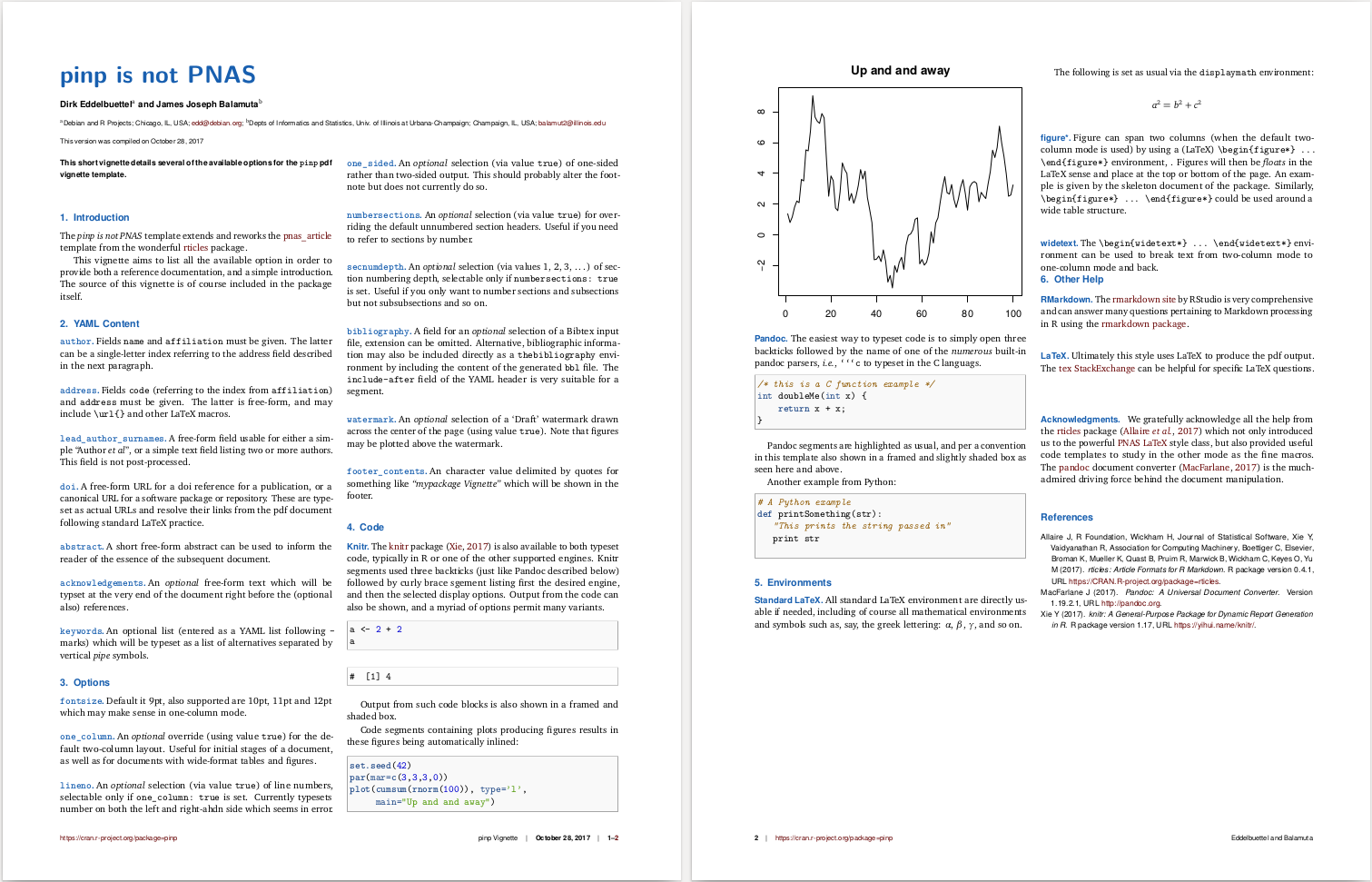
Dirk Eddelbuettel: pinp 0.0.2: Onwards

A first update 0.0.2 of the pinp package arrived on CRAN just a few days after the initial release. We added a new vignette for the package (see below), extended a few nice features, and smoothed a few corners.
The NEWS entry for this release follows.

Changes in tint version 0.0.2 (2017-09-20)
  • The YAML segment can be used to select font size, one-or-two column mode, one-or-two side mode, linenumbering and watermarks (#21 and #26 addressing #25)
  • If pinp.cls or jss.bst are not present, they are copied in ((#27 addressing #23)
  • Output is now in shaded framed boxen too (#29 addressing #28)
  • Endmatter material is placed in template.tex (#31 addressing #30)
  • Expanded documentation of YAML options in skeleton.Rmd and clarified available one-column option (#32).
  • Section numbering can now be turned on and off (#34)
  • The default bibliography style was changed to jss.bst.
  • A short explanatory vignette was added.

Courtesy of CRANberries, there is a comparison to the previous release. More information is on the tint page. For questions or comments use the issue tracker off the GitHub repo.

This post by Dirk Eddelbuettel originated on his Thinking inside the box blog. Please report excessive re-aggregation in third-party for-profit settings.

Iain R. Learmonth: Easy APT Repository

The PATHspider software I maintain as part of my work depends on some features in cURL and in PycURL that have only just been mereged or are still awaiting merge. I need to build a docker container that includes these as Debian packages, so I need to quickly build an APT repository. A Debian repository can essentially be seen as a static website and the contents are GPG signed so it doesn t necessarily need to be hosted somewhere trusted (unless availability is critical for your application). I host my blog with Netlify, a static website host, and I figured they would be perfect for this use case. They also support open source projects. There is a CLI tool for netlify which you can install with:
sudo apt install npm
sudo npm install -g netlify-cli
The basic steps for setting up a repository are:
mkdir repository
cp /path/to/*.deb repository/
cd repository
apt-ftparchive packages . > Packages
apt-ftparchive release . > Release
gpg --clearsign -o InRelease Release
netlify deploy
Once you ve followed these steps, and created a new site on Netlify, you ll be able to manage this site also through the web interface. A few things you might want to do are set up a custom domain name for your repository, or enable HTTPS with Let s Encrypt. (Make sure you have apt-transport-https if you re going to enable HTTPS though.) To add this repository to your apt sources:
gpg --export -a YOURKEYID   sudo apt-key add -
echo "deb https://SUBDOMAIN.netlify.com/ /"   sudo tee -a /etc/apt/sources.list
sudo apt update
You ll now find that those packages are installable. Beware of APT pinning as you may find that the newer versions on your repository are not actually the preferred versions according to your policy. Update: If you re wanting a solution that would be more suitable for regular use, take a look at repropro. If you re wanting to have end-users add your apt repository as a third-party repository to their system, please take a look at this page on the Debian wiki which contains advice on how to instruct users to use your repository. Update 2: Another commenter has pointed out aptly, which offers a greater feature set and removes some of the restrictions imposed by repropro. I ve never use aptly myself so can t comment on specifics, but from the website it looks like it might be a nicely polished tool.

19 September 2017

Gunnar Wolf: Call to Mexicans: Open up your wifi #sismo

Hi friends, ~3hr ago, we just had a big earthquake, quite close to Mexico City. Fortunately, we are fine, as are (at least) most of our friends and family. Hopefully, all of them. But there are many (as in, tens) damaged or destroyed buildings; there have been over 50 deceased people, and numbers will surely rise until a good understanding of the event's strength are evaluated. Mainly in these early hours after the quake, many people need to get in touch with their families and friends. There is a little help we can all provide: Provide communication. Open up your wireless network. Set it up unencrypted, for anybody to use. Refrain from over-sharing graphical content Your social network groups don't need to see every video and every photo of the shaking moments and of broken buildings. Download of all those images takes up valuable time-space for the saturated cellular networks. This advice might be slow to flow... The important moment to act is two or three hours ago, even now... But we are likely to have replicas; we are likely to have panic moments again. Do a little bit to help others in need!


18 September 2017

Carl Chenet: The Github threat

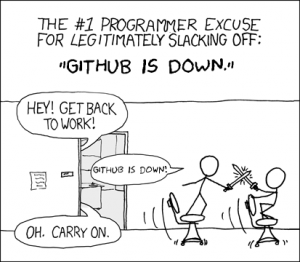
Many voices arise now and then against risks linked to the Github use by Free Software projects. Yet the infatuation for the collaborative forge of the Octocat Californian start-ups doesn t seem to fade away.

These recent years, Github and its services take an important role in software engineering as they are seen as easy to use, efficient for a daily workload with interesting functions in enterprise collaborative workflow or amid a Free Software project. What are the arguments against using its services and are they valid? We will list them first, then we ll examine their validity.

1. Critical points

1.1 Centralization

The Github application belongs to a single entity, Github Inc, a US company which manage it alone. So, a unique company under US legislation manages the access to most of Free Software application code sources, which may be a problem with groups using it when a code source is no longer available, for political or technical reason.

The Octocat, the Github mascot

This centralization leads to another trouble: as it obtained critical mass, it becomes more and more difficult not having a Github account. People who don t use Github, by choice or not, are becoming a silent minority. It is now fashionable to use Github, and not doing so is seen as out of date . The same phenomenon is a classic, and even the norm, for proprietary social networks (Facebook, Twitter, Instagram).

1.2 A Proprietary Software

When you interact with Github, you are using a proprietary software, with no access to its source code and which may not work the way you think it is. It is a problem at different levels. First, ideologically, but foremost in practice. In the Github case, we send them code we can control outside of their interface. We also send them personal information (profile, Github interactions). And mostly, Github forces any project which goes through the US platform to use a crucial proprietary tools: its bug tracking system.

Windows, the epitome of proprietary software, even if others took the same path

1.3 The Uniformization

Working with Github interface seems easy and intuitive to most. Lots of companies now use it as a source repository, and many developers leaving a company find the same Github working environment in the next one. This pervasive presence of Github in free software development environment is a part of the uniformization of said developers working space.

Uniforms always bring Army in my mind, here the Clone army

2 Critical points cross-examination

2.1 Regarding the centralization

2.1.1 Service availability rate

As said above, nowadays, Github is the main repository of Free Software source code. As such it is a favorite target for cyberattacks. DDOS hit it in March and August 2015. On December 15, 2015, an outage led to the inaccessibility of 5% of the repositories. The same occurred on November 15. And these are only the incident reported by Github itself. One can imagine that the mean outage rate of the platform is underestimated.

2.1.2 Chain reaction could block Free Software development

Today many dependency maintenance tools, as npm for javascript, Bundler for Ruby or even pip for Python can access an application source code directly from Github. Free Software projects getting more and more linked and codependents, if one component is down, all the developing process stop.

One of the best examples is the npmgate. Any company could legally demand that Github take down some source code from its repository, which could create a chain reaction and blocking the development of many Free Software projects, as suffered the Node.js community from the decisions of Npm, Inc, the company managing npm.

2.2 A historical precedent: SourceForge

Github didn t appear out of the blue. In his time, its predecessor, SourceForge, was also extremely popular.

Heavily centralized, based on strong interaction with the community, SourceForge is now seen as an aging SAAS (Software As A Service) and sees most of its customers fleeing to Github. Which creates lots of hurdles for those who stayed. The Gimp project suffered from spams and terrible advertising, which led to the departure of the VLC project, then from installers corrupted with adwares instead of the official Gimp installer for Windows. And finally, the Project Gimp s SourceForge account was hacked by SourceForge team itself!

These are very recent examples of what can do a commercial entity when it is under its stakeholders pressure. It is vital to really understand what it means to trust them with data and exchange centralization, where it could have tremendous repercussion on the day-to-day life and the habits of the Free Software and open source community.

2.3. Regarding proprietary software

2.3.1 One community, several opinions on proprietary software

Mostly based on ideology, this point deals with the definition every member of the community gives to Free Software and open source. Mostly about one thing: is it viral or not? Or GPL vs MIT/BSD.

Those on the side of the viral Free Software will have trouble to use a proprietary software as this last one shouldn t even exist. It must be assimilated, to quote Star Trek, as it is a connected black box, endangering privacy, corrupting for profit our uses and restrain our freedom to use as we re pleased what we own, etc.

Those on the side of complete freedom have no qualms using proprietary software as their very existence is a consequence of freedom without restriction. They even agree that code they developed may be a part of proprietary software, which is quite a common occurrence. This part of the Free Software community has no qualm using Github, which is well within their ideology parameters. Just take a look at the Janson amphitheater during Fosdem and check how many Apple laptops running on macOS are around.

FreeBSD, the main BSD project under the BSD license

2.3.2 Data loss and data restrictions linked to proprietary software use

Even without ideological consideration, and just focusing on Github infrastructure, the bug tracking system is a major problem by itself.

Bug report builds the memory of Free Software projects. It is the entrance point for new contributors, the place to find bug reporting, requests for new functions, etc. The project history can t be limited only to the code. It s very common to find bug reports when you copy and paste an error message in a search engine. Not their historical importance is precious for the project itself, but also for its present and future users.

Github gives the ability to extract bug reports through its API. What would happen if Github is down or if the platform doesn t support this feature anymore? In my opinion, not that many projects ever thought of this outcome. How could they move all the data generated by Github into a new bug tracking system? One old example now is Astrid, a TODO list bought by Yahoo a few years ago. Very popular, it grew fast until it was closed overnight, with only a few weeks for its users to extract their data. It was only a to-do list. The same situation with Github would be tremendously difficult to manage for several projects if they even have the ability to deal with it. Code would still be available and could still live somewhere else, but the project memory would be lost. A project like Debian has today more than 800,000 bug reports, which are a data treasure trove about problems solved, function requests and where the development stand on each. The developers of the Cpython project have anticipated the problem and decided not to use Github bug tracking systems.

Issues, the Github proprietary bug tracking system

Another thing we could lose if Github suddenly disappear: all the work currently done regarding the push requests (aka PRs). This Github function gives the ability to clone one project s Github repository, to modify it to fit your needs, then to offer your own modification to the original repository. The original repository s owner will then review said modification, and if he or she agrees with them will fuse them into the original repository. As such, it s one of the main advantages of Github, since it can be done easily through its graphic interface.

However reviewing all the PRs may be quite long, and most of the successful projects have several ongoing PRs. And this PRs and/or the proprietary bug tracking system are commonly used as a platform for comment and discussion between developers.

Code itself is not lost if Github is down (except one specific situation as seen below), but the peer review works materialized in the PRs and the bug tracking system is lost. Let s remember than the PR mechanism let you clone and modify projects and then generate PRs directly from its proprietary web interface without downloading a single code line on your computer. In this particular case, if Github is down, all the code and the work in progress is lost. Some also use Github as a bookmark place. They follow their favorite projects activity through the Watch function. This technological watch style of data collection would also be lost if Github is down.

Debian, one of the main Free Software projects with at least a thousand official contributors

2.4 Uniformization

The Free Software community is walking a thigh rope between normalization needed for an easier interoperability between its products and an attraction for novelty led by a strong need for differentiation from what is already there.

Github popularized the use of Git, a great tool now used through various sectors far away from its original programming field. Step by step, Git is now so prominent it s almost impossible to even think to another source control manager, even if awesome alternate solutions, unfortunately not as popular, exist as Mercurial.

A new Free Software project is now a Git repository on Github with README.md added as a quick description. All the other solutions are ostracized? How? None or very few potential contributors would notice said projects. It seems very difficult now to encourage potential contributors into learning a new source control manager AND a new forge for every project they want to contribute. Which was a basic requirement a few years ago. It s quite sad because Github, offering an original experience to its users, cut them out of a whole possibility realm. Maybe Github is one of the best web versioning control systems. But being the main one doesn t let room for a new competitor to grow. And it let Github initiate development newcomers into a narrow function set, totally unrelated to the strength of the Git tool itself.

3. Centralization, uniformization, proprietary software What s next? Laziness?

Fight against centralization is a main part of the Free Software ideology as centralization strengthens the power of those who manage it and who through it control those who are managed by it. Uniformization allergies born against main software companies and their wishes to impose a closed commercial software world was for a long time the main fuel for innovation thirst and intelligent alternative development. As we said above, part of the Free Software community was built as a reaction to proprietary software and their threat. The other part, without hoping for their disappearance, still chose a development model opposite to proprietary software, at least in the beginning, as now there s more and more bridges between the two.

The Github effect is a morbid one because of its consequences: at least centralization, uniformization, proprietary software usage as their bug tracking system. But some years ago the Dear Github buzz showed one more side effect, one I ve never thought about: laziness. For those who don t know what it is about, this letter is a complaint from several spokespersons from several Free Software projects which demand to Github team to finally implement, after years of polite asking, new functions. Since when Free Software project facing a roadblock request for clemency and don t build themselves the path they need? When Torvalds was involved in the Bitkeeper problem and the Linux kernel development team couldn t use anymore their revision control software, he developed Git. The mere fact of not being able to use one tool or functions lacking is the main motivation to seek alternative solutions and, as such, of the Free Software movement. Every Free Software community member able to code should have this reflex. You don t like what Github offers? Switch to Gitlab. You don t like it Gitlab? Improve it or make your own solution.

The Gitlab logo

Let s be crystal clear. I ve never said that every Free Software developers blocked should code his or her own alternative. We all have our own priorities, and some of us even like their beauty sleep, including me. But, to see that this open letter to Github has 1340 names attached to it, among them some spokespersons for major Free Software project showed me that need, willpower and strength to code a replacement are here. Maybe said replacement will be born from this letter, it would be the best outcome of this buzz.

In the end, Github usage is just another example of Internet usage massification. As Internet users are bound to go to massively centralized social network as Facebook or Twitter, developers are following the same path with Github. Even if a large fraction of developers realize the threat linked this centralized and proprietary organization, the whole community is following this centralization and uniformization trend. Github service is useful, free or with a reasonable price (depending on the functions you need) easy to use and up most of the time. Why would we try something else? Maybe because others are using us while we are savoring the convenience? The Free Software community seems to be quite sleepy to me.

The lion enjoying the hearth warm

About Me Carl Chenet, Free Software Indie Hacker, founder of the French-speaking Hacker News-like Journal du hacker. Follow me on social networks Translated from French by St phanie Chaptal. Original article written in 2015.

17 September 2017

Rapha&#235;l Hertzog: Freexian s report about Debian Long Term Support, August 2017

A Debian LTS logoLike each month, here comes a report about the work of paid contributors to Debian LTS. Individual reports In August, about 189 work hours have been dispatched among 12 paid contributors. Their reports are available: Evolution of the situation The number of sponsored hours is the same as last month. The security tracker currently lists 59 packages with a known CVE and the dla-needed.txt file 60. The number of packages with open issues decreased slightly compared to last month but we re not yet back to the usual situation. The number of CVE to fix per package tends to increase due to the increased usage of fuzzers. Thanks to our sponsors New sponsors are in bold.

No comment Liked this article? Click here. My blog is Flattr-enabled.

12 September 2017

Markus Koschany: My Free Software Activities in August 2017

Welcome to gambaru.de. Here is my monthly report that covers what I have been doing for Debian. If you re interested in Java, Games and LTS topics, this might be interesting for you. DebConf 17 in Montreal I traveled to DebConf 17 in Montreal/Canada. I arrived on 04. August and met a lot of different people which I only knew by name so far. I think this is definitely one of the best aspects of real life meetings, putting names to faces and getting to know someone better. I totally enjoyed my stay and I would like to thank all the people who were involved in organizing this event. You rock! I also gave a talk about the The past, present and future of Debian Games , listened to numerous other talks and got a nice sunburn which luckily turned into a more brownish color when I returned home on 12. August. The only negative experience I made was with my airline which was supposed to fly me home to Frankfurt again. They decided to cancel the flight one hour before check-in for unknown reasons and just gave me a telephone number to sort things out. No support whatsoever. Fortunately (probably not for him) another DebConf attendee suffered the same fate and together we could find another flight with Royal Air Maroc the same day. And so we made a short trip to Casablanca/Morocco and eventually arrived at our final destination in Frankfurt a few hours later. So which airline should you avoid at all costs (they still haven t responded to my refund claims) ? It s WoW-Air from Iceland. (just wow) Debian Games Debian Java Debian LTS This was my eighteenth month as a paid contributor and I have been paid to work 20,25 hours on Debian LTS, a project started by Rapha l Hertzog. In that time I did the following: Non-maintainer upload Thanks for reading and see you next time.

11 September 2017

Steinar H. Gunderson: rANS encoding of signed coefficients

I'm currently trying to make sense of some still image coding (more details to come at a much later stage!), and for a variety of reasons, I've chosen to use rANS as the entropy coder. However, there's an interesting little detail that I haven't actually seen covered anywhere; maybe it's just because I've missed something, or maybe because it's too blindingly obvious, but I thought I would document what I ended up with anyway. (I had hoped for something even more elegant, but I guess the obvious would have to do.) For those that don't know rANS coding, let me try to handwave it as much as possible. Your state is typically a single word (in my case, a 32-bit word), which is refilled from the input stream as needed. The encoder and decoder works in reverse order; let's just talk about the decoder. Basically it works by looking at the lowest 12 (or whatever) bits of the decoder state, mapping each of those 2^12 slots to a decoded symbol. More common symbols are given more slots, proportionally to the frequency. Let me just write a tiny, tiny example with 2 bits and three symbols instead, giving four slots:
Lowest bits Symbol
00 0
01 0
10 1
11 2
Note that the zero coefficient here maps to one out of two slots (ie., a range); you don't choose which one yourself, the encoder stashes some information in there (which is used to recover the next control word once you know which symbol there is). Now for the actual problem: When storing DCT coefficients, we typically want to also store a sign (ie., not just 1 or 2, but also -1/+1 and -2/+2). The statistical distribution is symmetrical, so the sign bit is incompressible (except that of course there's no sign bit needed for 0). We could have done this by introducing new symbols -1 and -2 in addition to our three other ones, but this means we'll need more bits of precision, and accordingly larger look-up tables (which is negative for performance). So let's find something better. We could also simply store it separately somehow; if the coefficient is non-zero, store the bits in some separate repository. Perhaps more elegantly, you can encode a second symbol in the rANS stream with probability 1/2, but this is more expensive computationally. But both of these have the problem that they're divergent in terms of control flow; nonzero coefficients potentially need to do a lot of extra computation and even loads. This isn't nice for SIMD, and it's not nice for GPU. It's generally not really nice. The solution I ended up with was simulating a larger table with a smaller one. Simply rotate the table so that the zero symbol has the top slots instead of the bottom slots, and then replicate the rest of the table. For instance, take this new table:
Lowest bits Symbol
000 1
001 2
010 0
011 0
100 0
101 0
110 -1
111 -2
(The observant reader will note that this doesn't describe the exact same distribution as last time zero has twice the relative frequency as in the other table but ignore that for the time being.) In this case, the bottom half of the table doesn't actually need to be stored! We know that if the three bottom bits are >= 110 (6 in decimal), we have a negative value, can subtract 6, and then continue decoding. If we are go past the end of our 2-bit table despite that, we know we are decoding a zero coefficient (which doesn't have a sign), so we can just clamp the read; or for a GPU, reads out-of-bounds on a texture will typically return 0 anyway. So it all works nicely, and the divergent I/O is gone. If this pickled your interest, you probably want to read up on rANS in general; Fabian Giesen (aka ryg) has some notes that work as a good starting point, but beware; some of this is pretty confusing. :-)

10 September 2017

Sylvain Beucler: dot-zed archive file format

TL,DR: I reverse-engineered the .zed encrypted archive format.
Following a clean-room design, I'm providing a description that can be implemented by a third-party.
Interested? :) (reference version at: https://www.beuc.net/zed/) .zed archive file format Introduction Archives with the .zed extension are conceptually similar to an encrypted .zip file. In addition to a specific format, .zed files support multiple users: files are encrypted using the archive master key, which itself is encrypted for each user and/or authentication method (password, RSA key through certificate or PKCS#11 token). Metadata such as filenames is partially encrypted. .zed archives are used as stand-alone or attached to e-mails with the help of a MS Outlook plugin. A variant, which is not covered here, can encrypt/decrypt MS Windows folders on the fly like ecryptfs. In the spirit of academic and independent research this document provides a description of the file format and encryption algorithms for this encrypted file archive. See the conventions section for conventions and acronyms used in this document. Structure overview The .zed file format is composed of several layers. Or as a diagram:
+----------------------------------------------------------------------------------------------------+
  .zed archive (MS-CBF)                                                                               
                                                                                                      
   stream #1                         stream #2                       stream #3...                     
  +------------------------------+  +---------------------------+  +---------------------------+      
    metadata (MS-OLEPS)               encryption (AES)               encryption (AES)                 
                                      512-bytes chunks               512-bytes chunks                 
    +--------------------------+                                                                      
      obfuscation (static key)        +-----------------------+      +-----------------------+        
      +----------------------+       -  compression (zlib)     -    -  compression (zlib)     -       
       _ctlfile (TLV)                                                                            ...  
      +----------------------+          +---------------+              +---------------+               
    +--------------------------+          file contents                  file contents                
                                                                                                      
    +--------------------------+     -  +---------------+      -    -  +---------------+      -       
      _catalog (TLV)                                                                                  
    +--------------------------+      +-----------------------+      +-----------------------+        
  +------------------------------+  +---------------------------+  +---------------------------+      
+----------------------------------------------------------------------------------------------------+
Encryption schemes Several AES key sizes are supported, such as 128 and 256 bits. The Cipher Block Chaining (CBC) block cipher mode of operation is used to decrypt multiple AES 16-byte blocks, which means an initialisation vector (IV) is stored in clear along with the ciphertext. All filenames and file contents are encrypted using the same encryption mode, key and IV (e.g. if you remove and re-add a file in the archive, the resulting stream will be identical). No cleartext padding is used during encryption; instead, several end-of-stream handlers are available, so the ciphertext has exactly the size of the cleartext (e.g. the size of the compressed file). The following variants were identified in the 'encryption_mode' field. STREAM This is the end-of-stream handler for: This end-of-stream handler is apparently specific to the .zed format, and applied when the cleartext's does not end on a 16-byte boundary ; in this case special processing is performed on the last partial 16-byte block. The encryption and decryption phases are identical: let's assume the last partial block of cleartext (for encryption) or ciphertext (for decryption) was appended after all the complete 16-byte blocks of ciphertext: In either case, if the full ciphertext is less then one AES block (< 16 bytes), then the IV is used instead of the second-to-last block. CTS CTS or CipherText Stealing is the end-of-stream handler for: It matches the CBC-CS3 variant as described in Recommendation for Block Cipher Modes of Operation: Three Variants of Ciphertext Stealing for CBC Mode. Empty cleartext Since empty filenames or metadata are invalid, and since all files are compressed (resulting in a minimum 8-byte zlib cleartext), no empty cleartext was encrypted in the archive. metadata stream It is named 05356861616161716149656b7a6565636e576a33317a7868304e63 (hexadecimal), i.e. the character with code 5 followed by '5haaaaqaIekzeecnWj31zxh0Nc' (ASCII). The format used is OLE Property Set (MS-OLEPS). It introduces 2 property names "_ctlfile" (index 3) and "_catalog" (index 4), and 2 instances of said properties each containing an application-specific VT_BLOB (type 0x0041). _ctlfile: obfuscated global properties and access list This subpart is stored under index 3 ("_ctlfile") of the MS-OLEPS metadata. It consists of: The ciphertext is encrypted with AES-CBC "STREAM" mode using 128-bit static key 37F13CF81C780AF26B6A52654F794AEF (hexadecimal) and the prepended IV so as to obfuscate the access list. The ciphertext is continuous and not split in chunks (unlike files), even when it is larger than 512 bytes. The decrypted text contain properties in a TLV format as described in _ctlfile TLV: Archives may include "mandatory" users that cannot be removed. They are typically used to add an enterprise wide recovery RSA key to all archives. Extreme care must be taken to protect these key, as it can decrypt all past archives generated from within that company. _catalog: file list This subpart is stored under index 4 ("_catalog") of the MS-OLEPS metadata. It contains a series of 'fileprops' TLV structures, one for each file or directory. The file hierarchy can be reconstructed by checking the 'parent_id' field of each file entry. If 'parent_id' is 0 then the file is located at the top-level of the hierarchy, otherwise it's located under the directory with the matching 'file_id'. TLV format This format is a series of fields : Value semantics depend on its Type. It may contain an uint32be integer, a UTF-16LE string, a character sequence, or an inner TLV structure. Unless otherwise noted, TLV structures appear once. Some fields are optional and may not be present at all (e.g. 'archive_createdwith'). Some fields are unique within a structure (e.g. 'files_iv'), other may be repeated within a structure to form a list (e.g. 'fileprops' and 'passworduser'). The following top-level types that have been identified, and detailed in the next sections: Some additional unidentified types may be present. _ctlfile TLV _catalog TLV Decrypting the archive AES key rsauser The user accessing the archive will be authenticated by comparing his/her X509 certificate with the one stored in the 'certificate' field using DER format. The 'files_key_ciphertext' field is then decrypted using the PKCS#1 v1.5 encryption mechanism, with the private key that matches the user certificate. passworduser An intermediary user key, a user IV and an integrity checksum will be derived from the user password, using the deprecated PKCS#12 method as described at rfc7292 appendix B. Note: this is not PKCS#5 (nor PBKDF1/PBKDF2), this is an incompatible method from PKCS#12 that notably does not use HMAC. The 'pkcs12_hashfunc' field defines the underlying hash function. The following values have been identified: PBA - Password-based authentication The user accessing the archive will be authenticated by deriving an 8-byte sequence from his/her password. The parameters for the derivation function are: The derivation is checked against 'pba_checksum'. PBE - Password-based encryption Once the user is identified, 2 new values are derived from the password with different parameters to produce the IV and the key decryption key, with the same hash function: The parameters specific to user key are: The user key needs to be truncated to a length of 'encryption_strength', as specified in bytes in the archive properties. The parameters specific to user IV are: Once the key decryption key and the IV are derived, 'files_key_ciphertext' is decrypted using AES CBC, with PKCS#7 padding. Identifying file streams The name of the MS-CFB stream is derived by shuffling the bytes from the 'file_id' field and then encoding the result as hexadecimal. The reordering is:
Initial  offset: 0 1 2 3 4 5 6 7 8 9 10 11 12 13 14 15
Shuffled offset: 3 2 1 0 5 4 7 6 8 9 10 11 12 13 14 15
The 16th byte is usually a NUL byte, hence the stream identifier is a 30-character-long string. Decrypting files The compressed stream is split in chunks of 512 bytes, each of them encrypted separately using AES CBS and the global archive encryption scheme. Decryption uses the global AES key (retrieved using the user credentials), and the global IV (retrieved from the deobfuscated archive metadata). The IV for each chunk is computed by: Each chunk is an independent stream and the decryption process involves end-of-stream handling even if this is not the end of the actual file. This is particularly important for the CTS handler. Note: this is not to be confused with CTR block cipher mode of operation with operates differently and requires a nonce. Decompressing files Compressed streams are zlib stream with default compression options and can be decompressed following the zlib format. Test cases Excluded for brevity, cf. https://www.beuc.net/zed/#test-cases. Conventions and references Feedback Feel free to send comments at beuc@beuc.net. If you have .zed files that you think are not covered by this document, please send them as well (replace sensitive files with other ones). The author's GPG key can be found at 8FF1CB6E8D89059F. Copyright (C) 2017 Sylvain Beucler Copying and distribution of this file, with or without modification, are permitted in any medium without royalty provided the copyright notice and this notice are preserved. This file is offered as-is, without any warranty.

Joachim Breitner: Less parentheses

Yesterday, at the Haskell Implementers Workshop 2017 in Oxford, I gave a lightning talk titled syntactic musings , where I presented three possibly useful syntactic features that one might want to add to a language like Haskell. The talked caused quite some heated discussions, and since the Internet likes heated discussion, I will happily share these ideas with you

Context aka. Sections This is probably the most relevant of the three proposals. Consider a bunch of related functions, say analyseExpr and analyseAlt, like these:
analyseExpr :: Expr -> Expr
analyseExpr (Var v) = change v
analyseExpr (App e1 e2) =
  App (analyseExpr e1) (analyseExpr e2)
analyseExpr (Lam v e) = Lam v (analyseExpr flag e)
analyseExpr (Case scrut alts) =
  Case (analyseExpr scrut) (analyseAlt <$> alts)
analyseAlt :: Alt -> Alt
analyseAlt (dc, pats, e) = (dc, pats, analyseExpr e)
You have written them, but now you notice that you need to make them configurable, e.g. to do different things in the Var case. You thus add a parameter to all these functions, and hence an argument to every call:
type Flag = Bool
analyseExpr :: Flag -> Expr -> Expr
analyseExpr flag (Var v) = if flag then change1 v else change2 v
analyseExpr flag (App e1 e2) =
  App (analyseExpr flag e1) (analyseExpr flag e2)
analyseExpr flag (Lam v e) = Lam v (analyseExpr (not flag) e)
analyseExpr flag (Case scrut alts) =
  Case (analyseExpr flag scrut) (analyseAlt flag <$> alts)
analyseAlt :: Flag -> Alt -> Alt
analyseAlt flag (dc, pats, e) = (dc, pats, analyseExpr flag e)
I find this code problematic. The intention was: flag is a parameter that an external caller can use to change the behaviour of this code, but when reading and reasoning about this code, flag should be considered constant. But this intention is neither easily visible nor enforced. And in fact, in the above code, flag does change , as analyseExpr passes something else in the Lam case. The idiom is indistinguishable from the environment idiom, where a locally changing environment (such as variables in scope ) is passed around. So we are facing exactly the same problem as when reasoning about a loop in an imperative program with mutable variables. And we (pure functional programmers) should know better: We cherish immutability! We want to bind our variables once and have them scope over everything we need to scope over! The solution I d like to see in Haskell is common in other languages (Gallina, Idris, Agda, Isar), and this is what it would look like here:
type Flag = Bool
section (flag :: Flag) where
  analyseExpr :: Expr -> Expr
  analyseExpr (Var v) = if flag then change1 v else change2v 
  analyseExpr (App e1 e2) =
    App (analyseExpr e1) (analyseExpr e2)
  analyseExpr (Lam v e) = Lam v (analyseExpr e)
  analyseExpr (Case scrut alts) =
    Case (analyseExpr scrut) (analyseAlt <$> alts)
  analyseAlt :: Alt -> Alt
  analyseAlt (dc, pats, e) = (dc, pats, analyseExpr e)
Now the intention is clear: Within a clearly marked block, flag is fixed and when reasoning about this code I do not have to worry that it might change. Either all variables will be passed to change1, or all to change2. An important distinction! Therefore, inside the section, the type of analyseExpr does not mention Flag, whereas outside its type is Flag -> Expr -> Expr. This is a bit unusual, but not completely: You see precisely the same effect in a class declaration, where the type signature of the methods do not mention the class constraint, but outside the declaration they do. Note that idioms like implicit parameters or the Reader monad do not give the guarantee that the parameter is (locally) constant. More details can be found in the GHC proposal that I prepared, and I invite you to raise concern or voice support there. Curiously, this problem must have bothered me for longer than I remember: I discovered that seven years ago, I wrote a Template Haskell based implementation of this idea in the seal-module package!

Less parentheses 1: Bulleted argument lists The next two proposals are all about removing parentheses. I believe that Haskell s tendency to express complex code with no or few parentheses is one of its big strengths, as it makes it easier to visualy parse programs. A common idiom is to use the $ operator to separate a function from a complex argument without parentheses, but it does not help when there are multiple complex arguments. For that case I propose to steal an idea from the surprisingly successful markup language markdown, and use bulleted lists to indicate multiple arguments:
foo :: Baz
foo = bracket
          some complicated code
          that is evaluated first
          other complicated code for later
          even more complicated code
I find this very easy to visually parse and navigate. It is actually possible to do this now, if one defines ( ) = id with infixl 0 . A dedicated syntax extension (-XArgumentBullets) is preferable:
  • It only really adds readability if the bullets are nicely vertically aligned, which the compiler should enforce.
  • I would like to use $ inside these complex arguments, and multiple operators of precedence 0 do not mix. (infixl -1 would help).
  • It should be possible to nest these, and distinguish different nesting levers based on their indentation.

Less parentheses 1: Whitespace precedence The final proposal is the most daring. I am convinced that it improves readability and should be considered when creating a new language. As for Haskell, I am at the moment not proposing this as a language extension (but could be convinced to do so if there is enough positive feedback). Consider this definition of append:
(++) :: [a] -> [a] -> [a]
[]     ++ ys = ys
(x:xs) ++ ys = x : (xs++ys)
Imagine you were explaining the last line to someone orally. How would you speak it? One common way to do so is to not read the parentheses out aloud, but rather speak parenthesised expression more quickly and add pauses otherwise. We can do the same in syntax!
(++) :: [a] -> [a] -> [a]
[]   ++ ys = ys
x:xs ++ ys = x : xs++ys
The rule is simple: A sequence of tokens without any space is implicitly parenthesised. The reaction I got in Oxford was horror and disgust. And that is understandable we are very used to ignore spacing when parsing expressions (unless it is indentation, of course. Then we are no longer horrified, as our non-Haskell colleagues are when they see our code). But I am convinced that once you let the rule sink in, you will have no problem parsing such code with ease, and soon even with greater ease than the parenthesised version. It is a very natural thing to look at the general structure, identify compact chunks of characters , mentally group them, and then go and separately parse the internals of the chunks and how the chunks relate to each other. More natural than first scanning everything for ( and ), matching them up, building a mental tree, and then digging deeper. Incidentally, there was a non-programmer present during my presentation, and while she did not openly contradict the dismissive groan of the audience, I later learned that she found this variant quite obvious to understand and more easily to read than the parenthesised code. Some FAQs about this:
  • What about an operator with space on one side but not on the other? I d simply forbid that, and hence enforce readable code.
  • Do operator sections still require parenthesis? Yes, I d say so.
  • Does this overrule operator precedence? Yes! a * b+c == a * (b+c).
  • What is a token? Good question, and I am not not decided. In particular: Is a parenthesised expression a single token? If so, then (Succ a)+b * c parses as ((Succ a)+b) * c, otherwise it should probably simply be illegal.
  • Can we extend this so that one space binds tighter than two spaces, and so on? Yes we can, but really, we should not.
  • This is incompatible with Agda s syntax! Indeed it is, and I really like Agda s mixfix syntax. Can t have everything.
  • Has this been done before? I have not seen it in any language, but Lewis Wall has blogged this idea before.
Well, let me know what you think!

Lior Kaplan: PHP 7.2 is coming mcrypt extension isn t

Early September, it s about 3 months before PHP 7.2 is expected to be release (schedule here). One of the changes is the removal of the mcrypt extension after it was deprecated in PHP 7.1. The main problem with mcrypt extension is that it is based on libmcrypt that was abandoned by it s upstream since 2007. That s 10 years of keeping a library alive, moving the burden to distribution s security teams. But this isn t new, Remi already wrote about this two years ago: About libmcrypt and php-mcrypt . But with removal of the extension from the PHP code base (about F**King time), it would force the recommendation was done nicely till now. And forcing people means some noise, although an alternative is PHP s owns openssl extension. But as many migrations that require code change it s going slow. The goal of this post is to reach to the PHP eco system and map the components (mostly frameworks and applications) to still require/recommend mcyrpt and to pressure them to fix it before PHP 72 is released. I ll appreciate the readers help with this mapping in the comments. For example, Laravel s release notes for 5.1:
In previous versions of Laravel, encryption was handled by the mcrypt PHP extension. However, beginning in Laravel 5.1, encryption is handled by the openssl extension, which is more actively maintained.
Or, on the other hand Joomla 3 requirements still mentions mcrypt. mcrypt safe: mcrypt dependant: For those who really need mcrypt, it is part of PECL, PHP s extensions repository. You re welcome to compile it on your own risk.
Filed under: Debian GNU/Linux, PHP

9 September 2017

Russell Coker: Observing Reliability

Last year I wrote about how great my latest Thinkpad is [1] in response to a discussion about whether a Thinkpad is still the Rolls Royce of laptops. It was a few months after writing that post that I realised that I omitted an important point. After I had that laptop for about a year the DVD drive broke and made annoying clicking sounds all the time in addition to not working. I removed the DVD drive and the result was that the laptop was lighter and used less power without missing any feature that I desired. As I had installed Debian on that laptop by copying the hard drive from my previous laptop I had never used the DVD drive for any purpose. After a while I got used to my laptop being like that and the gaping hole in the side of the laptop where the DVD drive used to be didn t even register to me. I would prefer it if Lenovo sold Thinkpads in the T series without DVD drives, but it seems that only the laptops with tiny screens are designed to lack DVD drives. For my use of laptops this doesn t change the conclusion of my previous post. Now the T420 has been in service for almost 4 years which makes the cost of ownership about $75 per year. $1.50 per week as a tax deductible business expense is very cheap for such a nice laptop. About a year ago I installed a SSD in that laptop, it cost me about $250 from memory and made it significantly faster while also reducing heat problems. The depreciation on the SSD about doubles the cost of ownership of the laptop, but it s still cheaper than a mobile phone and thus not in the category of things that are expected to last for a long time while also giving longer service than phones usually do. One thing that s interesting to consider is the fact that I forgot about the broken DVD drive when writing about this. I guess every review has an unspoken caveat of this works well for me but might suck badly for your use case . But I wonder how many other things that are noteworthy I m forgetting to put in reviews because they just don t impact my use. I don t think that I am unusual in this regard, so reading multiple reviews is the sensible thing to do.

Fran ois Marier: TLS Authentication on Freenode and OFTC

In order to easily authenticate with IRC networks such as OFTC and Freenode, it is possible to use client TLS certificates (also known as SSL certificates). In fact, it turns out that it's very easy to setup both on irssi and on znc.

Generate your TLS certificate On a machine with good entropy, run the following command to create a keypair that will last for 10 years:
openssl req -nodes -newkey rsa:2048 -keyout user.pem -x509 -days 3650 -out user.pem -subj "/CN=<your nick>"
Then extract your key fingerprint using this command:
openssl x509 -sha1 -noout -fingerprint -in user.pem   sed -e 's/^.*=//;s/://g'

Share your fingerprints with NickServ On each IRC network, do this:
/msg NickServ IDENTIFY Password1!
/msg NickServ CERT ADD <your fingerprint>
in order to add your fingerprint to the access control list.

Configure ZNC To configure znc, start by putting the key in the right place:
cp user.pem ~/.znc/users/<your nick>/networks/oftc/moddata/cert/
and then enable the built-in cert plugin for each network in ~/.znc/configs/znc.conf:
<Network oftc>
    ...
            LoadModule = cert
    ...
</Network>
    <Network freenode>
    ...
            LoadModule = cert
    ...
</Network>

Configure irssi For irssi, do the same thing but put the cert in ~/.irssi/user.pem and then change the OFTC entry in ~/.irssi/config to look like this:
 
  address = "irc.oftc.net";
  chatnet = "OFTC";
  port = "6697";
  use_tls = "yes";
  tls_cert = "~/.irssi/user.pem";
  tls_verify = "yes";
  autoconnect = "yes";
 
and the Freenode one to look like this:
 
  address = "chat.freenode.net";
  chatnet = "Freenode";
  port = "7000";
  use_tls = "yes";
  tls_cert = "~/.irssi/user.pem";
  tls_verify = "yes";
  autoconnect = "yes";
 
That's it. That's all you need to replace password authentication with a much stronger alternative.

8 September 2017

Sven Hoexter: munin with TLS

Primarily a note for my future self so I don't have to find out what I did in the past once more. If you're running some smaller systems scattered around the internet, without connecting them with a VPN, you might want your munin master and nodes to communicate with TLS and validate certificates. If you remember what to do it's a rather simple and straight forward process. To manage the PKI I'll utilize the well known easyrsa script collection. For this special purpose CA I'll go with a flat layout. So it's one root certificate issuing all server and client certificates directly. Some very basic docs can be also found in the munin wiki. master setup For your '/etc/munin/munin.conf':
tls paranoid
tls_verify_certificate yes
tls_private_key /etc/munin/master.key
tls_certificate /etc/munin/master.crt
tls_ca_certificate /etc/munin/ca.crt
tls_verify_depth 1
A node entry with TLS will look like this:
[node1.stormbind.net]
    address [2001:db8::]
    use_node_name yes
Important points here: For easy-rsa the following command invocations are relevant:
./easyrsa init-pki
./easyrsa build-ca
./easrsa gen-req master
./easyrsa sign-req client master
./easyrsa set-rsa-pass master nopass
node setup For your '/etc/munin/munin-node.conf':
tls paranoid
tls_verify_certificate yes
tls_private_key /etc/munin/node1.key
tls_certificate /etc/munin/node1.crt
tls_ca_certificate /etc/munin/ca.crt
tls_verify_depth 1
For easy-rsa the following command invocations are relevant:
./easyrsa gen-req node1
./easyrsa sign-req server node1
./easyrsa set-rsa-pass node1 nopass
Important points here:

7 September 2017

Lior Kaplan: FOSScamp Syros 2017 day 3

The 3rd day should have started with a Debian sprint and then a LibreOffice one, taking advantage I m still attending, as that s my last day. But plans don t always work out and we started 2 hours later. When everybody arrive we got everyone together for a short daily meeting (scrum style). The people were divided to 3 teams for translating: Debian Installer, LibreOffice and Gnome. For each team we did a short list of what left and with what to start. And in the end how does what so there will be no toe stepping. I was really proud with this and felt it was time well spent. The current translation percentage for Albanian in LibreOffice is 60%. So my recommendation to the team is translate master only and do not touch the help translation. My plans ahead would be to improve the translation as much as possible for LibreOffice 6.0 and near the branching point (Set to November 20th by the release schedule) decide if it s doable for the 6.0 life time or to set the goal at 6.1. In the 2nd case, we might try to backport translation back to 6.0. For the translation itself, I ve mentioned to the team about KeyID language pack and referred them to the nightly builds. These tools should help with keeping the translation quality high. For the Debian team, after deciding who works on what, I ve asked Silva to do review for the others, as doing it myself started to take more and more of my time. It s also good that the reviewer know the target language and not like me, can catch more the syntax only mistakes. Another point, as she s available more easily to the team while I m leaving soon, so I hope this role of reviewer will stay as part of the team. With the time left I mostly worked on my own tasks, which were packaging the Albanian dictionary, resulting in https://packages.debian.org/sid/myspell-sq and making sure the dictionary is also part of LibreOffice resulting in https://gerrit.libreoffice.org/#/c/41906/ . When it is accepted, I want to upload it to the LibreOffice repository so all users can download and use the dictionary. During the voyage home (ferry, bus, plain and train), I mailed Sergio Durigan Junior, my NM applicant, with a set of questions. My first action as an AM (: Overall FOSScamp results for Albanian translation were very close to the goal I set (100%): That s the result of work by Silva Arapi, Eva Vranici, Redon Skikuli, Anisa Kuci and Nafie Shehu.
Filed under: Debian GNU/Linux, i18n & l10n, LibreOffice

John Goerzen: Switching to xmonad + Gnome and ditching a Mac

I have been using XFCE with xmonad for years now. I m not sure exactly how many, but at least 6 years, if not closer to 10. Today I threw in the towel and switched to Gnome. More recently, at a new job, I was given a Macbook Pro. I wasn t entirely sure what to think of this, but I thought I d give it a try. I found MacOS to be extremely frustrating and confining. It had no real support for a tiling window manager, and although projects like amethyst tried to approximate what xmonad can do on Linux, they were just too limited by the platform and were clunky. Moreover, the entire UI was surprisingly sluggish; maybe that was an induced effect from animations, but I don t think that explains it. A Debisn stretch install, even on inferior hardware, was snappy in a way that MacOS never was. So I have requested to swap for a laptop that will run Debian. The strange use of Command instead of Control for things, combined with the overall lack of configurability of keybindings, meant that I was going to always be fighting muscle memory moving from one platform to another. Not only that, but being back in the world of a Free Software OS means a lot. Now then, back to xmonad and XFCE situation. XFCE once worked very well with xmonad. Over the years, this got more challenging. Around the jessie (XFCE 4.10) time, I had to be very careful about when I would let it save my session, because it would easily break. With stretch, I had to write custom scripts because the panel wouldn t show up properly, and even some application icons would be invisible, if things were started in a certain order. This took much trial and error and was still cumbersome. Gnome 3, with its tightly-coupled Gnome Shell, has never been compatible with other window managers at least not directly. A person could have always used MATE with xmonad but a lot of people that run XFCE tend to have some Gnome 3 apps (for instance, evince) anyhow. Cinnamon also wouldn t work with xmonad, because it is simply another tightly-coupled shell instead of Gnome Shell. And then today I discovered gnome-flashback. gnome-flashback is a Gnome 3 environment that uses the traditional X approach with a separate window manager (metacity of yore by default). Sweet. It turns out that Debian s xmonad has built-in support for it. If you know the secret: apt-get install gnome-session-flashback (OK, it s not so secret; it s even in xmonad s README.Debian these days) Install that, plus gnome and gdm3 and things are nice. Configure xmonad with GNOME support and poof goodness right out of the box, selectable from the gdm sessions list. I still have some gripes about Gnome s configurability (or lack thereof). But I ve got to say: This environment is the first one I ve ever used that got external display switching very nearly right without any configuration, and I include MacOS in that. Plug in an external display, and poof it s configured and set up. You can hit a toggle key (Windows+P by default) to change the configurations, or use the Display section in gnome-control-center. Unplug it, and it instantly reconfigures itself to put everything back on the laptop screen. Yessss! I used to have scripts to do this in the wheezy/jessie days. XFCE in stretch had numerous annoying failures in this area which rendered the internal display completely dark until the next reboot very frustrating. With Gnome, it just works. And, even if you have suspend on lid closed turned on, if the system is powered up and hooked up to an external display, it will keep running even if the lid is closed, figuring you must be using it on the external screen. Another thing the Mac wouldn t do well. All in all, some pretty good stuff here. I continue to be impressed by stretch. It is darn impressive to put this OS on generic hardware and have it outshine the closed-ecosystem Mac!

Next.

Previous.