Scarlett Gately Moore: KDE: KDE Snaps 23.08.4, PIM! KDE neon, Debian
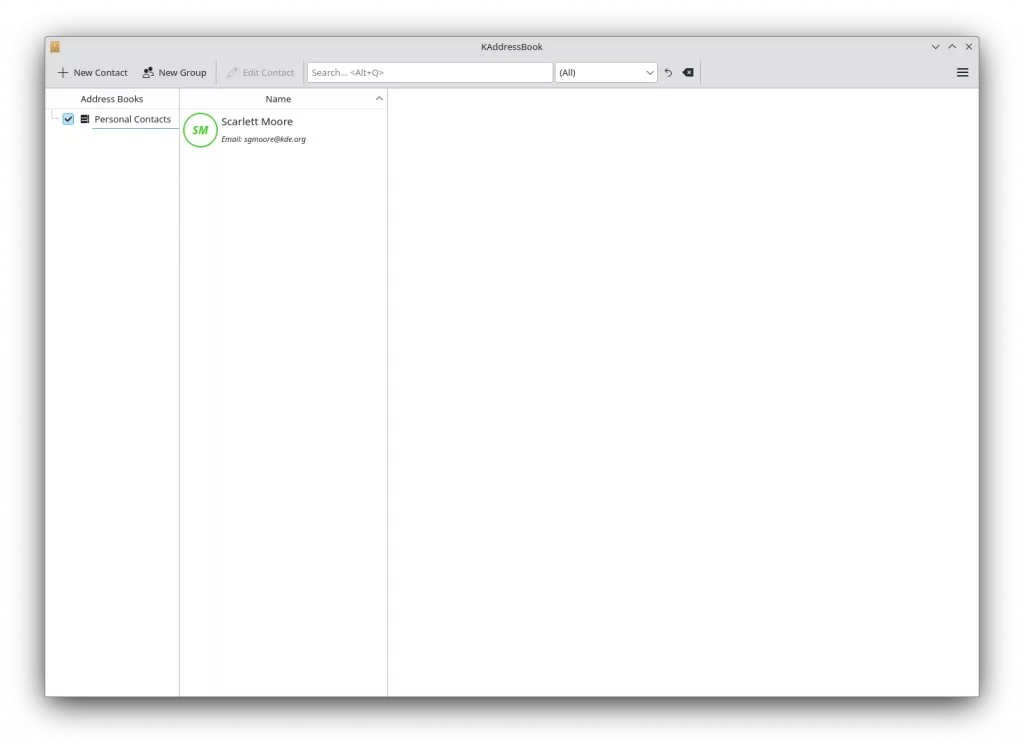 KDE PIM Kaddressbook snapKDE PIM Kaddressbook snap
 Contributing to Debian
is part of Freexian s mission. This article
covers the latest achievements of Freexian and their collaborators. All of this
is made possible by organizations subscribing to our
Long Term Support contracts and
consulting services.
Multi-Arch: same
file loss. It was found that the proposed
mitigation for ineffective diversions does
not work as expected. Trying to fix it up resulted in more problems, some of
which remain unsolved as of this writing.
Initial work on moving shared libraries in the essential set has been done.
Meanwhile, the wider Debian community worked on fixing all known
Multi-Arch: same file loss scenarios. This work is now being driven by
Christian Hofstaedler and during the Mini DebConf in Cambridge, Chris Boot,
tienne Mollier, Miguel Landaeta, Samuel Henrique, and Utkarsh Gupta sent
the other half of the necessary patches.
/dev/fd/N from fuse3 to fuse2.piuparts.sntrup761 related parts with the patch.
The foundation for lattice-based post-quantum algorithms has some uncertainty around it, and I have felt that there is more to the post-quantum story than adding sntrup761 to implementations. Classic McEliece has been mentioned to me a couple of times, and I took some time to learn it and did a cut n paste job of the proposed ISO standard and published draft-josefsson-mceliece in the IETF to make the algorithm easily available to the IETF community. A high-quality implementation of Classic McEliece has been published as libmceliece and I ve been supporting the work of Jan Moj to package libmceliece for Debian, alas it has been stuck in the ftp-master NEW queue for manual review for over two months. The pre-dependencies librandombytes and libcpucycles are available in Debian already.
All that text writing and packaging work set the scene to write some code. When I added support for sntrup761 in libssh, I became familiar with the OpenSSH code base, so it was natural to return to OpenSSH to experiment with a new SSH KEX for Classic McEliece. DJB suggested to pick mceliece6688128 and combine it with the existing X25519+sntrup761 or with plain X25519. While a three-algorithm hybrid between X25519, sntrup761 and mceliece6688128 would be a simple drop-in for those that don t want to lose the benefits offered by sntrup761, I decided to start the journey on a pure combination of X25519 with mceliece6688128. The key combiner in sntrup761x25519 is a simple SHA512 call and the only good I can say about that is that it is simple to describe and implement, and doesn t raise too many questions since it is already deployed.
After procrastinating coding for months, once I sat down to work it only took a couple of hours until I had a successful Classic McEliece SSH connection. I suppose my brain had sorted everything in background before I started. To reproduce it, please try the following in a Debian testing environment (I use podman to get a clean environment).
# podman run -it --rm debian:testing-slim
apt update
apt dist-upgrade -y
apt install -y wget python3 librandombytes-dev libcpucycles-dev gcc make git autoconf libz-dev libssl-dev
cd ~
wget -q -O- https://lib.mceliece.org/libmceliece-20230612.tar.gz   tar xfz -
cd libmceliece-20230612/
./configure
make install
ldconfig
cd ..
git clone https://gitlab.com/jas/openssh-portable
cd openssh-portable
git checkout jas/mceliece
autoreconf
./configure # verify 'libmceliece support: yes'
make # CC="cc -DDEBUG_KEX=1 -DDEBUG_KEXDH=1 -DDEBUG_KEXECDH=1"./ssh -Q kex and it should mention mceliece6688128x25519-sha512@openssh.com.
To have it print plenty of debug outputs, you may remove the # character on the final line, but don t use such a build in production.
You can test it as follows:
./ssh-keygen -A # writes to /usr/local/etc/ssh_host_...
# setup public-key based login by running the following:
./ssh-keygen -t rsa -f ~/.ssh/id_rsa -P ""
cat ~/.ssh/id_rsa.pub > ~/.ssh/authorized_keys
adduser --system sshd
mkdir /var/empty
while true; do $PWD/sshd -p 2222 -f /dev/null; done &
./ssh -v -p 2222 localhost -oKexAlgorithms=mceliece6688128x25519-sha512@openssh.com dateOpenSSH_9.5p1, OpenSSL 3.0.11 19 Sep 2023 ... debug1: SSH2_MSG_KEXINIT sent debug1: SSH2_MSG_KEXINIT received debug1: kex: algorithm: mceliece6688128x25519-sha512@openssh.com debug1: kex: host key algorithm: ssh-ed25519 debug1: kex: server->client cipher: chacha20-poly1305@openssh.com MAC: <implicit> compression: none debug1: kex: client->server cipher: chacha20-poly1305@openssh.com MAC: <implicit> compression: none debug1: expecting SSH2_MSG_KEX_ECDH_REPLY debug1: SSH2_MSG_KEX_ECDH_REPLY received debug1: Server host key: ssh-ed25519 SHA256:YognhWY7+399J+/V8eAQWmM3UFDLT0dkmoj3pIJ0zXs ... debug1: Host '[localhost]:2222' is known and matches the ED25519 host key. debug1: Found key in /root/.ssh/known_hosts:1 debug1: rekey out after 134217728 blocks debug1: SSH2_MSG_NEWKEYS sent debug1: expecting SSH2_MSG_NEWKEYS debug1: SSH2_MSG_NEWKEYS received debug1: rekey in after 134217728 blocks ... debug1: Sending command: date debug1: pledge: fork debug1: permanently_set_uid: 0/0 Environment: USER=root LOGNAME=root HOME=/root PATH=/usr/bin:/bin:/usr/sbin:/sbin:/usr/local/bin MAIL=/var/mail/root SHELL=/bin/bash SSH_CLIENT=::1 46894 2222 SSH_CONNECTION=::1 46894 ::1 2222 debug1: client_input_channel_req: channel 0 rtype exit-status reply 0 debug1: client_input_channel_req: channel 0 rtype eow@openssh.com reply 0 Sat Dec 9 22:22:40 UTC 2023 debug1: channel 0: free: client-session, nchannels 1 Transferred: sent 1048044, received 3500 bytes, in 0.0 seconds Bytes per second: sent 23388935.4, received 78108.6 debug1: Exit status 0Notice the
kex: algorithm: mceliece6688128x25519-sha512@openssh.com output.
How about network bandwidth usage? Below is a comparison of a complete SSH client connection such as the one above that log in and print date and logs out. Plain X25519 is around 7kb, X25519 with sntrup761 is around 9kb, and mceliece6688128 with X25519 is around 1MB. Yes, Classic McEliece has large keys, but for many environments, 1MB of data for the session establishment will barely be noticeable.
./ssh -v -p 2222 localhost -oKexAlgorithms=curve25519-sha256 date 2>&1   grep ^Transferred
Transferred: sent 3028, received 3612 bytes, in 0.0 seconds
./ssh -v -p 2222 localhost -oKexAlgorithms=sntrup761x25519-sha512@openssh.com date 2>&1   grep ^Transferred
Transferred: sent 4212, received 4596 bytes, in 0.0 seconds
./ssh -v -p 2222 localhost -oKexAlgorithms=mceliece6688128x25519-sha512@openssh.com date 2>&1   grep ^Transferred
Transferred: sent 1048044, received 3764 bytes, in 0.0 seconds
So how about session establishment time?
date; i=0; while test $i -le 100; do ./ssh -v -p 2222 localhost -oKexAlgorithms=curve25519-sha256 date > /dev/null 2>&1; i= expr $i + 1 ; done; date
Sat Dec  9 22:39:19 UTC 2023
Sat Dec  9 22:39:25 UTC 2023
# 6 seconds
date; i=0; while test $i -le 100; do ./ssh -v -p 2222 localhost -oKexAlgorithms=sntrup761x25519-sha512@openssh.com date > /dev/null 2>&1; i= expr $i + 1 ; done; date
Sat Dec  9 22:39:29 UTC 2023
Sat Dec  9 22:39:38 UTC 2023
# 9 seconds
date; i=0; while test $i -le 100; do ./ssh -v -p 2222 localhost -oKexAlgorithms=mceliece6688128x25519-sha512@openssh.com date > /dev/null 2>&1; i= expr $i + 1 ; done; date
Sat Dec  9 22:39:55 UTC 2023
Sat Dec  9 22:40:07 UTC 2023
# 12 seconds
I never noticed adding
sntrup761, so I m pretty sure I wouldn t notice this increase either. This is all running on my laptop that runs Trisquel so take it with a grain of salt but at least the magnitude is clear.
Future work items include:
sntrup761 on my machine.
Update 2023-12-26: An initial IETF document draft-josefsson-ssh-mceliece-00 published.
 The new-ish package RcppInt64
(announced earlier this fall in this
post, with two small updates following) arrived on CRAN minutes ago as relase 0.0.4.
RcppInt64
collects some of the previous conversions between 64-bit integer values
in R and C++, and regroups them in a single package. It offers two
interfaces: both a more standard
as<>() converter
from R values along with its companions wrap() to return to
R, as well as more dedicated functions from and to .
This release addresses an issues Sebastian
reported a few hours and which is reported by newer, pickier compilers:
We need to include <cstdint> so that
int64_t is declared. CRAN was at its usual best
processing this efficiently including tests of the by now two reverse
dependencies. Twenty two minutes total, all automated:
 The brief NEWS entry follows:
Courtesy of my CRANberries, there is a diffstat report relative to previous release. If you like this or other open-source work I do, you can sponsor me at GitHub.Changes in version 0.0.4 (2023-12-09)
- The
cstdintheader is now included (closes #1).
This post by Dirk Eddelbuettel originated on his Thinking inside the box blog. Please report excessive re-aggregation in third-party for-profit settings.
 For reasons I won't go into right now, I've spent some of this year
working on a refurbished Lenovo Thinkpad Yoga 260. Despite it being
relatively underpowered, I love almost everything about it.
Unfortunately the model I bought has 8G RAM which turned out to be
more limiting than I thought it would be. You can do incredible
things with 8G of RAM: incredible, wondrous things. And most of
my work, whether that's wrangling containers, hacking on OpenJDK, or
complex Haskell projects, are manageable.
Where it falls down is driving the modern scourge: Electron, and by
proxy, lots of modern IM tools: Slack (urgh), Discord (where one of
my main IRC social communities moved to), WhatsApp Web1 and
even Signal Desktop.
For that reason, I've (temporarily) looked at alternatives, and I was
pleasantly surprised to find serviceable plugins for
Pidgin, the stalwart Instant Messenger multiplexer. I
originally used Pidgin (then called Gaim) back in the last century, at the time
to talk to ICQ, MSN Messenger and AIM (all but ICQ2 long dead). It truly
is an elegant weapon from a more civilized age.
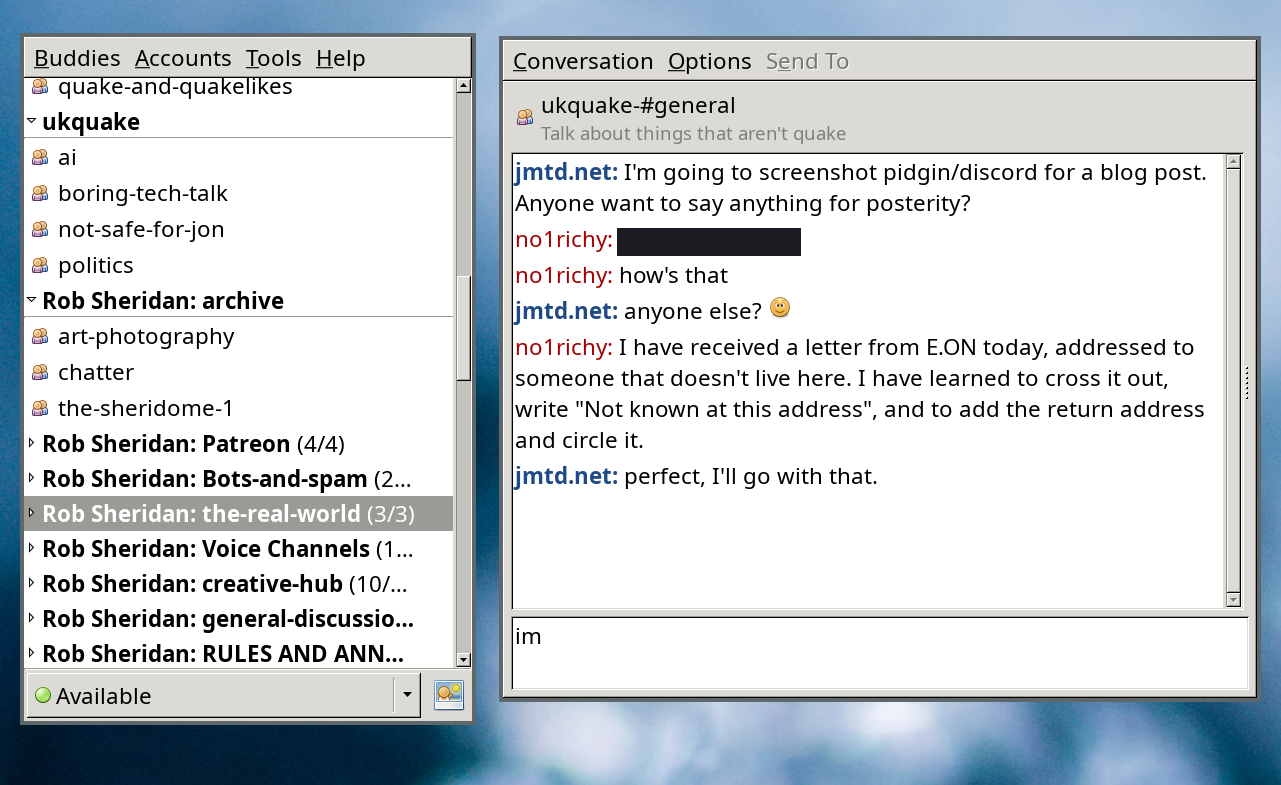 Discord from within Pidgin
purple-discord)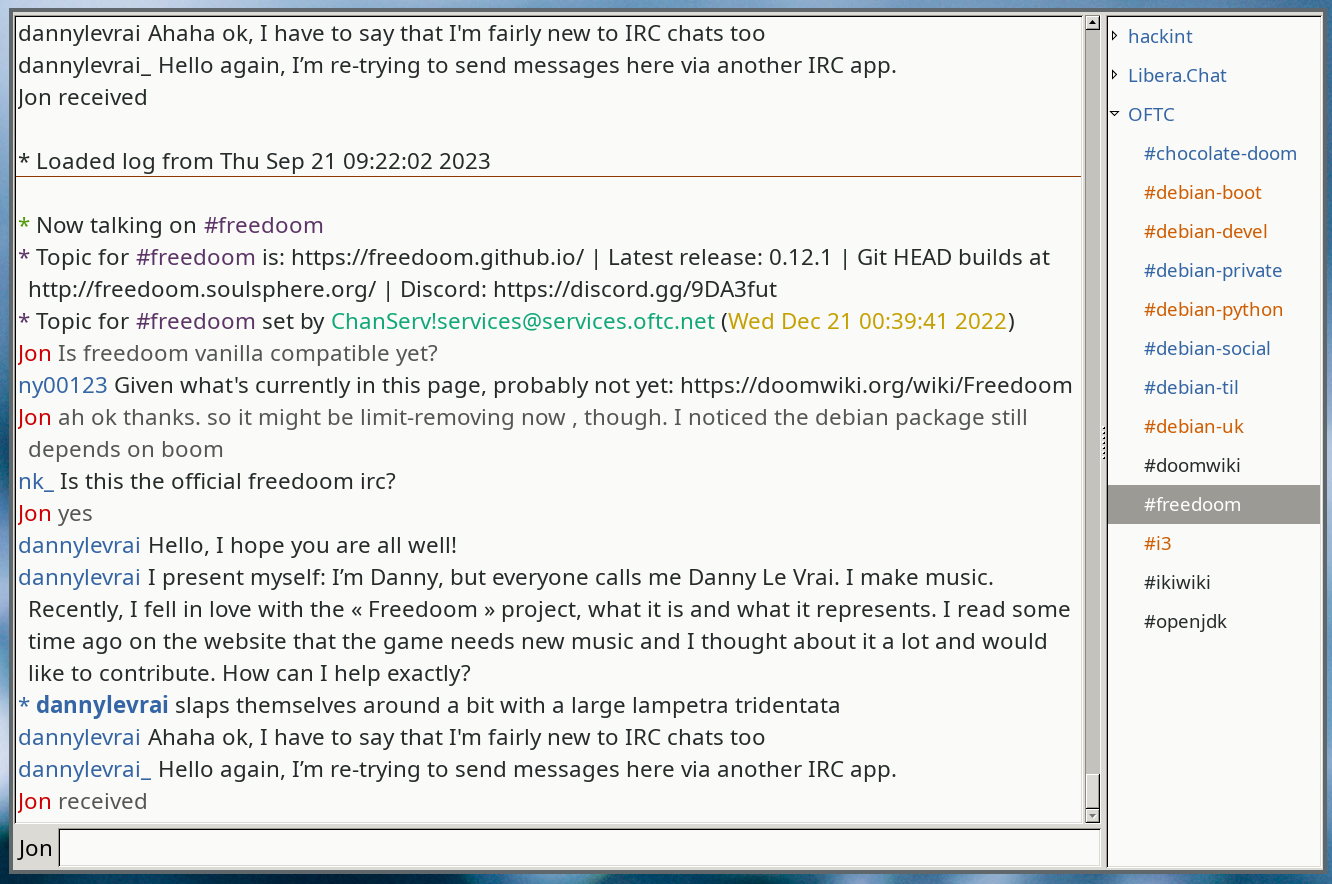 What my hexchat looks like
253. This version includes the following changes:
* Improve DOS/MBR extraction by adding support for 7z.
  (Closes: reproducible-builds/diffoscope#333)
* Process objdump symbol comment filter inputs as the Python "bytes" type
  (and not str). (Closes: reproducible-builds/diffoscope#358)
* Add a missing RequiredToolNotFound import.
* Update copyright years.
roslaunch PACKAGE THING.launch
PACKAGE (using some rules that nobody understands),
and tries to find the file THING.launch within this package. The .launch
file contains inscrutable xml, which includes other inscrutable xml. And
if you dig, you eventually find stuff like
<node pkg="PACKAGE"
      name="NAME"
      type="TYPE"
      args="...."
      ...>
TYPE.
I know that my particular program is broken, and needs an LD_PRELOAD (exciting
details described in another rant in the near future). But the above definition
doesn't have a clear way to add that. Adding it to the type fails (with a very
mysterious error message). Reading the docs tells you about launch-prefix,
which sounds exactly like what I want. But when I add
LD_PRELOAD=/tmp/whatever.so I get
RLException: Roslaunch got a 'No such file or directory' error while attempting to run:
LD_PRELOAD=/tmp/whatever.so ..../TYPE .....
But this is how you're supposed to be attaching gdb and such! Presumably it looks at the first token, and makes sure it's a file, instead of simply prepending it to the string it passes to the shell. So your options are:
launch-prefix="/lib64/ld-linux-x86-64.so.2 --preload /tmp/whatever.so"

Daniel Kahn Gillmor<dkg@debian.org><dkg@fifthhorseman.net>-----BEGIN PGP PUBLIC KEY BLOCK-----
xjMEZXEJyxYJKwYBBAHaRw8BAQdA5BpbW0bpl5qCng/RiqwhQINrplDMSS5JsO/Y
O+5Zi7HCwAsEHxYKAH0FgmVxCcsDCwkHCRC7fpEBSV5r90cUAAAAAAAeACBzYWx0
QG5vdGF0aW9ucy5zZXF1b2lhLXBncC5vcmfUAgfN9tyTSxpxhmHA1r63GiI4v6NQ
mrrWVLOBRJYuhQMVCggCmwECHgEWIQTUdwQMcMIValwphUm7fpEBSV5r9wAAmaEA
/3MvYJMxQdLhIG4UDNMVd2bsovwdcTrReJhLYyFulBrwAQD/j/RS+AXQIVtkcO9b
l6zZTAO9x6yfkOZbv0g3eNyrAs0QPGRrZ0BkZWJpYW4ub3JnPsLACwQTFgoAfQWC
ZXEJywMLCQcJELt+kQFJXmv3RxQAAAAAAB4AIHNhbHRAbm90YXRpb25zLnNlcXVv
aWEtcGdwLm9yZ4l+Z3i19Uwjw3CfTNFCDjRsoufMoPOM7vM8HoOEdn/vAxUKCAKb
AQIeARYhBNR3BAxwwhVqXCmFSbt+kQFJXmv3AAALZQEAhJsgouepQVV98BHUH6Sv
WvcKrb8dQEZOvHFbZQQPNWgA/A/DHkjYKnUkCg8Zc+FonqOS/35sHhNA8CwqSQFr
tN4KzRc8ZGtnQGZpZnRoaG9yc2VtYW4ubmV0PsLACgQTFgoAfQWCZXEJywMLCQcJ
ELt+kQFJXmv3RxQAAAAAAB4AIHNhbHRAbm90YXRpb25zLnNlcXVvaWEtcGdwLm9y
ZxLvwkgnslsAuo+IoSa9rv8+nXpbBdab2Ft7n4H9S+d/AxUKCAKbAQIeARYhBNR3
BAxwwhVqXCmFSbt+kQFJXmv3AAAtFgD4wqcUfQl7nGLQOcAEHhx8V0Bg8v9ov8Gs
Y1ei1BEFwAD/cxmxmDSO0/tA+x4pd5yIvzgfGYHSTxKS0Ww3hzjuZA7NE0Rhbmll
bCBLYWhuIEdpbGxtb3LCwA4EExYKAIAFgmVxCcsDCwkHCRC7fpEBSV5r90cUAAAA
AAAeACBzYWx0QG5vdGF0aW9ucy5zZXF1b2lhLXBncC5vcmd7X4TgiINwnzh4jar0
Pf/b5hgxFPngCFxJSmtr/f0YiQMVCggCmQECmwECHgEWIQTUdwQMcMIValwphUm7
fpEBSV5r9wAAMuwBAPtMonKbhGOhOy+8miAb/knJ1cIPBjLupJbjM+NUE1WyAQD1
nyGW+XwwMrprMwc320mdJH9B0jdokJZBiN7++0NoBM4zBGVxCcsWCSsGAQQB2kcP
AQEHQI19uRatkPSFBXh8usgciEDwZxTnnRZYrhIgiFMybBDQwsC/BBgWCgExBYJl
cQnLCRC7fpEBSV5r90cUAAAAAAAeACBzYWx0QG5vdGF0aW9ucy5zZXF1b2lhLXBn
cC5vcmfCopazDnq6hZUsgVyztl5wmDCmxI169YLNu+IpDzJEtQKbAr6gBBkWCgBv
BYJlcQnLCRB3LRYeNc1LgUcUAAAAAAAeACBzYWx0QG5vdGF0aW9ucy5zZXF1b2lh
LXBncC5vcmcQglI7G7DbL9QmaDkzcEuk3QliM4NmleIRUW7VvIBHMxYhBHS8BMQ9
hghL6GcsBnctFh41zUuBAACwfwEAqDULksr8PulKRcIP6N9NI/4KoznyIcuOHi8q
Gk4qxMkBAIeV20SPEnWSw9MWAb0eKEcfupzr/C+8vDvsRMynCWsDFiEE1HcEDHDC
FWpcKYVJu36RAUlea/cAAFD1AP0YsE3Eeig1tkWaeyrvvMf5Kl1tt2LekTNWDnB+
FUG9SgD+Ka8vfPR8wuV8D3y5Y9Qq9xGO+QkEBCW0U1qNypg65QHOOARlcQnLEgor
BgEEAZdVAQUBAQdAWTLEa0WmnhUmDBdWXX0ZlYAa4g1CK/fXg0NPOQSteA4DAQgH
wsAABBgWCgByBYJlcQnLCRC7fpEBSV5r90cUAAAAAAAeACBzYWx0QG5vdGF0aW9u
cy5zZXF1b2lhLXBncC5vcmexrMBZe0QdQ+ZJOZxFkAiwCw2I7yTSF2Ox9GVFWKmA
mAKbDBYhBNR3BAxwwhVqXCmFSbt+kQFJXmv3AABcJQD/f4ltpSvLBOBEh/C2dIYa
dgSuqkCqq0B4WOhFRkWJZlcA/AxqLWG4o8UrrmwrmM42FhgxKtEXwCSHE00u8wR4
Up8G
=9Yc8
-----END PGP PUBLIC KEY BLOCK-----
 Welcome to the November 2023 report from the Reproducible Builds project! In these reports we outline the most important things that we have been up to over the past month. As a rather rapid recap, whilst anyone may inspect the source code of free software for malicious flaws, almost all software is distributed to end users as pre-compiled binaries (more).
amd64, arm64, armhf, i386, ppc64el, riscv64 and s390 for Debian trixie, unstable and experimental, this is only around 500GB ie. less than 1%. Although the new service not yet ready for usage, it has already provided a promising outlook in this regard. More information is available on https://rebuilder-snapshot.debian.net and we hope that this service becomes usable in the coming weeks.
 The adjacent picture shows a sticky note authored by Jan-Benedict Glaw at the summit in Hamburg, confirming Holger Levsen s theory that rebuilding all Debian packages needs a very small subset of packages, the text states that 69,200 packages (in Debian sid) list 24,850 packages in their
.buildinfo files, in 8,0200 variations. This little piece of paper was the beginning of rebuilder-snapshot and is a direct outcome of the summit!
The Reproducible Builds team would like to thank our event sponsors who include Mullvad VPN, openSUSE, Debian, Software Freedom Conservancy, Allotropia and Aspiration Tech.
 On November 4th, Vagrant Cascadian presented Beyond Trusting FOSS at SeaGL in Seattle, WA in the United States. Founded in 2013, SeaGL is a free, grassroots technical summit dedicated to spreading awareness and knowledge about free source software, hardware and culture. The summary of Vagrant s talk mentions that it will:
[ ] introduce the concepts of Reproducible Builds, including best practices for developing and releasing software, the tools available to help diagnose issues, and touch on progress towards solving decades-old deeply pervasive fundamental security issues Learn how to verify and demonstrate trust, rather than simply hoping everything is OK!Germane to the contents of the talk, the slides for Vagrant s talk can be built reproducibly, resulting in a PDF with a SHA1 of
cfde2f8a0b7e6ec9b85377eeac0661d728b70f34 when built on Debian bookworm and c21fab273232c550ce822c4b0d9988e6c49aa2c3 on Debian sid at the time of writing.
 Marcel Fourn , Dominik Wermke, Sascha Fahl and Yasemin Acar have published an article in a Special Issue of the IEEE s Security & Privacy magazine. Entitled A Viewpoint on Human Factors in Software Supply Chain Security: A Research Agenda, the paper justifies the need for reproducible builds to reach developers and end-users specifically, and furthermore points out some under-researched topics that we have seen mentioned in interviews. An author pre-print of the article is available in PDF form.
[ ] today I hold in my hands the first two bit-identical LibreOffice rpm packages. And this is the success I wanted to share with you all today [and] it makes me feel as if we can solve anything.
esp32c3 microcontroller firmware reproducible with Rust, repro-env and Arch Linux:
I chose theesp32c3[board] because it has good Rust support from theesp-rsproject, and you can get a dev board for about 6-8 . To document my build environment I usedrepro-envtogether with Arch Linux because its archive is very reliable and contains all the different Rust development tools I needed.
dump command and hopes that someone may be able to help.
 Bernhard M. Wiedemann has created a wiki page outlining an proposal to create a general-purpose Linux distribution which consists of 100% bit-reproducible packages albeit minus the embedded signature within RPM files. It would be based on openSUSE Tumbleweed or, if available, its Slowroll-variant.
In addition, Bernhard posted another monthly update for his work elsewhere in openSUSE.
 As recently reported in the most recent Debian Developer News, Paul Gevers has integrated a package s reproducibility status into the way Debian migrates packages into the next stable release. For the
amd64, arm64, i386 and armhf architectures, data is collected from the Reproducible Builds testing framework is collected by this migration software even though, at the time of writing, it neither causes nor migration bonuses nor blocks migration. Indeed, the information only results are visible on Britney s excuses as well as on individual packages pages on tracker.debian.org.
.buildinfo files
Back in 2017, Steve Langasek filed a bug against Ubuntu s Launchpad code hosting platform to report that .changes files (artifacts of building Ubuntu and Debian packages) reference .buildinfo files that aren t actually exposed by Launchpad itself. This was causing issues when attempting to process .changes files with tools such as Lintian. However, it was noticed last month that, in early August of this year, Simon Quigley had resolved this issue, and .buildinfo files are now available from the Launchpad system.
 Firstly, the widely-deployed PHPUnit framework for the PHP programming language have recently released version 10.5.0, which introduces the inclusion of a
composer.lock file, ensuring total reproducibility of the shipped binary file. Further details and the discussion that went into their particular implementation can be found on the associated GitHub pull request.
In addition, the presentation Leveraging Nix in the PHP ecosystem has been given in late October at the PHP International Conference in Munich by Pol Dellaiera. While the video replay is not yet available, the (reproducible) presentation slides and speaker notes are available.
 diffoscope is our in-depth and content-aware diff utility that can locate and diagnose reproducibility issues. This month, Chris Lamb made a number of changes, including:
7z. [ ]RequiredToolNotFound import. [ ]252 to Debian unstable. [ ] A huge number of notes were added to our website that were taken at our recent Reproducible Builds Summit held between October 31st and November 2nd in Hamburg, Germany. In particular, a big thanks to Arnout Engelen, Bernhard M. Wiedemann, Daan De Meyer, Evangelos Ribeiro Tzaras, Holger Levsen and Orhun Parmaks z.
In addition to this, a number of other changes were made, including:
SOURCE_DATE_EPOCH and CMake [ ], added iomart (ne Bytemark) and DigitalOcean to our sponsors page [ ] and dropped an unnecessary link on some horizontal navigation buttons [ ].
amber-cli (date-related issue)bin86 (FTBFS-2038)buildah (timestamp)colord (CPU)google-noto-fonts (file modification issue)grub2 (directory-related metadata)guile-fibers (parallelism issue)guile-newt (parallelism issue)gutenprint (embedded date/hostname)hub (random build path)ipxe (nondeterministic behavoiour)joker / jokerkopete (undefined behaviour)kraft (embedde hostname)libcamera (signature)libguestfs (embeds build host file)llvm (toolchain/Rust-related issue)nfdump (date-related issue)ovmf (unknown cause)quazip (missing fonts)rdflib (nondeterminstic behaviour)rpm (toolchain)tigervnc (embedded an RSA signature)whatsie (date-related issue)xen (time-related issue)policycoreutils (sort-related issue)python-ansible-pygments.bidict.meson.radsecproxy.taffybar.php-doc.pelican.maildir-utils.openmrac-data.vectorscan. The Reproducible Builds project operates a comprehensive testing framework (available at tests.reproducible-builds.org) in order to check packages and other artifacts for reproducibility. In October, a number of changes were made by Holger Levsen:
Priority: important in a new package set. [ ][ ]pool_buildinfos script to be re-run for a specific year. [ ]osuosl4 node [ ][ ] along with lynxis [ ].amd64 Ionos builders from 48 GiB to 64 GiB; thanks IONOS! [ ]arm64 architecture workers from 24 to 16 in order to improve stability [ ], reduce the workers for amd64 from 32 to 28 and, for i386, reduce from 12 down to 8 [ ].cache_dir size setting to 16 GiB. [ ]systemd-oomd as it unfortunately kills sshd [ ]debootstrap from backports when commisioning nodes. [ ]live_build_debian_stretch_gnome, debsums-tests_buster and debsums-tests_buster jobs to the zombie list. [ ][ ]jekyll build with the --watch argument when building the Reproducible Builds website. [ ]rc.local s Bash syntax so it can actually run [ ], commenting away some file cleanup code that is (potentially) deleting too much [ ] and fixing the html_brekages page for Debian package builds [ ]. Finally, diagnosed and submitted a patch to add a AddEncoding gzip .gz line to the tests.reproducible-builds.org Apache configuration so that Gzip files aren t re-compressed as Gzip which some clients can t deal with (as well as being a waste of time). [ ]
#reproducible-builds on irc.oftc.net.
rb-general@lists.reproducible-builds.org
 The FAI.me service for creating customized installation and cloud
images has a new feature by a user requested it.
You can now enable installing recommended packages for your custom
package list. By default FAIme does only install the dependencies
needed, but not the recommended packages.
This was a very easy enhancement, only a few lines in the web
interface and nearly no changes in the backend were needed.
The web interface of the FAI.me service is available at
https://fai-project.org/FAIme
 Hello from a snowy Montr al! My life has been pretty busy lately1 so
please forgive this late report.
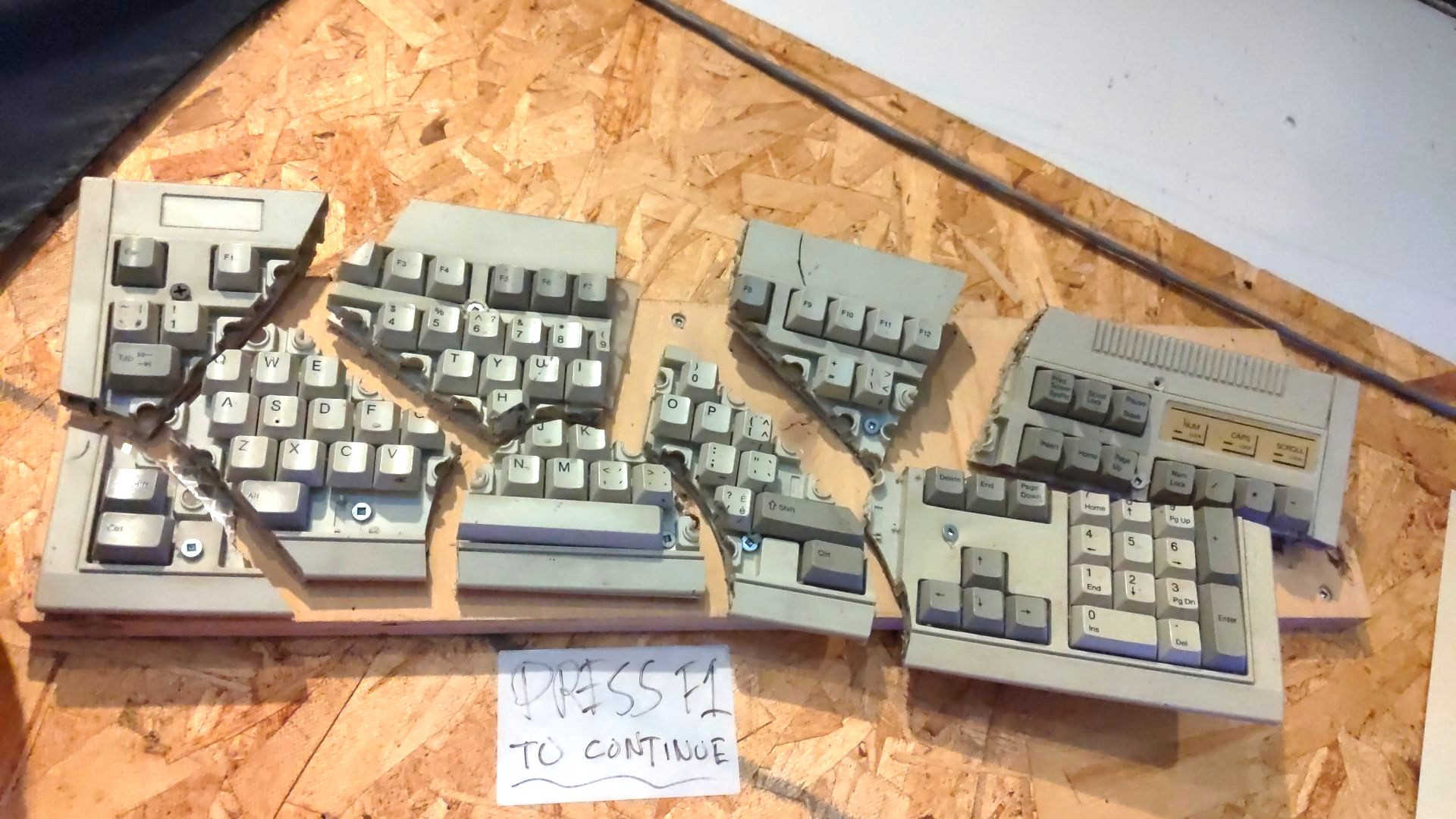
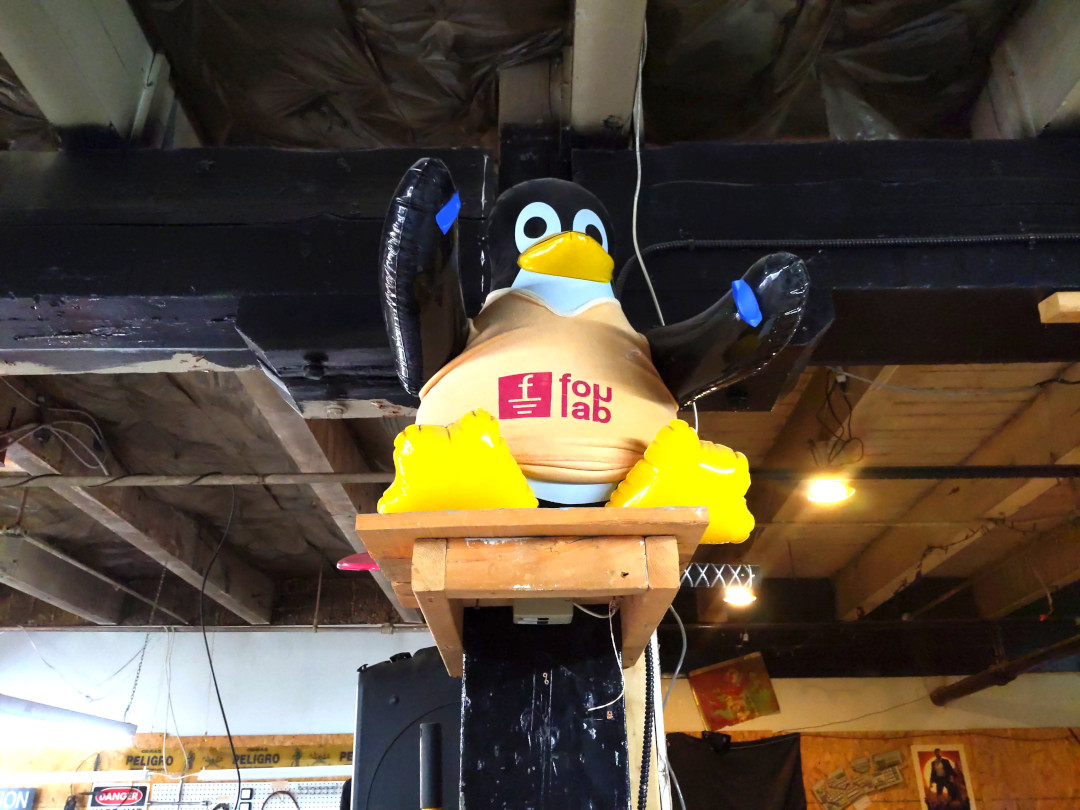
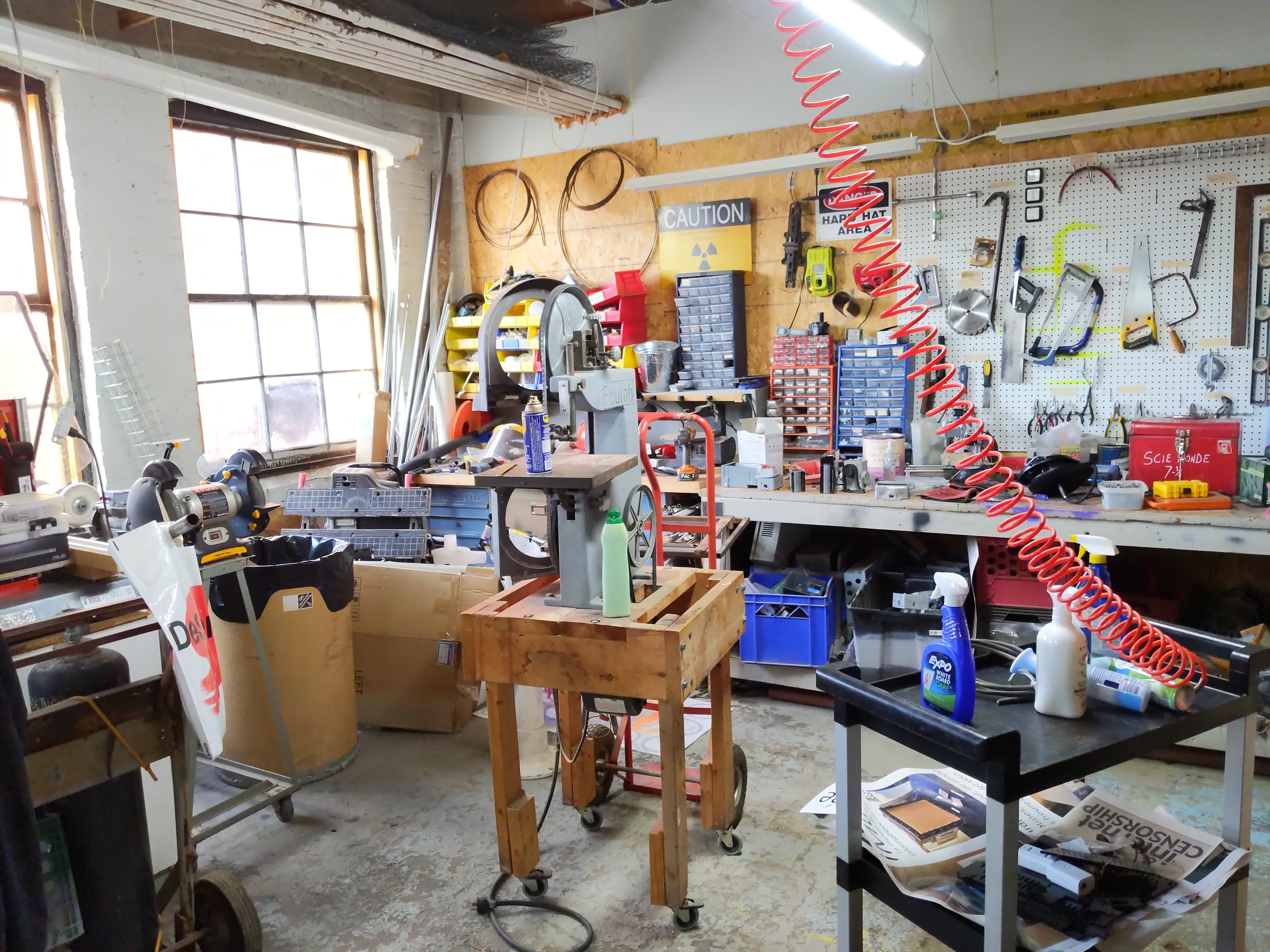
On November 19th, our local Debian User Group met at Montreal's most
prominent hackerspace, Foulab. We've been there a few times already, but
since our last visit, Foulab has had some membership/financial troubles. Happy
to say things are going well again and a new team has taken over the space.
This meetup wasn't the most productive day for me (something about being
exhausted apparently makes it hard to concentrate), but other people did a
bunch of interesting stuff :)
sbuild...dcf.debian.net to make daily updates on the data sources in the
dc-sources repository.

 There's a decent number of laptops with fingerprint readers that are supported by Linux, and Gnome has some nice integration to make use of that for authentication purposes. But if you log in with a fingerprint, the moment you start any app that wants to access stored passwords you'll get a prompt asking you to type in your password, which feels like it somewhat defeats the point. Mac users don't have this problem - authenticate with TouchID and all your passwords are available after login. Why the difference?
 Armadillo is a powerful
and expressive C++ template library for linear algebra and scientific
computing. It aims towards a good balance between speed and ease of use,
has a syntax deliberately close to Matlab, and is useful for algorithm
development directly in C++, or quick conversion of research code into
production environments. RcppArmadillo
integrates this library with the R environment and language and is
widely used by (currently) 1126 other packages on CRAN, downloaded 31.7 million
times (per the partial logs from the cloud mirrors of CRAN), and the CSDA paper (preprint
/ vignette) by Conrad and myself has been cited 569 times according
to Google Scholar.
This release ends the practice on asking Armadillo to suppress
deprecation warnings. RcppArmadillo,
as noted, has a large user base. Sometimes Conrad sometimes made changes
without too much of a heads-up so at times it was opportune to not bring
those warnings to dozens (or maybe hundreds) of packages at CRAN. Yet we need to balance this
with the demonstrable need to call out older deprecated code use. So
sixteen months ago, with GitHub issue
#391, we started to alert author of 30+ affected packages and
supplied either pull requests or emailed patches to all. Eleven months
ago GitHub
issues #402 was added for a second deprecation.
And the time of making the switch has come. Release 0.12.6.6.1 no
longer defines
ARMA_IGNORE_DEPRECATED_MARKER. So among the
over 1100 packages using RcppArmadillo
at CRAN, around a good dozen or
so were flagged in the upload but CRAN concurred and let the package
migrate to CRAN.
If you maintain an affected package, consider applying the patch or
pull request now. A simple stop-gap measure also exists by adding
-DARMA_IGNORE_DEPRECATED_MARKER to
src/Makevars as either PKG_CPPFLAGS or
PKG_CXXFLAGS to reactivate it. But a proper code update,
which is generally simple, may be better. If you are unsure, do not
hesitate to get in touch.
The set of changes since the last CRAN release follows.
Courtesy of my CRANberries, there is a diffstat report relative to previous release. More detailed information is on the RcppArmadillo page. Questions, comments etc should go to the rcpp-devel mailing list off the Rcpp R-Forge page. If you like this or other open-source work I do, you can sponsor me at GitHub.Changes in RcppArmadillo version 0.12.6.6.1 (2023-12-03)
This post by Dirk Eddelbuettel originated on his Thinking inside the box blog. Please report excessive re-aggregation in third-party for-profit settings.
apt source, or dpkg-source. Instead, use dgit and work in git.
Also, don t use: VCS links on official Debian web pages, debcheckout, or Debian s (semi-)official gitlab, Salsa. These are suitable for Debian experts only; for most people they can be beartraps. Instead, use dgit.
>
Struggling with Debian source packages?
A friend of mine recently asked for help on IRC. They re an experienced Debian administrator and user, and were trying to: make a change to a Debian package; build and install and run binary packages from it; and record that change for their future self, and their colleagues. They ended up trying to comprehend quilt.
quilt is an ancient utility for managing sets of source code patches, from well before the era of modern version control. It has many strange behaviours and footguns. Debian s ancient and obsolete tarballs-and-patches source package format (which I designed the initial version of in 1993) nowadays uses quilt, at least for most packages.
You don t want to deal with any of this nonsense. You don t want to learn quilt, and suffer its misbehaviours. You don t want to learn about Debian source packages and wrestle dpkg-source.
Happily, you don t need to.
Just use dgit
One of dgit s main objectives is to minimise the amount of Debian craziness you need to learn. dgit aims to empower you to make changes to the software you re running, conveniently and with a minimum of fuss.
You can use dgit to get the source code to a Debian package, as a git tree, with dgit clone (and dgit fetch). The git tree can be made into a binary package directly.
The only things you really need to know are:
dgit clone PACKAGE bookworm,-security (yes, with a comma).
debian/changelog to make your packages have a different version number.
dpkg-buildpackage -uc -b.
debian/rules clean can be inadequate, or crazy. Always commit before building, and use git clean and git reset --hard instead of running clean rules from the package.
dpkg-source manual!) Instead, to preserve and share your work, use the git branch.
dgit pull or dgit fetch can be used to get updates.
There is a more comprehensive tutorial, with example runes, in the dgit-user(7) manpage. (There is of course complete reference documentation, but you don t need to bother reading it.)
Objections
But I don t want to learn yet another tool
One of dgit s main goals is to save people from learning things you don t need to. It aims to be straightforward, convenient, and (so far as Debian permits) unsurprising.
So: don t learn dgit. Just run it and it will be fine :-).
Shouldn t I be using official Debian git repos?
Absolutely not.
Unless you are a Debian expert, these can be terrible beartraps. One possible outcome is that you might build an apparently working program but without the security patches. Yikes!
I discussed this in more detail in 2021 in another blog post plugging dgit.
Gosh, is Debian really this bad?
Yes. On behalf of the Debian Project, I apologise.
Debian is a very conservative institution. Change usually comes very slowly. (And when rapid or radical change has been forced through, the results haven t always been pretty, either technically or socially.)
Sadly this means that sometimes much needed change can take a very long time, if it happens at all. But this tendency also provides the stability and reliability that people have come to rely on Debian for.
I m a Debian maintainer. You tell me dgit is something totally different!
dgit is, in fact, a general bidirectional gateway between the Debian archive and git.
So yes, dgit is also a tool for Debian uploaders. You should use it to do your uploads, whenever you can. It s more convenient and more reliable than git-buildpackage and dput runes, and produces better output for users. You too can start to forget how to deal with source packages!
A full treatment of this is beyond the scope of this blog post.
What's new in the Linux kernel. Apologies for the poor audio quality; I will use a different microphone if I do this again.
Next.