Search Results: "eric"

27 March 2007

Adrian von Bidder: Samsung D900

David, after the demise of the little joystick of my previous phone (Sony Ericsson T610), I opted for the D900 (at CHF 21.-- plus 2 years, quite a good offer IMHO.) The hardware is very slick, though the display is disappointingly dark if you use the phone outside in bright light (Look at Casio's Exilim cameras for a good example of how a display can be readable even in direct sunlight.) Since I'm using the device as a phone only (and write less than 5 messages per month, usually), I still think it's a nice thing, but... Would I buy that phone again? I don't know. The price was good, and, again, it's still a very slick looking phone. But the firmware designers should be locked up for a few years and forced to write their code with the built in editor or someting like that. But if you expect anything other than to be able to call people over this device: don't go near it. I haven't relly looked at any other phones when I bought it, so I can't compare.

26 March 2007

Jordi Mallach: No more TV3 in the Valencian Country: another example of PP's democracy

Tomorrow at 9 in the morning some officers from the Valencian regional Government will drive up to the mountains of the Bartolo, Serra Perentxissa, Montd ver and Carrasqueta to power off the set of antennas which have broadcasted the signal of TV3, the Catalan public television, during the last 20 years for the entire Valencian territory. These news have been responded with protests from most of the Valencian cultural collectives. You can sign a petition, or send an e-mail, which will be swiftly ignored by the people in charge. Behind the official reasoning for this attack to our freedom of choice -the broadcast is illegal- there is a set of good reasons for the usual suspects, the Valencian Partido Popular to do this. The biggest one is that two months before the local and regional elections, the right-wing are doing their math and it may not be working out too well for them. They need to scrape as many votes as they can, and an easy granary is attracting the extreme right-wing, which is a bit active but fragmented in the region, and mostly in the city of Val ncia. This social group is greatly virulent against anything which sounds like Catalan , especially the people known as blaveros , who claim our culture and language has no common root and has nothing to do with the culture and language from the North. Fortunately, the ISO 639 standard and the entire scientific community agree that they are nuts. But back to my rant. So, how can the PP try to get a handful of votes from the right-wing? Easy, start an anti-TV3 show on the media and start scalating it until the final act -tomorrow-, where milions of citizens are deprived of one of the best channels available in our TV sets. This will surely be sold as a major victory against the Catalan invasion or as the end of an "alegal situation", although there are like 30 other channels in the same situation in the city of Val ncia, and the PP-controlled Canal 9 channel is broadcasted in the Balear Islands (also controled by PP) in the same legal situation. In a time when watching Middle-East or American channels is trivial using a satellite set, some people think the best thing they can do is to end a service paid and provided for free by Acci Cultural del Pa s Valenci , an important cultural entity, during the last 20 years, ending the right to choose one of the only channels with all the programs in our language for milions of Valencians. Their right to do it is also challenged in court, but there is no doubt that tomorrow they'll go ahead and shut it off. We could have a reasonable government who would maybe want to accept the Catalan TV and radio channels in our territory, if the Catalan government would also accept our (crappy) channels in theirs, but they refuse this as well, because they now feel insulted . All in all, I had enough of PP long ago, and am hoping I am not the only one. In less than a month, Valencians will celebrate the 300th anniversary of the Batalla d'Almansa on the 25th of April of 1707, although we seem to be fighting a new battle now in 2007. The Batalla d'Almansa meant the end of the War of the Spanish Succession in Spain, but also the start of tough times for our culture, language, and people, when Felipe V abolished the Valencian furs. But this story can make a blog post of its own next month. Quan el mal ve d'Almansa, a tots alcan a...

Peter Van Eynde: 'The Trap'

Yesterday I went to bed too late because I was captivated by the last episode of The Trap: What Happened to Our Dream of Freedom, a series by Adam Curtis. Even since I saw Pandora's Box I've been an avid viewer of his work. The Trap talks about what freedom is, and this morning I realised that many things he talked about can be seen in the OSS world, and more specifically in Debian. I'm certain Biella can write something much better (and shorter) and I'm still thinking about it, but I wanted to write some stuff down.
One of the main ideas is the modern western culture has been formed to appeal for people thinking like a model in the 'prisoners dilemma': they only case to further themselves. This lead to the idea that life (not only the economy) should be like a free market, and that people should be 'free' to choose what they liked. Of course in practice the rich are 'free' to send their kids to better schools then the poor who are 'free' but constrained to send their kids to worse schools. The program called this negative freedom: there is constrained freedom. Think of it as Microsoft's vision of freedom, their 'freedom to innovate' (which they don't), your freedom to select which of the N licences of vista is good enough for you. This limited freedom is more stable then the positive freedom that is actual seeking true freedom, without constraints. This positive freedom was then developed by Satre, Fanon and Shariati into the idea that true freedom could only be gained by armed struggle, to gain freedom but also an identity that transcends the simple individual.
The whole idea of the two freedoms was described by Isaiah Berlin and he also had the idea that freedom can only be gained by limiting the power of the state over the individual, otherwise both concepts of freedom would become tyrannical because the powers that be would decide what freedom is, and then suppress anybody that does not agree with that idea. Examples are the communists in the USSR, but also how the Americans turned to torture, imprisonment without tribunal to 'liberate the Iraqi people'. Or older still the Reign of Terror during the French revolution.
All of this has some relevance to OSS and Debian in particular. Don't we search freedom from constraints (licences, absence of source)? Don't we want a revolution in the use of computers? Are we not using disruptive means to get it? The introduction of a samba file-server in a pure MS environment by a disgruntled admin who just wants stuff to work could be seen as being almost a terrorist method of working. Not that we want to terrorise the population, but make them aware that an alternative exists. And this to chance the system. Sometimes the whole mindset does seem to be a little too much confrontational, almost towards having a real conflict. Just think about the many references that some disaster should wipe out the Seattle area. Are we not at risk of becoming tyrannical in many ways? Ignoring any Debian discussions, there is the whole FreeBSD/OpenBSD split, people complaining that wikipedia is removing contents the consider valuable, projects refusing to create howto's and introductions to keep the newbies away etc. OOS does seem to have a tendency to become tyrannical in some aspects. Not that this is always bad, see the benevolent dictators handling the Linux kernel or python.
If I understand the idea's correctly it means that even if we want freedom, from the moment we start using the powers of the project to limit somebody we start the slide towards being oppressive and tyrannical. Somehow I fear that all this will lead to a lot of reading and thinking...

Erich Schubert: Musicbox software

Dear Lazyweb, I was asked if I could easily setup a system with the following characteristics for a sport club: Two setups I was considering: This would likely require the least effort. It doesn't offer the playlist features I wanted (or only partially), and there are some access control limitations. No remote access. But for example the clients could even be Windows boxes I wouldn't have to deal with myself. Has better playlist sharing capabilities, and the web UI could probably be used remotely, too. But MPD doesn't allow extra metadata such as BPM information, it would need to be modified. Much more work. Maybe some solution using XMMS2 or VLC would also be possible. And the ideal solution would allow some pitching. Do you have any recommendations for me? Please send them via EMail to erich AT debian DOT org. IMHO, the key factor will actually be the UI for the trainers. It should allow them to easily locate a song when needed, or put a couple of songs into a playlist to use during their class. Carzy DJ mixing capabilities aren't needed; party evens will likely have a real DJ around. This setup is solely meant to help the trainers getting their music ready in no time. Right now there are always issues with cables gone missing, CDs in the wrong covers, CD readers not reading certain CDs, etc. pp. And after all CDs have a pretty bad usability; you can't reorder songs easily according to your needs, and you'll often have to switch CDs. Having the music on a harddisk and using playlists can offer some good improvements here. So instead the UI should allow easy searching of tracks, easy access to a large number of playlists and such key functionality. Note that this is just an idea floating around so far; I don't know if it will become reality sometime. Adding some PCs to the rooms, eventually even with a touch screen, is some expenditure; that money might be better spent differently.

24 March 2007

Erich Schubert: Google Video searches YouTube

The search functionality of YouTube always sucked. Ever since Google acquired them, I was looking forward for them to add a better search. Well, this apparently has happened now; searching at youtube now allows queries like "paris -hilton". At the same time, searching at Google Video now returns results at YouTube. In this particular case however, I'd prefer it to not return YouTube results, because videos at Google are usually of a better quality...

Erich Schubert: Please, think of the animals formerly known as kittens...

(Title stolen from Holger Levsen) Whenever I see this image [mozilla open Standards], I want to make a spoof of it titled: Every time you make an Ajax app, god kills a firefox. But I would certainly be violating Mozilla trademarks by doing so (their artwork, logos and trademarks such as "firefox" are not OpenSource). Anyway: AJAX is a hackaround, in particular it is not an open standard. Please use it only where it's really needed. Granted, there is worse (e.g. Flash; prepare for incompability hell now that the first opensource plugin can playback youtube videos - as you might be aware, many Linux distributions can not ship Adobe Flash, so they'll likely start shipping this plugin as soon as it's somewhat working sufficiently; or ActiveX which only works with MSIE...), but that's not really a good excuse for this abuse of Javascript that is called AJAX. On a side note, since I already mentioned flash - I can really recommend the Flashblock mozilla extension. A must have: you can view any flash if you need to by just clicking on it, but they won't be loaded automatically anymore. So you can easily access youtube (just one extra click!), but won't be bothered by flash ads and such stuff. Oh, and Adobe. They're probably the biggest blocker for a widespread Linux adoption judging by this article [computerworld.com], which is already very positive on Linux ("Unlike many of the applications included on new Windows systems, these don't seem to come with annoying self-launching advertisements, such as the irony-challenged Trend Micro Anti-Spyware pop-up upgrade pleas that plagued my HP system at home."): maybe his biggest issue is that he couldn't just run his Adobe Photoshop Elements on Linux. Of course there are application trying to offer the same functionality; starting with Gimp, digiKam and Krita (and I'm not sure he tried Krita and digiKam as well; they are probably more similar to Adobes product), but I can understand his wish to be able to continue using the same applications. (My personal recommendation: start using Opensource applications on Windows, e.g. Firefox, Thunderbird, Inkscape (great vector graphics program!) (and it's using open standards: SVG), Gaim (multi-protocol instant messenger and tons of others. They're free, so even if you don't use them every day, you didn't waste money on them... and if you happen to like them: you can be sure that they'll be working the same if you do the switch to Linux at some point in the future. Be prepared for when Microsoft says you PC is too old.

23 March 2007

Martin F. Krafft: Epiphany and vertical tabs

Firefox is becoming totally unusable, and even though some extensions I need/want do not exist for Epiphany (like Web Developer and Firebug, Live HTTP headers, Stealther, UrlParams, Cookie Button, and plenty of the features of Tab Mix Plus (among others)). The single biggest obstacle keeping me from switching are vertical tabs. I usually have a browser window for each task I work on, and on average, I'll have 15 tabs open in it. With Firefox, I hacked the UI to make the tabs line up vertically on the left side of the window. That way, I can easily keep track of 30 open tabs, and I gain vertical space for the payload at the expense of window width. Dear lazyweb: do you know of a way to move the Epiphany tab bar to the left of the window and have it fill with tabs top-down? Please let me know! NP: 65daysofstatic / The Fall of Math Update: Lazyweb, you're aweseome! Rodney Jokerst referred me to his Epiphany extension, which does just what I want. Update: due to popular demand, here's the Firefox hack I use in chrome/userChrome.css:
#content > tabbox  
  -moz-box-orient: horizontal;
 
.tabbrowser-strip  
  -moz-box-orient: vertical;
  /* note: you can set this to -moz-scrollbars-vertical instead,
  but then the scrollbar will *always* be visible. this way
  there is never a scrollbar, so it behaves like the tab bar
  normally does */
  overflow: -moz-scrollbars-none;
 
.tabbrowser-tabs  
  -moz-box-orient: horizontal;
  /* min-width: 50ex; */ /* >1680 pixels screens */
  /* min-width: 40ex; */ /* =1680,1600 pixels screens */
  /* min-width: 35ex; */ /* =1440 pixels screens */
  /* min-width: 30ex; */ /* <1440 pixels screens */
  min-width: 20ex; /* 1280 pixels screens */
  /* min-width: 17ex; */ /* this is almost the minimum to go down to on small screens */
  -moz-box-align: start;
 
/* Background for tabbrowser strip */
tabs.tabbrowser-tabs  
  background-color: grey !important;
 
.tabbrowser-tabs > stack > vbox > hbox > hbox  
  -moz-box-orient: vertical;
  -moz-box-align: stretch;
 
.tabbrowser-tabs > stack > vbox > hbox > hbox > tab  
  -moz-box-align: start;
  -moz-box-orient: horizontal;
 
/* to put the tabs on the right un-comment this line
  (not needed if using Tab Mix Plus) */
#content > tabbox  -moz-box-direction: reverse; 
Even though the origins of this code are IRC channels and other forms of random pasting back and forth, of which I was a part, I took the above from this page.

Erich Schubert: Google Summer of Code

Applications are still open until March 26th. Note: the following is my personal opinion; I'm not the coordinator of the Debian GSoC project, and others might disagree. Debian has received a couple of applications, but there were rather few among them I found really convincing. :-( What I usually dislike in applications: So if your application is really Debian-related, invest a few hours in writing the application and your chances are pretty good at being accepted! Of course Debian could be an Umbrella for e.g. another network configuration GUI, a tool to configure traffic shaping etc.; however I don't think that should be our focus. In fact, Google itself could mentor these topics maybe as good as we can. So please don't just submit a proposal to us because you happen to be a Debian user, or submit it to all mentoring organizations. Instead try to find an appropriate mentoring organization. (On a side note, the mentoring organization is supposed to provide you with a mentor which can actually help you on the topic). Debian is a good choice when it comes to integrating software, software management, system administration and such. Thats what we do: collect existing software and try to make it work together as good as possible. And build infrastructure and tools to make this task easier. This of course touches e.g. porting to different architectures and writing new administration frontends, however we try to avoid reinventing the wheel. One of the suggested topics, where I'm really surprised to not having seen a proposal yet is CRMI; which matches what I sometimes call a "per package wiki for metadata". Or a Debtags related project. Or a SELinux project. These are both pretty interesting technologies, which offer substantial benefits when actually used. When properly integrated in the distribution.

Alastair McKinstry: Preparing for Daylight Savings Time

While computers mostly handle the Daylight Savings Time changeover automatically, sometimes work is required. In our case at ICHEC, arranging for some jobs to run at set times, means changing the scheduler at the changeover. We use PBS and Maui to schedule what jobs run when on our cluster. Mostly jobs get run according to priorities: the scheduler (software) decides which what the priority jobs are and when; it collects free nodes until it has sufficient free CPUs to run the jobs at hand. It can do backfilling: when it's e.g. trying to run a large 128 node job but has only 10 nodes free, it will reserve nodes as they become free until it has all the resources needed to run the job. If by looking at the remaining time left on running jobs it realises that it won't get nodes free for the large job for say 2 hours, it can run small jobs with runtimes of less than two hours on the nodes it had reserved. Clever. The fun issue comes when you need to set reservations: say you need to run a job at 2am every day on 32 nodes, as we do: the scheduler needs to plan accordingly. The scheduler needs to really have 32 nodes free at that time. Thats 2am local time, of course: but next Sunday, at 2am, the clock changes... So, working out the consequences, and preparing for the change, I sympathise with our American friends who've moved three weeks early to save energy. Thus causing lots of midnight oil to be burned around the world by sysadmins and programmers updating software. Hmmm. Note to Self: When Posting a blog entry asking for help on getting blog comments to work with openid, try leaving the comments setup on the blog working, so people can leave replies. Fixed now.

22 March 2007

Isaac Clerencia: Bloodhound Gang gig, Sheffield crazyness, holidays in America

Last weekend my workmate Javi and I attended a Bloodhound Gang show in Sheffield, UK. It was quite cool and we got the chance to see Jimmy Pop and Evil Jared live. I also had the chance to see this amazingly crazy poster at Sheffield bus station. In unrelated news I’m leaving tomorrow towards the United States, I am going on holidays to New York and Boston for a couple of weeks with a group of friends, I hope it to be great :)

21 March 2007

Erich Schubert: Java inconsistency

Using Sun Java 1.5.0_11:
final SimpleDateFormat almostXsDateTime=new SimpleDateFormat("yyyy-MM-dd'T'HH:mm:ss.SSSZ");
System.out.println("One: "+almostXsDateTime.format(c));
c.set(GregorianCalendar.HOUR_OF_DAY, copy.get(GregorianCalendar.HOUR_OF_DAY));
System.out.println("Two: "+almostXsDateTime.format(c));
IMHO, the get/set combo shouldn't be changing the date... but:
One: 2007-05-17T00:00:00.000+0200
Two: 2007-05-17T02:00:00.000+0200
(I'm not yet sure under which exact cirumstances this happens; it doesn't happen always...) P.S. the format is called "almost XSDateTime", because it's just almost XML Schemas DateTime format. Unfortunately, the Java date parsing and writing classes can't handle XML Schema DateTime (or ISO 8601) because of a tiny little detail: they use a colon in their timezone offset. How annoying is that, that java can just almost handle this ISO date format? P.P.S. so apparently Java is adding the ZONE_OFFSET to the date in this situation; it likely is related to locales and timezones.

Erich Schubert: Gnomeish

I'm now a Gnome contributor; not a foundation member, but I have an account and a SVN Repository for Dbus-inspector at Gnome now. Thanks go to Riccardo for following up on the SVN and account creation! I've just committed my current version of dbus-inspector. It doesn't differ from my previous blog post on dbus-inspector; it does include the hotfix for working around python-dbus vs. tracker incompabilities (by just skipping tracker if the python-dbus version is known to crash). There is still a lot of things I need to find out (e.g. how to setup a proper project web page, how to properly offer tarballs for downloading); and I don't know when I'll find time to search for the appropriate documentation on everything. A repository for my "dbus-hook" project was also created, however I don't have any code (except the dbus-inspector stuff) that is ready to be shown yet. It's mostly an idea of mine so far, and I'll need to sit down and properly plan it's implementation.

20 March 2007

Jeff Bailey: Go Vegan, feel less guilty about driving a car.

A Business Week Article points out that Ethanol fuels in the US face opposition because of rising corn prices. Since 25% of the US' corn supply winds up going to Ethanol, that apparently leaves less for livestock.

Last year at Opus, someone had brought along signs that said "Support Your Soybean Farmers", followed by a URL http://thankachicken.com/. While it was funny, it was an interesting reminder that vegans really *aren't* the target of North American soybean producers.

According to a the Wikipedia article on Environment Vegetarianism, "the inefficiencies of meat, milk and egg production range from a 4:1 energy input to protein output ratio up to 54:1". Perhaps the solution to driving our cars as much as we want on clean fuel is to go vegan? What do you suppose would give first, our car addiction, or our meat addiction?

Erich Schubert: Microsoft Linux sales strategy

Microsofts view of Linux users, and how to convince them of Windows. I don't like linking to Microsoft stuff, and especially not to Microsoft FUD (the flash presentation of theirs will in turn try to bring you to their "get the facts" wrong site...) However, for Linux evangelists it's a good opportunity to see Microsofts strategy at attacking Linux, and where we should improve to counter their claims (e.g. with respect to mangeability). It's also nice to see that they actually feel oblieged to counter SAMBA and other Linux technology, and that especially in the networking part they have little to claim to be superior. And also for Samba all they claim is "higher value because of better integration and manageability". And I definitely have to agree that management of a larger Linux network isn't easy, and we could do with some better tools. (And especially tools to do tools for network management; we have different requirements, and there are good tools, but they are either hard to roll out and customize - cfengine -, or too primitive to be of use to many - webmin etc.) Still the average Linux administrator does manage a significantly higher number of servers than a Windows admin, so their claim actually is incorrect. And it's totally absurd they claim to be better in security with Exchange. Maybe better than their older crap, but I still would never ever trust a Microsoft system for Email... just remember all those bad email vacation notices etc. Microsoft delivers... So: know your "enemy"s tactics.

Erich Schubert: Flash memory and wear leveling

Uwe and Gunnar have been talking about using flash aka. solid state disks. So far, every USB memory stick I had has died after a fairly low number of write cycles... sometimes doing a low level format helped, but the errors resurfaced again later on. Interestingly enough, I never had such problems with digial camera media, just with USB thumb drives. The wikipedia article on Flash RAM is also rather vague:
Another limitation is that flash memory has a finite number of erase-write cycles (most commercially available flash products are guaranteed to withstand 1 million programming cycles). This effect is partially offset by some chip firmware or file system drivers by counting the writes and dynamically remapping the blocks in order to spread the write operations between the sectors.
And where do they store the write count without doing extra writes? :-) (Note: you can do some simple counting with programming cycles only, i.e. by doing only NOR/NAND operations and no resets) Note that there are also filesystems designed for flash, e.g. JFFS2, that have built-in wear leveling at the filesystem level. It might also make sense to not use a media with wear leveling, but instead do it yourself in software. However you most likely won't have a choice here unless you build your own hardware and want to skip the extra controller. You should however try to keep the number of writes low, so e.g. disable atime for ext2/3 (I guess JFFS2 doesn't support atime by design), reduce the frequency of flushing buffers to disk ('laptop mode') and use RAM filesystems where possible (e.g. /tmp). Anyway, go and read above Wikipedia article, it has some good information on it. And in half a year, many laptops will sell with hybrid drives, because of Microsoft pushing that technology. (I remember having read that in fall, having a hybrid drive will be a requirement for Vista gold compability or so?) It would be interesting to work out how Linux can benefit most from such a hybrid system. I can imagine using a USB thumb drive with my laptop both as access key and for rapid boot (my harddisk is encrypted anyway, and it would make sense to not have an unencrypted bootloader on the disk, but only on the flash drive. The flash drive would not contain the key, but the kernel, decryption software, i.e. cryptsetup etc., and maybe some services to be loaded on boot for fast startup)...

Biella Coleman: Soft Core, Hard Core, or something else

Awhile back, one of my favorite bloggers, Philip Dawdy of Furious Seasons, deviated from his usual posts that place a big fat critical magnifying glass under the marketing (and other shady) tactics of Big Pharma and wrote a very thoughtful, (also furious) account of Web 2.0 claiming:
this whole Web 2.0, social networking, virtual community business is essentially a pornography of the self a projected, fictionalized self that is then worshipped by the slightly less-perfect self.
It is a little off the top at times but makes some really good points that I agree with (and generated a really interesting discussion). It merits reading alongside Danah Boyd’s recent rumination on the very same topic, fame, narcissism and MySpace, where she seeks to address narcissism but she deflects blame the suite of technologies and places it instead on the broader set of cultural practices that sustain this accentuated inward focus:
My view is that we have trained our children to be narcissistic and that this is having all sorts of terrifying repercussions; to deal with this, we’re blaming the manifestations instead of addressing the root causes and the mythmaking that we do to maintain social hierarchies. Let’s unpack that for a moment.
These two read nicely with an older piece in Harpers Attack of the superzeroes: why Washington, Einstein, and Madonna can t compete with you . The author, Thomas de Zengotita claims “Being famous isn’t what it used to be” because new technologies of mediation and reflexivity (and by new, he means a lot more than web 2.0, it includes reality shows, focus groups, karaoke, the hyper-representation of the real stars, alongside the usual suspects) and concludes that we life as if we were always on stage, concluding somewhat disparagingly “We are all method actors now.” Of course, this is an important part of the story but not the whole story. There are times, for example, these social technologies help to patch up what is arguably as common in North America as is this narcissistic self, which is the fragmented self, that comes into being, for example because many of us, migrate here and the, for example, for work. So a social networking site like Facebook, provides somewhat of a stable point of reference, where there are individuals collected, in the same place, even though the people are no longer really in the same place. It is at least a recognition of certain relationships whose “local” face has now passed but instead of completely completely fading into the realm of memory, the past lives on, albeit in transformed ways, within a virtual space. This facet of social networking is not particularly narcissistic, but is building new technologies of memory that I think works somewhat against the conditions that fragment the self. And while the patching up of the person may make an individual “whole” and “individuated” it seems it is a form that is much more mundane than the “pornography” or “narcissism,” explored above, though of course, they do abound–but karaoke, that is always pornography of the self. But… porn can be fun.

19 March 2007

Erich Schubert: What the B in blog stands for

Rumor: the B in "blog" actually means beta. Original text of this post: You know you've been exposed to too many Web 2.0 applications when you start to think the B in the blogger.com logo is for "beta". I was like WTF, are they making "beta" to be all of their logo now? And yes, I know about it being a shortened version of "weblog", likely coming from the pun "we blog".

Wouter Verhelst: Bornem Titans - Antwerp Diamonds: 0 - 6

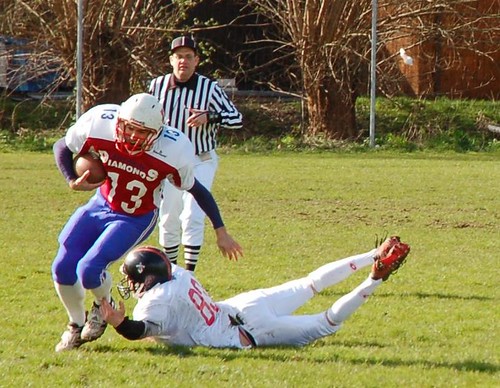
My brother has been playing American Football at the Antwerp Diamonds since about a year now, and he's playing along in the official competition's matches this season. Not that there's much of a season, with only 6 teams in all of Belgium, but okay. This sunday, they played against the Bornem Titans; and since he'd been asking me to come along to take some pictures of their match, and since I hadn't been all that productive on the camera front lately, I decided to come along. tak sidestepping a tackle They even won, although it was quite close: getting within 5yd of the goal line three times, only scoring once, and then even missing the conversion isn't exactly what they'd call a "perfect match", but it's good enough. Also more pictures in my gallery.

Andrew Pollock: [life/americania] Short-stay furnished apartments in New York

One for the note-to-self file. Years ago on Getaway, I remember seeing a story that mentioned New York had companies that offered short-term rentals of furnished apartments as potentially more economical alternative to hotel accommodation. After a bit of concerted searching with Google, I've come up with Abode as one such company.

Erich Schubert: Swing rules the world

Roger Cicero will be going for germany to the Eurovision song contest. With his song "Frauen regier'n die Welt" ("Women rule the world"), which he sings with the impression of being able to himself rule any woman. :-) His mix is very uncommon: it's swing, but with german lyrics, about love and life, flirting and with a well-dosed amount of macho in it, but not serious but always joking and cool. YouTube has some video clips with his music. Note that I don't think "Frauen regier'n die Welt" is his best song. Scroll down at least to "Murphys Gesetz" ("Murphys Law", and congrats for not incorrectly adding an apostrophe, it's correct this way...) Last.FM has some excerpts from songs I like better. I don't know if 'we' have any chance with him (last years' winner was Lordi, some 'schocker' hard-rock-heavy-metal band dressing up like halloween monsters), but he won't come out last for sure. Demographics of the Eurovision contest aren't too favourable for germany, nor are are European relations. But being a swing dancer, this is just really cool, because it gives my hobby a wider audience. :-) P.S. If you want to learn Swing dancing in Munich: the Lindy Hop course at Boogie-Bären starts again this tuesday, and I can also recommend the classes of Swing and the city (thats Cat and Chris); there is a beginners and intermediate workshop next weekend with world champions Markus & Bärbel together with Cat and Chris. And of course every monday there is a teaser class at Cord. P.P.S. I'd really love to see Roger Cicero perform together with some good Lindy dancers as show act. Probably a different song then, though.

Next.

Previous.