Search Results: "beh"

13 September 2010

Amaya Rodrigo: Of inner peace and struggle

[Nothing related to Debian here, move on if you don't care about my recurring obsession with the end of the world, Cassandra pains, or Big Phat Living Room Revolution yearnings].

Although I am still looking for a community of anarcho-primitivists that want to accept me joining their frugal living, and simply slip off the social construct, the system, the fucking face of earth, call it what you will, I could find some comfort in my favourite feminist blogger's take on the subject of my midlife crisis regarding ecology, capitalism, patriarchy, child bearing, overpopulation, meat consumption and all the rumination of consuming thoughts that (still) make my life miserable and have kept me running away from human contact for a year.

[Emphasis mine]

At what point does human culture depart from the Natural? With the invention of computers? TV? Cars? The cotton gin? Electricity? Taco stands? Gunpowder? The printing press? Written language? Shoes? Crop cultivation? Yurts? The wheel? Did humans become unnatural when the good old days of picturesque, endless agrarian toil, feudal oppression, unchecked disease, ignorance, and death from dysentery at 35 turned into the bad new days of urban post-industrial capitalism where a pound of fair-trade organic coffee costs $12.99 and your email inbox is full of spam?

ah. Everything humans do, or have ever done, is natural. We can t do anything else. The idea that modern culture is un-natural is nostalgic and inaccurate. Living off the grid in a yurt is good in some absolute sense, whereas driving an SUV from a suburban bungalow to the stripmall is bad ? Come on. This a romantic, but misguided view. The cosmic reaction to a 20 Ford Expedition is the same as to a sanctimonious Prius: bupkis. The universe doesn t give a fuck about you or your lifestyle choices. It doesn t give a fuck about the economy, oil spills, or civil unrest in Blargistan. It doesn t give a fuck about katydids. Eventually our whole planet will be erased from space, and the galaxy won t bat an eye. The inevitable extinction of our species (imminent, according to research here at Spinster Laboratories) via the exhaustion of available resources is as natural as a fresh-picked peach. As Andre 3000 and other dude philosophers have observed, nothing is forever.

Yes, yes, when people use the word natural what they really mean is free of chemical additives and maybe some of the assorted hippie concepts that go with that narrative. Barter economies, home furnishings made from bamboo, vegan cookbooks, living in the country. While I would argue that it is just as natural for people to put chemical additives in things as it is to not put chemical additives in things, I admit that it is appealing to fantasize that the source of human misery is an unnatural isolation from Nature, and that doing yoga on an organic rubber mat and drinking organic spinach smoothies will put me back in sync with the cosmos.

But alas, I m already in sync with the cosmos, and so are you. In other words, this is it. This is what we ve become, and this is what we get. Which is not to say that a person can t fantasize about a verdant paradise full of songbirds and polar bears and Bengal tigers, untouched by human influence. Only, that world isn t a world we could actually live in. The minute you add contented children, lazy from a carefree day at the swimming hole, eating ripe plums on the porch at sunset to that scenario, natural history changes, and it s right back to our scorched-earth dystopia. Our giant brains use up resources, it s as simple as that.

As long as we re still here, though, we might as well try to make the best of it.

http://blog.iblamethepatriarchy.com/2010/06/19/heads-up-art-week-starts-on-monday/


Though the comfort is somewhat ephemeral, because deep inside, I know she's wrong, I know another way is feasible, but I have given up already, I have very well come to terms with extiction, I get an enormous pleasure from the thought of the very well deserved human mass suicide-by-cop^Wnature, and in fact, I trust and hope it will save me personally from facing the hard times ahead, as I am a damn coward, paralized by fear, hopeless about the flock ever getting it (is it so hard, really?), while doing as much as I can but completely overwhelmed by the need of changing a world everyone seems to like just as it is. I can certainly empathize with much more disturbed ways of airing similar anguish, among many other examples, such as The Unabomber, or The Weather Underground. I don't even want to go there as I know violence all too well and it is not fun to be on the receiving end. But I see the screaming desperation behind the motives of acts I am not at the liberty to discuss here. I wonder if consumption of resources in the form of books will numb the disorder or make it worse and what sort of medical arrangement the stablishment has for it. As you click away the previous links will mean nothing to you because a)it is Wikipedia after all, and b)you probably don't even understand what the problem of eating animal corpses is, humans are omnivores after all, and what is all this nonsense about dropping language altogether.

WTF, there was no comfort after all, and I am still a nutjob.

12 September 2010

Lucas Nussbaum: Ruby packaging in Debian and Ubuntu: Mythbusting and FAQ

A lot is being said on how Ruby is packaged in Debian and Ubuntu. In this post, I m trying to go through the most common myths and give my position as a Debian Ruby maintainer. Note that those are my views, not necessarily those of the other Debian Ruby maintainers. Myth: Ruby is completely outdated in Debian and Ubuntu There s a culture in the Ruby community of always using the latest bleeding-edge version. There s also a culture (though this one has recessed a bit, I think) that it s perfectly fine to change APIs in incompatible ways if it makes the software slightly better. In Debian (and Ubuntu) stable releases, we try to provide a rock-solid version of Ruby that won t be allowed to change API during the support lifetime of a release. Bugfixes for important bugs can be applied, but that s basically all. So it s not surprising that Ruby in released versions of Debian and Ubuntu is behind the latest upstream version. In development branches, we are following the latest upstream versions quite closely. Debian 6.0 squeeze , to be released by the end of the year, includes Ruby 1.8.7-p302, and will include 1.9.2-p0 (the currently of Ruby 1.9.2 in squeeze is currenty a SVN snapshot from beginning of august). There are people interested in installing a packaged Ruby that just works, and other people interested in installing their own version of Ruby (through RVM and such). People in the Ruby community tend to forget about the first category, and consider that, because they install Ruby from source or with RVM, that should be the solution for everybody. We need the Ruby community to respect that different people have different ways of using Ruby, and to stop recommending that everyone using Debian and Ubuntu should install Ruby from source. We also need to leverage the backports services for both Debian and Ubuntu to provide a way to install the latest upstream version on stable releases. The only reason why we are not doing it yet is lack of time. Myth: Ruby is split into a myriad of packages in Debian In the past (pre-2005), a decision was made to split some libraries from the standard library into separate packages. This was motivated by: Most of the split was undone a very long time ago, and the readline and openssl splits were undone this year. The current package in Debian squeeze has: It is always possible to merge more packages, but merging any of the other packages would significantly increase the size of what you get by default, and might discourage people to use it in some contexts (disk space is not always cheap. Think embedded systems and smartphones). Myth: Rubygems is crippled in Debian There are two differences in the rubygems Debian packages. First, gems are installed in /var/lib/gems, not /usr/local/lib/gems. That is because rubygems are seen as state for the Rubygems package, not independant software installed separately. A change for this is currently being discussed, and should be done after the squeeze release. (I don t think that it s reasonable to push that change now). A consequence of installing to /var/lib/gems is that gems binary are outside of $PATH. After the change, gems binary would also be installed in /usr/local/bin. Second, gem update --sytem is disabled in the Debian package, because that would replace code from the Rubygems Debian package with code downloaded from the Internet, and can break your system in subtle ways. We have changed this (in SVN, not in any package in the archive yet) to allow gem update --system if a specific environment variable is set, which gives us the opportunity to display a warning message. Myth: Ruby is slow on Debian Ruby is built with the pthread threading code, because not using it breaks many native Ruby libraries (Ruby-gnome2, for example). And other Linux distributions are doing the same. There are some very old benchmark results floating around in some blogs that show that the pthread code has a performance impact of about 20%. There are been patches for that for a long time (applied in Ruby Enterprise Edition), but they were never properly sent back. Actually, all the discussions about this issue were rumors and blog posts, and there wasn t even a bug report about it! After the bug was reported properly, it was fixed in a timely manner. The fix is not yet included in the Ruby 1.8.7, but is being applied as a patch to the Debian package since 1.8.7.299-2. (So the Debian package is actually newer and faster than upstream Ruby in that regard). What makes Ruby so difficult to maintain in Debian? The main problems we have with Ruby are portability issues. The only officially supported platform for Ruby is IA32 (i386 in Debian), and everything else is best effort. It means that it is not even supported officially on x86_64/amd64! Debian supports a dozen of architectures, and the Ruby package has to work on each of them. Ruby 1.8 is mostly OK nowadays thanks to the help of Debian porters, but we still have serious problems with 1.9.2, since the test suite fails on sparc, hppa, ia64 and Debian GNU/kFreeBSD. Why doesn t Ruby use the alternatives system on Debian? The alternatives system provides a way to switch between different software providing the same functionality. Currently, if you want to use Ruby 1.9.2, you need to use the ruby1.9.1 executable (1.9.1 = ruby compatibility version here). The alternatives system would allow to switch ruby to ruby1.9.1 on a system-wide basis. However, the situation of applications and libraries working only with Ruby 1.8 should be clarified: those should use /usr/bin/ruby1.8 instead of /usr/bin/ruby. Another problem is that the way to specify packages dependencies still need to be determined. There s nothing impossible to do about that, it just needs someone to do the work. Where do we go from here? The Ruby developers (or expert users) community is generally very hostile towards Debian. Many harsh words and insults are used in discussions mentioning Debian in the ruby-core@ mailing list, and there are frequent recommendations to avoid the Debian packages and install from sources, which is quite demotivating (Actually, what prompted that blog post is someone calling Debian-specific changes unforgivable). This atmosphere makes it hard to recruit people, and the Debian Ruby teams are completely understaffed, which is clearly the major blocker to improving the situation further. We are 3 co-maintainers for the interpreter packages, and I m the only Debian Developer that is really active on a regular basis in the pkg-ruby-extras team (that does libraries and applications packaging). We desperately need help, but at the same time I have no time to improve our documentation and make it easier to join the team. While I haven t reached a final decision yet, I am also likely to stop doing Ruby work in Debian after squeeze is released, as I am getting increasingly tired and demotivated.

11 September 2010

Iustin Pop: New harddrive: WD6000HLHX

While SSDs are all the rage nowadays (and for good reason), I don't trust them yet for my important storage, as I'm not familiar with their failure behaviour. So when one of my hard-drives recently started misbehaving, I bought the new WD Raptor model. Since some people might be interested in how it performs in some synthetic tests under Linux, here are some fio results. Now, I admit that 10K RPM for desktop is a want versus need discussion, but nevertheless, these hard-drives are (for their capacity) quite affordable, compared to SSDs, and faster than a regular 7200 RPM drive. So:
# smartctl -i /dev/ 
 
Device Model:     WDC WD6000HLHX-01JJPV0
Serial Number:    WD-WXA1C20U0627
Firmware Version: 04.05G04
User Capacity:    600,127,266,816 bytes
The older hard-drive I'm comparing to is also a WD Raptor, the WD3000GLFS model (yes, I'm a sucker for shiny hardware). A few of the SMART capabilities seems to have changed (e.g. a new Phy Event Counter has been added, CRC errors within host-to-device FIS, and the SCT Status Version is now 3 instead of 2, the Temperature History Size is now 478 instead of 128), but nothing significantly different that I can see. First, the IOPS test: nothing changed here. To be honest, even the WD3000 model had pretty good performance. The fio job definition is:
[global]
filename=$ DRIVE 
iodepth=$ IODEPTH 
bs=$ BS 
ramp_time=10
runtime=120
[rate-iops]
rw=randread
ioscheduler=noop
ioengine=libaio
direct=1
I did tests for block sizes of 512 and 4096 bytes (but the results were so close that I only used the 512 bytes ones), and at queue depths of 1, 2, 4, 8, 16 and 24 (not 32 as AFAIK the SATA protocol only allows a max queue depth of 31, and I wanted to test only the drive's queue). So: IOPS graph As I said, nothing really changed, but starting at 130 IOPS and reaching more than 200 IOPS at queue depth 8 (which again, is not so much used at home) is nice. Next, the bandwidth tests. This uses the standard disk-zone-profile job shipped with fio:
[global]
bs=64k
direct=1
rw=read
ioengine=libaio
iodepth=2
zonesize=256m
zoneskip=2g
write_bw_log
[disk_zoning]
filename=$ DRIVE 
Here the changes are significant. Whereas the previous generation topped at around 110MB/s, the new model tops at over 140MB/s: Bandwidth graph I'm not sure what makes the old model vary so much at the start of the test (I repeated the measurement twice, and it looks the same), but in any case, there a few conclusions to be drawn: So, I can say I'm pretty happy. The 300GB model was a tiny bit too small for me, but the new size is great, and it seems the sequential read/write speed is also good. Let's see how long they will last though, HDD failures are (unwanted) friends of mine

10 September 2010

Gerfried Fuchs: Lenny: 900 RC bugs

It is a while since we managed to get below the 1000 stable RC mark. Last weekend we managed the next mark, that is we are below 900 now! Obviously my effort during the RCBC did take us a fair step in that direction, but I don't want to take full credit for it. The last bit that got us below the 900 happened through an event of last weekend: The current point release of lenny. Be aware that the BTS doesn't know about proposed-updates, so bugs closed through uploads to there only are seen when they hit the main pool which is the reason for point releases. It were something around 25 RC bugs that were closed by that. I haven't checked who exactly is to thank here, but looking at the non-DSA packages one finds some perl packages and at least two font packages. Thanks to the corresponding teams for their help! I plan to continue these efforts, so if you think it's a good idea you might want to flattr it. I think this quote sums up the motivation behind this pretty well:
<jwilk> Yay, only 900 bugs to fix and we can release lenny! Oh wait...

/debian permanent link Comments: 0 Flattr this

9 September 2010

Stefano Zacchiroli: yes we can

(... achieve Debian world domination without endorsing Facebook) Yes Raphael, we can.
Nobody said it would have been easy, to reach Total World Domination endorsing Free Software only, but that's not a reason to stop trying. I've recently stumbled upon a very nice article by Benjamin Mako Hill, titled Free Software Needs Free Tools, which I believe it's the best possible commentary to the proposal of having an official Debian Facebook page. Of course there is nothing wrong in having non-official, or let's call them "fan" pages, about Debian on Facebook. As a matter of fact we already have one, as you point out. And I also agree that it would be better to know who is behind that page. Individuals, including Debian Developers, are obviously free to use whatever media they please to spread the cause of Debian. After all, as individuals, each of us decide upon her own personal trade-offs (for instance, a trade-off of mine is to have both identi.ca and twitter accounts and to post only to the former with forwarding to the latter). There is no way to have an official Debian Facebook page and pretend that we are not, de facto, endorsing Facebook. That's why I believe having official Debian presence on Facebook, or on any other non Free Software platform, will just weaken our cause. It will send out the message that Free Software it's something which is good for others to use, but not necessarily for Debian as a project. That does not mean that we live under a rock and that we consider social networks useless to promote the Debian cause. It just mean that we should be picky in choosing social networks that respect our Free Software principles, as we are picky in choosing licenses that are DSFG-free. For instance, I'm glad to mention here that the Debian publicity team has recently obtained access to http://identi.ca/debian and will start using it soon. Subscribe! :-) PS This post also gives me a chance to comment on a so called "community page" of mine on Facebook. As I've briefly commented a few days ago I've nothing to do with that page. TTBOMK its content is just automatically injected from Wikipedia. The "Stefano Zacchiroli is on Facebook" claim on the upper left is true only in the sense that there are other people with my name on Facebook. IANAL, but such a claim (not the page in itself) will probably be considered an abusive advertisement in many countries around the world. update: re-word the identi.ca/debian paragraph, to better blend with surrounding text
update: mention "Debian" in heading

8 September 2010

Wouter Verhelst: goudengids.be

... or, 'yellow pages.be'. Or something. I like it that there is an on-line version of the Belgian yellow pages. Who wants to look up a phone number in a huge book, anyway? And that's ignoring the fact that it isn't any good for the environment. I also like it that the yellow pages are now no longer distributed by default on paper. You can still get them, if you so wish, but you have to explicitly request them. Of course, searching an on-line database is also faster than flipping through pages until you find what you're looking for. What's more, you can limit your search to your location rather than whatever shops just happen to be in the version of the book that is distributed to your house. That makes it much more efficient, since rather than all thousands of computer shops in the whole province, you'll find the computer shops in your municipality. Or the ones that are in a radius around your address, if you choose that option. Rather, that would be the case. But for some unfathomable1 reason, truvo, the company behind the yellow pages, decided to make the option that gets you the names and numbers of companies that serve your region, rather than companies that actually are in your region, as the default. And since there's really n o limit to what companies can enter as the 'region' they serve, you suddenly get a name for a shop hundreds of kilometers away when all you wanted was to find the closest grocery store. D'oh. 1 Yes, yes, I can guess that money has something to do with it. But whatever, that don't matter.

7 September 2010

John Goerzen: Labor Day with Jacob and Oliver

Yesterday started out with Jacob and me going to a men/boys breakfast organized by my great uncle and some others. He s in his 80s and this is probably his last year doing this. It was out in the woods by the Little Arkansas River. They cooked up bacon, sausage, and eggs and it was a fun time. Jacob enjoyed throwing sticks in the river and sitting on some logs. Terah, meanwhile, went to Wichita with Oliver. So it was just Jacob and me when we got home. Jacob spent two hours playing rivers with me. A few weeks ago, he and I set this up outside. I found an old length of pipe on our property (my dad thinks it used to carry water from a well) and some cement blocks. I set it up on the blocks so that one end is higher than the other, and the lower end empties out at the top of a small dirt pile. Then I brought a water hose over to it, turned on the water at a very slow speed, and put the hose in the pipe. The result is a small stream of water coming out at the dirt pile. After it runs just a little while, the dirt is soft enough that you can dig out little channels, or rivers , with your fingers or a stick. Jacob enjoyed this the first time he played, but yesterday he really enjoyed it. We had a fork in the river, and he informed me that he would sit on his bank and I would sit on mine. He also wanted to give river food to his river (the fork closest to him). River food was loose dirt that he d pick up and sprinkle over the water, and watch it get carried on down. I spotted some random bug in the area once, and that bug got food too. I think Jacob and the bug disagreed about whether this was particularly helpful. Jacob enjoyed playing other games with the pipe. I had showed him that we could send things through the pipe, so he would take out the hose, stuff some dirt in one end, and then make sure I was watching to see if it came out the other end. He sometimes made a fountain by setting the hose on top of the cement blocks and watching the water drip down from level to level. Then later in the day, I introduced him to Tuxpaint. This is a painting program aimed at children. I had told him I had a painting game to show him a few days ago, but because he made some bad behavior choices, he had lost access to my computer for a few days. Anyhow, we tried it yesterday and wow he loved it. There was constant laughter and excitement. I first showed him how to select colors for the paintbrush. He quickly figured out how to make lines, change colors, and change brushes. Tuxpaint has sound effects for just about everything, which he loved too. Then we explored the interface together and I showed him the stamps feature, which lets you paste pre-made pictures into a drawing. Tuxpaint comes with dozens of these, on kid-friendly themes such as animals, cars, fire trucks, signs, etc. This he loved even more. Terah and Oliver got home about this time, and Oliver and Jacob both sat on my lap for a time, both laughing loudly each time Jacob discovered something new to paste into his picture. Of course, then Oliver tried to eat my keyboard and smash my monitor, but there you go.

Biella Coleman: Ireland

This summer of 2010 has been memorable. It started with a difficult period following the hospitalization and death of my mother, a series of very intense and equally memorable conferences catapulting me out of my funk and ending with a trip to Ireland, perhaps one of my most pleasant trips ever. I have always wanted to go there, as I have some good Irish friends and I was also quite attracted to the place due to its history, so when the opportunity came for me to go, I did not hesitate to book my ticket. I was not left disappointed in any way, shape or form, although since I barely experienced the gray, misty, and rainy weather Irish is famous for, my experience may admittedly be a bit skewed. These are some of things I did and some of my fragmented thoughts about Ireland and some photos, proof that the weather was UnIrish Ireland and The Irish: Well I can t as no one can speak of The Irish as if they were some unitary group but I did learn a lot about Irish history and managed hang out with a number Irish folks (even a family) and one thing that seems to mark Ireland as distinct, what makes it stand out from the rest of its Western European brothers and sisters, is the pervasive sense of history bleeding into the ambiance, perhaps because it is so tragic. The short version of the history, if you don t know it, is that the Irish, especially the Catholics, got repeatedly screwed by the British monarchs/rulers/planters/government/ for nearly a thousand years, the last five hundred of those being particularly harsh and ugly, a cycle of slight gains crushed by various forms of tyranny and violence at least until part of the country achieved independence (Northern Ireland is a bit of a different story). I may have gone a bit out of my way to learn about Irish history, more than I have done for any other place, but this historical consciousness seemed to be inescapable, precipitating into all sorts of conversations and places. To take one example, I went to see Gaelic Football, one of the two beloved national sports (the other being hurling), and the minute you learn anything about this sport, you learn that it is intimately bound with the Irish fight for independence and nationalism. The Irish are also very warm, kind, and outgoing. They also seem to curse an awful lot as well, so much so cursing is a bit of a national pastime, which yes, I (f*cking) loved as I tend to have a bit of a foul mouth myself, curbed I will admit, in recent years and in the classroom. It crept up in a lot of places but was most pronounced during the All Ireland Semi-Final Gaelic football game when the ladies (not lads, mind you) behind me were constantly yelling at the referee, hurling the c-word (rhymes with trunk) whenever they made a call they disagreed with. EASA/Maynooth.: I went to Ireland to attend the largest Anthropological meetings in Europe, and in specific an all day panel on digital anthropology, which seemed like a great opportunity given we are a a bit of a minority. The conference was impressively large with roughly 1200 attendees (can you believe there are that many anthropologists?), smoothly run, and the all-day panel on digital media was quite lively and I got to meet some really interesting folks. I was a tad sad to find out Maynooth is the only university in Ireland with an Anthropology department (for crying shame lads!!!) but at least it is located in a darn stunning university: the old quarters of the campus are strikingly beautiful. Anonymous: I have done some work on Anonymous and well when I found out there was going to be a raid/protest at the Church of Scientology (a pretty dismal, and run down church), I got in contact with Irish anon to let them know I was coming. Although someone first decapitated me (at least in character with their norms, right?), when I showed up in person, they were not only civil but really quite hospitable (greeting me with one of my favorite songs). Overall it was a great day. I was reminded of important differences among Anons (Irish Anon s take their anonymity pretty seriously, the New York Anons do not) and also good to experience the social life and metabolism of a protest, especially one attended by folks who have lost family to the church. Dublin: Since I stayed with my friend and his family in Dublin, this is where I spent most of my time. I was able to hook up with various friends, including one from graduate school who just got back from years of fieldwork in Rwanda and hearing about his experiences and stunning but stunningly sad project made me feel like mine in comparison was Child s Play (in fact, it really was). I got to see the Debian crew (many who work at Google) and I finally paid a visit to the office, which was exactly how I imagined it to be (good and abundant food, good lighting, lots of toys and bikes, lots of Star Wars posters.. Yep, it could have been in Silicon Valley). But I was surprised at the young age of the marketing and sales folks who were hanging in their lounge when I ran into them. In fact when I saw them I thought like I was looking at my freshman class or something! It was great to see the Debian folks (though no one I met was actually Irish), as well, one of my favorite things to do whenever I visit a foreign city. I walked my heart out in the city getting a blister in a shoe that I thought was blister proof and while not as picturesque as some other European cities, it has a ton of character and no shortage of Guinness and pubs (no surprise there). My favorite places/things were: The National Library (great exhibit on Yeats, but make sure to use the multi-media as that is where all the information is stuffed), St. Stephen s Park (overflowing with chubby ducks and lovely flowers), the prison Kilmainham Gaol (would not advise a visit if you are feeling in any way down, there is some heavy shit you learn during the tour), the simple stained glass that seemed pretty common, and finally the Long Room in Trinity Church, which you enter after the Book of Kells (I realized just how much I adore books when I visited this old library stuffed from floor to ceiling with old old old books). The West Coast: I did not think I was going to head out west but after hurricane Earl started its burst along the eastern Seaboard and I was able to change my ticket for free so I stayed a few more days. I went to the Burren and the Cliffs of Moher both totally stunning, really majestic. As is often the case with these type of these natural wonders, I am often left elated and awed but such strikingly wondrous places also seem to subsequently spur a more melancholic state of mind and heart. Friends, Family, and Dogs: While in Dublin I stayed with my friend A. and his extremely hospitable family, which included, a brother, a father, and three Irish mutts, one of which, Buster (pitt bull/lab mix), pretty much stole my heart. Buster s true love, is food, so much so he almost poised himself to death a little while back snorting down something he shouldn t have costing the family a pretty penny to save him. My friend no longer lives there but came from Berlin and it was a real treat to not only spend days layered upon each other with a friend (it has been an awful long since I have done that outside of conferences) but also meet his family. You learn a lot about your friends that way and in this case, there is some serious and I mean serious intellectual jousting that happens, sometimes bordering on warfare but generally it plays out in more contained, civil and fascinating fashion. Now I understand why my friend is armed with seemingly endless knowledge: it was needed for purposes of defense at home. So in essence, a great, great trip and a fantastic way to end a memorable summer and transition into what I hope will be a bit of a monkish (I call it monk mode) period for this academic year. I am (so so so) fortunate enough to have a fellowship at the Institute for Advanced Study and am going to try my darnest to take advantage of the fact I am not teaching (Hell Yes!) and hide away and accomplish all that I have set out to do.

2 September 2010

MJ Ray: KohaCon10

Russel Garlick writes on behalf of the KohaCon10 Organising Committee:
KohaCon10 starts on October 25th in Wellington, New Zealand. We have an exciting line up of speakers on a range of topics related to Koha and [Free and] Open Source and Open Standards in libraries. See our programme for details. KohaCon is an opportunity for the entire Koha community, librarians and developers alike, to come together, meet each other, swap ideas and learn something new. The conference is split into 2 parts. The community conference will be held over 3 days 25-27th of October. This is not just a developer s conference. There will be presentations from librarians and developers alike. The second part of the conference is the Hackfest for Koha developers that will be held from 29th-31st of October. For more information see our website KohaCon10 is a free conference (that is right it will cost nothing for you to attend), but you still need to register to reserve your place. Registrations from the international Koha community have been very strong. Over half of all available spaces are already taken. If you have been holding off on the premise that you will have plenty of time to do this later, then please register now. Please do not rely on there being free spaces on the day. Registration is quick and easy via the website. We look forward to seeing you in Wellington!
Our co-op will be represented there. Will you?

31 August 2010

Jordi Mallach: De mar a mar, hiking across the Pyrenees

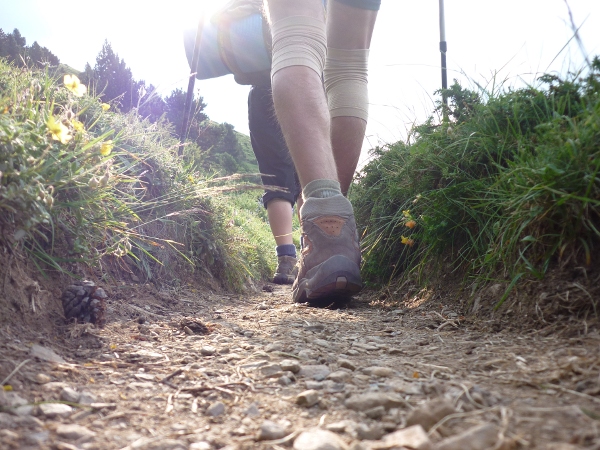
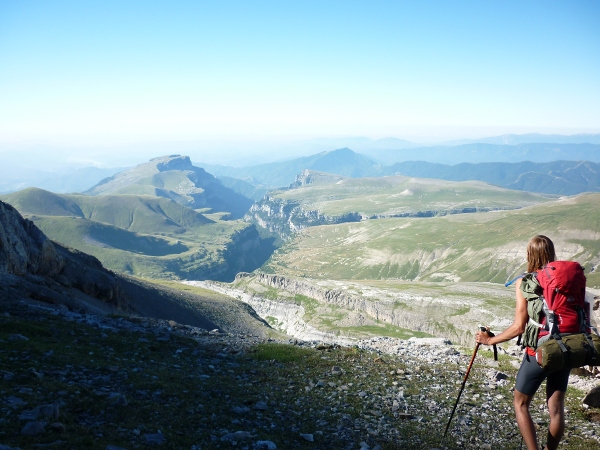
Two weeks ago, Maria and I completed one of our dreams when we arrived in Cap de Creus, where the Pyrenean range sinks in the Mediterranean. To get there, we walked hundreds of kilometres during a month, crossed dozens of steep valleys and enjoyed one of the richest experiences of our lives.

We managed to complete this challenge without facing major problems or pains, and after the first five our six days, our legs seemed to have gotten used to the daily effort and it started to be easier and easier. Our morale kept growing as days passed and we advanced east. When I started walking on a cold and rainy morning in Hondarribia, after barely no rest in the night bus to Ir n, I thought for myself that it was improbable that we'd manage to get anywhere near Catalunya, that one of us would get injuried way before, or we'd just give up and go for the easy beach vacation in the Basque Country.
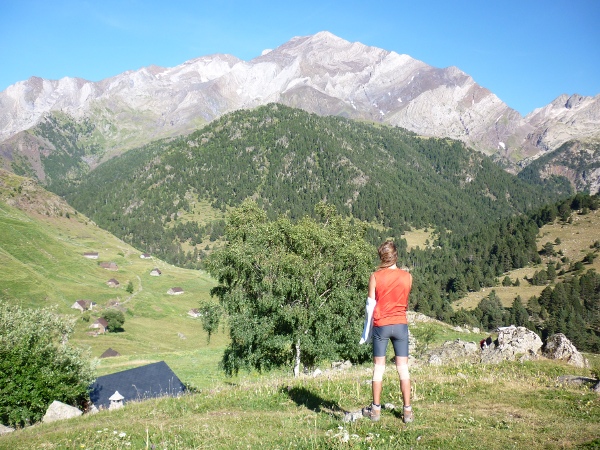

Biad s refuge, under Posets But we didn't, and after a somewhat painful start, with our boots soaking wet during the stages that crossed the enchanting Selva de Irati which ended up with me getting the biggest blister I've ever seen, we started to walk farther every day, extending the stages when we felt strong after reaching their official end. When we crossed from Nafarroa to Aragonese territory, the mental wall that I had built over the toughest stages in our quest started to fall apart. Days later, we found ourselves climbing down to Pineta, leaving Ordesa behind and enjoying a feeling that our adventure could not go better. The weather had been perfect for over a week and our legs and back were strong to go all over the way to the sea.


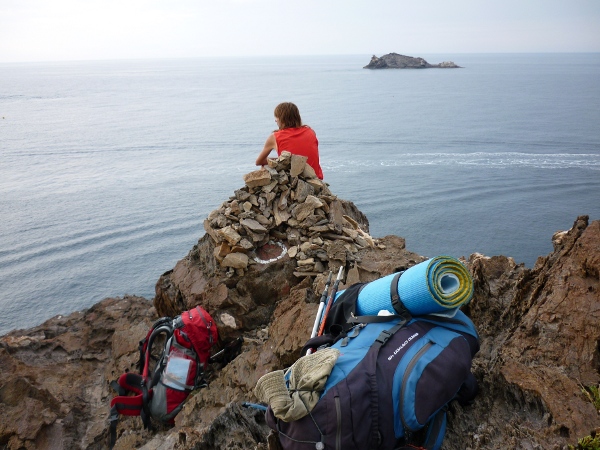
Ca n de A isclo, on our way to Pineta When we finally saw that huge blue stain on the horizon, the day before getting to the last mark, we got really excited. We had made it, but as we walked towards the cape, happiness slowly got mixed with melancholy. An unforgettable adventure was about to end, and we didn't want to face our return to the city and our routines. It had been many days surrounded only by awesome landscapes, and living without watches, with only sunlight and weariness marking the time to get in our sleeping bags.


At the very last red and white mark of our journey We've had plenty of time to meet great people. Starting with the Navarrian brothers we met in the early stage, which provided us with a good pace to follow while our leg muscles were still building up; or Kike and Ana, who drove from Pamplona to visit us during the first Aragonese stages (thanks for the supplies!). Tom s and Roger, young hikers from Matar , surprised us with their maturity and experience as mountaineers; we had the pleasure to join forces during four days, walking a really cool variant through the Infiernos and Collado del Letrero which avoided going through the ghost city of Panticosa. Roger and Tom s, we really hope to meet you soon! Andreu, Manel, Ghandi and Ga la visited us at the Vall de N ria and were unlucky to suffer a frightening hail and thunder storm when they left our shelter on their way back to their car. Thanks! All of you have been a very special part of our experience!

This adventure through GR 11 has been incredibly positive for us for several reasons. We've learned a lot about ourselves and strengthened our relation, and now I know how powerful drive can be; to get somewhere, no matter how far, it's really easy if you just believe you can do it and desire to get there. Maria and I are proud of what we've done, and no wonder we're looking for new challenges. An obvious one would be repeating this experience, going through the French side of the Pyrenees, but for now, the Corsican GR 20 seems the most appealing. We'll see, next summer!

Iustin Pop: Spooky harddrive

For a couple of weeks, one of the harddrives in my server has started to behave strangely. The RAID controller has started first reporting some drive timeouts (daily, when the drive runs a short or long smart test), and now it even kicks it out of the (RAID1) array. And yet, during normal operation, there's no read error or write error that I can trigger, and there are no reallocated sectors (according to smart). The only time when I can reproduce the error is: What happens when both these conditions are met? The the SMART query is taking ages (as in ~20-30 seconds). This might cause some such high delays that the drive itself will report a timeout error (if any I/O takes place at the same time), and log an error in its internal error log. Another harddrive (identical brand): ~3s for SMART query during selftest and I/O load, no issues whatsoever. For this harddrive, smartctl -a reads a while, and then:
Error SMART Error Self-Test Log Read failed: Input/output error
Smartctl: SMART Self Test Log Read Failed
 
real    0m39.029s
The timeout above also has generated lots of errors in the drive's error log. I don't know how to read these properly, but in any case they don't seem too scary:
Error 144 occurred at disk power-on lifetime: 13552 hours (564 days + 16 hours)
  When the command that caused the error occurred, the device was doing SMART Offline or Self-test.
  After command completion occurred, registers were:
  ER ST SC SN CL CH DH
  -- -- -- -- -- -- --
  10 51 00 80 ae 39 40
  Commands leading to the command that caused the error were:
  CR FR SC SN CL CH DH DC   Powered_Up_Time  Command/Feature_Name
  -- -- -- -- -- -- -- --  ----------------  --------------------
  61 80 70 80 ae 39 1c 08  41d+08:07:45.052  WRITE FPDMA QUEUED
  b0 d0 01 00 4f c2 00 08  41d+08:07:45.038  SMART READ DATA
  ec 00 01 00 00 00 00 08  41d+08:07:44.958  IDENTIFY DEVICE
  2f 00 01 10 00 00 00 08  41d+08:07:44.957  READ LOG EXT
  61 80 70 80 ae 39 1c 08  41d+08:07:37.960  WRITE FPDMA QUEUED
For some of the errors, all preceding commands are WRITE FPDMA QUEUED, but all are during a "SMART Offline or Self-test" phase. When a self-test is not being done, reading all the SMART data (smartctl -a) is very very quick, taking half a second. The only thing I can think of is that the drive's own area for storing SMART data is unhealthy, and reading it takes time, and a concurrent SMART test and I/O load makes it hard for the drive to do so. But again, I can't trigger any real I/O error, nor at the beginning of the drive neither at the end, so This also happens when the drives is connected to a plain SATA port, skipping the RAID controller, so it's not just the controller playing games on me. I'm really confused now. Given my previous experience, this drive will die, should already have died, and yet, no I/O errors, just some timeouts. Do I just need to wait a couple more weeks?

30 August 2010

Russell Coker: Interesting Developments in Islamic Culture

Shereen El Feki gave an inspiring TED talk about Islamic youth culture [1]. She shows some interesting exerpts from the 4SHBAB TV network which is known as Islamic MTV , the music video from the US was of particularly high quality while I expect high quality videos to be made in the US I don t generally expect quality Islamic videos from the US (or anywhere else really). She also notes that the videos show a kinder gentler face of Islam . She contrasts that with a clip by Haifa Wehbe [2] a Lebanese pop star who appears to have a lot in common with Britney Spears (Shereen describes her as a pan-Arab pinup-girl ). She cites the comic The 99 which has Islamic super-heros who represent the 99 attributes of Allah. One thing that I found very interesting was that the 99 character Jemi is shown using what is obviously an OLPC. This seems to indicate some very positive trends for the interaction of Islamic culture with the European and American culture which is Christian and Atheist dominated. Kavita Ramdas gave an interesting TED talk about radical women embracing tradition [3]. She highlights a woman who teaches girls to read in Afghanistan based on the religious edict that every Muslim should read the Koran and a Croatian Lesbian choir that sings traditional folk songs. Naif al-Mutawa gave an interesting TED talk about the creation of The 99 [4]. He starts by comparing some of the characters in the Justice League of America to Christian traditions and then describes the back story behind his Islamic super-heroes. His major aim is to provide positive role models for Muslim children. Apparently a cross-over production involving characters from The 99 and the Justice League of America is being developed at the moment Wonder Woman wears clothing that is less revealing than usual though. It s worth noting that Naif is a practicing psychologist who s clients include victims of political torture, so he seems to have some insight into the problems that most people will never have.

26 August 2010

Sylvain Le Gall: CentOS 5 chroot with schroot

OCaml compiles native executables in static mode. It allows to have a minimal set of dependencies when delivering an executable. It has also disadvantages like the size of the executable and problems arising when considering libraries update -- but this is another topic. There is still one strong dependency that you should not forget when you want to deliver a product for most of the Linux distributions: dependency on the glibc version. Trying to run OASIS compiled with Debian Lenny, on CentOS 5.5:
$ OASIS
.../OASIS: /lib64/libc.so.6: version  GLIBC_2.7' not found (required by .../OASIS)
So when compiling for delivery, one should choose the oldest distribution he targets. In my case, I choose CentOS 5 which comes with glibc v2.5. I usually choose Debian stable at the moment of writing Debian Lenny. But for now, the Debian Lenny's glibc is newer (v2.7) than the one coming from the CentOS 5.5 stable release. CentOS is a Red Hat like Linux distribution. I use a Debian Lenny amd64 host system and I decided to setup a chroot of CentOS 5 i386 and amd64. I also setup schroot to use my CentOS chroot. CentOS 5 amd64 setup First of all we use rinse, which can setup a RPM based distribution in a chroot. The version v1.3 shipped with Debian Lenny has some bugs: it doesn't install nss and other mandatory packages. So I downloaded v1.7 directly from Debian Sid. There is no dependencies problems and the package is arch:all, so it is straightforward to install:
$ wget http://ftp.de.debian.org/debian/pool/main/r/rinse/rinse_1.7-1_all.deb # Replace ftp.de.debian.org by your preferred Debian mirror
$ dpkg -i rinse_1.7-1_all.deb
Then I create the chroot directory and launch rinse:
$ mkdir /srv/chroot/centos5-amd64
$ rinse --arch amd64 --distribution centos-5 --directory /srv/chroot/centos5-amd64 # N.B. you must use --arch, the default is i386
Once installation is complete, you can add an entry for this distribution in /etc/schroot/schroot.conf:
[centos5-amd64]
description=Centos 5 (amd64)
location=/srv/chroot/centos5-amd64
priority=3
users=XXX
groups=
root-groups=root
type=directory
run-setup-scripts=true
run-exec-scripts=true
Replace XXX by your login. If you try to login directly, you will get warnings:
$ schroot -c centos5-i386
I : [chroot centos5-i386-a952de23-7f4b-4bae-a9b9-752ecee4a185] Ex cution de l'interpr teur de commandes initial :  /bin/bash 
-bash: /dev/null: Permission denied
This is a bit misleading because the real problem is that nothing is created in /dev/. CentOS delegates creating char/block devices to udev. You have two solutions to solve this issue:
$ MAKEDEV random
$ MAKEDEV console
$ MAKEDEV zero
$ MAKEDEV null
$ MAKEDEV stdout
$ MAKEDEV stdin
$ MAKEDEV stderr
$ rsync -av /srv/chroot/lenny-amd64/dev/* /srv/chroot/centos5-amd64/dev/
That's it, you now have a functional chrooted CentOS 5 environment:
$ schroot -c centos5-amd64 cat /etc/redhat-release
I : [chroot centos5-amd64-b9bae264-285b-4d17-a046-13386736cecd] Ex cution de la commande :   cat /etc/redhat-release  
CentOS release 5.5 (Final)
CentOS 5 i386 setup To setup an i386 environment, we follow almost the same scheme, except we need to fix a bug in rinse v1.7: we need to call linux32 before executing chroot. The problem is that the first stage installation of rinse install an i386/686 environment but as soon as you call chroot yum install ..., it will guess that the system is amd64 and will install missing packages. See the Debian bug report and the example patch attached to correct this behavior. WARNING: this patch is just an example, you can apply it for creating CentOS i386 chroot on Lenny amd64 host but you should remove the patch as soon as the installation is complete.
$ mkdir /srv/chroot/centos5-i386/
$ rinse --arch i386 --distribution centos-5 --directory /srv/chroot/centos5-i386 # With /usr/lib/rinse/centos-5/post-install.sh patched 
$ rsync -av /srv/chroot/lenny-i386/dev/* /srv/chroot/centos5-i386/dev/
Add this distribution to /etc/schroot/schroot.conf:
[centos5-i386]
description=Centos 5 (i386)
location=/srv/chroot/centos5-i386
priority=3
users=XXX
groups=
root-groups=root
type=directory
run-setup-scripts=true
run-exec-scripts=true
personality=linux32
You now have a schroot of CentOS 5 i386:
$ schroot -c centos5-i386 cat /etc/redhat-release
I : [chroot centos5-i386-9acafa91-9862-4488-aaef-4ab2a482771e] Ex cution de la commande :  cat /etc/redhat-release 
CentOS release 5.5 (Final)
Happy schroot hacking!

Dirk Eddelbuettel: Louis: A Silent Film with Live Music

The Chicago Symphony hosted the world premiere of Louis last evening, and I had snatched the (literally) last available ticket. The film, which is written, directed and producted by Dan Pritzker, is based loosely on the early years of Louis Armstrong in New Orleans. The movie is shot beautifully by Vilmos Zsigmond in blend of colour and black-and-white which works very well for invoking the early days of film. A key part of the production is of course the score, and the live music with both a thirteen-piece orchestra featuring Wynton Marsalis as well as piano solo recitals by Cecile Licad with an emphasis on pieces by 19th-century composer Louis Moreau Gottschalk. The combination of a silent movie with a stong live band is something to behold -- if you can catch the movie and performance in a city nearby, go!

25 August 2010

Marco Silva: Change of blog server

I'm now using ikiwiki with darcs in my own server and saying goodbye to wordpress.com. I tried to install wordpress before trying ikiwiki, but it was just eating all the memory of the server. And after using ikiwiki, I thanked wordpress for misbehaving, because ikiwiki is so much better. It's everything I wanted, but I didn't knew I wanted until I tried it. Just like sup. My homepage, which used to be my page on the Debian wiki is not being hosted here too, and it's great to have it so nicely integrated with the blog. I also thought about trying gitit, since it's written in Haskell, but it doesn't seem to support blog easily. And now I'm so happy with ikiwiki that I doubt I'll change.

Gregor Herrmann: derivatives as users?

there was a recurring catchphrase during DebConf10, worded something like "Debian derivatives are also our users", that appeared quite often in talks as well as in hallway chats.

I kept pondering about this idea, & I'm still not sure what to think about it, & what the "message behind the message" actually is: is it an intelligent new point of view, some new way of thinking, seeing an increase in our user base & therefore in our possibilities&responsibilities? or, on the contrary, is it an admission of "defeat", accepting in resignation that end users prefer other distros, & Debian can only cling to the idea of "derivatives as users" in order to maintain its raison d' tre?

in the beginning I liked the idea ("oh, I haven't looked at it that way yet"); over time I tended to hear the defending undertone stronger ("if nothing else we are at least useful as a base for other distros").

the phrase might have both aspects; & I'm still not sure neither how it was actually meant neither if I like it ...

Matt Zimmerman: DebConf 10: Last day and retrospective

DebConf continued until Saturday, but Friday the 6th was my last day as I left New York that evening. I m a bit late in getting this summary written up. Making Debian Rule, Again (Margarita Manterola) Marga took a bold look at the challenges facing Debian today. She says that Debian is perceived to be less innovative, out of date, difficult to use, and shrinking as a community. She called out Ubuntu as the elephant in the room , which is taking away from Debian. She insists that she is not opposed to Ubuntu, but that nonetheless Ubuntu is to some extent displacing Debian as a focal point for newcomers (both users and contributors). Marga points out that Debian s work is still meaningful, because many users still prefer Debian, and it is perceived to be of higher quality, as well as being the essential basis for derivatives like Ubuntu. She conducted a survey (about 40 respondents) to ask what Debian s problems are, and grouped them into categories like motivation and communication (tied for the #1 spot), visibility (#3, meaning public awareness and perception of Debian) and so on. She went on to make some suggestions about how to address these problems. On the topic of communication, she proposed changing Debian culture by: This stimulated a lot of discussion, and most of the remaining time was taken up by comments from the audience. The video has been published, and offers a lot of insight into how Debian developers perceive each other and the project. She also made suggestions for the problems of visibility and motivation. These are crucial issues for Debian devotees to be considering, and I applaud Marga for her fortitude in drawing attention to them. This session was one of the highlights of this DebConf, and catalyzed a lot of discussion of vital issues in Debian. Following her talk, there was a further discussion in the hallway which included many of the people who commented during the session, mostly about how to deal with problematic behavior in Debian. Although I agreed with much of what was said, I found it a bit painful to watch, because (ironically) this discussion displayed several of the characteristic people problems that Debian seems to have: These same patterns are easily observed on Debian mailing lists for the past 10+ years. I exhibited them myself when I was active on these lists. This kind of cultural norm, once established, is difficult to intentionally change. It requires a fairly radical approach, which will inevitably mean coping with loss. In the case of a community, this can mean losing volunteer contributors cannot let go of this norm, and that is an emotionally difficult experience. However, it is nonetheless necessary to move forward, and I think that Debian as a community is capable of moving beyond it. Juxtaposition Given my history with both Debian and Ubuntu, I couldn t help but take a comparative view of some of this. These problems are not new to Debian, and indeed they inspired many of the key decisions we made when founding the Ubuntu project in 2004. We particularly wanted to foster a culture which was supportive, encouraging and welcoming to potential contributors, something Debian has struggled with. Ubuntu has been, quite deliberately, an experiment in finding solutions to problems such as these. We ve learned a lot from this experiment, and I ve always hoped that this would help to find solutions for Debian as well. Unfortunately, I don t think Debian has benefited from these Ubuntu experiments as much as we might have hoped. A common example of this is the Ubuntu Code of Conduct. The idea of a project code of conduct predates Ubuntu, of course, but we did help to popularize it within the free software community, and this is now a common (and successful) practice used by many free software projects. The idea of behavioral standards for Debian has been raised in various forms for years now, but never seems to get traction. Hearing people talk about it at DebConf, it sometimes seemed almost as if the idea was dismissed out of hand because it was too closely associated with Ubuntu. I learned from Marga s talk that Enrico Zini drafted a set of Debian Community Guidelines over four years ago in 2006. It is perhaps a bit longand structured, but is basically excellent. Enrico has done a great job of compiling best practices for participating in an open community project. However, his document seems to be purely informational, without any official standing in the Debian project, and Debian community leaders have hesitated to make it something more. Perhaps Ubuntu leaders (myself included) could have done more to nurture these ideas in Debian. At least in my experience, though, I found that my affiliation with Ubuntu almost immediately labeled me an outsider in Debian, even when I was still active as a developer, and this made it very difficult to make such proposals. Perhaps this is because Debian is proud of its independence, and does not want to be unduly influenced by external forces. Perhaps the initial growing pains of the Debian/Ubuntu relationship got in the way. Nonetheless, I think that Debian could be stronger by learning from Ubuntu, just as Ubuntu has learned so much from Debian. Closing thoughts I enjoyed this DebConf very much. This was the first DebConf to be hosted in the US, and there were many familiar faces that I hadn t seen in some time. Columbia University offered an excellent location, and the presentation content was thought-provoking. There seemed to be a positive attitude toward Ubuntu, which was very good to see. Although there is always more work to do, it feels like we re making progress in improving cooperation between Debian and Ubuntu. I was a bit sad to leave, but was fortunate enough to meet up with Debian folk during my subsequent stay in the Boston area as well. It felt good to reconnect with this circle of friends again, and I hope to see you again soon. Looking forward to next year s DebConf in Bosnia

Christian Perrier: [life nolife] Debconf 10 was...

...awesome. OK, I'm writing this while I'm still in USA, but there are so many things to say about these weeks that I can't write them in only one blog post. And, still, this one will be quite long as it will talk about hacking, running and sightseeing...:) Let's start about hacking: after all, this is the first reason for being there in US, isn't it? I cam to DebConf with a very long TODO list and, for the first time in seven DebConfs, I'm pretty happy with what I achieved from it: As one can see, a lot of planned work happened while I still could maintain the usual flow of recurrent work with localization (Smith reviews, l10n NMUs). Some asked me why I didn't propose l10n sessions this year. Indeed, I wasn't feeling I could sustain animating them and I had no clear idea about which topic I could bring to be discussed. Last year, these sessions slightly killed my free time and I wanted to keep some this year for "impromptu" things. I didn't attend many talks, sorry for the speakers. The most I attended were during Debian Day, which I found highlyinteresting and motivating, just like Eben Moglen's talk. Marga's talk was also one I wanted to attend, though I regreted that things went mostly out of control during the talk (too many comments from the audience to allow Marga pushing her important points). As usual, I invested a big part of my time in "social" activities, the most proeminent being of course the Cheese and Wine party, which turned ut to be a great success. The help of my son Jean-Baptiste and the tremendous support of Michelle Lynn Hall helped a lot, though I still regret that we screwed about accessibility. I also ran a lot..:-)..that may be counted as social activities as I organized several group runs. The one I'm proud of has been participating to a local race, namely the Van Cortland Track Club Summer Series of cross-country running, in Bronx. We went there with no less than 10 DebConf participants and 1 kilt (hey, Luca!). All of us completed the race (that had 170 runners for 5 kilometers) and No l K the even finished 17th scratch and 2nd in his age/gender category. Besides that, we had a great run/sightseeing to Georges Washington Bridge (that links New Jersey and Harlem and offers an unusual view of Manhattan "from behind"). All this with a 17km run. We also ran several times in Central Park, and No l and me happened to go to Coney Island for the Day Trip by doing half of the trip by running (all around Manhattan and over the Broolyn Bridge), for about 20km. Then we "showered" in the Atlantic Ocean....:). At the end of DebConf, I think that I had my record broken with 112km run in 10 days and only one day *without* running. What about sightseeing? Well, this blog post is too long and we reach the end of Interstate-90, close to Albany, so that will be for an upcoming blog post. Aug 25th update: back home, so now I can publish this blog post...

24 August 2010

Lucas Nussbaum: RVM: seriously?

There s some hype in the Ruby community about RVM (Ruby Version Manager). It s a tool that allows to switch between Ruby versions on the same system (much like what the alternatives system provides for Java on Debian, except that RVM does it either system-wide or per-user). However, when you look at it, RVM looks quite scary. The recommended installation instruction is:
bash < <( curl http://rvm.beginrescueend.com/releases/rvm-install-head ).
That script doesn t use set -e, and actually does a git clone behind the scenes. Without first checking that git is installed. But if you don t have git installed, it s not a problem: there s another script later on the page that downloads and compiles it for you. After installing RVM itself, you need to install rubies (different ruby implementations). Use rvm install ree,1.9.2-head,jruby. That will automatically download and build the various versions in your homedir. It s interesting to note the the compilation messages were probably too scary, and are not displayed. But how does it handle the switch between different versions ? First, you need to add some magic to your .bashrc:
[[ -s "$HOME/.rvm/scripts/rvm" ]] && . "$HOME/.rvm/scripts/rvm"
or, for a system-wide install of rvm:
[[ -s "/usr/local/rvm/scripts/rvm" ]] && . "/usr/local/rvm/scripts/rvm"
And then, you can select your ruby implementation using rvm --default 1.9.2, for example. That works by redefining $PATH:
# echo $PATH
/usr/local/rvm/gems/ruby-1.9.2-p0/bin:/usr/local/rvm/gems/ruby-1.9.2-p0@global/bin:/usr/local/rvm/rubies/ruby-1.9.2-p0/bin:/usr/local/bin:/usr/local/bin:/usr/local/sbin:/usr/sbin:/usr/bin:/sbin:/bin:/usr/bin/X11
Of course, that s quite fragile: if you are in one of the cases where bash doesn t read .bashrc, or if you happen to be using dash, you lose. Looking at the code of RVM itself, it is also very fragile: it s pure bash, without any error handling. During my test (in a chroot), I often got error messages about missing commands that were apparently ignored. The installer insists on using colors, and spews lots of error messages if executed without a controlling tty. There are also some interesting code snippets like perl -e 'sleep 0.5'. So, where do we go from here? Well, obviously, with my Debian hat, I m not going to advocate a solution that makes everything possible to avoid the distribution s packaging system, and I don t see RVM being packaged in Debian anytime soon.
In Debian, we already provide co-installability of Ruby 1.8 and 1.9.2, and users are free to choose which one to use on a per-script basis, by running them with version-suffixed ruby executables. The ruby executable itself still points to 1.8, as it s clearly too early to make 1.9.2 the default. Many Ruby libraries are provided for both 1.8 and 1.9.2, and we plan to discuss changes in the packaging system to be able to make it easier to provide packages for both versions. There s also recent work on packaging JRuby, but it s quite hard as it requires removing all the non-free or undistributable parts, and packaging them separately.

Thorsten Glaser: FrOSCon 2010 and today s resum e

FrOSCon was a blast. I had two booths of my own MirBSD and FreeWRT as well as shares of Debian and Grml. Well, MirBSD was run by Benny and gecko2 because I just didn t have any time for it, despite XTaran s help with the FreeWRT booth. All I did was the initial setup of both booths, while at the same time answering about three questions regarding FreeWRT in parallel. Wow. What a little small, open hardware can do to you. XTaran and I had fun and we ll do FreeWRT booths again; I managed to flash my two FON2100 devices ( La Fonera the FON2200 can use the same image, says nbd of OpenWrt) and will fix the port s remaining few bugs I found; XTaran will try to push the WL-500gPv2 development. The social part was nice as well, although I think the greek restaurant in the city will not be visited by me again. Anyway, if you didn t attend FrOSCon, your own fault Since the BitTorrent tracker used by MirOS is down, here s the link to the [updated 2010-08-28] current (FrOSCon 2010 Edition) snapshot s torrent, Triforce as usual. We ll probably rewrite torrent files for all our ISOs and publish them on the MirBSD website. I m currently considering OpenBitTorrent plus one or two DHT seed nodes with no statistics. Maybe with webseed. (Need to update the libtorrent/rtorrent MirPorts first, though ) Other options would be different trackers or running one of our own. I will announce the outcome as news entry, once done. On the plus side, the review process of mksh(1) in Android continues, and I fixed the realpath builtin to behave even more POSIX-ish.

Next.

Previous.