Search Results: "bab"

16 January 2014

Daniel Pocock: Get ready to try Debian SIP

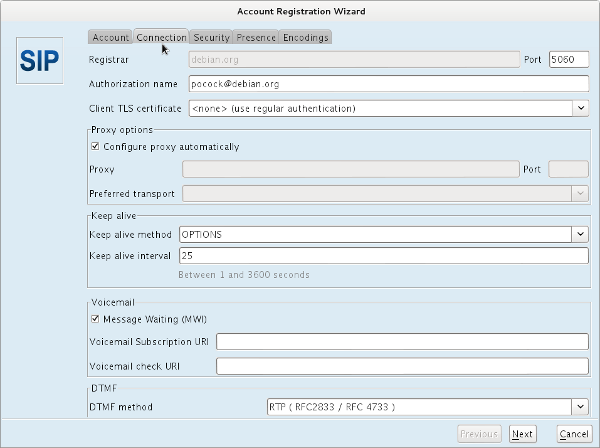
Before going on to talk about SIP, there is one really important thing that must be emphasized: XMPP/Jabber is also in the roadmap. Some of the infrastructure that has already been deployed (the new RTC passwords in ud-ldap, the TURN server and the RADIUS server) is good for both SIP and XMPP use cases. All to be revealed on Sunday As mentioned in my recent blog about the Debian.org NAPTR record, more details will be coming in my talk at mini-DebConf Paris this weekend. Today I'm just going to describe some things to install for those who want a head start. Jitsi Jitsi has been around for many years (originally as SIP Communicator) and it is probably the most advanced desktop softphone in the free software world. Jitsi packages are in jessie and sid - why not install them now. If you don't want to pull in dependencies from jessie on your wheezy system, you can also download from upstream and run it standalone. WebRTC browsers I've prepared a JSCommunicator implementation based on the jscommunicator-web-phone package. To use it, you need the latest version of Iceweasel/Firefox or Chromium. As HTML5 WebRTC / RTCPeerConnection is an evolving standard, using a recent browser is essential. Jitsi configuration for sip:debian.org It is not open for users just yet, but this is how you will configure it when it is available. More details to come...
AttachmentSize
step-4-setup-connection-scaled.png59.66 KB

13 January 2014

Daniel Pocock: PostFinance, where is my money?

Update: my money has been returned by PostFinance very soon after this blog appeared There's no better way to get the year off to a good start than finding money has gone missing from your bank account. Where I live in Switzerland, it is mandatory for everybody to make a monthly payment for health insurance (as it is mandatory, it is basically a tax, like the monthly council tax in England). Just like British council tax, the premiums go up each year and every person in the country has to log into their bank's web site and change their standing order. A few days after doing just that, I went back in to the web site to make another payment and noticed that the first health insurance payment for 2014 had been duplicated on two consecutive days, the 30th and 31st of December: I immediately sent them an email to alert them to the fault and ask for the duplicate transaction to be corrected. Normally, when a company makes a mistake, it would be fixed within a couple of days and certainly never reach my blog. Instead of getting a helpful reply, I was astonished to receive this:
There has been a misunderstanding when you have set up your standing order.
You selected "First execution" December 30, 2013 and then "monthly execution" 31. The system has followed your instruction and it results a double execution December 30 and 31.
Unfortunately, we are not able to return you the amount.
Great, apparently it is all my own fault. I thought "monthly" would mean one payment in each one month but apparently not everybody uses the same definition of monthly. (Actually, banks do have systems such as the 360 day calendar but that is another story). So let's look at these faulty instructions I supposedly gave. I immediately went back to the standing order page to take a screenshot. I even compared the page in English (my default language, which they are kind enough to let me use) and French (one of the four official languages of the Swiss Confederation) and I found they say much the same thing: Note: exact amounts and account numbers concealed The form is relatively clear: I authorised a monthly payment (Periodicite: mensuel) with the first (Premiere) payment on 30.12.2013 and then, or so I believed (and still do) a following payment (ensuite) on the 31st of each month, with the last payment at the end of November, for 12 payments in total. Simple, right? Where it says ensuite le 31, I sincerely believe that means the second payment is on 31 January, but Postfinance seem to be arguing that I meant the 31 December: just one day, rather than one month, after the first payment. Delaying tactics I replied to their email, telling them explicitly that I had authorized a monthly payment only and demanding the immediate return of the duplicate payment. When I got their next reply, I didn't know what to think:
We are pleased to do the necessary to revoke the transfer to SWICA. This will take at least two weeks.
On the one hand, it appears they are now starting to accept they may have made a blunder. But two more weeks? This was already 10 days after the money went missing. Do they even know what is wrong with their system? It doesn't give me confidence. I wrote back again and insisted that this is their error and that an immediate correction is required. Pass the buck, take three Today, another reply came back. After almost 14 days, I've now got three fob-off excuse mails and none of my money returned:
We did the request at SWICA to send back the money on your account on the 8th January 2014. The decision will be taken by them if they agree to send back this amount.
Unfortunately, we cannot do more except waiting their answer. You can call them and explain them the situation. With your call, maybe the reimbursement could be faster.
Why is it in the hands of the health insurance company? It is not their fault that Postfinance has a problem processing standing orders. Why do I have to waste my time chasing people, will I get compensation for that? Am I the only victim? With many people configuring their new health insurance payments at this time of the year, I can imagine that there may be other victims of this fault too. Are they all being fobbed off with these excuses? Some may not even realize if they don't check their account closely. What next? Sure, maybe I can just cancel the next health insurance payment: but why should I have that inconvenience? What exactly was I supposed to put on that form to not make this mistake they suggest I made? If I cancel the next payment like they suggest and then set up the payment again from March, how can I be sure the same duplication won't happen again? Using customers as unpaid QA testers Many leading financial organisations have experienced teams of developers, QA testers, and comprehensive regime of simulation/testing with paid participants to ensure their systems are reliable and as friendly and accurate as possible. Here, it feels like PostFinance has skipped all that, deploying a form that is ambiguous at best and they are using real customers like me to test the system and report the bugs. Normally organisations pay me for doing that very same task as part of my job as a software engineer. Not only have Postfinance taken almost 200 CHF of my money, but they have wasted my time with their strategy of fobbing me off and at the same time they are probably sending my feedback to their developers instead of paying a QA tester to check their systems. You be the judge What is your opinion?
  • Daniel can't use a web form, it is definitely Daniel's mistake, nobody else would make a mistake like that
  • The Postfinance form is ambiguous and so it is probably their fault and they should give back the money, it is likely these are cut and paste emails they send to all the customers who are duped by the form
  • Postfinance is completely wrong. Monthly means one payment each month.

9 January 2014

Gerfried Fuchs: Clawfinger

It's almost a month since I last blogged something, and one of my new year's resolution is to change that, a bit. Let's see how it goes. I've been listening a lot to this great band from Sweden recently again, put all their songs onto my mobile phone. It might sound weird because they have a rather aggressive style, both soundwise but also lyricswise, but it helps me to get things off my chest and stay relaxed in the rest of my life. The band I want to present to you was already twice mentioned in some other articles of my blog I noticed, but this is the proper post about them: I'm talking about Clawfinger. They came up in the nineties during the crossover phase and did blend in pretty well, but it's mostly their direct and political statements they carry in their lyrics that did let them stand out. One warning though: the direct language they use might be considered blunt and maybe even offensive by some. The message behind it though should rather get you thinking of your own doings if you consider it to be offensive. Here are the songs: Like always, enjoy! And maybe also think about it a bit. :)

/music permanent link Comments: 4 Flattr this

Russ Allbery: Review: Honeyed Words

Review: Honeyed Words, by J.A. Pitts
Series: Sarah Beauhall #2
Publisher: Tor
Copyright: July 2011
ISBN: 0-7653-2907-7
Format: Trade paperback
Pages: 412
Honeyed Words is a direct sequel to Black Blade Blues and probably doesn't make sense to read out of order. Sarah, Katie, their friends, and Katie's family are still recovering from the climactic events of Black Blade Blues and licking their wounds, but things are slowly looking up. Sarah is getting more comfortable openly expressing her sexuality, although there are still tensions, and her relationships are improving. The city of Vancouver also seems to be recovering. But major political shifts among the nonhuman races have echoes and ramifications, and after a kidnapped singer and a murdered dwarf, Sarah is pulled back into the turmoil. If you liked the world-building in Black Blade Blues, Honeyed Words is more of the same, but with more variety. Pitts adds elves to dwarves and dragons, shows considerably more of the supernatural world beneath the surface of human cities, and introduces Sarah to some new types of danger. There are a few more glimmers of the history of Sarah's sword and the nature of the gods in this universe, but still nothing conclusive. Pitts broadens the world-building rather than deepening it. But I liked the new characters. Teenage elves with obsessions make for great characters, and the demon who shows up about halfway through is delightful. As with the first book, this is mostly a story of things happening to Sarah while she tries to muddle through as best she can. There isn't much in the way of grand strategy or of seizing control of the plot. She just tries to do the right thing and gets lots of help from lots of friends. But the plot moves right along, and it's mixed with a healthy sense of normality that I find refreshing. She needs work as a blacksmith, she's trying to support a friend without having much money of her own, the living arrangements this forces are a bit of a strain for her own relationships, and her broken relationship with her family continues to lurk. Much urban fantasy is built around the premise of a regular person thrust into a fantasy world, but much of it then discards normal life once the supernatural starts. I think Pitts does a particularly good job of keeping his protagonist's life grounded in the ongoing mundane problems of living. It's also more fun to read about Sarah when she isn't quite as angstful. Over the course of Honeyed Words, she seems to be growing into a person who can accept who she is and feel secure about her place in the world. That's nice to see. The downside to this book is that, while it's full of quite a lot of stuff, not all of it coheres that horribly well. It has a certain "middle book" feel. The major plot resolves, but with some significant lingering consequences and something of a cliff-hanger last chapter. Most of the threads left open by the first book are still open here. There's character growth, and setup for some resolution, but not a lot of actual resolution. I still like this series, though. I like urban fantasy that isn't about vampires and werewolves; berserker blacksmiths and Norse legend has much more appeal, and I want to read more of it. Pitts's writing is a bit clunky and probably won't win many rewards, but it's serviceable and I think improving. If you enjoyed the first book, it's worth looking for this one as well. Followed by Forged in Fire. Rating: 7 out of 10

8 January 2014

Gunnar Wolf: [review] Packt's Instant Haml

Packt Publishing sent me Krzysztof Niki ski's Instant Haml to do a short blog review... Thing is, and those who read me know, I cannot write short reviews ;-) So lets see how this goes. Packt's Instant series First, as for the format this book follows and the series it fits in: They are very short books. I was the tech reviewer for their Instant Debian Build a Web Server , and when I opened it for the first time, I thought I had received only the first chapter. This series' motto is Short Fast Focused so, yes, the books are ~50 pages long, with ample margins and many big screenshots. I told the editors I was quite unsure about the value this kind of publications add, as they are very similar to online tutorials, but given they have so many books in this series (printed and electronic), there must be a market for them. They surely know their business better than me! There is one other detail regarding the publisher I'll stick in this section, although it is not specific to their Instant series: I do most of my reading in my Kindle. Packt seems to have chosen to specify a very small font for their texts. Besides the two books mentioned, I also have their Object Oriented JavaScript book. For all of the other books I read, I use the smallest font setting. Packt books in mobi format (what they present as Amazon format in their web site) are basically illegible without bumping up the font size through the roof. As I understand it, publishers should use industry-wide default sizes, and let the reader adjust their reading experience. Yes, books of technical nature (such as Packt's) often benefit from having more displayed information than what an ebook reader normally shows... But that's for me to decide! And no, this is not a Kindle-specific glitch: I also get a similar experience when opening it from Calibre. And as for the book... I am a long-time Haml convert/fan; I packaged its Ruby implementation for Debian (and should update it soon :-/ as new versions have appeared), the corresponding Emacs Lisp mode, and I use it for basically all of my static HTML sites and Ruby-based Web systems. Haml is a great templating language, meant to make dynamic HTML generation leaner and easier. It is a clean and elegant technology, and can clearly sell itself. And the project webpage has very good documentation, ranging from a short tutorial and a full API documentation for people to contribute to the project. The first part of this book, of course, covers the "why is Haml so great?" part, presenting the basic equivalences with HTML. In my opinion, the book could be structured a bit differently and would generate a stronger following. Why? Because, even given that Haml is greatly benefited from its Ruby integration and has many hooks to be tightly integrated in a Rails workflow, it can also be used by people who don't want to do Ruby. I have some static websites that are just a bunch of Haml files, compiled by a very simple Makefile and calling the haml command from the shell. I think there would be some value in presenting this invocation before learning how to call it from the Gems environment (i.e. bundle install). Using Haml as a standalone tool is only presented almost as an appendix ("Using HAML outside of Rails" section). Even more so if the author presents four different static-site solutions (probably more non-programmer-friendly than my trusty Makefile). Oh, and this little section uses the (old? obsolete?) uppercase HAML notation for the project's name instead of the now-standard Haml. Dirty screenshots About the screenshots presented in this first section (and I refer mainly to the scaffolding examples), they are meant to show how easy things are, but have an important stylistic mistake: Terminals with transparency might look cool (I hate using them, but then again I'm a very boring person when it comes to my computer habits ;-) ), but transparencies have no place in a book (be it printed or e-book), as the images appear very uncrisp. In the Kindle, they just seemed dirty Now that I'm browsing the PDF from my desktop, I see that the screenshot in "Step 1" has a photo of Earth from space behind the terminal, and even worse, in "Step 2" it is shown over a Web page detailing the installation! These elements are just distracting, and the text would be much cleaerer if it were presented typeset just as a regular code fragment. Opening many of those screenshots in the Kindle was plain useless. Editor integration It is perfectly clear from this text that the author strongly prefers Sublime Text, sometimes uses TextMate, and has just heard reports that Haml has some support in Vim, Rubymine, Emacs and Coda. Of course, devoting a full page (as it is for the first case) for each editor would be out of proportion for this size of book... I just felt the imbalance too big, specially given that most editors will sport approximately the same feature set. Text redundancy If the Instant series is about making short books, I would expect them to be loaded with easy to follow content (as they are), but free of repetition. I felt, however, a large chunk of step 1 of the "Quick start" chapter to be repeated with the the first section of the "Top 6 features" chapter. Yes, the second one adds some depth, but very little. Still, in the later parts of this "Top 6 features" chapter, a more thorough explanation could be used for the Filters, Multiline attributes/code/strings and helpers and extensions sections. It seems the author was on a hurry trying to get it finished, as it is barely explained Explaining a bit more deeply would surely benefit readers. Wrapping up Reading my review, I'm mostly talking about negative issues. IMO, the book is not excellent, but it is clearly not bad. Specially given it fits very well the format for which it was designed. There are many items that could be fixed, and I hope some of them can be fixed (i.e. the screenshots) before the book goes to print If I understand Packt's page correctly, it is currently only available as ebook, contrary to most of the Instant series' titles.

Russell Coker: Dr Suelette Dreyfus LCA Keynote

Dr Suelette Dreyfus gave an interesting LCA keynote speech on Monday (it s online now for people who aren t attending LCA [1]). One of the interesting points she made was regarding the greater support for privacy protection in Germany, this is apparently due to so many German citizens having read their own Stasi files. The section of her talk about the technology that is being used against us today was very concerning. I wonder whether we should plan to move away from using any hardware or closed source software from the US, China, and probably most countries other than Germany. We really need to consider these issues at election time. I have previously blogged some rough ideas about having organisations such as Linux Australia poll parties to determine how well they represent the interests of citizens who use Linux [2]. I think that such things are even more important now. Steven Levy wrote an interesting summary of the situation for Wired [3]. At the end of her talk Suelette suggested that Aspies might be more likely to be whistle-blowers due to being unable to recognise the social signals about such things (IE managers say that they won t punish people for speaking out but most people recognise that to be lies). It s a plausible theory but I m worried that managers might decide to avoid hiring Aspies because of this. I wonder how many managers plan to have illegal activity as an option. But I guess that having criminals refuse to hire me wouldn t be such a bad thing.

6 January 2014

Gunnar Wolf: Pan Latin American Hashomer, 18 years later

Pan Latin American Hashomer, 18 years later
In 1994/1995, I spent probably the most unique and memorable year of my life with the people of several Zionist youth movements in Israel, working in a kibutz, learning in Jerusalem... In 1995, after most of my group returned to Mexico, I stuck with the newly arrived South American group of Hashomer Hatzair (plus some affiliates). We were 18-19. And 18-19 years later, here we are: Fabi n (from Buenos Aires) and Fabiana (from Montevideo), living in Buenos Aires, with two kids. Regina (from Paran ) and me (from Mexico), living in Mexico, no kids yet. Two couples. Three countries. Four cities. And a lovely evening. And the hopes to stay in touch, to meet every year when we come to visit Argentina.

Russell Coker: Length of Conference Questions

After LCA last year I wrote about speaking stacks and conference questions [1]. In that post I did some rough calculations on the amount of conference time taken by questions and determined that anyone who asks one question per day at a conference such as LCA (with about 600 delegates) is going to be asking more than 1/600 of all questions. That doesn t necessarily mean that someone shouldn t ask more than one question in a day, but they should carefully consider whether their questions are adding value to other delegates. Another issue that I ve noticed is the length of questions which seems to be a separate problem and it seems that we should consider keynote speeches separately as they involve all delegates. The regular conference lectures involve 4 to 6 streams running in parallel which means that in aggregate more questions can be asked. LCA has one keynote for each day including the mini-conf days, so that s 5 keynote speeches in total. If each keynote has 20 minutes of question time (and most keynote speeches probably have less) then there s 100 minutes of question time for the entire conference. For a genuine question (IE not a statement) that is non-trivial (anything that has a yes/no answer probably isn t interesting to the whole audience) the answer is probably going to be about three times as long as the question. Given some overheads for applause etc that means that the amount of time spent asking questions would be something less than 20 minutes at keynote speeches over the entire conference. If every delegate asked one keynote-speech question in the entire conference then that 20 minutes of questions would allow each delegate to spend 2 seconds asking a question. If 10% of delegates each asked one question and no-one asked a second question then each question could take an average of 20 seconds. Given the acoustic issues of asking a question from the back of the hall it seems unlikely to get a speaking rate of much more than a word a second, so 20 seconds of speaking would be in the range of 25 words (one tweet) to 50 words (if you speak at the typical speed of audio books according to Wikipedia). I think that audio-book speed isn t going to work well so a question asked at a keynote speech should probably be of a length that would fit on twitter. So if a question wouldn t fit on twitter then maybe a blog post or a discussion after the lecture would be a more suitable option. Before Asking a Question I think that before asking a question at a keynote speech people should consider whether that question would fit on twitter. They should also consider whether it is strictly a question and whether it will be of interest to other delegates. If your question is significantly longer than something that would fit on twitter then the next thing to consider is whether you are more important than other delegates. Because when someone asks more or longer questions than other people it will be interpreted as an implicit I am more important than you statement by many other delegates. Some Disclaimers Firstly I m not making any suggestions here for people who run conferences. I m making suggestions for delegates who are considering how they should act. The next disclaimer is that the educational benefit of the conference has the priority. If you have a question that really helps other delegates learn something which takes a little longer to ask then that s OK. Finally I apply the same criteria to my own decisions. There were several questions I considered asking at the keynote this morning, but I decided that none of them met the criteria of being short enough and generally interesting enough. There is one issue I will discuss with the speaker privately and I ll probably write at least one blog post related to the lecture.

5 January 2014

Jonathan Carter: Happy 2014!

So, it s 2014 and I still haven t migrated away from WordPress to using something fancy written in Python. But who cares? Life is great and I ve made good progress in lots of other areas :) I m getting fitter by the day, last year I joined a running club and I now play squash too, which is working so much better than just going to the gym. Also finally making progress with learning how to play guitar, another ancient goal of mine that had slow progress for a while. It helps that I now live on my own and can make noise whenever I want to. I m also going for lessons every Wednesday and have some plans to convert my spare room in to a music room. I ve also gotten into beer brewing. I attended Beerschool via Beerlab, my first batch of American Pale Ale is just about ready for bottling and I ll probably do that next weekend. What else? Well, this year I definitely want to be more focused in my free software contributions than in 2013. I want to get my Debian contributions flowing well again with the aim of becoming a Debian Maintainer. Also planning to go to Debconf in Portland, Oregon in August. Then there s LTSP which is working towards LTSP 6, which will see a huge shift in proper support for local processing and less on thin client support. Not sure how far my involvement will stretch there but I m certainly very interested and will do my best to make the LTSP hackfest later in the year. The next 2-3 months will need the most focus on Edubuntu. The 14.04 LTS release will be a big release and the single-sign-on directory infrastructure that will be released along with it will mark a big milestone for the project. Well, to anyone still reading my blog, have a great 2014!

Jon Dowland: 2013 In Fiction

I read a lot this year - I'll write more about that and reflections on goodreads in another post - but most of the things I read weren't published in 2013. (I should also write a bit about my thoughts on e-readers). However, it seems I have enough to write about 2013's novels to make a round-up post worthwhile, so here we go.

The Cuckoos Calling UK cover
This year, crime author Robert Galbraith published his first novel The Cuckoo's Calling. I'd never have heard of it if Galbraith was not outed as an alias for Joanne "JK" Rowling. Clues that Rowling was working on a detective story exist as early as a Guardian preview article in 2012 for her last novel, The Casual Vacancy. Further hints, for me, that this was no first-time author were the taglines from Ian Rankin and Val McDermid on the cover, writers of a calibre I'd be surprised a new author could attract. However I don't know whether they were on the pre-unveiling cover or not. Rowling was upset be outed, having enjoyed the freedom to write without the baggage of expectation that she is subject to. I hope she's pleased: prior to her unmasking the novel was warmly received by the (admittedly relatively small) number of people who read it. And a very good novel it is too. It starts with a genre clich of a grizzled, meloncholy detective, Mr. Cormoran Strike, in an upstairs office with a neon light flickering through the window, but fleshes the story out both forwards - a client, a mysterious death - and backwards - how did Mr. Strike end up in that upstairs office - living out of it, no less? As is traditional for the genre there's a very clever twist. What I really enjoyed about Cormoran Strike was Galbraith/Rowling moving quickly from Chandler-esque everyman to a well fleshed-out, complex protagonist, intertwining the development of the character with the unfolding of the wider plot. I'm looking forward to the sequel, expected in 2014.
The Shining Girls UK cover
A second surprise favourite this year was Lauren Beukes' time-tripping crime story The Shining Girls. A monsterous murder of women somehow finds a room in Chicago that lets him travel through time (or perhaps the room finds him). He uses this facility to stalk and murder a set of Shining Girls: women who, for one reason or another, literally 'shine' in his perception of them. One such woman survives his first attack and decides to try and find out who attacked her, and why. The crimes are described in a brutal fashion which - from a distance - resemble the sometimes glorified violence for which crime fiction is sometimes criticised, but the focus of the story is very much on the victims: they are fully fleshed out characters and each death is felt by the reader as a genuine tragedy. I discovered Beukes when her earlier novel Zoo City was included in a Humble eBook bundle. On reading The Shining Girls I felt that the novel deserved to be more widely known than I would expect it to be trapped in the ghetto of genre fiction, so I was pleased to discover that the very mainstream Richard and Judy Book Club discovered it. In established author news, Terry Pratchett, having adopted speech recognition for writing (to combat his debilitating Alzheimer's) has seemingly managed to accelerate his rate of production and squeezed out at least two this year: The Long War with Stephen Baxter is the sequel to 2012's The Long Earth which I very much enjoyed, but it really felt like "difficult second novel" to me. Hopefully there'll be a third. Raising Steam, the 40th Discworld novel, was an enjoyable romp around the concept of steam trains, featuring the relatively new Moist von Lipwig who has managed to become one of my favourite Discworld characters. I can't think of much more to say about the novel, really. It's a Discworld novel, probably not the best introduction to the series for a new reader, but will give a reader familiar with the franchise everything they expect, and possibly no more. Iain Banks sadly died this year, shortly after the publication of his last novel, The Quarry. It's sat on my hardback shelf for the time being. I couldn't bring myself to read it in 2013. I did read his last SF offering from the year prior, The Hydrogen Sonata. Sadly, yet coincidentally, both of these books examine the nature of living and dying, The Quarry in particular from the point of view of a terminal cancer sufferer. I have a small backlog of unread Banks fiction which I want to take my time over with. Finally, whilst not really a book, I thoroughly enjoyed the BBC's 2013 adaptation of Neil Gaiman's Neverwhere. Natalie Dormer wrote a piece on the making of the drama which should serve as a good introduction. At the time of writing, most of the programmes have disappeared from iPlayer, but I would be surprised if this wasn't released commercially at some point.

1 January 2014

Russ Allbery: 2013 Book Reading in Review

What a strange year. 2013 was marked by a whole sequence of entirely unexpected events, including multiple major work upheavals. For large chunks of the year, I had very little time or emotional energy for personal reading goals, and particularly for writing reviews. I declared personal amnesty on most of my intentions halfway through the year, and all the totals will reflect that. On the plus side (although not for reading and reviews), it was a great year for video games. Next year, there will be no specific goals. Between continuing work fallout, a very busy project schedule, my intent to keep playing a lot of video games, and various other personal goals I want to take on, I'm going to take the pressure off of reading. Things will be read and reviews will be written (and I'm going to make more of an effort to write reviews shortly after reading books), but I'm not going to worry about how many. The below statistics are confined to the books I reviewed in 2013. I read six more books that I've not yet reviewed, due to the chaos at the end of the year. Those will be counted in 2014. There were no 10 out of 10 books this year, partly due to the much lower reading totals and partly due to my tendency this year to turn to safe comfort reading, which is reliably good but unlikely to be exceptional. There were, however, several near-misses that were worth calling out. My favorite book of the year was Neal Stephenson's Anathem, which narrowly missed a 10 for me due to some fundamental problems with the plot premise. But this is still an excellent book: the best novel about the practice of science and philosophy that I've ever read. Also deserving mention are K.E. Lane's And Playing the Role of Herself, lovely and intelligent lesbian romance that's likely to appeal even to people who would not normally try that genre, and Guy Gavriel Kay's River of Stars. The latter isn't quite at the level of Kay's earlier Under Heaven, but it's still an excellent work of alternate historical fiction in a memorable setting. A special honorable mention goes to Lisa O'Donnell's The Death of Bees. It requires a lot of warnings for very dark subject matter and a rather abrupt ending, but it's been a long time since I've cared that much about the characters of a book. My favorite non-fiction book of the year was Gary J. Hudson's They Had to Go Out, a meticulously researched account of a tragic Coast Guard mission. The writing is choppy, the editing could have been better, and it's clear that the author is not a professional writer, but it's the sort of detailed non-fiction account that can only be written by someone who's been there and lived through similar experiences. Also worth mentioning is Mark Jason Dominus's Higher Order Perl, which was the best technical book I read all year and which I found quite inspiring for my own programming. The full analysis includes some additional personal reading statistics, probably only of interest to me.

Debian Sysadmin Team: Peter Palfrader: Securing the Debian zones

We are in the process of deploying DNSSEC, the DNS Security Extensions, on the Debian zones. This means properly configured resolvers will be able to verify the authenticity of information they receive from the domain name system. The plan is to introduce DNSSEC in several steps so that we can react to issues that arise without breaking everything at once. We will start with serving signed debian.net and debian.com zones. Assuming nobody complains loudly enough the various reverse zones and finally the debian.org zone will follow. Once all our zones are signed we will publish our trust anchors in ISC's DLV Registry, again in stages. The various child zones that are handled differently from our normal DNS infrastructure (mirror.debian.net, alioth, bugs, ftp, packages, security, volatile, www) will follow at a later date. We are using bind 9.6 for NSEC3 support and our fork of RIPE's DNSSEC Key Management Tools for managing our keys because we believe that it integrates nicely with our existing DNS helper scripts, at least until something better becomes available. We will use NSEC3RSASHA1 with key sizes of 1536 bits for the KSK and 1152 bits for the ZSK. Signature validity period will most likely be four weeks, with a one week signature publication period (cf. RFC4641: DNSSEC Operational Practices). Zone keys rollovers will happen regularly and will not be announced in any specific way. Key signing key rollovers will probably be announced on the debian-infrastructure-announce list until such time that our zones are reachable from a signed root. KSK rollovers for our own child zones (www.d.o et al.), once signed, will not be announced because we can just put proper DS records in the respective parent zone. Until we announce the first set of trust anchors on the mailinglist the keysets present in DNS should be considered experimental. They can be changed at any time, without observing standard rollover practices. Please direct questions or comments to either the debian-admin or, if you want a more public forum, the debian-project list at lists.debian.org. See also: -- Peter Palfrader

Christian Perrier: [life] [running] 2013 summary

Yet another yearly summary of my running activities. As I already explained, now running took precedence over free software activities as you'll notice below... So, what happened on that front in 2013 for running bubulle? I finally managed to run 4603 km during the year, which is 1700km more than 2012. Definitively an explosion as I actually ran over 12.5km every day. I added to this 206km with my moutain bike, all of them achieved during December while I was (and still am) suffering from an injury (fatigue fracture). These 4603km were covered in 458 hours, so a bit over 19 days running and very very slightly over 10km/h. It seems that my favourite race type choice is obvious, here: I'm, by very far, privileging, trail races, either in the country or forests in my neighbourhood....or in moutains. As a result, also, the combined positive climb is faily high, too. Though harder to estimate than distance and time, I end up with about 72,900 meters positive climb (to be compared to last year's 33,000 meters...:-)). Clearly, my summer in moutains made the difference, here.... The longest time period without running, this year, has been 3 days. That's really insane...:-). Particularly when one notices that I happened to run *every day* during 40 consecutive days at one moment, between August and September. Who says that running is indeed a full part of my life? To be honest, I actually didn't run since December 11th (while writing this on January 1st) because of my tibia injury...but I did bike, so that's still some kind of sports, right? Indeed, there have been 282 days in this year where I ran (or biked) at least once. Last year was 205 so....drug addiction is still increasing. Most active month: November with 471km. Less active month: February with 334km (which is indeed more than 2012 most active month..:-)) This year was also a year of records: I ran 14 official races during the year : How about next^W this year? Well, my season's peaks are currently being secured: No marathon as of now...:-). Or, indeed one (Paris in April), but more for fun : I hope to complete it in....less than 5 hours...but still in Spongebob Squarepants suit. You may want to watch TV on April 6th..:-) As I wrote last year : all this of course is assuming that no injury comes up. I currently need to recover from the current one, though it doesn't seem as bad as it seemed a few weeks ago. We'll see on January 1st 2015...:-)

Russ Allbery: Review: The Female Man

Review: The Female Man, by Joanna Russ
Publisher: Beacon
Copyright: 1975
Printing: 1986
ISBN: 0-8070-6299-5
Format: Trade paperback
Pages: 214
The Female Man is one of the most famous novels of feminist science fiction, written by a giant of the field. Joanna Russ was one of the strongest writers of the first era of explicitly feminist SF and one of the most challenging. Along with Alice Sheldon (James Tiptree, Jr.) and Sheri Tepper, she's probably the best known author whose approach tended towards the directly confrontational. She was also a noted essayist, critic, and reviewer; her book How to Suppress Women's Writing is one of the most famous works of feminist literary criticism. That said, I wasn't sure what to expect from this book. I'd heard that it was about four different women: Jeannine, Joanna, Janet, and Jael. They're parallels of sorts but from far different cultures, alternate worlds displaced in time. I'd also heard that it was full of biting, accurate sarcasm, which is certainly the case. This is a book written from a place of righteous anger combined with keen social observation and a desire to point out how different the world could be. And how toxic male behavior towards women currently is. What it's not, however, is much of a novel, in the sense of having a clear plot that carries the reader through the book. There is a story of sorts, which revolves around the appearance of Janet in Joanna's time. Janet is a native of Whileaway, an alternate future Earth in which there are no men at all and social organization is significantly different. We get a fairly detailed description of her life and of some Whileaway customs over the course of the book. But they're mixed with excerpts from the lives of both Jeannine (from an alternate past in which the Great Depression never ended) and Joanna. If Janet's story is a sort of utopian alternate future, following the basic model of female separatist societies, Jeannine's is the dystopia drawn from our past. She's locked entirely into traditional gender roles and the desire to catch a man and be a wife. I found her the hardest character to read about by far, largely because she locks herself into the worst constraints of that role. She's almost entirely passive, and she's devoted to a man for whom it's difficult to have any respect at all. Janet is interesting in part because she's not particularly exceptional in either ability or intelligence. She just reflects the Whileaway culture, which leads to some sharp conflicts with the norms of Joanna's time. It's a very effective tactic for alienating the reader from current gender roles (or, at least, roles from the 1970s) and showing how absurd they appear with a different set of starting assumptions. Russ makes the point clearly; this is not a book that tends towards the subtle, although it can be a little hard to track the characters' progress through alternate timelines. Towards the end of the book, they meet the fourth character. (This is not really the sort of book that is possible to spoil by summary.) Jael is by far the most aggressive of any of them, the closest that any of them come to the caricature of a "man-hating feminist." One of the strengths of The Female Man is that, by the time the story reaches her, I at least was feeling quite a lot of sympathy towards her aggressively violent approach, after watching Joanna be put down and Jeannine simper ineffectually. However, it's worth nothing that Janet, the representative of the supposed utopia, does not agree with Jael or her methods, and the relationship between their worlds is interestingly complex. None of the four characters are exactly wrong (although Jeannine comes close); none of them are entirely right either. They're all struggling in different ways with how to define femininity. While the quiet and simplicity of Janet's world has definite appeal, it's the sort of utopia that one isn't sure one would actually want. And Jael has some pointed commentary on how wanting such a world is one thing, but the acts required to create it is quite another. I can see why this book is so well-known. Many of the scenes that show gender relations and male behavior are both painful and funny. Reading it forty years after it was written, it's clear that social norms have changed; men do and say things here that they would no longer be able to get away with, that are clearly from another era. But it's also clear that some of the underlying attitudes have not changed, just been cloaked in different language. And Russ's bluntness here is refreshing: this book does not pull its punches, both in openly ridiculing sexist behavior, and in showing how oppressive it is for women. That said, it didn't work as a story for me, in part because the plot is sketchy at best. It's a collection of individual excerpts and commentary, only some of which are shaped like a story. Much of it feels stream of consciousness, and when cut between three different viewpoints, it's also occasionally confusing. There are also a few too-obvious characters: some of the men, particularly in Jael's section, but also Jeannine, who I never liked even after she starts changing her mind about women's roles. I wanted a bit more story and a bit less introspection. I think this is an important book that's worth reading, and sadly it's not as obsolete as one would like. But I don't think it's entirely successful as a novel. Best treated as a piece of literary history. Rating: 6 out of 10

Andrew Pollock: [life] It's a new year, it's a new me

Well, it's 2014. The annus horribilus of 2013 is behind me. I'm entering 2014 in a much better place (on multiple levels) than I did for 2013. I'm positively excited to see what 2014 brings me. I was very fortunate to have someone I looked up to reach out to help me when my marriage fell apart. One of the things he said to me was "A year from now, you won't recognise yourself". He was right. I am such a different person today than I was a year ago. I'm happier, fitter, more self-confident. I'm focusing on different things in my life. One thing that has been a casualty, has been my geeky pursuits. There were a few times last year where I questioned if I was still a geek. I am. I've just deprioritised it. Instead, I've been putting my own self-care and my daughter above all else, meaning that my running has probably been the one thing I'd call a "hobby" at the moment. I've got some stuff in the pipeline that I'm not quite ready to write about yet, but I'm expecting a rearrangement of my time that will hopefully allow for some more geeky endeavours in 2014. I'm also hoping I can regain some momentum on blogging. Here's what I'd say my goals are, going into 2014: plus some other stuff I'm not ready to talk about yet.

30 December 2013

Russ Allbery: Init system evaluation thanks

Most people who follow Debian are probably aware that we're currently in the middle of a major debate over the future of Debian's init system. Over the past month, and particularly over the past week, I undertook an evaluation of two of the options in that debate, using one of my packages as a test bed. I also did a lot of reading, filed a few bugs, and asked a bunch of questions. That's an extension of the questions I've been asking and discussions I've been participating in around init systems for the past year plus. I have been keeping my opinions and writeups confined to the relevant Techncial Committee bug report so that they can be read in context with their rebuttals. There are a lot of thoughtful and well-informed opinions here, of which mine are only one, and several of my conclusions have been inaccurate or at least not complete, so the context is important. You can find the full traffic in the Technical Committee bug. Most of the discussion, in a threaded view, is in the Technical Committee archives for December. However, in one of the messages I sent today, I tried to show my appreciation for the people who have assisted with this evaluation over the past week, month, and years, and I think that section deserves broader distribution outside of the ongoing discussion. It is therefore included below. Throughout this evaluation process, my interactions with upstart and systemd upstream developers and Debian packagers have been uniformly excellent. Bug reports filed against both systemd and upstart have received excellent and timely response, and all involved have been quite willing to explain things I've misunderstood, correct my false starts, and discuss technical and practical aspects of their designs. I was particularly impressed by the clear effort that the systemd and upstart maintainers in Debian have put into fully integrating their init systems in such a way that makes them easy to test and use with existing Debian packages. This includes but is not limited to update-rc.d support, invoke-rc.d support, status synchronization with sysvinit, past Policy discussion, and attention to upgrade paths and init-switching use cases. I also want to particularly thank the OpenRC upstream development team for their involvement in this process and their contributions to the discussion. I personally don't think that package is a good match for Debian's needs on Linux, but that's through no fault of the people involved, and I think they would be an excellent upstream if that package looked like a good fit for the needs of any of Debian's non-Linux ports. I also want to thank Petter Reinholdtsen, Roger Leigh, and everyone else who has worked on the sysvinit package over the years, the insserv conversion to dependency-based boot, and the inclusion of LSB support. If it weren't for their hard work, we would be in a far worse position than we are today. It's often hard to see people discussing the inadequacies of something into which you put years of hard work. I want to call attention to their long-term contributions to the distribution, and to the number of Debian systems that have booted through their efforts over the years.

29 December 2013

Hideki Yamane: creating Ubuntu chroot becomes easier - ubuntu-archive-keyring package in Debian

Hi, I've just uploaded ubuntu-keyring source package to Debian (its RFP was posted in 26th Dec 2007 - wow 6 years ago) and it was accepted quickly (thanks to ftpmasters :-)

If you're using Debian as primary environment and need to rebuild package for Ubuntu, you'd create Ubuntu pbuilder/cowbuilder/chroot environment on your box. But you'll get an error as below.
henrich@hp:~ $ sudo cowbuilder --create --distribution saucy --mirror http://archive.ubuntu.com/ubuntu --basepath /var/cache/pbuilder/saucy
-> Invoking pbuilder
forking: pbuilder create --buildplace /var/cache/pbuilder/saucy --mirror http://archive.ubuntu.com/ubuntu --distribution saucy --no-targz --extrapackages cowdancer
I: Running in no-targz mode
I: Distribution is saucy.
I: Current time: Mon Dec 30 01:00:05 JST 2013
I: pbuilder-time-stamp: 1388332805
I: Building the build environment
I: running debootstrap
/usr/sbin/debootstrap
I: Retrieving Release
I: Retrieving Release.gpg
I: Checking Release signature
E: Release signed by unknown key (key id 3B4FE6ACC0B21F32)
E: debootstrap failed
W: Aborting with an error
pbuilder create failed
forking: rm -rf /var/cache/pbuilder/saucy

"E: Release signed by unknown key (key id 3B4FE6ACC0B21F32)", because your system doesn't know about Ubuntu release key. Okay, then "$ sudo apt-get install ubuntu-archive-keyring" and add "--debootstrapopts "--keyring /usr/share/keyrings/ubuntu-archive-keyring.gpg"" option to cowbuilder.
henrich@hp:~ $ sudo cowbuilder --create --distribution saucy --mirror http://archive.ubuntu.com/ubuntu --basepath /var/cache/pbuilder/saucy --debootstrapopts "--keyring=/usr/share/keyrings/ubuntu-archive-keyring.gpg"
-> Invoking pbuilder
forking: pbuilder create --debootstrapopts --keyring=/usr/share/keyrings/ubuntu-archive-keyring.gpg --buildplace /var/cache/pbuilder/saucy --mirror http://archive.ubuntu.com/ubuntu --distribution saucy --no-targz --extrapackages cowdancer
I: Running in no-targz mode
I: Distribution is saucy.
I: Current time: Mon Dec 30 01:06:30 JST 2013
I: pbuilder-time-stamp: 1388333190
I: Building the build environment
I: running debootstrap
/usr/sbin/debootstrap
I: Retrieving Release
I: Retrieving Release.gpg
I: Checking Release signature
I: Valid Release signature (key id 790BC7277767219C42C86F933B4FE6ACC0B21F32)
I: Retrieving Packages
I: Validating Packages
I: Resolving dependencies of required packages...
I: Resolving dependencies of base packages...
I: Checking component main on http://archive.ubuntu.com/ubuntu...
I: Retrieving apt 0.9.9.1~ubuntu3
I: Validating apt 0.9.9.1~ubuntu3
I: Retrieving base-files 6.12ubuntu4
(snip)
Good :)

note: Just add "--keyring" option (--keyring /usr/share/keyrings/ubuntu-archive-keyring.gpg) doesn't work as expected, bug?

difference with ubuntu-keyring package in Ubuntu

  • Binary package name is "ubuntu-archive-keyring", not "ubuntu-keyring". It's better to use "foobar-archive-keyring" for packages, same as debian-archive-keyring.
  • No udebs. Probably we don't need it.


Russ Allbery: lbcd 3.5.0

This turned out to be a more substantial release than I was originally planning. lbcd is a small daemon that listens to UDP queries and returns system load and usage information and, optionally, service availability. It's designed to work with a software DNS-based load-balancing system that we use at Stanford (lbnamed), but it can also be used in other situations where you want to easily and quickly query the load of systems remotely. Debian is currently debating which new init system to adopt, and lbcd was my test package for adding upstart and systemd support. The goal was to add proper, full support as described by upstream, making use of all relevant features, so that I could get some experience with a complete integration. That is complete in this version: lbcd now supports both systemd's and upstart's readiness synchronization mechanisms (using a -Z flag to raise SIGSTOP for upstart) and supports socket activation with systemd. (upstart's socket activation support is missing numerous features, including IPv6 support and, fatally, SOCK_DGRAM support.) It also installs systemd unit files directly when built on a system with systemd support, which should make life easier for use on Red Hat versions later regardless of what happens with Debian. Of course, while doing that, I kept running across other things that needed to be fixed. For example, systemd's socket activation provides proper support for IPv6, so lbcd should as well. That's now present; that was something I'd been planning on doing for some time. It also supports a -f option to run in the foreground but still log to syslog, something needed by both upstart and systemd to avoid having to use PID files. Since PID files are no longer necessary, lbcd no longer writes one by default (an idiosyncratic choice made by the previous maintainer), and also drops the -s and -r options to stop and restart itself. Adding these to each daemon was an interesting approach, but I think it's better to leave this to the init system. While working on the code, I discovered that lbcd allowed the client to request any of the built-in service probes be run, which meant that a client could cause TCP connects to random local services. While this probably couldn't do any harm other than a DoS attack, it still seemed like a bad idea, and was a "feature" I didn't realize was there. Now, only services specified with the -w or -a options may be queried by a client. I also finally implemented the -l option, which logs each client query, and improved lbcd's recognition of whether someone is on console to allow for modern display manager sessions. The simple client included in the package, lbcdclient, has been completely rewritten using modern Perl. It supports long options, setting the timeout, setting the port, and returns an error on timeout. It no longer supports multiple servers to query on the command line, since the output just gets confusing and I don't think anyone used this feature. It also now supports IPv6 if IO::Socket::INET6 is available. Finally, a typo that prevented compilation on Mac OS X has been fixed. You can get the latest version from the lbcd distribution page.

27 December 2013

Asheesh Laroia: New job (what running Debian means to me)

Five weeks ago, I started a new job (Security Engineer, Eventbrite). I accepted the offer on a Friday evening at about 5:30 PM. That evening, my new boss and I traded emails to help me figure out what kind of computer I'd like. Time was of the essence because my start date was very next day, Tuesday. I wrote about how I value pixel count, and then RAM, and then a speedy disk, and then a speedy CPU. I named a few ThinkPad models that could be good, and with advice from the inimitable danjared, I pointed out that some Dell laptops come pre-installed with Ubuntu (which I could easily swap out for Debian). On Monday, my boss replied. Given the options that the IT department supports, he picked out the best one by my metrics: a MacBook Pro. The IT department would set up the company-mandated full-disk encryption and anti-virus scanning. If I wanted to run Linux, I could set up BootCamp or a virtualization solution. As I read the email, my heart nearly stopped. I just couldn't see myself using a Mac. I thought about it. Does it really matter to me enough to call up my boss and undo an IT request that is already in the works, backpedaling on what I claimed was important to me, opting for brand anti-loyalty to Apple over hardware speed? Yes, I thought to myself. I am willing to just not work there if I have to use a Mac. So I called $BOSS, and I asked, "What can we do to not get me a Mac?" It all worked out fine; I use a ThinkPad X1 Carbon running Debian for work now, and it absolutely does everything I need. It does have a slower CPU, fewer pixels, and less RAM, and I am the only person in the San Francisco engineering office not running Mac OS. But it all works. In the process, I thought it made sense to write up some text to $BOSS. Here is how it goes.

Hi $BOSS,

Thanks for hearing my concerns about having a Mac. It would basically be a fairly serious blow to my self image. It's possible I could rationalize it, but it would take a long time, and I'm not sure it would work.

I don't at all need to start work using the computer I'm going to be using for the weeks afterward. I'm OK with using something temporarily that is whatever is available, Mac or non-Mac; I could happily borrow something out of the equipment closet in the short term if there are plans in the works to replace it with something else that makes me productive in the long term.

For full-disk encryption, there are great solutions for this on Linux.

For anti-virus, it seems Symantec AV is available for Linux <http://www.symantec.com/business/support/index?page=content&id=HOWTO17995>.

It sounds like Apple and possibly Lenovo are the only brands that are available through the IT department, but it is worth mentioning that Dell sells perfectly great laptops with Linux pre-installed, such as the XPS 13. I would perfectly happily use that.

If getting me more RAM is the priority, and the T440s is a bad fit for $COMPANY, then the Lenovo X230 would be a great option, and is noticeably less expensive, and it fits 16GB of RAM.

BootCamp and the like are theoretical possibilities on Macs, but one worry I have is that if there were a configuration issue, it might not be worth me spending work time to have me fix my environment, but instead I would be encouraged for efficiency to use Mac OS, which is well-tested on Apple hardware, and then I would basically hate using my computer, which is a strong emotion, but basically how I would feel.

Another issue (less technical) is that if I took my work machine to the kinds of conferences that I go to, like Debconf, I would find myself in the extremely uncomfortable position of advertising for Apple. I am pretty strongly unexcited about doing that.

Relating to the self-image issue is that it means a lot to me to sort of carry the open source community with me as I do my technical work, even if that technical work is not making more open source software. Feeling part of this world that shares software, and Debian in particular where I have a strong feeling of attachment to the community, even while doing something different, is part of what makes using computers fun for me. So it clashes with that to use Mac OS on my main machine, or to feel like I'm externally indistinguishable from people who don't care about this sort of community.

I am unenthusiastic about making your life harder and looking like a prima donna with my possibly obscure requirements.

I am, however, excited to contribute to $COMPANY!

I hope that helps! Probably nothing you couldn't have guessed in here, but I thought it was worth spelling some of that out. Happy to talk more.

-- Asheesh.

23 December 2013

Russell Coker: The Nexus 5

The Nexus 5 is the latest Android phone to be endorsed by Google (and manufactured by LG). It s getting good reviews and the price is good for the specs. I just bought one for my wife, I got her the 32G version because when I bought her a Nexus 4 at the start of the year [1] I chose the 8G version and regretted it ever since. The size of apps is always increasing (some Android games need more than 1G of storage) and higher resolution screens drives the use of high resolution video. Appearance back of Nexus 4, Nexus 5, and Samsung Galaxy Note 2front of Nexus 4, Nexus 5, and Samsung Galaxy Note 2 Above I have pictures of the Nexus 4, the Nexus 5, and the Samsung Galaxy Note 2. The photo of the phone backs captures part of the sparkling pattern on the back of the Nexus 4 and it looks much better in real life (IMHO) because it shimmers as you move the phone. The Nexus 4 looks so good that there s even a transparent case specifically designed to show off the rear panel [2]. It doesn t seem likely that anyone will design such a transparent case for the Nexus 5, it s a good phone to cover up IMHO. The Note 2 isn t the most attractive phone, but I think it has a streamlined elegance of being optimised for it s function. The Nexus 5 has it s camera sticking out, it would be better if they had just made the entire phone thicker and given it a bigger battery but for people who don t want good battery life I guess it s a way of providing a better focal length without making the phone thicker. Sticking the IMEI number on the back of the phone will be useful on rare occasions (and might be a security issue on more occasions) but it definitely makes the phone less attractive. Full HD The quality of the Full HD (1920*1080) display is obvious. The text is slightly clearer when viewing maps and the graphics in Ingress look nicer. Before I used the Nexus 5 I didn t think that there would be any benefit in having such a high resolution in a phone but now I realise that I was wrong. The higher resolution is clearly better. Chris Chavez wrote an article for Phandroid about a rumored Samsung phone with a 2560*1440 display [3]. If such a device had a 6.6 display (IE a new version of the Galaxy Mega) then it would have the same dot-pitch as the Nexus 5. If such a device had a 5.5 display (like the Galaxy Note 3) then it would have a 15% greater DPI than the Nexus 5. It seems that a higher DPI provides a real benefit and this is probably the biggest reason to choose the Nexus 5 over the Nexus 4 and most other Android devices. Comparing with the Nexus 4 The Nexus 5 has the same amount of RAM (2G), a slightly larger display (4.95 vs 4.7 ), higher resolution (a big deal), faster CPU and GPU, and optical zoom. Faster CPU isn t usually going to be a big deal (apart from the fact that more CPU power is needed as well as more GPU power to drive the higher resolution display). The Nexus 5 can come with 16G or 32G of storage while the Nexus 4 has options of 8G and 16G. If you want more than 16G of storage then that s a real benefit for the Nexus 5, but if you only need 16G then it s not an issue. It seems that when playing Ingress on a Nexus 5 it s more likely that running another program (such as Google Hangouts) will cause Ingress to be reloaded than it does on a Nexus 4 or a Galaxy Note 2. While I haven t done a good comparison of the Nexus 4 and the Nexus 5 in this regard I ve compared the Galaxy Note 2 and the Nexus 5 well. My Galaxy Note 2 (which has many daemons running) is much less likely to cause a reload of Ingress (IE have run low on memory and terminated Ingress) than the Nexus 5 my wife is using (which has very little running). So it seems that the OS build on the Nexus 5 uses more memory than the Galaxy Note 2. The Nexus 5 has Gorilla Glass 3 vs Gorilla Glass 2 on the Nexus 4. As my older Android phones with Gorilla Glass 1 (Galaxy S and Sony Ericsson Xperia X10i) didn t get any scratches that matter I don t think this is a benefit for me. Maybe if I lived near a beach I d care more about this. I think that the most significant benefit of the Nexus 5 over the Nexus 4 is the higher resolution display. The optical zoom should provide a theoretical benefit when taking photos, whether that results in better pictures in practice would probably depend on how you hold your phone, the available light, and other factors. I think that if it was possible to buy a Nexus 4 at a sensible price (IE something less than the $250 that Google last charged) then for most people the Nexus 4 would be a better choice than the Nexus 5. But as ebay is full of Nexus 4 phones selling for a higher prices than the Nexus 5 it seems that buying a Nexus 5 is the only option. The range of phones that Kogan sells [4] doesn t have anything for the same price that compares on features. Heat The heat produced by the Nexus 5 is significant and noticable. After some light Ingress playing on a cold day my Galaxy Note 2 with a gel case (that keeps it warm) reported itself as having a battery temperature of 34C. My wife s Nexus 5 reported a temperature of 43C. While the thermometer in the phone might not be the most accurate I don t think there was an accuracy problem, holding my wife s phone was unpleasant and felt like it could burn my hand if I held it tight (40C is the minimum temperature for burns). It seems that a Nexus 5 isn t a good choice if you want to play Ingress in a warm part of the world (EG most of Australia in summer). Also heat dissipated is directly proportional to power use which is going to be a problem for a phone that doesn t permit replacing it s battery. Conclusion I m quite disappointed with the Nexus 5. I expected it to be at least as good as the Nexus 4 in every way and better in many ways. Instead it s not always as good as the Nexus 4 and the ways that it is better won t necessarily provide benefits for everyone. The heat and power use problems are really going to hurt the use of it. But I guess we can always hope that Google release a new Android build that reduces the power use, they might even have a new build that uses less RAM too. I would not consider getting a Nexus 5 for my own use. For my use the Note 2 is clearly more suitable, the larger screen more than compensates for the clarity that the Nexus 5 gets from it s high resolution display. Also I REALLY like having a hardware home button. I ll probably get a Note 3 when the price drops, I m not interested in paying $649 for a phone and I m also not interested in replacing a phone that s less than a year old. So maybe I ll get a Note 3 in the second half of next year.

Next.

Previous.