Search Results: "ads"

7 April 2022

Gunnar Wolf: How is the free firmware for the Raspberry progressing?

Raspberry Pi computers require a piece of non-free software to boot the infamous raspi-firmware package. But for almost as long as there has been a Raspberry Pi to talk of (this year it turns 10 years old!), there have been efforts to get it to boot using only free software. How is it progressing? Michael Bishop (IRC user clever) explained today in the #debian-raspberrypi channel in OFTC that it advances far better than what I expected: It is even possible to boot a usable system under the RPi2 family! Just There is somewhat incomplete hardware support: For his testing, he has managed to use a xfce environment but over the composite (NTSC) video output, as HDMI initialization support is not there. However, he shared with me several interesting links and videos, and I told him I d share them there are still many issues; I do not believe it is currently worth it to make Debian images with this firmware. Before anything else: Go visit the librerpi/lk-overlay repository. Its README outlines hardware support for each of the RPi families; there is a binary build available with nixos if you want to try it out, and instructions to build it. But what clever showed me that made me write this post Is the amount of stuff you can do with the RPi s VPU (why Vision Vector Processing Unit and not the more familiar GPU, Graphical Processing Unit? I don t really know But I trust clever s definitions beyond how I trust my own ) before it loads an opearting system: There s not too much I can add to this. I was just Truly amazed. And I hope to see the remaining hurdles for regular Linux booting on this range of machines with purely free software quickly go away! Packaging this for Debian? Well, not yet not so fast I first told clever we could push this firmware to experimental instead of unstable, as it is not yet ready for most production systems. However, pabs made some spot-on further questions. And yes, it requires installing three(!) different cross-compilers, one of which vc4-toolchain, for the VPU is free software, but not yet upstreamed, and hence is not available for Debian. Anyway, the talk continued long after I had to go. I have gone a bit over the backlog, but I have to leave now so that will be it as for this blog post

6 April 2022

Jonathan Dowland: Hope in a Darkened Heart

I first heard Virginia Astley via Lauren Laverne, who played (I think) "With my eyes wide open" from her first album, "From Gardens Where We Feel Secure". Mostly ambient, a conceptual piece about a garden in an English Summer, spanning dawn to dusk. Bucolic ambient, dream pop. It was a little outside my wheel-house, but I loved it, and wanted to find out more. I soon learned that official, physical copies of it were rare and expensive.
'Hope in a Darkened Heart' spinning on my turntable
Some time later I stumbled across her second album "Hope in a Darkened Heart" (which is possibly the most commonly available of her albums) and bought it blind. It's quite different, with a lot more singing, but whatever drew me to Gardens is present. I love this. It was produced by Ryuichi Sakamoto. Only this week I was enormously pleased to discover a chunk of her discography on Bandcamp, including the two aformentioned albums. Highlights from Darkened:

Thorsten Alteholz: My Debian Activities in March 2022

FTP master This month I accepted 332 and rejected 15 packages. This ratio gives a reason to hope. The overall number of packages that got accepted was 342. Debian LTS This was my ninety-third month that I did some work for the Debian LTS initiative, started by Raphael Hertzog at Freexian. This month my all in all workload has been 40h. During that time I did LTS and normal security uploads of: All my PU bugs for Buster and Bullseye, that accumulated over the last months, were part of the latest point release. So new ones have to be created now :-). I also continued to work on security support for golang packages. As a result #1008577 and #1008578 were the first real tests with a simple package. Debian ELTS This month was the forty-fifth ELTS month. During my allocated time I uploaded: Unfortunately uploads have to be done for younger releases first, so I had to withhold some uploads for ELTS. Hopefully they can be done in April. Probably this policy needs to be reconsidered. Last but not least I did some days of frontdesk duties. Debian Printing This month I uploaded new upstream versions or improved packaging of: In order to make the Debian Edu team happy, I uploaded a new version of cups-filters with an adapted Apparmor-file to Unstable and Bullseye. Debian Astro This month I uploaded new upstream versions or improved packaging of: Other stuff This month I uploaded new upstream versions or improved packaging of: In order to avoid an AUTORM of some Osmocom packages, I also had to NMU:

Bits from Debian: Infomaniak Platinum Sponsor of DebConf22

infomaniaklogo We are very pleased to announce that Infomaniak has committed to support DebConf22 as a Platinum sponsor. This is the fourth year in a row that Infomaniak is sponsoring The Debian Conference with the higher tier! Infomaniak is Switzerland's largest web-hosting company, also offering backup and storage services, solutions for event organizers, live-streaming and video on demand services. It wholly owns its datacenters and all elements critical to the functioning of the services and products provided by the company (both software and hardware). With this commitment as Platinum Sponsor, Infomaniak contributes to make possible our annual conference, and directly supports the progress of Debian and Free Software helping to strengthen the community that continues to collaborate on Debian projects throughout the rest of the year. Thank you very much Infomaniak, for your support of DebConf22! Become a sponsor too! DebConf22 will take place from July 17th to 24th, 2022 at the Innovation and Training Park (ITP) in Prizren, Kosovo, and will be preceded by DebCamp, from July 10th to 16th. And DebConf22 is still accepting sponsors! Interested companies and organizations may contact the DebConf team through sponsors@debconf.org, and visit the DebConf22 website at https://debconf22.debconf.org/sponsors/become-a-sponsor. DebConf22 banner open registration

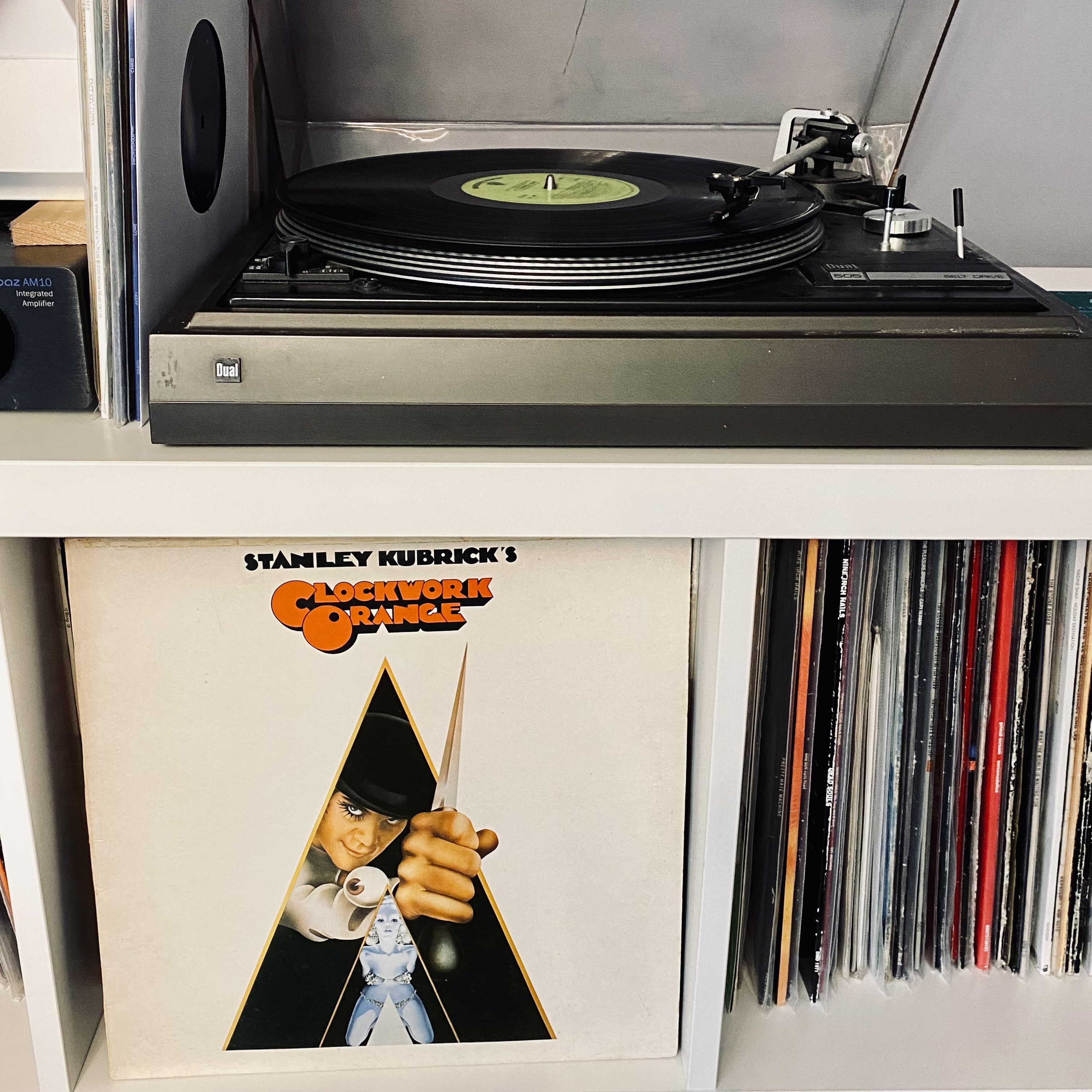
Jonathan Dowland: Stanley Kubrick's A Clockwork Orange (Music From The Soundtrack)

I was reminded of this record over the weekend, as Radio 4's Front Row was discussing the 50th anniversary of Kubrick's movie. To me, the soundtrack has a strange, whimsical, almost cynical element to it (especially with the selection of things like Pomp and Circumstance), but I was familiar with the movie before the soundtrack and it might just be the association that triggers those feelings.
Picture of 'A Clockwork Orange' vinyl record playing on my turntable
I think I picked this up at Tynemouth Market when I lived close by, but I'm not sure. I am sure I didn't pay much for it. Mine is a UK re-pressing from 1971. The abridged (and sped-up) version of William Tell Overture is great for getting the kids to complete a task. Burgess's novel (now 60 years old) has been on my to-read pile for years. in 2018 Electronic Sound magazine featured a cover-mount CD "New Clockwork Music" of music inspired by this soundtrack: It's very good. I must dig that out

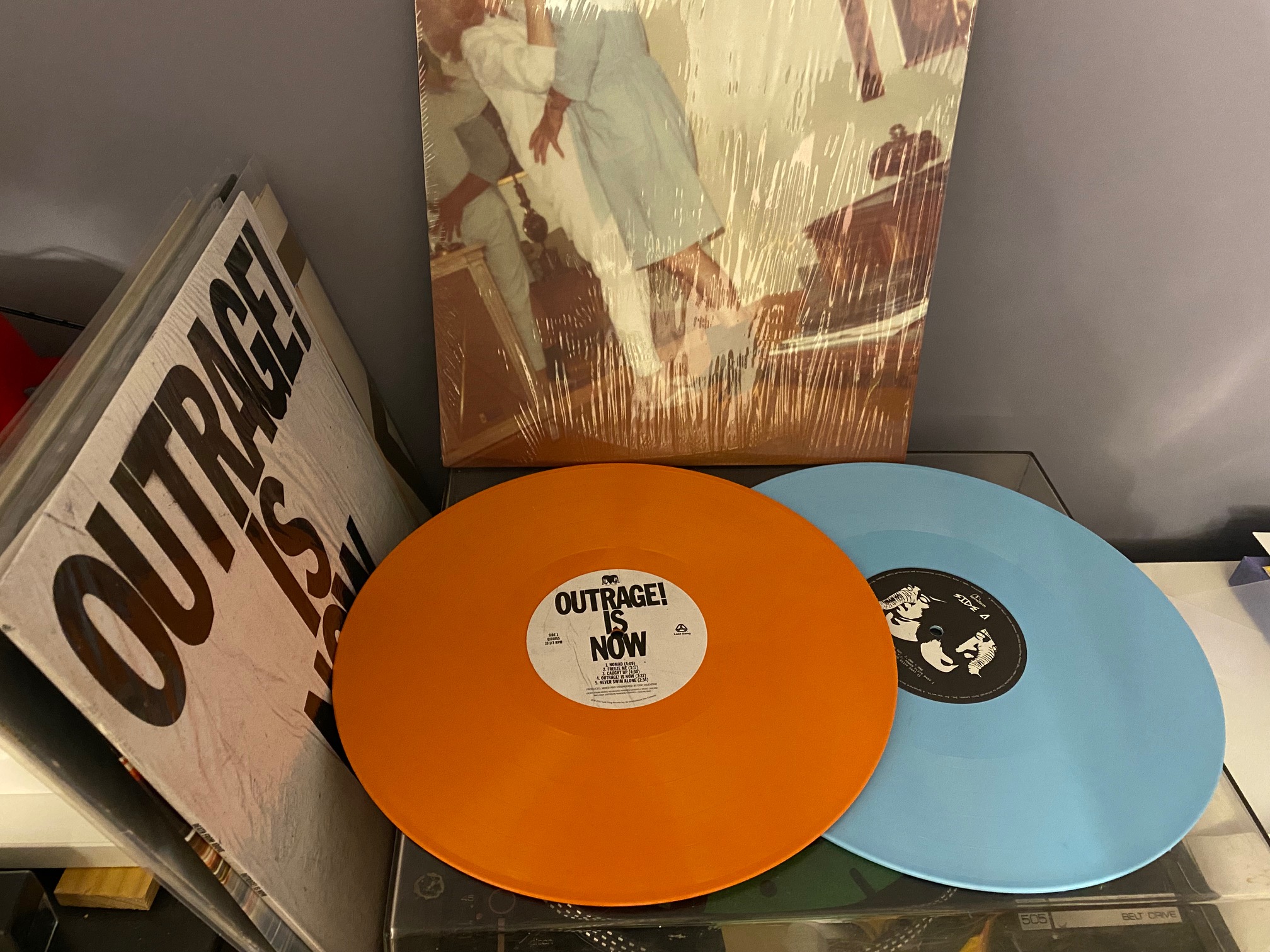
Jonathan Dowland: Death from Above

picture of two vinyl records
I received the last two Death From Above albums at Christmas and this weekend managed to give the first (Outrage Is Now) a spin. Pretty colours! They remain one of the best bands to see live. Last time I saw them in a support slot in Newcastle. My friend Rob, a man of few words said I wouldn t want to have to follow them on stage!

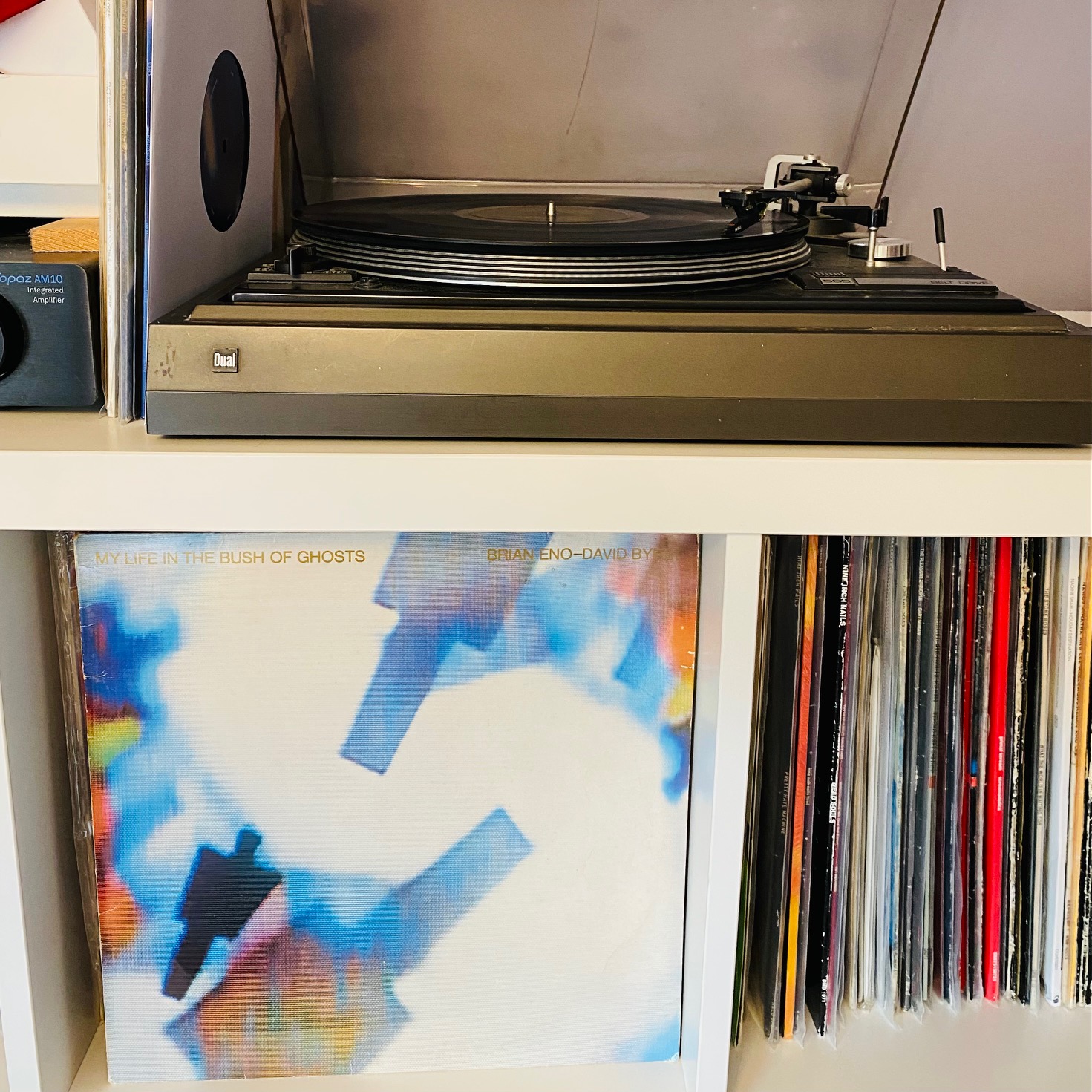
Jonathan Dowland: My Life In The Bush Of Ghosts

Photo of the record playing next to its cover.
My Life In The Bush Of Ghosts is a weird sound-collage-style album by Brian Eno and David Byrne, released in 1981. It has African-inspired rhythms layered with lots of samples from American radio and TV. It sounds almost like a field recording of the United States was made by wildlife surveyors. My copy is the UK first pressing which includes the track "Qu'ran" which was removed from later editions (and re-instated again later on). I previously wrote about uploading multitracks for two tracks from this album to archive.org.

Jonathan Dowland: One, by Be

picture of a vinyl record
The sublime One, by Be is a pastoral, English summer time instrumental improvisation around field recordings and the theme of the honey bee. A lovely piece to accompany deep thinking. I m reminded of Virginia Astley. Be are associated with Caught by the River, a collective who explore ways of setpping out of daily digital live and embrace, nature, walks, calm, etc.

5 April 2022

Matthew Garrett: Bearer tokens are just awful

As I mentioned last time, bearer tokens are not super compatible with a model in which every access is verified to ensure it's coming from a trusted device. Let's talk about that in a bit more detail.

First off, what is a bearer token? In its simplest form, it's simply an opaque blob that you give to a user after an authentication or authorisation challenge, and then they show it to you to prove that they should be allowed access to a resource. In theory you could just hand someone a randomly generated blob, but then you'd need to keep track of which blobs you've issued and when they should be expired and who they correspond to, so frequently this is actually done using JWTs which contain some base64 encoded JSON that describes the user and group membership and so on and then have a signature associated with them so whenever the user presents one you can just validate the signature and then assume that the contents of the JSON are trustworthy.

One thing to note here is that the crypto is purely between whoever issued the token and whoever validates the token - as far as the server is concerned, any client who can just show it the token is just fine as long as the signature is verified. There's no way to verify the client's state, so one of the core ideas of Zero Trust (that we verify that the client is in a trustworthy state on every access) is already violated.

Can we make things not terrible? Sure! We may not be able to validate the client state on every access, but we can validate the client state when we issue the token in the first place. When the user hits a login page, we do state validation according to whatever policy we want to enforce, and if the client violates that policy we refuse to issue a token to it. If the token has a sufficiently short lifetime then an attacker is only going to have a short period of time to use that token before it expires and then (with luck) they won't be able to get a new one because the state validation will fail.

Except! This is fine for cases where we control the issuance flow. What if we have a scenario where a third party authenticates the client (by verifying that they have a valid token issued by their ID provider) and then uses that to issue their own token that's much longer lived? Well, now the client has a long-lived token sitting on it. And if anyone copies that token to another device, they can now pretend to be that client.

This is, sadly, depressingly common. A lot of services will verify the user, and then issue an oauth token that'll expire some time around the heat death of the universe. If a client system is compromised and an attacker just copies that token to another system, they can continue to pretend to be the legitimate user until someone notices (which, depending on whether or not the service in question has any sort of audit logs, and whether you're paying any attention to them, may be once screenshots of your data show up on Twitter).

This is a problem! There's no way to fit a hosted service that behaves this way into a Zero Trust model - the best you can say is that a token was issued to a device that was, around that time, apparently trustworthy, and now it's some time later and you have literally no idea whether the device is still trustworthy or if the token is still even on that device.

But wait, there's more! Even if you're nowhere near doing any sort of Zero Trust stuff, imagine the case of a user having a bunch of tokens from multiple services on their laptop, and then they leave their laptop unlocked in a cafe while they head to the toilet and whoops it's not there any more, better assume that someone has access to all the data on there. How many services has our opportunistic new laptop owner gained access to as a result? How do we revoke all of the tokens that are sitting there on the local disk? Do you even have a policy for dealing with that?

There isn't a simple answer to all of these problems. Replacing bearer tokens with some sort of asymmetric cryptographic challenge to the client would at least let us tie the tokens to a TPM or other secure enclave, and then we wouldn't have to worry about them being copied elsewhere. But that wouldn't help us if the client is compromised and the attacker simply keeps using the compromised client. The entire model of simply proving knowledge of a secret being sufficient to gain access to a resource is inherently incompatible with a desire for fine-grained trust verification on every access, but I don't see anything changing until we have a standard for third party services to be able to perform that trust verification against a customer's policy.

Still, at least this means I can just run weird Android IoT apps through mitmproxy, pull the bearer token out of the request headers and then start poking the remote API with curl. It may all be broken, but it's also got me a bunch of bug bounty credit, so, it;s impossible to say if its bad or not,

(Addendum: this suggestion that we solve the hardware binding problem by simply passing all the network traffic through some sort of local enclave that could see tokens being set and would then sequester them and reinject them into later requests is OBVIOUSLY HORRIFYING and is also probably going to be at least three startup pitches by the end of next week)

comment count unavailable comments

Dirk Eddelbuettel: RcppSpdlog 0.0.8 on CRAN: Upstream Update

A new version 0.0.8 of RcppSpdlog is now on CRAN. RcppSpdlog bundles spdlog, a wonderful header-only C++ logging library with all the bells and whistles you would want that was written by Gabi Melman, and also includes fmt by Victor Zverovich. This release brings a new upstream release 1.10.0 of spdlog. The (minimal) NEWS entry for this release follows.

Changes in RcppSpdlog version 0.0.8 (2022-04-04)
  • Upgraded to upstream releases spdlog 1.10.0

Courtesy of my CRANberries, there is also a diffstat report. More detailed information is on the RcppSpdlog page, or the package documention site. If you like this or other open-source work I do, you can sponsor me at GitHub.

This post by Dirk Eddelbuettel originated on his Thinking inside the box blog. Please report excessive re-aggregation in third-party for-profit settings.

Dirk Eddelbuettel: RcppArmadillo 0.11.0.0.0 on CRAN: Upstream Updates

armadillo image Armadillo is a powerful and expressive C++ template library for linear algebra aiming towards a good balance between speed and ease of use with a syntax deliberately close to a Matlab. RcppArmadillo integrates this library with the R environment and language and is widely used by (currently) 972 other packages on CRAN, downloaded over 24 million times (per the partial logs from the cloud mirrors of CRAN), and the CSDA paper (preprint / vignette) by Conrad and myself has been cited 465 times according to Google Scholar. This release brings a new upstream release 11.0.0. We tested this very rigorously via three different RC release each of which got a full reverse-dependencies run (for which results are always logged here). The full set of changes (since the last CRAN release 0.10.8.1.0) follows.

Changes in RcppArmadillo version 0.11.0.0 (2022-04-04)
  • Upgraded to Armadillo release 11.0.0 (Creme Brulee)
    • added variants of inv() and inv_sympd() that provide rcond (reciprocal condition number)
    • expanded inv() and inv_sympd() with options inv_opts::tiny and inv_opts::allow_approx
    • stricter handling of singular matrices by inv() and inv_sympd()
    • stricter handling of non-sympd matrices by inv() and inv_sympd()
    • stricter handling of non-finitie matrices by pinv()
    • more robust handling of rank deficient matrices by solve()
    • faster handling of diagonal matrices by rcond()
    • changed eigs_sym() and eigs_gen() to use higher quality RNG
    • quantile() and median() will now throw an exception if given matrices/vectors have NaN elements
    • workaround for yet another bug in Intel MKL
  • Until May 2022, protect correction to Field behavior via define of RCPP_ARMADILLO_FIX_Field
  • If a LAPACK installation with missing complex routines is found (as e.g. Ubuntu using 3.9.0) then the LAPACK unit test is skipped.

Changes in RcppArmadillo version 0.10.8.2.0 (2022-02-01)
  • Upgraded to Armadillo release 10.8.2 (Realm Raider)
    • fix potential speed regression in pinv() and rank()

Courtesy of my CRANberries, there is a diffstat report relative to previous release. More detailed information is on the RcppArmadillo page. Questions, comments etc should go to the rcpp-devel mailing list off the R-Forge page. If you like this or other open-source work I do, you can sponsor me at GitHub.

This post by Dirk Eddelbuettel originated on his Thinking inside the box blog. Please report excessive re-aggregation in third-party for-profit settings.

Kees Cook: security things in Linux v5.10

Previously: v5.9 Linux v5.10 was released in December, 2020. Here s my summary of various security things that I found interesting: AMD SEV-ES
While guest VM memory encryption with AMD SEV has been supported for a while, Joerg Roedel, Thomas Lendacky, and others added register state encryption (SEV-ES). This means it s even harder for a VM host to reconstruct a guest VM s state. x86 static calls
Josh Poimboeuf and Peter Zijlstra implemented static calls for x86, which operates very similarly to the static branch infrastructure in the kernel. With static branches, an if/else choice can be hard-coded, instead of being run-time evaluated every time. Such branches can be updated too (the kernel just rewrites the code to switch around the branch ). All these principles apply to static calls as well, but they re for replacing indirect function calls (i.e. a call through a function pointer) with a direct call (i.e. a hard-coded call address). This eliminates the need for Spectre mitigations (e.g. RETPOLINE) for these indirect calls, and avoids a memory lookup for the pointer. For hot-path code (like the scheduler), this has a measurable performance impact. It also serves as a kind of Control Flow Integrity implementation: an indirect call got removed, and the potential destinations have been explicitly identified at compile-time. network RNG improvements
In an effort to improve the pseudo-random number generator used by the network subsystem (for things like port numbers and packet sequence numbers), Linux s home-grown pRNG has been replaced by the SipHash round function, and perturbed by (hopefully) hard-to-predict internal kernel states. This should make it very hard to brute force the internal state of the pRNG and make predictions about future random numbers just from examining network traffic. Similarly, ICMP s global rate limiter was adjusted to avoid leaking details of network state, as a start to fixing recent DNS Cache Poisoning attacks. SafeSetID handles GID
Thomas Cedeno improved the SafeSetID LSM to handle group IDs (which required teaching the kernel about which syscalls were actually performing setgid.) Like the earlier setuid policy, this lets the system owner define an explicit list of allowed group ID transitions under CAP_SETGID (instead of to just any group), providing a way to keep the power of granting this capability much more limited. (This isn t complete yet, though, since handling setgroups() is still needed.) improve kernel s internal checking of file contents
The kernel provides LSMs (like the Integrity subsystem) with details about files as they re loaded. (For example, loading modules, new kernel images for kexec, and firmware.) There wasn t very good coverage for cases where the contents were coming from things that weren t files. To deal with this, new hooks were added that allow the LSMs to introspect the contents directly, and to do partial reads. This will give the LSMs much finer grain visibility into these kinds of operations. set_fs removal continues
With the earlier work landed to free the core kernel code from set_fs(), Christoph Hellwig made it possible for set_fs() to be optional for an architecture. Subsequently, he then removed set_fs() entirely for x86, riscv, and powerpc. These architectures will now be free from the entire class of kernel address limit attacks that only needed to corrupt a single value in struct thead_info. sysfs_emit() replaces sprintf() in /sys
Joe Perches tackled one of the most common bug classes with sprintf() and snprintf() in /sys handlers by creating a new helper, sysfs_emit(). This will handle the cases where kernel code was not correctly dealing with the length results from sprintf() calls, which might lead to buffer overflows in the PAGE_SIZE buffer that /sys handlers operate on. With the helper in place, it was possible to start the refactoring of the many sprintf() callers. nosymfollow mount option
Mattias Nissler and Ross Zwisler implemented the nosymfollow mount option. This entirely disables symlink resolution for the given filesystem, similar to other mount options where noexec disallows execve(), nosuid disallows setid bits, and nodev disallows device files. Quoting the patch, it is useful as a defensive measure for systems that need to deal with untrusted file systems in privileged contexts. (i.e. for when /proc/sys/fs/protected_symlinks isn t a big enough hammer.) Chrome OS uses this option for its stateful filesystem, as symlink traversal as been a common attack-persistence vector. ARMv8.5 Memory Tagging Extension support
Vincenzo Frascino added support to arm64 for the coming Memory Tagging Extension, which will be available for ARMv8.5 and later chips. It provides 4 bits of tags (covering multiples of 16 byte spans of the address space). This is enough to deterministically eliminate all linear heap buffer overflow flaws (1 tag for free , and then rotate even values and odd values for neighboring allocations), which is probably one of the most common bugs being currently exploited. It also makes use-after-free and over/under indexing much more difficult for attackers (but still possible if the target s tag bits can be exposed). Maybe some day we can switch to 128 bit virtual memory addresses and have fully versioned allocations. But for now, 16 tag values is better than none, though we do still need to wait for anyone to actually be shipping ARMv8.5 hardware. fixes for flaws found by UBSAN
The work to make UBSAN generally usable under syzkaller continues to bear fruit, with various fixes all over the kernel for stuff like shift-out-of-bounds, divide-by-zero, and integer overflow. Seeing these kinds of patches land reinforces the the rationale of shifting the burden of these kinds of checks to the toolchain: these run-time bugs continue to pop up. flexible array conversions
The work on flexible array conversions continues. Gustavo A. R. Silva and others continued to grind on the conversions, getting the kernel ever closer to being able to enable the -Warray-bounds compiler flag and clear the path for saner bounds checking of array indexes and memcpy() usage. That s it for now! Please let me know if you think anything else needs some attention. Next up is Linux v5.11.

2022, Kees Cook. This work is licensed under a Creative Commons Attribution-ShareAlike 4.0 License.
CC BY-SA 4.0

4 April 2022

Ben Hutchings: Debian LTS work, March 2022

In March I was assigned 16 hours of work by Freexian's Debian LTS initiative and carried over 8 hours from February. I worked 16 hours, and will carry over the remaining time to April. I backported the mitigations for Spectre-BHB (CVE-2022-0001, CVE-2022-0002) on x86 processors, to Linux 4.9. I worked together with Salvatore Bonaccorso in preparing the kernel updates that were needed in all suites, and writing advisory text. I uploaded both the linux (4.9) and linux-4.19 packages to stretch, and issued DLA-2940-1 and DLA-2941-1. I also triaged new issues that were reported later in the month.

1 April 2022

Dirk Eddelbuettel: RInside 0.2.17

A new release 0.2.17 of RInside arrived on CRAN and in Debian today. This is the first release in two years since the 0.2.16 release. RInside provides a set of convenience classes which facilitate embedding of R inside of C++ applications and programs, using the classes and functions provided by Rcpp. This release brings a minor update for R 4.2.0, due out later this month, and kindly provided by Tomas Kalibera. It updates one function declaration; we wrapped some conditioning around so that RInside continues to build with older releases too. Besides that minor updates were made to continuous integration and some of the package files. The short list of changes since the last release were:

Changes in RInside version 0.2.17 (2022-03-31)
  • A Windows-only patch for R 4.2.0 kindly provided by Tomas Kalibera was applied, and also conditioned on R (>= 4.2.0)
  • Continuous Integration setup was updated and now uses r-ci.
  • Several updates were made to README.md (badges etc) and DESCRIPTION

My CRANberries also provides a short report with changes from the previous release. More information is on the RInside page. Questions, comments etc should go to the rcpp-devel mailing list off the Rcpp R-Forge page, or to issues tickets at the GitHub repo. If you like this or other open-source work I do, you can now sponsor me at GitHub.

This post by Dirk Eddelbuettel originated on his Thinking inside the box blog. Please report excessive re-aggregation in third-party for-profit settings.

Junichi Uekawa: I am more used to Rust.

I am more used to Rust. I can do simple string processing faster in Rust than say Python. It has enough things to make it more pleasant to work with than C++.

Paul Wise: FLOSS Activities March 2022

Focus This month I didn't have any particular focus. I just worked on issues in my info bubble.

Changes

Issues

Review
  • Spam: reported 3 Debian bug reports and 53 Debian mailing list posts
  • Debian wiki: RecentChanges for the month
  • Debian BTS usertags: changes for the month
  • Debian screenshots:

Administration
  • Debian servers: investigate wiki mail delivery issue, restart backup director
  • Debian wiki: unblock IP addresses, approve accounts

Communication
  • Forward python-plac test failure issue upstream
  • Participate in Debian Project Leader election discussions
  • Respond to queries from Debian users and contributors on the mailing lists and IRC

Sponsors The oci-python-sdk and plac work was sponsored. All other work was done on a volunteer basis.

31 March 2022

Matthew Garrett: ZTA doesn't solve all problems, but partial implementations solve fewer

Traditional network access controls work by assuming that something is trustworthy based on some other factor - for example, if a computer is on your office network, it's trustworthy because only trustworthy people should be able to gain physical access to plug something in. If you restrict access to your services to requests coming from trusted networks, then you can assert that it's coming from a trusted device.

Of course, this isn't necessarily true. A machine on your office network may be compromised. An attacker may obtain valid VPN credentials. Someone could leave a hostile device plugged in under a desk in a meeting room. Trust is being placed in devices that may not be trustworthy.

A Zero Trust Architecture (ZTA) is one where a device is granted no inherent trust. Instead, each access to a service is validated against some policy - if the policy is satisfied, the access is permitted. A typical implementation involves granting each device some sort of cryptographic identity (typically a TLS client certificate) and placing the protected services behind a proxy. The proxy verifies the device identity, queries another service to obtain the current device state (we'll come back to that in a moment), compares the state against a policy and either pass the request through to the service or reject it. Different services can have different policies (eg, you probably want a lax policy around whatever's hosting the documentation for how to fix your system if it's being refused access to something for being in the wrong state), and if you want you can also tie it to proof of user identity in some way.

From a user perspective, this is entirely transparent. The proxy is made available on the public internet, DNS for the services points to the proxy, and every time your users try to access the service they hit the proxy instead and (if everything's ok) gain access to it no matter which network they're on. There's no need to connect to a VPN first, and there's no worries about accidentally leaking information over the public internet instead of over a secure link.

It's also notable that traditional solutions tend to be all-or-nothing. If I have some services that are more sensitive than others, the only way I can really enforce this is by having multiple different VPNs and only granting access to sensitive services from specific VPNs. This obviously risks combinatorial explosion once I have more than a couple of policies, and it's a terrible user experience.

Overall, ZTA approaches provide more security and an improved user experience. So why are we still using VPNs? Primarily because this is all extremely difficult. Let's take a look at an extremely recent scenario. A device used by customer support technicians was compromised. The vendor in question has a solution that can tie authentication decisions to whether or not a device has a cryptographic identity. If this was in use, and if the cryptographic identity was tied to the device hardware (eg, by being generated in a TPM), the attacker would not simply be able to obtain the user credentials and log in from their own device. This is good - if the attacker wanted to maintain access to the service, they needed to stay on the device in question. This increases the probability of the monitoring tooling on the compromised device noticing them.

Unfortunately, the attacker simply disabled the monitoring tooling on the compromised device. If device state was being verified on each access then this would be noticed before too long - the last data received from the device would be flagged as too old, and the requests would no longer satisfy any reasonable access control policy. Instead, the device was assumed to be trustworthy simply because it could demonstrate its identity. There's an important point here: just because a device belongs to you doesn't mean it's a trustworthy device.

So, if ZTA approaches are so powerful and user-friendly, why aren't we all using one? There's a few problems, but the single biggest is that there's no standardised way to verify device state in any meaningful way. Remote Attestation can both prove device identity and the device boot state, but the only product on the market that does much with this is Microsoft's Device Health Attestation. DHA doesn't solve the broader problem of also reporting runtime state - it may be able to verify that endpoint monitoring was launched, but it doesn't make assertions about whether it's still running. Right now, people are left trying to scrape this information from whatever tooling they're running. The absence of any standardised approach to this problem means anyone who wants to deploy a strong ZTA has to integrate with whatever tooling they're already running, and that then increases the cost of migrating to any other tooling later.

But even device identity is hard! Knowing whether a machine should be given a certificate or not depends on knowing whether or not you own it, and inventory control is a surprisingly difficult problem in a lot of environments. It's not even just a matter of whether a machine should be given a certificate in the first place - if a machine is reported as lost or stolen, its trust should be revoked. Your inventory system needs to tie into your device state store in order to ensure that your proxies drop access.

And, worse, all of this depends on you being able to put stuff behind a proxy in the first place! If you're using third-party hosted services, that's a problem. In the absence of a proxy, trust decisions are probably made at login time. It's possible to tie user auth decisions to device identity and state (eg, a self-hosted SAML endpoint could do that before passing through to the actual ID provider), but that's still going to end up providing a bearer token of some sort that can potentially be exfiltrated, and will continue to be trusted even if the device state becomes invalid.

ZTA doesn't solve all problems, and there isn't a clear path to it doing so without significantly greater industry support. But a complete ZTA solution is significantly more powerful than a partial one. Verifying device identity is a step on the path to ZTA, but in the absence of device state verification it's only a step.

comment count unavailable comments

30 March 2022

Ulrike Uhlig: How do kids conceive the internet?

I wanted to understand how kids between 10 and 18 conceive the internet. Surely, we have seen a generation that we call digital natives grow up with the internet. Now, there is a younger generation who grows up with pervasive technology, such as smartphones, smart watches, virtual assistants and so on. And only a few of them have parents who work in IT or engineering
Pervasive technology contributes to the idea that the internet is immaterial With their search engine website design, Google has put in place an extremely simple and straightforward user interface. Since then, designers and psychologists have worked on making user interfaces more and more intuitive to use. The buzzwords are usability and user experience design . Besides this optimization of visual interfaces, haptic interfaces have evolved as well, specifically on smartphones and tablets where hand gestures have replaced more clumsy external haptic interfaces such as a mouse. And beyond interfaces, the devices themselves have become smaller and slicker. While in our generation many people have experienced opening a computer tower or a laptop to replace parts, with the side effect of seeing the parts the device is physically composed of, the new generation of end user devices makes this close to impossible, essentially transforming these devices into black boxes, and further contributing to the idea that the internet they are being used to access with would be something entirely intangible.

What do kids in 2022 really know about the internet? So, what do kids of that generation really know about the internet, beyond purely using services they do not control? In order to find out, I decided to interview children between 10 and 18. I conducted 5 interviews with kids aged 9, 10, 12, 15 and 17, two boys and three girls. Two live in rural Germany, one in a German urban area, and two live in the French capital. I wrote the questions in a way to stimulate the interviewees to tell me a story each time. I also told them that the interview is not a test and that there are no wrong answers. Except for the 9 year old, all interviewees possessed both, their own smartphone and their own laptop. All of them used the internet mostly for chatting, entertainment (video and music streaming, online games), social media (TikTok, Instagram, Youtube), and instant messaging. Let me introduce you to their concepts of the internet. That was my first story telling question to them:

If aliens had landed on Earth and would ask you what the internet is, what would you explain to them? The majority of respondents agreed in their replies that the internet is intangible while still being a place where one can do anything and everything . Before I tell you more about their detailed answers to the above question, let me show you how they visualize their internet.

If you had to make a drawing to explain to a person what the internet is, how would this drawing look like? Each interviewee had some minutes to come up with a drawing. As you will see, that drawing corresponds to what the kids would want an alien to know about the internet and how they are using the internet themselves.

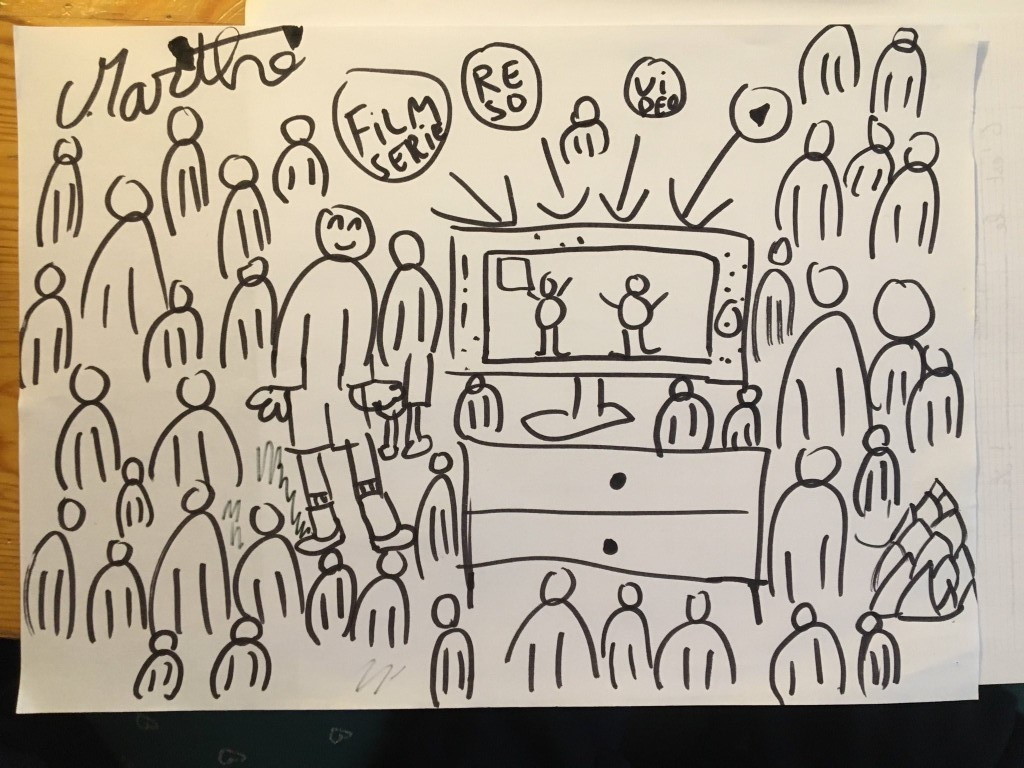
Movies, series, videos A child's drawing. In the middle, there is a screen, on the screen a movie is running. Around the screen there are many people, at least two dozens. The words 'film', 'series', 'network', 'video' are written and arrows point from these words to the screen. There's also a play icon. The youngest respondent, a 9 year old girl, drew a screen with lots of people around it and the words film, series, network, video , as well as a play icon. She said that she mostly uses the internet to watch movies. She was the only one who used a shared tablet and smartphone that belonged to her family, not to herself. And she would explain the net like this to an alien:
"Internet is a er one cannot touch it it s an, er [I propose the word idea ], yes it s an idea. Many people use it not necessarily to watch things, but also to read things or do other stuff."

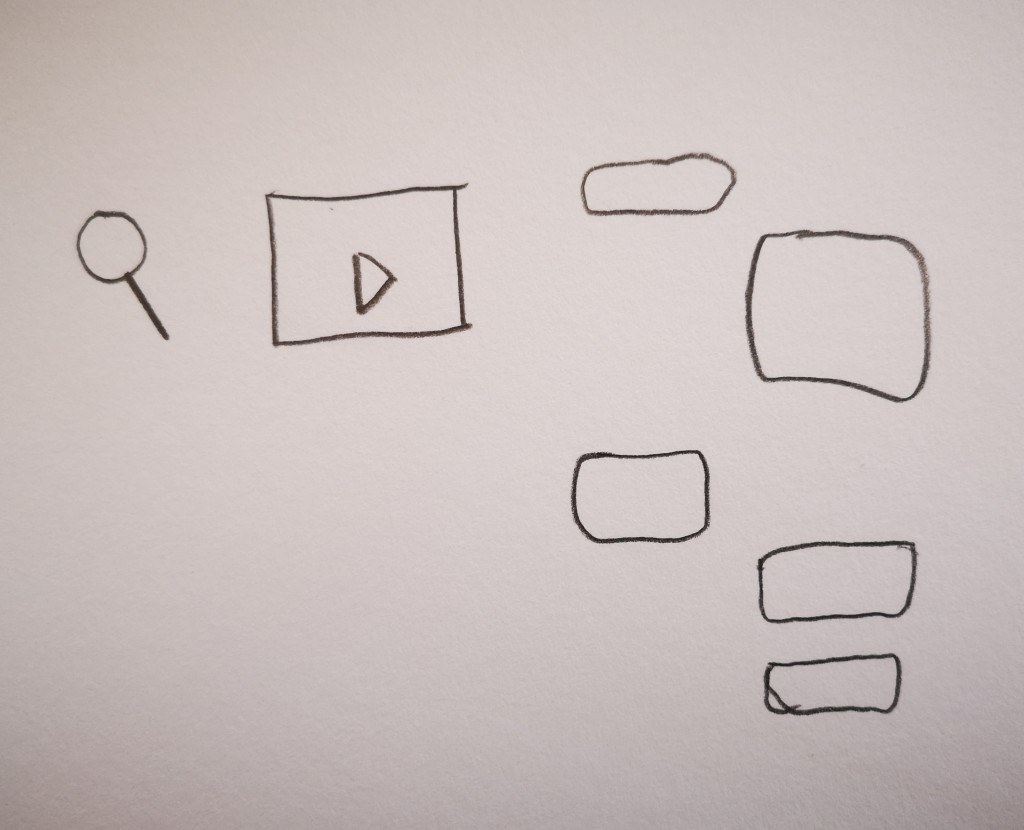
User interface elements There is a magnifying glass icon, a play icon and speech bubbles drawn with a pencil. A 10 year old boy represented the internet by recalling user interface elements he sees every day in his drawing: a magnifying glass (search engine), a play icon (video streaming), speech bubbles (instant messaging). He would explain the internet like this to an alien:
"You can use the internet to learn things or get information, listen to music, watch movies, and chat with friends. You can do nearly anything with it."

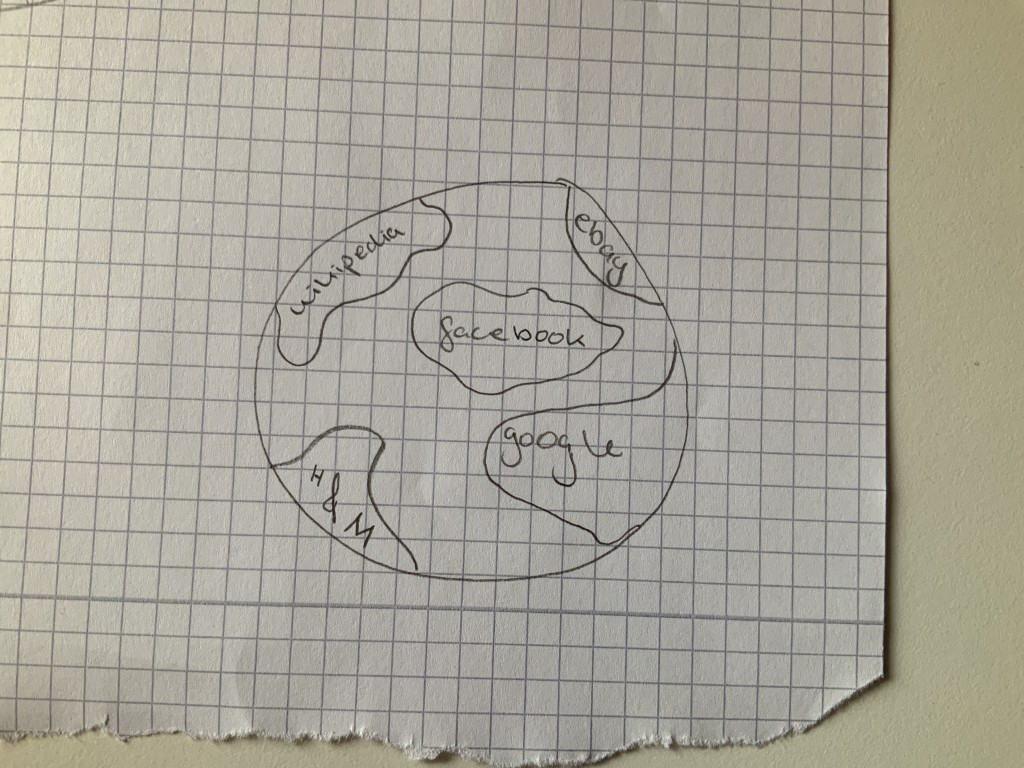
Another planet Pencil drawing that shows a planet with continents. The continents are named: H&M, Ebay, Google, Wikipedia, Facebook. A 12 year old girl imagines the internet like a second, intangible, planet where Google, Wikipedia, Facebook, Ebay, or H&M are continents that one enters into.
"And on [the] Ebay [continent] there s a country for clothes, and ,trousers , for example, would be a federal state in that country."
Something that was unique about this interview was that she told me she had an email address but she never writes emails. She only has an email account to receive confirmation emails, for example when doing online shopping, or when registering to a service and needing to confirm one s address. This is interesting because it s an anti-spam measure that might become outdated with a generation that uses email less or not at all.

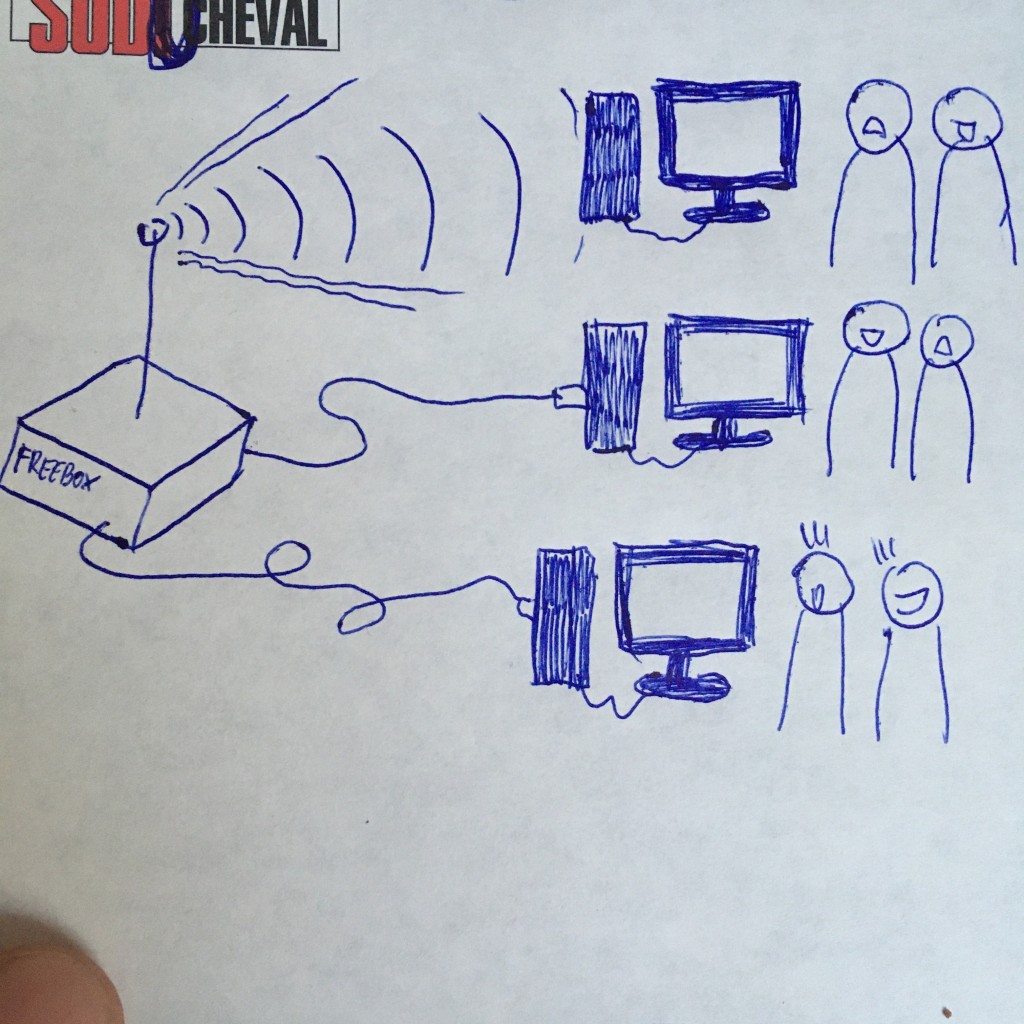
Home network Kid's drawing: there are three computer towers and next to each there are two people. The first couple is sad, the seconf couple is smiling, the last one is suprised. Each computer is connected to a router, two of them by cable, one by wifi. A 15 year old boy knew that his family s devices are connected to a home router (Freebox is a router from the French ISP Free) but lacked an imagination of the rest of the internet s functioning. When I asked him about what would be behind the router, on the other side, he said what s behind is like a black hole to him. However, he was the only interviewee who did actually draw cables, wifi waves, a router, and the local network. His drawing is even extremely precise, it just lacks the cable connecting the router to the rest of the internet.
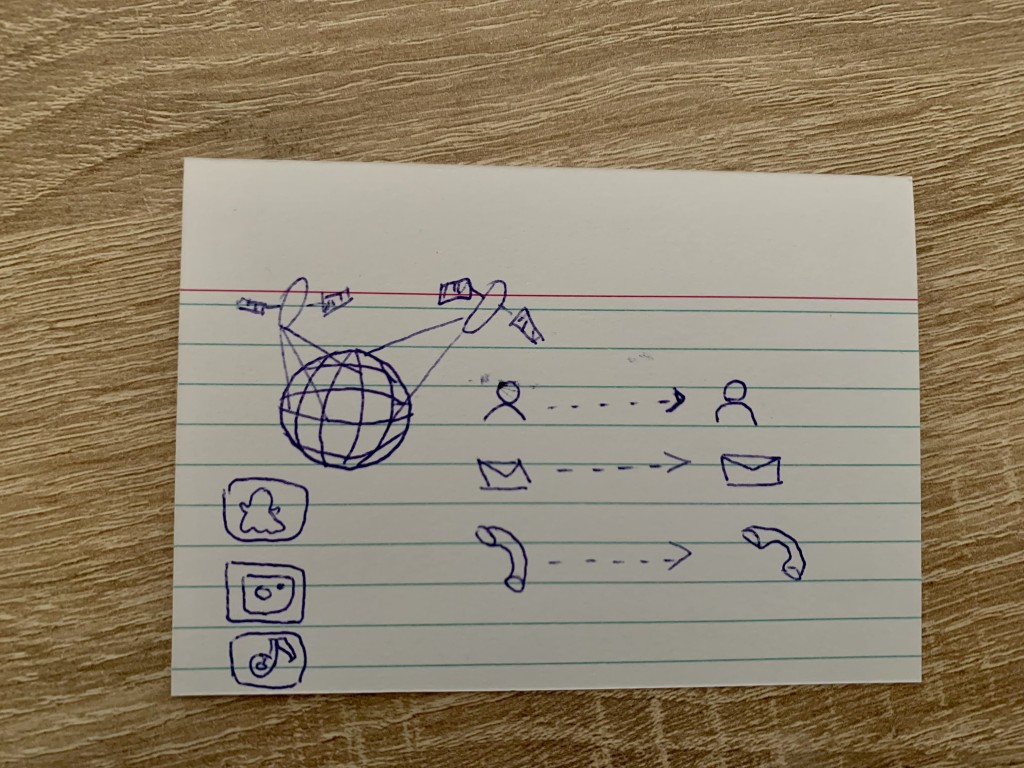
Satellite internet This is another very simple drawing: On top left, there's planet Earth an there are lines indicating that earth is a sphere. Around Earth there are two big satellites reaching most of Earth. on the left, below, there are three icons representing social media services on the internet: Snapchat, Instagram, TikTok. On the right, there are simplified drawings of possibilities which the internet offers: person to person connection, email (represented by envelopes), calls (represented by an old-style telephone set). A 17 year old girl would explain the internet to an alien as follows:

"The internet goes around the entire globe. One is networked with everyone else on Earth. One can find everything. But one cannot touch the internet. It s like a parallel world. With a device one can look into the internet. With search engines, one can find anything in the world, one can phone around the world, and write messages. [The internet] is a gigantic thing."
This interviewee stated as the only one that the internet is huge. And while she also is the only one who drew the internet as actually having some kind of physical extension beyond her own home, she seems to believe that internet connectivity is based on satellite technology and wireless communication.

Imagine that a wise and friendly dragon could teach you one thing about the internet that you ve always wanted to know. What would you ask the dragon to teach you about? A 10 year old boy said he d like to know how big are the servers behind all of this . That s the only interview in which the word server came up. A 12 year old girl said I would ask how to earn money with the internet. I always wanted to know how this works, and where the money comes from. I love the last part of her question! The 15 year old boy for whom everything behind the home router is out of his event horizon would ask How is it possible to be connected like we are? How does the internet work scientifically? A 17 year old girl said she d like to learn how the darknet works, what hidden things are there? Is it possible to get spied on via the internet? Would it be technically possible to influence devices in a way that one can listen to secret or telecommanded devices? Lastly, I wanted to learn about what they find annoying, or problematic about the internet.

Imagine you could make the internet better for everyone. What would you do first? Asked what she would change if she could, the 9 year old girl advocated for a global usage limit of the internet in order to protect the human brain. Also, she said, her parents spend way too much time on their phones and people should rather spend more time with their children. Three of the interviewees agreed that they see way too many advertisements and two of them would like ads to disappear entirely from the web. The other one said that she doesn t want to see ads, but that ads are fine if she can at least click them away. The 15 year old boy had different ambitions. He told me he would change:
"the age of access to the internet. More and more younger people access the internet ; especially with TikTok there is a recommendation algorithm that can influcence young people a lot. And influencing young people should be avoided but the internet does it too much. And that can be negative. If you don t yet have a critical spirit, and you watch certain videos you cannot yet moderate your stance. It can influence you a lot. There are so many things that have become indispensable and that happen on the internet and we have become dependent. What happens if one day it doesn t work anymore? If we connect more and more things to the net, that s not a good thing."

The internet - Oh, that s what you mean! On a sidenote, my first interview tentative was with an 8 year old girl from my family. I asked her if she uses the internet and she denied, so I abandoned interviewing her. Some days later, while talking to her, she proposed to look something up on Google, using her smartphone. I said: Oh, so you are using the internet! She replied: Oh, that s what you re talking about? I think she knows the word Google and she knows that she can search for information with this Google thing. But it appeared that she doesn t know that the Google search engine is located somewhere else on internet and not on her smartphone. I concluded that for her, using the services on the smartphone is as natural as switching on a light in the house: we also don t think about where the electricity comes from when we do that.

What can we learn from these few interviews? Unsurprisingly, social media, streaming, entertainment, and instant messaging are the main activities kids undertake on the internet. They are completely at the mercy of advertisements in apps and on websites, not knowing how to get rid of them. They interact on a daily basis with algorithms that are unregulated and known to perpetuate discrimination and to create filter bubbles, without necessarily being aware of it. The kids I interviewed act as mere service users and seem to be mostly confined to specific apps or websites. All of them perceived the internet as being something intangible. Only the older interviewees perceived that there must be some kind of physical expansion to it: the 17 year old girl by drawing a network of satellites around the globe, the 15 year old boy by drawing the local network in his home. To be continued

Bits from Debian: Lenovo Platinum Sponsor of DebConf22

lenovologo We are very pleased to announce that Lenovo has committed to supporting DebConf22 as a Platinum sponsor. This is the fourth year in a row that Lenovo is sponsoring The Debian Conference with the higher tier! As a global technology leader manufacturing a wide portfolio of connected products, including smartphones, tablets, PCs and workstations as well as AR/VR devices, smart home/office and data center solutions, Lenovo understands how critical open systems and platforms are to a connected world. With this commitment as Platinum Sponsor, Lenovo is contributing to make possible our annual conference, and directly supporting the progress of Debian and Free Software, helping to strengthen the community that continues to collaborate on Debian projects throughout the rest of the year. Thank you very much Lenovo, for your support of DebConf22! Become a sponsor too! DebConf22 will take place from July 17th to 24th, 2022 at the Innovation and Training Park (ITP) in Prizren, Kosovo, and will be preceded by DebCamp, from July 10th to 16th. And DebConf22 is still accepting sponsors! Interested companies and organizations may contact the DebConf team through sponsors@debconf.org, and visit the DebConf22 website at https://debconf22.debconf.org/sponsors/become-a-sponsor. DebConf22 banner open registration

29 March 2022

Dirk Eddelbuettel: RcppBDT 0.2.5: Maintenance

A minor maintenance release for the RcppBDT package is now on CRAN. The RcppBDT package is an early adopter of Rcpp and was one of the first packages utilizing Boost and its Date_Time library. The now more widely-used package anytime is a direct descentant of RcppBDT. Thanks again for the heads-up! This release mostly deals with a one-definition rule violation detected by link-time optimisation (which can be enable when configuring R itself at build time with --enable-lto). I confused myself into thinking Rcpp Modules may be at fault, but I aki was a little more awake than myself and noticed that I only needed to carry the (common) header RcppBDT.h to the file toPOSIXct.cpp added last summer. The NEWS entry follows:

Changes in version 0.2.5 (2022-03-29)
  • Ensure consistent compilation by ensuring RcppBDT.h is included in all files, this addresses an LTO/ODR issue
  • Correct one declaration in init.c
  • Minor additional cleanups

Courtesy of my CRANberries, there is also a diffstat report for this release. If you like this or other open-source work I do, you can now sponsor me at GitHub.

This post by Dirk Eddelbuettel originated on his Thinking inside the box blog. Please report excessive re-aggregation in third-party for-profit settings.

Next.

Previous.