Search Results: "ag"

26 June 2008

Pierre Habouzit: firefox3 and SSL

Yes Stefano, I too believe that the SSL certificate thingy in Iceweasel 3 is just a bad joke. I mean WHAT THE FUCK WERE THEY THINKING ? At least in the RCs it improved, and the logo isn't the same as 404, it took me 10 refresh the first time I saw it to understand that it was not a 404 but an untrusted self-signed certificate. And the whole "exception" thing is absurd. NO I DON'T WANT TO ADD AN EXCEPTION you morons. Here would be a good UI, that I never saw implemented in any browser but would make sense: It's enough for 99.9% of the users. Then, some of us really care about importing some untrusted certificates (for our own webmails e.g.). Then well, a small button that allows advanced users to check, import, and mark an untrusted certificate as trusted is just what one needs. One can even hide that in some menu, it would be fine. I for example, have only checked the SSL certificate from my webmail and something like 3 or 4 websites. I do NOT want to be bugged for the other. But no, instead we have this completely delirious interface that no-one can sanely call User Interface. They're on crack. Anyways, here is a way to make your pain easier, either in about:config or in your $ HOME /.mozilla/firefox/$ profile-with-name-on-crack-id /user.prefs set the following values this way[1]:
 user_pref("browser.ssl_override_behavior", 2);
 user_pref("browser.xul.error_pages.expert_bad_cert", true);
It makes validating a certificate two clicks away (one of the settings shows the 'add exception' buttons instead of showing a link to make them visible, the other settings makes firefox download the certificate for you so that you don't have to ASK HIM to do so[2]. And you know the worst thing ? I'm sure the guy(s) who wrote this fucking dialog is(are) very proud of it.
Notes [1] Thanks to glandium for the hints [2] WTF people, WTF do you need us to make you download the certificate. This is nonsensical, the user had already 3 clicks to have the add exception dialog, and you need one to download the certificate ? WTF are you thinking!!!

Stefano Zacchiroli: firefox 3 un-ranting

Gunnar, have a look at this: iceweasel-ssl.png. So your example using the Penta website was just a bad one, and I personally agree with the "INVALID" resolution of your bug report. In fact, showing a partially encrypted connection as an insecure one is an overall advantage for (l)user securities, as with the browser interfaces we are used to use, we don't know which parts are actually sent encrypted and which are not. As you can see in the example above a fully encrypted connection is properly reported as such by Firefox 3.0. FWIW: I'm overall satisfied with Firefox 3.0, especially about the new URL bar Wouther is disliking. Yes it is a bit slower than before, but even on my 4-year old laptop it is perfectly usable. The HTML title shown there? Well, it is rather handy when I start typing bugs.debian.org and then I've to discriminate among tons of almost identical bug report URLs ... Is the about:config hand-holding dialog worst than the pop-up the first time you "have provided unencrypted information" in a random form? It is not, we have probably just forgot about the first time we unchecked the corresponding checkbox. All in all, the only "feature" of the new Firefox I found incredibly stupid is the SSL certificate exception mechanism. Installing the untrusted certificate is what? ... 5 click-away from the initial page? That is just dumb. (And as it is well-known that habits form anyhow, getting the habits harder to form is just a way to piss-off users.)

25 June 2008

Christian Perrier: triggers: those great improvements Joe User will never see

My random thoughts of the day go to the "triggers" feature in dpkg. The addition of that feature triggered a lot of noise, discussions and flames a few months ago. Actually more about the way it was added and the schedule that was followed, more than the feature itself. No need to come back on this. That's Debian's life...:-) These days are over: the feature is here. And frankly I love it even though I probably don't understand more than 10% of it... Today, I ran quite huge "dist-upgrade" of my laptop (where I try to stick with unstable) after 3...days not upgrading it. And I noticed that:
.../...
D paquetage de la mise   jour de foo
Pr paration du remplacement de foo
.../...
Param trage de foo
.../...
Traitement des   d clenchements (triggers)   pour   menu  ...
.../...
(isn't the French localization of dpkg rocking?). So, as I understand, update-menus is now only called once per run instead of being launched on every package configuration. If I'm correct, this is what triggers are for. And, frankly, that rocks. This is one of these improvements that will never be noticed by Joe Random User, but exactly one that makes our favourite distro and its derivatives the best all around. So, that random blog post is dedicated to all people who made this possible. Such things are the reason I'm still stuck to Debian after so many years.

David Nusinow: Things To Do When You're Busy Trying To Graduate

I've been too busy to do any serious free software work lately, but here's my "low time commitment TODO list":
  1. Give xconq some serious love. That includes bugfixes, updating to the new tk, and a total repackaging with more standardized methods.

  2. Write more docs for X. I think we badly need a simple well integrated user's guide, followed by better high and low level internals documentation.

None of these things require a consistent time commitment (and no mailing lists for me to follow) so I hope I'll be able to get some work in on them soon.

Russell Coker: Safety of Child Seats

I have just watched an interesting lecture by Steven Levitt about car safety for children in the 2-6 age range [1]. The evidence he presents shows that the benefits for children in that age range are at best insignificant and that in some corner cases (EG rear impacts) the child seat may give a worse result than an adult seat belt! He advocates a 5-point harness [2] for children in the 2-6 age range that is based on a standard adult seat and seems to be advocating a child “booster seat” integrated into the adult seat (which approximates the booster seats offered by some recent cars such as the VW Passat). He has a picture of a child in a child-sized 5-point harness to illustrate his point. But one thing that should be considered is the benefit of a 5 point harness for adults. Race car drivers use 5 point harnesses, I wonder how the probability of a race car dying during the course of their employment compares with the probability of an average adult dying while doing regular driving. I also wonder how a 5 point harness compares to a three point harness with a pre-tensioner, it seems quite possible that a 5 point harness would be cheaper and safer than the 3 point harness with pre-tensioner that is found in all the most expensive cars manufactured in the last few years. He believes (based on tests with crash-test dummies) that part of the problem is that the child seat will move in an accident (it’s attached to a soft seat). It seems that one potential solution to this is to have child seats that firmly attach to some solid part of a vehicle. I had previously suggested that child seats which replace existing seats as an option from the manufacturer would be a good idea [3]. But there is a good option for making better child seats for existing vehicles. It is becoming common in the “people mover” market segment to design vehicles with removable seats. For example the Kia Carnival has three seats in the middle row which are removable and which attach to four steel bars in the floor. It should not be difficult to design a child seat which attaches to those bars and could therefore be plugged in to a Carnival in a matter of minutes. The Carnival is designed to have the mid row seats installed or removed easily and safely by someone who is untrained, while for comparison it is recommended that a regular child seat should only be installed by a trained professional (IE your regular mechanic can’t do it).

Kartik Mistry: fortunes-debian-hints 1.9!


* Yay! I did it again!! Tolimar had uploaded fortunes-debian-hints 1.9 just before he went for his marriage. Many thanks and congrats to him! Also, thanks to Nicolas (nekral) and all translators for great job!

Mike Hommey: Pissing users off

It seems some people don’t like the new about:config warning in Firefox 3.0. The sad thing is this message was not intended to piss people off. The localization note intended for translaters reads:
<!– LOCALIZATION NOTE: aboutWarningTitle.label should be attention grabbing and playful –>
It’s not even necessarily talking about warranty in other locales:
<!ENTITY aboutWarningTitle.label “Attention, danger !”> (fr)
<!ENTITY aboutWarningTitle.label “ Zona hostil para manazas!”> (es-ES)
<!ENTITY aboutWarningTitle.label “Here be dragons!”> (en-GB)
Seems like the en-US version has a strange definition of playful.

Pablo Lorenzzoni: Exciting new World

I ve just tested the improvements in the performance of Javascript in Firefox 3 and WOW! Javascript in FF3 is really fast. While googling about it I just ran across a recent interview with Brendan Eich about the future of Javascript and I got excited about two things about this future. First was what we already have, still in the beginning, but with a lot of potential: HotRuby. Really interesting to script a webpage in Ruby (which is my favorite language) and, while it s not embedded the way Javascript is, it gets compiled in the server side with YARV (the new bytecode compiler for the next version of Ruby, 1.9), and then served to the browser in the form of JSON objects, so it can be interpreted by the Javascript engine in it. All this is transparent and work with XMLHttpRequest. It s not a coincidence that Eich mentions it as being a form of ARAX (changing the J in AJAX for R from Ruby). I already do a lot of coding in Ruby not having to deal with Javascript anymore is surely a plus. ITOH, Eich is talking about improvements in Javascript that would render it as a real programming language Maybe coding in it would not be so painful anymore by then ;-) The whole interview have to do with this Project Tamarin, a high-performance, open source implementation of the ECMAScript 4th edition (ES4) language specification [ ECMAScript 4 is the same thing as Javascript 2 ] by the Mozilla developers. And this is the second thing I got excited for: they ve planned to glue IronRuby (Ruby compiler for argh! .NET) to it via IronMonkey. So exciting news! Either via Tamarin or via HotRuby, we ll get Ruby browser scripting. My free mind tends to favor HotRuby instead of IronRuby/IronMonkey/Tamarin But in the end what matters is that all those people now cursed by Javascript will finally have a taste of what a real programming language feels like.. Who knows! They might even like it ;-D

David Moreno Garza: YAPC::NA 2008

So I attended the conference last week in Chicago, IL. I was just been procrastinating to write about this.

As a (almost) complete outsider of the Perl community, I have countered thoughts about the whole event:

After all, it was quite a nice and new experience. I'm not totally sure I'll attend YAPC::NA 2009 in Pittsburgh, PA, we'll see.

Decklin Foster: Arrogance

Today, like any other day, I started Firefo^WIceweasel. I mapped it at the bottom of my window stack. It promptly raised itself. I closed everything and tried opening a new homepage. Nope, that's fine. I tried again with two tabs saved. It raised itself again. I have been watching variations of this bug regress for eight years now and I am tired of it. So I installed Conkeror. After a good three-year run of being able to sit down at someone else's random PC and say, "hey, a web browser that nearly works as well as mine" (since it is, you know, the same one), I look forward to being utterly fed up with how primitive the rest of the world is again. And what are we in this for, if not that?

Christoph Berg: Arrogant database

Imagine every Unix command would...
$ mysqladmin foo 2>&1   hd
00000000  07 6d 79 73 71 6c 61 64  6d 69 6e 3a 20 63 6f 6e   .mysqladmin: con 
... prepend ^G to its error messages.

Gunnar Wolf: Firefox suckyness

I have to agree with Wouter regarding Firefox Iceweasel 3's suckyness. It might be a superior product in many fronts (I prefer it overall to its predecesor), but were it not for the usefulness of its many available extensions (most notably Web Developer, which has become an integral part of my everyday life), I'd have jumped ship for basically any other browser.
I'm just... adding an <AOL>ME TOO!</AOL> on Wouter's comments... WTF, just go to about:config...

So... Are you telling me that Firefox (even if it were the original, Mozilla-blessed version) has a warranty? No? Didn't think so... Go to about:license. You will see the very familiar and expected:
7. Disclaimer of warranty
Covered code is provided under this license on an "as is" basis, without warranty of any kind, either expressed or implied, including, without limitation, warranties that the covered code is free of defects (...)
Other than this downright stupid issue (which by and large goes against the regular Free Software culture), my main gripe is the number of active regions in the location-entry boxes - Yes, I can jump straight to the search box with Ctrl-K and to the location bar with Ctrl-L, but if I happen to try to move between them with good ol' Tab, why must it be inconsistent?
What do I mean? Go to the search field, press Tab. As expected, you are in the Location entry. Now, press Shift-Tab. For 5 points, where are you now? Bzzzt, no, you are not back where you began - You are in a stupid button which looks like your favicon giving you the identity information about the page you are looking at.
Having this button is a great idea - but why does it have to sit in the way of my tabulation? Were it because, in an inspired moment, the Firefox interface designers decided that buttons should be keyboard-accessible, I'd be most happy (it is by far my most mouse-intensive application, and I hate that... But it's just a button embedded in what should be a clean text-entry box.
And for that matter, it is not even a consistent button - Shift-tabbing from the search field will not get you to the search engine selector. And no key combination will lead you to the noisy (and also, mutually inconsistent) iconic buttons at the far right of both fields... Which, again, have no reason to be inside a text entry field!
Oh, and I found another pretty little jewel: Go to any site which has a self-signed SSL certificate. Of course, Firefox will go to great lengths to make sure you understand how unsafe is it for you to trust anybody who didn't pay big bucks to Verisign... But this is enough reason for me to send a bug report:

I am connecting through a crypted HTTPS connection. The site is providing identity information - not certified, right, but it does provide something. And the connection is crypted. Firefox/Iceweasel 2 showed me the URL in a light-yellow background showing the connection was secure - Now it just denies penta.debconf.org the right to call itself secure.
(Yes, I am not an interface designer... But it seems neither are they)
[update]Bug filed. Any comments will be welcome in Bugzilla. The bug with the Debconf site (and I do regard it as a bug) is that Iceweasel displays that Your connection to this web site is not encrypted because some of the elements (i.e. the CSS, images..) are sent in the clear - Even though the real information is crypted. Ever heard of data/visualization decoupling?

Martin-&#201;ric Racine: O: planner -- project management application

This one had been a long time in the making, but here it goes: I'm orphaning Planner. Why? Because upstream hasn't been too active in ages, save from a few random bug fixes, and because the GCC 4.3 transition at Debian has exposed yet more bugs that make it FTBFS. The package had been marked as RFA for a while, but I decided that I'm not gonna wait any longer; O it is. Hopefully, an experienced GNOME maintainer will take over and revamp the upstream code into a usable shape. If not, then I guess we just found another dead package in the archive. So be it.

Biella Coleman: The Cultural Significance of Free Software

When it comes to research and writing, anthropologists are notorious for being slow as molasses. It takes, on average, 9 years to finish grad school and then another 3-6 years before you write and publish your first book. Such is the sometimes frustrating pace of academia. But sometimes it is worth the wait as this new book, Two Bits, the Cultural Significance of Free Software by the anthropologist of science and technology Chris Kelty, makes clear. I am pretty intimate with the details of the book as ck was one of my dissertation committee members. I have read earlier versions and was fortunate enough to teach the final version to a small group of graduate students last spring. While there have been previous books on the subject of open source or peer-to-peer production more generally, this is the first book to delve deep, analytically and historically, into the cultural significance of free software. And the best part is that ck managed (I am not sure how but he did) to convince Duke University Press to release the whole book under a CC license. So download it to your heart’s delight and if you find it useful, do order a treeware copy (as you can’t beat that for easy and comfortable reading). For the developers out there, I would suggest starting with the introduction, which provides an initial overview of some of the main themes he develops and then I would dig into part two where the historical chapters reside and then loop back to the theoretical chapters in part one or continue to part three. Trust me, these will fascinate and surprise even those geeks with a relatively deep historical sense of this world. In fact, my very favorite academic piece on free software exists in these pages: and is the chapter on the history of the actual conflict between James Gosling and Richard Stallman that led to the creation of the GNU General Public License. Here is a small excerpt to whet your appetite:
In brief the controversy was this: in 1983 James Gosling decided to sell his version of EMACS a version written in C for UNIX called GOSMACS to a commercial software vendor called Unipress. GOSMACS, the second most famous implementation of EMACS (after Stallman s itself ), was written when Gosling was a graduate student at Carnegie Mellon University. For years, Gosling had distributed GOSMACS by himself and had run a mailing list on Usenet, on which he answered queries and discussed extensions. Gosling had explicitly asked people not to redistribute the program, but to come back to him (or send interested parties to him directly) for new versions, making GOSMACS more of a benevolent dictatorship than a commune. Gosling maintained his authority, but graciously accepted revisions and bug-fixes and extensions from users, incorporating them into new releases. Stallman s system, by contrast, allowed users to distribute their extensions themselves, as well as have them included in the official EMACS. By 1983, Gosling had decided he was unable to effectively maintain and support GOSMACS a task he considered the proper role of a corporation.
[ . . .]
Indeed, the general irony of this complicated situation was certainly not as evident as it might have been given the emotional tone of the debates: Stallman was using code from Gosling based on permission Gosling had given to Labalme, but Labalme had written code for Gosling which Gosling had commercialized without telling Labalme conceivably, but not likely, the same code. Furthermore, all of them were creating software that had been originally conceived in large part by Stallman (but based on ideas and work on TECO, an editor written twenty years before EMACS), who was now busy rewriting the very software Gosling had rewritten for UNIX. The once proud hacker ethic that Labalme mentions would thus amount not so much to an explicit belief in sharing so much as a fast-and-loose practice of making contributions and fixes without documenting them, giving oral permission to use and reuse, and losing records that may or may not have existed hardly a noble enterprise.
[. . .]
The story is a lively one, punctuated with some great e-mail “moments,” and gives you a play-by-play sense of how it is that free software become so entangled with the law and how the unwritten norms that guided sharing were violated to then become transformed, explicit, and written. The other chapter that will also fascinate those who want a deeper sense of this history is on UNIX and its role in creating the technical and collaborative conditions necessary to secure the explosion of free software years later. The story of the norms of sharing source code is, not by accident, writes Kelty, also the history of the UNIX operating system. This connection has been made by others but not shown in any historical detail as it is done in this book. For those interested in more anthropological issues, the first few chapters is where this type of more conceptual theorizing is at. Chris Kelty introduces the master trope of his book: the recursive public which is an idea that feeds into a longer academic debate, inaugurated by Jurgen Habermas, on the role of publicity, dialogue, and circulation of ideas and texts in cementing a democratic sphere. Many others, such as Charles Taylor, Michael Warner, and Nancy Fraser have since refigured and rehashed the meaning publics and public debate but there have been few ethnographies on the topic. It is here where Chris Kelty intervenes most forcefully to conceptualize publics in explicitly ethnographic terms and in an arena technology and the Internet which is often left undertheorized by cultural theorists. There is a lot more in the book (the third section examines some of the various political modulations of free software, such as Connexions and Creative Commons) but instead of saying any more, I will just leave you with his definition of a recursive public and again urge you to check out the book for yourself!
A recursive public is a public that is vitally concerned with the material and practical maintenance and modification of the technical, legal, practical, and conceptual means of its own existence as a public; it is a collective independent of other forms of constituted power and is capable of speaking to existing forms of power through the production of actually existing alternatives.

Clint Adams: Relaxation

I was misled. That much is probably true. I certainly had no idea what I was getting myself into. Enough of that though; there's narrative fading away. The part I should take responsibility for is the decision I made to stray off the map. Perhaps it was not so much a decision as a compulsion. I looked at the map. I saw the suspicious unmarked area at the edge, and concluded immediately that there was something good there, something the people wanted to keep hidden from me. I was correct, but I presumed far too much about the terrain. I thought I would make a quick exploration of the secret place, then backtrack to the more mapped area and get back with the program. Enough of that though; I've nearly forgotten the story. First I should point out that, had the map been to scale, it should have taken me an leisurely fifteen minutes to get to my first destination. It should have, assuming the land would be as flat as the map that represented it. Instead, it turned out to be something one could cover in fifteen minutes if one had, say, a jetpack and spring boots. I'm probably wrong; I'd probably injure myself in the process and take longer. Anyway, the average incline was close to 45 , and luckily was mostly uphill. Luckily. When I got to a resting place, I was able to conclude that my supply of fluids was almost certainly insufficient for me to continue. On the other hand, there was probably no way I would return if I went back for more drink. I told myself that there would likely be a beverage-selling shack out in the middle of nowhere around the next bend or so. Having solved this probability problem, I pressed on into the blazing sun. I came to a path leading down to the sea. It was unclear what was down there, but it was clear that it seemed to be a million miles down, and that that path might be the only way back. Given my current state of exhaustion and hydration, I decided to pass on this opportunity. After continuing for a while, the features at the bottom of that path became visible. A very pretty cove was down there, and almost certainly no shack o' drinks. I then came upon a fork. A wide path led downward: to what, I could not see. To its left, a narrow and rough path led straight. Knowing that a descent probably meant climbing four to eight times the altitude back somehow, and assuming the less pleasant-looking path led somewhere better, I went left. After a while, the land began to slope down, ever so slightly. Little clusters of bottles and newspapers were left on the rocks here and there. Then came a sofa under a tent. I began to wonder what hippies were traveling this path. The slope grew greater, and I passed a bench in a tent. Then I came to a giant staircase, almost straight down. It was covered in weeds and insects. Some were vegan, some wanted my flesh. As I got toward the bottom I thought about how glad I was that I had come that way from the top and not the other way around. Oh, I was very glad. At the bottom was something resembling a plastic bottle graveyard and barrels among barrels filled with water. Rubber hoses seemed to run randomly between certain barrels. A kitchen stood at the edge of some barrels. I suddenly got the feeling that I was not supposed to be here. After discovering that a couple of escape routes were actually dead ends, I proceeded to descend a small staircase to a terraced garden. Hoses lay about the rows, presumably for watering the plants. A cot under a tent lay empty, and I hurried past hoping I would not encounter the owner. Then I was at the ocean. The coast was lined with huge boulders, and a wooden bridge led me to the first one, and another wooden bridge took me to the second. Then the bridges stopped. In the distance, I could see that pretty little cove from before. I took stock. I could either return whence I came, up that horrifying staircase, or I could try to traverse the rocky coast over to the cove, then maybe do a faceplant on the beach and let the tide drown me rather than climbing back up. It seemed like a no-brainer, so I began making my way toward the cove. It got harder. Several times I became very afraid, either of falling and smashing my head against a rock or falling into the water below, or some sequential combination thereof. In the end I turned out to be more afraid of going back, at least until I got to what I judged the point of no return. I was reasonably close to where I imagined the sandy beach started, but there was a huge and impassable boulder in the way. Also, if I went further there was no way I would be able to climb back up in case I needed to retreat. I was thinking I would need to retreat, because unless there was some magical hidden toehold, I would be forced to jump into the water and swim around. I did not want to jump into the water. I wanted my phone to stay unfried in the event that I would need to use it to get rescued. I also did not want to call anyone to get rescued, especially since I didn't really know how to explain where I was. With a heavy sigh, I gave up, turned, and went back. This time I moved more quickly, though incurring more damage to my hands and feet. No humans were visible at the crazy farm/garden and makeshift reservoir, but plenty of bugs were visible on the staircase. I made the mistake of trying to lean against the railing to catch my breath. When I finally got to the bench in the tent, I understood exactly what it was for. I sat down, took a sip of my remaining water, ate an apple, and kept going up. When I got to the couch, I sat again. This time I sat and tried to figure out a plan. I still clung to the belief that once I got back to somewhere less wild I'd be able to buy a drink. I noted that I only had a little bit of water left, that I was dehydrated, that I was sunburned, that my pulse was about 180, and that there were no dogs or Russian people wandering past me. I ate a pear and drank my last few drops of water. I kept sitting until my pulse was down to around 150, then I figured I needed to keep moving. I was experiencing most of the effects of caffeine, and for free. Oddly, I passed a dog a few steps later. It was just standing by a rock, looking at me. I decided not to converse. When I had nearly reached the fork again, a couple came my way. I thought about begging them for water. I decided not to be rude. I have no idea what happened to them. I'm betting they wisely decided not to go down the steps. Resolving that the only sane option was to go back all the way to where I absolutely knew I could buy something potable, I headed in that direction. Still, I took two risks. Instead of going up the exact way I had come, or taking a well-travelled path down, I took a narrow and flat dirt path. It was actually a bit of a dilemma. I started down the latter two more than once each. Finally I saw that the down path was rather V shaped, and I concluded correctly that the straight path would bypass that angular-half-pipe-like construct. When I finally got to a point I recognized, it was smooth sailing the rest of the way down. I bought water and a snack, since I had had almost nothing to eat that day. At this point it would have been prudent to call it quits and go off and gorge myself on seafood or something, but no, I was now in the mapped area and surely it would all be roses and manna. Finishing one bottle, I bought two more. Five minutes later I bought another. I had now overcompensated, but I was playing it safe. I continued my explorations. Bicyclists kept nearly running into me, and, aside from the obvious, I viewed this as a good sign. Bicyclists, especially those that can't seem to steer straight for some reason, avoid difficult terrain. This is why they take their bikes on subways, trains, and buses. I don't like bike-riding, but if I had my druthers, I would always go downhill. No up, no flat, just down. Like downhill skiing, just down. It is a good thing I don't ride a bike. Once I got to the point where the bicycles thinned out to nonexistence, I was at an intersection. The way I wanted to go was up. The way I didn't want to go, but was a reasonable option, was only very slightly up. Additional factors complicated this decision point. [elision] This passage has been marked friends-only and you will not be able to view it without logging in. Moving hurriedly away from there, I headed upward. After a couple of turns, I ran into Catholics. First there were dead Catholics. Then there were Catholics pre-occupied with dead Catholics. Then there were Catholics waiting to die. Then there were seminarians. Then there were teens with prayer books. When I reached the next pinnacle, there were more teens with prayer books. There were benches, and there were no teens on them, for the teens were standing or sitting on the ground, quietly contemplating the Word. Unfortunately, they had decided that the benches were more suitable for holding all their bags, so there was nowhere for me to sit. I considered interrupting their reverie, but decided it wouldn't be very Christian of me to disturb them, so I just placed an ancient Drasnian curse on them and plodded down the hill toward a small beach. I really didn't need any more sun, but at least there probably wouldn't be anyone praying there. The water was tempting, but I'm always paranoid about my belongings when swimming alone, and if my phone were taken I wouldn't be able to call anybody to come rescue me at the next crisis point, sure to come. So I skirted the coastline and arrived at a much larger beach, one with facilities and services. Opting to save money but complicate things by using the public changing rooms and showers, I made a discovery. [elision] This passage has been marked friends-only and you will not be able to view it without logging in. Nonetheless, I changed into my swimming trunks, stuffed everything else but my towel, sunglasses, and a disgusting sugary drink I never should have bought into my bag, and went barefoot a few buildings down to rent a locker. The locker was ridiculously large for a single person, which is good to know should I ever want to kidnap a family and torture them at this place. The proprietor informed me that they were closing at some specific time, about an hour from then. I had no timekeeping device outside of the locker, so I had to wing it, and erring heavily on the side of caution, I had a short beach diversion. Given that large swathes of my epidermis were turning bright red, it's probably for the best. Handling the shower, locker, and changing in the other direction was slightly more complicated, but I did it and then I headed inland, figuring I should have a substantial meal for once that day. On my way to find dinner is when things got really crazy. [elision] This passage has been marked friends-only and you will not be able to view it without logging in. I wandered over to a bench to eat my newly-acquired snack, and did not exercise enough caution, because the flimsy paper bag ripped and I got sauce all over my pants and a little on my shirt. Unfortunately I had used my napkin in that earlier episode, and I'm not sure how much it would have helped anyway. Thus I continued on, looking like a slobby retard. Then I made an obviously-poor decision and ended up having a subpar dinner. What happened after that is a story for another time.

Kartik Mistry: Wait is not yet over!


* As I mentioned in my previous wait() post. I was waiting for laptop from reseller, thats done and my Macbook (White, 2GB RAM, 160 GB HDD etc) finally arrived! Yay!! Spent some time in getting familiar with Mac OS and reading docs for installing Debian on Macbook. I started installation today but due to removal of lilo from Lenny, it was halted :( Now, trying again with some more bravery ;) And, I am also waiting for FD to wake up from 2 months of AM report. No big issues in it though..

Wouter Verhelst: Iceweasel sucks.

I knew this since quite a while, actually—most of the firefox developers seem to developing for something else than what I use; but, well, using something else isn't very appealing to me. Anyway, yesterday the Iceweasel 3.0 update came on my laptop, and I couldn't help but sigh. I hadn't tried anything, hadn't read any reviews, didn't know what would happen; but given their track record, I expected only problems. I wasn't disappointed. Or, well, I was, depending on how you look at it. And that's only after a day. I fear the next few weeks. For the time being, hints on getting the above moronic stupidities gone (apart from the about:config one, which takes a single click) would be helpful. And then of course I'm not even mentioning the fact that most of my add-ons don't work with 3.0 yet—but that is to be expected with a new brouwser, of course. At least flashblock works, which is the most important one.

Maximilian Attems: Open Source Graphic Drivers - oops less often

If you haven't read yet: Linux Graphics, a Tale of Three Drivers. The hard data is based on reports thanks to kerneloops.org. It matches quite evenly our bug experience on the Debian Linux images. As already stated "Open Source Graphic Drivers - They don't kill kittens". The unnamed company claims no need for open drivers. Hardware vendors need not to forget that they don't get revenues from the drivers side. The conclusion is to buy hardware, where the vendor cares about Linux support. That means documents the hardware and enhances current free xorg with all needed goodies of enhanced power support and last but not least 3D acceleration support.

Michal &#268;iha&#345;: Cool down the server

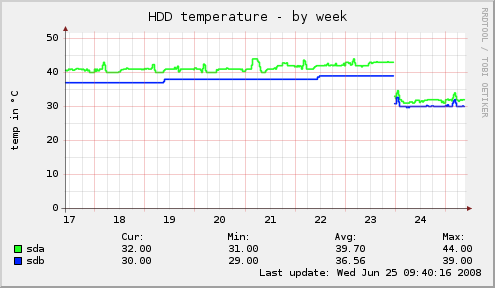
Moving of server seems to go quite well. There were some outages for users during night because of too big TTL in DNS, but after setting up redirector at old IP during morning, this should not be a problem. Now only few hosted sites were still unable to change their DNS settings, but it's not my problem :-). On the other hand, it looks that moving server to new server room will have some positive effect on it's health: Temperature of disks

Adrian von Bidder: Sometimes providers do get better...

Christian, I used to block quite aggressively (essentially blocking all IPs sending me spam for a few months) and remember seeing free.fr very, very often. Apparently this was before the block outgoing port 25 policy — I just had a grep through my log and see almost no spam coming in from free.fr. So, as I've said just recently, this is a note to all ISP: please, please, please block port 25! (ISP who don't offer unblocking will obviously lose the techie clients, but that's their own thing to decide...)

Next.

Previous.