Search Results: "ag"

11 July 2008

Adam Jensen: 11 Jul 2008

Yesterday, 10 July, was the due date for the second milestone of my work on DebGraph. I am happy to report that we are roughly two weeks ahead of schedule, so meeting this milestone was not a cause for worry. We now have support for the following graph operators: The next milestone includes the development of a high-level language (or integration with an existing extension language) that streamlines the construction of complex queries using the operators listed above. We can build arbitrarily complex queries using the C++ operators, but dealing with the static typing and compiler toolchain can be very clunky. As such, I have spent the past week working on Lua bindings for DebGraph, which will enable us to query the graph of Debian packages from a clean, dynamically typed language. Lua has a powerful C API that exposes the Lua stack and lets us move DebGraph information to and from the Lua interpreter. I'm writing documentation that outlines how to use DebGraph from both C++ and Lua in order to make this work accessible to more folks. Sneak peak
As an example, we can utilize the FindCycles operator in Lua as follows:
libdg = package.loadlib("./libdebgraph.so",
"luaopen_libdebgraph")
libdg()
LoadPackages('cache')
-- 'g' is the main graph of unstable binary-arm packages
cycles = FindCycles(g)
print("Found " .. #fc .. " cycles")
for comp_key,comp in pairs(cycles) do
    comp_nodes = ""
    for node_key,node in pairs(comp) do
        prop = GetProperty(node, "Package")
        comp_nodes = comp_nodes .. prop .. " "
    end
    print("* " .. comp_nodes)
end
The above Lua script produces the following result:
reading cache/unstable/main/binary-arm/Packages
Found 61 cycles
* debconf-english debconf-i18n debconf
* perl-modules perl 
* cdebconf fontconfig-config fontconfig gsfonts-x11
libcairo2 libfontconfig1 libgtk2.0-0 libpango1.0-0
libpango1.0-common libxft2 ucf x11-utils xutils
[...]
These are the package names in the strongly connected components, shown in alphabetical order. There is still a lot of work to do before the Lua binding will achieve feature parity with the core library, but we have now laid the foundation (and a brick or two).

Robert Collins: 11 Jul 2008

What the git vs bzr discussion is about IMO is usability. The following blog post about DTrace on linux talks about the same issue, and I'd like to use Bryan's words: "Over and over again, we made architectural and technical design decisions that would yield an instrumentation framework that would be not just safe, powerful and flexible, but also usable. The subtle bit here is that many of those decisions were not at the surface of the system (where the discussion on the Linux list seems to be currently mired), but in its guts." -> "Over and over again, we made architectural and technical design decisions that would yield a Distributed VCS be not just safe, powerful and flexible, but also usable. The subtle bit here is that many of those decisions were not at the surface of the system (where the discussions going on at the moment seem to be currently mired), but in its guts."

Joey Hess: Harvest Table restaurant

We tried the Harvest Table restaurant in Meadowview, Barbara Kingsolver's place and an outgrowth of her book Animal, Vegetable, Miracle: A Year of Food Life (which I have yet to read). All the food is local (or as close as possible) and seasonal. A great time was had by all, and the food was amazingly flavorful and fresh. Nicest of all was that we kept finding ingredients that you just don't normally find in restaurant food -- because typical restaurant's don't bother using quirky local produce. For example, I'd not expect to find lamb sausage in a burrito. Looking forward to going back and enjoying whatever's in season once my wallet has recovered.

Julien Blache: aurel32 now a PhD

Aur lien JARNO defended his PhD this morning, and I’m just back from attending his defense. He did an incredible work designing and implementing a simulator for the MUSE instrument that will equip the VLT in 2012 (”first light”) and is being built now. People working in the field are very impressed by the work he achieved, and I must add that it’s even more impressive when you know all he did in Debian and various other projects at the same time. Wow. Congratulations Dr. JARNO!

Lucas Nussbaum: 3G Internet access using mobile phone + laptop in France

In France, we only have 3 mobile network operators: Orange, SFR, and Bouygues Telecom. They usually discuss their rates together to make sure that one of them doesn’t break the market by creating too interesting rates (that’s why it would be so cool if Free.fr could get a 3G license, and why the governement can tell them “do what we want, or we will give Free a 3G license” - source). I’ve long been interested in using my mobile phone with my laptop to access the Internet. With the 3 operators, you can get a contract for a 3G USB key, but that’s not really interesting: it’s expensive, and there’s a limit on volume of data, so you have to monitor your bandwidth. Also, I only need to use my mobile phone as modem a few times a month. So I’m not really interested in paying an expensive monthly fee for that. What do french MNOs offer? Most of them have rather interesting offers when you want to get unlimited internet access from your mobile, but that doesn’t cover the case of using your phone as a modem, to access the internet on another device (e.g laptop). I’m not sure how they can see the difference, but apparently they do. (It seems that there are hacks making use of those unlimited rates, using your phone as a router between the Wifi network (but your phone has to support Wifi) and the 3G network, using apps like WMWiFiRouter. Another hack is to use the same HTTP proxy on the laptop than on the phone, which seems to give unlimited HTTP access.) But offers for using your phone as a modem are clearly less interesting (probably because they want to push their USB 3G cards offers): Bouygues:

Apparently, you are billed only based on the volume (see page 46 of this document), with a progressive rate. 5 MB/month costs 9 EUR, 100 MB costs 20 EUR, and over 100 MB, you pay 1 EUR/MB (!). SFR:
See page 40-41 of this document. You pay 0.50 EUR for a 30 minutes session, with 2 MB of data included. After those 2 MB of data, you pay 1 EUR/MB. Those rates are really crazy. Using a mobile phone on an HSDPA network (called “3G+” in France), you can easily reach 1 Mbps. (and I did see this rate while fetching files using rsync, so I was not particularly aiming at performance!). 1 Mbps translates to 7.5 EUR/min using the 1 EUR/MB rate. Or 12.5 cts/sec!!! Surprisingly, Orange (ex-France Telecom), which is usually not the most innovative MNO and ISP in France, saves us. With Orange, you pay 0.5 EUR for a 20 mins session, with unlimited volume (sessions called “session multim dia” by Orange). I was so surprised that I called the assistance to check. And after trying it yesterday, I was a bit anxious when checking my online bill this morning. But it works! Important note before you try (from Orange website):
La session multim dia est une tarification valable pour les clients forfaits mobile Orange (hors forfaits Orange pour iPhone, Mobicarte et cartes pr pay es). Pour les clients Classique, Intense, Pro, Click le forfait et Initial dont la souscription ou le r engagment est ant rieur au 14 juin 2007, pour les clients forfaits bloqu s dont la souscription ou le r engagement est ant rieur au 16 ao t 2007 et pour les clients b n ficiant d une offre blackberry, l accord expr s de l abonn b n ficier de la session multim dia est n cessaire. Les autres clients b n ficient de la tarification au volume.

10 July 2008

Andrew Pollock: [tech] What is a good RAID reconstruction speed?

I'm in the process of converting my poor-man's SAN from IDE disks attached to the host by IDE-USB adapters to SATA disks attached by eSATA to SATA cables. I had some spare time tonight, so I thought I'd prepare the new RAID-10 on brutus. The intent is to then take the 4-port USB 2.0 card out of minotaur during a lull in recordings on Saturday, and put it in brutus as well, and do a giant pvmove, then put the 4-port eSATA card back in minotaur with the new disks attached. So I've got the 4-port eSATA card (a Silicon Image SiI 3124) in brutus, and I've built the RAID-10 with mdadm and it's busily reconstructing. I'm getting a reconstruction speed of around 60Mb per second (/proc/mdstat says 60254K/sec right now). I have no idea if that's good, bad, or indifferent. I do know that output of hdparm -tT is very nice by comparison:

apollock@brutus:~$ sudo hdparm -tT /dev/sda
/dev/sda:
 Timing cached reads:   260 MB in  2.01 seconds = 129.06 MB/sec
 Timing buffered disk reads:  222 MB in  3.01 seconds =  73.77 MB/sec
compared to
apollock@minotaur:~$ sudo hdparm -tT /dev/sda
/dev/sda:
 Timing cached reads:   162 MB in  2.02 seconds =  80.20 MB/sec
 Timing buffered disk reads:   48 MB in  3.04 seconds =  15.78 MB/sec
Those times are with a reconstruction running on brutus and a recording being written to the array on minotaur, so not the most controlled benchmarking environment. If I can sit on my hands long enough, I'll try some benchmarks from the MythTV machine, comparing the performance of the SAN before and after switching disks.

Steve Kemp: He'll save every one of us!

So recently there have been a few posts by people discussing the idea of distributed bug reporting systems. This is topical, becuse I've been working on something vaguely related - a support system. Why is a support system, or ticketing system, related to a bug tracker? To answer that you must first clarify what you mean by a support system (or a bug tracker for that matter). There are two distinct types of support systems:
"Full"
This is a system which does "everything". Each submitted support, or bug, request has an associated status, severity, priority and work log. It might be assigned to multiple people through its lifetime, and it might be moved around various internal queues. Example: Request Tracker.
"Minimal"
A reported ticket is an email submission. A "ticket" from start to finish is nothing more than a collection of mails upon a particular topic - there is no assigned "owner", no "priority", no object-specific attributes at all.
I've neither the time, patience, or desire to create any system like the first one. But I've become increasingly dissatisfied with my current support system, roundup, for various reasons. So I need something new. Previously I ruled out several support systems and most of my objections still stand, although I admit I've not really looked again. I will certainly do so shortly. So what have I done? Well I figure I care very little about queues, priorities, reports, and all that stuff. (On the basis that priority is mostly in the ticket itself, and that I'm the sole recipient of the submissions. Previously I had a partner to share them, but these days just me.) I want something that is basically e-mail centric. That reduces the functionality of my support system to two distinct parts:
Ticket Submission
An email to sumbit@example.com should result in three actions:
  • A message being sent back to the submitter. "Hey got your ticket. We'll fix it. Love you long time.". (Set the reply-to address appropriately!)
  • A message to the site admin(s) saying "Hey, you've got a new ticket submission. Deal."
  • A new ticket being created/stored somewhere.
(There are additional nice things to have - such as SMS alerts outside 10:00-17:00, etc, but those are trivial bolt-ons.)
Ticket Updates
When a mail comes in to "ticket-XXXX@example.org" - which was setup in the submission process, or when a mail arrives with subject "[issueXXXX]" we need to append the correspondance to the existing ticket. If that ticket doesn't exist we report an error. If the ticket is closed we re-open it.
So, what do we have? A script that is conceptually simple, and can be invoked via a pipe transport of Exim4. A script that just reads the submitted email from STDIN and only has to decide a couple of things based pretty much on the contents of the "To:" and "Subject:" headers. Simple, no? OK it was actually amazingly simple once broken down. The amazing part is that it all works. I figured that I'd manage new tickets by writing them to mbox files - simple to do. Simple to understand. So the process goes: There are a couple of helper scripts: But basically one script and mutt does it all. So far it's been tested and it is rockin'! (Look at me, hangin' with the cool kids!) Obviously it is pretty Steve-specific, and there is only a toy CGI process for viewing history online, but I'm actually feeling pretty good about it. Once I've closed all my existing tickets I will probably migrate over to it. At least this handles (read: ignores) MIME - which makes it a clear winner of roundup, which just eats, bounces, or corrupts submitted multipart messages. ObQuote: Flash Gordon

Philipp Kern: Lufthansa Employees on Strike Soonish?

Dear Lufthansa, please do not mess with my flights! (Link Germany-only, sorry; title says it all, anyway...)

Erich Schubert: Thesis done!

Yay! I just handed in my Diploma thesis in Computer Science (approx. Masters degree). It will still be some weeks until it has been graded, the dean has signed the diploma etc., but I'm pretty much done.The topic of my thesis is
Statistical Approaches for Robustifying Correlation Clustering Algorithms
so my field of research is Data Mining, in particular Data Clustering and Outlier Detection. My particular contribution is to improve the accuracy of PCA results in the presence of noise.Some ideas of the thesis are also just being published at the 20th International Conference on Scientific and Statistical Database Management (SSDBM) July 9-11, 2008, Hong Kong, China and the associated proceedings (Springer LNCS volume 5069):
Hans-Peter Kriegel, Peer Kröger, Erich Schubert and Arthur Zimek. A General Framework for Increasing the Robustness of PCA-based Correlation Clustering Algorithms
Other related publications will follow (an outlier detection method using parts of my thesis will be submitted to a journal soon, too). And in case the first name on that list rings a bell: he did some major contributions to multi-dimensional data structures such as the R*-Tree, X-Tree and Buddy Tree, and has since been very active in data mining.I'll be giving a short talk at the graduate seminar next week, and I'll probably publish the slides on my web page. But they will only be a short excerpt of my work due to time limitations of the talk.So basically, I'm jobless now! :-)I still have plenty of related ideas to continue research, and my advisor asked me if I'd like to continue with a PhD degree (so you can assume the grade of the thesis won't be too bad). However, the university is always short on open positions, and I don't know if I'll be able to get one (a research proposal is pending). Therefore, I'm looking for a position that allows be to pursue data mining and/or clustering research. Part time jobs are fine if they are well enough paid, although it of course would be best if the job would just include related research. If the job is located outside of Munich, a contact to a local university with a strong data mining research group is needed. (In Munich I obviously already have contacts to a strong research group.)As you might figure from me posting on Planet Debian, Planet GNOME and similar, I'm fairly experienced in OpenSource and Linux (something like 19 years of programming experience, 13 years of Linux experience). So I'm not just a fresh graduate, but a doer when it comes to coding. (Which is partially why I'd prefer a job outside of the university!)Anyone with interesting job offers (Google Munich anyone? I've been trying to get a back channel contact with you for weeks), please just drop me an email at erich AT debian DOT org.P.S. No, that doesn't mean I'm only looking for jobs in the data mining field. It would just be more convenient.

Robert McQueen: GUADEC, Telepathy and a Party on a Boat

For everyone at GUADEC, there’s a boat party sponsored by Collabora this evening. Our sponsorship was confirmed after the program was printed so it’s listed anonymously, but it’s mostly sponsored by Collabora, of course with huge thanks to Baris and his team for the organisation, and local sponsors for food and discounted beer. The boat leaves from Kabatas at 9pm today (Thursday). It’s actually pretty close to the 3rd anniversary of Collabora’s incorporation, so I think we could call this our birthday party. :D I gave my presentation earlier today about using Telepathy to make collaborative applications. My slides are available, as well as the apps I demoed, which are the python VNC demo based on telepathy-python’s examples, Elliot’s Tic Tac Tube game, and Guillaume and Alban’s quick hack to Empathy and Vinagre to share your desktop over a stream tube. I was followed up by Senko’s presentation (slides also available) which had an overview of the libraries and APIs currently available to embed Telepathy functionality in applications on the desktop. The talks were all recorded so hopefully some videos will turn up on-line too. Speaking about collaborative stuff with Telepathy, we’re really keen to hear from the authors of applications like Abiword, Inkscape, Vinagre, Jokosher, Tomboy, Gobby, etc, to find out how we can help you integrate with Telepathy, what features you need before you can get started, or just try and convince you that it’s a good idea. :) If you’re at GUADEC, come and grab one of the Collaborans or drop by on #telepathy on FreeNode and tell us what you’d like to do and how we can help. Yesterday after the talks on Soylent and the People project, Travis and I met up with the guys behind the People project (Ali Sabil and Johann Prieur) and some of the Online Desktop team (Owen Taylor and Marina Zhurakhinskaya). We sketched out a way of plugging together Telepathy, People, Soylent and the Online Desktop to deal a lot better with meta-contacts on the desktop, providing “first-class” people objects. It all looks pretty promising and hopefully we’ll all find some time to make moves towards our vision. This afternoon at 3:30pm, Olivier is also presenting our work on Farsight 2, which is really cool stuff and should include some exciting demos of the multi-person video conferencing stuff we’ve been doing. More generally, GUADEC is awesome. I’m having a great time in Istanbul (despite it being pretty hot for a pale-faced Brit like me), and enjoying the sights and sounds of such an interesting city and culture. I’ve caught up with many of the usual suspects (like Lennart, who never turns down the chance to turn up at a conference and sample the local bars and clubs), and had some great discussions.

Robert Collins: 10 Jul 2008

I keep running into folk whom I knew of, that use bzr, but I did not know that they use bzr. Right now there is a lot of discussion going on about DVCS in various projects. While I imagine most bzr users just want to get on with their coding (after all thats what bzr is good at :))... it would be fantastic if you could blog that you use it, and folk at GUADEC wear the T-shirt! Also, I'm at GUADEC, and I'm extremely happy to answer questions from anyone, bzr user, git user, or even svn user :)

9 July 2008

Joey Hess: carving scooters

This is not exactly new, but it was new to me.. A guy on a trikke is zooming around downtown today. The swerving motion is bit of a traffic hazard, but it looked like fun, and pretty efficient. It's basically inline skates for those who lack balance. With brakes.

Obey Arthur Liu: State of the Aptitude (week 7)

New status update! Here’s what Aptitude looks like: aptitude-20080709-9 (more screenshots after the break) I’ve been exploring how the APT libraries work and how to interact with the aptitude back-end and here’s what it can do now: What’s missing: Basic functions of a package manager are already covered. We’re still at the APT API exploration phase although we’re almost done with it. I will soon start working on the final user interface and the real code design. The current code is about 2000 lines of hastily hacked together C++ and XML. I’ll have to restart the coding with a more elaborate Object design. Something that will be easier to work with in the future. The code is on http://dev.graffit.net/aptitude/trac. You can try to compile it and play with it. On the other hand I’m going to scrape most of the code soon for the restart so if you’re bored.. A walkthrough and more screenshots after the break. Here’s a walkthrough of what you can do right now: aptitude-20080709-2 aptitude-20080709-3 aptitude-20080709-4 aptitude-20080709-5 aptitude-20080709-6 aptitude-20080709-7 aptitude-20080709-8 aptitude-20080709-9

David Welton: Google, Android, and the case of the missing communication

Like many people, I participated in the Google Android contest this spring, and like most of them, I didn't win, but I did enjoy working with the platform, and am very excited about the idea of an open source mobile platform that's relatively powerful. From the outset, due to the lack of actual source code for a lot of the system, there have been "doubters" about what Google is really up to. I'm not one of them, and am largely ok with their reasons for holding back: I buy their reasoning that the long term benefits of a strong, properly QA'ed launch probably outweigh the possibility of failure that might come from the press and the public at large that doesn't care much about software freedom seeing phones come out with half-baked, early implementations. I think most of us working with Android were ok with that strategy, and the ones who weren't self-selected out of the platform, most likely. However, lately Google has made something of a mess of their communications regarding Android. The problem stems from the fact that they gave an updated version of the SDK only to the winners of the competition, which for a lot of people felt like a bit of a slap in the face: they helped popularize the platform by participating in the contest and writing applications for it, and in return got excluded from the upgrade path. Personally, it's not really any skin off my nose, as I'm sanguine about the Hecl port proceeding apace when the new SDK is public, but I can see that if you were, say, a company porting your app to the platform and now are left behind the competition winners, you might be a bit irritated. The biggest mistake they've made though, is a big lack of communication regarding this business. As I said, I don't really have that much skin in the game, and if they explained in a convincing way why they needed to do things that way, they would go a long ways to allaying the frustrations felt by many. I'm not much of a believer in conspiracy theories and plots, especially where companies are concerned. Inept bumbling is a far more likely explanation in most cases, including this one. What is odd, though, is that Google has a lot of people who "get it". I met Dan Morrill at the Munich Android event, and he definitely gets it. He writes about his frustrations as a developer advocate and all the crazy things people say. Well, one way to reduce the number of batty internet theories (eliminating them is clearly impossible due to the alien mind control rays) is to consistently communicate quality information about what's really going on, something that has been lacking with regards to the SDK question. Here's another Google employee who understands this need to communicate, and apparently does so despite being worried about being "slapped for talking publicy about all this": http://groups.google.com/group/android-developers/msg/244edfad99870c63
But the root of the problem is certainly not licensing but that there hasn't been a new public SDK release since M5, while at the same time a small group of people received updated versions privately. I really don't know precisely why this happened; but I'm sure it has more to do with logistics and reducing the burden of support while we shift priorities (to shipping real devices) rather than politics or any will of our part to "hurt the community" (come one guys, we are not that stupid... !) While others in the team may disagree, I think it was very very unfortunate; some of us are trying to prepare a new SDK release, but it's a lot harder than I can comment on here, so don't hold your breath because it might not happen that soon.
This explains things in part, but still leaves us in the dark, and leaves me with the feeling that someone in power, somewhere at Google, despite his or her clued in colleagues, really doesn't get it with regards to open source. I'm still unconcerned about the Android source code: I think we'll see it, but to be a true open source project, Android will need an open community as well, not one where decisions are taken exclusively at Google, and not even communicated to the development community at large. All in all, this mistake is more molehill than mountain, but however you look at it, in terms of open source, it is a step backwards.

8 July 2008

Jeff Bailey: Body updates

Angie spent ages trying to convince me that muscle pain was good - that the hurt that comes from actually exercising is a good thing.

I think it's taken me undergoing a live dissection to actually have a clue what she was talking about.

Some recent firsts:
* I've lifted Leif a couple of times to keep him from climbing up and over the child gate. I'm allowed to lift him in emergencies. I didn't need to crawl away and cuddle my Oxycodone after.

* I didn't take extra Tramadol in the morning this past weekend in order to cope with playing with him. This would've been a bright move had it been a 2 day weekend. As it was, I did wind up pulling a muscle near the end of the third day.

* I biked home today for the first time in 7 months.

I still haven't kicked the last pain killer in the evening. Every time I get brave enough to try it again, I up my activity level instead. So, keeping to a full dose this week. Maybe cutting to a half dose next week. There's travel coming up, and I want to make sure I don't screw myself for that.

Jonny Lamb: debexpo

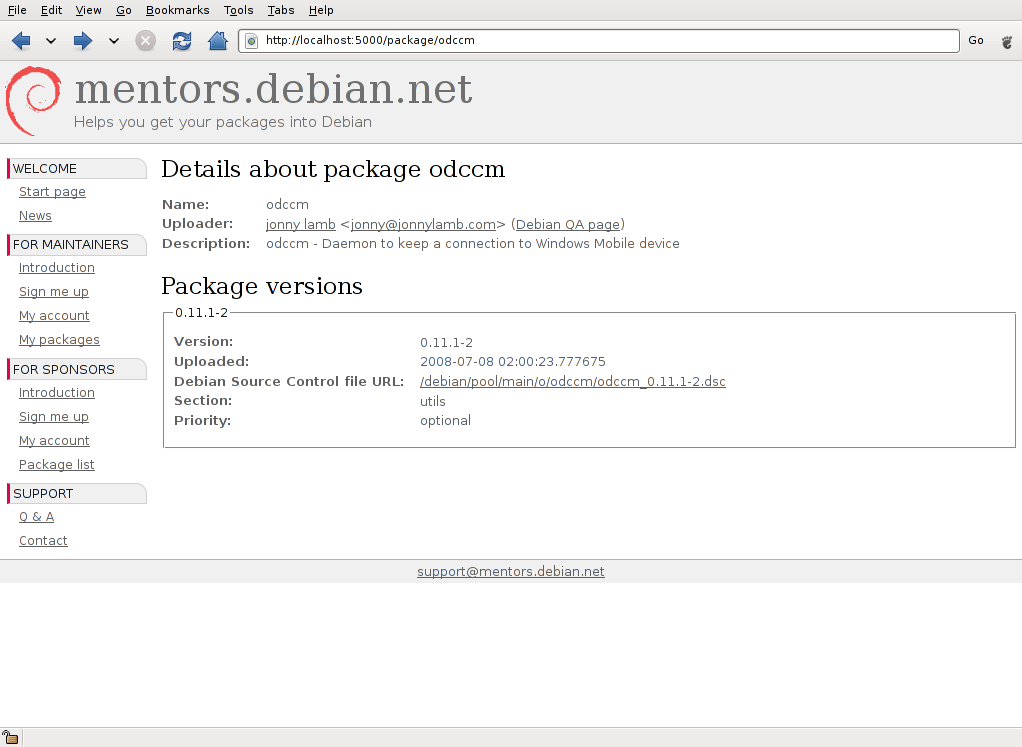
debexpo (Debian package exposition) is a web application that allows one to run a user-friendly public Debian package repository with social interaction that one may be used to from social networking sites. debexpo will be the basis for the mentors.debian.net site but will be useful for others as well. debexpo is the project I am working on for this year’s Summer of Code for Debian under the watch of Christoph Haas debexpo is more than just a web application though. It was based on suggestions by you, and therefore it has some nifty features: Development can be tracked through its Trac instance: http://debexpo.workaround.org/, where I invite you to submit tickets or even submit patches! Its Git repository is public: http://debexpo.workaround.org/debexpo.git (and mirrored here). Last but not least, the there is also a low-traffic mailing list. I invite you to try it out, and report bugs. Posting to the list is a great way to get in contact. There is little visible eye-candy in your browser to show for the work so far as nearly all the work so far has gone into the backend. A sneak peek at what it looks like at the moment is available though: As you can see, the theme is somewhat familiar. Hopefully, as the SoC program nears an end, this will be fixed. Oh, and hello: this is my first post to Planet Debian.

Russ Allbery: WebAuth and LDAP

Andreas, WebAuth really only requires that you use a Kerberos infrastructure for all of the web servers involved. It doesn't actually require that the user accounts be in Kerberos. That's the default, and the way verification is done by the WebKDC module, but the WebLogin front-end can also choose to do account verification itself and tell the WebKDC to trust it. There is currently code in there to do this for the REMOTE_USER case but nothing specifically to do an LDAP modification. However, it should be a relatively straightforward modification to login.fcgi, and I'd certainly take a patch that made it a hook. WebAuth still may not quite be what you want, but I wanted to throw the option out there. Another thing you could look at is Shibboleth, which does the whole web single sign-on thing without assuming any particular authentication system. (You have to protect a URL on the IdP with the authentication system of our choice.) The SP is packaged for Debian but the IdP isn't, and the configuration syntax and the documentation are fairly horrible, but it works and has a lot of fancy features.

Russell Coker: Is a GPG pass-phrase Useful?

Does a GPG pass-phrase provide a real benefit to the majority of users? It seems that there will be the following categories of attack which result in stealing the secret-key data:

  1. User-space compromise of account (EG exploiting a bug in a web browser or IRC client).
  2. System compromise (EG compromising a local account and exploiting a kernel vulnerability to get root access).
  3. Theft of the computer system while powered down when the system was configured to not use swap or to encrypt the swap space with a random key at boot time.

  4. Theft of a computer system while running or that did not have encrypted swap.

  5. Theft of unencrypted backup media.

Category 1 will permit an attacker to monitor user processes and intercept one that asks for a GPG pass-phrase as well as to copy the secret key. Category 2 will do the same but for all users on the system. Category 3 will give the potential for stealing the private key (if it’s not encrypted) but no direct potential for getting the pass-phrase. Category 4 has the potential for copying a pass-phrase from memory or swap. I am inclined to trust Werner Koch (and anyone else who submitted code to the GPG project) to have written code to correctly lock memory and scrub pass-phrase data and decrypted private key data from memory after use. But I really doubt the ability of most people who write code to interface with GPG to do the same. So every time that a GUI program prompts for a GPG pass-phrase I think that there is the potential for it to be stored in swap or to remain indefinitely in RAM. Therefore stealing a machine that does not have it’s swap-space encrypted with a random key (which is the most practical way of encrypting swap) or stealing a running machine (as mentioned in a previous post [1]) can potentially grant a hostile party access to the pass-phrase. So it seems to me that out of all the possible ways of getting access to a GPG private key, the only ones where a pass-phrase ones is going to really do some good are categories 3 and 5. While it’s good to protect against those situations, it seems to me that the greatest risk to a GPG key is from category 1, with category 2 following close behind. I previously wrote about the slow progress towards using SE Linux and GPG code changes to make it more difficult to steal the secret key [2] - something that I’ve been occasionally working on over the last 6 years. Now it seems to me that the same benefits can and should be made available to people who don’t use SE Linux. If a system directory such as /var/spool/gpg was mode 1770 then gpg could be setgid to group “gpg” so that it could create and access secret keys for users under /var/spool/gpg while the users in question could not directly access them. Then the sys-admin would be responsible for backing up GPG keys. Of course it would probably be ideal to have an option as to whether a new secret key would be created in the system spool or in the user home directory, and migrating the key from the user home directory to the system spool would be supported (but not migrating it back). This would mean that an attacker who compromised a local user account (maybe through a vulnerability in a web browser or MUA) would not be able to get the GPG secret key. They could probably get the pass-phrase by ptracing the MUA (or some other GUI process that calls GPG) but without the secret key itself that would not do as much good - of course once they had the pass-phrase and local access they could use the machine so sign and decrypt data which would still be a bad thing. But it would not have the same scope as stealing the secret key and the pass-phrase. I look forward to reading comments on this post.

David Moreno Garza: Updates

Julien Danjou: Moving back to Paris

It's now official, we're leaving Lille with my girlfriend and will move back to Paris in around 10 days. That means a new home, but I keep the same job. :-) I'll live again in the 14th arrondissement in a 2 room flat which is about 52 m . My DSL connection should already be up, even though I don't have the flat keys: (too) perfect timing. :-)

Next.

Previous.