Michael Stapelberg: Linux package managers are slow
I measured how long the most popular Linux distribution s package manager take
to install small and large packages (the
Measurements
Keep in mind that these are one-time measurements. They should be indicative of
actual performance, but your experience may vary.
(Looking for older measurements? See Appendix B (2019). The difference between the slowest and fastest package managers is 30x! How can Alpine s apk and Arch Linux s pacman be an order of magnitude faster than the rest? They are doing a lot less than the others, and more efficiently, too.Pain point: too much metadata
For example, Fedora transfers a lot more data than others because its main
package list is 60 MB (compressed!) alone. Compare that with Alpine s 734 KB
Conclusion
As per the current landscape, there is no
distribution-scoped package manager which uses images and leaves out hooks and
triggers, not even in smaller Linux distributions.
I think that space is really interesting, as it uses a minimal design to achieve
significant real-world speed-ups.
I have explored this idea in much more detail, and am happy to talk more about
it in my post Introducing the distri research linux distribution".
ack(1p) source code search Perl script
and qemu, respectively).
Where required, my measurements include metadata updates such as transferring an
up-to-date package list. For me, requiring a metadata update is the more common
case, particularly on live systems or within Docker containers.
All measurements were taken on an Intel(R) Core(TM) i9-9900K CPU @ 3.60GHz
running Docker 1.13.1 on Linux 4.19, backed by a Samsung 970 Pro NVMe drive
boasting many hundreds of MB/s write performance. The machine is located in
Z rich and connected to the Internet with a 1 Gigabit fiber connection, so the
expected top download speed is 115 MB/s.
See Appendix C for details on the measurement method and command
outputs.
Measurements
Keep in mind that these are one-time measurements. They should be indicative of
actual performance, but your experience may vary.
ack (small Perl program)
| distribution | package manager | data | wall-clock time | rate |
|---|---|---|---|---|
| Fedora | dnf | 114 MB | 33s | 3.4 MB/s |
| Debian | apt | 16 MB | 10s | 1.6 MB/s |
| NixOS | Nix | 15 MB | 5s | 3.0 MB/s |
| Arch Linux | pacman | 6.5 MB | 3s | 2.1 MB/s |
| Alpine | apk | 10 MB | 1s | 10.0 MB/s |
qemu (large C program)
| distribution | package manager | data | wall-clock time | rate |
|---|---|---|---|---|
| Fedora | dnf | 226 MB | 4m37s | 1.2 MB/s |
| Debian | apt | 224 MB | 1m35s | 2.3 MB/s |
| Arch Linux | pacman | 142 MB | 44s | 3.2 MB/s |
| NixOS | Nix | 180 MB | 34s | 5.2 MB/s |
| Alpine | apk | 26 MB | 2.4s | 10.8 MB/s |
(Looking for older measurements? See Appendix B (2019). The difference between the slowest and fastest package managers is 30x! How can Alpine s apk and Arch Linux s pacman be an order of magnitude faster than the rest? They are doing a lot less than the others, and more efficiently, too.
Pain point: too much metadata
For example, Fedora transfers a lot more data than others because its main
package list is 60 MB (compressed!) alone. Compare that with Alpine s 734 KB
APKINDEX.tar.gz.
Of course the extra metadata which Fedora provides helps some use case,
otherwise they hopefully would have removed it altogether. The amount of
metadata seems excessive for the use case of installing a single package, which
I consider the main use-case of an interactive package manager.
I expect any modern Linux distribution to only transfer absolutely required
data to complete my task.
Pain point: no concurrency
Because they need to sequence executing arbitrary package maintainer-provided
code (hooks and triggers), all tested package managers need to install packages
sequentially (one after the other) instead of concurrently (all at the same
time).
In my blog post Can we do without hooks and
triggers? , I outline that hooks and
triggers are not strictly necessary to build a working Linux distribution.
Thought experiment: further speed-ups
Strictly speaking, the only required feature of a package manager is to make
available the package contents so that the package can be used: a program can be
started, a kernel module can be loaded, etc.
By only implementing what s needed for this feature, and nothing more, a package
manager could likely beat apk s performance. It could, for example:
- skip archive extraction by mounting file system images (like AppImage or snappy)
- use compression which is light on CPU, as networks are fast (like
apk)
- skip fsync when it is safe to do so, i.e.:
- package installations don t modify system state
- atomic package installation (e.g. an append-only package store)
- automatically clean up the package store after crashes
Current landscape
Here s a table outlining how the various package managers listed on Wikipedia s
list of software package management
systems
fare:
apk)- package installations don t modify system state
- atomic package installation (e.g. an append-only package store)
- automatically clean up the package store after crashes
| name | scope | package file format | hooks/triggers |
|---|---|---|---|
| AppImage | apps | image: ISO9660, SquashFS | no |
| snappy | apps | image: SquashFS | yes: hooks |
| FlatPak | apps | archive: OSTree | no |
| 0install | apps | archive: tar.bz2 | no |
| nix, guix | distro | archive: nar. bz2,xz | activation script |
| dpkg | distro | archive: tar. gz,xz,bz2 in ar(1) | yes |
| rpm | distro | archive: cpio. bz2,lz,xz | scriptlets |
| pacman | distro | archive: tar.xz | install |
| slackware | distro | archive: tar. gz,xz | yes: doinst.sh |
| apk | distro | archive: tar.gz | yes: .post-install |
| Entropy | distro | archive: tar.bz2 | yes |
| ipkg, opkg | distro | archive: tar ,.gz | yes |
Conclusion
As per the current landscape, there is no
distribution-scoped package manager which uses images and leaves out hooks and
triggers, not even in smaller Linux distributions.
I think that space is really interesting, as it uses a minimal design to achieve
significant real-world speed-ups.
I have explored this idea in much more detail, and am happy to talk more about
it in my post Introducing the distri research linux distribution".
Appendix A: related work
There are a couple of recent developments going into the same direction:
- Revisiting How We Put Together Linux Systems describes mounting app bundles
- Android Q uses ext4 loopback images
- The Haiku Operating System s package manager Haiku
Depot uses images
Appendix C: measurement details (2020)
ack
You can expand each of these:
Fedora s dnf takes almost 33 seconds to fetch and unpack 114 MB.
% docker run -t -i fedora /bin/bash
[root@62d3cae2e2f9 /]# time dnf install -y ack
Fedora 32 openh264 (From Cisco) - x86_64     1.9 kB/s   2.5 kB     00:01
Fedora Modular 32 - x86_64                   6.8 MB/s   4.9 MB     00:00
Fedora Modular 32 - x86_64 - Updates         5.6 MB/s   3.7 MB     00:00
Fedora 32 - x86_64 - Updates                 9.9 MB/s    23 MB     00:02
Fedora 32 - x86_64                            39 MB/s    70 MB     00:01
[ ]
real	0m32.898s
user	0m25.121s
sys	0m1.408s
NixOS s Nix takes a little over 5s to fetch and unpack 15 MB.
% docker run -t -i nixos/nix
39e9186422ba:/# time sh -c 'nix-channel --update && nix-env -iA nixpkgs.ack'
unpacking channels...
created 1 symlinks in user environment
installing 'perl5.32.0-ack-3.3.1'
these paths will be fetched (15.55 MiB download, 85.51 MiB unpacked):
  /nix/store/34l8jdg76kmwl1nbbq84r2gka0kw6rc8-perl5.32.0-ack-3.3.1-man
  /nix/store/9df65igwjmf2wbw0gbrrgair6piqjgmi-glibc-2.31
  /nix/store/9fd4pjaxpjyyxvvmxy43y392l7yvcwy1-perl5.32.0-File-Next-1.18
  /nix/store/czc3c1apx55s37qx4vadqhn3fhikchxi-libunistring-0.9.10
  /nix/store/dj6n505iqrk7srn96a27jfp3i0zgwa1l-acl-2.2.53
  /nix/store/ifayp0kvijq0n4x0bv51iqrb0yzyz77g-perl-5.32.0
  /nix/store/w9wc0d31p4z93cbgxijws03j5s2c4gyf-coreutils-8.31
  /nix/store/xim9l8hym4iga6d4azam4m0k0p1nw2rm-libidn2-2.3.0
  /nix/store/y7i47qjmf10i1ngpnsavv88zjagypycd-attr-2.4.48
  /nix/store/z45mp61h51ksxz28gds5110rf3wmqpdc-perl5.32.0-ack-3.3.1
copying path '/nix/store/34l8jdg76kmwl1nbbq84r2gka0kw6rc8-perl5.32.0-ack-3.3.1-man' from 'https://cache.nixos.org'...
copying path '/nix/store/czc3c1apx55s37qx4vadqhn3fhikchxi-libunistring-0.9.10' from 'https://cache.nixos.org'...
copying path '/nix/store/9fd4pjaxpjyyxvvmxy43y392l7yvcwy1-perl5.32.0-File-Next-1.18' from 'https://cache.nixos.org'...
copying path '/nix/store/xim9l8hym4iga6d4azam4m0k0p1nw2rm-libidn2-2.3.0' from 'https://cache.nixos.org'...
copying path '/nix/store/9df65igwjmf2wbw0gbrrgair6piqjgmi-glibc-2.31' from 'https://cache.nixos.org'...
copying path '/nix/store/y7i47qjmf10i1ngpnsavv88zjagypycd-attr-2.4.48' from 'https://cache.nixos.org'...
copying path '/nix/store/dj6n505iqrk7srn96a27jfp3i0zgwa1l-acl-2.2.53' from 'https://cache.nixos.org'...
copying path '/nix/store/w9wc0d31p4z93cbgxijws03j5s2c4gyf-coreutils-8.31' from 'https://cache.nixos.org'...
copying path '/nix/store/ifayp0kvijq0n4x0bv51iqrb0yzyz77g-perl-5.32.0' from 'https://cache.nixos.org'...
copying path '/nix/store/z45mp61h51ksxz28gds5110rf3wmqpdc-perl5.32.0-ack-3.3.1' from 'https://cache.nixos.org'...
building '/nix/store/m0rl62grplq7w7k3zqhlcz2hs99y332l-user-environment.drv'...
created 49 symlinks in user environment
real	0m 5.60s
user	0m 3.21s
sys	0m 1.66s
Debian s apt takes almost 10 seconds to fetch and unpack 16 MB.
% docker run -t -i debian:sid
root@1996bb94a2d1:/# time (apt update && apt install -y ack-grep)
Get:1 http://deb.debian.org/debian sid InRelease [146 kB]
Get:2 http://deb.debian.org/debian sid/main amd64 Packages [8400 kB]
Fetched 8546 kB in 1s (8088 kB/s)
[ ]
The following NEW packages will be installed:
  ack libfile-next-perl libgdbm-compat4 libgdbm6 libperl5.30 netbase perl perl-modules-5.30
0 upgraded, 8 newly installed, 0 to remove and 23 not upgraded.
Need to get 7341 kB of archives.
After this operation, 46.7 MB of additional disk space will be used.
[ ]
real	0m9.544s
user	0m2.839s
sys	0m0.775s
Arch Linux s pacman takes a little under 3s to fetch and unpack 6.5 MB.
% docker run -t -i archlinux/base
[root@9f6672688a64 /]# time (pacman -Sy && pacman -S --noconfirm ack)
:: Synchronizing package databases...
 core            130.8 KiB  1090 KiB/s 00:00
 extra          1655.8 KiB  3.48 MiB/s 00:00
 community         5.2 MiB  6.11 MiB/s 00:01
resolving dependencies...
looking for conflicting packages...
Packages (2) perl-file-next-1.18-2  ack-3.4.0-1
Total Download Size:   0.07 MiB
Total Installed Size:  0.19 MiB
[ ]
real	0m2.936s
user	0m0.375s
sys	0m0.160s
Alpine s apk takes a little over 1 second to fetch and unpack 10 MB.
% docker run -t -i alpine
fetch http://dl-cdn.alpinelinux.org/alpine/v3.12/main/x86_64/APKINDEX.tar.gz
fetch http://dl-cdn.alpinelinux.org/alpine/v3.12/community/x86_64/APKINDEX.tar.gz
(1/4) Installing libbz2 (1.0.8-r1)
(2/4) Installing perl (5.30.3-r0)
(3/4) Installing perl-file-next (1.18-r0)
(4/4) Installing ack (3.3.1-r0)
Executing busybox-1.31.1-r16.trigger
OK: 43 MiB in 18 packages
real	0m 1.24s
user	0m 0.40s
sys	0m 0.15s
qemu
You can expand each of these:
Fedora s dnf takes over 4 minutes to fetch and unpack 226 MB.
% docker run -t -i fedora /bin/bash
[root@6a52ecfc3afa /]# time dnf install -y qemu
Fedora 32 openh264 (From Cisco) - x86_64     3.1 kB/s   2.5 kB     00:00
Fedora Modular 32 - x86_64                   6.3 MB/s   4.9 MB     00:00
Fedora Modular 32 - x86_64 - Updates         6.0 MB/s   3.7 MB     00:00
Fedora 32 - x86_64 - Updates                 334 kB/s    23 MB     01:10
Fedora 32 - x86_64                            33 MB/s    70 MB     00:02
[ ]
Total download size: 181 M
Downloading Packages:
[ ]
real	4m37.652s
user	0m38.239s
sys	0m6.321s
NixOS s Nix takes almost 34s to fetch and unpack 180 MB.
% docker run -t -i nixos/nix
83971cf79f7e:/# time sh -c 'nix-channel --update && nix-env -iA nixpkgs.qemu'
unpacking channels...
created 1 symlinks in user environment
installing 'qemu-5.1.0'
these paths will be fetched (180.70 MiB download, 1146.92 MiB unpacked):
[ ]
real	0m 33.64s
user	0m 16.96s
sys	0m 3.05s
Debian s apt takes over 95 seconds to fetch and unpack 224 MB.
% docker run -t -i debian:sid
root@b7cc25a927ab:/# time (apt update && apt install -y qemu-system-x86)
Get:1 http://deb.debian.org/debian sid InRelease [146 kB]
Get:2 http://deb.debian.org/debian sid/main amd64 Packages [8400 kB]
Fetched 8546 kB in 1s (5998 kB/s)
[ ]
Fetched 216 MB in 43s (5006 kB/s)
[ ]
real	1m25.375s
user	0m29.163s
sys	0m12.835s
Arch Linux s pacman takes almost 44s to fetch and unpack 142 MB.
% docker run -t -i archlinux/base
[root@58c78bda08e8 /]# time (pacman -Sy && pacman -S --noconfirm qemu)
:: Synchronizing package databases...
 core          130.8 KiB  1055 KiB/s 00:00
 extra        1655.8 KiB  3.70 MiB/s 00:00
 community       5.2 MiB  7.89 MiB/s 00:01
[ ]
Total Download Size:   135.46 MiB
Total Installed Size:  661.05 MiB
[ ]
real	0m43.901s
user	0m4.980s
sys	0m2.615s
Alpine s apk takes only about 2.4 seconds to fetch and unpack 26 MB.
% docker run -t -i alpine
/ # time apk add qemu-system-x86_64
fetch http://dl-cdn.alpinelinux.org/alpine/v3.10/main/x86_64/APKINDEX.tar.gz
fetch http://dl-cdn.alpinelinux.org/alpine/v3.10/community/x86_64/APKINDEX.tar.gz
[ ]
OK: 78 MiB in 95 packages
real	0m 2.43s
user	0m 0.46s
sys	0m 0.09s
Appendix B: measurement details (2019)
ack
You can expand each of these:
Fedora s dnf takes almost 30 seconds to fetch and unpack 107 MB.
% docker run -t -i fedora /bin/bash
[root@722e6df10258 /]# time dnf install -y ack
Fedora Modular 30 - x86_64            4.4 MB/s   2.7 MB     00:00
Fedora Modular 30 - x86_64 - Updates  3.7 MB/s   2.4 MB     00:00
Fedora 30 - x86_64 - Updates           17 MB/s    19 MB     00:01
Fedora 30 - x86_64                     31 MB/s    70 MB     00:02
[ ]
Install  44 Packages
Total download size: 13 M
Installed size: 42 M
[ ]
real	0m29.498s
user	0m22.954s
sys	0m1.085s
NixOS s Nix takes 14s to fetch and unpack 15 MB.
% docker run -t -i nixos/nix
39e9186422ba:/# time sh -c 'nix-channel --update && nix-env -i perl5.28.2-ack-2.28'
unpacking channels...
created 2 symlinks in user environment
installing 'perl5.28.2-ack-2.28'
these paths will be fetched (14.91 MiB download, 80.83 MiB unpacked):
  /nix/store/57iv2vch31v8plcjrk97lcw1zbwb2n9r-perl-5.28.2
  /nix/store/89gi8cbp8l5sf0m8pgynp2mh1c6pk1gk-attr-2.4.48
  /nix/store/gkrpl3k6s43fkg71n0269yq3p1f0al88-perl5.28.2-ack-2.28-man
  /nix/store/iykxb0bmfjmi7s53kfg6pjbfpd8jmza6-glibc-2.27
  /nix/store/k8lhqzpaaymshchz8ky3z4653h4kln9d-coreutils-8.31
  /nix/store/svgkibi7105pm151prywndsgvmc4qvzs-acl-2.2.53
  /nix/store/x4knf14z1p0ci72gl314i7vza93iy7yc-perl5.28.2-File-Next-1.16
  /nix/store/zfj7ria2kwqzqj9dh91kj9kwsynxdfk0-perl5.28.2-ack-2.28
copying path '/nix/store/gkrpl3k6s43fkg71n0269yq3p1f0al88-perl5.28.2-ack-2.28-man' from 'https://cache.nixos.org'...
copying path '/nix/store/iykxb0bmfjmi7s53kfg6pjbfpd8jmza6-glibc-2.27' from 'https://cache.nixos.org'...
copying path '/nix/store/x4knf14z1p0ci72gl314i7vza93iy7yc-perl5.28.2-File-Next-1.16' from 'https://cache.nixos.org'...
copying path '/nix/store/89gi8cbp8l5sf0m8pgynp2mh1c6pk1gk-attr-2.4.48' from 'https://cache.nixos.org'...
copying path '/nix/store/svgkibi7105pm151prywndsgvmc4qvzs-acl-2.2.53' from 'https://cache.nixos.org'...
copying path '/nix/store/k8lhqzpaaymshchz8ky3z4653h4kln9d-coreutils-8.31' from 'https://cache.nixos.org'...
copying path '/nix/store/57iv2vch31v8plcjrk97lcw1zbwb2n9r-perl-5.28.2' from 'https://cache.nixos.org'...
copying path '/nix/store/zfj7ria2kwqzqj9dh91kj9kwsynxdfk0-perl5.28.2-ack-2.28' from 'https://cache.nixos.org'...
building '/nix/store/q3243sjg91x1m8ipl0sj5gjzpnbgxrqw-user-environment.drv'...
created 56 symlinks in user environment
real	0m 14.02s
user	0m 8.83s
sys	0m 2.69s
Debian s apt takes almost 10 seconds to fetch and unpack 16 MB.
% docker run -t -i debian:sid
root@b7cc25a927ab:/# time (apt update && apt install -y ack-grep)
Get:1 http://cdn-fastly.deb.debian.org/debian sid InRelease [233 kB]
Get:2 http://cdn-fastly.deb.debian.org/debian sid/main amd64 Packages [8270 kB]
Fetched 8502 kB in 2s (4764 kB/s)
[ ]
The following NEW packages will be installed:
  ack ack-grep libfile-next-perl libgdbm-compat4 libgdbm5 libperl5.26 netbase perl perl-modules-5.26
The following packages will be upgraded:
  perl-base
1 upgraded, 9 newly installed, 0 to remove and 60 not upgraded.
Need to get 8238 kB of archives.
After this operation, 42.3 MB of additional disk space will be used.
[ ]
real	0m9.096s
user	0m2.616s
sys	0m0.441s
Arch Linux s pacman takes a little over 3s to fetch and unpack 6.5 MB.
% docker run -t -i archlinux/base
[root@9604e4ae2367 /]# time (pacman -Sy && pacman -S --noconfirm ack)
:: Synchronizing package databases...
 core            132.2 KiB  1033K/s 00:00
 extra          1629.6 KiB  2.95M/s 00:01
 community         4.9 MiB  5.75M/s 00:01
[ ]
Total Download Size:   0.07 MiB
Total Installed Size:  0.19 MiB
[ ]
real	0m3.354s
user	0m0.224s
sys	0m0.049s
Alpine s apk takes only about 1 second to fetch and unpack 10 MB.
% docker run -t -i alpine
/ # time apk add ack
fetch http://dl-cdn.alpinelinux.org/alpine/v3.10/main/x86_64/APKINDEX.tar.gz
fetch http://dl-cdn.alpinelinux.org/alpine/v3.10/community/x86_64/APKINDEX.tar.gz
(1/4) Installing perl-file-next (1.16-r0)
(2/4) Installing libbz2 (1.0.6-r7)
(3/4) Installing perl (5.28.2-r1)
(4/4) Installing ack (3.0.0-r0)
Executing busybox-1.30.1-r2.trigger
OK: 44 MiB in 18 packages
real	0m 0.96s
user	0m 0.25s
sys	0m 0.07s
qemu
You can expand each of these:
Fedora s dnf takes over a minute to fetch and unpack 266 MB.
% docker run -t -i fedora /bin/bash
[root@722e6df10258 /]# time dnf install -y qemu
Fedora Modular 30 - x86_64            3.1 MB/s   2.7 MB     00:00
Fedora Modular 30 - x86_64 - Updates  2.7 MB/s   2.4 MB     00:00
Fedora 30 - x86_64 - Updates           20 MB/s    19 MB     00:00
Fedora 30 - x86_64                     31 MB/s    70 MB     00:02
[ ]
Install  262 Packages
Upgrade    4 Packages
Total download size: 172 M
[ ]
real	1m7.877s
user	0m44.237s
sys	0m3.258s
NixOS s Nix takes 38s to fetch and unpack 262 MB.
% docker run -t -i nixos/nix
39e9186422ba:/# time sh -c 'nix-channel --update && nix-env -i qemu-4.0.0'
unpacking channels...
created 2 symlinks in user environment
installing 'qemu-4.0.0'
these paths will be fetched (262.18 MiB download, 1364.54 MiB unpacked):
[ ]
real	0m 38.49s
user	0m 26.52s
sys	0m 4.43s
Debian s apt takes 51 seconds to fetch and unpack 159 MB.
% docker run -t -i debian:sid
root@b7cc25a927ab:/# time (apt update && apt install -y qemu-system-x86)
Get:1 http://cdn-fastly.deb.debian.org/debian sid InRelease [149 kB]
Get:2 http://cdn-fastly.deb.debian.org/debian sid/main amd64 Packages [8426 kB]
Fetched 8574 kB in 1s (6716 kB/s)
[ ]
Fetched 151 MB in 2s (64.6 MB/s)
[ ]
real	0m51.583s
user	0m15.671s
sys	0m3.732s
Arch Linux s pacman takes 1m2s to fetch and unpack 124 MB.
% docker run -t -i archlinux/base
[root@9604e4ae2367 /]# time (pacman -Sy && pacman -S --noconfirm qemu)
:: Synchronizing package databases...
 core       132.2 KiB   751K/s 00:00
 extra     1629.6 KiB  3.04M/s 00:01
 community    4.9 MiB  6.16M/s 00:01
[ ]
Total Download Size:   123.20 MiB
Total Installed Size:  587.84 MiB
[ ]
real	1m2.475s
user	0m9.272s
sys	0m2.458s
Alpine s apk takes only about 2.4 seconds to fetch and unpack 26 MB.
% docker run -t -i alpine
/ # time apk add qemu-system-x86_64
fetch http://dl-cdn.alpinelinux.org/alpine/v3.10/main/x86_64/APKINDEX.tar.gz
fetch http://dl-cdn.alpinelinux.org/alpine/v3.10/community/x86_64/APKINDEX.tar.gz
[ ]
OK: 78 MiB in 95 packages
real	0m 2.43s
user	0m 0.46s
sys	0m 0.09s
- Revisiting How We Put Together Linux Systems describes mounting app bundles
- Android Q uses ext4 loopback images
- The Haiku Operating System s package manager Haiku Depot uses images
Appendix C: measurement details (2020)
ack
You can expand each of these:
Fedora s dnf takes almost 33 seconds to fetch and unpack 114 MB.
% docker run -t -i fedora /bin/bash
[root@62d3cae2e2f9 /]# time dnf install -y ack
Fedora 32 openh264 (From Cisco) - x86_64 1.9 kB/s 2.5 kB 00:01
Fedora Modular 32 - x86_64 6.8 MB/s 4.9 MB 00:00
Fedora Modular 32 - x86_64 - Updates 5.6 MB/s 3.7 MB 00:00
Fedora 32 - x86_64 - Updates 9.9 MB/s 23 MB 00:02
Fedora 32 - x86_64 39 MB/s 70 MB 00:01
[ ]
real 0m32.898s
user 0m25.121s
sys 0m1.408s
NixOS s Nix takes a little over 5s to fetch and unpack 15 MB.
% docker run -t -i nixos/nix
39e9186422ba:/# time sh -c 'nix-channel --update && nix-env -iA nixpkgs.ack'
unpacking channels...
created 1 symlinks in user environment
installing 'perl5.32.0-ack-3.3.1'
these paths will be fetched (15.55 MiB download, 85.51 MiB unpacked):
/nix/store/34l8jdg76kmwl1nbbq84r2gka0kw6rc8-perl5.32.0-ack-3.3.1-man
/nix/store/9df65igwjmf2wbw0gbrrgair6piqjgmi-glibc-2.31
/nix/store/9fd4pjaxpjyyxvvmxy43y392l7yvcwy1-perl5.32.0-File-Next-1.18
/nix/store/czc3c1apx55s37qx4vadqhn3fhikchxi-libunistring-0.9.10
/nix/store/dj6n505iqrk7srn96a27jfp3i0zgwa1l-acl-2.2.53
/nix/store/ifayp0kvijq0n4x0bv51iqrb0yzyz77g-perl-5.32.0
/nix/store/w9wc0d31p4z93cbgxijws03j5s2c4gyf-coreutils-8.31
/nix/store/xim9l8hym4iga6d4azam4m0k0p1nw2rm-libidn2-2.3.0
/nix/store/y7i47qjmf10i1ngpnsavv88zjagypycd-attr-2.4.48
/nix/store/z45mp61h51ksxz28gds5110rf3wmqpdc-perl5.32.0-ack-3.3.1
copying path '/nix/store/34l8jdg76kmwl1nbbq84r2gka0kw6rc8-perl5.32.0-ack-3.3.1-man' from 'https://cache.nixos.org'...
copying path '/nix/store/czc3c1apx55s37qx4vadqhn3fhikchxi-libunistring-0.9.10' from 'https://cache.nixos.org'...
copying path '/nix/store/9fd4pjaxpjyyxvvmxy43y392l7yvcwy1-perl5.32.0-File-Next-1.18' from 'https://cache.nixos.org'...
copying path '/nix/store/xim9l8hym4iga6d4azam4m0k0p1nw2rm-libidn2-2.3.0' from 'https://cache.nixos.org'...
copying path '/nix/store/9df65igwjmf2wbw0gbrrgair6piqjgmi-glibc-2.31' from 'https://cache.nixos.org'...
copying path '/nix/store/y7i47qjmf10i1ngpnsavv88zjagypycd-attr-2.4.48' from 'https://cache.nixos.org'...
copying path '/nix/store/dj6n505iqrk7srn96a27jfp3i0zgwa1l-acl-2.2.53' from 'https://cache.nixos.org'...
copying path '/nix/store/w9wc0d31p4z93cbgxijws03j5s2c4gyf-coreutils-8.31' from 'https://cache.nixos.org'...
copying path '/nix/store/ifayp0kvijq0n4x0bv51iqrb0yzyz77g-perl-5.32.0' from 'https://cache.nixos.org'...
copying path '/nix/store/z45mp61h51ksxz28gds5110rf3wmqpdc-perl5.32.0-ack-3.3.1' from 'https://cache.nixos.org'...
building '/nix/store/m0rl62grplq7w7k3zqhlcz2hs99y332l-user-environment.drv'...
created 49 symlinks in user environment
real 0m 5.60s
user 0m 3.21s
sys 0m 1.66s
Debian s apt takes almost 10 seconds to fetch and unpack 16 MB.
% docker run -t -i debian:sid
root@1996bb94a2d1:/# time (apt update && apt install -y ack-grep)
Get:1 http://deb.debian.org/debian sid InRelease [146 kB]
Get:2 http://deb.debian.org/debian sid/main amd64 Packages [8400 kB]
Fetched 8546 kB in 1s (8088 kB/s)
[ ]
The following NEW packages will be installed:
ack libfile-next-perl libgdbm-compat4 libgdbm6 libperl5.30 netbase perl perl-modules-5.30
0 upgraded, 8 newly installed, 0 to remove and 23 not upgraded.
Need to get 7341 kB of archives.
After this operation, 46.7 MB of additional disk space will be used.
[ ]
real 0m9.544s
user 0m2.839s
sys 0m0.775s
Arch Linux s pacman takes a little under 3s to fetch and unpack 6.5 MB.
% docker run -t -i archlinux/base
[root@9f6672688a64 /]# time (pacman -Sy && pacman -S --noconfirm ack)
:: Synchronizing package databases...
core 130.8 KiB 1090 KiB/s 00:00
extra 1655.8 KiB 3.48 MiB/s 00:00
community 5.2 MiB 6.11 MiB/s 00:01
resolving dependencies...
looking for conflicting packages...
Packages (2) perl-file-next-1.18-2 ack-3.4.0-1
Total Download Size: 0.07 MiB
Total Installed Size: 0.19 MiB
[ ]
real 0m2.936s
user 0m0.375s
sys 0m0.160s
Alpine s apk takes a little over 1 second to fetch and unpack 10 MB.
% docker run -t -i alpine
fetch http://dl-cdn.alpinelinux.org/alpine/v3.12/main/x86_64/APKINDEX.tar.gz
fetch http://dl-cdn.alpinelinux.org/alpine/v3.12/community/x86_64/APKINDEX.tar.gz
(1/4) Installing libbz2 (1.0.8-r1)
(2/4) Installing perl (5.30.3-r0)
(3/4) Installing perl-file-next (1.18-r0)
(4/4) Installing ack (3.3.1-r0)
Executing busybox-1.31.1-r16.trigger
OK: 43 MiB in 18 packages
real 0m 1.24s
user 0m 0.40s
sys 0m 0.15s
qemu
You can expand each of these:
Fedora s dnf takes over 4 minutes to fetch and unpack 226 MB.
% docker run -t -i fedora /bin/bash
[root@6a52ecfc3afa /]# time dnf install -y qemu
Fedora 32 openh264 (From Cisco) - x86_64 3.1 kB/s 2.5 kB 00:00
Fedora Modular 32 - x86_64 6.3 MB/s 4.9 MB 00:00
Fedora Modular 32 - x86_64 - Updates 6.0 MB/s 3.7 MB 00:00
Fedora 32 - x86_64 - Updates 334 kB/s 23 MB 01:10
Fedora 32 - x86_64 33 MB/s 70 MB 00:02
[ ]
Total download size: 181 M
Downloading Packages:
[ ]
real 4m37.652s
user 0m38.239s
sys 0m6.321s
NixOS s Nix takes almost 34s to fetch and unpack 180 MB.
% docker run -t -i nixos/nix
83971cf79f7e:/# time sh -c 'nix-channel --update && nix-env -iA nixpkgs.qemu'
unpacking channels...
created 1 symlinks in user environment
installing 'qemu-5.1.0'
these paths will be fetched (180.70 MiB download, 1146.92 MiB unpacked):
[ ]
real 0m 33.64s
user 0m 16.96s
sys 0m 3.05s
Debian s apt takes over 95 seconds to fetch and unpack 224 MB.
% docker run -t -i debian:sid
root@b7cc25a927ab:/# time (apt update && apt install -y qemu-system-x86)
Get:1 http://deb.debian.org/debian sid InRelease [146 kB]
Get:2 http://deb.debian.org/debian sid/main amd64 Packages [8400 kB]
Fetched 8546 kB in 1s (5998 kB/s)
[ ]
Fetched 216 MB in 43s (5006 kB/s)
[ ]
real 1m25.375s
user 0m29.163s
sys 0m12.835s
Arch Linux s pacman takes almost 44s to fetch and unpack 142 MB.
% docker run -t -i archlinux/base
[root@58c78bda08e8 /]# time (pacman -Sy && pacman -S --noconfirm qemu)
:: Synchronizing package databases...
core 130.8 KiB 1055 KiB/s 00:00
extra 1655.8 KiB 3.70 MiB/s 00:00
community 5.2 MiB 7.89 MiB/s 00:01
[ ]
Total Download Size: 135.46 MiB
Total Installed Size: 661.05 MiB
[ ]
real 0m43.901s
user 0m4.980s
sys 0m2.615s
Alpine s apk takes only about 2.4 seconds to fetch and unpack 26 MB.
% docker run -t -i alpine
/ # time apk add qemu-system-x86_64
fetch http://dl-cdn.alpinelinux.org/alpine/v3.10/main/x86_64/APKINDEX.tar.gz
fetch http://dl-cdn.alpinelinux.org/alpine/v3.10/community/x86_64/APKINDEX.tar.gz
[ ]
OK: 78 MiB in 95 packages
real 0m 2.43s
user 0m 0.46s
sys 0m 0.09s
Appendix B: measurement details (2019)
ack
You can expand each of these:
Fedora s dnf takes almost 30 seconds to fetch and unpack 107 MB.
% docker run -t -i fedora /bin/bash
[root@722e6df10258 /]# time dnf install -y ack
Fedora Modular 30 - x86_64 4.4 MB/s 2.7 MB 00:00
Fedora Modular 30 - x86_64 - Updates 3.7 MB/s 2.4 MB 00:00
Fedora 30 - x86_64 - Updates 17 MB/s 19 MB 00:01
Fedora 30 - x86_64 31 MB/s 70 MB 00:02
[ ]
Install 44 Packages
Total download size: 13 M
Installed size: 42 M
[ ]
real 0m29.498s
user 0m22.954s
sys 0m1.085s
NixOS s Nix takes 14s to fetch and unpack 15 MB.
% docker run -t -i nixos/nix
39e9186422ba:/# time sh -c 'nix-channel --update && nix-env -i perl5.28.2-ack-2.28'
unpacking channels...
created 2 symlinks in user environment
installing 'perl5.28.2-ack-2.28'
these paths will be fetched (14.91 MiB download, 80.83 MiB unpacked):
/nix/store/57iv2vch31v8plcjrk97lcw1zbwb2n9r-perl-5.28.2
/nix/store/89gi8cbp8l5sf0m8pgynp2mh1c6pk1gk-attr-2.4.48
/nix/store/gkrpl3k6s43fkg71n0269yq3p1f0al88-perl5.28.2-ack-2.28-man
/nix/store/iykxb0bmfjmi7s53kfg6pjbfpd8jmza6-glibc-2.27
/nix/store/k8lhqzpaaymshchz8ky3z4653h4kln9d-coreutils-8.31
/nix/store/svgkibi7105pm151prywndsgvmc4qvzs-acl-2.2.53
/nix/store/x4knf14z1p0ci72gl314i7vza93iy7yc-perl5.28.2-File-Next-1.16
/nix/store/zfj7ria2kwqzqj9dh91kj9kwsynxdfk0-perl5.28.2-ack-2.28
copying path '/nix/store/gkrpl3k6s43fkg71n0269yq3p1f0al88-perl5.28.2-ack-2.28-man' from 'https://cache.nixos.org'...
copying path '/nix/store/iykxb0bmfjmi7s53kfg6pjbfpd8jmza6-glibc-2.27' from 'https://cache.nixos.org'...
copying path '/nix/store/x4knf14z1p0ci72gl314i7vza93iy7yc-perl5.28.2-File-Next-1.16' from 'https://cache.nixos.org'...
copying path '/nix/store/89gi8cbp8l5sf0m8pgynp2mh1c6pk1gk-attr-2.4.48' from 'https://cache.nixos.org'...
copying path '/nix/store/svgkibi7105pm151prywndsgvmc4qvzs-acl-2.2.53' from 'https://cache.nixos.org'...
copying path '/nix/store/k8lhqzpaaymshchz8ky3z4653h4kln9d-coreutils-8.31' from 'https://cache.nixos.org'...
copying path '/nix/store/57iv2vch31v8plcjrk97lcw1zbwb2n9r-perl-5.28.2' from 'https://cache.nixos.org'...
copying path '/nix/store/zfj7ria2kwqzqj9dh91kj9kwsynxdfk0-perl5.28.2-ack-2.28' from 'https://cache.nixos.org'...
building '/nix/store/q3243sjg91x1m8ipl0sj5gjzpnbgxrqw-user-environment.drv'...
created 56 symlinks in user environment
real 0m 14.02s
user 0m 8.83s
sys 0m 2.69s
Debian s apt takes almost 10 seconds to fetch and unpack 16 MB.
% docker run -t -i debian:sid
root@b7cc25a927ab:/# time (apt update && apt install -y ack-grep)
Get:1 http://cdn-fastly.deb.debian.org/debian sid InRelease [233 kB]
Get:2 http://cdn-fastly.deb.debian.org/debian sid/main amd64 Packages [8270 kB]
Fetched 8502 kB in 2s (4764 kB/s)
[ ]
The following NEW packages will be installed:
ack ack-grep libfile-next-perl libgdbm-compat4 libgdbm5 libperl5.26 netbase perl perl-modules-5.26
The following packages will be upgraded:
perl-base
1 upgraded, 9 newly installed, 0 to remove and 60 not upgraded.
Need to get 8238 kB of archives.
After this operation, 42.3 MB of additional disk space will be used.
[ ]
real 0m9.096s
user 0m2.616s
sys 0m0.441s
Arch Linux s pacman takes a little over 3s to fetch and unpack 6.5 MB.
% docker run -t -i archlinux/base
[root@9604e4ae2367 /]# time (pacman -Sy && pacman -S --noconfirm ack)
:: Synchronizing package databases...
core 132.2 KiB 1033K/s 00:00
extra 1629.6 KiB 2.95M/s 00:01
community 4.9 MiB 5.75M/s 00:01
[ ]
Total Download Size: 0.07 MiB
Total Installed Size: 0.19 MiB
[ ]
real 0m3.354s
user 0m0.224s
sys 0m0.049s
Alpine s apk takes only about 1 second to fetch and unpack 10 MB.
% docker run -t -i alpine
/ # time apk add ack
fetch http://dl-cdn.alpinelinux.org/alpine/v3.10/main/x86_64/APKINDEX.tar.gz
fetch http://dl-cdn.alpinelinux.org/alpine/v3.10/community/x86_64/APKINDEX.tar.gz
(1/4) Installing perl-file-next (1.16-r0)
(2/4) Installing libbz2 (1.0.6-r7)
(3/4) Installing perl (5.28.2-r1)
(4/4) Installing ack (3.0.0-r0)
Executing busybox-1.30.1-r2.trigger
OK: 44 MiB in 18 packages
real 0m 0.96s
user 0m 0.25s
sys 0m 0.07s
qemu
You can expand each of these:
Fedora s dnf takes over a minute to fetch and unpack 266 MB.
% docker run -t -i fedora /bin/bash
[root@722e6df10258 /]# time dnf install -y qemu
Fedora Modular 30 - x86_64 3.1 MB/s 2.7 MB 00:00
Fedora Modular 30 - x86_64 - Updates 2.7 MB/s 2.4 MB 00:00
Fedora 30 - x86_64 - Updates 20 MB/s 19 MB 00:00
Fedora 30 - x86_64 31 MB/s 70 MB 00:02
[ ]
Install 262 Packages
Upgrade 4 Packages
Total download size: 172 M
[ ]
real 1m7.877s
user 0m44.237s
sys 0m3.258s
NixOS s Nix takes 38s to fetch and unpack 262 MB.
% docker run -t -i nixos/nix
39e9186422ba:/# time sh -c 'nix-channel --update && nix-env -i qemu-4.0.0'
unpacking channels...
created 2 symlinks in user environment
installing 'qemu-4.0.0'
these paths will be fetched (262.18 MiB download, 1364.54 MiB unpacked):
[ ]
real 0m 38.49s
user 0m 26.52s
sys 0m 4.43s
Debian s apt takes 51 seconds to fetch and unpack 159 MB.
% docker run -t -i debian:sid
root@b7cc25a927ab:/# time (apt update && apt install -y qemu-system-x86)
Get:1 http://cdn-fastly.deb.debian.org/debian sid InRelease [149 kB]
Get:2 http://cdn-fastly.deb.debian.org/debian sid/main amd64 Packages [8426 kB]
Fetched 8574 kB in 1s (6716 kB/s)
[ ]
Fetched 151 MB in 2s (64.6 MB/s)
[ ]
real 0m51.583s
user 0m15.671s
sys 0m3.732s
Arch Linux s pacman takes 1m2s to fetch and unpack 124 MB.
% docker run -t -i archlinux/base
[root@9604e4ae2367 /]# time (pacman -Sy && pacman -S --noconfirm qemu)
:: Synchronizing package databases...
core 132.2 KiB 751K/s 00:00
extra 1629.6 KiB 3.04M/s 00:01
community 4.9 MiB 6.16M/s 00:01
[ ]
Total Download Size: 123.20 MiB
Total Installed Size: 587.84 MiB
[ ]
real 1m2.475s
user 0m9.272s
sys 0m2.458s
Alpine s apk takes only about 2.4 seconds to fetch and unpack 26 MB.
% docker run -t -i alpine
/ # time apk add qemu-system-x86_64
fetch http://dl-cdn.alpinelinux.org/alpine/v3.10/main/x86_64/APKINDEX.tar.gz
fetch http://dl-cdn.alpinelinux.org/alpine/v3.10/community/x86_64/APKINDEX.tar.gz
[ ]
OK: 78 MiB in 95 packages
real 0m 2.43s
user 0m 0.46s
sys 0m 0.09s
% docker run -t -i fedora /bin/bash
[root@6a52ecfc3afa /]# time dnf install -y qemu
Fedora 32 openh264 (From Cisco) - x86_64 3.1 kB/s 2.5 kB 00:00
Fedora Modular 32 - x86_64 6.3 MB/s 4.9 MB 00:00
Fedora Modular 32 - x86_64 - Updates 6.0 MB/s 3.7 MB 00:00
Fedora 32 - x86_64 - Updates 334 kB/s 23 MB 01:10
Fedora 32 - x86_64 33 MB/s 70 MB 00:02
[ ]
Total download size: 181 M
Downloading Packages:
[ ]
real 4m37.652s
user 0m38.239s
sys 0m6.321s
% docker run -t -i nixos/nix
83971cf79f7e:/# time sh -c 'nix-channel --update && nix-env -iA nixpkgs.qemu'
unpacking channels...
created 1 symlinks in user environment
installing 'qemu-5.1.0'
these paths will be fetched (180.70 MiB download, 1146.92 MiB unpacked):
[ ]
real 0m 33.64s
user 0m 16.96s
sys 0m 3.05s
% docker run -t -i debian:sid
root@b7cc25a927ab:/# time (apt update && apt install -y qemu-system-x86)
Get:1 http://deb.debian.org/debian sid InRelease [146 kB]
Get:2 http://deb.debian.org/debian sid/main amd64 Packages [8400 kB]
Fetched 8546 kB in 1s (5998 kB/s)
[ ]
Fetched 216 MB in 43s (5006 kB/s)
[ ]
real 1m25.375s
user 0m29.163s
sys 0m12.835s
% docker run -t -i archlinux/base
[root@58c78bda08e8 /]# time (pacman -Sy && pacman -S --noconfirm qemu)
:: Synchronizing package databases...
core 130.8 KiB 1055 KiB/s 00:00
extra 1655.8 KiB 3.70 MiB/s 00:00
community 5.2 MiB 7.89 MiB/s 00:01
[ ]
Total Download Size: 135.46 MiB
Total Installed Size: 661.05 MiB
[ ]
real 0m43.901s
user 0m4.980s
sys 0m2.615s
% docker run -t -i alpine
/ # time apk add qemu-system-x86_64
fetch http://dl-cdn.alpinelinux.org/alpine/v3.10/main/x86_64/APKINDEX.tar.gz
fetch http://dl-cdn.alpinelinux.org/alpine/v3.10/community/x86_64/APKINDEX.tar.gz
[ ]
OK: 78 MiB in 95 packages
real 0m 2.43s
user 0m 0.46s
sys 0m 0.09s
ack
You can expand each of these:
Fedora s dnf takes almost 30 seconds to fetch and unpack 107 MB.
% docker run -t -i fedora /bin/bash
[root@722e6df10258 /]# time dnf install -y ack
Fedora Modular 30 - x86_64 4.4 MB/s 2.7 MB 00:00
Fedora Modular 30 - x86_64 - Updates 3.7 MB/s 2.4 MB 00:00
Fedora 30 - x86_64 - Updates 17 MB/s 19 MB 00:01
Fedora 30 - x86_64 31 MB/s 70 MB 00:02
[ ]
Install 44 Packages
Total download size: 13 M
Installed size: 42 M
[ ]
real 0m29.498s
user 0m22.954s
sys 0m1.085s
NixOS s Nix takes 14s to fetch and unpack 15 MB.
% docker run -t -i nixos/nix
39e9186422ba:/# time sh -c 'nix-channel --update && nix-env -i perl5.28.2-ack-2.28'
unpacking channels...
created 2 symlinks in user environment
installing 'perl5.28.2-ack-2.28'
these paths will be fetched (14.91 MiB download, 80.83 MiB unpacked):
/nix/store/57iv2vch31v8plcjrk97lcw1zbwb2n9r-perl-5.28.2
/nix/store/89gi8cbp8l5sf0m8pgynp2mh1c6pk1gk-attr-2.4.48
/nix/store/gkrpl3k6s43fkg71n0269yq3p1f0al88-perl5.28.2-ack-2.28-man
/nix/store/iykxb0bmfjmi7s53kfg6pjbfpd8jmza6-glibc-2.27
/nix/store/k8lhqzpaaymshchz8ky3z4653h4kln9d-coreutils-8.31
/nix/store/svgkibi7105pm151prywndsgvmc4qvzs-acl-2.2.53
/nix/store/x4knf14z1p0ci72gl314i7vza93iy7yc-perl5.28.2-File-Next-1.16
/nix/store/zfj7ria2kwqzqj9dh91kj9kwsynxdfk0-perl5.28.2-ack-2.28
copying path '/nix/store/gkrpl3k6s43fkg71n0269yq3p1f0al88-perl5.28.2-ack-2.28-man' from 'https://cache.nixos.org'...
copying path '/nix/store/iykxb0bmfjmi7s53kfg6pjbfpd8jmza6-glibc-2.27' from 'https://cache.nixos.org'...
copying path '/nix/store/x4knf14z1p0ci72gl314i7vza93iy7yc-perl5.28.2-File-Next-1.16' from 'https://cache.nixos.org'...
copying path '/nix/store/89gi8cbp8l5sf0m8pgynp2mh1c6pk1gk-attr-2.4.48' from 'https://cache.nixos.org'...
copying path '/nix/store/svgkibi7105pm151prywndsgvmc4qvzs-acl-2.2.53' from 'https://cache.nixos.org'...
copying path '/nix/store/k8lhqzpaaymshchz8ky3z4653h4kln9d-coreutils-8.31' from 'https://cache.nixos.org'...
copying path '/nix/store/57iv2vch31v8plcjrk97lcw1zbwb2n9r-perl-5.28.2' from 'https://cache.nixos.org'...
copying path '/nix/store/zfj7ria2kwqzqj9dh91kj9kwsynxdfk0-perl5.28.2-ack-2.28' from 'https://cache.nixos.org'...
building '/nix/store/q3243sjg91x1m8ipl0sj5gjzpnbgxrqw-user-environment.drv'...
created 56 symlinks in user environment
real 0m 14.02s
user 0m 8.83s
sys 0m 2.69s
Debian s apt takes almost 10 seconds to fetch and unpack 16 MB.
% docker run -t -i debian:sid
root@b7cc25a927ab:/# time (apt update && apt install -y ack-grep)
Get:1 http://cdn-fastly.deb.debian.org/debian sid InRelease [233 kB]
Get:2 http://cdn-fastly.deb.debian.org/debian sid/main amd64 Packages [8270 kB]
Fetched 8502 kB in 2s (4764 kB/s)
[ ]
The following NEW packages will be installed:
ack ack-grep libfile-next-perl libgdbm-compat4 libgdbm5 libperl5.26 netbase perl perl-modules-5.26
The following packages will be upgraded:
perl-base
1 upgraded, 9 newly installed, 0 to remove and 60 not upgraded.
Need to get 8238 kB of archives.
After this operation, 42.3 MB of additional disk space will be used.
[ ]
real 0m9.096s
user 0m2.616s
sys 0m0.441s
Arch Linux s pacman takes a little over 3s to fetch and unpack 6.5 MB.
% docker run -t -i archlinux/base
[root@9604e4ae2367 /]# time (pacman -Sy && pacman -S --noconfirm ack)
:: Synchronizing package databases...
core 132.2 KiB 1033K/s 00:00
extra 1629.6 KiB 2.95M/s 00:01
community 4.9 MiB 5.75M/s 00:01
[ ]
Total Download Size: 0.07 MiB
Total Installed Size: 0.19 MiB
[ ]
real 0m3.354s
user 0m0.224s
sys 0m0.049s
Alpine s apk takes only about 1 second to fetch and unpack 10 MB.
% docker run -t -i alpine
/ # time apk add ack
fetch http://dl-cdn.alpinelinux.org/alpine/v3.10/main/x86_64/APKINDEX.tar.gz
fetch http://dl-cdn.alpinelinux.org/alpine/v3.10/community/x86_64/APKINDEX.tar.gz
(1/4) Installing perl-file-next (1.16-r0)
(2/4) Installing libbz2 (1.0.6-r7)
(3/4) Installing perl (5.28.2-r1)
(4/4) Installing ack (3.0.0-r0)
Executing busybox-1.30.1-r2.trigger
OK: 44 MiB in 18 packages
real 0m 0.96s
user 0m 0.25s
sys 0m 0.07s
qemu
You can expand each of these:
Fedora s dnf takes over a minute to fetch and unpack 266 MB.
% docker run -t -i fedora /bin/bash
[root@722e6df10258 /]# time dnf install -y qemu
Fedora Modular 30 - x86_64 3.1 MB/s 2.7 MB 00:00
Fedora Modular 30 - x86_64 - Updates 2.7 MB/s 2.4 MB 00:00
Fedora 30 - x86_64 - Updates 20 MB/s 19 MB 00:00
Fedora 30 - x86_64 31 MB/s 70 MB 00:02
[ ]
Install 262 Packages
Upgrade 4 Packages
Total download size: 172 M
[ ]
real 1m7.877s
user 0m44.237s
sys 0m3.258s
NixOS s Nix takes 38s to fetch and unpack 262 MB.
% docker run -t -i nixos/nix
39e9186422ba:/# time sh -c 'nix-channel --update && nix-env -i qemu-4.0.0'
unpacking channels...
created 2 symlinks in user environment
installing 'qemu-4.0.0'
these paths will be fetched (262.18 MiB download, 1364.54 MiB unpacked):
[ ]
real 0m 38.49s
user 0m 26.52s
sys 0m 4.43s
Debian s apt takes 51 seconds to fetch and unpack 159 MB.
% docker run -t -i debian:sid
root@b7cc25a927ab:/# time (apt update && apt install -y qemu-system-x86)
Get:1 http://cdn-fastly.deb.debian.org/debian sid InRelease [149 kB]
Get:2 http://cdn-fastly.deb.debian.org/debian sid/main amd64 Packages [8426 kB]
Fetched 8574 kB in 1s (6716 kB/s)
[ ]
Fetched 151 MB in 2s (64.6 MB/s)
[ ]
real 0m51.583s
user 0m15.671s
sys 0m3.732s
Arch Linux s pacman takes 1m2s to fetch and unpack 124 MB.
% docker run -t -i archlinux/base
[root@9604e4ae2367 /]# time (pacman -Sy && pacman -S --noconfirm qemu)
:: Synchronizing package databases...
core 132.2 KiB 751K/s 00:00
extra 1629.6 KiB 3.04M/s 00:01
community 4.9 MiB 6.16M/s 00:01
[ ]
Total Download Size: 123.20 MiB
Total Installed Size: 587.84 MiB
[ ]
real 1m2.475s
user 0m9.272s
sys 0m2.458s
Alpine s apk takes only about 2.4 seconds to fetch and unpack 26 MB.
% docker run -t -i alpine
/ # time apk add qemu-system-x86_64
fetch http://dl-cdn.alpinelinux.org/alpine/v3.10/main/x86_64/APKINDEX.tar.gz
fetch http://dl-cdn.alpinelinux.org/alpine/v3.10/community/x86_64/APKINDEX.tar.gz
[ ]
OK: 78 MiB in 95 packages
real 0m 2.43s
user 0m 0.46s
sys 0m 0.09s
% docker run -t -i fedora /bin/bash
[root@722e6df10258 /]# time dnf install -y ack
Fedora Modular 30 - x86_64 4.4 MB/s 2.7 MB 00:00
Fedora Modular 30 - x86_64 - Updates 3.7 MB/s 2.4 MB 00:00
Fedora 30 - x86_64 - Updates 17 MB/s 19 MB 00:01
Fedora 30 - x86_64 31 MB/s 70 MB 00:02
[ ]
Install 44 Packages
Total download size: 13 M
Installed size: 42 M
[ ]
real 0m29.498s
user 0m22.954s
sys 0m1.085s
% docker run -t -i nixos/nix
39e9186422ba:/# time sh -c 'nix-channel --update && nix-env -i perl5.28.2-ack-2.28'
unpacking channels...
created 2 symlinks in user environment
installing 'perl5.28.2-ack-2.28'
these paths will be fetched (14.91 MiB download, 80.83 MiB unpacked):
/nix/store/57iv2vch31v8plcjrk97lcw1zbwb2n9r-perl-5.28.2
/nix/store/89gi8cbp8l5sf0m8pgynp2mh1c6pk1gk-attr-2.4.48
/nix/store/gkrpl3k6s43fkg71n0269yq3p1f0al88-perl5.28.2-ack-2.28-man
/nix/store/iykxb0bmfjmi7s53kfg6pjbfpd8jmza6-glibc-2.27
/nix/store/k8lhqzpaaymshchz8ky3z4653h4kln9d-coreutils-8.31
/nix/store/svgkibi7105pm151prywndsgvmc4qvzs-acl-2.2.53
/nix/store/x4knf14z1p0ci72gl314i7vza93iy7yc-perl5.28.2-File-Next-1.16
/nix/store/zfj7ria2kwqzqj9dh91kj9kwsynxdfk0-perl5.28.2-ack-2.28
copying path '/nix/store/gkrpl3k6s43fkg71n0269yq3p1f0al88-perl5.28.2-ack-2.28-man' from 'https://cache.nixos.org'...
copying path '/nix/store/iykxb0bmfjmi7s53kfg6pjbfpd8jmza6-glibc-2.27' from 'https://cache.nixos.org'...
copying path '/nix/store/x4knf14z1p0ci72gl314i7vza93iy7yc-perl5.28.2-File-Next-1.16' from 'https://cache.nixos.org'...
copying path '/nix/store/89gi8cbp8l5sf0m8pgynp2mh1c6pk1gk-attr-2.4.48' from 'https://cache.nixos.org'...
copying path '/nix/store/svgkibi7105pm151prywndsgvmc4qvzs-acl-2.2.53' from 'https://cache.nixos.org'...
copying path '/nix/store/k8lhqzpaaymshchz8ky3z4653h4kln9d-coreutils-8.31' from 'https://cache.nixos.org'...
copying path '/nix/store/57iv2vch31v8plcjrk97lcw1zbwb2n9r-perl-5.28.2' from 'https://cache.nixos.org'...
copying path '/nix/store/zfj7ria2kwqzqj9dh91kj9kwsynxdfk0-perl5.28.2-ack-2.28' from 'https://cache.nixos.org'...
building '/nix/store/q3243sjg91x1m8ipl0sj5gjzpnbgxrqw-user-environment.drv'...
created 56 symlinks in user environment
real 0m 14.02s
user 0m 8.83s
sys 0m 2.69s
% docker run -t -i debian:sid
root@b7cc25a927ab:/# time (apt update && apt install -y ack-grep)
Get:1 http://cdn-fastly.deb.debian.org/debian sid InRelease [233 kB]
Get:2 http://cdn-fastly.deb.debian.org/debian sid/main amd64 Packages [8270 kB]
Fetched 8502 kB in 2s (4764 kB/s)
[ ]
The following NEW packages will be installed:
ack ack-grep libfile-next-perl libgdbm-compat4 libgdbm5 libperl5.26 netbase perl perl-modules-5.26
The following packages will be upgraded:
perl-base
1 upgraded, 9 newly installed, 0 to remove and 60 not upgraded.
Need to get 8238 kB of archives.
After this operation, 42.3 MB of additional disk space will be used.
[ ]
real 0m9.096s
user 0m2.616s
sys 0m0.441s
% docker run -t -i archlinux/base
[root@9604e4ae2367 /]# time (pacman -Sy && pacman -S --noconfirm ack)
:: Synchronizing package databases...
core 132.2 KiB 1033K/s 00:00
extra 1629.6 KiB 2.95M/s 00:01
community 4.9 MiB 5.75M/s 00:01
[ ]
Total Download Size: 0.07 MiB
Total Installed Size: 0.19 MiB
[ ]
real 0m3.354s
user 0m0.224s
sys 0m0.049s
% docker run -t -i alpine
/ # time apk add ack
fetch http://dl-cdn.alpinelinux.org/alpine/v3.10/main/x86_64/APKINDEX.tar.gz
fetch http://dl-cdn.alpinelinux.org/alpine/v3.10/community/x86_64/APKINDEX.tar.gz
(1/4) Installing perl-file-next (1.16-r0)
(2/4) Installing libbz2 (1.0.6-r7)
(3/4) Installing perl (5.28.2-r1)
(4/4) Installing ack (3.0.0-r0)
Executing busybox-1.30.1-r2.trigger
OK: 44 MiB in 18 packages
real 0m 0.96s
user 0m 0.25s
sys 0m 0.07s
Fedora s dnf takes over a minute to fetch and unpack 266 MB.
% docker run -t -i fedora /bin/bash
[root@722e6df10258 /]# time dnf install -y qemu
Fedora Modular 30 - x86_64 3.1 MB/s 2.7 MB 00:00
Fedora Modular 30 - x86_64 - Updates 2.7 MB/s 2.4 MB 00:00
Fedora 30 - x86_64 - Updates 20 MB/s 19 MB 00:00
Fedora 30 - x86_64 31 MB/s 70 MB 00:02
[ ]
Install 262 Packages
Upgrade 4 Packages
Total download size: 172 M
[ ]
real 1m7.877s
user 0m44.237s
sys 0m3.258s
NixOS s Nix takes 38s to fetch and unpack 262 MB.
% docker run -t -i nixos/nix
39e9186422ba:/# time sh -c 'nix-channel --update && nix-env -i qemu-4.0.0'
unpacking channels...
created 2 symlinks in user environment
installing 'qemu-4.0.0'
these paths will be fetched (262.18 MiB download, 1364.54 MiB unpacked):
[ ]
real 0m 38.49s
user 0m 26.52s
sys 0m 4.43s
Debian s apt takes 51 seconds to fetch and unpack 159 MB.
% docker run -t -i debian:sid
root@b7cc25a927ab:/# time (apt update && apt install -y qemu-system-x86)
Get:1 http://cdn-fastly.deb.debian.org/debian sid InRelease [149 kB]
Get:2 http://cdn-fastly.deb.debian.org/debian sid/main amd64 Packages [8426 kB]
Fetched 8574 kB in 1s (6716 kB/s)
[ ]
Fetched 151 MB in 2s (64.6 MB/s)
[ ]
real 0m51.583s
user 0m15.671s
sys 0m3.732s
Arch Linux s pacman takes 1m2s to fetch and unpack 124 MB.
% docker run -t -i archlinux/base
[root@9604e4ae2367 /]# time (pacman -Sy && pacman -S --noconfirm qemu)
:: Synchronizing package databases...
core 132.2 KiB 751K/s 00:00
extra 1629.6 KiB 3.04M/s 00:01
community 4.9 MiB 6.16M/s 00:01
[ ]
Total Download Size: 123.20 MiB
Total Installed Size: 587.84 MiB
[ ]
real 1m2.475s
user 0m9.272s
sys 0m2.458s
Alpine s apk takes only about 2.4 seconds to fetch and unpack 26 MB.
% docker run -t -i alpine
/ # time apk add qemu-system-x86_64
fetch http://dl-cdn.alpinelinux.org/alpine/v3.10/main/x86_64/APKINDEX.tar.gz
fetch http://dl-cdn.alpinelinux.org/alpine/v3.10/community/x86_64/APKINDEX.tar.gz
[ ]
OK: 78 MiB in 95 packages
real 0m 2.43s
user 0m 0.46s
sys 0m 0.09s
 In some ways it is sad and interesting to see how personal liberty is viewed in India. And how it differs from those having the highest fame and power can get a different kind of justice then the rest cannot.
 Justice Chandrachud If you don t like a channel then don t watch it. 11th November 2020 .
 Information and Broadcasting Ministry bringing OTT services as well as news within its ambit.
 Unfortunately, in Debian in particular, libgit2 is undergoing a
 TL;DRVisit degiro-trading-tracker on Github I was always interested in stocks and investing. While I wanted to get into trading for long time, I could never...
The post



 This month, the Reproducible Builds project restarted our IRC meetings, managing to convene twice: the first time on October 12th (





 Over the summer I decided to migrate my backups from rdiff-backup to borg,
which offers some significant advantages, in particular de-duplication, but
comes at a cost of complexity, and a corresponding sense of unease about how
sound my backup strategy might be. I've now hit the Point Of No Return: my
second external backup drive is overdue being synced with my NAS, which will
delete the last copy of the older rdiff-backup backups.
Whilst I hesitate over this last action to commit to borg, something else
happened. My wife wanted to put a copy of her iTunes music library on her
new phone, and I couldn't find it: not only could I not find it on any of
our computers, I also couldn't find a copy on the NAS, or in backups, or even
in old DVD-Rs. This has further knocked my confidence in our family data
management, and makes me even more nervous to commit to borg. I'm now wondering
about stashing the contents of the second external backup disk on some cloud
service as a fail-safe.
There was one known-good copy of Sarah's music: on her ancient iPod Nano.
Apple have gone to varying lengths to prevent you from copying music from an
iPod. When Music is copied to an iPod, the files are stripped of all their
metadata (artist, title, album, etc.) and renamed to something non-identifying
(e.g.
 My maybe most impactful piece of code is
 In Emacs, you can use
 I have a lot of respect for Nadia Eghbal, partly because I can't help to be
jealous of her work on the economics of Free Software
 Contrary to what I was expecting, the book feels more like an extension of the
LCA keynote I previously mentioned than Roads and Bridges. Indeed, as made
apparent by the following quote, Eghbal doesn't believe funding to be the
primary problem of FOSS anymore:
 Last week I received the official notice: There is now a German company named "Fre(i)e Software GmbH" registered with the German Trade Register.
Founding a New Company
Over the past months I have put my energy into founding a new company. As a freelancing IT consultant I started facing the limitation of other companies having strict policies that forbid the cooperation with one person businesses (Personengesellschaften).
Thus, the requirement for setting up a GmbH business came onto my agenda. I will move some of my business activities into this new company, starting next year.
Policy Ideas
The "Fre(i)e Software GmbH" will be a platform to facilitate the growth and spreading of Free Software on this planet.
Here are some first ideas for company policies:
 About a month worth of updates on KDE/Plasma in Debian has accumulated, so here we go. The highlights are: Plasma 5.19.5 based on Qt 5.15 is in Debian/experimental and hopefully soon in Debian/unstable, and my own builds at OBS have been updated to Plasma 5.20.2, Frameworks 5.75, Apps 20.08.2.
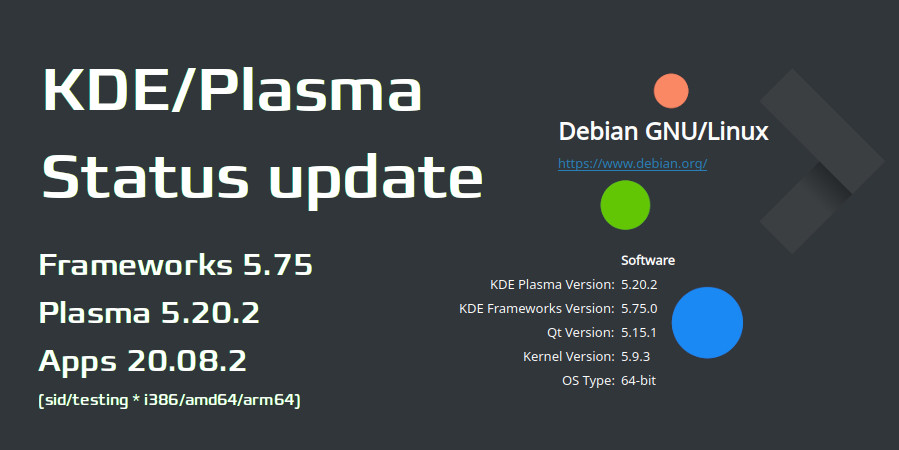 Thanks to the dedicated work of the Qt maintainers, Qt 5.15 has finally entered Debian/unstable and we can finally target Plasma 5.20.
OBS packages
The OBS packages as usual follow the latest release, and currently ship KDE Frameworks 5.75, KDE Apps 20.08.2, and new, Plasma 5.20.2. The package sources are as usual (note the different path for the Plasma packages and the App packages, containing the release version!), for Debian/unstable:
 A couple of years ago, I moved into a new flat that comes with RJ45 sockets wired for 10 Gigabit (but currently offering 1 Gigabit) Ethernet.This also meant changing the settings on my router box for my new ISP.I took this opportunity to review my router's other settings too. I'll be blogging about these over the next few posts.
GRUB fine-tuning
One thing that had been annoying me ever since Debian migrated to systemd as /sbin/init is that boot message verbosity hasn't been the same. Previously, the cmdline option
 The KDE Bugzilla handles a lot of projects and they often match with the repo name, but not always.
For instance we have ancient products and components at Bugzilla, as projects have a lifecycle from playground into Release Service, or Frameworks, sometimes with a change of name.
So you may end up searching Bugzilla quite awhile for the correct product and component to be able to confirm or create bug reports against an application.
Let's have a look at