Search Results: "reg"

13 February 2017

Ben Hutchings: Debian LTS work, January 2017

I was assigned 12.75 hours of work by Freexian's Debian LTS initiative and carried over 5.5 from December. I worked only 3 hours, so I carry over 15.25 hours - but I will probably give up some of those to the general pool. I spent some time finishing off the linux security update mentioned in my December entry. I also backported the current version of wireless-regdb - not a security update, but an important one anyway - and issued DLA 785-1.

Dirk Eddelbuettel: RcppTOML 0.1.1

Following up on the somewhat important RcppTOML 0.1.0 releaseas which brought RcppTOML to Windows, we have a first minor update 0.1.1. Two things changed: once again updated upstream code from Chase Geigle's cpptoml which now supports Date types too, and we added the ability to parse TOML from strings as opposed to only from files. TOML is a file format that is most suitable for configurations, as it is meant to be edited by humans but read by computers. It emphasizes strong readability for humans while at the same time supporting strong typing as well as immediate and clear error reports. On small typos you get parse errors, rather than silently corrupted garbage. Much preferable to any and all of XML, JSON or YAML -- though sadly these may be too ubiquitous now.
TOML is making good inroads with newer and more flexible projects such as the Hugo static blog compiler, or the Cargo system of Crates (aka "packages") for the Rust language.

Changes in version 0.1.1 (2017-xx-yy)
  • Synchronized multiple times with ccptoml upstream adding support for local datetime and local date and more (PR #9, #10, PR #11)
  • Dates are now first class types, some support for local versus UTC times was added (though it may be adviseable to stick with UTC)
  • Parsing from (R) character variables is now supported as well
  • Output from print.toml no longer prints extra newlines

Courtesy of CRANberries, there is a diffstat report for this release. More information and examples are on the RcppTOML page. Issues and bugreports should go to the GitHub issue tracker.

This post by Dirk Eddelbuettel originated on his Thinking inside the box blog. Please report excessive re-aggregation in third-party for-profit settings.

12 February 2017

Shirish Agarwal: Density and accessibility

Around 2 decades back and a bit more I was introduced to computers. The top-line was 386DX which was mainly used as fat servers and some lucky institutions had the 386SX where IF we were lucky we could be able to play some games on it. I was pretty bad at Prince of Persia or most of the games of the era as most of the games depended on lightning reflexes which I didn t possess. Then 1997 happened and I was introduced to GNU/Linux but my love of/for games still continued even though I was bad at most of them. The only saving grace was turn-based RPG s (role-playing games) which didn t have permadeath, so you could plan your next move. Sometimes a wrong decision would lead to getting a place from where it was impossible to move further. As the decision was taken far far break which lead to the tangent, the only recourse was to replay the game which eventually lead to giving most of those kind of games. Then in/around 2000 Maxis came out with Sims. This was the time where I bought my first Pentium. I had never played a game which had you building stuff, designing stuff, no violence and the whole idea used to be about balancing priorities of trying to get new stuff, go to work, maintain relationships and still make sure you are eating, sleeping, have a good time. While I might have spent probably something close to 500 odd hours in the game or even more so, I spent the least amount of time in building the house. It used to be 4 4 when starting (you don t have much of in-game money and other stuff you wanted to buy as well) to 8 8 or at the very grand 12 12. It was only the first time I spent time trying to figure out where the bathroom should be, where the kitchen should, where the bedroom should be and after that I could do that blind-folded. The idea behind my house-design used to be simplicity, efficient (for my character). I used to see other people s grand creations of their houses and couldn t understand why they made such big houses. Now few days back, I saw few episodes of a game called Stranded Deep . The story, plot is simple. You, the player are going in a chartered plane and suddenly lightning strikes ( game trope as today s aircrafts are much better able to deal with lightning strikes) and our hero or heroine washes up on a beach with raft with the barest of possessions. Now the whole game is based upon him/her trying to survive, once you get the hang of the basic mechanics and you know what is to be done, you can do it. The only thing the game doesn t have is farming but as the game has unlimited procedural world, you just paddle or with boat motor go island hopping and take all that what you need. What was interesting to me was seeing a gamer putting so much time and passion in making a house. When I was looking at that video, I realized that maybe because I live in a dense environment, even the designs we make either of houses or anything else is more to try to get more and more people rather than making sure that people are happy which leads to my next sharing. Couple of days back, I read Virali Modi s account of how she was molested three times when trying to use Indian Railways. She made a petition on change.org While I do condemn the molestation as it s an affront against individual rights, freedom, liberty, free movement, dignity. Few of the root causes as pointed out by her, for instance the inability or non-preference to give differently-abled people the right to board first as well as awaiting to see that everybody s boarded properly before starting the train are the most minimum steps that Indian Railways could take without spending even a paise. The same could be told/shared about sensitizing people, although I have an idea of why does Indian Railway not employ women porters or women attendants for precisely this job. I accompanied a blind gentleman friend few times on Indian Railways and let me tell you, it was one of the most unpleasant experiences. The bogies which is given to them is similar or even less than what you see in unreserved compartments. The toilets were/are smelly, the gap between the station and the train was/is considerable for everybody from blind people, differently-abled people, elderly people as well. This is one of the causes of accidents which happen almost every day on Indian Railways. I also learnt that especially for blind people they are looking for a sort of low-frequency whistle/noise which tells them the disabled coupe/bogie/coach will come at a specific spot in the Station. In a platform which could have anything between 1500-2000 people navigating it wouldn t be easy. I don t know about other places but Indian Railway Stations need to learn a lot to make it a space for differently abled to navigate by themselves. Pune Station operates (originating or passing through) around 200 odd trains, with exceptions of all the specials and weekly trains that ply through, adding those would probably another 5-10 trains to the mix. Each train carries anywhere between 750-1000 odd people so roughly anywhere between 15-20 million pass through Pune Railway Station daily. Even if we take conservative estimates of around 5% of the public commuting from Pune, it would mean around 750,000 people travelling daily. Pune Railway Station has 6 stations and if I spread them equally it would come to around 100,000 people on one platform in 24 hours. Divide that equally by 24 hours and it comes to 4,160 people per hour. Now you take those figures and you see the Pune platforms are under severe pressure. I have normalized many figures. For instance, just like airports, even in railways, there are specific timings where more trains come and go. From morning 0500 hrs to late night 2300 hrs. there would be lot many trains, whereas the graveyard shifts would have windows where maintenance of tracks and personnel takes place. I dunno if people can comprehend 4000 odd people on the platform. Add to that you usually arrive at least an hour or two before a train departs even if you are a healthy person as Indian Railways has a habit of changing platforms of trains at the last minute. So if you a differently abled person with some luggage for a long-distance train, the problems just multiply. See drag accidents because of gap between railway bogies and platforms. The width of the entrance to the bogie is probably between 30-40 inches but the design is such that 5-10 inches are taken on each side. I remembered the last year, our current Prime Minister, Mr. Narendra Modi had launched Accessible Campaign with great fanfare and we didn t hear anything much after that. Unfortunately, the site itself has latency and accessibility issues, besides not giving any real advice even if a person wants to know what building norms should one follow if one wants to make an area accessible. This was easily seen by last year s audit in Delhi as well as other places. A couple of web-searches later, I landed up at a Canadian site to have some idea about the width of the wheelchair itself as well as additional room to manoeuvre. Unfortunately, the best or the most modern coaches/bogies that Indian Railways has to offer are the LHB Bogies/Coaches. Now while the Coaches/Bogies by themselves are a big improvement from the ICF Coaches which we still have and use, if you read the advice and directions shared on the Canadian site, the coaches are far from satisfactory for people who are wheel-chair bound. According to Government s own census records, 0.6% of the population have movement issues. Getting all the differently-abled people together, it comes between 2, 2.5% of the population which is quite a bit. If 2-3 people out of every 100 people are differently-abled then we need to figure out something for them.While I don t have any ideas as to how we could improve the surroundings, it is clear that we need the change. While I was thinking,dreaming,understanding some of the nuances inadvertently, my attention/memories shifted to my toilet experiences at both Mumbai and the Doha Airport. As had shared then, had been pleasantly surprised to see that both in Mumbai Airport as well as the Doha Airport, the toilets were pretty wide, a part of me was happy and a part of me was seeing the added space as wastefulness. With the understanding of needs of differently-abled people it started to make whole lot of sense. I don t remember if I had shared then or not. Although am left wondering where they go for loo in the aircraft. The regular toilets are a tight fit for obese people, I am guessing aircrafts have toilets for differently-abled people as well. Looking back at last year s conference, we had 2-3 differently-abled people. I am just guessing that it wouldn t have been a pleasant experience for them. For instance, where we were staying, at UCT it had stairs, no lifts so by default they probably were on ground-floor. Then where we were staying and where most of the talks were about a few hundred metres away and the shortest distance were by stairs, the round-about way was by road but had vehicles around so probably not safe that way as well. I am guessing they had to be dependant on other people to figure out things. There were so many places where there were stairs and no ramps and even if there were ramps they were probably a bit more than the 1:12 which is the advice given. I have heard that this year s venue is also a bit challenging in terms of accessibility for differently-abled people. I am clueless as to did differently-able find debconf16 in terms of accessibility or not ? A related query to that one, if a Debconf s final report mentions issues with accessibility, do the venues make any changes so that at some future date, differently-abled people would have a better time. I know of Indian institutions reluctance to change, to do expenditure, dunno how western countries do it. Any ideas, comments are welcome.
Filed under: Miscellenous Tagged: #386, #accessibility, #air-travel, #Computers, #differently-abled, #Railways, gaming

Elena 'valhalla' Grandi: Mobile-ish devices as freedom respecting working environments

Mobile-ish devices as freedom respecting working environments

On planet FSFE, there is starting to be a conversation on using tablets / Android as the main working platform.

It started with the article by Henri Bergius http://bergie.iki.fi/blog/working-on-android-2017/ which nicely covers all practical points, but is quite light on the issues of freedom.

This was rectified by the article by David Boddie http://www.boddie.org.uk/david/www-repo/Personal/Updates/2017/2017-02-11.html which makes an apt comparison of Android to the platform it is replacing in many areas of work and life: Microsoft Windows and criticises its lack of effective freedom, even when the OS was supposed to be under a free license.

I fully agree that lightweight/low powered hardware can be an excellent work environment, especially when on the go, and even for many kinds of software developement, but I'd very much rather have that hardware run an environment that I can trust like Debian (or another traditional GNU/Linux distribution) rather than the phone based ones where, among other problems, there is no clear distinction between what is local and trustable and what is remote and under somebody else's control.

In theory, it would be perfectly possible to run Debian on most tablet and tablet-like hardware, and have such an environment; in practice this is hard for a number of reasons including the lack of mainline kernel support for most hardware and the way actually booting a different OS on it usually ranges from the quite hard to the downright impossible.

Luckily, there is some niche hardware that uses tablet/phone SoCs but is sold with a GNU/Linux distribution and can be used as a freedom respecting work environment on-the-go: my current setup includes an OpenPandora https://en.wikipedia.org/wiki/Pandora_(console) (running Angstrom + a Debian chroot) and an Efika MX Smartbook https://en.wikipedia.org/wiki/Efika, but they are both showing their age badly: they have little RAM (especially the Pandora), and they aren't fully supported by a mainline kernel, which means that you're stuck on an old kernel and dependent on the producer for updates (which for the Efika ended quite early; at least the Pandora is still somewhat supported, at least for bugfixes).

Right now I'm looking forward to two devices as a replacement: the DragonBox Pyra https://en.wikipedia.org/wiki/DragonBox_Pyra (still under preorders) and the THERES-I laptop kit https://www.olimex.com/Products/DIY%20Laptop/ (hopefully available for sale "in a few months", and with no current mainline support for the SoC, but there is hope to see it from the sunxi community http://linux-sunxi.org/Main_Page).

As for software, the laptop/clamshell designs means that using a regular Desktop Environment (or, in my case, Window Manager) works just fine; I do hope that the availability of Pyra (with its touchscreen and 4G/"phone" chip) will help to give a bit of life back to the efforts to improve mobile software on Debian https://wiki.debian.org/Mobile

Hopefully, more such devices will continue to be available, and also hopefully the trend for more openness of the hardware itself will continue; sadly I don't see this getting outside of a niche market in the next few years, but I think that this niche will remain strong enough to be sustainable.

P.S. from nitpicker-me: David Boddie mentions the ability to easily download sources for any component with apt-get source: the big difference IMHO is given by apt-get build-dep, which also install every dependency needed to actually build the code you have just downloaded.

P.S.2: I also agree with Davide Boddie that supporting Conservancy https://sfconservancy.org/supporter/ is very important, and there are still a few hours left to have the contribution count twice.

Iustin Pop: Fine art printing at home

Fine art printing at home It is very interesting how people change over time. Way back in the analog film era, I was using a very cheap camera, and getting the film developed and pictures printed at random places in town. As the movement towards digital began, I started dreaming of a full digital workflow take picture, download from camera, enjoy on your monitor. No more pesky physical stuff. And when I finally got a digital camera, I was oh-so-happy to finally get rid of films and prints. But time passes, and a few years back though, at the end of 2013, I had the misfortune to learn on various photography forums that, within certain limits, one can do high quality printing at home quality high enough for serious prints. I always imagined that "serious" prints can only happen on big, professional stuff, but to my surprise, what I was reading was that many professional photographers can do their prints themselves (for certain paper sizes). I tried before printing photos on my laser printer that I wrote about, but that is a hilarious exercise, nothing more. Thinking process was pretty simple: So I decided to get a photo printer. Because hey, one more printer was the thing I was missing the most. Ink The think with inkjet photo printers is that the bigger they are, the more cheaper the ink is, and the more optimised they are for large volume printing. The more optimisation for large volume, the worse the printers do if you don't print often enough, in the sense of dried ink. This means clogged heads, and each of the serious printer manufacturers (Canon, Epson, HP) deal in different ways with it; some by having extra, spare lines in the print head that replace the clogged ones, others have replaceable printer heads, others rely on wasting ink by trying to flush the ink lines, etc. Also within each manufacturer's lines, different printers behave differently. So one must take this into account how often will you print? Of course I thought very often, but the truth is, this is just another hobby, so time is lacking, and I have weeks going by without turning the printer on. And so, I did have some problems with dried ink, but minor I'd say; I only had once to run a "power cleaning", when due to real world I didn't have time to turn the printer on for months; I managed to choose a good printer in this regard. I never though computed how much ink I wasted with cleaning the heads Paper Another issue with printing is the fact that the result is a physical object, outside of the digital realm. And the transition from digital to physical is tricky. First, the printer itself and the ink are one relatively straightforward choice: decide (by whatever criteria you want) on the printer, and most printers at this level have one set of inks only. But the problem is: which paper? And as I learned, since how the paper looks is a subjective thing, this is an endless topic As you can see, this is really a bottomless pit. I made the mistake of buying lots of sample packs, thinking that settling on a specific paper will be an objective process, but no. Three years later, I have a few favourite papers, but I'm sure I could have almost randomly chosen them (read 3 reviews, choose) and not gotten objectively different results. ICC profiles and processing Another thing is that simply having the printer and the paper doesn't mean everything is fixed. Since printers are analog devices, there needs to be a printer and paper specific colour profile, so that you get (on paper) what you see on the screen (which also needs to be calibrated). So when choosing the printer you should be careful to choose one which is common enough that it has profiles, ideally profiles done by the paper manufacturer themselves. Or, you can go the more basic route, and calibrate the printer/paper combination yourself! I skipped that part though. However you get a profile, if you tell your photo processing application what is your display profile and your printer+paper profile, ideally you what you see is what you get, this time for real. Except that sometimes the gamut of colours in the picture can't be represented entirely in either the display nor the printer profile, so the display is an approximation, but a different one than your printer will do on paper. So you learn about relative and perceptual colorimetric conversions, and you read many blog posts about which one to use for what type of pictures (portraits have different needs than landscapes), and you wonder why did you chose this hobby? Of course, you can somewhat avoid the previous two issues by going more old-school to black and white printing. This should be simple, right? Black and white, nothing more. Hah, you wish. Do you do the B&W conversion in your photo processing application, or in your printer? Some printers are renowned by their good B&W conversions, some not. If you print B&W, then the choice of papers also change, because some papers are just awesome at B&W, but only so-so for colours. So says the internet, at least. But even if you solve all of the above, don't give up just yet, because there is still a little problem. Even if you send the right colours to the printer, the way a certain picture looks on paper is different than on screen. This circles somewhat back to paper choice (glossy type ink having deeper blacks than matte, for example) and colour-vs-b&w, but is a general issue: displays have better contrasts than paper (this doesn't mean the pictures are better looking on screen though). So you use the soft-proofing function, but it looks completely weird, and you learn that you need to learn how specific papers will differ from screen, and that sometimes you don't need any adjustment, sometimes you need a +15, which might mean another run of the same print. You print, then what? So you print. Nice, high quality print. All colours perfect! And then what? First, you wait. Because ink, as opposed to laser toner, is not "done" once the paper is out of the printer. It has to dry, which is a process taking about 24 hours in its initial phase, and which you help along by doing some stuff. The ink settles during this time in the paper, and only after that you know what the final look of the print will be. Depending on what you plan to do with the print, you might want to lay a layer of protective stuff on top of it; a kind of protective film that will keep it in better shape over time, but which has the downside that a) it must definitely be applied after the ink has dried and the the paper has for sure finished outgassing and b) it's a semi-hard layer, so you can roll the paper anymore (if you were planning to do that for transport). Or you say damn it, this is anyway a poor picture So with the print all good and really in its final state, you go on and research what solutions are there for hanging prints at home. And look at frames, and think about behind-glass framing or no glass-framing, and and and and you realise that if you just printed your photos at a lab, they'd come directly framed! I still have the really minimalist hanging solution that I bought a year ago unpacked Getting there, sometime! Costs/economic sense If you think all this effort is done in order to save money on prints, the answer is "Ha ha ha" While professional prints at a lab are expensive, how much do you think all the above (printer, inks, paper, framing, TIME) costs? A lot. It's definitely not worth unless your day job is photography. No, for me it was more the desire to own the photographic process from start to end: learn enough to be able to choose everything (camera which implies sensor which implies a lot of things, lens, post-processing, printer/ink, paper), and see (and have) the end result of your work in your hands. Is it worth all the trouble? Fast forward three years later, I still have the printer, although many times I was thinking of getting rid of it. It takes space, it costs some money (although you don't realise this as you print, since you already sunk the money in consumables), it takes time. Being able to print small photos for family (e.g. 10 15) is neat, but a small printer can do this as well, or you can order prints online, or print them from a memory card at many places. Being able to print A4-size (for which framing for e.g. desk-use is a pain) is also neat, but here there are still simpler solutions than your own big printer. The difference is when you print large. You look at the picture on your big screen, you think/imagine how it will look printer, and then you fire an A2 print. The printer starts, makes noises for about 10 minutes, and then you have the picture in your hands. The ink is still fresh (you know it takes 24 hours to settle), and has that nice ink smell that you don't get anymore in day to day life. With a good paper and a good printer, the way the picture looks is so special, that all the effort seems trivial now. I don't know how looking at pictures on an 8K 30+ inch monitor will be; but there's an indescribable difference between back-lighted LCD and paper for the same picture. Even at the same relative size, the paper is real, while the picture is virtual. You look at the people in the picture on your display, whereas the people in the print look at you. Maybe this is just size. A2 is bigger than my monitor wait, no. A2 has a diagonal of ~29 inches (vs. the display at 30"). Maybe it's resolution? An A2 print out of D810 is small enough to still have good resolution (it's about 320dpi after the small cropping needed for correcting the aspect ratio, which matches the printer's native 360dpi resolution). Coupled with a good printer, it's more than high enough resolution that even with a loupe, there's enough detail in the picture to not see its "digital" history (i.e. no rasterization, no gradients, etc.) Note that 360dpi for photo inkjet printers is much different from 600-1200dpi for laser printers (which are raster-based, not ink droplet based, so it's really not comparable). In any case, the print, even at this (relatively large) size, feels like a reflection of reality. On the monitor, it still feels like a digital picture. I could take a picture of the print to show you, but that would defeat the point, wouldn't it And this is what prompted this blog post. I had a pretty intense week at work, so when the weekend came, I was thinking what to do to disconnect and relax. I had a certain picture (people, group photo) that I wanted to print for a while, and it was OK on the screen, but not special. I said, somewhat not very enthusiastic, let's print it. And as the printer was slowly churning along, and the paper was coming out, I remembered why I don't get rid of the printer. Because every time I think about doing that, I say to myself "let's do one more print", which quickly turns into "wow, not, I'm keeping it". Because, even as our life migrates into the digital/virtual realm or maybe more so we're still living in the real world, and our eyes like to look at real objects. And hey, on top of that, it was and still is a pretty intense learning experience!

11 February 2017

Niels Thykier: On making Britney smarter

Updating Britney often makes our life easier. Like: Concretely, transitions have become a lot easier. When I joined the release team in the summer 2011, about the worst thing that could happen was discovering that two transitions had become entangled. You would have to wait for everything to be ready to migrate at the same time and then you usually also had to tell Britney what had to migrate together. Today, Britney will often (but not always) de-tangle the transitions on her own and very often figure out how to migrate packages without help. The latter is in fact very visible if you know where to look. Behold, the number of manual easy and hint -hints by RT members per year[2]:
Year   Total   easy   hint
-----+-------+------+-----
2005     53      30    23 
2006    146      74    72
2007     70      40    30
2008    113      68    45
2009    229     171    58
2010    252     159    93
2011    255     118   137
2012     29      21     8
2013     36      30     6
2014     20      20     0
2015     25      17     8
2016     16      11     5
2017      1       1     0
As can be seen, the number of manual hints drop by factor of ~8.8 between 2011 and 2012. Now, I have not actually done a proper statistical test of the data, but I have a hunch that drop was significant (see also [3] for a very short data discussion). In conclusion: Smooth-updates (which was enabled late in 2011) have been a tremendous success.  [1] A very surprising side-effect of that commit was that the ( original ) auto-hinter could now solve a complicated haskell transition. Turns out that it works a lot better, when you give correct information!  [2] As extracted by the following script and then manually massaged into an ASCII table. Tweak the in-line regex to see different hints.
respighi.d.o$ cd "/home/release/britney/hints" && perl -E '
    my (%years, %hints);
    while(<>)   
        chomp;
        if (m/^\#\s*(\d 4 )(?:-?\d 2 -?\d 2 );/ or m/^\#\s*(?:\d+-\d+-\d+\s*[;:]?\s*)?done\s*[;:]?\s*(\d 4 )(?:-?\d 2 -?\d 2 )/)  
             $year = $1; next;
          
         if (m/^((?:easy hint) .*)/)  
             my $hint = $1; $years $year ++ if defined($year) and not $hints $hint ++;
             next;
          
         if (m/^\s*$/)   $year = undef; next;  
     ;
    for my $year (sort(keys(%years)))   
        my $count = $years $year ;
        print "$year: $count\n"
     ' * OLD/jessie/* OLD/wheezy/* OLD/Lenny/* OLD/*
[3] I should probably mention for good measure that extraction is ignoring all hints where it cannot figure out what year it was from or if it is a duplicate. Notable it is omitting about 100 easy/hint-hints from OLD/Lenny (compared to a grep -c), which I think accounts for the low numbers from 2007 (among other). Furthermore, hints files are not rotated based on year or age, nor am I sure we still have all complete hints files from all members.
Filed under: Debian, Release-Team

Reproducible builds folks: Reproducible Builds: week 93 in Stretch cycle

Here's what happened in the Reproducible Builds effort between Sunday January 29 and Saturday February 4 2017: Media coverage Dennis Gilmore and Holger Levsen presented "Reproducible Builds and Fedora" (Video, Slides) at Devconf.cz on February 27th 2017. On February 1st, stretch/armhf reached 90% reproducible packages in our test framework, so that now all four tested architectures are 90% reproducible in stretch. Yay! For armhf this means 22472 reproducible source packages (in main); for amd64, arm64 and i386 these figures are 23363, 23062 and 22607 respectively. Chris Lamb appeared on the Changelog podcast to talk about reproducible builds: Holger Levsen pitched Reproducible Builds and our need for a logo in the "Open Source Design" room at FOSDEM 2017 (Video, 09:36 - 12:00). Upcoming Events Reproducible work in other projects We learned that the "slightly more secure" Heads firmware (a Coreboot payload) is now reproducibly built regardless of host system or build directory. A picture says more than a thousand words: reproducible heads build on two machines Docker started preliminary work on making image builds reproducible. Toolchain development and fixes Ximin Luo continued to write code and test cases for the BUILD_PATH_PREFIX_MAP environment variable. He also did extensive research on cross-platform and cross-language issues with enviroment variables, filesystem paths, and character encodings, and started preparing a draft specification document to describe all of this. Chris Lamb asked CPython to implement an environment variable PYTHONREVERSEDICTKEYORDER to add an an option to reverse iteration order of items in a dict. However this was rejected because they are planning to formally fix this order in the next language version. Bernhard Wiedemann and Florian Festi added support for our SOURCE_DATE_EPOCH environment variable, to the RPM Package Manager. James McCoy uploaded devscripts 2.17.1 with a change from Guillem Jover for dscverify(1), adding support for .buildinfo files. (Closes: #852801) Piotr O arowski uploaded dh-python 2.20170125 with a change from Chris Lamb for a patch to fix #835805. Chris Lamb added documentation to diffoscope, strip-nondeterminism, disorderfs, reprotest and trydiffoscope about uploading signed tarballs when releasing. He also added a link to these on our website's tools page. Packages reviewed and bugs filed Bugs filed: Reviews of unreproducible packages 83 package reviews have been added, 86 have been updated and 276 have been removed in this week, adding to our knowledge about identified issues. 2 issue types have been updated: Weekly QA work During our reproducibility testing, the following FTBFS bugs have been detected and reported by: diffoscope development Work on the next version (71) continued in git this week: reproducible-website development Daniel Shahaf added more notes on our "How to chair a meeting" document. tests.reproducible-builds.org Holger unblacklisted pspp and tiledarray. If you think further packages should also be unblacklisted (possibly only on some architectures), please tell us. Misc. This week's edition was written by Ximin Luo, Holger Levsen and Chris Lamb & reviewed by a bunch of Reproducible Builds folks on IRC & the mailing lists.

Noah Meyerhans: Using FAI to customize and build your own cloud images

At this past November's Debian cloud sprint, we classified our image users into three broad buckets in order to help guide our discussions and ensure that we were covering the common use cases. Our users fit generally into one of the following groups:
  1. People who directly launch our image and treat it like a classic VPS. These users most likely will be logging into their instances via ssh and configuring it interactively, though they may also install and use a configuration management system at some point.
  2. People who directly launch our images but configure them automatically via launch-time configuration passed to the cloud-init process on the agent. This automatic configuration may optionally serve to bootstrap the instance into a more complete configuration management system. The user may or may not ever actually log in to the system at all.
  3. People who will not use our images directly at all, but will instead construct their own image based on ours. They may do this by launching an instance of our image, customizing it, and snapshotting it, or they may build a custom image from scratch by reusing and modifying the tools and configuration that we use to generate our images.
This post is intended to help people in the final category get started with building their own cloud images based on our tools and configuration. As I mentioned in my previous post on the subject, we are using the FAI project with configuration from the fai-cloud-images. It's probably a good idea to get familiar with FAI and our configs before proceeding, but it's not necessary. You'll need to use FAI version 5.3.4 or greater. 5.3.4 is currently available in stretch and jessie-backports. Images can be generated locally on your non-cloud host, or on an existing cloud instance. You'll likely find it more convenient to use a cloud instance so you can avoid the overhead of having to copy disk images between hosts. For the most part, I'll assume throughout this document that you're generating your image on a cloud instance, but I'll highlight the steps where it actually matters. I'll also be describing the steps to target AWS, though the general workflow should be similar if you're targeting a different platform. To get started, install the fai-server package on your instance and clone the fai-cloud-images git repository. (I'll assume the repository is cloned to /srv/fai/config.) In order to generate your own disk image that generally matches what we've been distributing, you'll use a command like:
sudo fai-diskimage --hostname stretch-image --size 8G \
--class DEBIAN,STRETCH,AMD64,GRUB_PC,DEVEL,CLOUD,EC2 \
/tmp/stretch-image.raw
This command will create an 8 GB raw disk image at /tmp/stretch-image.raw, create some partitions and filesystems within it, and install and configure a bunch of packages into it. Exactly what packages it installs and how it configures them will be determined by the FAI config tree and the classes provided on the command line. The package_config subdirectory of the FAI configuration contains several files, the names of which are FAI classes. Activating a given class by referencing it on the fai-diskimage command line instructs FAI to process the contents of the matching package_config file if such a file exists. The files use a simple grammar that provides you with the ability to request certain packages to be installed or removed. Let's say for example that you'd like to build a custom image that looks mostly identical to Debian's images, but that also contains the Apache HTTP server. You might do that by introducing a new file to package_config/HTTPD file, as follows:
PACKAGES install
apache2
Then, when running fai-diskimage, you'll add HTTPD to the list of classes:
sudo fai-diskimage --hostname stretch-image --size 8G \
--class DEBIAN,STRETCH,AMD64,GRUB_PC,DEVEL,CLOUD,EC2,HTTPD \
/tmp/stretch-image.raw
Aside from custom package installation, you're likely to also want custom configuration. FAI allows the use of pretty much any scripting language to perform modifications to your image. A common task that these scripts may want to perform is the installation of custom configuration files. FAI provides the fcopy tool to help with this. Fcopy is aware of FAI's class list and is able to select an appropriate file from the FAI config's files subdirectory based on classes. The scripts/EC2/10-apt script provides a basic example of using fcopy to select and install an apt sources.list file. The files/etc/apt/sources.list/ subdirectory contains both an EC2 and a GCE file. Since we've enabled the EC2 class on our command line, fcopy will find and install that file. You'll notice that the sources.list subdirectory also contains a preinst file, which fcopy can use to perform additional actions prior to actually installing the specified file. postinst scripts are also supported. Beyond package and file installation, FAI also provides mechanisms to support debconf preseeding, as well as hooks that are executed at various stages of the image generation process. I recommend following the examples in the fai-cloud-images repo, as well as the FAI guide for more details. I do have one caveat regarding the documentation, however: FAI was originally written to help provision bare-metal systems, and much of its documentation is written with that use case in mind. The cloud image generation process is able to ignore a lot of the complexity of these environments (for example, you don't need to worry about pxeboot and tftp!) However, this means that although you get to ignore probably half of the FAI Guide, it's not immediately obvious which half it is that you get to ignore. Once you've generated your raw image, you can inspect it by telling Linux about the partitions contained within, and then mount and examine the filesystems. For example:
admin@ip-10-0-0-64:~$ sudo partx --show /tmp/stretch-image.raw
NR START      END  SECTORS SIZE NAME UUID
 1  2048 16777215 16775168   8G      ed093314-01
admin@ip-10-0-0-64:~$ sudo partx -a /tmp/stretch-image.raw 
partx: /dev/loop0: error adding partition 1
admin@ip-10-0-0-64:~$ lsblk 
NAME      MAJ:MIN RM    SIZE RO TYPE MOUNTPOINT
xvda      202:0    0      8G  0 disk 
 xvda1   202:1    0 1007.5K  0 part 
 xvda2   202:2    0      8G  0 part /
loop0       7:0    0      8G  0 loop 
 loop0p1 259:0    0      8G  0 loop 
admin@ip-10-0-0-64:~$ sudo mount /dev/loop0p1 /mnt/
admin@ip-10-0-0-64:~$ ls /mnt/
bin/   dev/  home/        initrd.img.old@  lib64/       media/  opt/   root/  sbin/  sys/  usr/  vmlinuz@
boot/  etc/  initrd.img@  lib/             lost+found/  mnt/    proc/  run/   srv/   tmp/  var/  vmlinuz.old@
In order to actually use your image with your cloud provider, you'll need to register it with them. Strictly speaking, these are the only steps that are provider specific and need to be run on your provider's cloud infrastructure. AWS documents this process in the User Guide for Linux Instances. The basic workflow is:
  1. Attach a secondary EBS volume to your EC2 instance. It must be large enough to hold the raw disk image you created.
  2. Use dd to write your image to the secondary volume, e.g. sudo dd if=/tmp/stretch-image.raw of=/dev/xvdb
  3. Use the volume-to-ami.sh script in the fail-cloud-image repo to snapshot the volume and register the resulting snapshot with AWS as a new AMI. Example: ./volume-to-ami.sh vol-04351c30c46d7dd6e
The volume-to-ami.sh script must be run with access to AWS credentials that grant access to several EC2 API calls: describe-snapshots, create-snapshot, and register-image. It recognizes a --help command-line flag and several options that modify characteristics of the AMI that it registers. When volume-to-ami.sh completes, it will print the AMI ID of your new image. You can now work with this image using standard AWS workflows. As always, we welcome feedback and contributions via the debian-cloud mailing list or #debian-cloud on IRC.

10 February 2017

Dirk Eddelbuettel: anytime 0.2.1

An updated anytime package arrived at CRAN yesterday. This is release number nine, and the first with a little gap to the prior release on Christmas Eve as the features are stabilizing, as is the implementation. anytime is a very focused package aiming to do just one thing really well: to convert anything in integer, numeric, character, factor, ordered, ... format to either POSIXct or Date objects -- and to do so without requiring a format string. See the anytime page, or the GitHub README.md for a few examples. This releases addresses two small things related to the anydate() and utcdate() conversion (see below) and adds one nice new format, besides some internal changes detailed below:
R> library(anytime)
R> anytime("Thu Sep 01 10:11:12 CDT 2016")
[1] "2016-09-01 10:11:12 CDT"
R> anytime("Thu Sep 01 10:11:12.123456 CDT 2016") # with frac. seconds
[1] "2016-09-01 10:11:12.123456 CDT"
R> 
Of course, all commands are also fully vectorised. See the anytime page, or the GitHub README.md for more examples.

Changes in anytime version 0.2.1 (2017-02-09)
  • The new DatetimeVector class from Rcpp is now used, and proper versioned Depends: have been added (#43)
  • The anydate and utcdate functions convert again from factor and ordered (#46 closing #44)
  • A format similar to RFC 28122 but with additonal timezone text can now be parsed (#48 closing #47)
  • Conversion from POSIXt to Date now also respect the timezone (#50 closing #49)
  • The internal .onLoad functions was updated
  • The Travis setup uses https to fetch the run script

Courtesy of CRANberries, there is a comparison to the previous release. More information is on the anytime page. For questions or comments use the issue tracker off the GitHub repo.

This post by Dirk Eddelbuettel originated on his Thinking inside the box blog. Please report excessive re-aggregation in third-party for-profit settings.

9 February 2017

Vincent Bernat: Integration of a Go service with systemd

Unlike other programming languages, Go s runtime doesn t provide a way to reliably daemonize a service. A system daemon has to supply this functionality. Most distributions ship systemd which would fit the bill. A correct integration with systemd is quite straightforward. There are two interesting aspects: readiness & liveness. As an example, we will daemonize this service whose goal is to answer requests with nifty 404 errors:
package main
import (
    "log"
    "net"
    "net/http"
)
func main()  
    l, err := net.Listen("tcp", ":8081")
    if err != nil  
        log.Panicf("cannot listen: %s", err)
     
    http.Serve(l, nil)
 
You can build it with go build 404.go. Here is the service file, 404.service1:
[Unit]
Description=404 micro-service
[Service]
Type=notify
ExecStart=/usr/bin/404
WatchdogSec=30s
Restart=on-failure
[Install]
WantedBy=multi-user.target

Readiness The classic way for an Unix daemon to signal its readiness is to daemonize. Technically, this is done by calling fork(2) twice (which also serves other intents). This is a very common task and the BSD systems, as well as some other C libraries, supply a daemon(3) function for this purpose. Services are expected to daemonize only when they are ready (after reading configuration files and setting up a listening socket, for example). Then, a system can reliably initialize its services with a simple linear script:
syslogd
unbound
ntpd -s
Each daemon can rely on the previous one being ready to do its work. The sequence of actions is the following:
  1. syslogd reads its configuration, activates /dev/log, daemonizes.
  2. unbound reads its configuration, listens on 127.0.0.1:53, daemonizes.
  3. ntpd reads its configuration, connects to NTP peers, waits for clock to be synchronized2, daemonizes.
With systemd, we would use Type=fork in the service file. However, Go s runtime does not support that. Instead, we use Type=notify. In this case, systemd expects the daemon to signal its readiness with a message to an Unix socket. go-systemd package handles the details for us:
package main
import (
    "log"
    "net"
    "net/http"
    "github.com/coreos/go-systemd/daemon"
)
func main()  
    l, err := net.Listen("tcp", ":8081")
    if err != nil  
        log.Panicf("cannot listen: %s", err)
     
    daemon.SdNotify(false, "READY=1") //  
    http.Serve(l, nil)                //  
 
It s important to place the notification after net.Listen() (in ): if the notification was sent earlier, a client would get connection refused when trying to use the service. When a daemon listens to a socket, connections are queued by the kernel until the daemon is able to accept them (in ). If the service is not run through systemd, the added line is a no-op.

Liveness Another interesting feature of systemd is to watch the service and restart it if it happens to crash (thanks to the Restart=on-failure directive). It s also possible to use a watchdog: the service sends watchdog keep-alives at regular interval. If it fails to do so, systemd will restart it. We could insert the following code just before http.Serve() call:
go func()  
    interval, err := daemon.SdWatchdogEnabled(false)
    if err != nil   interval == 0  
        return
     
    for  
        daemon.SdNotify(false, "WATCHDOG=1")
        time.Sleep(interval / 3)
     
 ()
However, this doesn t add much value: the goroutine is unrelated to the core business of the service. If for some reason, the HTTP part gets stuck, the goroutine will happily continue to send keep-alives to systemd. In our example, we can just do a HTTP query before sending the keep-alive. The internal loop can be replaced with this code:
for  
    _, err := http.Get("http://127.0.0.1:8081") //  
    if err == nil  
        daemon.SdNotify(false, "WATCHDOG=1")
     
    time.Sleep(interval / 3)
 
In , we connect to the service to check if it s still working. If we get some kind of answer, we send a watchdog keep-alive. If the service is unavailable or if http.Get() gets stuck, systemd will trigger a restart. There is no universal recipe. However, checks can be split into two groups:
  • Before sending a keep-alive, you execute an active check on the components of your service. The keep-alive is sent only if all checks are successful. The checks can be internal (like in the above example) or external (for example, check with a query to the database).
  • Each component reports its status, telling if it s alive or not. Before sending a keep-alive, you check the reported status of all components (passive check). If some components are late or reported fatal errors, don t send the keep-alive.
If possible, recovery from errors (for example, with a backoff retry) and self-healing (for example, by reestablishing a network connection) is always better, but the watchdog is a good tool to handle the worst cases and avoid too complex recovery logic. For example, if a component doesn t know how to recover from an exceptional condition3, instead of using panic(), it could signal its situation before dying. Another dedicated component could try to resolve the situation by restarting the faulty component. If it fails to reach an healthy state in time, the watchdog timer will trigger and the whole service will be restarted.

  1. Depending on the distribution, this should be installed in /lib/systemd/system or /usr/lib/systemd/system. Check with the output of the command pkg-config systemd --variable=systemdsystemunitdir.
  2. This highly depends on the NTP daemon used. OpenNTPD doesn t wait unless you use the -s option. ISC NTP doesn t either unless you use the --wait-sync option.
  3. An example of an exceptional condition is to reach the limit on the number of file descriptors. Self-healing from this situation is difficult and it s easy to get stuck in a loop.

Dirk Eddelbuettel: RcppArmadillo 0.7.700.0.0

armadillo image Time for another update of RcppArmadillo with a new release 0.7.700.0.0 based on a fresh Armadillo 7.700.0. Following my full reverse-dependency check of 318 package (commit of log here), CRAN took another day to check again. Armadillo is a powerful and expressive C++ template library for linear algebra aiming towards a good balance between speed and ease of use with a syntax deliberately close to a Matlab. RcppArmadillo integrates this library with the R environment and language--and is widely used by (currently) 318 other packages on CRAN -- an increase of 20 just since the last CRAN release of 0.7.600.1.0 in December! Changes in this release relative to the previous CRAN release are as follows:

Changes in RcppArmadillo version 0.7.700.0.0 (2017-02-07)
  • Upgraded to Armadillo release 7.700.0 ("Rogue State")
    • added polyfit() and polyval()
    • added second form of log_det() to directly return the result as a complex number
    • added range() to statistics functions
    • expanded trimatu()/trimatl() and symmatu()/symmatl() to handle sparse matrice

Changes in RcppArmadillo version 0.7.600.2.0 (2017-01-05)
  • Upgraded to Armadillo release 7.600.2 (Coup d'Etat Deluxe)
    • Bug fix to memory allocation for fields

Courtesy of CRANberries, there is a diffstat report. More detailed information is on the RcppArmadillo page. Questions, comments etc should go to the rcpp-devel mailing list off the R-Forge page.

This post by Dirk Eddelbuettel originated on his Thinking inside the box blog. Please report excessive re-aggregation in third-party for-profit settings.

7 February 2017

Carl Chenet: The Gitlab database incident and the Backup Checker project

The Gitlab.com database incident of 2017/01/31 and the resulting data loss reminded everyone (at least for the next days) how it s easy to lose data, even when you think all your systems are safe. Being really interested by the process of backing up data, I read with interest the report (kudos to the Gitlab company for being so transparent about it) and I was soooo excited to find the following sentence:
Regular backups seem to also only be taken once per 24 hours, though team-member-1 has not yet been able to figure out where they are stored. According to team-member-2 these don t appear to be working, producing files only a few bytes in size.
Whoa, guys! I m so sorry for you about the data loss, but from my point of view I was so excited to find a big FOSS company publicly admitting and communicating about a perfect use case for the Backup Checker project, a Free Software I ve been writing these last years. Data loss: nobody cares before, everybody cries after Usually people don t care about the backups. It s a serious business for web hosters and the backup team from big companies but otherwise and in other places, nobody cares. Usually everybody agrees about how backups are important but few people make them or install an automatized system to create backups and the day before, nobody verifies they are usable. The reason is obvious: it s totally boring, and in some cases e.g for large archives, difficult. Because verifying backups is boring for humans, I launched the Backup Checker project in order to automatize this task. Backup Checker offers a wide range of features, checking lots of different archives (tar. gz,bz2,xz , zip, tree of files and offer lots of different tests (hash sum, size equal, smaller/greater than , unix rights, ,). Have a look at the official documentation for a exhaustive list of features and possible tests. Automatize the controls of your backups with Backup Checker Checking your backups means to describe in a configuration file how a backup should be, e.g a gzipped database dump. You usually know about what size the archive is going to be, what the owner and the group owner should be. Even easier, with Backup Checker you can generate this list of criterias from an actual archive, and remove uneeded criterias to create a template you can re-use for different kind of archives. Ok, 2 minutes of your time for a real word example, I use an existing database sql dump in an tar.gz archive to automatically create the list describing this backup:
$ backupchecker -G database-dump.tar.gz
$ cat database-dump.list
[archive]
mtime  1486480274.2923253
[files]
database.sql  =7854803 uid 1000 gid 1000 owner chaica group chaica mode 644 type f mtime 1486480253.0
Now, just remove parameters too precise from this list to get a backup template. Here is a possible result:
[files]
database.sql  >6m uid 1000 gid 1000 mode 644 type f
We define here a template for the archive, meaning that the database.sql file in the archive should have a size greater than 6 megabytes, be owned by the user with the uid of 1000 and the group with a gid of 1000, this file should have the mode 644 and be a regular file. In order to use a template instead of the complete list, you also need to remove the sha512 from the .conf file. Pretty easy hmm? Ok, just for fun, lets replicate the part of the Gitlab.com database incident mentioned above and write an archive with an empty sql dump inside an archive:
$ touch /tmp/database.sql && \
tar zcvf /tmp/database-dump.tar.gz /tmp/database.sql && \
cp /tmp/database-dump.tar.gz .
Now we launch Backup Checker with the previously created template. If you didn t change the name of database-dump.list file, the command should only be:
$ backupchecker -C database-dump.conf
$ cat a.out 
WARNING:root:1 file smaller than expected while checking /tmp/article-backup-checker/database-dump.tar.gz: 
WARNING:root:database.sql size is 0. Should have been bigger than 6291456.
The automatized controls of Backup Checker trigger a warning in the log file. The empty sql dump has been identified inside the archive. A step further As you could read in this article, verifying some of your backups is not a time consuming task, given the fact you have a FOSS project dedicated to this task, with an easy way to realize a template of your backups and to use it. This article provided a really simple example of such a use case, the Backup Checker has lots of features to offer when verifying your backups. Read the official documentation for more complete descriptions of the available possibilities. Data loss, especially for projets storing user data is always a terrible event in the life of an organization. Lets try to learn from mistakes which could happen to anyone and build better backup systems. More information about the Backup Checker project

Bits from Debian: DebConf17: Call for Proposals

The DebConf Content team would like to Call for Proposals for the DebConf17 conference, to be held in Montreal, Canada, from August 6 through August 12, 2017. You can find this Call for Proposals in its latest form at: https://debconf17.debconf.org/cfp Please refer to this URL for updates on the present information. Submitting an Event Submit an event proposal and describe your plan. Please note, events are not limited to traditional presentations or informal sessions (BoFs). We welcome submissions of tutorials, performances, art installations, debates, or any other format of event that you think would be beneficial to the Debian community. Please include a short title, suitable for a compact schedule, and an engaging description of the event. You should use the field "Notes" to provide us information such as additional speakers, scheduling restrictions, or any special requirements we should consider for your event. Regular sessions may either be 20 or 45 minutes long (including time for questions), other kinds of sessions (like workshops) could have different durations. Please choose the most suitable duration for your event and explain any special requests. You will need to create an account on the site, to submit a talk. We'd encourage Debian account holders (e.g. DDs) to use Debian SSO when creating an account. But this isn't required for everybody, you can sign up with an e-mail address and password. Timeline The first batch of accepted proposals will be announced in April. If you depend on having your proposal accepted in order to attend the conference, please submit it as soon as possible so that it can be considered during this first evaluation period. All proposals must be submitted before Sunday 4 June 2017 to be evaluated for the official schedule. Topics and Tracks Though we invite proposals on any Debian or FLOSS related subject, we have some broad topics on which we encourage people to submit proposals, including: You are welcome to either suggest more tracks, or become a coordinator for any of them; please refer to the Content Tracks wiki page for more information on that. Code of Conduct Our event is covered by a Code of Conduct designed to ensure everyone's safety and comfort. The code applies to all attendees, including speakers and the content of their presentations. For more information, please see the Code on the Web, and do not hesitate to contact us at content@debconf.org if you have any questions or are unsure about certain content you'd like to present. Video Coverage Providing video of sessions amplifies DebConf achievements and is one of the conference goals. Unless speakers opt-out, official events will be streamed live over the Internet to promote remote participation. Recordings will be published later under the DebConf license, as well as presentation slides and papers whenever available. DebConf would not be possible without the generous support of all our sponsors, especially our Platinum Sponsor Savoir-Faire Linux. DebConf17 is still accepting sponsors; if you are interested, or think you know of others who would be willing to help, please get in touch! In case of any questions, or if you wanted to bounce some ideas off us first, please do not hesitate to reach out to us at content@debconf.org. We hope to see you in Montreal! The DebConf team

6 February 2017

Russell Coker: SE Linux in Debian/Stretch

Debian/Stretch has been frozen. Before the freeze I got almost all the bugs in policy fixed, both bugs reported in the Debian BTS and bugs that I know about. This is going to be one of the best Debian releases for SE Linux ever. Systemd with SE Linux is working nicely. The support isn t as good as I would like, there is still work to be done for systemd-nspawn. But it s close enough that anyone who needs to use it can use audit2allow to generate the extra rules needed. Systemd-nspawn is not used by default and it s not something that a new Linux user is going to use, I think that expert users who are capable of using such features are capable of doing the extra work to get them going. In terms of systemd-nspawn and some other rough edges, the issue is the difference between writing policy for a single system vs writing policy that works for everyone. If you write policy for your own system you can allow access for a corner case without a lot of effort. But if I wrote policy to allow access for every corner case then they might add up to a combination that can be exploited. I don t recommend blindly adding the output of audit2allow to your local policy (be particularly wary of access to shadow_t and write access to etc_t, lib_t, etc). But OTOH if you have a system that s running in enforcing mode that happens to have one daemon with more access than is ideal then all the other daemons will still be restricted. As for previous releases I plan to keep releasing updates to policy packages in my own apt repository. I m also considering releasing policy source to updates that can be applied on existing Stretch systems. So if you want to run the official Debian packages but need updates that came after Stretch then you can get them. Suggestions on how to distribute such policy source are welcome. Please enjoy SE Linux on Stretch. It s too late for most bug reports regarding Stretch as most of them won t be sufficiently important to justify a Stretch update. The vast majority of SE Linux policy bugs are issues of denying wanted access not permitting unwanted access (so not a security issue) and can be easily fixed by local configuration, so it s really difficult to make a case for an update to Stable. But feel free to send bug reports for Buster (Stretch+1).

5 February 2017

Dirk Eddelbuettel: random 0.2.6

A pure maintenance release of the random package for truly (hardware-based) random numbers as provided by random.org is now on CRAN. As requested by CRAN, we made running tests optional. Not running tests is clearly one way of not getting (spurious, networking-related) failures ... Courtesy of CRANberries comes a diffstat report for this release. Current and previous releases are available here as well as on CRAN.

This post by Dirk Eddelbuettel originated on his Thinking inside the box blog. Please report excessive re-aggregation in third-party for-profit settings.

4 February 2017

Dirk Eddelbuettel: RcppCCTZ 0.2.1

A new minor version 0.2.1, of RcppCCTZ is now on CRAN. It corrects a possible shortcoming and rounding in the conversion from internal representation (in C++11 using int64_t) to the two double values for seconds and nanoseconds handed to R. Two other minor changes are also summarized below. RcppCCTZ uses Rcpp to bring CCTZ to R. CCTZ is a C++ library for translating between absolute and civil times using the rules of a time zone. In fact, it is two libraries. One for dealing with civil time: human-readable dates and times, and one for converting between between absolute and civil times via time zones. The RcppCCTZ page has a few usage examples and details. The changes in this version are summarized here:

Changes in version 0.2.1 (2017-02-04)
  • Conversion from timepoint to two double values now rounds correctly (#14 closing #12, with thanks to Leonardo)
  • The Description was expanded to stress the need for a modern C++11 compiler; g++-4.8 (as on 'trusty' eg in Travis CI) works
  • Travis CI is now driven via run.sh from our fork

We also have a diff to the previous version thanks to CRANberries. More details are at the RcppCCTZ page; code, issue tickets etc at the GitHub repository.

This post by Dirk Eddelbuettel originated on his Thinking inside the box blog. Please report excessive re-aggregation in third-party for-profit settings.

Dirk Eddelbuettel: nanotime 0.1.1

A new version of the nanotime package for working with nanosecond timestamps is now on CRAN. nanotime uses the RcppCCTZ package for (efficient) high(er) resolution time parsing and formatting, and the bit64 package for the actual integer64 arithmetic. This release adds an improved default display format always showing nine digits of fractional seconds. It also changes the print() method to call format() first, and we started to provide some better default Ops methods. These fixes were suggested by Matt Dowle. We also corrected a small issue which could lead to precision loss in formatting as pointed out by Leonardo Silvestri.

Changes in version 0.1.1 (2017-02-04)
  • The default display format now always shows nine digits (#10 closing #9)
  • The default print method was updated to use formated output, and a new new converter as.integer64 was added
  • Several 'Ops' method are now explicitly defined allowing casting of results (rather than falling back on bit64 behaviour)
  • The format routine is now more careful about not loosing precision (#13 closing #12)

We also have a diff to the previous version thanks to CRANberries. More details and examples are at the nanotime page; code, issue tickets etc at the GitHub repository.

This post by Dirk Eddelbuettel originated on his Thinking inside the box blog. Please report excessive re-aggregation in third-party for-profit settings.

Markus Koschany: My Free Software Activities in January 2017

Welcome to gambaru.de. Here is my monthly report that covers what I have been doing for Debian. If you re interested in Java, Games and LTS topics, this might be interesting for you. Debian Games Debian Java Debian LTS This was my eleventh month as a paid contributor and I have been paid to work 12,75 hours on Debian LTS, a project started by Rapha l Hertzog. In that time I did the following: Misc

3 February 2017

Benjamin Mako Hill: New Dataset: Five Years of Longitudinal Data from Scratch

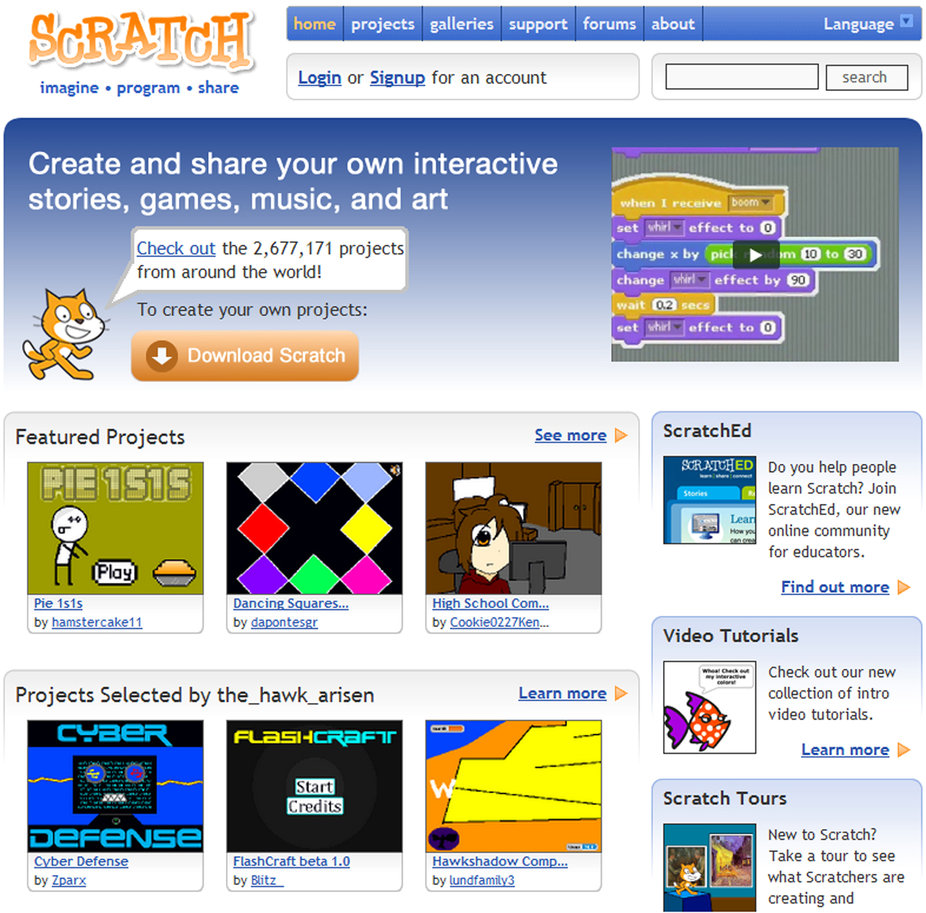
Scratch is a block-based programming language created by the Lifelong Kindergarten Group (LLK) at the MIT Media Lab. Scratch gives kids the power to use programming to create their own interactive animations and computer games. Since 2007, the online community that allows Scratch programmers to share, remix, and socialize around their projects has drawn more than 16 million users who have shared nearly 20 million projects and more than 100 million comments. It is one of the most popular ways for kids to learn programming and among the larger online communities for kids in general.
Front page of the Scratch online community (https://scratch.mit.edu) during the period covered by the dataset.
Since 2010, I have published a series of papers using quantitative data collected from the database behind the Scratch online community. As the source of data for many of my first quantitative and data scientific papers, it s not a major exaggeration to say that I have built my academic career on the dataset. I was able to do this work because I happened to be doing my masters in a research group that shared a physical space ( The Cube ) with LLK and because I was friends with Andr s Monroy-Hern ndez, who started in my masters cohort at the Media Lab. A year or so after we met, Andr s conceived of the Scratch online community and created the first version for his masters thesis project. Because I was at MIT and because I knew the right people, I was able to get added to the IRB protocols and jump through the hoops necessary to get access to the database. Over the years, Andr s and I have heard over and over, in conversation and in reviews of our papers, that we were privileged to have access to such a rich dataset. More than three years ago, Andr s and I began trying to figure out how we might broaden this access. Andr s had the idea of taking advantage of the launch of Scratch 2.0 in 2013 to focus on trying to release the first five years of Scratch 1.x online community data (March 2007 through March 2012) most of the period that the codebase he had written ran the site. After more work than I have put into any single research paper or project, Andr s and I have published a data descriptor in Nature s new journal Scientific Data. This means that the data is now accessible to other researchers. The data includes five years of detailed longitudinal data organized in 32 tables with information drawn from more than 1 million Scratch users, nearly 2 million Scratch projects, more than 10 million comments, more than 30 million visits to Scratch projects, and much more. The dataset includes metadata on user behavior as well the full source code for every project. Alongside the data is the source code for all of the software that ran the website and that users used to create the projects as well as the code used to produce the dataset we ve released. Releasing the dataset was a complicated process. First, we had navigate important ethical concerns about the the impact that a release of any data might have on Scratch s users. Toward that end, we worked closely with the Scratch team and the the ethics board at MIT to design a protocol for the release that balanced these risks with the benefit of a release. The most important features of our approach in this regard is that the dataset we re releasing is limited to only public data. Although the data is public, we understand that computational access to data is different in important ways to access via a browser or API. As a result, we re requiring anybody interested in the data to tell us who they are and agree to a detailed usage agreement. The Scratch team will vet these applicants. Although we re worried that this creates a barrier to access, we think this approach strikes a reasonable balance. Beyond the the social and ethical issues, creating the dataset was an enormous task. Andr s and I spent Sunday afternoons over much of the last three years going column-by-column through the MySQL database that ran Scratch. We looked through the source code and the version control system to figure out how the data was created. We spent an enormous amount of time trying to figure out which columns and rows were public. Most of our work went into creating detailed codebooks and documentation that we hope makes the process of using this data much easier for others (the data descriptor is just a brief overview of what s available). Serializing some of the larger tables took days of computer time. In this process, we had a huge amount of help from many others including an enormous amount of time and support from Mitch Resnick, Natalie Rusk, Sayamindu Dasgupta, and Benjamin Berg at MIT as well as from many other on the Scratch Team. We also had an enormous amount of feedback from a group of a couple dozen researchers who tested the release as well as others who helped us work through through the technical, social, and ethical challenges. The National Science Foundation funded both my work on the project and the creation of Scratch itself. Because access to data has been limited, there has been less research on Scratch than the importance of the system warrants. We hope our work will change this. We can imagine studies using the dataset by scholars in communication, computer science, education, sociology, network science, and beyond. We re hoping that by opening up this dataset to others, scholars with different interests, different questions, and in different fields can benefit in the way that Andr s and I have. I suspect that there are other careers waiting to be made with this dataset and I m excited by the prospect of watching those careers develop. You can find out more about the dataset, and how to apply for access, by reading the data descriptor on Nature s website.

Dirk Eddelbuettel: RPushbullet 0.3.0

RPpushbullet demo A major new update of the RPushbullet package is now on CRAN. RPushbullet interfacing the neat Pushbullet service for inter-device messaging, communication, and more. It lets you easily send alerts like the one to the to your browser, phone, tablet, ... -- or all at once. This release owes a lot to Seth Wenchel who was instrumental in driving several key refactorings. We now use the curl package instead of relying on system() calls to the binary. We also switched from RJSONIO to jsonlite. A new helper function to create the required resourcefile was added, and several other changes were made as detailed below in the extract from the NEWS.Rd file.

Changes in version 0.3.0 (2017-02-03)
  • The curl binary use was replaced by use of the curl package; several new helper functions added (PRs #30, #36 by Seth closing #29)
  • Use of RJSONIO was replaced by use of jsonlite (PR #32 by Seth closing #31)
  • A new function pbSetup was added to aid creating the resource file (PRs #34, #37 by Seth and Dirk)
  • The package intialization was refactored so that non-loading calls such as RPushbullet::pbPost(...) now work (#33 closing #26)
  • The test suite was updated and extended
  • The Travis script was updated use run.sh
  • DESCRIPTION, README.md and other files were updated for current R CMD check standards
  • Deprecated parts such as 'type=address' were removed, and the documentation was updated accordingly.
  • Coverage support was added (in a 'on-demand' setting as automated runs would need a Pushbullet API token)

Courtesy of CRANberries, there is also a diffstat report for this release. More details about the package are at the RPushbullet webpage and the RPushbullet GitHub repo.

This post by Dirk Eddelbuettel originated on his Thinking inside the box blog. Please report excessive re-aggregation in third-party for-profit settings.

Next.

Previous.