Search Results: "ema"

12 September 2016

Shirish Agarwal: mtpfs, feh and not being able to share the debconf experience.

I have been sick for about 2 weeks now hence haven t written. I had joint pains and still am weak. There has been lot of reports of malaria, chikungunya and dengue fever around the city. The only thing I came to know is how lucky I am to be able to move around on 2 legs and how powerless and debilitating it feels when you can t move. In the interim I saw Me Before You and after going through my most miniscule experience, I could relate with Will Taylor s character. If I was in his place, I would probably make the same choices. But my issues are and were slightly different. Last month I was supposed to share my debconf experience in the local PLUG meet. For that purpose, I took some pictures from my phone on a pen-drive to share. But when reached the venue, found out that I had forgotten to take the pen-drive. What I had also done is used the mogrify command from the imagemagick stable to lossy compress the images on the pen-drive so it is easier on image viewers. But that was not to be and at the last moment had to use my phone plugged into the USB drive of the lappy and show some pictures. This was not good. I had known that it was mounted somewhere but hadn t looked at where. After coming back home, it took me hardly 10 minutes to find out where it was mounted. It is not mounted under /media/shirish but under /run/user/1000/gvfs . If I do list under it shows mtp:host=%5Busb%3A005%2C007%5D . I didn t need any packages under debian to make it work. Interestingly, the only image viewer which seems to be able to work with all the images is feh which is a command-line image viewer in Debian. [$] aptitude show feh
Package: feh
Version: 2.16.2-1
State: installed
Automatically installed: no
Priority: optional
Section: graphics
Maintainer: Debian PhotoTools Maintainers
Architecture: amd64
Uncompressed Size: 391 k
Depends: libc6 (>= 2.15), libcurl3 (>= 7.16.2), libexif12 (>= 0.6.21-1~), libimlib2 (>= 1.4.5), libpng16-16 (>= 1.6.2-1), libx11-6, libxinerama1
Recommends: libjpeg-progs
Description: imlib2 based image viewer
feh is a fast, lightweight image viewer which uses imlib2. It is commandline-driven and supports multiple images through slideshows, thumbnail
browsing or multiple windows, and montages or index prints (using TrueType fonts to display file info). Advanced features include fast dynamic
zooming, progressive loading, loading via HTTP (with reload support for watching webcams), recursive file opening (slideshow of a directory
hierarchy), and mouse wheel/keyboard control.
Homepage: http://feh.finalrewind.org/
I did try various things to get it to mount under /media/shirish/ but as of date have no luck. Am running Android 6.0 Marshmallow and have enabled USB debugging with help from my friend Akshat . I even changed the /etc/fuse.conf options but even that didn t work. #cat /etc/fuse.conf
[sudo] password for shirish:
# /etc/fuse.conf - Configuration file for Filesystem in Userspace (FUSE)
# Set the maximum number of FUSE mounts allowed to non-root users.
# The default is 1000.
mount_max = 1
# Allow non-root users to specify the allow_other or allow_root mount options.
user_allow_other
One way which I haven t explored is adding/making an entry into /etc/fstab. If anybody knows of a solution which doesn t involve changing content of /etc/fstab. At the same time you are able to get the card and phone directories mounted under /media// , in my case /media/shirish would be interested to know. I would like the /etc/fstab to remain as it is. I am using Samsung J5 (unrooted) Btw I tried all the mtpfs packages in Debian testing but without any meaningful change Look forward to tips.
Filed under: Miscellenous Tagged: #Android, #Debconf16, #debian, #mptfs, feh, FUSE, PLUG

Steve Kemp: If your code accepts URIs as input..

There are many online sites that accept reading input from remote locations. For example a site might try to extract all the text from a webpage, or show you the HTTP-headers a given server sends back in response to a request. If you run such a site you must make sure you validate the schema you're given - also remembering to do that if you're sent any HTTP-redirects.
Really the issue here is a confusion between URL & URI.
The only time I ever communicated with Aaron Swartz was unfortunately after his death, because I didn't make the connection. I randomly stumbled upon the html2text software he put together, which had an online demo containing a form for entering a location. I tried the obvious input:
file:///etc/passwd
The software was vulnerable, read the file, and showed it to me. The site gives errors on all inputs now, so it cannot be used to demonstrate the problem, but on Friday I saw another site on Hacker News with the very same input-issue, and it reminded me that there's a very real class of security problems here. The site in question was http://fuckyeahmarkdown.com/ and allows you to enter a URL to convert to markdown - I found this via the hacker news submission. The following link shows the contents of /etc/hosts, and demonstrates the problem: http://fuckyeahmarkdown.example.com/go/?u=file:///etc/hosts&read=1&preview=1&showframe=0&submit=go The output looked like this:
..
127.0.0.1 localhost
255.255.255.255 broadcasthost
::1 localhost
fe80::1%lo0 localhost
127.0.0.1 stage
127.0.0.1 files
127.0.0.1 brettt..
..
In the actual output of '/etc/passwd' all newlines had been stripped. (Which I now recognize as being an artifact of the markdown processing.) UPDATE: The problem is fixed now.

Reproducible builds folks: Reproducible Builds: week 72 in Stretch cycle

What happened in the Reproducible Builds effort between Sunday September 4 and Saturday September 10 2016: Reproducible work in other projects Python 3.6's dictonary type now retains the insertion order. Thanks to themill for the report. In coreboot, Alexander Couzens committed a change to make their release archives reproducible. Patches submitted Reviews of unreproducible packages We've been adding to our knowledge about identified issues. 3 issue types have been added: 1 issue type has been updated: 16 have been have updated: 13 have been removed, not including removed packages: 100s of packages have been tagged with the more generic captures_build_path, and many with captures_kernel_version, user_hostname_manually_added_requiring_further_investigation, user_hostname_manually_added_requiring_further_investigation, captures_shell_variable_in_autofoo_script, etc. Particular thanks to Emanuel Bronshtein for his work here. Weekly QA work FTBFS bugs have been reported by: diffoscope development strip-nondeterminism development tests.reproducible-builds.org: Misc. This week's edition was written by Chris Lamb and Holger Levsen and reviewed by a bunch of Reproducible Builds folks on IRC.

9 September 2016

Jonathan Dowland: Metropolis

Every year since 2010 the Whitley Bay Film Festival has put on a programme of movies in my home town, often with some quirk or gimmick. A few years back we watched "Dawn Of The Dead" in a shopping centre the last act was interrupted by a fake film-reel break, then a load of zombies emerged from the shops. Sometime after that, we saw "The Graduate" within a Church as part of their annual "Secret Cinema" showing. Other famous stunts (which I personally did not witness) include a screening of Jaws on the beach and John Carpenter's "The Fog" in Whitley Bay Lighthouse. This year I only went to one showing, Fritz Lang's Metropolis. Two twists this time: it was being shown in The Rendezvous Cafe, an Art-Deco themed building on the sea front; the whole film was accompanied by a live, improvised synthesizer jam by a group of friends and synth/sound enthusiasts who branded themselves "The Mediators" for the evening. I've been meaning to watch Metropolis for a long time (I've got the Blu-Ray still sat in the shrink-wrap) and it was great to see the newly restored version, but the live synth accompaniment was what really made the night special for me. They used a bunch of equipment, most notably a set of Korg Volcas. The soundtrack varied in style and intensity to suit the scenes, with the various under-city scenes backed by a pumping, industrial-style improvisation which sounded quite excellent. I've had an interest in playing with synthesisers and making music for years, but haven't put the time in to do it properly. I left newly inspired and energised to finally try to make the time to explore it.

8 September 2016

Wouter Verhelst: Installing files for other applications with autotools

Let's say you have a configure.ac file which contains this:
PKG_CHECK_VAR([p11_moduledir], "p11-kit-1", "p11_module_path")
AC_SUBST([p11_moduledir])
and that it goes with a Makefile.am which contains this:
dist_p11_module_DATA = foo.module
Then things should work fine, right? When you run make install, your modules install to the right location, and p11-kit will pick up everything the way it should. Well, no. Not exactly. That is, it will work for the common case, but not for some other cases. You see, if you do that, then make distcheck will fail pretty spectacularly. At least if you run that as non-root (which you really really should do). The problem is that by specifying the p11_moduledir variable in that way, you hardcode it; it doesn't honour any $prefix or $DESTDIR variables that way. The result of that is that when a user installs your package by specifying --prefix=/opt/testmeout, it will still overwrite files in the system directory. Obviously, that's not desireable. The $DESTDIR bit is especially troublesome, as it makes packaging your software for the common distributions complicated (most packaging software heavily relies on DESTDIR support to "install" your software in a staging area before turning it into an installable package). So what's the right way then? I've been wondering about that myself, and asked for the right way to do something like that on the automake mailinglist a while back. The answer I got there wasn't entirely satisfying, and at the time I decided to take the easy way out (EXTRA_DIST the file, but don't actually install it). Recently, however, I ran against a similar problem for something else, and decided to try to do it the proper way this time around. p11-kit, like systemd, ships pkg-config files which contain variables for the default locations to install files into. These variables' values are meant to be easy to use from scripts, so that no munging of them is required if you want to directly install to the system-wide default location. The downside of this is that, if you want to install to the system-wide default location by default from an autotools package (but still allow the user to --prefix your installation into some other place, accepting that then things won't work out of the box), you do need to do the aforementioned munging. Luckily, that munging isn't too hard, provided whatever package you're installing for did the right thing:
PKG_CHECK_VAR([p11_moduledir], "p11-kit-1", "p11_module_path")
PKG_CHECK_VAR([p11kit_libdir], "p11-kit-1", "libdir")
if test -z $ac_cv_env_p11_moduledir_set; then
    p11_moduledir=$(echo $p11_moduledir sed -e "s,$p11kit_libdir,\$ libdir ,g")
fi
AC_SUBST([p11_moduledir])
Whoa, what just happened? First, we ask p11-kit-1 where it expects modules to be. After that, we ask p11-kit-1 what was used as "libdir" at installation time. Usually that should be something like /usr/lib or /usr/lib/gnu arch triplet or some such, but it could really be anything. Next, we test to see whether the user set the p11_moduledir variable on the command line. If so, we don't want to munge it. The next line looks for the value of whatever libdir was set to when p11-kit-1 was installed in the value of p11_module_path, and replaces it with the literal string $ libdir . Finally, we exit our if and AC_SUBST our value into the rest of the build system. The resulting package will have the following semantics: I suppose it would've been easier if the PKG_CHECK_VAR macro could (optionally) do that munging by itself, but then, can't have everything.

6 September 2016

Markus Koschany: My Free Software Activities in August 2016

Welcome to gambaru.de. Here is my monthly report that covers what I have been doing for Debian. If you re interested in Android, Java, Games and LTS topics, this might be interesting for you. Debian Android Debian Games Debian Java Debian LTS This was my seventh month as a paid contributor and I have been paid to work 14,75 hours on Debian LTS, a project started by Rapha l Hertzog. In that time I did the following: Non-maintainer uploads QA

3 September 2016

Thorsten Alteholz: My Debian Activities in August 2016

FTP assistant This month I marked 257 packages for accept and rejected only 26. Seems to be that I mostly choosed the high quality packages this month. I also sent 12 emails to maintainers asking questions. Debian LTS This was my twenty-sixth month that I did some work for the Debian LTS initiative, started by Raphael Hertzog at Freexian. This month my all in all workload has been 14.75h. Again, most of the time I choosed packages, where at the end the vulnerable code of the corresponding CVE was not present in the Wheezy version. So I could mark several CVEs for lshell and wget as not-affected, without doing an upload. Unfortunately I had to give up working on chicken. My scheme abilities appear to be rather rusty. Further, I uploaded a test version for php5 that takes care of 17 CVEs and as requested by the LTS users, two additional bugs. After all tests are passed, I will do a real upload with DLA. This month I also had another term of frontdesk work. Other stuff For the Alljoyn framework I fixed a compile issue with gcc 6 and could close RC-bugs
#831127, #831091, and #831198.
My patch was also accepted by upstream. Unfortunately a bug in gtest resulted in #833636. As gcc 6 is the default compiler now in testing, I could also close RC bug #831106.

Iustin Pop: Nationalpark Bike Marathon 2016

Nationalpark Bike Marathon 2016 report: gravity rules! "Marathon" is a bit of a misnomer, since I did the short route, not the medium nor the long one. But hey, it's the official name! Setup This race has four possible lengths: "Valader" which is full round-trip Scuol-Scuol (137km/4'026m), "Jauer" (Fuldera-Scuol, 103km/2'934m), "Livignasco" (Livigno-Scuol, 66km/1'871m) and "Put r" (S-chanf to Scuol, 47Km/1'051m). After many debates, I settled on the Livignasco route, as that was what I was reasonably confident to be able to do. The only problem was that this route (and all the longer ones, of course) were going over Pass Chaschauna, which is a quite hard climb. My bike shop person, who did the full length a number of times, just said when hearing the route I was planning: "Chaschauna is a bitch " Bad language, proper characterisation. The route choice also impacts the logistics: except for the full route, the question is where to sleep the night before? One can sleep either at the start place, or sleep in Scuol itself and take the official shuttle to the start place, but this means waking up much earlier. I decided to sleep in Livigno, as with a 7:45 start this would allow me to sleep until ~6:30, have a quick breakfast and be in time for the race. Problem #1 So on Friday (26th) I drove to Scuol, picked up my start number, and then drove over to Livigno and checked in to the hotel. Speaking of picking up the start number, I saw this at the start area: While picking up my start number: the race is so fast that an STI is needed as pacer?? An STI needed as pacer? How fast are these people, I wondered? Day of the race My plan to have a relaxing sleep until relatively late failed. I went to sleep with difficulties: late dinner due to my late arrival in Livigno, and then I was stressed enough about not missing the race that at 05:05 I already woke up, and was checking the clock every five minutes. Finally at 05:30 I gave up and got out of bed, with only about 6 hours of sleep. Problem #2. The other problem was that I na vely thought the hotel will have breakfast from 07:00 or even 07:30. Hah, as if this was Switzerland. The hotel had breakfast from 08:00, no reason to hurry, right? So I had a poor man's breakfast in the room, some energy bars and an ice tea. Problem #3. At least I had time to grab this picture from the hotel room: Good morning Livigno! Not bad. On to the race! But before that, remember to fill my hydration pack with 3L of water, and put it in my not-so-light backpack. Of course I had tools and some spare parts with me, what if something happens? Problem #4, over-planning. The race The setup at the start was pretty easy. Wait near the start until 07:45, then go. For me, not too in front, of course: Ready for the start! Pass Chaschauna About 3 kilometres of easy/flat road, and then it starts. Pass Chaschauna, killing your legs softly Already climbing  on foot! But not everybody. But at least the pictures were nice! The climb is hard, but the view is worth it! Still climbing So high already! Good legs :) Looking back: it's been a loong way up I can see the top!  and the remaining steep meters to climb :( The climb is difficult. It was around 22% for most of the time, and very few people were able to bike up. Not only the absolute meters were the problem, but also the fact that the ground was quite loose, and pushing the bike, or rather climbing up while pushing the bike, was difficult to do in bike shoes with cleats. Proper hiking shoes would have been much more adequate. Maybe this is why despite the effort, some people biked as much as possible? I was careful not to over-exert myself and walked almost all the way up. Hence the pictures But at last, reached the top of the pass, and was very happy to be done with it. The GPX file from my Garmin says it took only 4 minutes (1.2km) after the race start to actually start climbing (it was not obvious we were climbing so early), and then 1h:20m/8Km to get from 1'817m altitude to the highest point at 2'658m. 8Km in 1h:20m, faster than walking pace but quite slower than running pace (on flat terrain, of course). At the top of the pass I was quite happy: Finally at the top! Clipping in and Go! Smilling and happy! And then the descent started: I wonder how steep it will be going down This was an easy section :/ All the way leading to the race I kept thinking only about climbing Chaschauna, and not about going down on it. It was quite an experience, which I won't forget soon. The trail was already well travelled, which means that besides the loose ground in form of large clumps of dried earth, there was a layer of fine, somewhat moist earth, about 3-5 centimetres deep, which made the downhill "interesting". Coupled with what was a much steeper trail than going up I saw most of the time ~33% it's no surprise that many, or even most, of the people were walking their bikes down. The GPX track says that the trail goes 319m down in 1Km (so a 31.9% over one entire kilometre), then another 130m over the next 1.4Km (9.28%), and then (not sure if this is the pass per se or after) another longer segment of ~260m over 3Km (8.56%). The first steep segment needs lots of skill and concentration, the others are normal gradients. But at least things go fast. What took uphill took ~40 minutes for the last 450m up, downhill it took only 15 minutes! Falling I was able, thanks to recent training, to bike down the trail, or at least I thought so. So on the steep segment I was struggling to bike down and keep control of my bike, putting one leg down on some sections but in general being "on the bike", being hit by the dirt I was throwing in the air despite the mud-guards, being careful but at the same time enjoying this difficult section. That is, right up to the point where I got, I think, too comfortable. After the second-to-last curve, the rear wheel slides, I lose balance and fall in the (thankfully soft) dirt a bit more forcefully than I should have, the bike also sliding along in the dirt. No damage to myself, just some trivial scratches; the bike seems a bit shaken (fork was turned 180 , full of dirt, etc.). I get again on the bike and I continue down; however, something seems off: the rear brake level doesn't have a return anymore, I have to push it to go back. Still usable, but strange. So I continue the other two segment of this descent, and over these ~4-5Km I feel the brake issue going worse and worse: it's actually hard to push the brake lever back, and even pressing it doesn't seem to have much effect. And then the realisation dawns on my: I have hydraulic brakes, and the worsening thing leads me to think my brake hose has been punctured (by what? I fell in loose dirt) and I'm losing the brake fluid with every press. Now, on flat road, biking with only the front brake is tricky but doable. On an MTB course, having only one brake is not a smart thing . Not easy, not smart, and definitely dangerous. It also felt very strange to not have both brakes, and then I realised how much I work with the brakes in unison. I knew that there are repair posts in the race, but I didn't know if they can fix such things (and doing a brake fluid refill how complicated is it, how much time does it take?). Anyway, I resolved to try and continue if the terrain allows until I reach the first repair post, and stop if it gets too steep. It would be pretty sad to have to abort the race after only 10Km, right? The terrain did cooperate: up and down, so I was able to bleed speed easily, and even though through forest, the visibility was good enough that I could plan ahead. It was strangely lonely at this time: I was going slowly and thus not reaching from behind anyone, but also not being reached by riders from behind. I did enjoy it a bit, the quietness of the forest, just interrupted by the squeaking of my front brake And then I finally see the sign for "Repair: 1Km". Yaaay! maybe I don't have to quit the race. And then, about 100m further on, another sign: "Danger! Steep descent". Uh-oh tantalisingly close Let's go slow. And yes, here I was overtaken by 3-4 other cyclists. This was the single moment in the race where I did have a moment of real fear: at one point, I was going down with the remaining brake as pressed as I could without compromising stability, and I was still gaining speed. Not smart, and as I was debating how to fall to stop my descent, the terrain started to get less steep, and I finally reached the repair station, at kilometre 21. Difficult repairs There was another person being serviced for a flat rear tire, so I wait in line and discuss with him my problem. Upon hearing I only had the front brake, he said: "Wow, how did you manage to descend this last segment?" "Well, slowly ". My turn came up, I explain my problem and my theory, and the repair guy gives me one look, the bike one look, but doesn't look at the brake hose. Instead, he looks once at the brake lever, sees that another cable guide on my handle bar was bent during the fall and actually was mechanically interfering with the brake lever, unbends that thing, and says "here you go". I was stunned. 15 seconds of looking at the problem without stress, and the problem was solved. I could have done this myself if I took the time to look and think, and not hurry. And I could have enjoyed all the downhill on the pass, with two functioning brakes. Some lessons have to be learned the hard way, and this was one. I got off easy though, as I didn't have a real accident while biking with only one brake. And they say you get wiser as you get older Anyway, brake repaired, I stopped at the Sanit r tent to have my scratches disinfected, and onwards. The following few kilometres until S-chanf I enjoyed very much. S-chanf And then, 2 hours 10 minutes into the race, I exit the forest trail, reach S-chanf, and start climbing and descending and climbing and descending. In the sun, which now (after 10 AM) is not that light anymore. The initial climb at S-chanf, while not much, took away my remaining short-term reserves. The route is 50m ascent, then down and then another 50m ascent, and after a bit of flat another 75m ascent I was getting tired, despite eating energy bars and drinking water (and juice at stops). This goes one for an entire hour, during which I cover about 23Km, so not a bad speed everything considered. But getting more and more tired. There were also some very nice segments, along the river, in the shade of the forest. Some fast downhill, some fast flat. I got overtaken by quite a few real racers, that were going so fast I couldn't keep up with them as in I didn't dare ride that fast even when I had the energy. Clearly they were from the longer segments, and boy were they fast! A number of couples (or pairs?) one woman one man, a number of bigger groups, all going as if they had E-bikes or super-powers, not just biking along tired like me Last climb And then, the last big climb: half an hour of going about 300m up (absolute values, so cumulative number would probably be higher), in the sun, over about 6Km, so only 5% average gradient. But I was tired and even resorted to walking on some portions At least I could take some pictures again: Much later, climbing again. Or have pictures taken: A bit of a smile left. Yes, that's a smile, not a grimace! Nice views: Look, nice castle! Stopping for a picture, and not because I was *dead tired* :) At one point, in a bit of a shade, I stop to catch my breath. Somebody else stopped as well and, seeing as I was checking my GPS, asks: I got overtaken by a lot of cyclists here, although many of them were from S-chanf route (based on the number colour). Sad The thing is, besides the climbing and the sun, this and the previous part was a very nice route: through small towns, high above the valley, beautiful landscapes, etc. Just enjoying it was hard, since I wasn't a) trained well enough and b) prepared well enough. Last segment, last downhill In any case, after that hard half hour, it's flat (or rather said, average gradient zero): Flat route, good pavement. Can catch my breath, and take a another picture. Good road, good views, but I'm on the last virtual bar of my battery, so the remaining 15Km I do in 40 minutes, also "eating" the last ascent meters still about 300 left, I think, but up/down/up/down, so you could reuse kinetic energy to gain potential one. The only question I had now was, the route was at this moment about 400m higher (in absolute altitude) than the finish point, so when do we lose that altitude? The answer was a very very nice answer: in the last 5Km, for an average gradient of 8%, just perfect. I was tired however, so I couldn't really enjoy or go fast here, but it was a good feeling. Finish! And then, entering Scuol, not really believing I'm near the finish, that I will be able to actually stop and relax. My finish picture doesn't do justice to how happy I was at that moment: At the finish, happy happy happy! However, after passing the finish line, it was a bit weird. I just stop now? What next? So weird to just walk, not push pedals, and not go up. Or down. The funny thing here was that I thought I didn't use much of my water (hydration pack) during the race. But soon after finishing, I drank the equivalent of about two glasses (let's say 0.5L) and it was over. So I did manage to drink 2.5L during the race, plus the sport drinks at the stops. Time for stats: my Garmin says 67.07Km, 4h:29m, average speed 15.0kph (hah), 1'615m elevation gain. Official numbers say 66Km, 1'871m elevation, and thus 14.22kph. Ranking-wise: Sigh, could have done better. I was aiming for somewhere around last 33%, not last 25% :-P First classed was ~66% faster than me Going to the train station was hard as in difficult to move my legs. Took one nice picture of Scuol though, so was able to think a bit: After the race: Scuol is not so bad And then the long way back to Livigno. Took me 4 h to bike to Scuol, and about 3 hours to go back via public transport. At least I ate a sandwich in the meantime. Then reached Livigno, which was also looking nice: Took me almost as long by public transport as by bike, but finally back in Livigno. Also nice! Then got on my bike, which at this point was magically light and easy to ride (it seems I was at least partially recovered), rode to the hotel, packed my stuff, and drove home. On the highway I had my first real meal for that day, but I was quite tired so didn't feel like the achievement it should have been Lessons The biggest takeaway from this race was the huge learning experience I got. The race was itself awesome, but the learning even more so. First, for this particular race, it's much better to sleep in Scuol and (if not doing the whole route) take the shuttle to the actual start. Yes, one has to wake up earlier, but you have assured breakfast via the organisers (++++!), and after the race you don't have to get even more tired by taking the train and the bus and Second, I need better logistics: I don't need to carry that heavy load (spare tube, pump, tools, jacket in case it's cold) when the race is well organised. The water in the hydration pack was useful, but carrying it up Chaschauna was a pain. Not sure what I'll do next; it's possible to survive only on water/drinks from the food posts (basically 2.5-2.8L is equivalent to only 4 750ml bottles, and there were I think about 6 stops?), but the hydration pack is so easy to use Keeping one's head cool and not stress about things also would help: had I looked at my brake lever in peace, I could have solved it myself, and not ride ~10Km with only one brake. Also, losing some weight (as in losing fat, not having a lighter bike) would definitely help. I could stand to lose 5Kg easily, probably 10Kg, and that would bring me more in line with other people in the race (at least looking at the pictures). And hey, my Watts/Kg would improve magically! And last but most important, I need better training. Training on how to use my energy, training longer rides so that my body gets used to it and doesn't bonk after 3 hours, training training training. Which I like, but the problem is time to do it Also, in case anybody wonders: yes, I do recommend this race! It was definitely fun, and the route itself is very nice, nicer than the pictures here show. Closing words: gravity rules. Up or down, it's hard and punishing. Still: Ride on!

31 August 2016

Chris Lamb: Free software activities in August 2016

Here is my monthly update covering what I have been doing in the free software world (previously):

Reproducible builds

Whilst anyone can inspect the source code of free software for malicious flaws, most Linux distributions provide binary (or "compiled") packages to end users. The motivation behind the Reproducible Builds effort is to allow verification that no flaws have been introduced either maliciously and accidentally during this compilation process by promising identical binary packages are always generated from a given source.

Diffoscope diffoscope is our "diff on steroids" that will not only recursively unpack archives but will transform binary formats into human-readable forms in order to compare them:
  • Added a command-line interface to the try.diffoscope.org web service.
  • Added a JSON comparator.
  • In the HTML output, highlight lines when hovering to make it easier to visually track.
  • Ensure that we pass str types to our Difference class, otherwise we can't be sure we can render them later.
  • Testsuite improvements:
    • Generate test coverage reports.
    • Add tests for Haskell and GitIndex comparators.
    • Completely refactored all of the comparator tests, extracting out commonly-used routines.
    • Confirm rendering of text and HTML presenters when checking non-existing files.
    • Dropped a squashfs test as it was simply too unreliable and/or has too many requirements to satisfy.
  • A large number of miscellaneous cleanups, including:
    • Reworking the comparator setup/preference internals by dynamically importing classes via a single list.
    • Split exceptions out into dedicated diffoscope.exc module.
    • Tidying the PROVIDERS dict in diffoscope/__init__.py.
    • Use html.escape over xml.sax.saxutils.escape, cgi.escape, etc.
    • Removing hard-coding of manual page targets names in debian/rules.
    • Specify all string format arguments as logging function parameters, not using interpolation.
    • Tidying imports, correcting indentation levels and drop unnecessary whitespace.

disorderfs disorderfs is our FUSE filesystem that deliberately introduces nondeterminism in system calls such as readdir(3).
  • Added a testsuite to prevent regressions. (f124965)
  • Added a --sort-dirents=yes no option for forcing deterministic ordering. (2aae325)

Other
  • Improved strip-nondeterminism, our tool to remove specific nondeterministic information after a build:
    • Match more styles of Java .properties files.
    • Remove hyphen from "non-determinism" and "non-deterministic" throughout package for consistency.
  • Improvements to our testing infrastucture:
    • Improve the top-level navigation so that we can always get back to "home" of a package.
    • Give expandable elements cursor: pointer CSS styling to highlight they are clickable.
    • Drop various trailing underlined whitespaces after links.
    • Explicitly log that build was successful or not.
    • Various code-quality improvements, including prefering str.format over concatentation.
  • Miscellaneous updates to our filter-packages internal tool:
    • Add --random=N and --url options.
    • Add support for --show=comments.
    • Correct ordering so that --show-version runs after --filter-ftbfs.
    • Rename --show-ftbfs to --filter-ftbfs and --show-version to --show=version.
  • Created a proof-of-concept reproducible-utils package to contain commonly-used snippets aimed at developers wishing to make their packages reproducible.


I also submitted 92 patches to fix specific reproducibility issues in advi, amora-server, apt-cacher-ng, ara, argyll, audiotools, bam, bedtools, binutils-m68hc1x, botan1.10, broccoli, congress, cookiecutter, dacs, dapl, dateutils, ddd, dicom3tools, dispcalgui, dnssec-trigger, echoping, eekboek, emacspeak, eyed3, fdroidserver, flashrom, fntsample, forkstat, gkrellm, gkrellm, gnunet-gtk, handbrake, hardinfo, ircd-irc2, ircd-ircu, jack-audio-connection-kit, jpy, kxmlgui, libbson, libdc0, libdevel-cover-perl, libfm, libpam-ldap, libquvi, librep, lilyterm, mozvoikko, mp4h, mp4v2, myghty, n2n, nagios-nrpe, nikwi, nmh, nsnake, openhackware, pd-pdstring, phpab, phpdox, phpldapadmin, pixelmed-codec, pleiades, pybit, pygtksourceview, pyicu, python-attrs, python-gflags, quvi, radare2, rc, rest2web, roaraudio, rt-extension-customfieldsonupdate, ruby-compass, ruby-pg, sheepdog, tf5, ttf-tiresias, ttf-tiresias, tuxpaint, tuxpaint-config, twitter-bootstrap3, udpcast, uhub, valknut, varnish, vips, vit, wims, winswitch, wmweather+ & xshisen.

Debian GNU/Linux
Debian LTS

This month I have been paid to work 15 hours on Debian Long Term Support (LTS). In that time I did the following:
  • "Frontdesk" duties, triaging CVEs, etc.
  • Authored the patch & issued DLA 596-1 for extplorer, a web-based file manager, fixing an archive traversal exploit.
  • Issued DLA 598-1 for suckless-tools, fixing a segmentation fault in the slock screen locking tool.
  • Issued DLA 599-1 for cracklib2, a pro-active password checker library, fixing a stack-based buffer overflow when parsing large GECOS fields.
  • Improved the find-work internal tool adding optional colour highlighting and migrating it to Python 3.
  • Wrote an lts-missing-uploads tool to find mistakes where there was no correponding package in the archive after an announcement.
  • Added optional colour highlighting to the lts-cve-triage tool.

Uploads
  • redis 2:3.2.3-1 New upstream release, move to the DEP-5 debian/copyright format, ensure that we are running as root in LSB initscripts and add a README.Source regarding our local copies of redis.conf and sentinel.conf.
  • python-django:
    • 1:1.10-1 New upstream release.
    • 1:1.10-2 Fix test failures due to mishandled upstream translation updates.

  • gunicorn:
    • 19.6.0-2 Reload logrotate in the postrotate action to avoid processes writing to the old files and move to DEP-5 debian/copyright format.
    • 19.6.0-3 Drop our /usr/sbin/gunicorn ,3 -debian and related Debian-specific machinery to be more like upstream.
    • 19.6.0-4 Drop "template" systemd .service files and point towards examples and documentation instead.

  • adminer:
    • 4.2.5-1 Take over package maintenance, completely overhauling the packaging with a new upstream version, move to virtual-mysql-server to support MariaDB, updating package names of dependencies and fix the outdated Apache configuration.
    • 4.2.5-2 Correct the php5 package names.


FTP Team As a Debian FTP assistant I ACCEPTed 90 packages: android-platform-external-jsilver, android-platform-frameworks-data-binding, camlpdf, consolation, dfwinreg, diffoscope, django-restricted-resource, django-testproject, django-testscenarios, gitlab-ci-multi-runner, gnome-shell-extension-taskbar, golang-github-flynn-archive-go-shlex, golang-github-jamesclonk-vultr, golang-github-weppos-dnsimple-go, golang-golang-x-time, google-android-ndk-installer, haskell-expiring-cache-map, haskell-hclip, haskell-hdbc-session, haskell-microlens-ghc, haskell-names-th, haskell-persistable-record, haskell-should-not-typecheck, haskell-soap, haskell-soap-tls, haskell-th-reify-compat, haskell-with-location, haskell-wreq, kbtin, libclipboard-perl, libgtk3-simplelist-perl, libjs-jquery-selectize.js, liblemon, libplack-middleware-header-perl, libreoffice, libreswan, libtest-deep-json-perl, libtest-timer-perl, linux, linux-signed, live-tasks, llvm-toolchain-3.8, llvm-toolchain-snapshot, lua-luv, lua-torch-image, lua-torch-nn, magic-wormhole, mini-buildd, ncbi-vdb, node-ast-util, node-es6-module-transpiler, node-es6-promise, node-inline-source-map, node-number-is-nan, node-object-assign, nvidia-graphics-drivers, openhft-chronicle-bytes, openhft-chronicle-core, openhft-chronicle-network, openhft-chronicle-threads, openhft-chronicle-wire, pycodestyle, python-aptly, python-atomicwrites, python-click-log, python-django-casclient, python-git-os-job, python-hypothesis, python-nosehtmloutput, python-overpy, python-parsel, python-prov, python-py, python-schema, python-tackerclient, python-tornado, pyvo, r-cran-cairo, r-cran-mi, r-cran-rcppgsl, r-cran-sem, ruby-curses, ruby-fog-rackspace, ruby-mixlib-archive, ruby-tzinfo-data, salt-formula-swift, scapy3k, self-destructing-cookies, trollius-redis & websploit.

30 August 2016

Daniel Stender: My work for Debian in August

Here's again a little list of my humble off-time contributions I'm happy to add to the large amount of work we're completing all together each month. Then there is one more "new in Debian" (meaning: "new in unstable") announcement. First, the uploads (a few of them are from July): New packages: Sponsored uploads: Requested resp. suggested for packaging: New in Debian: Lasagne (deep learning framework) Now that the mathematical expression compiler Theano is available in Debian, deep learning frameworks resp. toolkits which have been build on top of it can become available within Debian, too (like Blocks, mentioned before). Theano is an own general computing engine which has been developed with a focus on machine learning resp. neural networks, which features an own declarative tensor language. The toolkits which have build upon it vary in the way how much they abstract the bare features of Theano, if they are "thick" or "thin" so to say. When the abstraction gets higher you gain more end user convenience up to the level that you have the architectural components of neural networks available for combination like in a lego box, while the more complicated things which are going on "under the hood" (like how the networks are actually implemented) are hidden. The downside is, thick abstraction layers usually makes it difficult to implement novel features like custom layers or loss functions. So more experienced users and specialists might to seek out for the lower abstraction toolkits, where you have to think more in terms of Theano. I've got an initial package of Keras in experimental (1.0.7-1), it runs (only a Python 3 package is available so far) but needs some more work (e.g. building the documentation with mkdocs). Keras is a minimalistic, high modular DNN library inspired by Torch1. It has a clean, rather easy API for experimenting and fast prototyping. It can also run on top of Google's TensorFlow, and we're going to have it ready for that, too. Lasagne follows a different approach. It's, like Keras and Blocks, a Python library to create and train multi-layered artificial neural networks in/on Theano for applications like image recognition resp. classification, speech recognition, image caption generation or other purposes like style transfers from paintings to pictures2. It abstracts Theano as little as possible, and could be seen rather like an extension or an add-on than an abstraction3. Therefore, knowledge on how things are working in Theano would be needed to make full use out of this piece of software. With the new Debian package (0.1+git20160728.8b66737-1)4, the whole required software stack (the corresponding Theano package, NumPy, SciPy, a BLAS implementation, and the nividia-cuda-toolkit and NVIDIA kernel driver to carry out computations on the GPU5) could be installed most conveniently just by a single apt-get install python ,3 -lasagne command6. If wanted with the documentation package lasagne-doc for offline use (no running around on remote airports seeking for a WIFI spot), either in the Python 2 or the Python 3 branch, or both flavours altogether7. While others have to spend a whole weekend gathering, compiling and installing the needed libraries you can grab yourself a fresh cup of coffee. These are the advantages of a fully integrated system (sublime message, as always: desktop users switch to Linux!). When the installation of packages has completed, the MNIST example of Lasagne could be used for a quick check if the whole library stack works properly8:
$ THEANO_FLAGS=device=gpu,floatX=float32 python /usr/share/doc/python-lasagne/examples/mnist.py mlp 5
Using gpu device 0: GeForce 940M (CNMeM is disabled, cuDNN 5005)
Loading data...
Downloading train-images-idx3-ubyte.gz
Downloading train-labels-idx1-ubyte.gz
Downloading t10k-images-idx3-ubyte.gz
Downloading t10k-labels-idx1-ubyte.gz
Building model and compiling functions...
Starting training...
Epoch 1 of 5 took 2.488s
  training loss:        1.217167
  validation loss:      0.407390
  validation accuracy:      88.79 %
Epoch 2 of 5 took 2.460s
  training loss:        0.568058
  validation loss:      0.306875
  validation accuracy:      91.31 %
The example on how to train a neural network on the MNIST database of handwritten digits is refined (it also provides --help) and explained in detail in the Tutorial section of the documentation in /usr/share/doc/lasagne-doc/html/. Very good starting points are also the IPython notebooks that are available from the tutorials by Eben Olson9 and Geoffrey French on the PyData London 201610. There you have Theano basics, examples for employing convolutional neural networks (CNN) and recurrent neural networks (RNN) for a range of different purposes, how to use pre-trained networks for image recognition, etc.

  1. For a quick comparison of Keras and Lasagne with other toolkits, see Alex Rubinsteyn's PyData NYC 2015 presentation on using LSTM (long short term memory) networks on varying length sequence data like Grimm's fairy tales (https://www.youtube.com/watch?v=E92jDCmJNek 27:30 sq.)
  2. https://github.com/Lasagne/Recipes/tree/master/examples/styletransfer
  3. Great introduction to Theano and Lasagne by Eben Olson on the PyData NYC 2015: https://www.youtube.com/watch?v=dtGhSE1PFh0
  4. The package is "freelancing" currently being in collab-maint, to set up a deep learning packaging team within Debian is in the stage of discussion.
  5. Only available for amd64 and ppc64el.
  6. You would need "testing" as package source in /etc/apt/sources.list to install it from the archive at the present time (I have that for years, but if Debian Testing could be advised as productive system is going to be discussed elsewhere), but it's coming up for Debian 9. The cuda-toolkit and pycuda are in the non-free section of the archive, thus non-free (mostly used in combination with contrib) must be added to main. Plus, it's a mere suggestion of the Theano packages to keep Theano in main, so --install-suggests is needed to pull it automatically with the same command, or this must be given explicitly.
  7. For dealing with Theano in Debian, see this previous blog posting
  8. Like suggested in the guideline From Zero to Lasagne on Ubuntu 14.04. cuDNN isn't available as official Debian package yet, but could be downloaded as a .deb package after registration at https://developer.nvidia.com/cudnn. It integrates well out of the box.
  9. https://github.com/ebenolson/pydata2015
  10. https://github.com/Britefury/deep-learning-tutorial-pydata2016, video: https://www.youtube.com/watch?v=DlNR1MrK4qE

Joachim Breitner: Explicit vertical alignment in Haskell

Chris Done s automatic Haskell formatter hindent is released in a new version, and getting quite a bit of deserved attention. He is polling the Haskell programmers on whether two or four spaces are the right indentation. But that is just cosmetics I am in principle very much in favor of automatic formatting, and I hope that a tool like hindent will eventually be better at formatting code than a human. But it currently is not there yet. Code is literature meant to be read, and good code goes at length to be easily readable, and formatting can carry semantic information. The Haskell syntax was (at least I get that impression) designed to allow the authors to write nicely looking, easy to understand code. One important tool here is vertical alignment of corresponding concepts on different lines. Compare

maze :: Integer -> Integer -> Integer
maze x y
  abs x > 4    abs y > 4  = 0
  abs x == 4   abs y == 4 = 1
  x ==  2    && y <= 0     = 1
  x ==  3    && y <= 0     = 3
  x >= -2    && y == 0     = 4
  otherwise                = 2
with
maze :: Integer -> Integer -> Integer
maze x y
  abs x > 4   abs y > 4 = 0
  abs x == 4   abs y == 4 = 1
  x == 2 && y <= 0 = 1
  x == 3 && y <= 0 = 3
  x >= -2 && y == 0 = 4
  otherwise = 2
The former is a quick to grasp specification, the latter (the output of hindent at the moment) is a desert of numbers and operators. I see two ways forward: What could such ways be? (This post is cross-posted on reddit.) Update (2016-09-05) Shortly after this post, the Haskell formatter brittany gets released, which supports vertial alignment. Yay!

29 August 2016

Gergely Nagy: Recruitment mistakes: part 3

It has been a while that I have been contacted by a recruiter, and the last few ones were fairly decent conversations, where they made an effort to research me first, and even if they did not get everything right, they still listened, and we had a productive talk. But four days ago, I had another recruiter reach out to me, from a company I know oh so well: one I ranted about before: Google. Apparently, their recruiters still do carpet-bombing style outreach. My first thought was "what took them so long?" - it has been five years since my last contact with a Google recruiter. I almost started missing them. Almost. To think that Google is now powerful enough to read my mind, is scary. Yet, I believe, this is not the case; rather, it's just another embarrassing mistake.To make my case, let me quote the full e-mail I was sent, with the name of the sender redacted, and my comments - which I'm also sending to the recruiter:
Hi Gergely,
Hi!
How are you? Hope you're well.
Thank you, I'm fine, just back from vacation, and I was thrilled to read your e-mail. Although, I did find it surprising too, and considering past events, I thought it to be spam first.
My name is XXX and I am recruiting for the Google Engineering team. I have just found your details on Github...
I'm happy that you found me through GitHub, but I'm curious why you mailed me at my debian.org address then? That address is not on my GitHub profile, and even though I have some code signed with that address, that's not what I use normally. My GitHub profile also links to a page I created especially for recruiters, which I don't think you have read - but more on that below.
...and your experience with software development combined with your open source contributions is particularly relevant to Google
Which part of my recent contributions are relevant to Google? For the past few months, the vast majority (over 90%) of my open source work has been on keyboard firmware. If Google is developing a keyboard, then this may be relevant, otherwise, I find it doubtful.Some of my past OSS contributions may be more relevant, but that's in the past, and it would take some digging to see those from GitHub. And if you did that kind of digging, you would have found the page on my site for recruiters, and would not have e-mailed me at my Debian address, either.
We are always interested in talking to top engineers with your mix of skills and I was wondering if you are at all open to exploring roles with Google in EMEA.
To make things short, my stance is the same as it was five years ago, when I wrote - and I quote - "So, here's a public request: do not email me ever again about job opportunities within Google. I do not wish to work for Google. Not now, not tomorrow, not ever."This still stands. Please do not ever e-mail me about job opportunities within Google. I do not wish to work for Google, not now, not tomorrow, not five years from now, not ever. This will not change. Many things may change, this however, will not.But even if I ignore this, let me ask you mix of skills are you exactly interested in? Keyboard firmware hacking, mixed with Emacs Lisp, some Clojure, and hacking on Hy (which, if you have explored my GitHub profile, will surely know) from time to time? Or is it my Debian Developer hat that got your interest? If so, why didn't you say so? Not that it would change anything, but I'm curious.Is it my participation in 24pullrequests? Or my participation in GSoC in years past?Nevertheless, my list of conditions I mentioned above, apply. Is Google able to fulfill all my requirements, and the preferences too? Last time I heard, working for Google required one to relocate, which I clearly said on that page, I'm not willing to do.
The teams I recruit for are responsible for Google's planet-scale systems. Just to give you more of an idea, some of the projects we work on that might be of interest to you would include:
  • MapReduce
  • App Engine
  • Mesa
  • Maglev
And how would these be interesting to me, considering my recent OSS work? (Hint: none of them interest me, not a bit. Ok perhaps MapReduce, a little.)
I think you could be a great fit here, where you can develop a great career and at the same time you will be part of the most mission critical team, designing and developing systems which run Google Search, Gmail, YouTube, Google+ and many more as you can imagine.
My career is already developing fine, thank you, I do not need Google to do that. I am already working on things I consider important and interesting, if I wanted to change, I would. But I certainly would not consider a company which I had asked numerous times NOT to contact me about opportunities. If you can't respect this wish, and forget about this in mere five years, why would I trust you to keep any other promises you make now?
Thank you so much for your time and I look forward to hearing from you.
I wish you had spent as much time researching me - or even half that - as I have spent replying to you. I suppose this is not the reply you were expecting, or looking for, but this is the only one I'll ever give to anyone from Google.And here, at the end, if you read this far, I'm asking you, and everyone at Google to never contact me about job opportunities. I will not work for Google. Not now, not tomorrow, not five years from now, not ever. Please do not e-mail me again, and do not reply to this e-mail either. I'm not interested in neither apologies, nor promises that you won't contact me - just simply don't do it.Thank you.

26 August 2016

Norbert Preining: ESSLLI 2016 Course: Algebraic Specification and Verification with CafeOBJ

During this year s ESSLLI (European Summer School in Logic, Language and Information) I was teaching a course on Algebraic Specification and Verification with CafeOBJ. Now that the course is over I can relax a bit and enjoy the beauty of the surrounding North Tyrol.
ESSLLI-2016-logo-darkblue-small For those who couldn t attend the ESSLLI or the course, here are the course materials: Thanks to the participants for the interesting questions and participation. What follows is the original description of the course. Abstract Ensuring correctness of complex systems like computer programs or communication protocols is gaining ever increasing importance. For correctness it does not suffice to consider the finished system, but correctness already on the level of specification is necessary, that is, before the actual implementation starts. To this aim, algebraic specification and verification languages have been conceived. They are aiming at a mathematically correct description of the properties and behavior of the systems under discussion, and in addition often allow to prove (verify) correctness within the same system. This course will give an introduction to algebraic specification, its history, logic roots, and actuality with respect to current developments. Paired with the theoretical background we give an introduction to CafeOBJ, a programming language that allows both specification and verification to be carried out together. The course should enable students to understand the theoretical background of algebraic specification, as well as enable them to read and write basic specifications in CafeOBJ. Description CafeOBJ is a specification language based on three-way extensions to many-sorted equational logic: the underlying logic is order-sorted, not just many-sorted; it admits unidirectional transitions, as well as equations; it also accommodates hidden sorts, on top of ordinary, visible sorts. A subset of CafeOBJ is executable, where the operational semantics is given by a conditional order-sorted term rewriting system. The language system CafeOBJ has been under constant development at the institute of the lecturers since the late 80ies. It is closely related to other algebraic specification languages in the OBJ family, including Maude. The CafeOBJ language and the range of verification methods and tools it supports including its support for inductive theorem proving, verification of behavioral specifications, deductive invariant proof, and reachability analysis of concurrent systems has played a key role in both extending and bringing algebraic specification techniques into contact with many software engineering applications. The following topics will be discussed: To make the lectures not too heavy , we will structure each lecture into two parts: A first part providing an introduction of some theoretical concept, or framework, and a second part dealing with actual programming and implementation. Especially for the second part of each lecture students are encouraged to use their laptops to try out code and experiment.

Matthew Garrett: Priorities in security

I read this tweet a couple of weeks ago:

and it got me thinking. Security research is often derided as unnecessary stunt hacking, proving insecurity in things that are sufficiently niche or in ways that involve sufficient effort that the realistic probability of any individual being targeted is near zero. Fixing these issues is basically defending you against nation states (who (a) probably don't care, and (b) will probably just find some other way) and, uh, security researchers (who (a) probably don't care, and (b) see (a)).

Unfortunately, this may be insufficient. As basically anyone who's spent any time anywhere near the security industry will testify, many security researchers are not the nicest people. Some of them will end up as abusive partners, and they'll have both the ability and desire to keep track of their partners and ex-partners. As designers and implementers, we owe it to these people to make software as secure as we can rather than assuming that a certain level of adversary is unstoppable. "Can a state-level actor break this" may be something we can legitimately write off. "Can a security expert continue reading their ex-partner's email" shouldn't be.

comment count unavailable comments

25 August 2016

Francois Marier: Debugging gnome-session problems on Ubuntu 14.04

After upgrading an Ubuntu 14.04 ("trusty") machine to the latest 16.04 Hardware Enablement packages, I ran into login problems. I could log into my user account and see the GNOME desktop for a split second before getting thrown back into the LightDM login manager. The solution I found was to install this missing package:

apt install libwayland-egl1-mesa-lts-xenial

Looking for clues in the logs The first place I looked was the log file for the login manager (/var/log/lightdm/lightdm.log) where I found the following:
DEBUG: Session pid=12743: Running command /usr/sbin/lightdm-session gnome-session --session=gnome
DEBUG: Creating shared data directory /var/lib/lightdm-data/username
DEBUG: Session pid=12743: Logging to .xsession-errors
This told me that the login manager runs the gnome-session command and gets it to create a session of type gnome. That command line is defined in /usr/share/xsessions/gnome.desktop (look for Exec=):
[Desktop Entry]
Name=GNOME
Comment=This session logs you into GNOME
Exec=gnome-session --session=gnome
TryExec=gnome-shell
X-LightDM-DesktopName=GNOME
I couldn't see anything unexpected there, but it did point to another log file (~/.xsession-errors) which contained the following:
Script for ibus started at run_im.
Script for auto started at run_im.
Script for default started at run_im.
init: Le processus gnome-session (GNOME) main (11946) s'est achev  avec l' tat 1
init: D connect  du bus D-Bus notifi 
init: Le processus logrotate main (11831) a  t  tu  par le signal TERM
init: Le processus update-notifier-crash (/var/crash/_usr_bin_unattended-upgrade.0.crash) main (11908) a  t  tu  par le signal TERM
Seaching for French error messages isn't as useful as searching for English ones, so I took a look at /var/log/syslog and found this:
gnome-session[4134]: WARNING: App 'gnome-shell.desktop' exited with code 127
gnome-session[4134]: WARNING: App 'gnome-shell.desktop' respawning too quickly
gnome-session[4134]: CRITICAL: We failed, but the fail whale is dead. Sorry....
It looks like gnome-session is executing gnome-shell and that this last command is terminating prematurely. This would explain why gnome-session exits immediately after login.

Increasing the amount of logging In order to get more verbose debugging information out of gnome-session, I created a new type of session (GNOME debug) by copying the regular GNOME session:
cp /usr/share/xsessions/gnome.desktop /usr/share/xsessions/gnome-debug.desktop
and then adding --debug to the command line inside gnome-debug.desktop:
[Desktop Entry]
Name=GNOME debug
Comment=This session logs you into GNOME debug
Exec=gnome-session --debug --session=gnome
TryExec=gnome-shell
X-LightDM-DesktopName=GNOME debug
After restarting LightDM (service lightdm restart), I clicked the GNOME logo next to the password field and chose GNOME debug before trying to login again. This time, I had a lot more information in ~/.xsession-errors:
gnome-session[12878]: DEBUG(+): GsmAutostartApp: starting gnome-shell.desktop: command=/usr/bin/gnome-shell startup-id=10d41f1f5c81914ec61471971137183000000128780000
gnome-session[12878]: DEBUG(+): GsmAutostartApp: started pid:13121
...
/usr/bin/gnome-shell: error while loading shared libraries: libwayland-egl.so.1: cannot open shared object file: No such file or directory
gnome-session[12878]: DEBUG(+): GsmAutostartApp: (pid:13121) done (status:127)
gnome-session[12878]: WARNING: App 'gnome-shell.desktop' exited with code 127
which suggests that gnome-shell won't start because of a missing library.

Finding the missing library To find the missing library, I used the apt-file command:
apt-file update
apt-file search libwayland-egl.so.1
and found that this file is provided by the following packages:
  • libhybris
  • libwayland-egl1-mesa
  • libwayland-egl1-mesa-dbg
  • libwayland-egl1-mesa-lts-utopic
  • libwayland-egl1-mesa-lts-vivid
  • libwayland-egl1-mesa-lts-wily
  • libwayland-egl1-mesa-lts-xenial
Since I installed the LTS Enablement stack, the package I needed to install to fix this was libwayland-egl1-mesa-lts-xenial. I filed a bug for this on Launchpad.

22 August 2016

Lars Wirzenius: Linux 25 jubilee symposium

I gave a talk about the early days of Linux at the jubilee symposium arranged by the University of Helsinki CS department. Below is an outline of what I meant to speak about, but the actual talk didn't follow it exactly. You can compare these to the video once it comes online.

Vincent Sanders: Down the rabbit hole

My descent began with a user reporting a bug and I fear I am still on my way down.

Like Alice I headed down the hole. https://commons.wikimedia.org/wiki/File:Rabbit_burrow_entrance.jpg
The bug was simple enough, a windows bitmap file caused NetSurf to crash. Pretty quickly this was tracked down to the libnsbmp library attempting to decode the file. As to why we have a heavily used library for bitmaps? I am afraid they are part of every icon file and many websites still have favicons using that format.

Some time with a hex editor and the file format specification soon showed that the image in question was malformed and had a bad offset header entry. So I was faced with two issues, firstly that the decoder crashed when presented with badly encoded data and secondly that it failed to deal with incorrect header data.

This is typical of bug reports from real users, the obvious issues have already been encountered by the developers and unit tests formed to prevent them, what remains is harder to produce. After a debugging session with Valgrind and electric fence I discovered the crash was actually caused by running off the front of an allocated block due to an incorrect bounds check. Fixing the bounds check was simple enough as was working round the bad header value and after adding a unit test for the issue I almost moved on.

Almost...

american fuzzy lop are almost as cute as cats https://commons.wikimedia.org/wiki/File:Rabbit_american_fuzzy_lop_buck_white.jpg
We already used the bitmap test suite of images to check the library decode which was giving us a good 75% or so line coverage (I long ago added coverage testing to our CI system) but I wondered if there was a test set that might increase the coverage and perhaps exercise some more of the bounds checking code. A bit of searching turned up the american fuzzy lop (AFL) projects synthetic corpora of bmp and ico images.

After checking with the AFL authors that the images were usable in our project I added them to our test corpus and discovered a whole heap of trouble. After fixing more bounds checks and signed issues I finally had a library I was pretty sure was solid with over 85% test coverage.

Then I had the idea of actually running AFL on the library. I had been avoiding this because my previous experimentation with other fuzzing utilities had been utter frustration and very poor return on investment of time. Following the quick start guide looked straightforward enough so I thought I would spend a short amount of time and maybe I would learn a useful tool.

I downloaded the AFL source and built it with a simple make which was an encouraging start. The library was compiled in debug mode with AFL instrumentation simply by changing the compiler and linker environment variables.

$ LD=afl-gcc CC=afl-gcc AFL_HARDEN=1 make VARIANT=debug test
afl-cc 2.32b by <lcamtuf@google.com>
COMPILE: src/libnsbmp.c
afl-cc 2.32b by <lcamtuf@google.com>
afl-as 2.32b by <lcamtuf@google.com>
[+] Instrumented 751 locations (64-bit, hardened mode, ratio 100%).
AR: build-x86_64-linux-gnu-x86_64-linux-gnu-debug-lib-static/libnsbmp.a
COMPILE: test/decode_bmp.c
afl-cc 2.32b by <lcamtuf@google.com>
afl-as 2.32b by <lcamtuf@google.com>
[+] Instrumented 52 locations (64-bit, hardened mode, ratio 100%).
LINK: build-x86_64-linux-gnu-x86_64-linux-gnu-debug-lib-static/test_decode_bmp
afl-cc 2.32b by <lcamtuf@google.com>
COMPILE: test/decode_ico.c
afl-cc 2.32b by <lcamtuf@google.com>
afl-as 2.32b by <lcamtuf@google.com>
[+] Instrumented 65 locations (64-bit, hardened mode, ratio 100%).
LINK: build-x86_64-linux-gnu-x86_64-linux-gnu-debug-lib-static/test_decode_ico
afl-cc 2.32b by <lcamtuf@google.com>
Test bitmap decode
Tests:606 Pass:606 Error:0
Test icon decode
Tests:392 Pass:392 Error:0
TEST: Testing complete

I stuffed the AFL build directory on the end of my PATH, created a directory for the output and ran afl-fuzz

afl-fuzz -i test/bmp -o findings_dir -- ./build-x86_64-linux-gnu-x86_64-linux-gnu-debug-lib-static/test_decode_bmp @@ /dev/null

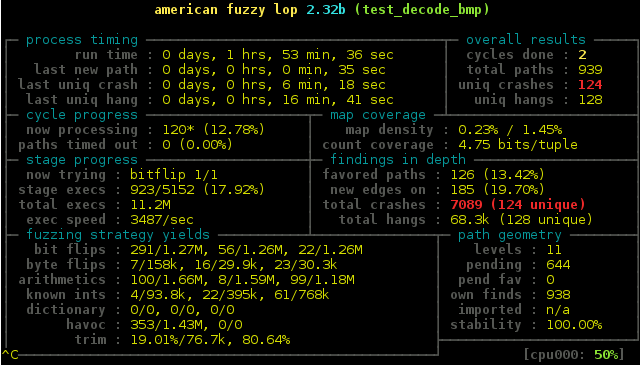
The result was immediate and not a little worrying, within seconds there were crashes and lots of them! Over the next couple of hours I watched as the unique crash total climbed into the triple digits.

I was forced to abort the run at this point as, despite clear warnings in the AFL documentation of the demands of the tool, my laptop was clearly not cut out to do this kind of work and had become distressingly hot.

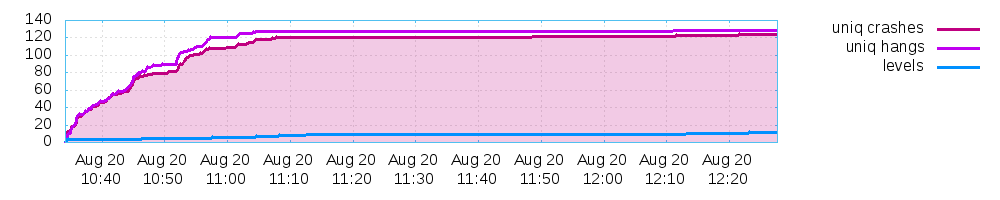
AFL has a visualisation tool so you can see what kind of progress it is making which produced a graph that showed just how fast it managed to produce crashes and how much the return plateaus after just a few cycles. Although it was finding a new unique crash every ten minutes or so when aborted.

I dove in to analyse the crashes and it immediately became obvious the main issue was caused when the test tool attempted allocations of absurdly large bitmaps. The browser itself uses a heuristic to determine the maximum image size based on used memory and several other values. I simply applied an upper bound of 48 megabytes per decoded image which fits easily within the fuzzers default heap limit of 50 megabytes.

The main source of "hangs" also came from large allocations so once the test was fixed afl-fuzz was re-run with a timeout parameter set to 100ms. This time after several minutes no crashes and only a single hang were found which came as a great relief, at which point my laptop had a hard shutdown due to thermal event!

Once the laptop cooled down I spooled up a more appropriate system to perform this kind of work a 24way 2.1GHz Xeon system. A Debian Jessie guest vm with 20 processors and 20 gigabytes of memory was created and the build replicated and instrumented.

AFL master node display
To fully utilise this system the next test run would utilise AFL in parallel mode. In this mode there is a single "master" running all the deterministic checks and many "secondary" instances performing random tweaks.

If I have one tiny annoyance with AFL, it is that breeding and feeding a herd of rabbits by hand is annoying and something I would like to see a convenience utility for.

The warren was left overnight with 19 instances and by morning had generated crashes again. This time though the crashes actually appeared to be real failures.

$ afl-whatsup sync_dir/
Summary stats
=============

Fuzzers alive : 19
Total run time : 5 days, 12 hours
Total execs : 214 million
Cumulative speed : 8317 execs/sec
Pending paths : 0 faves, 542 total
Pending per fuzzer : 0 faves, 28 total (on average)
Crashes found : 554 locally unique

All the crashing test cases are available and a simple file command immediately showed that all the crashing test files had one thing in common the height of the image was -2147483648 This seemingly odd number is actually meaningful to a programmer, it is the largest negative number which can be stored in a 32bit integer (INT32_MIN) I immediately examined the source code that processes the height in the image header.

if ((width <= 0)   (height == 0))          
return BMP_DATA_ERROR;
if (height < 0)
bmp->reversed = true;
height = -height;

The bug is where the height is made a positive number and results in height being set to 0 after the existing check for zero and results in a crash later in execution. A simple fix was applied and test case added removing the crash and any possible future failure due to this.

Another AFL run has been started and after a few hours has yet to find a crash or non false positive hang so it looks like if there are any more crashes to find they are much harder to uncover.

Main lessons learned are:
I will of course be debugging any new crashes that occur and perhaps turning my sights to all the projects other unit tested libraries. I will also be investigating the generation of our own custom test corpus from AFL to replace the demo set, this will hopefully increase our unit test coverage even further.

Overall this has been my first successful use of a fuzzing tool and a very positive experience. I would wholeheartedly recommend using AFL to find errors and perhaps even integrate as part of a CI system.

Michal &#268;iha&#345;: Continuous integration on multiple platforms

Over the weekend I've played with continuous integration for Gammu to make it run on more platforms. I had to remember many things from the Windows world on the way and the solution is not yet complete, but the basic build is working, the only problematic part are external dependencies. First of all we already have Linux builds on Travis CI. These cover compilation with both GCC and Clang compilers, hopefully covering most of the possible problems. Recently I've added OS X builds on Travis CI, what was pretty much painless and worked out of the box. The next major architecture to support is Windows. Once I've discovered AppVeyor I thought it might be the way to go. The have free plans for open-source projects (though it has only one parallel build compared to four provided by Travis CI). As our build system is cross platform based on CMake, it should work pretty much out of the box, right? Well almost, tweaking the basics took some time (unfortunately there is no CMake support on AppVeyor, so you have to script it a bit). The most painful things on the way: You can check our current appveyor.yml in case you're going to try something similar. Current build results are on AppVeyor. As a nice side effect, we now have up to date Windows binaries for Gammu.

Filed under: Debian English Gammu 0 comments

Zlatan Todori : When you wake up with a feeling

I woke up at 5am. Somehow made myself to soon go back to sleep again. Woke up at 6am. Such is the life of jet-lag. Or I am just getting old for it. But the truth wouldn't be complete with only those assertion. I woke inspired and tired and the same time. Tired because I am doing very time consumable things. Also in the same time very emotional things. AND at the exact same time things that inspire me. On paper, I am technical leader of Purism. In reality, I have insanely good relations with my CEO for such a short time. So good that I for months were not leading the technical shift only, but also I overtook operations (getting orders and delivering them while working with our assembly line to automate most of the tasks in this field). I was playing also as first line of technical support (forums, IRC and email). Actually I was pretty much the only line of support for few months. I was doing some website changes: change some wording, updating bunch of plugins and making it sure all works, resolved (hopefully) Tor and Cloudflare issues for it, annoying caching system for forums, stopped forum spam and so on. I worked on better messaging for Purism public relations. I thought my team to use keys for signing and encryption. I interviewed (and read all mails) for people that were interested in working or helping Purism. In process of doing all that, I maybe wasn't the most speedy person for all our users needs but I hope they understand and forgive me. I was doing all that while I was researching and developing tablets (which ended up not being the most successful campaign but we now do have them as product). I was doing all that while seeing (and resolving) that our kernel builds were failing. Worked on pushing touchpad (not so good but we are still working on) patches upstream (and they ended being upstreamed). While seeing repos being down because of our host. Repos being down because of broken sync with Debian. Repos being down because of our key mis-management. Metadata not working well. PureBrowser getting broken all the time. Tor browser out of date. No real ISO updates. Wrong sources.list entries and so on. And the hardest part on work was, I was doing all this with very limited scope and even more limited resources. So what kept me on, what is pushing me forward and what am I doing? One philosophy - Free software. Let me not explain it as a technical debt. Let me explain it as social movement. In age, where people are "bombed" by media, by all-time lying politicians (which use fear of non-existent threats/terror as model to control population), in age where proprietary corporations are selling your freedom so you can gain temporary convenience the term Free software is like Giordano Bruno in age of Inquisitions. Free software does not only preserve your Freedom to software source usage but it preserves your Freedom to think and think out of the box and not being punished for that. It preserves the Freedom to live - to choose what and when to do, without having the negative impact on your or others people lives. The Freedom to be transparent and to share. Because not only ideas grow with sharing, but we, as human beings, grow as we share. The Freedom to say "NO". NO. I somehow learnt, and personally think, that the Freedom to say NO is the most important Freedom in our lives. No I will not obey some artificially created master that think they can plan and choose my life decision. No I will not negotiate my Freedom for your convenience (also, such Freedom is anyway not real and it is matter of time where you will be blown away by such illusion). No I will not accept your credit because it has STRINGS attached to it which you either don't present or you blur it in mountain of superficial wording. No I will not implant a chip inside me for sake of your research or my convenience. No I will not have social account on media where majority of people are. No, I will not have pacemaker which is a blackbox with proprietary (buggy) software and it harvesting my data without me being able to look at it. Yin-Yang. Yes, I want to collaborate on making world better place for us all. I don't agree with most of people, but that doesn't make them my enemies (although media would like us to feel and think like that). I will try to preserve everyones Freedom as much as I can. Yes I will share with my community and friends. Yes I want to learn from better than I am. Yes I want to have awesome mentors. Yes, I will try to be awesome mentor. Yes, I choose to care and not ignore facts and actions done by me and other people. Yes, I have the right to be imperfect and do mistakes as long as I will aknowledge and work on them. Bugfixing ourselves as humans is the most important task in our lives. As in software, it is very time consumable but also as in software, it is improvement and incredible satisfaction to see better version of yourself, getting more and more features (even if that sometimes means actually getting read of other/bad features). This all is blending with my work at Purism. I spend a lot of time thinking about projects, development and future. I must do that in order not to make grave mistakes. Failing hardware and software is not grave mistake. Serious, but not grave. Grave is if we betray ourselves and our community in pursue for Freedom. We are trying to unify many things - we want to give you security, privacy and FREEDOM with convenience. So I am pushing myself out of comfort zones and also out of conventional and sometimes even my standard way of thinking. I have seen that non-existing infrastructure for PureOS is hurting is a lot but I needed to cope with it to the time where I will be able to say: not anymore, we are starting to build our own infrastructure. I was coping with Cloudflare being assholes to Tor users but now we also shifting away from them. I came to team where people didn't properly understand what and why are we building this. Came to very small and not that efficient team. Now, we employed a dedicated and hard working person on operations (Goran) which I trust. We have dedicated support person (Mladen) which tries hard to work with people. A very creative visual mastermind (Francois). We have a capable Debian Developer (Matthias Klumpp) working on PureOS new infra. We have a capable and dedicated sysadmins (Theo and Stelio) which we didn't even have in past. We are trying to LEVEL UP Free software and unify them in convenient solution which is lead by Joey Hess. We have a hard-working PureOS developer (Hema) who is coping with current non-existent PureOS infra. We have GNOME Boards of Directors person (Jeff) who is trying to light up our image in world (working with James, to try bring some lights into our shadows caused by infinite supply chain delays). We have created Advisory Board for Freedom, Privacy and Security which I don't want to name now as we are preparing to announce soon that (and trust me, we have good people in here). But, the most important thing here is not that they are all capable or cool people. It is the core value in all of them - they care about Freedom and I trust them on their paths. The trust is always important but in Purism it is essential for our work. I built the workflow without time management (everyone spends their time every single day as they see it fit as long as the work gets done). And we don't create insane short deadlines because everyone else thinks it is important (and rarely something is more important than our time freedom). So the trust is built out of knowledge and the knowledge I have about them and their works is because we freely share with no strings attached. Because of them, and other good people from our community I have the energy to sacrifice my entire time for Purism. It is not white and black: CEO and me don't always agree, some members of my team don't always agree with me or I with them, some people in community are very rude, impolite and don't respect our work but even with disagreement everyone in Purism finds agreement at the end (we use facts in our judgments) and all the people who just try to disturb my and mine teams work aren't as efficient as all the lovely words of people who believe in us, who send us words of support and who share ideas and their thoughts with us. There is no more satisfaction for me than reading a personal mail giving us kudos for the work and their understanding of underlaying amount of work and issues. While we are limited with resources we had an occasional outcry from community to help us. Now I want to help them to help me (you see the Freedom of sharing here?). PureOS has now a wiki. It will be a community wiki which is endorsed by Purism as company. Yes you read it right, Purism considers its community part of company (you don't need to get paycheck to be Purism member). That is why a call upon contributors (technical but mostly non-technical too) to help us make PureOS wiki the best resource on net for our needs. Write tutorials for others, gather and put info on wiki, create an ideas page and vote on them so we can see what community wants to see, chat with us so we all understand what, why and how are we working on things. Make it as transparent as possible. Everyone interested please get in touch with our teams by either poking us online (IRC, social accounts) or via emails (our personal or [hr, pr, feedback]@puri.sm. To finish this writing (as it is 8am here and I still want to rest a bit because I will have meetings for 6 hours straight today) - I wanted to share some personal insight into few things from my point of view. I wanted to say despite all the troubles and people who tried to make our time even harder (and it is already hard by all the limitation which come naturally today with our kind of work), we still create products, we still ship them, we still improved step by step, we still hired and we are still building. Keeping all that together and making progress is for me a milestone greater than just creating a technical product. I just hope we will continue and improve our pace so we can start progressing towards my personal great goal - integrate and cooperate with most of FLOSS ecosystem. P.S. yes, I also (finally!) became an official Debian Developer - still didn't have time to sit and properly think and cry (as every good men) about it.

20 August 2016

Francois Marier: Remplacer un disque RAID d fectueux

Traduction de l'article original anglais https://feeding.cloud.geek.nz/posts/replacing-a-failed-raid-drive/. Voici la proc dure que j'ai suivi pour remplacer un disque RAID d fectueux sur une machine Debian.

Remplacer le disque Apr s avoir remarqu que /dev/sdb a t expuls de mon RAID, j'ai utilis smartmontools pour identifier le num ro de s rie du disque retirer :
smartctl -a /dev/sdb
Cette information en main, j'ai ferm l'ordinateur, retir le disque d fectueux et mis un nouveau disque vide la place.

Initialiser le nouveau disque Apr s avoir d marr avec le nouveau disque vide, j'ai copi la table de partitions avec parted. Premi rement, j'ai examin la table de partitions sur le disque dur non-d fectueux :
$ parted /dev/sda
unit s
print
et cr une nouvelle table de partitions sur le disque de remplacement :
$ parted /dev/sdb
unit s
mktable gpt
Ensuite j'ai utilis la commande mkpart pour mes 4 partitions et je leur ai toutes donn la m me taille que les partitions quivalentes sur /dev/sda. Finalement, j'ai utilis les commandes toggle 1 bios_grub (partition d'amorce) et toggle X raid (o X est le num ro de la partition) pour toutes les partitions RAID, avant de v rifier avec la commande print que les deux tables de partitions sont maintenant identiques.

Resynchroniser/recr er les RAID Pour synchroniser les donn es du bon disque (/dev/sda) vers celui de remplacement (/dev/sdb), j'ai ex cut les commandes suivantes sur mes partitions RAID1 :
mdadm /dev/md0 -a /dev/sdb2
mdadm /dev/md2 -a /dev/sdb4
et j'ai gard un oeil sur le statut de la synchronisation avec :
watch -n 2 cat /proc/mdstat
Pour acc l rer le processus, j'ai utilis le truc suivant :
blockdev --setra 65536 "/dev/md0"
blockdev --setra 65536 "/dev/md2"
echo 300000 > /proc/sys/dev/raid/speed_limit_min
echo 1000000 > /proc/sys/dev/raid/speed_limit_max
Ensuite, j'ai recr ma partition swap RAID0 comme suit :
mdadm /dev/md1 --create --level=0 --raid-devices=2 /dev/sda3 /dev/sdb3
mkswap /dev/md1
Par que la partition swap est toute neuve (il n'est pas possible de restorer une partition RAID0, il faut la re-cr er compl tement), j'ai d faire deux choses:
  • remplacer le UUID pour swap dans /etc/fstab, avec le UUID donn par la commande mkswap (ou bien en utilisant la command blkid et en prenant le UUID pour /dev/md1)
  • remplacer le UUID de /dev/md1 dans /etc/mdadm/mdadm.conf avec celui retourn pour /dev/md1 par la commande mdadm --detail --scan

S'assurer que l'on peut d marrer avec le disque de remplacement Pour tre certain de bien pouvoir d marrer la machine avec n'importe quel des deux disques, j'ai r install le boot loader grub sur le nouveau disque :
grub-install /dev/sdb
avant de red marrer avec les deux disques connect s. Ceci confirme que ma configuration fonctionne bien. Ensuite, j'ai d marr sans le disque /dev/sda pour m'assurer que tout fonctionnerait bien si ce disque d cidait de mourir et de me laisser seulement avec le nouveau (/dev/sdb). Ce test brise videmment la synchronisation entre les deux disques, donc j'ai d red marrer avec les deux disques connect s et puis r -ajouter /dev/sda tous les RAID1 :
mdadm /dev/md0 -a /dev/sda2
mdadm /dev/md2 -a /dev/sda4
Une fois le tout fini, j'ai red marrer nouveau avec les deux disques pour confirmer que tout fonctionne bien :
cat /proc/mdstat
et j'ai ensuite ex cuter un test SMART complet sur le nouveau disque :
smartctl -t long /dev/sdb

Next.

Previous.