Search Results: "ag"

25 July 2008

Y Giridhar Appaji Nag: What should be NEW?

For some reason, I was under the impression that uploading a new upstream release would place the package in the NEW queue. I was proved wrong because I was able to upload ELinks 0.12~20080527-1 to experimental yesterday and I am a DM who can't upload NEW packages.

To me, this did not make a whole lot of sense. NEW exists to keep the Debian archive legal and to prevent serious QA issues. Uploading a new upstream release of a package pushes a _new_ orig.tar.gz file to the archive and could contain potentially DFSG non-free material which is an issue if the package is being uploaded to main.

What is a bit ironic here is that a DM can't upload an updated package that is essentially the same except that it creates new debugging-symbols packages from the same source package. To a very large extent, these -dbg packages should neither be of questionable legality nor have serious QA issues. What I don't know is if it is necessary that these go to NEW because the FTP masters add overrides manually.

24 July 2008

John Goerzen: OSCon Update

On Wednesday, OSCon really goes into high gear (and the wifi croaks) at OSCon. The people that aren't going to the tutorials all arrive, and aren't yet sluggish from the late-night vendor parties and BOFs.

The keynotes were OK, and after that, I listened to Keith Packard talk about the future of X. Then it was off to finish the preparation for my own talk on Linux on the corporate desktop. It was the first time I spoke at OSCon, and it seems to have gone well. I keep running into people that were at the talk and thought of some more questions -- and of course I chatted with a number of people right after as well. There are a number of other companies that are planning on doing what we've done, or even started down the implementation path already. It's some effort making something of OSCon quality (Damian Conway suggests something like 10 hours preparing for every 1 hour presenting -- I didn't do that), but I'm glad I did.

The Expo Hall opened Wednesday as well. Met some interesting folks there -- Open Lina, a company that sells Linux hardware, an Open Source groupware product I hadn't heard of before (they are apparently working on Debian Packages too), and some others I can't remember right now...

Tuesday I had dinner at Andina, a Peruvian restaurant, with fellow Haskellers Bryan O'Sullivan and Don Stewart -- the first time the three of us Real World Haskell folks met in one place.

Today brought Nat Torkington's excellent keynote, and also r0ml's great talk this afternoon ("I started this talk in 2003, and it's run a bit long.") Another great time for some networking in the hallways and expo hall. One of the LinuxFest Northwest folks had attended my talk, happened to see me as I was stuffing one of the may free t-shirts that vendors were giving out into my laptop bag (by afternoon, they were getting quite in your face about it), and struck up a conversation.

Went for sushi over lunch with a couple of folks from #oscon on IRC, then dinner with Debian folks.

Been a busy week, but met lots of people. I didn't go to as many talks as I planned because I was so busy talking to people -- guess that means the conference was a hit.

Christian Perrier: Holidays

Tomorrow, I'll leave /home for more than 3 weeks: For people who are not tired of this, I've had the great honor of being sollicited to hold a keynote lecture at Debconf. As you'd guess, that will be about i18n in Debian. I plan it to be a kinda general thing, giving the current rough picture of how things are going (or not going). No deep technical stuff (aha, how could *I* do that anyway?), just talking with hands. From informations I have, it should be on Aug. 14th, at the beginning of the talks schedule (9:30 or so, local time...check this when the official schedule is out). Apart from that, my personal schedule for DebConf is mostly working with the i18n folks who will be there (Felipe A. van de Wiel aka "faw", Nicolas Fran ois aka "nekral") on the i18n server. Work/talk with Neil Williams about tdebs stuff and all things related to i18n and embedded stuff is also planned as well as preparing the Extremadura meeting we need to have at the end of the year.

Russ Allbery: Slashdot promotion

Congratulations, Luk, on your new position as the Debian project's maintainer! Now you can fix the bugs in all of our packages! It's a huge job, which presumably is why Slashdot has given you an extra E to help out. Or maybe that's just for plausible deniability....

Steve Kemp: I think I'll take this back

KVM Utility
Gunnar Wolf made an interesting post about KVM today which is timely. He points to a simple shell script for managing running instances of KVM which was a big improvement on mine - and so is worth a look if you're doing that stuff yourself. Once I find time I will document my reasons for changing from Xen to KVM, but barring a few irritations I'm liking it a lot.
Chronicle Theme Update
I made a new release of the chronicle blog compiler yesterday, mostly to update one of the themes. That was for purely selfish reasons as I've taken the time to update the antispam protection site I'm maintaining. There have been some nice changes to make it scale more and now it is time for me to make it look prettier. (A common theme - I'm very bad at doing website design.) So now the site blog matches the real site.
ObQuote: Resident Evil

Lior Kaplan: August Penguin 2008


In the last two months I’ve been less active regarding free software as life keep me busy with other stuff. Nerver the less I’ve been able to help with orginizing August Penguin - the annual Israeli free software conference (happening the 7th time in a row). The conference takes half a day and occurs on the first Friday of August. This year we’re back to a two track conference with a tehcnical and non-technical tracks. Each track has 5 lectures, 30 min. each. Non technical track: Technical Track: This year with also have ISOC-IL, Microsoft (yes, you’re reading correctly) and Sun as sponsors (and a few smaller companies). Cool to have the “big boys” helping. As I found out more and more open source people from around the world in Israel, I thought it will be a good idea to write about the conference and invite them. Please be aware that the lectures are in Hebrew. But you can also come to meet the community and talk with the people or take part in our GPG signing party. More info (in Hebrew) at http://august.penguin.org.il and in Facebook’s event info.

Joey Hess: disturbing thought

So for those of you who arn't aware, as of yesterday, it's easy for any spotty teenager/script kiddie to make you see content you didn't expect to when you go to google or your bank, etc. Maybe you're lucky and someone has fixed the problem on your network. Most likely you're not so lucky. (Confidential to Anna, Maggie, Adrianne, Errol, Barbara, Mark: You're lucky! But only when you're at home.) At the moment, the idea that DNS can be trivially poisoned seems like a really serious problem. Will there come to be a point when we just regard this as "DNS spam", basically accepting that it's happening all the time, indeed that a given DNS query is as likely spoofed than good, and nothing can be trusted, or indeed, fixed? If you don't think this can happen to a internet techology, just look at the average inbox now, and compare it to the average inbox circa 1993. I can't claim to be an expert in this area, but based on what I'm reading, the current "fix" increases the time-to-exploit from 11 seconds to maybe 1 week. (BTW, is there a reason why DNS servers are caching in-baliwick responses.. would it work to entirely disable that caching? Any chance for a second round of more targeted fixes now that the cat is out of the bag?) Also, I get the impression DNSSEC will never be successfully deployed, barring a miracle. And we seem to have just run out of miracles.

Joey Hess: disturbing thought

So for those of you who arn't aware, as of yesterday, it's easy for any spotty teenager/script kiddie to make you see content you didn't expect to when you go to google or your bank, etc. Maybe you're lucky and someone has fixed the problem on your network. Most likely you're not so lucky. (Confidential to Anna, Maggie, Adrianne, Errol, Barbara, Mark: You're lucky! But only when you're at home.) At the moment, the idea that DNS can be trivially poisoned seems like a really serious problem. Will there come to be a point when we just regard this as "DNS spam", basically accepting that it's happening all the time, indeed that a given DNS query is as likely spoofed than good, and nothing can be trusted, or indeed, fixed? If you don't think this can happen to a internet techology, just look at the average inbox now, and compare it to the average inbox circa 1993. I can't claim to be an expert in this area, but based on what I'm reading, the current "fix" increases the time-to-exploit from 11 seconds to maybe 1 week. (BTW, is there a reason why DNS servers are caching in-baliwick responses.. would it work to entirely disable that caching? Any chance for a second round of more targeted fixes now that the cat is out of the bag?) Also, I get the impression DNSSEC will never be successfully deployed, barring a miracle. And we seem to have just run out of miracles.

Erich Schubert: Thesis graded

My advisors just told me my grade for my final thesis I handed in two weeks ago: a 1.0 (which is the best possible grade here).Well, they've been quite clear about this being the likely result before, since the thesis worked out very well, with a publication on a good conference and such. So right now I'm looking forward to continuing this research and doing a PhD degree. Right now, this would be my favorite option, if I manage to get a position at the university.

David Moreno Garza: July 24th, 1958

Today, fifty years ago, my mother was born.

On July 24th, 1958, Vicenta Leyva gave birth to Olga Cristina Garza Leyva in the small town of Zumpango del R o (later renamed to Eduardo Neri), in the southern Mexican state of Guerrero. Her father Guillermo Garza, who is still alive, was a private pilot. Olga Cristina was named Cristina after the saint that is celebrated on the same day.

She was their third kid, a couple of years before V ctor and Guillermo were born and a couple of years after, Carlos was born, all of them being born on total different places on southern and central Mexico. The father, being a pilot, was absent from home for long periods, he even had "another family" somewhere in northern Mexico, supposedly in Sinaloa.

In the early 60s, the family moved to Mexico City where they were going to spend most of their life. They lived on a small apartment on Col. Moctezuma, which was (and still is) a working class neighborhood, just besides the Mexico City International Airport, on the eastern part of the city. Back in the days, it used to take quite some time to travel from there to any point of the city, like the downtown area or beyond.

All the kids spent most of their childhood there attending public schools. They weren't a wealthy family who couldn't even afford to buy and have meat on some days but only in special ocassions.

As the years passed and the kids became adults, Olga met David Moreno Rojas in the same neighborhood. He was enrolled at the National Autonomous University of Mexico, under Enterprises Administration in Ciudad Universitaria. He was also an avid f tbol player. He was named David after his father, David Moreno Gonz lez. They became boyfriend and girlfriend and got married when she was 20 and he was 24 years old on December 19th, 1978. They lived together for a few years in Col. Del Valle in central Mexico City.

Ten months later they were married, Lorena Moreno Garza, their first kid, was born on October 7th, 1979. S The family then moved to the suburb in Aragon, Estado de M xico. They had their second child on August 8th, 1984, named David Moreno Garza, becoming David III.

After the 1985 Mexico City massive earthquake, the family wanted to move outside the city and found relocation in Ciudad del Carmen, on the Mexican state of Campeche, located on the shore of the Gulf of Mexico, on 1988. They spent three or four years there and then moved to Celaya, Guanajuato where most of the father's family was located. They spent about five years there and then, for family reasons, they returned to Mexico City in 1995 to attend the family business.

Olga and her family had a good, loving family by then and had decided to not have any more kids. They had both of their children on private schools and taught them catholicism. On 1998, Vicenta passed away after a quick period of time because of liver cancer. This shocked most of the family.

As the years passed, the family business was sold and Olga stopped working, as she used to in the business. But as she had always been very active, she started working as a seller for a fine jewelry firm where she keeps working currently. Her husband, after pursuing his dream of going back to school and studying Law, works as a private work-related issues lawyer.

Olga is the most loving, nursing, affective, meticulous, scrupulous person I've ever met and even though I have only met her for almost twenty-four of her fifty years now, I admire her and love her as much as I have no words to describe. She is the one that built my sensitive, loving side where my heart resides, and I thank God for giving me such a great life gift and having her at any time.

mama.jpg

Today, her husband is 54, her daughter is 28, her son is 23 and she is 50 now. This is also an special year because she and her husband will celebrate 30 years of their marriage.

mamaypapa.jpg
Felicidades, jefecita.

Russell Coker: SE Linux Policy Loading

One of the most significant tasks performed by a SE Linux system is loading the “policy“. The policy is the set of rules which determine what actions are permitted by each domain. When I first started using SE Linux (in 2001) the kernel knew where to find the policy file and would just read the data from disk as soon as it had mounted the root filesystem. Doing such things is generally considered to be a bad idea, but it was an acceptable mechanism for an early release. One issue is that the policy needs to be loaded very early in the system boot process, before anything significant happens. In the early days the design of SE Linux had no support for a process to change it’s security context other than by executing another process (similar to the way a non-root process in the Unix access control system can not change it’s UID, GID, or groups). Although later on support for this was added, it was only available as the request of the application (an external process could not change the context of an application without using ptrace - a concept that is too horrible to contemplate) and I am not aware of anyone actually using it. So it’s almost a requirement that there be no more than one active process in the system at the time that policy is loaded, therefore it must be init or something before init that loads the policy. When it was decided that a user-space program had to instruct the kernel to load the policy we had to determine which program should do it and when it should be done, with the constraint that it had to be done early. The most obvious solution to this problem was to load the policy in the initramfs (or initrd as it was known at the time). One problem with this is that the initramfs is limited in size by kernel compilation options and may need to be recompiled to fit a bigger policy. As an experiment to work around this limitation I had a small policy (which covered the domains for init and the scripts needed for the early stages for system boot) loaded in the initramfs and then later in the boot process (some time after the root filesystem was mounted read/write) the full policy was loaded. A more serious problem with including policy in the initramfs was that it required rebuilding the initramfs every time the policy changed in a significant way, of course scripts could not determine when a change was significant (neither could most users) so that required needless rebuilds (which wastes time). Even with a small policy for early booting loaded it was still sometimes necessary to change it and update the initramfs. I believe that as a general rule an initramfs should only be rebuilt when a new kernel is installed or when a radical change is made to the boot process (EG moving from single disk to software RAID, changing between AMD and Intel CPU architecture, changing SCSI controller, or anything else that would make the old initramfs not boot the machine). The initramfs that was used to boot my machine is known to actually work, the same can not be said for any new initramfs that I might generate. But the deciding factor for me was support of machines that did not use an initramfs or initrd (such as the Cobalt machines [1] I own). To solve these problems I first experimented with a wrapper for init. The idea was to divert the real init to another file name (or use the init= kernel command-line option) and then have the wrapper load the policy before running the real init. I never intended that to be a real solution, just to demonstrate a point. Once I had proven that it was possible to load the policy from user-space before running the real init program it was a small step to patch init to do this. One slightly tricky aspect of this was in getting the correct security context for init. The policy has always been written to allow a domain transition from kernel_t to init_t when a file of type init_exec_t is executed. The domain kernel_t is applied to all active processes (including kernel threads) at the time the policy is loaded. So init only has to re-exec itself to get the correct context. Fortunately init is designed to do this in the case of an upgrade so this was easy to manage. Since that time every implementation of SE Linux apart from some embedded systems has used init to load the policy. The latest trend in Linux distributions seems to be using upstart [2] as a replacement for the old SysV Init. The Fedora developers decided to make nash (a program that comes from the mkinitrd source tree in Fedora and is a utility program for a Red Hat based initramfs) load the SE Linux policy as it would apparently be painful to patch every init to load the policy. As far as I am aware there are only three different init programs in common use in Linux, the old SysV Init (which used to be used by everyone), Busybox (for rescuing broken systems and for embedded systems), and now Upstart (used by Ubuntu and Red Hat since Fedora 9). Embedded systems need to work differently to other systems in many ways (having the one Busybox program supply the equivalent to most coreutils in one binary is actually a small difference compared to the other things), and modifying the policy load process for embedded systems is trivial compared to all the other SE Linux work needed to get an embedded system working well. There are at least two commonly used initramfs systems (the Debian and Red Hat ones) and probably others. As one init system (SysV Init) already has SE Linux support it seems that only one needs to be patched to have complete coverage. I’ve just written a patch for Upstart (based on the version in Debian/Experimental) and sent it to an Ubuntu developer who’s interested in such things. I also volunteer to patch any other init system that is included in Debian (I am aware of minit and will patch it as soon as it’s description does not include “this package is experimental and not easy to install and use“). It seems to me that repeating the work which was done for SysV Init and upstart for any other init system will be little effort, at worst no greater than patching an initramfs systems (and I’ll do it). As the number of initramfs systems that would need to be patched would exceed the number of init systems it seems that less work is involved in patching the init systems. The amount of RAM required by the initramfs is in some situations a limitation on the use of a system, when I recently did some tests on swap performance by reducing the amount of RAM available to a Xen DomU [3] it was the initramfs that limited how small I could go. So adding extra code to the initramfs is not desired. While this will be a small amount of code in some situations (when I patched /sbin/init from Upstart it took an extra 64 bytes of disk space on AMD64), dragging in the libraries can take a moderate amount of space (the fact that an LVM or encrypted root filesystem causes SE Linux libraries to be included in the initramfs is something that I consider to be a bug and plan to fix). Finally not all boot loaders support an initrd or initramfs. I believe that any decision which prevents using such sweet hardware as Cobalt Qube and Raq machines from being used with SE Linux is a mistake. I have both Qube and Raq machines running fine with Debian SE Linux and plan to continue making sure that Debian will support SE Linux on such hardware (and anything with similar features and limitations).

MJ Ray: What was in my Nutsack? (from Lug Radio Live)


The notorious nutsack (cc-by-2.0) The conference pack for LugRadioLive was called a “nutsack” for some reason (anyone know why?). It seems like a pretty good pack, as far as these things go. First of all, it’s a durable paper bag, so much greener than plastic. It contained: All in all, smarter than your average conference pack… or am I just thinking that because it looks a bit like a picnic?

23 July 2008

Miriam Ruiz: Latest Frets on Fire in Debian at last: 1.2.512

We’ve finally been able to make the latest version of Frets on Fire work properly and be playable, without the high CPU consumption levels that we were getting, among other annoying bugs. I’ve already uploaded the latest version of the package (1.2.512.dfsg-3) to Debian SID, I hope in time for getting into Lenny before the freeze. Lots of thanks to deavid (David Mart nez Mart ) for the patches, it wouldn’t have been possible without your help!

Martín Ferrari: Wanted: Nokia n810

Image of an N810 from WikipediaDear lazyweb, I'm craving for one of these niceties. But unfortunately in Argentina they are very expensive and not easy to find (I think there's not any 'legal' channel to buy them currently). So, anyone coming to DebConf from the States would be so kind as to bring me one of these? They are small (72 128 14 mm) and lightweight (226 grams), and aren't so expensive as to be a big risk; I can buy it from here so you don't even have to lend the money for the time being. So if you want to help make a DebConf organiser happy, you know how :-). I can bribe in the form of a nice bbq at home, or a dinner at some restaurant. Tags: Planet Debian

Gunnar Wolf: Virtually having fun

Several weeks ago, the people in charge of maintaining the Windows machines in my institute were desperate because of a series of virus outbreaks - Specially, as expected, in the public lab - but the whole network smell virulent. After seeing their desperation, I asked Rolman to help me come up with a solution. He suggested me to try replacing the Windows workstations by substituting local installations by a server having several virtual machines, all regenerated from a clean image every day, and exporting rdesktop sessions. He suggested using Xen for this, as it is the virtualization/paravirtualization solution until now best offered and supported by most Linux distributions (including, of course, RedHat, towards which he is biased, and Debian, towards I am... more than biased, even bent). So far, no hassle, right?
Of course, I could just stay clear of this mess, as everything related to Windows is off my hands... But in October, we will be renewing ~150 antivirus licences. I want to save that money by giving a better solution, even if part of that money gets translated to a big server.
Get the hardware
But problems soon arose. The first issue was hardware. Xen can act in its paravirtualization mode on basically any x86 machine - but it requires a patched guest kernel. That means, I can paravitualize many several different free OSs on just any computer I lay my hands on here, but Windows requires full- or hardware-assisted- virtualization. And, of course, only one of the over 300 computers we have (around 100 of which are recent enough for me to expect to be usable as a proof-of-concept for this) has a CPU with VT extensions - And I'm not going to de-comission my firewall to become a test server! ;-)
When software gets confused for hardware
So, I requested a Intel Core 2 Quad Q9300 CPU, which I could just drop in any box with a fitting motherboard. But, of course, I'm not the only person requiring computer-related stuff. So, after pestering the people in charge for buying stuff on a daily basis for three weeks, the head of acquisitions came smiling to my office with a little box in his hands.
But no, it was not my Core 2 Quad CPU.
It was a box containing... Microsoft Visio. Yes, they spent their effort looking for the wrong computer-related thingy :-/ And meanwhile, Debconf 8 is getting nearer and nearer. Why does that matter? Because I have a deadline: By October, I want the institute to decide not to buy 150 antivirus licenses! Debconf will take some time off that target from me.
Anyway... The university vacations started on July 5. The first week of vacations I went to sweat my ass off at Monterrey, by Monday 14 I came back to my office, and that same day I finally got the box, together with two 2GB DIMMs.
Experiences with a nice looking potential disaster
Anyway, by Tuesday I got the CPU running, and a regular Debian install in place. A very nice workhorse: 5GB RAM, quad core CPU at 2.5GHz, 6MB cache (which seems to be split in two 3MB banks, each for two cores - but that's pure speculation from me). I installed Lenny (Debian testing), which is very soon going to freeze and by the time this becomes a production server will be very close to being a stable release, and I wanted to take advantage of the newest Xen administration tools. Of course, the installation was for AMD64 - Because 64 bitness is a terrible thing to waste.
But I started playing with Xen - And all kind of disasters stroke. First, although there is a Xen-enabled 2.6.25 Linux kernel, it is -686 only (i.e. no 64 bit support). Ok, install a second system on a second partition. Oh, but this kernel is only domU-able (this is, it will correctly run in a Xen paravirtualized host), but not dom0-able (it cannot act as a root domain). Grmbl.
So, get Etch's 2.6.18 AMD64 Xen-enabled kernel, and hope for the best. After all, up to this point, I was basically aware of many of the facts I mentioned (i.e. up to this point I did reinstall once, but not three times)... And I hoped the kernel team would have good news regarding a forward-port of the Xen dom0 patches to 2.6.25 - because losing dom0 support was IMO a big regression.
But quite on time, this revealing thread came up on the debian-devel mailing list. In short: Xen is a disaster. The Xen developers have done their work quite far away from the kernel developers, and the last decent synchronization that was made was in 2.6.18, over two years ago. Not surprisingly, enterprise-editions of other Linux distributions also ship that kernel version. There are some forward-patches, but current support in Xen is... Lacking, to say the least. From my POV, Xen's future in the Linux kernel looks bleakish.
Now, on the lightweight side...
Xen is also a bit too complicated - Of course, its role is also complicated as well, and it has a great deal of tunability. But I decided to keep a clean Lenny AMD64 install, and give KVM, the Kernel Virtual Machine a go. My first gripe? What a bad choice of name. Not only Google searches for KVM gives completely unrelated answers (to a name that's already well known, even in the same context, even in the same community).
KVM takes a much, much simpler approach to virtualization (both para- and full-): We don't need no stinkin' hypervisors. The kernel can just do that task. And then, kvm becomes just another almost-regular process. How nice!
In fact, KVM borrows so very much from qemu that it even refers to qemu's manpage for everything but two command-line switches.
Qemu is a completely different project, which gets to a very similar place but from the other extreme - Qemu started off as Bochs, a very slow but very useful multi-architecture emulator. Qemu started adding all kinds of optimizations, and it is nearly useful (i.e. I use it in my desktop whenever I need a W2K machine).
Instead of a heavyweight framework... KVM is just a modprobe away - Just ask Linux to modprobe kvm, and kvm -hda /path/to/your/hd/image gets you a working machine.
Anyway - I was immediatly happy with KVM. It took me a week to get a whole "lab" of 15 virtual computers (256MB RAM works surprisingly well for a regular XP install!) configured to start at boot time off a single master image over qcow images.
KVM's shortcomings
Xen has already been a long time in the enterprise, and has a nice suite of administrative tools. While Xen depends on having a configuration file for each host, KVM expects them to be passed at the command line. To get a bird-eye view of the system, xen has a load of utilities - KVM does not. And although RedHat's virt-manager is said to support KVM and qemu virtualization (besides its native Xen, of course), it falls short of what I need (i.e. it relies on a configuration file... which lacks expresivity to specify a snapshot-based HD image).
To my surprise, KVM has attained much of Xen's most amazing capabilities, such as the live migration. And although it's easier to just use fully virtualized devices (i.e. to use an emulation of the RTL8139 network card), as they require no drivers extraneous to the operating system, performance can be greatly enhanced by using the VirtIO devices. KVM is quickly evolving, and I predict it will largely overtake Xen's (and of course, vmware and others) places.
Where I am now
So... Well, those of us that adopt KVM and want to get it into production now will have some work of building the tools to gracefully manage and report it, it seems. I won't be touching much my setup until after Debconf, but so far I've done some work over Freddie Cash's kvmctl script. I'm submitting him some patches to make his script (IMHO) more reliable and automatizable (if you are interested, you can get my current version of the script as well). And... Starting September, I expect to start working on a control interface able to cover my other needs (such as distributing configuration to the terminals-to-be, or centrally managing the configurations).

Kartik Mistry: sitecopy


* Sandro Tosi uploaded latest version of sitecopy. Give it try, test it, so it will have enough testing for our dear Lenny. Thanks a lot Sandro and Joe (upstream) for taking care!

Rob Taylor: Post GUADEC stuff

Well, my microblogging of GUADEC failed miserably, mainly because I didn’t seem to be able to get a DHCP lease :( I hope identi.ca gets SMS support by next time. Either that or maybe just one conference where the network doesn’t keel over and die at the sight of a few hundred developers. I was kinda surprised to find quite a few people who didn’t know about stow. If you ever need to make install something, use this. The sides from my talk are now up on wizbit.org. The wiki’s pretty empty at the moment, but we’re slowly filling it up…
MJ Ray: LugRadio Live Event Review, Part Web2.0


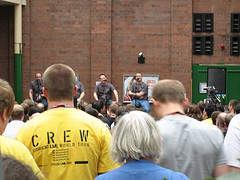
LUGRadioLive 2008 by sheilaellen (cc-by-2.0) One aspect I didn’t mention in the LugRadio Live Event Review was how old-fashioned it seemed in some ways. I guess I’ve got used to seeing conferences experimenting with various web2.0 toys like live-blogging, feedback walls and so on, or the excellent live video streaming of DebConfs, but it was a bit of a surprise to find myself the only person in the audience who connected to the IRC channel from the event. One possible reason for that was that the wireless network was a bit difficult, or at least that was what I was told. I felt quite smug with my 3G smartphone IRC client (which I’ll blog about later) until Rufus Pollock mentioned the 800+ patents involved in 3G. Damn - I guess I hate freedom. In one way, I guess it’s appropriate if the network wasn’t up to the task. Broken networks were a regular feature of early ALUG meetings, as the end of this email hints. Web2.0 was there a little bit. There was a facebook page (which I accidentally spammed while travelling to the event), flickr:lugradiolive and a twitter link of #lugradiolive - but how does that work? There’s no user called lugradiolive and you can’t have usernames containing # Update: twitter:#lugradiolive (thanks to Dave Briggs for the explanation in a comment). Anyway, seeing as there will be another LUG Radio Live, maybe we can arrange something more interactive but free-software-friendly for 2009? More reviews I’ve read: davee: Lugradio-in makes me feel good , Peter Cannon: The party’s over for LugRadio Live and No’: Lugradio Undead - but why aren’t more people writing about this event? There seemed to be enough there. Or are they out there but I’m just not seeing them?

22 July 2008

Andrew Pollock: [tech] Looking for a new colo for my server

Unfortunately the free ride I've had for the last oh, gee, it must be something like four years, is coming to an end, so I have to find somewhere else to co-locate daedalus. Thanks Ben, you've saved me a packet! The first step is to figure out roughly how much traffic this thing is doing. Fortunately I've been running Argus on it for donkey's ages, so I should be able to figure that part out. Then I have to find a colo facility, (preferably in Brisbane, to avoid too much dicking about with moving the hardware), which won't charge me an arm and a leg for traffic. I'd prefer a flat monthly fee if possible. I also need to do some soul searching to decide if it's even worthwhile continuing to keep a physical server. I could move my mail to Google Apps, the photos to Picasa, but I kind of like my blog the way it is. I spent a non-trivial amount of money of daedalus about 3 years ago. It's a grunty server. It seems something of a shame to get rid of it, but I could potentially get a virtual server a lot more cheaply. The other option would be to try and generate sufficient income with it to cover its costs, but that has all sorts of tax implications, not to mention having to maintain a service level agreement. I really don't have the time or inclination to be doing all of that on the side. All stuff to think about. I have an amorphous month to move my server, so if anyone out there has suggestions on a colo provider in Brisbane, please drop me a line.

Jaldhar Vyas: And I'll, Um, Check For Blaculas...Nope No Blaculas

Although it still nominally has my name on it, the Debian dovecot package has for a long time been looked after by Fabio Tranchitella. Recently, Joel Johnson has joined the team and he has prepared a package for version 1.1.1 which was uploaded to experimental a couple of days ago. Upstream thinks 1.1.1 will probably not be stable enough for Lenny but a backport will be provided (perhaps even by me!) Testing/Unstable will stick with the 1.0 series until after the release.

Next.

Previous.