Search Results: "ag"

5 August 2008

Steve Kemp: Five grand a head

It is nice when you work for a company where you can say:
"Ice-lolly break..."
The response?
"Me too!"
Tonight has been a productive evening, I guess the ice-lolly helped! I managed to optimize the storage of rejected SPAM mail for my commercial service. That is something I've been obsessing over recently since the volume of SPAM is currently hovering around 2.5 million messages. Still I suspect it is only a matter of weeks before I need to expand. The current setup has me using three machines: Ideally I'd like to split that up further so that I have a single machine running the web application (the part the user interacts with), a pair of MX machines, and the offsite machine doing the minimal work it does. That way the incoming mail will not affect the application at all directly. Thankfully the split should be trivial. The only hard part is finding a fast webhost that can offer me ~1Gb of RAM, ~1000Gb of disk space, and won't charge much. Ideally around £15/$30 a month. (hahaha! hahaha! ha!) ObQuote: L on

4 August 2008

Russell Coker: New HP Server

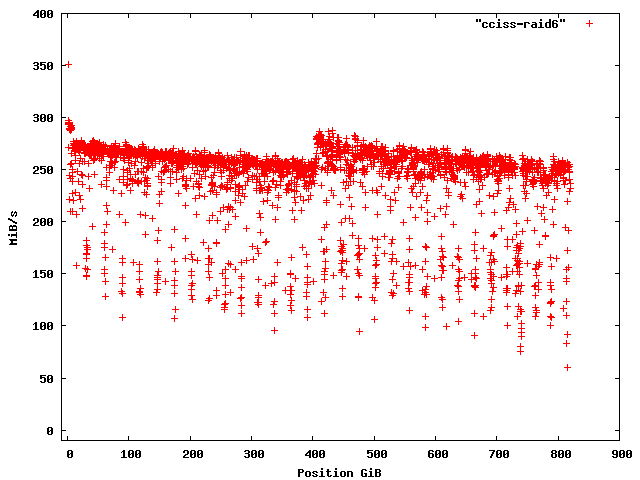
I’ve just started work on a new HP server running RHEL5 AS (needs to be AS to support more than 4 DomU’s). While I still have the Xen issues that made me give up using it on Debian [1] (the killer one being that an AMD64 Xen Dom0 would kernel panic on any serious disk IO) but the Xen implementation in RHEL is quite solid. The first thing I did was run zcav (part of my Bonnie++ benchmark suite) [2] to see how the array performs (as well as ensuring that the entire array actually appears to work). The result is below. For a single disk performance is expected to decrease as you read along the disk (from outer to inner tracks). I don’t know why the performance decreases until the half-way point and then starts with good performance again and again decreases. The next thing was to ensure that the machine had RAID-6 (I have been convinced that that using only RAID-5 verges on professional malpractice). As the machine is rented from a hosting company there was no guarantee that they would follow my clear written instructions involving running RAID-6. The machine is a HP rack-mounted server with a CCISS RAID controller, so to manage the array the command /usr/sbin/hpacucli is used. The command hpacucli controller all show reveals that there is a “Smart Array P400 in Slot 1“. The command hpacucli controller slot=1 show gives the following (amongst a lot of other output):
RAID 6 (ADG) Status: Enabled
Cache Board Present: True
Cache Status: OK
Accelerator Ratio: 25% Read / 75% Write
Drive Write Cache: Disabled
Total Cache Size: 512 MB
Battery Pack Count: 1
Battery Status: OK
SATA NCQ Supported: True So the write-back cache is enabled, 384M of data is for the write-back cache and 128M is for the read cache (hopefully all for read-ahead - the OS should do all the real caching for reads). The command hpacucli controller slot=1 array all show reveals that there is one array: “array A (SAS, Unused Space: 0 MB)“. The command hpacucli controller slot=1 array a show status tells me that the status is “array AOK“. Finally the command hpacucli controller slot=1 show config gives me the data that I really want at this time and says:
Smart Array P400 in Slot 1 (sn: *****)
array A (SAS, Unused Space: 0 MB)
logicaldrive 1 (820.2 GB, RAID 6 (ADG), OK) Then it gives all the data on the disks. It would be nice if there was a command to just dump all that. I would like to be able to show the configuration of all controllers with a single command. Also it would be nice if the fact that hpacucli is the tool to use for managing CCISS RAID arrays when using Linux on HP servers was more widely documented. It took me an unreasonable amount of effort to discover what tool to use for CCISS RAID management.

David Moreno Garza: On phone calls

I've enjoyed reading Sarah Hatter's (from 37signals) blog post about phone support. I can't say anything else that I totally agree about it, and I'd like to share my own experience.

Recently, I bought a ticket for my mom to come to visit us in New York. She finally couldn't do it for the dates we had picked so I had to cancel the airline ticket that I had already paid in Orbitz. I did this through their website, I saw how much of penalties it'd be, and it wasn't too much, so I accepted without too many other alternatives. Basically, from the total cost of the ticket, I'd have to take a small penalty fee for Orbitz and big one for the airline. The rest wouldn't be reimbursed but could be used as credit for another reservation, for the same passenger, of course. None of those tickets are transferrable, which yes, it's OK, it was just a delay of dates on the trip. Now, she is able to come again in a couple of months, so I tried to find a way to use that remaining credit to make a new reservation. I couldn't. After spending a lot of minutes (I should be an idiot, I guess) trying to find their phone number on the website, I called. A nice lady with a very weird accent for me answered, I tried to explain the issue and she was very gentle and told me that I had to do the reservation by phone. I asked if there wasn't any way that I could do the reservation online myself. She said no. I asked how come. She said that in order for me to use that credit I had to do it by phone. She started asking me the preferred days for traveling, whether at morning or at night, etc. All of this was OK, but it was very, very difficult for me to understand what she was saying sometimes, and most of the times I was embarrased to ask her to say things again and again. It was very, very difficult and frustrating to do this over phone for me. I apologized, thanked her and hung up. I couldn't do it.

This could have been easily solved over an online interface or over email (they already have my freaking credit card numbers!). I've been mostly happy with Orbitz and after all they are not guilty on having me as their customer, one that cannot speak to nice ladies with very weird accents, but it'd be easier for everybody to not leave phone support as the last resource for solving an issue. I still have to call and claim my unused credit. I've been avoiding it, both because I still want to find the energy and patience and because I'm waiting for next payroll :)

Paralelly, having spent a couple of weeks with the family in Mexico City I remembered how annoying phone calls to people's houses from companies are. All of us at my family place are economically actives. Because of this, a lot of companies, credit card companies, banks, inssurance companies, etc, annoy at any time offering their products. I almost had forgotten it since my phone activity is not too active here. Those fucking companies (or the representatives rather) call, introduce themselves and start talking saying that you've won an special thing, bonus, award for your records' activities, whatever. This is so impersonal, so cold, so bitter, tacky and so stupidly impolite and annoying that I've reached the point on saying nothing at all but hanging up immediately. Some other times I interrupt saying I was busy, how they dare calling with all their bullcrap without asking me a single question on whether I can or want to receive the call. This is incredibly annoying and find it very unpleasent and impolite. What, as customer, I have to do? Avoid connections with those companies, they don't deserve my attention, they had lost it. I should only maintain a private cell phone for family and friends and try to not give that number to any kind of company.

Die phone support, die!

Runa Sandvik: Assembly 2008

I had to learn it the hard way; really cheap plane tickets doesn’t exist unless you buy them months in advance, and killing three hours at an airport can be done by writing a long post on how to kill three hours at an airport. But Finnair does have the funniest instruction videos I’ve ever seen. Going to Helsinki for Assembly 2008 was worth the money. This was my first party outside Norway, and the one thing that really surprised me was that most of the gamers actually did kill all audio and lights when told to do so. Smash told me that some hardcore gamers just put a towel over their head and screen to continue playing, but I still think it deserves some credit. Being at the party place was ok, even with the security check. I think the scene booth organized by Truck was great, even though I don’t have anything to compare it to. It was nice to see someone walk up to the booth and ask a lot of questions. I’m happy about missing out on Hesburger, and sad that it took me two days to find the Pizza Hut. Boozembly was a lot more fun, even with the rain. I found out that Sauli can be a very nice guy, that you don’t need toothpaste when you have mintu, that guys in kilts got nothing under and that kiitos means thanks. I sure hope information like this will be useful to someone someday. It’s always nice to see old friends, like Spiikki, again and even nicer knowing that you can still pick up where you left two years ago. And it’s fun meeting the skilled people you’ve admired for a long time. Actually telling them that got a bit easier when I managed to stop being so shy. I always find it difficult to keep it short and still cover the most important things, so I just want to say the following; I think the 4k by Portal Process and TBC rocks, and the 64k by Fairlight did impress me. Thanks to Leia and Little Bitchard for letting me crash at their place. And thanks to Gargaj for being awesome.

MJ Ray: Firefox 3 Online Banking List Updates and Wordpress 2.6 Upgrades

Software Cooperative News has been upgraded to Wordpress 2.6 (and other co-hosted sites too), the “subscribe to comments” plugin has been activated and all comments will be pre-moderated from now on. There’s a few more changes to come, but hopefully nothing as dramatic. WP-2.6 has a few more SALTs and KEYs in the config file, but it was a local change to the wp-settings.php to make virtual hosting work across many domains which took us off-line for a few minutes this morning. Sorry if you missed us. There seem to have been a few changes to the rich text editor (the Icon to add align-left etc has disappeared from blog text editor and some users can’t word wrap) which I need to check, too. In other website news, updates from three people have gone onto the list about Online Banking with GNU/Linux, Firefox-based browsers or Free Software - Firefox-3-related breakages at NatWest and Norwich and Peterborough and a report that Nationwide works with FF3. Thanks to those contributors - as usual, I won’t say who told me what, in order to avoid telling people who banks where, but I’ve added more names to the credits.

Julien Danjou: awesome 3 in experimental

I've just uploaded awesome 3.0-rc1 to experimental. For people who can't wait, the git repository is on Alioth. awesome 3 should stay in experimental until it gets fully released. I plan to rename current awesome 2.x package to awesome2 and get awesome 3 as the new default awesome package. So Debian will still provide awesome 2 for people who don't want to upgrade.

Sami Haahtinen: The pain of locales

Linux has this great thing called locales. You can basically control everything through a few system variables. The system is so flexible that you could in fact have English language with Swedish dates and Chinese error messages. The problem with the current system is that it's controlled mostly with one variable. Just about everyone I know (including me) set the system locale to en_US because they don't want to use their local language as the system language. This in turn causes new problems, mostly due to the metric system used in the sane countries. I finally got around to debug how to get the system to speak my language. The key here is the file /etc/default/locale which on Debian based systems contain the locale settings. Usually there is just one line in that file. LANG=en_US.UTF-8 Since I live in Finland and want my computer to speak English I can add the following lines: LC_NUMERIC="fi_FI.UTF-8"
LC_PAPER="fi_FI.UTF-8"
LC_NAME="fi_FI.UTF-8"
LC_ADDRESS="fi_FI.UTF-8"
LC_TELEPHONE="fi_FI.UTF-8"
LC_MEASUREMENT="fi_FI.UTF-8"
This replaces the settings for numerals (decimal separator and such), paper (yes, the rest of the world uses A4), name, address, telephone and measurement (YAY, metric system!). This way I have a nice English speaking system with Finnish settings. I tried setting LC_ALL to fi_FI.UTF-8 but that causes gnome to speak Finnish to me, even though the LANGUAGE and LANG settings are set the English. LC_TIME is something I'd like to use, but I find the Finnish abbreviations for weekdays and months to be confusing. LC_MESSAGES causes gnome to talk partially Finnish, the general locale is English as it's supposed to be, but for example gnome-panel changes the menu entries to Finnish. I wish that it was easier to set these settings. I also doubt that various tools know how to respect these settings and will overwrite that file with the default setting. That is why I'm writing this entry so that I remember how to fix it when that happens. In the end the system is flexible but it's built in a funny way. The actual variable built by combining 2 or 3 values: language, country and possibly encoding. So to make thing easy for me I would have to declare en_FI.UTF-8 locale and start translating applications to that locale. I don't want to, so I'm sticking to this "temporary" solution.

Michael Schultheiss: I'm going to DebConf 8


I'm going to DebConf8, edition 2008 of the annual Debian developers meeting
I had a great time at DebConf 7 last year in Edinburgh and am looking forward to another great time at DebConf 8 in Mar del Plata this year. Hopefully this year's trip to DebConf will be less hectic than last year's (I still need to finish my blog post about that). See you in Argentina!

Uwe Hermann: Creating 32768 bit RSA keys for fun and profit

Have you ever wondered how long it would take to create a 32768 bit RSA key with ssh-keygen? Well, I did.
   $ time ssh-keygen -t rsa -b 32768 -f ~/.ssh/tmp32768 -N foobar -q
   real    244m31.259s
   user    244m15.664s
   sys     0m4.736s
In other words, on my test system (AMD X2 CPU with 1.8 GHz per core) it took ca. 4 hours. This is likely very dependent on how much entropy you can get (and how fast), so take the numbers with a grain of salt. A second key with 32767 bits (one less) took 16 hours, for instance. The resulting tmp32768 (private key) file is ca. 25 KB big, the tmp32768.pub (public key) file is 5 KB big. There's likely no noticeable performance hit for ssh or scp AFAICS, as all data transfers are done with a symmetrical session key, not the RSA key itself. Only the initial connection "handshake" will take ca. 40 seconds longer... And yes, 32768 is the maximum RSA key size you can currently create with OpenSSH, go file a bug report if that's not enough for you ;-) However, as I then noticed, this key will not actually work. When you put it in some authorized_keys file and try to login, the handshake will fail and the server-side will see the following error in /var/log/auth.log:
  sshd[xxxxxx]: error: RSA_public_decrypt failed: error:04067069:lib(4):func(103):reason(105)
I first thought I found an off-by-one error, but the 32767 bit key (one bit less) didn't work either. After looking through the OpenSSH and OpenSSL code as well as the RSA_private_decrypt(3SSL) manpage a bit, I saw that OpenSSH uses the RSA_PKCS1_PADDING parameter. My current theory is thus that some padding is making the key not work. I'm now creating a key with 11 bits less bits than 32768, let's see what happens. For the record, a key with 16384 bits does work just fine. Anyway, I'll probably report this as "bug" (more a theoretical than a practical problem, though) as ssh-keygen let's you generate RSA keys which will never work in practice...

Russell Coker: Lenny SE Linux on the Desktop

I have been asked about the current status of Lenny SE Linux on the Desktop. The first thing to consider is the combinations of policies and configurations. I will number them if only for the purpose of this post, if the numbering is considered generally helpful it could be more widely adopted to describe configurations.

  1. Default configuration. This has the default policy and is configured with all users having the domain unconfined_t and daemons such as POP servers are allowed to access home directories of type unconfined_home_dir_t. This allows such daemons to attack privileged user accounts.

  2. Some restricted users. This is the same as above but with some users restricted. Daemons such as POP servers are only allowed to access the home directories of restricted users. This means that if a user is to have an unconfined account and receive email they must have two Unix accounts or receive their mail under /var/spool/mail. This is one setsebool command and one (or maybe a few) “semanage login -m” commands from the default configuration.

  3. All users restricted. The system administrator has the domain sysadm_t and users have domains such as user_t. This requires a few more semanage commands. It is equivalent to the old strict policy.

  4. MLS. This is anything that is based around the MLS policy.

Currently I have two Desktop machines running Lenny (a test machine and my EeePC) and one server. I have only just switched my test machine to enforcing mode so have no good data on it (apart from the fact that I can boot it up and login - which is always a good start). The server is running in permissive mode because I have not yet written the policy to allow the POP server to read from unconfined_home_dir_t. I could get it working by switching from level 1 to level 2 or 3, but I want to get level 1 server policy working for the benefit of others else first. My EeePC however is fully functional, I have been doing some work on it - that mostly means running a ssh client under GNOME but that’s OK (desktop environments such as GNOME and KDE are quite complex and demanding, getting a machine to boot and run such a desktop environment tests out many parts of the system). It’s only at level 1 for the moment because I want to get level 1 working everywhere before moving to the higher levels. I want to get things ready for real users ASAP. With the way the policy is managed now it will be possible to move from level 1 to 2 or 3 without rebooting or interrupting running services. So once users have systems running well at level 1 they can easily increase the security at a later date. The problems that I have had are due to text relocations in libraries (see my previous post about execmod permission [1]). I’ve filed bug report #493678 against libtheora0 [2] in regard to this issue and included a patch from Fedora (which disables the non-relocatable assembly code in question). It seems that upstream have some new assembler code to try and fix this issue, so hopefully we’ll have something that can make it into Lenny! I’ve filed bug report #493705 against libswscale0 for the same issue [3]. I included a patch to turn off the assembler code in question but that was not well received. If anyone has some i386 assembler skill and some spare time I would appreciate it if you could try and find a way to make the code position independent while losing little or no performance. One thing to note is that I am now using an Opteron 1212 (2.0GHz dual-core) system for compiling, I run the i386 DomU with a 64bit kernel (I expect that 32bit user-space runs faster with a 64bit kernel than a 32bit kernel), and the disks are reasonably fast. Even so it takes about 15 minutes to build libswscale0 and the other packages from the same source tree. Previously I was using a 1.0GHz Pentium-3 for my Lenny i386 development until I had the libswscale0 build process go for more than 90 minutes before running out of disk space! If your build machine is old enough to only be 32bit then you should probably plan on watching a movie or going to bed while the build is in progress. I have built packages that work around the above bugs and included them in my Lenny repository [4]. If you take the packages from that repository plus the Lenny packages then you should have a functional desktop system at level 1. I would appreciate it if people would start testing that and providing feedback. One important issue is the discovery of libraries that want shared stacks, text relocations, and executable memory. The deadline for fixing them properly is even more of a problem due to the number of people who have to be involved in a solution (as compared to the policy where I can do it on my own). One finally problem is a bug in xdm which causes it to give the wrong context for login sessions due to having an old version of the SE Linux related code [5]. Due to a combination of this and some policy bugs you can not login with xdm. This is not a hugely important issue as most people will use gdm (which has the newer patch) or kdm (which has no SE Linux patch but can use pam_selinux.so). Also another option is wdm which works with pam_selinux.so. I’ve had a response to my bug report suggesting that there’s a bug in the patch (which was taken from gdm so maybe there’s a bug in gdm code too). I haven’t responded to that yet as I’ve been concentrating on the things that will make the most impact for Lenny. At this stage I’m still unsure of when the release team will cut me off and prevent further SE Linux related fixes from going in Lenny. I need at least one more update to the policy packages before Lenny is released. I could release one right now with some useful improvements over what is currently in unstable, but am waiting until I get some other things fixed. If I get everything fully working at level 1 (both client and server) before Lenny then I will provide a similar status report for users and testers of levels 2 and 3. I don’t expect that I will even get a chance to test level 4 (MLS) properly before Lenny releases.

Michal Čihař: Wammu 0.28 for Windows reloaded

I just found out that binary of Wammu for Windows was crippled in some strange way that it was not executed by some versions of Windows. This has been now fixed and you can download fixed version from download page.

Julien Danjou: Analysing tiling window manager market

I found an interesting but old analysis from Don Stewart about trends in the tiling window manager market. I was curious so I tried to make it again to see the result 8 months later. wm-market I took the vote data rather than installed, because it's more accurate: it tries to count people who use the software rather then people that just installed it. And we all know that installing a software does not mean you're using it. awesome is rising fast. It has overtaken larswm and xmonad very quickly. Now it seems it just kicked wmii out of the game, and the next target will be the famous ion3, which should be deprecated in some weeks. I'm very impressed. I never though it will happen that way. That stats, so it means anything you want them to mean, but I think it's very cool anyway. :-) I think that the next thing to do is to beat the floating-only window manager like the *box, etc An interesting challenge, so stay tuned! ;-)

Marcela Tiznado: When did we start attacking each other?

So, I should be at DebCamp, but I'm back home after driving 800km in one day.  
Why? I still don't know.

The main reason for this post is the irrational and unilateral response I got
from the DebConf Orga Team, with no right to replica of any kind, and with
the violence and humiliation we were treated with. I've helped to make
3 DebConf's possible, and have been involved in many ways for the past years
in Debian, so this shocked me deeply.

The short story is that there was an extra bed in the room I was staying in, the
person who was suppose to be in that bed is a close friend of mine, so I asked
if someone else could use it while they weren't, since that meant I could take
the necessary equipment that I managed to get for DebConf, and also introduce
to Debian someone who is very active and well known in our local community
(and also part of the umbrella foundation used for local finance issues).
I was excited about getting there, like every year. Just to make this extra
clear, this person had already booked the full week of DebConf, just not
DebCamp, as he previously thought he couldn't attend. When he found out he
could, he was thrilled to be able to go and help setup. So, I made the mistake
of not notifying the Orga team about the switch. I did this because it truly
was harmless action, where a bed which would otherwise be wasted would get
used, and, I did not notify the Orga team because they've been very
aggressive, inflexible and unhelpful throughout the planning of the
conference. This doesn't justify it, just explains why someone who generally
is helpful decides to take the wrong path to solve something.

Up to here, nothing very exciting. What made this special, is that when one
of the organizers, Margarita Manterola, found out about the switch, instead
of coming to talk to me, even though she's known me for *years*, she went
and informed the hotel that somebody had committed a crime, and checked in
under a different name, as if me or the person that came with me where
some random stranger. All I can say is, WTF?

Let me stress this, the email that was sent out[1] twisted the facts, to the
extent that some of them are a lie, like the problem arrived at check-in,
when it actually happened while we where napping a few hours after we had
arrived, and any effort made by the Orga team with the hotel where wasted,
as it was one of them who had originally created the problem.

Instead of solving this among us as a group, and, again, "solve" is a
bureaucratic thing, because no one was being harmed, Marga decided to
actually *harm* me personally, the person who I had brought, and DebConf
as a group. What got solved? Nothing. I left, along with someone who
would of otherwise been helping out build DebConf, while the Orga team
demanded a ridiculous fee for me to stay in the hotel.
Rules are rules, I understand, but I also understand everybody listens to
downloaded music, people in Germany install[2] nmap, and a very long list
of rules that we tend not to follow because they're unreasonable or
unnecessarily complicated.
Is this really what DebConf is turning into?

All I can say is I'm very sad and shocked that the people I've worked with
for so many years decided to condemn me over such a meaningless issue, and
especially that the local team, Martin Ferrari, Damian Viano, Maximiliano
Curia and Margarita Manterola would do such thing to "one of there own",
and that the international Orga team would mindlessly follow through with it.

I apologized to the hotel, I do want to apologize to the innocent people who
had to deal with this, and, even though my intentions where good and unselfish,
I regret what happened.

Despite all of this, I'm still deeply committed to Debian, have worked during
the year and deserve to relax and enjoy it, so I will be there for DebConf
as a regular attendee.

See you there!

[1] http://lists.debconf.org/lurker/message/20080802.231856.66c7d3fd.en.html
[2] http://it.slashdot.org/article.pl?sid=07/05/31/1629259&from=rss

Ingo Juergensmann: PostgreSQL on SMP machines

Dear lazyweb,

it's well known that PostgreSQL is not multi-threaded, but runs multiple instances that can run on different CPUs/cores.
We have lately bought a dual quad core system as our new database server and everything is neat and fine as long I'm testing the database locally via socket or TCP on either IP and the database scales about all 8 cores:

postgres@dhcp-140:~$ /usr/lib/postgresql/8.3/bin/pgbench -h 192.168.1.140 -c 8 -t 30000 testdb


Cpu0 : 24.1%us, 3.1%sy, 0.0%ni, 70.9%id, 0.0%wa, 0.0%hi, 1.9%si, 0.0%st
Cpu1 : 24.5%us, 4.8%sy, 0.0%ni, 69.0%id, 0.0%wa, 0.0%hi, 1.8%si, 0.0%st
Cpu2 : 17.7%us, 3.2%sy, 0.0%ni, 77.3%id, 0.0%wa, 0.0%hi, 1.9%si, 0.0%st
Cpu3 : 13.5%us, 2.3%sy, 0.0%ni, 83.0%id, 0.0%wa, 0.0%hi, 1.3%si, 0.0%st
Cpu4 : 22.0%us, 5.3%sy, 0.0%ni, 70.9%id, 0.0%wa, 0.0%hi, 1.9%si, 0.0%st
Cpu5 : 23.5%us, 4.2%sy, 0.0%ni, 70.0%id, 0.0%wa, 0.0%hi, 2.3%si, 0.0%st
Cpu6 : 28.3%us, 4.3%sy, 0.0%ni, 63.7%id, 0.0%wa, 0.0%hi, 3.7%si, 0.0%st
Cpu7 : 23.9%us, 4.3%sy, 0.0%ni, 69.1%id, 0.0%wa, 0.0%hi, 2.8%si, 0.0%st


PID USER PR NI VIRT RES SHR S %CPU P %MEM TIME+ COMMAND
3551 postgres 20 0 98.2m 18m 16m R 11 1 0.2 0:05.30 postgres
3553 postgres 20 0 98.2m 18m 16m R 11 3 0.2 0:05.38 postgres
3546 postgres 20 0 98.2m 18m 16m S 7 7 0.2 0:05.52 postgres
3547 postgres 20 0 98.2m 18m 16m S 7 0 0.2 0:04.22 postgres
3548 postgres 20 0 98.2m 18m 16m S 7 2 0.2 0:04.62 postgres
3549 postgres 20 0 98.2m 18m 16m S 7 4 0.2 0:04.92 postgres
3550 postgres 20 0 98.2m 18m 16m S 7 0 0.2 0:05.84 postgres
3552 postgres 20 0 98.2m 18m 16m S 5 6 0.2 0:04.96 postgres


Column P marks the last used processor that process was running on. As you can see, postgres runs basically on all cores. But when I try to access the database from a remote host something strange happens:

Cpu0 : 22.5%us, 3.7%sy, 0.0%ni, 72.8%id, 0.0%wa, 0.0%hi, 0.9%si, 0.0%st
Cpu1 : 17.8%us, 2.8%sy, 0.0%ni, 79.1%id, 0.0%wa, 0.0%hi, 0.3%si, 0.0%st
Cpu2 : 5.6%us, 1.3%sy, 0.0%ni, 92.7%id, 0.0%wa, 0.0%hi, 0.3%si, 0.0%st
Cpu3 : 18.7%us, 3.2%sy, 0.0%ni, 76.5%id, 0.0%wa, 0.0%hi, 1.6%si, 0.0%st
Cpu4 : 1.0%us, 0.3%sy, 0.0%ni, 98.3%id, 0.0%wa, 0.0%hi, 0.3%si, 0.0%st
Cpu5 : 27.0%us, 2.5%sy, 0.0%ni, 69.8%id, 0.0%wa, 0.0%hi, 0.6%si, 0.0%st
Cpu6 : 0.0%us, 0.0%sy, 0.0%ni,100.0%id, 0.0%wa, 0.0%hi, 0.0%si, 0.0%st
Cpu7 : 34.1%us, 3.7%sy, 0.0%ni, 57.0%id, 0.0%wa, 0.6%hi, 4.6%si, 0.0%st


PID USER PR NI VIRT RES SHR S %CPU P %MEM TIME+ COMMAND
3580 postgres 20 0 98.2m 18m 16m S 13 7 0.2 0:03.56 postgres
3582 postgres 20 0 98.2m 18m 16m S 12 1 0.2 0:03.54 postgres
3586 postgres 20 0 98.2m 18m 16m S 11 7 0.2 0:03.34 postgres
3587 postgres 20 0 98.2m 18m 16m S 11 5 0.2 0:03.36 postgres
3581 postgres 20 0 98.2m 18m 16m S 11 5 0.2 0:03.46 postgres
3583 postgres 20 0 98.2m 18m 16m S 11 7 0.2 0:03.40 postgres
3584 postgres 20 0 98.2m 18m 16m R 11 3 0.2 0:03.36 postgres
3585 postgres 20 0 98.2m 18m 16m S 11 1 0.2 0:03.34 postgres


Postgres runs only on all core with an odd cpuid, that is core 1, 3, 5 and 7. This is reproducible and doesn't change when I connect more then one remote client or by raising the -c parameter. I'm running Lenny:

dhcp-140:~# dpkg -l grep postgres
ii postgresql-8.3 8.3.3-1 object-relational SQL database, version 8.3
ii postgresql-client-8.3 8.3.3-1 front-end programs for PostgreSQL 8.3
ii postgresql-client-common 88 manager for multiple PostgreSQL client versi
ii postgresql-common 88 PostgreSQL database-cluster manager
ii postgresql-contrib-8.3 8.3.3-1 additional facilities for PostgreSQL


So, dear lazyweb, when you have some tips to debug or solve the issue, please comment! I don't know yet if this is a bug and when, if it's in Postgres or maybe in the kernel (2.6.25-2-amd64)?

3 August 2008

Russell Coker: Used Car Prices

There is an interesting article in The Age about the effect of petrol prices on the poorer people in Melbourne [1]. The article claims that people are unable to sell large old cars and buy smaller cars. To investigate that claim I did a price search on Ford Falcons and Holden Commodores on the web site www.drive.com.au . The Ford Falcon and Holden Commodore were for a long time the two leading marques of cars sold in Australia - both of them large cars. It seems that if I wanted to buy a Falcon that is less than 20 years old with an engine of 4.0L (or bigger) then I would have many choices available with list prices under $2500, including some cars in that price range which are as little as 10 years old (the average age of a car that’s registered for use in Australia). For Commodores there seems to be less choice, there are a few of them with 4L engines that are just over 10 years old being advertised for just under $5000 and a significant number being advertised in the $5,000 to $7,500 range. I don’t know whether the increased asking price for Commodores is due to greater optimism by the owners or a greater demand. One thing that we have to keep in mind is that due to the low price of advertising on the web site and the duration of the advert (which permits changing the price at any time) the sensible strategy is to start the advert with an optimistic price, and then gradually drop the price if there is little interest by the buyers. There are also some Falcons on auction on Ebay that are going fairly cheaply, one example is less than $6000 for a 2000 Falcon with only a few minutes to go. The HSV (Holden Special Vehicles) cars are listed on Drive as a different make on Drive (it’s just Holden’s range of faster vehicles), and surprisingly their prices are quite strong. There is only one vehicle on offer for less than $5000, and only a few for less than $10,000. Now when it comes to buying a small car, on ebay there are a number of Toyota Corollas on sale, two 1997 models are on sale for just under $9,000 and just under $10,000. It seems that you could sell a 2000 model Ford Falcon on ebay and not receive enough money to buy a 1997 Toyota Corolla! For the Corollas advertised on Drive the majority of them seem to be advertised for around $15,000, but the volume on sale is great enough that there is a significant minority advertised for lower prices. There are 173 Corollas advertised for between $2,500 and $5,000 it might be possible to find one of those that has no significant problems. So it seems that ebay is not the place to buy a Corolla! So it seems that the main premise of the article (that you can’t sell a second-hand large car and buy a small car) is correct. If you were to sell a 1990’s Falcon or Commodore and buy a Corolla (which cost about half as much as a high-end Falcon or Commodore when new) of the same age then you would be lucky to get more than half the Corolla purchase price. Then of course there’s a 4% “stamp duty” tax to pay and the risk that a second-hand car you buy might have some hidden problem (the cheaper cars are unlikely to have been well serviced).

Wouter Verhelst: Rijksregister access through Belgian electronic ID card

On the mijndossier website, it is possible to view your own file in the belgian 'rijksregister' (state register), provided you have an electronic ID card and a computer set up to use it. I should note that the website uses a certificate that iceweasel on Debian, in its default configuration and after installing and configuring the necessary packages for using the electronic ID card, still warns about the certificate being 'not safe'. I should check what's going on there. But that is not what this post is about. What it is about, however, is the fact that this website contains a "death" chapter. Now, by definition, this "death" chapter can never be filled in, since one can only access their own data. And I can hardly do that if I'm death, can I? Oh well, not that I care or anything.

loldebian - Can I has a RC bug?: rejecting ^w procexing gnu


Sami Haahtinen: Lazyweb, I asked about dreambox

A while back wanted to know about a replacement for my Dreambox. I was also asked to write up a summary of the replies. Initially I assumed that my Dreambox 7025C was failing, it showed a classic symptom, progressively increasing error rate which wasn't showing up on my neighbors. Since we share the cable they should see the problems too, so I ordered new tuners for the box and the problem persisted. In the end it turns out that the problems were initially showing on such channels that my neighbors weren't watching or in such amount that they didn't pay attention to it. In the end it was a problem in the feed and my box is just fine. I now have 2 brand new DVB-C tuners for the 7025 (anyone want to buy them?) and a perfectly working setup. (YAY!). In a way I feel lucky that the box wasn't failing on me. Nobody suggested any complete solutions, but I was able to spot ReelBox Avantgarde as a possible alternative. It runs Linux like I want it to, but it's way too expensive. Another alternative could have been Maximum 8000, which appears to be a re-branded Marusys C-8000. It has Linux as the OS but the community side appears to be rather lacking. Then again, it's a pretty new device... I was suggested VDR and MythTV as the DIY solution. I dismissed MythTV without even looking in to it. Although I must admit that it's been quite a few years since I tried MythTV, but it was way too unstable for my taste. Also I wasn't too happy about the architecture of it. VDR is something I could have tried. The downside appears to be that it lacks in hardware support. The last time I was building my own PVR I ran in to the common problem of getting a decent output to the TV. VDR folks have traditionally solved this by using a HW decoder card to output the stream directly to the TV. Using VDR with a budget DVB card is possible but not recommended because of the CPU power needed to decode the stream. I've always considered VDR to be the more sophisticated solution of the two, but it is starting to sound a lot more hassle than it's supposed to. Also, the DIY solutions are hard to get in to a decent form. Usually the cases are bulky and custom modifications are required. I'm not one of those guys that install neon lights to their computers to make it look cool, but if I'm having it in my living room I expect it to look decent. Take a look at the VDR boxes section on the website for examples. While I admit that it's up to me to build a decent box, I'm not willing to spend too much time hand picking every single component so that it fits a casing and works with the given application. Finally, I'd like to thank all the people that sent me comments. Even though I ended up sticking with the current setup, it was a valuable look in to what is out there. The Dreambox I have, doesn't have a HDMI output and lacks in few areas. Keeping that in mind I'm eventually going to take this same look in to the alternatives while picking a replacement for the current box. Lets hope VDR, MythTV and Elisa (to name a few) continue to evolve and the video output properties of Linux become better and eventually I'll have the possibility of replacing my current setup with something that is even more flexible.

Bastian Venthur: What is group x in /etc/group for and should I be a member?

A few days ago I noticed that suspend to RAM didn’t work anymore on my T60 running sid. By chance I stumbled upon #484248 which explains that the user now has to be in the powerdev group to be able to suspend the machine. If I hadn’t found this information, I would have had no idea what to change to make me able to suspend my machine again. Shouldn’t we have a central list somewhere in /usr/share/doc explaining all the different groups and what they mean? Most of the times the package a group belongs to already explains what the meaning of this group is, but if you don’t know the package, you’re pretty much screwed. I’m not saying, we already have too many groups, but a list with all the important groups and what they’re for would be a huge usability improvement. We can’t expect the user to find that information for every group alone.

loldebian - Can I has a RC bug?: p0wned!


p0wned!

p0wned!

Next.

Previous.