Search Results: "nic"

23 October 2017

Arturo Borrero Gonz lez: New job at Wikimedia Foundation

Wikimedia Foundation logo Today it s my first day working at the Wikimedia Foundation, the non-profit foundation behind well-known projects like Wikipedia and others. This is a full-time, remote job as part of the Wikimedia Cloud Services team, as Operations Engineer. I will be working with modern infrastructure/hosting technologies such as OpenStack and Kubernetes to provide support to the Wikimedia movement and community. All contributors of the movement that provide value to the Wikimedia movement are welcome to use our resources. The recruitment process took several months and was really challenging, 6 or 7 interviews with different people with, of course, heavy technical checks. The Wikimedia Foundation has been always in my radar due to 2 facts:
  1. They serve a very relevant mission, commited to freedom of knowledge, community colaboration, focusing in the benefit that this provides to the society.
  2. They have a huge infrastructure/technological deployment which, among other things, allows Wikipedia to be one of the TOP5-TOP10 websites.
This new job is a big challenge for me and I m a bit nervous. I feel like this is a big step forward in my professional career and I will try to do my best :-) My new email address is aborrero@wikimedia.org. You can find me in IRC freenode as well, nick arturo. Great times ahead! :-)

Russ Allbery: Review: Algorithms to Live By

Review: Algorithms to Live By, by Brian Christian & Tom Griffiths
Publisher: Henry Holt and Company
Copyright: April 2016
ISBN: 1-62779-037-3
Format: Kindle
Pages: 255
Another read for the work book club. This was my favorite to date, apart from the books I recommended myself. One of the foundations of computer science as a field of study is research into algorithms: how do we solve problems efficiently using computer programs? This is a largely mathematical field, but it's often less about ideal or theoretical solutions and more about making the most efficient use of limited resources and arriving at an adequate, if not perfect, answer. Many of these problems are either day-to-day human problems or are closely related to them; after all, the purpose of computer science is to solve practical problems with computers. The question asked by Algorithms to Live By is "can we reverse this?": can we learn lessons from computer science's approach to problems that would help us make day-to-day decisions? There's a lot of interesting material in the eleven chapters of this book, but there's also an amusing theme: humans are already very good at this. Many chapters start with an examination of algorithms and mathematical analysis of problems, dive into a discussion of how we can use those results to make better decisions, then talk about studies of the decisions humans actually make... and discover that humans are already applying ad hoc versions of the best algorithms we've come up with, given the constraints of typical life situations. It tends to undermine the stated goal of the book. Thankfully, it in no way undermines interesting discussion of general classes of problems, how computer science has tackled them, and what we've learned about the mathematical and technical shapes of those problems. There's a bit less self-help utility here than I think the authors had intended, but lots of food for thought. (That said, it's worth considering whether this congruence is less because humans are already good at this and more because our algorithms are designed from human intuition. Maybe our best algorithms just reflect human thinking. In some cases we've checked our solutions against mathematical ideals, but in other cases they're still just our best guesses to date.) This is the sort of a book where a chapter listing is an important part of the review. The areas of algorithms discussed here are optimal stopping, explore/exploit decisions (when to go with the best thing you've found and when to look for something better), sorting, caching, scheduling, Bayes's rule (and prediction in general), overfitting when building models, relaxation (solving an easier problem than your actual problem), randomized algorithms, a collection of networking algorithms, and finally game theory. Each of these has useful insights and thought-provoking discussion of how these sometimes-theoretical concepts map surprisingly well onto daily problems. The book concludes with a discussion of "computational kindness": an encouragement to reduce the required computation and complexity penalty for both yourself and the people you interact with. If you have a computer science background (as I do), many of these will be familiar concepts, and you might be dubious that a popularization would tell you much that's new. Give this book a shot, though; the analogies are less stretched than you might fear, and the authors are both careful and smart about how they apply these principles. This book passes with flying colors a key sanity check: the chapters on topics that I know well or have thought about a lot make few or no obvious errors and say useful and important things. For example, the scheduling chapter, which unsurprisingly is about time management, surpasses more than half of the time management literature by jumping straight to the heart of most time management problems: if you're going to do everything on a list, it rarely matters the order in which you do it, so the hardest scheduling problems are about deciding what not to do rather than deciding order. The point in the book where the authors won my heart completely was in the chapter on Bayes's rule. Much of the chapter is about Bayesian priors, and how one's knowledge of past events is a vital part of analysis of future probabilities. The authors then discuss the (in)famous marshmallow experiment, in which children are given one marshmallow and told that if they refrain from eating it until the researcher returns, they'll get two marshmallows. Refraining from eating the marshmallow (delayed gratification, in the psychological literature) was found to be associated with better life outcomes years down the road. This experiment has been used and abused for years for all sorts of propaganda about how trading immediate pleasure for future gains leads to a successful life, and how failure in life is because of inability to delay gratification. More evil analyses have (of course) tied that capability to ethnicity, with predictably racist results. I have kind of a thing about the marshmallow experiment. It's a topic that reliably sends me off into angry rants. Algorithms to Live By is the only book I have ever read to mention the marshmallow experiment and then apply the analysis that I find far more convincing. This is not a test of innate capability in the children; it's a test of their Bayesian priors. When does it make perfect sense to eat the marshmallow immediately instead of waiting for a reward? When their past experience tells them that adults are unreliable, can't be trusted, disappear for unpredictable lengths of time, and lie. And, even better, the authors supported this analysis with both a follow-up study I hadn't heard of before and with the observation that some children would wait for some time and then "give in." This makes perfect sense if they were subconsciously using a Bayesian model with poor priors. This is a great book. It may try a bit too hard in places (applicability of the math of optimal stopping to everyday life is more contingent and strained than I think the authors want to admit), and some of this will be familiar if you've studied algorithms. But the writing is clear, succinct, and very well-edited. No part of the book outlives its welcome; the discussion moves right along. If you find yourself going "I know all this already," you'll still probably encounter a new concept or neat explanation in a few more pages. And sometimes the authors make connections that never would have occurred to me but feel right in retrospect, such as relating exponential backoff in networking protocols to choosing punishments in the criminal justice system. Or the realization that our modern communication world is not constantly connected, it's constantly buffered, and many of us are suffering from the characteristic signs of buffer bloat. I don't think you have to be a CS major, or know much about math, to read this book. There is a lot of mathematical details in the end notes if you want to dive in, but the main text is almost always readable and clear, at least so far as I could tell (as someone who was a CS major and has taken a lot of math, so a grain of salt may be indicated). And it still has a lot to offer even if you've studied algorithms for years. The more I read of this book, the more I liked it. Definitely recommended if you like reading this sort of analysis of life. Rating: 9 out of 10

22 October 2017

Dirk Eddelbuettel: linl 0.0.1: linl is not Letter

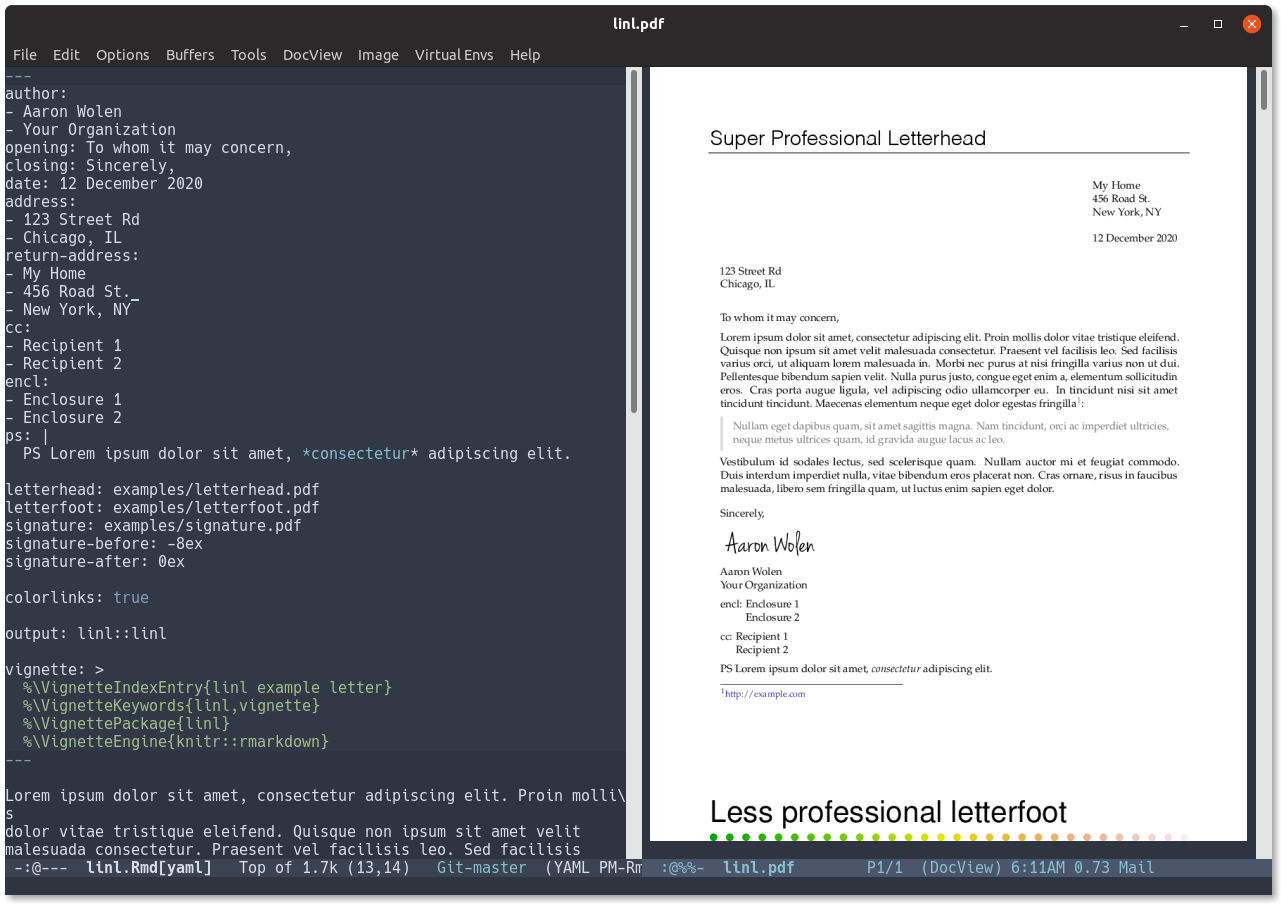
Aaron Wolen and I are pleased to announce the availability of the initial 0.0.1 release of our new linl package on the CRAN network. It provides a simple-yet-powerful Markdown---and RMarkdown---wrapper the venerable LaTeX letter class. Aaron had done the legwork in the underlying pandoc-letter repository upon which we build via proper rmarkdown integration. The package also includes a LaTeX trick or two: optional header and signature files, nicer font, better size, saner default geometry and more. See the following screenshot which shows the package vignette---itself a simple letter---along with (most of) its source:
The initial (short) NEWS entry follows:

Changes in tint version 0.0.1 (2017-10-17)
  • Initial CRAN release

The date is a little off; it took a little longer than usual for the good folks at CRAN to process the initial submission. We expect future releases to be more timely. For questions or comments use the issue tracker off the GitHub repo.

This post by Dirk Eddelbuettel originated on his Thinking inside the box blog. Please report excessive re-aggregation in third-party for-profit settings.

Steinar H. Gunderson: Introducing Narabu, part 3: Parallel structure

Narabu is a new intraframe video codec. You probably want to read part 1 and part 2 first. Now having a rough idea of how the GPU works, it's obvious that we need our codec to split the image into a lot of independent chunks to be parallel; we're aiming for about a thousand chunks. We'll also aim for a format that's as simple as possible; other people can try to push the frontiers on research, I just want something that's fast, reasonably good, and not too hard to implement. First of all, let's look at JPEG. It works by converting the image to Y'CbCr (usually with subsampled chroma), split each channel into 8x8 blocks, DCT them, quantize and then use Huffman coding to encode those coefficients. This is a very standard structure, and JPEG, despite being really old by now, is actually hard to beat, so let's use that as a template. But we probably can't use JPEG wholesale. Why? The answer is that the Huffman coding is just too serial. It's all just one stream, and without knowing where the previous symbol ends, we don't know where to start decoding the next. You can partially solve this by having frequent restart markers, but these reduce coding efficiency, and there's no index of them; you'd have to make a parallel scan for them, which is annoying. So we'll need to at least do something about the entropy coding. Do we need to change anything else to reach our ~1000 parallel target? 720p is the standard video target these days; the ~1M raw pixels would be great if we could do all of them independently, but we obviously can't, since DCT is not independent per pixel (that would sort of defeat the purpose). However, there are 14,400 DCT blocks (8x8), so we can certainly do all the DCTs in parallel. Quantization after that is trivially parallelizable, at least as long as we don't aim for trellis or the likes. So indeed, it's only entropy coding that we need to worry about. Since we're changing entropy coding anyway, I picked rANS, which is confusing but has a number of neat properties; it's roughly as expensive as Huffman coding, but has an efficiency closer to that of arithmetic encoding, and you can switch distributions for each symbol. It requires a bit more calculation, but GPUs have plenty of ALUs (a typical recommendation is 10:1 calculation to memory access), so that should be fine. I picked a pretty common variation with 32-bit state and 8-bit I/O, since 64-bit arithmetic is not universally available on GPUs (I checked a variation with 64-bit state and 32-bit I/O, but it didn't really matter much for speed). Fabian Giesen has described how you can actually do rANS encoding and decoding in parallel over a warp, but I've treated it as a purely serial operation. I don't do anything like adaptation, though; each coefficient is assigned to one out of four rANS static distributions that are signaled at the start of each stream. (Four is a nice tradeoff between coding efficiency, L1 cache use and the cost of transmitting the distributions themselves. I originally used eight, but a bit of clustering showed it was possible to get it down to four at basically no extra cost. JPEG does a similar thing, with separate Huffman codes for AC and DC coefficients. And I've got separate distributions for luma and chroma, which also makes a lot of sense.) The restart cost of rANS is basically writing the state to disk; some of that we would need to write even without a restart, and there are ways to combine many such end states for less waste (I'm not using them), but let's be conservative and assume we waste all of it for each restart. At 150 Mbit/second for 720p60, the luma plane of one frame is about 150 kB. 10% (15 kB) sounds reasonable to sacrifice to restarts, which means we can have about 3750 of them, or one for each 250th pixel or so. (3750 restarts also means 3750 independent entropy coding streams, so we're still well above our 1000 target.) So the structure is more or less clear; we'll DCT the blocks in parallel (since an 8x8 block can be expressed as 8 vertical DCTs and then 8 horizontal DCTs, we can even get 8-way parallelism there), and then encode at least 250 coefficients into an rANS stream. I've chosen to let a stream encompass a single coefficient from each of 320 DCT blocks instead of all coefficients from 5 DCT blocks; it's sort of arbitrary and might be a bit unintuitive, but it feels more natural, especially since you don't need to switch rANS distributions for each coefficient. So that's a lot of rambling for a sort-of abstract format. Next time we'll go into how decoding works. Or encoding. I haven't really made up my mind yet.

Hideki Yamane: openSUSE.Asia Summit 2017 in Tokyo

This weekend large typhoon is approaching to Japan, however, I went to UEC (The University of Electro-Communications, ) to give a talk in openSUSE.Asia Summit 2017 in Tokyo.

"... hey, wait. openSUSE? Are you using openSUSE?"

Honestly no, I'm not. My talk was "openSUSE tools on Debian" - the only one session about Debian in that conference :)

Photo by Youngbin Han (Ubuntu Korea Loco), thanks!


We Debian distribute some tools from openSUSE - OBS (Open Build Service), Snapper and I'm now working on openQA. So, it is a good chance to contact to upstream (=openSUSE) people, and I got some hints from them, thanks!


openSUSE tools on Debian from Hideki Yamane

21 October 2017

Michael Stapelberg: pk4: a new tool to avail the Debian source package producing the specified package

UNIX distributions used to come with the system source code in /usr/src. This is a concept which fascinates me: if you want to change something in any part of your system, just make your change in the corresponding directory, recomile, reinstall, and you can immediately see your changes in action. So, I decided I wanted to build a tool which can give you the impression of that, without the downsides of additional disk space usage and slower update times because of /usr/src maintenance. The result of this effort is a tool called pk4 (mnemonic: get me the package for ) which I just uploaded to Debian. What distinguishes this tool from an apt source call is the combination of a number of features: If you don t want to wait for the package to clear the NEW queue, you can get it from here in the meantime:
wget https://people.debian.org/~stapelberg/pk4/pk4_1_amd64.deb
sudo apt install ./pk4_1_amd64.deb
You can find the sources and issue tracker at https://github.com/Debian/pk4. Here is a terminal screencast of the tool in action, availing the sources of i3, applying a patch, rebuilding the package and replacing the installed binary packages:

Jaldhar Vyas: Sal Mubarak 2074

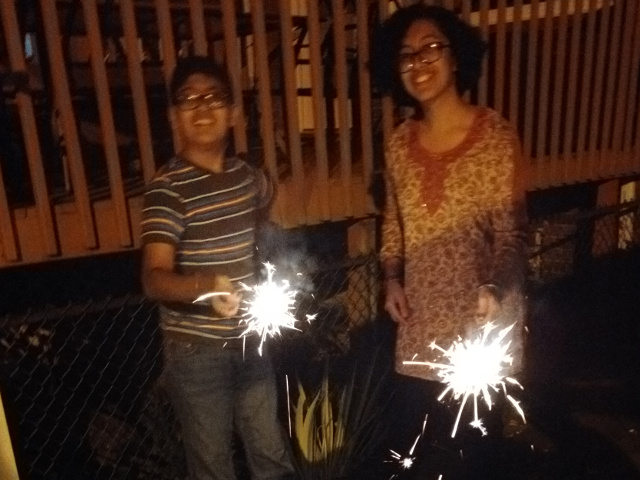
Wishing all Debian people a prosperous and auspicious Gujarati new year (V.S. 2074 called Saumya.) This year fireworks became legal for the first time in New Jersey. Not that it ever stopped us before but it is nice to see the government stop meddling for no reason. (Eff you, Indian Supreme Court.) Sparklers on Diwali. Although you can only see sparklers in the picture above, we got enough armament to make ISIS jealous. There were also lots of diabetes-inducing sweets and (inexpensive, practical) presents for young and old. That's what I call a proper Diwali and new year.

19 October 2017

Steinar H. Gunderson: Introducing Narabu, part 2: Meet the GPU

Narabu is a new intraframe video codec. You may or may not want to read part 1 first. The GPU, despite being extremely more flexible than it was fifteen years ago, is still a very different beast from your CPU, and not all problems map well to it performance-wise. Thus, before designing a codec, it's useful to know what our platform looks like. A GPU has lots of special functionality for graphics (well, duh), but we'll be concentrating on the compute shader subset in this context, ie., we won't be drawing any polygons. Roughly, a GPU (as I understand it!) is built up about as follows: A GPU contains 1 20 cores; NVIDIA calls them SMs (shader multiprocessors), Intel calls them subslices. (Trivia: A typical mid-range Intel GPU contains two cores, and thus is designated GT2.) One such core usually runs the same program, although on different data; there are exceptions, but typically, if your program can't fill an entire core with parallelism, you're wasting energy. Each core, in addition to tons (thousands!) of registers, also has some shared memory (also called local memory sometimes, although that term is overloaded), typically 32 64 kB, which you can think of in two ways: Either as a sort-of explicit L1 cache, or as a way to communicate internally on a core. Shared memory is a limited, precious resource in many algorithms. Each core/SM/subslice contains about 8 execution units (Intel calls them EUs, NVIDIA/AMD calls them something else) and some memory access logic. These multiplex a bunch of threads (say, 32) and run in a round-robin-ish fashion. This means that a GPU can handle memory stalls much better than a typical CPU, since it has so many streams to pick from; even though each thread runs in-order, it can just kick off an operation and then go to the next thread while the previous one is working. Each execution unit has a bunch of ALUs (typically 16) and executes code in a SIMD fashion. NVIDIA calls these ALUs CUDA cores , AMD calls them stream processors . Unlike on CPU, this SIMD has full scatter/gather support (although sequential access, especially in certain patterns, is much more efficient than random access), lane enable/disable so it can work with conditional code, etc.. The typically fastest operation is a 32-bit float muladd; usually that's single-cycle. GPUs love 32-bit FP code. (In fact, in some GPU languages, you won't even have 8-, 16-bit or 64-bit types. This is annoying, but not the end of the world.) The vectorization is not exposed to the user in typical code (GLSL has some vector types, but they're usually just broken up into scalars, so that's a red herring), although in some programming languages you can get to swizzle the SIMD stuff internally to gain advantage of that (there's also schemes for broadcasting bits by voting etc.). However, it is crucially important to performance; if you have divergence within a warp, this means the GPU needs to execute both sides of the if. So less divergent code is good. Such a SIMD group is called a warp by NVIDIA (I don't know if the others have names for it). NVIDIA has SIMD/warp width always 32; AMD used to be 64 but is now 16. Intel supports 4 32 (the compiler will autoselect based on a bunch of factors), although 16 is the most common. The upshot of all of this is that you need massive amounts of parallelism to be able to get useful performance out of a CPU. A rule of thumb is that if you could have launched about a thousand threads for your problem on CPU, it's a good fit for a GPU, although this is of course just a guideline. There's a ton of APIs available to write compute shaders. There's CUDA (NVIDIA-only, but the dominant player), D3D compute (Windows-only, but multi-vendor), OpenCL (multi-vendor, but highly variable implementation quality), OpenGL compute shaders (all platforms except macOS, which has too old drivers), Metal (Apple-only) and probably some that I forgot. I've chosen to go for OpenGL compute shaders since I already use OpenGL shaders a lot, and this saves on interop issues. CUDA probably is more mature, but my laptop is Intel. :-) No matter which one you choose, the programming model looks very roughly like this pseudocode:
for (size_t workgroup_idx = 0; workgroup_idx < NUM_WORKGROUPS; ++workgroup_idx)     // in parallel over cores
        char shared_mem[REQUESTED_SHARED_MEM];  // private for each workgroup
        for (size_t local_idx = 0; local_idx < WORKGROUP_SIZE; ++local_idx)    // in parallel on each core
                main(workgroup_idx, local_idx, shared_mem);
         
 
except in reality, the indices will be split in x/y/z for your convenience (you control all six dimensions, of course), and if you haven't asked for too much shared memory, the driver can silently make larger workgroups if it helps increase parallelity (this is totally transparent to you). main() doesn't return anything, but you can do reads and writes as you wish; GPUs have large amounts of memory these days, and staggering amounts of memory bandwidth. Now for the bad part: Generally, you will have no debuggers, no way of logging and no real profilers (if you're lucky, you can get to know how long each compute shader invocation takes, but not what takes time within the shader itself). Especially the latter is maddening; the only real recourse you have is some timers, and then placing timer probes or trying to comment out sections of your code to see if something goes faster. If you don't get the answers you're looking for, forget printf you need to set up a separate buffer, write some numbers into it and pull that buffer down to the GPU. Profilers are an essential part of optimization, and I had really hoped the world would be more mature here by now. Even CUDA doesn't give you all that much insight sometimes I wonder if all of this is because GPU drivers and architectures are meant to be shrouded in mystery for competitiveness reasons, but I'm honestly not sure. So that's it for a crash course in GPU architecture. Next time, we'll start looking at the Narabu codec itself.

Norbert Preining: Analysing Debian packages with Neo4j

I just finished the presentation at the Neo4j Online Meetup on getting the Debian UDD into a Neo4j graph database. Besides the usual technical quibbles it did work out quite well. The code for pulling the data from the UDD, as well as converting and importing it into Neo4j is available on Github Debian-Graph. The slides are also available on Github: preining-debian-packages-neo4j.pdf. There are still some things I want to implement, time permitting, because it would be a great tool for better integration for Debian. In any case, graph databases are lots of fun to play around.

Daniel Pocock: FOSDEM 2018 Real-Time Communications Call for Participation

FOSDEM is one of the world's premier meetings of free software developers, with over five thousand people attending each year. FOSDEM 2018 takes place 3-4 February 2018 in Brussels, Belgium. This email contains information about:
  • Real-Time communications dev-room and lounge,
  • speaking opportunities,
  • volunteering in the dev-room and lounge,
  • related events around FOSDEM, including the XMPP summit,
  • social events (the legendary FOSDEM Beer Night and Saturday night dinners provide endless networking opportunities),
  • the Planet aggregation sites for RTC blogs
Call for participation - Real Time Communications (RTC) The Real-Time dev-room and Real-Time lounge is about all things involving real-time communication, including: XMPP, SIP, WebRTC, telephony, mobile VoIP, codecs, peer-to-peer, privacy and encryption. The dev-room is a successor to the previous XMPP and telephony dev-rooms. We are looking for speakers for the dev-room and volunteers and participants for the tables in the Real-Time lounge. The dev-room is only on Sunday, 4 February 2018. The lounge will be present for both days. To discuss the dev-room and lounge, please join the FSFE-sponsored Free RTC mailing list. To be kept aware of major developments in Free RTC, without being on the discussion list, please join the Free-RTC Announce list. Speaking opportunities Note: if you used FOSDEM Pentabarf before, please use the same account/username Real-Time Communications dev-room: deadline 23:59 UTC on 30 November. Please use the Pentabarf system to submit a talk proposal for the dev-room. On the "General" tab, please look for the "Track" option and choose "Real Time Communications devroom". Link to talk submission. Other dev-rooms and lightning talks: some speakers may find their topic is in the scope of more than one dev-room. It is encouraged to apply to more than one dev-room and also consider proposing a lightning talk, but please be kind enough to tell us if you do this by filling out the notes in the form. You can find the full list of dev-rooms on this page and apply for a lightning talk at https://fosdem.org/submit Main track: the deadline for main track presentations is 23:59 UTC 3 November. Leading developers in the Real-Time Communications field are encouraged to consider submitting a presentation to the main track. First-time speaking? FOSDEM dev-rooms are a welcoming environment for people who have never given a talk before. Please feel free to contact the dev-room administrators personally if you would like to ask any questions about it. Submission guidelines The Pentabarf system will ask for many of the essential details. Please remember to re-use your account from previous years if you have one. In the "Submission notes", please tell us about:
  • the purpose of your talk
  • any other talk applications (dev-rooms, lightning talks, main track)
  • availability constraints and special needs
You can use HTML and links in your bio, abstract and description. If you maintain a blog, please consider providing us with the URL of a feed with posts tagged for your RTC-related work. We will be looking for relevance to the conference and dev-room themes, presentations aimed at developers of free and open source software about RTC-related topics. Please feel free to suggest a duration between 20 minutes and 55 minutes but note that the final decision on talk durations will be made by the dev-room administrators based on the received proposals. As the two previous dev-rooms have been combined into one, we may decide to give shorter slots than in previous years so that more speakers can participate. Please note FOSDEM aims to record and live-stream all talks. The CC-BY license is used. Volunteers needed To make the dev-room and lounge run successfully, we are looking for volunteers:
  • FOSDEM provides video recording equipment and live streaming, volunteers are needed to assist in this
  • organizing one or more restaurant bookings (dependending upon number of participants) for the evening of Saturday, 4 February
  • participation in the Real-Time lounge
  • helping attract sponsorship funds for the dev-room to pay for the Saturday night dinner and any other expenses
  • circulating this Call for Participation (text version) to other mailing lists
Related events - XMPP and RTC summits The XMPP Standards Foundation (XSF) has traditionally held a summit in the days before FOSDEM. There is discussion about a similar summit taking place on 2 February 2018. XMPP Summit web site - please join the mailing list for details. Social events and dinners The traditional FOSDEM beer night occurs on Friday, 2 February. On Saturday night, there are usually dinners associated with each of the dev-rooms. Most restaurants in Brussels are not so large so these dinners have space constraints and reservations are essential. Please subscribe to the Free-RTC mailing list for further details about the Saturday night dinner options and how you can register for a seat. Spread the word and discuss If you know of any mailing lists where this CfP would be relevant, please forward this email (text version). If this dev-room excites you, please blog or microblog about it, especially if you are submitting a talk. If you regularly blog about RTC topics, please send details about your blog to the planet site administrators:
Planet site Admin contact
All projects Free-RTC Planet (http://planet.freertc.org) contact planet@freertc.org
XMPP Planet Jabber (http://planet.jabber.org) contact ralphm@ik.nu
SIP Planet SIP (http://planet.sip5060.net) contact planet@sip5060.net
SIP (Espa ol) Planet SIP-es (http://planet.sip5060.net/es/) contact planet@sip5060.net
Please also link to the Planet sites from your own blog or web site as this helps everybody in the free real-time communications community. Contact For any private queries, contact us directly using the address fosdem-rtc-admin@freertc.org and for any other queries please ask on the Free-RTC mailing list. The dev-room administration team:

18 October 2017

Joey Hess: extending Scuttlebutt with Annah

This post has it all. Flotillas of sailboats, peer-to-peer wikis, games, and de-frogging. But, I need to start by talking about some tech you may not have heard of yet... So, how could these be combined together, and what might the result look like? Well, I could start by posting a Scuttlebutt message that defines what True is. And another Scuttlebutt message defining False. And then, another Scuttlebutt message to define the AND function, which would link to my messages for True and False. Continue this until I've built up enough Annah code to write some almost useful programs. Annah can't do any IO on its own (though it can model IO similarly to how Haskell does), so for programs to be actually useful, there needs to be Scuttlebutt client support. The way typing works in Annah, a program's type can be expressed as a Scuttlebutt link. So a Scuttlebutt client that wants to run Annah programs of a particular type can pick out programs that link to that type, and will know what type of data the program consumes and produces. Here are a few ideas of what could be built, with fairly simple client-side support for different types of Annah programs... This kind of extensibility in a peer-to-peer system is exciting! With these new systems, we can consider lessons from the world wide web and replicate some of the good parts, while avoiding the bad. Javascript has been both good and bad for the web. The extensibility is great, and yet it's a neverending security and privacy nightmare, and it ties web pages ever more tightly to programs hidden away on servers. I believe that Annah combined with Scuttlebutt will comprehensively avoid those problems. Shall we build it?

This exploration was sponsored by Jake Vosloo on Patreon.

Norbert Preining: Kobo firmware 4.6.9995 mega update (KSM, nickel patch, ssh, fonts)

It has been ages that I haven t updated the MegaUpdate package for Kobo. Now that a new and seemingly rather bug-free and quick firmware release (4.6.9995) has been released, I finally took the time to update the whole package to the latest releases of all the included items. The update includes all my favorite patches and features: Kobo Start Menu, koreader, coolreader, pbchess, ssh access, custom dictionaries, and some side-loaded fonts. Kobo Logo So what are all these items: Install procedure Download Mark6 Kobo GloHD firmware: Kobo 4.6.9995 for GloHD Mega update: Kobo-4.6.9995-combined/Mark6/KoboRoot.tgz Mark5 Aura firmware: Kobo 4.6.9995 for Aura Mega update: Kobo-4.6.9995-combined/Mark5/KoboRoot.tgz Mark4 Kobo Glo, Aura HD firmware: Kobo 4.6.9995 for Glo and AuraHD Mega update: Kobo-4.6.9995-combined/Mark4/KoboRoot.tgz Latest firmware Warning: Sideloading or crossloading the incorrect firmware can break/brick your device. The link below is for Kobo GloHD ONLY. The first step is to update the Kobo to the latest firmware. This can easily be done by just getting the latest firmware from the links above and unpacking the zip file into the .kobo directory on your device. Eject and enjoy the updating procedure. Mega update Get the combined KoboRoot.tgz for your device from the links above and put it into the .kobo directory, then eject and enjoy the updating procedure again. After this the device should reboot and you will be kicked into KSM, from where after some time of waiting Nickel will be started. If you consider the fonts too small, select Configure, then the General, and add item, then select kobomenuFontsize=55 and save. Remarks to some of the items included The full list of included things is above, here are only some notes about what specific I have done. WARNINGS If this is the first time you install this patch, you to fix the password for root and disable telnet. This is an important step, here are the steps you have to take (taken from this old post):
  1. Turn on Wifi on the Kobo and find IP address
    Go to Settings Connect and after this is done, go to Settings Device Information where you will see something like
    IP Address: 192.168.1.NN

    (numbers change!)
  2. telnet into your device
    telnet 192.168.1.NN
    it will ask you the user name, enter root (without the quotes) and no password
  3. (ON THE GLO) change home directory of root
    edit /etc/passwd with vi and change the entry for root by changing the 6th field from: / to /root (without the quotes). After this procedure the line should look like
    root::0:0:root:/root:/bin/sh
    don t forget to save the file
  4. (ON THE GLO) create ssh keys for dropbear
    [root@(none) ~]# mkdir /etc/dropbear
    [root@(none) ~]# cd /etc/dropbear
    [root@(none) ~]# dropbearkey -t dss -f dropbear_dss_host_key
    [root@(none) ~]# dropbearkey -t rsa -f dropbear_rsa_host_key
  5. (ON YOUR PERSONAL COMPUTER) check that you can log in with ssh
    ssh root@192.168.1.NN
    You should get dropped into your device again
  6. (ON THE GLO) log out of the telnet session (the first one you did)
    [root@(none) ~]# exit
  7. (ON THE GLO) in your ssh session, change the password of root
    [root@(none) ~]# passwd
    you will have to enter the new password two times. Remember it well, you will not be easily able to recover it without opening your device.
  8. (ON THE GLO) disable telnet login
    edit the file /etc/inetd.conf.local on the GLO (using vi) and remove the telnet line (the line starting with 23).
  9. restart your device
The combined KoboRoot.tgz is provided without warranty. If you need to reset your device, don t blame me!

17 October 2017

Reproducible builds folks: Reproducible Builds: Weekly report #129

Here's what happened in the Reproducible Builds effort between Sunday October 8 and Saturday October 14 2017: Upcoming events Reproducible work in other projects Pierre Pronchery reported that that he has built the foundations for doing more reproducibility work in NetBSD. Packages fixed Upstream bugs and patches: Reproducibility non-maintainer uploads in Debian: QA fixes in Debian: Reviews of unreproducible packages 6 package reviews have been added, 30 have been updated and 37 have been removed in this week, adding to our knowledge about identified issues. Weekly QA work During our reproducibility testing, FTBFS bugs have been detected and reported by: diffoscope development reprotest development Version 0.7.3 was uploaded to unstable by Ximin Luo. It included contributions already covered by posts of the previous weeks, as well as new ones: Misc. This week's edition was written by Ximin Luo, Chris Lamb and Holger Levsen & reviewed by a bunch of Reproducible Builds folks on IRC & the mailing lists.

Russ Allbery: Bundle haul

Confession time: I started making these posts (eons ago) because a close friend did as well, and I enjoyed reading them. But the main reason why I continue is because the primary way I have to keep track of the books I've bought and avoid duplicates is, well, grep on these posts. I should come up with a non-bullshit way of doing this, but time to do more elegant things is in short supply, and, well, it's my blog. So I'm boring all of you who read this in various places with my internal bookkeeping. I do try to at least add a bit of commentary. This one will be more tedious than most since it includes five separate Humble Bundles, which increases the volume a lot. (I just realized I'd forgotten to record those purchases from the past several months.) First, the individual books I bought directly: Ilona Andrews Sweep in Peace (sff)
Ilona Andrews One Fell Sweep (sff)
Steven Brust Vallista (sff)
Nicky Drayden The Prey of Gods (sff)
Meg Elison The Book of the Unnamed Midwife (sff)
Pat Green Night Moves (nonfiction)
Ann Leckie Provenance (sff)
Seanan McGuire Once Broken Faith (sff)
Seanan McGuire The Brightest Fell (sff)
K. Arsenault Rivera The Tiger's Daughter (sff)
Matthew Walker Why We Sleep (nonfiction)
Some new books by favorite authors, a few new releases I heard good things about, and two (Night Moves and Why We Sleep) from references in on-line articles that impressed me. The books from security bundles (this is mostly work reading, assuming I'll get to any of it), including a blockchain bundle: Wil Allsop Unauthorised Access (nonfiction)
Ross Anderson Security Engineering (nonfiction)
Chris Anley, et al. The Shellcoder's Handbook (nonfiction)
Conrad Barsky & Chris Wilmer Bitcoin for the Befuddled (nonfiction)
Imran Bashir Mastering Blockchain (nonfiction)
Richard Bejtlich The Practice of Network Security (nonfiction)
Kariappa Bheemaiah The Blockchain Alternative (nonfiction)
Violet Blue Smart Girl's Guide to Privacy (nonfiction)
Richard Caetano Learning Bitcoin (nonfiction)
Nick Cano Game Hacking (nonfiction)
Bruce Dang, et al. Practical Reverse Engineering (nonfiction)
Chris Dannen Introducing Ethereum and Solidity (nonfiction)
Daniel Drescher Blockchain Basics (nonfiction)
Chris Eagle The IDA Pro Book, 2nd Edition (nonfiction)
Nikolay Elenkov Android Security Internals (nonfiction)
Jon Erickson Hacking, 2nd Edition (nonfiction)
Pedro Franco Understanding Bitcoin (nonfiction)
Christopher Hadnagy Social Engineering (nonfiction)
Peter N.M. Hansteen The Book of PF (nonfiction)
Brian Kelly The Bitcoin Big Bang (nonfiction)
David Kennedy, et al. Metasploit (nonfiction)
Manul Laphroaig (ed.) PoC GTFO (nonfiction)
Michael Hale Ligh, et al. The Art of Memory Forensics (nonfiction)
Michael Hale Ligh, et al. Malware Analyst's Cookbook (nonfiction)
Michael W. Lucas Absolute OpenBSD, 2nd Edition (nonfiction)
Bruce Nikkel Practical Forensic Imaging (nonfiction)
Sean-Philip Oriyano CEHv9 (nonfiction)
Kevin D. Mitnick The Art of Deception (nonfiction)
Narayan Prusty Building Blockchain Projects (nonfiction)
Prypto Bitcoin for Dummies (nonfiction)
Chris Sanders Practical Packet Analysis, 3rd Edition (nonfiction)
Bruce Schneier Applied Cryptography (nonfiction)
Adam Shostack Threat Modeling (nonfiction)
Craig Smith The Car Hacker's Handbook (nonfiction)
Dafydd Stuttard & Marcus Pinto The Web Application Hacker's Handbook (nonfiction)
Albert Szmigielski Bitcoin Essentials (nonfiction)
David Thiel iOS Application Security (nonfiction)
Georgia Weidman Penetration Testing (nonfiction)
Finally, the two SF bundles: Buzz Aldrin & John Barnes Encounter with Tiber (sff)
Poul Anderson Orion Shall Rise (sff)
Greg Bear The Forge of God (sff)
Octavia E. Butler Dawn (sff)
William C. Dietz Steelheart (sff)
J.L. Doty A Choice of Treasons (sff)
Harlan Ellison The City on the Edge of Forever (sff)
Toh Enjoe Self-Reference ENGINE (sff)
David Feintuch Midshipman's Hope (sff)
Alan Dean Foster Icerigger (sff)
Alan Dean Foster Mission to Moulokin (sff)
Alan Dean Foster The Deluge Drivers (sff)
Taiyo Fujii Orbital Cloud (sff)
Hideo Furukawa Belka, Why Don't You Bark? (sff)
Haikasoru (ed.) Saiensu Fikushon 2016 (sff anthology)
Joe Haldeman All My Sins Remembered (sff)
Jyouji Hayashi The Ouroboros Wave (sff)
Sergei Lukyanenko The Genome (sff)
Chohei Kambayashi Good Luck, Yukikaze (sff)
Chohei Kambayashi Yukikaze (sff)
Sakyo Komatsu Virus (sff)
Miyuki Miyabe The Book of Heroes (sff)
Kazuki Sakuraba Red Girls (sff)
Robert Silverberg Across a Billion Years (sff)
Allen Steele Orbital Decay (sff)
Bruce Sterling Schismatrix Plus (sff)
Michael Swanwick Vacuum Flowers (sff)
Yoshiki Tanaka Legend of the Galactic Heroes, Volume 1: Dawn (sff)
Yoshiki Tanaka Legend of the Galactic Heroes, Volume 2: Ambition (sff)
Yoshiki Tanaka Legend of the Galactic Heroes, Volume 3: Endurance (sff)
Tow Ubukata Mardock Scramble (sff)
Sayuri Ueda The Cage of Zeus (sff)
Sean Williams & Shane Dix Echoes of Earth (sff)
Hiroshi Yamamoto MM9 (sff)
Timothy Zahn Blackcollar (sff)
Phew. Okay, all caught up, and hopefully won't have to dump something like this again in the near future. Also, more books than I have any actual time to read, but what else is new.

Norbert Preining: Japanese TeX User Meeting 2017

Last saturday the Japanese TeX User Meeting took place in Fujisawa, Kanagawa. For those who have been at the TUG 2013 in Tokyo you will remember that the Japanese TeX community is quite big and vibrant. On Saturday about 50 users and developers gathered for a set of talks on a variety of topics. The first talk was by Keiichiro Shikano ( ) on using Markup text to generate (La)TeX and HTML. He presented a variety of markup formats, including his own tool xml2tex. The second talk was my Masamichi Hosoda ( ) on reducing the size of PDF files using PDFmark extraction. As a contributor to many projects including Texinfo and LilyPond, Masamichi Hosoda tells us horror stories about multiple font embedding in the manual of LilyPond, the permanent need for adaption to newer Ghostscript versions, and the very recent development in Ghostscript prohibiting the merge of font definitions in PDF files. Next up was Yusuke Terada ( ) on grading exams using TeX. Working through hundreds and hundreds of exams and do the grading is something many of us are used to and I think nobody really enjoys it. Yusuke Terada has combined various tools, including scans, pdf merging using pdfpages, to generate gradable PDF which were then checked on an iPad. On the way he did hit some limits in dvipdfmx on the number of images, but this was obviously only a small bump on the road. Now if that could be automatized as a nice application, it would be a big hit I guess! The forth talk was by Satoshi Yamashita ( ) on the preparation of slides using KETpic. KETpic is a long running project by Setsuo Takato ( ) for the generation of graphics, in particular using Cinderella. KETpic and KETcindy integrates with lots of algebraic and statistical programs (R, Maxima, SciLab, ) and has a long history of development. Currently there are activities to incorporate it into TeX Live. The fifth talk was by Takuto Asakura ( ) on programming TeX using expl3, the main building block of the LaTeX3 project and already adopted by many TeX developers. Takuto Asakura came to fame on this years TUG/BachoTeX 2017 when he won the W. J. Martin Prize for his presentation Implementing bioinformatics algorithms in TeX. I think we can expect great new developments from Takuto! The last talk was by myself on fmtutil and updmap, two of the main management programs in any TeX installation, presenting the changes introduced over the last year, including the most recent release of TeX Live. Details have been posted on my blog, and a lengthy article in TUGboat 38:2, 2017 is available on this topic, too. After the conference about half of the participants joined a social dinner in a nearby Izakaya, followed by a after-dinner beer tasting at a local craft beer place. Thanks to Tatsuyoshi Hamada for the organization. As usual, the Japanese TeX User Meetings are a great opportunity to discuss new features and make new friends. I am always grateful to be part of this very nice community! I am looking forward to the next year s meeting.

Antoine Beaupr : A comparison of cryptographic keycards

An earlier article showed that private key storage is an important problem to solve in any cryptographic system and established keycards as a good way to store private key material offline. But which keycard should we use? This article examines the form factor, openness, and performance of four keycards to try to help readers choose the one that will fit their needs. I have personally been using a YubiKey NEO, since a 2015 announcement on GitHub promoting two-factor authentication. I was also able to hook up my SSH authentication key into the YubiKey's 2048 bit RSA slot. It seemed natural to move the other subkeys onto the keycard, provided that performance was sufficient. The mail client that I use, (Notmuch), blocks when decrypting messages, which could be a serious problems on large email threads from encrypted mailing lists. So I built a test harness and got access to some more keycards: I bought a FST-01 from its creator, Yutaka Niibe, at the last DebConf and Nitrokey donated a Nitrokey Pro. I also bought a YubiKey 4 when I got the NEO. There are of course other keycards out there, but those are the ones I could get my hands on. You'll notice none of those keycards have a physical keypad to enter passwords, so they are all vulnerable to keyloggers that could extract the key's PIN. Keep in mind, however, that even with the PIN, an attacker could only ask the keycard to decrypt or sign material but not extract the key that is protected by the card's firmware.

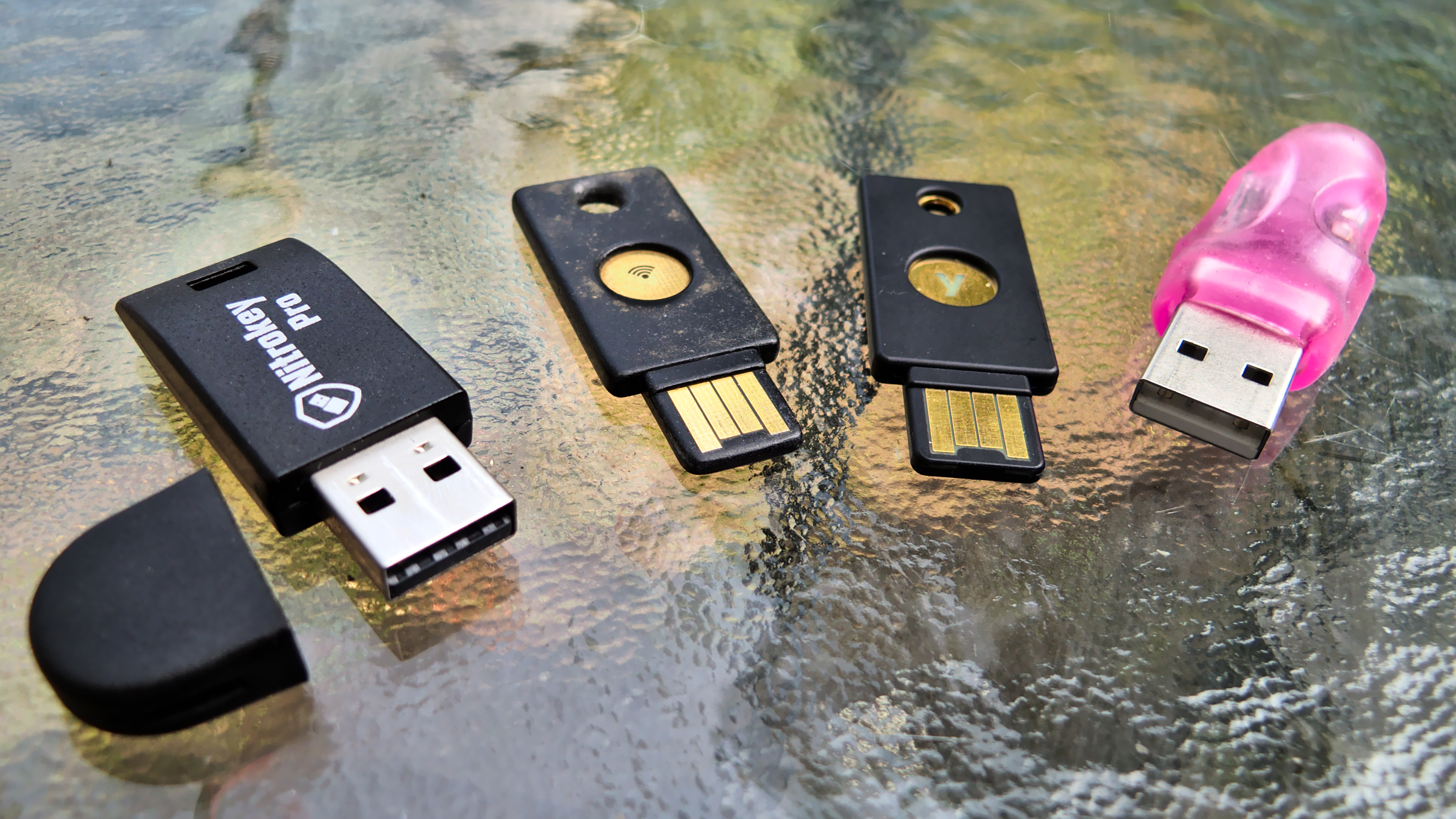
Form factor The Nitrokey Pro, YubiKey NEO (worn out), YubiKey 4, and FST-01 The four keycards have similar form factors: they all connect to a standard USB port, although both YubiKey keycards have a capacitive button by which the user triggers two-factor authentication and the YubiKey 4 can also require a button press to confirm private key use. The YubiKeys feel sturdier than the other two. The NEO has withstood two years of punishment in my pockets along with the rest of my "real" keyring and there is only minimal wear on the keycard in the picture. It's also thinner so it fits well on the keyring. The FST-01 stands out from the other two with its minimal design. Out of the box, the FST-01 comes without a case, so the circuitry is exposed. This is deliberate: one of its goals is to be as transparent as possible, both in terms of software and hardware design and you definitely get that feeling at the physical level. Unfortunately, that does mean it feels more brittle than other models: I wouldn't carry it in my pocket all the time, although there is a case that may protect the key a little better, but it does not provide an easy way to hook it into a keyring. In the group picture above, the FST-01 is the pink plastic thing, which is a rubbery casing I received along with the device when I got it. Notice how the USB connectors of the YubiKeys differ from the other two: while the FST-01 and the Nitrokey have standard USB connectors, the YubiKey has only a "half-connector", which is what makes it thinner than the other two. The "Nano" form factor takes this even further and almost disappears in the USB port. Unfortunately, this arrangement means the YubiKey NEO often comes loose and falls out of the USB port, especially when connected to a laptop. On my workstation, however, it usually stays put even with my whole keyring hanging off of it. I suspect this adds more strain to the host's USB port but that's a tradeoff I've lived with without any noticeable wear so far. Finally, the NEO has this peculiar feature of supporting NFC for certain operations, as LWN previously covered, but I haven't used that feature yet. The Nitrokey Pro looks like a normal USB key, in contrast with the other two devices. It does feel a little brittle when compared with the YubiKey, although only time will tell how much of a beating it can take. It has a small ring in the case so it is possible to carry it directly on your keyring, but I would be worried the cap would come off eventually. Nitrokey devices are also two times thicker than the Yubico models which makes them less convenient to carry around on keyrings.

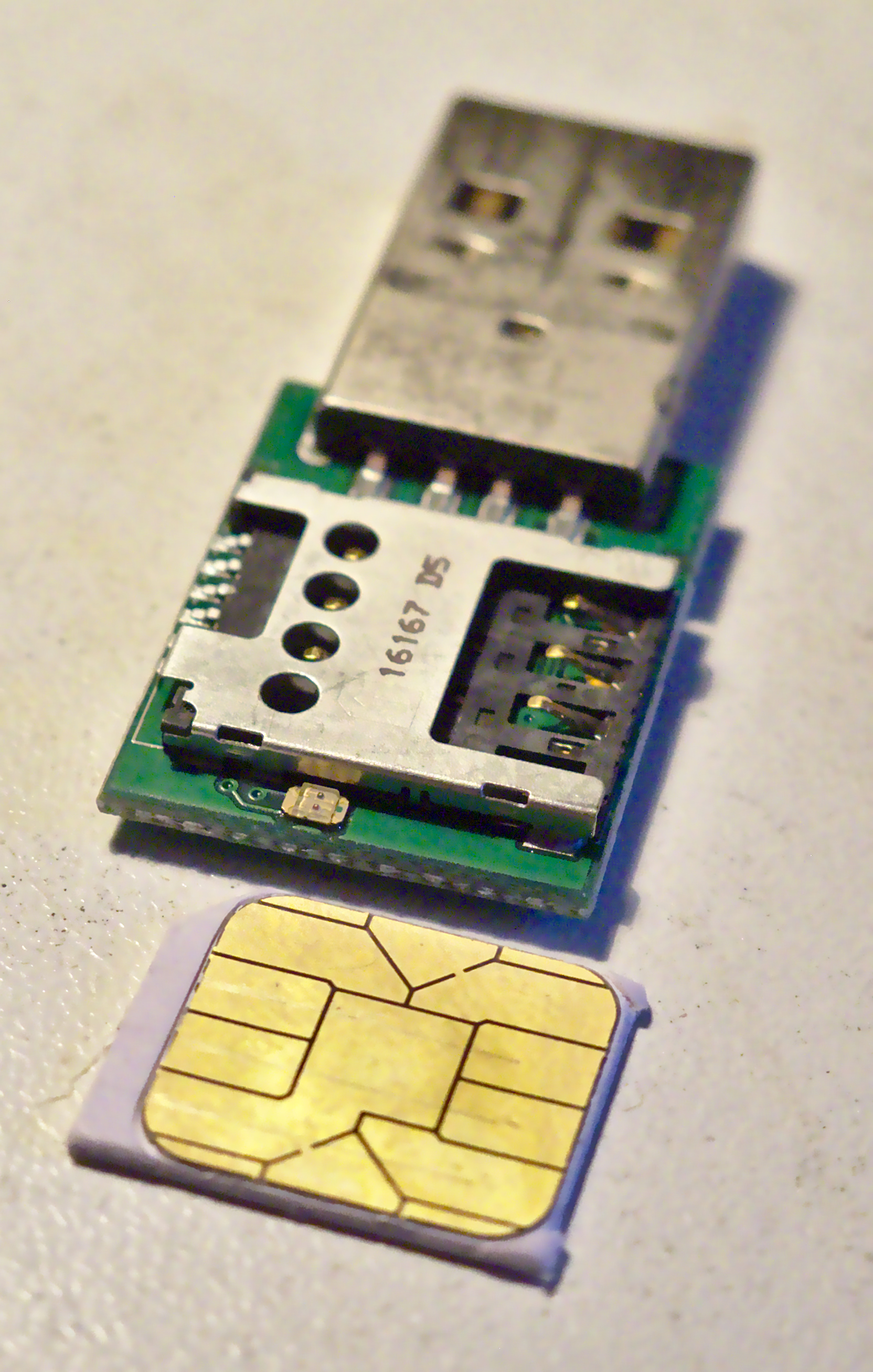
Open and closed designs The FST-01 is as open as hardware comes, down to the PCB design available as KiCad files in this Git repository. The software running on the card is the Gnuk firmware that implements the OpenPGP card protocol, but you can also get it with firmware implementing a true random number generator (TRNG) called NeuG (pronounced "noisy"); the device is programmable through a standard Serial Wire Debug (SWD) port. The Nitrokey Start model also runs the Gnuk firmware. However, the Nitrokey website announces only ECC and RSA 2048-bit support for the Start, while the FST-01 also supports RSA-4096. Nitrokey's founder Jan Suhr, in a private email, explained that this is because "Gnuk doesn't support RSA-3072 or larger at a reasonable speed". Its devices (the Pro, Start, and HSM models) use a similar chip to the FST-01: the STM32F103 microcontroller. Nitrokey Pro with STM32F103TBU6 MCU Nitrokey also publishes its hardware designs, on GitHub, which shows the Pro is basically a fork of the FST-01, according to the ChangeLog. I opened the case to confirm it was using the STM MCU, something I should warn you against; I broke one of the pins holding it together when opening it so now it's even more fragile. But at least, I was able to confirm it was built using the STM32F103TBU6 MCU, like the FST-01. Nitrokey back side But this is where the comparison ends: on the back side, we find a SIM card reader that holds the OpenPGP card that, in turn, holds the private key material and does the cryptographic operations. So, in effect, the Nitrokey Pro is really a evolution of the original OpenPGP card readers. Nitrokey confirmed the OpenPGP card featured in the Pro is the same as the one shipped by the Free Software Foundation Europe (FSFE): the BasicCard built by ZeitControl. Those cards, however, are covered by NDAs and the firmware is only partially open source. This makes the Nitrokey Pro less open than the FST-01, but that's an inevitable tradeoff when choosing a design based on the OpenPGP cards, which Suhr described to me as "pretty proprietary". There are other keycards out there, however, for example the SLJ52GDL150-150k smartcard suggested by Debian developer Yves-Alexis Perez, which he prefers as it is certified by French and German authorities. In that blog post, he also said he was experimenting with the GPL-licensed OpenPGP applet implemented by the French ANSSI. But the YubiKey devices are even further away in the closed-design direction. Both the hardware designs and firmware are proprietary. The YubiKey NEO, for example, cannot be upgraded at all, even though it is based on an open firmware. According to Yubico's FAQ, this is due to "best security practices": "There is a 'no upgrade' policy for our devices since nothing, including malware, can write to the firmware." I find this decision questionable in a context where security updates are often more important than trying to design a bulletproof design, which may simply be impossible. And the YubiKey NEO did suffer from critical security issue that allowed attackers to bypass the PIN protection on the card, which raises the question of the actual protection of the private key material on those cards. According to Niibe, "some OpenPGP cards store the private key unencrypted. It is a common attitude for many smartcard implementations", which was confirmed by Suhr: "the private key is protected by hardware mechanisms which prevent its extraction and misuse". He is referring to the use of tamper resistance. After that security issue, there was no other option for YubiKey NEO users than to get a new keycard (for free, thankfully) from Yubico, which also meant discarding the private key material on the key. For OpenPGP keys, this may mean having to bootstrap the web of trust from scratch if the keycard was responsible for the main certification key. But at least the NEO is running free software based on the OpenPGP card applet and the source is still available on GitHub. The YubiKey 4, on the other hand, is now closed source, which was controversial when the new model was announced last year. It led the main Linux Foundation system administrator, Konstantin Ryabitsev, to withdraw his endorsement of Yubico products. In response, Yubico argued that this approach was essential to the security of its devices, which are now based on "a secure chip, which has built-in countermeasures to mitigate a long list of attacks". In particular, it claims that:
A commercial-grade AVR or ARM controller is unfit to be used in a security product. In most cases, these controllers are easy to attack, from breaking in via a debug/JTAG/TAP port to probing memory contents. Various forms of fault injection and side-channel analysis are possible, sometimes allowing for a complete key recovery in a shockingly short period of time.
While I understand those concerns, they eventually come down to the trust you have in an organization. Not only do we have to trust Yubico, but also hardware manufacturers and designs they have chosen. Every step in the hidden supply chain is then trusted to make correct technical decisions and not introduce any backdoors. History, unfortunately, is not on Yubico's side: Snowden revealed the example of RSA security accepting what renowned cryptographer Bruce Schneier described as a "bribe" from the NSA to weaken its ECC implementation, by using the presumably backdoored Dual_EC_DRBG algorithm. What makes Yubico or its suppliers so different from RSA Security? Remember that RSA Security used to be an adamant opponent to the degradation of encryption standards, campaigning against the Clipper chip in the first crypto wars. Even if we trust the Yubico supply chain, how can we trust a closed design using what basically amounts to security through obscurity? Publicly auditable designs are an important tradition in cryptography, and that principle shouldn't stop when software is frozen into silicon. In fact, a critical vulnerability called ROCA disclosed recently affects closed "smartcards" like the YubiKey 4 and allows full private key recovery from the public key if the key was generated on a vulnerable keycard. When speaking with Ars Technica, the researchers outlined the importance of open designs and questioned the reliability of certification:
Our work highlights the dangers of keeping the design secret and the implementation closed-source, even if both are thoroughly analyzed and certified by experts. The lack of public information causes a delay in the discovery of flaws (and hinders the process of checking for them), thereby increasing the number of already deployed and affected devices at the time of detection.
This issue with open hardware designs seems to be recurring topic of conversation on the Gnuk mailing list. For example, there was a discussion in September 2017 regarding possible hardware vulnerabilities in the STM MCU that would allow extraction of encrypted key material from the key. Niibe referred to a talk presented at the WOOT 17 workshop, where Johannes Obermaier and Stefan Tatschner, from the Fraunhofer Institute, demonstrated attacks against the STMF0 family MCUs. It is still unclear if those attacks also apply to the older STMF1 design used in the FST-01, however. Furthermore, extracted private key material is still protected by user passphrase, but the Gnuk uses a weak key derivation function, so brute-forcing attacks may be possible. Fortunately, there is work in progress to make GnuPG hash the passphrase before sending it to the keycard, which should make such attacks harder if not completely pointless. When asked about the Yubico claims in a private email, Niibe did recognize that "it is true that there are more weak points in general purpose implementations than special implementations". During the last DebConf in Montreal, Niibe explained:
If you don't trust me, you should not buy from me. Source code availability is only a single factor: someone can maliciously replace the firmware to enable advanced attacks.
Niibe recommends to "build the firmware yourself", also saying the design of the FST-01 uses normal hardware that "everyone can replicate". Those advantages are hard to deny for a cryptographic system: using more generic components makes it harder for hostile parties to mount targeted attacks. A counter-argument here is that it can be difficult for a regular user to audit such designs, let alone physically build the device from scratch but, in a mailing list discussion, Debian developer Ian Jackson explained that:
You don't need to be able to validate it personally. The thing spooks most hate is discovery. Backdooring supposedly-free hardware is harder (more costly) because it comes with greater risk of discovery. To put it concretely: if they backdoor all of them, someone (not necessarily you) might notice. (Backdooring only yours involves messing with the shipping arrangements and so on, and supposes that you specifically are of interest.)
Since that, as far as we know, the STM microcontrollers are not backdoored, I would tend to favor those devices instead of proprietary ones, as such a backdoor would be more easily detectable than in a closed design. Even though physical attacks may be possible against those microcontrollers, in the end, if an attacker has physical access to a keycard, I consider the key compromised, even if it has the best chip on the market. In our email exchange, Niibe argued that "when a token is lost, it is better to revoke keys, even if the token is considered secure enough". So like any other device, physical compromise of tokens may mean compromise of the key and should trigger key-revocation procedures.

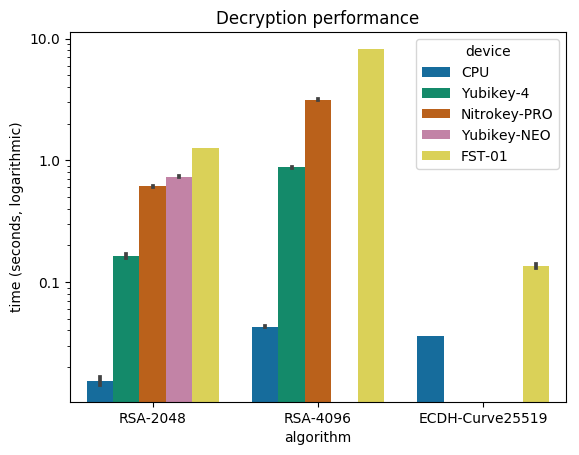
Algorithms and performance To establish reliable performance results, I wrote a benchmark program naively called crypto-bench that could produce comparable results between the different keys. The program takes each algorithm/keycard combination and runs 1000 decryptions of a 16-byte file (one AES-128 block) using GnuPG, after priming it to get the password cached. I assume the overhead of GnuPG calls to be negligible, as it should be the same across all tokens, so comparisons are possible. AES encryption is constant across all tests as it is always performed on the host and fast enough to be irrelevant in the tests. I used the following:
  • Intel(R) Core(TM) i3-6100U CPU @ 2.30GHz running Debian 9 ("stretch"/stable amd64), using GnuPG 2.1.18-6 (from the stable Debian package)
  • Nitrokey Pro 0.8 (latest firmware)
  • FST-01, running Gnuk version 1.2.5 (latest firmware)
  • YubiKey NEO OpenPGP applet 1.0.10 (not upgradable)
  • YubiKey 4 4.2.6 (not upgradable)
I ran crypto-bench for each keycard, which resulted in the following:
Algorithm Device Mean time (s)
ECDH-Curve25519 CPU 0.036
FST-01 0.135
RSA-2048 CPU 0.016
YubiKey-4 0.162
Nitrokey-Pro 0.610
YubiKey-NEO 0.736
FST-01 1.265
RSA-4096 CPU 0.043
YubiKey-4 0.875
Nitrokey-Pro 3.150
FST-01 8.218
Decryption graph There we see the performance of the four keycards I tested, compared with the same operations done without a keycard: the "CPU" device. That provides the baseline time of GnuPG decrypting the file. The first obvious observation is that using a keycard is slower: in the best scenario (FST-01 + ECC) we see a four-fold slowdown, but in the worst case (also FST-01, but RSA-4096), we see a catastrophic 200-fold slowdown. When I presented the results on the Gnuk mailing list, GnuPG developer Werner Koch confirmed those "numbers are as expected":
With a crypto chip RSA is much faster. By design the Gnuk can't be as fast - it is just a simple MCU. However, using Curve25519 Gnuk is really fast.
And yes, the FST-01 is really fast at doing ECC, but it's also the only keycard that handles ECC in my tests; the Nitrokey Start and Nitrokey HSM should support it as well, but I haven't been able to test those devices. Also note that the YubiKey NEO doesn't support RSA-4096 at all, so we can only compare RSA-2048 across keycards. We should note, however, that ECC is slower than RSA on the CPU, which suggests the Gnuk ECC implementation used by the FST-01 is exceptionally fast. In discussions about improving the performance of the FST-01, Niibe estimated the user tolerance threshold to be "2 seconds decryption time". In a new design using the STM32L432 microcontroller, Aurelien Jarno was able to bring the numbers for RSA-2048 decryption from 1.27s down to 0.65s, and for RSA-4096, from 8.22s down to 3.87s seconds. RSA-4096 is still beyond the two-second threshold, but at least it brings the FST-01 close to the YubiKey NEO and Nitrokey Pro performance levels. We should also underline the superior performance of the YubiKey 4: whatever that thing is doing, it's doing it faster than anyone else. It does RSA-4096 faster than the FST-01 does RSA-2048, and almost as fast as the Nitrokey Pro does RSA-2048. We should also note that the Nitrokey Pro also fails to cross the two-second threshold for RSA-4096 decryption. For me, the FST-01's stellar performance with ECC outshines the other devices. Maybe it says more about the efficiency of the algorithm than the FST-01 or Gnuk's design, but it's definitely an interesting avenue for people who want to deploy those modern algorithms. So, in terms of performance, it is clear that both the YubiKey 4 and the FST-01 take the prize in their own areas (RSA and ECC, respectively).

Conclusion In the above presentation, I have evaluated four cryptographic keycards for use with various OpenPGP operations. What the results show is that the only efficient way of storing a 4096-bit encryption key on a keycard would be to use the YubiKey 4. Unfortunately, I do not feel we should put our trust in such closed designs so I would argue you should either stick with 2048-bit encryption subkeys or keep the keys on disk. Considering that losing such a key would be catastrophic, this might be a good approach anyway. You should also consider switching to ECC encryption: even though it may not be supported everywhere, GnuPG supports having multiple encryption subkeys on a keyring: if one algorithm is unsupported (e.g. GnuPG 1.4 doesn't support ECC), it will fall back to a supported algorithm (e.g. RSA). Do not forget your previously encrypted material doesn't magically re-encrypt itself using your new encryption subkey, however. For authentication and signing keys, speed is not such an issue, so I would warmly recommend either the Nitrokey Pro or Start, or the FST-01, depending on whether you want to start experimenting with ECC algorithms. Availability also seems to be an issue for the FST-01. While you can generally get the device when you meet Niibe in person for a few bucks (I bought mine for around \$30 Canadian), the Seeed online shop says the device is out of stock at the time of this writing, even though Jonathan McDowell said that may be inaccurate in a debian-project discussion. Nevertheless, this issue may make the Nitrokey devices more attractive. When deciding on using the Pro or Start, Suhr offered the following advice:
In practice smart card security has been proven to work well (at least if you use a decent smart card). Therefore the Nitrokey Pro should be used for high security cases. If you don't trust the smart card or if Nitrokey Start is just sufficient for you, you can choose that one. This is why we offer both models.
So far, I have created a signing subkey and moved that and my authentication key to the YubiKey NEO, because it's a device I physically trust to keep itself together in my pockets and I was already using it. It has served me well so far, especially with its extra features like U2F and HOTP support, which I use frequently. Those features are also available on the Nitrokey Pro, so that may be an alternative if I lose the YubiKey. I will probably move my main certification key to the FST-01 and a LUKS-encrypted USB disk, to keep that certification key offline but backed up on two different devices. As for the encryption key, I'll wait for keycard performance to improve, or simply switch my whole keyring to ECC and use the FST-01 or Nitrokey Start for that purpose.
[The author would like to thank Nitrokey for providing hardware for testing.] This article first appeared in the Linux Weekly News.

16 October 2017

Yves-Alexis Perez: OpenPGP smartcard transition (part 1.5)

Following the news about the ROCA vulnerability (weak key generation in Infineon-based smartcards, more info here and here) I can confirm that the Almex smartcard I mentionned on my last post (which are Infineon based) are indeed vulnerable. I've contacted Almex to have more details, but if you were interested in buying that smartcard, you might want to refrain for now. It does *not* affect keys generated off-card and later injected (the process I use myself).

Russ Allbery: Free software log (September 2017)

I said that I was going to start writing these regularly, so I'm going to stick to it, even when the results are rather underwhelming. One of the goals is to make the time for more free software work, and I do better at doing things that I record. The only piece of free software work for September was that I made rra-c-util compile cleanly with the Clang static analyzer. This was fairly tedious work that mostly involved unconfusing the compiler or converting (semi-intentional) crashes into explicit asserts, but it unblocks using the Clang static analyzer as part of the automated test suite of my other projects that are downstream of rra-c-util. One of the semantic changes I made was that the vector utilities in rra-c-util (which maintain a resizable array of strings) now always allocate room for at least one string pointer. This wastes a small amount of memory for empty vectors that are never used, but ensures that the strings struct member is always valid. This isn't, strictly speaking, a correctness fix, since all the checks were correct, but after some thought, I decided that humans might have the same problem that the static analyzer had. It's a lot easier to reason about a field that's never NULL. Similarly, the replacement function for a missing reallocarray now does an allocation of size 1 if given a size of 0, just to avoid edge case behavior. (I'm sure the behavior of a realloc with size 0 is defined somewhere in the C standard, but if I have to look it up, I'd rather not make a human reason about it.) I started on, but didn't finish, making rra-c-util compile without Clang warnings (at least for a chosen set of warnings). By far the hardest problem here are the Clang warnings for comparisons between unsigned and signed integers. In theory, I like this warning, since it's the cause of a lot of very obscure bugs. In practice, gah does C ever do this all over the place, and it's incredibly painful to avoid. (One of the biggest offenders is write, which returns a ssize_t that you almost always want to compare against a size_t.) I did a bunch of mechanical work, but I now have a lot of bits of code like:
     if (status < 0)
         return;
    written = (size_t) status;
    if (written < avail)
        buffer->left += written;
which is ugly and unsatisfying. And I also have a ton of casts, such as with:
    buffer_resize(buffer, (size_t) st.st_size + used);
since st.st_size is an off_t, which may be signed. This is all deeply unsatisfying and ugly, and I think it makes the code moderately harder to read, but I do think the warning will potentially catch bugs and even security issues. I'm still torn. Maybe I can find some nice macros or programming styles to avoid the worst of this problem. It definitely requires more thought, rather than just committing this huge mechanical change with lots of ugly code. Mostly, this kind of nonsense makes me want to stop working on C code and go finish learning Rust.... Anyway, apart from work, the biggest thing I managed to do last month that was vaguely related to free software was upgrading my personal servers to stretch (finally). That mostly went okay; only a few things made it unnecessarily exciting. The first was that one of my systems had a very tiny / partition that was too small to hold the downloaded debs for the upgrade, so I had to resize it (VM disk, partition, and file system), and that was a bit exciting because it has an old-style DOS partition table that isn't aligned (hmmm, which is probably why disk I/O is so slow on those VMs), so I had to use the obsolete fdisk -c=dos mode because I wasn't up for replacing the partition right then. The second was that my first try at an upgrade died with a segfault during the libc6 postinst and then every executable segfaulted. A mild panic and a rescue disk later (and thirty minutes and a lot of swearing), I tracked the problem down to libc6-xen. Nothing in the dependency structure between jessie and stretch forces libc6-xen to be upgraded in lockstep or removed, but it's earlier in the search path. So ld.so gets upgraded, and then finds the old libc6 from the libc6-xen package, and the mismatch causes immediate segfaults. A chroot dpkg --purge from the rescue disk solved the problem as soon as I knew what was going on, but that was a stressful half-hour. The third problem was something I should have known was going to be an issue: an old Perl program that does some internal stuff for one of the services I ran had a defined @array test that has been warning for eons and that I never fixed. That became a full syntax error with the most recent Perl, and then I fixed it incorrectly the first time and had a bunch of trouble tracking down what I'd broken. All sorted out now, and everything is happily running stretch. (ejabberd, which other folks had mentioned was a problem, went completely smoothly, although I suspect I now have too many of the plugin packages installed and should do a purging.)

Pau Garcia i Quiles: FOSDEM 2018 Retrocomputing DevRoom Call for Participation

FOSDEM is a free software event that offers open source communities a place to meet, share ideas and collaborate. It is renown for being highly developer-oriented and brings together 8000+ participants from all over the world. It is held in the city of Brussels (Belgium). FOSDEM 2018 will take place during the weekend of February 3rd-4th 2018. More details about the event can be found at http://www.fosdem.org Call for Participation The Retrocomputing DevRoom is a first-timer at FOSDEM, with talks about use of older computing hardware and software in modern times. Presentation topics could include but are not limited to: You are not limited to slide presentations, of course. Be creative. However, FOSDEM is an open source conference, therefore we ask you to stay clear of marketing presentations. We are not afraid of technical stuff: devrooms are a place for development teams to meet, discuss, hack and publicly present their project s latest improvements and future directions. If you will have special needs for your talk (e. g. because you will need to plug some sort of a system), please note that clearly in your proposal so that we can provide it. You can use the Wikipedia definition of retrocomputing as a reference definition to see if you talk qualifies, although it is not exclusive: https://en.wikipedia.org/wiki/Retrocomputing Important dates Useful information Use the FOSDEM Pentabarf tool to submit your proposal: https://penta.fosdem.org/submission/FOSDEM18 If necessary, create a Pentabarf account and activate it. Please reuse your account from previous years if you have already created it. Details on submission: Please note neither FOSDEM nor the Retrocomputing DevRoom will reimburse any expenses you incur Recording of talks The FOSDEM organizers plan to have live streaming and recording fully working, both for remote/later viewing of talks, and so that people can watch streams in the hallways when rooms are full. This requires speakers to consent to being recorded and streamed. If you plan to be a speaker, please understand that by doing so you implicitly give consent for your talk to be recorded and streamed. The recordings will be published under the same license as all FOSDEM content (CC-BY). Contact The Retrocomputing DevRoom is managed by Pau Garcia Quiles (retrocomputing-devroom-manager@fosdem.org). A mailing list of speakers, audience and the curious is available, please subscribe at https://lists.fosdem.org/listinfo/retrocomputing-devroom Hope to hear from you soon! And please forward this announcement.

13 October 2017

Alex Muntada: My Free Software Activities in Jul-Sep 2017

If you read Planet Debian often, you ve probably noticed a trend of Free Software activity reports at the beginning of the month. First, those reports seemed a bit unamusing and lengthy, but since I take the time to read them I ve learnt a lot of things, and now I m amazed at the amount of work that people are doing for Free Software. Indeed, I knew already that many people are doing lots of work. But reading those reports gives you an actual view of how much it is. Then, I decided that I should do the same and write some kind of report since I became a Debian Developer in July. I think it s a nice way to share your work with others and maybe inspire them as it happened to me. So I asked some of the people that have been inspiring me how do they do it. I mean, I was curious to know how they keep track of the work they do and how long it takes to write their reports. It seems that it takes quite some time, it s mostly manual work and usually starts by the end of the month, reviewing their contributions in mailing lists, bug trackers, e-mail folders, etc. Here I am now, writing my first report about my Free Software activities since July and until September 2017. I hope you like it: Happy hacking!

Next.

Previous.