Search Results: "ina"

5 November 2021

Molly de Blanc: Tea(GL) Sandwiches

For SeaGL 2021 I m making some tea sandwiches. I know nothing about tea sandwiches, but read a Wikipedia article. If you want to make them along with me, I recommend getting the ingredients ahead of time. Smoked Not-salmon Sandwiches I guess you could make these with smoked salmon, though I think it s cleverer this way. Ingredients Procedure Apple and Brie Sandwiches This sounded good to me. Let s see how it goes. Ingredients Procedure

4 November 2021

Antoine Beaupr : A Python contextmanager gotcha

Dear lazy web... I've had this code sitting around as a wtf.py for a while. I've been meaning to understand what's going on and write a blog post about it for a while, but I'm lacking the time. Now that I have a few minutes, I actually sat down to look at it and I think I figured it out:
from contextlib import contextmanager
@contextmanager
def bad():
    print(&aposin the context manager&apos)
    try:
        print("yielding value")
        yield &aposvalue&apos
    finally:
        return print(&aposcleaning up&apos)
@contextmanager
def good():
    print(&aposin the context manager&apos)
    try:
        print("yielding value")
        yield &aposvalue&apos
    finally:
        print(&aposcleaning up&apos)
with bad() as v:
    print(&aposgot v = %s&apos % v)
    raise Exception(&aposexception not raised!&apos)  # SILENCED!
print("this code is reached")
with good() as v:
    print(&aposgot v = %s&apos % v)
    raise Exception(&aposexpection normally raised&apos)
print("NOT REACHED (expected)")
For those, like me, who need a walkthrough, here's what the above does:
  1. define a bad context manager (the things you use with with statements) with contextlib.contextmanager) which:
    1. prints a debug statement
    2. return a value
    3. then returns and prints a debug statement
  2. define a good context manager in much the same way, except it doesn't return, it just prints statement
  3. use the bad context manager to show how it bypasses an exception
  4. use the good context manager to show how it correctly raises the exception
The output of this code (in Debian 11 bullseye, Python 3.9.2) is:
in the context manager
yielding value
got v = value
cleaning up
this code is reached
in the context manager
yielding value
got v = value
cleaning up
Traceback (most recent call last):
  File "/home/anarcat/wikis/anarc.at/wtf.py", line 31, in <module>
    raise Exception('expection normally raised')
Exception: expection normally raised
What is surprising to me, with this code, is not only does the exception not get raised, but also the return statement doesn't seem to actually execute, or at least not in the parent scope: if it would, this code is reached wouldn't be printed and the rest of the code wouldn't run either. So what's going on here? Now I know that I should be careful with return in my context manager, but why? And why is it silencing the exception? The reason why it's being silenced is this little chunk in the with documentation:
If the suite was exited due to an exception, and the return value from the exit() method was false, the exception is reraised. If the return value was true, the exception is suppressed, and execution continues with the statement following the with statement.
This feels a little too magic. If you write a context manager with __exit__(), you're kind of forced to lookup again what that API is. But the contextmanager decorator hides that away and it's easy to make that mistake... Credits to the Python tips book for teaching me about that trick in the first place.

Russell Coker: USB Microphones

The Situation I bought myself some USB microphones over ebay, I couldn t see any with USB type A connectors (the original USB connectors) and bought ones with USB-C connectors. I thought it would be good to have microphones that could work with recent mobile phones and with PCs, because surely it wouldn t be difficult to get an adaptor. I tested one of the microphones, it worked well on a phone. I bought a pair of adaptors for USB A ports on a PC or laptop to USB-C (here s the link to where I bought them). I used one of the adaptors with a USB-C HDMI device which gave the following line from lsusb, I didn t try using a HDMI monitor on my laptop, having the device recognised was enough.
Bus 003 Device 002: ID 2109:0100 VIA Labs, Inc. USB 2.0 BILLBOARD
I tried connecting a USB-C microphone and Linux didn t recognise the existence of a USB device, I tried that on a PC and a laptop on multiple ports. I wondered whether the description of the VIA BILLBOARD device as USB 2.0 was relevant to my problem. According to Big Mess O Wires USB-C has separate wires for USB 3.1 and USB 2 [1]. So someone could make a device that converts USB-A to USB-C with only USB-2 wires in place. I tested the USB-A to USB-C adaptor with the HDMI device in a USB SuperSpeed (IE 3.x) port and it still identified as USB 2.0. I suspect that the USB-C HDMI device is using all the high speed wires for DisplayPort data (with a conversion to HDMI) and therefore looks like a USB 2.0 device. The Problem I want to install a microphone in my workstation for long Zoom training sessions (7 hours in a day) that otherwise require me to use multiple Android devices as I don t have a device that will do 7 hours of Zoom without running out of battery. A new workstation with USB-C is unreasonably expensive. A PCIe USB-C card would give me the port at the back of the machine, I can t have the back of the machine near the microphone because it s too noisy. If I could have a USB-C hub with reasonable length cables (the 1M cables typical for USB 2.0 hubs would be fine) connected to a USB-C port at the back of my workstation that would work. But there seems to be a great lack of USB-C hubs. NewBeDev has an informative post about the lack of USB-C hubs that have multiple USB-C ports [2]. There also seems to be a lack of USB-C hubs with cables longer than 20cm. The Solution I ended up ordering a Sades Wand gaming headset [3], that has over-ear headphones and an attached microphone which connects to the computer via USB 2.0. I gave the URL for the sades.com.au web site for reference but you will get a significantly better price by buying on ebay ($39+postage vs about $30 including postage). I guess I won t be using my new USB-C microphones for a while.

3 November 2021

Dirk Eddelbuettel: RDieHarder 0.2.2 on CRAN: Simpler Build, Fixes

An updated version 0.2.2 of the random-number generator tester RDieHarder (based on the DieHarder suite developed / maintained by Robert Brown with contributions by David Bauer and myself) is now on CRAN. I should dub this the due to Brian Ripley release. He sent me a detailed five-point email a few days ago which detailed a change I could not have tested ( no access ), a change I would not have known ( somewhat obscure C language bit-level manipulation ), a change I had missed (how my build setup failed for M1mac), another advanced C level fix, and one more simple fix I actually knew. Speechless. The man (I presume) does not sleep and is just so generous with his time and expertise. So based on the input I rejigged the package over the weekend and made two more (substantial) changes. First, extending on what 0.2.0 brought, I will no longer attempt to use an external libdieharder library (or build one on the fly) that was issue one. Now we just declare all C files as dependents of the package shared library, and things are simpler and more consistent. Sadly, that also implies everything is in the package so I had to edit out a metric ton of stdout or exit() reference with the appropriate R C API hooks to appease the CRAN Policy deities. Win some, loose some. But the package is now simpler, and cleaner, and should be in good standing. (Or so one hopes. Earlier today, and within hours of it hitting CRAN, I got an issue ticket from a motivated user about yet another ( mostly harmless in the Douglas Adams sense) compiler warning Good now too.) Thanks to CRANberries, you can also look at the most recent diff. If you like this or other open-source work I do, you can now sponsor me at GitHub.

This post by Dirk Eddelbuettel originated on his Thinking inside the box blog. Please report excessive re-aggregation in third-party for-profit settings.

1 November 2021

Russell Coker: Talking to Criminals

I think most people and everyone who reads my blog is familiar with the phone support scams that are common nowadays. There s the we are Microsoft support and have found a problem with your PC , the we are from your ISP and want to warn you that your Internet access will be cut off , and the here s the bill for something expensive and we need you to confirm whether you want to pay . Most people hang up when scammers call them and don t call them back. But I like to talk to them. I review the quality of their criminal enterprise and tell them that I expect better quality criminals to call me. I ask them if they are proud to be criminals and if their parents would be proud of them. I ask them if they are paid well to be a criminal. Usually they just hang up and on one occasion the criminal told me to get lost before hanging up. Today I got a spam message telling me to phone +61-2-8006-7237 about an invoice for Norton Software Enhancer and Firewall Defender if I wanted to dispute it. It was interesting that they had an invoice number in the email which they asked me for when I called, at the time I didn t think to make up an invoice number with the same format to determine if they were actually looking it up, in retrospect I should have used a random 9 digit number to determine if they had a database for this. On the first call they just hung up on me. The second call they told me you won t save anyone before hanging up. The third call I got on to a friendly and talkative guy who told me that he was making good money being a criminal. I asked if he was in India or Australia (both guys had accents from the Indian subcontinent), he said he was in Pakistan. He said that he made good money by Pakistani standards as $1 Australian is over 100 Pakistani Rupees. He asked me if I d like to work for him, I said that I make good money doing legal things, he said that if I have so much money I could send him some. ;) He also offered to take me on a tour of Islamabad if I visited, this could have been a genuine offer to have a friendly meeting with someone from the opposite site of computer security or an attempt at kidnap for ransom. He didn t address my question about whether the local authorities would be interested in his work, presumably he thinks that a combination of local authorities not caring much and the difficulty of tracking international crime makes him safe. It was an interesting conversation, I encourage everyone to chat to such criminals. They are right that you won t save anyone. But you can have some fun and occasionally learn some interesting things.

31 October 2021

Russ Allbery: Review: Shadow Scale

Review: Shadow Scale, by Rachel Hartman
Series: Seraphina #2
Publisher: Ember
Copyright: 2015
ISBN: 0-375-89659-7
Format: Kindle
Pages: 458
Shadow Scale, despite confusing publisher marketing that calls it a "companion" to Seraphina, is a direct sequel. It picks up shortly after Seraphina and resolves most of the loose ends of the previous book. This is a book for which my completionist tendencies did me no favors. The book I was intending to read, when I started on Hartman's work, is Tess of the Road, but I hate starting series in the middle and it was clear that Tess was set after Seraphina. (I have been repeatedly assured that this doesn't matter and that one can start with Tess. Such reassurances rarely work on me; do as I say, not as I do.) For Seraphina itself, this turned out fine; I'm mildly surprised by the book's Andre Norton award nomination, but it was enjoyable enough and I liked the first-person protagonist. Shadow Scale I approached with a bit more trepidation. I hadn't heard much about it and the few reviews I saw were lukewarm. Unfortunately, there's a reason for that. Seraphina left obvious room for a sequel, including a brewing war, significant unresolved interpersonal relationships, and Seraphina's own newfound understanding of the nature of her internal menagerie. Alas, the start of the book uses the war primarily as plot device (and introduces a brand-new bit of magic that I never found interesting), largely ignores the relationship, and focuses on that third plot element. And by focuses, I mean Seraphina is sent out of the country of Goredd on a journey of map exploration to collect plot coupons. The best description I have for the middle of this book is tedious and depressing. Like a lot of novels, it has a U-shaped plot: things get worse and worse until a crisis, and then start getting better. This plot can work, but the reader has to have a good reason to stick through the depressing bits. One of the better reasons is if the plot allows the main character some small triumphs, maintaining their agency throughout even if larger events are spiraling out of control. This is not one of those books. After some early successes tracking down some objects of her search, Seraphina encounters an antagonist from her own past (barely hinted at in the first book) who can systematically corrupt everything she is trying to do. She spends most of the book feeling like what she's doing is futile, or hoping for things the reader knows aren't going to happen. Given that this is happening during plodding map exploration fantasy through largely indistinguishable faux-medieval countries, or (later) somewhat more interesting but obviously irrelevant local politics in a remote trading city, it's hard to avoid sharing that sense of futility. The other structural problem with Shadow Scale is that the plot coupons are people, which means this book has an excessive cast size problem. Seraphina collects too many people for me to even keep straight, let alone care about. Critical developments (usually for the worst) in the lives of one of these characters were frequently met with reader mutterings like, "Now which one was Brasidas again, was he the plague doctor?" This tends to undermine the emotional impact. It didn't help that the plot was enough of a slog that I kept putting the book aside for a few days. This does get better, but not enough better to redeem the middle of the book, and one has to put up with a lot of helpless despair to get there. Shadow Scale is one of those stories where the protagonist has the innate power to resolve the plot, is told cryptically by various people that this is the case, but has absolutely no idea how to use it and her supposed mentors are essentially useless. The result is that she feels both hopeless and guilty, which was not the reading experience I wanted. I did enjoy the moment when she finally figures it out, and I thought Hartman's idea was reasonably clever, but it would have been better if that had happened faster. Like, 200 pages faster. At least. The major world-building in Seraphina was the dragons. The dragons also show up in this book (and feel less like autism spectrum archetypes, which I appreciated), and in theory are central to the plot, but I'm not entirely sure why? It was an odd reading experience. I think Hartman was attempting to set up dual villains posing different threats, but the dragon one is off-screen for nearly the entire book and never developed, so it feels perfunctory. Near the end of the book, Hartman abruptly picks up the dragons again, but that whole section felt oddly disconnected from the rest of the plot and is only barely relevant to the resolution. At least for me, the plot structure didn't cohere. Shadow Scale does go up a whole point in rating for me because of the romance plot and how Hartman resolves it, which I will not spoil but which I loved. The process of getting there is immensely frustrating because it feels like Hartman is forcing the characters into a corner where only stupid resolutions are possible, but in this case the U-shaped emotional structure worked on me. The ending is completely true to the characters in a way that I thought Hartman had made impossible (and which does a lovely bit of undermining of traditional roles), so full credit there. It helped that the relationship is put on ice for most of the book and only appears at the end (which is also the best part of the book), so it didn't drag on like the other parts of the plot. Overall, though, I tentatively agree with the general advice to skip this one, and suspect that advice will become less tentative once I read Tess of the Road. It's a largely unpleasant slog. There are some mildly interesting world-building revelations that fill in the background of Seraphina, the ending was reasonably good, and the relationships were much better than I was expecting through most of the book, but the amount of time and patience required to get there was not a good trade-off for me. Followed (in the sense that it's set in the same universe but is not a sequel and I suspect does not depend heavily on this plot) by Tess of the Road. Rating: 4 out of 10

30 October 2021

Dirk Eddelbuettel: RcppQuantuccia 0.1.0 on CRAN: Full QuantLib Business Calendar Support

Another new release of RcppQuantuccia arrived on CRAN today, just a week after the previous release which brought full calendaring support. RcppQuantuccia started from the Quantuccia header-only subset / variant of QuantLib which it brings it to R. As of this release, the QuantLib code is only minimally modified. In other words we no longer follow the Quantuccia route of header-izing the file but include both cpp and hpp directly. The minimal changes, documented in a diff file in the repo, consists chiefly of removing includes for headers we do not use (given the pure calendaring focus) and accomodating CRAN Policies (by eschewing #pragma directives). We do follow Quantuccia by not having any external linking requirement: the R package only depends on Rcpp (for the glue) and BH for the Boost headers (and system-level Boost headers can be used as drop-in). The our knowledge, this provides the only small and self-contained (apart from Boost headers) library with current (and regularly updated within QuantLib, which I intend to shadow here) calendaring code on a global scale. Every exchange that matters is likely included. The screenshot provides quick demo. The complete list changes for this release follows.

Changes in version 0.1.0 (2021-10-30)
  • Code reorganized to have minimal (documented) changes relative to upstream, essentially just removing unused headers, and pragma
  • Added example for full calendaring to README.md

Time permitting, I may look into other bindings from this sub-library; see a first email thread on this. Courtesy of CRANberries, there is also a diffstat report relative to the previous release. More information is on the RcppQuantuccia page. Issues and bugreports should go to the GitHub issue tracker. If you like this or other open-source work I do, you can now sponsor me at GitHub.

This post by Dirk Eddelbuettel originated on his Thinking inside the box blog. Please report excessive re-aggregation in third-party for-profit settings.

Dirk Eddelbuettel: dang 0.0.15: Small Correction

A bug-fix release of the dang package arrived at CRAN a little while ago. The dang package regroups a few functions of mine that had no other home as for example lsos() from a StackOverflow question from 2009 (!!), the overbought/oversold price band plotter from an older blog post, the market monitor from the last release as well the checkCRANStatus() function tweeted about by Tim Taylor. This release corrects a small mistake wrapping extern "C" ... around code that is not actually C but C++ which g++ kept silent about yet clang++ complains about, correctly. So CRAN asked me to correct this, which this version does. The NEWS entry follows.

Changes in version 0.0.15 (2021-10-26)
  • Corrected scope of 'extern "C"' declaration to the actually C-callable function (noticed by clang++, change requested by CRAN)

Courtesy of my CRANberries, there is a comparison to the previous release. For questions or comments use the issue tracker off the GitHub repo. If you like this or other open-source work I do, you can now sponsor me at GitHub.

This post by Dirk Eddelbuettel originated on his Thinking inside the box blog. Please report excessive re-aggregation in third-party for-profit settings.

28 October 2021

Dirk Eddelbuettel: td 0.0.5 on CRAN: New Reference Accessors

The td package for accessing the twelvedata API for financial data has been updated on CRAN to version 0.0.5. This is version is mostly the work of Kenneth who suggested to add accessors for reference data, and then did just that. So if you already use td, good news as you now have nine or so more functions getting data for you! The NEWS entry follows.

Changes in version 0.0.5 (2021-10-28)
  • New functions to access twelvedata reference data (Kenneth in #4 addressing #3)

Courtesy of my CRANberries, there is a comparison to the previous release. For questions or comments use the issue tracker off the GitHub repo. If you like this or other open-source work I do, you can now sponsor me at GitHub.

This post by Dirk Eddelbuettel originated on his Thinking inside the box blog. Please report excessive re-aggregation in third-party for-profit settings.

26 October 2021

Russell Coker: Links October 2021

Bloomburg has an insightful article about Juniper, the NSA, and the compromise of Netscreen [1]. It was worse than we previously thought and the Chinese government was involved. Haaretz has an amusing story about security issues at a credit card company based on a series of major WTFs [2]. They used WhatsApp for communicating with customers (despite the lack of support from Facebook for issues like account compromise), stored it on a phone (they should have used a desktop PC), didn t lock the phone down (should have been in a locked case and bolted down like any other financial security device), and allowed it to get stolen. Fortunately the thief was only after a free phone not the financial data stored on it. David Brin wrote an insightful blog post Should facts and successes matter in economics? Or politics? [3] which is part of his series about challenging conservatives to bet on their policies. Vice has an interesting article about a normal-looking USB-C to Lightning cable that intercepts data transfer and sends it out via an embedded Wifi AP [4]. Getting that into such a small space is an impressive engineering feat. The vendor already has a YSB-A to lightning cable with such features for $120 [5]. That s too expensive to just leave them lying around and hope that someone with interesting data finds them, but it s also quite cheap for a targeted attack. Interesting article about tracking people via Bluetooth MAC address or device name [6]. Most of the research is based on a man riding a bike around Norway and passively sniffing Bluetooth transmissions. You can buy commercial devices that can receive Bluetooth from 1Km away. A recent version of Bluetooth has random Mac addresses but that still allows tracking by device name which for many people is their own name. Cory Doctorow has a good summary of the ways that Facebook is rotten [7]. It s worse than you think. In 2019 almost all Facebook s top Christian pages were run by foreign troll farms [8]. This is partly due to Christians being gullible, but Facebook is also to blame for this. Cornell has an interesting article about using CRISPR to identify the gender of chicken eggs before they hatch [9]. This means that instead of killing roosters hatched from eggs for egg production they can just put those eggs for eating and save some money. Another option would be to genetically engineer more sexual dimorphism into chickens as the real problem is that hens for laying eggs are too thin to be good for eating so if you could have a breed of chicken with thin hens and fat cocks then all eggs could be hatched and the chickens used. The article claims that this is an ethical benefit of not killing baby roosters, but really it s about saving 50 cents per egg. Umair Haque wrote an insightful article about why everything will get more expensive as the externalities dating back to the industrial revolution have to be paid for [9]. Alexei Navalny (the jailed Russian opposition politician who Putin tried to murder) wrote an insightful article about why corruption is at the root of most world problems and how to solve it [10]. Cory Doctorow wrote an insightful article about breaking in to the writing industry which can apply to starting in most careers [11]. The main point is that people who have established careers have knowledge about starting a career that s at best outdated and at most totally irrelevant. Learning from people who are at most one step ahead of you is probably best. Peter Wehner wrote an insightful article for The Atlantic about the way churches in the US are breaking apart due to political issues [12]. Similar things appear to be happening in Australia for the same reason, conservative fear based politics which directly opposes everything in the Bible about Jesus is taking over churches. On the positive side this should destroy churches and the way churches are currently going they should be destroyed. The Guardian has an article about the incidence of reinfection with Covid19 [13]. The current expectation is that people who aren t vaccinated will probably get it about every 16 months if it becomes endemic (as it has in the US and will do in Australia if conservatives have their way). If the mortality rate is 2% each time then an unvaccinated person could expect a 15% chance of dying over the course of 10 years if there is no cumulative damage. However if damage to the heart and lungs accumulates over multiple courses of the disease then the probability of death over 10 years could be a lot higher. Psyche has an interesting article by Professor Jan-Willem van Prooijeni about the way that conspiracy theories bypass rationality [14]. The way that entertaining stories bypass rationality is particularly concerning given the way Facebook and other social media are driven by clickbait.

24 October 2021

Sean Whitton: Deploying containers with Consfigurator

For some months now I ve been working on some patches to Consfigurator to add support for Linux containers. My goal is to make Consfigurator capable of both performing the initial setup of a container and of entering the running container to apply configuration. For the case of unprivileged LXCs running as non-root, my work-in-progress branch can now do both of these things. As Consfigurator enters the container directly using system calls, it should be decently fast at configuring multiple containers on a host, and it will also be possible to have it do this in parallel. The initial setup for the container uses Consfigurator s existing support for building root filesystems, and it should be easy to extend that to support arbitrary GNU/Linux distributions by teaching Consfigurator how to invoke bootstrapping tools other than debootstrap(8). Here s an example:
(defhost lxc1.silentflame.com ()
  (os:debian-stable "bullseye" :amd64)
  (basic-props)
  (apt:installed "systemd" "netcat")
  (apache:https-vhost ...))
(defhost lxctest.laptop.silentflame.com ()
  (os:debian-stable "bullseye" :amd64)
  (apt:proxy "http://192.168.122.1:3142")
  (basic-props)
  (apt:installed "linux-image-amd64" "lxc")
  (lxc:usernet-usable-by "spwhitton" "lxcbr0")
  (lxc:user-containers-autostart "spwhitton")
  (lxc:user-container-for '(:additional-lines
                            ("lxc.net.0.type = veth"
                             "lxc.net.0.flags = up"
                             "lxc.net.0.link = lxcbr0"
                             ...))
                          "spwhitton"
                          lxc1.silentflame.com))
(defhost laptop.silentflame.com ()
  ...
  (libvirt:kvm-boots-chroot-for '(:always-deploys t)
                                lxctest.laptop.silentflame.com))
This code is a simplified definition of my testing setup for this work. It defines three hosts: a container lxc1, a container host lxctest, and my laptop. When Consfigurator is asked to deploy the laptop, it will set up the root filesystem for lxctest and then boot it as a KVM virtual machine. Preparing that root filesystem will include setting up the root filesystem for lxc1, too, including shifting the ownership and ACLs to match the user namespace LXC will use when booting the container. Thus, once the deployment of the laptop is finished, it will be possible to boot the lxctest VM, connect to it as the user spwhitton, and start lxc1. Consfigurator includes only minimal support for setting up container networking, as there are so many different ways in which you might want to do it. In my own consfig I ve been developing properties to connect containers directly to my tinc VPN. A single tinc daemon runs on the container host, and other tinc daemons route a whole subnet, containing the addresses for each of the containers, to the container host s tinc daemon. As the LXCs Consfigurator sets up run as non-root, some sort of setuid facility is required to configure this networking. Consfigurator s ability to dump executable Lisp images is helping here. I define a function which runs as root to set up the networking:
(defun route-athenet-container-veth (host)
  (let ((user (getenv "USERV_USER"))
        (peer (getenv "USERV_U_PEER"))
        (ip (car (uiop:command-line-arguments))))
    (unless (string-prefix-p (format nil "veth~D_" (getenv "USERV_UID")) peer)
      (error "~A does not belong to requester." peer))
    (unless (member (cons user ip) (get-hostattrs 'veth-ips host) :test #'equal)
      (error "~A does not have permission to route ~A." user ip))
    (flet ((r (&rest args)
             ;; Explicitly passing nil means UIOP will not invoke a shell.
             (run-program args :force-shell nil)))
      (eswitch ((getenv "USERV_U_HOOK_TYPE") :test #'string=)
        ("up"
         (apply #'r
                "sysctl" "-w"
                "net.ipv6.conf.all.forwarding=1"
                ...)
         (r "ip" "addr" "flush" "dev" peer "scope" "link")
         (r "ip" "-6" "addr" "add" "fe80::1/64" "dev" peer)
         (r "ip" "-6" "route" "add" (strcat ip "/128") "dev" peer)
         ...)
        ("down"
         ...
         (r "ip" "-6" "route" "del" (strcat ip "/128") "dev" peer))))))
and then apply the following property to lxctest to dump an image which will call this function and then exit:
(image-dumped
 "/usr/lib/userv/route-athenet-container-veth"
  (route-athenet-container-veth ,(intern (string-upcase (get-hostname)))))
I m using GNU userv to enable ordinary users to run this image as root, so there there s a small script which converts LXC s LXC_HOOK_* environment variables into appropriate command line arguments to userv(1) such that the function above is able to access that information from its environment (the USERV_U_* variables above). You could just as easily do this with sudo, by giving permission for the relevant LXC_HOOK_* environment variables to survive the switch to root. What s particularly nice about this is that there s no need to write any code to keep a config file updated, specifying which users are allowed to route which IPs to their containers. ROUTE-ATHENET-CONTAINER-VETH receives a HOST value for the container host and can just look at the metadata established by properties for particular containers. Each time this metadata is updated and lxctest is deployed, a fresh image is dumped containing the updated metadata. This work has provided opportunities to make various other improvements to Consfigurator, especially with regard to dumping and reinvoking images. Making SBCL capable of entering user namespaces required a change upstream, which made it into the recent SBCL 2.1.8 release. I m very grateful to the SBCL developers for their engagement with my project. I ve been able to add a workaround so that Consfigurator can still enter user namespaces when run on the version of SBCL included in Debian stable. I also discovered that deploying all of my laptop, lxctest and lxc1 at once generates enough output to fill up a pipe, thus revealing a deadlock in Consfigurator s IPC, which it was good to become aware of and fix. That involved writing my first multi-threaded Lisp, as there are two pipes that need to be kept from filling up, and to my surprise it worked first time. Take that Haskell :)

23 October 2021

Dirk Eddelbuettel: RcppQuantuccia 0.0.5 on CRAN: Updated and Calendar Focus

Another new release of RcppQuantuccia arrived on CRAN today, just a couple of days after the previous release. RcppQuantuccia started from the Quantuccia header-only subset / variant of QuantLib which it brings it to R. As of this release, it concentrates on calendaring functionality taking advantage of the extensive collection of country-specific holiday information in QuantLib. The release updates the included code to the most recent QuantLib release. We added one calendar (for Brazil) and one utility function (of exporting all business days in a given range, which is the simple complement to the existing holiday list getter). The complete list changes follows.

Changes in version 0.0.5 (2021-10-23)
  • Refocused on calendaring functionality only, removed daycounters/, math/, methods/, models/, plus other unused headers
  • Fully updated to (current) QuantLib release 0.2.4
  • Added getBusinessDays() to retrieve range of dates
  • Added Brazil calendar

Courtesy of CRANberries, there is also a diffstat report relative to the previous release. More information is on the RcppQuantuccia page. Issues and bugreports should go to the GitHub issue tracker. If you like this or other open-source work I do, you can now sponsor me at GitHub.

This post by Dirk Eddelbuettel originated on his Thinking inside the box blog. Please report excessive re-aggregation in third-party for-profit settings.

Antoine Beaupr : The Neo-Colonial Internet

I grew up with the Internet and its ethics and politics have always been important in my life. But I have also been involved at other levels, against police brutality, for Food, Not Bombs, worker autonomy, software freedom, etc. For a long time, that all seemed coherent. But the more I look at the modern Internet -- and the mega-corporations that control it -- and the less confidence I have in my original political analysis of the liberating potential of technology. I have come to believe that most of our technological development is harmful to the large majority of the population of the planet, and of course the rest of the biosphere. And now I feel this is not a new problem. This is because the Internet is a neo-colonial device, and has been from the start. Let me explain.

What is Neo-Colonialism? The term "neo-colonialism" was coined by Kwame Nkrumah, first president of Ghana. In Neo-Colonialism, the Last Stage of Imperialism (1965), he wrote:
In place of colonialism, as the main instrument of imperialism, we have today neo-colonialism ... [which] like colonialism, is an attempt to export the social conflicts of the capitalist countries. ... The result of neo-colonialism is that foreign capital is used for the exploitation rather than for the development of the less developed parts of the world. Investment, under neo-colonialism, increases, rather than decreases, the gap between the rich and the poor countries of the world.
So basically, if colonialism is Europeans bringing genocide, war, and its religion to the Africa, Asia, and the Americas, neo-colonialism is the Americans (note the "n") bringing capitalism to the world. Before we see how this applies to the Internet, we must therefore make a detour into US history. This matters, because anyone would be hard-pressed to decouple neo-colonialism from the empire under which it evolves, and here we can only name the United States of America.

US Declaration of Independence Let's start with the United States declaration of independence (1776). Many Americans may roll their eyes at this, possibly because that declaration is not actually part of the US constitution and therefore may have questionable legal standing. Still, it was obviously a driving philosophical force in the founding of the nation. As its author, Thomas Jefferson, stated:
it was intended to be an expression of the American mind, and to give to that expression the proper tone and spirit called for by the occasion
In that aging document, we find the following pearl:
We hold these truths to be self-evident, that all men are created equal, that they are endowed by their Creator with certain unalienable Rights, that among these are Life, Liberty and the pursuit of Happiness.
As a founding document, the Declaration still has an impact in the sense that the above quote has been called an:
"immortal declaration", and "perhaps [the] single phrase" of the American Revolutionary period with the greatest "continuing importance." (Wikipedia)
Let's read that "immortal declaration" again: "all men are created equal". "Men", in that context, is limited to a certain number of people, namely "property-owning or tax-paying white males, or about 6% of the population". Back when this was written, women didn't have the right to vote, and slavery was legal. Jefferson himself owned hundreds of slaves. The declaration was aimed at the King and was a list of grievances. A concern of the colonists was that the King:
has excited domestic insurrections amongst us, and has endeavoured to bring on the inhabitants of our frontiers, the merciless Indian Savages whose known rule of warfare, is an undistinguished destruction of all ages, sexes and conditions.
This is a clear mark of the frontier myth which paved the way for the US to exterminate and colonize the territory some now call the United States of America. The declaration of independence is obviously a colonial document, having being written by colonists. None of this is particularly surprising, historically, but I figured it serves as a good reminder of where the Internet is coming from, since it was born in the US.

A Declaration of the Independence of Cyberspace Two hundred and twenty years later, in 1996, John Perry Barlow wrote a declaration of independence of cyberspace. At this point, (almost) everyone has a right to vote (including women), slavery was abolished (although some argue it still exists in the form of the prison system); the US has made tremendous progress. Surely this text will have aged better than the previous declaration it is obviously derived from. Let's see how it reads today and how it maps to how the Internet is actually built now.

Borders of Independence One of the key ideas that Barlow brings up is that "cyberspace does not lie within your borders". In that sense, cyberspace is the final frontier: having failed to colonize the moon, Americans turn inwards, deeper into technology, but still in the frontier ideology. And indeed, Barlow is one of the co-founder of the Electronic Frontier Foundation (the beloved EFF), founded six years prior. But there are other problems with this idea. As Wikipedia quotes:
The declaration has been criticized for internal inconsistencies.[9] The declaration's assertion that 'cyberspace' is a place removed from the physical world has also been challenged by people who point to the fact that the Internet is always linked to its underlying geography.[10]
And indeed, the Internet is definitely a physical object. First controlled and severely restricted by "telcos" like AT&T, it was somewhat "liberated" from that monopoly in 1982 when an anti-trust lawsuit broke up the monopoly, a key historical event that, one could argue, made the Internet possible. (From there on, "backbone" providers could start competing and emerge, and eventually coalesce into new monopolies: Google has a monopoly on search and advertisement, Facebook on communications for a few generations, Amazon on storage and computing, Microsoft on hardware, etc. Even AT&T is now pretty much as consolidated as it was before.) The point is: all those companies have gigantic data centers and intercontinental cables. And those are definitely prioritizing the western world, the heart of the empire. Take for example Google's latest 3,900 mile undersea cable: it does not connect Argentina to South Africa or New Zealand, it connects the US to UK and Spain. Hardly a revolutionary prospect.

Private Internet But back to the Declaration:
Do not think that you can build it, as though it were a public construction project. You cannot. It is an act of nature and it grows itself through our collective actions.
In Barlow's mind, the "public" is bad, and private is good, natural. Or, in other words, a "public construction project" is unnatural. And indeed, the modern "nature" of development is private: most of the Internet is now privately owned and operated. I must admit that, as an anarchist, I loved that sentence when I read it. I was rooting for "us", the underdogs, the revolutionaries. And, in a way, I still do: I am on the board of Koumbit and work for a non-profit that has pivoted towards censorship and surveillance evasion. Yet I cannot help but think that, as a whole, we have failed to establish that independence and put too much trust in private companies. It is obvious in retrospect, but it was not, 30 years ago. Now, the infrastructure of the Internet has zero accountability to traditional political entities supposedly representing the people, or even its users. The situation is actually worse than when the US was founded (e.g. "6% of the population can vote"), because the owners of the tech giants are only a handful of people who can override any decision. There's only one Amazon CEO, he's called Jeff Bezos, and he has total control. (Update: Bezos actually ceded the CEO role to Andy Jassy, AWS and Amazon music founder, while remaining executive chairman. I would argue that, as the founder and the richest man on earth, he still has strong control over Amazon.)

Social Contract Here's another claim of the Declaration:
We are forming our own Social Contract.
I remember the early days, back when "netiquette" was a word, it did feel we had some sort of a contract. Not written in standards of course -- or barely (see RFC1855) -- but as a tacit agreement. How wrong we were. One just needs to look at Facebook to see how problematic that idea is on a global network. Facebook is the quintessential "hacker" ideology put in practice. Mark Zuckerberg explicitly refused to be "arbiter of truth" which implicitly means he will let lies take over its platforms. He also sees Facebook as place where everyone is equal, something that echoes the Declaration:
We are creating a world that all may enter without privilege or prejudice accorded by race, economic power, military force, or station of birth.
(We note, in passing, the omission of gender in that list, also mirroring the infamous "All men are created equal" claim of the US declaration.) As the Wall Street Journal's (WSJ) Facebook files later shown, both of those "contracts" have serious limitations inside Facebook. There are VIPs who systematically bypass moderation systems including fascists and rapists. Drug cartels and human traffickers thrive on the platform. Even when Zuckerberg himself tried to tame the platform -- to get people vaccinated or to make it healthier -- he failed: "vaxxer" conspiracies multiplied and Facebook got angrier. This is because the "social contract" behind Facebook and those large companies is a lie: their concern is profit and that means advertising, "engagement" with the platform, which causes increased anxiety and depression in teens, for example. Facebook's response to this is that they are working really hard on moderation. But the truth is that even that system is severely skewed. The WSJ showed that Facebook has translators for only 50 languages. It's a surprisingly hard to count human languages but estimates range the number of distinct languages between 2500 and 7000. So while 50 languages seems big at first, it's actually a tiny fraction of the human population using Facebook. Taking the first 50 of the Wikipedia list of languages by native speakers we omit languages like Dutch (52), Greek (74), and Hungarian (78), and that's just a few random nations picks from Europe. As an example, Facebook has trouble moderating even a major language like Arabic. It censored content from legitimate Arab news sources when they mentioned the word al-Aqsa because Facebook associates it with the al-Aqsa Martyrs' Brigades when they were talking about the Al-Aqsa Mosque... This bias against Arabs also shows how Facebook reproduces the American colonizer politics. The WSJ also pointed out that Facebook spends only 13% of its moderation efforts outside of the US, even if that represents 90% of its users. Facebook spends three more times moderating on "brand safety", which shows its priority is not the safety of its users, but of the advertisers.

Military Internet Sergey Brin and Larry Page are the Lewis and Clark of our generation. Just like the latter were sent by Jefferson (the same) to declare sovereignty over the entire US west coast, Google declared sovereignty over all human knowledge, with its mission statement "to organize the world's information and make it universally accessible and useful". (It should be noted that Page somewhat questioned that mission but only because it was not ambitious enough, Google having "outgrown" it.) The Lewis and Clark expedition, just like Google, had a scientific pretext, because that is what you do to colonize a world, presumably. Yet both men were military and had to receive scientific training before they left. The Corps of Discovery was made up of a few dozen enlisted men and a dozen civilians, including York an African American slave owned by Clark and sold after the expedition, with his final fate lost in history. And just like Lewis and Clark, Google has a strong military component. For example, Google Earth was not originally built at Google but is the acquisition of a company called Keyhole which had ties with the CIA. Those ties were brought inside Google during the acquisition. Google's increasing investment inside the military-industrial complex eventually led Google to workers organizing a revolt although it is currently unclear to me how much Google is involved in the military apparatus. Other companies, obviously, do not have such reserve, with Microsoft, Amazon, and plenty of others happily bidding on military contracts all the time.

Spreading the Internet I am obviously not the first to identify colonial structures in the Internet. In an article titled The Internet as an Extension of Colonialism, Heather McDonald correctly identifies fundamental problems with the "development" of new "markets" of Internet "consumers", primarily arguing that it creates a digital divide which creates a "lack of agency and individual freedom":
Many African people have gained access to these technologies but not the freedom to develop content such as web pages or social media platforms in their own way. Digital natives have much more power and therefore use this to create their own space with their own norms, shaping their online world according to their own outlook.
But the digital divide is certainly not the worst problem we have to deal with on the Internet today. Going back to the Declaration, we originally believed we were creating an entirely new world:
This governance will arise according to the conditions of our world, not yours. Our world is different.
How I dearly wished that was true. Unfortunately, the Internet is not that different from the offline world. Or, to be more accurate, the values we have embedded in the Internet, particularly of free speech absolutism, sexism, corporatism, and exploitation, are now exploding outside of the Internet, into the "real" world. The Internet was built with free software which, fundamentally, was based on quasi-volunteer labour of an elite force of white men with obviously too much time on their hands (and also: no children). The mythical writing of GCC and Emacs by Richard Stallman is a good example of this, but the entirety of the Internet now seems to be running on random bits and pieces built by hit-and-run programmers working on their copious free time. Whenever any of those fails, it can compromise or bring down entire systems. (Heck, I wrote this article on my day off...) This model of what is fundamentally "cheap labour" is spreading out from the Internet. Delivery workers are being exploited to the bone by apps like Uber -- although it should be noted that workers organise and fight back. Amazon workers are similarly exploited beyond belief, forbidden to take breaks until they pee in bottles, with ambulances nearby to carry out the bodies. During peak of the pandemic, workers were being dangerously exposed to the virus in warehouses. All this while Amazon is basically taking over the entire economy. The Declaration culminates with this prophecy:
We will spread ourselves across the Planet so that no one can arrest our thoughts.
This prediction, which first felt revolutionary, is now chilling.

Colonial Internet The Internet is, if not neo-colonial, plain colonial. The US colonies had cotton fields and slaves, we have disposable cell phones and Foxconn workers. Canada has its cultural genocide, Facebook has his own genocides in Ethiopia, Myanmar, and mob violence in India. Apple is at least implicitly accepting the Uyghur genocide. And just like the slaves of the colony, those atrocities are what makes the empire run. The Declaration actually ends like this, a quote which I have in my fortune cookies file:
We will create a civilization of the Mind in Cyberspace. May it be more humane and fair than the world your governments have made before.
That is still inspiring to me. But if we want to make "cyberspace" more humane, we need to decolonize it. Work on cyberpeace instead of cyberwar. Establish clear code of conduct, discuss ethics, and question your own privileges, biases, and culture. For me the first step in decolonizing my own mind is writing this article. Breaking up tech monopolies might be an important step, but it won't be enough: we have to do a culture shift as well, and that's the hard part.

Appendix: an apology to Barlow I kind of feel bad going through Barlow's declaration like this, point by point. It is somewhat unfair, especially since Barlow passed away a few years ago and cannot mount a response (even humbly assuming that he might read this). But then again, he himself recognized he was a bit too "optimistic" in 2009, saying: "we all get older and smarter":
I'm an optimist. In order to be libertarian, you have to be an optimist. You have to have a benign view of human nature, to believe that human beings left to their own devices are basically good. But I'm not so sure about human institutions, and I think the real point of argument here is whether or not large corporations are human institutions or some other entity we need to be thinking about curtailing. Most libertarians are worried about government but not worried about business. I think we need to be worrying about business in exactly the same way we are worrying about government.
And, in a sense, it was a little naive to expect Barlow to not be a colonist. Barlow is, among many things, a cattle rancher who grew up on a colonial ranch in Wyoming. The ranch was founded in 1907 by his great uncle, 17 years after the state joined the Union, and only a generation or two after the Powder River War (1866-1868) and Black Hills War (1876-1877) during which the US took over lands occupied by Lakota, Cheyenne, Arapaho, and other native American nations, in some of the last major First Nations Wars.

Appendix: further reading There is another article that almost has the same title as this one: Facebook and the New Colonialism. (Interestingly, the <title> tag on the article is actually "Facebook the Colonial Empire" which I also find appropriate.) The article is worth reading in full, but I loved this quote so much that I couldn't resist reproducing it here:
Representations of colonialism have long been present in digital landscapes. ( Even Super Mario Brothers, the video game designer Steven Fox told me last year. You run through the landscape, stomp on everything, and raise your flag at the end. ) But web-based colonialism is not an abstraction. The online forces that shape a new kind of imperialism go beyond Facebook.
It goes on:
Consider, for example, digitization projects that focus primarily on English-language literature. If the web is meant to be humanity s new Library of Alexandria, a living repository for all of humanity s knowledge, this is a problem. So is the fact that the vast majority of Wikipedia pages are about a relatively tiny square of the planet. For instance, 14 percent of the world s population lives in Africa, but less than 3 percent of the world s geotagged Wikipedia articles originate there, according to a 2014 Oxford Internet Institute report.
And they introduce another definition of Neo-colonialism, while warning about abusing the word like I am sort of doing here:
I m loath to toss around words like colonialism but it s hard to ignore the family resemblances and recognizable DNA, to wit, said Deepika Bahri, an English professor at Emory University who focuses on postcolonial studies. In an email, Bahri summed up those similarities in list form:
  1. ride in like the savior
  2. bandy about words like equality, democracy, basic rights
  3. mask the long-term profit motive (see 2 above)
  4. justify the logic of partial dissemination as better than nothing
  5. partner with local elites and vested interests
  6. accuse the critics of ingratitude
In the end, she told me, if it isn t a duck, it shouldn t quack like a duck.
Another good read is the classic Code and other laws of cyberspace (1999, free PDF) which is also critical of Barlow's Declaration. In "Code is law", Lawrence Lessig argues that:
computer code (or "West Coast Code", referring to Silicon Valley) regulates conduct in much the same way that legal code (or "East Coast Code", referring to Washington, D.C.) does (Wikipedia)
And now it feels like the west coast has won over the east coast, or maybe it recolonized it. In any case, Internet now christens emperors.

Arthur Diniz: Dropdown for GitHub workflows input parameters

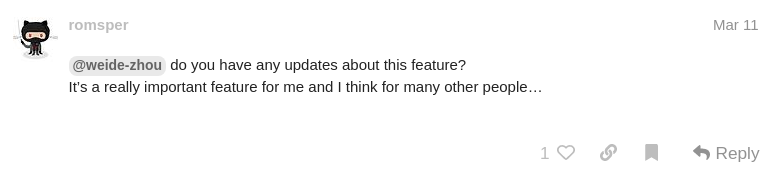
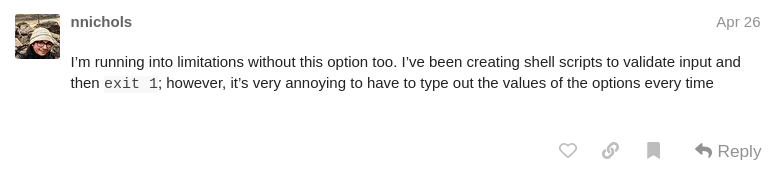
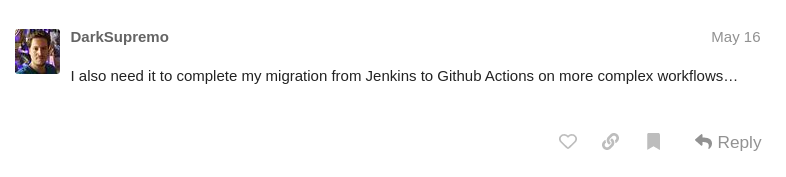
Dropdown for GitHub workflows input parameters Sometimes when we look at CI/CD tools embedded within git-based software repository manager like GitHub, GitLab or Bitbucket, we ran into a lack of some features. This time me and my DevOps/SRE team were facing a pain of not being able to have the option to create drop-downs within GitHub workflows using input parameters. Although this functionality is already available on other platforms such as Bitbucket, the specific client we were working on stored the code inside GitHub. At first I thought that someone has already solved this problem somehow, but doing an extensive search on the internet I found several angry GitHub users opening requests within the Support Community and even in the stack overflow. comment-1 comment-2 comment-3 comment-5 comment-4 So I decided to create a solution for this, always thinking about simplicity and in a way that makes it easy to get this missing functionality. I started by creating an input array pattern using commas and using a tag (the selector) e.g brackets as the default value marker. Here is an example of what an input string would look like:
name: gh-action-dropdown-list-input
on:
  workflow_dispatch:
    inputs:
      environment:
        description: 'Environment'
        required: true
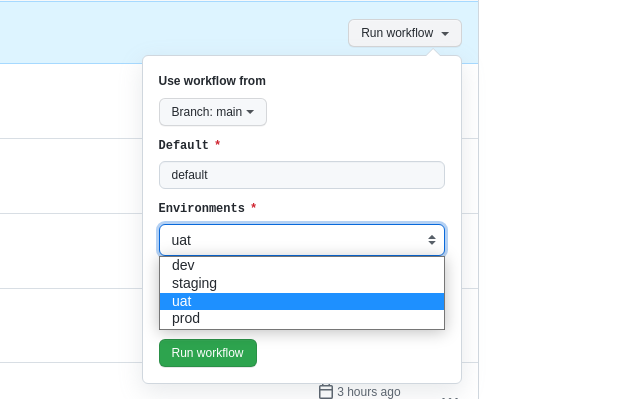
        default: 'dev,staging,[uat],prod'
Now the final question that would turn out to be the most complicated to deal with. How can I change the GitHub Actions interface to replace the input pattern we created earlier to a dropdown? The simplest answer I thought was to create a chrome and firefox extension that would do all this logic behind the scenes and replace the HTML input element with the selected tag containing the array values and leaving the tag value (selector) always as the default. All code was developed in pure JavaScript, open-source licensed under Apache 2.0 and available at https://github.com/arthurbdiniz/gh-action-dropdown-list-input.

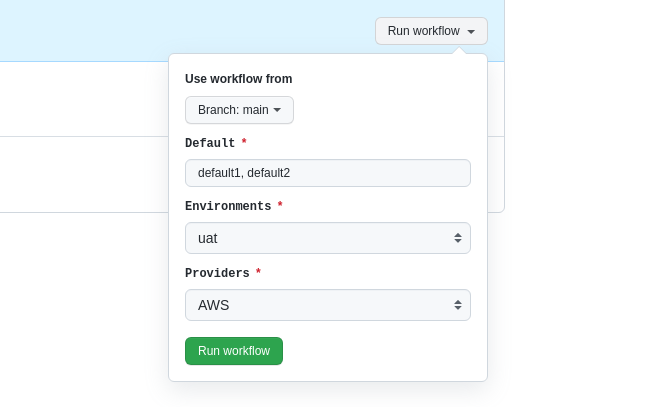
Install extension Once installed, the extension is ready to use and the final result we see is the Actions interface with drop-downs. :) showcase-1 showcase-2

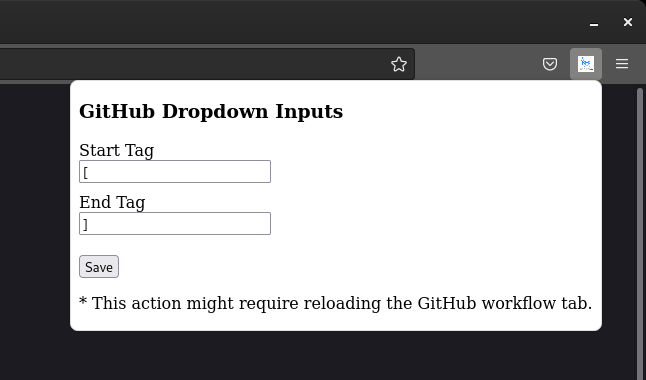
Configuring selectors Go to the top right corner of the browser you are using and click on the extension logo. A screen will popup with tag options. Choose the right tags for you and save it.
This action might require reloading the GitHub workflow tab. config

Have fun using drop-downs inside GitHub. If you liked this project please share this post and if possible star within the repository. Also feel free to connect with me on LinkedIn: https://www.linkedin.com/in/arthurbdiniz

References
  • https://github.community/t/can-workflow-dispatch-input-be-option-list/127338
  • https://stackoverflow.com/questions/69296314/dropdown-for-github-workflows-input-parameters

21 October 2021

Lisandro Dami n Nicanor P rez Meyer: CMake toolchain files with Debian's cross compilers

Almost a year ago I added a script made by Helmut Grohne that is able to create a CMake toolchain file pre-filled with Debian-specifics ross compilers. The tool is installed by the cmake package and located at /usr/share/cmake/debtoolchainfilegen. It's usage is simple:

debtoolchainfilegen (arch) > cmake_toolchain_<arch>.cmake
Where $arch can be any of the Debian supported architectures, like arm64 (aka aarch64):
$ /usr/share/cmake/debtoolchainfilegen arm64 > /tmp/cmake_toolchain_aarch64
dpkg-architecture: warning: specified GNU system type aarch64-linux-gnu does not match CC system type x86_64-linux-gnu, try setting a correct CC environment variable
$ cat /tmp/cmake_toolchain_aarch64
# Use it while calling CMake:
#   mkdir build; cd build
#   cmake -DCMAKE_TOOLCHAIN_FILE="/path/to/cmake_toolchain_<arch>.cmake" ../
#
set(CMAKE_SYSTEM_NAME "Linux")
set(CMAKE_SYSTEM_PROCESSOR "aarch64")
set(CMAKE_C_COMPILER "aarch64-linux-gnu-gcc")
set(CMAKE_CXX_COMPILER "aarch64-linux-gnu-g++")
set(PKG_CONFIG_EXECUTABLE "aarch64-linux-gnu-pkg-config")
set(PKGCONFIG_EXECUTABLE "aarch64-linux-gnu-pkg-config")
set(QMAKE_EXECUTABLE "aarch64-linux-gnu-qmake")
Note: I kept the warnings, which can be ignored and won't end up on the final file. As you might have noticed the file itself has instructions on how to use it. Of course we will need the requires cross toolchain for the selected arch. For example using arm64:
$ apt install crossbuild-essential-arm64
That's it, we can now start cross building our cmake-based software.

20 October 2021

Arturo Borrero Gonz lez: Iterating on how we do NFS at Wikimedia Cloud Services

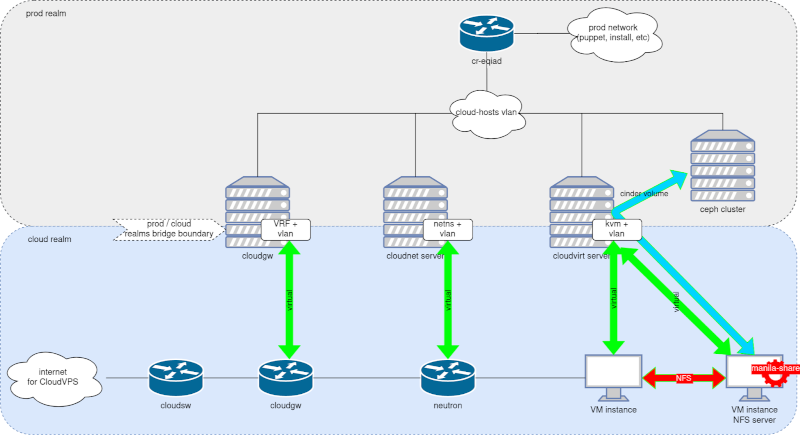
Logos This post was originally published in the Wikimedia Tech blog, authored by Arturo Borrero Gonzalez. NFS is a central piece of infrastructure that is essential to services like Toolforge. Recently, the Cloud Services team at Wikimedia had been reviewing how we do NFS. The current situation NFS is a central piece of technology for some of the services that the Wikimedia Cloud Services team offers to the community. We have several shares that power different use cases: Toolforge user home directories live on NFS, and Cloud VPS users can also access dumps using this protocol. The current setup involves several physical hardware servers, with about 20TB of storage, offering shares over 10G links to the cloud. For the system to be more fault-tolerant, we duplicate each share for redundancy using DRBD. Running NFS on dedicated hardware servers has traditionally offered us advantages: mostly on the performance and the capacity fields. As time has passed, we have been enumerating more and more reasons to review how we do NFS. For one, the current setup is in violation of some of our internal rules regarding realm separation. Additionally, we had been longing for additional flexibility managing our servers: we wanted to use virtual machines managed by Openstack Nova. The DRBD-based high-availability system required mostly a hand-crafted procedure for failover/failback. There s also some scalability concerns as NFS is easy to grow up, but not to grow horizontally, and of course, we have to be able to keep the tenancy setup while doing so, something that NFS does by using LDAP/Unix users and may get complicated too when growing. In general, the servers have become too big to fail , clearly technical debt, and it has taken us years to decide on taking on the task to rethink the architecture. It s worth mentioning that in an ideal world, we wouldn t depend on NFS, but the truth is that it will still be a central piece of infrastructure for years to come in services like Toolforge. Over a series of brainstorming meetings, the WMCS team evaluated the situation and sorted out the many moving parts. The team managed to boil down the potential service future to two competing options: Then we decided to research both options in parallel. For a number of reasons, the evaluation was timeboxed to three weeks. Both ideas had a couple of points in common: the NFS data would be stored on our Ceph farm via Cinder volumes, and we would rely on Ceph reliability to avoid using DRBD. Another open topic was how to back up data from Ceph, to store our important bits in more than one basket. We will get to the back up topic later. The manila experiment The Wikimedia Foundation was an early adopter of some Openstack components (Nova, Glance, Designate, Horizon), but Manila was never evaluated for usage until now. Our approach for this experiment was to closely follow the upstream guidelines. We read the documentation and tried to understand the different setups you can build with Manila. As we often feel with other Openstack components, the documentation doesn t perfectly describe how to introduce a given component in your particular local setup. Here we use an admin-controller flat-topology Neutron network. This network is shared by all tenants (or projects) in our Openstack deployment. Also, Manila can use many different driver backends, for things like NetApps or CephFS that we don t use , yet. After some research, the generic driver was the one that seemed to better fit our use case. The generic driver leverages Nova virtual machines instances plus Cinder volume to create and manage the shares. In general, Manila supports two operational modes, whether it should create/destroy the share servers (i.e, the virtual machine instances) or not. This option is called driver_handles_share_server (or DHSS) and takes a boolean value. We were interested in trying with DHSS=true, to really benefit from the potential of the setup. Manila diagram NFS idea 6, original image in Wikitech So, after sorting all these variables, we moved on with our initial testing. We built a PoC setup as depicted in the diagram above, with the manila-share component running in a virtual machine inside the cloud. The PoC led to us reporting several bugs upstream: In some cases we tried to address these bugs ourselves: It s worth mentioning that the upstream community was extra-welcoming to us, and we re thankful for that. However, at the end of our three-week period, our Manila setup still wasn t working as expected. Your experience may change with other drivers perhaps the ZFSonLinux or the CephFS ones. In general, we were having trouble making the setup work as expected, so we decided to abandon this approach in favor of the other option we were considering at the beginning. Simple virtual machine serving NFS The alternative was to create a Nova virtual machine instance by hand and to configure it using puppet. We have been investing in an automation framework lately, so the idea is to not actually create the server by hand. Anyway, the data would be decoupled from the instance into Cinder volumes, which led us to the question we left for later: How should we back up those terabytes of important information? Just to be clear, the backup problem was independent of the above options; with Manila we would still have had to solve the same challenge. We would like to see our data be backed up somewhere else other than in Ceph. And that s exactly where we are at right now. We ve been exploring different backup strategies and will finally use the Cinder backup API. Conclusion The iteration will end with the dedicated NFS hardware servers being stopped, and the shares being served from within the cloud. The migration will take some time to happen because we will check and double-check that everything works as expected (including from the performance point of view) before making definitive changes. We already have some plans to make sure our users experience as little service impact as possible. The most troublesome shares will be those related to Toolforge. At some point we will need to disallow writes to the NFS share, rsync the data out of the hardware servers into the Cinder volumes, point the NFS clients to the new virtual machines, and then enable writes again. The main Toolforge share has about 8TB of data, so this will take a while. We will have more updates in the future. Who knows, perhaps our next-next iteration, in a couple of years, will see us adopting Openstack Manila for good. Featured image credit: File:(from break water) Manila Skyline panoramio.jpg, ewol, CC BY-SA 3.0 This post was originally published in the Wikimedia Tech blog, authored by Arturo Borrero Gonzalez.
19 October 2021

Rapha&#235;l Hertzog: Freexian s report about Debian Long Term Support, September 2021

A Debian LTS logo
Like each month, have a look at the work funded by Freexian s Debian LTS offering. Debian project funding Folks from the LTS team, along with members of the Debian Android Tools team and Phil Morrel, have proposed work on the Java build tool, gradle, which is currently blocked due to the need to build with a plugin not available in Debian. The LTS team reviewed the project submission and it has been approved. After approval we ve created a Request for Bids which is active now. You ll hear more about this through official Debian channels, but in the meantime, if you feel you can help with this project, please submit a bid. Thanks! This September, Freexian set aside 2550 EUR to fund Debian projects. We re looking forward to receive more projects from various Debian teams! Learn more about the rationale behind this initiative in this article. Debian LTS contributors In September, 15 contributors have been paid to work on Debian LTS, their reports are available: Evolution of the situation In September we released 30 DLAs. September was also the second month of Jeremiah coordinating LTS contributors. Also, we would like say that we are always looking for new contributors to LTS. Please contact Jeremiah if you are interested! The security tracker currently lists 33 packages with a known CVE and the dla-needed.txt file has 26 packages needing an update. Thanks to our sponsors Sponsors that joined recently are in bold.

Dirk Eddelbuettel: RVowpalWabbit 0.0.16: One More CRAN Request

Another maintenance RVowpalWabbit released brings us to version 0.0.16 on CRAN. This is last package for which configure.ac needed an update to current standards (see the updates of corels, RcppGSL, RQuantLib, and littler). The make matters more interesting we also had to address one UBSAN issue we could not reproduce locally (which, it turns out, was our fault because we had not rebuilt one package dependency under UBSAN). But Prof Ripley confirmed the issue as addressed so all is good for now. As noted before, there is a newer package rvw based on the excellent GSoC 2018 and beyond work by Ivan Pavlov (mentored by James and myself) so if you are into Vowpal Wabbit from R go check it out. CRANberries provides a summary of changes to the previous version. More information is on the RVowpalWabbit page. Issues and bugreports should go to the GitHub issue tracker. If you like this or other open-source work I do, you can now sponsor me at GitHub.

This post by Dirk Eddelbuettel originated on his Thinking inside the box blog. Please report excessive re-aggregation in third-party for-profit settings.

18 October 2021

Gunnar Wolf: raspi.debian.net now hosted on Debian infrastructure

So, since I registered the URL for serving the unofficial Debian images for the Raspberry computers, raspi.debian.net, in April 2020, I had been hosting it in my Dreamhost webspace. Over two years ago yes, before I finished setting it up in Dreamhost Steve McIntyre approached me and invited me to host the images under the Debian cdimages user group. I told him I d first just get the setup running, and later I would approach him for finalizing the setup. Then, I set up the build on my own server, hosted on my Dreamhost account and forgot about it for many months. Last month, there was a not particularly happy flamewar in debian-arm@lists.debian.org finished with me stating I would be moving the hosting to Debian infrastructure soon. Well It took me a bit over a month to get this sorted out, together with several days of half-broken links, but it is finally done: raspi.debian.net is a CNAME for ftp.acc.umu.se, which is the same system that hosts cdimage.debian.org. And, of course it is also reachable as https://cdimage.debian.org/cdimage/unofficial/raspi/ looks more official, but is less memorable Thanks a lot to Steve for the nudging, and to maswan to help finalizing the setup. What next? Well, the images are being built on my server. I d love to move the builder over to Debian machines as well. When? How? That s still in the air.

Dirk Eddelbuettel: dang 0.0.14: Several Updates

A new release of the dang package arrived at CRAN a couple of hours ago, exactly eight months after the previous release. The dang package regroups a few functions of mine that had no other home as for example lsos() from a StackOverflow question from 2009 (!!), the overbought/oversold price band plotter from an older blog post, the market monitor from the last release as well the checkCRANStatus() function recently tweeted about by Tim Taylor. This release regroups a few small edits to several functions, adds a sample function for character encoding reading and conversion using a library already used by R (hence look Ma, no new depends ), adds a weekday helper, and a sample usage (computing rolling min/max values) of a new simple vector class added to tidyCpp (and the function and class need to get another blog post or study ), and an experimental git sha1sum and date marker (as I am not the fan of autogenerated binaries from repos as opposed to marked released meaning: we may see different binary release with the same version number). The full NEWS entry follows.

Changes in version 0.0.14 (2021-10-17)
  • Updated continuous integration to run on Linux only.
  • Edited checkNonAscii.cpp for readability.
  • More robust title display in intradayMarketMonitor.R.
  • New C++-based function to read and convert encoding via the R-supplied iconv library, noted a potential variability.
  • New function wday returning day of the week as integer.
  • The signature to as.data.table was standardized.
  • A new function rollMinMax was added illustrating use of the NumVec class from tidyCpp.
  • The configure script can record the last commit date and sha1 to automate timestamping builds, but not activated in this release.
  • checkCRANStatus() now works correctly for single-package lookups (Jordan Mark Barbone in #4).

Courtesy of my CRANberries, there is a comparison to the previous release. For questions or comments use the issue tracker off the GitHub repo. If you like this or other open-source work I do, you can now sponsor me at GitHub.

This post by Dirk Eddelbuettel originated on his Thinking inside the box blog. Please report excessive re-aggregation in third-party for-profit settings.

Next.

Previous.