Search Results: "dom"

15 May 2013

Daniel Kahn Gillmor: OpenPGP User ID Comments considered harmful

Most OpenPGP User IDs look like this:
Jane Q. Public <jane@example.org>
This is clean, clear, and unambiguous. However, some tools (gpg, enigmail among others) ask the user to provide a "Comment:" field when they are choosing a new User ID (e.g. when making a new key). These UI prompts are evil. The savvy user knows to avoid entering anything in this field, so that they can end up with a User ID like the one above. The user who provides something here (perhaps even something inconsequential like "I like strawberries", due to not being sure what should go in this little box) will instead end up with a User ID like:
Jane Q. Public (I like strawberries) <jane@example.org>
This is bad. This means that Jane is asking the people who certify her key+userid to certify whether she actually likes strawberries (how could they know? what if she changes her mind? should they revoke their certifications?) and anywhere that she is referred to by name will include this mention of strawberries. This is not Jane's identity, and it doesn't belong in an OpenPGP User ID packet. Furthermore, since User IDs are atomic, if Jane wants to change the comment field (but leave her name and e-mail address the same), she will instead need to create a new User ID, publish it, get everyone who has certified her old key+userid to certify the key+newuserid, and then revoke the old one. It is difficult already to help people understand and participate in the certification network that forms that backbone of OpenPGP's so-called "web of trust". These bogus comment fields make an already-difficult task harder. And all because of strawberries! Tools like enigmail and gpg should not expose the "Comment:" field to users who are generating keys or choosing new User IDs. If they feel it absolutely must be present for some weird corner case that 0.1% of their users will have, they could require that the user enters some sort of "expert mode" before prompting the user to do something that is likely to be a mistake. There is almost no legitimate reason for anyone to use this field. Let's go through some examples of this people use, taken from some examples i have lying around (identifying marks have been changed to protect the innocent who were duped by this bad UI choice, but you can probably find them on the public keyserver network if you want to hunt around):
domain repetition
John Q. Public (Debian) <johnqpublic@debian.org>
We know you're with debian already from the @debian.org address. If this is in contrast to your other address (johnqpublic@example.org) so that people know where to send you debian-related e-mail, this is still not necessary. Lest you think i'm just calling out debian developers, people with @ubuntu.com addresses and (Ubuntu) comments (as well as @example.edu addresses and (Example University) comments and @example.com addresses and (Example Corp) comments) are out there too.
nicknames already evident
John Q. Public (Johnny) <johnqpublic@example.net>
John Q. Public (wackydude) <wackydude@example.net>
Again, the information these comments are providing offers no clear disambiguation from the info already contained in the name and e-mail address, and just muddies the water about what the people who certify this identity should actually be trying to verify before they make their certification.
"Work"
John Q. Public (Work) <johnqpublic@example.com>
if John's correspondents know that he works for Example Corp, then "Work" isn't helpful to them, because they already know this as the address that they're writing to him with. If they don't know that, then they probably aren't writing to him at work, so they don't need this comment either. The same problem appears (for example) with literal comments of (School) next to their @example.edu address.
This is my nth try at this crazy system!
John Q. Public (This is my second key) <johnqpublic@example.com>
John Q. Public (This is my primary key) <johnqpublic@example.com>
John Q. Public (No wait really use this one) <johnqpublic@example.com>
OpenPGP is confusing, and it can be tricky to get it right. We all know :) This is still not part of John's identity. If you want to designate a key as your preferred key, keep it up-to-date, get people to certify it, and revoke or expire your old keys. People who care can look at the timestamps on your keys and tell which ones are the most recent ones. You do have a revocation certificate for your key handy just in case you lose it, right?
Don't use this key
John Q. Public (Old key, do not use) <johnqpublic@example.com>
John Q. Public (Please only use this through September 2004) <johnqpublic@example.com>
This kind of sentiment is better expressed by revoking the key in question or setting an expiration time on the key or User ID self-sig directly. This sentiment is not part of John's identity, and shouldn't be included as though it were.
"none"
John Q. Public (none) <johnqpublic@example.com>
sigh. This is clearly someone getting mixed up by the UI.
I use strong crypto!
John Q. Public (3092 bits of RSA) <johnqpublic@example.com>
This comment refers to the strength of the key material, or the algorithms preferred by the user. Since the User ID is associated with the key material already, people who care about this information can get it from the key directly. This is also not part of the user's actual identity.
"no comment"
John Q. Public (no comment) <johnqpublic@example.com>
This is actually not uncommon (some keyservers reply "too many matches!"). It shows that the user is witty and can think on their feet (at least once), but it is still not part of the user's identity.
But wait (i hear you say)! I have a special case that actually is a legitimate use of the comment field that cannot be expressed in OpenPGP in any other way! I'm sure that such cases exist. I've even seen one or two of them. The fact that one or two cases exist does not excuse the fact that that overwhelming majority of these comments in OpenPGP User IDs are a mistake, caused only by bad UI design that prompts people to put something (anything!) in the empty box (or on the command prompt, depending on your preference). And this mistake is one of the thousand papercuts that inhibits the robust growth of the OpenPGP certification network that some people call the "web of trust". Let's avoid them so we can focus on the other 999 papercuts. Please don't use comments in your OpenPGP User ID. And if you make a user interface for OpenPGP that prompts the user to decide on a new User ID, please don't include a prompt for "Comment" unless the user has already certified that they are really and truly a special special snowflake. Thanks!Tags: openpgp, ui

11 May 2013

Russell Coker: Geographic Sorting Lessons to Learn from Ingress

I ve recently been spending a bit of my spare time playing Ingress (see the Wikipedia page if you haven t heard of it). A quick summary is that Ingress is an Android phone game that involves geo-location of portals that you aim to control and most operations on a portal can only be performed when you are within 40 meters so you do a lot of travelling to get to portals at various locations. One reasonably common operation that can be performed remotely is recharging a portal by using it s key, after playing for a while you end up with a collection of keys which can be difficult to manage. Until recently the set of portal keys was ordered alphabetically. This isn t particularly useful given the fact that portal names are made up by random people who photograph things that they consider to be landmarks. If people tried to use a consistent geographic naming system (which was short enough to fit in large print on a phone display) then it would be really difficult to make it usable. But as joke names are accepted there s just no benefit in having a sort by name. A recent update to the Ingress client (the program which runs on the Android phone and is used for all game operations) changed the sort order to be by distance. This makes it really easy to see the portals which are near you (which is really useful) but also means that the order changes whenever you move which isn t such a good idea for use on a mobile phone. It s quite common for Ingress players to recharge portals while on public transport. But with the new Ingress client the list order will change as you move so anyone who does recharging on a train will find the order of the list changing during the process and it s really difficult to find items in a list which is in a different order each time you look at it. This problem of ordering by location has a much greater scope than Ingress. One example is collections of GPS tagged photographs, it wouldn t make any sense to mix the pictures of two different sets of holiday pictures because they were both taken in countries that are the same distance from my current location (as the current Ingress algorithm would do). It seems to me that the best way of sorting geo-tagged items (Ingress portals, photos, etc) is to base it on the distance from a fixed point which the user can select. It could default to the user s current location but in that case the order of the list should remain unchanged at least until the user returns to the main menu and I think it would be ideal for the order to remain unchanged until the user requests it. I think that most Ingress players would agree with me that fixing annoying mis-features of the Ingress client such as this one would be better for the game than adding new features. While most computer games have some degree of make-work (in almost every case a computer could do things better than a person) I don t think that finding things in a changing list should be part of the make-work. Also it would be nice if Google released some code for doing this properly to reduce the incidence of other developers implementing the same mistakes as the Ingress developers in this regard.

9 May 2013

Benjamin Mako Hill: The Remixing Dilemma: The Trade-off Between Generativity and Originality

This post was written with Andr s Monroy-Hern ndez. It is a summary of a paper just published in American Behavioral Scientist. You can also read the full paper: The remixing dilemma: The trade-off between generativity and originality. It is part of a series of papers I have written with Monroy-Hern ndez using data from Scratch. You can find the others on my academic website.
Remixing the reworking and recombination of existing creative artifacts represents a widespread, important, and controversial form of social creativity online. Proponents of remix culture often speak of remixing in terms of rich ecosystems where creative works are novel and highly generative. However, examples like this can be difficult to find. Although there is a steady stream of media being shared freely on the web, only a tiny fraction of these projects are remixed even once. On top of this, many remixes are not very different from the works they are built upon. Why is some content more attractive to remixers? Why are some projects remixed in deeper and more transformative ways?
Remix Diagram
We try to shed light on both of these questions using data from Scratch a large online remixing community. Although we find support for several popular theories, we also present evidence in support of a persistent trade-off that has broad practical and theoretical implications. In what we call the remixing dilemma, we suggest that characteristics of projects that are associated with higher rates of remixing are also associated with simpler and less transformative types of derivatives.

Our study is focused on two interrelated research questions. First, we ask why some projects shared in remixing communities are more or less generative than others. Generativity a term we borrow from Jonathan Zittrain describes creative works that are likely to inspire follow-on work. Several scholars have offered suggestions for why some creative works might be more generative than others. We focus on three central theories:
  1. Projects that are moderately complicated are more generative. The free and open source software motto release early and release often suggests that simple projects will offer more obvious opportunities for contribution than more polished projects. That said, projects that are extremely simple (e.g., completely blank slates) may also uninspiring to would-be contributors.
  2. Projects by prominent creators are more generative. The reasoning for this claim comes from the suggestion that remixing can act as a form of cultural conversation and that the work of popular creators can act like a common medium or language.
  3. Projects that are remixes themselves are more generative. The reasoning for this final claim comes from the idea that remixing thrives through the accumulation of contributions from groups of people building on each other s work.
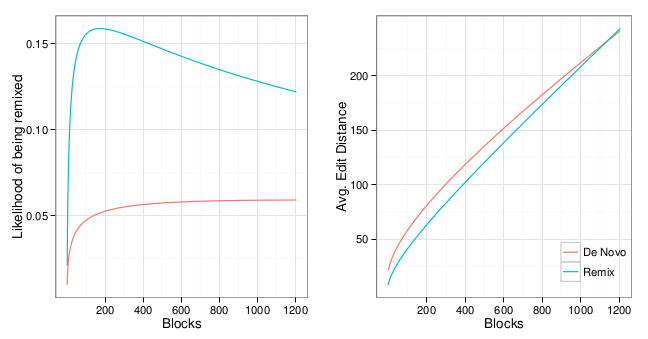
Our second question focuses on the originality of remixes and asks when more or less transformative remixing occurs. For example, highly generative projects may be less exciting if the projects produced based on them are all near-identical copies of antecedent projects. For a series of reasons including the fact that increased generativity might come by attracting less interested, skilled, or motivated individuals we suggest that each of the factors associated with generativity will also be associated with less original forms of remixing. We call this trade-off the remixing dilemma. We answer both of our research questions using a detailed dataset from Scratch, where young people build, share, and collaborate on interactive animations and video games. The community was built to support users of the Scratch programming environment, a desktop application with functionality similar to Flash created by the Lifelong Kindergarten Group at the MIT Media Lab. Scratch is designed to allow users to build projects by integrating images, music, sound, and other media with programming code. Scratch is used by more than a million users, most of them under 18 years old. To test our three theories about generativity, we measure whether or not, as well as how many times, Scratch projects were remixed in a dataset that includes every shared project. Although Scratch is designed as a remixing community, only around one tenth of all Scratch projects are ever remixed. Because more popular projects are remixed more frequently simply because of exposure, we control for the number of times each project is viewed. Our analysis shows at least some support for all three theories of generativity described above. (1) Projects with moderate amounts of code are remixed more often than either very simple or very complex projects. (2) Projects by more prominent creators are more generative. (3) Remixes are more likely to attract remixers than de novo projects. To test our theory that there is a trade-off between generativity and originality, we build a dataset that includes every Scratch remix and its antecedent. For each pair, we construct a measure of originality by comparing the remix to its antecedent and computing an edit distance (a concept we borrow from software engineering) to determine how much the projects differ. We find strong evidence of a trade-off: (1) Projects of moderate complexity are remixed more lightly than more complicated projects. (2) Projects by more prominent creators tend to be remixed in less transformative ways. (3) Cumulative remixing tends to be associated with shallower and less transformative derivatives. That said, our support for (1) is qualified in that we do not find evidence of the increased originality for the simplest projects as our theory predicted.
Two plots of estimated values for prototypical projects. Panel 1 (left) display predicted probabilities of being remixed. Panel 2 (right) display predicted edit distances. Both panels show predicted values for both remixes and de novo projects from 0 to 1,204 blocks (99th percentile).

Two plots of estimated values for prototypical projects. Panel 1 (left) displays predicted probabilities of being remixed. Panel 2 (right) displays predicted edit distances. Both panels show predicted values for both remixes and de novo projects from 0 to 1,204 blocks (99th percentile).

We feel that our results raise difficult but important challenges, especially for the designers of social media systems. For example, many social media sites track and display user prominence with leaderboards or lists of aggregate views. This technique may lead to increased generativity by emphasizing and highlighting creator prominence. That said, it may also lead to a decrease in originality of the remixes elicited. Our results regarding the relationship of complexity to generativity and originality of remixes suggest that supporting increased complexity, at least for most projects, may have fewer drawbacks. As supporters and advocates of remixing, we feel that although highly generative works that lead to highly original derivatives may be rare and difficult for system designers to support, understanding remixing dynamics and encouraging these rare projects remain a worthwhile and important goal. Benjamin Mako Hill, Massachusetts Institute of Technology
Andr s Monroy-Hern ndez, Microsoft Research
For more, see our full paper, The remixing dilemma: The trade-off between generativity and originality. Published in American Behavioral Scientist. 57-5, Pp. 643 663. (Official Link, Pay-Walled ).

7 May 2013

Steve Kemp: So progress is going well on lumail

A massive marathon has resulted in my lumail mail client working well. Functionally the application looks little different to the previous C-client, but it is a lot cleaner, neater, and nicer internally. The configuration file luamail.lua gives a good flavour of the code, and the github repository has brief instructions. Initially I decied that the navigation/index stuff was easy and the rest of the program would be hard; dealing with GPG-signatures, MIME-parts, etc. But I'm stubborn enough to keep going. If I can get as far as reading messages, with MIME handled properly, and replying then I can switch to using it immediately which will spur further development. I'm really pleased with the keybinding code, and implementing the built-in REPL-like prompt was a real revelation. Worht it for that alone. The domain name lumail.org was available. So I figured why not?

Matthew Garrett: A short introduction to TPMs

I've been working on TPMs lately. It turns out that they're moderately awful, but what's significantly more awful is basically all the existing documentation. So here's some of what I've learned, presented in the hope that it saves someone else some amount of misery.
What is a TPM?TPMs are devices that adhere to the Trusted Computing Group's Trusted Platform Module specification. They're typically microcontrollers[1] with a small amount of flash, and attached via either i2c (on embedded devices) or LPC[2] (on PCs). While designed for performing cryptographic tasks, TPMs are not cryptographic accelerators - in almost all situations, carrying out any TPM operations on the CPU instead would be massively faster[3]. So why use a TPM at all?
Keeping secrets with a TPMTPMs can encrypt and decrypt things. They're not terribly fast at doing so, but they have one significant benefit over doing it on the CPU - they can do it with keys that are tied to the TPM. All TPMs have something called a Storage Root Key (or SRK) that's generated when the TPM is initially configured. You can ask the TPM to generate a new keypair, and it'll do so, encrypt them with the SRK (or another key descended from the SRK) and hand it back to you. Other than the SRK (and another key called the Endorsement Key, which we'll get back to later), these keys aren't actually kept on the TPM - the running OS stores them on disk. If the OS wants to encrypt or decrypt something, it loads the key into the TPM and asks it to perform the desired operation. The TPM decrypts the key and then goes to work on the data. For small quantities of data, the secret can even be stored in the TPM's nvram rather than on disk.

All of this means that the keys are tied to a system, which is great for security. An attacker can't obtain the decrypted keys, even if they have a keylogger and full access to your filesystem. If I encrypt my laptop's drive and then encrypt the decryption key with the TPM, stealing my drive won't help even if you have my passphrase - any other TPM simply doesn't have the keys necessary to give you access.

That's fine for keys which are system specific, but what about keys that I might want to use on multiple systems, or keys that I want to carry on using when I need to replace my hardware? Keys can optionally be flagged as migratable, which makes it possible to export them from the TPM and import them to another TPM. This seems like it defeats most of the benefits, but there's a couple of features that improve security here. The first is that you need the TPM ownership password, which is something that's set during initial TPM setup and then not usually used afterwards. An attacker would need to obtain this somehow. The other is that you can set limits on migration when you initially import the key. In this scenario the TPM will only be willing to export the key by encrypting it with a pre-configured public key. If the private half is kept offline, an attacker is still unable to obtain a decrypted copy of the key.
So I just replace the OS with one that steals the secret, right?Say my root filesystem is encrypted with a secret that's stored on the TPM. An attacker can replace my kernel with one that grabs that secret once the TPM's released it. How can I avoid that?

TPMs have a series of Platform Configuration Registers (PCRs) that are used to record system state. These all start off programmed to zero, but applications can extend them at runtime by writing a sha1 hash into them. The new hash is concatenated to the existing PCR value and another sha1 calculated, and then this value is stored in the PCR. The firmware hashes itself and various option ROMs and adds those values to some PCRs, and then grabs the bootloader and hashes that. The bootloader then hashes its configuration and the files it reads before executing them.

This chain of trust means that you can verify that no prior system component has been modified. If an attacker modifies the bootloader then the firmware will calculate a different hash value, and there's no way for the attacker to force that back to the original value. Changing the kernel or the initrd will result in the same problem. Other than replacing the very low level firmware code that controls the root of trust, there's no way an attacker can replace any fundamental system components without changing the hash values.

TPMs support using these hash values to decide whether or not to perform a decryption operation. If an attacker replaces the initrd, the PCRs won't match and the TPM will simply refuse to hand over the secret. You can actually see this in use on Windows devices using Bitlocker - if you do anything that would change the PCR state (like booting into recovery mode), the TPM won't hand over the key and Bitlocker has to prompt for a recovery key. Choosing which PCRs to care about is something of a balancing act. Firmware configuration is typically hashed into PCR 1, so changing any firmware configuration options will change it. If PCR 1 is listed as one of the values that must match in order to release the secret, changing any firmware options will prevent the secret from being released. That's probably overkill. On the other hand, PCR 0 will normally contain the firmware hash itself. Including this means that the user will need to recover after updating their firmware, but failing to include it means that an attacker can subvert the system by replacing the firmware.
What about using TPMs for DRM?In theory you could populate TPMs with DRM keys for media playback, and seal them such that the hardware wouldn't hand them over. In practice this is probably too easily subverted or too user-hostile - changing default boot order in your firmware would result in validation failing, and permitting that would allow fairly straightforward subverted boot processes. You really need a finer grained policy management approach, and that's something that the TPM itself can't support.

This is where Remote Attestation comes in. Rather than keep any secrets on the local TPM, the TPM can assert to a remote site that the system is in a specific state. The remote site can then make a policy determination based on multiple factors and decide whether or not to hand over session decryption keys. The idea here is fairly straightforward. The remote site sends a nonce and a list of PCRs. The TPM generates a blob with the requested PCR values, sticks the nonce on, encrypts it and sends it back to the remote site. The remote site verifies that the reply was encrypted with an actual TPM key, makes sure that the nonce matches and then makes a policy determination based on the PCR state.

But hold on. How does the remote site know that the reply was encrypted with an actual TPM? When TPMs are built, they have something called an Endorsement Key (EK) flashed into them. The idea is that the only way to have a valid EK is to have a TPM, and that the TPM will never release this key to anything else. There's a couple of problems here. The first is that proving you have a valid EK to a remote site involves having a chain of trust between the EK and some globally trusted third party. Most TPMs don't have this - the only ones I know of that do are recent Infineon and STMicro parts. The second is that TPMs only have a single EK, and so any site performing remote attestation can cross-correlate you with any other site. That's a pretty significant privacy concern.

There's a theoretical solution to the privacy issue. TPMs never actually sign PCR quotes with the EK. Instead, TPMs can generate something called an Attestation Identity Key (AIK) and sign it with the EK. The OS can then provide this to a site called a PrivacyCA, which verifies that the AIK is signed by a real EK (and hence a real TPM). When a third party site requests remote attestation, the TPM signs the PCRs with the AIK and the third party site asks the PrivacyCA whether the AIK is real. You can have as many AIKs as you want, so you can provide each service with a different AIK.

As long as the PrivacyCA only keeps track of whether an AIK is valid and not which EK it was signed with, this avoids the privacy concerns - nobody would be able to tell that multiple AIKs came from the same TPM. On the other hand, it makes any PrivacyCA a pretty attractive target. Compromising one would not only allow you to fake up any remote attestation requests, it would let you violate user privacy expectations by seeing that (say) the TPM being used to attest to HolyScriptureVideos.com was also being used to attest to DegradingPornographyInvolvingAnimals.com.

Perhaps unsurprisingly (given the associated liability concerns), there's no public and trusted PrivacyCAs yet, and even if they were (a) many computers are still being sold without TPMs and (b) even those with TPMs often don't have the EK certificate that would be required to make remote attestation possible. So while remote attestation could theoretically be used to impose DRM in a way that would require you to be running a specific OS, practical concerns make it pretty difficult for anyone to deploy that at any point in the near future.
Is this just limited to early OS components?Nope. The Linux kernel has support for measuring each binary run or each module loaded and extending PCRs accordingly. This makes it possible to ensure that the running binaries haven't been modified on disk. There's not a lot of distribution infrastructure for setting this up, but in theory a distribution could deploy an entirely signed userspace and allow the user to opt into only executing correctly signed binaries. Things get more interesting when you add interpreted scripts to the mix, so there's still plenty of work to do there.
So what can I actually use a TPM for?Drive encryption is probably the best example (Bitlocker does it on Windows, and there's a LUKS-based implementation for Linux here) - while in theory you could do things like use your TPM as a factor in two-factor authentication or tie your GPG key to it, there's not a lot of existing infrastructure for handling all of that. For the majority of people, the most useful feature of the TPM is probably the random number generator. rngd has support for pulling numbers out of it and stashing them in /dev/random, and it's probably worth doing that unless you have an Ivy Bridge or other CPU with an RNG.

Things get more interesting in more niche cases. Corporations can bind VPN keys to corporate machines, making it possible to impose varying security policies. Intel use the TPM as part of their anti-theft technology on education-oriented devices like the Classmate. And in the cloud, projects like Trusted Computing Pools use remote attestation to verify that compute nodes are in a known good state before scheduling jobs on them.
Is there a threat to freedom?At the moment, probably not. The lack of any workable general purpose remote attestation makes it difficult for anyone to impose TPM-based restrictions on users, and any local code is obviously under the user's control - got a program that wants to read the PCR state before letting you do something? LD_PRELOAD something that gives it the desired response, or hack it so it ignores failure. It's just far too easy to circumvent.
Summary?TPMs are useful for some very domain-specific applications, drive encryption and random number generation. The current state of technology doesn't make them useful for practical limitations of end-user freedom.

[1] Ranging from 8-bit things that are better suited to driving washing machines, up to full ARM cores
[2] "Low Pin Count", basically ISA without the slots.
[3] Loading a key and decrypting a 5 byte payload takes 1.5 seconds on my laptop's TPM.

comment count unavailable comments

Timo Jyrinki: Qt 5 in Debian and Ubuntu, patches upstreaming

PackagesI quite like the current status of Qt 5 in Debian and Ubuntu (the links are to the qtbase packages, there are ca. 15 other modules as well). Despite Qt 5 being bleeding edge and Ubuntu having had the need to use it before even the first stable release came out in December, the co-operation with Debian has gone well. Debian is now having the first Qt 5 uploads done to experimental and later on to unstable. My work contributed to pkg-kde git on the modules has been welcomed, and even though more work has been done there by others, there haven't been drastic changes that would cause too big transition problems on the Ubuntu side. It has of course helped to ask others what they want, like the whole usage of qtchooser. Now with Qt 5.0.2 I've been able to mostly re-sync all newer changes / fixes to my packaging from Debian to Ubuntu and vice versa.

There will remain some delta, as pkg-kde plans to ask for a complete transition to qtchooser so that all Qt using packages would declare the Qt version either by QT_SELECT environment variable (preferable) or a package dependency (qt5-default or qt4-default). As a temporary change related to that, Debian will have a debhelper modification that defaults QT_SELECT to qt4 for the duration of the transition. Meanwhile, Ubuntu already shipped the 13.04 release with Qt 5, and a shortcut was taken there instead to prevent any Qt 4 package breakage. However, after the transition period in Debian is over, that small delta can again be removed.

I will also need to continue pushing any useful packaging I do to Debian. I pushed qtimageformats and qtdoc last week, but I know I'm still behind with some "possibly interesting" git snapshot modules like qtsensors and qtpim.

PatchesMore delta exists in the form of multiple patches related to the recent Ubuntu Touch efforts. I do not think they are of immediate interest to Debian let's start packaging Qt 5 apps to Debian first. However, about all of those patches have already been upstreamed to be part of Qt 5.1 or Qt 5.2, or will be later on. Some already were for 5.0.2.

A couple of months ago Ubuntu did have some patches hanging around with no clear author information. This was a result of the heated preparation for the Ubuntu Touch launches, and the fact that patches flew (too) quickly in place into various PPA:s. I started hunting down the authors, and the situation turned out to be better than I thought. About half of the patches were already upstreamed, and work on properly upstreaming the other ones was swiftly started after my initial contact. Proper DEP3 fields do help understanding the overall situation. There are now 10 Canonical individuals in the upstream group of contributors, and in the last week's sprint it turned out more people will be joining them to upstream their future patches.

Nowadays about all the requests I get for including patches from developers are stuff that was already upstreamed, like the XEmbed support in qtbase. This is how it should be.

One big patch still being Ubuntu only is the Unity appmenu support. There was a temporary solution for 13.04 that forward-ported the Qt 4 way of doing it. This will be however removed from the first 13.10 ('saucy') upload, as it's not upstreamable (the old way of supporting Unity appmenus was deliberately dropped from Qt 5). A re-implementation via QPA plugin support is on its way, but it may be that the development version users will be without appmenu support for some duration. Another big patch is related to qtwebkit's device pixel ratio, which will need to be fixed. Apart from these two areas of work that need to be followed through, patches situation is quite nice as mentioned.
ConclusionFree software will do world domination, and I'm happy to be part of it.

5 May 2013

Vasudev Kamath: CDBS Packaging: package relationship management

(It took me a while to come up with new CDBS packaging series post not because I stopped using CDBS just because I was procrastinating myself as busy) This is the second post in the CDBS packaging series. In this series I'm going to talk about package relationship management. The better example where this feature is useful is packages where build-depends and run-time dependencies overlap. Most of the Perl modules which have test suites have build-depend and run-time dependency intersection. So let me take example of a Perl module. First lets see control file of a Perl package which is not using CDBS and then let me explain how CDBS can help you improve the situation. I choose libxml-libxml-perl lets see part of control file which includes Build-Depends Depends Suggests Recommends.
Source: libxml-libxml-perl
Maintainer: Debian Perl Group <pkg-perl-maintainers@lists.alioth.debian.org>
Uploaders: Jonathan Yu <jawnsy@cpan.org>,
 gregor herrmann <gregoa@debian.org>,
 Chris Butler <chrisb@debian.org>
Section: perl
Priority: optional
Build-Depends: perl (>= 5.12),
 debhelper (>= 9.20120312),
 libtest-pod-perl,
 libxml2-dev,
 libxml-namespacesupport-perl,
 libxml-sax-perl,
 zlib1g-dev
Standards-Version: 3.9.4
Vcs-Browser: http://anonscm.debian.org/gitweb/?p=pkg-perl/packages/libxml-libxml-perl.git
Vcs-Git: git://anonscm.debian.org/pkg-perl/packages/libxml-libxml-perl.git
Homepage: https://metacpan.org/release/XML-LibXML/
Package: libxml-libxml-perl
Architecture: any
Depends: $ shlibs:Depends , $ misc:Depends , $ perl:Depends ,
 libxml-namespacesupport-perl,
 libxml-sax-perl
Breaks: libxml-libxml-common-perl
Replaces: libxml-libxml-common-perl
Description: Perl interface to the libxml2 library
 XML::LibXML is a Perl interface to the GNOME libxml2 library, which provides
 interfaces for parsing and manipulating XML files. This module allows Perl
 programmers to make use of the highly capable validating XML parser and the
 high performance Document Object Model (DOM) implementation. Additionally, it
 supports using the XML Path Language (XPath) to find and extract information.
So 2 packages are both in Build-Depends and Depends field
  1. libsax-xml-perl
  2. libxml-namespacesupport-perl
So in this situation there is a possibility that we miss to add one or both of these packages into Depends field, I'm not saying we will surely miss but we might after all we are all human beings. So how can we improve the situation using CDBS? Let me go through step by step on what we need to do.
  1. Create a file called control.in with same above contents but slight modification in Build-Depends and Depends section. I will display the diff below to avoid re-pasting entire file again and again.
--- debian/control      2013-04-28 23:08:11.930082600 +0530
+++ debian/control.in   2013-05-04 20:51:18.849680419 +0530
@@ -5,13 +5,7 @@
  Chris Butler <chrisb@debian.org>
 Section: perl
 Priority: optional
-Build-Depends: perl (>= 5.12),
- debhelper (>= 9.20120312),
- libtest-pod-perl,
- libxml2-dev,
- libxml-namespacesupport-perl,
- libxml-sax-perl,
- zlib1g-dev
+Build-Depends: @cdbs@
 Standards-Version: 3.9.4
 Vcs-Browser: http://anonscm.debian.org/gitweb/?p=pkg-perl/packages/libxml-libxml-perl.git
 Vcs-Git: git://anonscm.debian.org/pkg-perl/packages/libxml-libxml-perl.git
@@ -20,8 +14,7 @@
 Package: libxml-libxml-perl
 Architecture: any
 Depends: $ shlibs:Depends , $ misc:Depends , $ perl:Depends ,
- libxml-namespacesupport-perl,
- libxml-sax-perl
+ $ cdbs:Depends 
 Breaks: libxml-libxml-common-perl
 Replaces: libxml-libxml-common-perl
 Description: Perl interface to the libxml2 library
@@ -30,4 +23,3 @@
  programmers to make use of the highly capable validating XML parser and the
  high performance Document Object Model (DOM) implementation. Additionally, it
  supports using the XML Path Language (XPath) to find and extract information.
-
  1. Next we need to have something like below in the rule files
#!/usr/bin/make -f
include /usr/share/cdbs/1/rules/debhelper.mk
include /usr/share/cdbs/1/rules/utils.mk
include /usr/share/cdbs/1/rules/upstream-tarball.mk
include /usr/share/cdbs/1/class/perl-makemaker.mk
pkg = $(DEB_SOURCE_PACKAGE)
deps = libxml-libxml-perl libxml-sax-perl
deps-test = libtest-pod-perl
CDBS_BUILD_DEPENDS +=, $(deps), $(deps-test)
CDBS_BUILD_DEPENDS +=, zlib1g-dev, libxml2-dev, perl (>= 5.12)
CDBS_DEPENDS_$(pkg) = , $(deps)
So basically we moved all Build-Depends and Depends to rules file. The common ones are placed in deps variable and assigned to both Build-Depends and Depends. CDBS uses following variables for package relationship management.
  1. CDBS_BUILD_DEPENDS: This variable helps you manage Build-Depends field and all you need to do is in your control.in files Build-Depends field put place holder @cdbs@
  2. CDBS_DEPENDS: This field can be used to manage Depends field of binary package for each binary package you need to have one CDBS_DEPENDS_pkgname variable with depends assigned to it. And in your control.in append $ cdbs:Depends to Depends field.
  3. CDBS_PROVIDES, CDBS_BREAKS, CDBS_RECOMMENDS, CDBS_PREDEPENDS, CDBS_SUGGESTS, CDBS_REPLACES: all these does the job what you think it does :-).
Other than CDBS_BUILD_DEPENDS all other variables work using substvars i.e. CDBS will put the respective substitutions in pkgname.substvars file which will be used during deb creation to replace things in control file. So to make CDBS generate new control file run the below command
DEB_MAINTAINER_MODE=1 fakeroot debian/rules debian/control
Basically this command needs to be executed before starting build process if you miss your changes will not be reflected into debian/control. Additionally this feature is Maintainer Mode helper tool because Debian policy prohibits change of debian/control during normal package build. So what is the benefit of using this feature of CDBS? I've listed some of them which I felt are obvious.
  1. When there is intersection in Build-Depends and Depends this feature from CDBS is helpful. As I shown above put all intersecting dependencies in common variable and appropriately assign them wherever it is required. Thus we can avoid possible missing of some of run-time dependencies due to human error.
  2. It is also possible that newer version of package requires specific version of some package (mostly libraries) and we updated build dependencies but we might forget to do the same in Depends, by using this feature we can make sure we will not miss such minute details.
One last thing I want to point out is if you are NMUing a CDBS package
NMUs need not (but are encouraged to) make special use of these tools. In particular, the debian/control.in file can be completely ignored.
Before closing down the post, If you find some mistake in the post please let me know either through comments or through the email. Soon I will be back with new CDBS recipes till then cya.

2 May 2013

Russ Allbery: Review: The System of the World

Review: The System of the World, by Neal Stephenson
Series: The Baroque Cycle #3
Publisher: William Morrow
Copyright: 2004
ISBN: 0-06-052387-5
Format: Hardcover
Pages: 892
This is the third book of the three-volume Baroque Cycle. I think you could, if you really wanted, read it without reading the previous volumes; Stephenson is certainly long-winded enough that you can pick up most of what's going on while you read. It's been a year since I read the second volume, and I only resorted to Wikipedia a couple of times to remember plot elements (and mostly from the first book). However, I wouldn't recommended starting here. Many of the character relationships, and most of the underpinning of the plot, is established in the previous volumes and given more significance by them. You would also miss The Confusion, which is the best book of the series, although none of this series rises to the level at which I'd recommend it except under specific circumstances. Quicksilver establishes the characters of Daniel Waterhouse, a fictional Puritan whose family was close to Cromwell and who became a friend to Isaac Newton in the days following the Restoration; Jack Shaftoe, a vagabond who wanders Europe in a sequence of improbable adventures; and Eliza, who becomes a friend to Leibniz and a spy for William of Orange. The Waterhouse sections are prominent in Quicksilver: full of the early history of the Royal Society, alchemy, and a small amount of politics. Of those three characters, Eliza is by far the most interesting, which meant that I was delighted when The Confusion dropped Waterhouse almost entirely and mixed Eliza's further story with more improbable but entertaining sea adventures of Jack Shaftoe. You will immediately sense my root problem with The System of the World when you hear that it is almost entirely about Daniel Waterhouse. While Eliza and Jack both appear, they play supporting roles at best, and Eliza's wonderful sharp intelligence and pragmatic survival skills are left out almost entirely. Instead, this is a novel about Waterhouse's return to England after spending quite a bit of time in the American colonies working on calculating machines. He is almost immediately entangled in dangerous politics from multiple directions: the precarious national politics in England near the end of the reign of Queen Anne, Isaac Newton's attempts to maintain the currency of England as Master of the Mint, and a bombing attempt that may have been aimed at him, may have been aimed at Newton, and may have been aimed at someone else entirely. Much of the book consists of an extended investigation of this bombing plot, skullduggery involving counterfeiters, and attempts to use the currency and the Mint as part of the political conflict between Whigs and Tories, mixed in with attempts to construct a very early computer (this is Stephenson, after all). Leibniz and Eliza come into this only as confidants of the Hanoverians. All this may sound exciting, and there are parts of it that hold the attention. But this book sprawls as badly as Quicksilver did. There's just too much detail without either enough plot or enough clarity. Stephenson tries to make you feel, smell, and hear the streets of London and the concerns of an idiosyncratic group of semi-nobles during one of the more interesting junctures of British history, but he does that by nearly drowning you in it, and without providing enough high-level guidance. For most of the book, I felt like I was being given a tour of a house on my hands and knees with a magnifying glass. It's a bad sign when the reader of a historical novel is regularly resorting to Wikipedia, not to follow interesting tangents of supporting material, but to try to get a basic sense of the players and the politics involved because the author never explains them clearly. If you're more familiar with the details of British history than I am, and can more easily follow the casual intermixing of two or three forms of address for the same historical figure, you may not have that problem. But I think other structural issues remain, and one of the largest is Waterhouse himself. Jack Shaftoe, and particularly Eliza, are more interesting characters because they're characters. They're not always particularly believable, but they attack the world with panache and are constantly squirming into the center of things. Stephenson's portrayals of Newton, Leibniz, the Duke of Marlborough, Sophia of Hanover, Peter the Great, and the other historical figures who show up here are interesting for different reasons: Stephenson has history to draw on and elaborate, and it's fascinating to meet those people from a different angle than dry lists of accomplishments. History has a way of providing random details that are too bizarre to make up; Isaac Newton, for example, actually did disguise himself to infiltrate London criminal society in pursuit of counterfeiters while he was Master of the Mint! Waterhouse, for me, has none of these advantages. He is an invented character in whom I have no pre-existing interest. He drifts through events largely through personal connections, all of which seem to be almost accidental. He's welcome in the councils of the Royal Society because he's apparently a scientist, but the amount of actual science we see him doing is quite limited. His nonconformist background allies him squarely with the Whigs, but his actual position on religious matters seems much less set than the others around him. What he seems to want, more than anything else, is to help Leibniz in the development of a computer and to reconcile Newton and Leibniz. And he's not particularly effective at either. In short, he has little in the way of memorable character or dynamism, despite being the primary viewpoint character, and seems to exist mostly to know everyone and be everywhere that's important to the story. He feels like an authorial insertion more than a character. It's quite easy to believe that Stephenson himself would have loved to be in exactly the role and situation that Waterhouse finds himself in throughout the book, in the middle of the councils of the wise and powerful, in just the right position to watch the events of history. I can sympathize, but it doesn't make for engrossing reading. Novels live and die by the strength of their characters, particularly their protagonists; I want more than just a neutral viewpoint. The third major structural problem that I had with this book is that I think Stephenson buries his lede. After finishing it, I think this is a book with a point, a central premise around which all the events of the story turn, and which is the philosophical culmination of The Baroque Cycle as a whole. But Stephenson seems oddly unwilling to state that premise outright until the very end of the book. For the first half, one could be forgiven in thinking this is a story about alchemy and the oddly heavy gold that's been a part of the story since The Confusion, or perhaps about foundational but forgotten work on computation that preceded Babbage by a century. But those all turn out to be side stories, sometimes even without a proper conclusion. I appreciate honoring the intelligence of the reader, and I presume that Stephenson would like to guide the reader through the same process of realization that the characters go through, but I think he takes this much too far and fails to make the realization clear. I'll therefore state what I believe is the premise outright, since I think it's a stronger book with this idea in mind: The System of the World is a continuation of the transformational economics shown in The Confusion into the realm of politics. Specifically, it's about the replacement of people with systems, about the journey towards Parliamentary supremacy, central banking, and the persistent state, and about the application of scientific principles of consistency and reproducibility to politics and economics (however fitfully and arbitrarily). Quicksilver was about the rise of science; The Confusion was, in retrospect, about the rise of economics; and The System of the World tries to be about the rise of technocratic modern politics, barely perceptible among the squabbles between Tories and Whigs. I think that's a fascinating premise, and I would have loved to read a book that tackles it head-on. That's a concept that is much more familiar from the late 19th and early 20th centuries in the context of Marxism, early socialism, technological utopianism, and similar attempted applications of scientific analysis to political and human behavior for the betterment of human civilization. Shifting that 200 years earlier and looking at a similar question from the perspective of the giants of the Enlightenment feels full of of potential. There are moments when I think Stephenson captures the sense of a seismic shift in how economies are run, knowledge is established, and civilizations are knit together. But, most of the time, it just isn't clear. There's so much other stuff in this book, and in the whole series: so many false starts, digressions, abandoned plots, discarded characters, and awkward attempts at romance (as much as I like the characters, Stephenson's portrayal of the relationship between Eliza and Jack is simply ridiculous and not particularly funny) that the whole weight of the edifice crushes what I think is the core concept. Stephenson is never going to be sparse. When you start a Stephenson novel, you know it's going to be full of chunks of partly digested encyclopedia and random research findings that may have nothing to do with the plot. But his best books (Snow Crash, The Diamond Age, even Cryptonomicon) have an underlying structure off of which all of those digressions are hung. You can see the bones beneath the flesh, and the creature they create is one you want to get to know. I'm not sure there are any bones here, and that may be the peril, for Stephenson, of writing historical fiction. I wonder if he felt that the structure of history would provide enough structure by itself that he could wrap a few plots around the outside of it and call it good. If so, it didn't work, at least for me. A lot of things happen. Some of them are even exciting and tense. A lot of people meet, interact, and show off their views of the world. A great deal of history, research, and sense of place is described in painstaking detail. But at the end of the book, I felt like I had to reach for some sort of point and try to retrofit it to the story. Lots happened, but there wasn't a novel. And that makes it quite hard to get enthused by the book. If you adored Quicksilver, I suspect you will also like this. I think they're the most similar. If, like I did, you thought The Confusion was a significant step up in enjoyment in the series and were hoping the trend will continue, I'm sad to report that it didn't. If you were considering whether to read the whole series and were waiting to see what I thought of the end, my advice is to give The Baroque Cycle a pass unless you absolutely love Stephenson's digressions, don't care if they're about history instead of current technology, and cannot live without 3,000 pages of them. It's not that they're bad books, but they're very long books, they take a significant investment of time and attention, and I think that, for most readers, there are other books that would repay a similar investment with more enjoyment. Rating: 5 out of 10

30 April 2013

Gunnar Wolf: Activities facing the next round of Trans-Pacific Partnership negotiations ( #yaratpp )

Excuse me for the rush and lack of organization... But this kind of things don't always allow for proper planning. So, please bear with my chaos ;-) What is the Trans-Pacific Partnership? Yet another secretely negotiated international agreement that, among many chapters, aims at pushing a free-market based economy, as defined by a very select few Most important to me, and to many of my readers: It includes important chapters on intellectual property and online rights. Hundreds of thousands of us along the world took part in different ways on the (online and "meat-space") demonstrations against the SOPA/PIPA laws back in February 2012. We knew back then that a similar project would attempt to bite us back: Well, here it is. Only this time, it's not only covering copyright, patents, trademark, reverse engineering, etc. TPP is basically a large-scale free trade agreement on steroids. The issue that we care about now is just one of its aspects. Thus, it's way less probable we can get a full stop for TPP as we got for SOPA. But we have to get it on the minds of as many people as possible! Learn more with this infography distributed by the EFF. Which countries? The countries currently part of TPP are Chile, Peru, New Zealand, Australia, Malaysia, Brunei, Singapore, Vietnam And, of course, the USA. Mexico, Canada and Japan are in the process of joining the partnership. A group of Mexican senators are travelling to Lima to take part of this round. Image by Colin Beardon (It's Our Future, NZ) What are we doing about it? As much as possible! I tried to tune in with Peru's much more organized call The next round of negotiations will be in Lima, Peru, between May 14 and 24. Their activities are wildly more organized than ours: They are planning a weekend-long Camping for Internet freedom, with 28 hours worth of activities. As for us, our activities will be far more limited, but I still hope to have an interesting session: Poster design by Gacela. Thanks! This Friday, we will have Aula Magna, Facultad de Ingenier a, UNAM, M xico DF, from 10AM and until 3PM. We do not have a clear speakers program, as the organization was quite rushed. I have invited several people who I know will be interesting to hear, and I expect a good part of the discussion to be a round table. I expect we will:


  1. Introduce people working on different corners of this topic
  2. Explain in some more detail what TPP is about
  3. Come up with actions we can take to influence Mexico's joining of TPP
  4. And this will be at Facultad de Ingenier a. Another explicit goal of this session will be, of course, to bring the topic closer to the students!
We want you! So... I am posting this message also as a plead for help. Do you think you can participate here? Were you among the local organizers for the anti-SOPA movement? Do you have some insight on TPP you can share? Do you have some gear to film+encode the talks? (as they will surely be interesting!) Or, is the topic just interesting for you? Well, please come and join us! So, again: Friday, 2012-05-03, 10:00-15:00
AttachmentSize
Poster. Desgin by Gacela Thanks!457.49 KB
Infography about TPP distributed by the EFF392.45 KB
"Here, let me sign this for you". Image by Colin Beardon.27.08 KB

Gunnar Wolf: Activities facing the next round of Trans-Pacific Partnership negotiations ( #yaratpp #tpp #internetesnuestra )

Excuse me for the rush and lack of organization... But this kind of things don't always allow for proper planning. So, please bear with my chaos ;-) What is the Trans-Pacific Partnership? Yet another secretely negotiated international agreement that, among many chapters, aims at pushing a free-market based economy, as defined by a very select few Most important to me, and to many of my readers: It includes important chapters on intellectual property and online rights. Hundreds of thousands of us along the world took part in different ways on the (online and "meat-space") demonstrations against the SOPA/PIPA laws back in February 2012. We knew back then that a similar project would attempt to bite us back: Well, here it is. Only this time, it's not only covering copyright, patents, trademark, reverse engineering, etc. TPP is basically a large-scale free trade agreement on steroids. The issue that we care about now is just one of its aspects. Thus, it's way less probable we can get a full stop for TPP as we got for SOPA. But we have to get it on the minds of as many people as possible! Learn more with this infography distributed by the EFF. Which countries? The countries currently part of TPP are Chile, Peru, New Zealand, Australia, Malaysia, Brunei, Singapore, Vietnam And, of course, the USA. Mexico, Canada and Japan are in the process of joining the partnership. A group of Mexican senators are travelling to Lima to take part of this round. Image by Colin Beardon (It's Our Future, NZ) What are we doing about it? As much as possible! I tried to tune in with Peru's much more organized call The next round of negotiations will be in Lima, Peru, between May 14 and 24. Their activities are wildly more organized than ours: They are planning a weekend-long Camping for Internet freedom, with 28 hours worth of activities. As for us, our activities will be far more limited, but I still hope to have an interesting session: Poster design by Gacela. Thanks! This Friday, we will have Aula Magna, Facultad de Ingenier a, UNAM, M xico DF, from 10AM and until 3PM. We do not have a clear speakers program, as the organization was quite rushed. I have invited several people who I know will be interesting to hear, and I expect a good part of the discussion to be a round table. I expect we will:

  1. Introduce people working on different corners of this topic
  2. Explain in some more detail what TPP is about
  3. Come up with actions we can take to influence Mexico's joining of TPP
  4. And this will be at Facultad de Ingenier a. Another explicit goal of this session will be, of course, to bring the topic closer to the students!
We want you! So... I am posting this message also as a plead for help. Do you think you can participate here? Were you among the local organizers for the anti-SOPA movement? Do you have some insight on TPP you can share? Do you have some gear to film+encode the talks? (as they will surely be interesting!) Or, is the topic just interesting for you? Well, please come and join us! Some more informative links BE THERE! So, again: Friday, 2012-05-03, 10:00-15:00 [Update] So, 2012-05-03 came and went. And thankfully, Alfredo was there to record most of the talk! So, you can download the video: Gunnar Wolf, Salvador Alc ntar: Qu es TPP? Por qu me debe preoucpar? Qu podemos hacer?
AttachmentSize
Poster. Design by Gacela Thanks!457.49 KB
Infography about TPP distributed by the EFF392.45 KB
"Here, let me sign this for you". Image by Colin Beardon.27.08 KB

29 April 2013

Mart&iacute;n Ferrari: Setting up my server: netfilter

I was going to start this series with explaining how I did the remote set-up, but instead I will share something that happened today. One of the first things you want to do when putting a server directly connected to the Internet is some filtering. You don't want to have an application listening on the network by mistake, so a simple netfilter firewall is a good way to ensure you are only accepting connections on ports you explicitly allowed. I have been a long-time user of ferm, a simple tool that will read a configuration file written in a special structured syntax, and generates iptables commands from it. I have used it successfully to build very complex firewalls in previous jobs, and it had the huge benefit of keeping your firewall description readable and easy to modify by other people. This time I thought I may go with something simpler, as I only wanted a handful of very simple netfilter rules. I looked at Shorewall, and browsed a bit a few others. But in the end I decided against them: there was the need to learn the tools' concepts about different parts of the network, or there were more slanted towards command-line commands, so your actual configuration will be some files in /var/lib, totally managed by the tool. With ferm, I just need to write a very small configuration file, which reads almost like iptables commands, and that's it. In fact, the default configuration placed by the Debian package, already did 90% of what I wanted: accept incoming SSH connections, ICMP packets, and reject everything else. I took the example IPv6 configuration from /usr/share/doc/ferm/examples/ipv6.ferm and in 10 minutes it was ready:
table filter  
    chain INPUT  
        policy DROP;
        mod state state INVALID DROP;
        mod state state (ESTABLISHED RELATED) ACCEPT;
        interface lo ACCEPT;
        proto icmp ACCEPT; 
        # allow IPsec
        proto udp dport 500 ACCEPT;
        proto (esp ah) ACCEPT;
        proto tcp dport ssh ACCEPT;
        proto tcp dport (http https) ACCEPT;
     
    chain OUTPUT policy ACCEPT;
    chain FORWARD policy DROP;
 
domain ip6 table filter  
    chain INPUT  
        policy DROP;
        mod state state INVALID DROP;
        mod state state (ESTABLISHED RELATED) ACCEPT;
        interface lo ACCEPT;
        proto ipv6-icmp ACCEPT;
        proto tcp dport ssh ACCEPT;
        proto tcp dport (http https) ACCEPT;
     
    chain OUTPUT policy ACCEPT;
    chain FORWARD policy DROP;
 
It is important to note than when doing this kind of thing on a remote machine, you want to make sure you don't get locked out by accident. My method is that before activating any dangerous change, I drop an at job to disable the firewall in a few minutes:
# echo /etc/init.d/ferm stop   at now +10min
warning: commands will be executed using /bin/sh
job 4 at Mon Apr 29 02:47:00 2013
And if everything goes well, I just remove the job:
# atrm 4
Update: As paravoid pointed out in the comments, now (read: since many years ago, but I've never noticed) ferm has a --interactive mode which will revert the changes if you get locked out, much like the screen resolution changing dialog in Gnome.
Another thing that you definitely want to do, is to have some kind of protection against the almost constant influx of brute-force attacks against SSH. Apart from the obvious PermitRootLogin=no setting, there are a couple of popular methods to stop people probing random username/password combinations (I am assuming here that you actually have sensible passwords, or no passwords at all): running SSH in a non-standard port, and the great fail2ban daemon. Since I don't like non-standard stuff, I installed fail2ban, which by default it will inspect /var/log/auth.log for SSH login failures and insert netfilter rules to block the offenders. Problem is, I don't like much how fail2ban inserts rules and chains into my very tidy netfilter configuration which I had just created. So, I added an "action" to do things my way: only create a service-related chain and insert rules there, I will call that chain from my main ferm.conf. Ferm runs early in the boot sequence, so this won't be a problem during normal operation. The only caveat is that after changing a configuration in ferm, I need to restart fail2ban so it will recreate the netfilter chains and rules, which were wiped by ferm. This is my configuration, note that I am ignoring the port and protocol: the whole IP is blocked for a few minutes.
# cat /etc/fail2ban/jail.local 
[DEFAULT]
action = iptables-fixed[name=%(__name__)s]
# cat /etc/fail2ban/action.d/iptables-fixed.conf
[Definition]
actionstart = iptables -N fail2ban-<name>
              iptables -I fail2ban -j fail2ban-<name>
actionstop = iptables -D fail2ban -j fail2ban-<name>
             iptables -F fail2ban-<name>
             iptables -X fail2ban-<name>
actioncheck = iptables -n -L   grep -q fail2ban-<name>
actionban = iptables -I fail2ban-<name> 1 -s <ip> -j DROP
actionunban = iptables -D fail2ban-<name> -s <ip> -j DROP
[Init]
name = default

26 April 2013

Russ Allbery: WebAuth 4.5.0

Time to finally release three months of work! This is a very large feature release for the multifactor support in WebAuth and for the integration with the user information service, which is the way that WebAuth interacts with local site policy. (Currently, you still have to write your own to a well-defined protocol, although we do hope to provide Perl modules to help with this in the future.) The major driving motivation for this release is to add the infrastructure required to set long-lived persistent cookies in a browser that contribute factors to authentications, which allows WebAuth to support "remember this device" functionality and to only require multifactor from devices from which a user has not previously authenticated. This includes a new token type, new attributes the user information service can send (including a way to invalidate such tokens), and new data that's sent back to the user information service. The user information service also now has the ability to add arbitrary additional factors to the current authentication, something that is intended to provide a hook for a local help desk to bypass multifactor for a user for some time if required. This release also contains substantial contributions by Benjamin Coddington at UVM to improve multifactor interactions, including sending the OTP type back to the user information service if WebLogin knows it, a mechanism for the user information service to communicate a message to the user that's displayed on the multifactor login page, opaque state that can be sent back and forth between WebLogin and the user information service, and the ability for the user information service to add specific authentication factors to the required set for a particular authentication. Other improvements in multifactor handling include the ability to set a lifetime on factors obtained via OTP login, a fix for a long-standing bug where an initial multifactor factor would satisfy a session requirement for random multifactor, and logging of even ignored errors when contacting the user information service. There are other changes too. This release touches almost every part of WebAuth. The change to WebAuthForceLogin in 4.4.0 was reverted since, on further consideration, the original semantics seemed more useful. Password change handling in WebLogin was fixed (it's been broken for some time). Apache 2.4 error logging for all modules is much improved, and mod_webauth and mod_webkdc now produce better error logs for all versions of Apache. And WebLogin now communicates password expiration times to its templates in seconds since epoch in addition to a pre-formatted English time for better localization support. William Orr contributed a new WebAuthLdapOperationalAttribute directive for mod_webauthldap that allows it to query operational attributes and include them in the environemnt. There are two backward-incompatible changes for WebLogin. First, WebAuth now supports a user checkbox indicating either to remember their login on that device or to not remember their login (local site templates can present it either way). However, proper implementation of this matching the normal expected wording of "remember me on this device" required changing the default, so a straight upgrade from an earlier version will result in no single sign-on. To preserve behavior, either a template change to add the checkbox (checked by default) or a configuration change are required. Second, support for getting password expiration times directly with remctl to a kadmin-remctl backend has been removed in favor of using data from the user information service by way of the WebKDC. Finally, I got to do a lot of cleanup of the API, fix diagosis of undef passed to Perl XS functions, and fixed a compilation error with Heimdal. You can get the latest release from the official WebAuth distribution site or from my WebAuth distribution pages.

Ian Campbell: Generating Random MAC Addresses

Working with virtualisation I find myself occasionally needing to generate a random MAC address for use with a virtual machine. I have a stupid little local script which spits one out, which is all fine and dandy for my purposes. However this week one of my colleagues was writing a wiki page and needed to include instructions on how to set the MAC address on the Arndale board. He wanted to include a shell snippet to generate one and I suggested that there must be websites which will generate you a suitable address. But when I came to look we found that not a single one of the half a dozen site which I looked at handled the locally administered or multicast bits correctly, meaning that they would randomly generate either multicast addresses or addresses using assigned OUI (or both). Using a random OUI may not cause too much trouble in practice but using a multicast address is sure to lead to strange behaviour, and in any case it's kind of lame. So last night I sat down and wrote a quick hack cgi script to generate random addresses and tonight I deployed it at: http://www.hellion.org.uk/cgi-bin/randmac.pl. This is where the world and his dog leaves a comment pointing me to the existing service my searches missed...

20 April 2013

Dmitrijs Ledkovs: FTBFS fixes and other patches available for your package!

Wheeze is planned to release very soon! There is still a fair amount of work to push the release out, but it does mean that a lot of fun can begin for jessie.

Over the past cycle in Ubuntu, many packages where synced from experimental, many fixes were applied and many packages were upgraded ahead of debian version strings.

If one goes to your package PTS page at:

packages.qa.debian.org/$SCRPACKAGENAME

One can find the following box titled "ubuntu" in it:


Please click on "patches for VERSION STRING" to find:
  • Useless irrelevant changes =) oh well, it happens
  • FTBFS fixes due to GCC 4.8 (*)
  • FTBFS fixes due to new GlibC
  • FTBFS fixes due to multiarched Python2.7 and Python3.3
  • FTBFS fixes due to multiarched Tcl/Tk
  • FTBFS fixes due to Python hash randomisation enabled
  • FTBFS fixes due to Boost 1.53 (*)
  • Fixes to minimise dependencies when bootstrapping packages
  • Fixes to multiarch more and more libraries
  • Fixes to enable package cross-building
  • Updates to new upstream releases
  • Usage of pybuild
  • Completed migration away from guile1.6
(*) more of those will be available after S-series opens in ubuntu, from April the 29th onwards

Some of the above patches were submitted to debian, with majority of submitted patches have not been applied, simply because none of them were appropriate during freeze and could have been disruptive to Wheezy release.

Please check useful patches available on your PTS!

Please take those patches!

Not taking Ubuntu patches results in more duplicate work in Ubuntu (i.e. rebasing those patches), thus reducing total dev-time available to work to fix other issues.

I myself uploaded a few of those patches into Ubuntu. And in the beginning I was filing BTS bugs with a patch against relevant packages in Debian. Very quickly I realised that since Debian is frozen a lot of those patches would just bitrot in BTS. I of course wished that they would all be instantly applied and uploaded into Experimental, but that did not happen. At the moment there are still 8 bugs open with patches I submitted, with oldest one opened on 6th of July 2012. So that's the reason why I stopped pushing patches to BTS, because well they are not reviewed nor applied in a timely manner =) where my expectation of timely manner is less than 6 months to be uploaded into Experimental or reviewed/rejected/commented on. Not uploading patches because they don't apply to Debian yet, is silly as they will apply to Debian eventually. Unapplied patches continue to generate more work on a more universal scope (e.g. requiring those patches to be rebased in ubuntu, thus many developers spending their time doing that, instead of writting fixes for new issues).

19 April 2013

Gunnar Wolf: Ten years already!

(actually, please set your calendars to the day before yesterday I had a mental tab on this, but it seems watching mental tabs is a low-priority task for brain.sched) Ten years ago today, I got that long awaited mail telling me I had passed all of the needed hurdles and was accepted as a Debian Developer. We were at the first third of a very long release cycle, and the general spirit of the project was clearly younger both as in "things moved easier" and "we were much more immature" Try to follow the mailing list discussions we had back then, and even with all the vitriol that's every now and then spilled on debian-whatever@lists.debian.org, it's clear we have more experience working together. And yes, the main change that ten years bring to a group of people is social. I was at DebConf in Oslo when the now-historic presentation that prompted the birth of the Debian-Women group was given Surely, Debian (and Free Software) still is by far predominantly male and white But I fel it's no longer a hostile group, much to the contrary. Over the years, I was first active (as was the norm by then) as a "solo" maintainer. When Joachim Breitner started the pkg-perl group in 2004, I joined, and was part of the group while an important part of my work was based in Perl. I joined pkg-ruby-extras, and slowly migrated my technical work from one to the other. For several years, I also maintained the Cherokee webserver. I started getting involved in DebConf organization in 2005, and (except for 2008, as I took a vacation from many topics due to personal issues). Back in 2009, I became an official delegate! I joined Jonathan McDowell handling keyring maintenance. One year later, another delegation: With Moray Allan and Holger Levsen, the three of us became the DebConf chairs. This last couple of months, I have been quite inactive in most of my Debian work. I took up teaching at the univerity, and have been devoting what amounts to basically a full time job to prepare material. I expect (hope!) this craze to reach back a "workable" level by late May, when the course finishes, and I can retake some of my usual Debian tasks. Anyway 10 years. Wow. This project is one of the longest commitments in my life. I am still very happy I joined, it still thrills me to say I am part fo this great project, it still makes me proud to be accepted as a peer by so many highly skilled and intelligent people But, as I have repeatedly stated, I see Debian more as a social project (with a technological product) than as a technical one. And as such, I am really happy to have made so many good, close friends in this project, to have the opportunity to work and exchange points of view about anything, and have this large, highly disfunctional but very closely regarded family of friends. So, guys, see you this August in Switzerland. I will be among the group celebrating we have been there for half of the project's history!

16 April 2013

Michal &#268;iha&#345;: phpMyAdmin translations status

phpMyAdmin 4.0-rc2 is out and if your want to have your language in final release, it's last moment to start working on translation. So let's look at which translations are at 100% right now (new ones are bold): Almost complete: As you can see, there is still lot of languages missing, this might be your opportunity to contribute to phpMyAdmin. Also you are welcome to translate phpMyAdmin 4.0 using translation server. If your language is already fully translated and you want to help as well, you can translate our documentation as well.

Filed under: English Phpmyadmin 0 comments Flattr this!

12 April 2013

Keith Packard: dri3k first steps

DRI3K First Steps Here s an update on DRI3000. I ll start by describing what I ve managed to get working and then summarize discussions that happened on the xorg-devel mailing list. Private Back Buffers One of the big goals for DRI3000 is to finish the job of moving buffer management out of the X server and into applications. The only thing still allocated by DRI2 in the X server are back buffers; everything else moved to the client side. Yes, I know, this breaks the GLX requirement for sharing buffers between applications, but we just don t care anymore. As a quick hack, I figured out how to do this with DRI2 today allocate our back buffers separately by creating X pixmaps for them, and then using the existing DRI2GetBuffersWithFormat request to get a GEM handle for them. Of course, now that all I ve got is a pixmap, I can t use the existing DRI2 swap buffer support, so for now I m just using CopyArea to get stuff on the screen. But, that works fine, as long as you don t care about synchronization. Handling Window Resize The biggest pain in DRI2 has been dealing with window resize. When the window resizes in the X server, a new back buffer is allocated and the old one discarded. An event is delivered to invalidate the old back buffer, but anything done between the time the back buffer is discarded and when the application responds to the event is lost. You can easily see this with any GL application today resize the window and you ll see occasional black frames. By allocating the back buffer in the application, the application handles the resize within GL; at some point in the rendering process the resize is discovered, and GL creates a new buffer, copies the existing data over, and continues rendering. So, the rendered data are never lost, and every frame gets displayed on the screen (although, perhaps at the wrong size). The puzzle here was how to tell that the window was resized. Ideally, we d have the application tell us when it received the X configure notify event and was drawing the frame at the new size. We thought of a cute hack that might do this; track GL calls to change the viewport and make sure the back buffer could hold the viewport contents. In theory, the application would receive the X configure notify event, change the viewport and render at the new size. Tracking the viewport settings for an entire frame and constructing their bounding box should describe the size of the window; at least it should describe the intended size of the window. There s at least one serious problem with this plan applications may well call glClear before calling glViewport, and as glClear does not use the current viewport, instead clearing the whole window, we couldn t use the viewport as an indication of the current window size. However, what this exercise did lead us to realize was that we don t care what size the window actually is, we only care what size the application thinks it is. More accurately, the GL library just needs to be aware of any window configuration changes before the application, so that it will construct a buffer that is not older than the application knowledge of the window size. I came up with two possible mechanisms here; the first was to construct a shared memory block between application and X server where the X server would store window configuration changes and signal the application by incrementing a sequence number in the shared page; the GL library would simply look at the sequence number and reallocate buffers when it changed. The problem with the shared memory plan was that it wouldn t work across the network, and we have a future project in mind to replace GLX indirect rendering with local direct rendering and PutImage which still needs accurate window size tracking. More about that project in a future post though X Events to the Rescue So, I decided to just have the X server send me events when the window size changed. I could simply use the existing X configure notify events, but that would require a huge infrastructure change in the application so that my GL library could get those events and have the application also see them. Not knowing what the application is up to, we d have to track every ChangeWindowAttributes call and make sure the event_mask included the right bits. Ick. Fortunately, there s another reason to use a new event we need more information than is provided in the ConfigureNotify event; as you know, the Swap extension wants to have applications draw their content within a larger buffer that can have the window decorations placed around it to avoid a copy from back buffer to window buffer. So, our new ConfigureNotify event would also contain that information. Making sure that ConfigureNotify event is delivered before the core ConfigureNotify event ensures that the GL library should always be able to know about window size changes before the application. Splitting the XCB Event Stream Ok, so I ve got these new events coming from the X server. I don t want the application to have to receive them and hand them down to the GL library; that would mean changing every application on the planet, something which doesn t seem very likely at all. Xlib does this kind of thing by allowing applications to stick themselves into the middle of the event processing code with a callback to filter out the events they re interested in before they hit the main event queue. That s how DRI2 captures Invalidate events, and it works , but using callbacks from the middle of the X event processing code creates all kinds of locking nightmares. As discussed above, I don t care when GL sees the configure events, as long as it gets them before the application finds about about the window size change. So, we don t need to synchronously handle these events, we just need to be able to know they ve arrived and then handle them on the next call to a GL drawing function. What I ve created as a prototype is the ability to identify specific events and place them in a separate event queue, and when events are placed in that event queue, to bump a sequence number so that the application can quickly identify that there s something to process. Making the Event Mask Per-API Instead of Per-Client The problem described above about using the core ConfigureNotify events made me think about how to manage multiple APIs all wanting to track window configuration. For core events, the selection of which events to receive is all based on the client; each client has a single event mask, and each client receives one copy of each event. Monolithic applications work fine with this model; there s one place in the application selecting for events and one place processing them. However, modern applications end up using different APIs for 3D, 2D and media. Getting those libraries to cooperate and use a common API for event management seems pretty intractable. Making the X server treat each API as a separate entity seemed a whole lot easier; if two APIs want events, just have them register separately and deliver two events flagged for the separate APIs. So, the new DRI3 configure notify events are created with their own XID to identify the client-side owner of the event. Within the X server, this required a tiny change; we already needed to allocate an XID for each event selection so that it could be automatically cleaned up when the client exited, so the only change was to use the one provided by the client instead of allocating one in the server. On the wire, the event includes this new XID so that the library can use it to sort out which event queue to stick the event in using the new XCB event stream splitting code. Current Status The above section describes the work that I ve got running; with it, I can run GL applications and have them correctly track window size changes without losing a frame. It s all available on the dri3 branches of my various repositories for xcb proto, libxcb, dri3proto and the X server. Future Directions The first obvious change needed is to move the configuration events from the DRI3 extension to the as-yet-unspecified new Swap extension (which I may rename as Present , as in please present this pixmap in this window ). That s because they aren t related to direct rendering, but rather to tracking window sizes for off-screen rendering, either direct, indirect or even with the CPU to memory. DRI3 and Fences Right now, I m not synchronizing the direct rendering with the CopyArea call; that means the X server will end up with essentially random contents as the application may be mid-way through the next frame before it processes the CopyArea. A simple XSync call would suffice to fix that, but I want a more efficient way of doing this. With the current Linux DRI kernel APIs, it is sufficient to serialize calls that post rendering requests to the kernel to ensure that the rendering requests are themselves serialized. So, all I need to do is have the application wait until the X server has sent the CopyArea request down to the kernel. I could do that by having the X server send me an X event, but I think there s a better way that will extend to systems that don t offer the kernel serialization guarantee. James Jones and Aaron Plattner put together a proposal to add Fences to the X Sync extension. In the X world, those offer a method to serialize rendering between two X applications, but of course the real goal is to expose those fences to GL applications through the various GL sync extensions (including GLARBsync and GLNVfence). With the current Linux DRI implementation, I think it would be pretty easy to implement these fences using pthread semaphores in a block of memory shared between the server and application. That would be DRI-specific; other direct rendering interfaces would use alternate means to share the fences between X server and application. Swap/Present The Second Extension By simply using CopyArea for my application presentation step, I think I ve neatly split this problem into manageable pieces. Once I ve got the DRI3 piece working, I ll move on to fixing the presentation issue. By making that depend solely on existing core Pixmap objects as the source of data to present, I can develop that without any reference to DRI. This will make the extension useful to existing X applications that currently have only CopyArea for this operation. Presentation of application contents occurs in two phases; the first is to identify which objects are involved in the presentation. The second is to perform the presentation operation, either using CopyArea, or by swapping pages or the entire frame buffer. For offscreen objects, these can occur at the same time. For onscreen, the presentation will likely be synchronized with the scanout engine. The second form will mean that the Fences that mark when the presentation has occurred will need to signaled only once the operation completes. A CopyArea operation means that the source pixmap is ready immediately after the Copy has completed. Doing the presentation by using the source pixmap as the new front buffer means that the source pixmap doesn t become ready until after the next swap completes. What I don t know now is whether we ll need to report up-front whether the presentation will involve a copy or a swap. At this point, I don t think so the application will need two back buffers in all cases to avoid blocking between the presentation request and the presentation execution. Yes, it could use a fence for this, but that still sticks a bubble in the 3D hardware where it s blocked waiting for vblank instead of starting on the next frame immediately. Plan of Attack Right now, I m working on finishing up the DRI3 piece: The first three seem fairly straight forward. The fencing stuff will involve working with James and Aaron to integrate their XSync changes into the server. After that, I ll start working on the presentation piece. Foremost there is figuring out the right name for this new extension; I started with the name Swap as that s the GL call it implements. However, Swap is quite misleading as to the actual functionality; a name more like Present might provide a better indication of what it actually does. Of course, Present is both a verb and a noun, with very different connotations. Suggestions on this most complicated part of the project are welcome!

11 April 2013

Daniel Pocock: reSIProcate and reTURN come to Fedora

This week, I've released the first official reSIProcate packages for Fedora. EPEL packages for RHEL5 and RHEL6 are on the way too. This is exceptionally good news for Debian, Ubuntu, OpenWRT routers and every other platform that is already carrying these packages. reSIProcate is not just SIP: it also contains the powerful STUN/TURN server, reTurn Server. The TURN protocol is the IETF standard that solves many of the difficulties faced using VoIP/RTC from behind NAT. It is equally useful for SIP or XMPP (Jabber) and is supported in various ways by Empathy, Jitsi and Lumicall and it is a mandatory element of WebRTC which is expected to rapidly rise in prominence during 2013. Metcalfe's law tells us that the success of a communications platform grows quadratically in proportion to the number of users. In simple terms, doubling the number of potential SIP users gives four times the benefit to existing users. The tide lifts all ships equally The significance of these developments should not be underestimated. The success of Free software and open standards is intricately linked with the success of Free and open communications technology. In the world of RTC, projects don't exist in an ideological bubble, they have to be implemented in the real world and connected together for personal use, small business and large enterprise. People committed to free and open technology need to win all those domains. Conversely, the peer pressure of proprietary softphone technology is one of the strongest barriers faced in the deployment of all forms of Free software on the desktop. Offering an alternative is a high priority campaign of the FSF

Russ Allbery: Hugo nominee haul

I need to write up new Kindle books, of which there are now quite a few due to various sales plus the Hugo nominee slate, but I got another set of paper books and they're sitting in front of me. So here's a list. Saladin Ahmed Throne of the Crescent Moon (sff)
Elizabeth Bear Shattered Pillars (sff)
Ta-Nehisi Coates The Beautiful Struggle (non-fiction)
Guy Gavriel Kay River of Stars (sff)
Jenny Larson Let's Pretend This Never Happened (non-fiction)
Domenica Ruta With or Without You (non-fiction)
Jay Wexler The Odd Clauses (non-fiction) Ahmed's book is the remaining Hugo nominee that I didn't already pick up. I'm delighted to see the diversity on the Hugo and particularly the Nebula slate this year, and I'm curious to see the spin that Ahmed brings to the epic fantasy genre. Bear's book is the sequel to Range of Ghosts, another book I'm very much looking forward to reading to but haven't yet. I'm rather behind on reading Bear's work right now. Let's Pretend This Never Happened, With or Without You, and The Beautiful Struggle are all memoirs, of varying degrees of seriousness. I've gotten hooked on Coates's writing at The Atlantic, and I highly recommend it if you've not yet seen it. Domenica Ruta's memoir is the latest Indiespensible selection. Jay Wexler's book was recommended by Lowering the Bar, a legal humor blog whose entire archives I'm slowly reading. But the highlight of this order is Kay's River of Stars, which is a sequel of sorts to one of my favorite books ever. This is probably the book I'll read during my next vacation.

6 April 2013

Andrew Pollock: [life/repatexpat] Day #6 of repatriation -- the crash continues

I was really not doing well by yesterday, I had developed quite the runny nose. I've discovered that it's neigh on impossible (from my sample set of two pharmacies) to get pseudoephedrine over the counter in this country. In the US, you have to provide ID and they report all purchases to the government and if you start buying too much, they come and kick down the door of your meth lab. Here, you seem to need a prescription. One pharmacy told me that 1 in 10 pharmacies will sell it over the counter. I ended up with the Australian equivalent of Afrin, which I don't particularly like, but it at least dried up my nose. Discussions on Facebook suggest that I may have been dealing with second-rate pharmacies, and the "big ones" would be more useful. I was also advised to try begging and pleading for Claritin-D. The damn meth labs have ruined it for everybody. It's too bad they can't come up with an additive that is safe to ingest, but would fuck up the meth cooking process. Not content with only two marathon shopping days, Kristy came back for a third day of driving me all around town, as my quest for a sofa bed and a dining table continued. It turns out that one does not simply walk into a furniture store and walk out with a sofa bed (or a dining table, for that matter). These things all seem to be on boats from China, or at best interstate warehouses, and most places can sell you something they know is in transit at best, but they're loathe to sell floor stock (for obvious reasons), and they seem to not have anything in a Brisbane warehouse (plenty of stuff was in Sydney or Melbourne and they'd ship it up). Plushhad a chaise sofa bed that had a nice sprung mattress, and was due in late this month or early next, and they would lend me something in the meantime, so they got my business. I look forward to having something to sit on. We then had an epic time at Bunnings getting all sorts of random household stuff, with the obligatory sausage sizzle before and after. Oh, how I have missed proper sausages! It turns out I'm looking for something that doesn't seem to exist over here, Rubbermaid don't seem to make the plastic "shed" cupboards in Australia, so I'll have to look elsewhere (Clark Rubber seems to make something approximately like what I'm looking for). Then I picked up some towels from Westfield Chermside and resumed the search for a dining table. I was really liking the idea of at least one bench seat, and we finally found a matching table, a bench seat, some shelving and a coffee table that would work as an entertainment unit, at OZ Design Furniture. They had a 20% off sale that made it all fairly reasonable. The entertainment unit was available immediately, and the rest of the stuff should be delivered in a couple of weeks. That just leaves finding some dining chairs that will go with it. OZ Design Furniture had the most unusual delivery charging system. They charge by the flight of stairs. Living on the 2nd floor does have its disadvantages. At least I won't be moving out of here any time soon. By the end of the day, I was totally done, but very happy to have finally sorted out the elusive remaining bits of furniture. I had my first night sleeping in my new home.

Next.

Previous.