Search Results: "bab"

15 February 2014

Thomas Goirand: OpenStack 2013.2.2 uploaded

This is the 2nd point release of OpenStack Havana (this is the name of the current stable release of OpenStack). It was out on Thursday (US time), and I uploaded it on Friday (Chinese time). Unfortunately, I realized that the latest python-keystoneclient didn t support the token and endpoint command line options, effectively breaking Keystone itself, and all automated endpoint registration in all core packages. So after fixing Keystone and openstack-pkg-tools, I had to re-upload a 2nd Debian release. However, after this glitch, the packages passed successfully our CI testing suite: my friends at eNovance and I run the tempest functional test suite each time there s this kind of major update, so that we can validate the packages are working as expected. And all went well after the new keystone command line options were fixed in the postinst scripts. As a side note, I fail to see consistency on deprecating these interfaces. While we still have the old glance index thing in the Glance client (this is really old), keystoneclient just broke backward compatibility, when keystone is quite recent. So, it looks to me that it wasn t a great idea to just remove token and endpoint this way (though I can understand the need of consistency). Hopefully, this will all be fixed anyway, when we move to the unified python-openstackclient command lines instead of per-project clients. I realized today that the pkg-openstack team now maintains more than 100 packages. This of course includes general purpose Python modules, which probably will move to the Python module team if it one day supports Git (life is too short: I do not wish to learn such a deprecated technology as SVN). Though this is still a lot of packages, and some more are coming: as per the OpenStack TODO list wiki page, Ironic (a replacement for nova-baremetal), TripleO (OpenStack on OpenStack), Tuskar (contols where things are deployed with TripleO) and Designate (DNS as a Service) are already packaged, and I am waiting for the Icehouse (this is the name of the next stable release) beta3 to be out to upload them to Experimental. This is scheduled for the 6th of March. I believe I am currently nearly up-to-date with the current global-requirements.txt (eg: python dependencies of OpenStack), pending a few Python module upgrades, so hopefully, packaging OpenStack Icehouse beta3 will smooth.

Rog rio Brito: Miscellanea

Init system I am happy that Debian's Technical Committee was able to reach a very good decision with the choice of systemd as the default init system for the Linux ports. In particular, I was very pleasantly surprised by the lucidity of Russ Allbery's analyses and, above all, his patience even with people that, in my understanding, were just being trolls or trying to cause confusion and disrupt a process that was already chaotic. Russ, thank you for your exemplary role. (Also, you type fast or what? You fill whole e-mails seemingly faster than I can read!)

Unexpected union of forces It seems to me that Mark Shutterworth's decision of (perhaps?) embracing Debian's decision in the init system is a good thing. I think that one way where Ubuntu did a great thing with respect to Debian was their initial attitude towards cherry-picking the best of breed of Free Software from Debian's archive and polishing that to create a really "for human beings" operating system. I hope that this means that, at least in part, money (Mark's?) can be channeled in the best of the interests so that we all gain from it. (And, to be honest, I see no problem in making money with Free Software and I welcome a well done integration job).

More polarizing things I feel that, now, I may even have some hope of sending another potentially polarizing bug to the Tech Ctte (that is ffmpeg vs. libav) and have faith that some rational decision would be made. I was not even aware of it, but the ffmpeg folks even featured a news item in their page of me having filed the RFP bug mentioned above.

DebConf 14 If everything goes as expected, I hope to attend this year's DebConf. In fact, I am anticipating this, since I would love to, e.g., talk with Joey Hess and discuss a better way of having GNU parallel and the parallel program in moreutils have amicable co-installability among many, many other things with respect to my packages. And, quite probably, work on packaging ffmpeg with other interested people (which seem to be numerous).
Edit: Fix markdown link pointing twice to the ffmpeg site. Thanks Marius Gedminas for pointing this out.

12 February 2014

Mario Lang: Roughly 1500 source packages have possibly broken links in debian/control

There are currently roughly 1500 source packages in Debian which possibly (very likely actually) do have broken URLs in debian/control. While it is quite useful that we have VCS information and Homepage URLs in the Packages file these days, we also created a rather big source of bitrot. These URLs are typically paste-and-forget. Sure, people occasionally catch the fact that a homepage or VCS has moved, especially if they are active and in good contact with their upstreams. However, there are also other cases...
DUCK to the rescue! My coworker Simon Kainz has worked on a service that helps at least to track which URLs are currently broken. We've initially discussed some way to make this a part of Lintian, which is what I would have prefered. However, for good reasons, Lintian doesn't want to call out to the net by default, so these checks would likely not get run by many developers anyway. So Simon ended up creating DUCK - the Debian Url ChecKer which actually goes out to the net and verifies that all the Vcs-* and Homepage fields of debian/control are actually reachable. The frontend allows developers to search for packages they maintain, to quickly see if they have any URLs which are possibly broken. There is a slight chance of temporary network problems of course, so what DUCK does is to show the status of checks in the last few days, so that you quickly see if you are dealing with a typical false positive. First of all, thanks to Simon! I think DUCK is an excellent project for a future NM candidate. I actually already wanted to advocate him for DD, but we ended up on a website which suggested that new contributors should start by applying for DM these days, and only later go for DD. I find that actually quite strange, especially in Simons case, but well, we did not feel like argueing. Secondly, and thats also very important: whats needed to improve the overall quality of URLs in the package system is your attention! You can easily search for email addresses of maintainers or uploaders. Team members can create a bookmark entry that checks for problems in all packages maintained by the teams they are a member of. You just need to actually visit these pages from time to time. It would probably not be well received if we filed all these bugs at once :-). So we need you to care, since we don't want to generate too much noise regarding "just these broken URLs". Or are they? If your vcs fields are broken, debcheckout will not work properly. Which defeats the purpose of debcheckout. If your homepage URL is broken, packages.d.o will also have a wrong link. 1500 packages with broken URLs. Don't you think we can do better then that?

11 February 2014

Andrew Pollock: [life] Day 14, Kindergarten and a make up swim class

Zoe woke up pretty early today, at around 5:30am. I also officially became a Xoogler at some point overnight. I used this transition as the opportunity to move from my Nexus 4 to my Nexus 5, so I could have a clean start on a phone that had never had work credentials on it. I started that process before breakfast, and mostly had a usable phone by the time we biked to Kindergarten. Zoe was a bit more like her usual clingy self at drop off today, so I spent a bit longer getting her settled. I got home and pretty much spent the rest of the day sorting out my phone. I can say many good things about Android, but seamless device migration isn't one of them. I'll probably factory reset my Nexus 4 tomorrow. I biked back to Kindergarten to pick up Zoe, and sure enough, she was fast asleep again. It turned out that she'd gone down about 30 minutes later today, so she was deeply asleep, and didn't take too kindly to being woken up. She was very sad, and it took forever just to leave the Kindergarten. We were well and truly the last ones out. Then she saw Megan having a trial tennis lesson at the tennis courts on the way to the bike, and wanted to do that too, and we burned some more time, while I tried to talk her out of that. Zoe had a make up swim class today to cover the one she'd missed on Saturday when she went down to Canberra with Sarah. That was at 3:15pm. We were a tad late for it. Weekday swim classes are much quieter than the weekend ones, so I used the opportunity to talk to one of the swim school staff about progressing Zoe to the next level. They conducted an assessment on the spot, and graduated her! She's moving from "Platypus" to "Octopus", starting next week. The class time options were pretty crappy though, something like 11:45am on Saturday, or a late afternoon weekday. We've opted for a weekday class after Kindergarten for the rest of this quarter and will try and get an earlier Saturday class next quarter. There's a reasonable gap between the end of Kindergarten and the start of swim class, so I'll have to figure out how best to use that time. I might make our library visit in between, even though it means a bit of back and forth. The upside is Saturday mornings are now wide open. We had a celebratory ice cream when we got home from swim class, and went out for a babyccino after dinner. I think it's important to celebrate achievements. I managed to get Zoe to bed slightly early tonight in light of her reduced nap time, but she just woke up briefly at 10:30pm. She seems to be particularly sensitive to mosquitoes, and has a bite on her forehead, right at the hairline, and it was giving her some grief. I gave her some antihistamine and she's gone back to bed fairly easily. Fingers crossed she sleeps okay for the rest of the night.

10 February 2014

Russell Coker: Fingerprints and Authentication

Dustin Kirkland wrote an interesting post about fingerprint authentication [1]. He suggests using fingerprints for identifying users (NOT authentication) and gives an example of a married couple sharing a tablet and using fingerprints to determine who s apps are loaded. In response Tollef Fog Heen suggests using fingerprints for lightweight authentication, such as resuming a session after a toilet break [2]. I think that one of the best comments on the issue of authentication for different tasks is in XKCD comic 1200 [3]. It seems obvious that the division between administrator (who installs new device drivers etc) and user (who does everything from playing games to online banking with the same privileges) isn t working, and never could work well particularly when the user in question installs their own software. I think that one thing which is worth considering is the uses of a signature. A signature can be easily forged in many ways and they often aren t checked well. It seems that there are two broad cases of using a signature, one is to enter into legally binding serious contract such as a mortgage (where wanting to sign is the relevant issue) and the other is cases where the issue doesn t matter so much (EG signing off on a credit card purchase where the parties at risk can afford to lose money on occasion for efficient transactions). Signing is relatively easy but that s because it either doesn t matter much or because it s just a legal issue which isn t connected to authentication. The possibility of serious damage (sending life savings or incriminating pictures to criminals in another jurisdiction) being done instantly never applied to signatures. It seems to me that in many ways signatures are comparable to fingerprints and both of them aren t particularly good for authentication to a computer. In regard to Tollef s ideas about lightweight authentication I think that the first thing that would be required is direct user control over the authentication required to unlock a system. I have read about some Microsoft research into a computer monitoring the office environment to better facilitate the user s requests, an obvious extension to such research would be to have greater unlock requirements if there are more unknown people in the area or if the device is in a known unsafe location. But apart from that sort of future development it seems that having the user request a greater or lesser authentication check either at the time they lock their session or by policy would make sense. Generally users have a reasonable idea about the risk of another user trying to login with their terminal so user should be able to decide that a toilet break when at home only requires a fingerprint (enough to keep out other family members) while a toilet break at the office requires greater authentication. Mobile devices could use GPS location to determine unlock requirements, GPS can be forged, but if your attacker is willing and able to do that then you have a greater risk than most users. Some users turn off authentication on their phone because it s too inconvenient. If they had the option of using a fingerprint most of the time and a password for the times when a fingerprint can t be read then it would give an overall increase in security. Finally it should be possible to unlock only certain applications. Recent versions of Android support widgets on the lock screen so you can perform basic tasks such as checking the weather forecast without unlocking your phone. But it should be possible to have different authentication requirements for various applications. Using a fingerprint scan to allow playing games or reading email in the mailing list folder would be more than adequate security. But reading the important email and using SMS probably needs greater authentication. This takes us back to the XKCD cartoon.

9 February 2014

Jan Dittberner: Going to Chemnitzer Linux-Tage 2014

This year I take care of organizing of the Debian booth at Chemnitzer Linux-Tage 2014 which has been approved a few days ago. The CLT is a yearly (mostly) german speaking Free Software community event which takes place on the weekend of 15th/16th march in Chemnitz (Germany). On the Linux-Live pages you find a lot of projects that will have a booth there and the talk schedule contains many interesting topics. There will also be a key signing event for which you can register until 11th of march. The Wiki page for the Event is already in a good shape. Many things are already organized, but we still have some items left. A lot of people from the Debian community have already told me that they will be there. We will have a Debian Wheezy BabelBox demonstration running on a VirtualBox host that Jan Wagner will provide as well as merchandising (Thanks to Alexander Wirt). Two talks from people on our Wiki page have been accepted by the CLT organizers too: I am happy to meet many nice people from the Free Software community in Chemnitz soon.

Erich Schubert: Minimizing usage of debian-multimedia packages

How to reduce your usage of debian-multimedia packages: As you might be aware, the "deb-multimedia" packages have seen their share of chaos. Originally, they were named "debian-multimedia", but it was then decided that they should better be called "deb-multimedia" as they are not an official part of Debian. The old domain was then grabbed by cybersquatters when it expired. While a number of packages remain indistributable for Debian due to legal issues - such as decrypting DVDs - and thus "DMO" remains useful to many desktop users, please note that for many of the packages, a reasonable version exists within Debian "main". So here is a way to prevent automatically upgrading to DMO versions of packages that also exist in Debian main: We will use a configuration option known as apt pinning. We will modify the priority of DMO package to below 100, which means they will not be automatically upgraded to; but they can be installed when e.g. no version of this package exists within Debian main. I.e. the packages can be easily installed, but it will prefer using the official versions. For this we need to create a file I named /etc/apt/preferences.d/unprefer-dmo with the contents:
Package: *
Pin: release o=Unofficial Multimedia Packages
Pin-Priority: 123
As long as the DMO archive doesn't rename itself, this pin will work; it will continue to work if you use a mirror of the archive, as it is not tied to the URL. It will not downgrade packages for you. If you want to downgrade, this will be a trickier process. You can use aptitude for this, and start with a filter (l key, as in "limit") of ?narrow(~i,~Vdmo). This will only show packages installed where the version number contains dmo. You can now patrol this list, enter the detail view of each package, and check the version list at the end for a non-dmo version. I cannot claim this will be an easy process. You'll probably have a lot of conflicts to clear up, due to different libavcodec* API versions. If I recall correctly, I opted to uninstall some dmo packages such as ffmpeg that I do not really need. In other cases, the naming is slightly different: Debian main has handbrake, while dmo has handbrake-gtk. A simple approach is to consider uninstalling all of these packages. Then reinstall as needed; since installing Debian packages is trivial, it does not hurt to deinstall something, does it? When reinstalling, Debian packages will be preferred over DMO packages. I prefer to use DFSG-free software wherever possible. And as long as I can watch my favorite series (Tatort, started in 1970 and airing episode 900 this month) and the occasional DVD movie, I have all I need. An even more powerful aptitude filter to review installed non-Debian software is ?narrow(~i,!~ODebian), or equivalently ?narrow(?installed,?not(?origin(Debian))). This will list all package versions, which cannot be installed from Debian sources. In particular, this includes versions that are no longer available (they may have been removed because of security issues!), software that has been installed manually from .deb files, or any other non-Debian source such as Google or DMO. (You should check the output of aptitude policy that no source claims to be o=Debian that isn't Debian though). This filter is a good health check for your system. Debian packages receive a good amount of attention with respect to packaging quality, maintainability, security and all of these aspects. Third party packages usually failed the Debian quality check in at least one respect. For example, Sage isn't in Debian yet; mostly because it has so many dependencies, that making a reliable and upgradeable installation is a pain. Similarly, there is no Hadoop in Debian yet. If you look at Hadoop packaging efforts such as Apache Bigtop, they do not live up to Debian quality yet. In particular, the packages have high redundancy, and re-include various .jar copies instead of sharing access to an independently packaged dependency. If a security issue arises with any of these jars, all the Hadoop packages will need to be rebuilt. As you can see, it is usually not because of Debian being too strict or too conservative about free software when software is not packaged. More often than not, it's because the software in question itself currently does not live up to Debian packaging quality requirements. And of course sometimes because there is too little community backing the software in question, that would improve the packaging. If you want your software to be included in Debian, try to make it packaging friendly. Don't force-include copies of other software, for example. Allow the use of system-installed libraries where possible, and provide upgrade paths and backwards compatibility. Make dependencies optional, so that your software can be pacakged even if a dependency is not yet available - and does not have to be removed if the dependency becomes a security risk. Maybe learn how to package yourself, too. This will make it easier for you to push new features and bug fixes to your userbase: instead of requiring your users to manually upgrade, make your software packaging friendly. Then your users will be auto-upgraded by their operating system to the latest version. Update: If you are using APT::Default-Release or other pins, these may override above pin. You may need to use apt-cache policy to find out if the pins are in effect, and rewrite your default-release pin into e.g.
Package: *
Pin: release a=testing,o=Debian
Pin-Priority: 912
for debugging, use a different priority for each pin, so you can see which one is in effect. Notice the o=Debian in this pin, which makes it apply only to Debian repositories.

8 February 2014

Mario Lang: boost::python and boost::variant

I have unsuccessfully tried to find a solution for the following problem on the internet several times. Now that I have come at least closer to a usable approach, I thought I'd document what I have found so that others trying to achieve a similar thing can use this as a starting point. Boost.Python offers a very nice and flexible way to interface C++ data types with Python. With just a few lines of code, and the proper linker flags, you get a Python importable shared object from your C++ compiler. This can be very productive. However, there is one aspect of C++ data types that I couldn't figure out how to interface with Python, which are C++ discriminated unions, or more specifically, heterogeneous containers. While Python has no problems with containers containing objects of different types, C++ does not make this very easy by default. Usually the problem is solved with a container of pointers to a base class, and various subclasses with virtual functions. However, this approach is not always practical, especially if the different types of objects in an heterogeneous container dont have many things in common. This is where discriminated unions come to the rescue. They basically behave like a normal union in C, but have an additional field which indicates the type of object currently stored in the union. Boost.Variant does exactly that, with a nice visitor interface added on top of it.
Heterogeneous containers in C++ If we put the boost::variant<> template inside a STL container like std::vector<>, the result is a heterogeneous container. For the purpose of illustration, lets implement such a container. The example below is deliberately simple. In reality, the various types allowed in your variant will probably have more fields then just one.
#include <boost/variant.hpp>
#include <vector>
struct a   int x;  ;
struct b   std::string y;  ;
typedef boost::variant<a, b> variant;
typedef std::vector<variant> vector;
To ease creation of these two types of objects, we are going to write a few factory functions. We are going to wrap them in Python later on.
variant make_variant()   return variant();  
vector make_vector()   return vector a(), b(), a() ;  
Boost.Python Now lets create a Python module which exports the above functionality to Python.
#include <boost/python/class.hpp>
#include <boost/python/def.hpp>
#include <boost/python/implicit.hpp>
#include <boost/python/init.hpp>
#include <boost/python/module.hpp>
#include <boost/python/object.hpp>
#include <boost/python/suite/indexing/vector_indexing_suite.hpp>
vector_indexing_suite apparently needs operator== defined on the value_type of the container. In our case, this is our boost::variant<a, b> type. Luckily, boost::variant<> already provides operator==. However, that operator== relies on operator== being defined for the underlying types. Since equality comparison is probably useful for other things as well, lets just create operator== for our two classes a and b.
bool operator==(a const &lhs, a const &rhs)   return lhs.x == rhs.x;  
bool operator==(b const &lhs, b const &rhs)   return lhs.y == rhs.y;  
Convert a boost::variant<> to PyObject * Boost.Python needs a way to convert our discriminated union to a Python object. This code relies on Python class definitions being present for all underlying variant types. We will define them later.
struct variant_to_object : boost::static_visitor<PyObject *>  
  static result_type convert(variant const &v)  
    return apply_visitor(variant_to_object(), v);
   
  template<typename T>
  result_type operator()(T const &t) const  
    return boost::python::incref(boost::python::object(t).ptr());
   
 ;
And finally, lets create our Python module.
BOOST_PYTHON_MODULE(bpv)  
  using namespace boost::python;
  class_<a>("a", init<a>()).def(init<>()).def_readwrite("x", &a::x);
  class_<b>("b", init<b>()).def(init<>()).def_readwrite("y", &b::y);
  to_python_converter<variant, variant_to_object>();
  implicitly_convertible<a, variant>();
  implicitly_convertible<b, variant>();
  def("make_variant", make_variant);
  class_<vector>("vector").def(vector_indexing_suite<vector, true>());
  def("make_vector", make_vector);
 
Compiling Lets create a shared object for Python.
$ g++ -std=c++11 -fPIC -shared $(python-config --includes) -o bpv.so file.cpp -lboost_python
Running We can load the module into Python and see what it does.
>>> import bpv
>>> variant=bpv.make_variant()
>>> variant
<bpv.a object at 0x7f06bb2130c0>
>>> variant.x
0
>>> variant.x=2
>>> variant.x
2
Nice. We can access the underlying type, and even modify it. Lets see how our heterogeneous container wrapping code behaves.
>>> vector=bpv.make_vector()
>>> vector
<bpv.vector object at 0x7f20693289d0>
>>> len(vector)
3
>>> list(vector)
[<bpv.a object at 0x7f20693190c0>, <bpv.b object at 0x7f20693193d0>, <bpv.a object at 0x7f2069319440>]
So far, so good. This will at least make it possible to convert heterogeneous containers from C++ to Python, which was my initial goal. Unfortunately, contained objects are not treated as references. Whenever retrieved, we get a copy. So in-place modification does not work.
>>> vector[0].x
0
>>> vector[0].x=2
>>> vector[0].x
0
However, we can override an existing element with a modified copy.
>>> e0=vector[0]
>>> type(e0)
<class 'bpv.a'>
>>> e0.x = 2
>>> vector[0] = e0
>>> vector[0].x
2
And we can also use the append and extend methods of Python containers.
>>> len(vector)
3
>>> vector.extend(vector)
>>> vector.append(bpv.a())
>>> len(vector)
7
>>> len(filter(lambda x: type(x)==bpv.b, vector))
2
>>> len(filter(lambda x: type(x)==bpv.a, vector))
5
>>> map(lambda x: x.x, filter(lambda x: type(x)==bpv.a, vector))
[2, 0, 2, 0, 0]
All that is missing for a perfect world is reference semantics for container elements. If anyone has a hint on how to achieve this, please let me know.

6 February 2014

Johannes Schauer: botch updates

My last update about ongoing development of botch, the bootstrap/build ordering tool chain, was three months ago with the announcement of bootstrap.debian.net. Since then a number of things happened, so I thought an update was due.

New graphs for port metrics By default, a dependency graph is created by arbitrarily choosing an installation set for binary package installation or source package compilation. Installation set vertices and source vertices are connected according to this arbitrary selection. Niels Thykier approached me at Debconf13 about the possibility of using this graph to create a metric which would be able to tell for each source package, how many other source packages would become uncompilable or how many binary packages would become uninstallable, if that source package was removed from the archive. This could help deciding about the importance of packages. More about this can be found at the thread on debian-devel. For botch, this meant that two new graph graphs can now be generated. Instead of picking an arbitrary installation set for compiling a source package or installing a binary package, botch can now create a minimum graph which is created by letting dose3 calculate strong dependencies and a maximum graph by using the dependency closure.

Build profile syntax in dpkg With dpkg 1.17.2 we now have experimental build profile support in unstable. The syntax which ended up being added was:
Build-Depends: large (>= 1.0), small <!profile.stage1>
But until packages with that syntax can hit the archive, a few more tools need to understand the syntax. The patch we have for sbuild is very simple because sbuild relies on libdpkg for dependency parsing. We have a patch for apt too, but we have to rebase it for the current apt version and have to adapt it so that it works exactly like the functionality dpkg implements. But before we can do that we have to decide how to handle mixed positive and negative qualifiers or whether to remove this feature altogether because it causes too much confusion. The relevant thread on debian-dpkg starts here.

Update to latest dose3 git Botch heavily depends on libdose3 and unfortunately requires features which are only available in the current git HEAD. The latest version packaged in Debian is 3.1.3 from October 2012. Unfortunately the current dose3 git HEAD also relies on unreleased features from libcudf. On top of that, the GraphML output of the latest ocamlgraph version (1.8.3) is also broken and only fixed in the git. For now everything is set up as git submodules but this is the major blocker preventing any packaging of botch as a Debian package. Hopefully new releases will be done soon for all involved components.

Writing and reading GraphML Botch is a collection of several utilities which are connected together in a shell script. The advantage of this is, that one does not need to understand or hack the OCaml code to use botch for different purposes. In theory it also allows to insert 3rd party tools into a pipe to further modify the data. Until recently this ability was seriously hampered by the fact that many botch tools communicated with each other through marshaled OCaml binary files which prevent everything which is not written in OCaml from modifying them. The data that was passed around like this were the dependency graphs and I initially implemented it like that because I didnt want to write a GraphML parser. I now ended up writing an xmlm based GraphML parser so as of now, botch only reads and writes ASCII text files in XML (for the graphs) and in rfc822 packages format (for Packages and Sources files) which can both easily be modified by 3rd party tools. The ./tools directory contains many Python scripts using the networkx module to modify GraphML and the apt_pkg module to modify rfc822 files.

Splitting of tools To further increase the ability to modify program execution without having to know OCaml, I split up some big tools into multiple smaller ones. Some of the smaller tools are now even written in Python which is probably much more hackable for the general crowd. I converted those tools to Python which did not need any dose3 functionality and which were simple enough so that writing them didnt take much time. I could convert more tools but that might introduce bugs and takes time which I currently dont have much of (who does?).

Gzip instead of bz2 Since around January 14, snapshot.debian.org doesnt offer bzip2 compressed Packages and Sources files anymore but uses xz instead. This is awesome for must purposes but unfortunately I had to discover that there exist no OCaml bindings for libxz. Thus, botch is now using gzip instead of bz2 until either myself or anybody else finds some time to write a libxz OCaml binding.

Self hosting Fedora Paul Wise made me aware of Harald Hoyer's attempts to bootstrap Fedora. I reproduced his steps for the Debian dependency graph and it turns out that they are a little bit bigger. I'm exchanging emails with Harald Hoyer because it might not be too hard to use botch for rpm based distributions as well because dose3 supports rpm. The article also made me aware of the tred tool which is part of graphviz and allows to calculate the transitive reduction of a graph. This can help making horrible situations much better.

Dose3 bugs I planned to generate such simplified graphs for the neighborhood of each source package on bootstrap.debian.net but then binutils stopped building binutils-gold and instead provided binutils-gold while libc6-dev breaks binutils-gold (<< 2.20.1-11). This unfortunately triggered a dose3 bug and thus bootstrap.debian.net will not generate any new results until this is fixed in dose3. Another dose3 bug affects packages which Conflicts/Replaces/Provides:bar while bar is fully virtual and are Multi-Arch:same. Binaries of different architecture with this property can currently not be co-installed with dose3. Unfortunately linux-libc-dev has this property and thus botch cannot be used to analyze cross builds until that bug is fixed in dose3. I hope I get some free time soon to be able to look at these dose3 issues myself.

More documentation Since I started to like the current set of tools and how they work together I ended up writing over 2600 words of documentation in the past few days. You can start setting up and running botch by reading the first steps and get more detailed information by reading about the 28 tools that botch makes use of as of now. All existing articles, thesis and talks are linked from the wiki home.

Steve Kemp: External Comments, updated

The simple external-comments code is now complete enough for me to stop poking it on a daily basis: All in all I'm pretty happy with the way it works, and the server-code. The client-side Javascript is less good, but I'm probably done poking that too. In an ideal world the client-side code should be a jQuery plugin, but I've not worked out how to make a static method (the JSONP callback) be a member of a jQuery plugin-object. So without that I have to re-pass the options around too many places, rather than making them a member of "this". Meh, pull requests welcome for adding new storage back-ends (redis and sqlite are supported by default), and similarly for cleanups. Links:

Andrew Pollock: [life] Day 10, Playgroup again

I was bracing myself for a rough night, but Zoe slept through until almost 6am. Today was playgroup again, so we just took a slow start to the day and headed out on the bike a bit after 9am. There was a mix of new faces and people from last week. I packed a lunchbox this time instead of relying on the snack collection in my "Dad Bag" backpack. We worked on trying to approach other girls to get them to play. Unfortunately they're all that little bit younger and more shy, so we haven't had a huge success. Zoe's been pretty happy just playing with the various toys and playing with me. Parachute time was a big hit again. I think there were about 25 adults there (I was the only Dad this week), with many with multiple children. The youngest baby I saw was a 7 week old. Zoe had been asking me what a honeydew was, so after Playgroup we dropped by the Hawthorne Garage and grabbed half a honeydew and a couple of tomatoes and I made some fritters for lunch with leftover corned beef from dinner the other night. Zoe wasn't too impressed with them. I think she didn't like the diced tomato. She declared that the honeydew was just like rockmelon. We read a story in the hammock and she went down pretty easily for nap after that. I'd just started doing the dishes when my mate Steve gave me a call. He was in the area, and he dropped in. That worked out well, because I'd been meaning to pick his brain about my little electronics project. We geeked it up for a bit. Zoe's mini lab coat arrived in the mail, and when she finally woke up after 3pm, I asked her if she wanted to go out to Bunnings to get a pair of kids-sized safety glasses, but she said she wanted to do something "fun" instead. When I asked her what she wanted to do, she initially wanted to go to Wet and Wild, but that's an all day outing and we're going next Wednesday, so she settled on going to Colmslie pool again instead. So we quickly got organised and jumped on the bike and biked over to the pool. We started out in the kid's play area, which had a couple of small slides and some fountains and whatnot, and then we gravitated over to the 50 metre pool, where Zoe practised her diving for a bit and generally quite confidently navigated the 1.5m deep end of the pool. It was good, because at least I could just stand up instead of tread water while she practised diving in off the blocks. We had a post-swim ice cream and biked home, and then I whipped up dinner and it was bathtime and bedtime. I'm going to have to start tracking my weekly kilometres with Zoe on the bike, because I think it'll be a reasonable distance.

5 February 2014

Ricardo Mones: Fixing partridge eggs with industrial duct tape

Human nature is hard to change. Very hard. We can talk about it for ages, but mistakes repeat again and again. In the end it's mostly by mistakes how we learn, so I doubt this could ever be changed without losing our own nature. One of these is trying to fix some social issue with a technical measure. Unfortunately, given the technical orientation of most of the developers, this appears from time to time in our Debian private mailing list, and yesterday I realized it's our own version of Godwin's law:

As a social problem discussion grows longer in debian-private the probability of some developer proposing a technical solution aproaches one.

Not discussing about this problems in debian-private would be a good start, but of course that would only change the name of the list in the above sentence ;-).

4 February 2014

Russell Coker: Clothing and Phone Cameras

In 2012 I wrote about my jeans from Rivers that fit the largest available phones (and the smaller tablets) in their pockets [1]. Those jeans are still working well for me, I can add the fact that they don t wear out quickly to the list of positive attributes. Recently my sister asked for advice on getting a new phone, she was considering the Samsung Galaxy Note 2 (the phone I m using now) because it apparently takes better pictures than the Nexus 4 she s using. I ve used both those phones and I hadn t noticed a difference in picture quality, but there is some variation in manufacturing and it could be that I ve got a below average Note 2 and a better than average Nexus 4 so I ll assume for the sake of discussion that my sister would actually get an improvement in picture quality by using a Note 2. If you have a phone that doesn t have the picture quality you desire then one option is to buy a phone with a better camera, but you will be limited by issues of physics. A thin phone has a short focal length which means that the lens has to be small and therefore the amount of light that gets to the sensor is small. The Nokia Lumia 1020 has some of the best camera hardware that you ll find in a phone, but it s still only 14.5mm thick where the camera is and that will limit the quality a lot. Any compact camera should be able to beat all phone cameras in terms of picture quality in most areas. The Samsung Galaxy Camera [2] is also worth considering, it has more features than a typical compact camera and good GUI that allows novice photographers to take advantage of it. Also being able to blog your photos directly from the camera could be a useful feature. But the big down-side of a compact camera is that it s not that compact. Most people won t find it convenient to carry a compact camera with them at all times and therefore they might miss a good opportunity to take a photo. The Galaxy Note series of phones also suffer in this regard because they are larger than most phones. If your phone won t fit in your pocket and you have it in your backpack when on the move or on a bench at home then you will probably miss some good photos. As I was at a Rivers store recently I tested my Note 2 in the pockets of women s jeans. Rivers scored very poorly in this regard, one pair of women s jeans had fake pockets (this is just wrong for working clothes) and of the rest only one pair could fit a Note 2. The pair that fit a Note 2 didn t completely enclose the phone, one corner was sticking out, this would probably give a risk of having the phone fall out of the pocket and cause some discomfort to the wearer. I have a pair of shorts with similar size pockets and find it very annoying with the Note 2 in the pocket (for about 10 months of the year I wear jeans so this isn t a big deal). Rivers jeans only count as geeky jeans for male geeks. It s disappointing that with about a dozen different styles of women s jeans there didn t seem to be a single one with pockets of comparable size to the men s jeans. I had to recommend that my sister not get a phone from the Galaxy Note series if taking pictures is a priority due to the apparent difficulty in getting it to fit in a pocket and the probability that she would miss good photos due to this. In past discussions of phone size there have been mentions of the possibility of getting clothing altered. Does anyone have a good experience in getting clothes altered to have bigger pockets or in the case of women s clothing to have fake pockets replaced with real ones?

Andrew Pollock: [life] Day 8, another Kindergarten day

Yesterday was pretty crazy busy. I woke up a little bit late because I didn't have Zoe, and decided to head down to Jaycar to grab some components and other bits and pieces for my little spontaneous electronics project. I got home from Jaycar and fiddled around for a bit, and then biked down to Bulimba to get a ferry across to a bus so I could get into the city for lunch with my accountant. I ate my fill of sashimi while discussing the best corporate structure for my endeavours this year. Lunch ran a bit long, and it was going to be tight trying to bus it back to the ferry to retrieve my bike, so I decided to cab it back to Bulimba. I retrieved my bike and raced home and jumped in the car. It was just going to be too tight to bike over there. It probably worked out for the best, because I got to the Kindergarten and Zoe was fast asleep still. She took quite a lot of effort to wake. I think they'd only got her down for a nap not long before. I eventually roused her, but she was very groggy and a little bit sad about the whole thing. I think she would have been a sad panda if she'd had to then get on the bike. I asked her if she wanted to make some play dough or go swimming when we got home, and she chose swimming. I asked her if she wanted to bike or drive, and she wanted to drive. We took the new pool noodle that I picked up the other week and headed down to Colmslie Pool The pool was pretty busy with a lot of after school swim squads, but there was still enough room for Zoe to play around. Her sinkies were very popular and were "borrowed" extensively, and she really enjoyed riding the pool noodle like a horse. We got home and Sarah was waiting to pick up Zoe and I headed off for a massage, and then my girlfriend came over for dinner.

3 February 2014

Wouter Verhelst: Waking up

Today is the monday after FOSDEM 2014, and I'm slowly waking up. Being in charge of the video team, and after having spent a whole week preparing followed by a whole weekend stressing about, today is a day of slowly waking up from hibernation and returning gear to various rental companies. At FOSDEM 2013, we had recorded five rooms. Even though we did lose a few talks, I felt pretty good about the whole thing, and I think we did pretty well then. It had been my plan to increase the number of rooms to be recorded from 5 to a reasonably higher number say, 10 or so but someone convinced me to do all of them. I'll readily admit I was afraid. Scratch that, I was terrified. Petrified, that we wouldn't be able to pull it off. For previous editions, we'd kept the number conservative, since video work is a high-risk business: if something goes wrong with volunteers work (say, the heralding volunteer doesn't show up), you find a replacement, or you have a staff member introduce a speaker, and the show will go on. Not so with video work: if something minor goes wrong, you will most likely lose content. If something minor goes wrong in one devroom, I'll deal with it. If something minor goes wrong in 20% of devrooms, that's 4 to 5 devrooms, and I can't deal with it. Moreover, finding enough volunteers to manage the video for five rooms was a challenge last year; I couldn't even begin to imagine how to do so for 22 of them. We did work out a way that didn't seem too far-fetched, and that might work: why not look for volunteers from the devrooms themselves? But then, they couldn't be expected to have the required experience, so we'd have to do a lot of handholding. The week before FOSDEM, four of us sat down in an office in Mechelen, and started preparing. We had a lot to do; and when you do, more jobs keep being added to the pile; TODO lists tend to grow longer, not shorter. Installing servers, testing cameras, setting twinpact dipswitches, configuring laptops. Changing a few tests in the config management system, and having to go over the laptops again. Buying extra gear. Buying yet more extra gear, several times. Buying cardboard boxes when it appeared that the plastic foldable ones we'd ordered wouldn't make it in time, and unloading the pallet of them when it did, after all, so we could load them into the van with all of the other gear. Laminating instruction sheets. Receiving shipments of rented gear. Calling another supplier last minute when one of our other suppliers had contacted us to let us know one of their cameras that they'd promised us had broken down, and couldn't be repaired in time. Calling that last-minute supplier again when we found out that some of the cameras we'd rented could do HDV only (and not DV), and we needed to find more than the ones we'd already asked for. Discovering that his cameras were of the same problematic model and so also couldn't be used. The feeling of relief when he called me a few hours later and told me he'd managed to scrounge up enough cameras to help us out after all. And then it was time to go to the ULB and start setting up everything. On friday, we had a little bit of help, but did have to do most of it ourselves. After setting up everything in every room and testing as much as possible within the time constraints that we had, we picked up the most expensive bits of the gear, brought it down to a safe place, and went home. On saturday and sunday, for me it was mostly a matter of handing out gear to various devrooms, running around to fix various issues, and then in the evening receiving boxes back, using a checklist to ensure everything expected was in the box (and that things not needed would remain in the room, or be sent back). It was exhausting, to the extent that on saturday afternoon, I had to take a bit of time off so I could go and rest. I think it's safe to say that something like this hasn't been done before. FOSDEM is a huge conference; most conferences with multiple rooms don't have more somewhere between 5 and 10 of them. The fact that we have so many more, and the fact that we record all of them, puts FOSDEM video work in a class of its own, to the extent that the professional cameramen I talked to in order to get the right cameras would incredulously ask "what do you need that for?" when I gave them the numbers we needed. As such, I didn't expect, nor was aiming for, perfection. Unfortunately, with video work it is close to impossible to attain perfection; I have told multiple people during the event that I would be happy if we reached 85% of talks recorded at acceptable quality; and though it is much too soon to say for certain, my gut feeling tells m that we've probably achieved that. One thing we hadn't planned for was streaming. During the past three years, FOSDEM enlisted the help and sponsorship of flumotion to get streaming going. Unfortunately, that did not work out this year; and since we already had far too much on our plates with everything else, we decided to forego streaming and focus on recording, only. A few days before the event, however, Steinar Gunderson took it upon himself to fix that. While we couldn't support him a great deal, we could give him access to the secondary laptops (which weren't otherwise doing much anyway) on which he could then do his thing. This was mostly transparent to us; we did communicate to some extent (e.g., when a machine that had been down had fixed and was working again), but he mostly did his thing while we did ours. Full details, for those who want it, in the linked blog post. Today, then, I spent most of my time handling hardware: waiting for other members of FOSDEM to drive the van up to my office; waiting for the laptop rental company to retrieve most of the laptops; waiting for two of the camera rental companies to retrieve their cameras and tripods; driving over to the final camera rental company to return their cameras and tripods; and finally, driving up to the ULB to retrieve the last laptops who had been copying files all night. As I write this, some video files have already been uploaded to the FOSDEM video archive. However, these are extremely low-quality renditions of video snippets that need to be reviewed; they are not ready yet for public consumption. When those files exist, expect an announcement through the main FOSDEM website.

Kees Cook: compiler hardening in Ubuntu and Debian

Back in 2006, the compiler in Ubuntu was patched to enable most build-time security-hardening features (relro, stack protector, fortify source). I wasn t able to convince Debian to do the same, so Debian went the route of other distributions, adding security hardening flags during package builds only. I remain disappointed in this approach, because it means that someone who builds software without using the packaging tools on a non-Ubuntu system won t get those hardening features. Think of a sysadmin trying the latest nginx, or a vendor like Valve building games for distribution. On Ubuntu, when you do that ./configure && make you ll get the features automatically. Debian, at the time, didn t have a good way forward even for package builds since it lacked a concept of global package build flags . Happily, a solution (via dh) was developed about 2 years ago, and Debian package maintainers have been working to adopt it ever since. So, while I don t think any distro can match Ubuntu s method of security hardening compiler defaults, it is valuable to see the results of global package build flags in Debian on the package archive. I ve had an on-going graph of the state of build hardening on both Ubuntu and Debian for a while, but only recently did I put together a comparison of a default install. Very few people have all the packages in the archive installed, so it s a bit silly to only look at the archive statistics. But let s start there, just to describe what s being measured. Here s today s snapshot of Ubuntu s development archive for the past year (you can see development opening after a release every 6 months with an influx of new packages):
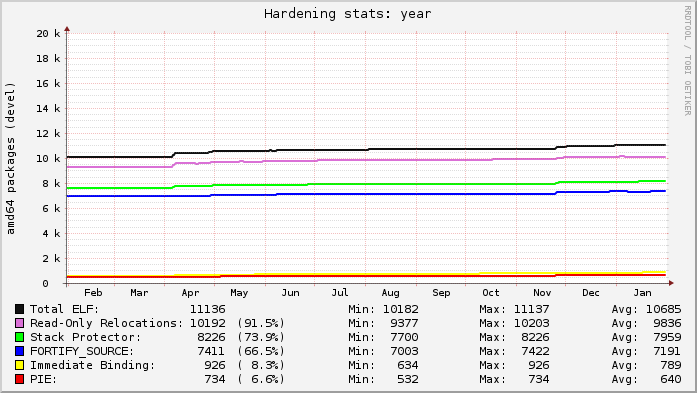
Here s today s snapshot of Debian s unstable archive for the past year (at the start of May you can see the archive unfreezing after the Wheezy release; the gaps were my analysis tool failing):
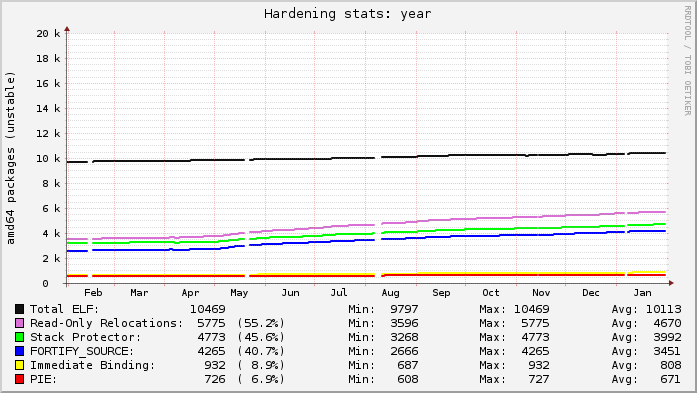
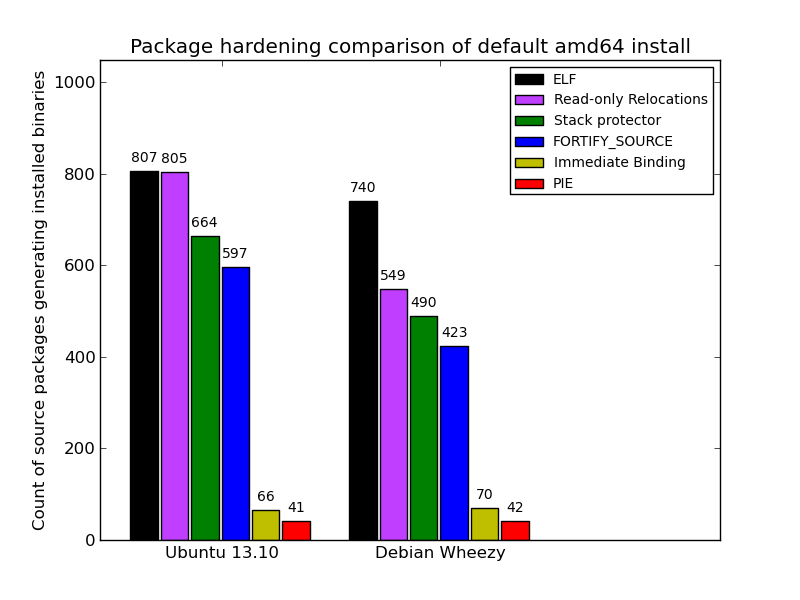
Ubuntu s lines are relatively flat because everything that can be built with hardening already is. Debian s graph is on a slow upward trend as more packages get migrated to dh to gain knowledge of the global flags. Each line in the graphs represents the count of source packages that contain binary packages that have at least 1 hit for a given category. ELF is just that: a source package that ultimately produces at least 1 binary package with at least 1 ELF binary in it (i.e. produces a compiled output). The Read-only Relocations ( relro ) hardening feature is almost always done for an ELF, excepting uncommon situations. As a result, the count of ELF and relro are close on Ubuntu. In fact, examining relro is a good indication of whether or not a source package got built with hardening of any kind. So, in Ubuntu, 91.5% of the archive is built with hardening, with Debian at 55.2%. The stack protector and fortify source features depend on characteristics of the source itself, and may not always be present in package s binaries even when hardening is enabled for the build (e.g. no functions got selected for stack protection, or no fortified glibc functions were used). Really these lines mostly indicate the count of packages that have a sufficiently high level of complexity that would trigger such protections. The PIE and immediate binding ( bind_now ) features are specifically enabled by a package maintainer. PIE can have a noticeable performance impact on CPU-register-starved architectures like i386 (ia32), so it is neither patched on in Ubuntu, nor part of the default flags in Debian. (And bind_now doesn t make much sense without PIE, so they usually go together.) It s worth noting, however, that it probably should be the default on amd64 (x86_64), which has plenty of available registers. Here is a comparison of default installed packages between the most recent stable releases of Ubuntu (13.10) and Debian (Wheezy). It s clear that what the average user gets with a default fresh install is better than what the archive-to-archive comparison shows. Debian s showing is better (74% built with hardening), though it is still clearly lagging behind Ubuntu (99%):

2014, Kees Cook. This work is licensed under a Creative Commons Attribution-ShareAlike 3.0 License.
Creative Commons License

Craig Small: jffnms 0.9.4

JFFNMS version 0.9.4 was released today, this version fixes some bugs that have recently appeared in previous versions.
Alarmed Interfaces and Events

Alarmed Interfaces and Events

The triggers rules editor had a problem where some of the rules clicked off the triggers would not appear or could not be edited correctly. Most of the Admin screens have the ability to sort the rows. This, unfortunately, didn t sort but the functionality has been restored. Most users are probably unaware of this, but the database schema is first created for MySQL and is then converted for PostgreSQL. The conversi0n process is far from ideal and hasn t worked until this release. More testing is required for PostgreSQL support but it should be a lot better.

Andrew Pollock: [life] Day 7, Kindergarten again

Today was a pretty quiet day, because Zoe had Kindergarten again. Nominally, I'm supposed to be doing Debian stuff today, but I had some work presentations I wanted to watch while I still had the chance, so I mostly watched them for four hours while blowing the cobwebs out of my development environment. Zoe slept well last night and slept in a little bit to a whopping 6:30am. We got out the door at about 8:05am and by the time I'd got the bike trailer on the bike and made it to Kindergarten it was about 8:30am. Drop off went pretty smoothly. I decided to go for a run after I got back home, so I banged out 5km. My running fitness has been a bit off of late, partially because of the heat, and partially because I just haven't been doing it enough. I need to get back up to 10km as soon as possible so I can try increasing the distance. Both of Megan's parents work, and so I'm helping them out with picking her up on Mondays and Wednesdays. Today was the day of doing that. It was certainly an interesting experience having to wrangle two kids instead of one. Megan's a good kid, so it was no trouble. To kill time, we went to the car wash, where I bought the girls babyccinos while we waited, and then we headed into the Valley so I could check my post office box. After we got home, I attempted to do something I'd seen on Mister Maker. He basically squirted some PVA glue, some paint and some detergent into a cup and then mixed it all up and then blew into it with a straw until the bubbles rose over the top of the cup and pressed down on it with some paper. I used bubble mix instead of detergent because I figured it would have to be as good, but only Zoe's cup really worked as intended. Then, despite much discussion about it, Zoe decided to suck on the straw instead of blow it and so I had to race her off to the bathroom to rinse her mouth out. After that the girls played a bit more on their own, then Zoe wanted to watch TV but Megan didn't, so we painted a butterfly together and then Megan's Dad arrived to pick her up, and Sarah arrived not long after that. I killed some time doing a spontaneous electronics project before yoga and that was my day.

2 February 2014

Gunnar Wolf: CuBox-i4Pro

CuBox-i4Pro
Somewhere back in August or September, I pre-ordered a CuBox-i A nicely finished, completely hackable, and reasonably powerful ARM system, nicely packaged and meant to be used to hack on. A sweet deal! There are four models (you can see the different models' specs here) I went for the top one, and bought a CuBox-i4Pro. That means, I have a US$130 nice little box, with 4 ARM7 cores, 2GB RAM, WiFi, and... well, all of its basic goodies and features. For some more details, look at the CuBox-i block diagram. I got it delivered by early January, and (with no real ARM experience on my side) I finally got to a point where I can, I believe, contribute something to its adoption/usage: How to get a basic Debian system installed and running in it. The ARM world is quite different to the x86 one: Compatibility is much harder, the computing platform does not self-describe properly, and a kernel must first understand how a specific subarchitecture is before being able to boot on it. Somewhere in the CuBox forums (or was it the IRC channel?) I learnt that the upstream Linux kernel does not yet boot on the i.MX6 chip (although support is rumored to be merged for the 3.14 release), so I am using both a kernel and an uBoot bootloader not built for (or by) Debian people. Besides that, the result I will describe is a kosher Debian install. Yes, I know that my orthodox friends and family will say that 99% kosher is taref... But remember I'm never ever that dogmatic. (yeah, right!) Note that there is a prebuilt image you can run if you are so inclined: In the CuBox-i forums and wiki, you will find links to a pre-installed Debian image you can use... But I cannot advise to do so. First, it is IMO quite bloated (you need a 4GB card for a very basic Debian install? Seriously?) Second, it has a whole desktop environment (LXDE, if I recall correctly) and a whole set of packages I will probably not use in this little box. Third, there is a preinstalled user, and that's a no-no (user: debian, password: debian). But, most importantly, fourth: It is a nightly build of the Testing (Jessie) suite... Built back in December. So no, as a Debian Developer, it's not something we should recommend our users to run! So, in the end and after quite a bit of frustration due to my lack of knowledge, here goes the list of steps I followed:
Using the CuBox
On the i2 and i4 models, you can use it either with a USB keyboard and a HDMI monitor, or by a serial consoles (smaller models do not have a serial console). I don't have a HDMI monitor handy (only a projector), so I prefer to use the serial terminal. Important details to avoid frustration: The USB keyboard has to be connected to the lower USB port, or it will be ignored during the boot process. And make sure your serial terminal is configured not to use hardware flow control. Minicom is configured by default to use hardware flow control, so it was not sending any characters to the CuBox. ^A-O gets you to the Minicom configuration, select Serial port setup, and disable it.
Set up the SD card
I created a 2GB partition, but much less can suffice; I'd leave it at least to 1GB to do the base install, although it can be less once the system is set up (more on this later). Partition and format using your usual tools (fdisk+mke2fs, or gparted, or whatever suits your style).
Install the bootloader
I followed up the instructions on this CuBox-i forums thread to get the SPL and uBoot bootloader running. In short, from this Google Drive folder, download the SPL-U-Boot.img.xz file, uncompress it (xz --decompress SPL-U-Boot.img.xz), and write it to the SD card just after the partition map: As root,
# dd if=SPL-U-Boot.img of=/dev/mmcblk0 bs=1024 seek=1.
Actually, to be honest: As I wanted something basic to be able to debug from, I downloaded (from the same Google Drive) the busybox.img.gz file. That's a bit easier to install from: xz --decompress busybox.img.xz, and just dump it into the SD from the beginning (as it does already include a partition table):
# dd if=busybox.img of=/dev/mmcblk0
This card is already bootable and minimal, and allows to debug some bits from the CuBox-i itself (as we will see shortly).
After this step, I created a second partition, as I said earlier. So, my mmcblk0p1 partition holds Busybox, and the second will hold Debian. We are still working from the x86 system, so we mount the SD card in /media/mmcblk0p2
Installing the base system
Without debian-installer to do the heavy lifting, I went for debootstrap. As I ran it from my PC, debootstrap's role will be for this first stage only to download and do a very initial pre-unpacking of the files: Bootstrapping a foreign architecture implies, right, using the --foreign switch:
debootstrap --foreign --arch=armhf wheezy /media/mmcblk0p2 http://http.debian.net/debian
You can add some packages you often use by specifying --include=foo,bar,baz
So, take note notes: This board is capable of running the armhf architecture (HF for Hardware Float). It can also run armel, but I understand it is way slower.
First boot (with busybox)
So, once debootstrap finishes, you are good to go to the real hardware! Unmount the SD card, put it in the little guy, plug your favorite console in (I'm using the serial port), and plug the power in! You should immediately see something like:
  1. U-Boot SPL 2013.10-rc4-gd05c5c7-dirty (Jan 12 2014 - 02:18:28)
  2. Boot Device: SD1
  3. reading u-boot.img
  4. Load image from RAW...
  5. U-Boot 2013.10-rc4-gd05c5c7-dirty (Jan 12 2014 - 02:18:28)
  6. CPU: Freescale i.MX6Q rev1.2 at 792 MHz
  7. Reset cause: POR
  8. Board: MX6-CuBox-i
  9. DRAM: 2 GiB
  10. MMC: FSL_SDHC: 0
  11. In: serial
  12. Out: vga
  13. Err: vga
  14. Net: phydev = 0x0
  15. Phy not found
  16. PHY reset timed out
  17. FEC
  18. (Re)start USB...
  19. USB0: USB EHCI 1.00
  20. scanning bus 0 for devices... 1 USB Device(s) found
  21. scanning usb for storage devices... 0 Storage Device(s) found
  22. scanning usb for ethernet devices... 0 Ethernet Device(s) found
  23. Hit any key to stop autoboot: 3

Let it boot (that means, don't stop autoboot), and you will soon see a familiar #, showing you are root in the busybox environment. Great! Now, mount the Debian partition:
# mount /dev/mmcblk0p2 /mnt
Finishing debootstrap's task
With everything in place, it's time for debootstrap to work. Chroot into the Debian partition:
# chroot /mnt
And ask Debootstrap to finish what it started:
# debootstrap --second-stage
Be patient, as this step takes quite a bit to be finished.
Some extra touches...
After this is done, your Debian system is almost ready to be booted into. Why almost? Because it still does not have any users, does not know its own name nor knows I want to use it via a serial terminal. Three very simple tasks to fix. First two:
  1. # passwd
  2. Enter new UNIX password:
  3. Retype new UNIX password:
  4. passwd: password updated successfully
  5. # echo cubox-i.gwolf.org > /etc/hostname

For the second one, add a line to /etc/inittab specifying the details of the serial console. You can just do this:
# echo 'T0:23:respawn:/sbin/getty -L ttymxc0 115200 vt100' >> /etc/inittab
Boot into Debian!
So, ready to boot Debian? Ok, first exit the chroot shell, to go back to the Busybox shell, unmount the Debian partition, and set the root partition read-only:
  1. # exit
  2. # umount /mnt
  3. # mount / -o remount,ro

Disconnect and connect power, and now, do interrupt the boot process when you see the Hit any key to stop automount prompt. To see the configuration of uboot, you can type printenv We will only modify the parameters given to the kernel:
  1. CuBox-i U-Boot > setenv root /dev/mmcblk0p2 rootfstype=ext3 ro rootwait
  2. CuBox-i U-Boot > boot

So, the kernel will load, and a minimal Debian system will be initialized. In my case, I get the following output:
  1. ** File not found /boot/busyEnv.txt **
  2. 4703740 bytes read in 390 ms (11.5 MiB/s)
  3. ## Booting kernel from Legacy Image at 10000000 ...
  4. Image Name: Linux-3.0.35-8
  5. Image Type: ARM Linux Kernel Image (uncompressed)
  6. Data Size: 4703676 Bytes = 4.5 MiB
  7. Load Address: 10008000
  8. Entry Point: 10008000
  9. Verifying Checksum ... OK
  10. Loading Kernel Image ... OK
  11. Starting kernel ...
  12. Unable to get enet.0 clock
  13. pwm-backlight pwm-backlight.0: unable to request PWM for backlight
  14. pwm-backlight pwm-backlight.1: unable to request PWM for backlight
  15. _regulator_get: get() with no identifier
  16. mxc_sdc_fb mxc_sdc_fb.2: NO mxc display driver found!
  17. INIT: version 2.88 booting
  18. [info] Using makefile-style concurrent boot in runlevel S.
  19. [....] Starting the hotplug events dispatcher: udevd. ok
  20. [....] Synthesizing the initial hotplug events...done.
  21. [....] Waiting for /dev to be fully populated...done.
  22. [....] Activating swap...done.
  23. [....] Cleaning up temporary files... /tmp. ok
  24. [....] Activating lvm and md swap...done.
  25. [....] Checking file systems...fsck from util-linux 2.20.1
  26. done.
  27. [....] Mounting local filesystems...done.
  28. [....] Activating swapfile swap...done.
  29. [....] Cleaning up temporary files.... ok
  30. [....] Setting kernel variables ...done.
  31. [....] Configuring network interfaces...done.
  32. [....] Cleaning up temporary files.... ok
  33. [....] Setting up X socket directories... /tmp/.X11-unix /tmp/.ICE-unix. ok
  34. INIT: Entering runlevel: 2
  35. [info] Using makefile-style concurrent boot in runlevel 2.
  36. [....] Starting enhanced syslogd: rsyslogd. ok
  37. [....] Starting periodic command scheduler: cron. ok
  38. Debian GNU/Linux 7 cubox-i.gwolf.org ttymxc0
  39. cubox-i login:

And that's it, the system is live and ready for my commands!
So, how big is this minimal Debian installed system? I cheated a bit on this, as I had already added emacs and screen to the system, so yours will be a small bit smaller. But anyway Lets clear our cache of downloaded packages, and see the disk usage information:
  1. root@cubox-i:~# apt-get clean
  2. root@cubox-i:~# df -h
  3. Filesystem Size Used Avail Use% Mounted on
  4. rootfs 1008M 347M 611M 37% /
  5. /dev/root 1008M 347M 611M 37% /
  6. devtmpfs 881M 0 881M 0% /dev
  7. tmpfs 177M 132K 177M 1% /run
  8. tmpfs 5.0M 0 5.0M 0% /run/lock
  9. tmpfs 353M 0 353M 0% /run/shm

So, instead of a 4GB install, we have a 350MB one. Great improvement! Now, lets get it to do something useful, in a most Debianic way!

31 January 2014

Andrew Pollock: [life] Day 4, Brazilian jiu jitsu, Science Friday and the Lunar New Year

I want Zoe to do one "extra curricular" activity per term this year. Something dance-related, something gymnastics-related and maybe some other form of sport (I'm thinking soccer). My girlfriend and I were wandering through Westfield Carindale on Saturday, and we happened upon a guy from Infinity Martial Arts touting his wares. I thought I'd suss it out, and they had an introductory offer where the sign-up fee and uniform fee were significantly reduced, and they had a pretty flexible timetable. They were just starting up their East Brisbane location, and the close proximity to home along with the reduced price sealed the deal. Long-term, I'd like for Zoe to learn Tae Kwon Do, for self-defense, but BJJ seemed as good as anything to get her introduced to the idea of martial arts. The class for 2-4 year olds was billed as "Fun and Fitness 4 Kids" so it's really a combination of listening to the instructor, some basic gymnastics-style stuff and a little bit of martial arts. We biked over this morning (going up Hawthorne Road is a slog) and got there in about 15 minutes via the direct route. It's in the upstairs of a gym in the middle of an industrial area, but it was pretty easily accessible by bike. They're still waiting on some of the equipment, so the space was a little spartan. It was just Zoe and I and a mother of two not quite 2 year old twin girls taking a trial class. First up, we got her uniform, and she looked so cute. There were pants and a jacket and a belt. I'm going to have to video the instructor tying up the belt next week so I can learn how to do it the right way. The class started with the kids standing on these flat coloured circles ("mushrooms") and effectively playing "Simon Says" ("instructor says") without being caught out. It was a pretty sneaky way of doing a bunch of warm up exercises like rotating the knees and ankles. Zoe did very well, but there were a few that she just point blank refused to do. Next the instructor set up a bunch of "stations" around the room. The first station involved me crouching in a fetal position with a football and Zoe had to try and tip me over to get the football. That was a load of fun. The next station was a few steps and foam-filled vinyl ramp, and Zoe just had to do a somersault down that. The next station was pretty much the same but taller, and Zoe had to do a "sausage roll" on her side down that. The next station was just a small exercise ball and Zoe had to do some "donkey kicks" on it. The final station involved me waving a couple of cut-off pool noodles at arm's length, and Zoe had to run in covering her head and give me a bear hug. We did a few rotations of these stations. It was heaps of fun. Next, the instructor got a whole bunch of ball pit balls of different colours, and scattered them over the floor, and put a basket at each end of the room. The kids were then instructed to retrieve specific colours as fast as possible. Zoe started out trying to get as many as possible in her arms before returning to the basket, but the idea was to do it one ball at a time. A lot of running back and forth. Finally, we did some actual BJJ (I think). It was called the "sleeping crocodile hold" or something like that. I had to lie on my back, and Zoe had to sneak up to me from my side and grapple me with one arm behind my head and the other around my waist and a knee in my side. I have no interest in Zoe learning mixed martial arts, but this class was so much fun. I was feeling a bit tired this morning before we headed out, but by the end of it I was so pumped. It was just the right combination of daddy/daughter rough and tumble, with a bit of gymnastics and following instruction. I'm pretty certain Zoe enjoyed it. I liked that the instructor stopped for a water break between each activity, so the kids were kept well hydrated throughout. We took the "scenic route" home, because we had no particular time constraints. It was more like 25 minutes and involved the Norman Park Greenway. I was so glad we went that way. It was a beautiful ride that I didn't know existed. Very indirect, it involved going through Woolloongabba, Coorparoo and Norman Park, around the back of Coorparoo State High School along the side of Norman Creek. It was semi-wetland conditions.The only part that was a bit annoying was where Norman Avenue met Wynnum Road. It was quite steep and the green light didn't last very long. I had wanted to do story time at Bulimba Library at 10:30am on Fridays, but I'd rather bike home via the Norman Park Greenway instead, because it's a nice ride. I've since decided that I'll just use the story time at the library during wet weather, when we'd be driving to BJJ anyway, and be able to make it to the library in time after class. I've also got to figure out where I'm going to fit doing some Science into the schedule. Fridays are going to be busy I think. I managed to get Zoe down for a nap by a bit after 12:30pm today. She was pretty knackered after the class (as was I from biking home) so I let her watch a bit of TV while I prepared lunch. She was funny, she saw how sweaty I was when we got home, and suggested I take a shower while she watch some TV. I was a bit unprepared for my first Science Friday, though. I'd been considering going to the Sir Thomas Brisbane Planetarium after BJJ, but I discovered it's closed until February 7 for maintenance and an upgrade, so that cunning plan was thwarted. I used her nap time to order 365 Science Experiments and 50 Dangerous Things (you Should Let Your Children Do). I should get plenty of inspiration out of those two. After she woke up, we did the old "vinegar and sodium bicarbonate" trick as our science experiment. I've finally got a use for my Google Labs Founders' Award lab coat. I need to try and find some child-sized safety glasses. The adult ones barely stay on her little nose. After that, we went for a walk to our local toy store to see if they sold child-sized safety glasses (they didn't) and then Zoe watched a little bit of TV and then we walked to the CityCat to go to Teneriffe to catch a bus to Chinatown. I couldn't have timed it better if I tried. Just as we got to Chinatown, they started doing a thing with the Chinese dragons, and I hoisted Zoe up on my shoulders so she could watch. I wasn't sure how she was going to take it, with all the noise from the drums and the dragons themselves, but she was enthralled. We watched other acts and then my girlfriend joined us, and we went to a Chinese restaurant for dinner. I bought Zoe these training chopsticks a while ago, and she's taken to them like a duck to water. I brought them with us so she could use them at the restaurant, and she ate the biggest dinner I've ever seen her eat. After dinner, we caught the tail end of a procession and had some ice cream. We were starting to leave, and there was another dragon, and Zoe was brave enough to go and touch it on her own, for good luck. We then made our way back to the bus. By the time the bus arrived and got us back to Teneriffe, and a CityCat finally arrived, it was very late, but Zoe was pretty good the whole time. It was probably the latest night she's ever had with me while we've been out on the go, and she only got a bit ratty once we were home. It didn't help that she'd forgotten that she'd put Cowie in a cupboard this morning and we burned some more time tracking her down. Today was a fantastic (and very full) day. I enjoyed it a lot, and I think Zoe did too. Fortunately, Fridays won't always be this full on.

Next.

Previous.