Search Results: "ah"

9 February 2011

Michal Čihař: Another new theme for phpMyAdmin

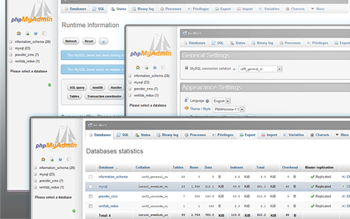
Today we've got new submission for phpMyAdmin theme contest and I must say it really looks great. The new theme is called pmahomme after it's author Mike Homme: pmahomme theme It's now also available on the demo server, so don't hesitate and try it there. Looking forward for other submissions to our contest.

Filed under: English Phpmyadmin 0 comments Flattr this!

8 February 2011

Mike Hommey: Knowing how much disk seeks hurt

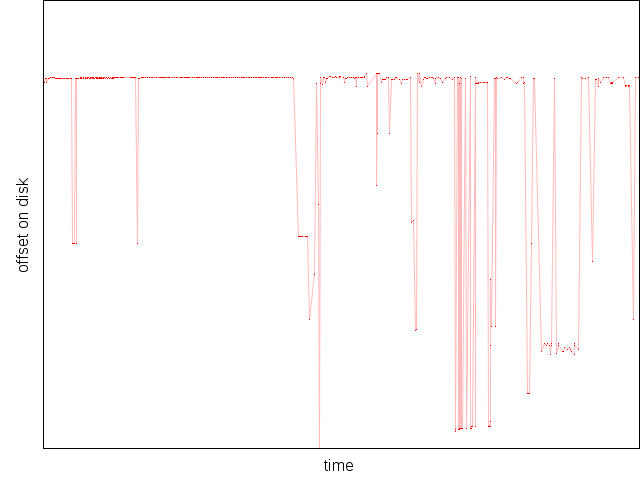
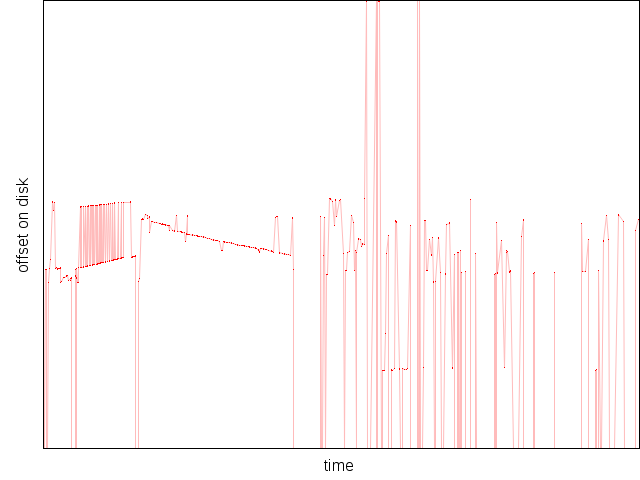
We all know disk seeks hurt. But we usually don t have a precise idea how much. How about getting that idea? Here is a little experiment I ran a few days ago. I took the output from the systemtap script tracking I/O I wrote, on a Firefox startup after boot. Each line of that output, which gives a timestamp (which we don t care about here), a file name, and an offset, represents a 4096 bytes read (one page). The first set of data points I got is how much time it takes to reproduce this read pattern after a reboot, and how that compares to Firefox startup time. For what it s worth, I did group following reads, to avoid doing too many system calls, and also avoided kernel readahead by using direct I/O, meaning I would only read exactly what the kernel reads when Firefox normally starts. All the following tests were done under the usual conditions (see previous posts), but I limited the tests to the x86-64 architecture, because all that really matters is the disk. I ll mention, however, that the amount of data read in these tests is 34,729,984 bytes, and that the original I/O pattern looks like this: Zooming around the main location where most I/O happen, we can see the pattern is still bumpy: This somehow looks familiar, doesn t it? We already know for a fact that even these patterns that, on the whole disk, look like pretty much insignificant, have an important impact on startup time. Try to imagine what kind of difference could be observed if we were reordering all these reads. Anyways, back to that I/O simulation, we first need to see how far it is from the actual Firefox startup. We would rather that simulated I/O + warm startup/hot cache end up close to the real thing. However, we need to keep in mind, as we saw in a previous post, that CPU scaling, when mixed with I/O, has an influence on startup time. Warm startup not involving I/O, the CPU can run at maximum speed the whole time. As such, for a fair comparison, we need to compare to cold startup time with the CPU forced at maximum speed, which we saw is faster than startup time with CPU scaling.
Average time (ms)
Simulated cold startup 2,764.26 0.42%
Warm startup 250.74 0.18%
Simulated cold + warm 3015
Real cold startup 3087.47 0.31%
Difference 72.47 (2.35%)
Close enough, I d say. The difference is most probably caused by metadata reads and a few other things, that isn t in the systemtap script scope. Now we know our simulated I/O is close to reality, what happens if we reorder all these reads according to the position on disk?
Average time (ms) Corresponding transfer rate
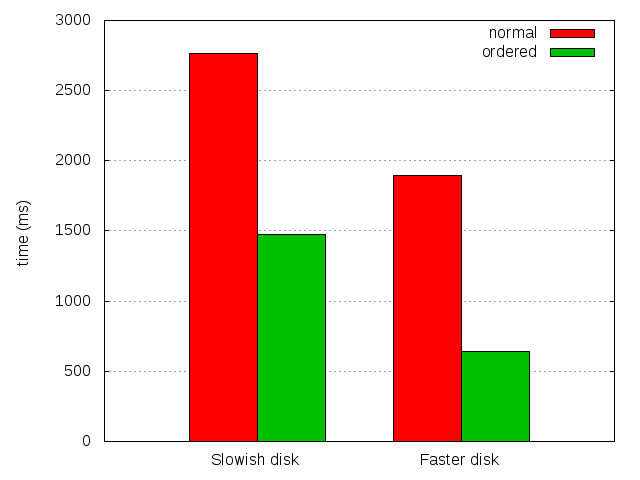
Simulated I/O 2,764.26 0.42% 12.56 MB/s
Reordered I/O 1,473.34 0.43% 23.57 MB/s
Difference 1,290.92 (46.7%) n/a
That s almost twice as fast ! And the disk doesn t even have a big throughput (around 30MB/s). Let s see what it does with a disk with a bigger throughput (85MB/s).
Average time (ms) Corresponding transfer rate
Simulated I/O 1,898.66 0.16% 18.29 MB/s
Reordered I/O 644.0 0.15% 53.93 MB/s
Difference 1,254.66 (66.08%) n/a
That s almost three times as fast ! The faster the disk, the bigger the improvement we can get by reordering and grouping I/O, which is not unexpected, but here we can see how much having to go back and forth on the disk hurt badly. Obviously, the numbers from the faster disk can t be directly compared to the ones from the slower disk, because the data was not arranged the same way on the disk, and file system fragmentation, as well as how the file system is filled also have their own share to add to the problem. And because it s more impressive to see on a graph than in a result table: Disks seeks hurt. Badly.

7 February 2011

Michal Čihař: New phpMyAdmin themes

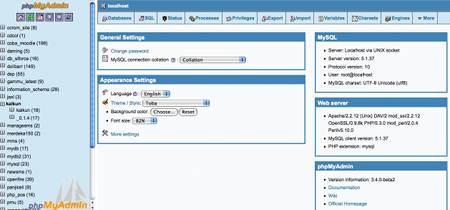
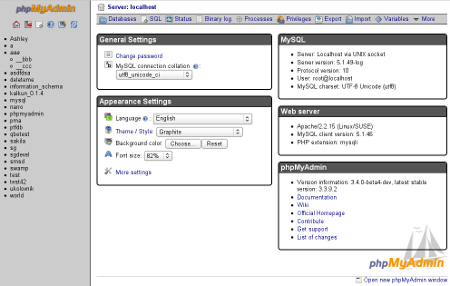
Today, I've made available two new themes for phpMyAdmin on our demo server. First one is Toba theme which was contributed by Azhari Harahap: Toba theme Second one is Graphite theme which I've started during Hackweek and finished during free time around FOSDEM: Graphite theme And we're still waiting for more contributions to our Theme contest. PS: Forgot to mention that new themes are only for 3.4 branch and won't work with others.

Filed under: English Phpmyadmin Suse 0 comments Flattr this!

6 February 2011

Kees Cook: fun with game memory

So, I was testing a (closed source) single-player offline game recently and thought this exercise might be fun to document. I didn t want to spend any time actually earning in-game money since I d played it before and I wanted to just skip ahead to other aspects of the game. I was curious how straight-forward adjusting my cash might be. So, noting the in-game bank account number of 219393 and account balance of 3000, I dived right in. First up, what s the memory layout of the heap look like? I looked at the brk and the mmap regions without a mapped library or file, marked with w in the permissions column, from /proc/PID/maps:
0827e000-08282000 rw-p 00000000 00:00 0
0a22e000-0b08a000 rw-p 00000000 00:00 0 [heap]
efa59000-efd00000 rw-p 00000000 00:00 0
efd00000-efd21000 rw-p 00000000 00:00 0
Knowing these, I could use gdb s find command, after attaching to the process:
$ gdb /some/cool/game

(gdb) attach PID

(gdb) find /w 0 0827e000, 0 08282000, 219393
(gdb) find /w 0 0a22e000, 0 0b08a000, 219393
0xaf03d08
0xaf06ca8
No hits in the first region, but I see two hits for the account number value in the second region. Let s start there and see what s near them
(gdb) x/8x 0xaf03d08
0xaf03d08: 0 00035901 0 00000000 0 00000000 0 0af06ce0
0xaf03d18: 0 0af06be0 0 00000059 0 0af03d98 0 0af041e8
(gdb) x/8x 0xaf06ca8
0xaf06ca8: 0 00035901 0 00000bb8 0 00000bb8 0 0820b148
0xaf06cb8: 0 00000001 0 00000000 0 00000000 0 00000000
In that second hit, I see the value 0xBB8, which is 3000, and matches our account balance. Let s see what happens if we just change both of those to add a bit a few orders of magnitude above the current value
(gdb) set var *0xaf06cac = 0 00100bb8
(gdb) set var *0xaf06cb0 = 0 00100bb8
(gdb) x/32x 0xaf06cac
0xaf06cac: 0 00100bb8 0 00100bb8 0 0820b148 0 00000001
(gdb) continue
And presto, clicking on the bank account details in-game shows a huge account balance of 1051576 now. No need to reverse-engineer any saved games, whew.

3 February 2011

Raphaël Hertzog: People behind Debian: Mike Hommey, Firefox/Iceweasel maintainer

Mike Hommey, our Iceweasel maintainer

For as long as I have known Mike, he s been maintaining one of the largest (and most widely used) package: Iceweasel, Debian s default web browser. It s effectively Mozilla s Firefox although it has been renamed to avoid some rules enforced by Mozilla s trademark policy. But we might see Firefox back in Debian read on to know Mike s plans. His story is also very interesting in that he went from simple user to Iceweasel maintainer, and now he s working for Mozilla Corporation. But you already knew that contributing to free software is a good way to grow skills and gain experience that are valuable on the job market, right? ;-) My questions are in bold, the rest is by Mike. Who are you? I am Mike Hommey. I am French, even if my name doesn t sound so. I have been a GNU/Linux user since 1995, using Debian since 1999, and started packaging in 2003. After a long time in the NM queue, I became a DD in 2005. The main reason I started being actively involved is quite selfish: I wanted some things done, and I just did them. My first packages were extensions for the Mozilla Suite, the old one that directly inherited from Netscape Communicator. Later on, I wanted some of these extensions to work with the new kid on the block: Phoenix; or maybe it was already Firebird. By then, integrating extensions was a hassle, and the mozilla-browser maintainer had come up with a script that would make it easier for extension packages. So I ported that script for use with Phoenix/Firebird and sent it to the BTS. Then Phoenix/Firebird became Firefox, and it grew a real extension manager. Except that is was entirely not suited for extensions installed by the packaging system. So I made it work better. And made a few more changes to make Firefox work better. All through patches or NMUs. Then I became co-maintainer, then Firefox couldn t keep its name and became Iceweasel, and, fast-forward until today, I m now taking care of Iceweasel/Xulrunner and Iceape in stable, unstable, experimental and an external repository. This 8 years-long story (wow, I hadn t even realized it had been that long until I wrote it) tells you something: newcomers shouldn t be afraid to stick their hands anywhere, even in big packages. I was only a Mozilla and Phoenix end-user when I started. Apart from Mozilla-related packaging, I also happen to (co-)maintain some other packages in Debian, most notably webkit, though I haven t been very active in the pkg-webkit team recently. There are several reasons for that, the main one being that there are other team members getting the job done. And I can t say that much about the pkg-mozilla team, since there are effectively no other team members. What s your biggest achievement within Debian? I am quite proud that Squeeze will be the first Debian release where Iceweasel works on all supported architectures. Previously, we only knew the package compiled on all these architectures. Starting with Squeeze, we know it passes several of the test suites coming with the source code. This ensures most of the browser is functional. It was actually far from being the case before, as it appeared when the test suites were first enabled. I think it is very important to have properly working packages on all our supported architectures. The current evolution of hardware shows how important it still is. Who would have thought a few years back that we would see ARM or MIPS based netbooks today ? What are your plans for Debian Wheezy? For Debian Wheezy, I would like to improve Iceweasel/Icedove/Iceape integration with the packaging system. Something that would allow to use the apt database to find extensions or plugins, on top of the current behaviour. I also want to improve desktop integration, most notably for KDE. Another thing I d like to see happen is to package google breakpad independently (its source code is currently embedded in chromium and iceweasel, though not built, as far as I know), and have our Mozilla products builds be able to send their crash reports upstream. It is very important that upstream gets direct visibility over what crashes on GNU/Linux systems. It helps making them aware of issues that would otherwise probably remain unnoticed, as there are much more users using distributions packages than upstream tarballs. And not all Debian users report crashes to the BTS. I know at least Fedora and SuSE are already doing it. More importantly, I want to avoid the sad situation we got with Squeeze, where we re going to release a 18 months old Iceweasel. We got there for a combination of reasons, one being that I was preparing for a freeze in December 2009 and focusing on getting 3.5 in shape instead of the then upcoming 3.6. The result was that we didn t get 3.6 packages before upstream released 3.6.3 in April 2010. By then it was too late, considering the uncertainty of the release schedule, to update reverse dependencies and get 3.6 ready for Squeeze. Things are different for 4.0. I m already getting ahead of things, and while reverse dependencies haven t been taken care of, all beta releases have been made available through http://mozilla.debian.net/, usually within hours after upstream release (sometimes even a few hours before official announcement, but always after availability on ftp.mozilla.org). A great share of our patches were also pushed upstream. Several things made that possible: There will be a couple major upstream releases until Wheezy comes along, and I want to make them available early in unstable, even if that means breaking reverse dependencies until they are fixed. Finally, I would like to get other people involved, starting with the Icedove maintainer. Volunteers are very much welcome, for any kind of involvement: bug triaging, documentation (which we are deeply lacking), testing, code People interested can contact the pkg-mozilla team list. As the Debian packaging gets less time consuming, I should be able to spend more time mentoring, which should help. If you could spend all your time on Debian, what would you work on? I actually have been working almost full time on Debian for a few months during a more-or-less purposeful unemployment period. That s when I attempted to add an alert popup when Iceweasel or extensions are upgraded (which was eventually removed because not working very effectively). That s when I worked on Iceweasel 3.6 and the first 4.0 betas. That s when I pushed more than 70 patches upstream, and got upstream commit access. I know for a fact that keeping up with upstream and answering bug reports is already time consuming, and time comes in finite quantity. Working full time on Debian allows to do more than that, as I ve been able to experience first hand. Unfortunately, that doesn t help pay the bills, so it would be best if time could be shared with other persons. Like, actual members in the pkg-mozilla team. ;) Anyways, if I were to work full time on Debian again, I d like to do more than packaging, and help improve some of our infrastructure, most notably the buildd network, to grow some automated way to get packages built on all or some of our architectures. Call that PPA if you want, though I don t think we need something exactly like PPA. We sure do have porter boxes, but there is a huge overhead to get packages built there: you need to first try, then see you lack build dependencies, then wait for admins to install them, then come back and launch your build, and finally come back again much later to see how it went. And that s when it goes smoothly. Repeat for each architecture. It s already cumbersome when it s a small package, so imagine when it s Iceweasel. I d like to be able to push a (signed) .dsc somewhere, say I want it built on that and that architecture, and get binary packages and logs back. It could then be up to developers to distribute them, or not. Sometimes, you re just interested in test suite results. Another related wish would be a way to access build trees of failed builds, possibly on the buildd where it failed. What s the biggest problem of Debian? Lack of contributors, lack of contributors, and lack of contributors. It can sound weird to say that in a community of 1000+ people. But the sad reality is that we ve seen, repeatedly, calls for help in various places from various understaffed teams (most often of effectively one member) for years. So there is obviously a problem getting people to invest time in these teams either on the long term, or at all. I know this is not a very significant metric, but it already should say a lot: I wouldn t be surprised if more than 2/3 of the number of source lines of code in Debian come from less than 5% of the number of packages in the archive, and see less than 5% of the DD/DM population involved. If someone feels like doing the actual math, I m curious to know how far I m from reality, and in what direction. We also lack manpower to be able to make our release development smoother. In a perfect world where manpower is not a scarce resource, we should work on $release+1 when $release is being frozen. Said otherwise, we should have been able to start working on Wheezy in August 2010, or even earlier. You ve been working for Mozilla Corporation for a few months. How does the work look like and what are you working on? I am actually not working full time for MoCo; I am only contracting for 4 days a week. That was a request I made to keep having enough spare time for Debian or other activities. I am working from home, and am pretty much free about when I work, as long as I work long enough. I take advantage of this freedom and the saved commuting time to live a healthier life by doing some sports in the daytime (which also happens to be cheaper). I mostly work with Taras Glek and other people on various aspects of Firefox startup performance. This involves pretty interesting low-level stuff, in which I actually got involved before being contracted. This work has nothing to do with packaging Iceweasel, though I can have a few opportunities to do things somehow related. You told in your blog that you were discussing with Mozilla how Debian could use the Firefox trademark. Can you tell us a bit about the progress you made? I have got an informal approval of the patches we are applying to the Iceweasel 4.0 beta packages. There are a few concerns about using the system cairo library, and the embedded copy of libpng needs to be used to have support for the animated PNGs that are used in the user interface and that are required in Firefox feature-set. Other than that, there are pretty much no objection on the technical side. We managed to get to some common ground as to how to manage stable updates and more generally, changes to our packages, but I m still waiting for an actual agreement draft. While I, as the maintainer, am fine with the way it should look according to my discussions with the people involved at Mozilla, I ll seek review from my fellow Debian Developers when I ll have something to show. I haven t decided yet how this will reflect on the Debian packages, though. For example, would Iceweasel stay? But I do hope Wheezy will get Firefox back. Is there someone in Debian that you admire for their contributions? Not someone, but all past, present and future release team members. This is a team that receives a lot of critics (and I indirectly gave one a few paragraphs ago), yet manages to keep doing an amazing job and its members are very committed to their task. I admire their dedication.
Thank you to Mike for the time spent answering my questions. I hope you enjoyed reading his answers as I did. Subscribe to my newsletter to get my monthly summary of the Debian/Ubuntu news and to not miss further interviews. You can also follow along on Identi.ca, Twitter and Facebook.

8 comments Liked this article? Click here. My blog is Flattr-enabled.

31 January 2011

Julien Danjou: Naquadah theme for Emacs

I often post Emacs screenshots on this blog, and consequently receive a bunch of request for my Emacs theme. Therefore I decided to publish it. Flattr this

David Welton: Parallelized web site creating and selling - underperformingstocks.com

I often have ideas for little web sites, stuff I just get the urge to create for the fun of it. Some of them have done rather well, like langpop.com but even that doesn't make any money, and, sadly, as I age, that is becoming a more important factor in life. So I decided to try a little experiment. I was thinking some about "value" stocks, and fiddling around with Google's stock screener, and thought of the idea of a site that highlights underperforming stocks: http://underperformingstocks.com - so far so good - I went ahead and registered the domain, and put together the beginnings of a Rails application. At the same time though, I decided I have enough things to do in my evenings and weekends, so I decided that it might be interesting to start selling the site at the same time I'm building it. I'm not really sure how it will work out: perhaps people will see that there's not much there and not bid for it. Perhaps someone likes the idea behind it and is willing to buy on that. My idea, in any case, is to keep working on it as the auction progresses. As an additional twist, there are obviously a lot of features that could be added to the site, so I'll prioritize work on features suggested by users who have bid on the site. Here's the auction listing on Flippa.com: www.underperformingstocks.com is For Sale on Flippa! Edit: I'll also be posting updates to the twitter account I created for the project: http://twitter.com/#!/underpstocks

30 January 2011

Michal Čihař: Photo of a week 4

I have to cheat a little bit in fourth week as the picture is actually from last Sunday. I simply did not have time to take my camera out. The photo was taken at visit Glassworks Novosad a syn at Harrachov. Glass cutter

Filed under: English Photography 0 comments Flattr this!

28 January 2011

John Goerzen: Slices of 2010

A lot of people look back on their year in December. I think it doesn t make sense to look back on a year until it s done. And then take a little time to let it simmer. That s my excuse for not doing this until almost February, anyhow. 2010 started with a 3-day ordeal of taking out the trash, nearly snapping the hood off my pickup while closing it, and Greek poetry. I then dived right into reading the Odyssey, and my post suggesting we read the Old Testament of the Bible like we read Greek mythology generated almost 100 comments. I guess I said something controversial I also read a number of other books last year. Our family had quite the year. In March, Terah and I got to visit Europe for the first time. A few months later, we visited New York City for the first time and I attended Debconf10. Jacob predictably loved our train trip to NYC, calling our room in the sleeper the best place of ever. Terah had thyroid surgery, and Jacob survived a tractor accident with amazingly minor injuries. But as I look back at my posts from last year, I m struck that most of them were about more everyday, ordinary events of life. Jacob loved the switchbox he and I built, Oliver somtimes acts like Yoda, and they both loved camping. I have made probably way too many posts with photos of them last year, but I m making no promises to slow down this year! Jacob and I built a computer together, and he loves bashing random words at the Linux shell. He also developed an interest in some half-broken FRS radios, and had tons of fun with them. Eventually this kindled in interest in amatuer radio in me. At the end of 2009, I finally completed my computer science degree and mused about what I might do next. I m a curious, inquisitive person that enjoys both challenge and knowledge. I thought that perhaps I would dive into reading more, or perhaps take some more college classes. Turns out I instead picked up amateur radio one of the big unexpected twists of the year. Jacob really did kindle that interest in me, and by July I had passed my technician and general exams and was on the air. I continued to study, and passed my extra class exam in October. Since then, I ve rigged up my bicycle for amateur radio operation, made some fun contacts, set up outdoor antennas, and got going with digital operation. It has been a lot of fun, and will keep providing opportunities for a challenge for me for a very long time. Also on the technical side, I made my archive of Gopherspace available for download. It s hard to cut off the list I have dozens of other things I could mention but I suppose I should end it with the Christmas gathering / piano moving episode.

26 January 2011

Martin Pitt: Na zdrav PyGI!

(Update: Link to Tomeu s blog post, repost for planet.gnome.org) Last week I was in Prague to attend the GNOME/Python 2011 Hackfest for gobject-introspection, to which Tomeu Vizoso kindly invited me after I started working with PyGI some months ago. It happened at a place called brmlab which was quite the right environment for a bunch of 9 hackers: Some comfy couches and chairs, soldering irons, lots of old TV tubes, chips, and other electronics, a big Pirate flag, really good Wifi, plenty of Club Mate and Coke supplies, and not putting unnecessary effort into mundane things like wallpapers. It was really nice to get to know the upstream experts John (J5) Palmieri and Tomeu Vizoso (check out Tomeu s blog post for his summary and some really nice photos). When sitting together in a room, fully focussing on this area for a full week, it s so much easier to just ask them about something and getting things done and into upstream than on IRC or bugzilla, where you don t know each other personally. I certainly learned a lot this week (and not only how great Czech beer tastes :-) )! So what did I do? Application porting After already having ported four Ubuntu PyGTK applications to GI before (apport, jockey, aptdaemon, and language-selector),
my main goal and occupation during this week was to start porting a bigger PyGTK application. I picked system-config-printer, as it s two magnitudes bigger than the previous projects, exercises quite a lot more of the GTK GI bindings, and thus also exposes a lot more GTK annotation and pygobject bugs. This resulted in a new pygi s-c-p branch which has the first 100 rounds of test, break, fix iterations. It now at least starts, and you can do a number of things with it, but a lot of functionality is still broken. As a kind of finger exercise and also to check for how well pygi-convert works for small projects now, I also ported computer-janitor. This went really well (I had it working after about 30 minutes), and also led me to finally fixing the unicode vs. str mess for GtkTreeView that you got so far with Python 2.x. pygobject and GTK fixes Porting system-config-printer and computer-janitor uncovered a lot of opportunities to improve pygi-convert.sh, a big perl -e kind of script to do the mechanical grunt work of the porting process. It doesn t fix up changed signatures (such as adding missing arguments which were default arguments in PyGTK, or the ubiquitous user_data argument for signal handlers), but at least it gets a lot of namespaces, method, and constant names right. I also fixed three annotation fixes in GTK+. We also collaboratively reviewed and tested Pavel s annotation branch which helped to fix tons of problems, especially after Steve Fr cinaux s excellent reference leak fix, so if you play around with current pygobject git head, you really also have to use the current GTK+ git head. Speaking of which, if you want to port applications and always stay on top of the pygobject/GTK development without having to clutter your package system with make install s of those, it works very well to have this in your ~/.bashrc:
export GI_TYPELIB_PATH=$HOME/projects/gtk/gtk:$HOME/projects/gtk/gdk
export PYTHONPATH=$HOME/projects/pygobject
Better GVariant/GDBus support The GNOME world is moving from the old dbus-glib python bindings to GDBus, which is integrated into GLib. However, dbus-python exposed a really nice and convenient way of doing D-Bus calls, while using GDBus from Python was hideously complicated, especially for nontrivial arguments with empty or nested arrays:
from gi.repository import Gio, GLib
from gi._gi import variant_type_from_string
d = Gio.bus_get_sync(Gio.BusType.SESSION, None)
notify = Gio.DBusProxy.new_sync(d, 0, None, 'org.freedesktop.Notifications',
    '/org/freedesktop/Notifications', 'org.freedesktop.Notifications', None)
vb = GLib.VariantBuilder()
vb.init(variant_type_from_string('r'))
vb.add_value(GLib.Variant('s', 'test'))
vb.add_value(GLib.Variant('u', 1))
vb.add_value(GLib.Variant('s', 'gtk-ok'))
vb.add_value(GLib.Variant('s', 'Hello World!'))
vb.add_value(GLib.Variant('s', 'Subtext'))
# add an empty array
eavb = GLib.VariantBuilder()
eavb.init(variant_type_from_string('as'))
vb.add_value(eavb.end())
# add an empty dict
eavb = GLib.VariantBuilder()
eavb.init(variant_type_from_string('a sv '))
vb.add_value(eavb.end())
vb.add_value(GLib.Variant('i', 10000))
args = vb.end()
result = notify.call_sync('Notify', args, 0, -1, None)
id = result.get_child_value(0).get_uint32()
print id
So I went to making the GLib.Variant constructor work properly with nested types and boxed variants, adding Pythonic GVariant iterators and indexing (so that you can treat GVariant dictionaries/arrays/tuples just like their Python equivalents), and finally a Variant.unpack() method for converting the return value of a D-Bus call back into a native Python data type. This looks a lot friendlier now:
from gi.repository import Gio, GLib
d = Gio.bus_get_sync(Gio.BusType.SESSION, None)
notify = Gio.DBusProxy.new_sync(d, 0, None, 'org.freedesktop.Notifications',
    '/org/freedesktop/Notifications', 'org.freedesktop.Notifications', None)
args = GLib.Variant('(susssasa sv i)', ('test', 1, 'gtk-ok', 'Hello World!',
    'Subtext', [],  , 10000))
result = notify.call_sync('Notify', args, 0, -1, None)
id = result.unpack()[0]
print id
I also prepared another patch in GNOME#640181 which will provide the icing on the cake, i. e. handle the variant building/unpacking transparently and make the explicit call_sync() unnecessary:
from gi.repository import Gio, GLib
d = Gio.bus_get_sync(Gio.BusType.SESSION, None)
notify = Gio.DBusProxy.new_sync(d, 0, None, 'org.freedesktop.Notifications',
    '/org/freedesktop/Notifications', 'org.freedesktop.Notifications', None)
result = notify.Notify('(susssasa sv i)', 'test', 1, 'gtk-ok', 'Hello World!',
            'Subtext', [],  , 10000)
print result[0]
I hope that I can get this reviewed and land this soon. Thanks to our sponsors! Many thanks to the GNOME Foundation and Collabora for sponsoring this event!

Francois Marier: Serving pre-compressed files using Apache

The easiest way to compress the data that is being served to the visitors of your web application is to make use of mod_deflate. Once you have enabled that module and provided it with a suitable configuration file, it will compress all releant files on the fly as it is serving them.

Given that I was already going to minify my Javascript and CSS files ahead of time (i.e. not using mod_pagespeed), I figured that there must be a way for me to serve gzipped files directly.

"Compiling" Static FilesI decided to treat my web application like a c program. After all, it starts as readable source code and ends up as an unreadable binary file.

So I created a Makefile to minify and compress all CSS and Javascript files using YUI Compressor and gzip:

all: build

build:
find static/css -type f -name "[^.]*.css" -execdir yui-compressor -o .css \;
find static/js -type f -name "[^.]*.js" -execdir yui-compressor -o .js \;
cd static/css && for f in *.css.css ; do gzip -c $$f > basename $$f .css .gz ; done
cd static/js && for f in *.js.js ; do gzip -c $$f > basename $$f .js .gz ; done

clean:
find static/css -name "*.css.css" -delete
find static/js -name "*.js.js" -delete
find static/css -name "*.css.gz" -delete
find static/js -name "*.js.gz" -delete
find -name "*.pyc" -delete

This leaves the original files intact and adds minified .css.css and .js.js files as well as minified and compressed .css.gz and .js.gz files.

How browsers advertise gzip supportThe nice thing about serving compressed content to browsers is that browsers that support receiving gzipped content (almost all of them nowadays) include the following HTTP header in their requests:
Accept-Encoding = gzip,deflate
(Incidently, if you want to test what non-gzipped enable browsers see, just browse to about:config and remove what's in the network.http.accept-encoding variable.)

Serving compressed files to clientsTo serve different files to different browsers, all that's needed is to enable Multiviews in our Apache configuration (as suggested on the Apache mailing list):

<Directory /var/www/static/css>
AddEncoding gzip gz
ForceType text/css
Options +Multiviews
SetEnv force-no-vary
Header set Cache-Control "private"
</Directory>

<Directory /var/www/static/js>
AddEncoding gzip gz
ForceType text/javascript
Options +Multiviews
SetEnv force-no-vary
Header set Cache-Control "private"
</Directory>

The ForceType directive is there to force the mimetype (as described in this solution) and to make sure that browsers (including Firefox) don't download the files to disk.

As for the SetEnv directive, it turns out that on Internet Explorer, most files with a Vary header (added by Apache) are not cached and so we must make sure it gets stripped out before the response goes out.

Finally, the Cache-Control headers are set to private to prevent intermediate/transparent proxies from caching our CSS and Javascript files, while allowing browsers to do so. If intermediate proxies start caching compressed content, they may incorrectly serve it to clients without gzip support.

25 January 2011

John Goerzen: rdiff-backup, ZFS, and rsync scripts

rdiff-backup vs. ZFS As I ve been writing about backups, I ve gone ahead and run some tests with rdiff-backup. I have been using rdiff-backup personally for many years now probably since 2002, when I packaged it up for Debian. It s a nice, stable system, but I always like to look at other options for things every so often. rdiff-backup stores an uncompressed current mirror of the filesystem, similar to rsync. History is achieved by the use of compressed backwards binary deltas generated by rdiff (using the rsync algorithm). So, you can restore the current copy very easily a simple cp will do if you don t need to preserve permissions. rdiff-backup restores previous copies by applying all necessary binary deltas to generate the previous version. Things I like about rdiff-backup:
  1. Bandwidth-efficient
  2. Reasonably space-efficient, especially where history is concerned
  3. Easily scriptable and nice CLI
  4. Unlike tools such as duplicity, there is no need to periodically run full backups old backups can be deleted without impacting the ability to restore more current backups
Things I don t like about it:
  1. Speed. It can be really slow. Deleting 3 months worth of old history takes hours. It has to unlink vast numbers of files and that s pretty much it, but it does it really slowly. Restores, backups, etc. are all slow as well. Even just getting a list of your increment sizes so you d know how much space would be saved can take a very long time.
  2. The current backup copy is stored without any kind of compression, which is not at all space-efficient
  3. It creates vast numbers of little files that take forever to delete or summarize
So I thought I would examine how efficient ZFS would be. I wrote a script that would replay the rdiff-backup history first it would rsync the current copy onto the ZFS filesystem and make a ZFS snapshot. Then each previous version was processed by my script (rdiff-backup s files are sufficiently standard that a shell script can process them), and a ZFS snapshot created after each. This lets me directly compare the space used by rdiff-backup to that used by ZFS using actual history. I enabled gzip-3 compression and block dedup in ZFS. My backups were nearly 1TB in size and the amount of space I had available for ZFS was roughly 600GB, so I couldn t test all of them. As it happened, I tested the ones that were the worst-case scenario for ZFS: my photos, music collection, etc. These files had very little duplication and very little compressibility. Plus a backup of my regular server that was reasonably compressible. The total size of the data backed up with rdiff-backup was 583 GB. With ZFS, this came to 498GB. My dedup ratio on this was only 1.05 (meaning 5% or 25GB saved). The compression ratio was 1.12 (60GB saved). The combined ratio was 1.17 (85GB saved). Interestingly 498 + 85 = 583. Remember that the data under test here was mostly a worst-case scenario for ZFS. It would probably have done better had I had the time to throw the rest of my dataset at it (such as the 60GB backup of my iPod, which would have mostly deduplicated with the backup of my music server). One problem with ZFS is that dedup is very memory-hungry. This is common knowledge and it is advertised that you need to use roughly 2GB of RAM per TB of disk when using dedup. I don t have quite that much to dedicate to it, so ZFS got VERY slow and thrashed the disk a lot after the ARC grew to about 300MB. I found some tweakables in zfsrc and the zfs command that let me tweak the ARC cache to grow bigger. But the machine in question only has 2GB RAM, and is doing lots of other things as well, so this barely improved anything. Note that this dedup RAM requirement is not out of line with what is expected from these sorts of solutions. Even if I got absolutely stellar dedup ratio of 2:1, that would get me at most 1TB. The cost of buying a 1TB disk is less than the cost of upgrading my system to 4GB RAM, so dedup isn t worth it here. I think the lesson is: think carefully about where dedup makes sense. If you re storing a bunch of nearly-identical virtual machine images the sort of canonical use case for this go for it. A general fileserver well, maybe you should just add more disk instead of more RAM. Then that raises the question: if I don t need dedup from ZFS, do I bother with it at all, or just use ext4 and LVM snapshots? I think ZFS still makes sense, given its built-in support for compression and very fast snapshots LVM snapshots are known to cause serious degradation to write performance once enabled, which ZFS doesn t. So I plan to switch my backups to use ZFS. A few observations on this:
  1. Some testing suggests that the time to delete a few months of old snapshots will be a minute or two with ZFS compared to hours with rdiff-backup.
  2. ZFS has shown itself to be more space-efficient than rdiff-backup, even without dedup enabled.
  3. There are clear performance and convenience wins with ZFS.
  4. Backup Scripts So now comes the question of backup scripts. rsync is obviously a pretty nice choice here and if used with inplace perhaps even will play friendly with ZFS snapshots even if dedup is off. But let s say I m backing up a few machines at home, or perhaps dozens at work. There is a need to automate all of this. Specifically, there s a need to:
    1. Provide scheduling, making sure that we don t hammer the server with 30 clients all at once
    2. Provide for run before jobs to do things like snapshot databases
    3. Be silent on success and scream loudly via emails to administrators on any kind of error and keep backing up other systems when there is an error
    4. Create snapshots and provide an automated way to remove old snapshots (or mount them for reading, as ZFS-fuse doesn t support the .zfs snapshot directory yet)
    To date I haven t found anything that looks suitable. I found a shell script system called rsbackup that does a large part of this, but something about using a script whose homepage is a forum makes me less than 100% confident. On the securing the backups front, rsync comes with a good-looking rrsync script (inexplicably installed under /usr/share/doc/rsync/scripts instead of /usr/bin on Debian) that can help secure the SSH authorization. GNU rush also looks like a useful restricted shell.

24 January 2011

Julien Danjou: Emacs snapshot Ubuntu packages

Emacs snapshot packages for Ubuntu are now available, thanks to Dimitri Fontaine. Flattr this

23 January 2011

Julien Danjou: OrgCamp Paris 2011 review

Yesterday afternoon, I was at the first OrgCamp in Paris. It was my first attendance to a BarCamp, and I really liked it. It's basically the first geek event I do not find boring nor useless. There was about 18-20 persons participating, which was quite high, since we all initially though we would have been only 5. We had several presentations of various features and personal usages of Org-mode. For my part, I've quickly presented the agenda, and my BBDB replacement named org-contacts (I'll probably talk about it on this blog in another post later). The only downside was that Bastien (the new Org-mode maintainer) was not able to come and join us. On the other side, there were so much to tell for a first time, I did not have so much time to code. I only have been able to fix one bug reported during my agenda presentation. In the end, the overall atmosphere was very enthusiastic and friendly, which was extremely pleasant. The #org-mode-fr IRC channel has been created on Freenode, following this event. Feel free to join us. Since people liked it so badly, it seems there should be another barcamp in the next months. Stay tuned. Flattr this

20 January 2011

Simon Josefsson: Introducing the OATH Toolkit

I am happy to announce a project that I have been working quietly on for about a year: the OATH Toolkit. OATH stands for Open AuTHentication and is an organization that specify standards around authentication. That is a pretty broad focus, but practically it has translated into work on specifying standards around deploying and using electronic token based user authentication such as the YubiKey. YubiKey OATH s most visible specification has been the HOTP algorithm which is a way to generate event-based one-time passwords from a shared secret using HMAC-SHA1. HOTP has been published through the IETF as RFC 4226. Built on top of HOTP is the time-based variant called TOTP, which requires a clock in the token. OATH do some other work too, like specifying a data format for transferring the token configuration data (e.g., serial number and shared secret) called PSKC.

The aim of my project OATH Toolkit is to provide an implementation of various OATH related technologies. I m intentionally leaving it open ended because you never know what they may specify that I find interesting. However, the primary goal has been to focus on HOTP and TOTP. Throughout 2010, the project was called HOTP Toolkit but that name made it difficult to support TOTP in a non-confusing way. During the last month, after discussion with Daniel Pocock on Dynalogin which is a potential consumer of my package, I took the time to create a fork of the HOTP Toolkit and the OATH Toolkit was born. Now what does the OATH Toolkit actually do? Primarily it provides a library called liboath that implements HOTP and TOTP. Liboath is a relatively small library, and my goal is to keep it well documented and of high quality. There is GTK-DOC generated API documentation. Of course there is a command line tool to go with it, called oathtool which makes working with HOTP/TOTP from the command line easier. It can generate and validate one-time passwords. Let s say you want to generate the first four OTP based on the dummy key 1234.
jas@latte:~$ oathtool -w4 1234
376439
299783
041392
819202
158134
jas@latte:~$
By default the tool is using HOTP, but you can switch it into TOTP mode with the totp parameter. The output OTP will now depend on the current time on your machine, unless you specify the time manually using the now parameter.
jas@latte:~$ oathtool now= 2011-01-20 15:46 UTC totp 1234
527971
jas@latte:~$
The tool can do more, check the oathtool man page for all the details. The final component of the OATH Toolkit is a PAM module pam_oath. With it, you can login to your machine using an OTP and optionally a password. Right now the user and password management is simplistic, but that should improve over time. To setup single-factor authentication for su you would create a file containing the user information and HOTP key as /etc/users.oath like this:
HOTP root 1234
Then configure PAM to use the pam_oath module like this in /etc/pam.d/su:
auth requisite pam_oath.so debug usersfile=/etc/users.oath window=20
The user file will be rewritten every time you su to hold the current state. There is a README for the PAM-module with more documentation. That s it for an intro! From the OATH Toolkit webpage we link to binary packages for Debian and Ubuntu so please try the OATH Toolkit yourself and provide feedback to the oath-toolkit-help mailing list.

Alexander Reichle-Schmehl: Myths and Facts about Firmwares and their non-removal from Debian

Debian's announcement to release Squeeze with a completely free Linux kernel caused quite some attention, which is actually a good thing. However, it also seems to have caused quite some uncertainty and was often partially misunderstood and miss quoted. I'll try to summarize and answer some of them in this blog post: So, one question remains: What is to bad about non-free firmware files? Aren't they just some tiny programs executed in the CPU of the device? Why care about them Good question! Let's take possible legal issues aside, and just look the practical side. The core problem is: Without source (and tool chain to use the source) firmware files are just some random numbers for us. We don't know what they are doing, we can't analyse and improve them. We can't change them, we can't support them. Maybe you already followed the link above to comment of the Fedora developer. I cite him here again, because I think he summarized the problem so well:
Updated qlogic 2400 and 2500 firmware to 5.03.13. What does 5.03.13 do? No one knows, except for QLogic, and they're not telling. I asked, and they told me that information was only available under NDA. So, I encourage you to imagine what this firmware does, and the bugs it fixes. While you're at it, imagine a world where vendors release source code for their firmware.
So, now that we established the fact, that we can't support firmware files, one could wonder, if we actually need to do so. What harm can a simple, tiny program in a peripheral device do to your computer? Well, scientist already managed to created trojaned firmwares for some network cards. So it is a problem, and can even under some circumstanced lead to security problems! So, to summarise: Yes, Debian changed something in the Kernels. No, it will continue to work as well as usual. Some users might need to enable the non-free repository in their sources list, but those who won't, don't have to. Firmware files needed during installation are also available, and can be loaded by the installation system. So, what's all the fuss about? BTW: Those of you, who can't remember links very well, but fear, they still might need the links to the non-free images and tarballs. just remember two things: wiki and Firmware, as you'll find all you need on the Firmware page of Debian's wiki.

19 January 2011

Evgeni Golov: funny spam

yes, I do collect funny spam ;)Today I will present you some spammy funny comments I got on my (wordpress-powered) blog in the last months.

  1. 2010/09/24 at 03:08
    I cant believe, Facebook is currently down with a DNS failure. I guess Facebook having some issues. Businesses are reporting a near impossible 480% increase in productivity
  2. 2010/10/25 at 11:07
    Not quite on topic BUT really important: Please guys, donate something for Haiti! I just came back from a trip down there and I have to say the situation is really terrible! It s soon christmas time, so please be so kind and do something good! Thanks
  3. 2010/10/27 at 11:07
    Hey, I can t view your site properly within Opera, I actually hope you look into fixing this.
  4. 2010/11/18 at 12:26
    Are you watch Sarah Palin s TV show? I saw the trailer & wtf? -__- She s like, This is so much better than being in politics. It s like she s doing this just because she is losser. o.O What do you think? Do you believe she can be the next american presiden? ..
  5. 2010/11/30 at 15:40
    Wende im Proze gegen J rg Kachelmann. Die des Publikumslieblings haben ihr Mandat niederlegt. Der Proze in Mannheim soll dennoch planm ig fortgesetzt werden. Es werde keinen Antrag auf Aussetzung des Prozesses geben, f gte Rechtsanwalt Ralf Hoecker hinzu. Der neue Strafverteidiger Johann Schwenn (Hamburg) und die seit Verfahrensbeginn anwesende Pflichtverteidigerin Andrea Comb werden top vorbereitet sein, sagte er weiter.
  6. 2010/12/09 at 17:31
    How I can download documents from WikiLeaks?
    Thanks
  7. 2010/12/10 at 10:09
    Hi, you should check out http://www.voteonwikileaks.com. It s sort of like a crowdsourced collection of arguments against Wikileaks. Considering you re a blogger, i think you d find it to be an interesting read
  8. 2010/12/16 at 18:38
    It appears as though Julian Assange will at least be out on bail any minute but what about Bradley Manning? Solitary confinement for seven months so far without being convicted of anything, without a trial, even. That s bad!
  9. 2010/12/24 at 09:03
    Gibt es ein Jailbreakme f r Nerdomaten? Gen gend Bugs sollte es im IE6 geben :D
  10. 2010/12/29 at 13:22
    Der hammer bei den dingern ist aber eigentlich, dass sie nicht mit win7 laufen sondern mit: XP!!!!!!! Das ist doch der Hammer oder? hab auch ein Beweisvideo vom Hochfahren des Teils
  11. 2010/12/30 at 05:03
    Widespread criticism of RealVNC vulnerability is fixed
    A security report claimed that RealVNC software virtual network a high-risk vulnerability could allow a malicious attacker does not need a password to login to a remote system
  12. 2011/01/05 at 18:10
    is it true that it is not possible to use that sky thing with verizon?
Sorry, some are in German ;)What s so funny about them you ask? Well, the do contain actual content (even if not always matching to the posts they were attached to), they look relevant to the time they were posted and still are spam: the links in the homepage field of the comment led to spamsites. Numbers 9 and 10 even funnier: they are exact copies of already present comments to the same post.And oh, I think WikiLeaks should leak a cable about downloading stuff from WikiLeaks ;)

18 January 2011

Matthew Garrett: LCA 2011 has moved

I haven't seen this widely publicised yet, so just to help make sure people know: Linux Conf AU 2011 is going ahead in Brisbane next week, but due to the flooding it's been moved to the QUT Kelvin Grove campus about 4KM north of the original venue. There are good bus links between it and the CBD. More details here.

17 January 2011

Aigars Mahinovs: Nexus S review incoming

This is just a quick note that I broke down and replaced my ageing iPhone 3G with a brand new unlocked Google Nexus S. I got it in my hands last Saturday and by the end of the first day it did 90% of what I used my iPhone for and by the end of day two it did 100% of what I used my phone for before this and did it better than the iPhone. I will give it a week and then write up a bigger thing on all the good and bad things I notices from my migration from iPhone to Nexus S. If you want to know something specific about Nexus S, Android 2.3, its interaction with Debian/Ubuntu, this is the time to ask.

16 January 2011

Dirk Eddelbuettel: Plotting overbought / oversold regions in R

The good folks at Bespoke Investment Group frequently show charts of so-called overbought or oversold levels; see e.g. here for the most recent global markets snapshot. Classifying markets as overbought or oversold is a popular heuristic. It starts from computing a rolling smoothed estimate of the prices, usually via a (exponential or standard) moving average over a suitable number of days (where Bespoke uses 50 days, see here). This is typically coupled with a (simple) rolling standard deviation. Overbought and oversold regions are then constructed by taking the smoothed mean plus/minus one and two standard deviations. Doing this is in R is pretty easy thanks to the combination of R's rich base functions and its add-on packages from CRAN. Below is a simply function I wrote a couple of months ago---and I figured I might as well release. It relies on the powerful packages quantmod and TTR by my pals Jeff Ryan and Josh Ulrich, respectively.
## plotOBOS -- displaying overbough/oversold as eg in Bespoke's plots
##
## Copyright (C) 2010 - 2011  Dirk Eddelbuettel
##
## This is free software: you can redistribute it and/or modify it
## under the terms of the GNU General Public License as published by
## the Free Software Foundation, either version 2 of the License, or
## (at your option) any later version.
suppressMessages(library(quantmod))     # for getSymbols(), brings in xts too
suppressMessages(library(TTR))          # for various moving averages
plotOBOS <- function(symbol, n=50, type=c("sma", "ema", "zlema"), years=1, blue=TRUE)  
    today <- Sys.Date()
    X <- getSymbols(symbol, src="yahoo", from=format(today-365*years-2*n), auto.assign=FALSE)
    x <- X[,6]                          # use Adjusted
    type <- match.arg(type)
    xd <- switch(type,                  # compute xd as the central location via selected MA smoother
                 sma = SMA(x,n),
                 ema = EMA(x,n),
                 zlema = ZLEMA(x,n))
    xv <- runSD(x, n)                   # compute xv as the rolling volatility
    strt <- paste(format(today-365*years), "::", sep="")
    x  <- x[strt]                       # subset plotting range using xts' nice functionality
    xd <- xd[strt]
    xv <- xv[strt]
    xyd <- xy.coords(.index(xd),xd[,1]) # xy coordinates for direct plot commands
    xyv <- xy.coords(.index(xv),xv[,1])
    n <- length(xyd$x)
    xx <- xyd$x[c(1,1:n,n:1)]           # for polygon(): from first point to last and back
    if (blue)  
        blues5 <- c("#EFF3FF", "#BDD7E7", "#6BAED6", "#3182BD", "#08519C") # cf brewer.pal(5, "Blues")
        fairlylight <- rgb(189/255, 215/255, 231/255, alpha=0.625) # aka blues5[2]
        verylight <- rgb(239/255, 243/255, 255/255, alpha=0.625) # aka blues5[1]
        dark <- rgb(8/255, 81/255, 156/255, alpha=0.625) # aka blues5[5]
      else  
        fairlylight <- rgb(204/255, 204/255, 204/255, alpha=0.5)         # grays with alpha-blending at 50%
        verylight <- rgb(242/255, 242/255, 242/255, alpha=0.5)
        dark <- 'black'
     
    plot(x, ylim=range(range(xd+2*xv, xd-2*xv, na.rm=TRUE)), main=symbol, col=fairlylight) 		# basic xts plot
    polygon(x=xx, y=c(xyd$y[1]+xyv$y[1], xyd$y+2*xyv$y, rev(xyd$y+xyv$y)), border=NA, col=fairlylight) 	# upper
    polygon(x=xx, y=c(xyd$y[1]-1*xyv$y[1], xyd$y+1*xyv$y, rev(xyd$y-1*xyv$y)), border=NA, col=verylight)# center
    polygon(x=xx, y=c(xyd$y[1]-xyv$y[1], xyd$y-2*xyv$y, rev(xyd$y-xyv$y)), border=NA, col=fairlylight) 	# lower
    lines(xd, lwd=2, col=fairlylight)   # central smooted location
    lines(x, lwd=3, col=dark)           # actual price, thicker
    invisible(NULL)
 
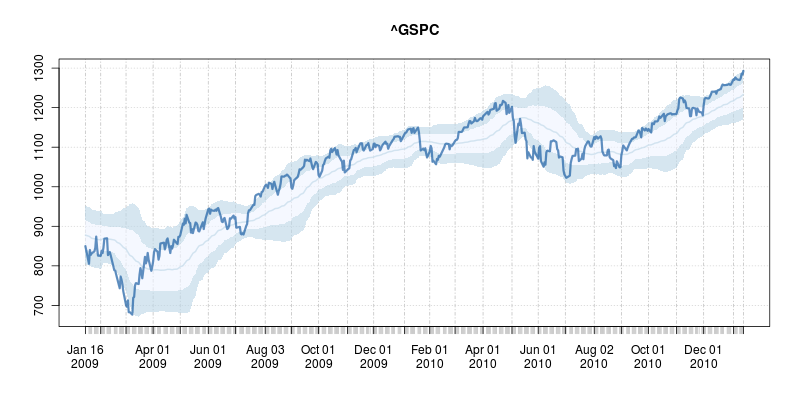
After downloading data and computing the rolling smoothed mean and standard deviation, it really is just a matter of plotting (appropriate) filled polygons. Here I used colors from the neat RColorBrewer package with some alpha blending. Colors can be turned off via an option to the function; ranges, data length and type of smoother can also be picked. To call this in R, simply source the file and the call, say, plotOBOS("^GSPC", years=2) which creates a two-year plot of the SP500 as shown here: Example chart of overbought/oversold levels from plotOBOS() function This shows the market did indeed bounce off the oversold lows nicely on a few occassions in 2009 and 2010 --- but also continued to slide after hitting the condition. Nothing is foolproof, and certainly nothing as simple as this is, so buyer beware. But it may prove useful in conjunction with other tools. The code for the script is here and of course available under GPL 2 or later. I'd be happy to help incorporate it into some other finance package. Lastly, if you read this post this far, also consider our R / Finance conference coming at the end of April.

Edit: Corrected several typos with thanks to Josh.

Next.

Previous.