Search Results: "ag"

8 August 2008

Andrew Pollock: [tech] Moved

Well that happened, and uneventfully as well. Now if only IntaServe actually made it possible to update glue records, everything would be done... What is it with domain registrars and glue records? Are glue records that much of an edge case these days that no one bothers having an interface for managing them?

Lucas Nussbaum: Of popular packages removed from testing, and the Ultimate Debian Database GSOC project

Some time ago, there was some flamewars^H^Hdebate about the Release Team’s removals of RC-buggy packages from testing. Basically, some people claimed that popular packages shouldn’t be removed, even if RC-buggy. But, do we really miss popular packages in testing? It’s difficult to know. You could get the popcon data, and compare it with the Packages files for testing and unstable. Or work with source packages (which removes a lot of noise), but then, you have to convert the popcon data (which uses binary packages names) to source packages. Not completely trivial. That’s where the Ultimate Debian Database GSOC project comes to the rescue. The goal of Christian von Essen’s project is to gather data from various sources in Debian into a single SQL DB, so queries that combine all those data sources can easily be written. For example, here is the query that lists the source packages that are in unstable, but not in testing, sorted by their popcon (using the number of insts of the most popular binary package of the source package as value for the source package):
SELECT DISTINCT unstable.package, insts
FROM (SELECT DISTINCT package FROM sources
WHERE distribution = 'debian' and release = 'sid') AS unstable, popcon_src
WHERE unstable.package NOT IN (
   SELECT package FROM sources
   WHERE distribution = 'debian' AND release = 'lenny')
AND popcon_src.source = unstable.package ORDER BY insts DESC;

And the results are available on the web! Top packages (> 1000 insts):
lzo	64962
gnome-cups-manager	32346
db4.6	20708
ffmpeg-debian	12908
freetype1	10569
flashplugin-nonfree	7116
perlftlib	6769
nvidia-graphics-drivers	3864
wxwindows2.4	3640
dvi2tty	2239
kdebase-runtime	1725
easytag	1717
g-wrap	1582
yaird	1507
slocate	1499
youtube-dl	1390
hugin	1275
w3c-libwww	1058
Interested in UDD? Join #debian-qa or debian-qa@lists.d.o (or talk to me @DebConf!)

Theodore Ts'o: Fast ext4 fsck times

This wasn’t one of the things we were explicitly engineering for when were designing the features that would go into ext4, but one of the things which we’ve found as a pleasant surprise is how much more quickly ext4 filesystems can be checked. Ric Wheeler reported some really good fsck times that were over ten times better than ext3 using filesystems generated using what was admittedly a very artificial/synthetic benchmark. During the past six weeks, though, I’ve been using ext4 on my laptop, and I’ve seen very similar results. This past week, while at LinuxWorld, I’ve been wowing people with the following demonstration. Using an LVM snapshot, I ran e2fsck on the root filesystem on my laptop. So using a 128 gigabyte filesystem, on a laptop drive, this is what people who got to see my demo saw:
e2fsck 1.41.0 (10-Jul-2008)
Pass 1: Checking inodes, blocks, and sizes
Pass 1: Memory used: 3440k/12060k (3311k/130k), time: 17.82/ 5.52/ 1.11
Pass 1: I/O read: 233MB, write: 0MB, rate: 13.08MB/s
Pass 2: Checking directory structure
Pass 2: Memory used: 3440k/13476k (3311k/130k), time: 41.47/ 2.16/ 3.30
Pass 2: I/O read: 274MB, write: 0MB, rate: 6.61MB/s
Pass 3: Checking directory connectivity
Peak memory: Memory used: 3440k/14504k (3311k/130k), time: 59.88/ 7.75/ 4.42
Pass 3: Memory used: 3440k/13476k (3311k/130k), time:  0.04/ 0.02/ 0.01
Pass 3: I/O read: 1MB, write: 0MB, rate: 27.38MB/s
Pass 4: Checking reference counts
Pass 4: Memory used: 3440k/6848k (3310k/131k), time:  0.25/ 0.24/ 0.00
Pass 4: I/O read: 0MB, write: 0MB, rate: 0.00MB/s
Pass 5: Checking group summary information
Pass 5: Memory used: 3440k/5820k (3310k/131k), time:  3.13/ 1.85/ 0.10
Pass 5: I/O read: 5MB, write: 0MB, rate: 1.60MB/s
  779726 inodes used (9.30%)
       1 non-contiguous inode (0.0%)
         # of inodes with ind/dind/tind blocks: 719/712/712
22706429 blocks used (67.67%)
       0 bad blocks
       4 large files
  673584 regular files
   58903 directories
    1304 character device files
    4575 block device files
      11 fifos
    1818 links
   41336 symbolic links (32871 fast symbolic links)
       4 sockets
--------
  781535 files
Memory used: 3440k/5820k (3376k/65k), time: 63.35/ 9.86/ 4.54
I/O read: 511MB, write: 1MB, rate: 8.07MB/s
How does this compare against ext3? To answer that, I copied my entire ext4 file system to an equivalently sized partition formatted for use with ext3. This comparison is a little unfair since the ext4 file system has six weeks of aging on it, where as the ext3 filesystem was a fresh copy, so the directories are a bit more optimized. That probably explains the slightly better times in pass 2 for the ext3 file system. Still, it was no contest; the ext4 file system was almost seven times faster to check using e2fsck compared to the ext3 file system. Fsck on an ext4 filesystem is fast!
Comparison of e2fsck times on an 128GB partition
Pass ext3 ext4
time (s) I/O time (s) I/O
real user system MB read MB/s real user system MB read MB/s
1 382.63 18.06 14.99 2376 6.21 17.82 5.52 1.11 233 13.08
2 31.76 1.76 2.13 303 9.54 41.47 2.16 3.3 274 6.61
3 0.03 0.01 0 1 31 0.04 0.02 0.01 1 27.38
4 0.2 0.2 0 0 0 0.25 0.24 0 0 0
5 9.86 1.26 0.22 5 0.51 3.13 1.85 0.1 5 1.6
Total 424.81 21.36 17.34 2685 6.32 63.35 9.86 4.54 511 8.07

Randall Donald: Busy Summer


My wife and I have almost settled in our new home now. We start moving the alpacas today. I finally have some time to address the issues with the NVIDIA packages in regards to Lenny. As 2.6.26 is now in unstable I can build kernel modules for the proper kernel target and get a xen patch for 71.86.06. 173.14.12 will go into experimental shortly.

Benjamin Mako Hill: Revealing Errors OSCON Keynote

When I gave a Revealing Errors talk at Lug Radio Live USA, I had the misfortune of being up against Robert Love's talk on Android which many people at the conference wanted to see -- myself included! One person who showed up to my talk anyway was Allison Randall. She was apparently entertained enough to invite me to give a short version of the talk as one of the keynote presentations at OSCON 2008! In the talk, I covered the ideas behind my Revealing Errors project and quickly walked through a few examples that showcase what I'm trying to do. I'm happy with the result: a couple thousand people showed up for the talk despite the fact that it was at 8:45 AM after the biggest "party night" of the conference! For those that missed it for whatever reason, you can watch a video recording that O'Reilly made and that I've embedded below. A larger version of the Flash video as well as a QuickTime version is over on blip.tv and I've created an OGG Theora version for all my freedom loving readers.

Stefano Zacchiroli: improved integration among PTS and Lintian

DebConf8 hacks: better PTS/Lintian integration Yesterday nigh hack: better integration of the PTS with Lintian.d.o. Quoting from the filed misc developer news:
=== Lintian and the PTS ===
The integration between lintian and the PTS has been improved. On one hand
now the hyperlink to the Lintian will be shown for a source package only if
Lintian had something "to say" about that package. On the other hand, if
there were warnings or errors in the last Lintian ran, they will be shown as
TODO items in the appropriate part of the PTS web interface.
The display logics is as follows:
 * if there is 1 or more amongst errors and warnings they will be shown as TODO items
 * if there is 1 or more amongst errors, warnings, and information messages, the hyperlink to the Lintian report will be shown

Some more info are available in the bug logs (bug #458329, bug #243729); if you want a sample page have a look at ocaml, but I'm pretty sure that most random package pages will show at least 1 lintian warning in need of your love :-)

Tollef Fog Heen: eweouz 0.1 released

I just released the first version of eweouz, the interface between emacs and evolution-data-server. Sources are available, no packages yet. It is now possible to both add contacts from within gnus and search for contacts. Patches and feedback is of course welcome.

Enrico Zini: Handling concurrent update-apt-xapian-index runs

Handling concurrent update-apt-xapian-index runs So, update-apt-xapian-index takes a bit of a long time to run. When you install the package, if the index isn't there then postinst will rebuild it in background, good. Now, suppose you have an advanced package manager that after installing apt-xapian-index, detects that it's installed, detects that there is no database and runs an update with a nice GUI feedback. If this happened while the update is running in the background, the usual thing to do would be to abort the update; however, the package manager wouldn't be able to know when the indexing has finished and it can enable the advanced features. Let's not do the usual thing, then:
#  progress' is the object that does progress reporting.  Commandline options
# can choose a silent one, a machine readable one or a user readable one.
# Lock the session so that we prevent concurrent updates
lockfd = os.open(XAPIANDBLOCK, os.O_RDWR   os.O_CREAT)
lockpyfd = os.fdopen(lockfd)
try:
    fcntl.lockf(lockpyfd, fcntl.LOCK_EX   fcntl.LOCK_NB)
    #  ServerProgress  is a proxy progress reporter that listens for
    # connections on a Unix socket, and broadcasts progress status updates both
    # to the local progress reporter and to whoever connects to the socket.
    progress = ServerProgress(progress)
except IOError, e:
    if e.errno == errno.EACCES or e.errno == errno.EAGAIN:
        progress.notice("Another update is already running: showing its progress.")
        #  ClientProgress' is another proxy class that connects to the socket
    # forwards progress updates to whatever the user has chosen as the
    # local progress indicator.
        childProgress = ClientProgress(progress)
        childProgress.loop()
        sys.exit(0)
    else:
        raise
What happens here is that if the upload is in progress, the second update-apt-xapian-index will not be able to lock a lockfile. But instead of exiting, it connects to the other indexer via a unix socket, and shows the progress just as if it were the one doing the indexing. So, now, suppose I run update-apt-xapian-index:
# update-apt-xapian-index
Reading Debtags database: done.  
Rebuilding Xapian index... 20%

And suppose I run another one:
# update-apt-xapian-index
Another update is already running: showing its progress.
Rebuilding Xapian index... 20%

And suppose I run yet another one:
# update-apt-xapian-index --batch-mode
notice: Another update is already running: showing its progress.
begin: Rebuilding Xapian index
progress: 19/100
progress: 20/100

And suppose I run yet another one (running with -q shows nothing, but it will wait until the master indexer has finished):
# update-apt-xapian-index -q

This way, the advanced package manager (adept 3 does this) will show a progress indicator and correctly let the user know when indexing has finished... only, if an update is already running, the progress indicator will not start at 0% because the update was already in progress, and the user will think: "wow, I've been lucky!". The server side of the socket only uses nonblocking I/O, so there's no risk of slave indexers causing the master indexer to hang. It's been simple to implement, and brillant. It is in apt-xapian-index 0.15, which I have just uploaded to sid. Shame it's a bit late for lenny.

John Goerzen: Weird Firefox Problem

Once again, I find myself turning to this wonderful series of tubes for help on a weird problem.

I have Firefox (Iceweasel) on all the computers I regularly use. One of these computers has had a persistent problem.

After using it for awhile, it takes a really long time to look up hostnames in DNS. And after upgrading to Firefox 3, it got much worse. Not only did name resolution get slow, but sometimes page loads would get exceptionally slow as well. I could have 5 tabs open, and all of a sudden at the magic moment, nothing would load on any tab. It was as if I was being hit by 75% packet loss. And new pages wouldn't load, either.

tcpdump showed Firefox not even sending out packets at these times. After a few minutes, it might be back to normal. But I could always quit and restart and it would be fine.

Now, here's the weird thing: I've eliminated every possible difference I can think of between this one machine and the others I use Firefox on. My plugins and extensions are the same set with the same versions. My configuration is the same. When this problem is happening, other network-related programs (even other web browsers) on the same machine are working fine. Nobody else here seems to be having this problem.

Any ideas?

MJ Ray: Is Yahoo Now Even Worse On Spam?

When working on mailservers, I’ve noticed that Yahoo’s mailservers seem to “punish” others by sending code 421 (service not available) for a few minutes for a first report of spam that originated from there, longer for a second report and so on. Yahoo’s help pages suggest they do this if you don’t “comply with our guidelines (described below)” (which aren’t actually described below). That system seems to completely screw everyone on a server if a user forwards their own email to Yahoo and then flags some as spam, or if a website user who registered with a Yahoo mail address then closes their Yahoo account without updating their registration details. In the worst cases, a server’s mail queue can become clogged with stuff that it can’t forward to Yahoo. I’ve suggested that server owners ban forwarding to Yahoo, but not all have done that yet. Yahoo’s server-punishing tactics are particularly unfair because of the amount of spam we receive from Yahoo - when I tried rejecting that, the server tested seemed to get more 421 punishment for that. I now usually direct it to a blackhole, which feels a bit dangerous. Now I’ve just seen this from Indymedia which makes it sound like Yahoo’s getting even worse recently:-
“Yahoo doesn’t make it so easy for us. They do (unintendedly) transport a remarkable amount of spam, often sent by robots which automatically (and wide scale) crack Yahoos’ new account signup CAPTCHAS (those images with the cats + dogs + digits + letters in them) just to relay their spam through Yahoo. So it’s not easy to determine who sends legitimate email through Yahoo and who does not.”
I wrote about some alternative service providers back in 2006, including ippimail, which Yahoo users might like to change to. I’d be interested in comments about any new arrivals in this field. BT internet customers are probably using Yahoo-hosted email too. I recommend changing to The Phone Co-op, but my company is an agent for them, so I would say that, wouldn’t I?

7 August 2008

Joachim Breitner: pam-dbus: authentication by bubbles

Imagine you have a device, such as a linux phone, that allows login via ssh, e.g. when on a wireless network. You don t want to set a password with the (limited) phone UI. On the other hand, you don t want to allow passwordless root logins into your phone. But you do want the ability to login via ssh, after all that s why you have bought a linux smartphone. This led me to the idea of a pam module and corresponding UI piece that asks the currently logged in user: Hey, someone tries to login. Is that ok or not? This might also be useful for guest accounts on regular laptops. For more on that, see my last blog post.So I hacked it together (actually twice, due to some unfortunate use of rm at some point), invested most of the time in learning more about the python garbage collector vs. callbacks, explicitly marked global variables and proper automake stuff. In the end I got, well, just what I wanted. A simple pam module, dubbed pam-dbus that sends a request via the dbus system bus and an autostart program (written in python for now, but I might re-implement it in C) that uses notification-daemon to get confirmation from the user.You are welcome to try the sources and binary debian packages or have a look at the darcs repository for pam-dbus (with debian/ directory, repository browser). This will end up in Debian later, I guess.Update: Erik Johansson pointed out that if you want to use this with ssh, you need to set UsePAM yes in /etc/ssh/ssd_config.

Joachim Breitner: Flow control with pam configuration

Usually, files in /etc/pam.d/ are simple, linear descriptions of how a user should be authenticated, e.g. Try to authenticate him against ldap, and then against the local data base . But sometimes, you want something more advanced, for example If the user is called guest, please authenticate him with pam_dbus, otherwise use regular pam_unix. This is possible, and here I ll note down how to do that.There are actually two problems to solve: How to detect the username, and then how to do the flow control.For the first problem, I recently discovered the pam_succeed_if module, that allows for relatively advanced logic for checking uids, usernames, hostnames and group membership. For our case, the line would read
auth ? pam_succeed_if.so quiet user = guest
Now what next? If we just wanted to allow unrestricted access to guest, we could put sufficient for the questionmark. But we need something like if..then..else. Unfortunately (and I hope this will be fixed eventually), the only flow control available is skip the next n lines . So we can skip to pam_unix when this module fails (i.e. the user was someone else but guest), and if we did not skip, we can run the guest-specific module and then skip over pam_unix. So here is the complete snippet:
auth [default=2 success=ignore] pam_succeed_if.so quiet user = guest
auth [success=ok new_authtok_reqd=done ignore=ignore default=die] pam_dbus.so
auth [default=1] pam_permit.so
auth required pam_unix.so
You can read more about this advanced configuration in the PAM Administration guide. And here is the corresponding configuration for gdm, where guest can always login:
auth [default=2 success=ignore] pam_succeed_if.so quiet user = guest
auth required pam_permit.so
auth [default=1] pam_permit.so
auth required pam_unix.so
So I have a guest account with a locked password and I can allow ssh logins with a mouse click and use it directly with gdm. I probably should put the gdm configuration also in xscreensaver to not lock me out.

Ian Wienand: How to find the current glibc version

A recent post reminded me of a problem I once had; determine the glibc version and its support for various things. There's actually a little known but useful confstr call defined for just this sort of thing. Here's a minimal example:
#include <stdio.h>
#include <unistd.h>
#include <alloca.h>
#include <string.h>
int main (void)
 
        size_t n = confstr (_CS_GNU_LIBC_VERSION, NULL, 0);
        if (n > 0)
         
                char *buf = alloca (n);
                confstr (_CS_GNU_LIBC_VERSION, buf, n);
                printf("%s\n", buf);
         
        return 0;
 
man confstr has all the details. If you don't need it in your program, you can also just run /lib/libc/so.6 and it will print out it's version info, e.g.
$ /lib/libc.so.6
GNU C Library stable release version 2.7, by Roland McGrath et al.
Copyright (C) 2007 Free Software Foundation, Inc.
This is free software; see the source for copying conditions.
There is NO warranty; not even for MERCHANTABILITY or FITNESS FOR A
PARTICULAR PURPOSE.
Compiled by GNU CC version 4.3.1 20080523 (prerelease).
Compiled on a Linux >>2.6.24.4<< system on 2008-06-02.
Available extensions:
	crypt add-on version 2.1 by Michael Glad and others
	GNU Libidn by Simon Josefsson
	Native POSIX Threads Library by Ulrich Drepper et al
	BIND-8.2.3-T5B
For bug reporting instructions, please see:
<http://www.gnu.org/software/libc/bugs.html>.
There's also another glibc trick that often comes in useful; the LD_DEBUG environment variable. Start with help and you can get more details from there.
$ LD_DEBUG=help ls
Valid options for the LD_DEBUG environment variable are:
  libs        display library search paths
  reloc       display relocation processing
  files       display progress for input file
  symbols     display symbol table processing
  bindings    display information about symbol binding
  versions    display version dependencies
  all         all previous options combined
  statistics  display relocation statistics
  unused      determined unused DSOs
  help        display this help message and exit
To direct the debugging output into a file instead of standard output
a filename can be specified using the LD_DEBUG_OUTPUT environment variable.

Gustavo Noronha Silva: 7 Aug 2008

So it is currently possible to use simple library calls in glib-based code to run something as root, by taking advantage of the gksu policykit mechanism: GksuProcess* gksu_process_new(const gchar *working_directory, const gchar **arguments);
gboolean gksu_process_spawn_async(GksuProcess *process, GError **error);
The DBus service already works; it is able to setup the environment and X authorization correctly. There is still lots to do; startup notification is still not handled, and dealing with the application’s stdandard output and error messages, as well as providing a way for the caller to send stuff into the processe’s standard input. It is already possible to start an application and know that it has been finished, though. As for the code: $ git clone git://kov.eti.br/srv/git/gksu-polkit.git/ Criticism is welcome! In other news… I’d like to ask our dear lazy web if anyone is using some nice way of providing only posts tagged in specific categories in a feed in wordpress. I’d like to use that to provide my posts to planet debian from my wordpress install.

Lucas Nussbaum: Exporting logs from Suunto X6HR watches on Linux

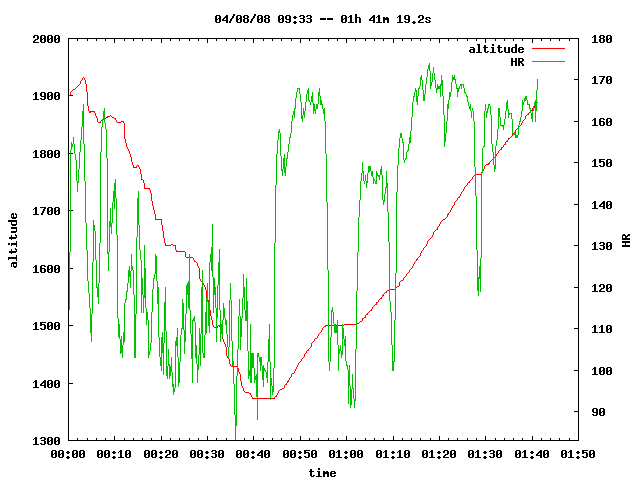
I’m the happy owner of a nice geeky toy: a Suunto X6HR watch, that includes an altimeter and an heart rate monitor, which I use mainly for moutain biking and hiking. During outings, the watch can log the altitude and heart rate every 2, 10 or 60 seconds, and the data can be transfered to a PC using a serial interface. The problem is that Suunto only provides software for Windows. I got tired of using virtualbox to connect to the watch (qemu doesn’t work, Suunto Activity Manager apparently does strange things with the serial port), so I reverse-engineered the protocol (using skimanager and J rome Kieffer’s work as a basis) and implemented a script to fetch the logs, and export them in a format suitable for gnuplot. Of course, Suuntux is publicly available. I’d be happy to hear from you if it works for you too. Also, if you own a Suunto X6 (similar watch, without HRM), I’d be interested in supporting it too (if it’s not supported already). Below is a example graph, from a short mountain bike ride just before leaving for Debconf. example suuntux output

Sandro Tosi: Another info source for Debian

It seems that #debian-devel@OFTC channel topic is used to inform for some particular situations, even grave ones (like HP Fort Collins outage of today).

But what to do if you'd like to be alerted for such situation and you can't check IRC, or you prefer different communication medium (like mails or feeds)?

There is a nice page on wiki.d.o that's been updated every time that #debian-devel@OFTC topic is changed. So, go there and simply subscribe to it (and you'll receive emails every time the page is changed). There should be a way to get an RSS feed from a MoinMoin page, but can't find a way: suggestions?

Russell Coker: A Basic IPVS Configuration

I have just configured IPVS on a Xen server for load balancing between multiple virtual hosts. The benefit is not load balancing but management. With two virtual machines providing a service I can gracefully shut one down for maintenance and have the other take the load. When there are two machines providing a service a load balancing configuration is much better than a hot-spare, one reason is the fact that there may be application scaling issues that prevent one machine with twice the resources from giving as much performance as two smaller machines. Another is the fact that if you have a machine configured but never used there will always be some doubt as to whether it would work… The first thing to do is to assign the IP address of the service to the front-end machine so that other machines on the segment (IE routers) will be able to send data to it. If the address for the service is 10.0.0.5 then the command “ip addr add dev eth0 10.0.0.5/24 broadcast +” will make it a secondary address on the eth0 interface. On a Debian system you would add the line “up ip addr add dev eth0 10.0.0.5/24 broadcast + true” to the appropriate section of /etc/network/interfaces, for a Red Hat system it seems that /etc/rc.local is the best place for it. I expect that it would be possible to merely advertise the IP address via ARP without adding it to the interface, but the ability to ping the IPVS server on the service address seems useful and there seems no benefit in not assigning the address. There are three methods used by IPVS for forwarding packets, gatewaying/routing (the default), IPIP encapsulation (tunneling), and masquerading. The gatewaying/routing method requires the back-end server to respond to requests on the service address. That would mean assigning the address to the back-end server without advertising it via ARP (which seems likely to have some issues for managing the system). The IPIP encapsulation method requires setting up IPIP which seemed like it would be excessively difficult (although maybe not more than required to set up masquerading). The masquerading option (which I initially chose) rewrites the packets to have the IP address of the real server. So for example if the service address is 10.0.0.5 and the back-end server has the address 10.0.1.5 then it will see packets addresses to 10.0.1.5. A benefit of masquerading is that it allows you to use different ports, so for example you could have a non-virtualised mail server listening on port 25 and a back-end server for a virtual service listening on port 26. While there is no practical limit to the number of private IP addresses that you might use it seems easier to manage servers listening on different ports with the same IP address - and there is the issue of server programs that are not written to support binding to an IP address. ipvsadm -A -t 10.0.0.5:25 -s lblc -p
ipvsadm -a -t 10.0.0.5:25 -r 10.0.1.5 -m The above two commands create an IPVS configuration that listens on port 25 of IP address 10.0.0.5 and then masquerades connections to 10.0.1.5 on port 25 (the default is to use the same port). Now the problem is in getting the packets to return via the IPVS server. If the IPVS server happens to be your default gateway then it’s not a problem and it will already be working after the above two commands (if a service is listening on 10.0.1.5 port 25). If the IPVS server is not the default gateway and you have only one IP address on the back-end server then this will require using netfilter to mark the packets and then route based on the packet matching. Marking via netfilter also seems to be the only well documented way of doing similar things. I spent some time working on this and didn’t get it working. However having multiple IP addresses per server is a recommended practice anyway (a back-end interface for communication between servers as well as a front-end interface for public data). ip rule add from 10.0.1.5 table 1
ip route add default via 10.0.0.1 table 1 I use the above two commands to set up a new routing table for the data for the virtual service. The first line causes any packets from 10.0.1.5 to be sent to routing table 1 (I currently have a rough plan to have table numbers match ethernet device numbers, the data in question is going out device eth1). The second line adds a default router to table 1 which sends all packets to 10.0.0.1 (the private IP address of the IPVS server). Then it SHOULD all be working, but in the network that I’m using (RHEL4 DomU and RHEL5 Dom0 and IPVS) it doesn’t. For some reason the data packets from the DomU are not seen as part of the same TCP stream (both in Net Filter connection tracking and by the TCP code in the kernel). So I get an established connection (3 way handshake completed) but no data transfer. The server sends the SMTP greeting repeatedly but nothing is received. At this stage I’m not sure whether there is something missing in my configuration or whether there’s a bug in IPVS. I would be happy to send tcpdump output to anyone who wants to try and figure it out. My next attempt at this was via routing. I removed the “-m” option from the ipvsadm command and added the service IP address to the back-end with the command “ifconfig lo:0 10.0.0.5 netmask 255.255.255.255” and configured the mail server to bind to port 25 on address 10.0.0.5. Success at last! Now I just have to get Piranha working to remove back-end servers from the list when they fail. Update: It’s quite important that when adding a single IP address to device lo:0 you use a netmask of 255.255.255.255. If you use the same netmask as the front-end device (which would seem like a reasonable thing to do) then (with RHEL4 kernels at least) you get proxy ARPs by default. For example you used netmask 255.255.255.0 to add address 10.0.0.5 to device lo:0 then on device eth0 the machine will start answering ARP requests for 10.0.0.6 etc. Havoc then ensues.

MJ Ray: RFID Security and Stability

While developing an RFID extension for the Koha library catalogue system over the last few months, I’ve learned a lot about I-Code tags and security systems, but I’ve not yet looked into Mifare, which is the other big RFID product line from NXP. I have been seeing several reports of problems with Oyster (which is Mifare-based) and a crack to be published. I thought Mifare was meant to be a much tougher product than I-Code. I’m surprised and disappointed that NXP’s reaction to a hack was to try to prevent publication. I haven’t heard from any suppliers about vulnerabilities, so I doubt that NXP are passing the message on to all Mifare-operators yet. They should tell Mifare operators so that they can protect themselves. It looks like the head-in-sand approach to security, which is very worrying. At least one of our RFID systems is Mifare-capable (which is why I think we should have been told about this vulnerability), so I’ll look into that when I get some spare time (March 2012 perhaps?) unless someone points me at a link with juicy details.

6 August 2008

Stefano Zacchiroli: yay from debcamp8

DebCamp8, shakiness, planes, python-debian Well, not unexpected news, but since I've been rather quite lately it is worth reminding that I'm now at DebConf8, enjoying the DebCamp. I've arrived today after a quite long trip made of unexpected extra plane stops in Madrid (thanks Iberia for not declaring it and letting me ponder about how can it possibly take 16 hours from Barcelona to Buenos Aires, now I know the reason ...) and shaky bus hours. First tiny teeny achievement of DebCamp (among a handful of beers already) is an upload of python-debian 0.1.11, implementing among other things support for parsed dependencies and a major overhaul changelog parsing (thanks to James Westby). Unfortunately we are going to miss Lenny with this release, but after all it is a package mostly meant for Debian Developers, so it is probably not a big deal.

Ingo Juergensmann: 2008 M68k Porter Meeting

Joey mailed lately just another announcement for the m68k port ermeeting. This year in Kiel from August 29th - 31st:

Executive summary:

2008 M68k Linux Porter Meeting
August 29th - 31st
University of Kiel, Germany


This summer we are organising a Linux porter meeting especially
targetting the m68k architecture. During the meeting current problems
of the m68k architecture, its integration in Debian, releases
etc. will be discussed.

The meeting will take place at the last weekend in August (29-31) at
the University of Kiel, Germany. Details and participants are
collected here:

This meeting is evolved from the Oldenburg porter meeting that has
started with the m68k architecture but had to stop two years ago.


Interested developers and supporters are invited to join the meeting
and help develop the m68k port of Linux.

If you are interested to attend this meeting, please drop Christian
(cts) or me a note or add yourself to the Wiki page.

Regards,

Joey


Despite all the problems the m68k faced in the last years, we're still alive and performing fine. Part of the meeting will be discussion about the current changes of the m68k port like Aranym buildds and other stuff.

So, if you're interested in the m68k port or the experience of the m68k porters for your embedded architecture, come to Kiel and visit us! :-)

Next.

Previous.