Search Results: "ag"

10 August 2008

Stefano Zacchiroli: PTS and package descriptions

PTS, package descriptions (and more than a bit of UDD) After delivering my talk at DebConf, I went back to some (more) PTS hacking ... apparently I'm in the mood for it :) An apparently trivial feature request (showing package descriptions) provided for interesting thoughts. First of all the PTS is mostly source-based, but in Debian we have no source package descriptions (issue which probably deserves fixing by its own). Rough consensus has then been to add tooltips on binary package hyperlinks, to show short descriptions. Still, adding the import of Packages sounded like overkilling, not mentioning duplicated wrt packages.d.o. Hence I decided to be the first jumping on the UDD boat (wonderful GSOC project which I had the pleasure to co-mentor together with Lucas and HE) for routinely usage. Retrieving the most recent short description of each binary package at each PTS run is as easy as:
select distinct packages.package, packages.description
from packages,
  (select package, max(version) from packages group by package)
    as latest (package, version)
where packages.package = latest.package
  and packages.version = latest.version ;

To solve the more generic problem of the PTS missing a generic description (or, if you want, to mitigate the problem that in Debian we are missing a source package description), Lucas came up with the intriguing idea of showing the description of the most popular binary package, according to popocon. Piece of cake:
select distinct packages.package, popcon.insts, packages.description
from packages, popcon,
  (select package, max(version) from packages group by package)
    as latest (package, version)
where packages.package = latest.package
  and packages.version = latest.version 
  and packages.package = popcon.package ;

(same as before, but adding popularity: one has both all short descriptions, and a way to spot the "canonical" one) Long life to UDD. (BTW if you are interested in UDD, and you happen to be at DebConf8, do not miss tomorrow's QA BOF.)

Russell Coker: Executable Stacks in Lenny

One thing that I would like to get fixed for Lenny is the shared objects which can reduce the security of a system. Almost a year ago I blogged about the libsmpeg0 library which is listed as requiring an executable stack [1]. I submitted a two-line patch which fixes the problem while making no code changes (the patch gives the same result as running “execstack -c” on the resulting shared object). My previous post documents the results of the problem when running SE Linux (a process is not permitted to run and an AVC message is logged). Some people might incorrectly think that this is merely a SE Linux functionality issue. The program paxtest (which is in Debian but is i386 only) tests for a variety of kernel security features in terms of memory management. To demonstrate the problem that is caused by this issue I ran the commands “paxtest kiddie” and “LD_PRELOAD=/usr/lib/libsmpeg-0.4.so.0 paxtest kiddie“. The difference is that the test named “Executable stack” returns a result of Vulnerable when the object is loaded. This means for example that attacks which rely on an executable stack will be permitted if the libsmpeg-0.4.so.0 shared object is loaded. So for example a program that loads the library and which takes data from the Internet (EG FreeCiv in network mode) will become vulnerable to attacks which rely on an executable stack because of this bug! My Etch SE Linux repository has had a libsmpeg0 package which fixes this bug on i386 for almost a year [2] (the AMD64 packages are more recent). I have now added packages to fix this bug to my Lenny SE Linux repository [3]. I have also volunteered to NMU the package for Lenny. It seems that it would be rather embarrassing for everyone concerned systems were vulnerable to attack because of a two-line patch not being applied for almost a year. I expect that the Release Team will be very accepting of package updates for Lenny which have patches to address this issue. A patch that has one line per assembler file (in the worst-case) to mark the object code is very easy to review. The results of the patch can be tested easily, and failure to have such a patch opens potential security holes. Package maintainers who can’t fix the assembly code can always run “execstack -c” in the build scripts to give the same result. Lintian performs checks for executable stacks and the results are archived here [4]. There are currently 36 packages which contain binaries listed as needing executable stacks, I would be surprised if more than 6 of them actually contain shared objects that need an executable stack. If you use a package that is on that list then please test whether an executable stack is required by running “execstack -c” on the shared object and see if it still works. If a test of most of the high-level operations of the program in question can be completed successfully without an executable stack then it’s a strong indication that it’s not needed. Note that execstack is in the prelink package. I am happy to help with writing the patches to the packages and using my repositories to distribute the packages, but am not going to do so unless I can work with someone who uses the program in question and can test it’s functions. As an example of such testing I played a game of Frozen Bubble to test out the libsmpeg0 patch.

Joey Hess: All Seated on the Ground

A few notes/reactions from the talks I attended today from the very, very back of the room. (AKA the skivvies and/or backyard track.) (titular story by Connie Willis) DPL talk FYI, I raised my hand when Sledge asked for a show of hands. : -( MANCOOSI (Is aptitude's dependency resolver deterministic?) wiki I doubt that trying to get the whole wiki licensed under a specific license is a good use of time. Since the wiki is not a package that we ship, but is instead a ad-hoc collection of many documents, and many conversations, I also don't see the point of a single consistent license, or any reason to be bothered by content whose license is not specified. Be very wary of anything that makes contributing to the wiki require jumping through more legal hoops than it takes to contribute to lists.debian.org or bugs.debian.org. Chilling effects can work both ways. method diffusion in free software projects Most interesting talk today. Was hoping for some results, but not disappointed. (Yak shaving!) user and NM surveys Looked like most DDs in the audience hadn't heard of the survey? SPI Nice numbers and more big projects than I'd thought. Avoided being locked in room, so still not a SPI member. ;-)

Alexander Reichle-Schmehl: Bits from the DPN editors

It's more or less four months since I proposed to resurrect our newsletter. We already released eight issues of the Debian Project News and work for the ninth issue has already started. So I guess it's time for a small "state of the DPN" speech, but since I'm not attending DebConf, you will have to read this mail instead ;) After having a rough start (and in fact missing some self-set deadlines and completely underestimating how much work is involved in such a kind of newsletter) we finally developed a - more or less - working flow of work (Which is by the way documented here). Speaking of the current state sadly means to confess, that our hopes to draw a lot of help from the community by using a system for drafting the news with a low entry barrier were not fulfilled. We actually had a good start, with good participation, but due to (I assume) the aforementioned initial difficulties participation in the creation of the DPN dropped considerably. Currently the workload of creating our bi-weekly newsletter is shared by only two people (that being Meike Reichle and myself), which is barely enough :( While we at least get a hint from time to time, what we should mention in the next issue, it rarely happens, that someone contributes by drafting a text -- which is the real work. (At this point a BIG "Thank You" to those who did! (See list bellow.) It's much appreciated!) We suffer especially, since although we are a two people team, we have in fact no redundancy, since real live issues affecting one of us will most likely affect the other one, too. Therefore we mostly concentrated our work on creating the next issues and getting them out in time, and didn't have time to answer all mails considering suggestions for changes and improvements (yet?). We are sorry, but at least we tried to read them briefly and keep them in mind when drafting the next issue. As a result of this we re-added the list of DSAs, WNPP and new and noteworthy packages due to popular demand. There are still a lot of unanswered mails not dealing with content, but with workflow issues / proposals (including changing from wiki.debian.org to a special ikiwiki instance). We are sorry, that we couldn't yet act on them and take appropriate measures, but be assured, they are not forgotten. Other issues the DPN currently have are "unwritten guidelines" regarding editorial choices of DSAs to be published and which packages to list in the "new and noteworthy package" section. Both is more or less done by our gut feeling. Speaking of problems the DPN are facing, we also need to mention translations of the DPN. The current workflow makes it difficult for translators of the DPN, since we often fail to get the final draft of the DPN ready in time to give translators a "head start" so the translated DPNs can be released together with (or at least with a as small as possible delay to) the English DPN. So here is a big call for help! We really need your help writing the DPN. (Monitoring lists and newstickers we don't monitor ourselves would be nice, too, but only add more work to us if you only give us pointers.) We will both be very busy with our real live the upcoming month, and are not sure how much time we can dedicate to the DPN. So please help us! The current draft for the next issue of the DPN is always available here . There should already be a todo list with pointers to interesting topics, which need to be written out. Some guidelines about style and content are available here. Last but not least, we would like to thank the following people who have contributed to the DPN so far: (Unfortunately we can't list those people, who contributed by translating the DPN, nor do we have a complete list of the native English speakers, who helped by proofreading. But we thank them nonetheless!)

Steve Kemp: Doesn't sound too bad. I'll try to stay awake

Well a semi-productive week during which I submitted another patch to GNU Screen - this is a trivial one, and the bug itself probably doesn't require an "important" severity. However I'm a little disappointed to see that a bug which I submitted late last year in the exaile package (#451303) is still not fixed - and worse still we're going to be stuck with it in Lenny. Still who knows, the recent activity suggests there might be a fix. But with the words "DNS cache poisoning" still ringing in our ears packages which automatically download and execute code from remote HTTP servers should ring alarm bells. Loudly. (Don't forget exaile.org has already been hacked once.) Next week I'll try to fix a couple of bugs. Publicly. Again. Unless that is dull to watch, or I find my time eaten by a .. grue. ObFilm: The Princess Bride

Clint Adams: Esperando por Andrew

Things I am not going to do this week:

Junichi Uekawa: Packages uploaded in Debconf.

Packages uploaded in Debconf. I've uploaded qemubuilder new version which supports armel architecture. And I updated dpatch with some necessary patches.

Martin Michlmayr: 2.6.26 ARM and MIPS udebs on the way...

Otavio has updated kernel-wedge in SVN to 2.6.26, so I updated ARM and MIPS today. The udebs built after minor modifications and I can also build installer images after having fixed some bugs in the build process. I tested a 2.6.26 based image on the QNAP TS-409 (armel) as well as in QEMU (mipsel). 2.6.26 will bring major improvements on ARM. Orion support is much better and our 2.6.26 has a number of patches from Marvell that help with performance on Orion. Our 2.6.26 also has Riku Voipio's LED driver for Thecus N2100 which has been accepted for the 2.6.27 mainline kernel. I haven't actually uploaded the udebs yet because I'm waiting for the go-ahead as well as for the new version of the 2.6.26 kernel package to build. But at least we're getting closer to having 2.6.26 as the kernel for lenny.

Joerg Jaspert: DebConf Assassins

Today is the day we start this years Assassins game, and I (together with the two other DebConf admins Mark and Stephen) have the role of the referee. As we all don’t want to do it by hand, and have seen bad examples in the past where the referee just wasn’t up to the task, we go another way. In the last two days, Stephen and me (mostly Stephen) developed a Pentabarf controller to do the work for us. It is ready for the game, so we start today. This controller basically tells the players their target, gets the “I killed em” notice and lets the target confirm it, then assigning a new target. And when we are done with the game - it even tells us the winner and also some information about the other players. This controller made us able to do another change to the known game rules: People can enter the game when it is already running. Which is useful, as now we only let people play that arrived at the venue. Late-comers get added to the players list whenever someone got killed. This ensures that no assassin has to wait for half the Conference time until their target finally arrives! (Ok, it might mean that Late-Comers have to wait a day or two before they finally get a target, as we only insert new players when someone dies). One more note if you are playing: Don’t tell anyone, not even your assassin, your target. Your assassin might not neccessarily get your target as his next (if we add people to the set), so keep it secret, all the time. The only people you should talk to about this game are us 3 admins, but only in case you have a problem. :) Comments: 0

Russell Coker: Xen CPU use per Domain

The command “xm list” displays the number of seconds of CPU time used by each Xen domain. This makes it easy to compare the CPU use of the various domains if they were all started at the same time (usually system boot). But is not very helpful if they were started at different times. I wrote a little Perl program to display the percentage of one CPU that has been used by each domain, here is a sample of the output: Domain-0 uses 7.70% of one CPU
demo uses 0.06% of one CPU
lenny32 uses 2.07% of one CPU
unstable uses 0.30% of one CPU Now the command “xm top” can give you the amount of CPU time used at any moment (which is very useful). But it’s also good to be able to see how much is being used over the course of some days of operation. For example if a domain is using the equivalent of 34% of one CPU over the course of a week (as one domain that I run is doing) then it makes sense to allocate more than one VCPU to it so that things don’t slow down at peak times or when cron jobs are running. I believe that it’s best to limit the number of CPUs allocated to Xen domains. For example I am running a Xen server with 8 CPU cores. I could grant each domain access to 8 VCPUs, but then any domain could use all that CPU power if it ran wild. While if I give no domain more than 2 VCPUs then one domain could use all the CPU resources allocated to it without the other domains being impacted. I realise that there are scheduling algorithms in the Xen kernel that are designed to deal with such situations, but I believe that simply denying access to excessive resource use is more effective and reliable. I have not filed a bug report requesting that my script be added to one of the Xen packages as I’m not sure which one it would belong in (and also it’s a bit of a hack). It’s licensed under the GPL so anyone who wants to use it can do what they want. Any distribution package maintainer who wants to include it in a Xen utilities package is welcome to do so. The code is below.
#!/usr/bin/perl
use strict; open(LIST, "xm list --long ") or die "Can't get list"; my $name = "Dom0";
my $uptime = 0.0;
my $cpu_time = 0.0; open(UPTIME, "</proc/uptime") or die "Can't open /proc/uptime";
my @arr = split(/ /, <UPTIME>);
$uptime = $arr[0];
close(UPTIME); while(<LIST>)

  chomp;
  if($_ =~ /^\)/)
 
    my $cpu = $cpu_time / $uptime * 100.0;
    printf("%s uses %.2f%% of one CPU\n", $name, $cpu);
    next;
 
  $_ =~ s/\).*$//;
  if($_ =~ /up_time /)
 
    $_ =~ s/^.*up_time //;
    $uptime = $_;
    next;
 
  if($_ =~ /cpu_time /)
 
    $_ =~ s/^.*cpu_time //;
    $cpu_time = $_;
    next;
 
  if($_ =~ /\(name /)
 
    $_ =~ s/^.*name //;
    $name = $_;
    next;
 

close(LIST);

Holger Levsen: DebConf8 video streams

in seven hours DebConf8 will officially begin, you can participate by watching the live video streams as described on the streams info page - have fun!

The schedule for tomorrow/today is available in - follow the links for the schedule for the other days. The times are localtime which is ART and equals to UTC-3.

Apologies for the short notice. But it should not come totally surprising for most of you! ;-)

More posts about Mar del la Plata pending since 9 days, IOW since I'm here...

9 August 2008

Bdale Garbee: Debconf 8

It took me 34 hours elapsed time to get from a hotel in downtown San Francisco to the Hotel Dora in Mar del Plata, a few hours longer than planned. But despite being tired, it seems like a good place, my first meal here was quite pleasant, and I've already had some great conversations with people I didn't know would be here. Hard to ask for much more! I'm glad someone reminded me that I have two sessions scheduled in the first two days, an SPI BOF and then a keynote on Monday morning. But first, some much-needed sleep!

Lucas Nussbaum: Code for Debian versions comparison?

Do you know code that compare versions of debian packages (for example, that knows if 2:23.2.3~rc1-1 is lower than 2:23.2.3-2?), besides dpkg –compare-versions? If yes, please write a comment to this blog post, preferably with a link to the code. Also, did someone already write a test suite for that? Who would be interested in such a test suite? I’m considering writing a function in PL/SQL to compare debian versions (for the Ultimate Debian Database project). If someone already wrote that, I’m interested as well.

Junichi Uekawa: Looking at native code invocation options for ruby.

Looking at native code invocation options for ruby. To make apt-listbugs code safer, and faster, I was looking for ways of not forking dpkg every time it tries to analyse package versions. SWIG and other stuff seem to be good for calling C code, but not useful for calling C++ code. C++ code isn't exactly convenient for dlopening and calling. I tried making a little shared library for forking and it seems to work that way, but I don't know if I really want to create and maintain this C++ shared library just for this feature. 390332 is the old patch I crafted.

Wouter Verhelst: Scattergraphs

Debcamp is nice. Talking to people in person rather than having to do IRC to get anything done is a breeze, really. One thing I haven't been particularly happy about is the fact that there aren't any good statistics on what the build capacity of an architecture is; i.e., you don't know you're low on build capacity until you suddenly start backlogging and it's too late. So, since J rg Jaspert, Mark Hymers, and Steve Gran were there, I asked them whether it'd be possible to add some data to the projectb database about installing a binary. One additional column with a default now() option later, and we now have interesting data that I can make statistics of. Of course, since that column was only added four days ago, during one of which the link to ftp-master.debian.org was down (meaning, no uploads), there's not much data there yet; but I can start making some graphs now. Of course, the hard part is trying to figure out how to present the data in a manner that one can actually get useful conclusions from, which is harder than it seems. Anyhow, I'm trying. For now, on my public space on merkel, you can find a (mostly empty) per-architecture scattergraph relating the size of a binary package against the time between the dinstall of a source package and that of its binary for that particular architecture. If the time between a binary upload and a source upload is "often" more than a day for small packages, then it's obvious that the architecture in question is having problems keeping up. It's not very useful (yet), but the graphs will be updated on a daily basis, so that hopefully one or two months from now, they will contain useful data. Note that the scales are fixed to go from 0.1 day to 1000 days, and from 1k packages to 512M packages, so as to make sure one can actually compare graphs. I'm also trying to come up with a useful line-based graph, so that it is possible to compare architectures over time against eachother. This will probably involve something with averages and standard deviations or some such, I guess. Not sure yet.

Stefano Zacchiroli: PTS integrated with mentors and gifts

more PTS hacking: mentors.d.n and gift/help bugs Some more PTS hacking at DebConf8. Among about 20 bugs triaged/fixed thus far, 2 are peculiar and integrate some more info in PTS package pages. A minor glitch is currently affecting this though: when pending uploads on mentors.d.n are not uploaded, but rather superseded by new versions in unstable, they are currently not removed automatically from mentors.d.n and will thus show up in the PTS. Apparently this is going to be fixed soon on mentors.d.n, so hopefully this bug won't have time to bother anyone. Bugs (user-)tagged gift on the other hand are a rather new (and thus far neglected) QA feature proposed by Lucas. Packages with gift bugs have now them shown as an extra line in the bug summary box. The idea is to point contributors to PTS pages to discover if some of the packages they are interested in have gifts for them. As an extra gift (pun, intended) I've written for the PTS a tiny Python script to retrieve bug summaries via SOAP. The lookup is via tag, supporting both official tags and usertags. In case it can be useful to someone else, I'm putting it up for download. The PTS is using tagged bugs.py it as follows:
$ tagged_bugs.py "gift" "debian-qa@lists.debian.org" > bugs.gift.txt
$ tagged_bugs.py "help" > bugs.gift.txt

Dirk Eddelbuettel: RQuantLib 0.2.9

As version 0.9.6 of QuantLib, which was released a couple of days ag, is now in Debian, I just uploaded an updated version of RQuantLib. Only minor API changes to src/curves.cpp were needed. This new version 0.2.9 is currently in the queue at R's master CRAN host and should hit the CRAN mirrors shortly; likewise the Debian package has been uploaded and should also propagate to Debian mirrors in due course. As usual, source are also available locally on my site. Lastly, RQuantLib is hosted on R-Forge and potential contributors are encouraged to register at R-Forge and to get in touch -- this is a great way to learn how to combine C++ and R.

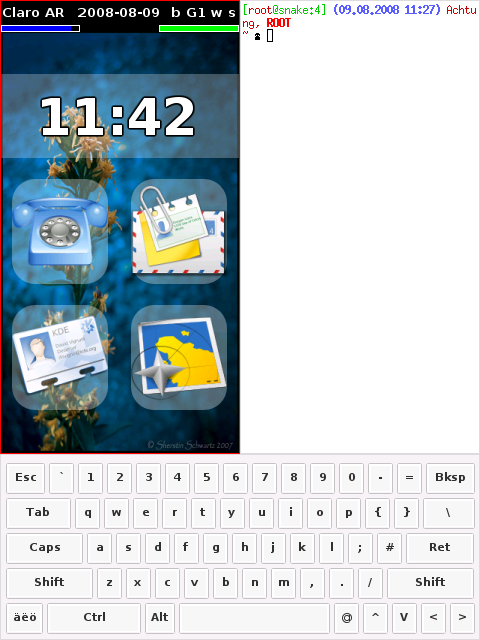
Joachim Breitner: Xmonad on my mobile phone

Here at DebConf 8 in Argentinia, I m working on getting Debian to work on the OpenMoko Freerunner Smartphone. We are progressing quite nicely, soon having the same features as the official freesmartphone.org image. See the pkg-fso wiki page for more on that. And why do we want to do that? Because we can use everything in the Debian archive on our phones!
This is the xmonad window manager, programmed in Haskell and usually running on my Desktop, now on my mobile phone! And it s almost usable. Only problem is that the screen keyboard, metacity-keyboard, gets the focus by xmonad, so I can t actually type into other windows. This could be fixed by configuring xmonad, but for that, I need to install ghc and I do not have these 280MB left on my SD card...

Lior Kaplan: Problem reading DVDs burnt in Linux


I’ve tried to create a data DVD to backup some files. I’ve used K3B as always to write the DVD, and the process finished OK. The weird part started when I tried to read the DVD on the same machine I created it. I got an error from mount about a wrong file system (the mount has iso9660). Checking dmesg, I found these errors:
Aug 9 01:03:24 desktop kernel: [ 2581.266854] attempt to access beyond end of device
Aug 9 01:03:24 desktop kernel: [ 2581.266854] hdc: rw=0, want=68, limit=4
Aug 9 01:03:24 desktop kernel: [ 2581.266854] isofs_fill_super: bread failed, dev=hdc, iso_blknum=16, block=16
I’ve tried to burn a few more DVD with differest option at K3B, but nothing helps. The funny (or not, depends on your point of view) is that windows and Mac OS X read the DVDs without a problem. Searching the web, I encountred mostly with hardware problems. I’d be happy to get an advise… I’m guessing the DVD isn’t the problem as the write process went fine.

Neil Williams: Progress at DebConf

First complete day after a full day travelling and I'm just about over the jet lag. Progress so far:

Overall, very good.
(Posting delayed due to network problems.)

It appears that drivel cannot cope with posting to the blog from DebConf.
:-(

Next.

Previous.