Search Results: "ag"

20 August 2008

John Goerzen: From Dell, a Uniquely Terrible Experience

Ah, Dell. Seeming inventors of the tech support pit of bureaucratic indifferences, inventors of the flamingo pink Inspiron, perpetrators of fraud in New York...

I have, for over a year now, been on a crusade trying to get them to stop sending me their Dell Home and Home Office catalog to my mailbox. It has been a bundle of fun, let me tell you.

They have a nice-sounding privacy policy. It says you can opt out of all their mailings by filling out a form online. Yeah, good luck with that. First of all, there are different forms for different departments at Dell. I've filled out them all, multiple times. They do nothing whatsoever. Perhaps they use them as lists of known-good addresses to send new advertisements to, rather than lists of people to remove. Oh well.

Now, unfortunately I feel compelled to bore you with the saga so far, involving telephone hang-ups, broken privacy policies, and the like. But there is a silver lining at the end, in which I submitted a request to the postal service asking them to block Dell from sending me any more mail, and it appears that they are very likely to violate Federal Law any day now.

I have called them about it. Dealt with the old "let me transfer you to the correct department" then hang up on me ploy. Spoken to people that have promised up and down that I'll be off their list in 30-60 days. It's always 30-60 days, isn't it? Very convenient that I can't tell for 2 months whether or not they've processed my request.

I've tried their online chat. One of my attempts went like this:

Session Started with Agent (Sneha Ranga)

Agent (Sneha Ranga): "Due to circumstances that have affected Dell Communications I am temporarily unable to pull up any information. The down time is temporary. We apologize for the inconvenience, as we value your time as a customer. Please contact us back after an hour."

Session Ended


Ah Dell, only you could reach such a pinnacle of customer service. /kicking someone out of a chat room before they have a chance to say a word.

Finally, last fall, I blogged about the situation (that's the link above). Debbie from Dell red the post and emailed me. Great, I thought. She asked for my address information and catalog information and sent me a removal confirmation:


From: Debbie@Dell.com
Date: Thu, 18 Oct 2007 13:08:18 -0500
To: jgoerzen@complete.org
Subject: RE: Dell mailing list

Thank you, Mr. Goerzen, your request to have the below address
information removed from our marketing lists has been received:

[ my address here ]

We will process your request promptly. However, it may take several
weeks for some changes to take effect. If you are still receiving
catalogs after thirty (30) days feel free to email me. Sorry for any
inconvenience you may have experienced.

Thank you,
Debbie


So that was October. In December, I replied to that message, saying: "I received another mailing today, and it's been nearly 2 months since your initial message. If there's anything further you can do, I'd appreciate it." Debbie said, "I am very sorry Mr. Goerzen, I will resubmit your request." Guess how successful that was.

So in February, I manage to figure out a way to send in a support ticket without having a Dell system serial number. I wrote:

I keep getting your Dell Home and Home Office catalog. I have tried for months to get off your mailing list. I have called in, talked to people in multiple departments, who have promised to remove me from the list. I have contacted you online. NOTHING IS HELPING. This has gone on for MONTHS.

PLEASE NEVER SEND ME MAIL AGAIN, EVER, AND DO NOT RENT OR SHARE MY NAME.

My address is above.

The code on the mailing I received is: [ snipped ]


The form letter I got back said:

If you are currently receiving our catalog or mailings and would like to be removed, please visit the following web page and select the appropriate link under the "Opt-out of direct mail, phone or fax communications" heading: http://www.dell.com/OptOut


I replied, saying that form didn't work. Guess what I got back?

Thank you for signing up for Dell Email Subscriptions. Please save this email for your records.


Yes, that's right. Asking them to take me off their postal mailing lists got them to PUT ME ON their email lists. ARGH.

So they eventually manage to correctly take me off the email list, and of course promise to do the same with the postal list. This back in February.

I contacted them again in March and July, only to have a similar stupidity-laced run-in with clueless form-answer-laden Dell support reps. Each one claimed to have now, finally, and permanently removed me from the list. It never happened, and none of them lifted a finger to find out way, and no amount of begging could make them.

So, here's the good part.

Junkbusters has spent years educating people on how to get rid of unwanted mail, and documents getting a prohibitory order against the sender. It was originally designed for people that didn't want to receive obscene advertising mailings, but thanks to the happy fact that one non-adult-mailer challenged a prohibitory order all the way to the Supreme Court, you can now get prohibitory order against anyone. Yes, even Dell. (The supreme court's ruling even gave an example: you can prohibit a clothing catalog if you want.)

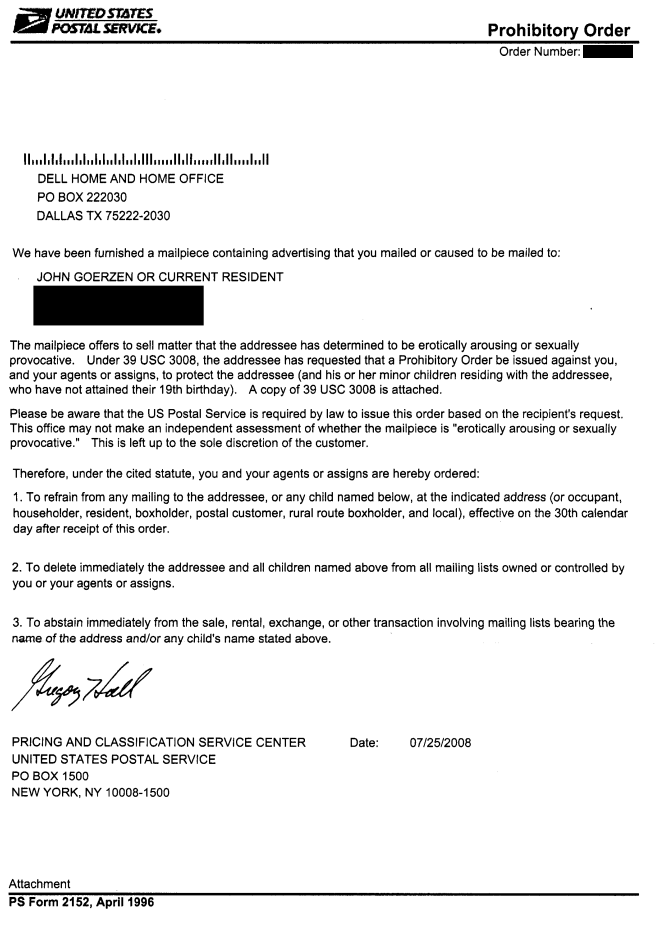
And last month, that's exactly what I did. The USPS sent me back a copy of the letter they sent to Dell, as well as a second page with instructions on reporting violations. Here's the letter they sent to Dell:
dell-usps

Somehow I get a chuckle over some Dell mail clerk trying to figure out how an 11-pound laptop is sexually provocative.

From August 25 on, it is a federal offense for Dell to send me another Home and Home Office catalog. This is a branch of criminal law, not civil law. That is, it's the maybe-go-to-jail branch of law.

How disappointed I was to receive yet another catalog from them today. If only they had waited 5 more days, I could have turned them in now.

Oh well. There's always next month's catalog. Let's just hope the clerk that received the USPS letter removed my name with a better system than everyone else at Dell uses, eh?

Sami Haahtinen: Setting up an OpenVPN tunnel

Recently I fixed my OpenVPN tunnel and figured out what was wrong with my bridge setup. Here is the complete setup that I have. Server I wanted to have as much of the configuration on the server as possible so that I could easily add more clients and wouldn't have a need to update client configuration when ever the server preferences change. Here is my OpenVPN server configuration:
mode server
tls-server
dev tap0
server-bridge 10.5.6.1 255.255.255.0 10.5.6.200 10.5.6.209
ifconfig-pool-persist /var/run/openvpn-ip.txt
keepalive 10 60
ping-timer-rem
persist-tun
push "route 10.5.6.0 255.255.255.0"
push "dhcp-option DNS 10.5.6.1"
ca /root/easy-rsa-2.0/keys/ca.crt
key /root/easy-rsa-2.0/keys/ressukka.net.key
cert /root/easy-rsa-2.0/keys/ressukka.net.crt
dh /root/easy-rsa-2.0/keys/dh1024.pem
client-to-client
up /etc/openvpn/ovpn-ressukka.sh

and the up script:
#!/bin/sh
# Bind the tunnel interface to the bridge
BRIDGE=br0
ifup $1
brctl addif $BRIDGE $1

There is nothing really special about that configuration. The server is in TLS mode configures a bridge. The keys are generated with easy-rsa by following a openvpn howto entry. The up script just binds the tap0 device to the network bridge after bringing up the device. Next I created the interface configuration by adding the following to /etc/network/interfaces:
iface br0 inet static  
 address 10.5.6.17  
 gateway 10.5.6.1  
 netmask 255.255.255.0  
 bridge-ports eth0

The trick here is to create a single bridge with just the eth0 device. We use the up script for openvpn to add the tunnel device to the bridge. Otherwise the bridge would never contain the proper devices. Client As for the client, you simply set the client to use the CA-certificate and Host key created with easy-rsa, set the hostname and tunnel type. Tunnel type is assumed to be a tun-device instead of tap, so in my case I needed to change it too. There is no need to tell the client anything else. Everything else will be negotiated through the tunnel. And since I use NetworkManager to set up my tunnels I didn't have a need to drop in to a shell even once at the client.

Sami Haahtinen: Dynamic network configuration

I've been meaning to write up on this for quite some time now, but always have something seemingly more important things to do. Most modern Linux distributions offer ways to manage network interfaces via some kind of abstraction. Usually this abstraction allows one to dynamically rename and add network interfaces. For Debian family management is done with ifupdown, while with RedHat family it's sysconfig. In addition there is NetworkManager which is a cross platform solution for dynamic network configuration (which eliminates the need to rename interfaces). Case Xenserver Usually this comes in rather handy, but on other occasions it can be a pain. A while I was helping out with an installation of a XenServer instance. This server had, for some reason, ethernet interfaces reversed in comparison to the other XenServers on the site. Luckily the service console has the network configuration in ifcfg scripts. We were easily able to reverse the interfaces by binding the interfaces to certain hardware addresses. The only problem is that the interface is renamed only when the interface is brought up. What's worse the interfaces were enumerated before the server would bring up all of the interfaces. Only eth0 was brought up for management purposes before enumerating. This means that the original eth0 was renamed to _tmp_xxxxxx. The (oh so elegant) solution was to create a script that does ifup eth1; ifdown eth1. Problem solved. Case tap0 I also experienced similar problems when I was setting up my OpenVPN tunnel. I wanted to use a bridged connection to my network, but for that I needed to create a br0 interface with tap0 as a member. It's easy enough to create ifupdown configuration to set up tap0. Hook that up to br0 and you are all set. The same problem will bite you here. The interface tap0 is actually created only when the tap0 is brought up and br0 members are added only if they are present. The solution? In my case, create a custom script that adds the device manually after it's been created properly. I was unable to find anything that works without using a custom script =( In retrospect Looking back at these cases, I should have known better. The problem was obvious and it took me way too long to figure out the cause for my problems. Then again, the utilities should be able to create a reasonable abstraction for themselves that they use to determine the actual status of the whole system. This way the trickery needed for setting up simple interface would be obsolete. You can't have it all, but you can always hope.

Nacho Barrientos Arias: Spain cries

At least 150 people were reported killed today in an air crash at Madrid. Rest in peace, all of you will be missed.

Martín Ferrari: Wunderbar!

DC8 group photoYou can say that DebConf8 is officially is over for you, when you're finally home, after three weeks in Mar del Plata; go to a primary school friend's house to celebrate his birthday, and end the day watching a movie alone. It's also when you delete the reminder for the two weekly IRC meetings, when you have to go back to classes, convince your boss not to kill you because of all the work hours spent on organisation, make your pet cat recognise you again, and be able to make a blog post about it. What can I say about DC8? It's been madness, rush, fun, tiredness beyond belief, intoxication, mao, meetings every day with the hotel, friends that you get to see only once a year, musicians out of key, and pride. Pride of seeing people enjoying themselves, things going more or less as were planned, and being part of a group of people that worked hard to make this dream come true: thanks to all of you! Cl mence Po syOne little thing I brought from MDQ is a copy of In Bruges, a movie I didn't know anything about, but whose title caught me. That's the movie I've just seen and loved because it brought me memoirs of Bruges and Belgium. City and country I visited last year after DebConf, and fell in love with. That's something else that DebConf has been for me: the opportunity to visit countries far away from mine, and not wanting to ever stop. Anyway, I still want to see some fellow debianites before they go to their respective countries. So a barbecue will take place at my home this weekend, just to compete with Steve's. If you're still around, just talk to me to arrange details and eat a little more beef if you hadn't got an overdose yet! By the way, I totally fell in love with Cl mence Po sy after this movie :-) Tags: Planet Lugfi, Planet Debian

David Pashley: Asymmetric Routing and Flow Sessions in JUNOS ES

We've recently installed a couple of Juniper J-Series routers that have the new JUNOS with Enhanced Services installed on them. During the transition from our existing Linux routers, we started moving internal subnets to the new routers, but when we moved the first subnet, we discovered a problem with hosts that had addresses on two different subnets. Connections would either connect for a minute and work and then get a connection reset, or packets would come in to the server and leave again, but then get swallowed in the ether. I spent quite a bit of time this week reading about the security features of the new routers, and finally came up with a solution. The first clue was that I was getting connection reset from something on the network, but carrying out packet sniffing on our existing routers and the end points showed that they weren't generating it. I eventually found the tcp-rst option, which generates a reset packet for any non-SYN packet that doesn't match an existing flow session. JUNOS ES does stateful packet inspection by creating a session when it sees an initial SYN packet and then does filtering and routing based on that flow session so it doesn't have to do it for every packet. When I turned off the tcp-rst option on the trust zone, my connection that worked for a minute worked again only for a minute, but this time, it just hung, rather than dying with a connection reset. This cemented the idea that the Juniper routers were the cause. It turned out that the problem was that there was asynchronous routing going on. A packet was coming in to 10.0.0.1/24, but the server was also on 10.0.1.1/24 and the default route nexthop was 10.0.1.2. Depending on which subnet we moved depended on the resulting behavour. If we moved 10.0.0.0/24 to the new routers, they would only see the incoming side of the conversation. If we moved 10.0.1.0/24, they would only see the outgoing side of the conversation. If we then think how this would work with the session-based routing and firewalling, in the first case, the router would see the initial SYN packet, but would never see the returning SYN-ACK packet, and after an initial timeout, decide the flow never established and destroy the session info, resulting in further incoming packets to be dropped. In the second case, it would never see the SYN packet, only the SYN-ACK. This packet wouldn't belong to an existing session, so would be blocked. The solution is to turn off the SYN check, using:
[edit]
user@host# set security flow tcp-session no-syn-check
After commiting that, sessions work correctly, even without the router seeing both sides of the connection:
user@host> show security flow session destination-prefix 10.0.0.1    
Session ID: 201341, Policy name: default-permit/4, Timeout: 1798
  In: 192.168.0.1/61136 --> 10.0.0.1/22;tcp, If: ge-0/0/0.7
  Out: 10.0.0.1/22 --> 192.168.0.1/61136;tcp, If: ge-0/0/1.7
1 sessions displayed
Sadly, I couldn't find much information on the no-syn-check option, so hopefully people will find this explaination useful.
Read Comments (1)

MJ Ray: Would a Real Free Software Developer Group Bite Apple Like FSF Did?

I’ve been installing free software for library cataloguing onto Apples recently. It’s not been great (GNU/Linux is still easier and faster, in my opinion) but it has worked much better than older Macs. As well as making servers that are finally getting easier, Apple lead the way in locked-down portable players, with their iPod and iPhone devices and iTunes service. Quite rightly, free software users campaign against Apple’s use of DRM/TPM (Technical Protection Measures). One of the rallying points has been Defective by Design (DbD), an FSF initiative since 2006. Long-time readers may remember that I took part in a DbD protest at an Apple Store in September 2006:-
“I noticed the huge till queue, which was attractive for three reasons: it had no security (I guess shoplifters rarely queue for the till), most of them are standing around waiting for something to read and they are almost certainly Apple customers, so who better to inform? After I rejoined the back of the queue a few times, a security man was watching it, so I moved off and chatted to people waiting to do hands-on tests on the upper floor for a bit [...] then I moved back to leaflet the till queue again. [...] Then, I got a bit bored and started putting the leaflets into Apple’s product leaflet dispensers (in front of Apple’s - no leaflets were removed), which soon got me rumbled.”
To me, that was fine: I dislike that type of store, which tries to look like public space, but is actually privatised and controlled. My resource use was minimal (one security man escorting me out and some Saturday kid probably “cleaned” the leaflet racks) but I passed information to many Apple customers, who are one of only two groups Apple must keep happy, ultimately. Popey is a bit upset by the latest protest idea, which he describes as:-
“urging people to book slots at the Apple in-store “Genius Bar” to ask probing questions which they already know the answer to about their company policy on DRM and Free software. The ‘Genius Bar’ is an official Apple support avenue for their customers, and is a service provided inside many of their stores.”
It’s also been criticised by neuro and Pete along similar lines. I agree. It’s wasting both side’s resources. Apple don’t really need to keep their staff happy (they can hire new staff) and it offends Apple customers and shareholders. It’s not even efficient: each unit of Apple employee time wasted costs a unit of DbyD worker time and who’s got the most resources there? What are FSF thinking? It’s stupid, even without the bad press it’s had. So, this brings me in a roundabout way to answering
“I am aware of the Linux Foundation and the FSF and others, but how does SPI differentiate itself and its goals from those organizations?”
from why people don’t join SPI. In my opinion, a key difference of Software in the Public Interest is that it is managed by free software developers in a more-or-less democratic fashion. Even though I’ve failed in two elections, I still think it’s better than the alternatives. No project as unpopular as wasting Apple Store helpdesk time would ever get backed by SPI, would it?

19 August 2008

Daniel Burrows: Package Management Sudoku

Update: There are more notes on how aptitude performs as a Sudoku solver here. Russell Coker recently wrote a post entitled Ownership of the Local SE Linux Policy. This post has nothing to do with the substance of his post, which is a discussion of how distributions should configure SELinux by default. I know nothing about SELinux, but something that Russell said in passing caught my attention:
I am not aware of the Debian package dependencies (or those of any other distribution) being about to represent that the postfix package depends on selinux-policy-default-postfix if and only if the selinux-policy-default package is installed. Please note that I am not suggesting that we add support for such things, a package management system that can solve Sudoku based on package dependency rules is not something that I think would be useful or worth having.
(emphasis added) As it happens, a little-known fact about the Debian packaging system is that you can, in fact, describe Sudoku puzzles in it! Note for the impatient: If you want to skip all this talk and jump to the code, see debsudoku.py. For those of you who, like me, are not Sudoku-heads, here's a quick summary of the rules (for the common case of a game with 3 blocks):
  1. The game is played by filling in a 9-by-9 grid with numbers between 1 and 9, inclusive. The board is divided into 9 3-by-3 blocks of grid cells in the obvious way.
  2. All the cells in a column must contain different numbers.
  3. All the cells in a row must contain different numbers.
  4. All the cells in a block must contain different numbers.
There are many ways that you could convert a Sudoku problem into a Debian package archive, but here's a particularly simple one that is close to my summary of the rules. Create 9 * 9 * 9 = 729 packages, named cellR.C-V where R stands for row, C for column, and V for value. Each of these packages represents writing the value V in the cell (R, C). To describe the relationships of each cell to the other cells in the problem, we can create several virtual packages: Converting these requirements to package dependencies is quite straightforward. For the package cellR.C-V, in block row BR and block column BC, we add these lines to the package's definition:
Provides: cellR.C, blockBR.BC-V, rowR-V, colC-V
Conflicts: cellR.C, blockBR.BC-V, rowR-V, colC-V
For instance, the cell at (5, 8) will get these provides/conflicts for V=2:
Provides: cell5.8, block2.3-2, row5-2, col8-2
Conflicts: cell5.8, block2.3-2, row5-2, col8-2
This relies on the fact that self-conflicts are ignored (see Debian Policy section 7.4). To actually describe the puzzle we want to solve, we need to add another package that requires two things:
  1. Every cell contains a value.
  2. The cells that the problem fixes have their fixed values.
For instance,
Package: puzzle
Depends: cell1.1, cell1.2, ..., cell5.9-3, cell6.1, ....
if we want to require that the cell at (5, 9) contains the value 3. Proof-of-concept As a proof-of-concept, I have written a hacky Python script, named debsudoku.py, that can convert ksudoku saved games into Packages files suitable for use with apt-get or aptitude. In fact, it has two modes: conflicts, which implements the conversion described above, and depends, which implements a different but logically equivalent conversion using only Depends instead of Conflicts. To use the script, save a ksudoku board without doing any work on it, then run
python debsudoku.py /path/to/the/ksudoku/board
I've only done minimal testing on this, so don't use it to fly airplanes (in fact, please don't use any Sudoku player to fly airplanes), but I did use it, in combination with aptitude, to solve a single ksudoku puzzle. Real-world evaluation Interestingly, in a test with an easy puzzle generated by ksudoku, aptitude was able to solve the puzzle in just a few seconds when it was expressed with the conflicts reduction, but failed to find a solution at all using depends (I stopped it after several minutes). I think this is due to how the depends reduction is performed. Take rows: instead of generating conflicts between cells in a row, it requires that each row contain every number between 1 and 9. The problem with this is that aptitude's resolver functions poorly when there are non-obvious conflicts in the dependency structure. It will decide to try a combination of packages that can't be installed together, but it won't realize it. As a result of this, it ends up trying many possible combinations of packages. For instance, it might try to place the number 3 in both (2, 5) and (5, 5). There is no dependency outlawing this in the depends reduction, so aptitude will happily continue trying to resolve dependencies. Since it has used 3 twice in the fifth column, it will not be able to find any way to resolve all the dependencies that state that all the numbers between 1 and 9 appear in the 5th column, but it lacks the higher-level reasoning that would allow it to break out; it will end up trying many or most of the possible ways of filling cells in before it gives up on the offending re-use of 3. Luckily, real-world package archives (what the aptitude resolver is designed to run on) don't usually look like this.

Wouter Verhelst: Hardware test: followup

I have gotten quite some response to my blog post about the hardware test proposal thingy from Bdale. It would seem I haven't been entirely clear Someone referred me to a page by Kenshi Muto that parses 'lspci' output into a hardware compatibility list. This doesn't help. It ignores x.org stuff (which is important, too) and the page itself clearly says that it cannot guarantee whether a piece of hardware will actually work. For clarity: when I said 'Apparently all the other vendors have it, too', I really meant 'Apparently all the other GNU/Linux vendors have it, too'. People have suggested some cooperation between kernel/xorg upstream, other vendors, and perhaps something like freedesktop.org; and while that may be a good idea in and of itself, in the end Debian will have to provide something which it will call 'official' and which will tell a vendor whether or not Debian is supported on their hardware. This thing may not be fully automated or polished; it may need interactivity; but it must be something which will give a result that a product manager may want to lose some sleep over if it's not good enough. Holger also suggested we try implementing this with Debian Live, rather than debian-installer. This may be a good suggestion; a debian-live image will have a full Debian system available rather than the somewhat limited d-i environment, so writing a test should be easier. Also, I don't even want to think how testing X.org drivers would work out from within d-i. So what's left is a way to figure out how to do such a live system. I'll be posting some suggestion to the debian-devel mailinglist 'soon'.

Wouter Verhelst: The (almost) 429 tripod

Some interesting two days have just passed. I took the airplane from Mar del Plata to Buenos Aires on the 17th, slept one night in a hostel on a mattress that felt like stone, and went to the 'Circulo del Officieles de la Mar' (or some such, I don't know spanish) where I had to give a talk. The oral feedback I've gotten so far indicates that people did appreciate it, which is good. I had originally planned to do some sightseeing in Buenos Aires after my talk, but me being tired and not immediately finding anyone else to go with me changed those plans. Instead, I just stayed at the C.O.M., where we played some Mao. Amongst other things. About an hour before I left the place, Holger Levsen gave me a tripod, with the request to take it with me to Belgium, and keep it until FOSDEM. As that would also give me the use of an tripod, and being the photography hobbyist that I am, I was too happy to oblige. There was just one problem: the suitcase that contained my luggage already had a bulge from here to tokio, so adding it was a no-no. No problem, I thought. I'll just keep it in my carry-on luggage. There's some space left there, and I certainly didn't have 5kg of carry-on luggage yet. Problem solved. The 'security' in EZE is a joke; the security officer doesn't even look at the screen while X-raying my luggage. Well done. So I fly from EZE to MAD on the first, 11-and-a-half-hour leg of my flight. Madrid Barajas is a crazy airport, with its own private metro. Somewhere between gates R-something (where IB6844 from EZE arrived) and J40 (where the flight to BRU will depart from), we need to go through a security checkpoint. Strange, since I hadn't had to do that on my way in from BRU to EZE; but of course you have no choice, so I comply. As I've gotten used to by now, what with the mess of cabling in my laptop bag and the other metal objects there, I get a baggage check. The security officer who goes through my very messy bag asks me to open the bag containing the tripod, so he can see it. He then promptly decides that it is a "sharp" object, and that it is "not acceptible". Here the fun begins. Of course, trying to argue with a security guard isn't the best idea if you want to be allowed on any flight, ever, so I don't even try that. I ask him 'can I check that in, instead?' and he tells me how to go back, to the exit, and to the departures hall where I can have that little tripod get checked in. So I go there. The lady at the check-in desk tells me that she cannot check the tripod in, because the flight has already been closed and I'm too late. I tell her I'm from a connecting flight, and that I can't help that. She says she knows. So I ask her what my other options are. She tells me I could try to get on the next flight to Brussels, which is at 20:00 (rather than the 16:20 flight that I was booked on). I consider that an acceptable compromise, so ask her how to get that done, and she refers me to the ticket sales desk, some 10 meters to my left. Unfortunately, the 20:00 flight turns out to be completely booked, and there are no other flights on the same day. The best alternative he can give me is a flight to Amsterdam at 19:20, which would cost 'a little more'. I ask him 'how much more'. He starts looking up things in his computer, and after a few minutes tells me that he cannot refund my ticket for the 16:20 flight and that a flight to amsterdam would cost me 429. At this point I get somewhat angry, and tell him that this is not acceptable. He refers me to the customer service desk right across. The lady at the customer service desk is friendly, but firm: she cannot help me. Either I leave the tripod behind, or I pay whatever the ticket service asks me—she takes my word that it is 429, because she cannot check it, and cannot change it, either. I get more agitated, and ask to see the supervisor. She points me to a lady a little across who can 'call' the supervisor. At this point it is 15:55 As I reach that lady, apparently someone else had just asked for the same thing, and starts arguing with a guy in black uniform, who appears to be the supervisor, about the fact that he's got more than 30kg of luggage which he isn't allowed to take along with him. Dude, not a single airline will let you do that, no matter how much you argue. I let them argue for about 10 minutes, all the while nervously looking at my watch, but then I interrupt with 'please, I don't have much time left before my flight leaves'. That gets his attention. In our two-minute conversation, the guy in black backs up everything the other three people have told me, adding that '429 is reasonable; your luggage is already on the flight, and it will cost Iberia a lot of money to delay the flight and get it off'. I curse. He also seems surprised at the notion that I'm not allowed to take a tripod in my carry-on luggage. Hmm. Figuring I have nothing to loose, I curse one more time, and make a run for it. When I reach the security checkpoint, I ask to be allowed to skip the queue in front of it, on the grounds that I have only 15 minutes left before my flight leaves. Mind you, this is not the same security checkpoint as the one where I was rejected about an hour earlier; this is the security checkpoint between the departures hall and the secure area, whereas the other security checkpoint was one between two different terminals. I am granted my request, and quickly throw everything in the X-ray boxes. They need to go through my bag again. I help them, showing where everything conspicuous is, and opening my flute box so they know what's in there. He looks at everything, and signals that I can move on. Hang on, I think. This can't be right. 'Okay,' I ask? 'Yes,' he says. I run for the nearest info desk, show them my boarding pass, and tell them 'please, my flight leaves in 10 minutes, can you tell me where to go?' They are quick and efficient. Gate J40. I make a run for it again, and just make it in time. Of course, I could forget about my plans of finding a power outlet, plugging in my cell phone and calling my parents, but that's not a big deal—there's a train station at Brussels Airport. So what have we learned? Security on airports is random, arbitrary, non-standardized, and utterly stupid. Items that pose no danger at all—plastic bottles containing more than 100ml of water, small quantities of yoghurt that are over 100grammes but not over 100ml, tripods—are not allowed, while on the other hand I've occasionally gotten through security carrying knives and tools that are clearly forbidden by the rules. We've also learned that the rules very much depend on the particular person checking you. If you're refused for an item that is not a knife or a gun or something else similarly problematic, it may help to just find a different security checkpoint and try again. It's not as if they make any sense, anyway.

Sandro Tosi: Display the progress of long operations in Python

I'm developing a tool that will take a loooong time to complete, so I'd like to know what's the progress of its execution. Basically I'd like something to tell me "Processed: x of y" where x is the current position and y is the total to process.

On Python Cookbook there are three articles about it, but none of them satisfied me.

The I remembered that there's a program, written in Python, that does what I need: dput! So I wrote a simple script (if you want to look at it, use wget, not open with browser) to mimic what dput does.

At the end, I finally find a really nice module: progressbar. I'm preparing a package for Debian for it, since it contains many nice kind of progress bars. Anyhow, I needed to create a patch to add "Processed: 5 of 47"-kinda output, but it's really useful even as it is, even for you.

Clint Adams: No puedes ashudarme

That was the best flan I've had since A-Rod's cousin brought me some. Hers wasn't topped with dulce de leche though. Suite Judy Blue Eyes, the dulce de leche. Mmm. I don't know how I managed to get intoxicated. The waiter did flash me a creepy, mischievous smile when he was pouring my wine, so maybe he spiked it. Maybe the fine herbs in my cooked cheese were of a special psychoactive variety. I don't know. What I do know is that I noticed something was wrong when I found myself walking up to a police officer and wishing him buenas noches. This is an unwise thing to do in police states like the US or UK. Depending on region and jurisdiction, this type of behavior can get you searched, cuffed, jacked, detained, questioned, interrogated, co-opted to help steal a fire truck, beaten, shot, looked at with disdain, or Clockwork-Oranged. He just looked at me like I was completely unsuspicious. Then I inquired about how babby is formed. A few minutes later I was trying to escape from the ninth floor of a construction zone. I have a friend whose name isn't Ronaldinho. not-Ronaldinho lives at the crossroads between two cultures. One culture is all about paying attention to your fellow human, trying to behave with honor and propriety, not inconveniencing anyone or causing them distress. The other culture is more about being reactive. Do what it is you like, and if you end up bothering people, they will alert you with loud complaints. Depending on the situation, the loud complaints can either result in apologies and behavior correction, or escalation. The two of them don't mix particularly well because they're founded on entirely different assumptions. It's like what the Uruguayan prostitute says about the sponge used to wash ambos lados. I really hate her for that attitude.

Alexander Reichle-Schmehl: Why free is better than open

You might have noticed, that the latest issue of the Debian Project News was delayed. It where ready - more or less in time (thanks for those helping us), but for some reason it didn't passed the spam filters of our listserver. Today listmaster explained we why. The reason: I mentioned and linked to a Debian birthday party, which was celebrated virtually in second live. It took place on their free and open Island which has the URL www.freeandopenisland.org. Noticed anything? I'll write it down again: www.freeandopenisland.org. That's why free is better than open ;) PS: The pictures of that party look kind of cool. A virtual party in a virtual world where virtual people wear virtual Debian T-Shirts...

Neil Williams: Adapting autofs for GPG keys to an SD card

Steve's docs on keys on a USB stick needed a few tweaks for my own systems - first thing I noticed was that I had /dev/loop0 instead of /dev/loop/0. As my configuration needs to use an SDcard instead of a USB stick or pen, I've changed the references from 'pen' to 'card'.
SDcards on my systems come out on /dev/mmcblk0 with partitions having a 'p[0-9]' suffix (p1, p2 etc.) so the DEVBASE setting needed a tweak. (This line needs to be modified for each user case anyway because the size of the partition will vary so the '62390272' value needs to be modified.)
DEVBASE= fdisk -l /dev/mmcblk0 2>/dev/null grep ^Disk.*62390272\ bytes sed 's?^.*/d?/d?g;s?:.*$??g'
A few other notes for those using Sid instead of Etch:
  1. kernel module needed: loop-aes-modules-2.6.26-1 - getting the modules to load requires a reboot. :-(

  2. loop-aes-utils the actual package that provides the diverted mount binaries, instead of just "loop-aes"


Barring a few typos I made in transcribing, the rest of the documentation works fine.

Alternative keys
I have two keys, one is intended to remain on the laptop and has comments to that effect (0xA897FD02). The other key, (0x28BCB3E3), is my Debian upload key so needs to be protected a little more than the ordinary laptop key (which I'll use when signing email on the laptop).
'debsign' does not have a way to specify a different --homedir or secret keyring or any other option that would allow me to have an alternative gpg configuration (maybe it should?). So I've copied debsign into my home scripts directory to create a slightly modified version and then I followed Steve's advice for ~/.gnupg/ to create a duplicate directory with the same permissions and a much reduced public keyring file (just exported my own keys). The secring.gpg file for this alternative homedir is the on the SD card with the autofs symlink (so the only file on the encrypted SDCard is the secret keyring).
Then it is a simple case of manually calling debsign (e.g. after using debuild -uc -us):
~/scripts/debsign -k0x28bcb3e3 /path/to/.changes

+CARD=" --no-default-keyring --homedir=/home/neil/.gcard "
...
- $signcommand --local-user "$2" --clearsign \
+ $signcommand $CARD --local-user "$2" --clearsign \
...
- $signcommand --local-user "$2" --clearsign \
+ $signcommand $CARD --local-user "$2" --clearsign \
...
- $signcommand -u "$2" +clearsig=on -fast "$1" > "$ASCII_SIGNED_FILE"
+ $signcommand $CARD -u "$2" +clearsig=on -fast "$1" > "$ASCII_SIGNED_FILE"

Randall Donald: Entering the module ball room

I just uploaded lenny modules for the current branch of NVIDIA drivers. Only 4 more source packages to go, plus patching 71.86.06 for xen and 2.6.25+.

Lucas Nussbaum: tiling terminals manager

I tried terminator (thanks go to Nicolas Valcarcel for asking me to sponsor a Debian upload, thus forcing me to try it, and Asheesh Laroia for doing a lightning talk at debconf about it), but I’m not convinced.
- More keybindings are clearly missing. You can only switch terminals using Previous/Next keybindings.
- More features would be great, like the ability to switch the position of two terminals (so you could reorganize them).
- It has some small usability problems, like the fact that the config is text-based, not using gconf, that it’s not possible to change the config without restarting it, that the title bar doesn’t display anything useful most of the time, since it prefixes the current terminal’s title with “Terminator: “, etc. So, is there any other tiling terminals manager I should try, before filing tons of feature requests on terminator? My other requirement is that it mustn’t reinvent the wheel, but use the gnome-terminal widget. Thank you.

Jonathan McDowell: Back from DebConf8

I got back home from DebConf8 about 11pm last night, having left Mar del Plata at 11am on Sunday morning. 4 hours time difference makes for a 32 hour trip time covering minibus, 2 planes, a coach and a car, 3 time zones (I flew via Madrid) and 4 countries. Not fun, and I'm glad I booked today off to recover. However I'm also exceptionally glad I went to what's probably my best DebConf so far.

Marga and Mart n, along with the rest of the local team, did a fantastic job. The venue was great - I really like it when the talks and accomodation are in the same building. It helps convince me to roll out of bed to the first talk of the day after a late night playing Mao if I know I only have to walk upstairs to get to it! ;) Bonus points for the hotel being actually in the middle of the city so it was possible to go out and walk about during the breaks or in the evening. Special mention to zer0 (website looks down at present, but given that he gave his machine up to act as the schedule announce by the restaurant it should hopefully be back soonish) who arranged for the hotel to supply us with Antares beer, as well as taking us to their pub/restaurant several times.

Mark, Steve and Joerg did the usual great job of running the network. They were hampered by a dodgy 3com switch (don't think they'll be using one of those again), but wireless that coped with roaming between the ground, 1st, 3rd and 7th floors without dropping connections is pretty impressive. Phil Hands' VOIP setup was much appreciated too.

I've got a few notes about the talks I attended that I'll try to write up this week (it might help explain to my workmates just exactly why I went as well), as well as a few todo things I should really post so I actually do some of them. For now I'm going back to relaxing on my sofa and trying not to think about having to go to work tomorrow.

Roland Mas: Netfilter-based port-knocking

When you have a server on the Internet, you get lots of "brute force" attacks on the SSH daemon, trying plausible logins with a variety of passwords. Even with good passwords, these attacks might eventually succeed (and they're annoying even when they don't), so you want to thwart them. One way is to use fail2ban, a script that monitors the failed connections, and sets up firewall rules (for instance) blocking further connections from the attacking IP addresses. It's good, but it fills your logs with messages about IPs getting banned and unbanned after a while. And you're still at risk that the multiple connections crash the SSH daemon, or trigger a bug in it, or whatever. A second layer of protection can be to block all SSH connection attempts except when they come from known IP addresses, but that doesn't work when you're away from home, and you're locked out. Been there, done that. So, some wise people have devised a trick called "port-knocking". It's similar to only opening the door to people who use a special knock (think "That's all, folks"): the firewall stays closed, but it opens a tiny targeted hole to some IP addresses for a limited length of time, based on a secret handshake. The window for attack is therefore very small, and the SSH daemon stays idle most of the time. And you can still log on your hosted server when you're attending conferences. There are a variety of implementations for this concept. Some could be web-based (you need to submit the right password to a web page), some could use other services or a dedicated daemon. But when I started investigating port-knocking, I wanted something simple, preferably with no dependencies on a daemon that would need to be exposed to the net and potentially crash. I found an article on the Debian Administration website, but I wasn't entirely satisfied with it. The principles appealed to me (netfilter-only, secret handshake in the form of opening connections to secret ports), though, so I evolved it into my own implementation, which I proudly present to you today. The goals of this implementation were: The bulk of the work therefore stays in the kernel's netfilter (that's for robustness and no user-land dependency), but the control interface is integrated with the usual firewalling script. Resistance to replay attacks is achieved by choosing hard-to-predict ports. So if someone snoops the wireless while I'm at a conference and catches my secret handshake, it'll only be valid for a short period of time, hopefully short enough to prevent dictionary attacks. The handshake is therefore calculated as a function of the current date and time, with an added secret seed. The following shell function calculates 5 port numbers within a given range (requires dc to be installed, for big-integer arithmetic):
calc_knock_ports ()  
    secret=$1
    bottomport=$2
    topport=$3
    nbports=$(( $topport - $bottomport + 1 ))
    hash=$(TZ=UTC date +%Y-%m-%d-%H-$secret   md5sum   awk ' print $1 '   tr a-z A-Z)
    num=$(echo 16i $hash f   dc)
    pk_port1=$(echo $num $nbports 0 ^ / $nbports % $bottomport + f   dc)
    pk_port2=$(echo $num $nbports 1 ^ / $nbports % $bottomport + f   dc)
    pk_port3=$(echo $num $nbports 2 ^ / $nbports % $bottomport + f   dc)
    pk_port4=$(echo $num $nbports 3 ^ / $nbports % $bottomport + f   dc)
    pk_port5=$(echo $num $nbports 4 ^ / $nbports % $bottomport + f   dc)
 
Okay. So this function calculates ports, now what? Now we're going to define a few chains by which netfilter will store states of IP addresses as they progress through the handshake:
setup_portknocking_tables ()  
    iptables -N portknock_into_phase1
    iptables -A portknock_into_phase1 -m recent --name PK_PHASE1 --set
    # iptables -A portknock_into_phase1 -j LOG --log-level notice --log-prefix "INTO PK_PHASE1: "
    iptables -N portknock_into_phase2
    iptables -A portknock_into_phase2 -m recent --name PK_PHASE1 --remove
    iptables -A portknock_into_phase2 -m recent --name PK_PHASE2 --set
    # iptables -A portknock_into_phase2 -j LOG --log-level notice --log-prefix "INTO PK_PHASE2: "
    iptables -N portknock_into_phase3
    iptables -A portknock_into_phase3 -m recent --name PK_PHASE2 --remove
    iptables -A portknock_into_phase3 -m recent --name PK_PHASE3 --set
    # iptables -A portknock_into_phase3 -j LOG --log-level notice --log-prefix "INTO PK_PHASE3: "                     
    iptables -N portknock_into_phase4
    iptables -A portknock_into_phase4 -m recent --name PK_PHASE3 --remove
    iptables -A portknock_into_phase4 -m recent --name PK_PHASE4 --set
    # iptables -A portknock_into_phase4 -j LOG --log-level notice --log-prefix "INTO PK_PHASE4: "
    iptables -N portknock_into_phase5
    iptables -A portknock_into_phase5 -m recent --name PK_PHASE4 --remove
    iptables -A portknock_into_phase5 -m recent --name PK_PHASE5 --set
    iptables -A portknock_into_phase5 -m recent --name PK_ESTABLISHED --set
    # iptables -A portknock_into_phase5 -j LOG --log-level notice --log-prefix "INTO PK_PHASE5: "
    iptables -N portknock_accept
    iptables -A portknock_accept -m limit -j LOG --log-level notice --log-prefix "ACCEPTED AFTER PORTKNOCKING: "
    # iptables -A portknock_accept -m recent --name PK_PHASE5 --remove
    iptables -A portknock_accept -j ACCEPT
    iptables -N portknocking
 
These chains use the recent module, which seems to be commonly available in standard kernels. You'll notice how, as one packet goes through these rules, its originating IP address moves from one set of "recent" addresses to the next. But no logic exists yet to make the packet actually go through these rules, so here comes the glue:
refresh_portknocking ()  
    calc_knock_ports f00b4r 10000 10999
    iptables -F portknocking
    iptables -A portknocking -p tcp --dport $pk_port1 -m state --state NEW                                                 -j portknock_into_phase1
    iptables -A portknocking -p tcp --dport $pk_port2 -m state --state NEW -m recent --rcheck --name PK_PHASE1 --seconds 5 -j portknock_into_phase2
    iptables -A portknocking -p tcp --dport $pk_port3 -m state --state NEW -m recent --rcheck --name PK_PHASE2 --seconds 5 -j portknock_into_phase3
    iptables -A portknocking -p tcp --dport $pk_port4 -m state --state NEW -m recent --rcheck --name PK_PHASE3 --seconds 5 -j portknock_into_phase4
    iptables -A portknocking -p tcp --dport $pk_port5 -m state --state NEW -m recent --rcheck --name PK_PHASE4 --seconds 5 -j portknock_into_phase5
    # echo clear > /proc/net/ipt_recent/PK_DONE
    echo clear > /proc/net/ipt_recent/PK_PHASE1
    echo clear > /proc/net/ipt_recent/PK_PHASE2
    echo clear > /proc/net/ipt_recent/PK_PHASE3
    echo clear > /proc/net/ipt_recent/PK_PHASE4
    echo clear > /proc/net/ipt_recent/PK_PHASE5
 
Right. This function adds rules to the portknocking chain. A packet injected into this ruleset will, depending on its destination port and whether its source IP address has already been seen, end up in one of the PK_PHASE* sets. All we have to do now is therefore to send some packets to this portknocking chain, and use the port-knocking sets to decide whether to accept incoming connections or not:
iptables -A INPUT -j portknocking
iptables -A INPUT -m recent --rcheck --seconds 5 --name PK_PHASE5 -m state --state NEW -p tcp --dport ssh -j portknock_accept
This example only mentions accepting incoming SSH connections, but it's in no way a limitation: a server of mine uses similar rules to DNAT certain ports to internal IP addresses. And there we have it for the server part: incoming SSH connections are usually ignored (well, handled by the rest of the firewall script, but let's assume that it drops these packets by default), but if one IP address knows the appropriate ports and sends a connection attempt to them in order, then it'll be able to open SSH connections for a little while after that. Of course, it's going to be boring if one has to send these packets by hand, but it can be easily automated by a script. Here's a ~/bin/portknock.sh I have:
#! /bin/sh
host=$1
port=$2
calc_knock_ports ()  
[...]
 
calc_knock_ports f00b4r 10000 10999
for i in $pk_port1 $pk_port2 $pk_port3 $pk_port4 $pk_port5 ; do
    nc -w 1 $host $i < /dev/null > /dev/null 2>&1
done
nc $host $port
It's designed to be called with two parameters, a host and a port, and it needs netcat in addition to dc. Why the last line, I hear you cry? Because then I can just add the following lines to my ~/.ssh/config:
Host blahblah
  IdentityFile foobar
  ProxyCommand /home/roland/bin/portknock.sh %h %p
...and SSH will automagically tunnel its network socket through the script, which will in turn happily tunnel that through netcat after completing the secret handshake. And when I type ssh myserver on my laptop, interesting stuff happens behind the scenes, and a special, just-for-me hole is opened in the server firewall, just for the few seconds I need to establish the SSH session (packets belonging to established TCP sockets are allowed by the firewall's connection tracking). Note: This article is deliberately short on details and ready-to-run scripts. Firstly because firewall scripts vary wildly so any script would have to be adapted anyway, but mostly because security is best handled with one's brain switched on. Fiddling with a firewall can easily open gaping holes or lock everyone out. So please make sure you understand what goes on before blindly pasting stuff into your own setup. Some of the lines that are commented out may also be of interest, and were left as an exercise for the reader. Other lines were not included, and are also left as a rather important exercise to the reader; note in particular how the netfilter rules as currently established do not mitigate the replay attacks...

MJ Ray: Using at to Record DebConf Streams

While I enjoyed watching some of the DebConf 8 Video Team’s Excellent Service, not all of it was at convenient times for me, being several timezones away, so I used the following script to record some of the streams:-
#!/bin/sh
# Example: recordstream 09:00 09:55 -Otalk.ogv http://server:8000/stream
start=$1
end=$2
shift 2
( echo wget -q "$@" '&'
echo 'echo $! > $HOME/wget.pid' )   at $start
echo 'kill $(<$HOME/wget.pid)'   at $end
I think that’s right, but I might have fluffed a $@ for a $* or similar (I usually use the simpler rc shell but it’s not on that server yet). It uses the oft-forgotten at command for one-off timed scripts, so you’ll need the at package installed. I think it might exploit the fact that players like mplayer, VLC and ffplay don’t mind truncated streams, but it seems to work fairly reliably apart from the timing. In other Debian-related news: Debian GNU/Linux: 15 Years Old and at the Crossroads by Bruce Byfield seems an interesting summary (warning: its feedback form contains an eyetest), but doesn’t mention DebConf apart from getting its name wrong. I had the impression that there were a few “at the crossroads” type of talks at DebConf. I guess we’ll see what concrete results come out of DebConf over the next few weeks.

Dirk Eddelbuettel: UseR! 2008 talk

Besides the slides from the tutorial at UseR! 2008 that were mentioned here previously, I also gave a short talk on scripting with R in high-performance computing using our littler frontend to R. The talk introduces and extends an example related to some of the material from the tutorial itself. The slides from the talk are a little rough as the talk was somewhat ad-hoc: As session chair, I was confronted with a fairly last-minute cancellation and a 15 minute hole, and thought this would make a good little talk. It does show a nice trick for using littler with Open MPI (via snow) under the powerful slurm resource manager and batch/queue engine.

Next.

Previous.