Search Results: "sto"

23 December 2020

Sven Hoexter: Jenkins dynamically parameterized pipelins for terraform execution

Jenkins in the Ops space is in general already painful. Lately the deprecation of the multiple-scms plugin caused some headache, becaue we relied heavily on it to generate pipelines in a Seedjob based on structure inside secondary repositories. We kind of started from scratch now and ship parameterized pipelines defined in Jenkinsfiles in those secondary repositories. Basically that is the way it should be, you store the pipeline definition along with code you'd like to execute. In our case that is mostly terraform and ansible. Problem Directory structure is roughly "stage" -> "project" -> "service". We'd like to have one job pipeline per project, which dynamically reads all service folder names and offers those as available parameters. A service folder is the smallest entity we manage with terraform in a separate state file. Now Jenkins pipelines are by intention limited, but you can add some groovy at will if you whitelist the usage in Jenkins. You have to click through some security though to make it work. Jenkinsfile This is basically a commented version of the Jenkinsfile we copy now around as a template, to be manually adjusted per project.
// Syntax: https://jenkins.io/doc/book/pipeline/syntax/
// project name as we use it in the folder structure and job name
def TfProject = "myproject-I-dev"
// directory relative to the repo checkout inside the jenkins workspace
def jobDirectory = "terraform/dev/$ TfProject "
// informational string to describe the stage or project
def stageEnvDescription = "DEV"
/* Attention please if you rebuild the Jenkins instance consider the following:
- You've to run this job at least *thrice*. It first has to checkout the
repository, then you've to add permisions for the groovy part, and on
the third run you can gather the list of available terraform folder.
- As a safeguard the first first folder name is always the invalid string
"choose-one". That prevents accidential execution of a random project.
- If you add new terraform folder you've to run the "choose-one" dummy rollout so
the dynamic parameters pick up the new folder. */
/* Here we hardcode the path to the correct job workspace on the jenkins host, and
   discover the service folder list. We have to filter it slightly to avoid temporary folders created by Jenkins (like @tmp folders). */
List tffolder = new File("/var/lib/jenkins/jobs/terraform $ TfProject /workspace/$ jobDirectory ").listFiles().findAll   it.isDirectory() && it.name ==~ /(?i)[a-z0-9_-]+/  .sort()
/* ensure the "choose-one" dummy entry is always the first in the list, otherwise
   initial executions might execute something. By default the first parameter is
   used if none is selected */
tffolder.add(0,"choose-one")
pipeline  
    agent any
    /* Show a choice parameter with the service directory list we stored
       above in the variable tffolder */
    parameters  
        choice(name: "TFFOLDER", choices: tffolder)
     
    // Configure logrotation and coloring.
    options  
        buildDiscarder(logRotator(daysToKeepStr: "30", numToKeepStr: "100"))
        ansiColor("xterm")
     
    // Set some variables for terraform to pick up the right service account.
    environment  
        GOOGLE_CLOUD_KEYFILE_JSON = '/var/lib/jenkins/cicd.json'
        GOOGLE_APPLICATION_CREDENTIALS = '/var/lib/jenkins/cicd.json'
     
stages  
    stage('TF Plan')  
    /* Make sure on every stage that we only execute if the
       choice parameter is not the dummy one. Ensures we
       can run the pipeline smoothly for re-reading the
       service directories. */
    when   expression   params.TFFOLDER != "choose-one"    
    steps  
        /* Initialize terraform and generate a plan in the selected
           service folder. */
        dir("$ params.TFFOLDER ")  
        sh 'terraform init -no-color -upgrade=true'
        sh 'terraform plan -no-color -out myplan'
         
        // Read in the repo name we act on for informational output.
        script  
            remoteRepo = sh(returnStdout: true, script: 'git remote get-url origin').trim()
         
        echo "INFO: job *$ JOB_NAME * in *$ params.TFFOLDER * on branch *$ GIT_BRANCH * of repo *$ remoteRepo *"
     
     
    stage('TF Apply')  
    /* Run terraform apply only after manual acknowledgement, we have to
       make sure that the when     condition is actually evaluated before
       the input. Default is input before when. */
    when  
        beforeInput true
        expression   params.TFFOLDER != "choose-one"  
     
    input  
        message "Cowboy would you really like to run **$ JOB_NAME ** in **$ params.TFFOLDER **"
        ok "Apply $ JOB_NAME  to $ stageEnvDescription "
     
    steps  
        dir("$ params.TFFOLDER ")  
        sh 'terraform apply -no-color -input=false myplan'


    post  
            failure  
                // You can also alert to noisy chat platforms on failures if you like.
                echo "job failed"
             
         
job-dsl side of the story Having all those when conditions in the pipeline stages above allows us to create a dependency between successful Seedjob executions and just let that trigger the execution of the pipeline jobs. This is important because the Seedjob execution itself will reset all pipeline jobs, so your dynamic parameters are gone. By making sure we can re-execute the job, and doing that automatically, we still have up to date parameterized pipelines, whenever the Seedjob ran successfully. The job-dsl script looks like this:
import javaposse.jobdsl.dsl.DslScriptLoader;
import javaposse.jobdsl.plugin.JenkinsJobManagement;
import javaposse.jobdsl.plugin.ExecuteDslScripts;
def params = [
    // Defaults are repo: mycorp/admin, branch: master, jenkinsFilename: Jenkinsfile
    pipelineJobs: [
        [name: 'terraform myproject-I-dev', jenkinsFilename: 'terraform/dev/myproject-I-dev/Jenkinsfile', upstream: 'Seedjob'],
        [name: 'terraform myproject-I-prod', jenkinsFilename: 'terraform/prod/myproject-I-prod/Jenkinsfile', upstream: 'Seedjob'],
    ],
]
params.pipelineJobs.each   job ->
    pipelineJob(job.name)  
        definition  
            cpsScm  
                // assume admin and branch master as a default, look for Jenkinsfile
                def repo = job.repo ?: 'mycorp/admin'
                def branch = job.branch ?: 'master'
                def jenkinsFilename = job.jenkinsFilename ?: 'Jenkinsfile'
                scm  
                    git("ssh://git@github.com/$ repo .git", branch)
                 
                scriptPath(jenkinsFilename)
             
         
        properties  
            pipelineTriggers  
                triggers  
                    if(job.upstream)  
                        upstream  
                            upstreamProjects("$ job.upstream ")
                            threshold('SUCCESS')



Disadvantages There are still a bunch of disadvantages you've to consider Jenkins Rebuilds are Painful In general we rebuild our Jenkins instances quite frequently. With the approach outlined here in place, you've to allow the groovy script execution after the first Seedjob execution, and then go through at least another round of run the job, allow permissions, run the job, until it's finally all up and running. Copy around Jenkinsfile Whenever you create a new project you've to copy around Jenkinsfiles for each and every stage and modify the variables at the top accordingly. Keep the Seedjob definitions and Jenkinsfile in Sync You not only have to copy the Jenkinsfile around, but you also have to keep the variables and names in sync with what you define for the Seedjob. Sadly the pipeline env-vars are not available outside of the pipeline when we execute the groovy parts. Kudos This setup was crafted with a lot of help by Michael and Eric.

John Goerzen: How & Why To Use Airgapped Backups

A good backup strategy needs to consider various threats to the integrity of data. For instance: It s that last one that is of particular interest today. A lot of backup strategies are such that if a user (or administrator) has their local account or network compromised, their backups could very well be destroyed as well. For instance, do you ssh from the account being backed up to the system holding the backups? Or rsync using a keypair stored on it? Or access S3 buckets, etc? It is trivially easy in many of these schemes to totally ruin cloud-based backups, or even some other schemes. rsync can be run with delete (and often is, to prune remotes), S3 buckets can be deleted, etc. And even if you try to lock down an over-network backup to be append-only, still there are vectors for attack (ssh credentials, OpenSSL bugs, etc). In this post, I try to explore how we can protect against them and still retain some modern conveniences. A backup scheme also needs to make a balance between: My story so far About 20 years ago, I had an Exabyte tape drive, with the amazing capacity of 7GB per tape! Eventually as disk prices fell, I had external disks plugged in to a server, and would periodically rotate them offsite. I ve also had various combinations of partial or complete offsite copies over the Internet as well. I have around 6TB of data to back up (after compression), a figure that is growing somewhat rapidly as I digitize some old family recordings and videos. Since I last wrote about backups 5 years ago, my scheme has been largely unchanged; at present I use ZFS for local and to-disk backups and borg for the copies over the Internet. Let s take a look at some options that could make this better. Tape The original airgapped backup. You back up to a tape, then you take the (fairly cheap) tape out of the drive and put in another one. In cost per GB, tape is probably the cheapest medium out there. But of course it has its drawbacks. Let s start with cost. To get a drive that can handle capacities of what I d be needing, at least LTO-6 (2.5TB per tape) would be needed, if not LTO-7 (6TB). New, these drives cost several thousand dollars, plus they need LVD SCSI or Fibre Channel cards. You re not going to be hanging one off a Raspberry Pi; these things need a real server with enterprise-style connectivity. If you re particularly lucky, you might find an LTO-6 drive for as low as $500 on eBay. Then there are tapes. A 10-pack of LTO-6 tapes runs more than $200, and provides a total capacity of 25TB sufficient for these needs (note that, of course, you need to have at least double the actual space of the data, to account for multiple full backups in a set). A 5-pack of LTO-7 tapes is a little more expensive, while providing more storage. So all-in, this is going to be in the best possible scenario nearly $1000, and possibly a lot more. For a large company with many TB of storage, the initial costs can be defrayed due to the cheaper media, but for a home user, not so much. Consider that 8TB hard drives can be found for $150 $200. A pair of them (for redundancy) would run $300-400, and then you have all the other benefits of disk (quicker access, etc.) Plus they can be driven by something as cheap as a Raspberry Pi. Fancier tape setups involve auto-changers, but then you re not really airgapped, are you? (If you leave all your tapes in the changer, they can generally be selected and overwritten, barring things like hardware WORM). As useful as tape is, for this project, it would simply be way more expensive than disk-based options. Fundamentals of disk-based airgapping The fundamental thing we need to address with disk-based airgapping is that the machines being backed up have no real-time contact with the backup storage system. This rules out most solutions out there, that want to sync by comparing local state with remote state. If one is willing to throw storage efficiency out the window maybe practical for very small data sets one could just send a full backup daily. But in reality, what is more likely needed is a way to store a local proxy for the remote state. Then a runner device (a USB stick, disk, etc) could be plugged into the network, filled with queued data, then plugged into the backup system to have the data dequeued and processed. Some may be tempted to short-circuit this and just plug external disks into a backup system. I ve done that for a long time. This is, however, a risk, because it makes those disks vulnerable to whatever may be attacking the local system (anything from lightning to ransomware). ZFS ZFS is, it should be no surprise, particularly well suited for this. zfs send/receive can send an incremental stream that represents a delta between two checkpoints (snapshots or bookmarks) on a filesystem. It can do this very efficiently, much more so than walking an entire filesystem tree. Additionally, with the recent addition of ZFS crypto to ZFS on Linux, the replication stream can optionally reflect the encrypted data. Yes, as long as you don t need to mount them, you can mostly work with ZFS datasets on an encrypted basis, and can directly tell zfs send to just send the encrypted data instead of the decrypted data. The downside of ZFS is the resource requirements at the destination, which in terms of RAM are higher than most of the older Raspberry Pi-style devices. Still, one could perhaps just save off zfs send streams and restore them later if need be, but that implies a periodic resend of a full stream, an inefficient operation. dedpulicating software such as borg could be used on those streams (though with less effectiveness if they re encrypted). Tar Perhaps surprisingly, tar in listed incremental mode can solve this problem for non-ZFS users. It will keep a local cache of the state of the filesystem as of the time of the last run of tar, and can generate new tarballs that reflect the changes since the previous run (even deletions). This can achieve a similar result to the ZFS send/receive, though in a much less elegant way. Bacula / Bareos Bacula (and its fork Bareos) both have support for a FIFO destination. Theoretically this could be used to queue of data for transfer to the airgapped machine. This support is very poorly documented in both and is rumored to have bitrotted, however. rdiff and xdelta rdiff and xdelta can be used as sort of a non-real-time rsync, at least on a per-file basis. Theoretically, one could generate a full backup (with tar, ZFS send, or whatever), take an rdiff signature, and send over the file while keeping the signature. On the next run, another full backup is piped into rdiff, and on the basis of the signature file of the old and the new data, it produces a binary patch that can be queued for the backup target to update its stored copy of the file. This leaves history preservation as an exercise to be undertaken on the backup target. It may not necessarily be easy and may not be efficient. rsync batches rsync can be used to compute a delta between two directory trees and express this as a single-file batch that can be processed by a remote rsync. Unfortunately this implies the sender must always keep an old tree around (barring a solution such as ZFS snapshots) in order to compute the delta, and of course it still implies the need for history processing on the remote. Getting the Data There OK, so you ve got an airgapped system, some sort of runner device for your sneakernet (USB stick, hard drive, etc). Now what? Obviously you could just copy data on the runner and move it back off at the backup target. But a tool like NNCP (sort of a modernized UUCP) offer a lot of help in automating the process, returning error reports, etc. NNCP can be used online over TCP, over reliable serial links, over ssh, with offline onion routing via intermediaries or directly, etc. Imagine having an airgapped machine at a different location you go to frequently (workplace, friend, etc). Before leaving, you put a USB stick in your pocket. When you get there, you pop it in. It s despooled and processed while you want, and return emails or whatever are queued up to be sent when you get back home. Not bad, eh? Future installment I m going to try some of these approaches and report back on my experiences in the next few weeks.

Russ Allbery: Review: Anti-Social

Review: Anti-Social, by Nick Pettigrew
Publisher: Century
Copyright: 2020
ISBN: 1-4735-7639-3
Format: Kindle
Pages: 375
Nick Pettigrew was an anti-social behavior officer for council housing for over a decade. This book is a diary of one year in the life of that job. According to the author, the dates, names, and some of the identifying details have been changed but not exaggerated. While it's hard to verify that, and I'm sure a few of the stories have been tweaked to make better narratives, it has a messiness and chaos of half-resolved drama mixed with mundane office tedium that makes it ring true. The subject matter requires some explanation for US readers. Council housing is the UK's version of what the US would call public housing or "the projects," although it's a far larger percentage of the housing stock in the UK than it is in the US. These are buildings built by the government and run by local governments or non-profits to provide housing to working class and poor people at reduced cost compared to the private market. As in the US, new council housing construction has dropped off dramatically; as in the US, a bunch of it has been privatized, although in the UK the Right to Buy law at least sells the housing to the people living in it, as opposed to slumlords. The 1998 UK Crime and Disorder Act collects under anti-social behavior a bunch of low-grade irritations that in the US would fall under public nuisance laws, noise ordinances, and other vague misdemeanors like "creating a public disturbance": essentially, all the irritating and obnoxious things that people subject their neighbors to, but which fall short of obvious criminal behavior like theft or assault. As Pettigrew puts it:
"I just don't want to hear the word 'cunt' shouted repeatedly at 3am every night any more. I don't think that's unreasonable."
That law required the organizations managing council estates to have a procedure to deal with anti-social behavior, and thus the job of an anti-social behavior officer was created. In the US, these sorts of problems are dealt with by the local police, which is a little like trying to get rid of a raccoon by running it over with a balky, thirty-year-old car. The best outcome is that the raccoon gets freaked out by your efforts to get the car to start and leaves. The worst outcome is that you accidentally run over your neighbor's kid while aiming for the raccoon. Either way, neither you nor the car nor your neighbors are going to be happy about the process. An anti-social behavior officer is someone with some authority to do things like install cameras, tell people who don't live somewhere that they need to stop coming there, and start eviction proceedings, but who doesn't carry guns, can't arrest people, and enforces those rules when necessary via court proceedings or calling the police. In other words, it's one of the types of alternative responders whose job is to solve problems rather than stop crimes that we've been talking about in the United States. And although Pettigrew is quite grumpy and cynical about his job (for very understandable reasons explained in this book), my takeaway from another country with even worse problems is that the system sort of works. It's underfunded and poorly managed and nebulous and sometimes very sad, but it also achieves some of what it sets out to do, and you can see the outlines of a better system beneath it. My favorite thing about this book is that it forces the reader to grapple with the actual job in all its messiness, rather than our ideals of what we want the job to be. For example, if you're going to hire a bunch of people to do this job, you need some way to figure out whether they're any good at it, but it's not obvious how to measure success.
One infuriating KPI we're measured on is the final question a resident is asked once their case is closed: "Are you happy with the outcome of your case?" Because unless you evict the problem neighbor within a fortnight, erect a security wall around the complainant's house manned by armed guards, and bake them a cake, the answer will almost certainly be no.
Pettigrew has a background in comedy so he's sarcastically funny rather than strident or didactic, which for me was just the tone I needed to enjoy reading this enough to think deeply about it. The thing that most surprised me, even though it probably shouldn't, was just how many of the problems Pettigrew had to deal with stemmed from drugs. My guess is that a good 75% of the issues he described were a direct result of someone dealing drugs, growing drugs, stealing things to buy drugs, throwing parties with druggie friends, doing bizarre and dangerous things because they were on drugs, not taking care of their property because they were too busy doing drugs, or letting their property be taken over by other people doing or selling drugs. It's just never-ending. The case load is clearly made worse by chronic understaffing and underfunding, and spending more money on giving people more assistance is part of any reasonable solution, but so is reducing the demand. If the pattern of complaints in the US is at all similar (and I bet it is), it's no wonder that the police perceive drugs as central to their job. Pettigrew talks about this at some length in the epilogue, and I think one of his conclusions is worth quoting here:
Years of interacting with class A drug users has shown me that they really don't want to be out hustling to make enough money for their next score of diluted heroin. They want to sit at home, take drugs and when those drugs wear off, take some more. You may view this as a wasted life, and you may well be right, but here's the thing: they are going to do this anyway, whether we decide to criminalize them or not. If, after a lengthy period of honest, mature drug education across the country via schools, further education, government advertising and so on, class A drugs were made legally available on prescription to adults via pharmacies, the vast majority of users would pick up their prescriptions, go home, take their drugs and leave everyone else alone. They couldn't be arsed to break into your car if they didn't have to.
The decriminalization argument is a lot larger than the space of this book review, so I won't get into it further, except to say that if you think that conclusion sounds unreasonable or dangerous or destructive to society, consider reading this book. One of the things that becomes obvious from Pettigrew's diary of incidents is that most people just want to feel safe, and a truly stunning amount of crime and anti-social behavior that makes them feel not safe is a direct or indirect result of people trying to get drugs or to get money to get drugs. The other pattern that's obvious from this book (and obvious from most writing by anyone involved in the justice system) is that the system doesn't really work.
The best way to describe going to court is that it's like paying a visit to a run-down hospital where nobody gets better.
Some of that is because it's not set up to solve problems, and a lot of that is because solving problems is a lot more expensive than we want to admit and we don't want to pony up the resources. I'm probably making this book sound hopelessly depressing, but it's not. It's angry and cynical, but it's also very funny (particularly if you like sarcasm), extremely quotable, insightful, and deeply empathetic. There are people trying their best to help other people despite a system that doesn't reward them for doing so, and surprisingly often they manage to do so. The path to helping more people isn't even that difficult to find. The epilogue of this book is full of solid and straightforward ideas that don't require some novel insight into humanity, just a bunch of hard work. And, while reading about the work of helping people and being exasperated by people, you'll also get to laugh at the bits of office nonsense that are universal.
The old form for monthly one-to-ones used to have two questions "What did you do over the last month?" and "What do you plan to do in the next month?" and my line manager at the time seemed unimpressed when I answered "my job" to both.
I loved this book. It was one of my favorite random finds of the year, and, at least judging from how difficult it is to find in Amazon search results, it's not gotten enough attention in the United States. Highly recommended. Rating: 9 out of 10

John Goerzen: Every Storm Runs Out Of Rain

Every storm runs out of rain. Maya Angelou
There are a lot of rain clouds in life these days. May we all remember that days like this one are behind us and also ahead of us. Every storm runs out of rain.
That was the start of a series of photos from my collection & quotes I shared with friends during the initial lockdown in spring. I ll be sharing some here. And here we all are, still dealing with this and it s more severe in a lot of ways. One of my colleagues won t be able to see his parents this Christmas for the first time in over 40 years. But this storm will run out rain. And look how the scene changed, in just a few minutes. This is coming!

22 December 2020

Joachim Breitner: Don t think, just defunctionalize

TL;DR: CPS-conversion and defunctionalization can help you to come up with a constant-stack algorithm. Update: Turns out I inadvertedly plagiarized the talk The Best Refactoring You ve Never Heard Of by James Koppel. Please consider this a form of sincere flattery.

The starting point Today, I ll take you on a another little walk through the land of program transformations. Let s begin with a simple binary tree, with value of unknown type in the leaves, as well as the canonical map function:
data T a = L a   B (T a) (T a)
map1 :: (a -> b) -> T a -> T b
map1 f (L x) = L (f x)
map1 f (B t1 t2) = B (map1 f t1) (map1 f t2)
As you can see, this map function is using the program stack as it traverses the tree. Our goal is now to come up with a map function that does not use the stack! Why? Good question! In Haskell, there wouldn t be a strong need for this, as the Haskell stack is allocated on the heap, just like your normal data, so there is plenty of stack space. But in other languages or environments, the stack space may have a hard limit, and it may be advised to not use unbounded stack space. That aside, it s a fun exercise, and that s sufficient reason for me. (In the following, I assume that tail-calls, i.e. those where a function end with another function call, but without modifying its result, do not actually use stack space. Once all recursive function calls are tail calls, the code is equivalent to an imperative loop, as we will see.)

Think? We could now just stare at the problem (rather the code), and try to come up with a solution directly. We d probably think ok, as I go through the tree, I have to remember all the nodes above me so I need a list of those nodes and for each of these nodes, I also need to remember whether I am currently processing the left child, and yet have to look at the right one, or whether I am done with the left child so what do I have to remember about the current node ? ah, my brain spins already. Maybe eventually I figure it out, but why think when we can derive the solution? So let s start with above map1, and rewrite it, in several, mechanical, steps into a stack-less, tail-recursive solution.

Go! Before we set out, let me rewrite the map function using a local go helper, as follows:
map2 :: forall a b. (a -> b) -> T a -> T b
map2 f t = go t
  where
    go :: T a -> T b
    go (L x) = L (f x)
    go (B t1 t2) = B (go t1) (go t2)
This transformation (effectively the static argument transformation ) has the nice advantage that we do not have to pass f around all the time, and that when we copy the function, I only have to change the top-level name, but not the names of the inner functions. Also, I find it more aesthetically pleasing.

CPS A blunt, effective tool to turn code that is not yet using tail-calls into code that only uses tail-calls is use continuation-passing style. If we have a function of type -> t, we turn it into a function of type -> (t -> r) -> r, where r is the type of the result we want at the very end. This means the function now receives an extra argument, often named k for continuation, and instead of returning some x, the function calls k x. We can apply this to our go function. Here, both t and r happen to be T b; the type of finished trees:
map3 :: forall a b. (a -> b) -> T a -> T b
map3 f t = go t (\r -> r)
  where
    go :: T a -> (T b -> T b) -> T b
    go (L x) k  = k (L (f x))
    go (B t1 t2) k  = go t1 (\r1 -> go t2 (\r2 -> k (B r1 r2)))
Note that when initially call go, we pass the identity function (\r -> r) as the initial continuation. Alas, suddenly all function calls are in tail position, and this codes does not use stack space! Technically, we are done, although it is not quite satisfying; all these lambdas floating around obscure the meaning of the code, are maybe a bit slow to execute, and also, we didn t really learn much yet. This is certainly not the code we would have writing after thinking hard .

Defunctionalization So let s continue rewriting the code to something prettier, simpler. Something that does not use lambdas like this. Again, there is a mechanical technique that can help it. It likely won't make the code prettier, but it will get rid of the lambdas, so let s do that an clean up later. The technique is called defunctionalization (because it replaces functional values by plain data values), and can be seen as a form of refinement. Note that we pass around vales of type (T b -> T b), but we certainly don t mean the full type (T b -> T b). Instead, only very specific values of that type occur in our program, So let us replace (T b -> T b) with a data type that contains representatives of just the values we actually use.
  1. We find at all values of type (T b -> T b). These are:
    • (\r -> r)
    • (\r1 -> go t2 (\r2 -> k (B r1 r2)))
    • (\r2 -> k (B r1 r2))
  2. We create a datatype with one constructor for each of these:
     data K = I   K1   K2
    (This is not complete yet.)
  3. We introduce an interpretation function that turns a K back into a (T b -> T b):
    eval :: K -> (T b -> T b)
    eval = (* TBD *)
  4. In the function go, instead of taking a parameter of type (T b -> T b), we take a K. And when we actually use the continuation, we have to turn the K back to the function using eval:
    go :: T a -> K a b -> T b
    go (L x) k  = eval k (L (f x))
    go (B t1 t2) k = go t1 K1
    We also do this to the code fragments identified in the first step; these become:
    • (\r -> r)
    • (\r1 -> go t2 K2)
    • (\r2 -> eval k (B r1 r2))
  5. Now we complete the eval function: For each constructor, we simply map it to the corresponding lambda from step 1:
    eval :: K -> (T b -> T b)
    eval I = (\r -> r)
    eval K1 = (\r1 -> go t2 K2)
    eval K2 = (\r2 -> eval k (B r1 r2))
  6. This doesn t quite work yet: We have variables on the right hand side that are not bound (t2, r1, k). So let s add them to the constructors K1 and K2 as needed. This also changes the type K itself; it now needs to take type parameters.
This leads us to the following code:
data K a b
  = I
    K1 (T a) (K a b)
    K2 (T b) (K a b)
map4 :: forall a b. (a -> b) -> T a -> T b
map4 f t = go t I
  where
    go :: T a -> K a b -> T b
    go (L x) k  = eval k (L (f x))
    go (B t1 t2) k  = go t1 (K1 t2 k)
    eval :: K a b -> (T b -> T b)
    eval I = (\r -> r)
    eval (K1 t2 k) = (\r1 -> go t2 (K2 r1 k))
    eval (K2 r1 k) = (\r2 -> eval k (B r1 r2))
Not really cleaner or prettier, but everything is still tail-recursive, and we are now working with plain data.

We like lists To clean it up a little bit, we can notice that the K data type really is just a list of values, where the values are either T a or T b. We do not need a custom data type for this! Instead of our K, we can just use the following, built from standard data types:
type K' a b = [Either (T a) (T b)]
Now I replace I with [], K1 t2 k with Left t2 : k and K2 r1 k with Right r1 : k. I also, very suggestively, rename go to down and eval to up:
map5 :: forall a b. (a -> b) -> T a -> T b
map5 f t = down t []
  where
    down :: T a -> K' a b -> T b
    down (L x) k  = up k (L (f x))
    down (B t1 t2) k  = down t1 (Left t2 : k)
    up :: K' a b -> T b -> T b
    up [] r = r
    up (Left  t2 : k) r1 = down t2 (Right r1 : k)
    up (Right r1 : k) r2 = up k (B r1 r2)
At this point, the code suddenly makes more sense again. In fact, I can try to verbalize it:
As we traverse the tree, we have to remember for all parent nodes, whether there is still something Left to do when we come back to it (so we remember a T a), or if we are done with that (so we have a T b). This is the list K' a b. We begin to go down the left of the tree (noting that the right siblings are still left to do), until we hit a leaf. We transform the leaf, and then go up. If we go up and hit the root, we are done. Else, if we go up and there is something Left to do, we remember the subtree that we just processed (as that is already in the Right form), and go down the other subtree. But if we go up and there is nothing Left to do, we put the two subtrees together and continue going up.
Quite neat!

The imperative loop At this point we could stop: the code is pretty, makes sense, and has the properties we want. But let s turn the dial a bit further and try to make it an imperative loop. We know that if we have a single tail-recursive function, then that s equivalent to a loop, with the function s parameter turning into mutable variables. But we have two functions! It turns out that if you have two functions a -> r and b -> r that have the same return type (which they necessarily have here, since we CPS-converted them further up), then those two functions are equivalent to a single function taking a or b , i.e. Either a b -> r. This really nothing else than the high-school level algebra rule of ra rb = ra + b. So (after reordering the arguments of down to put T b first) we can rewrite the code as
map6 :: forall a b. (a -> b) -> T a -> T b
map6 f t = go (Left t) []
  where
    go :: Either (T a) (T b) -> K' a b -> T b
    go (Left (L x))     k        = go (Right (L (f x))) k
    go (Left (B t1 t2)) k        = go (Left t1) (Left t2 : k)
    go (Right r)  []             = r
    go (Right r1) (Left  t2 : k) = go (Left t2) (Right r1 : k)
    go (Right r2) (Right r1 : k) = go (Right (B r1 r2)) k
Do you see the loop yet? If not, maybe it helps to compare it with the following equivalent imperative looking pseudo-code:
mapLoop :: forall a b. (a -> b) -> T a -> T b
mapLoop f t  
  var node = Left t;
  var parents = [];
  while (true)  
    switch (node)  
      Left (L x) -> node := Right (L (f x))
      Left (B t1 t2) -> node := Left t1; parents.push(Left t2)
      Right r1 ->  
        if (parents.len() == 0)  
          return r1;
          else  
          switch (parents.pop())  
            Left t2  -> node := Left t2; parents.push(Right r1);
            Right r2 -> node := Right (B r1 r2)


Conclusion I find it enlightening to see how apparently very different approaches to a problem (recursive, lazy functions and imperative loops) are connected by a series of rather mechanical transformations. When refactoring code, it is helpful to see if one can conceptualize the refactoring as one of those mechanical steps (refinement, type equivalences, defunctionalization, cps conversion etc.) If you liked this post, you might enjoy my talk The many faces of isOrderedTree, which I have presented at MuniHac 2019 and Haskell Love 2020.

Norbert Preining: Debian KDE Status for Bullseye

A long journey has come to nice finish. 9 month ago I switched to KDE/Plasma, and started to package newer versions of it than available in Debian. Since then I have packaged every single version of Plasma, the KDE frameworks, and KDE Apps and made them available for Debian/unstable and Debian/testing via the OBS build server. Today, finally, I have uploaded Frameworks 5.77 and Plasma 5.20.4 to unstable, the end of a long story. Despite some initial disagreements with the Debian Qt/KDE Team, we found a modus vivendi, and since some months now I am member of the team and working together with the rest to get an uptodate KDE/Plasma system into Debian/bullseye. Thanks to everyone involved! The last weeks we have also worked on updating many of the KDE/Apps packages to the latest release 20.12.0, which means that as of now, Debian/unstable contains the most recent versions of KDE Frameworks, KDE Plasma, and of most KDE Apps. Thanks goes to all the team members, in particular to (in alphabetic order) Aur lien, Patrick, Pino, Sandro, and Scarlett for their work, and to all the testers and bug reporters. The current status is also more or less what we plan to get into Debian/Bullseye. An update to Frameworks 5.78 and Plasma 5.20.5 is still possible, but not decided by now. Concerning my OBS packages: they are mostly superseeded by now, and all but the KDE Apps package can be removed from the apt sources. The only remaining archive of interest is
deb https://download.opensuse.org/repositories/home:/npreining:/debian-kde:/apps2012/Debian_Unstable/ ./
and the same with Testing instead of Unstable for Debian/testing. For those adventurous, there is also the digikam-beta repository That s it. Have a nice Christmas, if you celebrate it, and a good start into a hopefully better 2021! Enjoy.

21 December 2020

Sven Hoexter: docker buildx sugar - dumping results to disk

The latest docker 20.10.x release unlocks the buildx subcommands which allow for some sugar, like building something in a container and dumping the result to your local directory in one command. Dockerfile
FROM docker-registry.mycorp.com/debian-node:lts as builder
USER service
COPY . /opt/service
RUN cd /opt/service; npm install; npm run build
FROM scratch as dist
COPY --from=builder /opt/service/dist /
build with
docker buildx build --target=dist --output type=local,dest=$(pwd)/pages/ .
Here we build a page, copy the result with all assets from the /opt/service/dist directory to an empty image and dump it into the local pages directory.

Russ Allbery: Review: Behind the Throne

Review: Behind the Throne, by K.B. Wagers
Series: Indranan War #1
Publisher: Orbit
Copyright: August 2016
ISBN: 0-316-30859-5
Format: Kindle
Pages: 416
Hail is a gunrunner, an outlaw and criminal, someone who knows how to survive violence and navigate by personal loyalty. That world knows her as Cressen Stone. What her colleagues don't know is that she's also an Imperial Princess. Hailimi Mercedes Jaya Bristol left that world twenty years earlier in secret pursuit of her father's killer and had no intention of returning. But her sisters are dead, her mother's health is failing, and two Imperial Trackers have been sent to bring her back to her rightful position as heir. I'm going to warn up-front that the first half of this novel was rough to the point of being unreadable. Wagers tries much too hard to establish Hail as a reluctant heroine torn between her dislike of royal protocols and her grief and anger at the death of her sisters. The result is excessively melodramatic and, to be frank, badly written. There are a lot of passages like this:
His words slammed into me, burning like the ten thousand volts of a Solarian Conglomerate police Taser.
(no, there's no significance to the Solarian Conglomerate here), or, just three paragraphs later:
The air rushed out of my lungs. Added grief for a niece I'd never known. One more log on the pyre set to burn my freedom to ashes. The hope I'd had of getting out of this mess was lost in that instant, and I couldn't do anything but stare at Emmory in abject shock.
Given how much air rushes out of Hail's lungs and how often she's struck down with guilt or grief, it's hard to believe she doesn't have brain damage. Worse, Hail spends a great deal of the first third of the book whining, which given that the book is written in first person gets old very quickly. Every emotion is overwritten and overstressed as Hail rails against obvious narrative inescapability. It's blatantly telegraphed from the first few pages that Hail is going to drop into the imperial palace like a profane invasion force and shake everything up, but the reader has to endure far too long of Hail being dramatically self-pitying about the plot. I almost gave up on this book in irritation (and probably should have). And then it sort of grew on me, because the other thing Wagers is doing (also not subtly) is a story trope for which I have a particular weakness: The fish out of water who nonetheless turns out to be the person everyone needs because she's systematically and deliberately kind and thoughtful while not taking any shit. Hail left Pashati young and inexperienced, with a strained relationship with her mother and a habit of letting her temper interfere with her ability to negotiate palace politics. She still has the temper, but age, experience, and confidence mean that she's decisive and confident in a way she never was before. The second half of this book is about Hail building her power base and winning loyalty by being loyal and decent. It's still not great writing, but there's something there I enjoyed reading. Wagers's setting is intriguing, although it makes me a bit nervous. The Indranan Empire was settled by colonists of primarily Indian background. The court trappings, mythology, and gods referenced in Behind the Throne are Hindu-derived, and I suspect (although didn't confirm) that the funeral arrangements are as well. Formal wear (and casual wear) for women is a sari. There's a direct reference to the goddess Lakshimi (not Lakshmi, which Wikipedia seems to indicate is the correct spelling, although transliteration is always an adventure). I was happy to see this, since there are more than enough SF novels out there that seem to assume only western countries go into space. But I'm never sure whether the author did enough research or has enough personal knowledge to pull off the references correctly, and I personally wouldn't know the difference. The Indranan Empire is also matriarchal, and here Wagers goes for an inversion of sexism that puts men in roughly the position women were in the 1970s. They can, in theory, do most jobs, but there are many things they're expected not to do, there are some explicit gender lines in power structures, and the role of men in society is a point of political conflict. It's skillfully injected as social background, with a believable pattern of societal prejudice that doesn't necessarily apply to specific men in specific situations. I liked that Wagers did this without giving the Empire itself any feminine-coded characteristics. All admirals are women because the characters believe women are obviously better military leaders, not because of some claptrap about nurturing or caring or some other female-coded reason from our society. That said, this gender role inversion didn't feel that significant to the story. The obvious "sexism is bad, see what it would be like if men were subject to it" message ran parallel to the main plot and never felt that insightful to me. I'm therefore not sure it was successful or worth the injection of sexism into the reading experience, although it certainly is different from the normal fare of space empires. I can't recommend Behind the Throne because a lot of it just isn't very good. But I still kind of want to because I sincerely enjoyed the last third of the book, despite some lingering melodrama. Watching Hail succeed by being a decent, trustworthy, loyal, and intelligent person is satisfying, once she finally stops whining. The destination is probably not worth the journey, but now that I've finished the first book, I'm tempted to grab the second. Followed by After the Crown. Rating: 6 out of 10

20 December 2020

Sven Hoexter: Mock a Serial pty Device with socat

Another note to myself before I forget about this nifty usage of socat again. I was looking for something to mock a serial device, similar to a microcontroller which usually ends up as /dev/ttyACM0 and might output some text. What I found is a very helpful post on stackoverflow showing an example utilizing socat.
$ socat -d -d pty,rawer pty,rawer
2020/12/20 21:37:53 socat[29130] N PTY is /dev/pts/8
2020/12/20 21:37:53 socat[29130] N PTY is /dev/pts/11
2020/12/20 21:37:53 socat[29130] N starting data transfer loop with FDs [5,5] and [7,7]
Write whatever you need to the second pty, here /dev/pts/11, e.g.
$ i=0; while :; do echo "foo: $ i " > /dev/pts/11; let i++; sleep 5; done
Now you can listen with whatever you like, e.g. some tool you work on, on the fist pty, here /dev/pts/8. For demonstration purpose just use cat:
$ cat /dev/pts/8
foo: 0
foo: 1
socat is an awesome tool, looking through the manpage you need some knowledge about sockets, but it's incredibly vesatile.

Shirish Agarwal: Insane Logic and Farming in other countries

The people who are pro-Government and in this case pro-Corporate do not have any success stories that they can share. Hence, most of the time the arguments are that the other are bad. For e.g. quite a few people argue that we don t need farmers, we can just order from restaurant. They have completely disassociated the idea that even then you need farmers as unless the farmers put the seed in, till the soil and wait for the rains or have irrigation you won t get ripe vegetables which then has to be taken out, and somehow sold to the wholesaler from where it comes to the restaurant and then to your plate. Sadly, even the farm-to-fork infographics are so depressingly sad, you want to look away. If you see the infographic you see it is just not non-veg but also vegetarian food grains which go under lot of questionable practices. Even, with such scenarios that is done by corporations our people want to go ahead. I will share stories from other countries which tell how they are doing more. The Soldier-Farmer Another sad part of these protests have been soldiers who have been returning their medals. The ones who oppose have the gall to say they should return the cash rewards they got. So just like farmers, seems soldiers also do not need money to survive. They are supposed to live only on air and water. This is after the present Govt. has reduced their pensions after retirement and that too without any discussion

GOI pensions to ex-servicemen
Now I nor anybody else would have minded if these conditions were shared going forward rather than doing it retrospectively. People who usually go to the army are not in it for money but for the adventure and glory they bring. But they do also have a family and have a family responsibility. In most other countries, the soldier and his families are well-looked after. If you know that even after you die, the Government would look after your family, you will do your best. Unfortunately, many veterans in India themselves are asked to help by many war widows as the widows don t get family pensions. The proposal naturally has left many miffed. In fact many of the veterans who used to advise people to join the armed forces now advise young people to pursue civilian life and careers. This is when Indian Army has been ironically having shortage of officers from well over a decade and stresses felt by Army personnel also known for a long time. Even under this nationalistic Government, if it cannot take care of its soldiers, then forget about others.
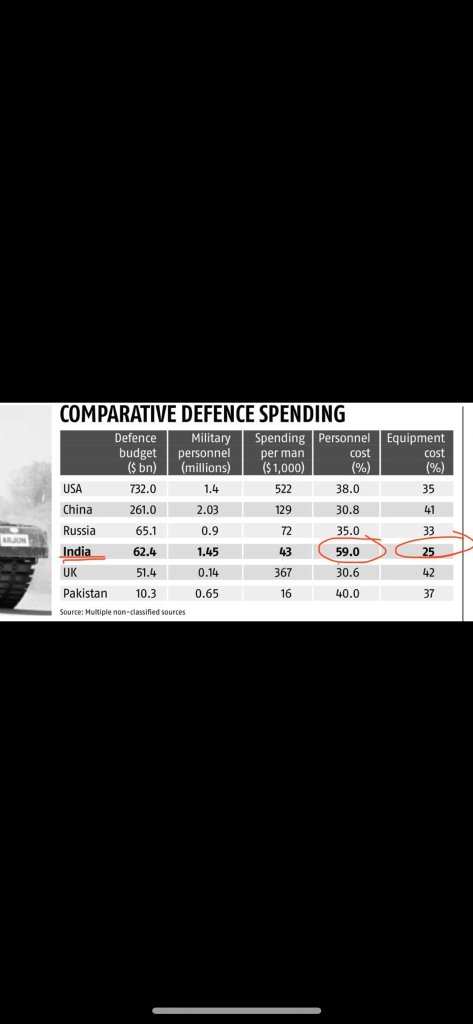
India Defence Spending vis-a-vis other countries.
Now it is nobody s argument that India needs to improve its tooth-to-tail ratio but this is the wrong way to go about it. I would probably talk about that some other time as that totally needs its whole place. Even OROP, which was the mandate of this Government hasn t had been done in full as there are quite a few cases in the Supreme Court. Almost all the cases have been heard and only decisions have to be given which the SC for whatever reason doesn t want to give. They just keep changing the date of the hearing. Nowadays, in many suits/cases, the SC asks for fresh hearings even though all the old records are there. This is a newish phenomena which is being observed in SC. Why is it being done? Your guess is as good as mine. One thing for sure has changed, the SC which used to be citizen-focussed or enabler of human rights and used to be held as a beacon for judicial activism has changed but these are other topics which need their own space. Update 16/12/2020 The SC recommends setting up a committee to discuss farmer issues. And this is nothing new. This is called death by committee. When there is already so much literature on the subject, including the works done by Swaminathan Commission. There has been 6 reports which do look at farmer issues in a holistic manner. This is the Supreme Court giving an escape route to GOI. They also have abstained from having a whole session citing Covid. This is when the ruling Govt. is putting a massive 1000 crore on a new building on which the SC has put on hold. And even then the GOI went ahead and did a Bhoomi-Pujan (traditional ceremony when making a new construction from scratch.) Naturally due to the double whammy of both the pension reforms and now the laws to make corporate farming more aggressive has left a deep impact on the soldier-farmer that the state does not think or feel for him. Even the United States farm-aid eloquently describes how corporate farming has made independent farmers suffer. You read that, and it seems it is as the state of our farmers here in India. Even their average land-holding has dropped a bit. I have shared about the state of farmers in India, in two blog posts previously. And it is not just farm owners who have had it bad, even farm workers in U.S. The issue may look to be about the pandemic but goes far deeper. The Israeli Model The Israelis have always used collective farming and do have a large share in farming there. The old model called Kibbutz is what made Israelis self-sufficient in food and water and actually are world-leaders where they export their services to other nations on the same thing. France Just like many other countries, France also seems to have favored farmer co-operatives. Almost 75% of all farmers are in co-operatives. Italy The country world-famous for its wines and cheese are made by its co-operatives. In fact co-ops are the buzzword it seems in Italy, more so in Northern Italy. Asian economies Even Asian economies, especially East Asian economies by and large have been turning to co-operatives. Brazil Now Brazil is almost 40% more than India. In fact, in most of the indices, Brazil beats India handsomely. So one would be forgiven to think that Brazil must have corporate farming. But nothing could be further from the truth. The only downer is that they have high crime in some areas. Otherwise, they are in many ways better than India. In fact, I was surprised a few years ago to learn about Mercsour. I would have to admit though I learned much about Brazil when Debian was holding a debconf about a year back. Otherwise, I had known about the country for number of years but apart from its carnival and samba, hadn t known much about it. I did come to know that most of Latin America also loves spices as much as Indians do. They show that love by using hot sauces. I do one day wanna try one of their sauces to see what makes it tick. I do know they like to barbecue vegetables as much as barbecuing non-veg food. This is going a bit OT but then that s the foodie in me  Conclusion I could have shared more countries which have chosen the co-operative way rather than corporate farming and that is simply because they know what is best for their people and what is best even politically. The new farm laws are neither grounded in farmer s welfare nor anything else. The Govt. has been trying to undermine the farmers for years together. In fact, Madhya Pradesh has openly said that they will not allow farmers from other states to sell in their state. Although, even before these laws there was nothing to restrict the farmer from selling his produce anywhere in the country. Angering the farmers is not good politics as was found sometime back but guessing some lessons need to be re-learned. One comment though, on social media I have seen many people especially youngsters having no real understanding of what inflation is all about. For e.g. if you ask them how come we are having a sort of record inflation in a technical recession (there has been a contraction, actually) and you see them putting themselves into bigger and bigger ditches. This does explain in part why the BJP wins in elections. If you do more rhetoric, which BJP is good as, rather than educating people than you are bound to win. You don t need plans, you don t need a vision, just rhetoric will do. What more evidence is needed when the economy is and was in a worse shape even before the pandemic and BJP won. I would probably write about that as that again needs lot of background and understanding as well as related terms.

Russell Coker: SMART and SSDs

The Hetzner server that hosts my blog among other things has 2*256G SSDs for the root filesystem. The smartctl and smartd programs report both SSDs as in FAILING_NOW state for the Wear_Leveling_Count attribute. I don t have a lot of faith in SMART. I run it because it would be stupid not to consider data about possible drive problems, but don t feel obliged to immediately replace disks with SMART errors when not convenient (if I ordered a new server and got those results I would demand replacement before going live). Doing any sort of SMART scan will cause service outage. Replacing devices means 2 outages, 1 for each device. I noticed the SMART errors 2 weeks ago, so I guess that the SMART claims that both of the drives are likely to fail within 24 hours have been disproved. The system is running BTRFS so I know there aren t any unseen data corruption issues and it uses BTRFS RAID-1 so if one disk has an unreadable sector that won t cause data loss. Currently Hetzner Server Bidding has ridiculous offerings for systems with SSD storage. Search for a server with 16G of RAM and SSD storage and the minimum prices are only 2E cheaper than a new server with 64G of RAM and 2*512G NVMe. In the past Server Bidding has had servers with specs not much smaller than the newest systems going for rates well below the costs of the newer systems. The current Hetzner server is under a contract from Server Bidding which is significantly cheaper than the current Server Bidding offerings, so financially it wouldn t be a good plan to replace the server now. Monitoring I have just released a new version of etbe-mon [1] which has a new monitor for SMART data (smartctl). It also has a change to the sslcert check to search all IPv6 and IPv4 addresses for each hostname, makes freespace check look for filesystem mountpoint, and makes the smtpswaks check use latest swaks command-line. For the new smartctl check there is an option to treat Marginal alert status from smartctl as errors and there is an option to name attributes that will be treated as marginal even if smartctl thinks they are significant. So now I have my monitoring system checking the SMART data on the servers of mine which have real hard drives (not VMs) and aren t using RAID hardware that obscures such things. Also it s not alerting me about the Wear_Leveling_Count on that particular Hetzner server.

Russ Allbery: Review: Can't Even

Review: Can't Even, by Anne Helen Petersen
Publisher: Houghton Mifflin
Copyright: 2020
ISBN: 0-358-31659-6
Format: Kindle
Pages: 230
Like many other people, I first became aware of Anne Helen Petersen's journalism when her Buzzfeed article "How Millennials Became the Burnout Generation" went viral. Can't Even is the much-awaited (at least by me) book-length expansion of that thesis: The United States is, as a society, burning out, and that burnout is falling on millennials the hardest. We're not recognizing the symptoms because we think burnout looks like something dramatic and flashy. But for most people burnout looks less like a nervous breakdown and more like constant background anxiety and lack of energy.
Laura, who lives in Chicago and works as a special ed teacher, never wants to see her friends, or date, or cook she's so tired, she just wants to melt into the couch. "But then I can't focus on what I'm watching, and end up unfocused again, and not completely relaxing," she explained. "Here I am telling you I don't even relax right! I feel bad about feeling bad! But by the time I have leisure time, I just want to be alone!"
Petersen explores this idea across childhood, education, work, family, and parenting, but the core of her thesis is the precise opposite of the pervasive myth that millennials are entitled and lazy (a persistent generational critique that Petersen points out was also leveled at their Baby Boomer parents in the 1960s and 1970s). Millennials aren't slackers; they're workaholics from childhood, for whom everything has become a hustle and a second (or third or fourth) job. The struggle with "adulting" is a symptom of the burnout on the other side of exhaustion, the mental failures that happen when you've forced yourself to keep going on empty so many times that it's left lingering damage. Petersen is a synthesizing writer who draws together the threads of other books rather than going deep on a novel concept, so if you've been reading about work, psychology, stress, and productivity, many of the ideas here will be familiar. But she's been reading the same authors that I've been reading (Tressie McMillan Cottom, Emily Guendelsberger, Brigid Schulte, and even Cal Newport), and this was the book that helped me pull those analyses together into a coherent picture. That picture starts with the shift of risk in the 1970s and 1980s from previously stable corporations with long-lasting jobs and retirement pensions onto individual employees. The corresponding rise in precarity and therefore fear led to a concerted effort to re-establish a feeling of control. Baby Boomers doubled down on personal responsibility and personal capability, replacing unstructured childhood for their kids with planned activities and academic achievement. That generation, in turn, internalized the need for constant improvement, constant grading, and constant achievement, accepting an implied bargain that if they worked very hard, got good grades, got into good schools, and got a good degree, it would pay off in a good life and financial security. They were betrayed. The payoff never happened; many millennials graduated into the Great Recession and the worst economy since World War II. In response, millennials doubled down on the only path to success they were taught. They took on more debt, got more education, moved back in with their parents to cut expenses, and tried even harder.
Even after watching our parents get shut out, fall from, or simply struggle anxiously to maintain the American Dream, we didn't reject it. We tried to work harder, and better, more efficiently, with more credentials, to achieve it.
Once one has this framework in mind, it's startling how pervasive the "just try harder" message is and how deeply we've internalized it. It is at the center of the time management literature: Getting Things Done focuses almost entirely on individual efficiency. Later time management work has become more aware of the importance of pruning the to-do list and doing fewer things, but addresses that through techniques for individual prioritization. Cal Newport is more aware than most that constant busyness and multitasking interacts poorly with the human brain, and has taken a few tentative steps towards treating the problem as systemic rather than individual, but his focus is still primarily on individual choices. Even when tackling a problem that is clearly societal, such as the monetization of fear and outrage on social media, the solutions are all individual: recognize that those platforms are bad for you, make an individual determination that your attention is being exploited, and quit social media through your personal force of will. And this isn't just productivity systems. Most of public discussion of environmentalism in the United States is about personal energy consumption, your individual carbon footprint, household recycling, and whether you personally should eat meat. Discussions of monopoly and monopsony become debates over whether you personally should buy from Amazon. Concerns about personal privacy turn into advocacy for using an ad blocker or shaming people for using Google products. Articles about the growth of right-wing extremism become exhortations to take responsibility for the right-wing extremist in your life and argue them out of their beliefs over the dinner table. Every major systemic issue facing society becomes yet another personal obligation, another place we are failing as individuals, something else that requires trying harder, learning more, caring more, doing more. This advice is well-meaning (mostly; sometimes it is an intentional and cynical diversion), and can even be effective with specific problems. But it's also a trap. If you're feeling miserable, you just haven't found the right combination of time-block scheduling, kanban, and bullet journaling yet. If you're upset at corporate greed and the destruction of the environment, the change starts with you and your household. The solution is in your personal hands; you just have try a little harder, work a little harder, make better decisions, and spend money more ethically (generally by buying more expensive products). And therefore, when we're already burned out, every topic becomes another failure, increasing our already excessive guilt and anxiety. Believing that we're in control, even when we're not, does have psychological value. That's part of what makes it such a beguiling trap. While drafting this review, I listened to Ezra Klein's interview with Robert Sapolsky on poverty and stress, and one of the points he made is that, when mildly or moderately bad things happen, believing you have control is empowering. It lets you recast the setback as a larger disaster that you were able to prevent and avoid a sense of futility. But when something major goes wrong, believing you have control is actively harmful to your mental health. The tragedy is now also a personal failure, leading to guilt and internal recrimination on top of the effects of the tragedy itself. This is why often the most comforting thing we can say to someone else after a personal disaster is "there's nothing you could have done." Believing we can improve our lives if we just try a little harder does work, until it doesn't. And because it does work for smaller things, it's hard to abandon; in the short term, believing we're at the mercy of forces outside our control feels even worse. So we double down on self-improvement, giving ourselves even more things to attempt to do and thus burning out even more. Petersen is having none of this, and her anger is both satisfying and clarifying.
In writing that article, and this book, I haven't cured anyone's burnout, including my own. But one thing did become incredibly clear. This isn't a personal problem. It's a societal one and it will not be cured by productivity apps, or a bullet journal, or face mask skin treatments, or overnight fucking oats. We gravitate toward those personal cures because they seem tenable, and promise that our lives can be recentered, and regrounded, with just a bit more discipline, a new app, a better email organization strategy, or a new approach to meal planning. But these are all merely Band-Aids on an open wound. They might temporarily stop the bleeding, but when they fall off, and we fail at our new-found discipline, we just feel worse.
Structurally, Can't Even is half summaries of other books and essays put into this overall structure and half short profiles and quotes from millennials that illustrate her point. This is Petersen's typical journalistic style if you're familiar with her other work. It gains a lot from the voices of individuals, but it can also feel like argument from anecdote. If there's a epistemic flaw in this book, it's that Petersen defends her arguments more with examples than with scientific study. I've read enough of the other books she cites, many of which do go into the underlying studies and statistics, to know that her argument is well-grounded, but I think Can't Even works better as a roadmap and synthesis than as a primary source of convincing data. The other flaw that I'll mention is that although Petersen tries very hard to incorporate poorer and non-white millennials, I don't think the effort was successful, and I'm not sure it was possible within the structure of this book. She frequently makes a statement that's accurate and insightful for millennials from white, middle-class families, acknowledges that it doesn't entirely apply to, for example, racial minorities, and then moves on without truly reconciling those two perspectives. I think this is a deep structural problem: One's experience of American life is very different depending on race and class, and the phenomenon that Petersen is speaking to is to an extent specific to those social classes who had a more comfortable and relaxing life and are losing it. One way to see the story of the modern economy is that white people are becoming as precarious as everyone else already was, and are reacting by making the lives of non-white people yet more miserable. Petersen is accurately pointing to significant changes in relationships with employers, productivity, family, and the ideology of individualism, but experiencing that as a change is more applicable to white people than non-white people. That means there are, in a way, two books here: one about the slow collapse of the white middle class into constant burnout, and a different book about the much longer-standing burnout of being non-white in the United States and our systemic failure to address the causes of it. Petersen tries to gesture at the second book, but she's not the person to write it and those two books cannot comfortably live between the same covers. The gestures therefore feel awkward and forced, and while the discomfort itself serves some purpose, it lacks the insight that Petersen brings to the rest of the book. Those critiques aside, I found Can't Even immensely clarifying. It's the first book that explained to me in a way I understood what's so demoralizing and harmful about Instagram and its allure of cosplaying as a successful person. It helped me understand how productivity and individual political choices fit into a system that emphasizes individual action as an excuse to not address collective problems. And it also gave me a strange form of hope, because if something can't go on forever, it will, at some point, stop.
Millennials have been denigrated and mischaracterized, blamed for struggling in situations that set us up to fail. But if we have the endurance and aptitude and wherewithal to work ourselves this deeply into the ground, we also have the strength to fight. We have little savings and less stability. Our anger is barely contained. We're a pile of ashes smoldering, a bad memory of our best selves. Underestimate us at your peril: We have so little left to lose.
Nothing will change without individual people making different decisions and taking different actions than they are today. But we have gone much too far down the path of individual, atomized actions that may produce feelings of personal virtue but that are a path to ineffectiveness and burnout when faced with systemic problems. We need to make different choices, yes, but choices towards solidarity and movement politics rather than personal optimization. There is a backlash coming. If we let it ground itself in personal grievance, it could turn ugly and take a racist and nationalist direction. But that's not, by in large, what millennials have done, and that makes me optimistic. If we embrace the energy of that backlash and help shape it to be more inclusive, just, and fair, we can rediscover the effectiveness of collective solutions for collective problems. Rating: 8 out of 10

18 December 2020

Russell Coker: Thinkpad Storage Problem

For a while I ve had a problem with my Thinkpad X1 Carbon Gen 1 [1] where storage pauses for 30 seconds, it s become more common recently and unfortunately everything seems to depend on storage (ideally a web browser playing a video from the Internet could keep doing so with no disk access, but that s not what happens).
echo 3 > /sys/block/sda/device/timeout
I ve put the above in /etc/rc.local which should make it only take 3 seconds to recover from storage problems instead of 30 seconds, the problem hasn t recurred since that change so I don t know if it works as desired. The Thinkpad is running BTRFS and no data is reported as being lost, so it s not a problem to use it at this time. The bottom of this post has an example of the errors I m getting. A friend said that his searches for such errors shows people claiming that it s a SATA controller or cable problem, which for a SATA device bolted directly to the motherboard means it s likely to be a motherboard problem (IE more expensive to fix than the $289 I paid for the laptop almost 3 years ago). A Lenovo forum discussion says that the X1 Carbon Gen1 uses an unusual connector that s not M.2 SATA and not mSATA [2]. This means that a replacement is going to be expensive, $100US for a replacement from eBay when a M.2 SATA or NVMe device would cost about $50AU from my local store. It also means that I can t use a replacement for anything else. If my laptop took a regular NVMe I d buy one and test it out, if it didn t solve the problem a spare NVMe device is always handy to have. But I m not interested in spending $100US for a part that may turn out to be useless. I bought the laptop expecting that there was nothing I could fix inside it. While it is theoretically possible to upgrade the CPU etc in a laptop most people find that the effort and expense makes it better to just replace the entire laptop. With the ultra light category of laptops the RAM is soldered on the motherboard and there are even less options for replacing things. So while it s annoying that Lenovo didn t use a standard interface for this device (they did so for other models in the range) it s not a situation that I hadn t expected. Now the question is what to do next. The Thinkpad has a SD socket and micro SD cards are getting large capacities nowadays. If it won t boot from a SD card I could boot from USB and then run from SD. So even if the internal SATA device fails entirely it should still be useful. I wonder if I could find a Thinkpad with a similar problem going cheap as I m pretty sure that a Windows user couldn t make any storage device usable the way I can with Linux. I ve looked at prices on auction sites but haven t seen a Thinkpad X1 Carbon going for anywhere near the price I got this one. The nearest I ve seen is around $350 for a laptop with significant damage. While I am a little unhappy at Lenovo s choice of interface, I ve definitely got a lot more than $289 of value out of this laptop. So I m not really complaining.
[315041.837612] ata1.00: status:   DRDY  
[315041.837613] ata1.00: failed command: WRITE FPDMA QUEUED
[315041.837616] ata1.00: cmd 61/20:48:28:1e:3e/00:00:00:00:00/40 tag 9 ncq dma 
16384 out
                         res 40/00:01:00:00:00/00:00:00:00:00/e0 Emask 0x4 
(timeout)                
[315041.837617] ata1.00: status:   DRDY  
[315041.837618] ata1.00: failed command: READ FPDMA QUEUED
[315041.837621] ata1.00: cmd 60/08:50:e0:26:84/00:00:00:00:00/40 tag 10 ncq 
dma 4096 in
                         res 40/00:01:00:00:00/00:00:00:00:00/e0 Emask 0x4 
(timeout)                
[315041.837622] ata1.00: status:   DRDY  
[315041.837625] ata1: hard resetting link
[315042.151781] ata1: SATA link up 6.0 Gbps (SStatus 133 SControl 300)
[315042.163368] ata1.00: ACPI cmd ef/02:00:00:00:00:a0 (SET FEATURES) 
succeeded
[315042.163370] ata1.00: ACPI cmd f5/00:00:00:00:00:a0 (SECURITY FREEZE LOCK) 
filtered out
[315042.163372] ata1.00: ACPI cmd ef/10:03:00:00:00:a0 (SET FEATURES) filtered 
out
[315042.183332] ata1.00: ACPI cmd ef/02:00:00:00:00:a0 (SET FEATURES) 
succeeded
[315042.183334] ata1.00: ACPI cmd f5/00:00:00:00:00:a0 (SECURITY FREEZE LOCK) 
filtered out
[315042.183336] ata1.00: ACPI cmd ef/10:03:00:00:00:a0 (SET FEATURES) filtered 
out
[315042.193332] ata1.00: configured for UDMA/133
[315042.193789] sd 0:0:0:0: [sda] tag#10 FAILED Result: hostbyte=DID_OK 
driverbyte=DRIVER_SENSE
[315042.193791] sd 0:0:0:0: [sda] tag#10 Sense Key : Illegal Request [current] 
[315042.193793] sd 0:0:0:0: [sda] tag#10 Add. Sense: Unaligned write command
[315042.193795] sd 0:0:0:0: [sda] tag#10 CDB: Read(10) 28 00 00 84 26 e0 00 00 
08 00
[315042.193797] print_req_error: I/O error, dev sda, sector 8660704
[315042.193810] ata1: EH complete

17 December 2020

Elana Hashman: Easy risotto

I have a secret: risotto doesn't have to involve standing over a pot, stirring for 30 minutes. There is a better way. I've made risotto using the "stir 5ever" method and frankly this one is half the work and just as good. I took inspiration from Kenji Lopez-Alt, who describes how you can make risotto with only a few minutes of stirring at the end! Yes, this is a secret too good to keep to myself. The linked recipe is too rich for a weeknight dinner, at least for my tastes, so I've included my typical modifications below, which omits the heavy cream. I usually make mushroom risotto, because all the ingredients are long-lived pantry ingredients, which means I can make this on a whim without having to grocery shop! Mushroom risotto Serves 3 as a main course. Active time: 25m. Total time: 45m. Ingredients: Recipe:
  1. Leave mushrooms to rehydrate in 1 cup of hot water for at least 10 minutes.
  2. Set a wide saucepan (about 3.5qts) or skillet on medium heat.
  3. Mix stock and wine for a total of 4 cups. You can used homemade stock (the best), boxed, or reconstitute from bouillon (my usual). If you use bouillon, I find you get the best flavour if you use a mix, so I tend to use half "no-chicken" and half "organic chicken" of the Better than Bouillon brand. Let this cool if you used boiling water; you don't want it to be too hot.
  4. Mix the rice and stock in a large bowl, agitating it to release the starch. Reserve stock and set the rice in a strainer to drain.
  5. Small dice an onion. Add olive oil and butter to the pan, and then add the onion. Cook the onion until it's translucent, but don't brown it.
  6. Increase the heat to high and add the rice to the pan to toast until it becomes a little bit brown, stirring occasionally, about 3-4 minutes. Set a timer so it doesn't burn
  7. Meanwhile, drain the mushrooms, making sure you reserve the broth. Chop mushrooms and mince the garlic. Once the rice is toasted, add mushrooms and garlic and stir.
  8. Stir the reserved stock. Add all of the mushroom liquid and all but 1 cup of the starchy stock to the pan. Bring to a boil.
  9. Once it has reached a boil, cover, reduce to the lowest heat, and allow the rice to simmer undisturbed for 10 minutes. In the meantime, you can grate the cheese.
  10. After 10 minutes, stir the rice once, shake the pan to ensure it is level, and return to the heat for 10 more minutes. Sit back, relax, and bask in the very little stirring you are doing.
  11. At this point, the rice should be nearly cooked. Give it a stir, and add the remaining cup of broth. Stir until fully incorporated, turn the heat up to high, and cook until the risotto reaches your preferred consistency. I like mine rather thick.
  12. Once the rice is fully cooked, turn off the heat and stir in the grated cheese a bit at a time, reserving some for garnish. Taste, and season with salt and pepper.
  13. Garnish with the grated cheese, and perhaps some herbs. Serve and enjoy!
Variations No mushrooms: Okay, okay, you hate mushrooms! Sorry! You can leave them out. Don't bother with the mushrooms, and add broth to make up for the lost liquid. Mushroom lover: Alternatively, if you love mushrooms and you have fresh ones available, use &frac13 to a pound (150-225g) chopped fresh mushrooms instead of dried. Add them at the same time you add the onions to ensure all the liquid cooks off. Milanese, with stuff: One of my favourite variations on this dish is a version with shrimp, asparagus, and saffron. Leave the mushrooms out, increase the wine to or even 1 cup (seafood likes a little extra acidity), ensure you have a total of 5 cups of broth, and add a few strands of saffron. Chop asparagus and shrimp, season with salt and pepper, saut them with some butter or olive oil in a separate pan so they don't overcook, and fold them in at the very end, after you've added the cheese. I MUST SUFFER: This was too easy? Want to stir more??? Fine, have it your $*!#ing way. I'm sure you can be creative and come up with something on your own...

16 December 2020

John Goerzen: Non-Creepy Technology Purchasing & Gifting Guides

This time of year, a lot of people are thinking of buying gadgets and phones as gifts. But there are a lot of tech companies that have unethical practices, from terrible working conditions in their factories to spying on their users. Here are some buying guides to help you find gadgets that are fun and not creepy. The Free Software Foundation s Ethical Tech Giving Guide is a fantastic resource from what s probably the pickiest organization out there when it comes to tech. Not only do they highlight good devices, they also explain why and why you should, for instance, avoid the iPhone (their history of silencing political activists and spying on users). The FSF also has a Guide to DRM-Free Living talks about books, video, audio, and software that respects your freedom by letting you make your own backups, move it to other devices, and continue to use your purchases even if you have no Internet or the company you bought them from goes bankrupt. This is a fantastic and HUGE resource; there are hundreds of organizations out there that provide content in a way that respects your rights and many of them do it for free, legally, as well. PrivacyTools has a fantastic series of guides on everything from email providers to operating systems, as well as links to a number of other guides. The DeGoogle wiki on Reddit (as well as the sidebar) has a lot of fantastic alternatives to things like Chromebooks, Chrome, Gmail, etc. Related resources Here are some resources for education (what the issues are) and information about what companies and products to avoid. In addition to the FSF s other fantastic resources above, they also have a list of proprietary malware. It lists things, practices, and companies to avoid, and talks about the reasons why. Their addictions page is particularly good and relevant to my recent post on the problems of the attention economy. The Surveillance Self-Defense site from the Electronic Frontier Foundation is a fantastic introduction into how corporate surveillance works and how to defend against it. Use with a grain of salt: Mozilla, the people behind Firefox, have a site called Privacy Not Included that rates products by how creepy they are. They focus more narrowly on privacy than the more expansive set of freedoms the FSF considers (privacy is one of a number of things the FSF looks at), and in some cases I would say Mozilla is too generous (eg, with the Amazon Kindle, a number of their data points are just incorrect.)

Jonathan McDowell: DeskPi Pro + 8GB Pi 4

DeskPi Pro Raspberry Pi case Despite having worked on a number of ARM platforms I ve never actually had an ARM based development box at home. I have a Raspberry Pi B Classic (the original 256MB rev 0002 variant) a coworker gave me some years ago, but it s not what you d choose for a build machine and generally gets used as a self contained TFTP/console server for hooking up to devices under test. Mostly I ve been able to do kernel development with the cross compilers already built as part of Debian, and either use pre-built images or Debian directly when I need userland pieces. At a previous job I had a Marvell MACCHIATObin available to me, which works out as a nice platform - quad core A72 @ 2GHz with 16GB RAM, proper SATA and a PCIe slot. However they re still a bit pricey for a casual home machine. I really like the look of the HoneyComb LX2 - 16 A72 cores, up to 64GB RAM - but it s even more expensive. So when I saw the existence of the 8GB Raspberry Pi 4 I was interested. Firstly, the Pi 4 is a proper 64 bit device (my existing Pi B is ARMv6 which means it needs to run Raspbian instead of native Debian armhf), capable of running an upstream kernel and unmodified Debian userspace. Secondly the Pi 4 has a USB 3 controller sitting on a PCIe bus rather than just the limited SoC USB 2 controller. It s not SATA, but it s still a fairly decent method of attaching some storage that s faster/more reliable than an SD card. Finally 8GB RAM is starting to get to a decent amount - for a headless build box 4GB is probably generally enough, but I wanted some headroom. The Pi comes as a bare board, so I needed a case. Ideally I wanted something self contained that could take the Pi, provide a USB/SATA adaptor and take the drive too. I came across the pre-order for the DeskPi Pro, decided it was the sort of thing I was after, and ordered one towards the end of September. It finally arrived at the start of December, at which point I got round to ordering a Pi 4 from CPC. Total cost ~ 120 for the case + Pi.

The Bad First, let s get the bad parts out of the way. Broken USB port (right) I managed to break a USB port on the Desk Pi. It has a pair of forward facing ports, I plugged my wireless keyboard dongle into it and when trying to remove it the solid spacer bit in the socket broke off. I ve never had this happen to me before and I ve been using USB devices for 20 years, so I m putting the blame on a shoddy socket. The first drive I tried was an old Crucial M500 mSATA device. I have an adaptor that makes it look like a normal 2.5 drive so I used that. Unfortunately it resulted in a boot loop; the Pi would boot its initial firmware, try to talk to the drive and then reboot before even loading Linux. The DeskPi Pro comes with an m2 adaptor and I had a spare m2 drive, so I tried that and it all worked fine. This might just be power issues, but it was an unfortunate experience especially after the USB port had broken off. (Given I ended up using an M.2 drive another case option would have been the Argon ONE M.2, which is a bit more compact.)
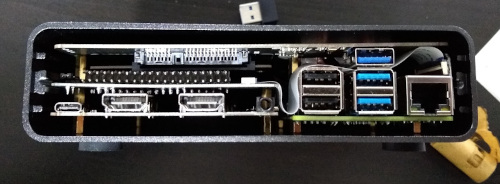
The Annoying DeskPi Pro without rear bezel The case is a little snug; I was worried I was going to damage things as I slid it in. Additionally the construction process is a little involved. There s a good set of instructions, but there are a lot of pieces and screws involved. This includes a couple of FFC cables to join things up. I think this is because they ve attempted to make a compact case rather than allowing a little extra room, and it does have the advantage that once assembled it feels robust without anything loose in it. DeskPi Pro with rear bezel and USB3 dongle I hate the need for an external USB3 dongle to bridge from the Pi to the USB/SATA adaptor. All the cases I ve seen with an internal drive bay have to do this, because the USB3 isn t brought out internally by the Pi, but it just looks ugly to me. It s hidden at the back, but meh. Fan control is via a USB/serial device, which is fine, but it attaches to the USB C power port which defaults to being a USB peripheral. Raspbian based kernels support device tree overlays which allows easy reconfiguration to host mode, but for a Debian based system I ended up rolling my own dtb file. I changed

#include "bcm283x-rpi-usb-peripheral.dtsi"
to
#include "bcm283x-rpi-usb-host.dtsi"
in arch/arm/boot/dts/bcm2711-rpi-4-b.dts and then I did:
cpp -nostdinc -I include -I arch -undef -x assembler-with-cpp \
    arch/arm/boot/dts/bcm2711-rpi-4-b.dts > rpi4.preprocessed
dtc -I dts -O dtb rpi4.preprocessed -o bcm2711-rpi-4-b.dtb
and the resulting bcm2711-rpi-4-b.dtb file replaced the one in /boot/firmware. This isn t a necessary step if you don t want to use the cooling fan in the case, or the front USB ports, and it s not really anyone s fault, but it was an annoying extra step to have to figure out. The DeskPi came with a microSD card that was supposed to have RaspiOS already on it. It didn t, it was blank. In my case that was fine, because I wanted to use Debian, but it was a minor niggle.

The Good I used Gunnar s pre-built Pi Debian image and it Just Worked; I dd d it to the microSD as instructed and the Pi 4 came up with working wifi, video and USB enabling me to get it configured for my network. I did an apt upgrade and got updated to the Buster 10.7 release, as well as the latest 5.9 backport kernel, and everything came back without effort after a reboot. It s lovely to be able to run Debian on this device without having to futz around with self-compiled kernels. The DeskPi makes a lot of effort to route things externally. The SD slot is brought out to the front, making it easy to fiddle with the card contents without having to open the case to replace it. All the important ports are brought out to the back either through orientation of the Pi, or extenders in the case. That means the built in Pi USB ports, the HDMI sockets (conveniently converted to full size internally), an audio jack and a USB-C power port. The aforementioned USB3 dongle for the bridge to the drive is the only external thing that s annoying. Thermally things seem good too. I haven t done a full torture test yet, but with the fan off the system is sitting at about 40 C while fairly idle. Some loops in bash that push load up to above 2 get the temperature up to 46 C or so, and turning the fan on brings it down to 40 C again. It s audible, but quieter than my laptop and not annoying. I liked the way the case came with everything I needed other than the Pi 4 and a suitable disk drive. There was an included PSU (a proper USB-C PD device, UK plug), the heatsink/fan is there, the USB/SATA converter is there and even an SD card is provided (though that s just because I had a pre-order). Speaking of the SD, I only needed it for initial setup. Recent Pi 4 bootloaders are capable of booting directly from USB mass storage devices. So I upgraded using the RPi EEPROM Recovery image (which just needs extracted to the SD FAT partition, no need for anything complicated - boot with it and the screen goes all green and you know it s ok), then created a FAT partition at the start of the drive for the kernel / bootloader config and a regular EXT4 partition for root. Copies everything over, updated paths, took out the SD and it all just works happily.

Summary My main complaint is the broken USB port, which feels like the result of a cheap connector. For a front facing port expected to see more use than the rear ports I think there s a reasonable expectation of robustness. However I m an early adopter and maybe future runs will be better. Other than that I m pretty happy. The case is exactly the sort of thing I wanted; I was looking for something that would turn the Pi into a box that can sit on my desk on the network and that I don t have to worry about knocking wires out of or lots of cables hooking bits up. Everything being included made it very convenient to get up and running. I still haven t poked the Pi that hard, but first impressions are looking good for it being a trouble free ARM64 dev box in the corner, until I can justify a HoneyComb.

John Goerzen: How To Join the Fediverse and Cast Off the Attention Economy

In a recent post, I wrote about how the attention economy in use at big social networks hurts you. In this post, I m going to suggest what to do about it. Mastodon and the Fediverse When you use email, you can send a message from an account at Google to one at Yahoo, Microsoft, or any of millions of businesses and organizations running their own mail server. Unlike, say, Facebook, email isn t a single service, but rather a whole bunch of independent systems that can communicate (or federate) with each other. The Fediverse is similar, and the most advanced Fediverse client is Mastodon. Mastodon: It s easy to get started! Head over to joinmastodon.org and click Get Started . Pick a community don t worry, this isn t a hugely consequential decision, as you can always move or change later. You can browse activity from across the Fediverse, or just on your local community, so if you find a community with similar interests, it can be a neat way to find others to follow. If you re looking for more details, mastodon.help has a nice guide. Defeating the Attention Economy So, why does Mastodon make a difference? First of all, you get to pick your host (and even software). With Twitter, you pretty much are using Twitter (yes, I know of things like Hootsuite, but for the vast majority of people, it s twitter.com only). With Mastodon, you have choice. Pick the host that runs the software and has the kind of moderation you like. Secondly, Mastodon is not for profit. There is no money to be made in keeping you on the site. Almost all Mastodon instances are ad-free. And Mastodon s completely open protocols make it easy to go elsewhere if you like. It s Not Just Mastodon! There are plenty of other programs in the Fediverse. And, this is really key, they all interact with each other. You can share photos in Pixelfed (sort of like a federated Instagram) and see them and comment in Mastodon! Some things to point out: And there are many others. This blog, for instance, runs WordPress and uses an ActivityPub connector; comments from the Fediverse integrate here. Find me in the Fediverse You can look me up: just type in @jgoerzen@floss.social in the search box of any Mastodon instance and click Follow. You can also follow this blog at @jgoerzen@changelog.complete.org.

14 December 2020

Jonathan Dowland: git rebasing and lab books

For my PhD work, I've been working on preparing an experimental branch of StrIoT for merging down to the main branch. This has been a long-lived branch (a year!) within which I've been exploring some ideas. Some of the code I want to keep, and some I don't. The history of the experimental branch is consequently messy. Looking it over and considering what a reviewer needs to see, there's a lot of things that are irrelevant and potentially distracting. And so, I've been going through an iterative process of steadily whittling down the history to the stuff that matters: some strings of commits are dropped, others squashed together, and others re-ordered. The resulting branch is a historic fiction. This is common practice. Joey Hess ruminated about it 5 years ago in "our beautiful fake histories", pointing out that the real history is also useful, and perhaps worth preserving. After a recent conversation with my supervisor I realised the situation was analagous to writing a research paper (or a thesis): the process of getting to the conclusion which the thesis documents is messy, with false starts, wrong directions, and plenty of roads-not-travelled. The eventual write-up focusses on the path that lead to the conclusion, and a lot of the side-quest stuff disappears. The "true history" then, is captured elsewhere: in lab books, diaries and the like, and these have their own value. So do my messy exploratory branches, before they've been cleaned up for merging.

Vincent Fourmond: Version 3.0 of QSoas is out

After almost two years of development, version 3.0 of QSoas is finally out ! It brings in a number of new features. An expert mode for fitting Undoubtedly the most important feature in the new version is a complete upgrade of the fit system, which now features an expert mode, turned on by using the /expert=true option with the fit commands. The expert mode features a command prompt that looks like the normal command prompt, in which it is possible: The latter feature is very important when running fits with many parameters. In that case, there are a number of local minima, and it is necessary to try a number of different starting parameters to really find the best parameters. The new parameter space exploration feature makes it much easier than before, with an interface that allows easily finding the best parameters tried so far and reuse them.
A new documentation system Another very important update is the inclusion of a new, offline, documentation system. The documentation features browsing via table of contents, a command index and text search. It also features the possibility to copy commands from the help to the command prompt, or even run them directly. To top it all, it comes with a series of startup tips that might teach you a thing or two about QSoas (try hitting Show random to learn new tricks !).
Many other features For the full list of changes, please see the changelog. Apart from the changes described above, these are my favorites:
To get the new version, you can just download the source code from the downloads page, where you can also purchase precompiled versions for Windows and MacOS. You can also clone the source from the GitHub repository. About QSoasQSoas is a powerful open source data analysis program that focuses on flexibility and powerful fitting capacities. It is released under the GNU General Public License. It is described in Fourmond, Anal. Chem., 2016, 88 (10), pp 5050 5052. Current version is 3.0. You can download its source code there (or clone from the GitHub repository) and compile it yourself, or buy precompiled versions for MacOS and Windows there.

Russ Allbery: remctl 3.17

remctl is a simple GSS-API-based RPC system designed to be as trivial to deploy as possible for sites already using Kerberos. I owe various people deeper reviews of remctl feature changes, but alas this release is not that. This is a bit of a stopgap maintenance release primarily to fix a testing problem on Debian that booted remctl out of testing. The basic problem is that a lot of test machinery assumes that every system will have an IPv4 address available, but this is not necessarily true on modern systems. This release only fixes the tests that don't use Kerberos. The tests that require Kerberos have much deeper assumptions that the IPv4 loopback will be available, and will require later work (hampered by the fact that I personally don't have such an environment readily available that also has access to a KDC and need to construct something in Docker or some similar container system). This release also adds support for PHP 8 in anticipation of a possible Debian migration (some minor C source cleanup was required, nothing major), fixes some Python build system problems, and incorporates the changes from rra-c-util 8.4. For future releases, I am considering removing the language bindings from the remctl distribution and distributing them separately as stand-alone tarballs. The primary reason for this is to more easily upload those packages to the respective repositories for those languages (particularly Perl and Python; I don't know how the Ruby and PHP ones work and would need to find out), thus making them available to tools like cpanm and pip as long as the C libraries were already installed. The cost is that someone who wants the C libraries and the extensions will have to download multiple tarballs, and someone (not me) will have to create separate Red hat spec files for the various language bindings. If this would cause problems for you, let me know. It's not likely to happen soon since it would require some major reworking of my web page publication software, but once I finish the prerequisites, I'm likely to adopt this approach unless there are objections. You can get the latest release from the remctl distribution page.

Next.

Previous.