Search Results: "spa"

3 September 2017

Lior Kaplan: FOSScamp Syros 2017 day 1

During Debconf17 I was asked by Daniel Pocock if I can attend FOSScamp Syros to help with Debian s l10n in the Balkans. I said I would be happy to, although my visit would be short (2.5 days) due to previous plans. The main idea of camp is to have FOSS people meet for about 1 week near a beach. So it s sun, water and free software. This year it takes place in Syros, Greece. After take the morning ferry, I met with the guys at noon. I didn t know how would it be, as it s my first time with this group/meeting, but they were very nice and welcoming. 10 minutes after my arrival I found myself setting with two of the female attendees starting to work on Albanian (sq) translation of Debian Installer. It took my a few minutes to find my where to check out the current level1 files, as I thought they aren t in SVN anymore, but ended up learning the PO files is the only part of the installer still on SVN. As the girls were quick with the assinged levle1 sublevels, I started to look for the level2 and level3 files, and it was annoying to have the POT files very accessible, but no links to the relevant git repositories. I do want to have all the relevant links in one central place, so people who want to help with translation could do that. While some of the team member just used a text editor to edit the files, I suggested to them using either poedit or granslator, both I used a few years ago. Yaron Shahrabani also recommended virtaal to me, but after trying it for a while I didn t like it (expect it s great feature showing the diff with fuzzy messages). For the few people who also have Windows on their machine, both poedit and Virtaal have windows binaries for download. So you don t have to have Linux in order to help with translations. In parallel, I used the free time to work on the Hebrew translation for level1, as it s been a while since either me or Omer Zak worked on it. Quite soon the guys started to send me the files for review, and I did find some errors using diff. Especially when not everyone use a PO editor. I also missed a few strings during the review, which got fixed later on by Christian Perrier. Team work indeed (: I found it interesting to see the reactions and problems for the team to work with the PO files, and most projects now use some system (e.g. Pootle) for online web translation. Which saves some of the head ace, but also prevents from making some review and quality check before submitting the files. It s a good idea to explore this option for Debian as well. A tip for those who do want to work with PO files, either use git s diff features or use colordiff to check your changes (notice less will require -R parameter to keep the color). Although I met the guys only at noon, the day was very fruitful for Debian Installer l10n: Some files are still work in progress and will be completed tomorrow. My goal is to have Albanian at 100% during the camp and ready for the next d-i alpha. I must admit that I remember d-i to have many more strings as part of the 3 levels, especially levels 2+3 which were huge (e.g. the iso codes). Except all the work and FOSS related conversations, I found a great group who welcomed me quickly, made me feel comfortable and taught me a thing or two about Greece and the Syros specifically. TIP: try the dark chocolate with red hot chili pepper in the icecream shop.

Filed under: Debian GNU/Linux, i18n & l10n

2 September 2017

Antoine Beaupr : My free software activities, August 2017

Debian Long Term Support (LTS) This is my monthly Debian LTS report. This month I worked on a few major packages that took a long time instead of multiple smaller issues. Affected packages were Mercurial, libdbd-mysql-perl and Ruby.

Mercurial updates Mercurial was vulnerable to two CVEs: CVE-2017-1000116 (command injection on clients through malicious ssh URLs) and CVE-2017-1000115 (path traversal via symlink). The former is an issue that actually affects many other similar software like Git (CVE-2017-1000117), Subversion (CVE-2017-9800) and even CVS (CVE-2017-12836). The latter symlink issue is a distinct issue that came up during an internal audit. The fix, shipped as DLA-1072-1, involved a rather difficult backport, especially because the Mercurial test suite takes a long time to complete. This reminded me of the virtues of DEB_BUILD_OPTIONS=parallel=4, which sped up the builds considerably. I also discovered that the Wheezy build chain doesn't support sbuild's --source-only-changes flag which I had hardcoded in my sbuild.conf file. This seems to be simply because sbuild passes --build=source to dpkg-buildpackage, an option that is supported only in jessie or later.

libdbd-mysql-perl I have worked on fixing two issues with the libdbd-mysql-perl package, CVE-2017-10788 and CVE-2017-10789, which resulted in the DLA-1079-1 upload. Behind this mysteriously named package sits a critical piece of infrastructure, namely the mysql commandline client which is probably used and abused by hundreds if not thousands of home-made scripts, but also all of Perl's MySQL support, which is probably used by even a larger base of software. Through the Debian bug reports (Debian bug #866818 and Debian bug #866821), I have learned that the patches existed in the upstream tracker but were either ignored or even reverted in the latest 4.043 upstream release. It turns out that there are talks of forking that library because of maintainership issue. It blows my mind that such an important part of MySQL is basically unmaintained. I ended up backporting the upstream patches, which was also somewhat difficult because of the long-standing issues with SSL support in MySQL. The backport there was particularly hard to test, as you need to run that test suite by hand, twice: once with a server configured with a (valid!) SSL certificate and one without (!). I'm wondering how much time it is really worth spending on trying to fix SSL in MySQL, however. It has been badly broken forever, and while the patch is an improvement, I would actually still never trust SSL transports in MySQL over an untrusted network. The few people that I know use such transports wrap their connections around a simpler stunnel instead. The other issue was easier to fix so I submitted a pull request upstream to make sure that work isn't lost, although it is not clear what the future of that patch (or project!) will be at this point.

Rubygems I also worked on the rubygems issues, which, thanks to the "vendoring" practice of the Ruby community, also affects the ruby1.9 package. 4 distinct CVEs were triaged here (CVE-2017-0899, CVE-2017-0900, CVE-2017-0901 and CVE-2017-0902) and I determined the latter issue didn't affect wheezy as rubygems doesn't do its own DNS resolution there (later versions lookup SRV records). This is another package where the test suite takes a long time to run. Worse, the packages in Wheezy actually fails to build from source: the test suites just fail in various steps, particularly because of dh key too small errors for Rubygems, but also other errors for Ruby. I also had trouble backporting one test which I had to simply skip for Rubygems. I uploaded and announced test packages and hopefully I'll be able to complete this work soon, although I would certainly appreciate any help on this...

Triage I took a look at the sox, libvorbis and exiv2 issues. None had fixes available. sox and exiv2 were basically a list of fuzzing issues, which are often minor or at least of unknown severity. Those would have required a significant amount of work and I figured I would prioritize other work first. I also triaged CVE-2017-7506, which doesn't seem to affect the spice package in wheezy, after doing a fairly thorough audit of the code. The vulnerability is specifically bound to the reds_on_main_agent_monitors_config function, which is simply not present in our older version. A hostile message would fall through the code and not provoke memory allocation or out of bounds access, so I simply marked the wheezy version as not-affected, something which usually happens during the original triage but can also happen during the actual patching work, as in this case.

Other free software work This describes the volunteer work I do on various free software projects. This month, again, my internal reports show that I spent about the same time on volunteer and paid time, but this is probably a wrong estimate because I spent a lot of time at Debconf which I didn't clock in...

Debconf So I participated in the 17th Debian Conference in Montreal. It was great to see (and make!) so many friends from all over the world in person again, and I was happy to work on specific issues together with other Debian developers. I am especially thankful to David Bremner for fixing the syncing of the flagged tag when added to new messages (patch series). This allows me to easily sync the one tag (inbox) that is not statically assigned during notmuch new, by using flagged as a synchronization tool. This allows me to use notmuch more easily across multiple machines without having to sync all tags with dump/restore or using muchsync which wasn't working for me (although a new release came out which may fix my issues). The magic incantation looks something like this:
notmuch tag -inbox tag:inbox and not tag:flagged
notmuch tag +inbox not tag:inbox and tag:flagged
However, most of my time in the first week (Debcamp) was spent trying to complete the networking setup: configure switches, setup wiring and so on. I also configured an apt-cacher-ng proxy to serve packages to attendees during the conference. I configured it with Avahi to configure clients automatically, which led me to discover (and fix) issue Debian bug #870321) although there are more issues with the autodiscovery mechanism... I spent extra time to document the (somewhat simple) configuration of such a server in the Debian wiki because it was not the first time I had research that procedure... I somehow thought this was a great time to upgrade my laptop to stretch. Normally, I keep that device running stable because I don't use it often and I don't want to have major traumatizing upgrades every time I leave with it on a trip. But this time was special: there were literally hundreds of Debian developers to help me out if there was trouble. And there was, of course, trouble as it turns out! I had problems with the fonts on my display, because, well, I had suspended (twice) my laptop during the install. The fix was simply to flush the fontconfig cache, and I tried to document this in the fonts wiki page and my upgrades page. I also gave a short training called Debian packaging 101 which was pretty successful. Like the short presentation I made at the last Montreal BSP, the workshop was based on my quick debian development guide. I'm thinking of expanding this to a larger audience with a "102" course that would discuss more complex packaging problems. But my secret plan (well, secret until now I guess) is to make packaging procedures more uniform in Debian by training new Debian packagers using that same training for the next 2 decades. But I will probably start by just trying to do this again at the next Debconf, if I can attend.

Debian uploads I also sponsored two packages during Debconf: one was a "scratch an itch" upload (elpa-ivy) which I requested (Debian bug #863216) as part of a larger effort to ship the Emacs elisp packages as Debian packages. The other was an upload of diceware to build the documentation in a separate package and fix other issues I have found in the package during a review. I also uploaded a bunch of other fixes to the Debian archive:

Signing keys rotation I also started the process of moving my main OpenPGP certification key by adding a signing subkey. The subkey is stored in a cryptographic token so I can sign things on more than one machine without storing that critical key on all those devices physically. Unfortunately, this meant that I need to do some shenanigans when I want to sign content in my Debian work, because the new subkey takes time to propagate to the Debian archive. For example, I have to specify the primary key with a "bang" when signing packages (debsign -k '792152527B75921E!' ...) or use inline signatures in email sent for security announcement (since that trick doesn't work in Mutt or Notmuch). I tried to figure out how to better coordinate this next time by reading up documentation on keyring.debian.org, but there is no fixed date for key changes on the rsync interface. There are "monthly changes" so one's best bet is to look for the last change in their git repository.

GitLab.com and LFS migration I finally turned off my src.anarc.at git repository service by moving the remaining repos to GitLab. Unfortunately, GitLab removed support for git-annex recently, so I had to migrate my repositories to Git-LFS, which was an interesting experience. LFS is pretty easy to use, definitely simpler than git-annex. It also seems to be a good match for the use-case at hand, which is to store large files (videos, namely) as part of slides for presentations. It turns out that their migration guide could have been made much simpler. I tried to submit those changes to the documentation but couldn't fork the GitLab EE project to make a patch, so I just documented the issue in the original MR for now. While I was there I filed a feature request to add a new reference shortcut (GL-NNN) after noticing a similar token used on GitHub. This would be a useful addition because I often have numbering conflicts between Debian BTS bug numbers and GitLab issues in packages I maintain there. In particular, I have problems using GitLab issue numbers in Monkeysign, because commit logs end up in Debian changelogs and will be detected by the Debian infrastructure even though those are GitLab bug numbers. Using such a shortcut would avoid detection and such a conflict.

Numpy-stats I wrote a small tool to extract numeric statistics from a given file. I often do ad-hoc benchmarks where I store a bunch of numbers in a file and then try to make averages and so on. As an exercise in learning NumPy, I figured I would write such a simple tool, called numpy-stats, which probably sounds naive to seasoned Python scientists. My incentive was that I was trying to figure out what was the distribution of password length in a given password generator scheme. So I wrote this simple script:
for i in seq 10000 ; do
    shuf -n4 /usr/share/dict/words   tr -d '\n'
done > length
And then feed that data in the tool:
$ numpy-stats lengths 
 
  "max": 60, 
  "mean": 33.883293722913464, 
  "median": 34.0, 
  "min": 14, 
  "size": 143060, 
  "std": 5.101490225062775
 
I am surprised that there isn't such a tool already: hopefully I am wrong and will just be pointed towards the better alternative in the comments here!

Safe Eyes I added screensaver support to the new SafeEyes project, which I am considering as a replacement to the workrave project I have been using for years. I really like how the interruptions basically block the whole screen: way more effective than only blocking the keyboard, because all potential distractions go away. One feature that is missing is keystrokes and mouse movement counting and of course an official Debian package, although the latter would be easy to fix because upstream already has an unofficial build. I am thinking of writing my own little tool to count keystrokes, since the overlap between SafeEyes and such a counter isn't absolutely necessary. This is something that workrave does, but there are "idle time" extensions in Xorg that do not need to count keystrokes. There are already certain tools to count input events, but none seem to do what I want (most of them are basically keyloggers). It would be an interesting test to see if it's possible to write something that would work both for Xorg and Wayland at the same time. Unfortunately, preliminary research show that:
  1. in Xorg, the only way to implement this is to sniff all events, ie. to implement a keylogger
  2. in Wayland, this is completely unsupported. it seems some compositors could implement such a counter, but then it means that this is compositor specific, or, in other words, unportable
So there is little hope here, which brings to my mind "painmeter" as an appropriate name for this future programming nightmare.

Ansible I sent my first contribution to the ansible project with a small documentation fix. I had an eye opener recently when I discovered a GitLab ansible prototype that would manipulate GitLab settings. When I first discovered Ansible, I was frustrated by the YAML/Jinja DSL: it felt silly to write all this code in YAML when you are a Python developer. It was great to see reasonably well-written Python code that would do things and delegate the metadata storage (and only that!) to YAML, as opposed to using YAML as a DSL. So I figured I would look at the Ansible documentation on how this works, but unfortunately, the Ansible documentation is severly lacking in this area. There are broken links (I only fixed one page) and missing pieces. For example, the developing plugins page doesn't explain how to program a plugin at all. I was told on IRC that: "documentation around developing plugins is sparse in general. the code is the best documentation that exists (right now)". I didn't get a reply when asking which code in particular could provide good examples either. In comparison, Puppet has excellent documentation on how to create custom types, functions and facts. That is definitely a turn-off for a new contributor, but at least my pull request was merged in and I can only hope that seasoned Ansible contributors expand on this critical piece of documentation eventually.

Misc As you can see, I'm all over the place, as usual. GitHub tells me I "Opened 13 other pull requests in 11 repositories" (emphasis mine), which I guess means on top of the "9 commits in 5 repositories" mentioned earlier. My profile probably tells a more detailed story that what would be useful to mention here. I should also mention how difficult it is to write those reports: I basically do a combination of looking into my GitHub and GitLab profiles, the last 30 days of emails (!) and filesystem changes (!!). En vrac, a list of changes which may be of interest:
  • font-large (and its alias, font-small): shortcut to send the right escape sequence to rxvt so it changes its font
  • fix-acer: short script to hardcode the modeline (you remember those?!) for my screen which has a broken EDID pin (so autodetection fails, yay Xorg log files...)
  • ikiwiki-pandoc-quickie: fake ikiwiki renderer that (ab)uses pandoc to generate a HTML file with the right stylesheet to preview Markdown as it may look in this blog (the basic template is missing still)
  • git-annex-transfer: a command I've often been missing in git-annex, which is a way to transfer files between remotes without having to copy them locally (upstream feature request)
  • I linked the graphics of the Debian archive software architecture in the Debian wiki in the hope more people notice it.
  • I did some tweaks on my Taffybar to introduce a battery meter and hoping to have temperature sensors, which mostly failed. there's a pending pull request that may bring some sense into this, hopefully.
  • I made two small patches in Monkeysign to fix gpg.conf handling and multiple email output, a dumb bug I cannot believe anyone noticed or reported just yet. Thanks Valerie for the bug report! The upload of this in Debian is pending a review from the release team.

1 September 2017

Russ Allbery: Review: Regeneration

Review: Regeneration, by Julie E. Czerneda
Series: Species Imperative #3
Publisher: DAW
Copyright: 2006
ISBN: 0-7564-0345-6
Format: Hardcover
Pages: 543
This is the third book of the Species Imperative trilogy, and this is the type of trilogy that's telling a single story in three books. You don't want to read this out of order, and I'll have to be cautious about aspects of the plot to not spoil the earlier books. Mac is still recovering from the effects of the first two books of the series, but she's primarily worried about a deeply injured friend. Worse, that friend is struggling to explain or process what's happened, and the gaps in her memory and her very ability to explain may point at frightening, lingering risks to humanity. As much as she wants to, Mac can't give her friend all of her focus, since she's also integral to the team trying to understand the broader implications of the events of Migration. Worse, some of the non-human species have their own contrary interpretations that, if acted on, Mac believes would be desperately risky for humanity and all the other species reachable through the transects. That set of competing priorities and motivations eventually sort themselves out into a tense and rewarding multi-species story, but they get off to an awkward start. The first 150 pages of Regeneration are long on worry, uncertainty, dread, and cryptic conversations, and short on enjoyable reading. Czerneda's recaps of the previous books are appreciated, but they weren't very smoothly integrated into the story. (I renew my occasional request for series authors to include a simple plot summary of the previous books as a prefix, without trying to weave it into the fiction.) I was looking forward to this book after the excellent previous volumes, but struggled to get into the story. That does change. It takes a bit too long, with a bit too much nameless dread, a bit too much of an irritating subplot between Fourteen and Oversight that I didn't think added anything to the book, and not enough of Mac barreling forward doing sensible things. But once Mac gets back into space, with a destination and a job and a collection of suspicious (or arrogant) humans and almost-incomprehensible aliens to juggle, Czerneda hits her stride. Czerneda doesn't entirely avoid Planet of the Hats problems with her aliens, but I think she does better than most of science fiction. Alien species in this series do tend to be a bit all of a type, and Mac does figure them out by drawing conclusions from biology, but those conclusions are unobvious and based on Mac's mix of biological and human social intuition. They refreshingly aren't as simple as biology completely shaping culture. (Czerneda's touch is more subtle than James White's Sector General, for example.) And Mac has a practical, determined, and selfless approach that's deeply likable and admirable. It's fun as a reader to watch her win people over by just being competent, thoughtful, observant, and unrelentingly ethical. But the best part of this book, by far, are the Sinzi. They first appeared in the second book, Migration, and seemed to follow the common SF trope of a wise elder alien race that can bring some order to the universe and that humanity can learn from. They, or more precisely the one Sinzi who appeared in Migration, was very good at that role. But Czerneda had something far more interesting planned, and in Regeneration they become truly alien in their own right, with their own nearly incomprehensible way of viewing the universe. There are so many ways that this twist can go wrong, and Czerneda avoids all of them. She doesn't undermine their gravitas, nor does she elevate them to the level of Arisians or other semi-angelic wise mentors of other series. Czerneda makes them different in profound ways that are both advantage and disadvantage, pulls that difference into the plot as a complicating element, and has Mac stumble yet again into a role that is accidentally far more influential than she intends. Mac is the perfect character to do that to: she has just the right mix of embarrassment, ethics, seat-of-the-pants blunt negotiation skills, and a strong moral compass. Given a lever and a place to stand, one can believe that Mac can move the world, and the Sinzi are an absolutely fascinating lever. There are also three separate, highly differentiated Sinzi in this story, with different goals, life experience, personalities, and levels of gravitas. Czerneda's aliens are good in general, but her focus is usually more on biology than individual differentiation. The Sinzi here combine the best of both types of character building. I think the ending of Regeneration didn't entirely work. After all the intense effort the characters put into understanding the complexity of the universe over the course of the series, the denouement has a mopping-up feel and a moral clarity that felt a bit too easy. But the climax has everything I was hoping for, there's a lot more of Mac being Mac, and I loved every moment of the Sinzi twist. Now I want a whole new series exploring the implications of the Sinzi's view of the universe on the whole history of galactic politics that sat underneath this story. But I'll settle for moments of revelation that sent shivers down my spine. This is a bit of an uneven book that falls short of its potential, but I'll remember it for a long time. Add it on to a deeply rewarding series, and I will recommend the whole package unreservedly. The Species Imperative is excellent science fiction that should be better-known than it is. I still think the romance subplot was unfortunate, and occasionally the aliens get too cartoony (Fourteen, in particular, goes a bit too far in that direction), but Czerneda never lingers too long on those elements. And the whole work is some of the best writing about working scientific research and small-group politics that I've read. Highly recommended, but read the whole series in order. Rating: 9 out of 10

Dirk Eddelbuettel: RcppAnnoy 0.0.9

An new version 0.0.9 of RcppAnnoy, our Rcpp-based R integration of the nifty Annoy library by Erik, is now on CRAN. Annoy is a small and lightweight C++ template header library for very fast approximate nearest neighbours. This release corrects an issue for Windows users discovered by GitHub user 'khoran' who later also suggested the fix of binary mode. It upgrades to Annoy release 1.9.1 and brings its new Manhattan distance to RcppAnnoy. A number of unit tests were added as well, and we updated some packaging internals such as symbol registration. And I presume I had a good streak emailing with Uwe's robots as the package made it onto CRAN rather smoothly within ten minutes of submission:
RcppAnnou to CRAN
Changes in this version are summarized here:

Changes in version 0.0.9 (2017-08-31)
  • Synchronized with Annoy upstream version 1.9.1
  • Minor updates in calls and tests as required by annoy 1.9.1
  • New Manhattan distance modules along with unit test code
  • Additional unit tests from upstream test code carried over
  • Binary mode is used for save (as suggested by @khoran in #21)
  • A new file init.c was added with calls to R_registerRoutines() and R_useDynamicSymbols()
  • Symbol registration is enabled in useDynLib

Courtesy of CRANberries, there is also a diffstat report for this release.

This post by Dirk Eddelbuettel originated on his Thinking inside the box blog. Please report excessive re-aggregation in third-party for-profit settings.

31 August 2017

Paul Wise: FLOSS Activities August 2017

Changes

Issues

Review

Administration
  • myrepos: get commit/admin access from joeyh at DebConf17, add commit/admin access for other patch submitters, apply my stack of patches
  • Debian: fix weird log file issues, redirect hardware donor, cleaned up a weird dir, fix some OOB info, ask for TLS on meetings-archive.d.n, check an I/O error, restart broken stunnels, powercycle 1 borked machine,
  • Debian mentors: lintian/security updates & reboot
  • Debian wiki: remove some stray cache files, whitelist 3 email domains, whitelist some email addresses, disable 1 spammer account, disable 1 accounts with bouncing email,
  • Debian QA: apply patch to fix PTS watch file errors, deploy changes
  • Debian derivatives census: run scripts for Purism, remove some noise from logs, trigger a recheck, merge fix by Unit193, deploy changes
  • Openmoko: security updates, reboots, enable unattended-upgrades

Communication
  • Attended DebConf17 and provided some input in BoFs
  • Sent Misc Dev News #44
  • Invite Google gLinux (on IRC) to the Debian derivatives census
  • Welcome Sven Haardiek (of GreenboneOS) to the Debian derivatives census
  • Inquire about the status of Canaima

Sponsors The samba bug report was sponsored by my employer. All other work was done on a volunteer basis.

Chris Lamb: Free software activities in August 2017

Here is my monthly update covering what I have been doing in the free software world in August 2017 (previous month):
Reproducible builds

Whilst anyone can inspect the source code of free software for malicious flaws, most software is distributed pre-compiled to end users. The motivation behind the Reproducible Builds effort is to allow verification that no flaws have been introduced either maliciously or accidentally during this compilation process by promising identical results are always generated from a given source, thus allowing multiple third-parties to come to a consensus on whether a build was compromised. I have generously been awarded a grant from the Core Infrastructure Initiative to fund my work in this area. This month I:
  • Presented a status update at Debconf17 in Montr al, Canada alongside Holger Levsen, Maria Glukhova, Steven Chamberlain, Vagrant Cascadian, Valerie Young and Ximin Luo.
  • I worked on the following issues upstream:
    • glib2.0: Please make the output of gio-querymodules reproducible. (...)
    • gcab: Please make the output reproducible. (...)
    • gtk+2.0: Please make the immodules.cache files reproducible. (...)
    • desktop-file-utils: Please make the output reproducible. (...)
  • Within Debian:
  • Categorised a large number of packages and issues in the Reproducible Builds "notes" repository.
  • Worked on publishing our weekly reports. (#118, #119, #120, #121 & #122)

I also made the following changes to our tooling:
diffoscope

diffoscope is our in-depth and content-aware diff utility that can locate and diagnose reproducibility issues.

  • Use name attribute over path to avoid leaking comparison full path in output. (commit)
  • Add missing skip_unless_module_exists import. (commit)
  • Tidy diffoscope.progress and the XML comparator (commit, commit)

disorderfs

disorderfs is our FUSE-based filesystem that deliberately introduces non-determinism into directory system calls in order to flush out reproducibility issues.

  • Add a simple autopkgtest smoke test. (commit)


Debian
Patches contributed
  • openssh: Quote the IP address in ssh-keygen -f suggestions. (#872643)
  • libgfshare:
    • SIGSEGV if /dev/urandom is not accessible. (#873047)
    • Add bindnow hardening. (#872740)
    • Support nodoc build profile. (#872739)
  • devscripts:
  • memcached: Add hardening to systemd .service file. (#871610)
  • googler: Tidy long and short package descriptions. (#872461)
  • gnome-split: Homepage points to domain-parked website. (#873037)

Uploads
  • python-django 1:1.11.4-1 New upstream release.
  • redis:
    • 4:4.0.1-3 Drop yet more non-deterministic tests.
    • 4:4.0.1-4 Tighten systemd/seccomp hardening.
    • 4:4.0.1-5 Drop even more tests with timing issues.
    • 4:4.0.1-6 Don't install completions to /usr/share/bash-completion/completions/debian/bash_completion/.
    • 4:4.0.1-7 Don't let sentinel integration tests fail the build as they use too many timers to be meaningful. (#872075)
  • python-gflags 1.5.1-3 If SOURCE_DATE_EPOCH is set, either use that as a source of current dates or the UTC-version of the file's modification time (#836004), don't call update-alternatives --remove in postrm. update debian/watch/Homepage & refresh/tidy the packaging.
  • bfs 1.1.1-1 New upstream release, tidy autopkgtest & patches, organising the latter with Pq-Topic.
  • python-daiquiri 1.2.2-1 New upstream release, tidy autopkgtests & update travis.yml from travis.debian.net.
  • aptfs 2:0.10-2 Add upstream signing key, refer to /usr/share/common-licenses/GPL-3 in debian/copyright & tidy autopkgtests.
  • adminer 4.3.1-2 Add a simple autopkgtest & don't install the Selenium-based tests in the binary package.
  • zoneminder (1.30.4+dfsg-2) Prevent build failures with GCC 7 (#853717) & correct example /etc/fstab entries in README.Debian (#858673).

Finally, I reviewed and sponsored uploads of astral, inflection, more-itertools, trollius-redis & wolfssl.

Debian LTS

This month I have been paid to work 18 hours on Debian Long Term Support (LTS). In that time I did the following:
  • "Frontdesk" duties, triaging CVEs, etc.
  • Issued DLA 1049-1 for libsndfile preventing a remote denial of service attack.
  • Issued DLA 1052-1 against subversion to correct an arbitrary code execution vulnerability.
  • Issued DLA 1054-1 for the libgxps XML Paper Specification library to prevent a remote denial of service attack.
  • Issued DLA 1056-1 for cvs to prevent a command injection vulnerability.
  • Issued DLA 1059-1 for the strongswan VPN software to close a denial of service attack.

Debian bugs filed
  • wget: Please hash the hostname in ~/.wget-hsts files. (#870813)
  • debian-policy: Clarify whether mailing lists in Maintainers/Uploaders may be moderated. (#871534)
  • git-buildpackage: "pq export" discards text within square brackets. (#872354)
  • qa.debian.org: Escape HTML in debcheck before outputting. (#872646)
  • pristine-tar: Enable multithreaded compression in pristine-xz. (#873229)
  • tryton-meta: Please combine tryton-modules-* into a single source package with multiple binaries. (#873042)
  • azure-cli:
  • fwupd-tests: Don't ship test files to generic /usr/share/installed-tests dir. (#872458)
  • libvorbis: Maintainer fields points to a moderated mailing list. (#871258)
  • rmlint-gui: Ship a rmlint-gui binary. (#872162)
  • template-glib: debian/copyright references online source without quotation. (#873619)

FTP Team

As a Debian FTP assistant I ACCEPTed 147 packages: abiword, adacgi, adasockets, ahven, animal-sniffer, astral, astroidmail, at-at-clojure, audacious, backdoor-factory, bdfproxy, binutils, blag-fortune, bluez-qt, cheshire-clojure, core-match-clojure, core-memoize-clojure, cypari2, data-priority-map-clojure, debian-edu, debian-multimedia, deepin-gettext-tools, dehydrated-hook-ddns-tsig, diceware, dtksettings, emacs-ivy, farbfeld, gcc-7-cross-ports, git-lfs, glewlwyd, gnome-recipes, gnome-shell-extension-tilix-dropdown, gnupg2, golang-github-aliyun-aliyun-oss-go-sdk, golang-github-approvals-go-approval-tests, golang-github-cheekybits-is, golang-github-chzyer-readline, golang-github-denverdino-aliyungo, golang-github-glendc-gopher-json, golang-github-gophercloud-gophercloud, golang-github-hashicorp-go-rootcerts, golang-github-matryer-try, golang-github-opentracing-contrib-go-stdlib, golang-github-opentracing-opentracing-go, golang-github-tdewolff-buffer, golang-github-tdewolff-minify, golang-github-tdewolff-parse, golang-github-tdewolff-strconv, golang-github-tdewolff-test, golang-gopkg-go-playground-validator.v8, gprbuild, gsl, gtts, hunspell-dz, hyperlink, importmagic, inflection, insighttoolkit4, isa-support, jaraco.itertools, java-classpath-clojure, java-jmx-clojure, jellyfish1, lazymap-clojure, libblockdev, libbytesize, libconfig-zomg-perl, libdazzle, libglvnd, libjs-emojify, libjwt, libmysofa, libundead, linux, lua-mode, math-combinatorics-clojure, math-numeric-tower-clojure, mediagoblin, medley-clojure, more-itertools, mozjs52, openssh-ssh1, org-mode, oysttyer, pcscada, pgsphere, poppler, puppetdb, py3status, pycryptodome, pysha3, python-cliapp, python-coloredlogs, python-consul, python-deprecation, python-django-celery-results, python-dropbox, python-fswrap, python-hbmqtt, python-intbitset, python-meshio, python-parameterized, python-pgpy, python-py-zipkin, python-pymeasure, python-thriftpy, python-tinyrpc, python-udatetime, python-wither, python-xapp, pythonqt, r-cran-bit, r-cran-bit64, r-cran-blob, r-cran-lmertest, r-cran-quantmod, r-cran-ttr, racket-mode, restorecond, rss-bridge, ruby-declarative, ruby-declarative-option, ruby-errbase, ruby-google-api-client, ruby-rash-alt, ruby-representable, ruby-test-xml, ruby-uber, sambamba, semodule-utils, shimdandy, sjacket-clojure, soapysdr, stencil-clojure, swath, template-glib, tools-analyzer-jvm-clojure, tools-namespace-clojure, uim, util-linux, vim-airline, vim-airline-themes, volume-key, wget2, xchat, xfce4-eyes-plugin & xorg-gtest. I additionally filed 6 RC bugs against packages that had incomplete debian/copyright files against: gnome-recipes, golang-1.9, libdazzle, poppler, python-py-zipkin & template-glib.

30 August 2017

Daniel Silverstone: STM32 USB and Rust - Packet Memory Area

In this, our next exciting installment of STM32 and Rust for USB device drivers, we're going to look at what the STM32 calls the 'packet memory area'. If you've been reading along with the course, including reading up on the datasheet content then you'll be aware that as well as the STM32's normal SRAM, there's a 512 byte SRAM dedicated to the USB peripheral. This SRAM is called the 'packet memory area' and is shared between the main bus and the USB peripheral core. Its purpose is, simply, to store packets in transit. Both those IN to the host (so stored queued for transmission) or OUT from the host (so stored, queued for the application to extract and consume). It's time to actually put hand to keyboard on some Rust code, and the PMA is the perfect starting point, since it involves two basic structures. Packets are the obvious first structure, and they are contiguous sets of bytes which for the purpose of our work we shall assume are one to sixty-four bytes long. The second is what the STM32 datasheet refers to as the BTABLE or Buffer Descriptor Table. Let's consider the BTABLE first.

The Buffer Descriptor Table The BTABLE is arranged in quads of 16bit words. For "normal" endpoints this is a pair of descriptors, each consisting of two words, one for transmission, and one for reception. The STM32 also has a concept of double buffered endpoints, but we're not going to consider those in our proof-of-concept work. The STM32 allows for up to eight endpoints (EP0 through EP7) in internal register naming, though they support endpoints numbered from zero to fifteen in the sense of the endpoint address numbering. As such there're eight descriptors each four 16bit words long (eight bytes) making for a buffer descriptor table which is 64 bytes in size at most.
Buffer Descriptor Table
Byte offset in PMA Field name Description
(EPn * 8) + 0 USB_ADDRn_TX The address (inside the PMA) of the TX buffer for EPn
(EPn * 8) + 2 USB_COUNTn_TX The number of bytes present in the TX buffer for EPn
(EPn * 8) + 4 USB_ADDRn_RX The address (inside the PMA) of the RX buffer for EPn
(EPn * 8) + 6 USB_COUNTn_RX The number of bytes of space available for the RX buffer for EPn (and once received, the number of bytes received)
The TX entries are trivial to comprehend. To transmit a packet, part of the process involves writing the packet into the PMA, putting the address into the appropriate USB_ADDRn_TX entry, and the length into the corresponding USB_COUNTn_TX entry, before marking the endpoint as ready to transmit. To receive a packet though is slightly more complex. The application must allocate some space in the PMA, setting the address into the USB_ADDRn_RX entry of the BTABLE before filling out the top half of the USB_COUNTn_RX entry. For ease of bit sizing, the STM32 only supports space allocations of two to sixty-two bytes in steps of two bytes at a time, or thirty-two to five-hundred-twelve bytes in steps of thirty-two bytes at a time. Once the packet is received, the USB peripheral will fill out the lower bits of the USB_COUNTn_RX entry with the actual number of bytes filled out in the buffer.

Packets themselves Since packets are, typically, a maximum of 64 bytes long (for USB 2.0) and are simply sequences of bytes with no useful structure to them (as far as the USB peripheral itself is concerned) the PMA simply requires that they be present and contiguous in PMA memory space. Addresses of packets are relative to the base of the PMA and are byte-addressed, however they cannot start on an odd byte, so essentially they are 16bit addressed. Since the BTABLE can be anywhere within the PMA, as can the packets, the application will have to do some memory management (either statically, or dynamically) to manage the packets in the PMA.

Accessing the PMA The PMA is accessed in 16bit word sections. It's not possible to access single bytes of the PMA, nor is it conveniently structured as far as the CPU is concerned. Instead the PMA's 16bit words are spread on 32bit word boundaries as far as the CPU knows. This is done for convenience and simplicity of hardware, but it means that we need to ensure our library code knows how to deal with this. First up, to convert an address in the PMA into something which the CPU can use we need to know where in the CPU's address space the PMA is. Fortunately this is fixed at 0x4000_6000. Secondly we need to know what address in the PMA we wish to access, so we can determine which 16bit word that is, and thus what the address is as far as the CPU is concerned. If we assume we only ever want to access 16bit entries, we can just multiply the PMA offset by two before adding it to the PMA base address. So, to access the 16bit word at byte-offset 8 in the PMA, we'd look for the 16bit word at 0x4000_6000 + (0x08 * 2) => 0x4000_6010.

Bundling the PMA into something we can use I said we'd do some Rust, and so we shall
    // Thanks to the work by Jorge Aparicio, we have a convenient wrapper
    // for peripherals which means we can declare a PMA peripheral:
    pub const PMA: Peripheral<PMA> = unsafe   Peripheral::new(0x4000_6000)  ;
    // The PMA struct type which the peripheral will return a ref to
    pub struct PMA  
        pma_area: PMA_Area,
     
    // And the way we turn that ref into something we can put a useful impl on
    impl Deref for PMA  
        type Target = PMA_Area;
        fn deref(&self) -> &PMA_Area  
            &self.pma_area
         
     
    // This is the actual representation of the peripheral, we use the C repr
    // in order to ensure it ends up packed nicely together
    #[repr(C)]
    pub struct PMA_Area  
        // The PMA consists of 256 u16 words separated by u16 gaps, so lets
        // represent that as 512 u16 words which we'll only use every other of.
        words: [VolatileCell<u16>; 512],
     
That block of code gives us three important things. Firstly a peripheral object which we will be able to (later) manage nicely as part of the set of peripherals which RTFM will look after for us. Secondly we get a convenient packed array of u16s which will be considered volatile (the compiler won't optimise around the ordering of writes etc). Finally we get a struct on which we can hang an implementation to give our PMA more complex functionality. A useful first pair of functions would be to simply let us get and put u16s in and out of that word array, since we're only using every other word
    impl PMA_Area  
        pub fn get_u16(&self, offset: usize) -> u16  
            assert!((offset & 0x01) == 0);
            self.words[offset].get()
         
        pub fn set_u16(&self, offset: usize, val: u16)  
            assert!((offset & 0x01) == 0);
            self.words[offset].set(val);
         
     
These two functions take an offset in the PMA and return the u16 word at that offset. They only work on u16 boundaries and as such they assert that the bottom bit of the offset is unset. In a release build, that will go away, but during debugging this might be essential. Since we're only using 16bit boundaries, this means that the first word in the PMA will be at offset zero, and the second at offset two, then four, then six, etc. Since we allocated our words array to expect to use every other entry, this automatically converts into the addresses we desire. If we pop (and please don't worry about the unsafe stuff for now):
    unsafe   (&*usb::pma::PMA.get()).set_u16(4, 64);  
into our main function somewhere, and then build and objdump our test binary we can see the following set of instructions added:
 80001e4:   f246 0008   movw    r0, #24584  ; 0x6008
 80001e8:   2140        movs    r1, #64 ; 0x40
 80001ea:   f2c4 0000   movt    r0, #16384  ; 0x4000
 80001ee:   8001        strh    r1, [r0, #0]
This boils down to a u16 write of 0x0040 (64) to the address 0x4006008 which is the third 32 bit word in the CPU's view of the PMA memory space (where offset 4 is the third 16bit word) which is exactly what we'd expect to see. We can, from here, build up some functions for manipulating a BTABLE, though the most useful ones for us to take a look at are the RX counter functions:
    pub fn get_rxcount(&self, ep: usize) -> u16  
        self.get_u16(BTABLE + (ep * 8) + 6) & 0x3ff
     
    pub fn set_rxcount(&self, ep: usize, val: u16)  
        assert!(val <= 1024);
        let rval: u16 =  
            if val > 62  
                assert!((val & 0x1f) == 0);
                (((val >> 5) - 1) << 10)   0x8000
              else  
                assert!((val & 1) == 0);
                (val >> 1) << 10
             
         ;
        self.set_u16(BTABLE + (ep * 8) + 6, rval)
     
The getter is fairly clean and clear, we need the BTABLE base in the PMA, add the address of the USB_COUNTn_RX entry to that, retrieve the u16 and then mask off the bottom ten bits since that's the size of the relevant field. The setter is a little more complex, since it has to deal with the two possible cases, this isn't pretty and we might be able to write some better peripheral structs in the future, but for now, if the length we're setting is 62 or less, and is divisible by two, then we put a zero in the top bit, and the number of 2-byte lumps in at bits 14:10, and if it's 64 or more, we mask off the bottom to check it's divisible by 32, and then put the count (minus one) of those blocks in, instead, and set the top bit to mark it as such. Fortunately, when we set constants, Rust's compiler manages to optimise all this very quickly. For a BTABLE at the bottom of the PMA, and an initialisation statement of:
    unsafe   (&*usb::pma::PMA.get()).set_rxcount(1, 64);  
then we end up with the simple instruction sequence:
80001e4:    f246 001c   movw    r0, #24604  ; 0x601c
80001e8:    f44f 4104   mov.w   r1, #33792  ; 0x8400
80001ec:    f2c4 0000   movt    r0, #16384  ; 0x4000
80001f0:    8001        strh    r1, [r0, #0]
We can decompose that into a C like *((u16*)0x4000601c) = 0x8400 and from there we can see that it's writing to the u16 at 0x1c bytes into the CPU's view of the PMA, which is 14 bytes into the PMA itself. Since we know we set the BTABLE at the start of the PMA, it's 14 bytes into the BTABLE which is firmly in the EP1 entries. Specifically it's USB_COUNT1_RX which is what we were hoping for. To confirm this, check out page 651 of the datasheet. The value set was 0x8400 which we can decompose into 0x8000 and 0x0400. The first is the top bit and tells us that BL_SIZE is one, and thus the blocks are 32 bytes long. Next the 0x4000 if we shift it right ten places, we get the value 2 for the field NUM_BLOCK and multiplying 2 by 32 we get the 64 bytes we asked it to set as the size of the RX buffer. It has done exactly what we hoped it would, but the compiler managed to optimise it into a single 16 bit store of a constant value to a constant location. Nice and efficient. Finally, let's look at what happens if we want to write a packet into the PMA. For now, let's assume packets come as slices of u16s because that'll make our life a little simpler:
    pub fn write_buffer(&self, base: usize, buf: &[u16])  
        for (ofs, v) in buf.iter().enumerate()  
            self.set_u16(base + (ofs * 2), *v);
         
     
Yes, even though we're deep in no_std territory, we can still get an iterator over the slice, and enumerate it, getting a nice iterator of (index, value) though in this case, the value is a ref to the content of the slice, so we end up with *v to deref it. I am sure I could get that automatically happening but for now it's there. Amazingly, despite using iterators, enumerators, high level for loops, function calls, etc, if we pop:
    unsafe   (&*usb::pma::PMA.get()).write_buffer(0, &[0x1000, 0x2000, 0x3000]);  
into our main function and compile it, we end up with the instruction sequence:
80001e4:    f246 0000   movw    r0, #24576  ; 0x6000
80001e8:    f44f 5180   mov.w   r1, #4096   ; 0x1000
80001ec:    f2c4 0000   movt    r0, #16384  ; 0x4000
80001f0:    8001        strh    r1, [r0, #0]
80001f2:    f44f 5100   mov.w   r1, #8192   ; 0x2000
80001f6:    8081        strh    r1, [r0, #4]
80001f8:    f44f 5140   mov.w   r1, #12288  ; 0x3000
80001fc:    8101        strh    r1, [r0, #8]
which, as you can see, ends up being three sequential halfword stores directly to the right locations in the CPU's view of the PMA. You have to love seriously aggressive compile-time optimisation :-) Hopefully, by next time, we'll have layered some more pleasant routines on our PMA code, and begun a foray into the setup necessary before we can begin handling interrupts and start turning up on a USB port.

29 August 2017

Colin Watson: env chdir

I was recently asked to sort things out so that snap builds on Launchpad could themselves install snaps as build-dependencies. To make this work we need to start doing builds in LXD containers rather than in chroots. As a result I ve been doing some quite extensive refactoring of launchpad-buildd: it previously had the assumption that it was going to use a chroot for everything baked into lots of untested helper shell scripts, and I ve been rewriting those in Python with unit tests and with a single Backend abstraction that isolates the high-level logic from the details of where each build is being performed. This is all interesting work in its own right, but it s not what I want to talk about here. While I was doing all this refactoring, I ran across a couple of methods I wrote a while back which looked something like this:

def chroot(self, args, echo=False):
    """Run a command in the chroot.
    :param args: the command and arguments to run.
    """
    args = set_personality(
        args, self.options.arch, series=self.options.series)
    if echo:
        print("Running in chroot: %s" %
              ' '.join("'%s'" % arg for arg in args))
        sys.stdout.flush()
    subprocess.check_call([
        "/usr/bin/sudo", "/usr/sbin/chroot", self.chroot_path] + args)
def run_build_command(self, args, env=None, echo=False):
    """Run a build command in the chroot.
    This is unpleasant because we need to run it in /build under sudo
    chroot, and there's no way to do this without either a helper
    program in the chroot or unpleasant quoting.  We go for the
    unpleasant quoting.
    :param args: the command and arguments to run.
    :param env: dictionary of additional environment variables to set.
    """
    args = [shell_escape(arg) for arg in args]
    if env:
        args = ["env"] + [
            "%s=%s" % (key, shell_escape(value))
            for key, value in env.items()] + args
    command = "cd /build && %s" % " ".join(args)
    self.chroot(["/bin/sh", "-c", command], echo=echo)
(I ve already replaced the chroot method with a call to Backend.run, but it s easier to see what I m talking about in the original form.) One thing to notice about this code is that it uses several adverbial commands: that is, commands that run another command in a different way. For example, sudo runs another command as another user, while chroot runs another command with a different root directory, and env runs another command with different environment variables set. These commands chain neatly, and they also have the useful property that they take the subsidiary command and its arguments as a list of arguments. coreutils has several other commands that behave this way, and adverbio is another useful example. By contrast, su -c is something you might call a quasi-adverbial command: it does modify the behaviour of another command, but it takes it as a single argument which it then passes to sh -c. Every time you have something that s passed to a shell like this, you need a corresponding layer of shell quoting to escape any shell metacharacters that should be interpreted literally. This is often cumbersome and is easy to get wrong. My Python implementation is as follows, and I wouldn t be totally surprised to discover that it contained a bug:
import re
non_meta_re = re.compile(r'^[a-zA-Z0-9+,./:=@_-]+$')
def shell_escape(arg):
    if non_meta_re.match(arg):
        return arg
    else:
        return "'%s'" % arg.replace("'", "'\\''")
Python >= 3.3 has shlex.quote, which is an improvement and we should probably use that instead, but it s still another thing to forget to call. This is why process-spawning libraries such as Python s subprocess, Perl s system and open, and my own libpipeline for C encourage programmers to use a list syntax and to avoid involving the shell entirely wherever possible. One thing that the standard Unix tools don t let you do in an adverbial way is to change your working directory, and I ve run into this annoying limitation several times. This means that it s difficult to chain that operation together with other adverbs, for example to run a command in a particular working directory inside a chroot. The workaround I used above was to invoke a shell that runs cd /build && ..., but that s another command that s only quasi-adverbial, since the extra shell means an extra layer of shell quoting. (Ian Jackson rightly observes that you can in fact write the necessary adverb as something like sh -ec 'cd "$1"; shift; exec "$@"' chdir. I think that s a bit uglier than I ideally want to use in production code, but you might reasonably think that it s worth it to avoid the extra layer of shell quoting.) I therefore decided that this was a feature that belonged in coreutils, and after a bit of mailing list discussion we felt it was best implemented as a new option to env(1). I sent a patch for this which has been accepted. This means that we have a new composable adverb, env --chdir=NEWDIR, which will allow the run_build_command method above to be rewritten as something like this:
def run_build_command(self, args, env=None, echo=False):
    """Run a build command in the chroot.
    :param args: the command and arguments to run.
    :param env: dictionary of additional environment variables to set.
    """
    env_args = ["env", "--chdir=/build"]
    if env:
        for key, value in env.items():
            env_args.append("%s=%s" % (key, value))
    self.chroot(env_args + args, echo=echo)
The env --chdir option will be in coreutils 8.28. We won t be able to use it in launchpad-buildd until that s available in all Ubuntu series we might want to build for, so in this particular application that s going to take a few years; but other applications may well be able to make use of it sooner.

Dirk Eddelbuettel: RcppSMC 0.2.0

A new version 0.2.0 of the RcppSMC package arrived on CRAN earlier today (as a very quick pretest-publish within minutes of submission). RcppSMC provides Rcpp-based bindings to R for the Sequential Monte Carlo Template Classes (SMCTC) by Adam Johansen described in his JSS article. This release 0.2.0 is chiefly the work of Leah South, a Ph.D. student at Queensland University of Technology, who was during the last few months a Google Summer of Code student mentored by Adam and myself. It was pleasure to work with Leah on this, and see her progress. Our congratulations to Leah for a job well done!

Changes in RcppSMC version 0.2.0 (2017-08-28)
  • Also use .registration=TRUE in useDynLib in NAMESPACE
  • Multiple Sequential Monte Carlo extensions (Leah South as part of Google Summer of Code 2017)
    • Switching to population level objects (#2 and #3).
    • Using Rcpp attributes (#2).
    • Using automatic RNGscope (#4 and #5).
    • Adding multiple normalising constant estimators (#7).
    • Static Bayesian model example: linear regression (#10 addressing #9).
    • Adding a PMMH example (#13 addressing #11).
    • Framework for additional algorithm parameters and adaptation (#19 addressing #16; also #24 addressing #23).
    • Common adaptation methods for static Bayesian models (#20 addressing #17).
    • Supporting MCMC repeated runs (#21).
    • Adding adaptation to linear regression example (#22 addressing #18).

Courtesy of CRANberries, there is a diffstat report for this release. More information is on the RcppSMC page. Issues and bugreports should go to the GitHub issue tracker.

This post by Dirk Eddelbuettel originated on his Thinking inside the box blog. Please report excessive re-aggregation in third-party for-profit settings.

27 August 2017

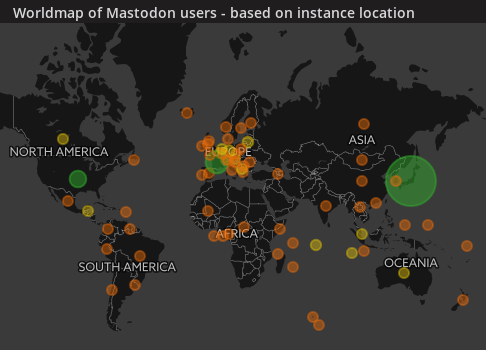
Carl Chenet: The Importance of Choosing the Correct Mastodon Instance

Remember, Mastodon is a new decentralized social network, based on a free software which is rapidly gaining users (already there is more than 1.5 million accounts). As I ve created my account in June, I was a fast addict and I ve already created several tools for this network, Feed2toot, Remindr and Boost (mostly written in Python).

Now, with all this experience I have to stress out the importance of choosing the correct Mastodon instance.

Some technical reminders on how Mastodon works

First, let s quickly clarify something about the decentralized part. In Mastodon, decentralization is made through a federation of dedicated servers, called instances , each one with a complete independent administration. Your user account is created on one specific instance. You have two choices:

  • Create your own instance. Which requires advanced technical knowledge.
  • Create your user account on a public instance. Which is the easiest and fastest way to start using Mastodon.

You can move your user account from one instance to another, but you have to follow a special procedure which can be quite long, considering your own interest for technical manipulation and the total amount of your followers you ll have to warn about your change. As such, you ll have to create another account on a new instance and import three lists: the one with your followers, the one with the accounts you have blocked, and the one with the account you have muted.

From this working process, several technical and human factors will interest us.

A good technical administration for instance

As a social network, Mastodon is truly decentralized, with more than 1.5 million users on more than 2350 existing instances. As such, the most common usage is to create an account on an open instance. To create its own instance is way too difficult for the average user. Yet, using an open instance creates a strong dependence on the technical administrator of the chosen instance.

The technical administrator will have to deal with several obligations to ensure its service continuity, with high-quality hardware and regular back-ups. All of these have a price, either in money and in time. Regarding the time factor, it would be better to choose an administration team over an individual, as life events can change quite fast everyone s interests. As such, Framasoft, a French association dedicated to promoting the Free software use, offers its own Mastodon instance named: Framapiaf. The creator of the mastodon project, also offers a quite solid instance, Mastodon.social (see below).

Regarding the money factor, many instance administrators with a large number of users are currently asking for donation via Patreon, as hosting an instance server or renting one cost money.

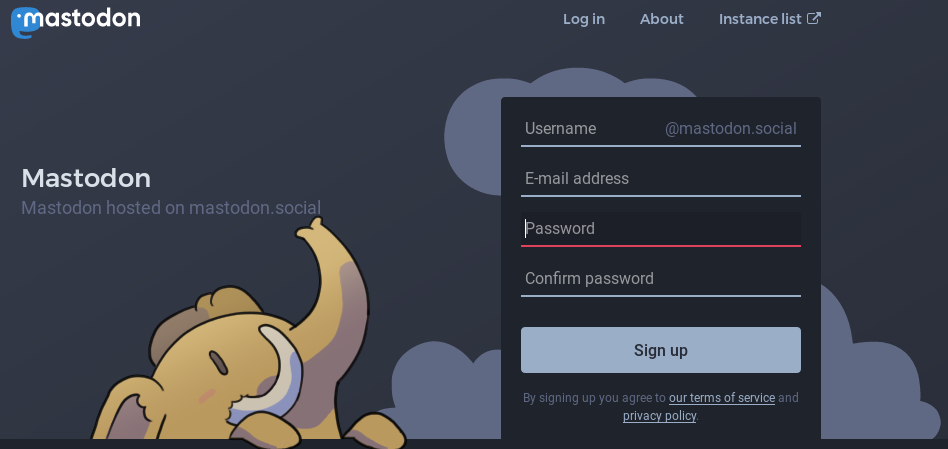
Mastodon.social, the first instance of the Mastodon network

The Ideological Trend Of Your Instance

If anybody could have guessed the previous technical points since the recent registration explosion on the Mastodon social network, the following point took almost everyone by surprise. Little by little, different instances show their culture , their protest action, and their propaganda on this social network.

As the instance administrator has all the powers over its instance, he or she can block the instance of interacting with some other instances, or ban its instance s users from any interaction with other instances users.

With everyone having in mind the main advantages to have federalized instance from, this partial independence of some instances from the federation was a huge surprise. One of the most recent example was when the Unixcorn.xyz instance administrator banned its users from reading Aeris account, which was on its own instance. It was a cataclysm with several consequences, which I ve named the #AerisGate as it shows the different views on moderation and on its reception by various Mastodon users.

If you don t manage your own instance, when you ll have to choose the one where to create your account, make sure that the content you plan to toot is within the rules and compatible with the ideology of said instance s administrator. Yes, I know, it may seem surprising but, as stated above, by entering a public instance you become dependent on someone else s infrastructure, who may have an ideological way to conceive its Mastodon hosting service. As such, if you re a nazi, for example, don t open your Mastodon account on a far-left LGBT instance. Your account wouldn t stay open for long.

The moderation rules are described in the about/more page of the instance, and may contain ideological elements.

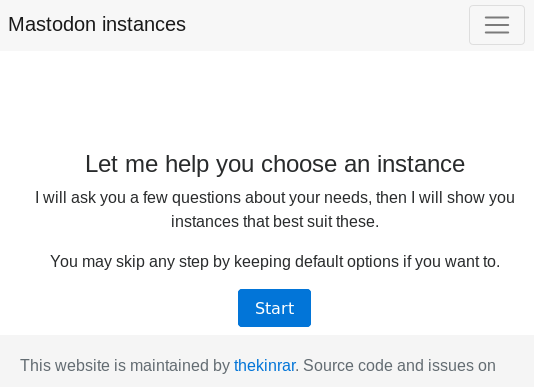
To ease the process for newcomers, it is now possible to use a great tool to select what instance should be the best to host your account.

Remember that, as stated above, Mastodon is decentralized, and as such there is no central authority which can be reached in case you have a conflict with your instance administrator. And nobody can force said administrator to follow its own rules, or not to change them on the fly. Think Twice Before Creating Your Account

If you want to create an account on an instance you don t control, you need to check two elements: the availability of the instance hosting service in the long run, often linked to the administrator or the administration group of said instance, and the ideological orientation of your instance. With these two elements checked, you ll be able to let your Mastodon account growth peacefully, without fearing an outage of your instance, or simple your account blocked one morning because it doesn t align with your instance s ideological line.

in Conclusion

To help me get involved in free software and writing articles for this blog, please consider a donation through my Liberapay page, even if it s only a few cents per week. My contact Bitcoin and Monero are also available on this page. Follow me on Mastodon Translated from French to English by St phanie Chaptal.

25 August 2017

Dirk Eddelbuettel: BH 1.65.0-1

The BH package on CRAN was updated today to version 1.65.0. BH provides a sizeable portion of the Boost C++ libraries as a set of template headers for use by R, possibly with Rcpp as well as other packages. This release upgrades the version of Boost to the rather new upstream version Boost 1.65.0 released earlier this week, and adds two new libraries: align and sort. I had started the upgrade process a few days ago under release 1.64.0. Rigorous checking of reverse dependencies showed that mvnfast needed a small change (which was trivial: just seeding the RNG prior to running tests), which Matteo did in no time with a fresh CRAN upload. rstan is needing a bit more work but should be ready real soon now and we are awaiting a new version. And once I switched to the just release Boost 1.65.0 it became apparent that Cyclops no longer needs its embedded copy of Boost iterator---and Marc already made that change with yet another fresh CRAN upload. It is a true pleasure to work in such a responsive and collaborative community.

Changes in version 1.65.0-1 (2017-08-24)
  • Upgraded to Boost 1.64 and then 1.65 installed directly from upstream source with several minor tweaks (as before)
  • Fourth tweak corrects a misplaced curly brace (see the Boost ublas GitHub repo and its issue #40)
  • Added Boost align (as requested in #32)
  • Added Boost sort (as requested in #35)
  • Added Boost multiprecision by fixing a script typo (as requested in #42)
  • Updated Travis CI support via newer run.sh

Via CRANberries, there is a diffstat report relative to the previous release. Comments and suggestions are welcome via the mailing list or the issue tracker at the GitHub repo.

This post by Dirk Eddelbuettel originated on his Thinking inside the box blog. Please report excessive re-aggregation in third-party for-profit settings.

23 August 2017

Antoine Beaupr : The supposed decline of copyleft

At DebConf17, John Sullivan, the executive director of the FSF, gave a talk on the supposed decline of the use of copyleft licenses use free-software projects. In his presentation, Sullivan questioned the notion that permissive licenses, like the BSD or MIT licenses, are gaining ground at the expense of the traditionally dominant copyleft licenses from the FSF. While there does seem to be a rise in the use of permissive licenses, in general, there are several possible explanations for the phenomenon.

When the rumor mill starts Sullivan gave a recent example of the claim of the decline of copyleft in an article on Opensource.com by Jono Bacon from February 2017 that showed a histogram of license usage between 2010 and 2017 (seen below).
[Black Duck   histogram]
From that, Bacon elaborates possible reasons for the apparent decline of the GPL. The graphic used in the article was actually generated by Stephen O'Grady in a January article, The State Of Open Source Licensing, which said:
In Black Duck's sample, the most popular variant of the GPL version 2 is less than half as popular as it was (46% to 19%). Over the same span, the permissive MIT has gone from 8% share to 29%, while its permissive cousin the Apache License 2.0 jumped from 5% to 15%.
Sullivan, however, argued that the methodology used to create both articles was problematic. Neither contains original research: the graphs actually come from the Black Duck Software "KnowledgeBase" data, which was partly created from the old Ohloh web site now known as Open Hub. To show one problem with the data, Sullivan mentioned two free-software projects, GNU Bash and GNU Emacs, that had been showcased on the front page of Ohloh.net in 2012. On the site, Bash was (and still is) listed as GPLv2+, whereas it changed to GPLv3 in 2011. He also claimed that "Emacs was listed as licensed under GPLv3-only, which is a license Emacs has never had in its history", although I wasn't able to verify that information from the Internet archive. Basically, according to Sullivan, "the two projects featured on the front page of a site that was using [the Black Duck] data set were wrong". This, in turn, seriously brings into question the quality of the data:
I reported this problem and we'll continue to do that but when someone is not sharing the data set that they're using for other people to evaluate it and we see glimpses of it which are incorrect, that should give us a lot of hesitation about accepting any conclusion that comes out of it.
Reproducible observations are necessary to the establishment of solid theories in science. Sullivan didn't try to contact Black Duck to get access to the database, because he assumed (rightly, as it turned out) that he would need to "pay for the data under terms that forbid you to share that information with anybody else". So I wrote Black Duck myself to confirm this information. In an email interview, Patrick Carey from Black Duck confirmed its data set is proprietary. He believes, however, that through a "combination of human and automated techniques", Black Duck is "highly confident at the accuracy and completeness of the data in the KnowledgeBase". He did point out, however, that "the way we track the data may not necessarily be optimal for answering the question on license use trend" as "that would entail examination of new open source projects coming into existence each year and the licenses used by them". In other words, even according to Black Duck, its database may not be useful to establish the conclusions drawn by those articles. Carey did agree with those conclusions intuitively, however, saying that "there seems to be a shift toward Apache and MIT licenses in new projects, though I don't have data to back that up". He suggested that "an effective way to answer the trend question would be to analyze the new projects on GitHub over the last 5-10 years." Carey also suggested that "GitHub has become so dominant over the recent years that just looking at projects on GitHub would give you a reasonable sampling from which to draw conclusions".
[GitHub   graph]
Indeed, GitHub published a report in 2015 that also seems to confirm MIT's popularity (45%), surpassing copyleft licenses (24%). The data is, however, not without its own limitations. For example, in the above graph going back to the inception of GitHub in 2008, we see a rather abnormal spike in 2013, which seems to correlate with the launch of the choosealicense.com site, described by GitHub as "our first pass at making open source licensing on GitHub easier". In his talk, Sullivan was critical of the initial version of the site which he described as biased toward permissive licenses. Because the GitHub project creation page links to the site, Sullivan explained that the site's bias could have actually influenced GitHub users' license choices. Following a talk from Sullivan at FOSDEM 2016, GitHub addressed the problem later that year by rewording parts of the front page to be more accurate, but that any change in license choice obviously doesn't show in the report produced in 2015 and won't affect choices users have already made. Therefore, there can be reasonable doubts that GitHub's subset of software projects may not actually be that representative of the larger free-software community.

In search of solid evidence So it seems we are missing good, reproducible results to confirm or dispel these claims. Sullivan explained that it is a difficult problem, if only in the way you select which projects to analyze: the impact of a MIT-licensed personal wiki will obviously be vastly different from, say, a GPL-licensed C compiler or kernel. We may want to distinguish between active and inactive projects. Then there is the problem of code duplication, both across publication platforms (a project may be published on GitHub and SourceForge for example) but also across projects (code may be copy-pasted between projects). We should think about how to evaluate the license of a given project: different files in the same code base regularly have different licenses often none at all. This is why having a clear, documented and publicly available data set and methodology is critical. Without this, the assumptions made are not clear and it is unreasonable to draw certain conclusions from the results. It turns out that some researchers did that kind of open research in 2016 in a paper called "The Debsources Dataset: Two Decades of Free and Open Source Software" [PDF] by Matthieu Caneill, Daniel M. Germ n, and Stefano Zacchiroli. The Debsources data set is the complete Debian source code that covers a large history of the Debian project and therefore includes thousands of free-software projects of different origins. According to the paper:
The long history of Debian creates a perfect subject to evaluate how FOSS licenses use has evolved over time, and the popularity of licenses currently in use.
Sullivan argued that the Debsources data set is interesting because of its quality: every package in Debian has been reviewed by multiple humans, including the original packager, but also by the FTP masters to ensure that the distribution can legally redistribute the software. The existence of a package in Debian provides a minimal "proof of use": unmaintained packages get removed from Debian on a regular basis and the mere fact that a piece of software gets packaged in Debian means at least some users found it important enough to work on packaging it. Debian packagers make specific efforts to avoid code duplication between packages in order to ease security maintenance. The data set covers a period longer than Black Duck's or GitHub's, as it goes all the way back to the Hamm 2.0 release in 1998. The data and how to reproduce it are freely available under a CC BY-SA 4.0 license.
[Debsource   graph]
Sullivan presented the above graph from the research paper that showed the evolution of software license use in the Debian archive. Whereas previous graphs showed statistics in percentages, this one showed actual absolute numbers, where we can't actually distinguish a decline in copyleft licenses. To quote the paper again:
The top license is, once again, GPL-2.0+, followed by: Artistic-1.0/GPL dual-licensing (the licensing choice of Perl and most Perl libraries), GPL-3.0+, and Apache-2.0.
Indeed, looking at the graph, at most do we see a rise of the Apache and MIT licenses and no decline of the GPL per se, although its adoption does seem to slow down in recent years. We should also mention the possibility that Debian's data set has the opposite bias: toward GPL software. The Debian project is culturally quite different from the GitHub community and even the larger free-software ecosystem, naturally, which could explain the disparity in the results. We can only hope a similar analysis can be performed on the much larger Software Heritage data set eventually, which may give more representative results. The paper acknowledges this problem:
Debian is likely representative of enterprise use of FOSS as a base operating system, where stable, long-term and seldomly updated software products are desirable. Conversely Debian is unlikely representative of more dynamic FOSS environments (e.g., modern Web-development with micro libraries) where users, who are usually developers themselves, expect to receive library updates on a daily basis.
The Debsources research also shares methodology limitations with Black Duck: while Debian packages are reviewed before uploading and we can rely on the copyright information provided by Debian maintainers, the research also relies on automated tools (specifically FOSSology) to retrieve license information. Sullivan also warned against "ascribing reason to numbers": people may have different reasons for choosing a particular license. Developers may choose the MIT license because it has fewer words, for compatibility reasons, or simply because "their lawyers told them to". It may not imply an actual deliberate philosophical or ideological choice. Finally, he brought up the theory that the rise of non-copyleft licenses isn't necessarily at the detriment of the GPL. He explained that, even if there is an actual decline, it may not be much of a problem if there is an overall growth of free software to the detriment of proprietary software. He reminded the audience that non-copyleft licenses are still free software, according to the FSF and the Debian Free Software Guidelines, so their rise is still a positive outcome. Even if the GPL is a better tool to accomplish the goal of a free-software world, we can all acknowledge that the conversion of proprietary software to more permissive and certainly simpler licenses is definitely heading in the right direction.
[I would like to thank the DebConf organizers for providing meals for me during the conference.] Note: this article first appeared in the Linux Weekly News.

22 August 2017

Sven Hoexter: whois databases and registration spam

Lately I experienced some new kind of spam, at least new to myself. Seems that spammer abuse registration input fields that do not implement strong enough validation, and echo back several values from the registration process in some kind of welcome mail. Basically filling the spam message in name and surname fields. So far I found a bunch of those originating from the following AS: AS49453, AS50896, AS200557 and AS61440. The first three belong to something identifying itself as "QUALITYNETWORK". The last one, AS61440, seems to be involved only partially with some networks being delegated to "Atomohost". To block them it's helpful to query the public radb service whois.radb.net for all networks belonging to the specific AS like this:
whois -h whois.radb.net -- '-i origin AS50896'
Another bunch of batch capable whois services are provided by Team Cymru. They've some examples at the end of https://www.team-cymru.org/IP-ASN-mapping.html. In this specific case the spam was for "www.robotas.ru" which is currently terminated at CloudFlare and redirects via JS document.location to "http://link31.net/b494d/ooo/", which in turn redirects via JS window.location to "http://revizor-online.ga/" which is again hosted at CloudFlare. The page at the end plays some strange youtube video - currently at around 1900 plays, so not that widely spread. In the end an interesting indicator about spam campaign success.

Daniel Silverstone: Building a USB descriptor table set

In order to proceed further on our USB/STM32 oddessy, we need to start to build a USB descriptor set for our first prototype piece of code. For this piece, we're going to put together a USB device which is vendor-specific class-wise and has a single configuration with a interface with a single endpoint which we're not going to actually implement anything of. What we're after is just to get the information presented to the computer so that lsusb can see it. To get these built, let's refer to information we discovered and recorded in a previous post about how descriptors go together.

Device descriptor Remembering that values which are > 1 byte in length are always stored little-endian, we can construct our device descriptor as:
Our device descriptor
Field Name Value Bytes
bLength 18 0x12
bDescriptorType DEVICE 0x01
bcdUSB USB 2.0 0x00 0x02
bDeviceClass 0 0x00
bDeviceSubClass 0 0x00
bDeviceProtocol 0 0x00
bMaxPacketSize 64 0x40
idVendor TEST 0xff 0xff
idProduct TEST 0xff 0xff
bcdDevice 0.0.1 0x01 0x00
iManufacturer 1 0x01
iProduct 2 0x02
iSerialNumber 3 0x03
bNumConfigurations 1 0x01
We're using the vendor ID and product id 0xffff because at this point we don't have any useful values for this (it costs $5,000 to register a vendor ID). This gives us a final byte array of:
0x12 0x01 0x00 0x02 0x00 0x00 0x00 0x40 (Early descriptor) 0xff 0xff 0xff 0xff 0x01 0x00 0x01 0x02 0x03 0x01 (and the rest)
We're reserving string ids 1, 2, and 3, for the manufacturer string, product name string, and serial number string respectively. I'm deliberately including them all so that we can see it all come out later in lsusb. If you feed the above hex sequence into a USB descriptor decoder then you can check my working.

Endpoint Descriptor We want a single configuration, which covers our one interface, with one endpoint in it. Let's start with the endpoint...
Our bulk IN endpoint
Field Name Value Bytes
bLength 7 0x07
bDescriptorType ENDPOINT 0x05
bEndpointAddress EP2IN 0x82
bmAttributes BULK 0x02
wMaxPacketSize 64 0x40 0x00
bInterval IGNORED 0x00
We're giving a single bulk IN endpoint, since that's the simplest thing to describe at this time. This endpoint will never be ready and so nothing will ever be read into the host. All that gives us:
0x07 0x05 0x82 0x02 0x40 0x00 0x00

Interface Descriptor The interface descriptor prefaces the endpoint set, and thanks to our simple single endpoint, and no plans for alternate interfaces, we can construct the interface simply as:
Our single simple interface
Field Name Value Bytes
bLength 9 0x09
bDescriptorType INTERFACE 0x04
bInterfaceNumber 1 0x01
bAlternateSetting 1 0x01
bNumEndpoints 1 0x01
bInterfaceClass 0 0x00
bInterfaceSubClass 0 0x00
bInterfaceProtocol 0 0x00
iInterface 5 0x05
All that gives us:
0x09 0x04 0x01 0x01 0x01 0x00 0x00 0x00 0x05

Configuration descriptor Finally we can put it all together and get the configuration descriptor...
Our sole configuration, encapsulating the interface and endpoint above
Field Name Value Bytes
bLength 9 0x09
bDescriptorType CONFIG 0x02
wTotalLength 9+9+7 0x19 0x00
bNumInterfaces 1 0x01
bConfigurationValue 1 0x01
iConfiguration 4 0x04
bmAttributes Bus powered, no wake 0x80
bMaxPower 500mA 0xfa
The wTotalLength field is interesting. It contains the configuration length, the interface length, and the endpoint length, hence 9 plus 9 plus 7 is 25. This gives:
0x09 0x02 0x19 0x00 0x01 0x01 0x04 0x80 0xfa

String descriptors We allowed ourselves a total of five strings, they were iManufacturer, iProduct, iSerial (from the device descriptor), iConfiguration (from the configuration descriptor), and iInterface (from the interface descriptor) respectively. Our string descriptors will therefore be:
String descriptor zero, en_GB only
Field Name Value Bytes
bLength 4 0x04
bDescriptorType STRING 0x03
wLangID[0] en_GB 0x09 0x08
0x04 0x03 0x09 0x08
...and...
String descriptor one, iManufacturer
Field Name Value Bytes
bLength 38 0x26
bDescriptorType STRING 0x03
bString "Rusty Manufacturer" ...
0x26 0x03 0x52 0x00 0x75 0x00 0x73 0x00 0x74 0x00 0x79 0x00 0x20 0x00 0x4d 0x00 0x61 0x00 0x6e 0x00 0x75 0x00 0x66 0x00 0x61 0x00 0x63 0x00 0x74 0x00 0x75 0x00 0x72 0x00 0x65 0x00 0x72 0x00
(You get the idea, there's no point me breaking down the rest of the string descriptors here, suffice it to say that the other strings are appropriate for the values they represent - namely product, serial, configuration, and interface.)

Putting it all together Given all the above, we have a device descriptor which is standalone, then a configuration descriptor which encompasses the interface and endpoint descriptors too. Finally we have a string descriptor table with six entries, the first is the language sets available, and the rest are our strings. In total we have:
    // Device descriptor
    const DEV_DESC: [u8; 18] =  
        0x12, 0x01, 0x00, 0x02, 0x00, 0x00, 0x00, 0x40,
        0xff, 0xff, 0xff, 0xff, 0x01, 0x00, 0x01, 0x02,
        0x03, 0x01
     ;
    // Configuration descriptor
    const CONF_DESC: [u8; 25] =  
        0x09, 0x02, 0x19, 0x00, 0x01, 0x01, 0x04, 0x80, 0xfa,
        0x09, 0x04, 0x01, 0x01, 0x01, 0x00, 0x00, 0x00, 0x05,
        0x07, 0x05, 0x82, 0x02, 0x40, 0x00, 0x00
     ;
    // String Descriptor zero
    const STR_DESC_0: [u8; 4] =  0x04, 0x03, 0x09, 0x08 ;
    // String Descriptor 1, "Rusty Manufacturer"
    const STR_DESC_1: [u8; 38] =  
        0x26, 0x03, 0x52, 0x00, 0x75, 0x00, 0x73, 0x00,
        0x74, 0x00, 0x79, 0x00, 0x20, 0x00, 0x4d, 0x00,
        0x61, 0x00, 0x6e, 0x00, 0x75, 0x00, 0x66, 0x00,
        0x61, 0x00, 0x63, 0x00, 0x74, 0x00, 0x75, 0x00,
        0x72, 0x00, 0x65, 0x00, 0x72, 0x00
     ;
    // String Descriptor 2, "Rusty Product"
    const STR_DESC_2: [u8; 28] =  
        0x1c, 0x03, 0x52, 0x00, 0x75, 0x00, 0x73, 0x00,
        0x74, 0x00, 0x79, 0x00, 0x20, 0x00, 0x50, 0x00,
        0x72, 0x00, 0x6f, 0x00, 0x64, 0x00, 0x75, 0x00,
        0x63, 0x00, 0x74, 0x00
     ;
    // String Descriptor 3, "123ABC"
    const STR_DESC_3: [u8; 14] =  
        0x0e, 0x03, 0x31, 0x00, 0x32, 0x00, 0x33, 0x00,
        0x41, 0x00, 0x42, 0x00, 0x43, 0x00
     ;
    // String Descriptor 4, "Rusty Configuration"
    const STR_DESC_4: [u8; 40] =  
        0x28, 0x03, 0x52, 0x00, 0x75, 0x00, 0x73, 0x00,
        0x74, 0x00, 0x79, 0x00, 0x20, 0x00, 0x43, 0x00,
        0x6f, 0x00, 0x6e, 0x00, 0x66, 0x00, 0x69, 0x00,
        0x67, 0x00, 0x75, 0x00, 0x72, 0x00, 0x61, 0x00,
        0x74, 0x00, 0x69, 0x00, 0x6f, 0x00, 0x6e, 0x00
     ;
    // String Descriptor 5, "Rusty Interface"
    const STR_DESC_5: [u8; 32] =  
        0x20, 0x03, 0x52, 0x00, 0x75, 0x00, 0x73, 0x00,
        0x74, 0x00, 0x79, 0x00, 0x20, 0x00, 0x49, 0x00,
        0x6e, 0x00, 0x74, 0x00, 0x65, 0x00, 0x72, 0x00,
        0x66, 0x00, 0x61, 0x00, 0x63, 0x00, 0x65, 0x00
     ;
With the above, we're a step closer to our first prototype which will hopefully be enumerable. Next time we'll look at beginning our prototype low level USB device stack mock-up.

20 August 2017

Dirk Eddelbuettel: RcppArmadillo 0.7.960.1.1

armadillo image On the heels of the very recent bi-monthly RcppArmadillo release comes a quick bug-fix release 0.7.960.1.1 which just got onto CRAN (and I will ship a build to Debian in a moment). There were three distinct issues I addressed in three quick pull requests: Armadillo is a powerful and expressive C++ template library for linear algebra aiming towards a good balance between speed and ease of use with a syntax deliberately close to a Matlab. RcppArmadillo integrates this library with the R environment and language--and is widely used by (currently) 382 other packages on CRAN---an increase of 52 since the CRAN release in June! Changes in this release relative to the previous CRAN release are as follows:

Changes in RcppArmadillo version 0.7.960.1.1 (2017-08-20)
  • Added improved check for inherited S4 matrix classes (#162 fixing #161)
  • Changed fastLm C++ function to fastLm_impl to not clash with R method (#164 fixing #163)
  • Added OpenMP check for configure (#166 fixing #165)

Courtesy of CRANberries, there is a diffstat report. More detailed information is on the RcppArmadillo page. Questions, comments etc should go to the rcpp-devel mailing list off the R-Forge page.

This post by Dirk Eddelbuettel originated on his Thinking inside the box blog. Please report excessive re-aggregation in third-party for-profit settings.

Vincent Bernat: IPv6 route lookup on Linux

TL;DR: With its implementation of IPv6 routing tables using radix trees, Linux offers subpar performance (450 ns for a full view 40,000 routes) compared to IPv4 (50 ns for a full view 500,000 routes) but fair memory usage (20 MiB for a full view).
In a previous article, we had a look at IPv4 route lookup on Linux. Let s see how different IPv6 is.

Lookup trie implementation Looking up a prefix in a routing table comes down to find the most specific entry matching the requested destination. A common structure for this task is the trie, a tree structure where each node has its parent as prefix. With IPv4, Linux uses a level-compressed trie (or LPC-trie), providing good performances with low memory usage. For IPv6, Linux uses a more classic radix tree (or Patricia trie). There are three reasons for not sharing:
  • The IPv6 implementation (introduced in Linux 2.1.8, 1996) predates the IPv4 implementation based on LPC-tries (in Linux 2.6.13, commit 19baf839ff4a).
  • The feature set is different. Notably, IPv6 supports source-specific routing1 (since Linux 2.1.120, 1998).
  • The IPv4 address space is denser than the IPv6 address space. Level-compression is therefore quite efficient with IPv4. This may not be the case with IPv6.
The trie in the below illustration encodes 6 prefixes: Radix tree For more in-depth explanation on the different ways to encode a routing table into a trie and a better understanding of radix trees, see the explanations for IPv4. The following figure shows the in-memory representation of the previous radix tree. Each node corresponds to a struct fib6_node. When a node has the RTN_RTINFO flag set, it embeds a pointer to a struct rt6_info containing information about the next-hop. Memory representation of a routing table The fib6_lookup_1() function walks the radix tree in two steps:
  1. walking down the tree to locate the potential candidate, and
  2. checking the candidate and, if needed, backtracking until a match.
Here is a slightly simplified version without source-specific routing:
static struct fib6_node *fib6_lookup_1(struct fib6_node *root,
                                       struct in6_addr  *addr)
 
    struct fib6_node *fn;
    __be32 dir;
    /* Step 1: locate potential candidate */
    fn = root;
    for (;;)  
        struct fib6_node *next;
        dir = addr_bit_set(addr, fn->fn_bit);
        next = dir ? fn->right : fn->left;
        if (next)  
            fn = next;
            continue;
         
        break;
     
    /* Step 2: check prefix and backtrack if needed */
    while (fn)  
        if (fn->fn_flags & RTN_RTINFO)  
            struct rt6key *key;
            key = fn->leaf->rt6i_dst;
            if (ipv6_prefix_equal(&key->addr, addr, key->plen))  
                if (fn->fn_flags & RTN_RTINFO)
                    return fn;
             
         
        if (fn->fn_flags & RTN_ROOT)
            break;
        fn = fn->parent;
     
    return NULL;
 

Caching While IPv4 lost its route cache in Linux 3.6 (commit 5e9965c15ba8), IPv6 still has a caching mechanism. However cache entries are directly put in the radix tree instead of a distinct structure. Since Linux 2.1.30 (1997) and until Linux 4.2 (commit 45e4fd26683c), almost any successful route lookup inserts a cache entry in the radix tree. For example, a router forwarding a ping between 2001:db8:1::1 and 2001:db8:3::1 would get those two cache entries:
$ ip -6 route show cache
2001:db8:1::1 dev r2-r1  metric 0
    cache
2001:db8:3::1 via 2001:db8:2::2 dev r2-r3  metric 0
    cache
These entries are cleaned up by the ip6_dst_gc() function controlled by the following parameters:
$ sysctl -a   grep -F net.ipv6.route
net.ipv6.route.gc_elasticity = 9
net.ipv6.route.gc_interval = 30
net.ipv6.route.gc_min_interval = 0
net.ipv6.route.gc_min_interval_ms = 500
net.ipv6.route.gc_thresh = 1024
net.ipv6.route.gc_timeout = 60
net.ipv6.route.max_size = 4096
net.ipv6.route.mtu_expires = 600
The garbage collector is triggered at most every 500 ms when there are more than 1024 entries or at least every 30 seconds. The garbage collection won t run for more than 60 seconds, except if there are more than 4096 routes. When running, it will first delete entries older than 30 seconds. If the number of cache entries is still greater than 4096, it will continue to delete more recent entries (but no more recent than 512 jiffies, which is the value of gc_elasticity) after a 500 ms pause. Starting from Linux 4.2 (commit 45e4fd26683c), only a PMTU exception would create a cache entry. A router doesn t have to handle those exceptions, so only hosts would get cache entries. And they should be pretty rare. Martin KaFai Lau explains:
Out of all IPv6 RTF_CACHE routes that are created, the percentage that has a different MTU is very small. In one of our end-user facing proxy server, only 1k out of 80k RTF_CACHE routes have a smaller MTU. For our DC traffic, there is no MTU exception.
Here is how a cache entry with a PMTU exception looks like:
$ ip -6 route show cache
2001:db8:1::50 via 2001:db8:1::13 dev out6  metric 0
    cache  expires 573sec mtu 1400 pref medium

Performance We consider three distinct scenarios:
Excerpt of an Internet full view
In this scenario, Linux acts as an edge router attached to the default-free zone. Currently, the size of such a routing table is a little bit above 40,000 routes.
/48 prefixes spread linearly with different densities
Linux acts as a core router inside a datacenter. Each customer or rack gets one or several /48 networks, which need to be routed around. With a density of 1, /48 subnets are contiguous.
/128 prefixes spread randomly in a fixed /108 subnet
Linux acts as a leaf router for a /64 subnet with hosts getting their IP using autoconfiguration. It is assumed all hosts share the same OUI and therefore, the first 40 bits are fixed. In this scenario, neighbor reachability information for the /64 subnet are converted into routes by some external process and redistributed among other routers sharing the same subnet2.

Route lookup performance With the help of a small kernel module, we can accurately benchmark3 the ip6_route_output_flags() function and correlate the results with the radix tree size: Maximum depth and lookup time Getting meaningful results is challenging due to the size of the address space. None of the scenarios have a fallback route and we only measure time for successful hits4. For the full view scenario, only the range from 2400::/16 to 2a06::/16 is scanned (it contains more than half of the routes). For the /128 scenario, the whole /108 subnet is scanned. For the /48 scenario, the range from the first /48 to the last one is scanned. For each range, 5000 addresses are picked semi-randomly. This operation is repeated until we get 5000 hits or until 1 million tests have been executed. The relation between the maximum depth and the lookup time is incomplete and I can t explain the difference of performance between the different densities of the /48 scenario. We can extract two important performance points:
  • With a full view, the lookup time is 450 ns. This is almost ten times the budget for forwarding at 10 Gbps which is about 50 ns.
  • With an almost empty routing table, the lookup time is 150 ns. This is still over the time budget for forwarding at 10 Gbps.
With IPv4, the lookup time for an almost empty table was 20 ns while the lookup time for a full view (500,000 routes) was a bit above 50 ns. How to explain such a difference? First, the maximum depth of the IPv4 LPC-trie with 500,000 routes was 6, while the maximum depth of the IPv6 radix tree for 40,000 routes is 40. Second, while both IPv4 s fib_lookup() and IPv6 s ip6_route_output_flags() functions have a fixed cost implied by the evaluation of routing rules, IPv4 has several optimizations when the rules are left unmodified5. Those optimizations are removed on the first modification. If we cancel those optimizations, the lookup time for IPv4 is impacted by about 30 ns. This still leaves a 100 ns difference with IPv6 to be explained. Let s compare how time is spent in each lookup function. Here is a CPU flamegraph for IPv4 s fib_lookup(): IPv4 route lookup flamegraph Only 50% of the time is spent in the actual route lookup. The remaining time is spent evaluating the routing rules (about 30 ns). This ratio is dependent on the number of routes we inserted (only 1000 in this example). It should be noted the fib_table_lookup() function is executed twice: once with the local routing table and once with the main routing table. The equivalent flamegraph for IPv6 s ip6_route_output_flags() is depicted below: IPv6 route lookup flamegraph Here is an approximate breakdown on the time spent:
  • 50% is spent in the route lookup in the main table,
  • 15% is spent in handling locking (IPv4 is using the more efficient RCU mechanism),
  • 5% is spent in the route lookup of the local table,
  • most of the remaining is spent in routing rule evaluation (about 100 ns)6.
Why does the evaluation of routing rules is less efficient with IPv6? Again, I don t have a definitive answer.

History The following graph shows the performance progression of route lookups through Linux history: IPv6 route lookup performance progression All kernels are compiled with GCC 4.9 (from Debian Jessie). This version is able to compile older kernels as well as current ones. The kernel configuration is the default one with CONFIG_SMP, CONFIG_IPV6, CONFIG_IPV6_MULTIPLE_TABLES and CONFIG_IPV6_SUBTREES options enabled. Some other unrelated options are enabled to be able to boot them in a virtual machine and run the benchmark. There are three notable performance changes:
  • In Linux 3.1, Eric Dumazet delays a bit the copy of route metrics to fix the undesirable sharing of route-specific metrics by all cache entries (commit 21efcfa0ff27). Each cache entry now gets its own metrics, which explains the performance hit for the non-/128 scenarios.
  • In Linux 3.9, Yoshifuji Hideaki removes the reference to the neighbor entry in struct rt6_info (commit 887c95cc1da5). This should have lead to a performance increase. The small regression may be due to cache-related issues.
  • In Linux 4.2, Martin KaFai Lau prevents the creation of cache entries for most route lookups. The most sensible performance improvement comes with commit 4b32b5ad31a6. The second one is from commit 45e4fd26683c, which effectively removes creation of cache entries, except for PMTU exceptions.

Insertion performance Another interesting performance-related metric is the insertion time. Linux is able to insert a full view in less than two seconds. For some reason, the insertion time is not linear above 50,000 routes and climbs very fast to 60 seconds for 500,000 routes. Insertion time Despite its more complex insertion logic, the IPv4 subsystem is able to insert 2 million routes in less than 10 seconds.

Memory usage Radix tree nodes (struct fib6_node) and routing information (struct rt6_info) are allocated with the slab allocator7. It is therefore possible to extract the information from /proc/slabinfo when the kernel is booted with the slab_nomerge flag:
# sed -ne 2p -e '/^ip6_dst/p' -e '/^fib6_nodes/p' /proc/slabinfo   cut -f1 -d:
   name            <active_objs> <num_objs> <objsize> <objperslab> <pagesperslab>
fib6_nodes         76101  76104     64   63    1
ip6_dst_cache      40090  40090    384   10    1
In the above example, the used memory is 76104 64+40090 384 bytes (about 20 MiB). The number of struct rt6_info matches the number of routes while the number of nodes is roughly twice the number of routes: Nodes The memory usage is therefore quite predictable and reasonable, as even a small single-board computer can support several full views (20 MiB for each): Memory usage The LPC-trie used for IPv4 is more efficient: when 512 MiB of memory is needed for IPv6 to store 1 million routes, only 128 MiB are needed for IPv4. The difference is mainly due to the size of struct rt6_info (336 bytes) compared to the size of IPv4 s struct fib_alias (48 bytes): IPv4 puts most information about next-hops in struct fib_info structures that are shared with many entries.

Conclusion The takeaways from this article are:
  • upgrade to Linux 4.2 or more recent to avoid excessive caching,
  • route lookups are noticeably slower compared to IPv4 (by an order of magnitude),
  • CONFIG_IPV6_MULTIPLE_TABLES option incurs a fixed penalty of 100 ns by lookup,
  • memory usage is fair (20 MiB for 40,000 routes).
Compared to IPv4, IPv6 in Linux doesn t foster the same interest, notably in term of optimizations. Hopefully, things are changing as its adoption and use at scale are increasing.

  1. For a given destination prefix, it s possible to attach source-specific prefixes:
    ip -6 route add 2001:db8:1::/64 \
      from 2001:db8:3::/64 \
      via fe80::1 \
      dev eth0
    
    Lookup is first done on the destination address, then on the source address.
  2. This is quite different of the classic scenario where Linux acts as a gateway for a /64 subnet. In this case, the neighbor subsystem stores the reachability information for each host and the routing table only contains a single /64 prefix.
  3. The measurements are done in a virtual machine with one vCPU and no neighbors. The host is an Intel Core i5-4670K running at 3.7 GHz during the experiment (CPU governor set to performance). The benchmark is single-threaded. Many lookups are performed and the result reported is the median value. Timings of individual runs are computed from the TSC.
  4. Most of the packets in the network are expected to be routed to a destination. However, this also means the backtracking code path is not used in the /128 and /48 scenarios. Having a fallback route gives far different results and make it difficult to ensure we explore the address space correctly.
  5. The exact same optimizations could be applied for IPv6. Nobody did it yet.
  6. Compiling out table support effectively removes those last 100 ns.
  7. There is also per-CPU pointers allocated directly (4 bytes per entry per CPU on a 64-bit architecture). We ignore this detail.

Dirk Eddelbuettel: #10: Compacting your Shared Libraries, After The Build

Welcome to the tenth post in the rarely ranting R recommendations series, or R4 for short. A few days ago we showed how to tell the linker to strip shared libraries. As discussed in the post, there are two options. One can either set up ~/.R/Makevars by passing the strip-debug option to the linker. Alternatively, one can adjust src/Makevars in the package itself with a bit a Makefile magic. Of course, there is a third way: just run strip --strip-debug over all the shared libraries after the build. As the path is standardized, and the shell does proper globbing, we can just do
$ strip --strip-debug /usr/local/lib/R/site-library/*/libs/*.so
using a double-wildcard to get all packages (in that R package directory) and all their shared libraries. Users on macOS probably want .dylib on the end, users on Windows want another computer as usual (just kidding: use .dll). Either may have to adjust the path which is left as an exercise to the reader. The impact can be Yuge as illustrated in the following dotplot:
This illustration is in response to a mailing list post. Last week, someone claimed on r-help that tidyverse would not install on Ubuntu 17.04. And this is of course patently false as many of us build and test on Ubuntu and related Linux systems, Travis runs on it, CRAN tests them etc pp. That poor user had somehow messed up their default gcc version. Anyway: I fired up a Docker container, installed r-base-core plus three required -dev packages (for xml2, openssl, and curl) and ran a single install.packages("tidyverse"). In a nutshell, following the launch of Docker for an Ubuntu 17.04 container, it was just
$ apt-get update
$ apt-get install r-base libcurl4-openssl-dev libssl-dev libxml2-dev
$ apt-get install mg          # a tiny editor
$ mg /etc/R/Rprofile.site     # to add a default CRAN repo
$ R -e 'install.packages("tidyverse")'
which not only worked (as expected) but also installed a whopping fifty-one packages (!!) of which twenty-six contain a shared library. A useful little trick is to run du with proper options to total, summarize, and use human units which reveals that these libraries occupy seventy-eight megabytes:
root@de443801b3fc:/# du -csh /usr/local/lib/R/site-library/*/libs/*so
4.3M    /usr/local/lib/R/site-library/Rcpp/libs/Rcpp.so
2.3M    /usr/local/lib/R/site-library/bindrcpp/libs/bindrcpp.so
144K    /usr/local/lib/R/site-library/colorspace/libs/colorspace.so
204K    /usr/local/lib/R/site-library/curl/libs/curl.so
328K    /usr/local/lib/R/site-library/digest/libs/digest.so
33M     /usr/local/lib/R/site-library/dplyr/libs/dplyr.so
36K     /usr/local/lib/R/site-library/glue/libs/glue.so
3.2M    /usr/local/lib/R/site-library/haven/libs/haven.so
272K    /usr/local/lib/R/site-library/jsonlite/libs/jsonlite.so
52K     /usr/local/lib/R/site-library/lazyeval/libs/lazyeval.so
64K     /usr/local/lib/R/site-library/lubridate/libs/lubridate.so
16K     /usr/local/lib/R/site-library/mime/libs/mime.so
124K    /usr/local/lib/R/site-library/mnormt/libs/mnormt.so
372K    /usr/local/lib/R/site-library/openssl/libs/openssl.so
772K    /usr/local/lib/R/site-library/plyr/libs/plyr.so
92K     /usr/local/lib/R/site-library/purrr/libs/purrr.so
13M     /usr/local/lib/R/site-library/readr/libs/readr.so
4.7M    /usr/local/lib/R/site-library/readxl/libs/readxl.so
1.2M    /usr/local/lib/R/site-library/reshape2/libs/reshape2.so
160K    /usr/local/lib/R/site-library/rlang/libs/rlang.so
928K    /usr/local/lib/R/site-library/scales/libs/scales.so
4.9M    /usr/local/lib/R/site-library/stringi/libs/stringi.so
1.3M    /usr/local/lib/R/site-library/tibble/libs/tibble.so
2.0M    /usr/local/lib/R/site-library/tidyr/libs/tidyr.so
1.2M    /usr/local/lib/R/site-library/tidyselect/libs/tidyselect.so
4.7M    /usr/local/lib/R/site-library/xml2/libs/xml2.so
78M     total
root@de443801b3fc:/# 
Looks like dplyr wins this one at thirty-three megabytes just for its shared library. But with a single stroke of strip we can reduce all this down a lot:
root@de443801b3fc:/# strip --strip-debug /usr/local/lib/R/site-library/*/libs/*so
root@de443801b3fc:/# du -csh /usr/local/lib/R/site-library/*/libs/*so
440K    /usr/local/lib/R/site-library/Rcpp/libs/Rcpp.so
220K    /usr/local/lib/R/site-library/bindrcpp/libs/bindrcpp.so
52K     /usr/local/lib/R/site-library/colorspace/libs/colorspace.so
56K     /usr/local/lib/R/site-library/curl/libs/curl.so
120K    /usr/local/lib/R/site-library/digest/libs/digest.so
2.5M    /usr/local/lib/R/site-library/dplyr/libs/dplyr.so
16K     /usr/local/lib/R/site-library/glue/libs/glue.so
404K    /usr/local/lib/R/site-library/haven/libs/haven.so
76K     /usr/local/lib/R/site-library/jsonlite/libs/jsonlite.so
20K     /usr/local/lib/R/site-library/lazyeval/libs/lazyeval.so
24K     /usr/local/lib/R/site-library/lubridate/libs/lubridate.so
8.0K    /usr/local/lib/R/site-library/mime/libs/mime.so
52K     /usr/local/lib/R/site-library/mnormt/libs/mnormt.so
84K     /usr/local/lib/R/site-library/openssl/libs/openssl.so
76K     /usr/local/lib/R/site-library/plyr/libs/plyr.so
32K     /usr/local/lib/R/site-library/purrr/libs/purrr.so
648K    /usr/local/lib/R/site-library/readr/libs/readr.so
400K    /usr/local/lib/R/site-library/readxl/libs/readxl.so
128K    /usr/local/lib/R/site-library/reshape2/libs/reshape2.so
56K     /usr/local/lib/R/site-library/rlang/libs/rlang.so
100K    /usr/local/lib/R/site-library/scales/libs/scales.so
496K    /usr/local/lib/R/site-library/stringi/libs/stringi.so
124K    /usr/local/lib/R/site-library/tibble/libs/tibble.so
164K    /usr/local/lib/R/site-library/tidyr/libs/tidyr.so
104K    /usr/local/lib/R/site-library/tidyselect/libs/tidyselect.so
344K    /usr/local/lib/R/site-library/xml2/libs/xml2.so
6.6M    total
root@de443801b3fc:/#
Down to six point six megabytes. Not bad for one command. The chart visualizes the respective reductions. Clearly, C++ packages (and their template use) lead to more debugging symbols than plain old C code. But once stripped, the size differences are not that large. And just to be plain, what we showed previously in post #9 does the same, only already at installation stage. The effects are not cumulative.

This post by Dirk Eddelbuettel originated on his Thinking inside the box blog. Please report excessive re-aggregation in third-party for-profit settings.

19 August 2017

Holger Levsen: 20170819-lasercutter-sprint

laser-cutter sprint So I'm overcoming my jetlag after DebConf17 by helping to make the Alioth sprint happen, and while it's good to witness work on the upcoming git.debian.org replacement, I'm rather minding my own business instead of getting involved And so I got interested in this laser cutter, which since two months has been set up in the CCCHH hackerspace and which is nicely documentend (and set up), so I managed to learn how to do my first baby steps with the laser cutter in one evening: Basically there is a hosted web application named 'LaserWeb4' for which a pre-configuration exists, so that one only needs to load an image, scale and position it and tune the laser settings a bit. The laser itself is inside a cage, which has a physical safety switch which will turn off the laser if the cage is opened. Obviously the setup is a lot more complex and there are many parameters to tune, and I basically just learned one thing, which is "printing images on wood", but "printing images on a laptop cover" should be pretty similar and something to learn in the future ;-) And now I'm even teaching weasel how to use this thing (and he already made interesting new mistakes) and it looks like Ganneff & formorer are next. Fun fun fun! Oh, and the Alioth sprint also seems to be quite productive, but I'll leave reporting about this to others.

Vasudev Kamath: Writing a UDP Broadcast Receiver as Python Iterator

I had to write a small Python application to listen for some broadcast message and process the message. This broadcast messages are actually sort of discovery messages to find some peers in a network. Writing a simple UDP Server to listen on a particular port was easy; but while designing an application I was wondering how can I plugin this server into my main code. There are 2 possibility
  1. Use threading module of python to send the server code in back ground and give it a callback to communicate the data to main thread.
  2. Periodically read some messages from server code and then dispose of server.
I didn't like first approach because I need to pass a callback function and I some how will end up complicating code. Second approach sounded sane but I did want to make server more like iterator. I searched around to see if some one has attempted to write something similar, but did not find anything useful (may be my Googling skills aren't good enough). Anyway so I thought what is wrong in trying?. If it works then I'll be happy that I did something different :-). The first thing for making iterator in Python is having function __iter__ and __next__ defined in your class. For Python 2 iterator protocol wanted next to be defined instead of __next__. So for portable code you can define a next function which in return calls __next__. So here is my first shot at writing BroadCastReceiver class.
from socket import socket, AF_INET, SOCK_DGRAM
class BroadCastReceiver:
    def __init__(self, port, msg_len=8192):
        self.sock = socket(AF_INET, SOCK_DGRAM)
        self.sock.setsockopt(SOL_SOCKET, SO_REUSEADDR, 1)
        self.sock.bind(('', port))
        self.msg_len = msg_len
    def __iter__(self):
             return self
    def __next__(self):
             try:
                 addr, data = self.sock.recvfrom(self.msg_len)
                 return addr, data
             except Exception as e:
                 print("Got exception trying to recv %s" % e)
                 raise StopIteration
This version of code can be used in a for loop to read from socket UDP broadcasts. One problem will be that if no packet is received which might be due to disconnected network the loop will just block forever. So I had to modify the code slightly to add timeout parameter. So changed portion of code is below.
...
    def __init__(self, port, msg_len=8192, timeout=15):
        self.sock = socket(AF_INET, SOCK_DGRAM)
        self.sock.setsockopt(SOL_SOCKET, SO_REUSEADDR, 1)
        self.sock.settimeout(timeout)
        self.sock.msg_len = msg_len
        self.sock.bind(('', port))
 ...
So now if network is disconnected or no packet was received for timeout period we get a socket.timeout exception due to which StopIteration will be raised causing the for loop using server as iterator to exit. This avoids us just blocking our periodic code run forever when network is disconnected or no messages are received for long time. (may be due to connected to wrong network). Now every thing looks fine but only part is if we create the server object each time our periodic code is called we will have binding issue as we did not properly close the socket once iterator has stopped. So I added socket closing code in __del__ function for the class. __del__ will be called when garbage collector try to recollect object when it goes out of scope.
...
    def __del__(self):
        self.sock.close()
So the server can be used in for loop or by passing the object of server to next built-in function. Here are 2 examples.
r = BroadCastReceiver(5000, timeout=10)
count = 0
for (address, data) in r:
    print('Got packet from %s: %s' % address, data)
    count += 1
    # do whatever you want with data
    if count > 10:
        break
Here we use an counter variable to track iteration and after some iteration we exit for loop. Another way is use for loop with range of iteration like below.
r = BroadCastReceiver(5000,  timeout=10)
for i in range(20):
    try:
        address, data = next(r)
        # do whatever you want with data
    except:
        break
Here an additional try block was needed inside the for loop to card call to next, this is to handle the timeout or other exception and exit the loop. In first case this is not needed as StopIteration is understood by for. Both use cases I described above are mostly useful when it is not critical to handle each and every packet (mostly peer discovery) and packets will always be sent. So if we miss some peers in one iteration we will still catch them in next iteration. We just need to make sure we provide big enough counter to catch most peers in each iteration. If its critical to receive each packet we can safely send this iterating logic to a separate thread which keeps receiving packets and process data as needed. For now I tried this pattern mostly with UDP protocol but I'm sure with some modification this can be used with TCP as well. I'll be happy to get feed back from Pythonistas out there on what you think of this approach. :-)
Update I got a suggestion from Ryan Nowakowski to make the server object as context manager and close the socket in __exit__ as it can't be guaranteed that __del__ will be called for objects which exists during interpreter exits. So I slightly modified the class to add __enter__ and __exit__ method like below and removed __del__
...
    def __enter__(self):
        return self
    def __exit__(self, exc_type, exc_value, traceback):
        self.sock.close()
Usage pattern is slightly modified because of this and we need to use with statement while creating object.
with BroadCastReceiver(2000) as r:
    # use server object as you wish
    ...
It is also possible to cleanly close socket without adding context manager that is adding finally statement to our try and except block in __next__. The modified code without adding context manager looks like below.
def __next__(self):
    try:
        addr, data = self.sock.recvfrom(self.msg_len)
        return addr, data
    except Exception as e:
        print("Got exception trying to recv %s" % e)
        raise StopIteration
    finally:
        self.sock.close()
When we raise StopIteration again from except block, it will be temporarily saved and finally block is executed which will now close the socket.

18 August 2017

Rapha&#235;l Hertzog: Freexian s report about Debian Long Term Support, July 2017

A Debian LTS logoLike each month, here comes a report about the work of paid contributors to Debian LTS. Individual reports In July, about 181 work hours have been dispatched among 11 paid contributors. Their reports are available: Evolution of the situation The number of sponsored hours increased slightly with two new sponsors: Leibniz Rechenzentrum (silver sponsor) and Catalyst IT Ltd (bronze sponsor). The security tracker currently lists 74 packages with a known CVE and the dla-needed.txt file 64. The number of packages with open issues increased of almost 50% compared to last month. Hopefully this backlog will get cleared up when the unused hours will actually be done. In any case, this evolution is worth watching. Thanks to our sponsors New sponsors are in bold.

No comment Liked this article? Click here. My blog is Flattr-enabled.

Next.

Previous.