Search Results: "ina"

20 November 2021

Jonathan Dowland: hledger footguns

I wrote in budgeting tools that I was taking a look at Plain Text Accounting and in particular, hledger. My Jury's still out on the tools, but in the time I've been looking at them I've come across a couple of foot-guns I thought it was worth writing down. hledger's ledger format is derived from that of its predecessor ledger, and so some of the problems might be inherited. 1. significant white space delimiters The basic syntax for a transaction looks like this
2020-03-15 client payment
    assets:checking         $ 2000
    income:consulting       $-2000
There's some significant white space delimiters in play. The most subtle is what separates the account names from the values: it is two or more spaces. A single space, and the value is treated as part of the account name. For some reason I hit this frequently with trying to encode opening balances: the account name used as the source of the initial balances is something not otherwise generally referred to again (something like equity:opening balances) and the transaction amount is inferred where possible, so I ended up with a bunch of accounts named equity:opening balances 100 and similar. 2. flexible decimal delimiter The value of transactions can be interspersed with commas and periods to make it more readable: e.g. $2000 could be written as $2,000. Different locales have different conventions here: It seems some(/most/all?) of Europe use periods to separate out the units and a comma to delimit the fractional part, whereas the US and the UK do the opposite. There is no built-in association between the currency symbol you are using and the period/comma convention: it's quite possible to accidentally write a number which is interpreted differently to how you intended, and it doesn't matter if you are using $ or etc. 3. new syntax has unexpected results in old versions Finally, my favourite. hledger has a notion of rules that can be used to match transactions when importing from CSV. The format looks like this:
if (match rule)
& (another rule)
account1 some:account:from
account2 some:account:to
By default, multiple rules in sequence like above are OR'd: any of them can match. The & prefix switches the behaviour to AND. But, & is a relatively new addition: it's not supported in 1.18.1, the version in Debian stable, which upstream released in June 2020. In prior versions the & prefix is not a syntax error, or at least, not one that's reported: it's silently ignored; meaning, the line with the & does nothing, and any of the other rules in the set will match. This is easy to miss, and means imports could be incorrectly posted.

19 November 2021

Mike Hommey: Announcing git-cinnabar 0.5.8

Git-cinnabar is a git remote helper to interact with mercurial repositories. It allows to clone, pull and push from/to mercurial remote repositories, using git. Get it on github. These release notes are also available on the git-cinnabar wiki. What s new since 0.5.7?

Evgeni Golov: A String is not a String, and that's Groovy!

Halloween is over, but I still have some nightmares to share with you, so sit down, take some hot chocolate and enjoy :) When working with Jenkins, there is almost no way to avoid writing Groovy. Well, unless you only do old style jobs with shell scripts, but y'all know what I think about shell scripts Anyways, Eric have been rewriting the jobs responsible for building Debian packages for Foreman to pipelines (and thus Groovy). Our build process for pull requests is rather simple:
  1. Setup sources - get the orig tarball and adjust changelog to have an unique version for pull requests
  2. Call pbuilder
  3. Upload the built package to a staging archive for testing
For merges, it's identical, minus the changelog adjustment. And if there are multiple packages changed in one go, it runs each step in parallel for each package. Now I've been doing mass changes to our plugin packages, to move them to a shared postinst helper instead of having the same code over and over in every package. This required changes to many packages and sometimes I'd end up building multiple at once. That should be fine, right? Well, yeah, it did build fine, but the upload only happened for the last package. This felt super weird, especially as I was absolutely sure we did test this scenario (multiple packages in one PR) and it worked just fine So I went on a ride though the internals of the job, trying to understand why it didn't work. This requires a tad more information about the way we handle packages for Foreman:
  • the archive is handled by freight
  • it has suites like buster, focal and plugins (that one is a tad special)
  • each suite has components that match Foreman releases, so 2.5, 3.0, 3.1, nightly etc
  • core packages (Foreman etc) are built for all supported distributions (right now: buster and focal)
  • plugin packages are built only once and can be used on every distribution
As generating the package index isn't exactly fast in freight, we tried not not run it too often. The idea was that when we build two packages for the same target (suite/version combination), we upload both at once and run import only once for both. That means that when we build Foreman for buster and focal, this results in two parallel builds and then two parallel uploads (as they end up in different suites). But if we build Foreman and Foreman Installer, we have four parallel builds, but only two parallel uploads, as we can batch upload Foreman and Installer per suite. Well, or so was the theory. The Groovy code, that was supposed to do this looked roughly like this:
def packages_to_build = find_changed_packages()
def repos = [:]
packages_to_build.each   pkg ->
    suite = 'buster'
    component = '3.0'
    target = "$ suite -$ component "
    if (!repos.containsKey(target))  
        repos[target] = []
     
    repos[target].add(pkg)
 
do_the_build(packages_to_build)
do_the_upload(repos)
That's pretty straight forward, no? We create an empty Map, loop over a list of packages and add them to an entry in the map which we pre-create as empty if it doesn't exist. Well, no, the resulting map always ended with only having one element in each target list. And this is also why our original tests always worked: we tested with a PR containing changes to Foreman and a plugin, and plugins go to this special target we have So I started playing with the code (https://groovyide.com/playground is really great for that!), trying to understand why the heck it erases previous data. The first finding was that it just always ended up jumping into the "if map entry not found" branch, even though the map very clearly had the correct entry after the first package was added. The second one was weird. I was trying to minimize the reproducer code (IMHO always a good idea) and switched target = "$ suite -$ component " to target = "lol". Two entries in the list, only one jump into the "map entry not found" branch. What?! So this is clearly related to the fact that we're using String interpolation here. But hey, that's a totally normal thing to do, isn't it?! Admittedly, at this point, I was lost. I knew what breaks, but not why. Luckily, I knew exactly who to ask: Jens. After a brief "well, that's interesting", Jens quickly found the source of our griefs: Double-quoted strings are plain java.lang.String if there s no interpolated expression, but are groovy.lang.GString instances if interpolation is present.. And when we do repos[target] the GString target gets converted to a String, but when we use repos.containsKey() it remains a GString. This is because GStrings get converted to Strings, if the method wants one, but containsKey takes any Object while the repos[target] notation for some reason converts it. Maybe this is because using GString as Map keys should be avoided. We can reproduce this with simpler code:
def map = [:]
def something = "something"
def key = "$ something "
map[key] = 1
println key.getClass()
map.keySet().each  println it.getClass()  
map.keySet().each  println it.equals(key) 
map.keySet().each  println it.equals(key as String) 
Which results in the following output:
class org.codehaus.groovy.runtime.GStringImpl
class java.lang.String
false
true
With that knowledge, the fix was to just use the same repos[target] notation also for checking for existence Groovy helpfully returns null which is false-y when it can't find an entry in a Map absent. So yeah, a String is not always a String, and it'll bite you!

Neil Williams: git worktrees

A few scenarios have been problematic with git and I've now discovered git worktrees which help with each. You could go to the trouble of making a new directory and re-cloning the same tree. However, a local commit in one tree is then not accessible to the other tree. You could commit everything every time, but with a dirty tree, that involves sorting out the .gitignore rules as well. That could well be pointless with an experimental change. Git worktrees allow multiple filesystems from a single git tree. Commits on any branch are visible from other branches, even when the commit was on a different worktree. This makes things like cherry-picking easy, without needing to push pointless changes or branches. Branches on a worktree can be rebased as normal, with the benefit that commit hashes from other local changes are available for reference and cherry-picks. I'm sure git worktrees are not new. However, I've only started using them recently and others have asked about how the worktree operates. Creating a new tree can be done with a new or existing branch. To make it easier, set the new directory at the same time, usually in ../ New branch (branched from the current branch):
git worktree add -b branch_name ../branch_name
Existing branch - note, slightly different syntax here, specify the commit-ish last (branch name, tag or hash):
git worktree add ../branch_name branch_name
git worktree list
/home/neil/Documents/testing/testrepo        0612677 [master]
/home/neil/Documents/testing/testtree        d38f5a3 [testtree]
Use git worktree remove <name> to drop the entire directory for that tree and the git tracking. I'm using this for work on the Debian Security Tracker. I have two local branches and having two worktrees allows me to have three terminals open, using the same files and the same git repository. One to run make serve and update the local SQLite database. One to access master to run git pull One to make local changes without risking collisions on master.
git add data/CVE/list
git commit
# pre commit hook runs here
git log -n 1
# copy the hash
# switch to master terminal
git pull
git cherry-pick <HASH>
git push
# switch to server terminal
git rebase master
# no git pull or fetch, it's all local
make
# switch back to changes terminal
git rebase master
Sadly, one area where this isn't as easy is with importing a new DSC into Salsa with git-buildpackage as that uses several branches at the same time. It would be possible but you'll need to have a separate upstream and possibly pristine-tar branches and supply the relevant options. Possibly something git-buildpackage to adopt - it is common to need to make changes to the packaging with a new upstream release & a lot of those changes are currently done outside git. For the rest of the support, see git worktree (1)

Dirk Eddelbuettel: RcppArmadillo 0.10.7.3.0 on CRAN: Bugfix, New Features

armadillo image Armadillo is a powerful and expressive C++ template library for linear algebra aiming towards a good balance between speed and ease of use with a syntax deliberately close to a Matlab. RcppArmadillo integrates this library with the R environment and language and is widely used by (currently) 928 other packages on CRAN. I somehow missed to blog and tweet about the recent release based on the Armadillo 10.7.3 upstream release. Conrad is in long-term support mode , and 10.7.* is meant to provide fixes and stability relative to the most recent release which we did on September 30. We did actually find a regression when checking reverse-dependencies requiring an upstream move to 10.7.3. At the same time, we folded pull request #352 in. It addresses an old bug of ours where Armadillo fields types were not converted correctly in all dimensions. So no we do have 0.10.7.3.0 on CRAN, as well as 0.10.7.3.1 with the (opt-in) field) fixes on the drat repo) repo. As the change perturbs a few existing packages, it is opt-in for now. We will likely aim at a proper deprecation of the old behaviour and give packages time to adjust. Stay tuned. With that, big thanks to Jonathan Berrisch for filing issue #351 and basically addressing it in pull request #352. Very nice work, and I basically just wrapped a few more tests around it. The full set of changes (since the last CRAN release 0.10.7.0.) follows.

Changes in RcppArmadillo version 0.10.7.3.1 (2021-11-18)
  • Correct dimensions setting in import/export of arma::field types, protected by #define (Jonathan Berrisch in #352 fixing #351)
  • Add unit tests for fields both with and without new #define (Dirk)

Changes in RcppArmadillo version 0.10.7.3.0 (2021-11-04)
  • Upgraded to Armadillo release 10.7.3
    • fix regression in alias handling by fliplr(), flipud(), reverse()

Changes in RcppArmadillo version 0.10.7.2.0 (2021-11-02)
  • Upgraded to Armadillo release 10.7.2
    • more robust handling of diagonal matrices by pinv()

Changes in RcppArmadillo version 0.10.7.1.0 (2021-10-08)
  • Upgraded to Armadillo release 10.7.1
    • fix regression in interactions between dense matrix subviews and sparse matrices

Courtesy of my CRANberries, there is a diffstat report relative to previous release. More detailed information is on the RcppArmadillo page. Questions, comments etc should go to the rcpp-devel mailing list off the R-Forge page. If you like this or other open-source work I do, you can sponsor me at GitHub.

This post by Dirk Eddelbuettel originated on his Thinking inside the box blog. Please report excessive re-aggregation in third-party for-profit settings.

17 November 2021

Rapha&#235;l Hertzog: Freexian s report about Debian Long Term Support, October 2021

A Debian LTS logo
Every month we review the work funded by Freexian s Debian LTS offering. Please find the report for October below. Debian project funding We re looking forward to receiving more projects from various Debian teams! Learn more about the rationale behind this initiative in this article. Debian LTS contributors In October 12 contributors were paid to work on Debian LTS, their reports are available below. Evolution of the situation In October we released 34 DLAs.

Also, we would like to remark once again that we are constantly looking for new contributors. Please contact Jeremiah if you are interested! The security tracker currently lists 37 packages with a known CVE and the dla-needed.txt file has 22 packages needing an update. Thanks to our sponsors Sponsors that joined recently are in bold.

16 November 2021

Paul Tagliamonte: Measuring the Power Output of my SDRs

Over the last few years, I ve often wondered what the true power output of my SDRs are. It s a question with a shocking amount of complexity in the response, due to a number of factors (mostly Frequency). The ranges given in spec sheets are often extremely vague, and if I m being honest with myself, not incredibly helpful for being able to determine what specific filters and amplifiers I ll need to get a clean signal transmitted.
Hey, heads up! - This post contains extremely unvalidated and back of the napkin quality work to understand how my equipment works. Hopefully this work can be of help to others, but please double check any information you need for your own work!
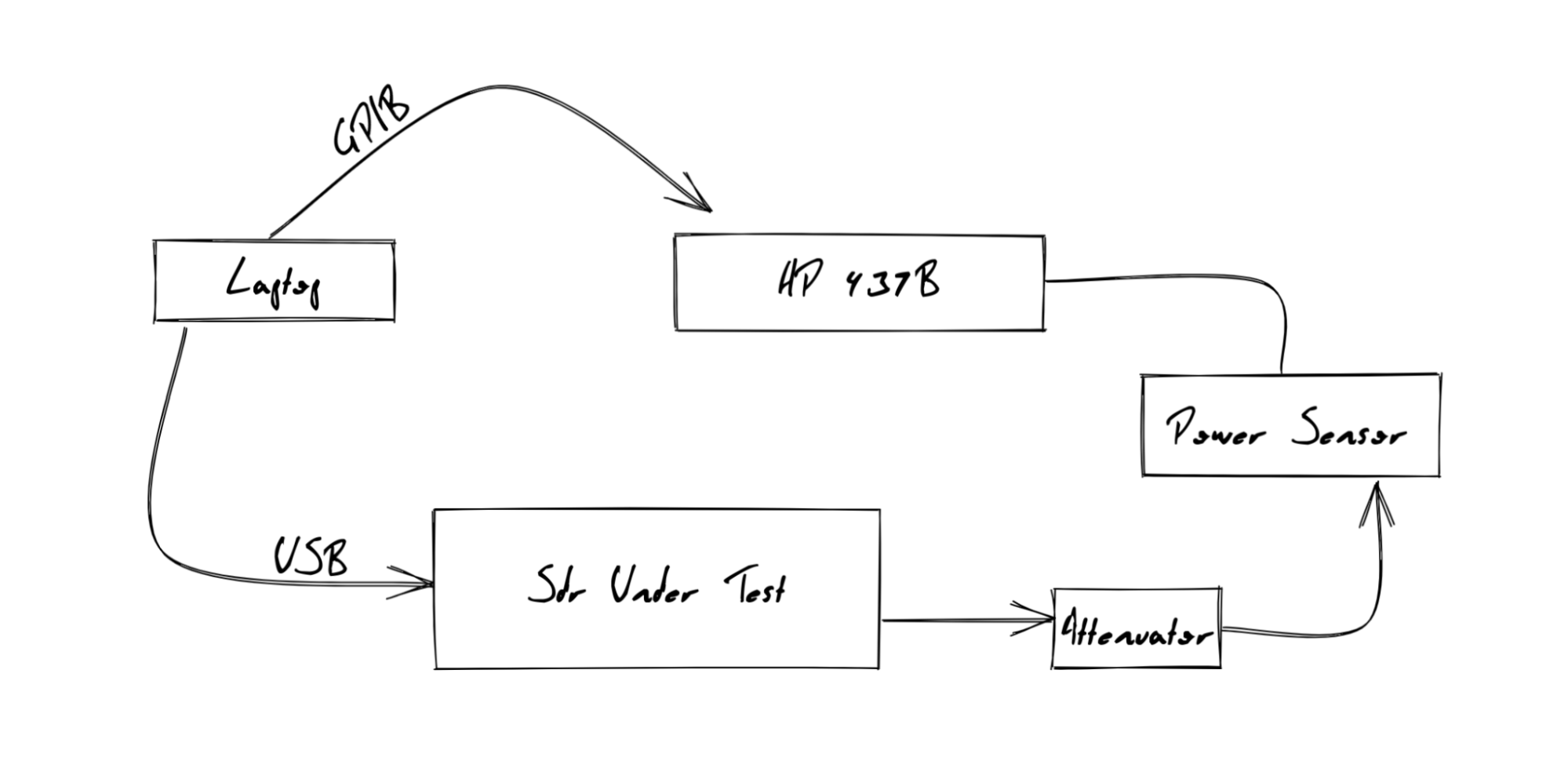
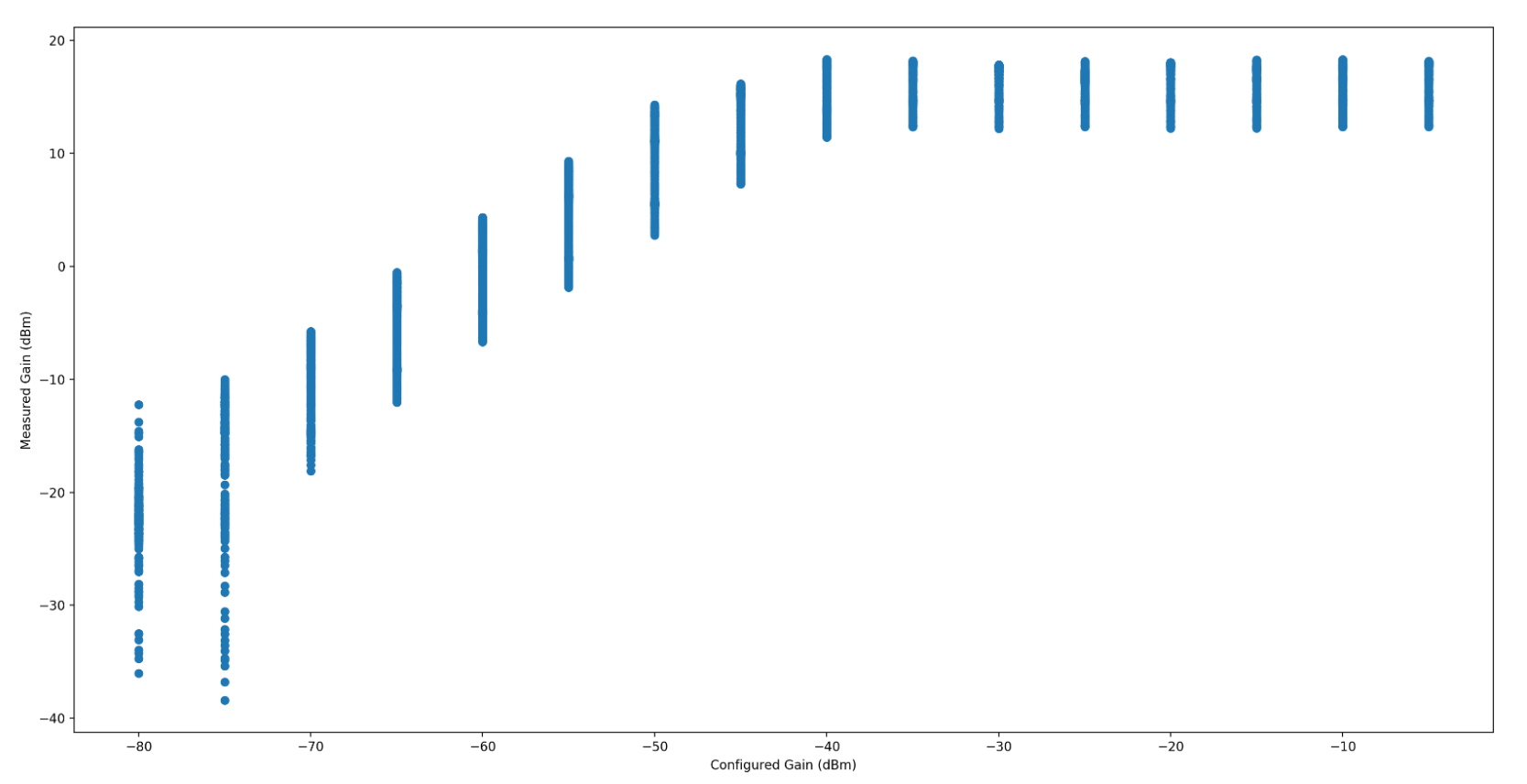
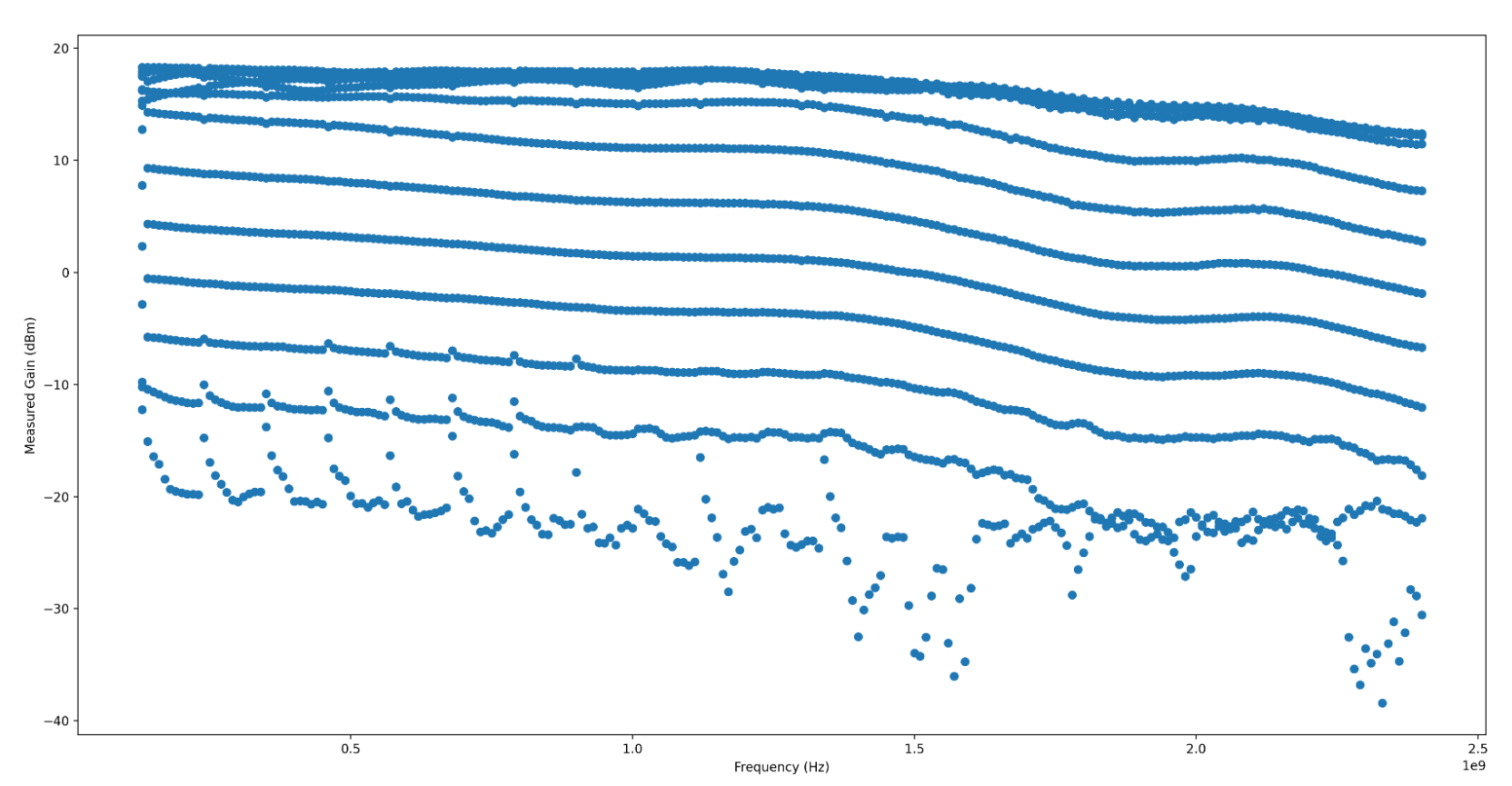
I was specifically interested in what gain output (in dBm) looks like across the frequency range in particular, how variable the output dBm is when I change frequencies. The second question I had was understanding how linear the output gain is when adjusting the requested gain from the radio. Does a 2 dB increase on a HackRF API mean 2 dB of gain in dBm, no matter what the absolute value of the gain stage is? I ve finally bit the bullet and undertaken work to characterize the hardware I do have, with some outdated laboratory equipment I found on eBay. Of course, if it s worth doing, it s worth overdoing, so I spent a bit of time automating a handful of components in order to collect the data that I need from my SDRs. I bought an HP 437B, which is the cutting edge of 30 years ago, but still accurate to within 0.01dBm. I paired this Power Meter with an Agilent 8481A Power Sensor (-30 dBm to 20 dBm from 10MHz to 18GHz). For some of my radios, I was worried about exceeding the 20 dBm mark, so I used a 20db attenuator while I waited for a higher power power sensor. Finally, I was able to find a GPIB to USB interface, and get that interface working with the GPIB Kernel driver on my system. With all that out of the way, I was able to write Go bindings to my HP 437B to allow for totally headless and automated control in sync with my SDR s RF output. This allowed me to script the transmission of a sine wave at a controlled amplitude across a defined gain range and frequency range and read the Power Sensor s measured dBm output to characterize the Gain across frequency and configured Gain.

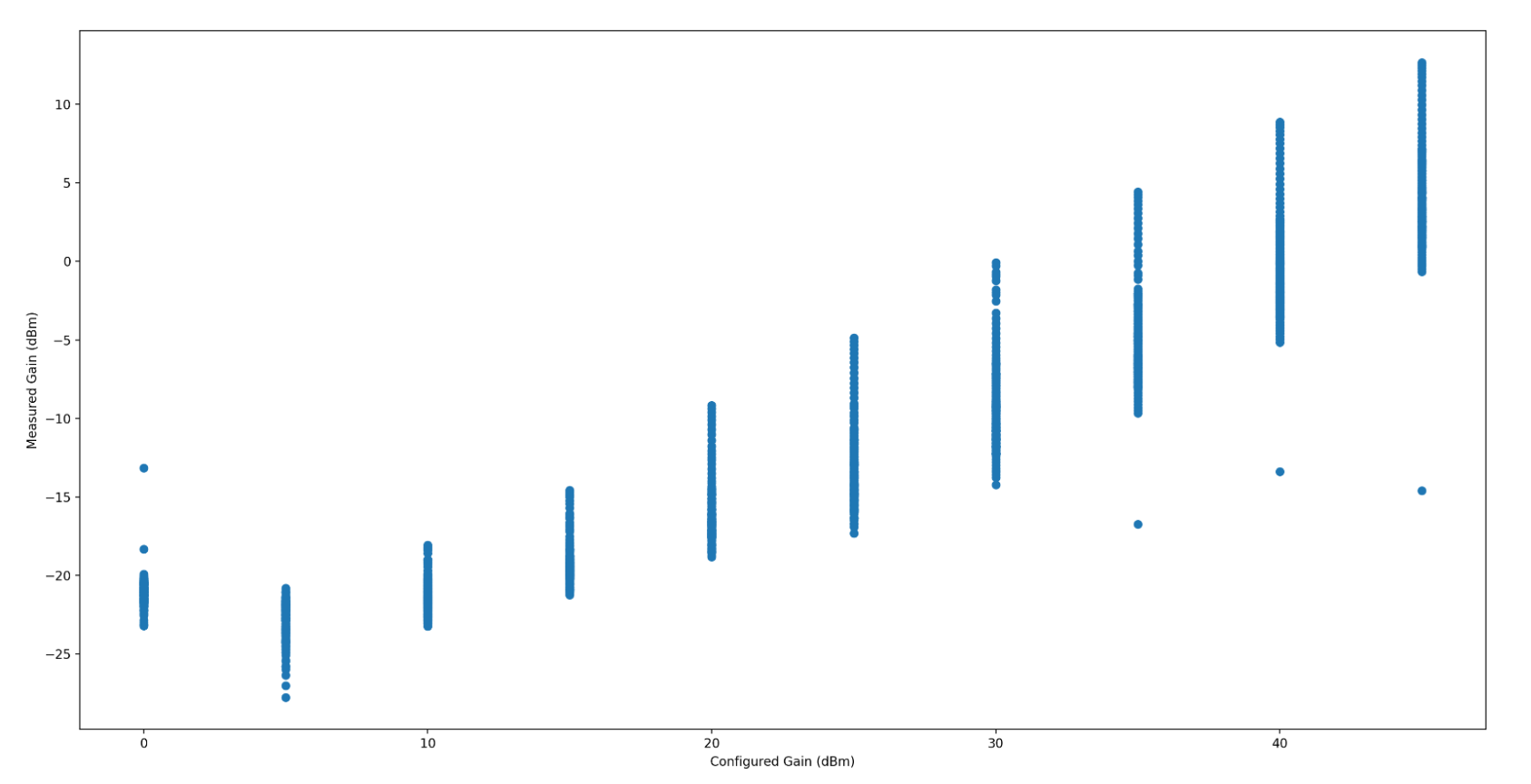
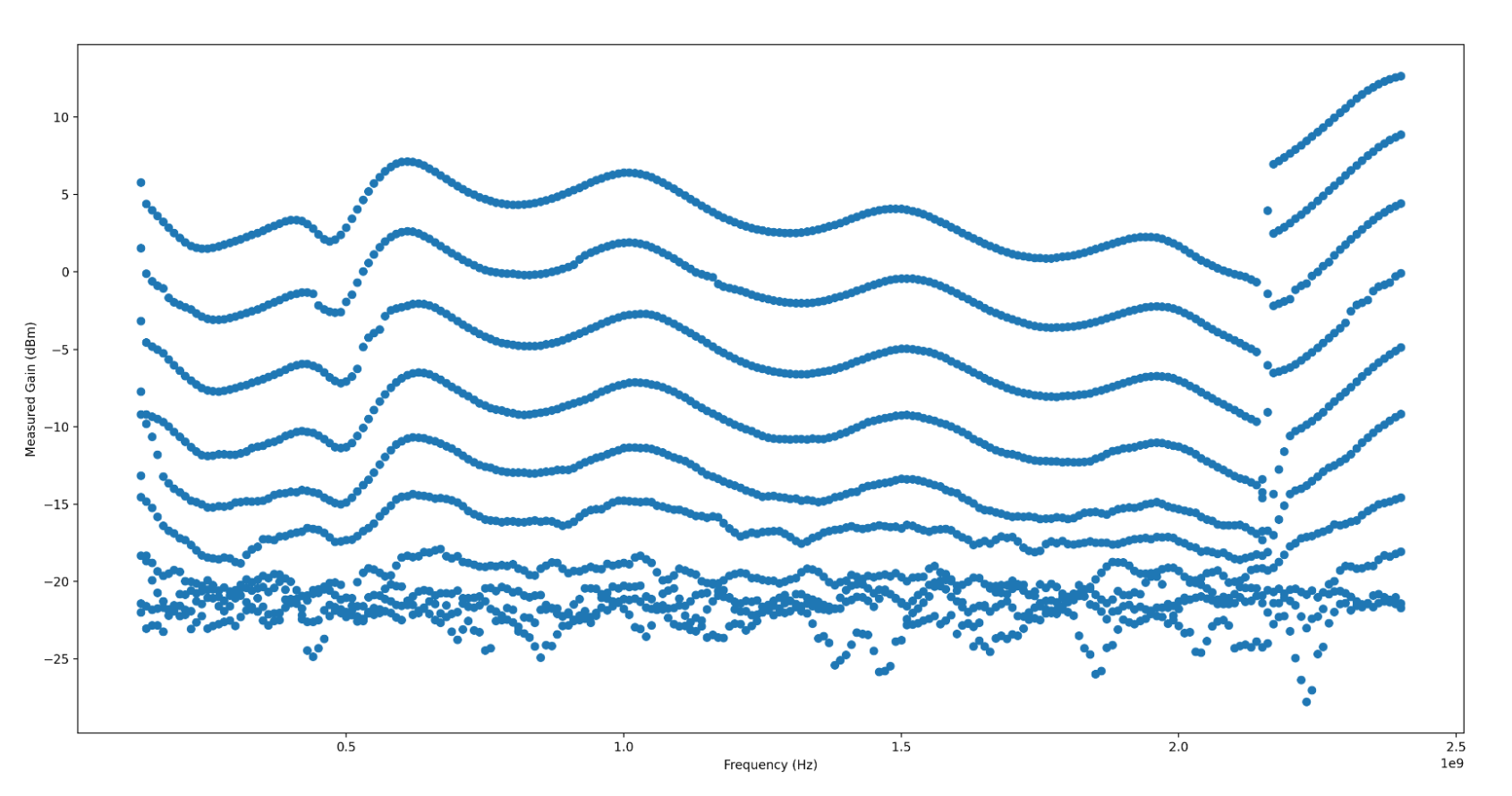
HackRF Looking at configured Gain against output power, the requested gain appears to have a fairly linear relation to the output signal power. The measured dBm ranged between the sensor noise floor to approx +13dBm. The average standard deviation of all tested gain values over the frequency range swept was +/-2dBm, with a minimum standard deviation of +/-0.8dBm, and a maximum of +/-3dBm. When looking at output power over the frequency range swept, the HackRF contains a distinctive (and frankly jarring) ripple across the Frequency range, with a clearly visible jump in gain somewhere around 2.1GHz. I have no idea what is causing this massive jump in output gain, nor what is causing these distinctive ripples. I d love to know more if anyone s familiar with HackRF s RF internals!

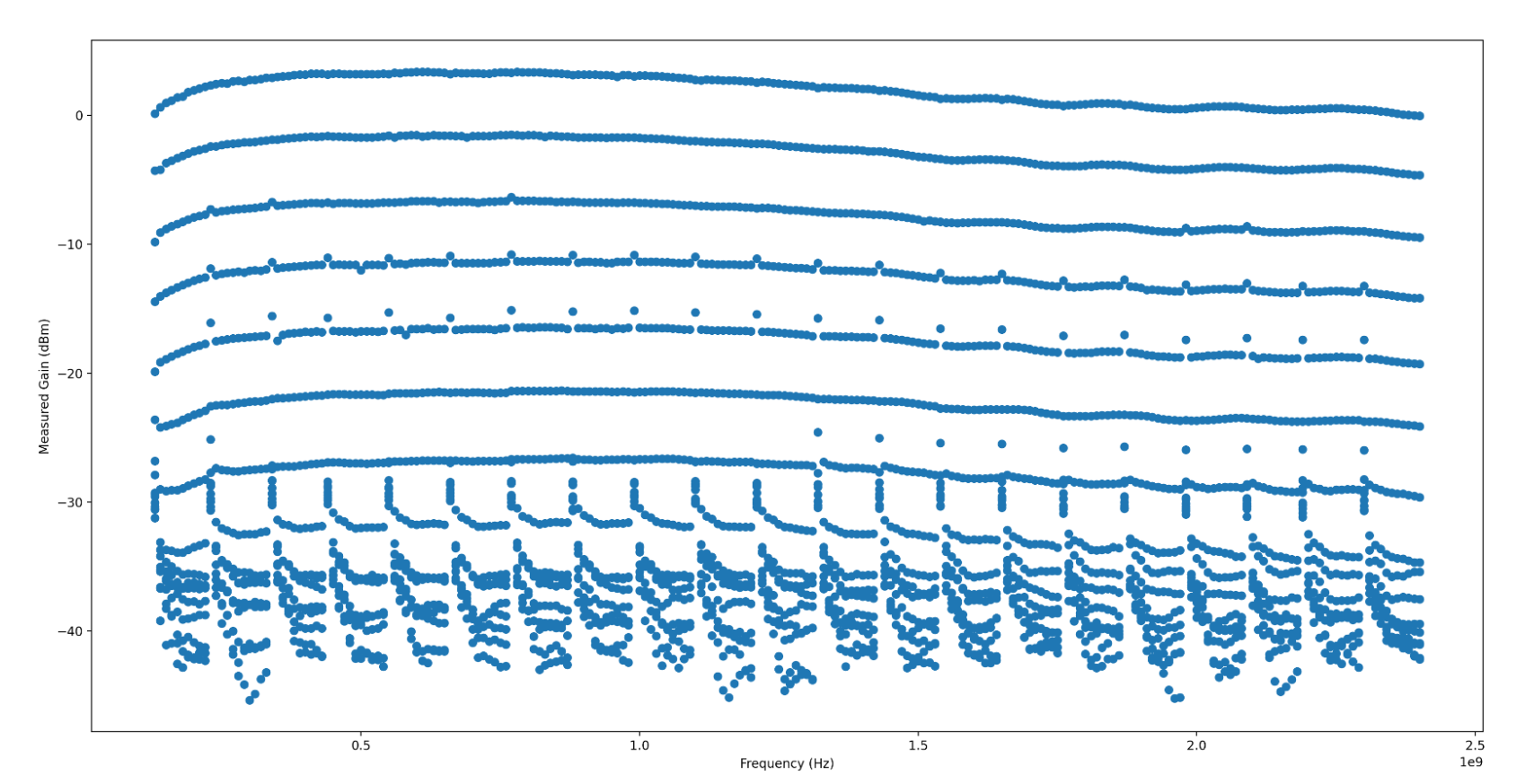
PlutoSDR The power output is very linear when operating above -20dB TX channel gain, but can get quite erratic the lower the output power is configured. The PlutoSDR s output power is directly related to the configured power level, and is generally predictable once a minimum power level is reached. The measured dBm ranged from the noise floor to 3.39 dBm, with an average standard deviation of +/-1.98 dBm, a minimum standard deviation of +/-0.91 dBm and a maximum standard deviation of +/-3.37 dBm. Generally, the power output is quite stable, and looks to have very even and wideband gain control. There s a few artifacts, which I have not confidently isolated to the SDR TX gain, noise (transmit artifacts such as intermodulation) or to my test setup. They appear fairly narrowband, so I m not overly worried about them yet. If anyone has any ideas what this could be, I d very much appreciate understanding why they exist!

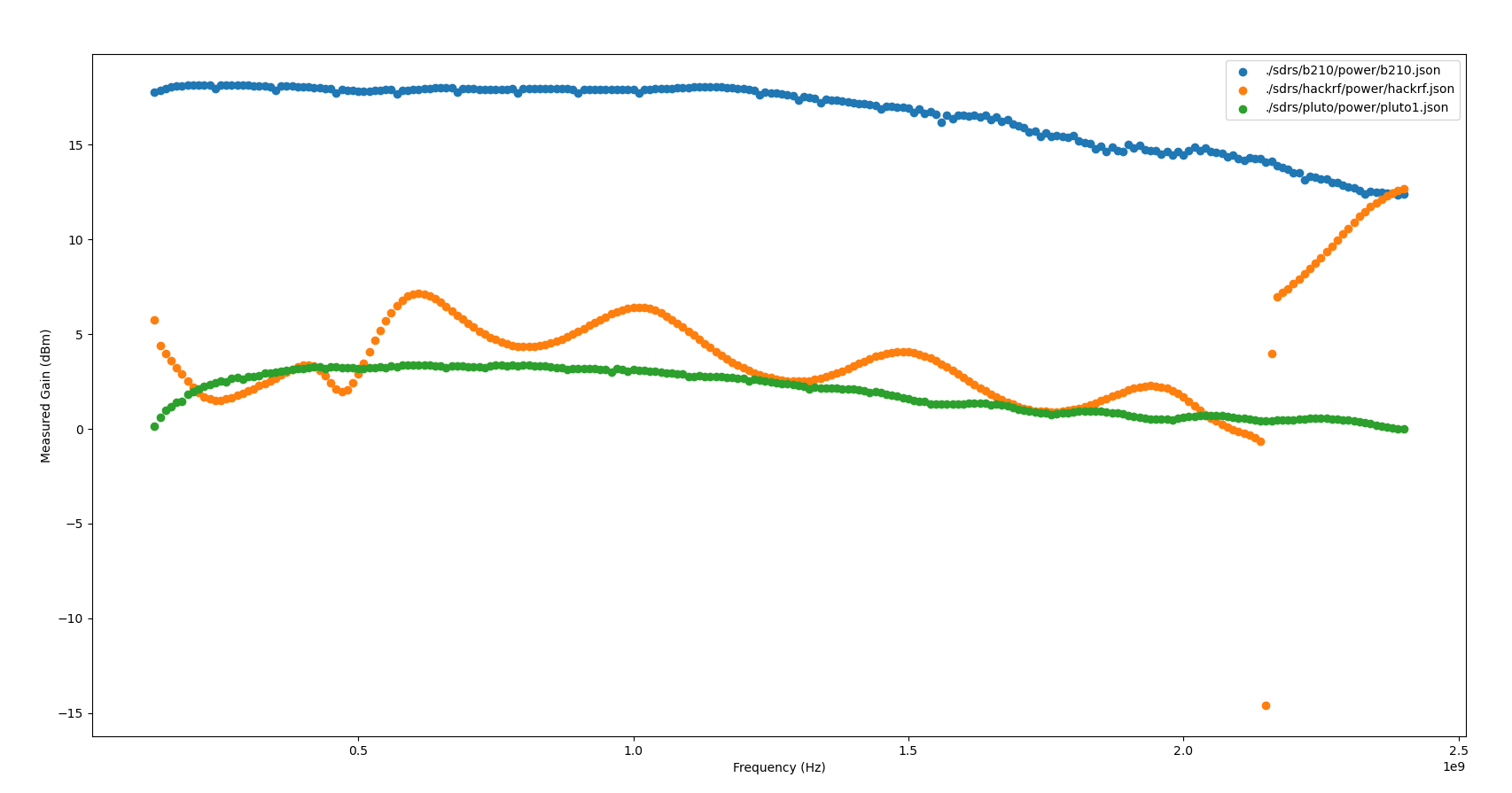
Ettus B210 The power output on the Ettus B210 is higher (in dBm) than any of my other radios, but it has a very odd quirk where the power becomes nonlinear somewhere around -55dB TX channel gain. After that point, adding gain has no effect on the measured signal output in dBm up to 0 dB gain. The measured dBm ranged from the noise floor to 18.31 dBm, with an average standard deviation of +/-2.60 dBm, a minimum of +/-1.39 dBm and a maximum of +/-5.82 dBm. When the Gain is somewhere around the noise floor, the measured gain is incredibly erratic, which throws the maximum standard deviation significantly. I haven t isolated that to my test setup or the radio itself. I m inclined to believe it s my test setup. The radio has a fairly even and wideband gain, and so long as you re operating between -70dB to -55dB, fairly linear as well.

Summary Of all my radios, the Ettus B210 has the highest output (in dBm) over the widest frequency range, but the HackRF is a close second, especially after the gain bump kicks in around 2.1GHz. The Pluto SDR feels the most predictable and consistent, but also a very low output, comparatively - right around 0 dBm.
Name Max dBm stdev dBm stdev min dBm stdev max dBm
HackRF +12.6 +/-2.0 +/-0.8 +/-3.0
PlutoSDR +3.3 +/-2.0 +/-0.9 +/-3.7
B210 +18.3 +/-2.6 +/-1.4 +/-6.0

14 November 2021

Russ Allbery: Review: The Last Graduate

Review: The Last Graduate, by Naomi Novik
Series: The Scholomance #2
Publisher: Del Rey
Copyright: 2021
ISBN: 0-593-12887-7
Format: Kindle
Pages: 388
This is a direct sequel to A Deadly Education, by which I mean it starts in the same minute at which A Deadly Education ends (and let me say how grateful I am for a sequel that doesn't drop days, months, or years between books). You do not want to read this series out of order. This book is also very difficult to review without spoiling either it or the previous book, so please bear with me if I'm elliptical in my ravings. Because The Last Graduate is so good. So good, not only as a piece of writing, but as a combination of two of my favorite tropes in fiction, one of which I can't talk about because of spoilers. I adored this book in a way that is not entirely rational. I will attempt a review below anyway, but if you liked the first book, just stop reading here and go read the second one. It's more of everything I loved in the first book except even better, it did some things I was expecting and some things I didn't expect at all, and it's just so ridiculously good. Just be aware that it has another final-line cliffhanger. The third book is coming in (hopefully) 2022. Novik handles the cliffhanger at the end of the previous book beautifully, which is worth noting because there were so many ways in which it could have gone poorly. One of the best things about this series is Novik's skill at writing El's relationship with her mother, even though her mother has not appeared in the series so far. El argues with her mother's voice in her head, tells stories about her, wonders what her mother would think of her classmates (or in some cases knows exactly what her mother would think of her classmates), and sometimes makes the explicit decision to not be her mother. The relationship has the sort of messy complexity, shared history, and underlying respect that many people experience in life but that I've rarely seen portrayed this well in a fantasy novel. Novik's presentation of that relationship works because El's voice is so strong. Within fifteen minutes of starting The Last Graduate, I was already muttering "I love this book" to myself, mostly because of how much I enjoy El's sarcastic, self-deprecating internal commentary. Novik strikes a balance between self-awareness, snark, humor, and real character growth that rivals Murderbot in its effectiveness of first-person perspective. It carries the story over a few weak points, such as a romance that didn't do much for me. Even when I didn't care about part of the plot, I cared about El's opinion of the plot and what it said about El's growing understanding of how to navigate the world. A Deadly Education was scene and character establishment. El insisted on being herself and following her own morals and social rules, and through that found some allies. The Last Graduate gives El enough breathing space to make more nuanced decisions. This is the part of growing up where one realizes the limitations of one's knee-jerk reactions and innate moral judgment. It's also when it becomes hard to trust success that is entirely outside of one's previous experience. El was not a kid who had friends, so she doesn't know what to do with them now that she has them. She's barely able to convince herself that they are friends. This is one of the two fictional tropes I mentioned, the one that I can talk about (at least briefly) without major spoilers. I have such a soft spot for stubborn, sarcastic, principled characters who refuse to play by the social rules that they think are required to make friends and who then find friends who like them for themselves. The moment when they start realizing this has happened and have no idea how to deal with it or how to be a person who has friends is one I will happily read over and over again. I enjoyed this book from the beginning, but there were two points when it grabbed my heart and I was all in. The first one is a huge spoiler that I can't talk about. The second was this paragraph:
[She] came round to me and put her arm around my waist and said under her breath, "Hey, she can be taught," with a tease in her voice that wobbled a little, and when I looked at her, her eyes were bright and wet, and I put my arm around her shoulders and hugged her.
You'll know it when you get there. The Last Graduate also gives the characters other than El and Orion more room, which is part of how it handles the chosen one trope. It's been obvious since early in the first book that Orion is a sort of chosen one, and it becomes obvious to the reader that El may be as well. But Novik doesn't let the plot focus only on them; instead, she uses that trope to look at how alliances and collective action happen, and how no one can carry the weight by themselves. As El learns more and gains power, she also becomes less central to the plot resolution and has to learn how to be less self-reliant. This is not a book where one character is trained to save the world. It's a book where she manages to enlist the support of a kick-ass project manager and becomes part of a team. Middle books of a trilogy are notoriously challenging. Often they're travel books: the first book sets up a problem, the second book moves the characters both physically and emotionally into a position to solve the problem, and the third book is the payoff. Travel books often sag. They can feel obligatory but somewhat boring, like a chore on the way to the third-book climax. The Last Graduate is not a travel book; it is, instead, a pivot book, which is my favorite form of trilogy. It's a book that rewrites the problem the first book set up, both resolving it and expanding the scope beyond what the reader had expected. This is immensely satisfying when done well, and Novik does it extremely well. This is not a flawless book. There are some pacing hiccups, there is a romance angle that didn't work for me (although it does arrive at some character insights that I thought were spot on), and although I think Novik is doing something interesting with the trope, there is a lot of chosen one power escalation happening here. It's not the sort of book that I can claim is perfectly written. Instead, it's the sort of book that uses some of my favorite plot elements and emotional beats in such an effective way and with such a memorable character that I do not have it in me to care about any of the flaws. Your mileage may therefore vary, but I would be happy to read books like this until the end of time. As mentioned above, The Last Graduate ends on another cliffhanger. This time I was worried that Novik might have ended the series there, since there's enough of an internal climax that I could imagine some literary fiction (which often seems allergic to endings) would have stopped here. Thankfully, Novik's web site says this is not the case. The next year is going to be a difficult wait. The third book of this series is going to be incredibly difficult to write, and I hope Novik is up to the challenge she's made for herself. But she handled the transition between the first and second book so well, and this book is so good that I have a lot of hope. If the third book is half as good as I'm hoping, this is going to be one of my favorite fantasy series of all time. Followed by an as-yet-untitled third book. Rating: 10 out of 10

Ruby Team: Ruby transition and packaging hints #2 - Gemfile.lock created by bundler/setup with Ruby 2.7 preventing successful test with Ruby 3.0

We currently face an issue in all packages requiring bunlder/setup and trying to run the tests for Ruby 2.7 and 3.0. The problem is that the first tests will create Gemfile.lock (or gemfile/gemfile-*.lock) using Ruby 2.7 and the next run for Ruby 3 will report e.g.:
Failure/Error: require 'bundler/setup' # Set up gems listed in the Gemfile.
Bundler::GemNotFound:
  Could not find racc-1.4.16 in any of the sources
or
/usr/share/rubygems-integration/all/gems/bundler-2.2.27/lib/bundler/definition.rb:496:in  materialize':
  Could not find rexml-3.2.3.1 in any of the sources (Bundler::GemNotFound)
Both bugs #996207 and #996302 are incarnations of this issue. The fix is as easy as making sure that the .lock files are removed before each run. This can be done in e.g. debian/ruby-tests.rake as very first task:
File.delete("Gemfile.lock") if File.exist?("Gemfile.lock")
In another case the .lock file is created by the tests in gemfiles/. While the first examples could actually be solved by gem2deb removing Gemfile.lock on its own, I m not quite sure how to handle the last case using packaging tools. The interesting part is that we will unlikely be confronted with this issue anytime soon again. It seems very specific to the Ruby 3.0 transition.

Update After talking to Antonio he added some code to gem2deb-test-runner to moving Gemfile.lock files out of the way. The tool already did this in an autopkgtest environment. In the upcoming 1.7 release it will do it in general and this will fix some more FTBFSes, e.g. #998497 and #996141 - originally reported against ruby-voight-kampff and ruby-bootsnap.

13 November 2021

Ruby Team: Ruby transition and packaging hints #1 - Adjusting Ruby version in commands

This is the first part of a series of short posts about issues that came up during the Ruby 3.0 transition and how to fix them. Hopefully more team members will join in and add their input. During the Ruby 3.0 transition there are essentially two different Ruby versions with two different binaries available, /usr/bin/ruby2.7 and /usr/bin/ruby3.0, while /usr/bin/ruby points to the current default version, which is Ruby 2.7. In some cases the tests shipped by the source packages will use shell commands to run scripts or Ruby code. It is imparative that in these cases the Ruby executable is not invoked by /usr/bin/ruby or ruby, because this will point to Ruby 2.7 only and fail if the tests are invoked with Ruby version 3. The fix is to rely on RbConfig.ruby which will point to the absolute pathname of the ruby command for the current Ruby environment, e.g.
cmd = "# RbConfig.ruby  ..."
This issue appeard for example in ruby-byebug and ruby-backports.

John Goerzen: Managing an External Display on Linux Shouldn t Be This Hard

I first started using Linux and FreeBSD on laptops in the late 1990s. Back then, there were all sorts of hassles and problems, from hangs on suspend to pure failure to boot. I still worry a bit about suspend on unknown hardware, but by and large, the picture of Linux on laptops has dramatically improved over the last years. So much so that now I can complain about what would once have been a minor nit: dealing with external monitors. I have a USB-C dock that provides both power and a Thunderbolt display output over the single cable to the laptop. I think I am similar to most people in wanting the following behavior from the laptop: This sounds so simple. But somehow on Linux we ve split up these things into a dozen tiny bits: Problems I ve Seen My problems don t even begin with laptops, but with my desktop, running XFCE with xmonad and lightdm. My desktop is hooked to a display that has multiple inputs. This scenario (reproducible in both buster and bullseye) causes the display to be unusable until a reboot on the desktop:
  1. Be logged in and using the desktop
  2. Without locking the desktop screen, switch the display input to another device
  3. Keep the display input on another device long enough for the desktop screen to auto-lock
  4. At this point, it is impossible to re-awaken the desktop screen.
I should not here that the problems aren t limited to Debian, but also extend to Ubuntu and various hardware. Lightdm: which greeter? At some point while troubleshooting things after upgrading my laptop to bullseye, I noticed that while both were running lightdm, I had different settings and a different appearance between the two. Upon further investigation, I realized that one hat slick-greeter and lightdm-settings installed, while the other had lightdm-gtk-greeter and lightdm-gtk-greeter-settings installed. Very strange. XFCE: giving up I eventually gave up on making lightdm work. No combination of settings or greeters would make things work reliably when changing screen configurations. I installed xscreensaver. It doesn t hang, but it does sometimes take a few tries before it figures out what device to display on. Worse, since updating from buster to bullseye, XFCE no longer automatically switches audio output when the docking station is plugged in, and there seems to be no easy way to convince Pulseaudio to do this. X-Based Gnome and derivatives sigh. I also tried Gnome, Mate, and Cinnamon, and all of them had various inabilities to configure things to act the way I laid out above. I ve long not been a fan of Gnome s way of hiding things from the user. It now has a Windows-like situation of three distinct settings programs (settings, tweaks, and dconf editor), which overlap in strange ways and interact with systemd in even stranger ways. Gnome 3 make it quite non-intuitive to make app icons from various programs work, and so forth. Trying Wayland I recently decided to set up an older laptop that I hadn t used in awhile. After reading up on Wayland, I decided to try Gnome 3 under Wayland. Both the Debian and Arch wikis note that KDE is buggy on Wayland. Gnome is the only desktop environment that supports it then, unless I want to go with Sway. There s some appeal to Sway to this xmonad user, but I ve read of incompatibilities of Wayland software when Gnome s not available, so I opted to try Gnome. Well, it s better. Not perfect, but better. After finding settings buried in a ton of different Settings and Tweaks boxes, I had it mostly working, except gdm3 would never shut off power to the external display. Eventually I found /etc/gdm3/greeter.dconf-defaults, and aadded:
sleep-inactive-ac-timeout=60
sleep-inactive-ac-type='blank'
sleep-inactive-battery-timeout=120
sleep-inactive-battery-type='suspend'
Of course, these overlap with but are distinct from the same kinds of things in Gnome settings. Sway? Running without Gnome seems like a challenge; Gnome is switching audio output appropriately, for instance. I am looking at some of the Gnome Shell tiling window manager extensions and hope that some of them may work for me.

12 November 2021

Jonathan Dowland: Frictionless external backups with systemd

Here's a description of how my monthly external backups are managed at a technical level. I didn't realise I hadn't written this all down anywhere yet. What
blinkenlights! blinkenlights!
I plug in one of two (prepared) external hard drives into my headless NAS. The NAS contains my primary data backup. A job automatically decrypts the encrypted filesystem on the drive, mounts it and synchronises the copy of my backup data on the drive from that on the NAS. Whilst this is going on, the blinkstick LED on the NAS switches to a colour to signal "in progress". When it's done, the light changes to green to signal "done" and I can remove it. If something goes wrong, it turns red and I get mail. Why I want a third-strand, off-site backup of my and my family's data in case of a disaster in our house. For it to be useful it has to be regular, so I needed to remove as much of the friction of performing the backup as possible. I use two drives alternately so that I don't have all my eggs in one basket in the window when I bring one of them home and perform the backup. How As much as possible I lean on systemd and its ability to trigger actions based on events.
  1. External drive is plugged in. systemd instantiates a corresponding device unit, named dev-disk-by\x2duuid-aaaaaaaa\x2daaaa\x2daaaa\x2daaaa\x2daaaaaaaaaaaa.device, where aaaa is the UUID of a partition on the device
  2. The backup job is a systemd service which has a WantedBy relationship on the device unit, so when the device appears, systemd starts the backup service.
  3. The backup service has Requires and After relationships on systemd-cryptsetup@extbackup.service, a service created by systemd's cryptsetup generator on start-up (but slightly customised, see below). The encrypted device is therefore unlocked.
  4. The backup service defines multiple start and stop commands with ExecStart and ExecStop. These are used to:
    1. set the blinkstick to the working colour (blue-ish)
    2. mount the now-decrypted filesystem
    3. get a lock on the backup repository (so nothing else writes to it) and synchronise the files
    4. unmount the filesystem
    5. set the blinkstick to the success colour (green)
  5. Finally, the systemd-cryptsetup@extbackup.service unit realises it is not required any more. It has been customised with StopWhenUnneeded=true1, so the encrypted filesystem is closed, ready for the drive to be removed.
  6. I notice the LED colour is green, remove the drive, and take it to its off-site home.
If anything goes wrong, all my custom systemd units have, as a matter of course,
OnFailure=status-email-user@%n.service blinkstick-fail.service
Preparing a new backup disk This is mostly just a standard dm-crypt/cryptsetup/LUKS encrypted device, on top of a standard partition on the underlying disk, with a normal filesystem sitting on top: Basically, the most common way to encrypt a drive in Linux. See places like the cryptsetup docs for how to set something like that up. The key things here are The backup service Here's the backup service unit definition in its entirety:
 [Unit]
 OnFailure=status-email-user@%n.service blinkstick-fail.service
 Requires=systemd-cryptsetup@extbackup.service backup.mount
 After=systemd-cryptsetup@extbackup.service backup.mount
 [Service]
 Type=oneshot
 ExecStart=/usr/local/bin/blinkstick --index 1 --limit 10 --set-color 33c280
 ExecStart=/bin/mount /extbackup
 ExecStart=/home/jon/bin/phobos-backup-monthly
 ExecStop=/bin/umount /extbackup
 ExecStop=/usr/local/bin/blinkstick --index 1 --limit 10 --set-color green
 [Install]
 WantedBy=dev-disk-by\x2duuid-aaaaaaaa\x2daaaa\x2daaaa\x2daaaa\x2daaaaaaaaaaaa.device
The dashes in the UUID in WantedBy= need to be encoded as \x2d and then the slashes from the path bit as dashes. Using dashes to encode slashes is possibly the single most frustrating systemd design decision. Issues Sadly (as detailed in Blinkenlights, part 2) there are 2 some frustrating limitations with trying to handle the mount (and unmount) of the filesystem in systemd-land, so instead, it's done using the traditional mount, umount and fstab. If you can point out any improvements to this approach, please let me know!

  1. I customized mine a while ago by copying the generated service file to a static file, but nowadays I think you could do systemd edit systemd-cryptsetup@extbackup.service to add the StopWhenUnneeded to an override file and not need the rest.
  2. or at least were. It's been a while since I revisited this part.

10 November 2021

Jonathan Dowland: LEGO Princess Castle-books

The set The set
My eldest daughter and I visited a LEGO shop recently and I wanted to buy her a gift. The catch was that we were going to be flying on an airplane the next day, so I wanted to find something with the lowest risk of losing parts on the plane. We settled on Ariel, Belle, Cinderella and Tiana's Storybook Adventures which had a number of things going for it: It was reasonably priced at under 20, for the size of the set; it included four human minifigs (albeit in a sub-minifig size, some kind of munchkin size, but that did not seem to matter) and an assortment of animal accompaniments; but mostly, it folded up into a self-contained mock fairytail "book", and opened up into an enclosed "tray" play area, minimising the risk of losses on the flight.
The set in its resting state The set in its resting state
Lego have done a few of these styles of sets, all Disney princess themed, and it looks like they have a few more on their product roadmap. The newer ones incorporate a locking mechanism with a cute Lego key. I love the concept and think it should be extended to other themes/properties. I can imagine a Lego Star Wars-themed version with a little Death Star trench in the middle, or even an original IP like Classic Space, or Medieval.
Exploring a DIY Lego book frame Exploring a DIY Lego book frame
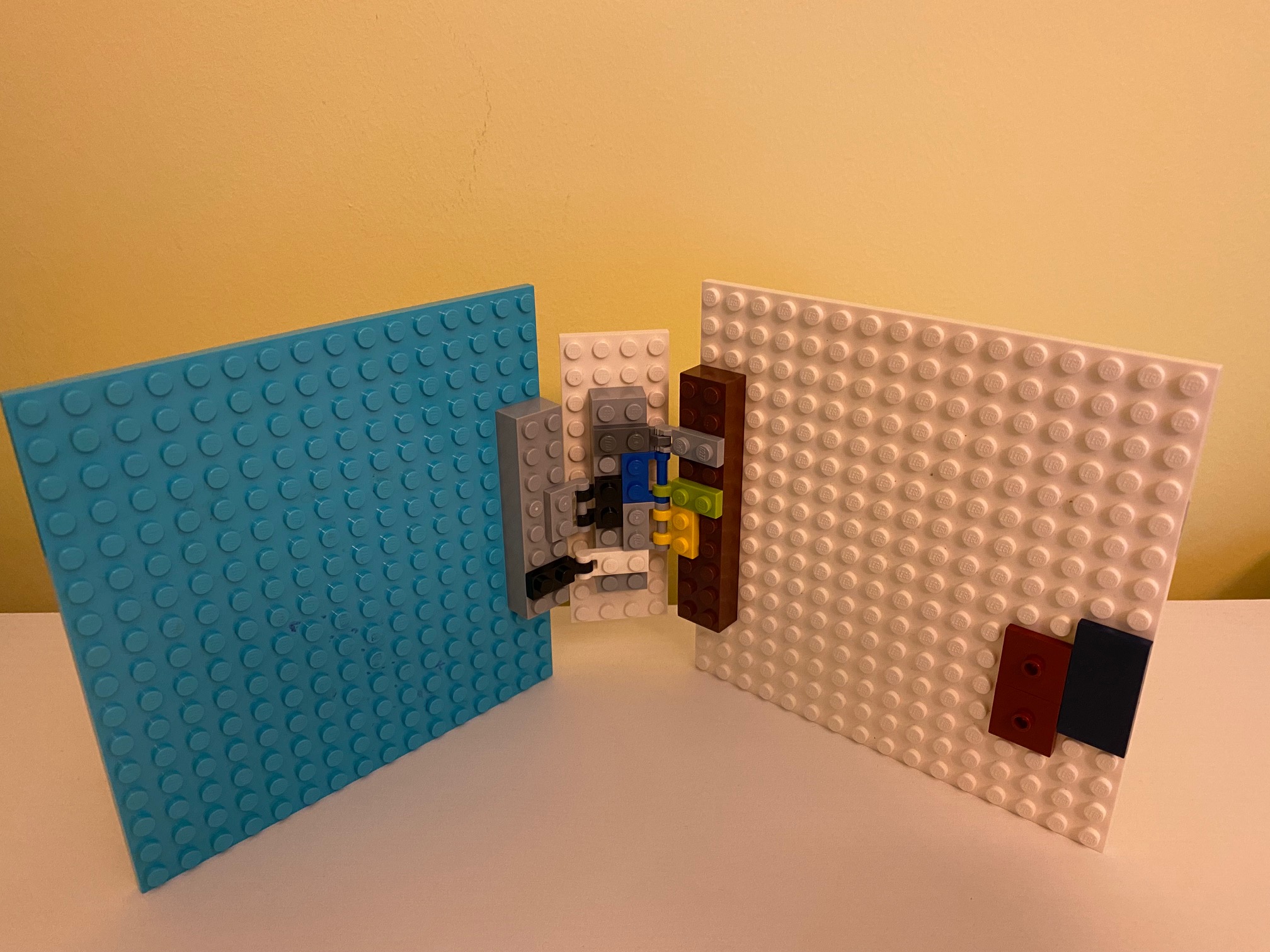
I really liked the Book device which reminded me of hollow books as a child. The cover and spine pieces are bespoke Lego bricks made for purpose, but I thought you could create something similar with generic parts. Holly and I had a go at the concept with what bricks we had to hand. It's definitely viable (and you could do a lot better with a wider selection of bricks / more skilled builders) and it will be fun to pick something to try and build on the spine.

Neil Williams: LetsEncrypt with Apache, Gunicorn and Debian Bullseye

This took me far too long to identify and debug, so I'm going to write it up here for my own reference and to possibly help others.
Background Upgrading an old codebase from Python2 on Buster to Python3 ready for Bullseye and from Django1 to Django2 (prepared for Django3). Everything is fine at this stage - the Django test server is happy with HTTP and it gives enough support to do the actual code changes to get to Python3. All well and good so far. The main purpose of this particular code was to support payments, so a chunk of the testing cannot be done without HTTPS, which is where things got awkward. This particular service needs HTTPS using LetsEncrypt and Apache2. To support Django, I typically use Gunicorn. All of this works with HTTP. Moving to HTTPS was easy to test using the default-ssl virtual host that comes with Apache2 in Debian. It's a static page and it worked well with https. The problems all start when trying to use this known-working HTTPS config with the other Apache virtual host to add support for the gunicorn proxy.
Apache reverse proxy AH00898 Error during SSL Handshake with remote server
Investigating Now that I know why this happened, it's easier to see what was happening. At the time, I was swamped in a plethora of options and permutations between the Django HTTPS options and the Apache VirtualHost SSL and proxy commands. Going through all of those took up huge amounts of time, all in the wrong area. In previous configurations using packages in Buster, gunicorn could simply run on http://localhost:8000 and Apache would proxy that as https. In versions in Bullseye, this no longer works and it is that handover from https in Apache to http in the proxy is where it is failing. Apache is using HTTPS because the LetsEncrypt certificates, created using dehydrated, are specified in the VirtualHost configuration. To fix the handshake error, the proxy server needs to know about the certificates created by dehydrated as well.
Gunicorn needs the certificates The clue is in the gunicorn help:
--keyfile FILE        SSL key file [None]
--certfile FILE       SSL certificate file [None]
The final part of the puzzle is that the certificates created by dehydrated are in a private location:
drwx------ 2 root root /var/lib/dehydrated/certs/
To test gunicorn, this will mean using sudo but that's just a step towards running gunicorn as a systemd service (when access to the certs will not be a problem). Starting gunicorn using these options shows the proxy now being available at https://localhost:8000 which is a subtle but very important change.
Environment=LOGLEVEL=DEBUG WORKERS=4 LOGFILE=/var/log/gunicorn/site.log
ExecStart=/usr/bin/gunicorn3 site.wsgi --log-level $LOGLEVEL --log-file $LOGFILE --workers $WORKERS \
--certfile /var/lib/dehydrated/certs/site/cert.pem \
--keyfile /var/lib/dehydrated/certs/site/privkey.pem
The specified locations are symbolic links created by dehydrated to cope with regular updates of the certificates using cron.

9 November 2021

Joachim Breitner: How to audit an Internet Computer canister

I was recently called upon by Origyn to audit the source code of some of their Internet Computer canisters ( canisters are services or smart contracts on the Internet Computer), which were written in the Motoko programming language. Both the application model of the Internet Computer as well as Motoko bring with them their own particular pitfalls and possible sources for bugs. So given that I was involved in the creation of both, they reached out to me. In the course of that audit work I collected a list of things to watch out for, and general advice around them. Origyn generously allowed me to share that list here, in the hope that it will be helpful to the wider community.

Inter-canister calls The Internet Computer system provides inter-canister communication that follows the actor model: Inter-canister calls are implemented via two asynchronous messages, one to initiate the call, and one to return the response. Canisters process messages atomically (and roll back upon certain error conditions), but not complete calls. This makes programming with inter-canister calls error-prone. Possible common sources for bugs, vulnerabilities or simply unexpected behavior are:
  • Reading global state before issuing an inter-canister call, and assuming it to still hold when the call comes back.
  • Changing global state before issuing an inter-canister call, changing it again in the response handler, but assuming nothing else changes the state in between (reentrancy).
  • Changing global state before issuing an inter-canister call, and not handling failures correctly, e.g. when the code handling the callback rolls backs.
If you find such pattern in your code, you should analyze if a malicious party can trigger them, and assess the severity that effect These issues apply to all canisters, and are not Motoko-specific.

Rollbacks Even in the absence of inter-canister calls the behavior of rollbacks can be surprising. In particular, rejecting (i.e. throw) does not rollback state changes done before, while trapping (e.g. Debug.trap, assert , out of cycle conditions) does. Therefore, one should check all public update call entry points for unwanted state changes or unwanted rollbacks. In particular, look for methods (or rather, messages, i.e. the code between commit points) where a state change is followed by a throw. This issues apply to all canisters, and are not Motoko-specific, although other CDKs may not turn exceptions into rejects (which don t roll back).

Talking to malicious canisters Talking to untrustworthy canisters can be risky, for the following (likely incomplete) reasons:
  • The other canister can withhold a response. Although the bidirectional messaging paradigm of the Internet Computer was designed to guarantee a response eventually, the other party can busy-loop for as long as they are willing to pay for before responding. Worse, there are ways to deadlock a canister.
  • The other canister can respond with invalidly encoded Candid. This will cause a Motoko-implemented canister to trap in the reply handler, with no easy way to recover. Other CDKs may give you better ways to handle invalid Candid, but even then you will have to worry about Candid cycle bombs that will cause your reply handler to trap.
Many canisters do not even do inter-canister calls, or only call other trustwothy canisters. For the others, the impact of this needs to be carefully assessed.

Canister upgrade: overview For most services it is crucial that canisters can be upgraded reliably. This can be broken down into the following aspects:
  1. Can the canister be upgraded at all?
  2. Will the canister upgrade retain all data?
  3. Can the canister be upgraded promptly?
  4. Is three a recovery plan for when upgrading is not possible?

Canister upgradeability A canister that traps, for whatever reason, in its canister_preupgrade system method is no longer upgradeable. This is a major risk. The canister_preupgrade method of a Motoko canister consists of the developer-written code in any system func preupgrade() block, followed by the system-generated code that serializes the content of any stable var into a binary format, and then copies that to stable memory. Since the Motoko-internal serialization code will first serialize into a scratch space in the main heap, and then copy that to stable memory, canisters with more than 2GB of live data will likely be unupgradeable. But this is unlikely the first limit: The system imposes an instruction limit on upgrading a canister (spanning both canister_preupgrade and canister_postupgrade). This limit is a subnet configuration value, and sepearate (and likely higher) than the normal per-message limit, and not easily determined. If the canister s live data becomes too large to be serialized within this limit, the canister becomes non-upgradeable. This risk cannot be eliminated completely, as long as Motoko and Stable Variables are used. It can be mitigated by appropriate load testing: Install a canister, fill it up with live data, and exercise the upgrade. If this succeeds with a live data set exceeding the expected amount of data by a margin, this risk is probably acceptable. Bonus points for adding functionality that will prevent the canister s live data to increase above a certain size. If this testing is to be done on a local replica, extra care needs to be taken to make sure the local replica actually performs instruction counting and has the same resource limits as the production subnet. An alternative mitigation is to avoid canister_pre_upgrade as much as possible. This means no use of stable var (or restricted to small, fixed-size configuration data). All other data could be
  • mirrored off the canister (possibly off chain), and manually re-hydrated after an upgrade.
  • stored in stable memory manually, during each update call, using the ExperimentalStableMemory API. While this matches what high-assurance Rust canisters (e.g. the Internet Identity) do, This requires manual binary encoding of the data, and is marked experimental, so I cannot recommend this at the moment.
  • not put into a Motoko canister until Motoko has a scalable solution for stable variable (for example keeping them in stable memory permanently, with smart caching in main memory, and thus obliterating the need for pre-upgrade code.)

Data retention on upgrades Obviously, all live data ought to be retained during upgrades. Motoko automatically ensures this for stable var data. But often canisters want to work with their data in a different format (e.g. in objects that are not shared and thus cannot be put in stable vars, such as HashMap or Buffer objects), and thus may follow following idiom:
stable var fooStable =  ;
var foo = fooFromStable(fooStable);
system func preupgrade()   fooStable := fooToStable(foo);  )
system func postupgrade()   fooStable := (empty);  )
In this case, it is important to check that
  • All non-stable global vars, or global lets with mutable values, have a stable companion.
  • The assignments to foo and fooStable are not forgotten.
  • The fooToStable and fooFromStable form bijections.
An example would be HashMaps stored as arrays via Iter.toArray( .entries()) and HashMap.fromIter( .vals()). It is worth pointiong out that a code view will only look at a single version of the code, but cannot check whether code changes will preserve data on upgrade. This can easily go wrong if the names and types of stable variables are changed in incompatible way. The upgrade may fail loudly in this cases, but in bad cases, the upgrade may even succeed, losing data along the way. This risk needs to be mitigated by thorough testing, and possibly backups (see below).

Prompt upgrades Motoko and Rust canisters cannot be safely upgraded when they are still waiting for responses to inter-canister calls (the callback would eventually reach the new instance, and because of infelicities of the IC s System API, could possibly call arbitrary internal functions). Therefore, the canister needs to be stopped before upgrading, and started again. If the inter-canister calls take a long time, this mean that upgrading may take a long time, which may be undesirable. Again, this risk is reduced if all calls are made to trustworthy canisters, and elevated when possibly untrustworthy canisters are called, directly or indirectly.

Backup and recovery Because of the above risk around upgrades it is advisable to have a disaster recovery strategy. This could involve off-chain backups of all relevant data, so that it is possible to reinstall (not upgrade) the canister and re-upload all data. Note that reinstall has the same issue as upgrade described above in prompt upgrades : It ought to be stopped first to be safe. Note that the instruction limit for messages, as well as the message size limit, limit the amount of data returned. If the canister needs to hold more data than that, the backup query method might have to return chunks or deltas, with all the extra complexity that entails, e.g. state changes between downloading chunks. If large data load testing is performed (as Irecommend anyways to test upgradeability), one can test whether the backup query method works within the resource limits.

Time is not strictly monotonic The timestamps for current time that the Internet Computer provides to its canisters is guaranteed to be monotonic, but not strictly monotonic. It can return the same values, even in the same messages, as long as they are processed in the same block. It should therefore not be used to detect happens-before relations. Instead of using and comparing time stamps to check whether Y has been performed after X happened last, introduce an explicit var y_done : Bool state, which is set to False by X and then to True by Y. When things become more complex, it will be easier to model that state via an enumeration with speaking tag names, and update this state machine along the way. Another solution to this problem is to introduce a var v : Nat counter that you bump in every update method, and after each await. Now v is your canister s state counter, and can be used like a timestamp in many ways. While we are talking about time: The system time (typically) changes across an await. So if you do let now = Time.now() and then await, the value in now may no longer be what you want.

Wrapping arithmetic The Nat64 data type, and the other fixed-width numeric types provide opt-in wrapping arithmetic (e.g. +%, fromIntWrap). Unless explicitly required by the current application, this should be avoided, as usually a too large or negatie value is a serious, unrecoverable logic error, and trapping is the best one can do.

Cycle balance drain attacks Because of the IC s canister pays model, all canisters are prone to DoS attacks by draining their cycle balance, and this risk needs to be taken into account. The most elementary mitigation strategy is to monitor the cycle balance of canisters and keep it far from the (configurable) freezing threshold. On the raw IC-level, further mitigation strategies are possible:
  • If all update calls are authenticated, perform this authentication as quickly as possible, possibly before decoding the caller s argument. This way, a cycle drain attack by an unauthenticated attacker is less effective (but still possible).
  • Additionally, implementing the canister_inspect_message system method allows the above checks to be performed before the message even is accepted by the Internet Computer. But it does not defend against inter-canister messages and is therefore not a complete solution.
  • If an attack from an authenticated user (e.g. a stakeholder) is to be expected, the above methods are not effective, and an effective defense might require relatively involved additional program logic (e.g. per-caller statistics) to detect such an attack, and react (e.g. rate-limiting).
  • Such defenses are pointless if there is only a single method where they do not apply (e.g. an unauthenticated user registration method). If the application is inherently attackable this way, it is not worth the bother to raise defenses for other methods.
Related: A justification why the Internet Identity does not use canister_inspect_message) A motoko-implemented canister currently cannot perform most of these defenses: Argument decoding happens unconditionally before any user code that may reject a message based on the caller, and canister_inspect_message is not supported. Furthermore, Candid decoding is not very cycle defensive, and one should assume that it is possible to construct Candid messages that require many instructions to decode, even for simple argument type signatures. The conclusion for the audited canisters is to rely on monitoring to keep the cycle blance up, even during an attack, if the expense can be born, and maybe pray for IC-level DoS protections to kick in.

Large data attacks Another DoS attack vector exists if public methods allow untrustworthy users to send data of unlimited size that is persisted in the canister memory. Because of the translation of async-await code into multiple message handlers, this applies not only to data that is obviously stored in global state, but also local data that is live across an await point. The effectiveness of such attacks is limited by the Internet Computer s message size limit, which is in the order of a few megabytes, but many of those also add up. The problem becomes much worse if a method has an argument type that allows a Candid space bomb: It is possible to encode very large vectors with all values null in Candid, so if any method has an argument of type [Null] or [?t], a small message will expand to a large value in the Motoko heap. Other types to watch out:
  • Nat and Int: This is an unbounded natural number, and thus can be arbitrarily large. The Motoko representation will however not be much larger than the Candid encoding (so this does not qualify as a space bomb).
It is still advisable to check if the number is reasonable in size before storing it or doing an await. For example, when it denotes an index in an array, throw early if it exceeds the size of the array; if it denotes a token amount to transfer, check it against the available balance, if it denotes time, check it against reasonable bounds.
  • Principal: A Principal is effectively a Blob. The Interface specification says that principals are at most 29 bytes in length, but the Motoko Candid decoder does not check that currently (fixed in the next version of Motoko). Until then, a Principal passed as an argument can be large (the principal in msg.caller is system-provided and thus safe). If you cannot wait for the fix to reach you, manually check the size of the princial (via Principal.toBlob) before doing the await.

Shadowing of msg or caller Don t use the same name for the message context of the enclosing actor and the methods of the canister: It is dangerous to write shared(msg) actor, because now msg is in scope across all public methods. As long as these also use public shared(msg) func , and thus shadow the outer msg, it is correct, but it if one accidentially omits or mis-types the msg, no compiler error would occur, but suddenly msg.caller would now be the original controller, likely defeating an important authorization step. Instead, write shared(init_msg) actor or shared( caller = controller ) actor to avoid using msg.

Conclusion If you write a serious canister, whether in Motoko or not, it is worth to go through the code and watch out for these patterns. Or better, have someone else review your code, as it may be hard to spot issues in your own code. Unfortunately, such a list is never complete, and there are surely more ways to screw up your code in addition to all the non-IC-specific ways in which code can be wrong. Still, things get done out there, so best of luck!

8 November 2021

Dima Kogan: mrcal 2.0: triangulation and stereo

mrcal is my big toolkit for geometric computer vision: making models (camera calibration) and using models (mapping, ranging, etc). Since the release of mrcal 1.0 back in February I've been busy using the tools in the field, fixing things and improving things. Today I'm happy to finally be able to announce the release of mrcal 2.0. A big part of this release is maintenance and cleanup that resulted from me heavily using the tools over the course of this past year, and improving whatever was bugging me. The most notable result of that effort, is that splined models are no longer "experimental". They work well and they're awesome. Go try them. And there're a number of new features, most notably nice dense stereo support and nice sparse triangulation support (with uncertainty propagation!) These are awesome. Go try them. As before, the tour of mrcal provides a good overview of the capabilities of the toolkit, and is a good place to start reading the documentation. Reading these docs would be very illuminating for anybody that calibrates cameras, even for those that have no intent to actually use the mrcal tools. Let me know if you try it out! The most list of most notable improvements, from the release notes:

Enrico Zini: An educational debugging session

This morning we realised that a test case failed on Fedora 34 only (the link is in Italian) and we set to debugging. The initial analysis This is the initial reproducer:
$ PROJ_DEBUG=3 python setup.py test
test_recipe (tests.test_litota3.TestLITOTA3NordArkimetIFS) ... pj_open_lib(proj.db): call fopen(/lib64/../share/proj/proj.db) - succeeded
proj_create: Open of /lib64/../share/proj/proj.db failed
pj_open_lib(proj.db): call fopen(/lib64/../share/proj/proj.db) - succeeded
proj_create: no database context specified
Cannot instantiate source_crs
EXCEPTION in py_coast(): ProjP: cannot create crs to crs from [EPSG:4326] to [+proj=merc +lon_0=0 +k=1 +x_0=0 +y_0=0 +ellps=WGS84 +datum=WGS84 +over +units=m +no_defs]
ERROR
Note that opening /lib64/../share/proj/proj.db sometimes succeeds, sometimes fails. It's some kind of Schr dinger path, which works or not depending on how you observe it:
# ls -lad /lib64
lrwxrwxrwx 1 1000 1000 9 Jan 26  2021 /lib64 -> usr/lib64
$ ls -la /lib64/../share/proj/proj.db
-rw-r--r-- 1 root root 8925184 Jan 28  2021 /lib64/../share/proj/proj.db
$ cd /lib64/../share/proj/
$ cd /lib64
$ cd ..
$ cd share
-bash: cd: share: No such file or directory
And indeed, stat(2) finds it, and sqlite doesn't (the file is a sqlite database):
$ stat /lib64/../share/proj/proj.db
  File: /lib64/../share/proj/proj.db
  Size: 8925184     Blocks: 17432      IO Block: 4096   regular file
Device: 33h/51d Inode: 56907       Links: 1
Access: (0644/-rw-r--r--)  Uid: (    0/    root)   Gid: (    0/    root)
Access: 2021-11-08 14:09:12.334350779 +0100
Modify: 2021-01-28 05:38:11.000000000 +0100
Change: 2021-11-08 13:42:51.758874327 +0100
 Birth: 2021-11-08 13:42:51.710874051 +0100
$ sqlite3 /lib64/../share/proj/proj.db
Error: unable to open database "/lib64/../share/proj/proj.db": unable to open database file
A minimal reproducer Later on we started stripping layers of code towards a minimal reproducer: here it is. It works or doesn't work depending on whether proj is linked explicitly, or via MagPlus:
$ cat tc.cc
#include <magics/ProjP.h>
int main()  
    magics::ProjP p("EPSG:4326", "+proj=merc +lon_0=0 +k=1 +x_0=0 +y_0=0 +ellps=WGS84 +datum=WGS84 +over +units=m +no_defs");
    return 0;
 
$ g++ -o tc  tc.cc -I/usr/include/magics  -lMagPlus
$ ./tc
proj_create: Open of /lib64/../share/proj/proj.db failed
proj_create: no database context specified
terminate called after throwing an instance of 'magics::MagicsException'
  what():  ProjP: cannot create crs to crs from [EPSG:4326] to [+proj=merc +lon_0=0 +k=1 +x_0=0 +y_0=0 +ellps=WGS84 +datum=WGS84 +over +units=m +no_defs]
Aborted (core dumped)
$ g++ -o tc  tc.cc -I/usr/include/magics -lproj  -lMagPlus
$ ./tc
What is going on here? A difference between the two is the path used to link to libproj.so:
$ ldd ./tc   grep proj
    libproj.so.19 => /lib64/libproj.so.19 (0x00007fd4919fb000)
$ g++ -o tc  tc.cc -I/usr/include/magics   -lMagPlus
$ ldd ./tc   grep proj
    libproj.so.19 => /lib64/../lib64/libproj.so.19 (0x00007f6d1051b000)
Common sense screams that this should not matter, but we chased an intuition and found that one of the ways proj looks for its database is relative to its shared library. Indeed, gdb in hand, that dladdr call returns /lib64/../lib64/libproj.so.19. From /lib64/../lib64/libproj.so.19, proj strips two paths from the end, presumably to pass from something like /something/usr/lib/libproj.so to /something/usr. So, dladdr returns /lib64/../lib64/libproj.so.19, which becomes /lib64/../, which becomes /lib64/../share/proj/proj.db, which exists on the file system and is used as a path to the database. But depending how you look at it, that path might or might not be valid: it passes the stat(2) check that stops the lookup for candidate paths, but sqlite is unable to open it. Why does the other path work? By linking libproj.so in the other way, dladdr returns /lib64/libproj.so.19, which becomes /share/proj/proj.db, which doesn't exist, which triggers a fallback to a PROJ_LIB constant defined at compile time, which is a path that works no matter how you look at it. Why that weird path with libMagPlus? To complete the picture, we found that libMagPlus.so is packaged with a rpath set, which is known to cause trouble
# readelf -d /usr/lib64/libMagPlus.so grep rpath
 0x000000000000000f (RPATH)              Library rpath: [$ORIGIN/../lib64]
The workaround We found that one can set PROJ_LIB in the environment to override the normal proj database lookup. Building on that, we came up with a simple way to override it on Fedora 34 only:
    if distro is not None and distro.linux_distribution()[:2] == ("Fedora", "34") and "PROJ_LIB" not in os.environ:
         self.env_overrides["PROJ_LIB"] = "/usr/share/proj/"
This has been a most edifying and educational debugging session, with only the necessary modicum of curses and swearwords. Working in a team of excellent people really helps.

Michael Ablassmeier: Libvirt/KVM Backup on Debian Bullseye

The libvirt and qemu versions in Debian Bullseye support a new feature that allows for easier backup and recovery of virtual machines. Instead of using snapshots for backup operation, its now possible to enable dirty bitmaps. Other hypervisors tend to call this changed block tracking . Using the new backup begin approach, its not only possible to create live full backups (without having to create an snapshot) but also track the changes between so called checkpoints, which is very useful for incremental backups. Over the course of the last few months, i have been working on a simple backup and recovery utility called virtnbdbackup It uses the pull based approach in the libvirt api set and currently supports: Preparing the virtual machines The dirty bitmap feature is not enabled by default, users can enable it by adding a new capability to a virtual machine configuration:
 <domain type='kvm' id='1' xmlns:qemu='http://libvirt.org/schemas/domain/qemu/1.0'>
 [..]
 <qemu:capabilities>
   <qemu:add capability='incremental-backup'/>
 </qemu:capabilities>
 [..]
 </domain>
To finally enable the feature, power cycle virtual machine once. Creating backups By default, virtnbdbackup saves the virtual machine config, disks and its logfiles to a given target directory. Its also possible to stream the output into a uncompressed zip archive Taking a backup is as simple as:
# virtnbdbackup -d vm2 -l full -o /tmp/WEEKLY_BACKUP/
 [..]
[2021-11-08 15:43:46] INFO virtnbdbackup - main [MainThread]: Backup jobs finished, stopping backup task.
[2021-11-08 15:43:46] INFO virtnbdbackup - main [MainThread]: Finished
# tree /tmp/WEEKLY_BACKUP/
 /tmp/WEEKLY_BACKUP/
  backup.full.11082021154343.log
  checkpoints
    virtnbdbackup.0.xml
  sda.full.data
  vm2.cpt
  vmconfig.virtnbdbackup.0.xml
From that point on, its now possible to create incremental backups:
 # virtnbdbackup -d vm2 -l inc -o /tmp/WEEKLY_BACKUP/
 # tree /tmp/WEEKLY_BACKUP/
 /tmp/WEEKLY_BACKUP/
  backup.full.11082021154343.log
  backup.inc.11082021154538.log
  checkpoints
    virtnbdbackup.0.xml
    virtnbdbackup.1.xml
  sda.full.data
  sda.inc.virtnbdbackup.1.data
  vm2.cpt
  vmconfig.virtnbdbackup.0.xml
  vmconfig.virtnbdbackup.1.xml
Restoring backups The virtnbdrestore utility can be used to reconstruct the backup sets into usable qcow images, like so:
 # virtnbdrestore -a restore -i /tmp/WEEKLY_BACKUP/ -o /tmp/VM_RESTORE
Using the --until option its also possible to only reconstruct the images to a certain checkpoint, allowing for point in time recovery. Restoring single files Via virtnbdmap you can map full backups back into an usable block device, without having to reconstruct the complete backup image:
# virtnbdmap -f /tmp/WEEKLY_BACKUP/sda.full.data
 [..] INFO virtnbdmap - <module> [MainThread]: Done mapping backup image to [/dev/nbd0]
 [..] INFO virtnbdmap - <module> [MainThread]: Press CTRL+C to disconnect
# fdisk -l /dev/nbd0
Disk /dev/nbd0: 2 GiB, 2147483648 bytes, 4194304 sectors
From here, you can either mount the disc and recover single files, or boot from it via:
qemu-img create -b /dev/nbd0 -f qcow2 bootme.qcow2
qemu-system-x86_64 -enable-kvm -m 2000 -hda bootme.qcow2
Check out the README for the full feature set.

6 November 2021

Reproducible Builds: Reproducible Builds in October 2021

Welcome to the October 2021 report from the Reproducible Builds project!
This month Samanta Navarro posted to the oss-security security mailing on a novel category of exploit in the .tar archive format, where a single .tar file contains different contents depending on the tar utility being used. Naturally, this has consequences for reproducible builds as Samanta goes onto reply:

Arch Linux uses libarchive (bsdtar) in its build environment. The default tar program installed is GNU tar. It is possible to create a source distribution which leads to different files seen by the build environment than compared to a careful reviewer and other Linux distributions.
Samanta notes that addressing the tar utilities themselves will not be a sufficient fix:
I have submitted bug reports and patches to some projects but eventually I had to conclude that the problem itself cannot be fixed by these implementations alone. The best choice for these tools would be to only allow archives which are fully compatible to standards but this in turn would render a lot of archives broken.
Reproducible builds, with its twin ideas of reaching consensus on the build outputs as well as precisely recording and describing the build environment, would help address this problem at a higher level.
Codethink announced that they had achieved ISO-26262 ASIL D Tool Certification, a way of determining specific safety standards for software. Codethink used open source tooling to achieve this, but they also leverage:
Reproducibility, repeatability and traceability of builds, drawing heavily on best-practices championed by the Reproducible Builds project.

Elsewhere on the internet, according to a comment on Hacker News, Microsoft are now comparing NPM Javascript packages with their original source repositories:
I got a PR in my repository a few days ago leading back to a team trying to make it easier for packages to be reproducible from source.

Lastly, Martin Monperrus started an interesting thread on our mailing list about Github, specifically that their autogenerated release tarballs are not deterministic . The thread generated a significant number of replies that are worth reading.

Events and presentations

Community news On our mailing list this month:
There were quite a few changes to the Reproducible Builds website and documentation this month as well, including Feng Chai updating some links on our publications page [ ] and marco updated our project metadata around the Bitcoin Core building guide [ ].
Lastly, we ran another productive meeting on IRC during October. A full set of notes from the meeting is available to view.

Distribution work Qubes was heavily featured in the latest edition of Linux Weekly News, and a significant section was dedicated to discussing reproducibility. For example, it was mentioned that the Qubes project has been working on incorporating reproducible builds into its continuous integration (CI) infrastructure . But the LWN article goes on to describe that:
The current goal is to be able to build the Qubes OS Debian templates solely from packages that can be built reproducibly. Templates in Qubes OS are VM images that can be used to start an application qube quickly based on the template. The qube will have read-only access to the root filesystem of the template, so that the same root filesystem can be shared with multiple application qubes. There are official templates for several variants of both Fedora and Debian, as well as community maintained templates for several other distributions.
You can view the whole article on LWN, and Fr d ric also published a lengthy summary about their work on reproducible builds in Qubes as well for those wishing to learn more.
In Debian this month, 133 reviews of Debian packages were added, 81 were updated and 24 were removed this month, adding to Debian s ever-growing knowledge about identified issues. A number of issues were categorised and added by Chris Lamb and Vagrant Cascadian too [ ][ ][ ]. In addition, work on alternative snapshot service has made progress by Fr d ric Pierret and Holger Levsen this month, including moving from the existing host (snapshot.notset.fr) to snapshot.reproducible-builds.org (more info) thanks to OSUOSL for the machine and hosting and Debian for the disks.
Finally, Bernhard M. Wiedemann posted his monthly reproducible builds status report.

diffoscope diffoscope is our in-depth and content-aware diff utility. Not only can it locate and diagnose reproducibility issues, it can provide human-readable diffs from many kinds of binary formats. This month, Chris Lamb made the following changes, including preparing and uploading versions 186, 187, 188 and 189 to Debian
  • New features:
    • Add support for Python Sphinx inventory files (usually named objects.inv on-disk). [ ]
    • Add support for comparing .pyc files. Thanks to Sergei Trofimovich for the inspiration. [ ]
    • Try some alternative suffixes (e.g. .py) to support distributions that strip or retain them. [ ][ ]
  • Bug fixes:
    • Fix Python decompilation tests under Python 3.10+ [ ] and for Python 3.7 [ ].
    • Don t raise a traceback if we cannot unmarshal Python bytecode. This is in order to support Python 3.7 failing to load .pyc files generated with newer versions of Python. [ ]
    • Skip Python bytecode testing where we do not have an expected diff. [ ]
  • Codebase improvements:
    • Use our file_version_is_lt utility instead of accepting both versions of uImage expected diff. [ ]
    • Split out a custom call to assert_diff for a .startswith equivalent. [ ]
    • Use skipif instead of manual conditionals in some tests. [ ]
In addition, Jelle van der Waa added external tool references for Arch Linux for ocamlobjinfo, openssl and ffmpeg [ ][ ][ ] and added Arch Linux as a Continuous Integration (CI) test target. [ ] and Vagrant Cascadian updated the testsuite to skip Python bytecode comparisons when file(1) is older than 5.39. [ ] as well as added external tool references for the Guix distribution for dumppdf and ppudump. [ ][ ]. Vagrant Cascadian also updated the diffoscope package in GNU Guix [ ][ ]. Lastly, Guangyuan Yang updated the FreeBSD package name on the website [ ], Mattia Rizzolo made a change to override a new Lintian warning due to the new test files [ ], Roland Clobus added support to detect and log if the GNU_BUILD_ID field in an ELF binary been modified [ ], Sandro J ckel updated a number of helpful links on the website [ ] and Sergei Trofimovich made the uImage test output support file() version 5.41 [ ].

reprotest reprotest is the Reproducible Build s project end-user tool to build same source code twice in widely differing environments, checking the binaries produced by the builds for any differences. This month, reprotest version 0.7.18 was uploaded to Debian unstable by Holger Levsen, which also included a change by Holger to clarify that Python 3.9 is used nowadays [ ], but it also included two changes by Vasyl Gello to implement realistic CPU architecture shuffling [ ] and to log the selected variations when the verbosity is configured at a sufficiently high level [ ]. Finally, Vagrant Cascadian updated reprotest to version 0.7.18 in GNU Guix.

Upstream patches The Reproducible Builds project detects, dissects and attempts to fix unreproducible packages. We try to send all of our patches upstream where appropriate. We authored a large number of such patches this month, including:

Testing framework The Reproducible Builds project runs a testing framework at tests.reproducible-builds.org, to check packages and other artifacts for reproducibility. This month, the following changes were made:
  • Holger Levsen:
    • Debian-related changes:
      • Incorporate a fix from bremner into builtin-pho related to binary-NMUs. [ ]
      • Keep bullseye environments around longer, in an attempt to fix a Jenkins issue. [ ]
      • Improve the documentation of buildinfos.debian.net. [ ]
      • Improve documentation for the builtin-pho setup. [ ][ ]
    • OpenWrt-related changes:
      • Also use -j1 for better debugging. [ ]
      • Document that that Python 3.x is now used. [ ]
      • Enable further debugging for the toolchain build. [ ]
    • New snapshot.reproducible-builds.org service:
      • Actually add new node. [ ][ ]
      • Install xfsprogs on snapshot.reproducible-builds.org. [ ]
      • Create account for fpierret on new node. [ ]
      • Run node_health_check job on new node too. [ ]
  • Mattia Rizzolo:
    • Debian-related changes:
      • Handle schroot errors when invoking diffoscope instead of masking them. [ ][ ]
      • Declare and define some variables separately to avoid masking the subshell return code. [ ]
      • Fix variable name. [ ]
      • Improve log reporting. [ ]
      • Execute apt-get update with the -q argument to get more decent logs. [ ]
      • Set the Debian HTTP mirror and proxy for snapshot.reproducible-builds.org. [ ]
      • Install the libarchive-tools package (instead of bsdtar) when updating Jenkins nodes. [ ]
    • Be stricter about errors when starting the node agent [ ] and don t overwrite NODE_NAME so that we can expect Jenkins to properly set for us [ ].
    • Explicitly warn if the NODE_NAME is not a fully-qualified domain name (FQDN). [ ]
    • Document whether a node runs in the future. [ ]
    • Disable postgresql_autodoc as it not available in bullseye. [ ]
    • Don t be so eager when deleting schroot internals, call to schroot -e to terminate the schroots instead. [ ]
    • Only consider schroot underlays for deletion that are over a month old. [ ][ ]
    • Only try to unmount /proc if it s actually mounted. [ ]
    • Move the db_backup task to its own Jenkins job. [ ]
Lastly, Vasyl Gello added usage information to the reproducible_build.sh script [ ].

Contributing If you are interested in contributing to the Reproducible Builds project, please visit our Contribute page on our website. However, you can get in touch with us via:

Vincent Bernat: How to rsync files between two remotes?

scp -3 can copy files between two remote hosts through localhost. This comes in handy when the two servers cannot communicate directly or if they are unable to authenticate one to the other.1 Unfortunately, rsync does not support such a feature. Here is a trick to emulate the behavior of scp -3 with SSH tunnels. When syncing with a remote host, rsync invokes ssh to spawn a remote rsync --server process. It interacts with it through its standard input and output. The idea is to recreate the same setup using SSH tunnels and socat, a versatile tool to establish bidirectional data transfers. The first step is to connect to the source server and ask rsync the command-line to spawn the remote rsync --server process. The -e flag overrides the command to use to get a remote shell: instead of ssh, we use echo.
$ ssh web04
$ rsync -e 'sh -c ">&2 echo $@" echo' -aLv /data/. web05:/data/.
web05 rsync --server -vlogDtpre.iLsfxCIvu . /data/.
rsync: connection unexpectedly closed (0 bytes received so far) [sender]
rsync error: error in rsync protocol data stream (code 12) at io.c(228) [sender=3.2.3]
The second step is to connect to the destination server with local port forwarding. When connecting to the local port 5000, the TCP connection is forwarded through SSH to the remote port 5000 and handled by socat. When receiving the connection, socat spawns the rsync --server command we got at the previous step and connects its standard input and output to the incoming TCP socket.
$ ssh -L 127.0.0.1:5000:127.0.0.1:5000 web05
$ socat tcp-listen:5000,reuseaddr exec:"rsync --server -vlogDtpre.iLsfxCIvu . /data/."
The last step is to connect to the source with remote port forwarding. socat is used in place of a regular SSH connection and connects its standard input and output to a TCP socket connected to the remote port 5000. Thanks to the remote port forwarding, SSH forwards the data to the local port 5000. From there, it is relayed back to the destination, as described in the previous step.
$ ssh -R 127.0.0.1:5000:127.0.0.1:5000 web04
$ rsync -e 'sh -c "socat stdio tcp-connect:127.0.0.1:5000"' -aLv /data/. remote:/data/.
sending incremental file list
haproxy.debian.net/
haproxy.debian.net/dists/buster-backports-1.8/Contents-amd64.bz2
haproxy.debian.net/dists/buster-backports-1.8/Contents-i386.bz2
[ ]
media.luffy.cx/videos/2021-frnog34-jerikan/progressive.mp4
sent 921,719,453 bytes  received 26,939 bytes  7,229,383.47 bytes/sec
total size is 7,526,872,300  speedup is 8.17
This little diagram may help understand how everything fits together:
Diagram showing how all processes are connected together: rsync, socat and ssh
How each process is connected together. Arrows labeled stdio are implemented as two pipes connecting the process to the left to the standard input and output of the process to the right. Don't be fooled by the apparent symmetry!
The rsync manual page prohibits the use of --server. Use this hack at your own risk!
The options --server and --sender are used internally by rsync, and should never be typed by a user under normal circumstances. Some awareness of these options may be needed in certain scenarios, such as when setting up a login that can only run an rsync command. For instance, the support directory of the rsync distribution has an example script named rrsync (for restricted rsync) that can be used with a restricted ssh login.

Addendum I was hoping to get something similar with a one-liner. But this does not work!
$ socat \
>  exec:"ssh web04 rsync --server --sender -vlLogDtpre.iLsfxCIvu . /data/." \
>  exec:"ssh web05 rsync --server -vlogDtpre.iLsfxCIvu /data/. /data/." \
over-long vstring received (511 > 255)
rsync error: requested action not supported (code 4) at compat.c(387) [sender=3.2.3]
rsync error: requested action not supported (code 4) at compat.c(387) [Receiver=3.2.3]
socat[878291] E waitpid(): child 878292 exited with status 4
socat[878291] E waitpid(): child 878293 exited with status 4

  1. And SSH agent forwarding is dangerous. Don t use it if you can.

Next.

Previous.