Search Results: "edd"

23 January 2011

James Morrison: Taiwan

A couple quick impressions from the trip Sonia and I took to Taiwan for her cousin Arthur's wedding. One is that sidewalks are for selling not for walking. The streets are good enough to walk on. Second is that there are a lot of scooters in Taiwan. It should be easy to meet green house gas goals**. 1) Get electric scooters down in price (it looks like they are close), 2) Finish off the nuclear power plan so that the new electric scooters are powered by something other than coal.


** Obviously there are many complications and emission sources I'm not thinking of.

22 January 2011

Matthew Palmer: Debugging Debian Installer

I've been doing a bit of work recently on the netcfg portion of Debian Installer, with the largest work so far being adding IPv6 support. Unlike most of the rest of d-i, netcfg is written in C, and as such suffers from some difficulties in the realm of debugging. Worse, the whole d-i environment is rather bereft of the usual debugging tools (strace, lsof, etc) -- but most importantly, in this case, gdb. Thanks to some hints from Julien Cristau, I was reminded of the existence of gdbserver, a small part of gdb that allows you to debug a program running on a remote machine, using a copy of gdb running on your local machine. It's designed for debugging embedded systems, I think, because all of the heavy lifting (symbol lookups, etc) happens on your local machine, not where gdbserver is running. Here are the steps I took to get a useful gdbserver session inside d-i:
  1. Get the gdb sources (apt-get source gdb) and drop into the gdbserver tree (cd gdb-x.y.z/gdb/gdbserver)
  2. Configure gdbserver to build a static binary (LDFLAGS=-static ./configure). This is necessary because you don't want to have to faff around with library dependencies inside the d-i environment. Then build gdbserver (make).
  3. Copy gdbserver over to your d-i machine/VM (I like using netcat; nc -l -p 31310 >/bin/gdbserver on the d-i machine, and nc IPADDR 31310 <gdbserver where you built gdbserver), then make it executable (chmod /bin/gdbserver)
  4. Fire up gdbserver in d-i, attaching it to the process you wish to debug: gdbserver host:31337 --attach PID
  5. Now things get a little trickier... on your local machine, you need to have an unstripped copy of the binary you're debugging. For me, this is easy, because I'm building netcfg myself (to keep the symbols, I just run DEB_BUILD_OPTIONS=noopt dpkg-buildpackage -b -rfakeroot) but I'm not sure what you'd do if you were just tracing around for fun.
  6. Once you've got your binary, just run gdb BINARY on your host machine to start gdb running.
  7. For the "even trickier" part of the show, your local machine also needs copies of all the libraries your binary is linked against. If you don't have this, when you try to debug you'll get all sorts of "wrong library or version mismatch?" errors, and your backtraces will likely break (amongst other things). Again, for me, this is easy, because I'm only running the d-i initrd, but if you're debugging something later in the installation process you might need to unpack some udebs somewhere. All I have to do is keep the initrd build tree around (which lives in the installer tree, under build/tmp/netboot/tree). Once you've got your tree of libraries, you can continue.
  8. You need to tell gdb about that tree of libraries, by running the following in gdb: set solib-absolute-prefix /path/to/library/tree
  9. Now, tell gdb to connect to your gdbserver: target remote IPADDR:31337 -- gdb should tell you "Remote debugging using IPADDR:31337", and the gdbserver should say "Remote debugging from host LOCALIP:31337".
  10. Now, you should be able to interact with the program being debugged just like any other. Enjoy!

Matthew Garrett: Open embedded GPUs

Luke: It's great to see open code for the 6410, but I'm pretty sure that that chip uses Samsung's own GPU design rather than being anything PowerVR based. What makes you think it's an SGX? The listing here implies that it's an unrelated part.

19 January 2011

Eddy Petri&#537;or: Picking up the pieces

Update: After trying KiBi's suggestion to take advantage of this information, I looked for more info on the issue and found this conversation. A git upgrade to the backported git 1:1.7.1-1.1~bpo50+1 version, and git svn rebase started pulling the right stuff in. Yes, I left the svn-remote.svn.rewriteRoot stuff set to the old value and the svn-remote.svn.url to the new value.

Keywords:

Unable to determine upstream SVN information from working tree history

when running git svn reabase


As I said yesterday, I am going to come back to being active in Debian.

I remember looking a little at my page on the Debian Wiki and it was clear that it was stale. (I sometimes find it amusing how I presented myself my name is Eddy Petrisor .) For some reason now the wiki seems to be down.

Two days ago I tried to get the Wormux/Warmux upstream source but git svn appears not to like the rename although I even modified the .git/config and .git/svn/.metadata, but it still wasn't satisfied and answered in a bad mood with this message (after a long waiting period):

$ git svn rebase
Unable to determine upstream SVN information from working tree history


And, yes, I am aware of the compromise and I changed my password for the project on gna.org.

I guess is better if I try to take a look at the RC bugs for the moment.

Robert Millan: Finally, amd32 is taking shape

When AMD launched its now widely used 64-bit architecture in year 2000, it started marketing it as a significant step forward because of it having longer word and pointer size. One just has to check the advertising material and notice those big 64 being touted as the main improvement. But it is commonly accepted that most applications don t need a 64-bit address space for anything. Building them in LP64 model is just a waste of memory due to increase of pointer size. Even though this made most applications lag behind, the new architecture still was an improvement in terms of speed because of the AMD revised ISA, featuring changes like: To summarize, most of the merit from AMD64 architecture was in fixing some of the insanity of Intel 386 ISA (instruction set architecture), rather than the increased pointer size which was a source of inefficiency most of the time. Perhaps AMD didn t evaluate this correctly, or perhaps its marketing side won over technical merit. However, although the new hardware is biased towards LP64 data model, it s not actually enforced. It was a matter of time until an independent project took over and attempted to fix this, combining the AMD64 ISA with ILP32 data model. I ve been reading with much interest in the binutils and gcc mailing lists that such project is beginning to take shape. A port of binutils, GCC, GDB and Linux is already available. Future plans include porting Glibc which will make it possible to build a standard GNU derivative out of this. Sadly, I don t have the time to devote to this project myself, but I ll continue following its progress. I m looking forward to bringing this speed boost to my machines.

Dirk Eddelbuettel: RcppBDT 0.1.0

The family of Rcpp packages just grew by one: the first 0.1.0 release of RcppBDT is now on CRAN. RcppBDT stands for Rcpp Boost Date_Time. It employs what we call Rcpp modules: a mechanism which provides easier ways to expose C++ functions and classes to R (and which bears some resemblance to Boost.Python---see this vignette about Rcpp modules for more details). And thus RcppBDT provides R users with access to (some) Boost Date.Time functionality. I used Boost Date.Time because it is widely known, useful and well tested. It can also be used in pure template mode not requiring linking (if one foregoes string parsing and formatting which is fine here as we get this from R already; it can be added via a #define in the header file). With that, the package is rather portable as it only needs to find the Boost headers. (And no, I have not yet added a configure option for that.) Basic usage follows Rcpp modules and provides the C++ class via a Reference Class in R. That means using a new constructor and assessing functions via the $ operator. Here is an example:
R> library(RcppBDT)
Creating a new generic function for "print" in "RcppBDT"
Creating a new generic function for "format" in "RcppBDT"
R> d <- new(bdtMod$date, 2011, 1, 18)
R> format(d)
[1] "2011-01-18"
R>
Not very exiting yet: we create a date, using explicit year, months and date arguments and then format it. Something more useful follows:
R> d$getDayOfWeek()
[1] 2
R> d$getModJulian()
[1] 55579
R> d$getFirstOfNextMonth()
[1] "2011-02-01"
R>
We can use accessors to extracts parts of the date, or use functions to convert the date to different representations such as a modified Julian date. Moreover, given a date, we can apply helper functions such as get me the date of the beginning of the next month. More interesting still are helper functions such as the ones below. Note that this also shows the alternate access method using wrapper functions I added for the package, this may be more familiar to most R users:
R> getNthDayOfWeek(third, Wed, Dec, 2010)
[1] "2010-12-15"
R> getLastDayOfWeekInMonth(Sat, Dec, 2010)
[1] "2010-12-25"
R> getFirstDayOfWeekInMonth(Sat, Dec, 2010)
[1] "2010-12-04"
R> getFirstDayOfWeekAfter(Wed, as.Date("2010-12-31"))
[1] "2011-01-05"
R>
This uses some of the constants Jan, Feb, ... , Dec; Sun, Mon, ..., Sat and first ... fifth defined in the package; normal integers can also be used. The third Wednesday in a month is also known as the IMM Date to Finance-heads; the example was borrowed from Whit's earlier rboostdatetime code on github. More examples are in the demo available with the package and accessible via demo(RcppBDT) once you install the package. As always, feedback would be welcome, both on the usefulness (or lack thereof) of the Boost Date.Time functionality as well as on the Rcpp modules wrapping. Additional Boost Date.Time functionality (durations, times, ...) may be added; contributions would be welcome. The rcpp-devel mailing list off the R-Forge page for Rcpp is the best place to start a discussion.

18 January 2011

Eddy Petri&#537;or: Back to coding and similar stuff soon

There has been a quite long hiatus in my Debian activity, first due to my involvement in OpenStreeMap and later due to some personal reasons. This has left the packages I was responsible for basically without a maintainer, even in the case of the game packages which should have been taken care by the Debian Games Team. Sadly, it seems the principle there are other people which can get involved was at work in this case.

The good news is that I foresee a period when I will be able to get involved again in Debian work, although I don't know yet how long will it take to start and how long will it last.

The first thing on the agenda should be the Womux - Warmux rename and packaging the latest version of the game.

And yes, currently I am totally clueless about the state of squeeze release and the RC bug count. If I get fast enough back in the Debian work wagon, I'll probably try to help fix a couple of RC bugs here and there.

Benjamin Drung: Poll: How to call the library?

Dear lazy web, I am writing a library that implements the Units Policy of Ubuntu. This library can be used to format sizes (of files, disks, memory, etc.) for displaying them and the other way around. For example, the size 12345 bytes can be formatted to 12.3 kB, 12.1 KiB, or 12.1 KB depending on the configuration. An other function will give you the possibility to convert 12.3 kB, 12.1 KiB, or 12.1 KB back to 12345 bytes. The preferred binary unit can be configured by an text file (per system and per user) and by an environment variable. The library is written in C and doesn t have any dependency. Therefore it can be used by any program on any desktop environment. Binding to other languages like C++, Python, Java are planned. Before creating a project for this library, I need a name for the library. The current prototype is called libdisplayunits, but this name reflect only the half of the project. It does not indicate that the library can be used for inputting sizes. What do you think? What is the best name for the library? Please poll and/or comment below.

<script charset="utf-8" language="javascript" src="http://static.polldaddy.com/p/3972978.js" type="text/javascript"></script> <noscript> View This Poll
survey software </noscript>

Benjamin Drung: Poll: libkibi VS libbyteprefix (or: How to call the library? 2)

Dear lazy web, thanks for voting the best name for the library that helps implementing the Units Policy of Ubuntu. The winner with the most votes has been libkibi. There was one suggestion that got my attention: libbyteprefix. The suggestion came too late to have a chance. Therefore I ask you again to vote for the library name, but this time only these two names are open for voting: libkibi and libbyteprefix. libkibi is short and sounds good. On the other hand, libbyteprefix describes exactly what the library is supposed to do. I was asked to use a free (as in freedom) poll-service. So please go to the Selectricity unitspolity vote and select your favorite. Thanks.

17 January 2011

Dirk Eddelbuettel: Keeping simple things simple

My friend Jeff deserves a sincere congratulation for finally unveiling his rebranded R consultancy Lemnica. One notable feature of the new website is a section called esoteric R which discusses less frequently-visited corners of the R world. It even boasts its own CRAN package esotericR with the example sources. esoteric R currently holds two articles. Jeff had sent me the one about introducing closures a while back, and I like it and may comment at another time. What caught me by surprise when Lemnica finally opened was the other article: R calling C. It is a fine article motivated by all the usual reasons that are e.g. mentioned in the Google Tech Talk which Romain and I gave last October about our work around Rcpp. But it is just not simple. Allow me to explain. When Jeff showed this C language file
#include <R.h>
#include <Rinternals.h>
SEXP esoteric_rev (SEXP x)  
  SEXP res;
  int i, r, P=0;
  PROTECT(res = allocVector(REALSXP, length(x))); P++;
  for(i=length(x), r=0; i>0; i--, r++)  
     REAL(res)[r] = REAL(x)[i-1];
   
  copyMostAttrib(x, res);
  UNPROTECT(P);
  return res;
 
and then needs several paragraphs to explain what is going on, what is needed to compile and then how to load it --- I simply could not resist. Almost immediately, I emailed back to him something as simple as this using both our Rcpp package as well as the wonderful inline package by Oleg which Romain and I more or less adopted:
library(inline)  ## for cxxfunction()
src <- 'Rcpp::NumericVector x = Rcpp::NumericVector(xs);
        std::reverse(x.begin(), x.end());
        return(x);'
fun <- cxxfunction(signature(xs="numeric"), body=src, plugin="Rcpp")
fun( seq(0, 1, 0.1) )
Here we load inline, and then define a three-line C++ program using facilities from our Rcpp package. All we need to revert a vector is to first access its R object in C++ by instantiating the R vector as a NumericVector. These C++ classes then provide iterators which are compatible with the Standard Template Library (STL). So we simply call the STL function reverse pointing the beginning and end of the vector, and are done! Rcpp then allows us the return the C++ vector which it turns into an R vector. Efficient in-place reversal, just like Jeff had motivated, in three lines. Best of all, we can execute this from within R itself:
R> library(inline)  ## for cxxfunction()
R> src <- 'Rcpp::NumericVector x = Rcpp::NumericVector(xs);
+         std::reverse(x.begin(), x.end());
+         return(x);'
R> fun <- cxxfunction(signature(xs="numeric"), body=src, plugin="Rcpp")
R> fun( seq(0, 1, 0.1) )
 [1] 1.0 0.9 0.8 0.7 0.6 0.5 0.4 0.3 0.2 0.1 0.0
R>
Lastly, Jeff shows a more complete example wherein a new vector is created, and any potential attributes are copied as well. Naturally, we can do that too. First, we used clone() to make a deep copy (ie forcing creation of a new object rather than a mere proxy) and use the same R API function he accessed---but it our case both prefixed with ::Rf_ for R remapping (to protect clashed with other functions with identical names) and a global namespace identifier (as it is a global C function from R).
R> library(inline)
R> src <- 'Rcpp::NumericVector x = Rcpp::clone<Rcpp::NumericVector>(xs);
+         std::reverse(x.begin(), x.end());
+         ::Rf_copyMostAttrib(xs, x);
+         return(x);'
R> fun <- cxxfunction(signature(xs="numeric"), body=src, plugin="Rcpp")
R> obj <- structure(seq(0, 1, 0.1), obligatory="hello, world!")
R> fun(obj)
 [1] 1.0 0.9 0.8 0.7 0.6 0.5 0.4 0.3 0.2 0.1 0.0
attr(,"obligatory")
[1] "hello, world!"
R> obj
 [1] 0.0 0.1 0.2 0.3 0.4 0.5 0.6 0.7 0.8 0.9 1.0
attr(,"obligatory")
[1] "hello, world!"
R>
Both the obj variable and the new copy contain the desired data attribute, the new copy is reversed, the original is untouched---and all in four lines of C++ called via one inline call. I have now been going on for over one hundred lines yet I never had to mention memory management, pointers, PROTECT or other components of the R API for C. Hopefully, this short writeup provided an idea of why Romain and I think Rcpp is the way to go for creating C/C++ functions for extending and enhancing R.

16 January 2011

Dirk Eddelbuettel: Plotting overbought / oversold regions in R

The good folks at Bespoke Investment Group frequently show charts of so-called overbought or oversold levels; see e.g. here for the most recent global markets snapshot. Classifying markets as overbought or oversold is a popular heuristic. It starts from computing a rolling smoothed estimate of the prices, usually via a (exponential or standard) moving average over a suitable number of days (where Bespoke uses 50 days, see here). This is typically coupled with a (simple) rolling standard deviation. Overbought and oversold regions are then constructed by taking the smoothed mean plus/minus one and two standard deviations. Doing this is in R is pretty easy thanks to the combination of R's rich base functions and its add-on packages from CRAN. Below is a simply function I wrote a couple of months ago---and I figured I might as well release. It relies on the powerful packages quantmod and TTR by my pals Jeff Ryan and Josh Ulrich, respectively.
## plotOBOS -- displaying overbough/oversold as eg in Bespoke's plots
##
## Copyright (C) 2010 - 2011  Dirk Eddelbuettel
##
## This is free software: you can redistribute it and/or modify it
## under the terms of the GNU General Public License as published by
## the Free Software Foundation, either version 2 of the License, or
## (at your option) any later version.
suppressMessages(library(quantmod))     # for getSymbols(), brings in xts too
suppressMessages(library(TTR))          # for various moving averages
plotOBOS <- function(symbol, n=50, type=c("sma", "ema", "zlema"), years=1, blue=TRUE)  
    today <- Sys.Date()
    X <- getSymbols(symbol, src="yahoo", from=format(today-365*years-2*n), auto.assign=FALSE)
    x <- X[,6]                          # use Adjusted
    type <- match.arg(type)
    xd <- switch(type,                  # compute xd as the central location via selected MA smoother
                 sma = SMA(x,n),
                 ema = EMA(x,n),
                 zlema = ZLEMA(x,n))
    xv <- runSD(x, n)                   # compute xv as the rolling volatility
    strt <- paste(format(today-365*years), "::", sep="")
    x  <- x[strt]                       # subset plotting range using xts' nice functionality
    xd <- xd[strt]
    xv <- xv[strt]
    xyd <- xy.coords(.index(xd),xd[,1]) # xy coordinates for direct plot commands
    xyv <- xy.coords(.index(xv),xv[,1])
    n <- length(xyd$x)
    xx <- xyd$x[c(1,1:n,n:1)]           # for polygon(): from first point to last and back
    if (blue)  
        blues5 <- c("#EFF3FF", "#BDD7E7", "#6BAED6", "#3182BD", "#08519C") # cf brewer.pal(5, "Blues")
        fairlylight <- rgb(189/255, 215/255, 231/255, alpha=0.625) # aka blues5[2]
        verylight <- rgb(239/255, 243/255, 255/255, alpha=0.625) # aka blues5[1]
        dark <- rgb(8/255, 81/255, 156/255, alpha=0.625) # aka blues5[5]
      else  
        fairlylight <- rgb(204/255, 204/255, 204/255, alpha=0.5)         # grays with alpha-blending at 50%
        verylight <- rgb(242/255, 242/255, 242/255, alpha=0.5)
        dark <- 'black'
     
    plot(x, ylim=range(range(xd+2*xv, xd-2*xv, na.rm=TRUE)), main=symbol, col=fairlylight) 		# basic xts plot
    polygon(x=xx, y=c(xyd$y[1]+xyv$y[1], xyd$y+2*xyv$y, rev(xyd$y+xyv$y)), border=NA, col=fairlylight) 	# upper
    polygon(x=xx, y=c(xyd$y[1]-1*xyv$y[1], xyd$y+1*xyv$y, rev(xyd$y-1*xyv$y)), border=NA, col=verylight)# center
    polygon(x=xx, y=c(xyd$y[1]-xyv$y[1], xyd$y-2*xyv$y, rev(xyd$y-xyv$y)), border=NA, col=fairlylight) 	# lower
    lines(xd, lwd=2, col=fairlylight)   # central smooted location
    lines(x, lwd=3, col=dark)           # actual price, thicker
    invisible(NULL)
 
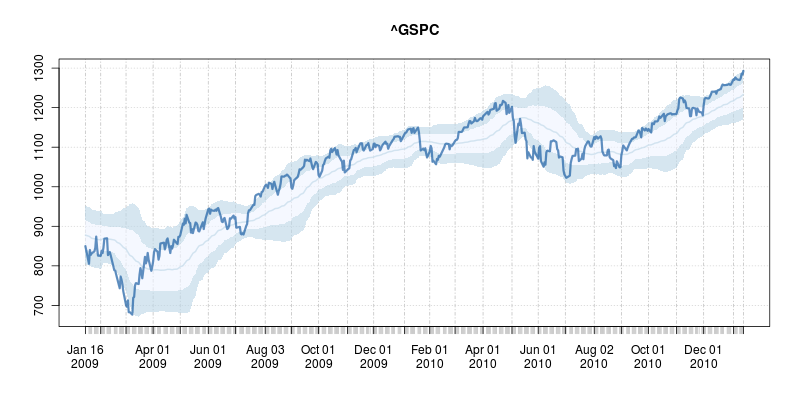
After downloading data and computing the rolling smoothed mean and standard deviation, it really is just a matter of plotting (appropriate) filled polygons. Here I used colors from the neat RColorBrewer package with some alpha blending. Colors can be turned off via an option to the function; ranges, data length and type of smoother can also be picked. To call this in R, simply source the file and the call, say, plotOBOS("^GSPC", years=2) which creates a two-year plot of the SP500 as shown here: Example chart of overbought/oversold levels from plotOBOS() function This shows the market did indeed bounce off the oversold lows nicely on a few occassions in 2009 and 2010 --- but also continued to slide after hitting the condition. Nothing is foolproof, and certainly nothing as simple as this is, so buyer beware. But it may prove useful in conjunction with other tools. The code for the script is here and of course available under GPL 2 or later. I'd be happy to help incorporate it into some other finance package. Lastly, if you read this post this far, also consider our R / Finance conference coming at the end of April.

Edit: Corrected several typos with thanks to Josh.

15 January 2011

Dirk Eddelbuettel: Allen Toussaint with Don Byron and Nicholas Payton

Lisa snagged us some sort of subscription to the CSO's jazz series and last night was a first concert resulting from this. In town were Allen Toussaint with a three piece rhythm section as well as Don Byron (also here) on clarinet and tenor saxophone, and Nicholas Payton (also here) on trumpet. Given Allen Toussaint's live-long association with New Orleans, there was a lot of music inspired by the town, including a modern rendition of an old Sidney Bechet tune as well as other material came from his most recent album The Bright Mississippi. And, given Allen Toussaint's fame in Rhythm and Blues circles, there was lot of R&B too. I found the program to be a little uneven and unbalanced that way---but it was still a great show, and he surely brought the house down. He is a charming old school performer, and maybe the audience warmed his heart right before the concert started with a quick Happy Birthday rendition as yesterday was in fact his this 73rd birthday! Don Byron and Nicholas Payton were, as expected, stellar in their own right. A nice night out.

14 January 2011

Jo Shields: The phantom fifth freedom

Not for the first time, I ve seen the suggestion in the echo chamber that Mono packages should be moved from Debian into the non-free repository, which is not formally part of Debian. The reason, as it so often is, is patents specifically this time, the searing risk posed to Debian and its users that Mono s packaging does not (and technically could not without forking from upstream) provide base class libraries which implement only the content of ECMA-335 4th Edition. As I understand it, this implies three things about the suggestion/demand: firstly, that the individual in question believes that Mono end users are at risk from patent litigation from Microsoft Corp because Mono s implementation of Microsoft.NET beyond the content of ECMA 334/335 infringes on Microsoft patents; secondly, that the Microsoft Community Promise which promises not to assert legal claims over third party implementations of ECMA-335 4th Edition (and ECMA-334 4th Edition which defines the C# language) would render a pure ECMA-only runtime safe if it existed (which it does not); thirdly that without the protection offered by the Microsoft Community Promise, the source code licenses of Mono are irrelevant the patent risk renders the software non-Free. It appears, unfortunately, that the community of Free Software Advocates don t actually understand what Free Software actually IS. That explains an awful lot, but should surprise nobody. So here s a lesson on what, exactly, is being advocated for. The Free Software Foundation defines four Software Freedoms these are the minimum criteria required for something to be considered Free Software by the FSF: Other groups have their own variants on these, but those are really just clarifications on the FSF definition - for example, the Debian Free Software Guidelines mostly line up, but have some additional clauses such as clause 4 which allows software to be considered Free if source code may be redistributed without modifications, as long as patches may be shipped alongside. These four freedoms are offered to you by the software s copyright holders only, and apply regardless of their choice of license any Free license, from a lengthy legal tome like the MPL to the completely-Free WTFPL, will offer you these four basic freedoms as a minimum, and any additional clauses in their licenses cannot seek to restrict these freedoms. These four freedoms represent the beginning, and end, of whether a piece of software is Free or not. Software does not need to be developed in the open, in a community-responsive way, in order to qualify as Free projects such as Google s Android, which are developed under a throw a final release over the wall, bugs and all, and expect people to thank you for it model, are still free, even if contribution is difficult. Actually, on a related note, software does not need to solicit upstream contribution of any kind in order to qualify as Free as long as you personally can redistribute the code with changes, then that s enough. Software does not need to serve a fully or even partially legal purpose in order to qualify as Free the favoured tool for causing distributed denial of service attacks, Low Orbit Ion Cannon, is Free Software, even though realistically it serves no legal purpose. DeCSS, the code initially used to allow DVD media to play on Linux (by breaking the CSS encryption mechanism) is Free Software. Software does not need to be useful or tasteful in order to qualify as Free the Last Measure Operating System, a minimalist OS primarily designed to loudly display the famous shock site images from goatse and related, is Free Software. Even in somewhat less clear-cut cases of taste, your personal opinion of software has no bearing on whether it is Free Software, as long as the four freedoms are guaranteed by the author(s). Software does not need to have only Free dependencies to qualify as Free Software it is entirely permissible to write software which relies upon a non-Free framework or library, and release your code under a Free license. It is the downstream recipient s problem to provide the dependencies, including their choice to craft a Free replacement for any non-Free code you make use of. Debian has a special repository called contrib, where Free software which only works with non-Free data, lives for example, Free game engines which require the insertion of proprietary game data in order to operate. You could write Free addons for expensive proprietary software such as Matlab, and as long as your code is Free, your responsibilities are met. Software does not need to avoid patents software, algorithmic, or otherwise in order to qualify as Free. The Freetype font library was still entirely Free Software when Apple were slinging threats around regarding font hinting data. FFmpeg, the Swiss Army knife of media codec libraries, is Free Software regardless of the number of codec patents it breaks. Software does not need any third party approval to be Free Software the rights of Free Software can only be offered by the copyright holders, and the opinion of third parties is an irrelevance as to whether software is Free. The GPL d clone of Blizzard Entertainment s Battle.net servers, bnetd, is Free Software, regardless of legal takedown notices. Third parties cannot influence whether or not a piece of software is Free. They can influence tangentially related topics, such as whether the software can be legally used, but that s the limit. And even within a given piece of software, where copyright is shared by contributors, the author of one component has no say on other components. And you can t make code which is already released as Free, suddenly un-Free you can, if you hold all the copyrights, close up future versions, but your existing code remains Free forever. Reasonably, you can opt to avoid using a piece of software because you have requirements beyond it merely being Free Software Cdrtools has been avoided in Debian for a long time due to the upstream author s legal threats and rambling but that is a side issue as to the question of whether or not the software is Free. Patents are simply not involved in the question of whether or not something is Free Software, except for one narrow case: where Free Software is released by somebody who also holds related patents, and uses a license such as Ms-PL or Apache 2.0 or GPLv3 which requires them to also release those patents to those using/distributing the software. Outside that narrow situation, patents do not relate to the question of whether something is Free Software even if a company releases some source code under a license like BSD then demands patent fees from end users. So, on to the original topic of Mono. Every piece of Mono s source code is released by its authors under a license which guarantees the FSF s Four Freedoms. Whether or not you find Mono useful or tasteful does not affect that Free status. Whether or not Mono infringes upon any laws or patents does not affect that Free status. That Mono contains some libraries whose upstream author is Microsoft does not give Microsoft even the remotest claim to a single line of code outside the code they wrote and even then, it wouldn t be an issue, since the licenses they use are Free. In fact, both the licenses used in the Microsoft portions of the source base make patent grants to all users, in addition to guaranteeing the FSF s Four Freedoms and any license contamination would decrease, not increase, any risk of legal attack from Microsoft. There s even plenty of Microsoft code available for re-use at a lower level than the currently re-used libraries: The Microsoft.NET Micro Framework (for use on embedded platforms direct to the metal) is under the Free Software Apache 2.0 license, and would provide access to some of Microsoft s runtime and class library code, complete with a patent grant, if it were desired. Please try to keep your thought processes straight. If you want to argue that you re all for Free Software, please remember that there s plenty of Free Software you might not approve of and don t claim to be a Free Software advocate then use bogus arguments to claim that Free Software is not Free. Free Software includes LMOS and LOIC and Mono, whether you like it or not.

13 January 2011

Dominique Dumont: Debian copyright DEP5 parser/editor/validator/migrator is released

Hello The new version of libconfig-model-perl 1.229 is now available in Debian/Sid. This new version provides a model of Debian s DEP-5 copyright file specification updated according to the CANDIDATE version. (Among other features, like editor/validator for debian/control). The DEP-5 editor must be run in the source package directory (I ll provide an example below) with the following command:
config-edit -application dpkg-copyright
Features: Known issues: Example: The copyright file of libconfig-model-backend-augeas-perl needs to be updated: Here s the original copyright file (slightly edited to protect my mail box and save electrons) :
$ cat debian/copyright
Format-Specification: http://wiki.debian.org/Proposals/CopyrightFormat?action=recall&rev=196 Upstream-Maintainer: Dominique Dumont (ddumont at cpan.org)
Upstream-Source: http://search.cpan.org/dist/Config-Model-Backend-Augeas/
Upstream-Name: Config-Model-Backend-Augeas Copyright: 2008-2009, Dominique Dumont (ddumont at cpan.org)
License: LGPL-2+ Files: debian/*
Copyright: 2009, Dominique Dumont
License: LGPL-2+ License: LGPL-2+
This program is free software; you can redistribute it and/or
[snip]
First, let s just check issues:
$ config-edit -application dpkg-copyright -ui none
Element Upstream-Maintainer of node Debian::Dpkg::Copyright is deprecated
Element Upstream-Source of node Debian::Dpkg::Copyright is deprecated
Element Upstream-Name of node Debian::Dpkg::Copyright is deprecated
Missing Files: specification at top of section number 2. Adding Files: * spec
Then, let s see what s config-edit can fix all by itself:
$ config-edit -application dpkg-copyright -ui none -save
[ same warnings displayed ]
Let s check the result of the migration:
$ config-edit -application dpkg-copyright -ui none
[ good: no more warnings ]
And here s the content of the upgraded file (drum rolls, please):
$ cat debian/copyright
Format: http://dep.debian.net/deps/dep5/
Upstream-Name: Config-Model-Backend-Augeas
Upstream-Contact: Dominique Dumont (ddumont at cpan.org)
Source: http://search.cpan.org/dist/Config-Model-Backend-Augeas/ Files: *
Copyright: 2008-2009, Dominique Dumont (ddumont at cpan.org)
License: LGPL-2+ Files: debian/*
Copyright: 2009, Dominique Dumont
License: LGPL-2+ License: LGPL-2+
This program is free software; you can redistribute it and/or
[snip]
You can see that: Please provide feedback! If you have problem migrating DEP5 files, yell, and we ll fix them. If this migration works fine, don t be shy, please say so. Under the hood:

Most of the migration work is specified in DEP-5 model [2]. Using config-model s GUI [3] to update DEP-5 model, about one hour was spent to: This shows one important feature of Config::Model: maintenance and evolution of a model is not a huge task. Even though copyright files are not configuration files, the same approach can be used to specify model and migration of other configuration files. Now comes the question of the migration as seen by the user. Well, it s your turn now. Try it and tell us how it works! Hopefully, encouraged by your feedback, other people will apply config-model to other specifications or other configuration. All the best (*) E.g, in the text format produced by the model editor GUI: 'Upstream-Contact',

'value_type' => 'string',
'migrate_from' =>
'formula' => '$old_maintainer',
'variables' =>
'old_maintainer' => '- Maintainer'

,
'type' => 'leaf',
'description' => '* Syntax: line based list [snip]'
,

12 January 2011

Dirk Eddelbuettel: RProtoBuf 0.2.2

Thanks to two patches by Murray Stokely, we have a nice new minor release 0.2.2 of RProtoBuf out on CRAN. RProtoBuf provides GNU R bindings for the Google Protobuf data encoding library used and released by Google. The NEWS file entry follows below:
0.2.2   2011-01-11
   o    Applied two patches by Murray Stokely which 
         - correct a typo preventing some functions from being called, 
         - add bounds checking in call to google protobuf library, 
         - add a new name method 
         - add a tiny unit test for the above
         - add more graceful error handling
         - add support for import patterns other than .proto$, 
         - add simple reading file that does not exist (exception) test
         - add simple repeated field unit test
And courtesy of CRANberries, here is the diff to the previous release 0.2.1:
 ChangeLog                                               35 
 DESCRIPTION                                              8 
 R/00classes.R                                           11 
 R/internals.R                                            7 
 R/wrapper_EnumDescriptor.R                               6 
 inst/NEWS                                               12 
 inst/THANKS                                          only
 inst/doc/Makefile                                        4 
 inst/doc/RProtoBuf-quickref.pdf                      binary
 inst/doc/RProtoBuf-unitTests.pdf                     binary
 inst/doc/RProtoBuf.pdf                                2362 +++++++++-----------
 inst/doc/unitTests-results/RProtoBuf-unitTests.html     20 
 inst/doc/unitTests-results/RProtoBuf-unitTests.txt      23 
 inst/unitTests/runit.addressbook.R                      11 
 inst/unitTests/runit.enums.R                         only
 inst/unitTests/runit.golden.message.R                    7 
 inst/unitTests/runit.import.R                        only
 man/EnumDescriptor-class.Rd                             42 
 man/EnumValueDescriptor-class.Rd                        23 
 man/readProtoFiles.Rd                                    3 
 src/DescriptorPoolLookup.cpp                            26 
 src/S4_classes.h                                         6 
 src/wrapper_EnumDescriptor.cpp                          25 
 src/wrapper_EnumValueDescriptor.cpp                     25 
 24 files changed, 1357 insertions(+), 1299 deletions(-)
As always, there is more information at the RProtoBuf page which has a draft package vignette, a 'quick' overview vignette and a unit test summary vignette. Questions, comments etc should go to the rprotobuf mailing list off the RProtoBuf page at R-Forge.

10 January 2011

Christoph G hre: Shredder (aka Thunderbird/Icedove) Nightly Builds

Last August I listened to Axel Beckert's (abe) talk at FrOSCon about Automated building .deb packages from VCS snapshots. Axel builds the web browser Conkeror this way and I daydreamed from a nightly built Icedove. Mozilla provides nightly snapshots of Thunderbird, but these are compressed tar files and I'm too lazy to do things (download, extract, remove, purge, ...) which a package manager does better and faster than me. Today, four months later, I want to announce my nightly build service for Icedove. It provides binary packages - shredder-nightly - for i386 and amd64 in a signed APT repository.

8 January 2011

Dirk Eddelbuettel: RcppArmadillo 0.2.11

Just before Xmas, Conrad Sanderson released version 1.1.0 of Armadillo, his templated C++ library for linear algebra. Which I only noticed this week, so here comes version 0.2.11 of RcppArmadillo, our Rcpp-based integration into R. The only other change is the addition of an unexported function SHLIB which can be used to compiled a single source file into a loadable shared library file for R, while automagically find Rcpp and RcppArmadillo headers and the Rcpp library. The short NEWS file extract follows, also containing Conrad's entry for 1.1.0:
0.2.11  2011-01-06
    o   Upgraded to Armadillo Version 1.1.0    Climate Vandal 
         * Extended submatrix views, including access to elements whose
           indices are specified in a separate vector
         * Added handling of raw binary files by save/load functions
         * Added cumsum()
         * Added interpretation of matrices as triangular via
           trimatu()/trimatl() 
         * Faster solve(), inv() via explicit handling of triangular matrices 
         * The stream for logging of errors and warnings can now be changed 
    o   New unexported R function SHLIB, a small wrapper around R CMD SHLIB,
        which can be used as   Rscript -e "RcppArmadillo:::SHLIB('foo.cpp')"
And courtesy of CRANberries, here is the diff to the previous release 0.2.10:
 ChangeLog                                                   17 
 DESCRIPTION                                                 12 
 R/SHLIB.R                                                only
 inst/NEWS                                                   13 
 inst/doc/Makefile                                            5 
 inst/doc/RcppArmadillo-unitTests.pdf                     binary
 inst/doc/unitTests-results/RcppArmadillo-unitTests.html     16 
 inst/doc/unitTests-results/RcppArmadillo-unitTests.txt      34 
 inst/include/armadillo                                       9 
 inst/include/armadillo_bits/Col_meat.hpp                    25 
 inst/include/armadillo_bits/Col_proto.hpp                    5 
 inst/include/armadillo_bits/Cube_meat.hpp                   54 +
 inst/include/armadillo_bits/Cube_proto.hpp                   7 
 inst/include/armadillo_bits/Mat_meat.hpp                   469 ++++++++++++
 inst/include/armadillo_bits/Mat_proto.hpp                   54 +
 inst/include/armadillo_bits/Proxy.hpp                       63 +
 inst/include/armadillo_bits/Row_meat.hpp                    25 
 inst/include/armadillo_bits/Row_proto.hpp                    3 
 inst/include/armadillo_bits/arma_version.hpp                11 
 inst/include/armadillo_bits/auxlib_meat.hpp                102 ++
 inst/include/armadillo_bits/auxlib_proto.hpp                13 
 inst/include/armadillo_bits/debug.hpp                      101 +-
 inst/include/armadillo_bits/diskio_meat.hpp                280 +++++++
 inst/include/armadillo_bits/diskio_proto.hpp                 9 
 inst/include/armadillo_bits/field_meat.hpp                  23 
 inst/include/armadillo_bits/field_proto.hpp                  3 
 inst/include/armadillo_bits/fn_cumsum.hpp                only
 inst/include/armadillo_bits/fn_dot.hpp                      66 +
 inst/include/armadillo_bits/fn_elem.hpp                  only
 inst/include/armadillo_bits/fn_inv.hpp                      27 
 inst/include/armadillo_bits/fn_max.hpp                      17 
 inst/include/armadillo_bits/fn_mean.hpp                     17 
 inst/include/armadillo_bits/fn_median.hpp                   15 
 inst/include/armadillo_bits/fn_min.hpp                      21 
 inst/include/armadillo_bits/fn_misc.hpp                    604 ----------------
 inst/include/armadillo_bits/fn_prod.hpp                     15 
 inst/include/armadillo_bits/fn_solve.hpp                    22 
 inst/include/armadillo_bits/fn_stddev.hpp                   15 
 inst/include/armadillo_bits/fn_sum.hpp                      25 
 inst/include/armadillo_bits/fn_trimat.hpp                only
 inst/include/armadillo_bits/fn_var.hpp                      15 
 inst/include/armadillo_bits/forward_proto.hpp                7 
 inst/include/armadillo_bits/glue_solve_meat.hpp             32 
 inst/include/armadillo_bits/glue_solve_proto.hpp            12 
 inst/include/armadillo_bits/lapack_proto.hpp               103 ++
 inst/include/armadillo_bits/op_cumsum_meat.hpp           only
 inst/include/armadillo_bits/op_cumsum_proto.hpp          only
 inst/include/armadillo_bits/op_dot_meat.hpp                 46 +
 inst/include/armadillo_bits/op_dot_proto.hpp                 9 
 inst/include/armadillo_bits/op_find_meat.hpp                59 -
 inst/include/armadillo_bits/op_inv_meat.hpp                 13 
 inst/include/armadillo_bits/op_inv_proto.hpp                14 
 inst/include/armadillo_bits/op_trimat_meat.hpp           only
 inst/include/armadillo_bits/op_trimat_proto.hpp          only
 inst/include/armadillo_bits/podarray_meat.hpp                7 
 inst/include/armadillo_bits/span.hpp                         9 
 inst/include/armadillo_bits/subview_elem1_meat.hpp       only
 inst/include/armadillo_bits/subview_elem1_proto.hpp      only
 inst/include/armadillo_bits/subview_meat.hpp               321 ++++++--
 inst/include/armadillo_bits/subview_proto.hpp                1 
 inst/include/armadillo_bits/typedef.hpp                      4 
 inst/include/armadillo_bits/unwrap.hpp                     135 +++
 62 files changed, 2155 insertions(+), 829 deletions(-)
More information is on the RcppArmadillo page. Questions, comments etc should go to the rcpp-devel mailing list off the R-Forge page.

7 January 2011

Peter Eisentraut: Git commit mode

Hardly anything ruins a glorious day of coding like fat-fingering the commit message late at night as you doze off, and then pushing it out for the world to see. To prevent that, I have equipped my Emacs configuration with a few little tools now.

First, I found the git-commit-mode, a special mode for Git commit messages. This helps you format the commit messages according to convention, and will use ugly colors if, for example, you write lines that are too long or you do not keep the second line blank. It also allows the use of things like M-q without shredding the whole file template.

Second, I integrated on-the-fly spell checking into the git-commit-mode. It won't stop you from writing nonsense, but it will catch the silly mistakes.

Here's a simple configuration snippet:
(require 'git-commit)
(add-hook 'git-commit-mode-hook 'turn-on-flyspell)
(add-hook 'git-commit-mode-hook (lambda () (toggle-save-place 0)))
The last line is handy if you have save-place on by default. When you make a new commit, it would then normally place the cursor where a previously edited commit message was finished, because to the save-place functionality, it looks as though it's the same file.

5 January 2011

Dirk Eddelbuettel: The kindness of strangers

A couple of days ago, an email arrived in which I am kindly asked to provide my PayPal coordinates. And before you dear reader start to laugh, it was actually perfectly genuine and came from a very happy user of the Finance::YahooQuote Perl module. DJ Padzensky wrote this well over a decade ago, and I first introduced and then maintained it as a package in Debian for what is now almost twelve years. I have also been acting as upstream maintainer for the last eight or so years providing the occassional patch to keep up with changes at the Yahoo! server side. After a short reflection, I decided to keep it simple. I undusted a wishlist I had once created over at Amazon, yet never publicised. And amazingly, within minutes of minutes of passing the URL on, I received a cheerful email stating that three books are their merry way. Appropriately enough, two were from Springer's useR! series and another one was a brand new GPU programming title. And they all arrived yesterday. I am still stunned. So with that, my time to say thanks! This was a genuinely nice gesture, and I really appreciate it. I have been doing open source work for over fifteen years now, and I would not still be doing it if I did not enjoy it myself. I continue to learn a lot in the process, and have had a chance to meet lot interesting folks. Yet it is also nice to get a little Thanks every now and them.

3 January 2011

Ian Wienand: easygeotag.info

I think I've just about finished my Thanksgiving project easygeotag.info. easygeotag.info I'm a little bit obsessive about geotagging my photos and while I know there are many photo management solutions out there that can do it in various ways, I generally find it quicker and easier to use exiv2 and simple shell scripts to embed the location info directly into my files. I've tried a number of things that have never worked out better than simply using Google Maps and panning around to find locations I even bought a GPS tracker which would supposedly automatically tag my photos; assuming of course it could ever get a GPS lock, it hadn't run out of batteries and corrupted its filesystem, you had all times in sync and could figure out the various timezone issues, daylight savings changes, etc etc. I always feel safer having all my metadata embedded in the actual files just incase Yahoo ever does a del.icio.us to Flickr (I use a little Python script with IPTC bindings for comments, which I then backup similarly obsessively locally and to Amazon S3). The site is fairly simple in concept it allows you to search for locations, easily extract the geotag info and provides the ability to save frequently used locations for easy reference. Mostly it was an exercise for me to implement something after reading the excellent Javascript patterns with YUI3, Google App Engine and OpenID all of which of which I managed to cram in. Although the audience may be limited (maybe just to me :) I hope someone else finds it useful for managaing their memories! If you think this might be useful and would like the output in some other format, just let me know.

Next.

Previous.