Matthew Garrett: Avoiding TPM PCR fragility using Secure Boot
 In measured boot, each component of the boot process is "measured" (ie, hashed and that hash recorded) in a register in the Trusted Platform Module (TPM) build into the system. The TPM has several different registers (Platform Configuration Registers, or PCRs) which are typically used for different purposes - for instance, PCR0 contains measurements of various system firmware components, PCR2 contains any option ROMs, PCR4 contains information about the partition table and the bootloader. The allocation of these is defined by the PC Client working group of the Trusted Computing Group. However, once the boot loader takes over, we're outside the spec[1].
One important thing to note here is that the TPM doesn't actually have any ability to directly interfere with the boot process. If you try to boot modified code on a system, the TPM will contain different measurements but boot will still succeed. What the TPM can do is refuse to hand over secrets unless the measurements are correct. This allows for configurations where your disk encryption key can be stored in the TPM and then handed over automatically if the measurements are unaltered. If anybody interferes with your boot process then the measurements will be different, the TPM will refuse to hand over the key, your disk will remain encrypted and whoever's trying to compromise your machine will be sad.
The problem here is that a lot of things can affect the measurements. Upgrading your bootloader or kernel will do so. At that point if you reboot your disk fails to unlock and you become unhappy. To get around this your update system needs to notice that a new component is about to be installed, generate the new expected hashes and re-seal the secret to the TPM using the new hashes. If there are several different points in the update where this can happen, this can quite easily go wrong. And if it goes wrong, you're back to being unhappy.
Is there a way to improve this? Surprisingly, the answer is "yes" and the people to thank are Microsoft. Appendix A of a basically entirely unrelated spec defines a mechanism for storing the UEFI Secure Boot policy and used keys in PCR 7 of the TPM. The idea here is that you trust your OS vendor (since otherwise they could just backdoor your system anyway), so anything signed by your OS vendor is acceptable. If someone tries to boot something signed by a different vendor then PCR 7 will be different. If someone disables secure boot, PCR 7 will be different. If you upgrade your bootloader or kernel, PCR 7 will be the same. This simplifies things significantly.
I've put together a (not well-tested) patchset for Shim that adds support for including Shim's measurements in PCR 7. In conjunction with appropriate firmware, it should then be straightforward to seal secrets to PCR 7 and not worry about things breaking over system updates. This makes tying things like disk encryption keys to the TPM much more reasonable.
However, there's still one pretty major problem, which is that the initramfs (ie, the component responsible for setting up the disk encryption in the first place) isn't signed and isn't included in PCR 7[2]. An attacker can simply modify it to stash any TPM-backed secrets or mount the encrypted filesystem and then drop to a root prompt. This, uh, reduces the utility of the entire exercise.
The simplest solution to this that I've come up with depends on how Linux implements initramfs files. In its simplest form, an initramfs is just a cpio archive. In its slightly more complicated form, it's a compressed cpio archive. And in its peak form of evolution, it's a series of compressed cpio archives concatenated together. As the kernel reads each one in turn, it extracts it over the previous ones. That means that any files in the final archive will overwrite files of the same name in previous archives.
My proposal is to generate a small initramfs whose sole job is to get secrets from the TPM and stash them in the kernel keyring, and then measure an additional value into PCR 7 in order to ensure that the secrets can't be obtained again. Later disk encryption setup will then be able to set up dm-crypt using the secret already stored within the kernel. This small initramfs will be built into the signed kernel image, and the bootloader will be responsible for appending it to the end of any user-provided initramfs. This means that the TPM will only grant access to the secrets while trustworthy code is running - once the secret is in the kernel it will only be available for in-kernel use, and once PCR 7 has been modified the TPM won't give it to anyone else. A similar approach for some kernel command-line arguments (the kernel, module-init-tools and systemd all interpret the kernel command line left-to-right, with later arguments overriding earlier ones) would make it possible to ensure that certain kernel configuration options (such as the iommu) weren't overridable by an attacker.
There's obviously a few things that have to be done here (standardise how to embed such an initramfs in the kernel image, ensure that luks knows how to use the kernel keyring, teach all relevant bootloaders how to handle these images), but overall this should make it practical to use PCR 7 as a mechanism for supporting TPM-backed disk encryption secrets on Linux without introducing a hug support burden in the process.
[1] The patchset I've posted to add measured boot support to Grub use PCRs 8 and 9 to measure various components during the boot process, but other bootloaders may have different policies.
[2] This is because most Linux systems generate the initramfs locally rather than shipping it pre-built. It may also get rebuilt on various userspace updates, even if the kernel hasn't changed. Including it in PCR 7 would entirely break the fragility guarantees and defeat the point of all of this.
 There was a recent
 In my previous


 Like
 I am not sure I can squeeze any more out of it with my (lack of) GNU make skills.

 I've released version 1.6.1 of
 As
 Recently, I and my Co speaker Pranav Jain, got a chance to speak at Open Source Bridge conference which was held in Portland, Oregon!
Pranav talked about GSoC and I talked about Outreachy , together we talked about Free RTC project Lumicall.
 We talked and exchanged ideas about the programme. and.. she clicked beautiful pictures of us delivering the talk.
 Picture Courtesy Sarah Sharp
 Picture Courtesy Sarah Sharp
 Thank you Debian for giving us a chance to speak at Open Source Bridge and to meet wonderful people in Open Source.

 Dear all, This would be a biggish one so please have a chai/coffee or something stronger as it would take a while.
I would start with attempt at some alcohol humor. While some people know that I have had a
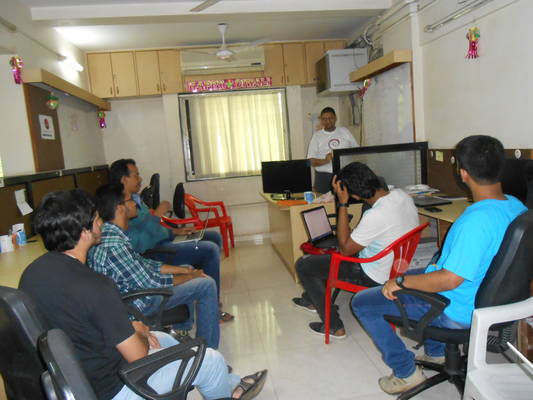 It included couple of co-organizers with most people being newbies so while I had thought of showing how to contribute via reporting bugs or putting up patches, had to set that aside and explain how things work in free software and open-source world. We didn t get into the debate of free vs open-source or free/open-source/open-core as that would have been counter-productive and probably confusing for newbies.
We did however share the debian tree structure
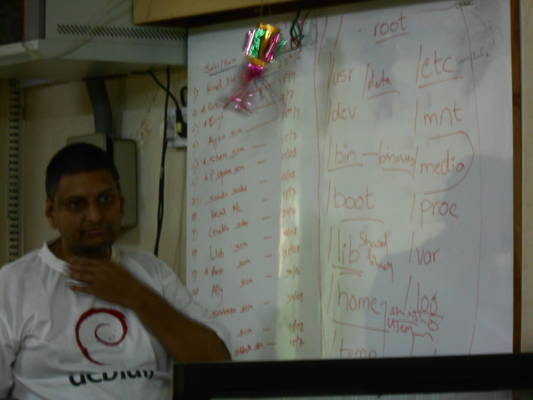 I was stumped by /var and /proc . I hadn t taken my lappy as it is expensive (a lenovo thinkpad I love very dearly) and I was unsure if I would be able to take care of it (weight wise). Dhanesh had told me that he had Debian on his lappy + zsh both of which are my favourites.
While back at home I realized /var has been relegated to having apache/server logs and stuff like that, I do recall (vaguely) a thread on debian-devel about removing /var although that discussion went nowhere.
One of the bugs that we hit early on is that nobody had enough space on their hdd to have Debian comfortably. It took a while to get an external hdd and push some of the content from somebody s lappy to the external drive to have space for the installation.
I did share the /. /home, optional swap while Dhanesh helped by sharing about having a separate /boot partition as well which I had forgotten. I can t even begin to remember the number of times having a separate /boot partition has helped me in all of my systems.
That done, we did try to install/show Debian 9 without network but were hit with
 Dhanesh is on the left while I m on the right.
We did have a cute 3-4 year old boy as our guest as well bud didn t get good pictures of him.
Lastly, the Debian cake itself
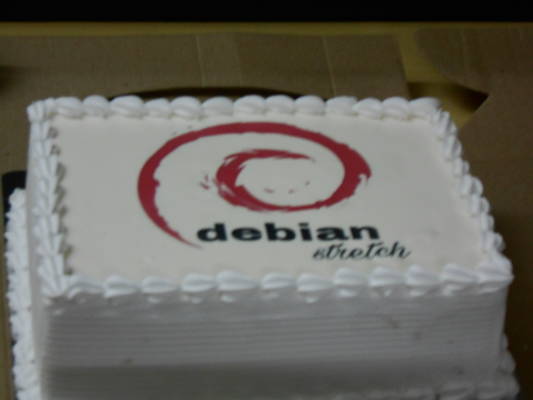 We also talked about the kernel and subsystem maintainers and how Linus is the overlord.
Look forward to comments. I am hoping Dhanesh might recollect some points that I might have missed/forgotten.
Update 07/07/17 All programming languages stats. can be seen