Search Results: "dom"

17 June 2013

Gunnar Wolf: Cultural objects/goods: When a superhero is too famous for his own good

I found the following news item; if you can read Spanish, you will most probably prefer the original version in the Proceso magazine's site. The subject? The federal police (PGR) and army arrest 17 artisans for making money out of Spiderman. The following translation is mine. Done past midnight, and being quite tired, and translated so this news item can reach a broader audience. All errors are mine (except those carried out by the security forces, that is).
June 13, 2013 Cuernavaca, Morelos. Policement from the General Republic Attorney (Procuradur a General de la Rep blica, PGR) and the Army entered and searched the "3 de mayo" neighbourhood, in the municipality of Emiliano Zapata, detaining 17 ceramist artisans that sold candies, dolls and pi atas shaped like Spiderman. This search was done on the evening of last Wednesday, around 16:00. Federal ministerial policement and army soldiers closed a street with several informal stores and detained workers taht were selling this Marvel Comics character, following said company's denounce. As a result for this operation, 17 artisants were detained, although the same day five of them were freed. The policemen also seized 12 bags of candies, pi atas, ceramics and wooden figures of the superhero. PGR closed down 11 stores where ceramics with this same figure was being sold, accusing the detainees of plagiarizing Spiderman's image, protected under the copyright law. The 12 that remained under detention were put at the Federal Justice's disposal, which prompted that this Thursday, around 10AM, hundreds of sellers of "3 de mayo" went out to PGR's building to demand their friends' freedom, who are facing a bail of up to 200,000 pesos (~USD$18,000). Outraged because they said they were treated as if they were part of a drug ring, hundreds of artisans closed intermitently Avenida Cuauhn huac, where the PGR representation in Morelos state is located. The artisans' pressure helped for the amount of the bail to be lowered from MX$200,000 to MX$16,000, and so they were set free. Francisco Fern ndez Flores, president of the Ceramists Association, criticized the operation because, he said, it was as strong as if they were "drug dealers". The artisans explained that they don't even make the Spiderman figures, they are made by the interns of the Centro Estatal de Reinserci n Social de Atlacholoaya (prision), located in the Xochitepec municipality, who offered them to the ceramists so they could be sold. "The Atlacholoaya inmates do them, we buy them to support them, and turns out we are the delinquents now", said Miriam Monroy, sister of one of the detainees. This information was contradicted by Jes s Valencia Valencia, responsible for Morelos' state prision system, who assured that in said prision no ceramics are done. Fern ndez Flores insisted though that from within the prision they are being offered pi atas, candies and "piggy banks" with Spiderman's shape. Jos Luis Pozo, vicepresident of the Ceramists Union, said that to avoid more such federal operations for copyright breaches, they have committed not to produce or commercialize Marvel superhero figures, and any other characters the authority demands. "We do commit to, from now on, those products singled out to us will not be commercialized", he said. Pozo said that the PGR operation caused losses not just to the detained producers and salesmen, but to over 200 ceramists that had to close their stores in solidarity with their friends. Acording to the artisans, the products were a success until the PGR came, seized the products and detained the salesmen.
And yes, the copyright insanity does not stop. Spiderman is by today a clear part of popular culture. Marvel brilliantly succeeded in creating such a popular icon that everybody recognizes, that everybody identifies with And that everybody should be able to recreate. We are not talking about brand protection. Marvel does not, and will never, commercialize pi atas, ceramics or wooden toys. And even if they were plastic-cast While Spiderman is still under the protection of copyright, as the Berne Convention defines it (and of course, as the much stricter Mexican laws agree), that does not mean that any and every product resembling a Spiderman should be protected. Many ceramists and pi ata makers will create unique pieces of art Ok, handicraft. But reading the copyright law more strictly, Spiderman is more treated as a trademark than as a copyright. And it is a trademark that should be declared as having passed on to the public domain.

13 June 2013

Bits from Debian: Remove unofficial debian-multimedia.org repository from your sources

The unofficial third party repository Debian Multimedia stopped using the domain debian-multimedia.org some months ago. The domain expired and it is now registered again by someone unknown to Debian. (If we're wrong on this point, please sent us an email so we can take over the domain! ;) ) This means that the repository is no longer safe to use, and you should remove the related entries from your sources.list file. After all, the need of an external repository for multimedia related packages has been greatly reduced with the release of Wheezy, which features many new and updated codecs and multimedia players. Not sure if you're using the debian-multimedia repository? You can easily check it by running: grep -i debian-multimedia.org /etc/apt/sources.list /etc/apt/sources.list.d/* If you can see debian-multimedia.org line in output, you should remove all the lines including it.

12 June 2013

Dominique Dumont: Improving error messages of Dpkg dependency parser

Hello Config::Model::Dpkg project (a Debian source package model based on Config::Model) is partly based on a ParseRec::Descent grammar. This grammar is used to parse the dependency of a Debian source package. This article will show how such a grammar is written, its limitation regarding error handling and how to improve the situation. Debian package main data is described in debian/control file. This file can feature a list of dependencies, i.e. a list of package that must be installed for the package to work. These dependencies are declared in fields like Build-Depends , or Depends as a list of package. For Dpkg model purpose, I needed only to parse one item of a dependency list at a time. This dependency item can be a simple package name: foo or a package name with a version requirement: foo ( > 1.24 ) or a package name with architectures restrictions: foo [alpha amd64 hurd-arm linux-armeb] or both: foo ( > 1.24 ) [alpha amd64 hurd-arm linux-armeb] or a list of alternate choices combining the possibilities above: foo ( > 1.24 ) bar [ linux-any] baz ( << 3.14 ) [ ! hurd-armel !hurd-armeb ] or a variable that is replaced during package build: $ perl-depends Writing a Parse::RecDescent grammar to parse this is relatively straightforward. The first production handles alternate dependencies separated by and raises an error if some text was not consumed by the dependencies:
dependency_item: depend(s /\ /) eofile  
A dependency as explained above is expressed as:
depend: pkg_dep   variable
A variable like $ foo or $ bar -1.24~ is parsed with:
variable: /\$ [\w:\-]+ [\w\.\-~+]*/
This rule handles a package name with optional version or arch restriction:
pkg_dep: pkg_name dep_version(?) arch_restriction(?) 
pkg_name: /[a-z0-9][a-z0-9\+\-\.]+/
The remaining rules are quite simple:
dep_version: '(' oper version ')' 
oper: '<<'   '<='   '='   '>='   '>>'
version: variable   /[\w\.\-~:+]+/
arch_restriction: '[' arch(s) ']'
arch:  /!?[\w-]+/
eofile: /^\Z/
The grammar above works well to parse the dependency. You can test it with this small Perl script:
#!/usr/bin/perl
use strict;
use warnings;
use 5.010 ;
use Parse::RecDescent ;
my $parser = Parse::RecDescent->new(join('',));
my $dep = shift ;
say "parsing '$dep'";
my $ret = $parser->dependency_item($dep) ;
say "result is ", $ret if $ref ;
__DATA__
# insert grammar here !!!
Unfortunately, any error in the optional parts (i.e version requirements and arch restriction) leads to an error message which is not very helpful. The error message only mention that some text could not be parsed:
parsing 'foo ( != 1.24 )   bar'
       ERROR (line 1): Invalid dependency item: Was expecting /\ / but found
                       "( != 1.24 )   bar" instead
or
parsing 'foo [ arm & armel]   bar'
       ERROR (line 1): Invalid dependency item: Was expecting /\ / but found
                       "[ arm & armel]   bar" instead
The problem comes from the fact that version requirements or arch restrictions are optional. For instance if a version requirement has a syntax error, Parse::RecDescent will try to parse it as an arch restriction. This arch restriction rule will also fail and the last terminal ( eofile ) will fail. So the error message does not hint at the actual syntax problem. To generate better error messages, I improved the suggestion made in Parse::RecDescent FAQ. Instead of calling a plain subroutine, I use a sub reference that will store the error messages in a closure. This sub ref is declared in a start-up action. Note that the sub ref explicitly returns undef. I ll explain why later.
 
    my @dep_errors ;
    my $add_error = sub  
        my ($err, $txt) = @_ ;
        push @dep_errors, "$err: '$txt'" ;
        return ;
      ;
 
The following production always fails while ensuring that the error list is reset. This production is always run at the beginning of the dependency parsing:
dependency:   @dep_errors = ();  
Here s the actual dependency production that is run when dependency method is called on the parser. It will return an array ref containing (1, data) if the dependency is valid or (0, errors) otherwise:
dependency: depend(s /\ /) eofile
   
    $return = [ 1 , @ $item[1]  ] ;


    push( @dep_errors, "Cannot parse: '$text'" ) unless @dep_errors ;
    $return =  [ 0, @dep_errors ];
   
The following productions don t change much:
depend: pkg_dep   variable
variable: /\$ [\w:\-]+ [\w\.\-~+]*/
pkg_dep: pkg_name dep_version(?) arch_restriction(?) 
dep_version: '(' oper version ')'
The first rule of this production parses the package name which must be followed by a space, end of string ( or ['. A positive look-ahead assertion is used so only the package name is consumed. If the first rule fails, the second rule provides a meaningful error message. The second rule will match anything which is not a space and create an error message. Since $add_error returns undef, the second rule returns undef and the production fails. So the text stored in the error message is not consumed:
pkg_name: /[a-z0-9][a-z0-9\+\-\.]+(?=\s \Z \( \[)/
      /\S+/   $add_error->("bad package name", $item[1]) ; 
The same trick is used with these productions:
oper: '<<'   '='   '>>'
      /\S+/   $add_error->("bad dependency version operator", $item[1]) ; 
version: variable   /[\w\.\-~:+]+(?=\s \) \Z)/
      /\S+/   $add_error->("bad dependency version", $item[1]) ; 
The action of this production is a little bit more tricky. The action ensures that '!' are either added before all arch or not at all. Otherwise an error message is generated and added to the list of errors:
arch_restriction: '[' osarch(s) ']'
     
        my $mismatch = 0;
        # $ref contains ['!',os,arch] or ['',os,arch]
        my $ref = $item[2] ;
        for (my $i = 0; $i < $#$ref -1 ; $i++ )  
            $mismatch  = ($ref->[$i][0] xor $ref->[$i+1][0]) ;
         
        my @a = map   ($_->[0]   '') . ($_->[1]   '') . $_->[2]   @$ref ;
        if ($mismatch)  
            $add_error->("some names are prepended with '!' while others aren't.", "@a") ;
         
        else  
            $return = 1 ;
         
     
The check above is possible only if the "osarch" production returns an array ref containing something like ('!','linux','any') for "!linux-any' or ('','linux','any') for "linux-any":
osarch: not(?) os(?) arch
     
        $return =  [ $item[1][0], $item[2][0], $item[3] ];
     
      /.?(?=\s \] \Z)/   $add_error->("bad arch specification: ", $item[1]) ;  
not: '!'
Here's the remaining of the grammar:
os: /(any uclibc-linux linux kfreebsd knetbsd etc...)-/
     /\w+/ '-'   $add_error->("bad os in architecture specification", $item[1]) ; 
arch: / (any  alpha amd64  arm\b  arm64  etc... )
        (?=(\]  ))
      /x
        /\w+/   $add_error->("bad arch in architecture specification", $item[1]) ; 
eofile: /^\Z/
That's all for grammar 2.0... Before someone yells: "Show me the message ! ", here are some example of bad dependencies and their error message generated by the parser:
parse 'foo ( != 1.24 )   bar'
result is: 0 bad dependency version operator: '!='
parsing 'foo [ arm & armel]   bar'
result is: 0 bad arch specification: : '&'
parsing 'foo [ arm armel ]   bar [!moo]'
result is: 0 bad arch specification: : ']' bad arch in architecture specification: 'moo'
The 2 first error messages are spot on the actual error. The second one has a false positive (']' is correct) but correctly highlights the wrong arch name ('moo'). Mission accomplished. In order to keep this post (relatively) simple, I've removed the part that actually store parsed data. They don't really matter for error handling. Nevertheless, you may see the whole grammar in Config::Model::Dpkg::Dependency module. All the best
Tagged: Config::Model, debian, dpkg, package, Parse::RecDescent, Perl

Daniel Pocock: The week that everything changed

Last Wednesday, I felt an urge to carefully write out a list of all the possible characteristics that would make communications technology genuinely free. I felt this was important for a number of reasons: for example, to follow up on my earlier claim that free software does not always provide free communications, it is necessary to be able to measure the shortcomings against a perfect (although possibly unachievable) benchmark. Then something happened Just hours after my blog was live, The Guardian, a leading British newspaper (and contributor to open source) started publishing explosive allegations about the extent of US Government monitoring of communications. They kicked off a dramatic four days of coverage of this topic with the story that one of America's largest phone companies, Verizon, is secretly passing details of all customer phone calls and approximate locations (metadata) to the NSA. I've published further blog entries about this subject in the meantime. One thing I want to make clear: real friends tell each other the truth. There is no need to flatter America with gratitude for inventing the Internet when discussing these fundamental privacy failings. Anybody who has tried to generalise any comments about the NSA scandal as anti-American' is themselves failing to respect America's own principles of free speech. A doctor doesn't make up fairy tales for a patient diagnosed with cancer, he puts the facts on the table as that is the first step in making progress. The winds of change Activity on all my free communications web sites, especially Lumicall and OpenTelecoms.org has doubled. Google Play reports that the rate of Lumicall installations have also doubled - hopefully it is getting closer to the point where Metcalfe's Law kicks in and everybody will have federated SIP on their phone. What next One thing is clear: this situation provides a huge opportunity for anybody promoting free software, not just for communications. As I mentioned, web sites on the subject of free and private communications are attracting significant interest and I hope this rubs off on other projects. While I have contended that free software does not always provide free communications, there is a compelling argument for the case that you can't have free communications without having genuinely free software. Some of the developments that are coming up in the very near future: An upcoming release of DruCall, initially packaged for Debian and leveraging the libraries API packaging scheme, is going to make it much, much easier for the vast majority of web sites to offer a secure calling facility, without any third-party browser plugins required. Other CMS vendors such as xWiki are also working on WebRTC support. DebConf13 is aiming to feature a half-day track on Free real-time communications with a focus on the way free operating systems, particularly Debian (and it's derivatives like Ubuntu) are fundamental to rolling out an alternative to the status quo. Federated VoIP is also a confirmed feature of the upcoming Fedora 19 release and will eventually work it's way into EPEL. This is another great way for people who work in an RPM environment to start getting more active deploying SIP as a standard service in their environment. The real-time communication (RTC) quick-start guide is currently being updated and will include a convenient web-checker to help people test their federated connectivity. Can you help? Not sure where to begin? Come and join us on the Free RTC discussion list that has been sponsored by the FSF Europe or join the discussion list of one of your favourite free RTC applications.

11 June 2013

Wouter Verhelst: DNSSEC enabled for my domains

If you're using the DNSSEC validator and you're reading either my blog or Planet Grep, you may have noticed that the validator icon went from the gray "undefined" version to the green "validated" one. That's right, I have working DNSSEC now with thanks to Philip for doing all the hard work.

9 June 2013

Ingo Juergensmann: Edward Snowden whistleblowed PRISM

Sometimes there are true heros. Even today. Like Edward Snowden who made PRISM publically known. There's an interview by The Guardian with Edward Snowden:
In a note accompanying the first set of documents he provided, he wrote: "I understand that I will be made to suffer for my actions," but "I will be satisfied if the federation of secret law, unequal pardon and irresistible executive powers that rule the world that I love are revealed even for an instant." [...] He has had "a very comfortable life" that included a salary of roughly $200,000, a girlfriend with whom he shared a home in Hawaii, a stable career, and a family he loves. "I'm willing to sacrifice all of that because I can't in good conscience allow the US government to destroy privacy, internet freedom and basic liberties for people around the world with this massive surveillance machine they're secretly building."
Neither Bradley Manning nor Edward Snowden should be sentenced, but the Government that is responsible for such surveilance programs like PRISM should.
Kategorie:
Tags:

8 June 2013

Daniel Pocock: Rendition link to PRISM

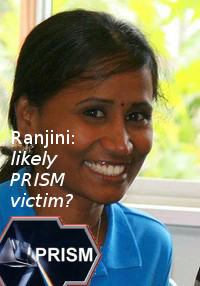
The Guardian is reporting that Britain's GCHQ first started getting produtive with PRISM early 2012. It was about the same time that their buddies down under, ASIO revised their earlier assessment of a refugee, Ranjini, and scooped her up in Australia's domestic rendition program. This may be more than a notable co-incidince, because it adds further support to the hypothesis that Ranjini is a victim of Big Data and PRISM. If ASIO first gained access to PRISM at the same time as GCHQ, then they may have used some tenuous PRISM data to form their revised assessment of her suitability for a visa. Making such inferences, and using them as the basis for a cruel program of indefinite detention is a gross violation of human rights and goes far beyond the claim that PRISM is about catching real terrorists. I've previously mentioned the systematic persecution of coloured people in my own country. Like many honest people, I'm utterly ashamed of it. The Government also has similar programs for indigineous people (they cooked one aboriginal elder alive on our national holiday) and they've also toyed with outlawing homosexuality. Having seen first hand some of the prejudiced, Government-sanctioned evil that exists in Australia, it's not hard to imagine small-minded members of the public service using PRISM data to target these classes of people for an unhealthy dose of bastardisation. Ranjini was ripped away from her husband by the rendition program and dumped in Sydney's Villawood death camp. Twenty-four hours after the gestapo got their hands on her, it was discovered she was pregnant - her child, an Australian citizen, was recently born and confined to the same concentration camp. Ranjini has racked up more than 12 months in captivity now, most of it while pregnant, and the Government has still not made any official charges against this woman. They say they can't comment on her case for fear of revealing their sources: once again, they don't want to talk about programs like PRISM that they share with the US. Maybe she just had one of the wrong people in her facebook friends list? That is not the sort of evidence that can be used to convict somebody in court, especially if the Government wants to avoid public questioning about their access to a close ally's secret database. Various rapists and murderers have made multiple court appearances in the last 12 months, tried and convicted in accordance with the procedures of justice. Ranjini has not been brought into a court room even once because the spooks don't want to reveal their sinister sources like PRISM.
Potential PRISM victim Ranjini
Australia's close ties with the US Australia has had particularly close ties with the US for many years and just as the British GCHQ has been linked to PRISM, it seems Australia's ASIO is also in on the act. For those not familiar with the depth of this alliance, it is worth checking up on Pine Gap, the ECHELON program and the recent exposure (by Wikileaks) of one of our senators with unauthorised US spy connections - he quietly resigned for family reasons'. Pine Gap
Pine Gap, Australia This is not to say that the US is universally bad or that the strategic alliance is undesirable: rather, it is simply to demonstrate the strength of these links and the real risk that data-sharing is used for inappropriate purposes. While many of us in a technical field treat large volumes of data from a very theoretical perspective, it is worth remembering that in the wrong hands, data can be very dangerous and there are real human victims.

Steve Kemp: Migrations and movements

Recently I wanted to cleanup my "main" remote machine. It is a system I've had for many years, which started off as a i386 KVM-guest and was later migrated in place to an AMD64 installation. These days the host runs: The plan was originally to move the "mail stuff" to a new (wheezy) guest. I aborted that after discovering that the mutt-patched package has (IMHO) regressed. So today I spun up a new virtual machine, and configured it to host websites. Thus far I've migrated steve.org.uk, and lumail.org to the new host. Both simple sites that are built via my static-site-generator. Migration mostly involved configuring the proxy and the thttpd instances - then using rsync to migrate the content. I've renamed my current host, which was previously www.steve.org.uk and is now ssh.steve.org.uk, and pushed DNS changes. If all is smooth and happy I'll slowly migrate the rest of the sites. Fingers crossed this will be painless and I'll have a clean split between "login + mail" and "websites".

7 June 2013

Tanguy Ortolo: Looking for an SPF milter

Envelope

For email extensions such as SPF, DKIM and DMARC, I think the most flexible and portable system is the milter protocol. Originally developed for Sendmail, it is now also supported by Postfix, and it allows to plug specific filters in the mail server without the hassle of the previous systems like SMTP proxies.

SPF milters in Debian OpenDKIM provides a good milter for checking DKIM. OpenDMARC provides a similar milter for DMARC. But the situation is more difficult for SPF in Debian which is a requirement for DMARC! :
spf-milter
It was based on the buggy libspf0 and was never updated to libspf2, and was finally removed from Debian;
spf-milter-python
This one seems a bit Sendmail-centric it uses a dbm configuration file for instance and not very documented.
Packaging a new SPF milter? There are other milters for SPF, which have not been packaged for Debian yet, but I am ready to package one. Has anybody tried another SPF milter?
spfmilter
Still in beta test, still to be ported to libspf2 which may never happen since it was not updated since 2005.
smf-spf
Based on libspf2, seems rather neat, with a clean configuration, but inactive since 2007.
milter-spiff
Proprietary.

5 June 2013

Daniel Pocock: The Gold Standard in Free Communications Technology

In a previous blog entry, I posed the question whether open source communications software is really free and came to the conclusion that additional principles need to be defined for free communications, above and beyond the normal expectations of free software. This is a fundamental problem that projects like the FreedomBox, Lumicall and other privacy-enabling free communications solutions must be familiar with. Otherwise there is a risk that development will never end as there is no finish line in sight. Practical solutions are not so easily defined though: so let's just imagine a perfect solution for a moment. Later, we can contemplate the trade-offs that are necessary to make it practical. Perfect privacy Here are some attributes that may exist for a perfect solution: Privacy must be the default: the user should not have to explicitly request privacy. If there is a risk that an incoming communication will establish a session without full privacy, the user should be able to decline the opportunity to participate. Only participants to a communication can receive the communication A third party should not be able to replay, modify or forge any aspect of the communication or the request to initiate a session Only participants to a communication are aware that a communication occurred Only participants to the communication are aware of who participated in the communication A participant may be anonymous: but in this case, all other participants will be aware that there is an anonymous party present in the communication Participants may not deduce any information about the other participants that is not explicitly shared (e.g. location, type of device, service provider) In the case of real-time communication, a participant may leave the communication without any other party even realising that they left or why. Communication is off-the-record: No participant can save and reproduce a copy of the communication in such a way that a third-party will know it was authentic. Anonymous reception of communications - the perfect post-office box: someone may create an anonymous identifier that allows other people to call them without being able to trace their location or identity Some consequences of a perfect solution Just imagine if all communications worked in this manner. There are many potential consequences. For example, if you call somebody and the call is not connected, you will get no feedback about whether their line is busy, out of service or whether they deliberately chose to reject your call. Another example is somebody who is driving while talking on a telephone. If they have an accident, there will be no way to prove that they were using the phone. This may already be the case if somebody uses a VoIP app on their phone - the police investigating the accident later will simply find no records of calls through the mobile phone account. Conclusion The perfect solution described here is something of a holy grail rather than a recipe that a developer can implement. It is unlikely that such a solution will fall out of the sky in the immediate future. Most software products that offer secure communications only address less than half the issues described above: for example, digital mobile phones prevent eavesdropping with arbitrary radio receivers, but they don't prevent shops detecting the IMEI (serial numbers) of phones that pass through their store and using that information to identify repeat visits to their store.

Steve Kemp: How do people deal with email?

As part of writing a new mail client I'm wondering about how to change my email-life, and how other people process/handle their incoming email. I sort my incoming email into folders at delivery-time using procmail. Mail is generally filtered into mailboxes on the basis of the company that sent it, the person that sent it, or the machine which generated it. Because I manage a lot of machines personally I've split things up so that I have a folder per host. So on a morning I might have unread mail in the following folders:
machines.steve.org.uk/
machines.da-db1/
machines.da-db2/
machines.da-web1/
machines.da-web2/
machines.da-web3/
machines.da-web4/
The per-machine mailboxes usually contain a single mail every day from LogWatch, along with output from any cron-jobs. For example today I received the mail:
From: Cron Daemon
To: steve@steve.org.uk
Subject: Cron steve@steve.org.uk /home/steve/bin/download-check
URL http://nodejs.org/ - no longer matches v0.10.9
Generally speaking I don't need to read the per-machine messages. I'll keep the most recent 100 for reference, but only need to look if something seems "off" on a machine. But if I don't look I'd not see the node upgrade notice, so find that I do read them after all. This suggest to me that email isn't the right way to handle this kind of thing. Instead I should use a notification system - at work we have a central service called MauveAlert (yes, Red Dwarf reference). Mauve receives "alerts" of various kinds, via UDP. The alerts are then fanned out to appropriate people via XMPP, Email, or SMSs. I have a similarly-inspired system I use on my Debian Administration cluster. A (node) service runs non-stop collecting UDP messages and showing them on a dashboard. I look at it throughout the day to see when slaughter runs, etc. Anyway in conslusion I get a lot of mail. Some of it is related to random projects, and all ends up in the steve.org.uk/ mailbox, some of it relates to machines, and gets filed away, and I have regular conversions with folk so I have a .people.kirsi/ folder which receives a lot of attention, for example. ObRandom:daily() - Mark ~/Maildir/.machines.*, etc, read.

31 May 2013

Gunnar Wolf: The joys of updating a webapp

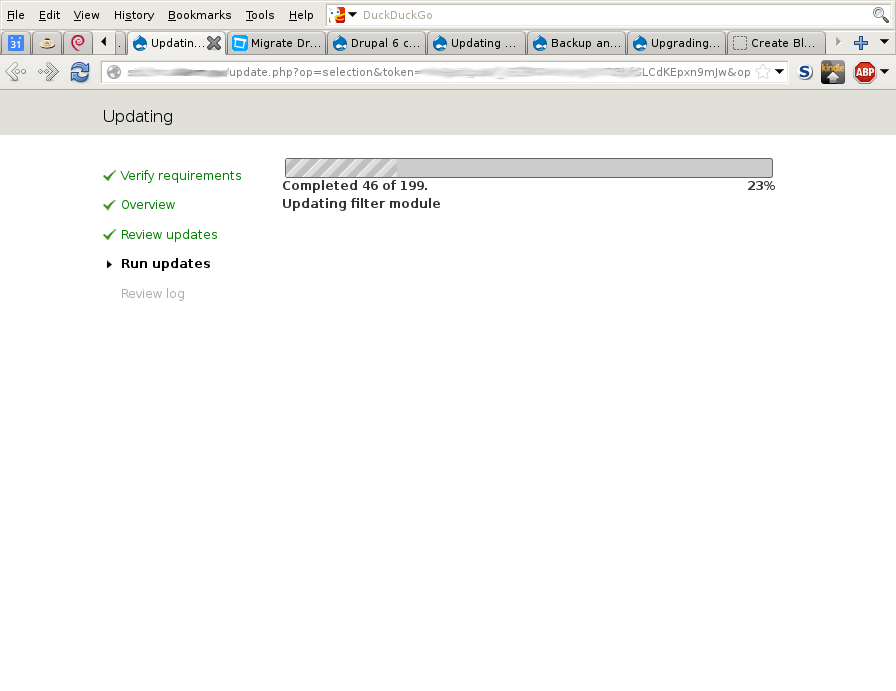
I like Drupal. It's a very, very flexible CMS that evolved into a full-fledged Web development framework. Mind you, it's written in PHP, and that makes it a nightmare to develop for (in ~6 years I have used it for all of my important websites I have only got around to develop a set of related modules for it once). PHP programming sucks and makes my eyes and fingers bleed, but happily there are people who disagree with me And they tend to write code. All the better! Minor upgrades with Drupal are quite easy to handle. Not as easy as I'd like (i.e. whenever I upgrade the core system or a module, I have to log in as root^Wadmin^WUser #1 to ~15 different sites and run http://someurl/update.php It very seldom causes any pain. The updates that have to be run via this URL are usually on the database's structures, so I understand they have to be started (and watched) by a human. And yes, I know I could do that with Drush, the Drupal shell, but it is not very friendly to Debian-packaged Drupal... But easy enoguh. But major updates are a royal pain, and they usually amount to quite a bit. First, disable all of the modules and revert to a known-safe theme. Ok, it makes sense. Second, check whether the modules exist for the newer version (as they won't work Drupal changes enough between major versions that not only it's API-incompatible, I'd classify it as API-unrecognizable). Ok, all set? Now for the live migration itself... It has to be triggered from the browser. So yes, I am now staring at a window making clever AJAX status updates. I am sitting at 46 of 199, but following the lovely ways of programmers, it's impossible to forsee whether update #47 will just be an UPDATE foo SET bar=0 WHERE bar IS NULL or a full-scale conversion between unspeakable serialized binary structures while rearranging the whole database structure. And yes, while the meter progresses I stand in fear that update #n+1 will bomb giving me an ugly red error. I must keep the magic AJAX running, or the update might be botched. And, of course, the update has sat at #69 all while I wrote the last two paragraphs. Sometimes the updates can progress after an interruption... And it seems I have no choice but to interrupt it. /me crosses fingers... [update] Wow... I am happy I got bored of looking at the meter and decided to write this blog post: After several minutes, and just as I was about to launch a second update session (130 updates to go), the meter advanced! I'm now sitting watching it at #75. Will it ever reach 199? [update] And so it had to be... At around 115, I now got: *sigh* The update process was aborted prematurely while running update #7000 in biblio.module...
AttachmentSize
drupal_updating.png39.5 KB
drupal_updating_failed.png64.72 KB

Daniel Pocock: VoIP federation: another milestone

Slashdot recently picked out Federated VoIP as one of the compelling features in the upcoming Fedora 19 (Schrodinger's Cat) release. The same capability was recently part of the Debian 7 (wheezy) release and it is in Ubuntu too. It is ironic that the debates about Federated VoIP have long mirrored the debate about Schrodinger's famous feline - is it dead, is it alive, or is it just a theory? Well, the answer is here today (for VoIP, not the cat).

Does it work? Yes, it does work. Even better, users on all the supported platforms can call each other, for example, user1@debian.org should be able to seamlessly and securely place a call to user2@fedoraproject.org What is involved? Server: Each domain needs a SIP proxy, XMPP server or preferably both. They are alternatives and they happily co-exist. For convenience, they can run on an existing mail server as long as the load is not excessive. See the Real-time communcations (RTC) quick start guide for setting up the server, firewall rules, DNS entries and all other details Clients: Each user can have a hard phone, softphone such as Jitsi or Empathy or a mobile VoIP client like Lumicall. Each of these projects has their own email support lists where users can ask any questions about getting started. Is the server difficult to set up and maintain? Setting up fully featured Asterisk or FreeSWITCH servers and keeping them secure for public Internet use is a daunting task. That's why federated VoIP with a basic SIP proxy is so compelling. It is possible to set up the SIP proxy now, get people talking, and add in a soft PBX later if optional features like queues or menus are needed. The repro SIP proxy from reSIProcate is one of the easiest to set up. It can be configured through a web interface or directly entering users into the MySQL tables. Here is a screenshot: Where to next for federated VoIP? People should not be waiting for their ISP to deploy federated VoIP. Many of them are either looking for ways to monetize VoIP, or keen to keep costs low by just selling bandwidth. Rather, it will be up to power users (like those of us who run their own mail server at home), corporate IT departments and also the IT departments of universities and other large, distributed organisations to take leadership. There is huge opportunity here: by displacing the phone companies, IT departments can provide a wider range of services to their organisations. Money previously lost in contracts for phone systems can bolster the IT department as the one-stop-shop for technology, giving IT workers greater career opportunities and stability in their organisation. The organisation benefits from having a system designed and operated around their business needs with much better value for money and a visible support team.

30 May 2013

Daniel Pocock: Is open source communications software really free?

Does every communications technology based on open source and open standards enable free communications? Or is something more necessary? The FSF's campaign for a Skype replacement gives some indication that existing free software solutions have shortcomings. The opening paragraph of their campaign pitch suggests that with proprietary solutions, "we can't be sure who is listening in". Many open source solutions (including VoIP, IRC and email) have exactly the same limitation depending upon how they are configured and used. If the option of privacy is an essential characteristic of a communications system that should be considered a free solution, then simply using open source and open standards does not make a solution free. Some additional criteria are needed to help evaluate each solution to find out if it is free. Most major Linux distributions have criteria for evaluating software freedom. Debian has it's free software guidelines and provides an interesting set of tests that can be used when evaluating whether a license is free. Yet I could not find any evidence that the FSF or any other organisation has taken steps to define a similar set of guidelines for communications freedom The recent incident involved phone tapping at Associated Press gives more hints: journalists expect a certain amount of freedom to interact with and protect sources as they go about their work in a free society but their technology platform failed to give them that freedom. It is not just journalists who have this expectation and it is not just the Government who might be listening: in the UK, the roles were reversed as News International journalists allegedly gained access to communications records from crime victims and Government officials Defining concise high-level guidelines for communications technology that is genuinely free will not only help us in fulfilling the search for a Skype replacement but it could also have consequences for the evolution of email and other protocols that have evolved with relatively poor privacy support up to now or the successful design of completely self-contained solutions like the FreedomBox. This is one of the topics that has been raised recently on the Free Real-time Communications mailing list sponsored by FSF Europe.

29 May 2013

Russell Coker: Nexus 4

My wife has had a LG Nexus 4 for about 4 months now so it s time for me to review it and compare it to my Samsung Galaxy S3. A Sealed Case The first thing to note about the Nexus 4 is that it doesn t support changing a battery or using micro-SD storage. The advantage of these design choices is that it allows reduced weight and greater strength compared to what the phone might otherwise be. Such choices would also allow the phone to be slightly cheaper which is a massive advantage, it s worth noting that the Nexus 4 is significantly cheaper than any other device I can buy with comparable specs. My wife s phone has 8G of storage (not RAM thanks Robin) and cost $369 at the start of the year while the current price is $349 for the 8G version and $399 for the 16G version. Of course one down-side of this is that if you need 16G of storage then you need to spend an extra $50 on the 16G phone instead of buying a phone with 8G of storage and inserting a 16GB micro-SD card which costs $19 from OfficeWorks. Also there s no option of using a 32G SD card (which costs less than $50) or a 64G SD card. Battery etc The battery on the Nexus 4 isn t nearly big enough, when playing Ingress it lasts about half as long as my Galaxy S3, about 90 minutes to fully discharge. If it was possible to buy a bigger battery from a company like Mugan Power then the lack of battery capacity wouldn t be such a problem. But as it s impossible to buy a bigger battery (unless you are willing to do some soldering) the only option is an external battery. I was unable to find a Nexus 4 case which includes a battery (which is probably because the Nexus 4 is a lot less common than the Galaxy S3) so my wife had to buy an external battery. If you are serious about playing Ingress with a Nexus 4 then you will end up with a battery in your pocket and cable going to your phone from the battery, this is a real annoyance. While being a cheap fast phone with a clear screen makes it well suited to Ingress the issue of having a cable permanently attached is a real down-side. One significant feature of the Nexus 4 is that it supports wireless charging. I have no immediate plans to use that feature and the wireless charger isn t even on sale in Australia. But if the USB connector was to break then I could buy a wireless charger from the US and keep using the phone, while for every other phone I own a broken connector would render the phone entirely useless. Screen Brightness I have problems with my Galaxy S3 not being bright enough at midday when on auto brightness. I have problems with my wife s Nexus 4 being too bright in most situations other than use at midday. Sometimes at night it s painfully bright. The brightness of the display probably contributes to the excessive battery use. I don t know whether all Nexus 4 devices are like this or whether there is some variance. In any case it would be nice if the automatic screen brightness could be tuned so I could make it brighter on my phone and less bright on my wife s. According to AndroSensor my Galaxy S3 thinks that the ambient light in my computer room is 28 lux while my wife s Nexus 4 claims it s 4 lux. So I guess that part of the problem is the accuracy of the light sensors in the phones. On-Screen Buttons I am a big fan of hardware buttons. Hardware buttons work reliably when your fingers are damp and can be used by feel at night. My first Android phone the Sony-Ericsson Xperia X10 had three hardware buttons for settings, home, and back as well as buttons for power, changing volume, and taking a photo which I found very convenient. My Galaxy S3 has hardware buttons for power, home, and volume control. I think that Android phones should have more hardware buttons not less. Unfortunately it seems that Google and the phone manufacturers disagree with me and the trend is towards less buttons. Now the Nexus 4 only has hardware buttons for power, and volume control. One significant advantage of the Galaxy S3 over the Nexus 4 is that the S3 s settings and back buttons while not implemented in hardware are outside the usable screen area. So the 4.8 1280*720 display is all for application data while the buttons for home, settings, and back on the Nexus 4 take up space on the screen so only a subset of the 4.7 1280*768 is usable by applications. While according to specs the Nexus 4 has a screen almost as big as the Galaxy S3 and a slightly higher resolution in practice it has an obviously smaller screen with fewer usable pixels. Also one of the changes related to having the buttons on-screen means that the settings button is often in the top right corner which I find annoying. I didn t like that aspect of the GUI the first time I used a tablet running Android 3.0 and I still don t like it now. GPS My wife s Nexus 4 seems to be much less accurate than my Galaxy S3 for GPS. I don t know how much of this is due to phone design and how much is due to random factors in manufacturing. I presume that a large portion of it is due to random manufacturing issues because other people aren t complaining about it. Maybe she just got unlucky with an inaccurate phone. Shape and Appearance One feature that I really like in the Samsung Galaxy S is that it has a significant ridge surrounding the screen. If you place a Galaxy S face-down on a desk that makes it a lot less likely to get a scratch on the screen. The LG U990 Viewty also had a similar ridge. Of course the gel case I have bought for every Android phone has solved this problem, but it would really be nice to have a phone that I consider usable without needing to buy such a case. The Nexus 4 has a screen that curves at the edges which if anything makes the problem worse than merely lacking a ridge around the edge. On the up-side the Nexus 4 looks and feels nice before you use it. The back of the Nexus 4 sparkles, that s nice but when you buy a gel case (which doesn t seem to be optional with modern design trends) you don t get to see it. The Nexus 4 is a very attractive package, it s really a pity that they didn t design it to be usable without a gel case. Conclusion Kogan is currently selling the Galaxy S3 with 16G of storage for $429. When comparing that to the 16G version of the Nexus 4 at $399 that means there s a price of $30 to get a SD socket, the option of replacing a battery, one more hardware button, and more screen space. So when comparing the Google offers for the Nexus 4 with the Kogan offer on the Galaxy S3 or the Galaxy Note which also has 16G of storage and sells for $429 the Google offer doesn t seem appealing to me. The Nexus 4 is still a good phone and is working well for my wife, but she doesn t need as much storage as I do. Also when she got her phone the Galaxy S3 was much more expensive than it is now. Also Kogan offer the 16G version of the Nexus 4 for $389 which makes it more appealing when compared to the Galaxy S3. It s surprising that they can beat Google on price. Generally I recommend the Nexus 4 without hesitation to anyone who wants a very capable phone for less than $400 and doesn t need a lot of storage. If you need more storage then the Galaxy S3 is more appealing. Also if you need to use a phone a lot then a Galaxy S3 with a power case works well in situations where the Nexus 4 performs poorly.

Russ Allbery: Review: The Making of the Indebted Man

Review: The Making of the Indebted Man, by Maurizio Lazzarato
Translator: Joshua David Jordan
Publisher: Semiotext(e)
Copyright: 2011, 2012
Printing: 2012
ISBN: 1-58435-115-2
Format: Trade paperback
Pages: 199
This is a continuation of my effort to catch up on Marxist thought while pondering workplace governance, this time following the recommendations of a friend after a related conversation (about pension systems and basic income guarantee in a Usenet group Usenet isn't dead yet). As opposed to Democracy at Work, which is a popularization, The Making of the Indebted Man has more of the density of a scholarly text. The version I'm reading is also in translation, which I suspect makes it even harder going in places. The basic thesis, though, is clear: debt is far more central to the way that we construct not only economic systems but social systems and even internal models of our own nature than is often realized. We prefer to think of societies as structured around mutual exchange, but in practice they're more often constructed around concepts of debt and credit that have been fully internalized and used to construct a moral code for a responsible debtor. And this is not a neutral construction; rather, it is a key support mechanism of capitalism and of the financial and economic status quo, used (both intentionally and accidentally) to reduce uncertainty and to support exploitation and economic domination. This is one of those perspectives that didn't occur to me prior to reading this book but which is startlingly obvious in retrospect. Once Lazzarato starts pointing it out, the prevelance and universality of debt as a basic structure of social and economic life is striking. The creditor and debtor concept extends not just to obvious examples, such as consumer credit or mortgages, but also to education (via student loans), law enforcement ("pay one's debt to society"), employment (most employers, particularly during economic downturns, have successfully inverted the natural direction of the creditor relationship and have made employees feel in debt to the employer for having a job), and social services (unemployment and welfare benefits come with significant, if often unstated, debt-like requirements). Debt is also the great leveller. It now cuts across race, gender, and social class. Apart from a small handful of extremely rich individuals and corporations, Lazzarato claims, convincingly, that nearly everyone is enmeshed to some extent in a network of debt, or at least in in attitudes and moral pressures of a debtor. Nor is this a static situation. The role of debt in our social lives seems to be constantly increasing. The past fifteen years in particular have seen drastic increases in debt during a debt-funded economic boom combined with debt-funded asset bubbles. Even after the financial collapse, much of that growth of debt persists. Lazzarato, probably in part because he's Italian, focuses on national debt (more on that in a moment); as an American, I'd identify student loan debt as a more compelling example in the United States. Other countries probably have their own examples. For a system to be this widespread, it must serve some social purpose. Lazzarato sees it as an instrument of control. Debt has been very effectively built up as a moral obligation, and (unlike a society of mutual support) it's a very one-sided moral obligation that strongly favors existing power. The debtor is held to a tight moral standard of repayment of debts, and is morally condemned by all of society, including their peers, for a failure to repay. But there is little or no corresponding moral pressure on the creditor: perhaps a half-hearted dislike of high interest rates or occasional pressure to not change previously agreed terms, but nothing like the moral pressure applied to the debtor. To be a creditor is to have an agreed-upon, one-sided right to dictate to the debtor the terms on which they must conduct a portion of their life, and the larger the debt, the larger the portion. The debtor is expected to realign their life, at least in part, around paying off the debt, including choice of profession, decisions about when to quit a job, about how to prioritize personal spending, and so forth. This is all so automatic and so deeply ingrained that, even while writing this, I'm nodding along and thinking "well, of course." Lazzarato offers an opportunity to take a step back and think about the implications, particularly of the deeply one-sided web of obligations this creates. A Marxist analysis adds another level of consideration. One of the basic questions of Marxist thought is why workers put up with exploitation by capitalists. In a Marxist analysis, workers provide the productive output of society, which is then redirected and controlled by a relatively small capitalists. The workers massively outnumber the capitalists. Why would they be content for this situation to continue? Marx, of course, thought they wouldn't be, that the periodic crises of capitalism would eventually result in a socialist revolution by the workers. But by and large this hasn't happened. Why? Lazzarato offers debt as a partial explanation. The profits redirected by capitalists are returned to workers to some extent, but as debt rather than payment. This allows workers to participate to some extent in the growth of societal wealth from constantly increasing productivity, while simultaneously entangling workers in a system of moral control. Company stores, starvation wages, and other confiscatory practices are clear mechanisms of external control that provoke directed outrage. Debt is something that the debtor has nominally agreed to (however much the situation is manipulated to make that agreement almost inevitable), and to which attaches a deep tradition of moral responsibility. The worker has respected grounds on which to object to inequitable treatment; the debtor is wholly responsible for repayment, and is rarely considered to have grounds to complain about the debt. Most of the historical attempts to balance those scales, such as laws and religious rules against usury or the historical Jewish rule of Jubilee, have fallen by the wayside. This is a rather extended summary of what I got out of the book. I'm doing that in part because the book itself is somewhat heavy going. Lazzarato makes extensive use of specialized terms (often not defined) and fills the book with references to other works without much in the way of useful summary. It's the sort of book where, if you're not already well-versed in the field, you may need to just keep reading through some passages to find a point of reference that makes the argument retroactively make sense. I had a particular difficulty with "subjectivation," a term that Wikipedia tells me is from the writings of Michel Foucault (a major source for this book), which Lazzarato uses extensively but never adequately defines. Some external research indicates that this is a very difficult term to define, which explains why I was never quite comfortable with my understanding. I think Lazzarato is using it to get at the process of internalization of the morality of debt and the way that a debt society forces individuals into a mode of economic individualism in which many of their personal choices are bent towards making themselves better (more reliable, more trustworthy) debtors. But I'm not completely sure. There are also places in which I think Lazzarato takes his argument too far, although one of those, I think, reflects a difference in national economic status. He makes quite a lot of national debt in this book, placing it in the universal position of the overarching debt that turns every citizen into a debtor even if they've avoided other debts. This is possibly true in countries whose national debts are held in other currencies, or in countries like Italy that are part of the Euro (which, if one is not Germany or France, amounts to much the same thing). It's a dubious assertion for countries like the UK, Japan, or the United States, where the national debt is held in their own free-floating currency and is largely owed domestically, and partly plays into some frustratingly incorrect political rhetoric. One of the key dynamics of debt, namely the extreme power imbalance between debtor and creditor, is missing in countries with sovereign debt in their own currency, since those countries can always (if they're willing to pay the inflation price) simply print money to pay off national debt. Creditors know this, and therefore interest rates are much lower, the amount of leverage the creditor has is quite limited, and the sorts of debt crises seen in Italy and elsewhere in the Euro periphery are not seen. Lazzarato is understandably writing from the Italian perspective, but I think he weakens his argument by lumping national debt so completely into the same category as the other types of exploitative debt he discusses. The principle does feel universal to me, but the best examples of debt vary by country, so one has to be careful about generalizing specific examples. Another place where I simply disagree with his conclusions is around some of the more dramatic presentations of subjectivation. Lazzarato talks, at one point, about how debt reduces debtors to mechanical components, and uses as an example an ATM machine, which he portrays as uniquely dehumanizing through the mechanical process that someone has to follow to withdraw money. There may be some point here about the dehumanization of debt and its subsumption into the foundation of day-to-day social interaction, but he lost me entirely with the unwarranted technophobia of the specific example. The idea that machines and automation make us less human is an old argument that's orthogonal to the thrust of his argument. It reminded me of old contentions that human relationships made on-line aren't real, which is nonsense. Overall, this is a fascinating and insightful discussion hampered by a difficult and sometimes overly elliptical presentation, a bit too much drama and grand theorizing, and a few poor choices of examples. I found the basic idea extremely valuable, but the amount of work required to extract it occasionally irritating. (This could be partly due to the limits of translation, but I suspect most of the difficulty was present in the original.) I'm not sure that I would recommend the book, but I definitely recommend considering the underlying ideas. Debt now works alongside the employment relationship as a primary means of reinforcing economic and social control and hierarchy. This is likely via accidental development rather than any grand plan, but it's now being actively exploited by the creditors of society, large corporations most notably. Viewed in that light, the explosive growth of student loan debt in the United States is particularly frightening. After Lazzarato's extensive examination of the distortive effects of permanent debt, not just on economics and society but on our own conceptions of our selves and our duties and roles in life, the idea of trapping a generation in debt from the moment of their financial independence is deeply troubling, even nauseating. Rating: 6 out of 10

25 May 2013

Jonas Smedegaard: FreedomBox - Helps You Stay Free!

On saturday 25. of May I gave a talk about FreedomBox at the "Claim back your device" track of LinuxTag in Berlin. LinuxTag is a fairly big annual conference about (yes, you guessed right) Linux and related topics. The FreedomBox is a project to help non-geeks care about their personal privacy when online, same ways as geeks have practiced for a decade or more. Concrete goal is to design a small, cheap physical box similar to an internet gateway or wifi router but with three additions: "Privacy" is commonly mistaken as "secrecy": Privacy is to keep you in control of your information, so that sharing or keeping to yourself is truly your own choice. Thanks a lot especially to Matthias Kirschner for inviting me as a speaker! Slides (sources) for the event.

21 May 2013

Russell Coker: No Backups WTF

Some years ago I was working on a project that involved a database cluster of two Sun E6500 servers that were fairly well loaded. I believe that the overall price was several million pounds. It s the type of expensive system where it would make sense to spend adequately to do things properly in all ways. The first interesting thing was the data center where it was running. The front door had a uniformed security guard and a sign threatening immediate dismissal for anyone who left the security door open. The back door was wide open for the benefit of the electricians who were working there. Presumably anyone who had wanted to steal some servers could have gone to the back door and asked the electricians for assistance in removing them. The system was poorly tested. My colleagues thought that with big important servers you shouldn t risk damage by rebooting them. My opinion has always been that rebooting a cluster should be part of standard testing and that it s especially important with clusters which have more interesting boot sequences. But I lost the vote and there was no testing of rebooting. Along the way there were a number of WTFs in that project. One of which was when the web developers decided to force all users to install the latest beta release of Internet Explorer, a decision that was only revoked when the IE install process broke MS-Office on the PC of a senior manager. Another was putting systems with a default Solaris installation live on the Internet with all default services running, there s never a reason for a database server to be directly accessible over the Internet. No Backups At All But I think that the most significant failing was the decision not to make any backups. This wasn t merely forgetting to make backups, when I raised the issue I received a negative reaction from almost everyone. As an aside I find it particularly annoying when someone implies that I want backups because I am likely to stuff things up. There are many ways of proving that there s a general lack of competence in the computer industry. But I think that one of the best is the number of projects where the person who wants backups has their competence questioned instead of all the people who don t want backups. A decision to make no backups relies on one of two conditions, either the service has to be entirely unimportant or you need to have no bugs in the OS or hardware defects that can corrupt data, no application bugs, and a team of sysadmins who never make mistakes. The former condition raises the question of why the service is being run and the latter is impossible. As I m more persistent than most people I kept raising the issue via email and adding more people to the CC list until I got a positive reaction. Eventually I CC d someone who responded with What the fuck which I consider to be a reasonable response to a huge and expensive project with no backups. However the managers on the CC list regarded the use of profanity in email to be a much more serious problem. To the best of my knowledge there were never any backups of that system but the policy on email was strongly enforced. This is only a partial list of WTF incidents that assisted in my decision to leave the UK and migrate to the Netherlands. Not Doing Much About a year after leaving I returned to London for a holiday and had dinner with a former colleague. When I asked what he was working on he said Not much . It turned out that proximity to the nearest manager determined the amount of work that was assigned. As his desk was a long way from the nearest manager he had spent about 6 months getting paid to read Usenet. That wasn t really a surprise given my observations of the company in question.

16 May 2013

Vincent Sanders: True art selects and paraphrases, but seldom gives a verbatim translation

In my professional life I am sometimes required to provide technical support to one of our salesmen. I find this an interesting change in pace though sometimes challenging.

Occasionally I fail to clearly convey the solution we are trying to sell because of my tendency to focus on detail the customer probably does not need to understand but I think is the interesting part of the problem.

Conversely sometimes the sales people gloss over important technology choices which have a deeper impact on the overall solution. I was recently in such a situation where as part of a larger project the subject of internationalisation (you can see why it gets abbreviated to i18n) was raised.

I had little direct personal experience with handling this within a project workflow so could not give any guidance but the salesman recommended the Transifex service as he had seen it used before, indicated integration was simple and we moved onto the next topic.

Unfortunately previous experience tells me that sometime in the near future someone is going to ask me hard technical questions about i18n and possibly how to integrate Transifex into their workflow (or at least give a good estimate on the work required).
LearningBeing an engineer I have few coping strategies available for situations when I do not know how something works. The approach I best know how to employ is to give myself a practical crash course and write up what I learned...so I did.

I proceeded to do all the usual things you do when approaching something unfamiliar (wikipedia, google, colleagues etc.) and got a basic understanding of internationalisation and localisation and how they fit together.

This enabled me to understand that the Transifex workflow proposed only covered the translation part of the problem and that, as Aldrich observed in my title quote, there is an awful lot more to translation than I suspected.
PlatformsMy research indicated that there are numerous translation platforms available for both open source and commercial projects and Transifex is one of many solutions.

Although the specific platform used was Transifex most of these observations apply to all these other platforms. The main lesson though is that all platforms are special snowflakes and once a project invests effort and time into one platform it will result in the dreaded lock in. The effort to move to another platform afterwards is at least as great as the initial implementation.

It became apparent to me that all of these services, regardless of their type, boil down to a very simple data structure. They appear to be a trivial table of Key:Language:Value wrapped in a selection of tools to perform format conversions and interfaces to manipulate the data.

There may be facilities to attach additional metadata to the table such as groupings for specific sets of keys (often referred to as resources) or translator hints to provide context but the fundamental operation is common.

The pseudo workflow is:
The first three steps are almost always performed together by the uploading of a resource file containing an initial set of translations in the "default" language and due to the world being the way it is this is almost always english (some services are so poorly tested with other defaults they fail if this is not the case!)

The platforms I looked at generally follow this pattern with a greater or lesser degree of freedom in what the keys are, how the groupings into resources are made and the languages that can be used. The most common issue with these platforms (especially open source ones) is that the input convertors will only accept a very limited number of formats and often restricted to just GNU gettext PO files. This means that to use those platforms a project would have to be able to convert any internal resources into gettext translatable format.

The prevalence of the PO format pushes assumptions into almost every platform I examined, mainly that a resource is for a single language translation and that the Key (msgid in gettext terms) is the untranslated default language string in the C locale.

The Transifex service does at least allow for the Key values to be arbitrary although the resources are separated by language.

Even assuming a project uses gettext PO files and UTF-8 character encoding (and please can we kill every other character encoding and move the whole world to UTF-8) the tools to integrate the import/export into the project must be written.

A project must decide some pretty important policies, including:
These are project policy decisions and, as I discovered, just as difficult to answer as the technical challenges.

Armed with my basic understanding it was time to move on and see how the transifex platform could be integrated into a real project workflow.
ImplementingProof of conceptMy first exercise was to take a trivial command line tool, use xgettext to generate a PO file and add the relevant libintl calls to produce gettext internationalised tool.

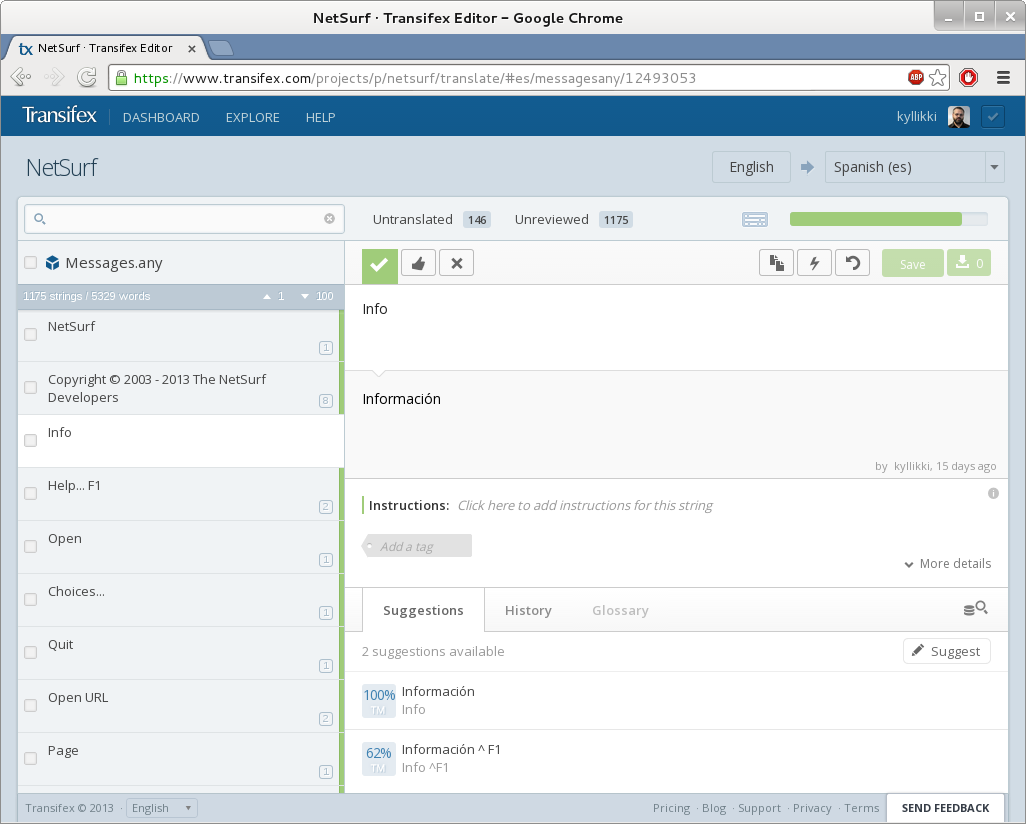
A transifex project was created and the english po file uploaded as the initial resource. A french language was added and the online editor used to provide translations for some strings. The PO resource file for french was exported and the tool executed with LANGUAGE=fr and the french translation seen.

This proved the trivial workflow was straightforward to implement. It also provided insight into the need to automate the process as the manual website operation would soon become exceptionally tedious and error prone.
Something more usefulTo get a better understanding of a real world workflow I needed a project that:
I selected the NetSurf web browser as it best fit this list.

Internally NetSurf keeps all the translated messages in a simple associative array this is serialised to an equally straightforward file named FatMessages. The file is UTF-8 encoded with keys separated from values by a colon. The Key is constrained to be ASCII characters with no colons and is structured as language.toolkit.identifier and is unique on identifier part alone.

This file is processed at build time into a simple identifier:value dictionary for each language and toolkit.

Transifex can import several resource formats similar to this, after experimenting with YAML and Android Resource format I immediately discovered a problem, the services import and export routines were somewhat buggy.

These routines coped ok with simple use cases but having more complex characters such as angle brackets and quotation marks in the translated strings would completely defeat the escaping mechanisms employed by both these formats (through entity escaping in android resource format XML is problematic anyway)

Finally the Java property file format was used (with UTF-8 encoding) which while having bugs in the import and export escaping these could at least be worked around. The existing tool that was used to process the FatMessages file was rewritten to cope with generating different output formats and a second tool to merge the java property format resources.

To create these two tools I enlisted the assistance of my colleague Vivek Dasmohapatra as his Perl language skills exceeded my own. He eventually managed to overcome the format translation issues and produce correct input and output.
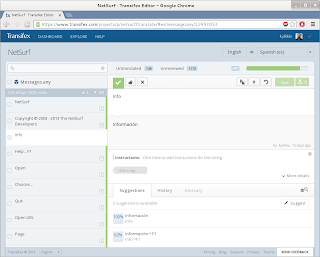
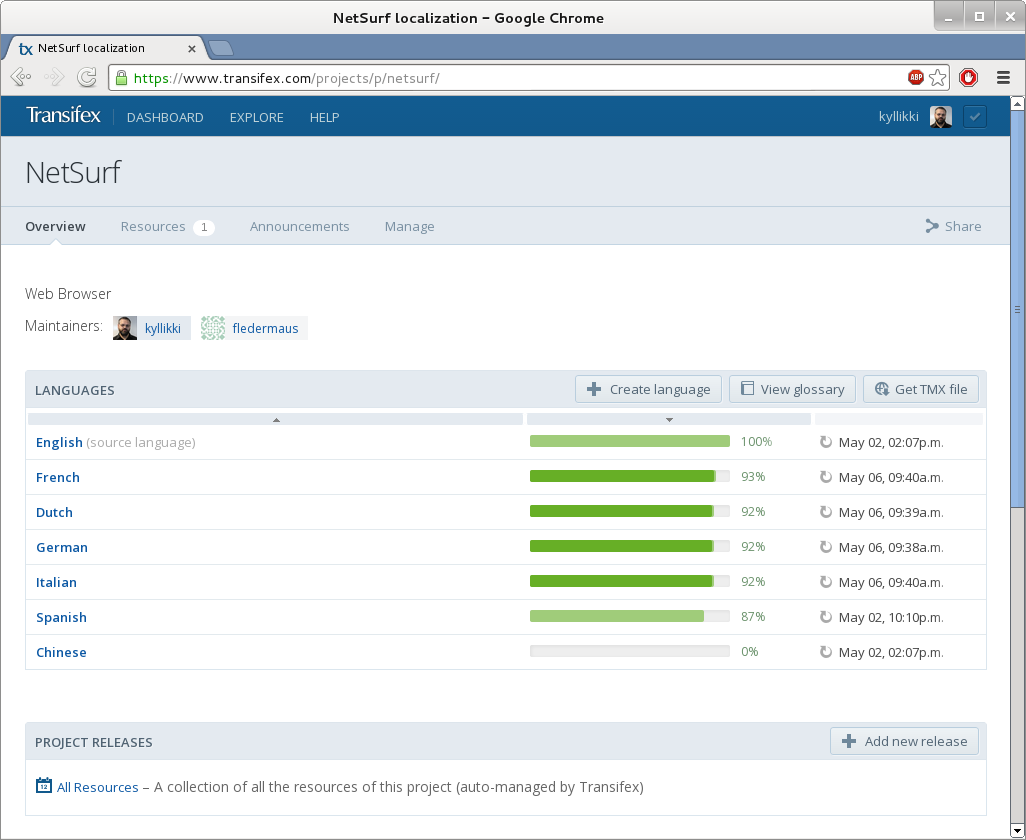
I used the Transifex platforms free open source product, created a new project and configured it for free machine translation from the Microsoft service, all of which is pretty clearly documented by Transifex.

Once this was done the messages file was split up tinto resources for the supported languages and uploaded to the transifex system.

I manually marked all the uploaded translations as "verified" and then added a few machine translations to a couple of languages. I also created spanish as a new language and machine translated most of the keys.

The resources for each language were then downloaded and merged and the resulting FatMessages file checked for differences and verified only the changes I expected appeared.

I quickly determined that manually downloading the language resources every time was not going to work with any form of automation, so I wrote a perl script to retrieve the resources automatically (might be useful for other projects too).

Once these tools were written and integrated into the build system I could finally make an evaluation as to how successful this exercise had been.
ConclusionsThe main things I learned from this investigation were:

Overall I think the final observation has to be that integrating translation services is not a straightforward operation and each project has unique challenges and requirements which reduce the existing platforms to compromise solutions.

15 May 2013

Craig Small: itools is back

My last post I said that I had to remove my internet query tools due to some bugs that were a concern. Some of the code was hard to maintain and probably had holes and I had noticed that it looped at times. I m happy to say that I have restored some of those tools now, still located at http://enc.com.au/itools This code is completely re-written in Python using the TurboGears toolkit which means it is a lot cleaner in how it works and how it looks. Some of the lookup tables use a database rather than an array for ease of updating and querying. The downside is the backends will take time. It currently only does nslookup queries and whois only works for IPv4 addresses. The domain name queries will be a while off as these are the most complicated to handle. To give you an idea, all IPv4 and IPv6 address information comes from 5 sources with two formats while domain names come from over 200 sources with about 40 formats. This means the information from Regional Internet Registries will be done first.

Next.

Previous.