Search Results: "agi"

12 March 2015

Hideki Yamane: localized directory name is harmful

Summary: xdg user directory spec is broken, I want to fix it.

One of annoyed things in Linux Desktop environment is localized user's directory (e.g. $HOME/ , instead of $HOME/Download). I know it is handled by XDG, my ~/.config/user-dirs.dirs has setting as below (by default).

XDG_DESKTOP_DIR="$HOME/ "
XDG_DOWNLOAD_DIR="$HOME/ "
XDG_TEMPLATES_DIR="$HOME/ "
XDG_PUBLICSHARE_DIR="$HOME/ "
XDG_DOCUMENTS_DIR="$HOME/ "
XDG_MUSIC_DIR="$HOME/ "
XDG_PICTURES_DIR="$HOME/ "
XDG_VIDEOS_DIR="$HOME/ "

So XDG utlility program changes it as setting, moves ~/Desktop to ~/ . However, it is NOT what users want.

Because if you would play with shell, you should also input localized characters in your terminal. Imagine, sometimes I download files with browser, then use it in terminal - download some tar.xz file and extract it. Well, it is downloaded in ~/ directory... it's not convinient - you cannot use tab completion without IME (input method editor), e.g. Anthy or Mozc for Japanese. And if you don't want to install it, what do you do? Use mouse to copy&paste?

Then, some Japanese people create webpages about "How to change localized user directory back to English name" ;)

Windows and OS X has localized Desktop, Download, Document directory, too. But it's not directory itself. In Windows, you can see " " (Desktop) with Windows Explorer but it is seen as just "Desktop" directory with cmd.exe (I don't know how to trick it. Maybe Windows registory magic). And in OS X, same thing with Finder. Those users don't annoy with localized directory name, it's friendly and convinient for cmd/shell users, and also for GUI (Windows' Explorer/OS X's Finder) users.


And also, it seems that localized directory name is good for average users who use File manager (Nautilus, etc). Just labeled with only English is not friendly to non-English native users like my mother ;) (Yes, localization is important!) But it's _better_ for *everyone* to set directory name with English _and_ localized with hardlink (and probably not harm anyone).

So lazyweb, could you tell me where should I go to talk this issue with upstream? It's not big thing, but still annoying. I can change it with xdg-user-dirs-update for my environment but it's just a workaround, not solution for this problem.

Gergely Nagy: Lost in a maze, looking for cheese

ApologyAs a twisted turn of fate, I need to start my platform with an apology. Last year, I withdrew my nomination, because my life turned upside down, and the effects of that are still felt today, and will continue to have a considerable footprint for the rest of my life. But this is not what I want to apologise for! I want to apologise because my nomination, my platform, and my plans are rather uncommon - or so I believe. Unlike past Project Leaders, if elected, I will not have as much time to travel, as some of them. Nor will I have the resources to do all the things one may expect from a Project Leader. But - as you'll read later - I consider this both the biggest weakness and the greatest strength of my platform.Furthermore, I will not be available from the second half of the voting period until after the new Project Leader's term starts: I'll be getting married, and will enjoy a nice honeymoon, and as such, my email will remain unread from the 9th of April until we're back on the 21st of April.On the mouse behind the keyboardMy name is Gergely Nagy, or algernon, for those of you who may know me by my online presence. I used to be a lot of things: a flaming youth, an application manager, package maintainer, upstream, ftp-assistant, a student, a mentor, a hacker. In the end, however, I am but a simple, albeit sometimes crazy person. I imagine, a lot of people reading this will not know me, and that is actually not only fine, but in my case, desirable.The Role of the Project LeaderThe role of the Project Leader, what people perceive about the role, and what is actually done by one single person changed dramatically over time. In some ways for the better, some ways for the worse. It should be sufficiently clear by now that if we combine all the things past Project Leaders have done, and what people expect the Project Leader to do, then not even all the time in the world would be enough to accomplish everything. On the other hand, we should not cut the responsibilities back to constitution-granted ones only.There has been some discussion about this very topic on debian-project@, back in February, with excellent observations by both past Project Leaders and the current one. I encourage my dear readers to stop reading this platform now, and read at least Lucas's mail. I'll be right here when you get back.Back? Good.You may notice that unlike in previous years, I do not have a Grand Vision, not in the same sense at least. No matter what I envision, however noble that vision may be, it is not the Project Leader's job to save the world, so to say. While I still believe that we have serious problems with motivation, inspiration and innovation within the project, the Project Leader is the wrong person to try and solve these issues with.Apart from the constitutionally required responsibilities, the primary purpose of the Project Leader in my opinion, is to be an enabler: the Project Leader is not a front runner to lead the herd to victory, but a gentle shepherd to make them happy.HappyThere are many ways to make people happy. One such way is to enable them to pursue their passion - and not just enable them, but encourage and fuel that passion, too! -, to remove barriers, to empower them, or in a lot of cases, to include them in the first place. My vision is a project that is greater than just an amazing distribution. More than a role model for technical excellence. I want to do away with territorial pissings (with which I don't mean to imply that this would be the general atmosphere within the project - far from it!), and would rather see a warm, welcoming culture within the project - the kind of "I'm home!" feeling I had at the DebConfs I had the privilege to attend -, on public and private media alike.That is the vision I have, but I can't do it. At best, I can hope to enable people much better at the these things to do what needs to be done. I wish to take the burden of administration, bureaucracy off their shoulders, so they can focus on what they do best. I feel that this is the most important part of being a Project Leader: to enable the project to grow. And this is why I feel that most of you not knowing my name is an advantage here: When you look at a beautiful flower, you admire the flower itself, rarely the gardener.In the endI wish to be the Project Leader no one remembers. I'd rather see people remember all the great things the Project - as a whole - accomplished, for there are many. My purpose is to let You pursue your passion, which in turn enables even more people to pursue their happiness, and allows the greater Free Software community to bask in the warm glow of accomplished dreams.

11 March 2015

Joey Hess: 7drl 2015 day 5 type directed spell system development

I want my 7drl game Scroll to have lots of interesting spells. So, as I'm designing its spell system, I've been looking at the types, and considering the whole universe of possible spells that fit within the constraints of the types. My first throught was that a spell would be a function from World -> World. That allows any kind of spell that manipulates the game map. Like, for instance a "whiteout" that projects a stream of whitespace from the player's mouth. Since Scroll has a state monad, I quickly generalized that; making spell actions a state monad M (), which lets spells reuse other monadic actions, and affect the whole game state, including the player. Now I could write a spell like "teleport", or "grow". But it quickly became apparent this was too limiting: While spells could change the World map, the player, and even change the list of supported spells, they had no way to prompting for input. I tried a few types of the Event -> M () variety, but they were all too limiting. Finally, I settled on this type for spell actions: M NextStep -> M NextStep. And then I spent 3 hours exploring the universe of spells that type allows! To understand them, it helps to see what a NextStep is:
type Step = Event -> M NextStep
data NextStep = NextStep View (Maybe Step)
Since NextStep is a continuation, spells take the original continuation, and can not only modify the game state, but can return an altered continuation. Such as one that prompts for input before performing the spell, and then calls the original continuation to get on with the game. That let me write "new", a most interesting spell, that lets the player add a new way to cast an existing spell. Spells are cast using ingredients, and so this prompts for a new ingredient to cast a spell. (I hope that "new farming" will be one mode of play to possibly win Scroll.) And, it lets me write spells that fail in game-ending ways. (Ie, "genocide @"). A spell can cause the game to end by returning a continuation that has Nothing as its next step. Even better, I could write spells that return a continuation that contains a forked background task, using the 66 line contiuation based threading system I built in day 3. This allows writing lots of fun spells that have an effect that lasts for a while. Things like letting the player quickly digest letters they eat, or slow down the speed of events. And then I thought of "dream". This spell stores the input continuation and game state, and returns a modified continuation that lets the game continue until it ends, and then restores from the point it saved. So, the player dreams they're playing, and wakes back up where they cast the spell. A wild spell, which can have different variants, like precognitive dreams where the same random numbers are used as will be used upon awaking, or dreams where knowledge carries back over to the real world in different ways. (Supports Inception too..) Look how easy it was to implement dreaming, in this game that didn't have any notion of "save" or "restore"!
runDream :: M NextStep -> M NextStep -> (S -> S) -> M NextStep
runDream sleepcont wakecont wakeupstate = go =<< sleepcont
   where
         go (NextStep v ms) = return $ NextStep v $ Just $
        maybe wake (go <=<) ms
         wake _evt = do
                 modify wakeupstate
                 wakecont
I imagine that, if I were not using Haskell, I'd have just made the spell be an action, that can do IO in arbitrary ways. Such a spell system can of course do everything I described above and more. But, I think that using a general IO action is so broad that it hides the interesting possibilities like "dream". By starting with a limited type for spells, and exploring toward more featureful types, I was able to think about the range of possibilities of spells that each type allowed, be inspired with interesting ideas, and implement them quickly. Just what I need when writing a roguelike in just 7 days!
Fun comment thread on reddit

10 March 2015

Joey Hess: 7drl 2015 day 4 coding through exhaustion

Slow start today; I was pretty exhausted after yesterday and last night's work. Somehow though, I got past the burn and made major progress today. All the complex movement of both the player and the scroll is finished now, and all that remains is to write interesting spells, and a system for learning spells, and to balance out the game difficulty.
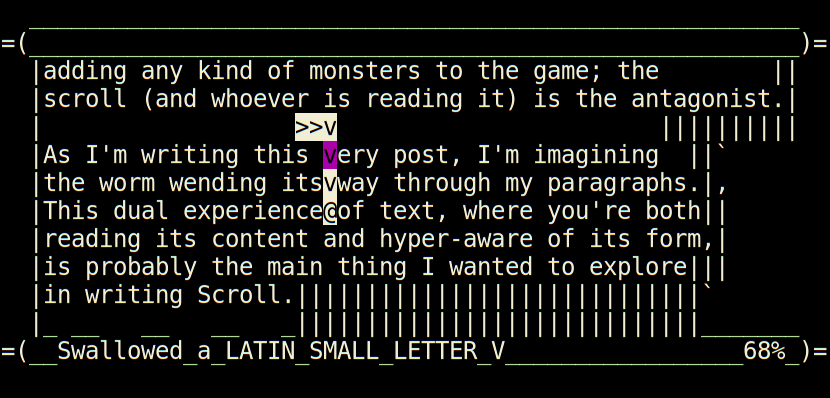
I haven't quite said what Scroll is about yet, let's fix that: In Scroll, you're a bookworm that's stuck on a scroll. You have to dodge between words and use spells to make your way down the page as the scroll is read. Go too slow and you'll get wound up in the scroll and crushed. The character is multiple chars in size (size is the worm's only stat), and the worm interacts with the scroll in lots of ways, like swallowing letters, or diving through a hole to the other side of the scroll. While it can swallow some letters, if it gets too full, it can't move forward anymore, so letters are mostly consumed to be used as spell components. I think that I will manage to get away without adding any kind of monsters to the game; the scroll (and whoever is reading it) is the antagonist. As I'm writing this very post, I'm imagining the worm wending its way through my paragraphs. This dual experience of text, where you're both reading its content and hyper-aware of its form, is probably the main thing I wanted to explore in writing Scroll. As to the text that fills the scroll, it's broadly procedurally generated, in what I hope are unusual and repeatedly surprising (and amusing) ways. I'm not showing any screenshots of the real text, because I don't want to give that surprise away. But, the other thing about Scroll is that it's scroll, a completely usable (if rather difficult..) Unix pager!

9 March 2015

Ulrike Uhlig: Final report from the Outreach Program round 9

Between december 9th 2014 and march 9th 2015 I ve been working as an intern for Debian on Improving AppArmor support in Debian. Progress Before the internship started, I had no clue about AppArmor at all. Reading the Wikipedia page and the AppArmor wiki did barely enlighten me. At least, until I got my hands dirty and installed and activated it. I was able to do this only because there was already some basic documentation on the Debian wiki on how to get AppArmor running on a Debian system. When the internship started I felt a little bit lost. I started to read the documentation and to play around with some AppArmor profiles. But the error messages I saw and the profiles I opened for reading overwhelmed me. What did all these lines mean? Then one mentor briefed me about the current status of AppArmor in Debian. I took many notes and tried to bring some order into the information I was being given. These notes became the first page of the documentation and my first blog post.
Surprise: suddenly I was in the middle of knowing what we were talking about and how the next few weeks would look like. To start with, I have set up a test environment and continued to test some of the profiles which came with the packages I had installed, namely apparmor-profiles-extra which provided me with a profile for Pidgin. I was very much interested in securing this several thousand lines long C-code application on my machine! As a Pidgin user, I noticed immediately that one of my favourite features pidgin blinklight threw an error in the logs. I tried to fix it on my test VM and eventually made it work. Now knowing that such fixes should first be done upstream, i cloned the corresponding upstream repository and sent my first patch. It was not easy at first to switch to another VCS than Git, although I had been using Bazaar and Subversion years ago. Shortly afterwards, I saw my patch showing up on the upstream mailing list, and some days later it got merged. That was a huge encouragement. I was now able to write more documentation on how to contribute upstream. In order to organize the documentation, we ve set up some User Stories. I did not know about this tool before and had quite a hard time to grasp all the details but it proved to be very useful as some pages started to become long and confusing. Writing the documentation took up a lot of time, but before being able to write anything down, I needed to work everything out! This way I incidentally learned how to interact with many parts of Debian s infrastructure: While playing around with the tools provided to inspect AppArmor status on the system, I even accidentally found a little bug in one of the upstream tools. It got fixed very quickly after I mentioned it on the AppArmor team s mailing list. Organization Although I was uncomfortable with this in the beginning, we organized public meetings every two weeks on IRC. These meetings were also attended by MeetBot who took care of taking notes and leaving a trace of our discussions.
Based on the meetings, I maintained a progress page and todo list on the Debian wiki, which helped us to know which tasks were planned for the next two weeks. Before each meeting I sent a status update to the mailing list, so the mentors could catch up with my work. During the meetings I was not only asked to provide feedback on progress but also on mentoring itself. It proved to be very useful to be able to say where I was stuck and if the mentoring process worked out well enough (it did!).
Furthermore, I got regular, detailed and pedantic (thanks for trying to push me to perfection!) feedback on the team s mailing list. The mentors had introduced me on the upstream IRC channel in the beginning, so most of the people who are active there knew about my existence, something which also proved to be handy! Future The internship time is over, but some work remains to be done. As a new member of the AppArmor Packaging team, I am committed to make it happen: Thanks I feel much more confident after these three months, technically but also personally. Thank you: Holger Levsen and intrigeri for mentoring and encouraging me on this journey and to upstream contributors Christian Boltz, Steve Beattie (and everybody else I might forget here) for providing help and feedback. The Debian community (OPW organizers, sponsors, Alioth maintainers, planet.debian.org maintainers although my posts don t show up anymore :( -and others) has been very friendly and welcoming and I am very happy to be part of it.

Axel Beckert: Do we need a zsh-static package in Debian?

Dear Planet Debian, the Debian Zsh Packaging Team (consisting of Michael Prokop, Frank Terbeck, Richard Hartmann and myself) wonders if there s still a reason to build and ship a zsh-static package in Debian. There are multiple reasons: So we ask you, the Planet Debian reader:

Do you need Debian s zsh-static package? If so, please send an e-mail to us Debian Zsh Maintainers <pkg-zsh-devel@lists.alioth.debian.org> and state that you use zsh-static, and, if you want, please also state why or how you re using it. Thanks in advance! Mika, Frank, RichiH and Axel

8 March 2015

Hideki Yamane: community booth @ "developers summit 2015" in Tokyo (19th&20th Feb)

I'm back to Developers Summit at (Meguro Gajoen), Tokyo. I was an attendee 2 years ago, and I'm at community booth this year :)

We were at booth "Debian JP Project" (Japanese local Debian community) and other distro people (Ubuntu Japanese Team, openSUSE, VineLinux)


Its conference mostly focuses "development style" in companies, not FLOSS -Keyword: Agile (Scrum), DevOps, using cloud infrastructure, IoT, etc. So, we're a bit stranger but enjoyed chat with some people.

4 March 2015

Zlatan Todori : Interviews with FLOSS developers: Paul Wise

After starting with Joey Hess, we continue with Paul Wise. What makes his star to shine are many things such as being a DSA (Debian System Administrator), a helpful hand on mailings list, encouraging people to join Debian teams but most of all - he has encyclopedia knowledge on Debian as a whole which he gladly shares with anyone who asks (very fast response on IRC channels). It is almost impossible for any single person to count all Debian teams, work and places - to know most of those things, you can image the vast knowledge which Paul has. The legend says that his brain has better and faster search engine algorithm on Debian related queries than all other engines combined. So lets see what he has to share with world. me: Who are you? pabs: Paul Wise (pabs) and I have to say that I'm no-where near as knowledgeable as your intro suggests. me: How did you start programming? pabs: Messing around with fractals and graphics things in MS BASIC. me: How would you now advise others to start programming? pabs: Pick an issue in a tool you use, investigate how the tool works and how you can change it, fix that and contribute the change back to the project that created that tool. In the process you will learn skills, interact with the community and contribute to the project. me: Setup of your development machine? pabs: Lenovo Thinkpad with external monitor, Debian testing and some tweaks me What is your preferable language (for hacking)? Why? How do you compare it to other languages? pabs: I currently prefer Python for its readability. It still has some rough edges though the documentation covers them fairly well. I generally pick up new languages when working on projects written in them. Haskell is next on the horizon due to Nikki and the Robots. me: Describe your current most memorable situation as software developer/hacker? pabs: I had a great time creating fractals in BASIC, learning about the Mandelbrot set, L-systems and more. My days and nights of hacking on frhed (a GPLed hex editor for Windows) to help me cheat at Civilisation were pretty memorable. frhed led to my work on reverse engineering the CHM file format (a documentation format for Windows programs). A stand-out moment during my time with Debian was hacking on the derivates census patch generation code during the Debian UK BBQ weekend, surrounded by geeks playing Portal, cooking things, hacking on Debian and generally having a good time (thanks Steve!). me: Some memorable moments from Debian conferences? pabs: There are so many; meeting Debian folks, playing Mao once and then never again, late night games of werewolf, both delectably delicious and hideously disgusting cheeses, fried insects, day trips to beautiful landscapes, inspiring keynotes, exciting BoFs, secret IRC channels for planning surprise birthday parties, blue hair, wet air, blocks of fried cheese, a vast quantity of icecream, pants, geeks in the surf, volcanoes, hiking, a wonderful view, a uni-cycling stormtrooper & more. me: How do you see future of Debian development? pabs: I hope we will continue to exist and uphold our principles for the foreseeable future. I don't have any crystal balls though. me: You recently became member of Debian DSA - what is that like, what roles do you have and what tasks are in front of DSA? pabs: We wrote a bit of text about that for DPN recently. me: You have large knowledge on Debian and you share it with anyone who wants to know more. What motivates you to do so? pabs: I want the operating system I personally rely on to exist into the future, helping folks work on and join Debian can help with that. me: Why should developers and users join Debian community? What makes Debian a great and happy place? pabs: Every Debian contributor has different reasons for joining the community. Personally the Social Contract, the DFSG and the spirit and culture behind them are the main reason to be involved. I also like our many efforts towards technical excellence and correctness. Of course I've made a number of good friends over the years, especially as a result of attending DebConf every year since 2007. me: You are member of Debian publicity team which writes Debian news - do you need more people to join that team and how can they start? pabs: Since there is an infinite amount of work to do, pretty much every part of Debian always needs help, that includes the publicity team. We published a post about ways to help here. me: If someone wants to contribute to Debian in terms of packaging, can they do it anonymously (for example over Tor network, does Debian have .onion address)? pabs: Due to Debian's penchant for transparency it is harder but there are definitely package maintainers who have built up a reputation for good work under a pseudonym over the years and become Debian contributors as a result. I'm not aware of completely anonymous package maintainers but there are definitely people who file bugs using one-off pseudonyms, which is almost the same thing as anonymously. There are definitely Debian contributors and members who use Tor while contributing to Debian. In fact, as Debian is very highly dependent on OpenPGP and the best practices for OpenPGP include refreshing your keyring slowly over Tor, so probably quite a number of Debian contributors use Tor. As far as I know Debian itself does not run any Tor relays or onion services. me: What are places that non-packaging developers and people could join and help spread Debian even more? pabs: There are many ways to help Debian, including non-technical ones. Unfortunately our web page about helping Debian isn't quite up-to-date with all of them but a few more are to volunteer at DebConf, helo with artwork requests, speak about Debian at events or even come up with ideas for projects. Whatever skills you have, Debian can probably make use of them. If you aren't sure where to start, jump on the debian-mentors mailing list or IRC channel and we can probably guide you to the right place within Debian. Don't worry about not being skilled enough, everyone starts somewhere. me: How do you see Debian will manage webapps? pabs: Personally I prefer locally installed software, standard data formats and standard data transfer protocols to the wild webapps world but I understand they are becoming very popular to produce and use due to the ubiquity of the web browser platform. Antonio Terceiro is mentoring a project for this year's newcomer mentorship programs (outreachy/gsoc) that aims to improve support for installing web apps on Debian installations. I hope it succeeds as it could help make Debian more popular on servers and home servers in particular. me: How would you advise Debian (and other FLOSS users) to setup their machine in terms of security and anonymity? pabs: All technology has upsides and downsides. I would advise anyone to analyse their situation and protect themselves accordingly. For example if you have a bad memory, full disk encryption, which is based on pass-phrases might lead to data loss and physical security might be a better choice for protecting your data. The right choices around technology are very much a personal thing. me: Is it better to setup xmonad (because it is Haskell based WM) with small dependency chain or GNOME (because it is getting sandboxed apps) in term of security and privacy implications? pabs: Again, the right choices around technology are very much a personal thing. Due to the design of X11, both of these are approximately equivalent from a window-manager security properties point of view, that is to say, pretty bad. Wayland is one of the possible X11 successors and offers much better security properties. GNOME folks are working on switching to Wayland. Ultimately though it comes down to how each person uses their window manager and which software they run under it. me: Should Debian join Tor project as distro that installs Tor relays by default - should it offer that as option in installer in Debian 9? pabs: Running a Tor relay requires a reasonably fast and reliable Internet connection and should be a conscious decision on behalf of the sysadmin for a computer so Debian probably shouldn't install them by default. If tasksel gets support for installing tasks from Debian Pure Blends, then we could add a Tor relay task to the Debian Sanctuary Pure Blend. me: Have you ever considered joining initiatives such as FreedomBox? pabs: I was quite moved by Eben Moglen's talk at DebConf10 in New York and the resulting BoF. It seemed like a very ambitious project but I didn't really have the knowledge, skills or time to contribute yet. me: Are you a gamer? Valve Steam games are offered for free to Debian Developers - do you use steam and play Valve games? Your thoughts on Steam and non-free Linux gaming? pabs: I play computer games occasionally, all from Debian main or ones that I'm packaging. 0ad is my current go-to for a bit of gaming. I don't have any experience with Steam or non-free games on Linux. me: Is there something you would change in FLOSS ecosystem? pabs: Various folks have highlighted new and ongoing challenges for the FLOSS ecosystem in various places in recent years. Something that I would like to highlight that does not get talked about enough is the choices we make around our digital artefacts. This is the discussion around "preferred form for modification" or "source". The "source" for a particular digital artefact is a deliberate choice on behalf of the authors. Often generated files are distributed alongside the "source" without any instructions for reproducing the generated files from the "source". It sometimes happens that FLOSS contributors forget to distriute what they have chosen as "source", instead just distributing the generated files. This is a fairly well known issue but still happens. What isn't thought about quite as much is that the choice of "source" has consequences for future development possibilities of that "source". Some forms of "source" are more expressive than others, can be modified in a wider variety of ways and are better choices in general. Sometimes the consequences of choosing less expressive forms are mild and other times they are quite important. I hope more people will start to think about these choices. Some examples where, in my opinion, various people could have made better choices are listed in the mail I sent to the games team list last year. Another thing I would like to highlight is the work that organisations like Software Freedom Conservancy and Software in the Public Interest do to protect, defend, promote and support FLOSS projects. It is very important work that needs our interest and support. me: Can FLOSS world create great alternatives to Viber, Dropbox, WhatsUp, Facebook, Skype and other non-free services? pabs: I think that the FLOSS world has already created alternatives to all of those. The success of non-free services doesn't take these alternatives away but it does mean some of them are less useful because some of them are the kind of tools that become more useful with a larger amount of people using them. I don't know what it would take for the FLOSS alternatives to achieve similar success as network effects are hard to overcome. Hopefully mako is right and the network effects are overrated. me: Your thoughts and compare Cloud, IaaS, PaaS, SaaSS? To what should the FLOSS world pay more attention and energy? pabs: Initially I dismissed these as buzzwords and a threat to Free Software. These days I view them as potential opportunities for Free Software. Cloud-related technologies such as OpenStack and virtual machines can make private compute farm hardware more flexible and useful to their owners. IaaS providers can be used to run Debian more simply and cheaply and therefore bring Debian to more people than possible with hardware. PaaS providers can be used to run Free Software services. SaaSS can be based entirely on Free Software and respect users. Of course, just like running Free Software on hardware (proprietary or libre), cloud technology, IaaS, PaaS and SaaSS all come with downsides. The FLOSS world should aim to inform users of our software of these downsides. For example, the Debian installer could note that it is running on Intel CPUs with a proprietary BIOS and various proprietary software running, that it is running on a mobile phone with a locked bootloader, that it is running in a Xen VM on machines owned by Amazon. Free Software services could note they are running on Google App Engine etc. Free Software web browsers, chat clients etc could note when they are connecting to proprietary network services. All these notes could inform users about the downsides present in the particular situation encountered. There is also much work to be done making it easier to run Free Software on top of or use Free Software to connect to all manner of platforms from lowRISC to UEFI to VMware to Google App Engine to GitHub to Facebook. The more places Free Software can reach, the more people will be exposed to the philosophy behind it and the more potential there is for folks to join the community. While co-option of the FLOSS world is a dangerous certainty, co-option of proprietary platforms might be able to expand the reach of the philosophy behind Free Software. me: Your thoughts on Purism (the open hardware laptop initiative that got recently funded on CrowdSupply)? pabs: I don't know enough about that to comment but personally I am more interested in a laptop based on a libre CPU architecture. The RISC-V ISA and the lowRISC project seems to be one of the more promising possibilities at this point in time. me: Did you watch Citizenfour - comments on it? pabs: I've seen the trailer and look forward to watching it at some point, I read there might be a screening at DebConf15.

2 March 2015

Gergely Nagy: Distributed Version Control from another angle

I've been using distributed version control systems for a good while, started with TLA back in 2001, when it was still a bunch of shell scripts and was simply called "Arch". I jumped the Git bandwagon quite early too, sometime around May 2005, I believe, though it was only something to test and play with on the side: I didn't migrate my projects over yet. There are many reasons why I preferred these over the systems I used in the past (RCS and CVS; never considered Subversion an option), most of those reasons have been discussed at length over the years, and there's no reason to do so again.The reason for this post, is because I read a blog post about why Git and the other DVCSes fall short. There are a number of things in that article that I find... well, lets just say misinformed. I'll try to explain why.But here's the rub
I have wanted to have the full history while offline a grand total of maybe about six times. And this is merely going down over time as bandwidth gets ever more readily available. If you work as a field tech, or on a space station, or in a submarine or something, then okay, sure, this is a huge feature for you. But for the rest of us, I am going to assert that this is not the use case you need to optimize for when choosing a VCS.
I'm neither a field tech, nor do I work on a space station or a submarine. Yet, having the full history available locally has been crucial for my work for at least the past six years. Initially, I worked offline primarily, because my internet connection was incredibly limited (slow, expensive and unreliable), yet, I had a habit of committing small changes often. I needed a full clone to work effectively, and conveniently. Throw-away branches and all that - I needed them local, I didn't have the resources to push them online every time I wanted a merge.But now that I have fast and reliable internet, why do I need the full history on my own computer? I do, because I do much more research than I do development. The vast majority of my work between 2010 and 2012 involved reading histories, cherry picking and so on. About six hours a day, I was reading the past. Having the full history locally is a terrific aid when your job involves digging through it.Between 2013 and 2014, the amount of history reading dropped significantly, but I still worked with long-lived branches a lot, branches where history matters, where having easy and fast access to them is indispensable. I still had to find changes based on content (not commit message, branch, date or anything - content) on a daily basis. Hitting the network for each and every search would have wasted not only tremendous bandwidth and processing power on the server, but also a significant amount of time.If you do more maintenance and research, or follow a good number of branches (or forks), with the intent to merge and cherry-pick actively from them, having all the histories available locally is a huge improvement. I'm happy to pay the price of "wasting" disk space to have this available. I couldn't work otherwise. Without full, local history, the things I did for syslog-ng would not have been possible. No maintenance, none of the features I implemented, none of the fixes I found. Why? Because I rely on the project's history to aid me in learning the whys, not just the hows.Thank you, but - perhaps unlike others - I like to learn from the past, and prefer doing it efficiently.Say goodbye to blobs (or your sanity (and sometimes both))
You know what kind of external binary asset management system works really well? Subversion. Turns out it works tolerably for source control, too. Maybe you should take a look at it.
Sure, some systems are better at managing binary assets. Git - and usually DVCSes - are terrible at it. There's nothing stopping anyone from using two systems: one for source, another for data. Mind you, I am extremely happy with git-annex. I disagree with Subversion being tolerable for source control. I'd turn this assertion around instead: You know what kind of system works really well for source code? Git. Turns out it works tolerably as an external binary assest management system, too. Maybe you should take a look at it.But then, I rarely need to work with blobs, so I'm likely not the best person to disagree here.Say goodbye to sane version synchronizationOkay, so this part of the article is ill-titled, I believe. Large repositories and version synchronisation are two different, not necessarily related topic. Granted DVCSes may not be the best fit for large repositories, but neither are centralised version control systems, based on my past experience. I had the misfortune of working with a roughly 3-4Gb (checked out) project, with extensive history, managed with a centralised version control system, without local history. It was terrible (and blame was so slow and expensive that we were told never to use it, because it crashed the server). While the system allowed us to have a reasonable overview over the whole project, but it utterly failed at allowing us to work at the component level. How do I see which version of component X we had in project release A? Or the version of component Y we had two weeks ago? Or what if we have component M, made up from components J and K, and belonging to component Z? Good luck managing that in a single repository.With TLA, we had configs, which were a bit cumbersome to use, but captured most of the essential parts of managing component bundling and hierarchical versioning far better than any other solution I've seen so far. I've yet to find an acceptable solution, but I'm convinced it will not have anything to do with centralised systems. You can't capture the delicate relations there.Say what again, I dare you, I double dare you
All of the above might be almost tolerable if DVCSes were easier to use than traditional SCMs, but they aren t.
I'm sorry, but have you tried managing a decently sized project, with a large history, built from multiple components with a traditional SCM? Because that is a colossal pain in the backside.Does Git's UI suck? Yes. But so did CVS's and Subversion's. If you rely on the command-line tools, you're going to feel the pain. That is why you use the IDE integration you surely have, which makes the most common tasks a breeze. That may sound like a git-apology, but remember, we did the same with every other version control system, because smart people prefer integration, and want the computer to work for them.
And yet, when someone dares to say that Git is harder than other SCMs, they inevitably get yelled at, in what I can only assume is a combination of Stockholm syndrome and groupthink run amok by overdosing on five-hour energy buckets.
If you feel the need to understand the innards of Git - then yes, it is harder than traditional SCMs. It is distributed, and different than what you're used to. If you do not have prior knowledge though, the difference in learning the internal working of Git and - say - Subversion all that different. And if you do not care how it works down below (and I dare say, a lot of developers should not, and do not care), then there is nothing to learn, apart from your IDE integration, which ain't different from a traditional SCM's.Mind you, I found it both interesting, and beneficial to learn Git's inner workings. Not only because it allowed me to make better use of my VCS, but because it taught me a bunch of things I could make use of elsewhere. I learned nothing from traditional SCMs.Do you hear the people sing, singing the song of angry men
There is one last major argument that I hear all the time about why DVCSes are superior, which is that they somehow enable more democratic code development.
The reason Git and other tools make code contribution easier is not GitHub pull requests (although, for drive-by contributions those are pretty useful too). The reason they make contribution easier is because you have your own copy of the full history. You can create your own branches easily, you can work with it as if you were the owner. For one-off contributions, that is no real advantage, I'll give you that. It takes more effort to fork & do a PR on GitHub, than to send a patch, I'll also agree with that.But once you start working with a project for more than a few patches, when you want to work with its history too, once you have long-lived branches, the local copy quickly becomes a great asset. Once you want to submit more than a few changes, you won't have to repeat a all steps. And not only that: since you have the full history, merging upstream changes (or just cherry picking from them), rebasing your work, and many other tasks become simpler.That is what it buys you, that is why it makes contribution easier. GitHub pull requests are an icing over the cake at best (and there are a good number of cases where the icing is completely unnecessary, because it doesn't go well with the cake).In closingIn closing, I'd like to highlight that different projects have different requirements. For example, I understand why Facebook, Google and a number of others use a single, huge repository. I happen to hate that setup, and would find working in such an environment horrible. But luckily, I don't work for those companies, and they don't listen to me, either, so everyone's happy. That does not mean I would go out and tell them they're wrong to use such a centralised, single-repository setup. For their use, in their situation, for their requirements, that may be the better option. For mine, not so much.In the end, what we need to realise is that there is no single tool that will fit all needs. There are tasks where Git is a terrible choice, but that does not make it terrible for all cases. Similarly, there are cases where Subversion is superior (I assume - I didn't have the misfortune of meeting with such a case).Instead of bashing the DVCS world, and assuming the Big Company use cases are all that matter, and that everyone uses the tools the same way, accept that some use it to achieve things you didn't think of, jobs you didn't consider.

1 March 2015

Robert Edmonds: Converting to --upstream-vcs-tag

Recently, the Google protobuf developers announced a migration of their project's source code from an svn repository to a git repository. Up until this point, the Debian protobuf package repository had only tracked upstream development by embedding upstream release tarballs using gbp import-orig with pristine-tar. It would be nice to smoothly migrate the packaging repository to additionally make use of the --upstream-vcs-tag option to gbp import-orig, the advantages of which have been well described by Russ Allbery. This turned out to be harder than expected, so for reference I documented the steps I took below. Note that this packaging repository uses the default gbp import-orig repository layout, where upstream sources are placed on a branch named upstream, and the Debian branch is named master. Add an upstream remote configured to track the upstream repository's master branch and tags.
$ git remote add --tags --track master upstream https://github.com/google/protobuf.git
The upstream remote shouldn't be confused with our upstream branch. Note that git-remotes are local to the repository, so the upstream remote should probably be documented in the debian/README.source file. Fetch the upstream branch and tags.
$ git fetch upstream
warning: no common commits
remote: Counting objects: 5210, done.
remote: Compressing objects: 100% (861/861), done.
remote: Total 5210 (delta 3869), reused 5194 (delta 3855)
Receiving objects: 100% (5210/5210), 3.57 MiB   1.43 MiB/s, done.
Resolving deltas: 100% (3869/3869), done.
From https://github.com/google/protobuf
 * [new branch]      master     -> upstream/master
 * [new tag]         v2.6.0     -> v2.6.0
$
We now have a git-remote upstream, a remote-tracking branch upstream/master which corresponds to the master branch that upstream makes releases from, and a release tag v2.6.0. Note that the remote-tracking branch upstream/master shouldn't be confused with our master branch. Up until this point, our upstream branch has been synthetically generated by importing upstream's release tarballs with gbp import-orig. We need to merge this synthetic history with upstream/master. Unfortunately, I couldn't find a way to do this without using a temporary branch.
$ git checkout -b tmp upstream/master
Branch tmp set up to track remote branch master from upstream.
Switched to a new branch 'tmp'
$ git merge -s ours -m \
  "Merge the original 'upstream' branch with upstream's new master branch" upstream
Merge made by the 'ours' strategy.
$ git checkout upstream
Switched to branch 'upstream'
Your branch is up-to-date with 'origin/upstream'.
$ git merge --ff-only tmp
Updating 7ed940b..9ba221e
Fast-forward
 CHANGES.txt                                                          49 +-
 COPYING.txt => LICENSE                                                0
 Makefile.am                                                          64 +-
 Makefile.in                                                        1041 --
 README.txt => README.md                                              49 +-
[...many more lines...]
$ git branch -D tmp
Deleted branch tmp (was 5f18f02).
$
There are now an additional 400 or so commits on our upstream branch, corresponding to the new git repository history published by upstream. Import the 2.6.0 release tarball against the upstream v2.6.0 tag, using the --upstream-vcs-tag option.
$ git checkout master
Switched to branch 'master'
Your branch is up-to-date with 'origin/master'.
$ gbp import-orig -u 2.6.0 --upstream-vcs-tag=v2.6.0 ~/debian/tarballs/protobuf_2.6.0.orig.tar.gz
gbp:info: Importing '/home/edmonds/debian/tarballs/protobuf_2.6.0.orig.tar.gz' to branch 'upstream'...
gbp:info: Source package is protobuf
gbp:info: Upstream version is 2.6.0
pristine-tar: committed protobuf_2.6.0.orig.tar.gz.delta to branch pristine-tar
gbp:info: Merging to 'master'
gbp:info: Successfully imported version 2.6.0 of /home/edmonds/debian/tarballs/protobuf_2.6.0.orig.tar.gz
$
The upstream branch now contains a mixture of the original series of release tarball content imported by plain gbp import-orig and the upstream/master branch as published by upstream. Updating the Debian packaging repository when new upstream releases occur only requires a git fetch to pull down upstream's updated git history and release tag and using the --upstream-vcs-tag option when importing the release tarball with gbp import-orig.

28 February 2015

Mathieu Parent: Hello Planet Debian

After more than five years of being a Debian developer, here is my first post on Planet Debian! I currently maintain 165 packages. My focus has changed since 2009, but those are still mostly sysadmin packages: Now that the first post is online, I will try to keep up!

26 February 2015

Daniel Pocock: PostBooks accounting and ERP suite coming to Fedora

PostBooks has been successful on Debian and Ubuntu for a while now and for all those who asked, it is finally coming to Fedora. The review request has just been submitted and the spec files have also been submitted to xTuple as pull requests so future upstream releases can be used with rpmbuild to create packages. Can you help? A few small things outstanding:
  • Putting a launcher icon in the GNOME menus
  • Packaging the schemas - they are in separate packages on Debian/Ubuntu. Download them here and load the one you want into your PostgreSQL instance using the instructions from the Debian package.
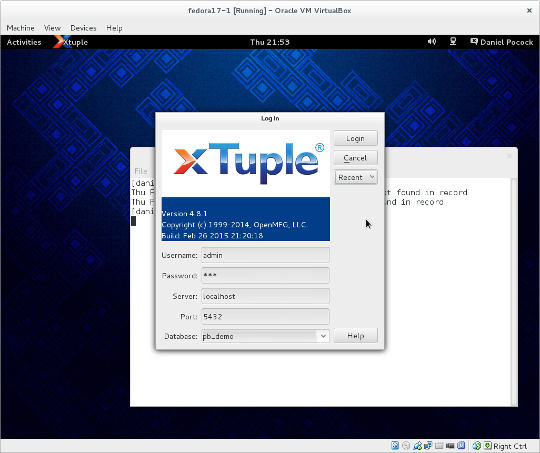
Community support The xTuple forum is a great place to ask any questions and get to know the community. Screenshot Here is a quick look at the login screen on a Fedora 19 host:

25 February 2015

Holger Levsen: 20150225-apparmor-user-stories

Developing is a use case too For whatever reason Ulrike's blog post about AppArmor user stories and user tags was not syndicated to planet.d.o, despite it should have been and despite planet admins nicely having looked into it. Whatever... As you might have guessed by now, the user stories referred to in this blog post are about developers supporting AppArmor (a kernel module for restricting capabilities of processes) in their Debian packages. So if you're maintaining packages and have always been pondering to look into this apparmor thingy, go read that blog post! Hopefully the next post will "magically" appear on planet again ;-)

23 February 2015

Enrico Zini: akonadi-build-hth

The wonders of missing documentation Update: I have managed to build an example Akonadi client application. I'm new here, I want to make a simple C++ GUI app that pops up a QCalendarWidget which my local Akonadi has appointments. I open qtcreator, create a new app, hack away for a while, then of course I get undefined references for all Akonadi symbols, since I didn't tell the build system that I'm building with akonadi. Ok. How do I tell the build system that I'm building with akonadi? After 20 minutes of frantic looking around the internet, I still have no idea. There is a package called libakonadi-dev which does not seem to have anything to do with this. That page mentions everything about making applications with Akonadi except how to build them. There is a package called kdepimlibs5-dev which looks promising: it has no .a files but it does have haders and cmake files. However, qtcreator is only integrated with qmake, and I would really like the handholding of an IDE at this stage. I put something together naively doing just what looked right, and I managed to get an application that segfaults before main() is even called:
/*
 * Copyright   2015 Enrico Zini <enrico@enricozini.org>
 *
 * This work is free. You can redistribute it and/or modify it under the
 * terms of the Do What The Fuck You Want To Public License, Version 2,
 * as published by Sam Hocevar. See the COPYING file for more details.
 */
#include <QDebug>
int main(int argc, char *argv[])
 
    qDebug() << "BEGIN";
    return 0;
 
QT       += core gui widgets
CONFIG += c++11
TARGET = wtf
TEMPLATE = app
LIBS += -lkdecore -lakonadi-kde
SOURCES += wtf.cpp
I didn't achieve what I wanted, but I feel like I achieved something magical and beautiful after all. I shall now perform some haruspicy on those oscure cmake files to see if I can figure something out. But seriously, people?

19 February 2015

Matthew Garrett: It has been 0 days since the last significant security failure. It always will be.

So blah blah Superfish blah blah trivial MITM everything's broken.

Lenovo deserve criticism. The level of incompetence involved here is so staggering that it wouldn't be a gross injustice for the company to go under as a result[1]. But let's not pretend that this is some sort of isolated incident. As an industry, we don't care about user security. We will gladly ship products with known security failings and no plans to update them. We will produce devices that are locked down such that it's impossible for anybody else to fix our failures. We will hide behind vague denials, we will obfuscate the impact of flaws and we will deflect criticisms with announcements of new and shinier products that will make everything better.

It'd be wonderful to say that this is limited to the proprietary software industry. I would love to be able to argue that we respect users more in the free software world. But there are too many cases that demonstrate otherwise, even where we should have the opportunity to prove the benefits of open development. An obvious example is the smartphone market. Hardware vendors will frequently fail to provide timely security updates, and will cease to update devices entirely after a very short period of time. Fortunately there's a huge community of people willing to produce updated firmware. Phone manufacturer is never going to fix the latest OpenSSL flaw? As long as your phone can be unlocked, there's a reasonable chance that there's an updated version on the internet.

But this is let down by a kind of callous disregard for any deeper level of security. Almost every single third-party Android image is either unsigned or signed with the "test keys", a set of keys distributed with the Android source code. These keys are publicly available, and as such anybody can sign anything with them. If you configure your phone to allow you to install these images, anybody with physical access to your phone can replace your operating system. You've gained some level of security at the application level by giving up any real ability to trust your operating system.

This is symptomatic of our entire ecosystem. We're happy to tell people to disable security features in order to install third-party software. We're happy to tell people to download and build source code without providing any meaningful way to verify that it hasn't been tampered with. Install methods for popular utilities often still start "curl sudo bash". This isn't good enough.

We can laugh at proprietary vendors engaging in dreadful security practices. We can feel smug about giving users the tools to choose their own level of security. But until we're actually making it straightforward for users to choose freedom without giving up security, we're not providing something meaningfully better - we're just providing the same shit sandwich on different bread.

[1] I don't see any way that they will, but it wouldn't upset me

comment count unavailable comments

16 February 2015

Julien Danjou: Hacking Python AST: checking methods declaration

A few months ago, I wrote the definitive guide about Python method declaration, which had quite a good success. I still fight every day in OpenStack to have the developers declare their methods correctly in the patches they submit. Automation plan The thing is, I really dislike doing the same things over and over again. Furthermore, I'm not perfect either, and I miss a lot of these kind of problems in the reviews I made. So I decided to replace me by a program a more scalable and less error-prone version of my brain. In OpenStack, we rely on flake8 to do static analysis of our Python code in order to spot common programming mistakes. But we are really pedantic, so we wrote some extra hacking rules that we enforce on our code. To that end, we wrote a flake8 extension called hacking. I really like these rules, I even recommend to apply them in your own project. Though I might be biased or victim of Stockholm syndrome. Your call. Anyway, it's pretty clear that I need to add a check for method declaration in hacking. Let's write a flake8 extension! Typical error The typical error I spot is the following:
class Foo(object):
# self is not used, the method does not need
# to be bound, it should be declared static
def bar(self, a, b, c):
return a + b - c

That would be the correct version:
class Foo(object):
@staticmethod
def bar(a, b, c):
return a + b - c

This kind of mistake is not a show-stopper. It's just not optimized. Why you have to manually declare static or class methods might be a language issue, but I don't want to debate about Python misfeatures or design flaws. Strategy We could probably use some big magical regular expression to catch this problem. flake8 is based on the pep8 tool, which can do a line by line analysis of the code. But this method would make it very hard and error prone to detect this pattern. Though it's also possible to do an AST based analysis on on a per-file basis with pep8. So that's the method I pick as it's the most solid. AST analysis I won't dive deeply into Python AST and how it works. You can find plenty of sources on the Internet, and I even talk about it a bit in my book The Hacker's Guide to Python. To check correctly if all the methods in a Python file are correctly declared, we need to do the following: Flake8 plugin In order to register a new plugin in flake8 via hacking, we just need to add an entry in setup.cfg:
[entry_points]
flake8.extension =
[ ]
H904 = hacking.checks.other:StaticmethodChecker
H905 = hacking.checks.other:StaticmethodChecker

We register 2 hacking codes here. As you will notice later, we are actually going to add an extra check in our code for the same price. Stay tuned. The next step is to write the actual plugin. Since we are using an AST based check, the plugin needs to be a class following a certain signature:
@core.flake8ext
class StaticmethodChecker(object):
def __init__(self, tree, filename):
self.tree = tree

def run(self):
pass

So far, so good and pretty easy. We store the tree locally, then we just need to use it in run() and yield the problem we discover following pep8 expected signature, which is a tuple of (lineno, col_offset, error_string, code). This AST is made for walking The ast module provides the walk function, that allow to iterate easily on a tree. We'll use that to run through the AST. First, let's write a loop that ignores the statement that are not class definition.
@core.flake8ext
class StaticmethodChecker(object):
def __init__(self, tree, filename):
self.tree = tree

def run(self):
for stmt in ast.walk(self.tree):
# Ignore non-class
if not isinstance(stmt, ast.ClassDef):
continue

We still don't check for anything, but we know how to ignore statement that are not class definitions. The next step need to be to ignore what is not function definition. We just iterate over the attributes of the class definition.
for stmt in ast.walk(self.tree):
# Ignore non-class
if not isinstance(stmt, ast.ClassDef):
continue
# If it's a class, iterate over its body member to find methods
for body_item in stmt.body:
# Not a method, skip
if not isinstance(body_item, ast.FunctionDef):
continue

We're all set for checking the method, which is body_item. First, we need to check if it's already declared as static. If so, we don't have to do any further check and we can bail out.
for stmt in ast.walk(self.tree):
# Ignore non-class
if not isinstance(stmt, ast.ClassDef):
continue
# If it's a class, iterate over its body member to find methods
for body_item in stmt.body:
# Not a method, skip
if not isinstance(body_item, ast.FunctionDef):
continue
# Check that it has a decorator
for decorator in body_item.decorator_list:
if (isinstance(decorator, ast.Name)
and decorator.id == 'staticmethod'):
# It's a static function, it's OK
break
else:
# Function is not static, we do nothing for now
pass

Note that we use the special for/else form of Python, where the else is evaluated unless we used break to exit the for loop.
for stmt in ast.walk(self.tree):
# Ignore non-class
if not isinstance(stmt, ast.ClassDef):
continue
# If it's a class, iterate over its body member to find methods
for body_item in stmt.body:
# Not a method, skip
if not isinstance(body_item, ast.FunctionDef):
continue
# Check that it has a decorator
for decorator in body_item.decorator_list:
if (isinstance(decorator, ast.Name)
and decorator.id == 'staticmethod'):
# It's a static function, it's OK
break
else:
try:
first_arg = body_item.args.args[0]
except IndexError:
yield (
body_item.lineno,
body_item.col_offset,
"H905: method misses first argument",
"H905",
)
# Check next method
continue

We finally added some check! We grab the first argument from the method signature. Unless it fails, and in that case, we know there's a problem: you can't have a bound method without the self argument, therefore we raise the H905 code to signal a method that misses its first argument. Now you know why we registered this second pep8 code along with H904 in setup.cfg. We have here a good opportunity to kill two birds with one stone. The next step is to check if that first argument is used in the code of the method.
for stmt in ast.walk(self.tree):
# Ignore non-class
if not isinstance(stmt, ast.ClassDef):
continue
# If it's a class, iterate over its body member to find methods
for body_item in stmt.body:
# Not a method, skip
if not isinstance(body_item, ast.FunctionDef):
continue
# Check that it has a decorator
for decorator in body_item.decorator_list:
if (isinstance(decorator, ast.Name)
and decorator.id == 'staticmethod'):
# It's a static function, it's OK
break
else:
try:
first_arg = body_item.args.args[0]
except IndexError:
yield (
body_item.lineno,
body_item.col_offset,
"H905: method misses first argument",
"H905",
)
# Check next method
continue
for func_stmt in ast.walk(body_item):
if six.PY3:
if (isinstance(func_stmt, ast.Name)
and first_arg.arg == func_stmt.id):
# The first argument is used, it's OK
break
else:
if (func_stmt != first_arg
and isinstance(func_stmt, ast.Name)
and func_stmt.id == first_arg.id):
# The first argument is used, it's OK
break
else:
yield (
body_item.lineno,
body_item.col_offset,
"H904: method should be declared static",
"H904",
)

To that end, we iterate using ast.walk again and we look for the use of the same variable named (usually self, but if could be anything, like cls for @classmethod) in the body of the function. If not found, we finally yield the H904 error code. Otherwise, we're good. Conclusion I've submitted this patch to hacking, and, finger crossed, it might be merged one day. If it's not I'll create a new Python package with that check for flake8. The actual submitted code is a bit more complex to take into account the use of abc module and include some tests. As you may have notice, the code walks over the module AST definition several times. There might be a couple of optimization to browse the AST in only one pass, but I'm not sure it's worth it considering the actual usage of the tool. I'll let that as an exercise for the reader interested in contributing to OpenStack. Happy hacking!
The Hacker's Guide to Python
A book I wrote talking about designing Python applications, state of the art, advice to apply when building your application, various Python tips, etc. Interested? Check it out.

13 February 2015

Steve McIntyre: Linaro VLANd v0.2

I've been working on this for too long without really talking about it, so let's fix that now! VLANd is a simple (hah!) python program intended to make it easy to manage port-based VLAN setups across multiple switches in a network. It is designed to be vendor-agnostic, with a clean pluggable driver API to allow for a wide range of different switches to be controlled together. There's more information in the README file. I've just released v0.2, with a lot of changes included since the last release: I've demonstrated this code today in Hong Kong at the Linaro Connect event, and now I'm going on vacation for 4 weeks. Australia here I come! :-)

12 February 2015

Sven Hoexter: Out of the comfort zone: What I learned from my net-snmp backport on CentOS 5 and 6

This is a short roundup of things I learned after I've rolled out the stuff I wrote about here. Bugs and fighting with multiarch rpm/yum One oversight led me to not special case the perl-devel dependency on the net-snmp-devel package for CentOS 5, to depend on perl instead. That was easily fixed but afterwards a yum install net-snmp-devel still failed because it tried to install the stock CentOS 5 net-snmp-devel package and its dependencies. Closer investigation showed that it did so because I only provided x86_64 packages in our internal repository but it wanted to install i386 and x86_64 packages. Looking around this issue is documented in the Fedora Wiki. So the modern way to deal with it is to make the dependency architecture dependend with the
% ?_isa 
macro. That is evaluated at build time of the src.rpm and then the depedency is hardcoded together with the architecture. Compare
$ rpm -qRp net-snmp-devel-5.7.2-18.el6.x86_64.rpm grep perl
perl-devel(x86-64)
to
$ rpm -qRp net-snmp-devel-5.7.2-19.el5.centos.x86_64.rpm  grep perl
perl
As you can see it's missing for the el5 package and that's because it's too old, or more specific, rpm is too old to know about it. The workaround we use for now is to explicitly install only the x86_64 version of net-snmp-devel on CentOS 5 when required. That's a
yum install net-snmp-devel.x86_64
Another possible workaround is to remove i386 from your repository or just blacklist it in your yum configuration. I've read that's possible but did not try it. steal time still missing on CentOS 6 One of the motivations for this backport is support for steal time reporting via SNMP. For CentOS 5 that's solved with our net-snmp backport but for CentOS 6 we still do not see steal time. A short look around showed that it's also missing in top, vmstat and friends. Could it be a kernel issue? Since we're already running on the CentOS Xen hypervisor we gave the Linux 3.10.x packages a spin in a domU and now we also have steal time reporting. Yes, a kernel issue with the stock CentOS 6/RHEL 6 kernel. I'm not sure where and how to fill it since RedHat moved to KVM.

11 February 2015

John Goerzen: Reactions to Has modern Linux lost its way? and the value of simplicity

Apparently I touched a nerve with my recent post about the growing complexity of issues. There were quite a few good comments, which I ll mention here. It s provided me some clarity on the problem, in fact. I ll try to distill a few more thoughts here. The value of simplicity and predictability The best software, whether it s operating systems or anything else, is predictable. You read the documentation, or explore the interface, and you can make a logical prediction that when I do action X, the result will be Y. grep and cat are perfect examples of this. The more complex the rules in the software, the more hard it is for us to predict. It leads to bugs, and it leads to inadvertant security holes. Worse, it leads to people being unable to fix things themselves one of the key freedoms that Free Software is supposed to provide. The more complex software is, the fewer people will be able to fix it by themselves. Now, I want to clarify: I hear a lot of talk about ease of use. Gnome removes options in my print dialog box to make it easier to use. (This is why I do not use Gnome. It actually makes it harder to use, because now I have to go find some obscure way to just make the darn thing print.) A lot of people conflate ease of use with ease of learning, but in reality, I am talking about neither. I am talking about ease of analysis. The Linux command line may not have pointy-clicky icons, but at least at one time once you understood ls -l and how groups, users, and permission bits interacted, you could fairly easily conclude who had access to what on a system. Now we have a situation where the answer to this is quite unclear in terms of desktop environments (apparently some distros ship network-manager so that all users on the system share the wifi passwords they enter. A surprise, eh?) I don t mind reading a manpage to learn about something, so long as the manpage was written to inform. With this situation of dbus/cgmanager/polkit/etc, here s what it feels like. This, to me, is the crux of the problem: It feels like we are in a twisty maze, every passage looks alike, and our flashlight ran out of battieries in 2013. The manpages, to the extent they exist for things like cgmanager and polkit, describe the texture of the walls in our cavern, but don t give us a map to the cave. Therefore, we are each left to piece it together little bits at a time, but there are traps that keep moving around, so it s slow going. And it s a really big cave. Other user perceptions There are a lot of comments on the blog about this. It is clear that the problem is not specific to Debian. For instance: This stuff is really important, folks. People being able to maintain their own software, work with it themselves, etc. is one of the core reasons that Free Software exists in the first place. It is a fundamental value of our community. For decades, we have been struggling for survival, for relevance. When I started using Linux, it was both a question and an accomplishment to have a useable web browser on many platforms. (Netscape Navigator was closed source back then.) Now we have succeeded. We have GPL-licensed and BSD-licensed software running on everything from our smartphones to cars. But we are snatching defeat from the jaws of victory, because just as we are managing to remove the legal roadblocks that kept people from true mastery of their software, we are erecting technological ones that make the step into the Free Software world so much more difficult than it needs to be. We no longer have to craft Modelines for X, or compile a kernel with just the right drivers. This is progress. Our hardware is mostly auto-detected and our USB serial dongles work properly more often on Linux than on Windows. This is progress. Even our printers and scanners work pretty darn well. This is progress, too. But in the place of all these things, now we have userspace mucking it up. We have people with mysterious errors that can t be easily assisted by the elders in the community, because the elders are just as mystified. We have bugs crop up that would once have been shallow, but are now non-obvious. We are going to leave a sour taste in people s mouth, and stir repulsion instead of interest among those just checking it out. The ways out It s a nasty predicament, isn t it? What are your ways out of that cave without being eaten by a grue? Obviously the best bet is to get rid of the traps and the grues. Somehow the people that are working on this need to understand that elegance is a feature a darn important feature. Sadly I think this ship may have already sailed. Software diagnosis tools like Enrico Zini s seat-inspect idea can also help. If we have something like an ls for polkit that can reduce all the complexity to something more manageable, that s great. The next best thing is a good map good manpages, detailed logs, good error messages. If software would be more verbose about the permission errors, people could get a good clue about where to look. If manpages for software didn t just explain the cavern wall texture, but explain how this room relates to all the other nearby rooms, it would be tremendously helpful. At present, I am unsure if our problem is one of very poor documentation, or is so bad that good documentation like this is impossible because the underlying design is so complex it defies being documented in something smaller than a book (in which case, our ship has not just sailed but is taking on water). Counter-argument: progress One theme that came up often in the comments is that this is necessary for progress. To a certain extent, I buy that. I get why udev is important. I get why we want the DE software to interact well. But here s my thing: this already worked well in wheezy. Gnome, XFCE, and KDE software all could mount/unmount my drives. I am truly still unsure what problem all this solved. Yes, cloud companies have demanding requirements about security. I work for one. Making security more difficult to audit doesn t do me any favors, I can assure you. The systemd angle To my surprise, systemd came up quite often in the discussion, despite the fact that I mentioned I wasn t running systemd-sysv. It seems like the new desktop environemt ecosystem is the systemd ecosystem in a lot of people s minds. I m not certain this is justified; systemd was not my first choice, but as I said in an earlier blog post, jessie will still boot . A final note I still run Debian on all my personal boxes and I m not going to change. It does awesome things. For under $100, I built a music-playing system, with Raspberry Pis, fully synced throughout my house, using a little scripting and software. The same thing from Sonos would have cost thousands. I am passionate about this community and its values. Even when jessie releases with polkit and all the rest, I m still going to use it, because it is still a good distro from good people.

Next.

Previous.