Search Results: "tach"

7 June 2021

Russ Allbery: Review: Stoneskin

Review: Stoneskin, by K.B. Spangler
Series: Deep Witches #0
Publisher: A Girl and Her Fed Books
Copyright: September 2017
ASIN: B075PHK498
Format: Kindle
Pages: 226
Stoneskin is a prequel to the Deep Witches Trilogy, which is why I have it marked as book 0 of the series. Unlike most prequels, it was written and published before the series and there doesn't seem to be any reason not to read it first. Tembi Moon is an eight-year-old girl from the poor Marumaru area on the planet of Adhama. Humanity has spread to the stars and first terraformed the worlds and then bioformed themselves to live there. The differences are subtle, but Tembi's skin becomes thicker and less sensitive when damaged (either physically or emotionally) and she can close her ears against dust storms. One day, she wakes up in an unknown alley and finds herself on the world of Miha'ana, sixteen thousand light-years away, where she is rescued and brought home by a Witch named Matindi. In this science fiction future, nearly all interstellar travel is done through the Deep. The Deep is not like the typical hand-waved science fiction subspace, most notably in that it's alive. No one is entirely sure where it came from or what sort of creature it is. It sometimes manages to communicate in words, but abstract patterns with feelings attached are more common, and it only communicates with specific people. Those people are Witches, who are chosen by the Deep via some criteria no one understands. Witches can use the Deep to move themselves or anything else around the galaxy. All interstellar logistics rely on them. The basics of Tembi's story are not that unusual; she's been chosen by the Deep to be a Witch. What is remarkable is that she's young and she's poor, completely disconnected from the power structures of the galaxy. But, once chosen, her path as far as the rest of the galaxy is concerned is fixed: she will go to Lancaster to be trained as a Witch. Matindi is able to postpone this for a time by keeping an eye on her, but not forever. I bought this book because of the idea of the Deep, and that is indeed the best part of the book. There is a lot of mystery about its exact nature, most of which is not resolved in this book, but it mostly behaves like a giant and extremely strange dog, and it's awesome. Replacing the various pseudo-scientific explanations for faster than light travel with interactions with a dream-weird giant St. Bernard with too many paws that talks in swirls of colored bubbles and is very eager to please its friends is brilliant. This book covers a lot of years of Tembi's life and is, as advertised, a prelude to a story that is not resolved here. It's a coming of age story in which she does eventually end up at Lancaster, learns and chafes at the elaborate and very conservative structures humans have put in place to try to make interactions with the Deep predictable and reliable, and eventually gets drawn into the politics of war and the question of when people have a responsibility to intervene. Tembi, and the reader, also have many opportunities to get extremely upset at how the Deep is treated and how much entitlement the Witches have about their access and control, although how the Deep feels about it is left for a future book. Not all of this story is as good as the premise. There are some standard coming of age tropes that I'm not fond of, such as Tembi's predictable temporary falling out with the Deep (although the Deep's reaction is entertaining). It's also not at all a complete story, although that's clearly signaled by the subtitle. But as an introduction to the story universe and an extended bit of scene-setting, it accomplishes what it sets out to do. It's also satisfyingly thoughtful about the moral trade-offs around stability and the value of preserving institutions. I know which side I'm on within the universe, but I appreciated how much nuance and thoughtfulness Spangler puts into the contrary opinion. I'm hooked on the universe and want to learn more about the Deep, enough so that I've already bought the first book of the main trilogy. Followed by The Blackwing War. Rating: 7 out of 10

6 June 2021

Evgeni Golov: Controlling Somfy roller shutters using an ESP32 and ESPHome

Our house has solar powered, remote controllable roller shutters on the roof windows, built by the German company named HEIM & HAUS. However, when you look closely at the remote control or the shutter motor, you'll see another brand name: SIMU. As the shutters don't have any wiring inside the house, the only way to control them is via the remote interface. So let's go on the Internet and see how one can do that, shall we? ;) First thing we learn is that SIMU remote stuff is just re-branded Somfy. Great, another name! Looking further we find that Somfy uses some obscure protocol to prevent (replay) attacks (spoiler: it doesn't!) and there are tools for RTL-SDR and Arduino available. That's perfect! Always sniff with RTL-SDR first! Given the two re-brandings in the supply chain, I wasn't 100% sure our shutters really use the same protocol. So the first "hack" was to listen and decrypt the communication using RTL-SDR:
$ git clone https://github.com/dimhoff/radio_stuff
$ cd radio_stuff
$ make -C converters am_to_ook
$ make -C decoders decode_somfy
$ rtl_fm -M am -f 433.42M -s 270K   ./am_to_ook -d 10 -t 2000 -    ./decode_somfy
<press some buttons on the remote>
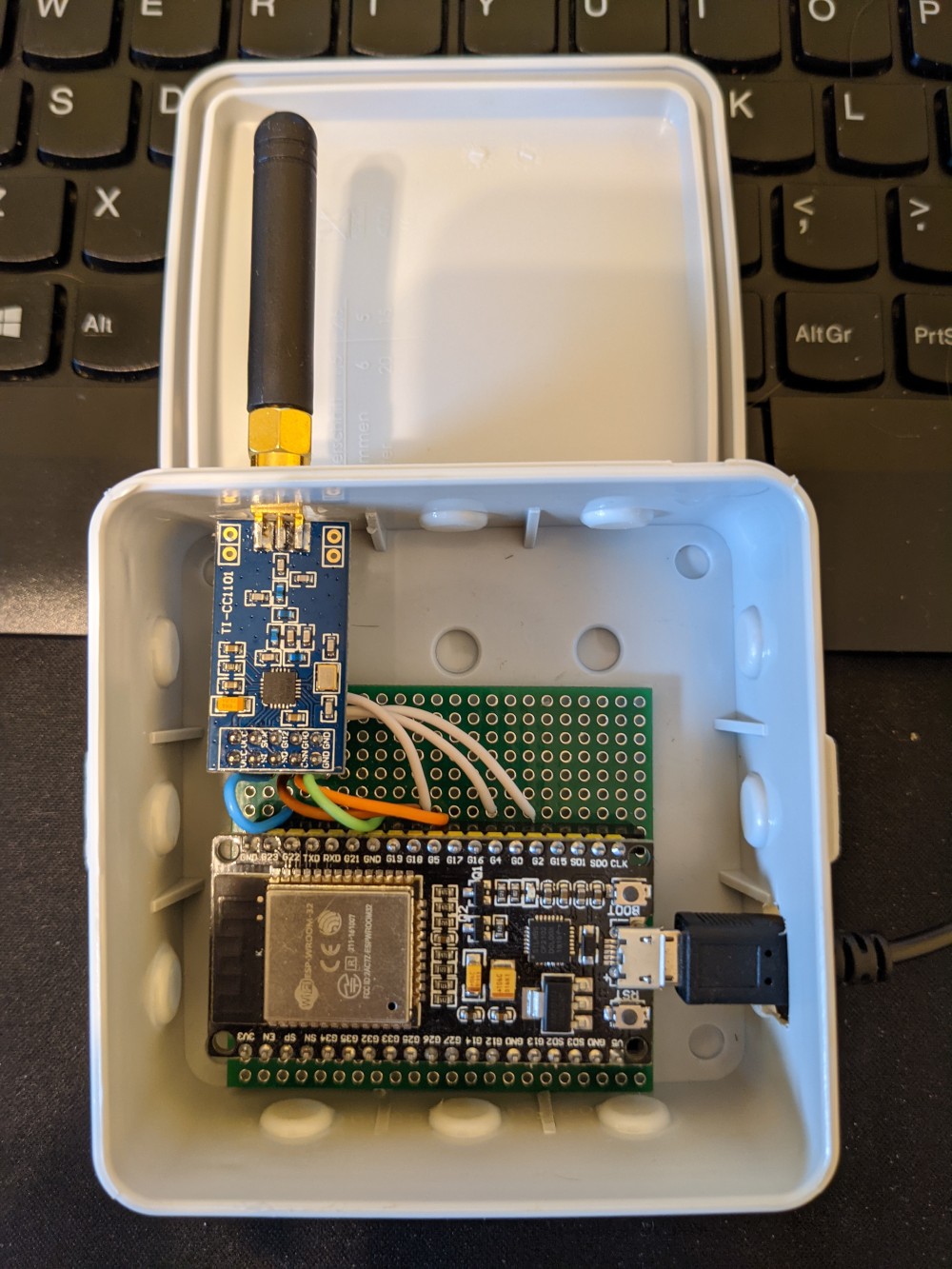
The output contains the buttons I pressed, but also the id of the remote and the command counter (which is supposed to prevent replay attacks). At this point I could just use the id and the counter to send own commands, but if I'd do that too often, the real remote would stop working, as its counter won't increase and the receiver will drop the commands when the counters differ too much. But that's good enough for now. I know I'm looking for the right protocol at the right frequency. As the end result should be an ESP32, let's move on! Acquiring the right hardware Contrary to an RTL-SDR, one usually does not have a spare ESP32 with 433MHz radio at home, so I went shopping: a NodeMCU-32S clone and a CC1101. The CC1101 is important as most 433MHz chips for Arduino/ESP only work at 433.92MHz, but Somfy uses 433.42MHz and using the wrong frequency would result in really bad reception. The CC1101 is essentially an SDR, as you can tune it to a huge spectrum of frequencies. Oh and we need some cables, a bread board, the usual stuff ;) The wiring is rather simple: ESP32 wiring for a CC1101 And the end result isn't too beautiful either, but it works: ESP32 and CC1101 in a simple case Acquiring the right software In my initial research I found an Arduino sketch and was totally prepared to port it to ESP32, but luckily somebody already did that for me! Even better, it's explicitly using the CC1101. Okay, okay, I cheated, I actually ordered the hardware after I found this port and the reference to CC1101. ;) As I am using ESPHome for my ESPs, the idea was to add a "Cover" that's controlling the shutters to it. Writing some C++, how hard can it be? Turns out, not that hard. You can see the code in my GitHub repo. It consists of two (relevant) files: somfy_cover.h and somfy.yaml. somfy_cover.h essentially wraps the communication with the Somfy_Remote_Lib library into an almost boilerplate Custom Cover for ESPHome. There is nothing too fancy in there. The only real difference to the "Custom Cover" example from the documentation is the split into SomfyESPRemote (which inherits from Component) and SomfyESPCover (which inherits from Cover) -- this is taken from the Custom Sensor documentation and allows me to define one "remote" that controls multiple "covers" using the add_cover function. The first two params of the function are the NVS name and key (think database table and row), and the third is the rolling code of the remote (stored in somfy_secrets.h, which is not in Git). In ESPHome a Cover shall define its properties as CoverTraits. Here we call set_is_assumed_state(true), as we don't know the state of the shutters - they could have been controlled using the other (real) remote - and setting this to true allows issuing open/close commands at all times. We also call set_supports_position(false) as we can't tell the shutters to move to a specific position. The one additional feature compared to a normal Cover interface is the program function, which allows to call the "program" command so that the shutters can learn a new remote. somfy.yaml is the ESPHome "configuration", which contains information about the used hardware, WiFi credentials etc. Again, mostly boilerplate. The interesting parts are the loading of the additional libraries and attaching the custom component with multiple covers and the additional PROG switches:
esphome:
  name: somfy
  platform: ESP32
  board: nodemcu-32s
  libraries:
    - SmartRC-CC1101-Driver-Lib@2.5.6
    - Somfy_Remote_Lib@0.4.0
    - EEPROM
  includes:
    - somfy_secrets.h
    - somfy_cover.h
 
cover:
  - platform: custom
    lambda:  -
      auto somfy_remote = new SomfyESPRemote();
      somfy_remote->add_cover("somfy", "badezimmer", SOMFY_REMOTE_BADEZIMMER);
      somfy_remote->add_cover("somfy", "kinderzimmer", SOMFY_REMOTE_KINDERZIMMER);
      App.register_component(somfy_remote);
      return somfy_remote->covers;
    covers:
      - id: "somfy"
        name: "Somfy Cover"
      - id: "somfy2"
        name: "Somfy Cover2"
switch:
  - platform: template
    name: "PROG"
    turn_on_action:
      - lambda:  -
          ((SomfyESPCover*)id(somfy))->program();
  - platform: template
    name: "PROG2"
    turn_on_action:
      - lambda:  -
          ((SomfyESPCover*)id(somfy2))->program();
The switch to trigger the program mode took me a bit. As the Cover interface of ESPHome does not offer any additional functions besides movement control, I first wrote code to trigger "program" when "stop" was pressed three times in a row, but that felt really cumbersome and also had the side effect that the remote would send more than needed, sometimes confusing the shutters. I then decided to have a separate button (well, switch) for that, but the compiler yelled at me I can't call program on a Cover as it does not have such a function. Turns out, you need to explicitly cast to SomfyESPCover and then it works, even if the code becomes really readable, NOT. Oh and as the switch does not have any code to actually change/report state, it effectively acts as a button that can be pressed. At this point we can just take an existing remote, press PROG for 5 seconds, see the blinds move shortly up and down a bit and press PROG on our new ESP32 remote and the shutters will learn the new remote. And thanks to the awesome integration of ESPHome into HomeAssistant, this instantly shows up as a new controllable cover there too. Future Additional Work I started writing this post about a year ago And the initial implementation had some room for improvement More than one remote The initial code only created one remote and one cover element. Sure, we could attach that to all shutters (there are 4 of them), but we really want to be able to control them separately. Thankfully I managed to read enough ESPHome docs, and learned how to operate std::vector to make the code dynamically accept new shutters. Using ESP32's NVS The ESP32 has a non-volatile key-value storage which is much nicer than throwing bits at an emulated EEPROM. The first library I used for that explicitly used EEPROM storage and it would have required quite some hacking to make it work with NVS. Thankfully the library I am using now has a plugable storage interface, and I could just write the NVS backend myself and upstream now supports that. Yay open-source! Remaining issues Real state is unknown As noted above, the ESP does not know the real state of the shutters: a command could have been lost in transmission (the Somfy protocol is send-only, there is no feedback) or the shutters might have been controlled by another remote. At least the second part could be solved by listening all the time and trying to decode commands heard over the air, but I don't think this is worth the time -- worst that can happen is that a closed (opened) shutter receives another close (open) command and that is harmless as they have integrated endstops and know that they should not move further. Can't program new remotes with ESP only To program new remotes, one has to press the "PROG" button for 5 seconds. This was not exposed in the old library, but the new one does support "long press", I just would need to add another ugly switch to the config and I currently don't plan to do so, as I do have working remotes for the case I need to learn a new one.

2 June 2021

Matthew Garrett: Producing a trustworthy x86-based Linux appliance

Let's say you're building some form of appliance on top of general purpose x86 hardware. You want to be able to verify the software it's running hasn't been tampered with. What's the best approach with existing technology?

Let's split this into two separate problems. The first is to do as much as we can to ensure that the software can't be modified without our consent[1]. This requires that each component in the boot chain verify that the next component is legitimate. We call the first component in this chain the root of trust, and in the x86 world this is the system firmware[2]. This firmware is responsible for verifying the bootloader, and the easiest way to do this on x86 is to use UEFI Secure Boot. In this setup the firmware contains a set of trusted signing certificates and will only boot executables with a chain of trust to one of these certificates. Switching the system into setup mode from the firmware menu will allow you to remove the existing keys and install new ones.

(Note: You shouldn't use the trusted certificate directly for signing bootloaders - instead, the trusted certificate should be used to sign another certificate and the key for that certificate used to sign your bootloader. This way, if you ever need to revoke the signing certificate, you can simply sign a new one with the trusted parent and push out a revocation update instead of having to provision new keys)

But what do you want to sign? In the general purpose Linux world, we use an intermediate bootloader called Shim to bridge from the Microsoft signing authority to a distribution one. Shim then verifies the signature on grub, and grub in turn verifies the signature on the kernel. This is a large body of code that exists because of the use cases that general purpose distributions need to support - primarily, booting on arbitrary off the shelf hardware, and allowing arbitrary and complicated boot setups. This is unnecessary in the appliance case, where the hardware target can be well defined, where there's no need for interoperability with the Microsoft signing authority, and where the boot configuration can be extremely static.

We can skip all of this complexity using systemd-boot's unified Linux image support. This has the format described here, but the short version is that it's simply a kernel and initramfs linked into a small EFI executable that will run them. Instructions for generating such an image are here, and if you follow them you'll end up with a single static image that can be directly executed by the firmware. Signing this avoids dealing with a whole host of problems associated with relying on shim and grub, but note that you'll be embedding the initramfs as well. Again, this should be fine for appliance use-cases, but you'll need your build system to support building the initramfs at image creation time rather than relying on it being generated on the host.

At this point we have a single image that can be verified by the firmware and will get us to the point of a running kernel and initramfs. Unless you've got enough RAM that you can put your entire workload in the initramfs, you're going to want a filesystem as well, and you're going to want to verify that that filesystem hasn't been tampered with. The easiest approach to this is to use dm-verity, a device-mapper layer that uses a hash tree to verify that the filesystem contents haven't been modified. The kernel needs to know what the root hash is, so this can either be embedded into your initramfs image or into the kernel command line. Either way, it'll end up in the signed boot image, so nobody will be able to tamper with it.

It's important to note that a dm-verity partition is read-only - the kernel doesn't have the cryptographic secret that would be required to generate a new hash tree if the partition is modified. So if you require the ability to write data or logs anywhere, you'll need to add a new partition for that. If this partition is unencrypted, an attacker with access to the device will be able to put whatever they want on there. You should treat any data you read from there as untrusted, and ensure that it's validated before use (ie, don't just feed it to a random parser written in C and expect that everything's going to be ok). On the other hand, if it's encrypted, remember that you can't just put the encryption key in the boot image - an attacker with access to the device is going to be able to dump that and extract it. You'll probably want to use a TPM-sealed encryption secret, which will be discussed later on.

At this point everything in the boot process is cryptographically verified, and so should be difficult to tamper with. Unfortunately this isn't really sufficient - on x86 systems there's typically no verification of the integrity of the secure boot database. An attacker with physical access to the system could attach a programmer directly to the firmware flash and rewrite the secure boot database to include keys they control. They could then replace the boot image with one that they've signed, and the machine would happily boot code that the attacker controlled. We need to be able to demonstrate that the system booted using the correct secure boot keys, and the only way we can do that is to use the TPM.

I wrote an introduction to TPMs a while back. The important thing to know here is that the TPM contains a set of Platform Configuration Registers that are large enough to contain a cryptographic hash. During boot, each component of the boot process will generate a "measurement" of other security critical components, including the next component to be booted. These measurements are a representation of the data in question - they may simply be a hash of the object being measured, or the hash of a structure containing various pieces of metadata. Each measurement is passed to the TPM, along with the PCR it should be measured into. The TPM takes the new measurement, appends it to the existing value, and then stores the hash of this concatenated data in the PCR. This means that the final PCR value depends not only on the measurement, but also on every previous measurement. Without breaking the hash algorithm, there's no way to set the PCR to an arbitrary value. The hash values and some associated data are stored in a log that's kept in system RAM, which we'll come back to later.

Different PCRs store different pieces of information, but the one that's most interesting to us is PCR 7. Its use is documented in the TCG PC Client Platform Firmware Profile (section 3.3.4.8), but the short version is that the firmware will measure the secure boot keys that are used to boot the system. If the secure boot keys are altered (such as by an attacker flashing new ones), the PCR 7 value will change.

What can we do with this? There's a couple of choices. For devices that are online, we can perform remote attestation, a process where the device can provide a signed copy of the PCR values to another system. If the system also provides a copy of the TPM event log, the individual events in the log can be replayed in the same way that the TPM would use to calculate the PCR values, and then compared to the actual PCR values. If they match, that implies that the log values are correct, and we can then analyse individual log entries to make assumptions about system state. If a device has been tampered with, the PCR 7 values and associated log entries won't match the expected values, and we can detect the tampering.

If a device is offline, or if there's a need to permit local verification of the device state, we still have options. First, we can perform remote attestation to a local device. I demonstrated doing this over Bluetooth at LCA back in 2020. Alternatively, we can take advantage of other TPM features. TPMs can be configured to store secrets or keys in a way that renders them inaccessible unless a chosen set of PCRs have specific values. This is used in tpm2-totp, which uses a secret stored in the TPM to generate a TOTP value. If the same secret is enrolled in any standard TOTP app, the value generated by the machine can be compared to the value in the app. If they match, the PCR values the secret was sealed to are unmodified. If they don't, or if no numbers are generated at all, that demonstrates that PCR 7 is no longer the same value, and that the system has been tampered with.

Unfortunately, TOTP requires that both sides have possession of the same secret. This is fine when a user is making that association themselves, but works less well if you need some way to ship the secret on a machine and then separately ship the secret to a user. If the user can simply download the secret via some API, so can an attacker. If an attacker has the secret, they can modify the secure boot database and re-seal the secret to the new PCR 7 value. That means having to add some form of authentication, along with a strong binding of machine serial number to a user (in order to avoid someone with valid credentials simply downloading all the secrets).

Instead, we probably want some mechanism that uses asymmetric cryptography. A keypair can be generated on the TPM, which will refuse to release an unencrypted copy of the private key. The public key, however, can be exported and stored. If it's acceptable for a verification app to connect to the internet then the public key can simply be obtained that way - if not, a certificate can be issued to the key, and this exposed to the verifier via a QR code. The app then verifies that the certificate is signed by the vendor, and if so extracts the public key from that. The private key can have an associated policy that only permits its use when PCR 7 has an appropriate value, so the app then generates a nonce and asks the user to type that into the device. The device generates a signature over that nonce and displays that as a QR code. The app verifies the signature matches, and can then assert that PCR 7 has the expected value.

Once we can assert that PCR 7 has the expected value, we can assert that the system booted something signed by us and thus infer that the rest of the boot chain is also secure. But this is still dependent on the TPM obtaining trustworthy information, and unfortunately the bus that the TPM sits on isn't really terribly secure (TPM Genie is an example of an interposer for i2c-connected TPMs, but there's no reason an LPC one can't be constructed to attack the sort usually used on PCs). TPMs do support encrypted communication channels, but bootstrapping those isn't straightforward without firmware support. The easiest way around this is to make use of a firmware-based TPM, where the TPM is implemented in software running on an ancillary controller. Intel's solution is part of their Platform Trust Technology and runs on the Management Engine, AMD run it on the Platform Security Processor. In both cases it's not terribly feasible to intercept the communications, so we avoid this attack. The downside is that we're then placing more trust in components that are running much more code than a TPM would and which have a correspondingly larger attack surface. Which is preferable is going to depend on your threat model.

Most of this should be achievable using Yocto, which now has support for dm-verity built in. It's almost certainly going to be easier using this than trying to base on top of a general purpose distribution. I'd love to see this become a largely push button receive secure image process, so might take a go at that if I have some free time in the near future.

[1] Obviously technologies that can be used to ensure nobody other than me is able to modify the software on devices I own can also be used to ensure that nobody other than the manufacturer is able to modify the software on devices that they sell to third parties. There's no real technological solution to this problem, but we shouldn't allow the fact that a technology can be used in ways that are hostile to user freedom to cause us to reject that technology outright.
[2] This is slightly complicated due to the interactions with the Management Engine (on Intel) or the Platform Security Processor (on AMD). Here's a good writeup on the Intel side of things.

comment count unavailable comments

6 May 2021

Matthew Garrett: More doorbell adventures

Back in my last post on this topic, I'd got shell on my doorbell but hadn't figured out why the HTTP callbacks weren't always firing. I still haven't, but I have learned some more things.

Doorbird sell a chime, a network connected device that is signalled by the doorbell when someone pushes a button. It costs about $150, which seems excessive, but would solve my problem (ie, that if someone pushes the doorbell and I'm not paying attention to my phone, I miss it entirely). But given a shell on the doorbell, how hard could it be to figure out how to mimic the behaviour of one?

Configuration for the doorbell is all stored under /mnt/flash, and there's a bunch of files prefixed 1000eyes that contain config (1000eyes is the German company that seems to be behind Doorbird). One of these was called 1000eyes.peripherals, which seemed like a good starting point. The initial contents were "Peripherals":[] , so it seemed likely that it was intended to be JSON. Unfortunately, since I had no access to any of the peripherals, I had no idea what the format was. I threw the main application into Ghidra and found a function that had debug statements referencing "initPeripherals and read a bunch of JSON keys out of the file, so I could simply look at the keys it referenced and write out a file based on that. I did so, and it didn't work - the app stubbornly refused to believe that there were any defined peripherals. The check that was failing was pcVar4 = strstr(local_50[0],PTR_s_"type":"_0007c980);, which made no sense, since I very definitely had a type key in there. And then I read it more closely. strstr() wasn't being asked to look for "type":, it was being asked to look for "type":". I'd left a space between the : and the opening " in the value, which meant it wasn't matching. The rest of the function seems to call an actual JSON parser, so I have no idea why it doesn't just use that for this part as well, but deleting the space and restarting the service meant it now believed I had a peripheral attached.

The mobile app that's used for configuring the doorbell now showed a device in the peripherals tab, but it had a weird corrupted name. Tapping it resulted in an error telling me that the device was unavailable, and on the doorbell itself generated a log message showing it was trying to reach a device with the hostname bha-04f0212c5cca and (unsurprisingly) failing. The hostname was being generated from the MAC address field in the peripherals file and was presumably supposed to be resolved using mDNS, but for now I just threw a static entry in /etc/hosts pointing at my Home Assistant device. That was enough to show that when I opened the app the doorbell was trying to call a CGI script called peripherals.cgi on my fake chime. When that failed, it called out to the cloud API to ask it to ask the chime[1] instead. Since the cloud was completely unaware of my fake device, this didn't work either. I hacked together a simple server using Python's HTTPServer and was able to return data (another block of JSON). This got me to the point where the app would now let me get to the chime config, but would then immediately exit. adb logcat showed a traceback in the app caused by a failed assertion due to a missing key in the JSON, so I ran the app through jadx, found the assertion and from there figured out what keys I needed. Once that was done, the app opened the config page just fine.

Unfortunately, though, I couldn't edit the config. Whenever I hit "save" the app would tell me that the peripheral wasn't responding. This was strange, since the doorbell wasn't even trying to hit my fake chime. It turned out that the app was making a CGI call to the doorbell, and the thread handling that call was segfaulting just after reading the peripheral config file. This suggested that the format of my JSON was probably wrong and that the doorbell was not handling that gracefully, but trying to figure out what the format should actually be didn't seem easy and none of my attempts improved things.

So, new approach. Rather than writing the config myself, why not let the doorbell do it? I should be able to use the genuine pairing process if I could mimic the chime sufficiently well. Hitting the "add" button in the app asked me for the username and password for the chime, so I typed in something random in the expected format (six characters followed by four zeroes) and a sufficiently long password and hit ok. A few seconds later it told me it couldn't find the device, which wasn't unexpected. What was a little more unexpected was that the log on the doorbell was showing it trying to hit another bha-prefixed hostname (and, obviously, failing). The hostname contains the MAC address, but I hadn't told the doorbell the MAC address of the chime, just its username. Some more digging showed that the doorbell was calling out to the cloud API, giving it the 6 character prefix from the username and getting a MAC address back. Doing the same myself revealed that there was a straightforward mapping from the prefix to the mac address - changing the final character from "a" to "b" incremented the MAC by one. It's actually just a base 26 encoding of the MAC, with aaaaaa translating to 00408C000000.

That explained how the hostname was being generated, and in return I was able to work backwards to figure out which username I should use to generate the hostname I was already using. Attempting to add it now resulted in the doorbell making another CGI call to my fake chime in order to query its feature set, and by mocking that up as well I was able to send back a file containing X-Intercom-Type, X-Intercom-TypeId and X-Intercom-Class fields that made the doorbell happy. I now had a valid JSON file, which cleared up a couple of mysteries. The corrupt name was because the name field isn't supposed to be ASCII - it's base64 encoded UTF16-BE. And the reason I hadn't been able to figure out the JSON format correctly was because it looked something like this:

"Peripherals":[] "prefix": "type":"DoorChime","name":"AEQAbwBvAHIAYwBoAGkAbQBlACAAVABlAHMAdA==","mac":"04f0212c5cca","user":"username","password":"password" ]


Note that there's a total of one [ in this file, but two ]s? Awesome. Anyway, I could now modify the config in the app and hit save, and the doorbell would then call out to my fake chime to push config to it. Weirdly, the association between the chime and a specific button on the doorbell is only stored on the chime, not on the doorbell. Further, hitting the doorbell didn't result in any more HTTP traffic to my fake chime. However, it did result in some broadcast UDP traffic being generated. Searching for the port number led me to the Doorbird LAN API and a complete description of the format and encryption mechanism in use. Argon2I is used to turn the first five characters of the chime's password (which is also stored on the doorbell itself) into a 256-bit key, and this is used with ChaCha20 to decrypt the payload. The payload then contains a six character field describing the device sending the event, and then another field describing the event itself. Some more scrappy Python and I could pick up these packets and decrypt them, which showed that they were being sent whenever any event occurred on the doorbell. This explained why there was no storage of the button/chime association on the doorbell itself - the doorbell sends packets for all events, and the chime is responsible for deciding whether to act on them or not.

On closer examination, it turns out that these packets aren't just sent if there's a configured chime. One is sent for each configured user, avoiding the need for a cloud round trip if your phone is on the same network as the doorbell at the time. There was literally no need for me to mimic the chime at all, suitable events were already being sent.

Still. There's a fair amount of WTFery here, ranging from the strstr() based JSON parsing, the invalid JSON, the symmetric encryption that uses device passwords as the key (requiring the doorbell to be aware of the chime's password) and the use of only the first five characters of the password as input to the KDF. It doesn't give me a great deal of confidence in the rest of the device's security, so I'm going to keep playing.

[1] This seems to be to handle the case where the chime isn't on the same network as the doorbell

comment count unavailable comments

19 April 2021

Ritesh Raj Sarraf: Catching Up Your Sources

I ve mostly had the preference of controlling my data rather than depend on someone else. That s one reason why I still believe email to be my most reliable medium for data storage, one that is not plagued/locked by a single entity. If I had the resources, I d prefer all digital data to be broken down to its simplest form for storage, like email format, and empower the user with it i.e. their data. Yes, there are free services that are indirectly forced upon common users, and many of us get attracted to it. Many of us do not think that the information, which is shared for the free service in return, is of much importance. Which may be fair, depending on the individual, given that they get certain services without paying any direct dime.

New age communication So first, we had email and usenet. As I mentioned above, email was designed with fine intentions. Intentions that make it stand even today, independently. But not everything, back then, was that great either. For example, instant messaging was very closed and centralised then too. Things like: ICQ, MSN, Yahoo Messenger; all were centralized. I wonder if people still have access to their ICQ logs. Not much has chagned in the current day either. We now have domination by: Facebook Messenger, Google Whatever the new marketing term they introdcue, WhatsApp, Telegram, Signal etc. To my knowledge, they are all centralized. Over all this time, I m yet to see a product come up with good (business) intentions, to really empower the end user. In this information age, the most invaluable data is user activity. That s one data everyone is after. If you decline to share that bit of free data in exchange for the free services, mind you, that that free service like Facebook, Google, Instagram, WhatsApp, Truecaller, Twitter; none of it would come to you at all. Try it out. So the reality is that while you may not be valuating the data you offer in exchange correctly, there s a lot that is reaped from it. But still, I think each user has (and should have) the freedom to opt in for these tech giants and give them their personal bit, for free services in return. That is a decent barter deal. And it is a choice that one if free to choose

Retaining my data I m fond of keeping an archive folder in my mailbox. A folder that holds significant events in the form of an email usually, if documented. Over the years, I chose to resort to the email format because I felt it was more reliable in the longer term than any other formats. The next best would be plain text. In my lifetime, I have learnt a lot from the internet; so it is natural that my preference has been with it. Mailing Lists, IRCs, HOWTOs, Guides, Blog posts; all have helped. And over the years, I ve come across hundreds of such content that I d always like to preserve. Now there are multiple ways to preserving data. Like, for example, big tech giants. In most usual cases, your data for your lifetime, should be fine with a tech giant. In some odd scenarios, you may be unlucky if you relied on a service provider that went bankrupt. But seriously, I think users should be fine if they host their data with Microsoft, Google etc; as long as they abide by their policies. There s also the catch of alignment. As the user, you should ensure to align (and transition) with the product offerings of your service provider. Otherwise, what may look constant and always reliable, will vanish in the blink of an eye. I guess Google Plus would be a good example. There was some Google Feed service too. Maybe Google Photos in the near decade future, just like Google Picasa in the previous (or current) decade.

History what is On the topic of retaining information, lets take a small drift. I still admire our ancestors. I don t know what went in their mind when they were documenting events in the form of scriptures, carvings, temples, churches, mosques etc; but one things for sure, they were able to leave a fine means of communication. They are all gone but a large number of those events are evident through the creations that they left. Some of those events have been strong enough that further rulers/invaders have had tough times trying to wipe it out from history. Remember, history is usually not the truth, but the statement to be believed by the teller. And the teller is usually the survivor, or the winner you may call. But still, the information retention techniques were better. I haven t visited, but admire whosoever built the Kailasa Temple, Ellora, without which, we d be made to believe what not by all invaders and rulers of the region. But the majestic standing of the temple, is a fine example of the history and the events that have occured in the past.
Ellora Temple -  The majectic carving believed to be carved out of a single stone
Ellora Temple - The majectic carving believed to be carved out of a single stone
Dominance has the power to rewrite history and unfortunately that s true and it has done its part. It is just that in a mere human s defined lifetime, it is not possible to witness the transtion from current to history, and say that I was there then and I m here now, and this is not the reality. And if not dominance, there s always the other bit, hearsay. With it, you can always put anything up for dispute. Because there s no way one can go back in time and produce a fine evidence. There s also a part about religion. Religion can be highly sentimental. And religion can be a solid way to get an agenda going. For example, in India - a country which today consitutionally is a secular country, there have been multiple attempts to discard the belief, that never ever did the thing called Ramayana exist. That the Rama Setu, nicely reworded as Adam s Bridge by who so ever, is a mere result of science. Now Rama, or Hanumana, or Ravana, or Valmiki, aren t going to come over and prove that that is true or false. So such subjects serve as a solid base to get an agenda going. And probably we ve even succeeded in proving and believing that there was never an event like Ramayana or the Mahabharata. Nor was there ever any empire other than the Moghul or the British Empire. But yes, whosoever made the Ellora Temple or the many many more of such creations, did a fine job of making a dent for the future, to know of what the history possibly could also be.

Enough of the drift So, in my opinion, having events documented is important. It d be nice to have skills documented too so that it can be passed over generations but that s a debatable topic. But events, I believe should be documented. And documented in the best possible ways so that its existence is not diminished. A documentation in the form of certain carvings on a rock is far more better than links and posts shared on Facebook, Twitter, Reddit etc. For one, these are all corporate entities with vested interests and can pretext excuse in the name of compliance and conformance. So, for the helpless state and generation I am in, I felt email was the best possible independent form of data retention in today s age. If I really had the resources, I d not rely on digital age. This age has no guarantee of retaining and recording information in any reliable manner. Instead, it is just mostly junk, which is manipulative and changeable, conditionally.

Email and RSS So for my communication, I like to prefer emails over any other means. That doesn t mean I don t use the current trends. I do. But this blog is mostly about penning my desires. And desire be to have communication over email format. Such is the case that for information useful over the internet, I crave to have it formatted in email for archival. RSS feeds is my most common mode of keeping track of information I care about. Not all that I care for is available in RSS feeds but hey such is life. And adaptability is okay. But my preference is still RSS. So I use RSS feeds through a fine software called feed2imap. A software that fits my bill fairly well. feed2imap is:
  • An rss feed news aggregator
  • Pulls and extracts news feeds in the form of an email
  • Can push the converted email over pop/imap
  • Can convert all image content to email mime attachment
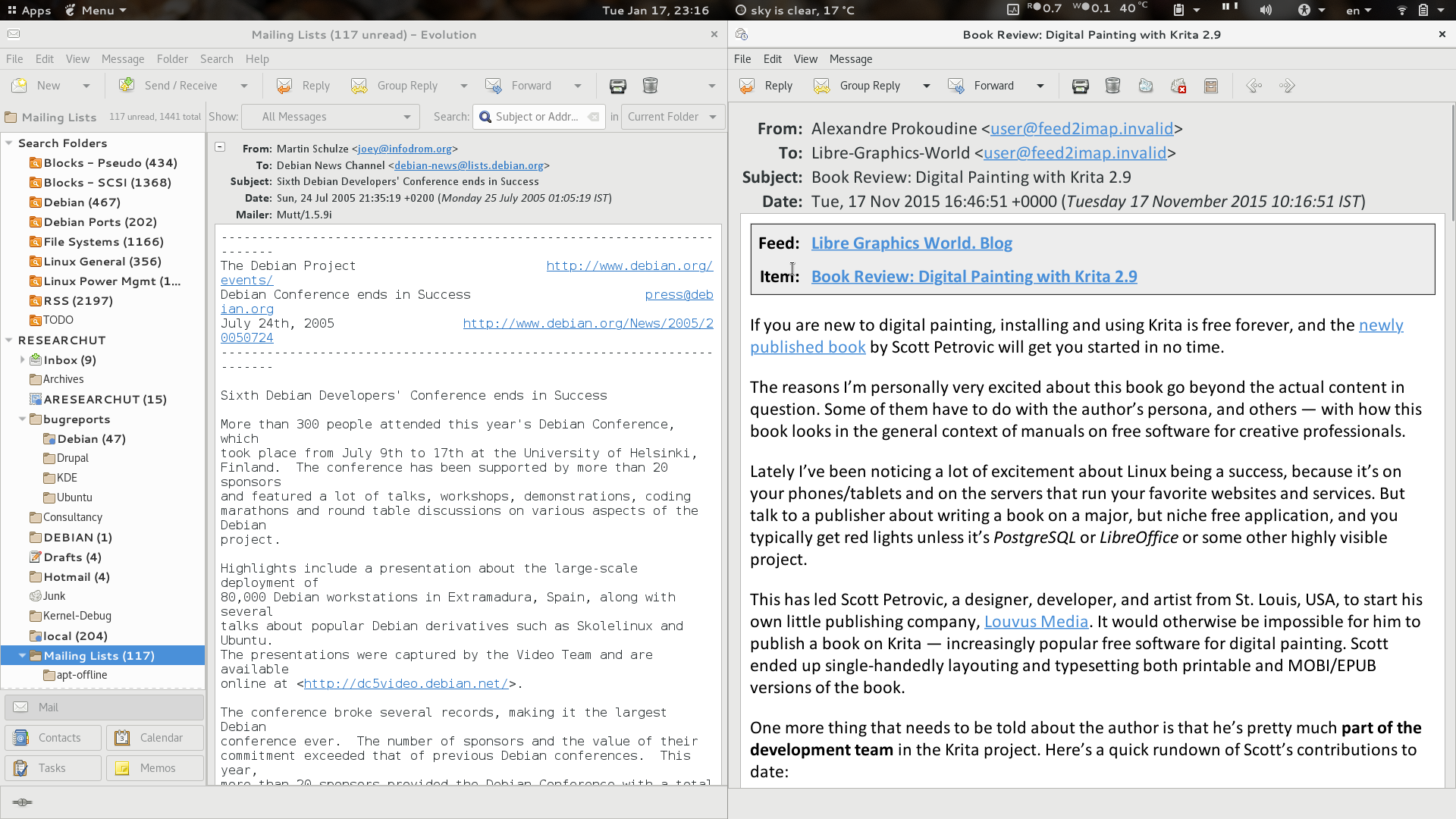
In a gist, it makes the online content available to me offline in the most admired email format In my mail box, in today s day, my preferred email client is Evolution. It does a good job of dealing with such emails (rss feed items). An image example of accessing the rrs feed item through it is below
RSS News Item through Evolution
The good part is that my actual data is always independent of such MUAs. Tomorrow, as technology - trends - economics evolve, something new would come as a replacement but my data would still be mine.

9 April 2021

Michael Prokop: A Ceph war story

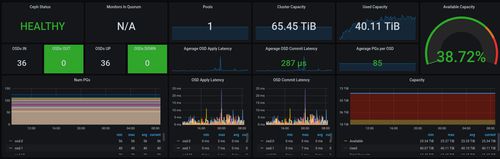
It all started with the big bang! We nearly lost 33 of 36 disks on a Proxmox/Ceph Cluster; this is the story of how we recovered them. At the end of 2020, we eventually had a long outstanding maintenance window for taking care of system upgrades at a customer. During this maintenance window, which involved reboots of server systems, the involved Ceph cluster unexpectedly went into a critical state. What was planned to be a few hours of checklist work in the early evening turned out to be an emergency case; let s call it a nightmare (not only because it included a big part of the night). Since we have learned a few things from our post mortem and RCA, it s worth sharing those with others. But first things first, let s step back and clarify what we had to deal with. The system and its upgrade One part of the upgrade included 3 Debian servers (we re calling them server1, server2 and server3 here), running on Proxmox v5 + Debian/stretch with 12 Ceph OSDs each (65.45TB in total), a so-called Proxmox Hyper-Converged Ceph Cluster. First, we went for upgrading the Proxmox v5/stretch system to Proxmox v6/buster, before updating Ceph Luminous v12.2.13 to the latest v14.2 release, supported by Proxmox v6/buster. The Proxmox upgrade included updating corosync from v2 to v3. As part of this upgrade, we had to apply some configuration changes, like adjust ring0 + ring1 address settings and add a mon_host configuration to the Ceph configuration. During the first two servers reboots, we noticed configuration glitches. After fixing those, we went for a reboot of the third server as well. Then we noticed that several Ceph OSDs were unexpectedly down. The NTP service wasn t working as expected after the upgrade. The underlying issue is a race condition of ntp with systemd-timesyncd (see #889290). As a result, we had clock skew problems with Ceph, indicating that the Ceph monitors clocks aren t running in sync (which is essential for proper Ceph operation). We initially assumed that our Ceph OSD failure derived from this clock skew problem, so we took care of it. After yet another round of reboots, to ensure the systems are running all with identical and sane configurations and services, we noticed lots of failing OSDs. This time all but three OSDs (19, 21 and 22) were down:
% sudo ceph osd tree
ID CLASS WEIGHT   TYPE NAME      STATUS REWEIGHT PRI-AFF
-1       65.44138 root default
-2       21.81310     host server1
 0   hdd  1.08989         osd.0    down  1.00000 1.00000
 1   hdd  1.08989         osd.1    down  1.00000 1.00000
 2   hdd  1.63539         osd.2    down  1.00000 1.00000
 3   hdd  1.63539         osd.3    down  1.00000 1.00000
 4   hdd  1.63539         osd.4    down  1.00000 1.00000
 5   hdd  1.63539         osd.5    down  1.00000 1.00000
18   hdd  2.18279         osd.18   down  1.00000 1.00000
20   hdd  2.18179         osd.20   down  1.00000 1.00000
28   hdd  2.18179         osd.28   down  1.00000 1.00000
29   hdd  2.18179         osd.29   down  1.00000 1.00000
30   hdd  2.18179         osd.30   down  1.00000 1.00000
31   hdd  2.18179         osd.31   down  1.00000 1.00000
-4       21.81409     host server2
 6   hdd  1.08989         osd.6    down  1.00000 1.00000
 7   hdd  1.08989         osd.7    down  1.00000 1.00000
 8   hdd  1.63539         osd.8    down  1.00000 1.00000
 9   hdd  1.63539         osd.9    down  1.00000 1.00000
10   hdd  1.63539         osd.10   down  1.00000 1.00000
11   hdd  1.63539         osd.11   down  1.00000 1.00000
19   hdd  2.18179         osd.19     up  1.00000 1.00000
21   hdd  2.18279         osd.21     up  1.00000 1.00000
22   hdd  2.18279         osd.22     up  1.00000 1.00000
32   hdd  2.18179         osd.32   down  1.00000 1.00000
33   hdd  2.18179         osd.33   down  1.00000 1.00000
34   hdd  2.18179         osd.34   down  1.00000 1.00000
-3       21.81419     host server3
12   hdd  1.08989         osd.12   down  1.00000 1.00000
13   hdd  1.08989         osd.13   down  1.00000 1.00000
14   hdd  1.63539         osd.14   down  1.00000 1.00000
15   hdd  1.63539         osd.15   down  1.00000 1.00000
16   hdd  1.63539         osd.16   down  1.00000 1.00000
17   hdd  1.63539         osd.17   down  1.00000 1.00000
23   hdd  2.18190         osd.23   down  1.00000 1.00000
24   hdd  2.18279         osd.24   down  1.00000 1.00000
25   hdd  2.18279         osd.25   down  1.00000 1.00000
35   hdd  2.18179         osd.35   down  1.00000 1.00000
36   hdd  2.18179         osd.36   down  1.00000 1.00000
37   hdd  2.18179         osd.37   down  1.00000 1.00000
Our blood pressure increased slightly! Did we just lose all of our cluster? What happened, and how can we get all the other OSDs back? We stumbled upon this beauty in our logs:
kernel: [   73.697957] XFS (sdl1): SB stripe unit sanity check failed
kernel: [   73.698002] XFS (sdl1): Metadata corruption detected at xfs_sb_read_verify+0x10e/0x180 [xfs], xfs_sb block 0xffffffffffffffff
kernel: [   73.698799] XFS (sdl1): Unmount and run xfs_repair
kernel: [   73.699199] XFS (sdl1): First 128 bytes of corrupted metadata buffer:
kernel: [   73.699677] 00000000: 58 46 53 42 00 00 10 00 00 00 00 00 00 00 62 00  XFSB..........b.
kernel: [   73.700205] 00000010: 00 00 00 00 00 00 00 00 00 00 00 00 00 00 00 00  ................
kernel: [   73.700836] 00000020: 62 44 2b c0 e6 22 40 d7 84 3d e1 cc 65 88 e9 d8  bD+.."@..=..e...
kernel: [   73.701347] 00000030: 00 00 00 00 00 00 40 08 00 00 00 00 00 00 01 00  ......@.........
kernel: [   73.701770] 00000040: 00 00 00 00 00 00 01 01 00 00 00 00 00 00 01 02  ................
ceph-disk[4240]: mount: /var/lib/ceph/tmp/mnt.jw367Y: mount(2) system call failed: Structure needs cleaning.
ceph-disk[4240]: ceph-disk: Mounting filesystem failed: Command '['/bin/mount', '-t', u'xfs', '-o', 'noatime,inode64', '--', '/dev/disk/by-parttypeuuid/4fbd7e29-9d25-41b8-afd0-062c0ceff05d.cdda39ed-5
ceph/tmp/mnt.jw367Y']' returned non-zero exit status 32
kernel: [   73.702162] 00000050: 00 00 00 01 00 00 18 80 00 00 00 04 00 00 00 00  ................
kernel: [   73.702550] 00000060: 00 00 06 48 bd a5 10 00 08 00 00 02 00 00 00 00  ...H............
kernel: [   73.702975] 00000070: 00 00 00 00 00 00 00 00 0c 0c 0b 01 0d 00 00 19  ................
kernel: [   73.703373] XFS (sdl1): SB validate failed with error -117.
The same issue was present for the other failing OSDs. We hoped, that the data itself was still there, and only the mounting of the XFS partitions failed. The Ceph cluster was initially installed in 2017 with Ceph jewel/10.2 with the OSDs on filestore (nowadays being a legacy approach to storing objects in Ceph). However, we migrated the disks to bluestore since then (with ceph-disk and not yet via ceph-volume what s being used nowadays). Using ceph-disk introduces these 100MB XFS partitions containing basic metadata for the OSD. Given that we had three working OSDs left, we decided to investigate how to rebuild the failing ones. Some folks on #ceph (thanks T1, ormandj + peetaur!) were kind enough to share how working XFS partitions looked like for them. After creating a backup (via dd), we tried to re-create such an XFS partition on server1. We noticed that even mounting a freshly created XFS partition failed:
synpromika@server1 ~ % sudo mkfs.xfs -f -i size=2048 -m uuid="4568c300-ad83-4288-963e-badcd99bf54f" /dev/sdc1
meta-data=/dev/sdc1              isize=2048   agcount=4, agsize=6272 blks
         =                       sectsz=4096  attr=2, projid32bit=1
         =                       crc=1        finobt=1, sparse=1, rmapbt=0
         =                       reflink=0
data     =                       bsize=4096   blocks=25088, imaxpct=25
         =                       sunit=128    swidth=64 blks
naming   =version 2              bsize=4096   ascii-ci=0, ftype=1
log      =internal log           bsize=4096   blocks=1608, version=2
         =                       sectsz=4096  sunit=1 blks, lazy-count=1
realtime =none                   extsz=4096   blocks=0, rtextents=0
synpromika@server1 ~ % sudo mount /dev/sdc1 /mnt/ceph-recovery
SB stripe unit sanity check failed
Metadata corruption detected at 0x433840, xfs_sb block 0x0/0x1000
libxfs_writebufr: write verifer failed on xfs_sb bno 0x0/0x1000
cache_node_purge: refcount was 1, not zero (node=0x1d3c400)
SB stripe unit sanity check failed
Metadata corruption detected at 0x433840, xfs_sb block 0x18800/0x1000
libxfs_writebufr: write verifer failed on xfs_sb bno 0x18800/0x1000
SB stripe unit sanity check failed
Metadata corruption detected at 0x433840, xfs_sb block 0x0/0x1000
libxfs_writebufr: write verifer failed on xfs_sb bno 0x0/0x1000
SB stripe unit sanity check failed
Metadata corruption detected at 0x433840, xfs_sb block 0x24c00/0x1000
libxfs_writebufr: write verifer failed on xfs_sb bno 0x24c00/0x1000
SB stripe unit sanity check failed
Metadata corruption detected at 0x433840, xfs_sb block 0xc400/0x1000
libxfs_writebufr: write verifer failed on xfs_sb bno 0xc400/0x1000
releasing dirty buffer (bulk) to free list!releasing dirty buffer (bulk) to free list!releasing dirty buffer (bulk) to free list!releasing dirty buffer (bulk) to free list!found dirty buffer (bulk) on free list!bad magic number
bad magic number
Metadata corruption detected at 0x433840, xfs_sb block 0x0/0x1000
libxfs_writebufr: write verifer failed on xfs_sb bno 0x0/0x1000
releasing dirty buffer (bulk) to free list!mount: /mnt/ceph-recovery: wrong fs type, bad option, bad superblock on /dev/sdc1, missing codepage or helper program, or other error.
Ouch. This very much looked related to the actual issue we re seeing. So we tried to execute mkfs.xfs with a bunch of different sunit/swidth settings. Using -d sunit=512 -d swidth=512 at least worked then, so we decided to force its usage in the creation of our OSD XFS partition. This brought us a working XFS partition. Please note, sunit must not be larger than swidth (more on that later!). Then we reconstructed how to restore all the metadata for the OSD (activate.monmap, active, block_uuid, bluefs, ceph_fsid, fsid, keyring, kv_backend, magic, mkfs_done, ready, require_osd_release, systemd, type, whoami). To identify the UUID, we can read the data from ceph --format json osd dump , like this for all our OSDs (Zsh syntax ftw!):
synpromika@server1 ~ % for f in  0..37  ; printf "osd-$f: %s\n" "$(sudo ceph --format json osd dump   jq -r ".osds[]   select(.osd==$f)   .uuid")"
osd-0: 4568c300-ad83-4288-963e-badcd99bf54f
osd-1: e573a17a-ccde-4719-bdf8-eef66903ca4f
osd-2: 0e1b2626-f248-4e7d-9950-f1a46644754e
osd-3: 1ac6a0a2-20ee-4ed8-9f76-d24e900c800c
[...]
Identifying the corresponding raw device for each OSD UUID is possible via:
synpromika@server1 ~ % UUID="4568c300-ad83-4288-963e-badcd99bf54f"
synpromika@server1 ~ % readlink -f /dev/disk/by-partuuid/"$ UUID "
/dev/sdc1
The OSD s key ID can be retrieved via:
synpromika@server1 ~ % OSD_ID=0
synpromika@server1 ~ % sudo ceph auth get osd."$ OSD_ID " -f json 2>/dev/null   jq -r '.[]   .key'
AQCKFpZdm0We[...]
Now we also need to identify the underlying block device:
synpromika@server1 ~ % OSD_ID=0
synpromika@server1 ~ % sudo ceph osd metadata osd."$ OSD_ID " -f json   jq -r '.bluestore_bdev_partition_path'    
/dev/sdc2
With all of this, we reconstructed the keyring, fsid, whoami, block + block_uuid files. All the other files inside the XFS metadata partition are identical on each OSD. So after placing and adjusting the corresponding metadata on the XFS partition for Ceph usage, we got a working OSD hurray! Since we had to fix yet another 32 OSDs, we decided to automate this XFS partitioning and metadata recovery procedure. We had a network share available on /srv/backup for storing backups of existing partition data. On each server, we tested the procedure with one single OSD before iterating over the list of remaining failing OSDs. We started with a shell script on server1, then adjusted the script for server2 and server3. This is the script, as we executed it on the 3rd server. Thanks to this, we managed to get the Ceph cluster up and running again. We didn t want to continue with the Ceph upgrade itself during the night though, as we wanted to know exactly what was going on and why the system behaved like that. Time for RCA! Root Cause Analysis So all but three OSDs on server2 failed, and the problem seems to be related to XFS. Therefore, our starting point for the RCA was, to identify what was different on server2, as compared to server1 + server3. My initial assumption was that this was related to some firmware issues with the involved controller (and as it turned out later, I was right!). The disks were attached as JBOD devices to a ServeRAID M5210 controller (with a stripe size of 512). Firmware state:
synpromika@server1 ~ % sudo storcli64 /c0 show all   grep '^Firmware'
Firmware Package Build = 24.16.0-0092
Firmware Version = 4.660.00-8156
synpromika@server2 ~ % sudo storcli64 /c0 show all   grep '^Firmware'
Firmware Package Build = 24.21.0-0112
Firmware Version = 4.680.00-8489
synpromika@server3 ~ % sudo storcli64 /c0 show all   grep '^Firmware'
Firmware Package Build = 24.16.0-0092
Firmware Version = 4.660.00-8156
This looked very promising, as server2 indeed runs with a different firmware version on the controller. But how so? Well, the motherboard of server2 got replaced by a Lenovo/IBM technician in January 2020, as we had a failing memory slot during a memory upgrade. As part of this procedure, the Lenovo/IBM technician installed the latest firmware versions. According to our documentation, some OSDs were rebuilt (due to the filestore->bluestore migration) in March and April 2020. It turned out that precisely those OSDs were the ones that survived the upgrade. So the surviving drives were created with a different firmware version running on the involved controller. All the other OSDs were created with an older controller firmware. But what difference does this make? Now let s check firmware changelogs. For the 24.21.0-0097 release we found this:
- Cannot create or mount xfs filesystem using xfsprogs 4.19.x kernel 4.20(SCGCQ02027889)
- xfs_info command run on an XFS file system created on a VD of strip size 1M shows sunit and swidth as 0(SCGCQ02056038)
Our XFS problem certainly was related to the controller s firmware. We also recalled that our monitoring system reported different sunit settings for the OSDs that were rebuilt in March and April. For example, OSD 21 was recreated and got different sunit settings:
WARN  server2.example.org  Mount options of /var/lib/ceph/osd/ceph-21      WARN - Missing: sunit=1024, Exceeding: sunit=512
We compared the new OSD 21 with an existing one (OSD 25 on server3):
synpromika@server2 ~ % systemctl show var-lib-ceph-osd-ceph\\x2d21.mount   grep sunit
Options=rw,noatime,attr2,inode64,sunit=512,swidth=512,noquota
synpromika@server3 ~ % systemctl show var-lib-ceph-osd-ceph\\x2d25.mount   grep sunit
Options=rw,noatime,attr2,inode64,sunit=1024,swidth=512,noquota
Thanks to our documentation, we could compare execution logs of their creation:
% diff -u ceph-disk-osd-25.log ceph-disk-osd-21.log
-synpromika@server2 ~ % sudo ceph-disk -v prepare --bluestore /dev/sdj --osd-id 25
+synpromika@server3 ~ % sudo ceph-disk -v prepare --bluestore /dev/sdi --osd-id 21
[...]
-command_check_call: Running command: /sbin/mkfs -t xfs -f -i size=2048 -- /dev/sdj1
-meta-data=/dev/sdj1              isize=2048   agcount=4, agsize=6272 blks
[...]
+command_check_call: Running command: /sbin/mkfs -t xfs -f -i size=2048 -- /dev/sdi1
+meta-data=/dev/sdi1              isize=2048   agcount=4, agsize=6336 blks
          =                       sectsz=4096  attr=2, projid32bit=1
          =                       crc=1        finobt=1, sparse=0, rmapbt=0, reflink=0
-data     =                       bsize=4096   blocks=25088, imaxpct=25
-         =                       sunit=128    swidth=64 blks
+data     =                       bsize=4096   blocks=25344, imaxpct=25
+         =                       sunit=64     swidth=64 blks
 naming   =version 2              bsize=4096   ascii-ci=0 ftype=1
 log      =internal log           bsize=4096   blocks=1608, version=2
          =                       sectsz=4096  sunit=1 blks, lazy-count=1
 realtime =none                   extsz=4096   blocks=0, rtextents=0
[...]
So back then, we even tried to track this down but couldn t make sense of it yet. But now this sounds very much like it is related to the problem we saw with this Ceph/XFS failure. We follow Occam s razor, assuming the simplest explanation is usually the right one, so let s check the disk properties and see what differs:
synpromika@server1 ~ % sudo blockdev --getsz --getsize64 --getss --getpbsz --getiomin --getioopt /dev/sdk
4685545472
2398999281664
512
4096
524288
262144
synpromika@server2 ~ % sudo blockdev --getsz --getsize64 --getss --getpbsz --getiomin --getioopt /dev/sdk
4685545472
2398999281664
512
4096
262144
262144
See the difference between server1 and server2 for identical disks? The getiomin option now reports something different for them:
synpromika@server1 ~ % sudo blockdev --getiomin /dev/sdk            
524288
synpromika@server1 ~ % cat /sys/block/sdk/queue/minimum_io_size
524288
synpromika@server2 ~ % sudo blockdev --getiomin /dev/sdk 
262144
synpromika@server2 ~ % cat /sys/block/sdk/queue/minimum_io_size
262144
It doesn t make sense that the minimum I/O size (iomin, AKA BLKIOMIN) is bigger than the optimal I/O size (ioopt, AKA BLKIOOPT). This leads us to Bug 202127 cannot mount or create xfs on a 597T device, which matches our findings here. But why did this XFS partition work in the past and fails now with the newer kernel version? The XFS behaviour change Now given that we have backups of all the XFS partition, we wanted to track down, a) when this XFS behaviour was introduced, and b) whether, and if so how it would be possible to reuse the XFS partition without having to rebuild it from scratch (e.g. if you would have no working Ceph OSD or backups left). Let s look at such a failing XFS partition with the Grml live system:
root@grml ~ # grml-version
grml64-full 2020.06 Release Codename Ausgehfuahangl [2020-06-24]
root@grml ~ # uname -a
Linux grml 5.6.0-2-amd64 #1 SMP Debian 5.6.14-2 (2020-06-09) x86_64 GNU/Linux
root@grml ~ # grml-hostname grml-2020-06
Setting hostname to grml-2020-06: done
root@grml ~ # exec zsh
root@grml-2020-06 ~ # dpkg -l xfsprogs util-linux
Desired=Unknown/Install/Remove/Purge/Hold
  Status=Not/Inst/Conf-files/Unpacked/halF-conf/Half-inst/trig-aWait/Trig-pend
 / Err?=(none)/Reinst-required (Status,Err: uppercase=bad)
 / Name           Version      Architecture Description
+++-==============-============-============-=========================================
ii  util-linux     2.35.2-4     amd64        miscellaneous system utilities
ii  xfsprogs       5.6.0-1+b2   amd64        Utilities for managing the XFS filesystem
There it s failing, no matter which mount option we try:
root@grml-2020-06 ~ # mount ./sdd1.dd /mnt
mount: /mnt: mount(2) system call failed: Structure needs cleaning.
root@grml-2020-06 ~ # dmesg   tail -30
[...]
[   64.788640] XFS (loop1): SB stripe unit sanity check failed
[   64.788671] XFS (loop1): Metadata corruption detected at xfs_sb_read_verify+0x102/0x170 [xfs], xfs_sb block 0xffffffffffffffff
[   64.788671] XFS (loop1): Unmount and run xfs_repair
[   64.788672] XFS (loop1): First 128 bytes of corrupted metadata buffer:
[   64.788673] 00000000: 58 46 53 42 00 00 10 00 00 00 00 00 00 00 62 00  XFSB..........b.
[   64.788674] 00000010: 00 00 00 00 00 00 00 00 00 00 00 00 00 00 00 00  ................
[   64.788675] 00000020: 32 b6 dc 35 53 b7 44 96 9d 63 30 ab b3 2b 68 36  2..5S.D..c0..+h6
[   64.788675] 00000030: 00 00 00 00 00 00 40 08 00 00 00 00 00 00 01 00  ......@.........
[   64.788675] 00000040: 00 00 00 00 00 00 01 01 00 00 00 00 00 00 01 02  ................
[   64.788676] 00000050: 00 00 00 01 00 00 18 80 00 00 00 04 00 00 00 00  ................
[   64.788677] 00000060: 00 00 06 48 bd a5 10 00 08 00 00 02 00 00 00 00  ...H............
[   64.788677] 00000070: 00 00 00 00 00 00 00 00 0c 0c 0b 01 0d 00 00 19  ................
[   64.788679] XFS (loop1): SB validate failed with error -117.
root@grml-2020-06 ~ # mount -t xfs -o rw,relatime,attr2,inode64,sunit=1024,swidth=512,noquota ./sdd1.dd /mnt/
mount: /mnt: wrong fs type, bad option, bad superblock on /dev/loop1, missing codepage or helper program, or other error.
32 root@grml-2020-06 ~ # dmesg   tail -1
[   66.342976] XFS (loop1): stripe width (512) must be a multiple of the stripe unit (1024)
root@grml-2020-06 ~ # mount -t xfs -o rw,relatime,attr2,inode64,sunit=512,swidth=512,noquota ./sdd1.dd /mnt/
mount: /mnt: mount(2) system call failed: Structure needs cleaning.
32 root@grml-2020-06 ~ # dmesg   tail -14
[   66.342976] XFS (loop1): stripe width (512) must be a multiple of the stripe unit (1024)
[   80.751277] XFS (loop1): SB stripe unit sanity check failed
[   80.751323] XFS (loop1): Metadata corruption detected at xfs_sb_read_verify+0x102/0x170 [xfs], xfs_sb block 0xffffffffffffffff 
[   80.751324] XFS (loop1): Unmount and run xfs_repair
[   80.751325] XFS (loop1): First 128 bytes of corrupted metadata buffer:
[   80.751327] 00000000: 58 46 53 42 00 00 10 00 00 00 00 00 00 00 62 00  XFSB..........b.
[   80.751328] 00000010: 00 00 00 00 00 00 00 00 00 00 00 00 00 00 00 00  ................
[   80.751330] 00000020: 32 b6 dc 35 53 b7 44 96 9d 63 30 ab b3 2b 68 36  2..5S.D..c0..+h6
[   80.751331] 00000030: 00 00 00 00 00 00 40 08 00 00 00 00 00 00 01 00  ......@.........
[   80.751331] 00000040: 00 00 00 00 00 00 01 01 00 00 00 00 00 00 01 02  ................
[   80.751332] 00000050: 00 00 00 01 00 00 18 80 00 00 00 04 00 00 00 00  ................
[   80.751333] 00000060: 00 00 06 48 bd a5 10 00 08 00 00 02 00 00 00 00  ...H............
[   80.751334] 00000070: 00 00 00 00 00 00 00 00 0c 0c 0b 01 0d 00 00 19  ................
[   80.751338] XFS (loop1): SB validate failed with error -117.
Also xfs_repair doesn t help either:
root@grml-2020-06 ~ # xfs_info ./sdd1.dd
meta-data=./sdd1.dd              isize=2048   agcount=4, agsize=6272 blks
         =                       sectsz=4096  attr=2, projid32bit=1
         =                       crc=1        finobt=1, sparse=0, rmapbt=0
         =                       reflink=0
data     =                       bsize=4096   blocks=25088, imaxpct=25
         =                       sunit=128    swidth=64 blks
naming   =version 2              bsize=4096   ascii-ci=0, ftype=1
log      =internal log           bsize=4096   blocks=1608, version=2
         =                       sectsz=4096  sunit=1 blks, lazy-count=1
realtime =none                   extsz=4096   blocks=0, rtextents=0
root@grml-2020-06 ~ # xfs_repair ./sdd1.dd
Phase 1 - find and verify superblock...
bad primary superblock - bad stripe width in superblock !!!
attempting to find secondary superblock...
..............................................................................................Sorry, could not find valid secondary superblock
Exiting now.
With the SB stripe unit sanity check failed message, we could easily track this down to the following commit fa4ca9c:
% git show fa4ca9c5574605d1e48b7e617705230a0640b6da   cat
commit fa4ca9c5574605d1e48b7e617705230a0640b6da
Author: Dave Chinner <dchinner@redhat.com>
Date:   Tue Jun 5 10:06:16 2018 -0700
    
    xfs: catch bad stripe alignment configurations
    
    When stripe alignments are invalid, data alignment algorithms in the
    allocator may not work correctly. Ensure we catch superblocks with
    invalid stripe alignment setups at mount time. These data alignment
    mismatches are now detected at mount time like this:
    
    XFS (loop0): SB stripe unit sanity check failed
    XFS (loop0): Metadata corruption detected at xfs_sb_read_verify+0xab/0x110, xfs_sb block 0xffffffffffffffff
    XFS (loop0): Unmount and run xfs_repair
    XFS (loop0): First 128 bytes of corrupted metadata buffer:
    0000000091c2de02: 58 46 53 42 00 00 10 00 00 00 00 00 00 00 10 00  XFSB............
    0000000023bff869: 00 00 00 00 00 00 00 00 00 00 00 00 00 00 00 00  ................
    00000000cdd8c893: 17 32 37 15 ff ca 46 3d 9a 17 d3 33 04 b5 f1 a2  .27...F=...3....
    000000009fd2844f: 00 00 00 00 00 00 00 04 00 00 00 00 00 00 06 d0  ................
    0000000088e9b0bb: 00 00 00 00 00 00 06 d1 00 00 00 00 00 00 06 d2  ................
    00000000ff233a20: 00 00 00 01 00 00 10 00 00 00 00 01 00 00 00 00  ................
    000000009db0ac8b: 00 00 03 60 e1 34 02 00 08 00 00 02 00 00 00 00  ... .4..........
    00000000f7022460: 00 00 00 00 00 00 00 00 0c 09 0b 01 0c 00 00 19  ................
    XFS (loop0): SB validate failed with error -117.
    
    And the mount fails.
    
    Signed-off-by: Dave Chinner <dchinner@redhat.com>
    Reviewed-by: Carlos Maiolino <cmaiolino@redhat.com>
    Reviewed-by: Darrick J. Wong <darrick.wong@oracle.com>
    Signed-off-by: Darrick J. Wong <darrick.wong@oracle.com>
diff --git fs/xfs/libxfs/xfs_sb.c fs/xfs/libxfs/xfs_sb.c
index b5dca3c8c84d..c06b6fc92966 100644
--- fs/xfs/libxfs/xfs_sb.c
+++ fs/xfs/libxfs/xfs_sb.c
@@ -278,6 +278,22 @@ xfs_mount_validate_sb(
                return -EFSCORRUPTED;
         
        
+       if (sbp->sb_unit)  
+               if (!xfs_sb_version_hasdalign(sbp)  
+                   sbp->sb_unit > sbp->sb_width  
+                   (sbp->sb_width % sbp->sb_unit) != 0)  
+                       xfs_notice(mp, "SB stripe unit sanity check failed");
+                       return -EFSCORRUPTED;
+                 
+         else if (xfs_sb_version_hasdalign(sbp))   
+               xfs_notice(mp, "SB stripe alignment sanity check failed");
+               return -EFSCORRUPTED;
+         else if (sbp->sb_width)  
+               xfs_notice(mp, "SB stripe width sanity check failed");
+               return -EFSCORRUPTED;
+        
+
+       
        if (xfs_sb_version_hascrc(&mp->m_sb) &&
            sbp->sb_blocksize < XFS_MIN_CRC_BLOCKSIZE)  
                xfs_notice(mp, "v5 SB sanity check failed");
This change is included in kernel versions 4.18-rc1 and newer:
% git describe --contains fa4ca9c5574605d1e48
v4.18-rc1~37^2~14
Now let s try with an older kernel version (4.9.0), using old Grml 2017.05 release:
root@grml ~ # grml-version
grml64-small 2017.05 Release Codename Freedatensuppe [2017-05-31]
root@grml ~ # uname -a
Linux grml 4.9.0-1-grml-amd64 #1 SMP Debian 4.9.29-1+grml.1 (2017-05-24) x86_64 GNU/Linux
root@grml ~ # lsb_release -a
No LSB modules are available.
Distributor ID: Debian
Description:    Debian GNU/Linux 9.0 (stretch)
Release:        9.0
Codename:       stretch
root@grml ~ # grml-hostname grml-2017-05
Setting hostname to grml-2017-05: done
root@grml ~ # exec zsh
root@grml-2017-05 ~ #
root@grml-2017-05 ~ # xfs_info ./sdd1.dd
xfs_info: ./sdd1.dd is not a mounted XFS filesystem
1 root@grml-2017-05 ~ # xfs_repair ./sdd1.dd
Phase 1 - find and verify superblock...
bad primary superblock - bad stripe width in superblock !!!
attempting to find secondary superblock...
..............................................................................................Sorry, could not find valid secondary superblock
Exiting now.
1 root@grml-2017-05 ~ # mount ./sdd1.dd /mnt
root@grml-2017-05 ~ # mount -t xfs
/root/sdd1.dd on /mnt type xfs (rw,relatime,attr2,inode64,sunit=1024,swidth=512,noquota)
root@grml-2017-05 ~ # ls /mnt
activate.monmap  active  block  block_uuid  bluefs  ceph_fsid  fsid  keyring  kv_backend  magic  mkfs_done  ready  require_osd_release  systemd  type  whoami
root@grml-2017-05 ~ # xfs_info /mnt
meta-data=/dev/loop1             isize=2048   agcount=4, agsize=6272 blks
         =                       sectsz=4096  attr=2, projid32bit=1
         =                       crc=1        finobt=1 spinodes=0 rmapbt=0
         =                       reflink=0
data     =                       bsize=4096   blocks=25088, imaxpct=25
         =                       sunit=128    swidth=64 blks
naming   =version 2              bsize=4096   ascii-ci=0 ftype=1
log      =internal               bsize=4096   blocks=1608, version=2
         =                       sectsz=4096  sunit=1 blks, lazy-count=1
realtime =none                   extsz=4096   blocks=0, rtextents=0
Mounting there indeed works! Now, if we mount the filesystem with new and proper sunit/swidth settings using the older kernel, it should rewrite them on disk:
root@grml-2017-05 ~ # mount -t xfs -o sunit=512,swidth=512 ./sdd1.dd /mnt/
root@grml-2017-05 ~ # umount /mnt/
And indeed, mounting this rewritten filesystem then also works with newer kernels:
root@grml-2020-06 ~ # mount ./sdd1.rewritten /mnt/
root@grml-2020-06 ~ # xfs_info /root/sdd1.rewritten
meta-data=/dev/loop1             isize=2048   agcount=4, agsize=6272 blks
         =                       sectsz=4096  attr=2, projid32bit=1
         =                       crc=1        finobt=1, sparse=0, rmapbt=0
         =                       reflink=0
data     =                       bsize=4096   blocks=25088, imaxpct=25
         =                       sunit=64    swidth=64 blks
naming   =version 2              bsize=4096   ascii-ci=0, ftype=1
log      =internal log           bsize=4096   blocks=1608, version=2
         =                       sectsz=4096  sunit=1 blks, lazy-count=1
realtime =none                   extsz=4096   blocks=0, rtextents=0
root@grml-2020-06 ~ # mount -t xfs                
/root/sdd1.rewritten on /mnt type xfs (rw,relatime,attr2,inode64,logbufs=8,logbsize=32k,sunit=512,swidth=512,noquota)
FTR: The sunit=512,swidth=512 from the xfs mount option is identical to xfs_info s output sunit=64,swidth=64 (because mount.xfs s sunit value is given in 512-byte block units, see man 5 xfs, and the xfs_info output reported here is in blocks with a block size (bsize) of 4096, so sunit = 512*512 := 64*4096 ). mkfs uses minimum and optimal sizes for stripe unit and stripe width; you can check this e.g. via (note that server2 with fixed firmware version reports proper values, whereas server3 with broken controller firmware reports non-sense):
synpromika@server2 ~ % for i in /sys/block/sd*/queue/ ; do printf "%s: %s %s\n" "$i" "$(cat "$i"/minimum_io_size)" "$(cat "$i"/optimal_io_size)" ; done
[...]
/sys/block/sdc/queue/: 262144 262144
/sys/block/sdd/queue/: 262144 262144
/sys/block/sde/queue/: 262144 262144
/sys/block/sdf/queue/: 262144 262144
/sys/block/sdg/queue/: 262144 262144
/sys/block/sdh/queue/: 262144 262144
/sys/block/sdi/queue/: 262144 262144
/sys/block/sdj/queue/: 262144 262144
/sys/block/sdk/queue/: 262144 262144
/sys/block/sdl/queue/: 262144 262144
/sys/block/sdm/queue/: 262144 262144
/sys/block/sdn/queue/: 262144 262144
[...]
synpromika@server3 ~ % for i in /sys/block/sd*/queue/ ; do printf "%s: %s %s\n" "$i" "$(cat "$i"/minimum_io_size)" "$(cat "$i"/optimal_io_size)" ; done
[...]
/sys/block/sdc/queue/: 524288 262144
/sys/block/sdd/queue/: 524288 262144
/sys/block/sde/queue/: 524288 262144
/sys/block/sdf/queue/: 524288 262144
/sys/block/sdg/queue/: 524288 262144
/sys/block/sdh/queue/: 524288 262144
/sys/block/sdi/queue/: 524288 262144
/sys/block/sdj/queue/: 524288 262144
/sys/block/sdk/queue/: 524288 262144
/sys/block/sdl/queue/: 524288 262144
/sys/block/sdm/queue/: 524288 262144
/sys/block/sdn/queue/: 524288 262144
[...]
This is the underlying reason why the initially created XFS partitions were created with incorrect sunit/swidth settings. The broken firmware of server1 and server3 was the cause of the incorrect settings they were ignored by old(er) xfs/kernel versions, but treated as an error by new ones. Make sure to also read the XFS FAQ regarding How to calculate the correct sunit,swidth values for optimal performance . We also stumbled upon two interesting reads in RedHat s knowledge base: 5075561 + 2150101 (requires an active subscription, though) and #1835947. Am I affected? How to work around it? To check whether your XFS mount points are affected by this issue, the following command line should be useful:
awk '$3 == "xfs" print $2 ' /proc/self/mounts   while read mount ; do echo -n "$mount " ; xfs_info $mount   awk '$0 ~ "swidth" gsub(/.*=/,"",$2); gsub(/.*=/,"",$3); print $2,$3 '   awk '  if ($1 > $2) print "impacted"; else print "OK" ' ; done
If you run into the above situation, the only known solution to get your original XFS partition working again, is to boot into an older kernel version again (4.17 or older), mount the XFS partition with correct sunit/swidth settings and then boot back into your new system (kernel version wise). Lessons learned Thanks: Darshaka Pathirana, Chris Hofstaedtler and Michael Hanscho. Looking for help with your IT infrastructure? Let us know!

5 April 2021

Anton Gladky: How to vote in Debian using the command line only

Currently, Debian has two running votings: DPL election 2021 and GR about RSM. If you want to use the command line only for sending the filled ballot per email, there are a couple of helpers. Let us assume, that you have got the ballot, filled it and saved as a vote.txt.

Signed-only message If it is acceptable for you yo send signed only message (not encrypted), use following snippets:
  • DPL-vote:
cat vote.txt   gpg --clearsign    mail leader2021@vote.debian.org
  • GR-rms-vote:
cat vote.txt   gpg --clearsign    mail gr_rms@vote.debian.org

Signed and encrypted message If you wish to encrypt the message, the public key which is attached to the ballot should be imported with
gpg --import public_key.asc
Then you can vote.
  • DPL-vote:
cat vote.txt   gpg --encrypt --armor -s -r leader2021@vote.debian.org    mail leader2021@vote.debian.org
  • GR-rms-vote:
cat vote.txt   gpg --encrypt --armor -s -r gr_rms@vote.debian.org    mail gr_rms@vote.debian.org
You can specify some more parameters to the mail such as From:"-field and reply-to address:
...  mail gr_rms@vote.debian.org -a "From: Max Mustermann <max.mustermann@debian.org>" -r max.mustermann@debian.org
Hope that helps.

31 March 2021

Timo Jyrinki: MotionPhoto / MicroVideo File Formats on Pixel Phones

Google Pixel phones support what they call Motion Photo which is essentially a photo with a short video clip attached to it. They are quite nice since they bring the moment alive, especially as the capturing of the video starts a small moment before the shutter button is pressed. For most viewing programs they simply show as static JPEG photos, but there is more to the files.
I d really love proper Shotwell support for these file formats, so I posted a longish explanation with many of the details in this blog post to a ticket there too. Examples of the newer format are linked there too.
Info posted to Shotwell ticket

There are actually two different formats, an old one that is already obsolete, and a newer current format. The older ones are those that your Pixel phone recorded as MVIMG_[datetime].jpg", and they have the following meta-data:
Xmp.GCamera.MicroVideo                       XmpText     1  1
Xmp.GCamera.MicroVideoVersion XmpText 1 1
Xmp.GCamera.MicroVideoOffset XmpText 7 4022143
Xmp.GCamera.MicroVideoPresentationTimestampUs XmpText 7 1331607
The offset is actually from the end of the file, so one needs to calculate accordingly. But it is exact otherwise, so one simply extract a file with that meta-data information:
#!/bin/bash
#
# Extracts the microvideo from a MVIMG_*.jpg file

# The offset is from the ending of the file, so calculate accordingly
offset=$(exiv2 -p X "$1" grep MicroVideoOffset sed 's/.*\"\(.*\)"/\1/')
filesize=$(du --apparent-size --block=1 "$1" sed 's/^\([0-9]*\).*/\1/')
extractposition=$(expr $filesize - $offset)
echo offset: $offset
echo filesize: $filesize
echo extractposition=$extractposition
dd if="$1" skip=1 bs=$extractposition of="$(basename -s .jpg $1).mp4"
The newer format is recorded in filenames called PXL_[datetime].MP.jpg , and they have a _lot_ of additional metadata:
Xmp.GCamera.MotionPhoto                      XmpText     1  1
Xmp.GCamera.MotionPhotoVersion XmpText 1 1
Xmp.GCamera.MotionPhotoPresentationTimestampUs XmpText 6 233320
Xmp.xmpNote.HasExtendedXMP XmpText 32 E1F7505D2DD64EA6948D2047449F0FFA
Xmp.Container.Directory XmpText 0 type="Seq"
Xmp.Container.Directory[1] XmpText 0 type="Struct"
Xmp.Container.Directory[1]/Container:Item XmpText 0 type="Struct"
Xmp.Container.Directory[1]/Container:Item/Item:Mime XmpText 10 image/jpeg
Xmp.Container.Directory[1]/Container:Item/Item:Semantic XmpText 7 Primary
Xmp.Container.Directory[1]/Container:Item/Item:Length XmpText 1 0
Xmp.Container.Directory[1]/Container:Item/Item:Padding XmpText 1 0
Xmp.Container.Directory[2] XmpText 0 type="Struct"
Xmp.Container.Directory[2]/Container:Item XmpText 0 type="Struct"
Xmp.Container.Directory[2]/Container:Item/Item:Mime XmpText 9 video/mp4
Xmp.Container.Directory[2]/Container:Item/Item:Semantic XmpText 11 MotionPhoto
Xmp.Container.Directory[2]/Container:Item/Item:Length XmpText 7 1679555
Xmp.Container.Directory[2]/Container:Item/Item:Padding XmpText 1 0
Sounds like fun and lots of information. However I didn t see why the length in first item is 0 and I didn t see how to use the latter Length info. But I can use the mp4 headers to extract it:
#!/bin/bash
#
# Extracts the motion part of a MotionPhoto file PXL_*.MP.mp4

extractposition=$(grep --binary --byte-offset --only-matching --text \
-P "\x00\x00\x00\x18\x66\x74\x79\x70\x6d\x70\x34\x32" $1 sed 's/^\([0-9]*\).*/\1/')

dd if="$1" skip=1 bs=$extractposition of="$(basename -s .jpg $1).mp4"
UPDATE: I wrote most of this blog post earlier. When now actually getting to publishing it a week later, I see the obvious ie the Length is again simply the offset from the end of the file so one could do the same less brute force approach as for MVIMG. I ll leave the above as is however for the of binary grepping.(cross-posted to my other blog)

29 March 2021

Benjamin Mako Hill: Identifying Underproduced Software

I wrote this blog post with Kaylea Champion and a version of this post was originally posted on the Community Data Science Collective blog. Critical software we all rely on can silently crumble away beneath us. Unfortunately, we often don t find out software infrastructure is in poor condition until it is too late. Over the last year or so, I have been supporting Kaylea Champion on a project my group announced earlier to measure software underproduction a term we use to describe software that is low in quality but high in importance. Underproduction reflects an important type of risk in widely used free/libre open source software (FLOSS) because participants often choose their own projects and tasks. Because FLOSS contributors work as volunteers and choose what they work on, important projects aren t always the ones to which FLOSS developers devote the most attention. Even when developers want to work on important projects, relative neglect among important projects is often difficult for FLOSS contributors to see. Given all this, what can we do to detect problems in FLOSS infrastructure before major failures occur? Kaylea Champion and I recently published a paper laying out our new method for measuring underproduction at the IEEE International Conference on Software Analysis, Evolution and Reengineering (SANER) 2021 that we believe provides one important answer to this question.

A conceptual diagram of underproduction. The x-axis shows relative importance, the y-axis relative quality. The top left area of the graph described by these axes is 'overproduction' -- high quality, low importance. The diagonal is Alignment: quality and importance are approximately the same. The lower right depicts underproduction -- high importance, low quality -- the area of potential risk.Conceptual diagram showing how our conception of underproduction relates to quality and importance of software.
In the paper, we describe a general approach for detecting underproduced software infrastructure that consists of five steps: (1) identifying a body of digital infrastructure (like a code repository); (2) identifying a measure of quality (like the time to takes to fix bugs); (3) identifying a measure of importance (like install base); (4) specifying a hypothesized relationship linking quality and importance if quality and importance are in perfect alignment; and (5) quantifying deviation from this theoretical baseline to find relative underproduction. To show how our method works in practice, we applied the technique to an important collection of FLOSS infrastructure: 21,902 packages in the Debian GNU/Linux distribution. Although there are many ways to measure quality, we used a measure of how quickly Debian maintainers have historically dealt with 461,656 bugs that have been filed over the last three decades. To measure importance, we used data from Debian s Popularity Contest opt-in survey. After some statistical machinations that are documented in our paper, the result was an estimate of relative underproduction for the 21,902 packages in Debian we looked at. One of our key findings is that underproduction is very common in Debian. By our estimates, at least 4,327 packages in Debian are underproduced. As you can see in the list of the most underproduced packages again, as estimated using just one more measure many of the most at risk packages are associated with the desktop and windowing environments where there are many users but also many extremely tricky integration-related bugs.
This table shows the 30 packages with the most severe underproduction problem in Debian, shown as a series of boxplots.These 30 packages have the highest level of underproduction in Debian according to our analysis.
We hope these results are useful to folks at Debian and the Debian QA team. We also hope that the basic method we ve laid out is something that others will build off in other contexts and apply to other software repositories.
In addition to the paper itself and the video of the conference presentation on Youtube by Kaylea, we ve put a repository with all our code and data in an archival repository Harvard Dataverse and we d love to work with others interested in applying our approach in other software ecosytems.

For more details, check out the full paper which is available as a freely accessible preprint.

This project was supported by the Ford/Sloan Digital Infrastructure Initiative. Wm Salt Hale of the Community Data Science Collective and Debian Developers Paul Wise and Don Armstrong provided valuable assistance in accessing and interpreting Debian bug data. Ren Just generously provided insight and feedback on the manuscript.

Paper Citation: Kaylea Champion and Benjamin Mako Hill. 2021. Underproduction: An Approach for Measuring Risk in Open Source Software. In Proceedings of the IEEE International Conference on Software Analysis, Evolution and Reengineering (SANER 2021). IEEE.

Contact Kaylea Champion (kaylea@uw.edu) with any questions or if you are interested in following up.

19 March 2021

Antoine Beaupr : Securing my IRC (irssi, screen) session with dtach and systemd

A recent vulnerability in GNU screen caused some people to reconsider their commitment to the venerable terminal multiplexing program. GNU screen is probably used by thousands of old sysadmins around the world to run long-standing processes and, particularly, IRC sessions, which are especially vulnerable to arbitrary garbage coming on ... screen, so to speak. So this vulnerability matters, and you should definitely pay attention to it. If you haven't switched to tmux yet, now might be a good time to get your fingers trained. But don't switch to it just yet for your IRC session, and read on for a better, more secure solution. After all, it's not because we found this flaw in screen that it doesn't exist in tmux (or your favorite terminal emulator, for that matter, a much scarier thought).

Hardening my bouncer Back in March 2019, I had already switched away from screen for IRC, but not to tmux like many did, but to dtach. I figured that I didn't actually need multiplexing to run my long-running IRC session: I just needed to be able to reattach to the terminal. That's what dtach does. No windows, no panes, and, especially, no way to start a new shell, which is exactly the kind of hardening I need. So I came up with this, to start irssi:
dtach -N /run/$USER/dtach-irssi.socket irssi
To attach:
dtach -a /run/$USER/dtach-irssi.socket
Fairly simple no? Already one attack vector gone: evil attacker can't get a new shell through my terminal multiplexer, yay.

Splitting into another user But why stop there! Why am I running irssi as my main user anyways! Let's take the lessons from good UNIX security, and run this as a separate user altogether. This requires me to create another user, say foo-irc:
adduser foo-irc
... and run it as a systemd service, because how else are you going to start this thing anyways, cron? I came up with something like this unit file:
[Unit]
Description=IRC screen session
After=network.target
[Service]
Type=simple
Environment="TERM=screen.xterm-256color"
User=%i
RuntimeDirectory=%i
ExecStart=-/usr/bin/dtach -N /run/%i/dtach-irssi.socket irssi
ExecStop=-/bin/sh -c 'echo /quit stopping service...   exec /usr/bin/dtach -p /run/%i/dtach-irssi.socket'
ExecReload=-/bin/sh -c 'echo /restart   exec /usr/bin/dtach -p /run/%i/dtach-irssi.socket'
Notice this is a service template, because of the %i stuff. I don't actually remember how to enable this thing, but let's say you drop this in /etc/systemd/system/irssi@.service, then you run:
systemctl daemon-reload
And then, not sure about this bit, instantiate that template:
systemctl enable irssi@foo-irc.service
And then this should start the irssi session:
systemctl start irssi@foo-irc.service
To access the session:
sudo -u foo-irc dtach -a /run/foo-irc/dtach-irssi.socket
Obviously, you will probably need to migrate your irssi configuration over, otherwise you'll end up with a blank, old-school irssi. Take a moment to savor the view though. Nostalgia. Ah.

Hardening irssi But this is still not enough. That pesky foo-irc user can still launch arbitrary commands, thanks to irssi /exec (and a generous Perl scripting environment). Let's throw the entire kitchen sink at it and see what sticks. At this point, the unit file becomes too long to just maintain in a blog post (which would be silly, but not unheard of), so just look at this git repository instead.

Password-less remote irssi The neat thing with this hardening is that I now feel comfortable enough with the setup to just add a password-less SSH key to that (basically throwaway) account: worst that can happen if someone gets a hold of that SSH key is they land in a heavily sandboxed irssi session. So yay, no password to jump on chat. Like a real client or something. Just make sure to secure the SSH key you'll deploy in authorized_keys with:
restrict,pty,command="dtach -a /run/foo-irc/dtach-irssi.socket" [...]
Obviously, make sure the keys are not writable by the user, by placing it somewhere outside their home, which might require hacking at your server's SSH configuration. Because otherwise a compromised user will be able to change his own authorized_keys, which could be bad.

Configuration management And at this point, you may have noticed that you shouldn't actually followed my instructions to the letter. Instead, just use this neat little Puppet module which does all of the above, but also include some little wrapper so that mosh still works. It also includes instructions on how to setup your SSH keys. Enjoy, and let me know if (or rather, how) I messed up.

Updates
  1. it seems that dtach is not very active upstream: the last release (0.9) is from 2016, and the last commit (at the time of writing) is from 2017
  2. dtach is not necessarily safer than screen or tmux from arbitrary input from the outside, in fact there was a vulnerability on dtach CVE-2012-3368 that led to an attacker accessing stack memory (but maybe not code execution)
  3. after writing the Puppet module and publishing this article, I started to get weird behavior from dtach: i would leave the office at night and then return the next morning to find that I was timed out on servers. from my perspective, irssi noticed only when I re-attached the session:
    09:39:51 -!- Irssi: warning Broken pipe
    09:39:51 -!- Irssi: warning SSL write error: Broken pipe
    09:39:51 -!- Irssi: warning SSL write error: Broken pipe
    09:39:51 -!- Irssi: warning SSL write error: Broken pipe
    09:39:51 -!- Irssi: warning SSL write error: Broken pipe
    09:39:51 [bitlbee] -!- Irssi: Connection lost to localhost
    09:39:51 -!- Irssi: warning SSL write error: Broken pipe
    09:39:51 [gitter] -!- Irssi: Connection lost to irc.gitter.im
    09:39:51 [OFTC] -!- Irssi: Connection lost to irc.oftc.net
    09:42:34 [IMC] -!- Irssi: Connection lost to irc.indymedia.org
    09:42:34 -!- Irssi: Connection lost to irc.hackint.org
    09:42:34 -!- Irssi: Connection lost to chat.freenode.net
    09:42:34 -!- dtach_away: Set away
    
    from the outside I actually timed out a few minutes after I detached, which also makes for a weird asymmetry:
    22:31:00 -!- anarcat [~anarcat@ocean] has quit [Ping timeout: 250 seconds]
    
    that is eleven hours before the error I get.
  4. the mosh wrapper script seems to not work as well as it did before. somehow just running mosh $server hangs with a blank screen instead of instantly rejoining the session. I'm not sure it is related to the timeout problem but I did rewrite the wrapper before publication. this is the old version:
    #!/bin/sh
    # inspired by https://serverfault.com/questions/749474/ssh-authorized-keys-command-option-multiple-commands
    command="dtach -a /run/anarcat-irc/dtach-irssi.socket"
    case "$SSH_ORIGINAL_COMMAND" in
        mosh-server*)
        exec mosh-server -- $command
        ;;
        *)
        exec $command
        ;;
    esac
    
    I'm thinking of trying that one out for a while to see if it's related. The weirdest thing is that mosh "un-hangs" if i reattach with plain ssh, so there's definitely something fishy going on here.

12 March 2021

Ryan Kavanagh: Static Comments in Hugo

I switched from Jekyll to Hugo last week for a variety of reasons. One thing that was missing was a port of the jekyll-static-comments plugin that I used to use. I liked it because it saved readers from being tracked by Disqus or other comments solutions, and it required no javascript. To comment, users would email me their comment following a template attached to the bottom of each post. I then piped their email through a script to add it to the right post. As an added benefit, I could delegate comment spam detection to my mail server. I ve managed to reimplement this setup using Hugo. For those who are interested in a similar setup, here is what you need to do.

Pages with comments Instead of being single files, pages need to be leaf bundles. For example, this means that your blog post must be located at /content/blog/2021-03-12-static-comments-in-hugo/index.md instead of /content/blog/2021-03-12-static-comments-in-hugo.md. This lets you store the comments as page resources in the subdirectory /content/blog/2021-03-12-static-comments-in-hugo/comments/.

Partials You should create a comments.html partial and include it in the layout for the pages which should get comments:
<div class="post-comments">
  <p class="comment-notice"><b>Comments</b>: To comment on this post,
	send me an email following the template below. Your email address
	will not be posted, unless you choose to include it in
	the <span style="font-family: monospace;">link:</span> field.</p>
  <pre class="comment-notice">
To: Your Name &lt;your.email<span>@</span>example.org&gt;
Subject: [blog-comment]   .Page.RelPermalink  
post_id:   .Page.RelPermalink  
author: [How should you be identified? Usually your name or "Anonymous"]
link: [optional link to your website]
Your comments here. Markdown syntax accepted.</pre>
    $scratch := newScratch  
    $scratch.Set "comments" (.Resources.Match "comments/*yml")  
    if eq 1 (len ($scratch.Get "comments"))  
  <h2>1 Comment</h2>
    else  
  <h2>  len ($scratch.Get "comments")   Comments</h2>
    end  
    range ($scratch.Get "comments")  
  <div class="post-comment  % cycle 'odd', 'even' % ">
	  $comment := (.Content   transform.Unmarshal)  
	<span class="post-meta">
		 - $comment.date   dateFormat "Jan 2, 2006 at 15:04" - 
	</span>
	<h3 class="comment-header">
	    if $comment.link  
	  <a href="  $comment.link  ">  $comment.author  </a>
	    else  
	    $comment.author  
	    end  
	  <br />
	</h3>
	  $comment.comment   markdownify  
  </div>
    end  
</div>

Comments To associate comments received by email to posts, I pipe them from mutt (using the keybinding) to the following (admittedly janky) shell script. It takes the comment, reformats it appropriately, and puts it in the post s comments subdirectory. Note that it determines which filename to use based on the email s contents, so make sure to check that the email doesn t contain anything nefarious before you pipe it into the script!
#!/bin/sh
# Copyright (C) 2016-2021 Ryan Kavanagh <rak@rak.ac>
# Distributed under the ISC license
BLOG_BASE="/media/t/work/blog"
MESSAGE=$(cat)
EMAIL=$(echo "$ MESSAGE "   grep "From:"   sed -e 's/From[^<]*<\?\([^>]*\)>\?.*/\1/g;s/@/-at-/g')
DATE=$(echo "$ MESSAGE "   grep "Date:"   sed -e 's/Date:\s*//g'   xargs -0 date -Iseconds -u -d)
POST_ID=$(echo "$ MESSAGE "   grep "post_id:"   sed -e 's/post_id: //g')
COMMENTS_DIR="$ BLOG_BASE /content/$ POST_ID /comments/"
COMMENT_FILE="$ COMMENTS_DIR /$ DATE _$ EMAIL .yml"
# Strip out the email headers and whitespace until the start of the comment
COMMENT_WHOLE=$(echo "$ MESSAGE "   sed -e '/^\s*$/,$!d;/^[^\s]/,$!d')
# Indent everything after the comment header
COMMENT_INDENTED=$(echo "$ COMMENT_WHOLE "   sed -e '/^\s*$/,$ s/.*/  &/g ')
# And add the comment header
COMMENT_PREFIXED=$(echo "$ COMMENT_INDENTED "   sed -e '0,/^\s*$/ s/^\s*$/comment:  / ')
[ -d "$ COMMENTS_DIR " ]   mkdir -p "$ COMMENTS_DIR "
echo "Saving the comment to $ COMMENT_FILE "
echo "date: $ DATE "   tee "$ COMMENT_FILE "
echo "$ COMMENT_PREFIXED "   tee -a "$ COMMENT_FILE "
For example, the following comment in an email body:
post_id: /blog/2021-03-12-static-comments-in-hugo/
author: Ryan Kavanagh
link: https://rak.ac/
Dear self,
Here is a test comment for your blog post.
It supports *markdown* **syntax** and  stuff .
Best,
Yourself
results in a file content/blog/2021-03-12-static-comments-in-hugo/comments/2021-03-12T18:47:25+00:00_rak-at-example.org.yml containing:
date: 2021-03-12T18:47:25+00:00
post_id: /blog/2021-03-12-static-comments-in-hugo/
author: Ryan Kavanagh
link: https://rak.ac/
comment:  
  Dear self,

  Here is a test comment for your blog post.
  It supports *markdown* **syntax** and  stuff .

  Best,
  Yourself  
You can see the rendered output at the bottom of this page.

10 March 2021

Sean Whitton: consfigurator 0.3.1

I d like to briefly introduce my new project, Consfigurator:

Consfigurator is a system for declarative configuration management using Common Lisp. You can use it to configure hosts as root, deploy services as unprivileged users, build and deploy containers, and produce disc images. [not all of these are implemented yet, but the design permits them to be] Consfigurator s design gives you a great deal of flexibility about how to control the hosts you want to configure. If there is a command you can run which will obtain input and output streams attached to an interactive POSIX sh running on the target host/container, then with a little glue code, you can use much of Consfigurator s functionality to configure that host/container. But if it is possible to get an implementation of Common Lisp started up on the host, then Configurator can transparently execute your deployment code over on the remote side, rather than exchanging information via POSIX sh. This lets you use the full power of Common Lisp to deploy your configuration. Configurator has convenient abstractions for combining these different ways to execute your configuration on hosts with different ways of connecting to them. Connections can be arbitrarily nested. For example, to combine SSHing to a Debian machine as an unprivileged user, using sudo to become root, and then starting up a Lisp image to execute your deployment code, you would evaluate
    (deploy ((:ssh (:sudo :as "spwhitton@athena.example.com") :debian-sbcl)) athena.example.com)
Declarative configuration management systems like Consfigurator and Propellor share a number of goals with projects like the GNU Guix System and NixOS. However, tools like Consfigurator and Propellor try to layer the power of declarative and reproducible configuration on top of traditional, battle-tested unix system administration infrastructure like apt, dpkg, yum, and distro package archives, rather than seeking to replace any of those. Let s get as much as we can out of all that existing distro policy-compliant work!
Please check out the user s manual, which includes a tutorial/quick start guide, and come join us in #consfigurator on irc.oftc.net. It s early days but you can already do a fair few things with Consfigurator. It s a good time to come help get all the basic properties defined!

9 March 2021

Matthew Garrett: Unauthenticated MQTT endpoints on Linksys Velop routers enable local DoS

(Edit: this is CVE-2021-1000002)

Linksys produces a series of wifi mesh routers under the Velop line. These routers use MQTT to send messages to each other for coordination purposes. In the version I tested against, there was zero authentication on this - anyone on the local network is able to connect to the MQTT interface on a router and send commands. As an example:
mosquitto_pub -h 192.168.1.1 -t "network/master/cmd/nodes_temporary_blacklist" -m ' "data": "client": "f8:16:54:43:e2:0c", "duration": "3600", "action": "start" '
will ask the router to block the client with MAC address f8:16:54:43:e2:0c from the network for an hour. Various other MQTT topics pass parameters to shell scripts without quoting them or escaping metacharacters, so more serious outcomes may be possible.

The vendor has released two firmware updates since report - I have not verified whether either fixes this, but the changelog does not indicate any security issues were addressed.

Timeline:

2020-07-30: Submitted through the vendor's security vulnerability report form, indicating that I plan to disclose in either 90 days or after a fix is released. The form turns out to file a Bugcrowd submission.
2020-07-30: I claim the Bugcrowd submission.
2020-08-19: Vendor acknowledges the issue, is able to reproduce and assigns it a P3 priority.
2020-12-15: I ask if there's an update.
2021-02-02: I ask if there's an update.
2021-02-03: Bugcrowd raise a blocker on the issue, asking the vendor to respond.
2021-02-17: I ask for permission to disclose.
2021-03-09: In the absence of any response from the vendor since 2020-08-19, I violate Bugcrowd disclosure policies and unilaterally disclose.

comment count unavailable comments

18 February 2021

Jonathan McDowell: Hacking and Bricking the EE Opsrey 2 Mini

I ve mentioned in the past my twisted EE network setup from when I moved in to my current house. The 4GEE WiFi Mini (also known as the EE Osprey 2 Mini or the EE40VB, and actually a rebadged Alcatel Y853VB) has been sitting unused since then, so I figured I d see about trying to get a shell on it. TL;DR: Of course it s running Linux, there s a couple of test points internally which bring out the serial console, but after finding those and logging in I discovered it s running ADB on port 5555 quite happily available without authentication both via wifi and the USB port. So if you have physical or local network access, instant root shell. Well done, folks. And then I bricked it before I could do anything more interesting. There s a lack of information about this device out there - most of the links I can find are around removing the SIM lock - so I thought I d document the pieces I found just in case anyone else is trying to figure it out. It s based around a Qualcomm MDM9607 SoC, paired with 64M RAM and 256M NAND flash. Wifi is via an RTL8192ES. Kernel is 3.18.20. Busybox is v1.23.1. It s running dnsmasq but I didn t grab the version. Of course there s no source or offer of source provided. Taking it apart is fairly easy. There s a single screw to remove, just beside the SIM slot. The coloured rim can then be carefully pried away from the back, revealing the battery. There are then 4 screws in the corners which need removed in order to be able to lift out the actual PCB and gain access to the serial console test points. EE40VB PCB serial console test points My mistake was going poking around trying to figure out where the updates are downloaded from - I know I m running a slightly older release than what s current, and the device can do an automatic download + update. Top tip; don t run Jrdrecovery. It ll error on finding /cache/update.zip and wipe the main partition anyway. That ll leave you in a boot loop where the device boots the recovery partition which tries to install /cache/update.zip which of course still doesn t exist. So. Where next? First, I need to get the device into a state where I can actually do something other than watch it boot into recovery, fail to flash and reboot. Best guess at present is to try and get it to enter the Qualcomm EDL (Emergency Download) mode. That might be possible with a custom USB cable that grounds D+ on boot. Alternatively I need to probe some of the other test points on the PCB and see if grounding any of those helps enter EDL mode. I then need a suitable firehose OEM-signed programmer image. And then I need to actually get hold of a proper EE40VB firmware image, either via one of the OTA update files or possibly via an Alcatel ADSU image (though no idea how to get hold of one, other than by posting to a random GSM device forum and hoping for the kindness of strangers). More updates if/when I make progress
Qualcomm bootloader log
Format: Log Type - Time(microsec) - Message - Optional Info
Log Type: B - Since Boot(Power On Reset),  D - Delta,  S - Statistic
S - QC_IMAGE_VERSION_STRING=BOOT.BF.3.1.2-00053
S - IMAGE_VARIANT_STRING=LAATANAZA
S - OEM_IMAGE_VERSION_STRING=linux3
S - Boot Config, 0x000002e1
B -    105194 - SBL1, Start
D -     61885 - QSEE Image Loaded, Delta - (451964 Bytes)
D -     30286 - RPM Image Loaded, Delta - (151152 Bytes)
B -    459330 - Roger:boot_jrd_oem_main
B -    461526 - Welcome to key_check_poweron!!!
B -    466436 - REG0x00, rc=47
B -    469120 - REG0x01, rc=1f
B -    472018 - REG0x02, rc=1c
B -    474885 - REG0x03, rc=47
B -    477782 - REG0x04, rc=b2
B -    480558 - REG0x05, rc=
B -    483272 - REG0x06, rc=9e
B -    486139 - REG0x07, rc=
B -    488854 - REG0x08, rc=a4
B -    491721 - REG0x09, rc=80
B -    494130 - bq24295_probe: vflt/vsys/vprechg=0mV/0mV/0mV, tprechg/tfastchg=0Min/0Min, [0C, 0C]
B -    511546 - come to calculate vol and temperature!!
B -    511637 - ##############battery_core_convert_vntc: NTC_voltage=1785690
B -    517280 - battery_core_convert_vntc: <-44C, 1785690uV>, present=0
B -    529358 - bq24295_set_current_limit: setting=0mA, mode=-1, input/fastchg/prechg/termchg=-1mA/0mA/0mA/0mA
B -    534360 - bq24295_set_charge_current, rc=0,reg_val=0,i=0
B -    539636 - bq24295_enable_charge: setting=0, chg_enable=-1, otg_enable=0
B -    546072 - bq24295_enable_charging: enable_charging=0
B -    552172 - bq24295_set_current_limit: setting=0mA, mode=-1, input/fastchg/prechg/termchg=-1mA/0mA/0mA/0mA
B -    561566 - bq24295_set_charge_current, rc=0,reg_val=0,i=0
B -    567056 - bq24295_enable_charge: setting=0, chg_enable=0, otg_enable=0
B -    579286 - come to calculate vol and temperature!!
B -    579378 - ##############battery_core_convert_vntc: NTC_voltage=1785777
B -    585539 - battery_core_convert_vntc: <-44C, 1785777uV>, present=0
B -    597617 - charge_main: battery is plugout!!
B -    597678 - Welcome to pca955x_probe!!!
B -    601063 - pca955x_probe: PCA955X probed successfully!
D -     27511 - APPSBL Image Loaded, Delta - (179348 Bytes)
B -    633271 - QSEE Execution, Start
D -       213 - QSEE Execution, Delta
B -    638944 - >>>>>>>>>>>>>>>>>>>>>>>>>>>>>>>>>Start writting JRD RECOVERY BOOT
B -    650107 - >>>>>>>>>>>>>>>>>>>>>>>>>>>>>>>>>Start writting  RECOVERY BOOT
B -    653218 - >>>>>>>>>>>>>>>>>>>>>>>>>>>>>>>>>read_buf[0] == 0
B -    659044 - SBL1, End
D -    556137 - SBL1, Delta
S - Throughput, 2000 KB/s  (782884 Bytes,  278155 us)
S - DDR Frequency, 240 MHz
littlekernel aboot log
Android Bootloader - UART_DM Initialized!!!
[0] welcome to lk
[0] SCM call: 0x2000601 failed with :fffffffc
[0] Failed to initialize SCM
[10] platform_init()
[10] target_init()
[10] smem ptable found: ver: 4 len: 17
[10] ERROR: No devinfo partition found
[10] Neither 'config' nor 'frp' partition found
[30] voltage of NTC  is 1789872!
[30] voltage of BAT  is 3179553!
[30] usb present is 1!
[30] Loading (boot) image (4171776): start
[530] Loading (boot) image (4171776): done
[540] DTB Total entry: 25, DTB version: 3
[540] Using DTB entry 0x00000129/00010000/0x00000008/0 for device 0x00000129/00010000/0x00010008/0
[560] JRD_CHG_OFF_FEATURE!
[560] come to jrd_target_pause_for_battery_charge!
[570] power_on_status.hard_reset = 0x0
[570] power_on_status.smpl = 0x0
[570] power_on_status.rtc = 0x0
[580] power_on_status.dc_chg = 0x0
[580] power_on_status.usb_chg = 0x0
[580] power_on_status.pon1 = 0x1
[590] power_on_status.cblpwr = 0x0
[590] power_on_status.kpdpwr = 0x0
[590] power_on_status.bugflag = 0x0
[590] cmdline: noinitrd  rw console=ttyHSL0,115200,n8 androidboot.hardware=qcom ehci-hcd.park=3 msm_rtb.filter=0x37 lpm_levels.sleep_disabled=1  earlycon=msm_hsl_uart,0x78b3000  androidboot.serialno=7e6ba58c androidboot.baseband=msm rootfstype=ubifs rootflags=b
[620] Updating device tree: start
[720] Updating device tree: done
[720] booting linux @ 0x80008000, ramdisk @ 0x80008000 (0), tags/device tree @ 0x81e00000
Linux kernel console boot log
[    0.000000] Booting Linux on physical CPU 0x0
[    0.000000] Linux version 3.18.20 (linux3@linux3) (gcc version 4.9.2 (GCC) ) #1 PREEMPT Thu Aug 10 11:57:07 CST 2017
[    0.000000] CPU: ARMv7 Processor [410fc075] revision 5 (ARMv7), cr=10c53c7d
[    0.000000] CPU: PIPT / VIPT nonaliasing data cache, VIPT aliasing instruction cache
[    0.000000] Machine model: Qualcomm Technologies, Inc. MDM 9607 MTP
[    0.000000] Early serial console at I/O port 0x0 (options '')
[    0.000000] bootconsole [uart0] enabled
[    0.000000] Reserved memory: reserved region for node 'modem_adsp_region@0': base 0x82a00000, size 56 MiB
[    0.000000] Reserved memory: reserved region for node 'external_image_region@0': base 0x87c00000, size 4 MiB
[    0.000000] Removed memory: created DMA memory pool at 0x82a00000, size 56 MiB
[    0.000000] Reserved memory: initialized node modem_adsp_region@0, compatible id removed-dma-pool
[    0.000000] Removed memory: created DMA memory pool at 0x87c00000, size 4 MiB
[    0.000000] Reserved memory: initialized node external_image_region@0, compatible id removed-dma-pool
[    0.000000] cma: Reserved 4 MiB at 0x87800000
[    0.000000] Memory policy: Data cache writeback
[    0.000000] CPU: All CPU(s) started in SVC mode.
[    0.000000] Built 1 zonelists in Zone order, mobility grouping on.  Total pages: 17152
[    0.000000] Kernel command line: noinitrd  rw console=ttyHSL0,115200,n8 androidboot.hardware=qcom ehci-hcd.park=3 msm_rtb.filter=0x37 lpm_levels.sleep_disabled=1  earlycon=msm_hsl_uart,0x78b3000  androidboot.serialno=7e6ba58c androidboot.baseband=msm rootfstype=ubifs rootflags=bulk_read root=ubi0:rootfs ubi.mtd=16
[    0.000000] PID hash table entries: 512 (order: -1, 2048 bytes)
[    0.000000] Dentry cache hash table entries: 16384 (order: 4, 65536 bytes)
[    0.000000] Inode-cache hash table entries: 8192 (order: 3, 32768 bytes)
[    0.000000] Memory: 54792K/69632K available (5830K kernel code, 399K rwdata, 2228K rodata, 276K init, 830K bss, 14840K reserved)
[    0.000000] Virtual kernel memory layout:
[    0.000000]     vector  : 0xffff0000 - 0xffff1000   (   4 kB)
[    0.000000]     fixmap  : 0xffc00000 - 0xfff00000   (3072 kB)
[    0.000000]     vmalloc : 0xc8800000 - 0xff000000   ( 872 MB)
[    0.000000]     lowmem  : 0xc0000000 - 0xc8000000   ( 128 MB)
[    0.000000]     modules : 0xbf000000 - 0xc0000000   (  16 MB)
[    0.000000]       .text : 0xc0008000 - 0xc07e6c38   (8060 kB)
[    0.000000]       .init : 0xc07e7000 - 0xc082c000   ( 276 kB)
[    0.000000]       .data : 0xc082c000 - 0xc088fdc0   ( 400 kB)
[    0.000000]        .bss : 0xc088fe84 - 0xc095f798   ( 831 kB)
[    0.000000] SLUB: HWalign=64, Order=0-3, MinObjects=0, CPUs=1, Nodes=1
[    0.000000] Preemptible hierarchical RCU implementation.
[    0.000000] NR_IRQS:16 nr_irqs:16 16
[    0.000000] GIC CPU mask not found - kernel will fail to boot.
[    0.000000] GIC CPU mask not found - kernel will fail to boot.
[    0.000000] mpm_init_irq_domain(): Cannot find irq controller for qcom,gpio-parent
[    0.000000] MPM 1 irq mapping errored -517
[    0.000000] Architected mmio timer(s) running at 19.20MHz (virt).
[    0.000011] sched_clock: 56 bits at 19MHz, resolution 52ns, wraps every 3579139424256ns
[    0.007975] Switching to timer-based delay loop, resolution 52ns
[    0.013969] Switched to clocksource arch_mem_counter
[    0.019687] Console: colour dummy device 80x30
[    0.023344] Calibrating delay loop (skipped), value calculated using timer frequency.. 38.40 BogoMIPS (lpj=192000)
[    0.033666] pid_max: default: 32768 minimum: 301
[    0.038411] Mount-cache hash table entries: 1024 (order: 0, 4096 bytes)
[    0.044902] Mountpoint-cache hash table entries: 1024 (order: 0, 4096 bytes)
[    0.052445] CPU: Testing write buffer coherency: ok
[    0.057057] Setting up static identity map for 0x8058aac8 - 0x8058ab20
[    0.064242]
[    0.064242] **********************************************************
[    0.071251] **   NOTICE NOTICE NOTICE NOTICE NOTICE NOTICE NOTICE   **
[    0.077817] **                                                      **
[    0.084302] ** trace_printk() being used. Allocating extra memory.  **
[    0.090781] **                                                      **
[    0.097320] ** This means that this is a DEBUG kernel and it is     **
[    0.103802] ** unsafe for produciton use.                           **
[    0.110339] **                                                      **
[    0.116850] ** If you see this message and you are not debugging    **
[    0.123333] ** the kernel, report this immediately to your vendor!  **
[    0.129870] **                                                      **
[    0.136380] **   NOTICE NOTICE NOTICE NOTICE NOTICE NOTICE NOTICE   **
[    0.142865] **********************************************************
[    0.150225] MSM Memory Dump base table set up
[    0.153739] MSM Memory Dump apps data table set up
[    0.168125] VFP support v0.3: implementor 41 architecture 2 part 30 variant 7 rev 5
[    0.176332] pinctrl core: initialized pinctrl subsystem
[    0.180930] regulator-dummy: no parameters
[    0.215338] NET: Registered protocol family 16
[    0.220475] DMA: preallocated 256 KiB pool for atomic coherent allocations
[    0.284034] cpuidle: using governor ladder
[    0.314026] cpuidle: using governor menu
[    0.344024] cpuidle: using governor qcom
[    0.355452] msm_watchdog b017000.qcom,wdt: wdog absent resource not present
[    0.361656] msm_watchdog b017000.qcom,wdt: MSM Watchdog Initialized
[    0.371373] irq: no irq domain found for /soc/pinctrl@1000000 !
[    0.381268] spmi_pmic_arb 200f000.qcom,spmi: PMIC Arb Version-2 0x20010000
[    0.389733] platform 4080000.qcom,mss: assigned reserved memory node modem_adsp_region@0
[    0.397409] mem_acc_corner: 0 <--> 0 mV
[    0.401937] hw-breakpoint: found 5 (+1 reserved) breakpoint and 4 watchpoint registers.
[    0.408966] hw-breakpoint: maximum watchpoint size is 8 bytes.
[    0.416287] __of_mpm_init(): MPM driver mapping exists
[    0.420940] msm_rpm_glink_dt_parse: qcom,rpm-glink compatible not matches
[    0.427235] msm_rpm_dev_probe: APSS-RPM communication over SMD
[    0.432977] smd_open() before smd_init()
[    0.437544] msm_mpm_dev_probe(): Cannot get clk resource for XO: -517
[    0.445730] smd_channel_probe_now: allocation table not initialized
[    0.453100] mdm9607_s1: 1050 <--> 1350 mV at 1225 mV normal idle
[    0.458566] spm_regulator_probe: name=mdm9607_s1, range=LV, voltage=1225000 uV, mode=AUTO, step rate=4800 uV/us
[    0.468817] cpr_efuse_init: apc_corner: efuse_addr = 0x000a4000 (len=0x1000)
[    0.475353] cpr_read_fuse_revision: apc_corner: fuse revision = 2
[    0.481345] cpr_parse_speed_bin_fuse: apc_corner: [row: 37]: 0x79e8bd327e6ba58c, speed_bits = 4
[    0.490124] cpr_pvs_init: apc_corner: pvs voltage: [1050000 1100000 1275000] uV
[    0.497342] cpr_pvs_init: apc_corner: ceiling voltage: [1050000 1225000 1350000] uV
[    0.504979] cpr_pvs_init: apc_corner: floor voltage: [1050000 1050000 1150000] uV
[    0.513125] i2c-msm-v2 78b8000.i2c: probing driver i2c-msm-v2
[    0.518335] i2c-msm-v2 78b8000.i2c: error on clk_get(core_clk):-517
[    0.524478] i2c-msm-v2 78b8000.i2c: error probe() failed with err:-517
[    0.531111] i2c-msm-v2 78b7000.i2c: probing driver i2c-msm-v2
[    0.536788] i2c-msm-v2 78b7000.i2c: error on clk_get(core_clk):-517
[    0.542886] i2c-msm-v2 78b7000.i2c: error probe() failed with err:-517
[    0.549618] i2c-msm-v2 78b9000.i2c: probing driver i2c-msm-v2
[    0.555202] i2c-msm-v2 78b9000.i2c: error on clk_get(core_clk):-517
[    0.561374] i2c-msm-v2 78b9000.i2c: error probe() failed with err:-517
[    0.570613] msm-thermal soc:qcom,msm-thermal: msm_thermal:Failed reading node=/soc/qcom,msm-thermal, key=qcom,core-limit-temp. err=-22. KTM continues
[    0.583049] msm-thermal soc:qcom,msm-thermal: probe_therm_reset:Failed reading node=/soc/qcom,msm-thermal, key=qcom,therm-reset-temp err=-22. KTM continues
[    0.596926] msm_thermal:msm_thermal_dev_probe Failed reading node=/soc/qcom,msm-thermal, key=qcom,online-hotplug-core. err:-517
[    0.609370] sps:sps is ready.
[    0.613137] msm_rpm_glink_dt_parse: qcom,rpm-glink compatible not matches
[    0.619020] msm_rpm_dev_probe: APSS-RPM communication over SMD
[    0.625773] mdm9607_s2: 750 <--> 1275 mV at 750 mV normal idle
[    0.631584] mdm9607_s3_level: 0 <--> 0 mV at 0 mV normal idle
[    0.637085] mdm9607_s3_level_ao: 0 <--> 0 mV at 0 mV normal idle
[    0.643092] mdm9607_s3_floor_level: 0 <--> 0 mV at 0 mV normal idle
[    0.649512] mdm9607_s3_level_so: 0 <--> 0 mV at 0 mV normal idle
[    0.655750] mdm9607_s4: 1800 <--> 1950 mV at 1800 mV normal idle
[    0.661791] mdm9607_l1: 1250 mV normal idle
[    0.666090] mdm9607_l2: 1800 mV normal idle
[    0.670276] mdm9607_l3: 1800 mV normal idle
[    0.674541] mdm9607_l4: 3075 mV normal idle
[    0.678743] mdm9607_l5: 1700 <--> 3050 mV at 1700 mV normal idle
[    0.684904] mdm9607_l6: 1700 <--> 3050 mV at 1700 mV normal idle
[    0.690892] mdm9607_l7: 1700 <--> 1900 mV at 1700 mV normal idle
[    0.697036] mdm9607_l8: 1800 mV normal idle
[    0.701238] mdm9607_l9: 1200 <--> 1250 mV at 1200 mV normal idle
[    0.707367] mdm9607_l10: 1050 mV normal idle
[    0.711662] mdm9607_l11: 1800 mV normal idle
[    0.716089] mdm9607_l12_level: 0 <--> 0 mV at 0 mV normal idle
[    0.721717] mdm9607_l12_level_ao: 0 <--> 0 mV at 0 mV normal idle
[    0.727946] mdm9607_l12_level_so: 0 <--> 0 mV at 0 mV normal idle
[    0.734099] mdm9607_l12_floor_lebel: 0 <--> 0 mV at 0 mV normal idle
[    0.740706] mdm9607_l13: 1800 <--> 2850 mV at 2850 mV normal idle
[    0.746883] mdm9607_l14: 2650 <--> 3000 mV at 2650 mV normal idle
[    0.752515] msm_mpm_dev_probe(): Cannot get clk resource for XO: -517
[    0.759036] cpr_efuse_init: apc_corner: efuse_addr = 0x000a4000 (len=0x1000)
[    0.765807] cpr_read_fuse_revision: apc_corner: fuse revision = 2
[    0.771809] cpr_parse_speed_bin_fuse: apc_corner: [row: 37]: 0x79e8bd327e6ba58c, speed_bits = 4
[    0.780586] cpr_pvs_init: apc_corner: pvs voltage: [1050000 1100000 1275000] uV
[    0.787808] cpr_pvs_init: apc_corner: ceiling voltage: [1050000 1225000 1350000] uV
[    0.795443] cpr_pvs_init: apc_corner: floor voltage: [1050000 1050000 1150000] uV
[    0.803094] cpr_init_cpr_parameters: apc_corner: up threshold = 2, down threshold = 3
[    0.810752] cpr_init_cpr_parameters: apc_corner: CPR is enabled by default.
[    0.817687] cpr_init_cpr_efuse: apc_corner: [row:65] = 0x15000277277383
[    0.824272] cpr_init_cpr_efuse: apc_corner: CPR disable fuse = 0
[    0.830225] cpr_init_cpr_efuse: apc_corner: Corner[1]: ro_sel = 0, target quot = 631
[    0.837976] cpr_init_cpr_efuse: apc_corner: Corner[2]: ro_sel = 0, target quot = 631
[    0.845703] cpr_init_cpr_efuse: apc_corner: Corner[3]: ro_sel = 0, target quot = 899
[    0.853592] cpr_config: apc_corner: Timer count: 0x17700 (for 5000 us)
[    0.860426] apc_corner: 0 <--> 0 mV
[    0.864044] i2c-msm-v2 78b8000.i2c: probing driver i2c-msm-v2
[    0.869261] i2c-msm-v2 78b8000.i2c: error on clk_get(core_clk):-517
[    0.875492] i2c-msm-v2 78b8000.i2c: error probe() failed with err:-517
[    0.882225] i2c-msm-v2 78b7000.i2c: probing driver i2c-msm-v2
[    0.887775] i2c-msm-v2 78b7000.i2c: error on clk_get(core_clk):-517
[    0.893941] i2c-msm-v2 78b7000.i2c: error probe() failed with err:-517
[    0.900719] i2c-msm-v2 78b9000.i2c: probing driver i2c-msm-v2
[    0.906256] i2c-msm-v2 78b9000.i2c: error on clk_get(core_clk):-517
[    0.912430] i2c-msm-v2 78b9000.i2c: error probe() failed with err:-517
[    0.919472] msm-thermal soc:qcom,msm-thermal: msm_thermal:Failed reading node=/soc/qcom,msm-thermal, key=qcom,core-limit-temp. err=-22. KTM continues
[    0.932372] msm-thermal soc:qcom,msm-thermal: probe_therm_reset:Failed reading node=/soc/qcom,msm-thermal,
key=qcom,therm-reset-temp err=-22. KTM continues
[    0.946361] msm_thermal:get_kernel_cluster_info CPU0 topology not initialized.
[    0.953824] cpu cpu0: dev_pm_opp_get_opp_count: device OPP not found (-19)
[    0.960300] msm_thermal:get_cpu_freq_plan_len Error reading CPU0 freq table len. error:-19
[    0.968533] msm_thermal:vdd_restriction_reg_init Defer vdd rstr freq init.
[    0.975846] cpu cpu0: dev_pm_opp_get_opp_count: device OPP not found (-19)
[    0.982219] msm_thermal:get_cpu_freq_plan_len Error reading CPU0 freq table len. error:-19
[    0.991378] cpu cpu0: dev_pm_opp_get_opp_count: device OPP not found (-19)
[    0.997544] msm_thermal:get_cpu_freq_plan_len Error reading CPU0 freq table len. error:-19
[    1.013642] qcom,gcc-mdm9607 1800000.qcom,gcc: Registered GCC clocks
[    1.019451] clock-a7 b010008.qcom,clock-a7: Speed bin: 4 PVS Version: 0
[    1.025693] a7ssmux: set OPP pair(400000000 Hz: 1 uV) on cpu0
[    1.031314] a7ssmux: set OPP pair(1305600000 Hz: 7 uV) on cpu0
[    1.038805] i2c-msm-v2 78b8000.i2c: probing driver i2c-msm-v2
[    1.043587] AXI: msm_bus_scale_register_client(): msm_bus_scale_register_client: Bus driver not ready.
[    1.052935] i2c-msm-v2 78b8000.i2c: msm_bus_scale_register_client(mstr-id:86):0 (not a problem)
[    1.062006] irq: no irq domain found for /soc/wcd9xxx-irq !
[    1.069884] i2c-msm-v2 78b7000.i2c: probing driver i2c-msm-v2
[    1.074814] AXI: msm_bus_scale_register_client(): msm_bus_scale_register_client: Bus driver not ready.
[    1.083716] i2c-msm-v2 78b7000.i2c: msm_bus_scale_register_client(mstr-id:86):0 (not a problem)
[    1.093850] i2c-msm-v2 78b9000.i2c: probing driver i2c-msm-v2
[    1.098889] AXI: msm_bus_scale_register_client(): msm_bus_scale_register_client: Bus driver not ready.
[    1.107779] i2c-msm-v2 78b9000.i2c: msm_bus_scale_register_client(mstr-id:86):0 (not a problem)
[    1.167871] KPI: Bootloader start count = 24097
[    1.171364] KPI: Bootloader end count = 48481
[    1.175855] KPI: Bootloader display count = 3884474147
[    1.180825] KPI: Bootloader load kernel count = 16420
[    1.185905] KPI: Kernel MPM timestamp = 105728
[    1.190286] KPI: Kernel MPM Clock frequency = 32768
[    1.195209] socinfo_print: v0.10, id=297, ver=1.0, raw_id=72, raw_ver=0, hw_plat=8, hw_plat_ver=65536
[    1.195209]  accessory_chip=0, hw_plat_subtype=0, pmic_model=65539, pmic_die_revision=131074 foundry_id=0 serial_number=2120983948
[    1.216731] sdcard_ext_vreg: no parameters
[    1.220555] rome_vreg: no parameters
[    1.224133] emac_lan_vreg: no parameters
[    1.228177] usbcore: registered new interface driver usbfs
[    1.233156] usbcore: registered new interface driver hub
[    1.238578] usbcore: registered new device driver usb
[    1.244507] cpufreq: driver msm up and running
[    1.248425] ION heap system created
[    1.251895] msm_bus_fabric_init_driver
[    1.262563] qcom,qpnp-power-on qpnp-power-on-c7303800: PMIC@SID0 Power-on reason: Triggered from PON1 (secondary PMIC) and 'cold' boot
[    1.273747] qcom,qpnp-power-on qpnp-power-on-c7303800: PMIC@SID0: Power-off reason: Triggered from UVLO (Under Voltage Lock Out)
[    1.285430] input: qpnp_pon as /devices/virtual/input/input0
[    1.291246] PMIC@SID0: PM8019 v2.2 options: 3, 2, 2, 2
[    1.296706] Advanced Linux Sound Architecture Driver Initialized.
[    1.302493] Add group failed
[    1.305291] cfg80211: Calling CRDA to update world regulatory domain
[    1.311216] cfg80211: World regulatory domain updated:
[    1.317109] Switched to clocksource arch_mem_counter
[    1.334091] cfg80211:  DFS Master region: unset
[    1.337418] cfg80211:   (start_freq - end_freq @ bandwidth), (max_antenna_gain, max_eirp), (dfs_cac_time)
[    1.354087] cfg80211:   (2402000 KHz - 2472000 KHz @ 40000 KHz), (N/A, 2000 mBm), (N/A)
[    1.361055] cfg80211:   (2457000 KHz - 2482000 KHz @ 40000 KHz), (N/A, 2000 mBm), (N/A)
[    1.370545] NET: Registered protocol family 2
[    1.374082] cfg80211:   (2474000 KHz - 2494000 KHz @ 20000 KHz), (N/A, 2000 mBm), (N/A)
[    1.381851] cfg80211:   (5170000 KHz - 5250000 KHz @ 80000 KHz), (N/A, 2000 mBm), (N/A)
[    1.389876] cfg80211:   (5250000 KHz - 5330000 KHz @ 80000 KHz), (N/A, 2000 mBm), (N/A)
[    1.397857] cfg80211:   (5490000 KHz - 5710000 KHz @ 80000 KHz), (N/A, 2000 mBm), (N/A)
[    1.405841] cfg80211:   (5735000 KHz - 5835000 KHz @ 80000 KHz), (N/A, 2000 mBm), (N/A)
[    1.413795] cfg80211:   (57240000 KHz - 63720000 KHz @ 2160000 KHz), (N/A, 0 mBm), (N/A)
[    1.422355] TCP established hash table entries: 1024 (order: 0, 4096 bytes)
[    1.428921] TCP bind hash table entries: 1024 (order: 0, 4096 bytes)
[    1.435192] TCP: Hash tables configured (established 1024 bind 1024)
[    1.441528] TCP: reno registered
[    1.444738] UDP hash table entries: 256 (order: 0, 4096 bytes)
[    1.450521] UDP-Lite hash table entries: 256 (order: 0, 4096 bytes)
[    1.456950] NET: Registered protocol family 1
[    1.462779] futex hash table entries: 256 (order: -1, 3072 bytes)
[    1.474555] msgmni has been set to 115
[    1.478551] Block layer SCSI generic (bsg) driver version 0.4 loaded (major 251)
[    1.485041] io scheduler noop registered
[    1.488818] io scheduler deadline registered
[    1.493200] io scheduler cfq registered (default)
[    1.502142] msm_rpm_log_probe: OK
[    1.506717] msm_serial_hs module loaded
[    1.509803] msm_serial_hsl_probe: detected port #0 (ttyHSL0)
[    1.515324] AXI: get_pdata(): Error: Client name not found
[    1.520626] AXI: msm_bus_cl_get_pdata(): client has to provide missing entry for successful registration
[    1.530171] msm_serial_hsl_probe: Bus scaling is disabled                      [    1.074814] AXI: msm_bus_scale_register_client(): msm_bus_scale_register_client: Bus driver not ready.
[    1.083716] i2c-msm-v2 78b7000.i2c: msm_bus_scale_register_client(mstr-id:86):0 (not a problem)
[    1.093850] i2c-msm-v2 78b9000.i2c: probing driver i2c-msm-v2
[    1.098889] AXI: msm_bus_scale_register_client(): msm_bus_scale_register_client: Bus driver not ready.
[    1.107779] i2c-msm-v2 78b9000.i2c: msm_bus_scale_register_client(mstr-id:86):0 (not a problem)
[    1.167871] KPI: Bootloader start count = 24097
[    1.171364] KPI: Bootloader end count = 48481
[    1.175855] KPI: Bootloader display count = 3884474147
[    1.180825] KPI: Bootloader load kernel count = 16420
[    1.185905] KPI: Kernel MPM timestamp = 105728
[    1.190286] KPI: Kernel MPM Clock frequency = 32768
[    1.195209] socinfo_print: v0.10, id=297, ver=1.0, raw_id=72, raw_ver=0, hw_plat=8, hw_plat_ver=65536
[    1.195209]  accessory_chip=0, hw_plat_subtype=0, pmic_model=65539, pmic_die_revision=131074 foundry_id=0 serial_number=2120983948
[    1.216731] sdcard_ext_vreg: no parameters
[    1.220555] rome_vreg: no parameters
[    1.224133] emac_lan_vreg: no parameters
[    1.228177] usbcore: registered new interface driver usbfs
[    1.233156] usbcore: registered new interface driver hub
[    1.238578] usbcore: registered new device driver usb
[    1.244507] cpufreq: driver msm up and running
[    1.248425] ION heap system created
[    1.251895] msm_bus_fabric_init_driver
[    1.262563] qcom,qpnp-power-on qpnp-power-on-c7303800: PMIC@SID0 Power-on reason: Triggered from PON1 (secondary PMIC) and 'cold' boot
[    1.273747] qcom,qpnp-power-on qpnp-power-on-c7303800: PMIC@SID0: Power-off reason: Triggered from UVLO (Under Voltage Lock Out)
[    1.285430] input: qpnp_pon as /devices/virtual/input/input0
[    1.291246] PMIC@SID0: PM8019 v2.2 options: 3, 2, 2, 2
[    1.296706] Advanced Linux Sound Architecture Driver Initialized.
[    1.302493] Add group failed
[    1.305291] cfg80211: Calling CRDA to update world regulatory domain
[    1.311216] cfg80211: World regulatory domain updated:
[    1.317109] Switched to clocksource arch_mem_counter
[    1.334091] cfg80211:  DFS Master region: unset
[    1.337418] cfg80211:   (start_freq - end_freq @ bandwidth), (max_antenna_gain, max_eirp), (dfs_cac_time)
[    1.354087] cfg80211:   (2402000 KHz - 2472000 KHz @ 40000 KHz), (N/A, 2000 mBm), (N/A)
[    1.361055] cfg80211:   (2457000 KHz - 2482000 KHz @ 40000 KHz), (N/A, 2000 mBm), (N/A)
[    1.370545] NET: Registered protocol family 2
[    1.374082] cfg80211:   (2474000 KHz - 2494000 KHz @ 20000 KHz), (N/A, 2000 mBm), (N/A)
[    1.381851] cfg80211:   (5170000 KHz - 5250000 KHz @ 80000 KHz), (N/A, 2000 mBm), (N/A)
[    1.389876] cfg80211:   (5250000 KHz - 5330000 KHz @ 80000 KHz), (N/A, 2000 mBm), (N/A)
[    1.397857] cfg80211:   (5490000 KHz - 5710000 KHz @ 80000 KHz), (N/A, 2000 mBm), (N/A)
[    1.405841] cfg80211:   (5735000 KHz - 5835000 KHz @ 80000 KHz), (N/A, 2000 mBm), (N/A)
[    1.413795] cfg80211:   (57240000 KHz - 63720000 KHz @ 2160000 KHz), (N/A, 0 mBm), (N/A)
[    1.422355] TCP established hash table entries: 1024 (order: 0, 4096 bytes)
[    1.428921] TCP bind hash table entries: 1024 (order: 0, 4096 bytes)
[    1.435192] TCP: Hash tables configured (established 1024 bind 1024)
[    1.441528] TCP: reno registered
[    1.444738] UDP hash table entries: 256 (order: 0, 4096 bytes)
[    1.450521] UDP-Lite hash table entries: 256 (order: 0, 4096 bytes)
[    1.456950] NET: Registered protocol family 1
[    1.462779] futex hash table entries: 256 (order: -1, 3072 bytes)
[    1.474555] msgmni has been set to 115
[    1.478551] Block layer SCSI generic (bsg) driver version 0.4 loaded (major 251)
[    1.485041] io scheduler noop registered
[    1.488818] io scheduler deadline registered
[    1.493200] io scheduler cfq registered (default)
[    1.502142] msm_rpm_log_probe: OK
[    1.506717] msm_serial_hs module loaded
[    1.509803] msm_serial_hsl_probe: detected port #0 (ttyHSL0)
[    1.515324] AXI: get_pdata(): Error: Client name not found
[    1.520626] AXI: msm_bus_cl_get_pdata(): client has to provide missing entry for successful registration
[    1.530171] msm_serial_hsl_probe: Bus scaling is disabled
[    1.535696] 78b3000.serial: ttyHSL0 at MMIO 0x78b3000 (irq = 153, base_baud = 460800 [    1.544155] msm_hsl_console_setup: console setup on port #0
[    1.548727] console [ttyHSL0] enabled
[    1.548727] console [ttyHSL0] enabled
[    1.556014] bootconsole [uart0] disabled
[    1.556014] bootconsole [uart0] disabled
[    1.564212] msm_serial_hsl_init: driver initialized
[    1.578450] brd: module loaded
[    1.582920] loop: module loaded
[    1.589183] sps: BAM device 0x07984000 is not registered yet.
[    1.594234] sps:BAM 0x07984000 is registered.
[    1.598072] msm_nand_bam_init: msm_nand_bam_init: BAM device registered: bam_handle 0xc69f6400
[    1.607103] sps:BAM 0x07984000 (va:0xc89a0000) enabled: ver:0x18, number of pipes:7
[    1.616588] msm_nand_parse_smem_ptable: Parsing partition table info from SMEM
[    1.622805] msm_nand_parse_smem_ptable: SMEM partition table found: ver: 4 len: 17
[    1.630391] msm_nand_version_check: nand_major:1, nand_minor:5, qpic_major:1, qpic_minor:5
[    1.638642] msm_nand_scan: NAND Id: 0x1590aa98 Buswidth: 8Bits Density: 256 MByte
[    1.646069] msm_nand_scan: pagesize: 2048 Erasesize: 131072 oobsize: 128 (in Bytes)
[    1.653676] msm_nand_scan: BCH ECC: 8 Bit
[    1.657710] msm_nand_scan: CFG0: 0x290408c0,           CFG1: 0x0804715c
[    1.657710]             RAWCFG0: 0x2b8400c0,        RAWCFG1: 0x0005055d
[    1.657710]           ECCBUFCFG: 0x00000203,      ECCBCHCFG: 0x42040d10
[    1.657710]           RAWECCCFG: 0x42000d11, BAD BLOCK BYTE: 0x000001c5
[    1.684101] Creating 17 MTD partitions on "7980000.nand":
[    1.689447] 0x000000000000-0x000000140000 : "sbl"
[    1.694867] 0x000000140000-0x000000280000 : "mibib"
[    1.699560] 0x000000280000-0x000000e80000 : "efs2"
[    1.704408] 0x000000e80000-0x000000f40000 : "tz"
[    1.708934] 0x000000f40000-0x000000fa0000 : "rpm"
[    1.713625] 0x000000fa0000-0x000001000000 : "aboot"
[    1.718582] 0x000001000000-0x0000017e0000 : "boot"
[    1.723281] 0x0000017e0000-0x000002820000 : "scrub"
[    1.728174] 0x000002820000-0x000005020000 : "modem"
[    1.732968] 0x000005020000-0x000005420000 : "rfbackup"
[    1.738156] 0x000005420000-0x000005820000 : "oem"
[    1.742770] 0x000005820000-0x000005f00000 : "recovery"
[    1.747972] 0x000005f00000-0x000009100000 : "cache"
[    1.752787] 0x000009100000-0x000009a40000 : "recoveryfs"
[    1.758389] 0x000009a40000-0x00000aa40000 : "cdrom"
[    1.762967] 0x00000aa40000-0x00000ba40000 : "jrdresource"
[    1.768407] 0x00000ba40000-0x000010000000 : "system"
[    1.773239] msm_nand_probe: NANDc phys addr 0x7980000, BAM phys addr 0x7984000, BAM IRQ 164
[    1.781074] msm_nand_probe: Allocated DMA buffer at virt_addr 0xc7840000, phys_addr 0x87840000
[    1.791872] PPP generic driver version 2.4.2
[    1.801126] cnss_sdio 87a00000.qcom,cnss-sdio: CNSS SDIO Driver registered
[    1.807554] msm_otg 78d9000.usb: msm_otg probe
[    1.813333] msm_otg 78d9000.usb: OTG regs = c88f8000
[    1.820702] gbridge_init: gbridge_init successs.
[    1.826344] msm_otg 78d9000.usb: phy_reset: success
[    1.830294] qcom,qpnp-rtc qpnp-rtc-c7307000: rtc core: registered qpnp_rtc as rtc0
[    1.838474] i2c /dev entries driver
[    1.842459] unable to find DT imem DLOAD mode node
[    1.846588] unable to find DT imem EDLOAD mode node
[    1.851332] unable to find DT imem dload-type node
[    1.856921] bq24295-charger 4-006b: bq24295 probe enter
[    1.861161] qcom,iterm-ma = 128
[    1.864476] bq24295_otg_vreg: no parameters
[    1.868502] charger_core_register: Charger Core Version 5.0.0(Built at 20151202-21:36)!
[    1.877007] i2c-msm-v2 78b8000.i2c: msm_bus_scale_register_client(mstr-id:86):0x3 (ok)
[    1.885559] bq24295-charger 4-006b: bq24295_set_bhot_mode 3
[    1.890150] bq24295-charger 4-006b: power_good is 1,vbus_stat is 2
[    1.896588] bq24295-charger 4-006b: bq24295_set_thermal_threshold 100
[    1.902952] bq24295-charger 4-006b: bq24295_set_sys_min 3700
[    1.908639] bq24295-charger 4-006b: bq24295_set_max_target_voltage 4150
[    1.915223] bq24295-charger 4-006b: bq24295_set_recharge_threshold 300
[    1.922119] bq24295-charger 4-006b: bq24295_set_terminal_current_limit iterm_disabled=0, iterm_ma=128
[    1.930917] bq24295-charger 4-006b: bq24295_set_precharge_current_limit bdi->prech_cur=128
[    1.940038] bq24295-charger 4-006b: bq24295_set_safty_timer 0
[    1.945088] bq24295-charger 4-006b: bq24295_set_input_voltage_limit 4520
[    1.972949] sdhci: Secure Digital Host Controller Interface driver
[    1.978151] sdhci: Copyright(c) Pierre Ossman
[    1.982441] sdhci-pltfm: SDHCI platform and OF driver helper
[    1.989092] sdhci_msm 7824900.sdhci: sdhci_msm_probe: ICE device is not enabled
[    1.995473] sdhci_msm 7824900.sdhci: No vreg data found for vdd
[    2.001530] sdhci_msm 7824900.sdhci: sdhci_msm_pm_qos_parse_irq: error -22 reading irq cpu
[    2.009809] sdhci_msm 7824900.sdhci: sdhci_msm_pm_qos_parse: PM QoS voting for IRQ will be disabled
[    2.018600] sdhci_msm 7824900.sdhci: sdhci_msm_pm_qos_parse: PM QoS voting for cpu group will be disabled
[    2.030541] sdhci_msm 7824900.sdhci: sdhci_msm_probe: sdiowakeup_irq = 353
[    2.036867] sdhci_msm 7824900.sdhci: No vmmc regulator found
[    2.042027] sdhci_msm 7824900.sdhci: No vqmmc regulator found
[    2.048266] mmc0: SDHCI controller on 7824900.sdhci [7824900.sdhci] using 32-bit ADMA in legacy mode
[    2.080401] Welcome to pca955x_probe!!
[    2.084362] leds-pca955x 3-0020: leds-pca955x: Using pca9555 16-bit LED driver at slave address 0x20
[    2.095400] sdhci_msm 7824900.sdhci: card claims to support voltages below defined range
[    2.103125] i2c-msm-v2 78b7000.i2c: msm_bus_scale_register_client(mstr-id:86):0x5 (ok)
[    2.114183] msm_otg 78d9000.usb: Avail curr from USB = 1500
[    2.120251] come to USB_SDP_CHARGER!
[    2.123215] Welcome to sn3199_probe!
[    2.126718] leds-sn3199 5-0064: leds-sn3199: Using sn3199 9-bit LED driver at slave address 0x64
[    2.136511] sn3199->led_en_gpio=21
[    2.139143] i2c-msm-v2 78b9000.i2c: msm_bus_scale_register_client(mstr-id:86):0x6 (ok)
[    2.150207] usbcore: registered new interface driver usbhid
[    2.154864] usbhid: USB HID core driver
[    2.159825] sps:BAM 0x078c4000 is registered.
[    2.163573] bimc-bwmon 408000.qcom,cpu-bwmon: BW HWmon governor registered.
[    2.171080] devfreq soc:qcom,cpubw: Couldn't update frequency transition information.
[    2.178513] coresight-fuse a601c.fuse: QPDI fuse not specified
[    2.184242] coresight-fuse a601c.fuse: Fuse initialized
[    2.192407] coresight-csr 6001000.csr: CSR initialized
[    2.197263] coresight-tmc 6026000.tmc: Byte Counter feature enabled
[    2.203204] sps:BAM 0x06084000 is registered.
[    2.207301] coresight-tmc 6026000.tmc: TMC initialized
[    2.212681] coresight-tmc 6025000.tmc: TMC initialized
[    2.220071] nidnt boot config: 0
[    2.224563] mmc0: new ultra high speed SDR50 SDIO card at address 0001
[    2.231120] coresight-tpiu 6020000.tpiu: NIDnT on SDCARD only mode
[    2.236440] coresight-tpiu 6020000.tpiu: TPIU initialized
[    2.242808] coresight-replicator 6024000.replicator: REPLICATOR initialized
[    2.249372] coresight-stm 6002000.stm: STM initialized
[    2.255034] coresight-hwevent 606c000.hwevent: Hardware Event driver initialized
[    2.262312] Netfilter messages via NETLINK v0.30.
[    2.266306] nf_conntrack version 0.5.0 (920 buckets, 3680 max)
[    2.272312] ctnetlink v0.93: registering with nfnetlink.
[    2.277565] ip_set: protocol 6
[    2.280568] ip_tables: (C) 2000-2006 Netfilter Core Team
[    2.285723] arp_tables: (C) 2002 David S. Miller
[    2.290146] TCP: cubic registered
[    2.293915] NET: Registered protocol family 10
[    2.298740] ip6_tables: (C) 2000-2006 Netfilter Core Team
[    2.303407] sit: IPv6 over IPv4 tunneling driver
[    2.308481] NET: Registered protocol family 17
[    2.312340] bridge: automatic filtering via arp/ip/ip6tables has been deprecated. Update your scripts to load br_netfilter if you need this.
[    2.325094] Bridge firewalling registered
[    2.328930] Ebtables v2.0 registered
[    2.333260] NET: Registered protocol family 27
[    2.341362] battery_core_register: Battery Core Version 5.0.0(Built at 20151202-21:36)!
[    2.348466] pmu_battery_probe: vbat_channel=21, tbat_channel=17
[    2.420236] ubi0: attaching mtd16
[    2.723941] ubi0: scanning is finished
[    2.732997] ubi0: attached mtd16 (name "system", size 69 MiB)
[    2.737783] ubi0: PEB size: 131072 bytes (128 KiB), LEB size: 126976 bytes
[    2.744601] ubi0: min./max. I/O unit sizes: 2048/2048, sub-page size 2048
[    2.751333] ubi0: VID header offset: 2048 (aligned 2048), data offset: 4096
[    2.758540] ubi0: good PEBs: 556, bad PEBs: 2, corrupted PEBs: 0
[    2.764305] ubi0: user volume: 3, internal volumes: 1, max. volumes count: 128
[    2.771476] ubi0: max/mean erase counter: 192/64, WL threshold: 4096, image sequence number: 35657280
[    2.780708] ubi0: available PEBs: 0, total reserved PEBs: 556, PEBs reserved for bad PEB handling: 38
[    2.789921] ubi0: background thread "ubi_bgt0d" started, PID 96
[    2.796395] android_bind cdev: 0xC6583E80, name: ci13xxx_msm
[    2.801508] file system registered
[    2.804974] mbim_init: initialize 1 instances
[    2.809228] mbim_init: Initialized 1 ports
[    2.815074] rndis_qc_init: initialize rndis QC instance
[    2.819713] jrd device_desc.bcdDevice: [0x0242]
[    2.823779] android_bind scheduled usb start work: name: ci13xxx_msm
[    2.830230] android_usb gadget: android_usb ready
[    2.834845] msm_hsusb msm_hsusb: [ci13xxx_start] hw_ep_max = 32
[    2.840741] msm_hsusb msm_hsusb: CI13XXX_CONTROLLER_RESET_EVENT received
[    2.847433] msm_hsusb msm_hsusb: CI13XXX_CONTROLLER_UDC_STARTED_EVENT received
[    2.855851] input: gpio-keys as /devices/soc:gpio_keys/input/input1
[    2.861452] qcom,qpnp-rtc qpnp-rtc-c7307000: setting system clock to 1970-01-01 06:36:41 UTC (23801)
[    2.870315] open file error /usb_conf/usb_config.ini
[    2.876412] jrd_usb_start_work open file erro /usb_conf/usb_config.ini, retry_count:0
[    2.884324] parse_legacy_cluster_params(): Ignoring cluster params
[    2.889468] ------------[ cut here ]------------
[    2.894186] WARNING: CPU: 0 PID: 1 at /home/linux3/jrd/yanping.an/ee40/0810/MDM9607.LE.1.0-00130/apps_proc/oe-core/build/tmp-glibc/work-shared/mdm9607/kernel-source/drivers/cpuidle/lpm-levels-of.c:739 parse_cluster+0xb50/0xcb4()
[    2.914366] Modules linked in:
[    2.917339] CPU: 0 PID: 1 Comm: swapper Not tainted 3.18.20 #1
[    2.923171] [<c00132ac>] (unwind_backtrace) from [<c0011460>] (show_stack+0x10/0x14)
[    2.931092] [<c0011460>] (show_stack) from [<c001c6ac>] (warn_slowpath_common+0x68/0x88)
[    2.939175] [<c001c6ac>] (warn_slowpath_common) from [<c001c75c>] (warn_slowpath_null+0x18/0x20)
[    2.947895] [<c001c75c>] (warn_slowpath_null) from [<c034e180>] (parse_cluster+0xb50/0xcb4)
[    2.956189] [<c034e180>] (parse_cluster) from [<c034b6b4>] (lpm_probe+0xc/0x1d4)
[    2.963527] [<c034b6b4>] (lpm_probe) from [<c024857c>] (platform_drv_probe+0x30/0x7c)
[    2.971380] [<c024857c>] (platform_drv_probe) from [<c0246d54>] (driver_probe_device+0xb8/0x1e8)
[    2.980118] [<c0246d54>] (driver_probe_device) from [<c0246f30>] (__driver_attach+0x68/0x8c)
[    2.988467] [<c0246f30>] (__driver_attach) from [<c02455d0>] (bus_for_each_dev+0x6c/0x90)
[    2.996626] [<c02455d0>] (bus_for_each_dev) from [<c02465a4>] (bus_add_driver+0xe0/0x1c8)
[    3.004786] [<c02465a4>] (bus_add_driver) from [<c02477bc>] (driver_register+0x9c/0xe0)
[    3.012739] [<c02477bc>] (driver_register) from [<c080c3d8>] (lpm_levels_module_init+0x14/0x38)
[    3.021459] [<c080c3d8>] (lpm_levels_module_init) from [<c0008980>] (do_one_initcall+0xf8/0x1a0)
[    3.030217] [<c0008980>] (do_one_initcall) from [<c07e7d4c>] (kernel_init_freeable+0xf0/0x1b0)
[    3.038818] [<c07e7d4c>] (kernel_init_freeable) from [<c0582d48>] (kernel_init+0x8/0xe4)
[    3.046888] [<c0582d48>] (kernel_init) from [<c000dda0>] (ret_from_fork+0x14/0x34)
[    3.054432] ---[ end trace e9ec50b1ec4c8f73 ]---
[    3.059012] ------------[ cut here ]------------
[    3.063604] WARNING: CPU: 0 PID: 1 at /home/linux3/jrd/yanping.an/ee40/0810/MDM9607.LE.1.0-00130/apps_proc/oe-core/build/tmp-glibc/work-shared/mdm9607/kernel-source/drivers/cpuidle/lpm-levels-of.c:739 parse_cluster+0xb50/0xcb4()
[    3.083858] Modules linked in:
[    3.086870] CPU: 0 PID: 1 Comm: swapper Tainted: G        W      3.18.20 #1
[    3.093814] [<c00132ac>] (unwind_backtrace) from [<c0011460>] (show_stack+0x10/0x14)
[    3.101575] [<c0011460>] (show_stack) from [<c001c6ac>] (warn_slowpath_common+0x68/0x88)
[    3.109641] [<c001c6ac>] (warn_slowpath_common) from [<c001c75c>] (warn_slowpath_null+0x18/0x20)
[    3.118412] [<c001c75c>] (warn_slowpath_null) from [<c034e180>] (parse_cluster+0xb50/0xcb4)
[    3.126745] [<c034e180>] (parse_cluster) from [<c034b6b4>] (lpm_probe+0xc/0x1d4)
[    3.134126] [<c034b6b4>] (lpm_probe) from [<c024857c>] (platform_drv_probe+0x30/0x7c)
[    3.141906] [<c024857c>] (platform_drv_probe) from [<c0246d54>] (driver_probe_device+0xb8/0x1e8)
[    3.150702] [<c0246d54>] (driver_probe_device) from [<c0246f30>] (__driver_attach+0x68/0x8c)
[    3.159120] [<c0246f30>] (__driver_attach) from [<c02455d0>] (bus_for_each_dev+0x6c/0x90)
[    3.167285] [<c02455d0>] (bus_for_each_dev) from [<c02465a4>] (bus_add_driver+0xe0/0x1c8)
[    3.175444] [<c02465a4>] (bus_add_driver) from [<c02477bc>] (driver_register+0x9c/0xe0)
[    3.183398] [<c02477bc>] (driver_register) from [<c080c3d8>] (lpm_levels_module_init+0x14/0x38)
[    3.192107] [<c080c3d8>] (lpm_levels_module_init) from [<c0008980>] (do_one_initcall+0xf8/0x1a0)
[    3.200877] [<c0008980>] (do_one_initcall) from [<c07e7d4c>] (kernel_init_freeable+0xf0/0x1b0)
[    3.209475] [<c07e7d4c>] (kernel_init_freeable) from [<c0582d48>] (kernel_init+0x8/0xe4)
[    3.217542] [<c0582d48>] (kernel_init) from [<c000dda0>] (ret_from_fork+0x14/0x34)
[    3.225090] ---[ end trace e9ec50b1ec4c8f74 ]---
[    3.229667] /soc/qcom,lpm-levels/qcom,pm-cluster@0: No CPU phandle, assuming single cluster
[    3.239954] qcom,cc-debug-mdm9607 1800000.qcom,debug: Registered Debug Mux successfully
[    3.247619] emac_lan_vreg: disabling
[    3.250507] mem_acc_corner: disabling
[    3.254196] clock_late_init: Removing enables held for handed-off clocks
[    3.262690] ALSA device list:
[    3.264732]   No soundcard [    3.274083] UBIFS (ubi0:0): background thread "ubifs_bgt0_0" started, PID 102
[    3.305224] UBIFS (ubi0:0): recovery needed
[    3.466156] UBIFS (ubi0:0): recovery completed
[    3.469627] UBIFS (ubi0:0): UBIFS: mounted UBI device 0, volume 0, name "rootfs"
[    3.476987] UBIFS (ubi0:0): LEB size: 126976 bytes (124 KiB), min./max. I/O unit sizes: 2048 bytes/2048 bytes
[    3.486876] UBIFS (ubi0:0): FS size: 45838336 bytes (43 MiB, 361 LEBs), journal size 9023488 bytes (8 MiB, 72 LEBs)
[    3.497417] UBIFS (ubi0:0): reserved for root: 0 bytes (0 KiB)
[    3.503078] UBIFS (ubi0:0): media format: w4/r0 (latest is w4/r0), UUID 4DBB2F12-34EB-43B6-839B-3BA930765BAE, small LPT model
[    3.515582] VFS: Mounted root (ubifs filesystem) on device 0:12.
[    3.520940] Freeing unused kernel memory: 276K (c07e7000 - c082c000)
INIT: version 2.88 booting

11 February 2021

Dirk Eddelbuettel: td 0.0.1 on CRAN: New Finance Data Package

Thrilled to announce that a new package of mine just made it to CRAN: the td package accesses the twelvedata API for financial data. Currently only the time_series REST access point is supported, but it is already supported with all meaningful options (we skipped only JSON or CSV which makes no sense here) so for example any resolution between 1 minute and 1 month can be requested for any stock, etf or currency symbol for a wide array of exchanges. Historical access is available too via (optional) start and end dates. We return either raw JSON or a data.frame or an xts object making it trivial to call high-end plotting functions on the data the project and repo pages show several examples. As just one example, here is GME during the follies. We simply request via
> gme <- time_series("GME", "1min",
+                    start_date="2021-01-25 09:30:00",
+                    end_date="2021-02-04 16:00:00", as="xts")
(where the API key is either in a user-local config file accessed via the new-ish R function tools::R_user_dir("td") pointing at this package s directory, or via an environment variable; either is accessed at package load or attachment) from which we can then plot via quantmod
> quantmod::chart_Series(gme, name=paste0(attr(gme, "symbol"), "/", attr(gme, "exchange")))
which shows how we also helpfully store metadata returned by twelvedata as extra attributes of the object. The chart is You will need an API key to have up to 800 daily accesses for free, higher-performance plans (including websocket access) are available for paying customers too. I have only used the free API so far myself. I plan to add quote and price support this weekend, and generalize the time series access to returning lists of objects as the API does in fact support multi-security access. As always, feedback is welcomed. Please post comments and suggestions at the GitHub repo. If you like this or other open-source work I do, you can now sponsor me at GitHub.

This post by Dirk Eddelbuettel originated on his Thinking inside the box blog. Please report excessive re-aggregation in third-party for-profit settings.

31 January 2021

Chris Lamb: Free software activities in January 2021

Here is my monthly update covering what I have been doing in the free software world during January 2021 (previous month):

Reproducible Builds One of the original promises of open source software is that distributed peer review and transparency of process results in enhanced end-user security. However, whilst anyone may inspect the source code of free and open source software for malicious flaws, almost all software today is distributed as pre-compiled binaries. This allows nefarious third-parties to compromise systems by injecting malicious code into ostensibly secure software during the various compilation and distribution processes. The motivation behind the Reproducible Builds effort is to ensure no flaws have been introduced during this compilation process by promising identical results are always generated from a given source, thus allowing multiple third-parties to come to a consensus on whether a build was compromised. This month, I:
I also made the following changes to diffoscope, our in-depth and content-aware diff utility that can locate and diagnose reproducibility issues, releasing version 164, version 165 and version 166 as well as triaging and merging many contributions from others:

Debian Uploads Debian LTS This month I worked 18 hours on Debian Long Term Support (LTS) and 12 hours on its sister Extended LTS project. You can find out more about the project via the following video:

John Goerzen: The Hidden Drawbacks of P2P (And a Defense of Signal)

Not long ago, I posted a roundup of secure messengers with off-the-grid capabilities. Some conversation followed, which led me to consider some of the problems with P2P protocols. P2P and Privacy Brave adopting IPFS has driven a lot of buzz lately. IPFS is essentially a decentralized, distributed web. This concept has a lot of promise. But take a look at the IPFS privacy document. Some things to highlight: So in this case, you have traded giving information about what you request to specific sites to giving it to potentially hundreds of untrusted peers, some of which may be logging this for nefarious purposes. Worse, you have a durable PeerID that can be used for tracking and tied to your IP address a data collector s dream. This PeerID, combined with DHT requests and the CIDs (Content ID) of the things you host (implying you viewed them in the past), can be used to establish a picture of what you are requesting now and requested recently. Similar can be said from everything like Scuttlebutt to GNU Jami; any service that operates on a P2P basis will likely reveal your IP, and tie your identity to it (and your IP address history). In some cases, as with Jami, this would be limited to friends you add; in others, as with Scuttlebutt and IPFS, it could be revealed to anyone. The advantages of P2P are undeniable and profound, but few are effectively addressing the privacy implications. The one I know of that is, Briar, routes all traffic over Tor; every node is reached by a Tor onion service. Federation: somewhat better In a federated model, every client connects to a server, and there are many servers participating in a federation with each other. Matrix and Mastodon are examples of a federated model. In this scenario, only one server your own homeserver can track you by IP. End-to-end encryption is certainly possible in a federated model, and Matrix supports it. This does give a third party (the specific server you use) knowledge of your IP, but that knowledge can be significantly limited. A downside of this approach is that if your particular homeserver is down, you are unable to communicate. Truly decentralized P2P solutions don t have that problem thought they do have a related one, which is that clients communicating with each other must both be online simultaneously in order for messages to be transmitted, and this can be a real challenge for mobile devices. Centralization and Signal Signal is centralized; it has one central server farm, and if it is down, you can t communicate or choose any other server, either. We saw it go down recently after Elon Musk mentioned it. Still, I recommend Signal for the general public. Here s why. Signal brings encryption and privacy to meet people where they re at, not the other way around. People don t have to choose a server, it can automatically recognize contacts that use Signal, it has emojis, attachments, secure voice and video calling, and (aside from the Musk incident), it all just works. It feels like, and is, a polished, modern experience with the bells and whistles people are used to. I m a huge fan of Matrix (aka Element) and even run my own instance. It has huge promise. But it is Not. There. Yet. Why do I saw this about Matrix? Again, I love MAtrix. I use it every day to interact with Matrix, IRC, Slack, and Discord channels. It has a ton of promise. But would I count on it to carry a my car s broken down and I m stranded message? No. How about some of the other options out there? I mentioned Briar above. It s fantastic and its offline options are novel and promising. But in common usage, it can t deliver a message unless both devices are online simultaneously, and doesn t run on iOS (though both are being worked on). It also can t send photos or do voice or video calling. Some of these same limitations apply to most of the other Signal alternatives also. either that, or they are encryption-optional, or terribly hard to set up and use. I recently mentioned Status, which shows a ton of promise, but has no voice or video calling capabilities. Scuttlebutt is a fantastic protocol with extremely difficult onboarding (lengthy process, error-prone finding a pub, multi-GB initial download, etc.) And many of these leak IP addresses as discussed above. So Signal gives people: If you are going to tell someone, it s so EASY to get your texts away from Facebook and AT&T , then Signal is the thing you ve got to point them to. It may not be in two years, but for now, it is. Do not let the perfect be the enemy of the good. It advances the status quo without harming usability, which nothing else does yet. I am aware of all of the very legitimate criticisms of Signal. They are real and they are why I am excited that there are so many alternatives with promise, some of which I use actively. Let us technical people use, debug, contribute to, and evangelize the alternatives. And while we re doing that, tell Grandma to contact us on Signal.

19 January 2021

John Goerzen: Roundup of Secure Messengers with Off-The-Grid Capabilities (Distributed/Mesh Messengers)

Amid all the conversation about Signal, and the debate over decentralization, one thing has often not been raised: all of these things require an Internet connection. Of course, you might say. Internet is everywhere these days. Well, not so much, and it turns out there are some very good reasons that people might want messengers that work offline. Here are some examples: How do they work? These all use some form of local radio signal. Some, such as Briar, may use short-range Bluetooth and Wifi, while others use radios such as LoRa that can reach several miles with low power. I ve written quite a bit about LoRa before, and its unique low-speed but extreme-distance radio capabilities even on low power. One common thread through these is that most of them are Android-only, though many are compatible with F-Droid and privacy-enhanced Android distributions. Every item on this list uses full end-to-end encryption (E2EE). Let s dive on in. Briar Of all the options mentioned here, Briar is the one that bridges the traditional Internet-based approach with alternative options the best. It offers three ways for distributing data: As far as I can tell, there is no centralized server in Briar at all. Your account , such as it is, lives entirely within your device; if you wipe your device, you will have to make a new account and re-establish contacts. The use of Tor is also neat to see; it ensures that an adversary can t tell, just from that, that you re using Briar at all, though of course timing analysis may still be possible (and Bluetooth and Wifi uses may reval some of who is communicating). Briar features several types of messages (detailed in the manual), which really are just different spins on communication, which they liken to metaphors people are familiar with: By default, Briar raises an audible notification for incoming messages of all types. This is configurable for each type. Blogs have a way to reblog (even a built-in RSS reader to facilitate that), but framed a different way, they are broadcast messages. They could, for instance, be useful for a send help message to everyone (assuming that people haven t all shut off notifications of blogs due to others using them different ways). Briar s how it works page has an illustration specifically of how blogs are distributed. I m unclear on some of the details, and to what extent this applies to other kinds of messages, but one thing that you can notice from this is that a person A could write a broadcast message without Internet access, person B could receive it via Bluetooth or whatever, and then when person B gets Internet access again, the post could be distributed more widely. However, it doesn t appear that Briar is really a full mesh, since only known contacts in the distribution path for the message would repeat it. There are some downsides to Briar. One is that, since an account is fully localized to a device, one must have a separate account for each device. That can lead to contacts having to pick a specific device to send a message to. There is an online indicator, which may help, but it s definitely not the kind of seamless experience you get from Internet-only messengers. Also, it doesn t support migrating to a new phone, live voice/video calls, or attachments, but attachments are in the works. All in all, a solid communicator, and is the only one on this list that works 100% with the hardware everyone already has. While Bluetooth and Wifi have far more limited range than the other entries, there is undeniably convenience in not needing any additional hardware, and it may be particularly helpful when extra bags/pockets aren t available. Also, Briar is fully Open Source. Meshtastic Meshtastic is a radio-first LoRa mesh project. What do I mean by radio-first? Well, basically cell phones are how you interact with Meshtastic, but they are optional. The hardware costs about $30 and the batteries last about 8 days. Range between nodes is a few miles in typical conditions (up to 11km / 7mi in ideal conditions), but nodes act as repeaters, so it is quite conceivable to just drop a node in the middle if you and contacts will be far apart. The project estimates that around 2000 nodes are in operation, and the network is stronger the more nodes are around. The getting started site describes how to build one. Most Meshtastic device builds have a screen and some buttons. They can be used independently from the Android app to display received messages, distance and bearing to other devices (assuming both have a GPS enabled), etc. This video is an introduction showing it off, this one goes over the hardware buttons. So even if your phone is dead, you can at least know where your friends are. Incidentally, the phone links up to the radio board using Bluetooth, and can provide a location source if you didn t include one in your build. There are ideas about solar power for Meshtastic devices, too. Meshtastic doesn t, as far as I know, have an option for routing communication over the Internet, but the devices appear to be very thoughtfully-engineered and easy enough to put together. This one is definitely on my list to try. Ripple-based devices This is based on the LoRa Mesh Radio Instructables project, and is similar in concept to Meshtastic. It uses similar hardware, a similar app, but also has an option with a QWERTY hardware keyboard available, for those that want completely phone-free operation while still being able to send messages. There are a number of related projects posted at Instructables: a GPS tracker, some sensors, etc. These are variations on the same basic concept. These use the Ripple firmware, which is not open source, so I haven t pursued it further. GoTenna For people that want less of a DIY model, and don t mind proprietary solutions, there are two I ll mention. The first is GoTenna Mesh, which is LoRa-based and sells units for $90 each. However, there are significant community concerns about the longevity of the project, as GoTenna has re-focused on government and corporate work. The Android app hasn t been updated in 6 monnths despite a number of reviews citing issues, and the iOS app is also crusty. Beartooth Even more expensive at $125 each is the Beartooth. Also a proprietary option, I haven t looked into it more, but they are specifically targetting backwoods types of markets. Do not use: Bridgefy Bridgefy was briefly prominent since it was used during the Hong Kong protests. However, numerous vulnerabilities have been demonstrated, and the developers have said they are re-working the app to address them. I wouldn t recommend it for now. Alternatives: GMRS handhelds In the USA, GMRS voice handhelds are widely available. Although a license is required, it is simple (no exam) and cheap ($35) and extends to a whole family. GMRS radios also interoperate with FRS radios, which require no license and share some frequencies, but are limited to lower power (though are often sufficient). Handheld GMRS radios that use up to 5W of power are readily available. A voice signal is a lot harder to carry for a long distance than a very low-bandwidth digital one, so even with much more power you will probably not get the same kind of range you will with something like Meshtastic, and they don t come with any kind of security or encryption at all. However, for basic communication, they are often a useful tool.

16 January 2021

Abhijith PA: Transition from Thunderbird to Mutt

I was going OK with Thunderbird and enigmail(though it have many problems). Normally I go through changelogs before updating packages and rarely do a complete upgrage of my machine. Couple of days ago I did a complete upgrade of system which updated my Thunderbird to latest version and throwing of enigmail plugin for using their native openPGP support. There is a blog from Mozilla which I should ve read earlier. Thunderbird s builtin openPGP functionality is still in experimental, atleast not ready for my workflow. I could ve downgrade to version 68. But I chose to move to my secondary MUA, mutt. I was using mutt for emails and newsletters that I check twice in a year a so. So I started configuring mutt to handle my big mailboxes. It took three evenings to configure mutt to my workflow. Though the basic setup can be done in less than an hour it is the small nitpicks consumed much of my time. Currently I have isync to pull and keep mails offline. Mutt to read, msmtp to send, abook as the email address book and urlview to see the links in mail. I am still learning notmuch and virtual mailbox ways to filter. Mutt There are ton of articles out there to configure mutt and all related things to it. But I find certain configs very hard to get. So I will write down those. So far, everything going okay.

Cons
  • some times mbsync throws EOF and secret key not found error.
  • searching is still a pain in mutt
  • nano s spell checker also check things which I am replying to.

More to come Well for now I moved mail from part of the Thunderbird. But Thunderbird was more than a MUA to me. It was my RSS reader, calendar and to-do list manager. I will write more about those once I make a complete transition.

12 January 2021

Russell Coker: RISC-V and Qemu

RISC-V is the latest RISC architecture that s become popular. It is the 5th RISC architecture from the University of California Berkeley. It seems to be a competitor to ARM due to not having license fees or restrictions on alterations to the architecture (something you have to pay extra for when using ARM). RISC-V seems the most popular architecture to implement in FPGA. When I first tried to run RISC-V under QEMU it didn t work, which was probably due to running Debian/Unstable on my QEMU/KVM system and there being QEMU bugs in Unstable at the time. I have just tried it again and got it working. The Debian Wiki page about RISC-V is pretty good [1]. The instructions there got it going for me. One thing I wasted some time on before reading that page was trying to get a netinst CD image, which is what I usually do for setting up a VM. Apparently there isn t RISC-V hardware that boots from a CD/DVD so there isn t a Debian netinst CD image. But debootstrap can install directly from the Debian web server (something I ve never wanted to do in the past) and that gave me a successful installation. Here are the commands I used to setup the base image:
apt-get install debootstrap qemu-user-static binfmt-support debian-ports-archive-keyring
debootstrap --arch=riscv64 --keyring /usr/share/keyrings/debian-ports-archive-keyring.gpg --include=debian-ports-archive-keyring unstable /mnt/tmp http://deb.debian.org/debian-ports
I first tried running RISC-V Qemu on Buster, but even ls didn t work properly and the installation failed.
chroot /mnt/tmp bin/bash
# ls -ld .
/usr/bin/ls: cannot access '.': Function not implemented
When I ran it on Unstable ls works but strace doesn t work in a chroot, this gave enough functionality to complete the installation.
chroot /mnt/tmp bin/bash
# strace ls -l
/usr/bin/strace: test_ptrace_get_syscall_info: PTRACE_TRACEME: Function not implemented
/usr/bin/strace: ptrace(PTRACE_TRACEME, ...): Function not implemented
/usr/bin/strace: PTRACE_SETOPTIONS: Function not implemented
/usr/bin/strace: detach: waitpid(1602629): No child processes
/usr/bin/strace: Process 1602629 detached
When running the VM the operation was noticably slower than the emulation of PPC64 and S/390x which both ran at an apparently normal speed. When running on a server with equivalent speed CPU a ssh login was obviously slower due to the CPU time taken for encryption, a ssh connection from a system on the same LAN took 6 seconds to connect. I presume that because RISC-V is a newer architecture there hasn t been as much effort made on optimising the Qemu emulation and that a future version of Qemu will be faster. But I don t think that Debian/Bullseye will give good Qemu performance for RISC-V, probably more changes are needed than can happen before the freeze. Maybe a version of Qemu with better RISC-V performance can be uploaded to backports some time after Bullseye is released. Here s the Qemu command I use to run RISC-V emulation:
qemu-system-riscv64 -machine virt -device virtio-blk-device,drive=hd0 -drive file=/vmstore/riscv,format=raw,id=hd0 -device virtio-blk-device,drive=hd1 -drive file=/vmswap/riscv,format=raw,id=hd1 -m 1024 -kernel /boot/riscv/vmlinux-5.10.0-1-riscv64 -initrd /boot/riscv/initrd.img-5.10.0-1-riscv64 -nographic -append net.ifnames=0 noresume security=selinux root=/dev/vda ro -object rng-random,filename=/dev/urandom,id=rng0 -device virtio-rng-device,rng=rng0 -device virtio-net-device,netdev=net0,mac=02:02:00:00:01:03 -netdev tap,id=net0,helper=/usr/lib/qemu/qemu-bridge-helper
Currently the program /usr/sbin/sefcontext_compile from the selinux-utils package needs execmem access on RISC-V while it doesn t on any other architecture I have tested. I don t know why and support for debugging such things seems to be in early stages of development, for example the execstack program doesn t work on RISC-V now. RISC-V emulation in Unstable seems adequate for people who are serious about RISC-V development. But if you want to just try a different architecture then PPC64 and S/390 will work better.

Next.

Previous.