Search Results: "stone"

15 August 2016

Russ Allbery: Review: Winds of Fate

Review: Winds of Fate, by Mercedes Lackey
Series: Mage Winds #1
Publisher: DAW
Copyright: 1991
Printing: July 1992
ISBN: 0-88677-516-7
Format: Mass market
Pages: 460
As a kid working my way through nearly everything in the children's section of the library, I always loved book series, since it meant I could find a lot more of something I liked. But children's book series tended to be linear, with a well-defined order. When I moved into the adult SF section, I encountered a new type of series: one that moves backwards and forwards in time to fill in a broader story. I mention that here because Winds of Fate, although well into the linked series that make up Valdemar, was one of the first Valdemar books I read. (I think it was the first, but my memory is hazy.) Therefore, in my brain, this is where the story of Valdemar "begins": with Elspeth, a country that has other abilities but has forgotten about magic, a rich world full of various approaches to magic, and very pushy magic horses. Talia's story, and particularly Vanyel's, were always backstory, the events that laid the groundwork for Elspeth's story. (I didn't encounter Tarma and Kethry until somewhat later.) Read now in context, this is obviously not the case. The Mage Winds trilogy, of which this is the first book, are clearly sequels to the Arrows of the Queen trilogy. Valdemar was victorious in the first round of war with Ancar, but the Heralds have slowly (and with great difficulty) become aware of their weakness against magic and their surprising lack of it. Elspeth has grown into the role of heir, but she's also one of the few who find it easy to talk about and think about magic (perhaps due to her long association with Kerowyn, who came into Valdemar from the outside world in By the Sword). She therefore takes on the mission of finding an Adept who can return to Valdemar, solve the mystery of whatever is keeping magic out of the kingdom, and start training mages for the kingdom again. Meanwhile, we get the first viewpoint character from the Tayledras: the elf-inspired mages who work to cleanse the Pelagiris forests from magic left over from a long-ago war. They appeared briefly in Vanyel's story, since his aunt was friends with a farther-north tribe of them and Valdemar of the time had contact with mages. Darkwind and his people are far to the south, up against the rim of the Dhorisha crater. Something has gone horribly wrong with Heartstone of the k'Sheyna, his tribe: it cracked when being drained, killing most of the experienced mages including Darkwind's mother, and now it is subtly wrong, twisting and undermining the normal flow of magic inside their Vale. In the aftermath of that catastrophe, Darkwind has forsworn magic and become a scout, putting him sharply at odds with his father. And it's a matter of time before less savory magic users in the area realize how vulnerable k'Sheyna is. Up to this point in the Valdemar series, Lackey primarily did localized world-building to support the stories and characters she was writing about. Valdemar and its Heralds and Companions have been one of the few shared elements, and only rarely did the external magic-using world encounter them. Here, we get the first extended contact between the fairly naive Heralds and experienced mages who understand how they and their Companions fit into the broader system of magic. We also finally get the origin of the Dhorisha Plains and the Tayledras and Shin'a'in, and a much better sense of the broader history of this world. And Need, which started as Kethry's soul-bonded sword and then became Kerowyn's, joins the story in a much more active way. The world-building is a definite feature if you like this sort of thing. It doesn't withstand too much thinking about the typical sword and sorcery lack of technology, but for retroactive coherence constructed from originally scattered stories, it's pretty fun. (I suspect part of why I like the Valdemar world-building is that it feels a lot like large shared universe world-building in comics.) And Need is the high point of the story: she brings a much-needed cynical stubbornness to the cast and is my favorite character in this book. What is not a feature, unfortunately, is the characterization. Darkwind is okay but a largely unremarkable here, more another instance of the troubled but ethical Tayledras type than a clearly defined character. But Elspeth is just infuriating, repeatedly making decisions and taking hard positions that seem entirely unwarranted by the recorded events of the book. This is made worse by how frequently she's shown to be correct in ways that seem like authorial cheating. At times, it feels like she's the heroine by authorial fiat, not because she's doing a particularly good job. I can muster some sympathy for not wanting to follow the plan of the Companions when it became clear they were acting entirely out of character and actively intervening, but she expresses that with petulant, childish insistence rather than reasoned argument. And she suddenly decides Skif is in love with her and treating her like a fragile princess on the basis of absolutely no action that occurs on camera in this book so far as I can tell, and proceeds to treat him like dirt for large sections of the book. That Skif then lives down to this suddenly negative impression doesn't help. This book also has quite a lot of the U-shaped story arc in which everything gets worse and more horrific and more hopeless for the heroes over the course of the book until it turns into torture, and only then do they manage to claw their way back out. I've come to dislike this way of building tension. It's undeniably effective, but the parts of the story near the bottom of the U are difficult and painful reading. I prefer a bit more evenly-spread hurt/comfort storytelling in my popcorn fantasy reading. Winds of Fate is, sadly, not a very good book. Most of the characterization is intensely irritating, the writing is a bit uneven, and the middle section of the book is rather painful to read. For me, though, that's balanced by the world-building and the sense of broadened scope, by Need's abrasive decisiveness, and by some really entertaining reactions to the combination of Elspeth, Need, and her Companion walking naive into the broader world. I still have a fond spot in my heart for it, but I'm hoping the remaining books of the trilogy are better. Rating: 6 out of 10

14 August 2016

Dirk Eddelbuettel: rfoaas 1.0.0

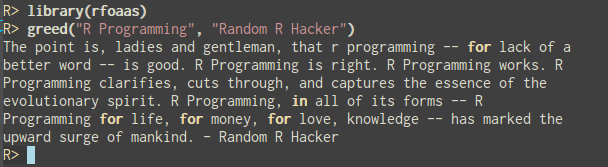
rfoaas greed example The big 1.0.0 is here! Following the unsurpassed lead of the FOAAS project, we have arrived at a milestone: Release 1.0.0 is now on CRAN. The rfoaas package provides an interface for R to the most excellent FOAAS service--which itself provides a modern, scalable and RESTful web service for the frequent need to tell someone to f$#@ off. Release 1.0.0 brings fourteen (!!) new access points: back(), bm(), gfy(), think(), keep(), single_(), look(), looking(), no(), give(), zero(), pulp(), sake(), and anyway(). All with documentation and testing. Even more neatly, thanks to a very pull request by Tyler Hunt, we can now issue random FOs via the getRandomFO() function! As usual, CRANberries provides a diff to the previous CRAN release. Questions, comments etc should go to the GitHub issue tracker. More background information is on the project page as well as on the github repo

This post by Dirk Eddelbuettel originated on his Thinking inside the box blog. Please report excessive re-aggregation in third-party for-profit settings.

29 July 2016

Norbert Preining: TUG 2016 Day 4 Books, ooh Books (and Boats)

Talks have been finished, and as a special present to the participants, Pavneet has organized an excursion that probably was one of the best I ever had. First we visited the Toronto Reference Library where we were treated to a delicious collection of rare books (not to mention all the other books and architecture), and then a trip through the Ismaili Centre Toronto and the Aga Khan Museum.
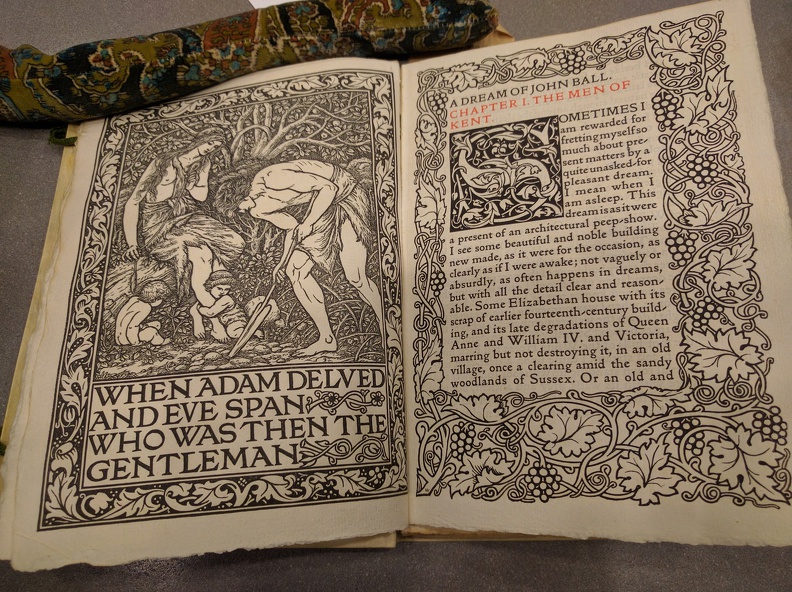
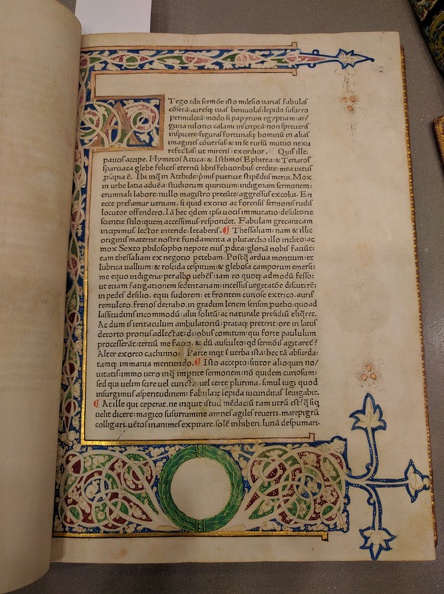
Page from "A Dream of John Ball", Kelmscott Press Edition, 1892.
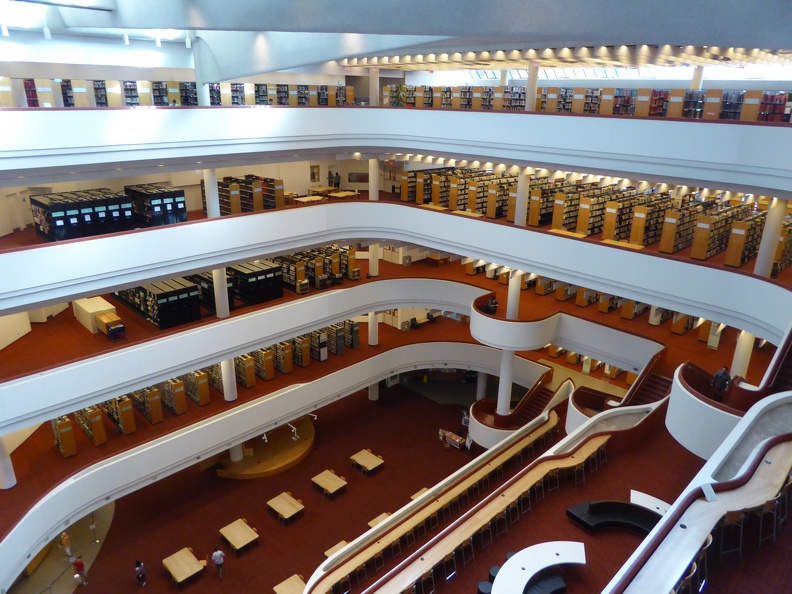
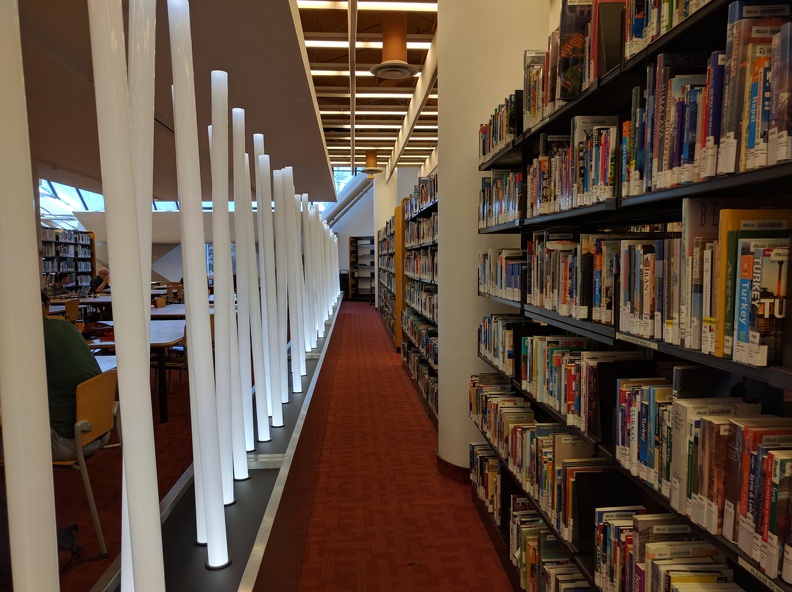
(Kelmscott press edition from 1892 of William Morris A Dream of John Ball.) All these places were great pieces of architecture with excellent samples of the writing and printing art. And after all that and not to be mentioned, the conference dinner evening cruise! Our first stop was the Toronto Reference Library. Designed by Raymond Moriyama, it features a large open atrium with skylights, and it gives the library an open and welcoming feeling. We were told that it resembles a tea cup that needs to be filled with knowledge.
The Toronto Reference Library's atrium
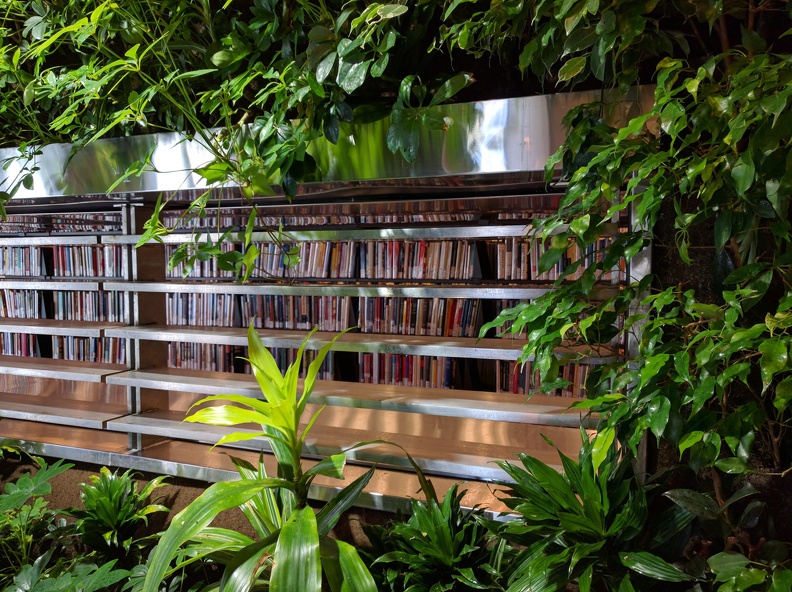
The library also features running water at several places the architect had the idea that natural ambient noise is more natural for a library than the eclectic silence that anyway never happens. Originally there were lots of greens hanging down into the Atrium, resembling the Hanging Gardens, but they have been scrapped due to financial reasons. But there are still green oasis like this beautiful green wall in a corner of the library.
Wall of Green in the middle of the library
We were guided first to the fifth floor where the special collection is housed. And what a special collection. The librarian in charge has laid out about 20 exquisite books starting from early illuminated manuscripts over incunabula to high pieces of printing art from the 18th and 19th century. Here we have a illuminated script in Carolingian minuscule.
Illuminated script in Carolingian minuscule
What was really surprising for all of us in this special collection that all these books were simply laid out in front of us, that the librarian touched and used it without gloves, and above all, that he told us that if one wants it is common practice to check out these books for study sessions and enjoy them on the spot in the reading room. I don t know any other library that allows you to actually handle these rare and beauty specimens! The library not only featured lots of great books, it also had some art installation like these light rods.
Art Light installation in the Toronto Reference Library
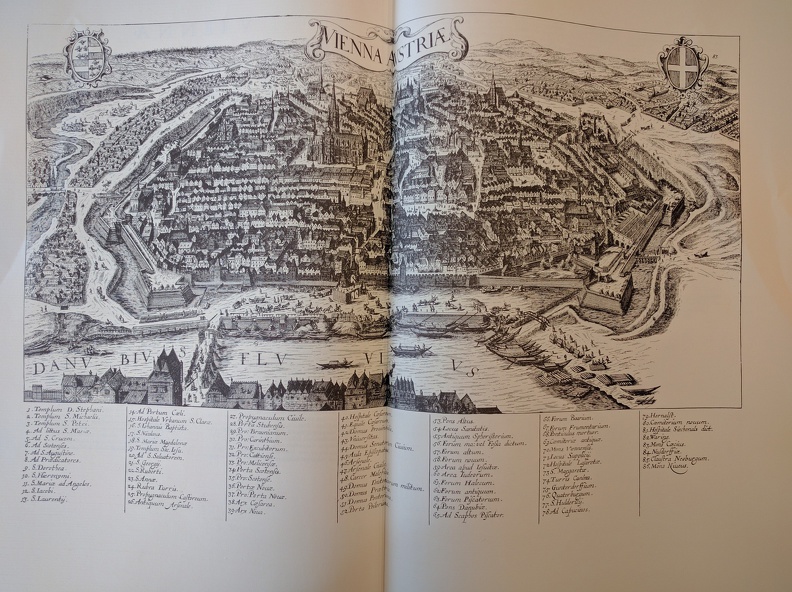
In one of the books I found by chance a map of my hometown of Vienna. Looking at this map from very old times, the place where I grew up is still uninhabited somewhere in the far upper right corner of the map. Times have changed.
Map op Vienna found in the Toronto Reference Library
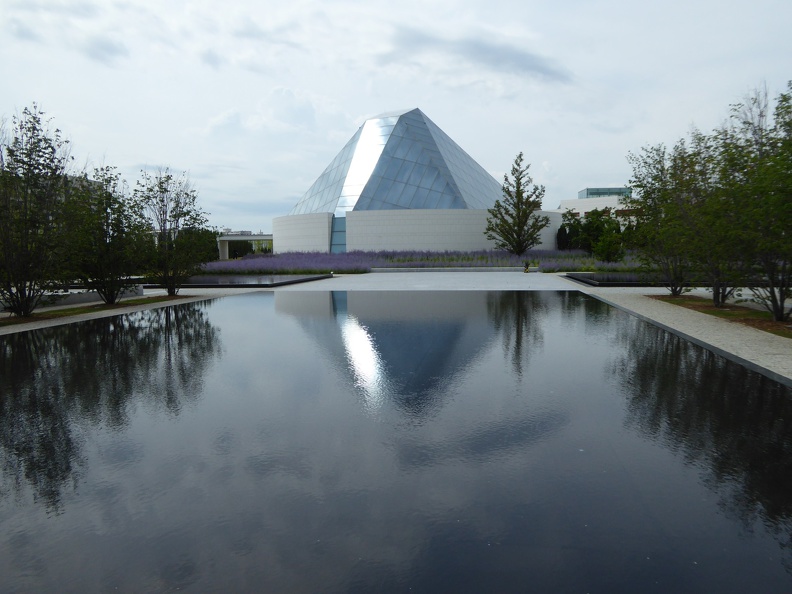
After we left this open and welcoming treasure house of beautiful books, we moved to the Aga Khan Museum and Ismaili Centre Toronto, which are standing face-to-face separated by some water ponds in the Aga Khan park a bit outside of central Toronto. Here we see the Ismaili Centre from the Aga Khan Museum entrance. The big glass dome is the central prayer room, and is illuminated at night. Just one detail one can see in the outer wall one part that looks like glass, too. This is the prayer alcove in the back of the prayer hall, and is made from huge slabs of Onyx that are also lit up in the night.
View onto the Ismaili Centre's Prayer Hall formed by a glass dome
The Ismaili Centre, designed by Charles Correa combines modern functional and simple style with the wonderful ornamental art of the Islam heritage. The inside of the Ismaili Centre features many pieces of exquisite art calligraphy, murals, stone work, etc here is a medallion made from precious stone and set onto a hand-carved wall.
Medaillon made of precious stones in hand carved wall, Ismaili Centre Toronto
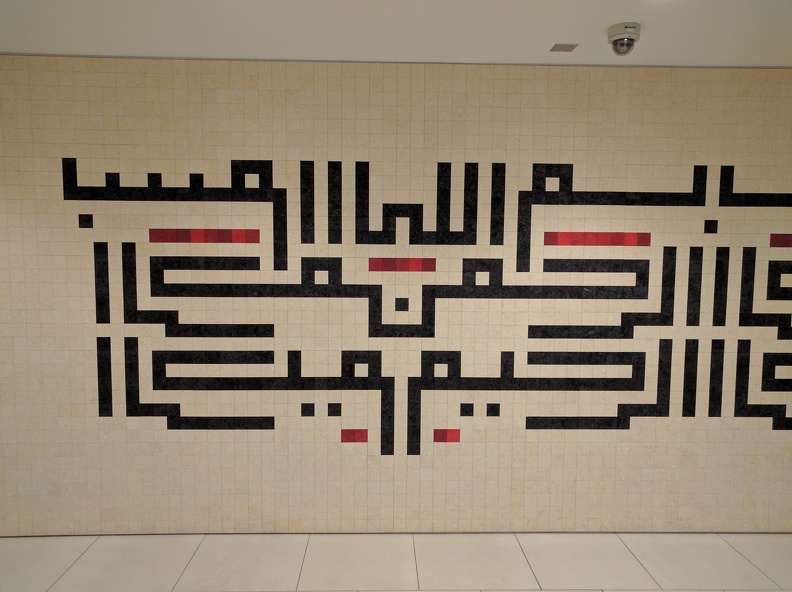
A calligraphy on the wall in the Ismaili Centre
Wall Calligraphy in the Ismaili Centre Toronto
Following the Ismaili Centre we turned to the Aga Khan museum which documents Islamic art, science, and history with an extensive collection. We didn t have much time, and in addition I had to do some fire-fighting over the phone, but the short trip through the permanent collection with samples of excellent calligraphy was amazing.
Koran Calligraphy, Aga Khan Museum Toronto
After returning from this lovely excursion and a short break, we set off for the last stop for tonight, the dinner cruise. After a short bus ride we could board our ship and off we go. Although the beer selection was not on par with what we are used from carft breweries, the perfectly sized boat with two decks and lots of places to hang around invited us to many discussions and chitchats. And finally I could enjoy also the skyline of Toronto.
View onto Toronto from the boat
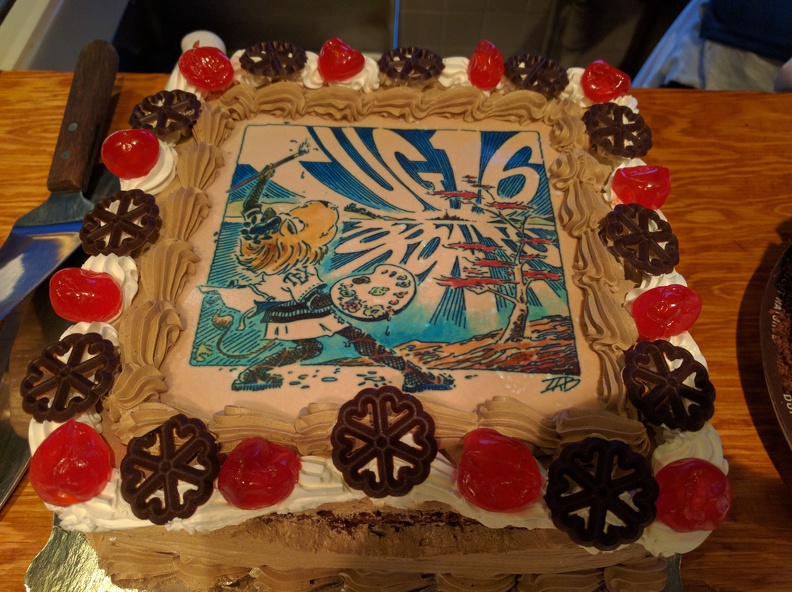
After the dinner we had some sweets, one of which was a specially made cake with the TUG 2016 logo on it. I have to say, it was not only this cake but the whole excellent and overboarding food we had during all these days, that will make me go on diet when I am back in Japan. Pavneet organized for the lunch breaks three different style of kitchens (Thai, Indian, Italian), then the excursions to local brewers and and and If it wouldn t be for TeX, I would call it a Mastkur .
TUG 2016 cake
During the cruise we also had a little ceremony thanking Jim for his work as president of the TUG, but above all Pavneet for this incredible well organized conference. I think everyone agreed that this was the best TUG conference since long.

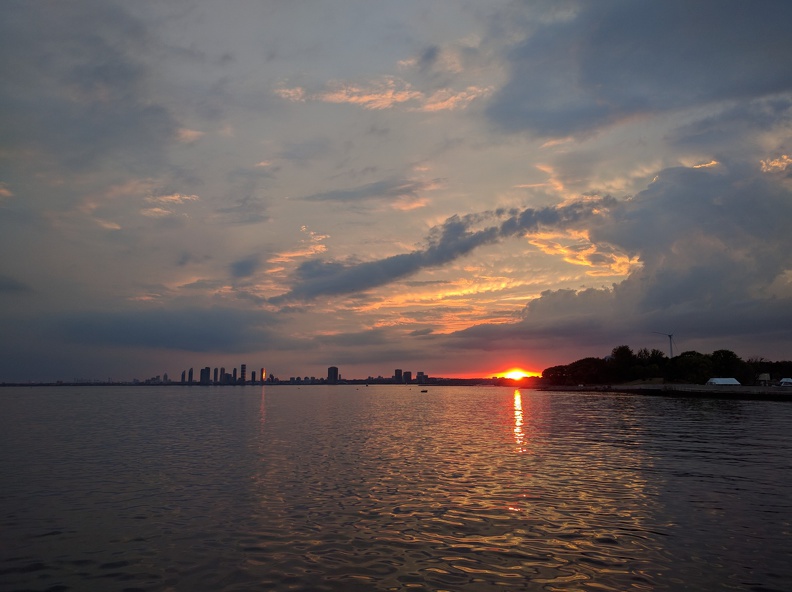
Sunset near Toronto
pensDuring the ceremony, Pavneet also announced the winners of the TUG 2016 fountain pen auction. These pens have a long history/travel behind them, see details on the linked page, and were presented to the special guests of the conference. Two remaining pens were auctioned with funds going to the TUG. The first one was handed over to Steve Grathwohl, and to my utter surprise the second one to myself. So now I am a happy owner of a TUG 2016 fountain pen. What a special feature! Just one more detail about these pens: They are traditional style, so without ink capsules, but one needs to insert the ink with a syringe. I guess I need to stack up a bit at home, and more importantly, train my really ugly hand-writing, otherwise it would be a shame to use this exquisite tool. We returned to the harbor around 10pm, and back to the hotel, where there was much greeting and thanking, as many people will return the following day.
Heading back to Toronto
I will also leave on Friday morning to meet with friends, thus I will not be participating in (and not reporting on) the last excursion of the TUG 2016. I will leave Toronto and the TUG 2016 with (nearly) exclusively good memories of excellent talks, great presentations, wonderful excursions, and lots of things I have learned. I hope to see all of the participants on next year s TUG meeting and I hope I will be able to attend it. Thanks a lot to Pavneet, you have done an incredible job. And last but not least, thanks to your lovely wife for letting you do all this, I know how much time we did steal from her. A few more photos can be found at the album Day 4 Books, ooh books.

25 July 2016

Norbert Preining: TUG 2016 Day 0 Books and Beers

The second pre-conference day was dedicated to books and beers, with a visit to an exquisite print studio, and a beer tasting session at one of the craft breweries in Canada. In addition we could grab a view into the Canadian lifestyle by visiting Pavneet s beautiful house in the countryside, as well as enjoying traditional style pastries from a bakery.
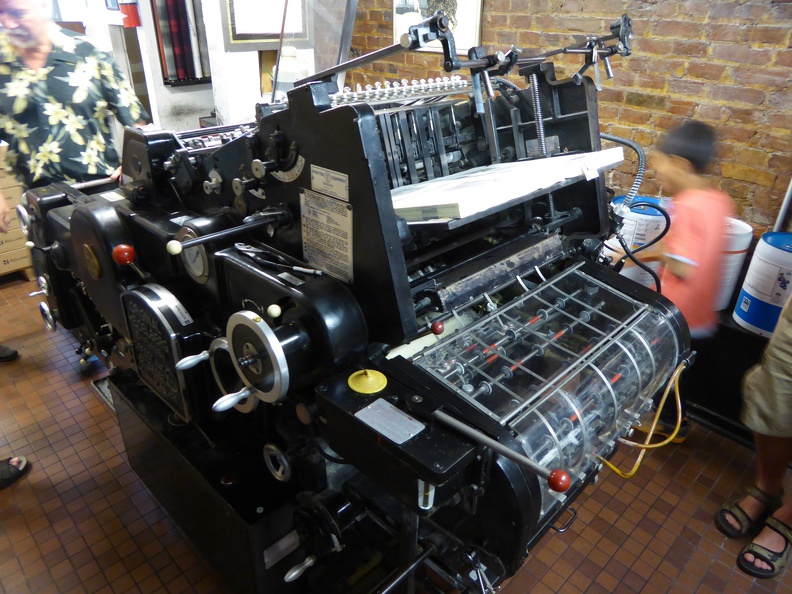
Heidelberg printing machine at Porcupine's quilt
In short, a perfect combination for us typography and beer savvy freaks! This morning we had somehow an early start from the hotel. Soon the bus left downtown Toronto and entered countryside Ontario, large landscapes filled with huge (for my Japanese feeling) estates and houses, separated by fields, forests and wild landscape. Very beautiful and inviting to live there. On our way to the printing workshop we stopped at Pavneet s house for a very short visit of the exterior, which includes mathematics in the bricking. According to Pavneet, his kids hate to see math on the wall I would be proud to have it.
Pavneet's house is hiding some mathematics
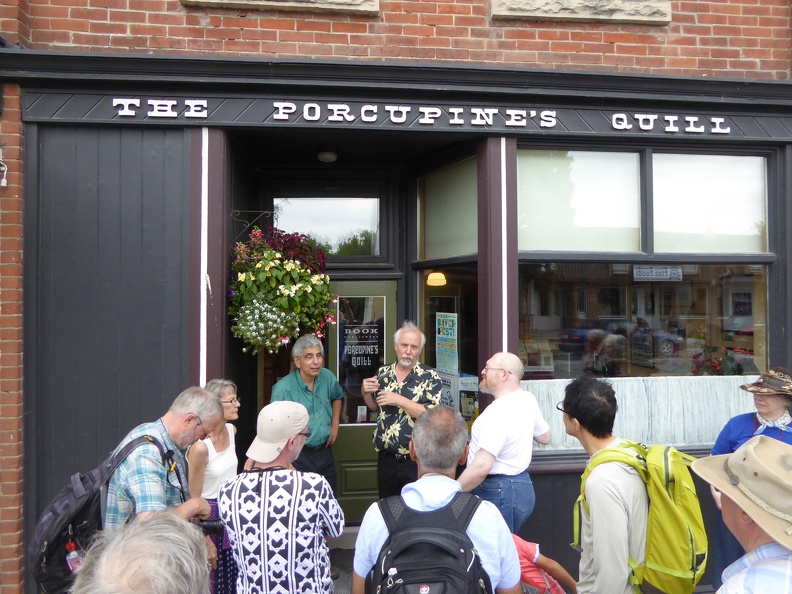
A bit further on we entered into Erin, where the Porcupine s Quill is located. A small building along the street, one could easily oversee that rare jewel! In addition considering that according to the owners, Google Maps has a bad error which would lead you to a completely different location. This printing workshop, led by Tim and Elke Inkster, is producing books in a traditional style using an old Heidelberg Offset printing machine.
Entrance to the Porcupine's Quill, a local bookshop doing excellent printing
Elke introduced us to the sewing of folded signatures together with a lovely old sewing machine. It was the first time I actually saw one in action.
Sewn signatures
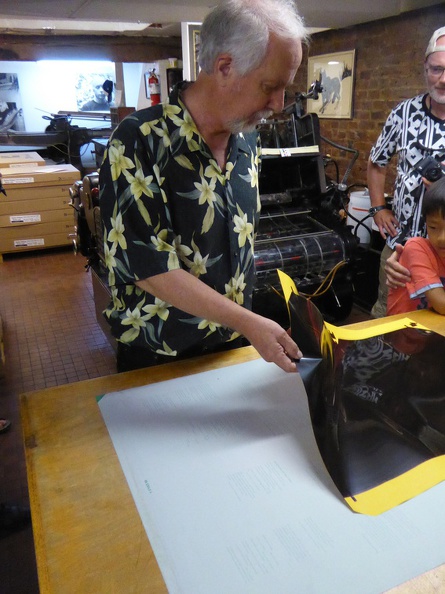
Tim, the head master of the printing shop, first entertained us with stories about Chinese publishers visiting them in the old cold-war times, before diving into explanations of the actual machines around, like the Heidelberg offset printing machine.
Master Tim is showing us offset technique
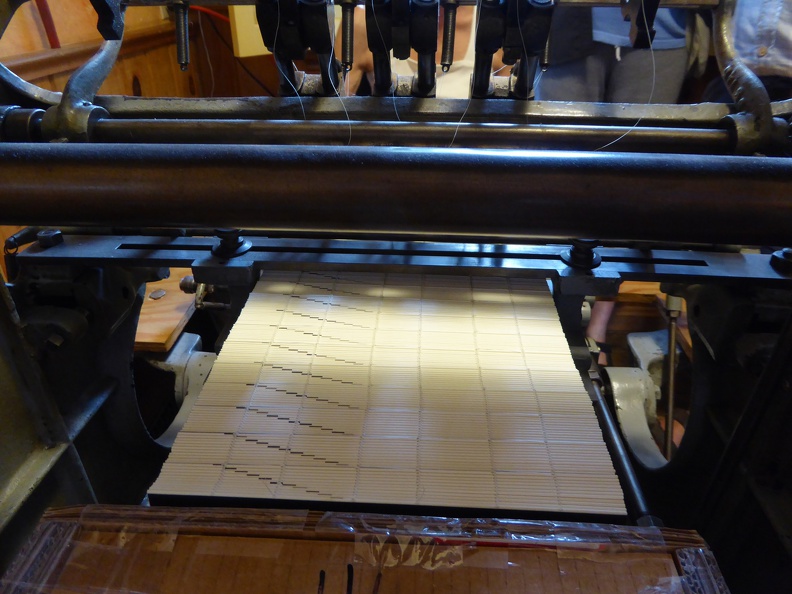
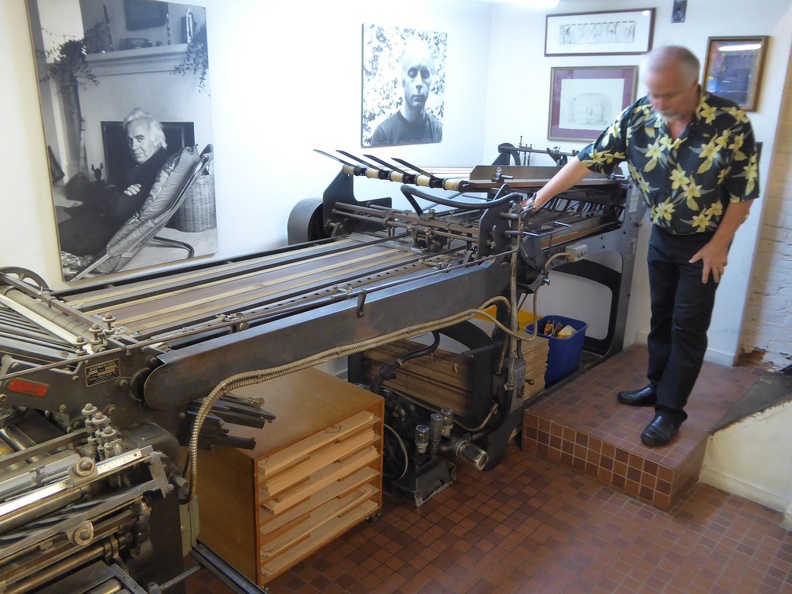
In the back of the basement of the little studio there is also a huge folding machine, which cuts up the big signatures of 16 pages and folds them into bundles. An impressive example of tricky engineering.
The folding machine creates from a printed signature 16 pages in proper order.
Due to the small size of the printing studio, our groups were actually split into two groups, and while the other group got its guided tour, we grabbed coffee and traditional cookies and pastries from the nearby Holtom s bakery. Loads of nice pastries with various filling, my favorite being the slightly salty cherry pie, and above all the rhubarb-raspberry pie.
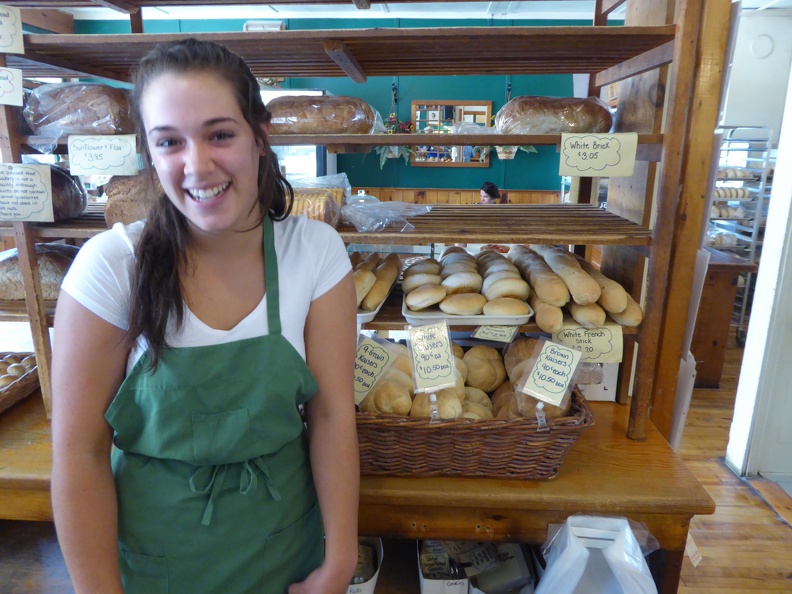
Nearby old-style bakery, selling Viennese-style "Kaisersemmel", calling them "Kaiser buns". There must be an Austrian hiding somewhere around.
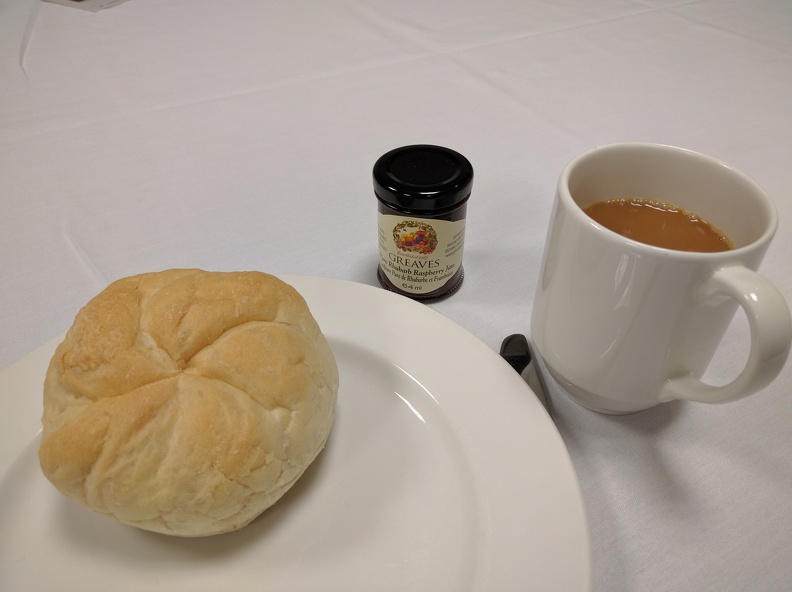
To my absolute astonishment I also found there a Viennese Kaisersemmel , called Kaiser bun here, but keeping the shape and the idea (but unfortunately not the crispy cracky quality of the original in Vienna). Of course I got two of them, together with a nice jam from the region, and enjoyed these Viennese breakfast the next day morning.
Viennese breakfast from the Bakery near Porcupine's Quill
Leaving the Quill we headed for a lunch in a nice pizzeria (I got Pizza Toscana) which also served excellent local beer how would I like to have something like this over in Japan! Our last stop on this excursion was Stone Hammer Brewery, ne of the most famous craft breweries in Canada.
One of the top craft breweries in Canada, the Stone Hammer
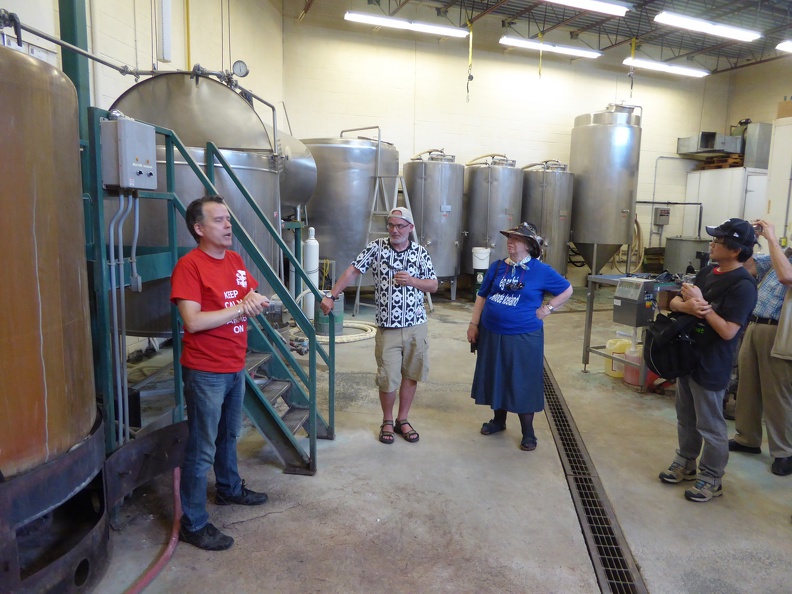
keep-calmAlthough they wont win a prize for typography (besides one page of a coaster there that carried a nice pun), their beers are exquisite. We got five different beers to taste, plus extensive explanations on brewing methods and differences. Now I finally understand why most of the new craft breweries in Japan are making Ales: Ales don t need a long process and are ready for sale in rather short time, compared to e.g. lagers.)
Explanations of the the secrets of beer brewing
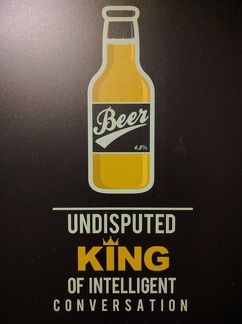
Nothing to add to this poster found in the Stone Hammer Brewery!
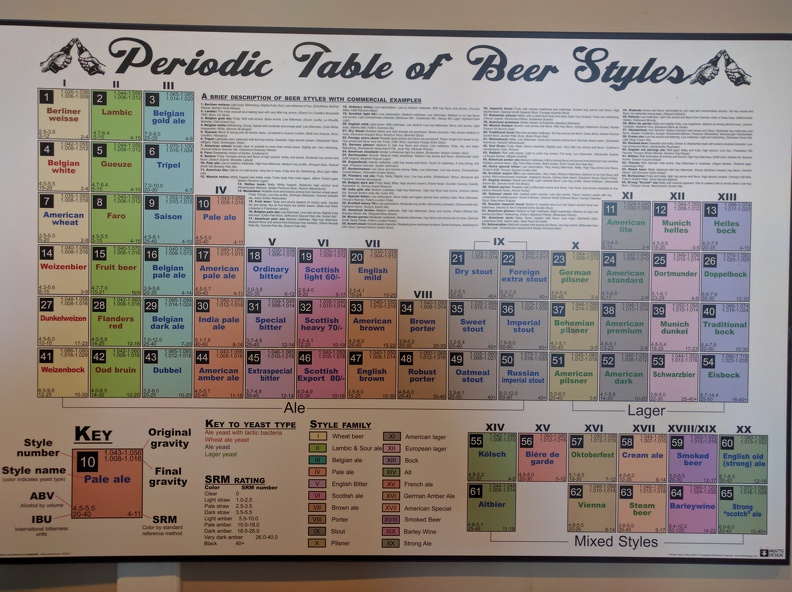
Also at the Stone Hammer Brewery I spotted this very nice poster on the wall of the toilet. And I cannot agree more, everything can easily be discussed over a good beer it calms down aversions, makes even the worst enemies friends, and is healthy for both the mind and body. Filled with excellent beer, some of us (notably an unnamed US TeXnician and politician), stacked up on beers to carry home. I was very tempted to get a huge batch, but putting cans into an airplane seems to be not the optimal idea. Since we are talking cans, I was surprised to hear that many craft beer brewers nowadays prefer cans due to their better protection of the beer from light and oxygen, both killers of good beer. Before leaving we took a last look at the Periodic Table of Beer Types, which left me in awe about how much I don t know and I probably never will know. In particular, I heard the first time of a Vienna style beer Vienna is not really famous for beer, better to say, it is infamous. So maybe this is a different Vienna than my home town that is meant here.
Lots to study here, the Periodic Table of Beers
Another two hour bus ride brought us back to Toronto, where we met with other participants at the reception in a restaurant of Mediterranean cuisine, where I could enjoy for the first time in years a good Tahina and Humus. All around another excellent day, now I only would like to have two days of holidays, guess I need to relax in the lectures starting from tomorrow.

Norbert Preining: TUG 2016 Day -1 Wines and Waters

This years TUG is held in Toronto, Canada, and our incredible host Pavneet has managed to put together an busy program of excursions and events around the real conference. The -1st day (yeah, you read right, the minus-first day), that is two days before the actual conference starts, was dedicated to an excursion to enjoying wines at the wine estate Ch teau des Charmes, followed by a visit to the Niagara falls.
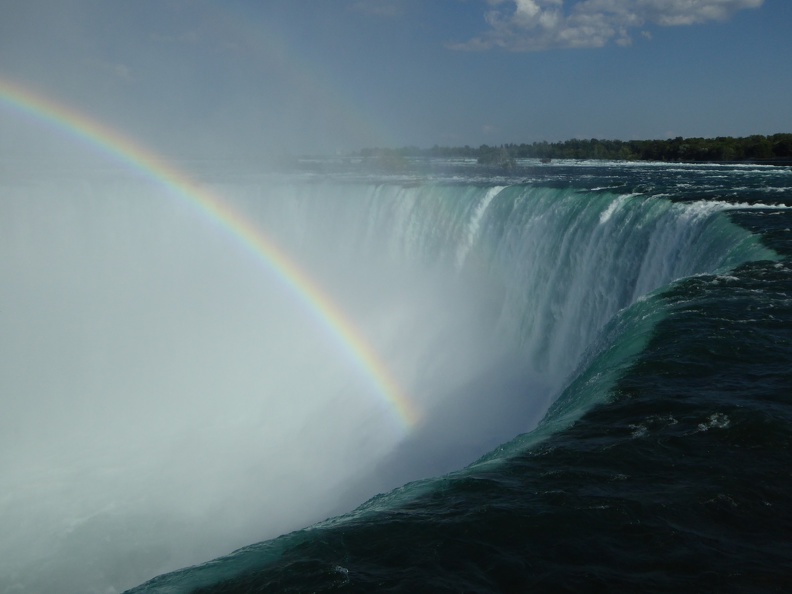
The amount of water running down the Horseshoe Falls is incredible
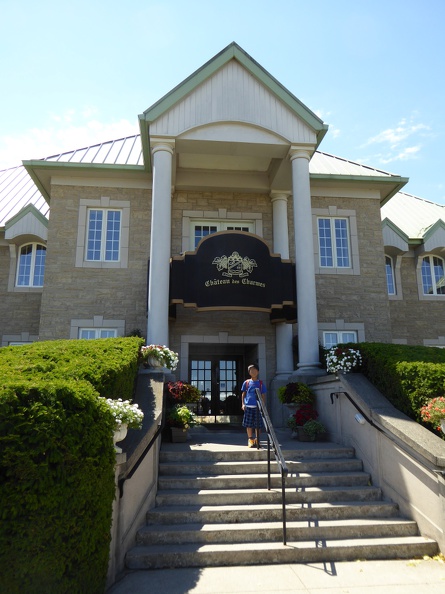
What should I say, if the first thing after getting out of the bus is a good wine, then there is nothing to go wrong I arrived in Toronto already two days earlier in the late afternoon, and spend Friday relaxing, recovering from the long flight, walking the city a bit, trying to fix my cold, and simply going slowly. Saturday morning we met already at a comfortable 10am in the morning (still to early for me, due to jet lag and a slightly late evening before), but the first 2h of bus drive allowed us to relax. Our first stop was the Ch teau des Charmes, and impressive building surrounded by vineyards.
Entrance to the Ch teau des Charmes
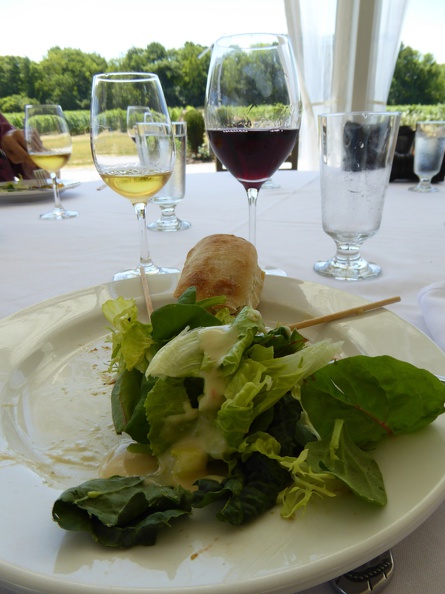
We were immediately handed over to a sandwich lunch with white, red, and ice wine. Good start! And although the breakfast wasn t that long time ago, the delicious sandwiches (at least the vegetarian ones I tried) were good foundation for the wine.
Lunch impressions at Ch teau des Charmes
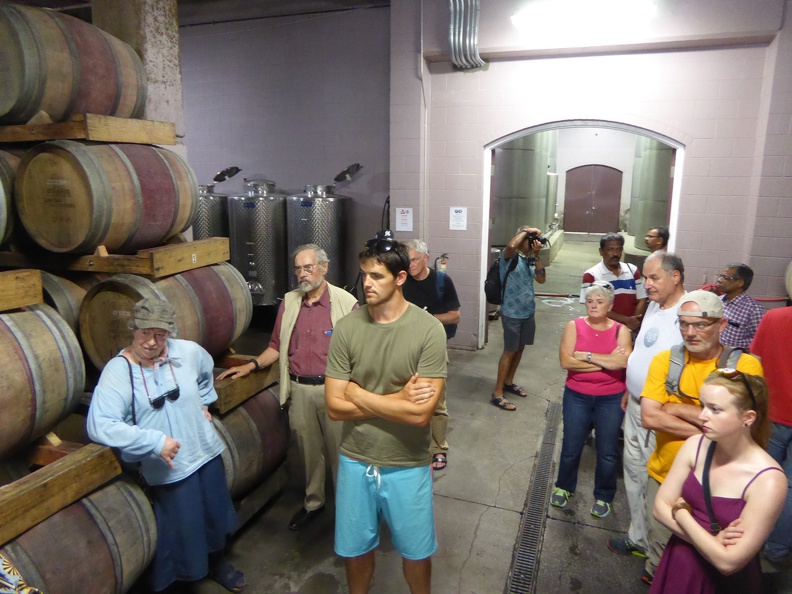
After having refilled our energy reserves, we are ready to start our tour. Our guide, very, if not over, enthusiastic, explains us that practically everything related to wine in Canada has been started at this Ch teau from the current owner the Ch teau system where farmer and wine producer are the same, import of European grapes, winter protection methods, wine making I was close to forgetting our Roman and Greek ancestors. At least she admitted that the Ice wine was brought over by an Austrian but perfection was done here, were the controls of the government are much stricter than anywhere else hmmm, somehow I cannot completely believe all this narrative, but at least it is enjoyable. So now that we know all about the history, we dive into the production process area, and the barrel space, always accompanied with extensive comments and (self-)praise.
Enjoying the explanations of our very enthusiastic guide
After this exhaustive and exhausting round, we are guided back to the patio to taste another three different wines, a white (bit too warm, not so much my taste), a rose (very good), and a red made from a new grape variety that has mutated first here on the Ch teau (interesting). As I didn t have enough, I tried to get something out of the big containers directly, but without success!
Me trying to get a full load of wine
Happy and content, and after passing through the shopping area, we are boarding the bus to continue direction of the Niagara Falls. Passing by at quite some nice houses of definitely quite rich people (although Pavneet told me that houses in Toronto are far more expensive than those here how can someone afford this?), we first have a view onto the lower Niagara river. A bit further one we are let out to see huge whirlpools in the river, where boat tours are bringing sightseers on a rough ride ride into the pool.
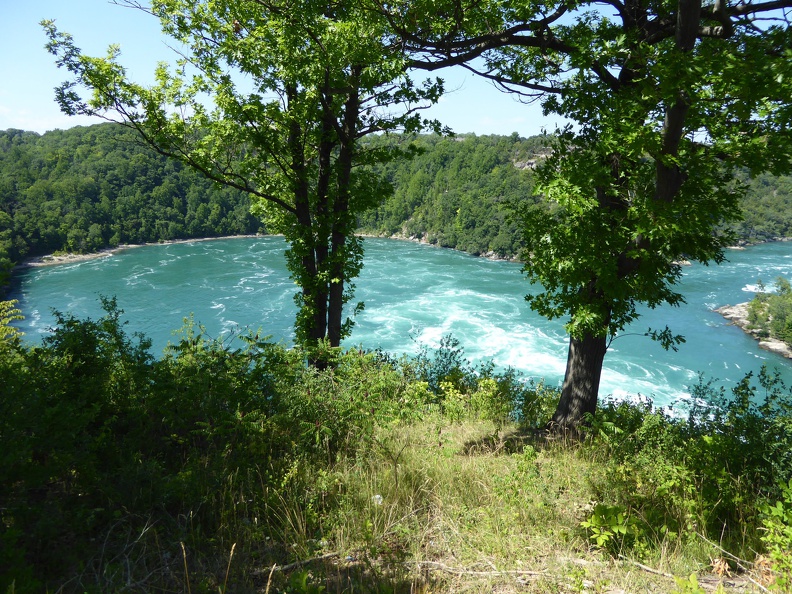
Whirlpools along the Niagara river
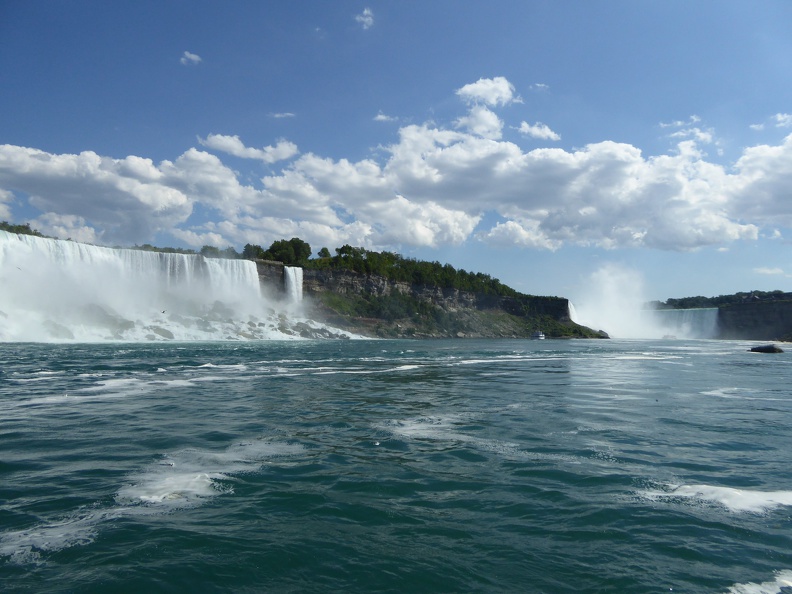
Only a slight bit further on we finally reach the Niagara falls, with the great view onto the American falls in full power, and the Horseshoe Falls further up.
Horseshoe Falls in view
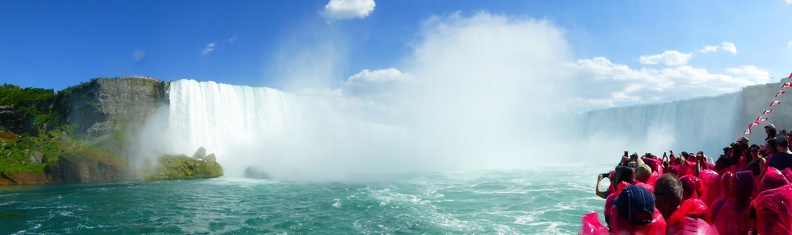
We immediately boarded a boat tour making a short trip to the Horseshoe Fall. Lining up with hundreds and hundreds of other spectators, we prepare for the splash with red rain wear (the US side uses blue, not that any side would rescue a wrong person and create an illegal immigrant!). The trip passes first under the American Falls and continues right into the mist that fills all the area in the middle of the Horseshoe falls. Spectacular impression with walls of water falling down on both sidess.
Panorama of the Horseshoe Falls
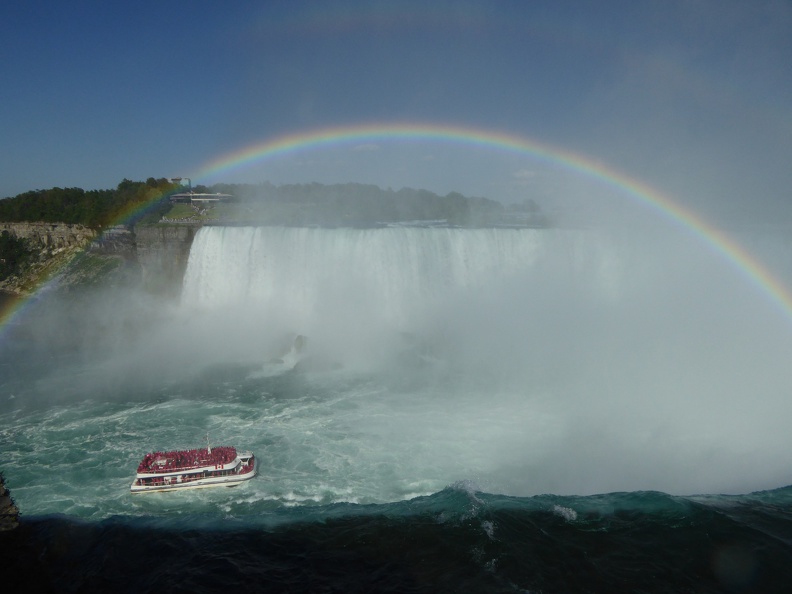
Returned from the splash and having dried our feet, we walk along the ridge to see the Horseshoe falls from close up. The amount of water falling down these falls is incredible, and so is the erosion that creates the brown foam on the water down in the pool, made up from pulverized limestone. Blessed as we were, the sun was laughing all the day and we got a nice rainbow right in the fall.
Horseshoe Falls with boat and rainbow, lovely.
The surroundings of the fall are less impressive Disney land? Horror cabinet? Jodel bar? A wild mixture of amusement park style locations squeezed together and overly full with people as if enjoying the nature itself would not be enough. All immersed by ever blasting loudspeaker music.
Torture around Niagara falls
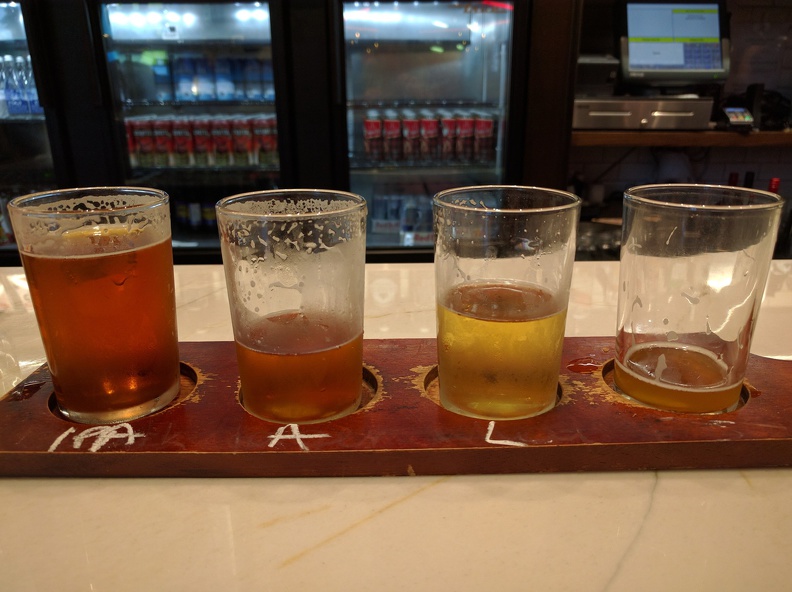
The only plus point I could find in this encampment of forced happiness was a local craft beer brewer where one could taste 8 different beers I made it only to four, though.
Beer tasting at Niagara Brewery, IPA, Amber ale, Lager, and some Light Fruity Radler beer.
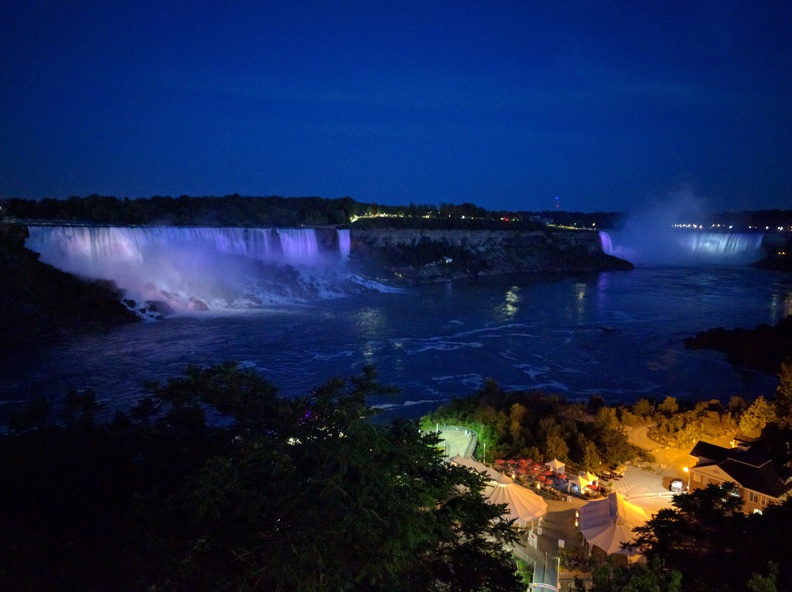
Finally night was falling in and we moved down to the falls again to enjoy the illumination of the falls.
Night view onto Niagara falls
After this wonderful finish we boarded the bus and back to Toronto, where we arrived around mid-night. A long but very pleasurable Day Minus One! Further photos can be seen at the gallery TUG 2016 Day Minus One.

21 July 2016

Reproducible builds folks: Reproducible builds: week 62 in Stretch cycle

What happened in the Reproducible Builds effort between June 26th and July 2nd 2016: Read on to find out why we're lagging some weeks behind ! GSoC and Outreachy updates Toolchain fixes With the doxygen upload we are now down to only 2 modified packages in our repository: dpkg and rdfind. Weekly reports delay and the future of statistics To catch up with our backlog of weekly reports we have decided to skip some of the statistics for this week. We might publish them in a future report, or we might switch to a format where we summarize them more (and which we can create (even) more automatically), we'll see. We are doing these weekly statistics because we believe it's appropriate and useful to credit people's work and make it more visible. What do you think? We would love to hear your thoughts on this matter! Do you read these statistics? Somewhat? Actually, thanks to the power of notmuch, Holger came up with what you can see below, so what's missing for this week are the uploads fixing irreprodubilities. Which we really would like to show for the reasons stated above and because we really really need these uploads to happen ;-) But then we also like to confirm the bugs are really gone, which (atm) requires manual checking, and to look for the words "reproducible" and "deterministic" (and spelling variations) in debian/changelogs of all uploads, to spot reproducible work not tracked via the BTS. And we still need to catch up on the backlog of weekly reports. Bugs submitted with reproducible usertags It seems DebCamp in Cape Town was hugely successful and made some people get a lot of work done: 61 bugs have been filed with reproducible builds usertags and 60 of them had patches: Package reviews 437 new reviews have been added (though most of them were just linking the bug, "only" 56 new issues in packages were found), an unknown number has been been updated and 60 have been removed in this week, adding to our knowledge about identified issues. 4 new issue types have been found: Weekly QA work 98 FTBFS bugs have been reported by Chris Lamb and Santiago Vila. diffoscope development strip-nondeterminism development tests.reproducible-builds.org Misc. This week's edition was written by Mattia Rizzolo, Reiner Herrmann, Ceridwen and Holger Levsen and reviewed by a bunch of Reproducible builds folks on IRC.

11 July 2016

Dirk Eddelbuettel: Rcpp now used by over 700 CRAN packages

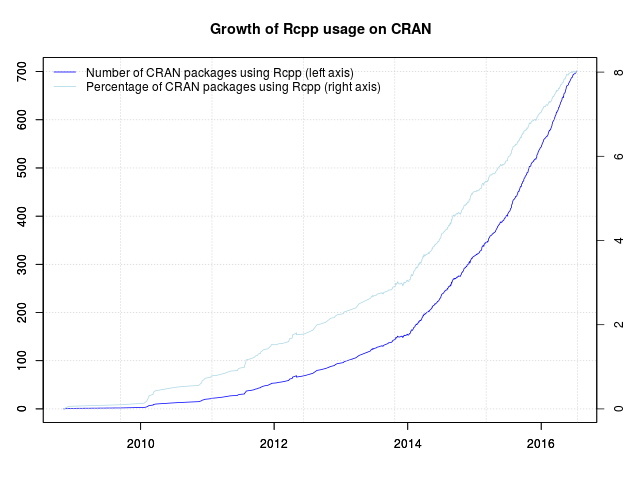
600 Rcpp packages Earlier this morning, Rcpp reached another milestone: 701 packages on CRAN now depend on it (as measured by Depends, Imports and LinkingTo declarations). The graph is on the left depicts the growth of Rcpp usage over time. Rcpp cleared 300 packages in November 2014. It passed 400 packages in June of last year (when I only tweeted about it), 500 packages in late October and 600 packages exactly four months ago in March. The chart extends to the very beginning via manually compiled data from CRANberries and checked with crandb. Then next part uses manually saved entries, and the final and largest part of the data set was generated semi-automatically via a short script appending updates to a small file-based backend. A list of packages using Rcpp is kept on this page. Also displayed in the graph is the relative proportion of CRAN packages using Rcpp. The four per-cent hurdle was cleared just before useR! 2014 where I showed a similar graph (as two distinct graphs) in my invited talk. We passed five percent in December of 2014, six percent last July, seven percent just before Christmas and now criss-crosses 8 eight percent, or a little less than one in twelve R packages. 700 user packages is a really large and humbling number. This places quite some responsibility on us in the Rcpp team as we continue to try our best try to keep Rcpp as performant and reliable as it has been. So with that a very big Thank You! to all users and contributors of Rcpp for help, suggestions, bug reports, documentation or, of course, code.

This post by Dirk Eddelbuettel originated on his Thinking inside the box blog. Please report excessive re-aggregation in third-party for-profit settings.

10 July 2016

Michal Čihař: Weblate 2.7

Slightly later than on monthly schedule but Weblate 2.7 is out today. This release brings improvements to the API and is first to officially support wlc a command line client for Weblate. Full list of changes for 2.7: If you are upgrading from older version, please follow our upgrading instructions. You can find more information about Weblate on https://weblate.org, the code is hosted on Github. If you are curious how it looks, you can try it out on demo server. You can login there with demo account using demo password or register your own user. Weblate is also being used https://hosted.weblate.org/ as official translating service for phpMyAdmin, OsmAnd, Aptoide, FreedomBox, Weblate itself and many other projects. Should you be looking for hosting of translations for your project, I'm happy to host them for you or help with setting it up on your infrastructure. Further development of Weblate would not be possible without people providing donations, thanks to everybody who have helped so far! The roadmap for next release is just being prepared, you can influence this by expressing support for individual issues either by comments or by providing bounty for them.

Filed under: Debian English SUSE Weblate 0 comments

7 July 2016

Joey Hess: twenty years of free software -- part 10 shell-monad

shell-monad is a small project, done over a couple days and not needing many changes since, but I'm covering it separately because it was a bit of a milestone for me. As I learned Haskell, I noticed that the libraries were excellent and did things to guide their users that libraries in other languages don't do. Starting with using types and EDSLs and carefully constrained interfaces, but going well beyond that, as far as applying category theory. Using these libraries push you toward good solutions. shell-monad was a first attempt at building such a library. The shell script it generates should always be syntactically valid, and never forgets to quote a shell variable. That's only the basics. It goes further by making it impossible to typo the name of a shell variable or shell function. And it uses phantom types so that the Haskell type checker can check the types of shell variables and functions match up. So I think shell-monad is pretty neat, and I certianly learned a lot about writing Haskell libraries making it. Including how much I still have to learn! I have not used shell-monad much, but keep meaning to make propellor and git-annex use it for some of their shell script needs. And ponder porting etckeeper to generate its shell scripts using it. Next: twenty years of free software -- part 11 concurrent-output

28 June 2016

John Goerzen: A great day for a flight with the boys

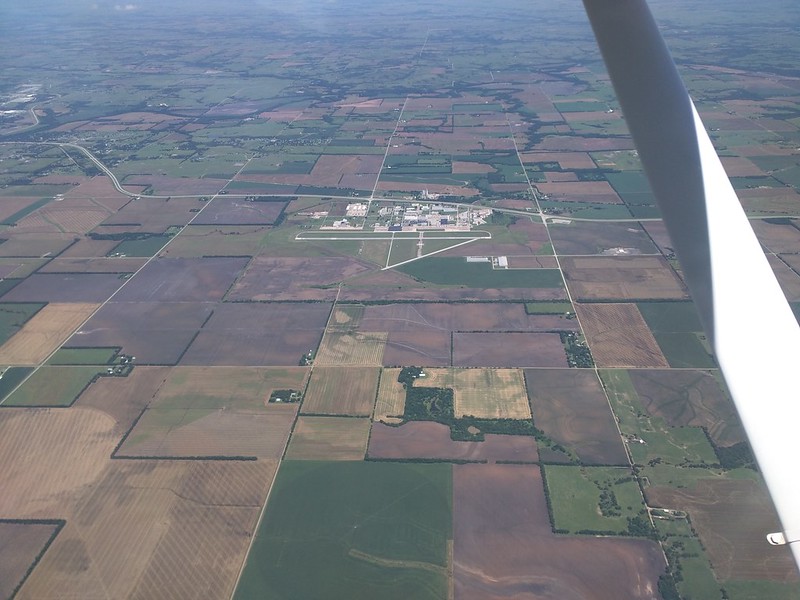
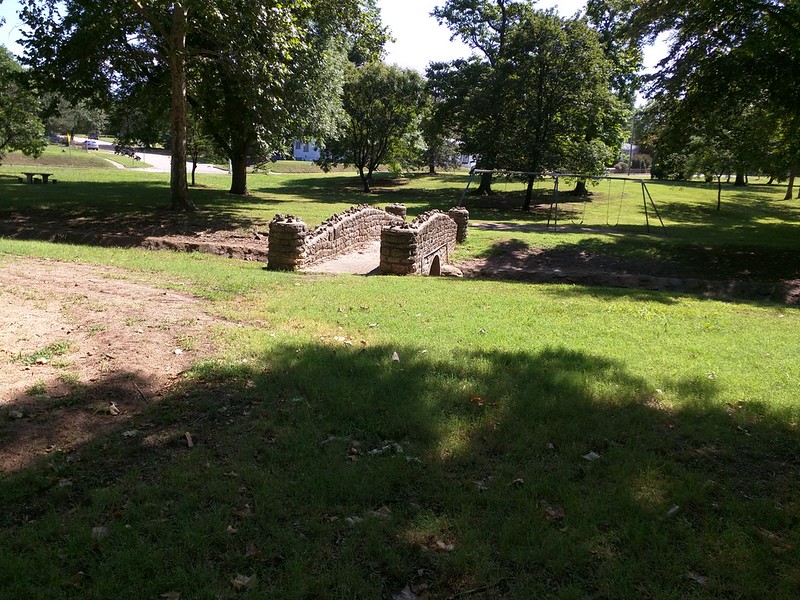
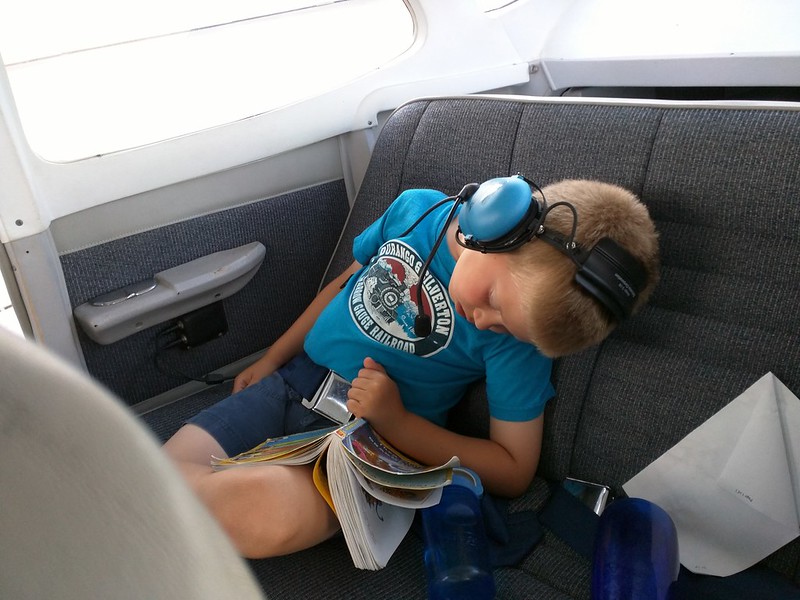
I tend to save up my vacation time to use in summer for family activities, and today was one of those days. Yesterday, Jacob and Oliver enjoyed planning what they were going to do with me. They ruled out all sorts of things nearby, but they decided they would like to fly to Ponca City, explore the oil museum there, then eat at Enrique s before flying home. Of course, it is not particularly hard to convince me to fly somewhere. So off we went today for some great father-son time. The weather on the way was just gorgeous. We cruised along at about a mile above ground, which gave us pleasantly cool air through the vents and a smooth ride. Out in the distance, a few clouds were trying to form. IMG_20160627_141614 Whether I m flying or driving, a pilot is always happy to pass a small airport. Here was the Winfield, KS airport (KWLD): IMG_20160627_142106 This is a beautiful time of year in Kansas. The freshly-cut wheat fields are still a vibrant yellow. Other crops make a bright green, and colors just pop from the sky. A camera can t do it justice. They enjoyed the museum, and then Oliver wanted to find something else to do before we returned to the airport for dinner. A little exploring yielded the beautiful and shady Garfield Park, complete with numerous old stone bridges. IMG_20160627_162121 Of course, the hit of any visit to Enrique s is their ice cream tacos (sopapillas with ice cream). Here is Oliver polishing off his. IMG_20160627_174345 They had both requested sightseeing from the sky on our way back, but both fell asleep so we opted to pass on that this time. Oliver slept through the landing, and I had to wake him up when it was time to go. I always take it as a compliment when a 6-year-old sleeps through a landing! IMG_20160627_191524 Most small airports have a bowl of candy setting out somewhere. Jacob and Oliver have become adept at finding them, and I will usually let them talk me into a piece of candy at one of them. Today, after we got back, they were intent at exploring the small gift shop back home, and each bought a little toy helicopter for $1.25. They may have been too tired to enjoy it though. They ve been in bed for awhile now, and I m still smiling about the day. Time goes fast when you re having fun, and all three of us were. It is fun to see them inheriting my sense of excitement at adventure, and enjoying the world around them as they go. The lady at the museum asked how we had heard about them, and noticed I drove up in an airport car (most small airports have an old car you can borrow for a couple hours for free if you re a pilot). I told the story briefly, and she said, So you flew out to this small town just to spend some time here? Yep. Wow, that s really neat. I don t think we ve ever had a visitor like you before. Then she turned to the boys and said, You boys are some of the luckiest kids in the world. And I can t help but feel like the luckiest dad in the world.

23 June 2016

Jonathan McDowell: Fixing missing text in Firefox

Every now and again I get this problem where Firefox won t render text correctly (on a Debian/stretch system). Most websites are fine, but the odd site just shows up with blanks where the text should be. Initially I thought it was NoScript, but turning that off didn t help. Daniel Silverstone gave me a pointer today that the pages in question were using webfonts, and that provided enough information to dig deeper. The sites in question were using Cantarell, via:
src: local('Cantarell Regular'), local('Cantarell-Regular'), url(cantarell.woff2) format('woff2'), url(cantarell.woff) format('woff');
The Firefox web dev inspector didn t show it trying to fetch the font remotely, so I removed the local() elements from the CSS. That fixed the page, letting me pinpoint the problem as a local font issue. I have fonts-cantarell installed so at first I tried to remove it, but that breaks gnome-core. So instead I did an fc-list grep -i cant to ask fontconfig what it thought was happening. That gave:
/usr/share/fonts/opentype/cantarell/Cantarell-Regular.otf.dpkg-tmp: Cantarell:style=Regular
/usr/share/fonts/opentype/cantarell/Cantarell-Bold.otf.dpkg-tmp: Cantarell:style=Bold
/usr/share/fonts/opentype/cantarell/Cantarell-Bold.otf: Cantarell:style=Bold
/usr/share/fonts/opentype/cantarell/Cantarell-Oblique.otf: Cantarell:style=Oblique
/usr/share/fonts/opentype/cantarell/Cantarell-Regular.otf: Cantarell:style=Regular
/usr/share/fonts/opentype/cantarell/Cantarell-Bold-Oblique.otf: Cantarell:style=Bold-Oblique
/usr/share/fonts/opentype/cantarell/Cantarell-Oblique.otf.dpkg-tmp: Cantarell:style=Oblique
/usr/share/fonts/opentype/cantarell/Cantarell-BoldOblique.otf: Cantarell:style=BoldOblique
Hmmm. Those .dpkg-tmp files looked odd, and sure enough they didn t actually exist. So I did a sudo fc-cache -f -v to force a rebuild of the font cache and restarted Firefox (it didn t seem to work before doing so) and everything works fine now. It seems that fc-cache must have been run at some point when dpkg had not yet completed installing an update to the fonts-cantarell package. That seems like a bug - fontconfig should probably ignore .dpkg* files, but equally I wouldn t expect it to be run before dpkg had finished its unpacking stage fully.

8 June 2016

Daniel Pocock: Working to pass GSoC

GSoC students have officially been coding since 23 May (about 2.5 weeks) and are almost half-way to the mid-summer evaluation (20 - 27 June). Students who haven't completed some meaningful work before that deadline don't receive payment and in such a large program, there is no possibility to give students extensions or let them try and catch up later. Every project and every student are different, some are still getting to know their environment while others have already done enough to pass the mid-summer evaluation. I'd like to share a few tips to help students ensure they don't inadvertently fail the mid-summer evaluation Kill electronic distractions As a developer of real-time communications projects, many people will find it ironic or hypocritical that this is at the top of my list. Switch off the mobile phone or put it in silent mode so it doesn't even vibrate. Research has suggested that physically turning it off and putting it out of sight has significant benefits. Disabling the voicemail service can be an effective way of making sure no time is lost listening to a bunch of messages later. Some people may grumble at first but if they respect you, they'll get into the habit of emailing you and waiting for you to respond when you are not working. Get out a piece of paper and make a list of all the desktop notifications on your computer, whether they are from incoming emails, social media, automatic updates, security alerts or whatever else. Then figure out how to disable them all one-by-one. Use email to schedule fixed times for meetings with mentors. Some teams/projects also have fixed daily or weekly times for IRC chat. For a development project like GSoC, it is not necessary or productive to be constantly on call for 3 straight months. Commit every day Habits are a powerful thing. Successful students have a habit of making at least one commit every day. The "C" in GSoC is for Code and commits are a good way to prove that coding is taking place. GSoC is not a job, it is like a freelance project. There is no safety-net for students who get sick or have an accident and mentors are not bosses, each student is expected to be their own boss. Although Google has started recommending students work full time, 40 hours per week, it is unlikely any mentors have any way to validate these hours. Mentors can look for a commit log, however, and simply won't be able to pass a student if there isn't code. There may be one day per week where a student writes a blog or investigates a particularly difficult bug and puts a detailed report in the bug tracker but by the time we reach the second or third week of GSoC, most students are making at least one commit in 3 days out of every 5. Consider working away from home/family/friends Can you work without anybody interrupting you for at least five or six hours every day? Do you feel pressure to help with housework, cooking, siblings or other relatives? Even if there is no pressure to do these things, do you find yourself wandering away from the computer to deal with them anyway? Do family, friends or housemates engage in social activities, games or other things in close proximity to where you work? All these things can make a difference between passing and failing. Maybe these things were tolerable during high school or university. GSoC, however, is a stepping stone into professional life and that means making a conscious decision to shut those things out and focus. Some students have the ability to manage these distractions well, but it is not for everybody. Think about how leading sports stars or musicians find a time and space to be "in the zone" when training or rehearsing, this is where great developers need to be too. Some students find the right space in a public library or campus computer lab. Some students have been working in hacker spaces or at empty desks in local IT companies. These environments can also provide great networking opportunities. Managing another summer job concurrently with GSoC It is no secret that some GSoC students have another job as well. Sometimes the mentor is aware of it, sometimes it has not been disclosed. The fact is, some students have passed GSoC while doing a summer job or internship concurrently but some have also failed badly in both GSoC and their summer job. Choosing one or the other is the best way to succeed, get the best results and maximize the quality of learning and community interaction. For students in this situation, now it is not too late to make the decision to withdraw from GSoC or the other job. If doing a summer job concurrently with GSoC is unavoidable, the chance of success can be greatly increased by doing the GSoC work in the mornings, before starting the other job. Some students have found that they actually finish more quickly and produce better work when GSoC is constrained to a period of 4 or 5 hours each morning and their other job is only in the afternoon. On the other hand, if a student doesn't have the motivation or energy to get up and work on GSoC before the other job then this is a strong sign that it is better to withdraw from GSoC now.

28 May 2016

Russ Allbery: Another small book haul

Book reading is happening, and more book review posting will be happening. I'm a bit behind in writing reviews, but the holiday weekend is a good opportunity to do a bit of catching up. In the meantime, here are some new acquisitions: Roxanne J. Coady & Joy Johannessen (ed.) The Books That Changed My Life (nonfiction)
James S.A. Corey Caliban's War (sff)
James S.A. Corey Abaddon's Gate (sff)
Max Gladstone Full Fathom Five (sff)
Max Gladstone Last First Snow (sff)
N.K. Jemisin The Fifth Season (sff)
Guy Gavriel Kay Children of Earth and Sky (sff)
Naomi Novik Uprooted (sff)
Ada Palmer Too Like the Lightning (sff)
Graydon Saunders Safely You Deliver (sff)
Neal Stephenson Seveneves (sff)
Jeff VanderMeer Annihilation (sff) This is mostly catching up on books that were nominated for awards. I want to read the (legitimate) nominees for Hugo best novel this year if I can find the time, and VanderMeer won the Nebula last year. The rest of Gladstone's series to date was on sale, and I really liked the first book. And of course a new Guy Gavriel Kay is buy on sight. I'm currently re-reading The Sarantine Mosaic, since I read that before I started writing reviews and Children of Earth and Sky is apparently set in historical contact with it. (It's possible all of Kay's historical fantasies are set in the same universe, but they're usually fairly disconnected.)

8 May 2016

John Goerzen: The Simple Joys of the Plains
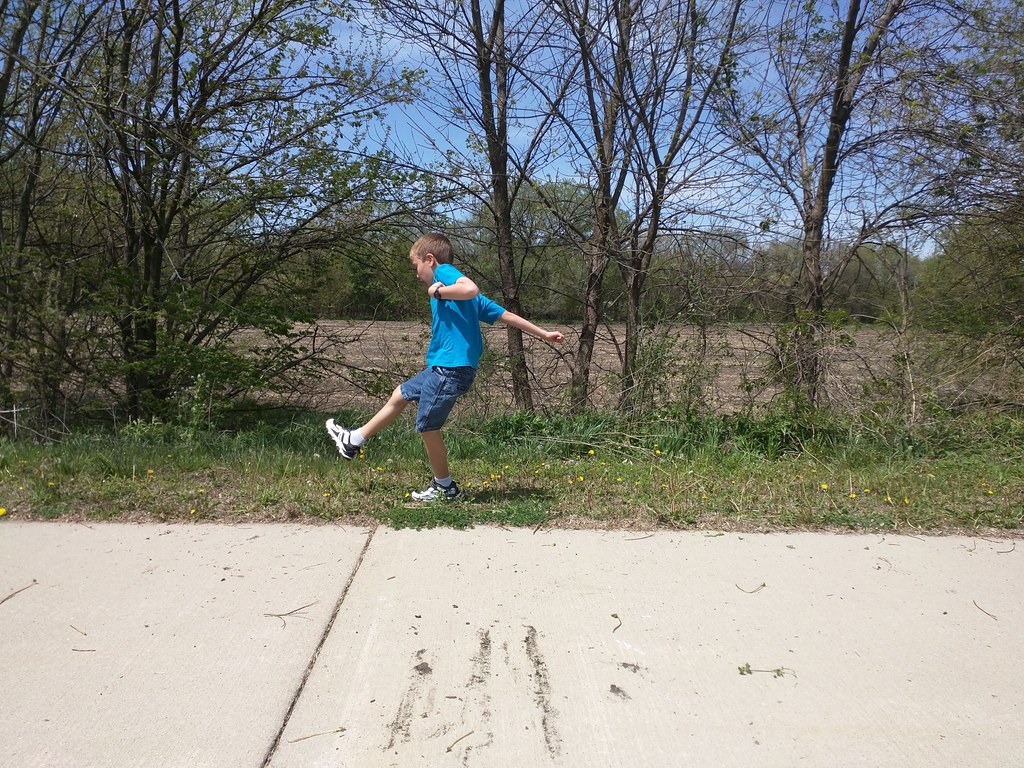
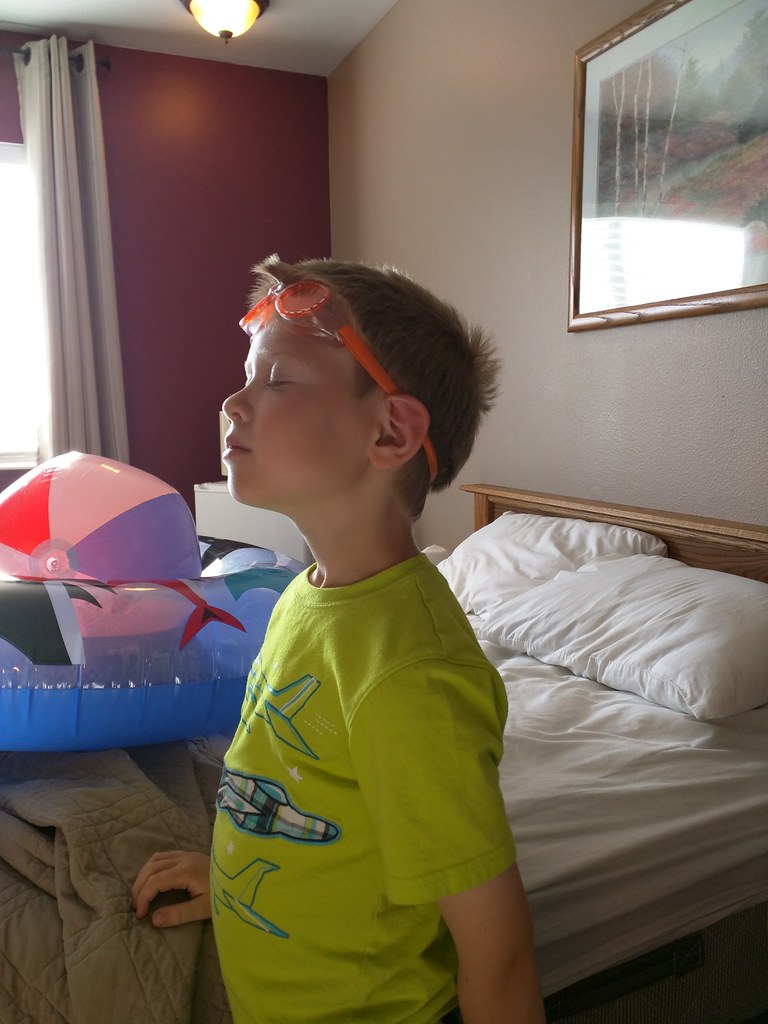
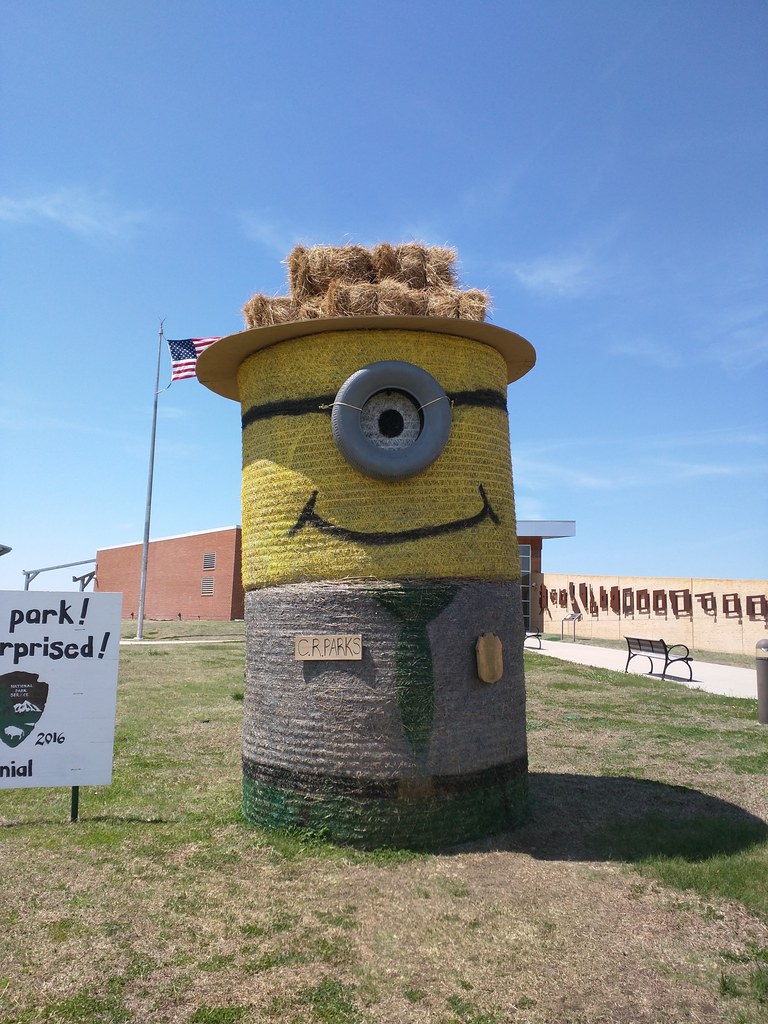
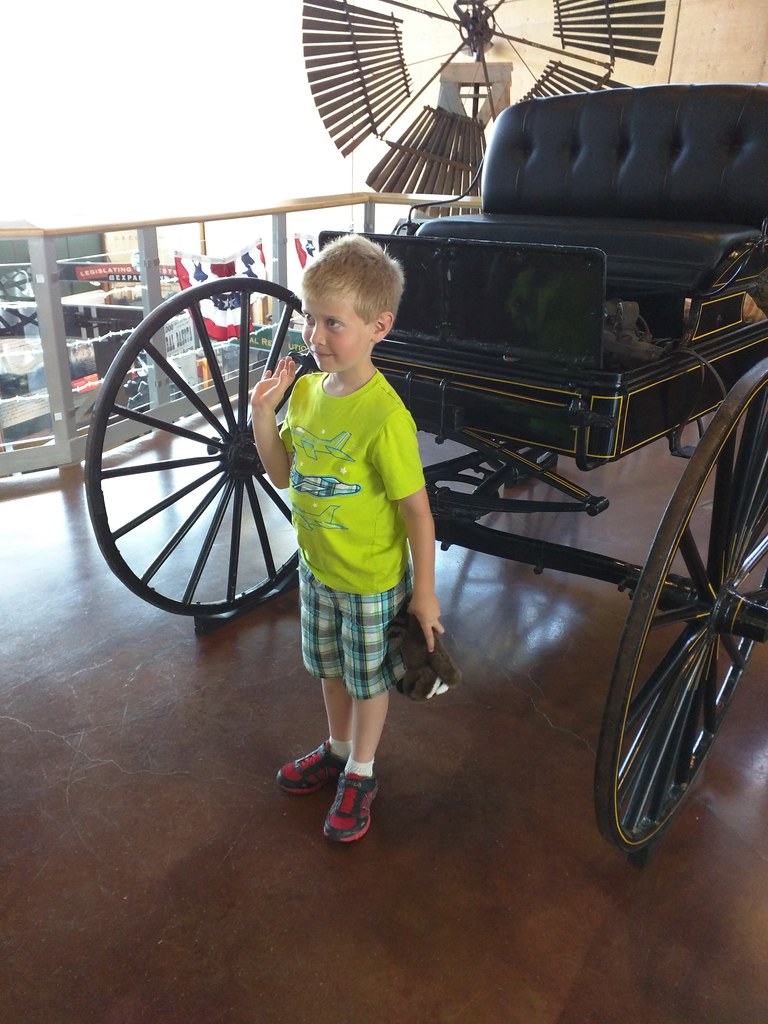
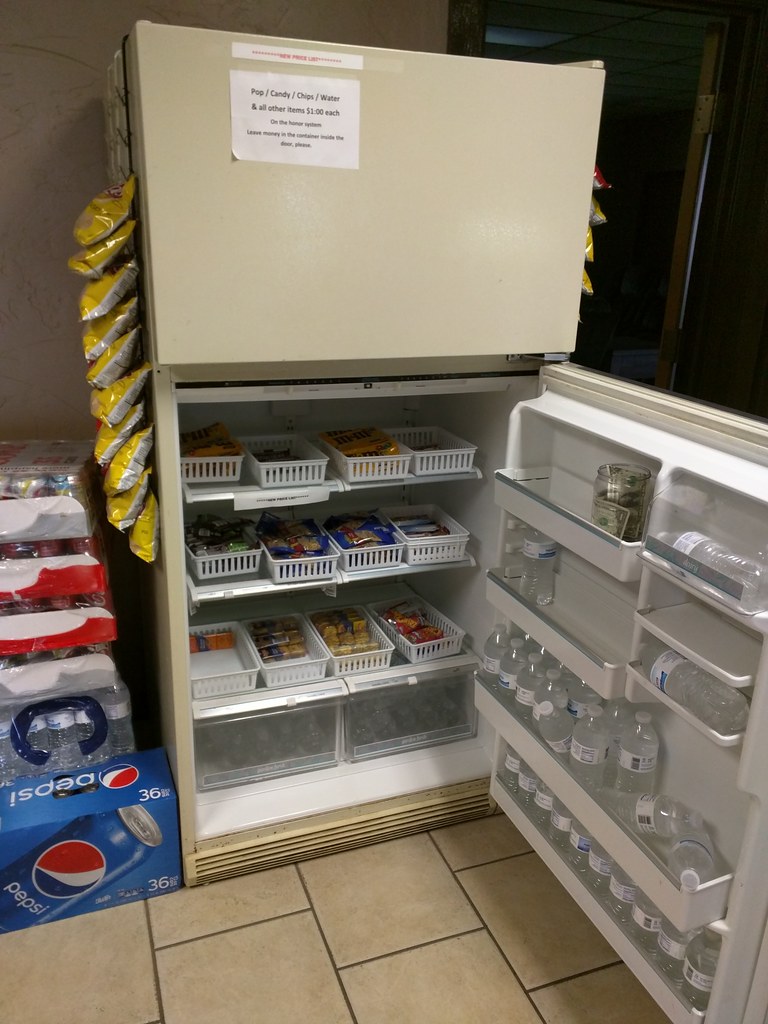
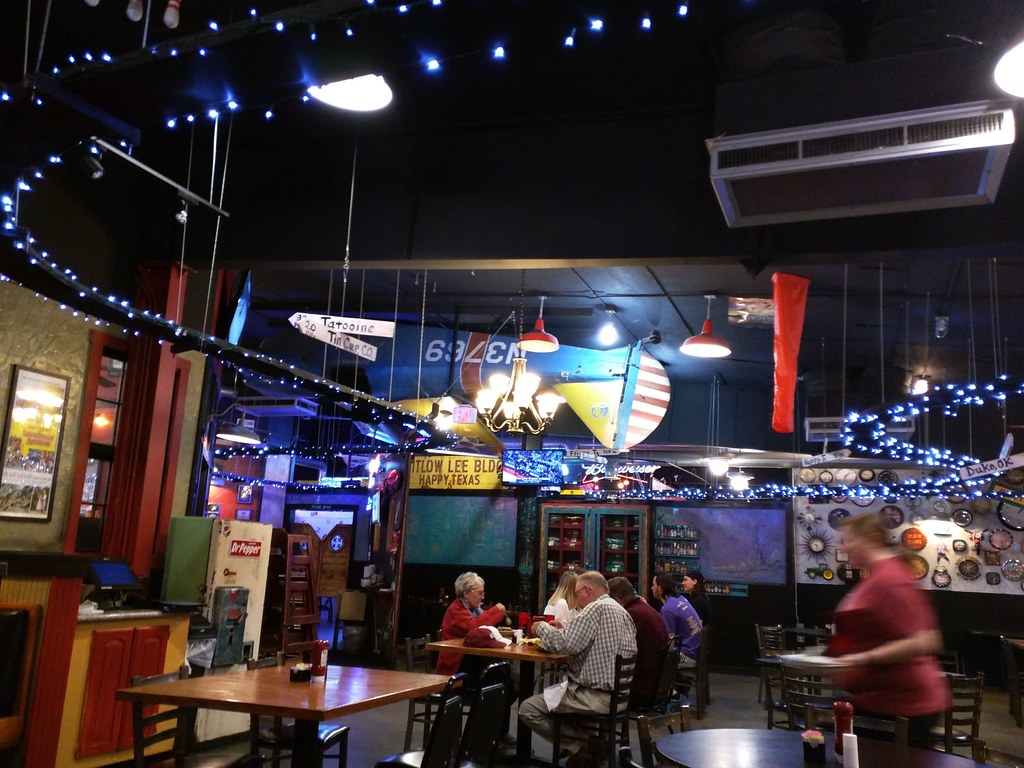
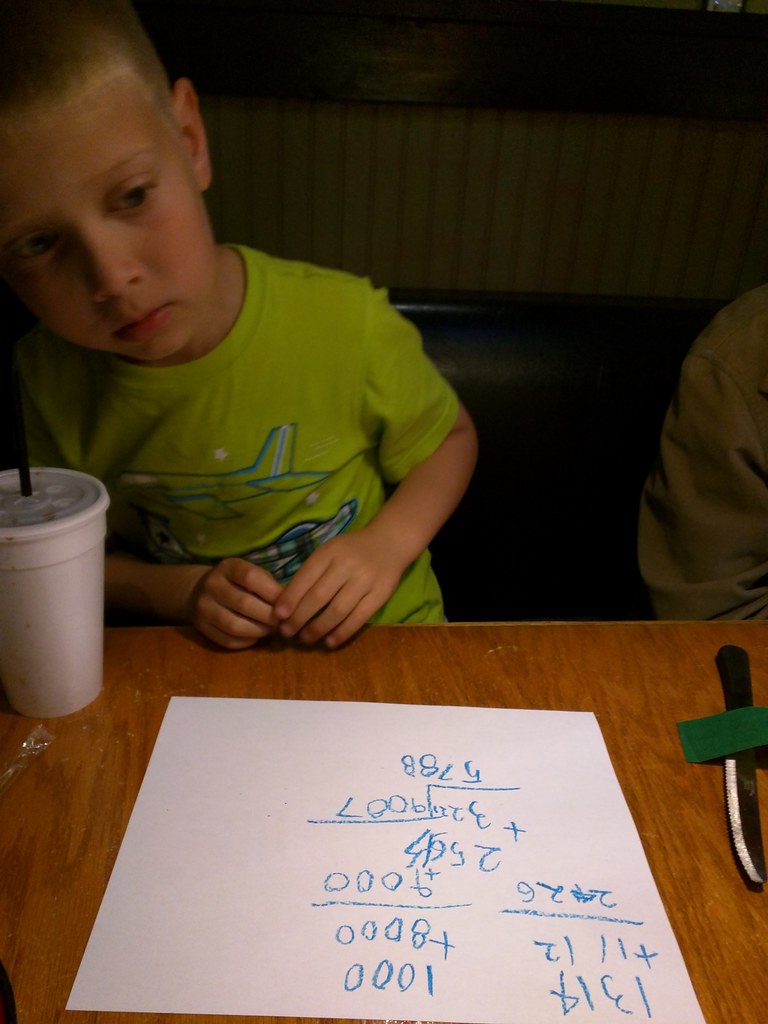
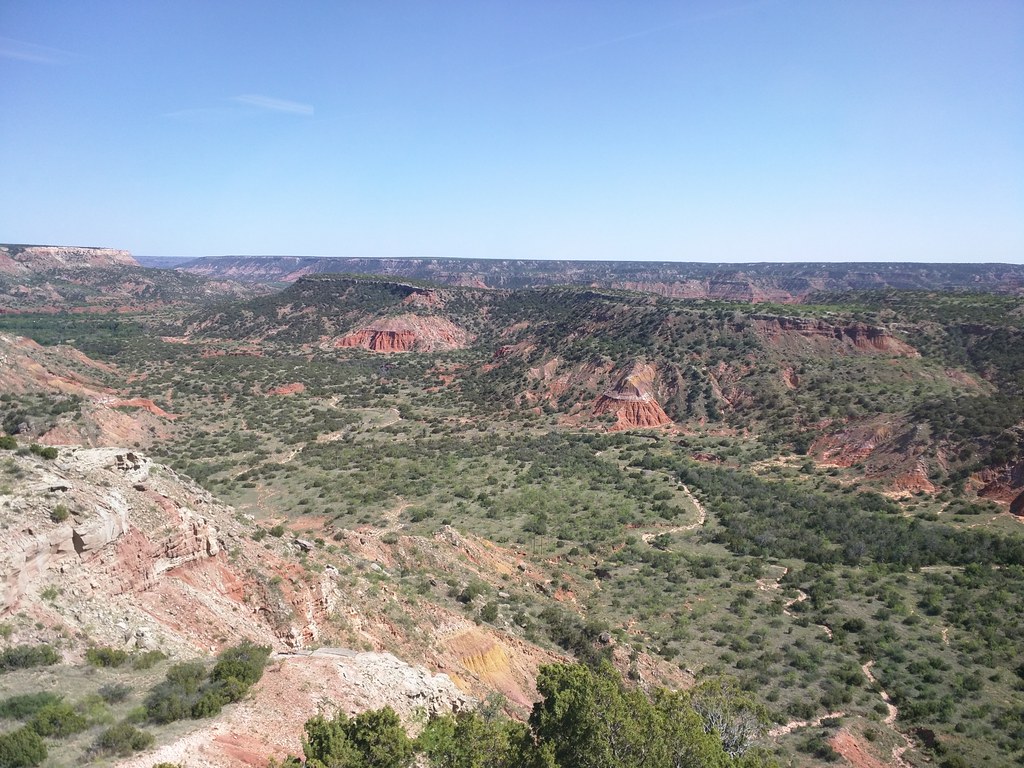
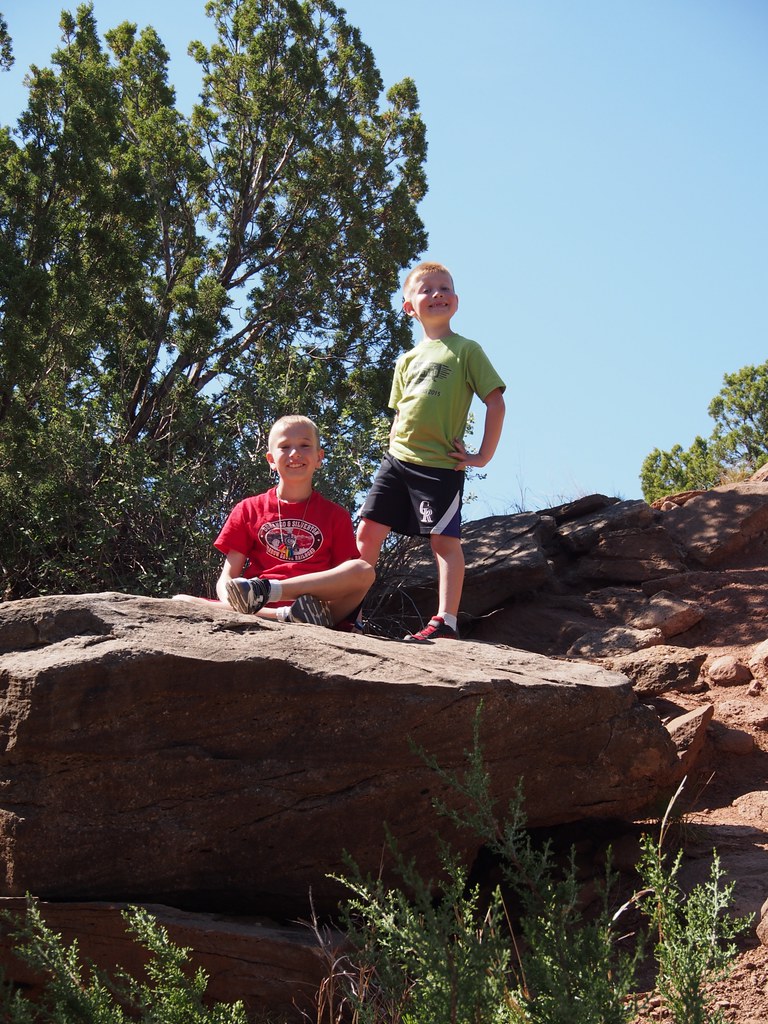
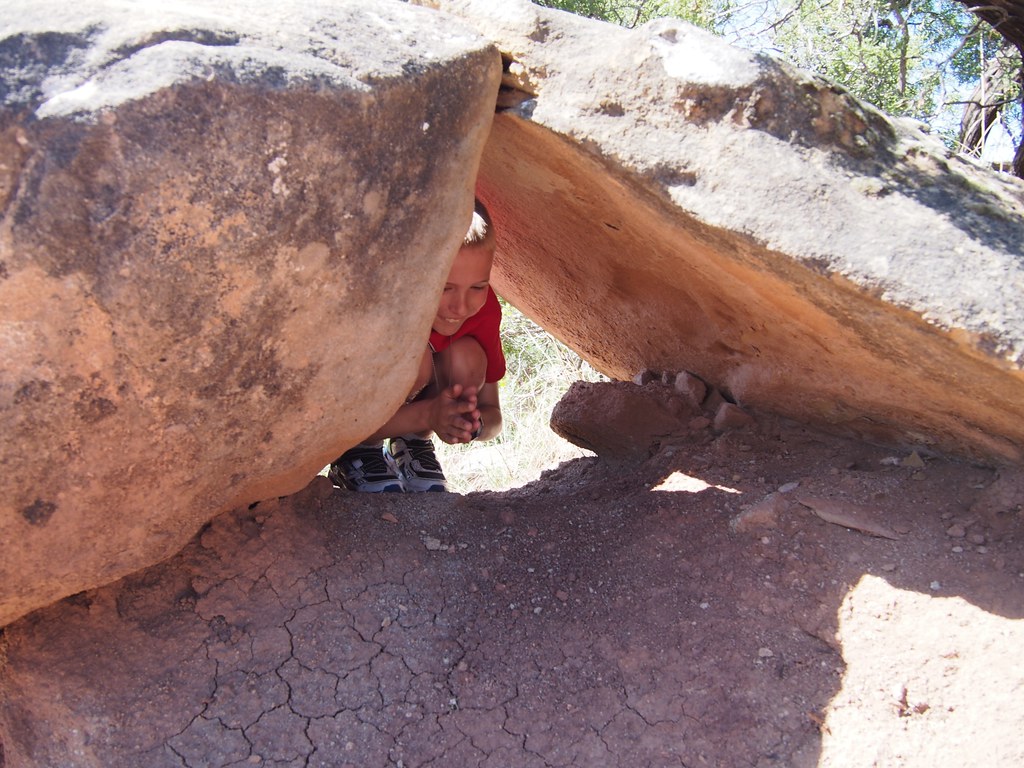
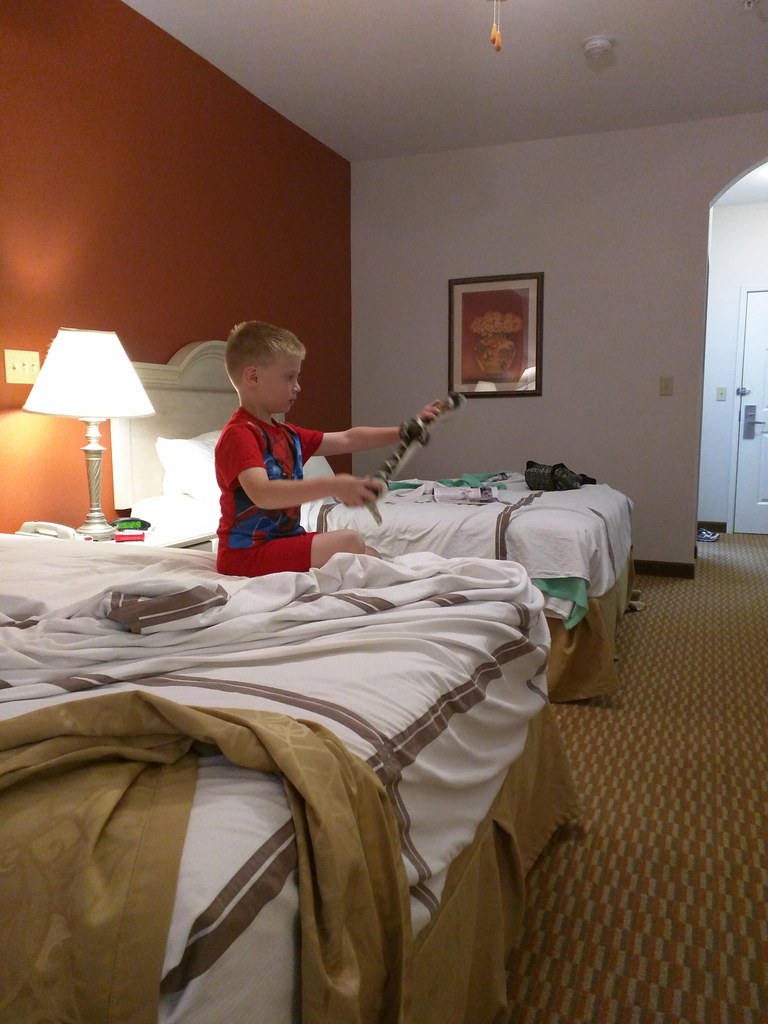
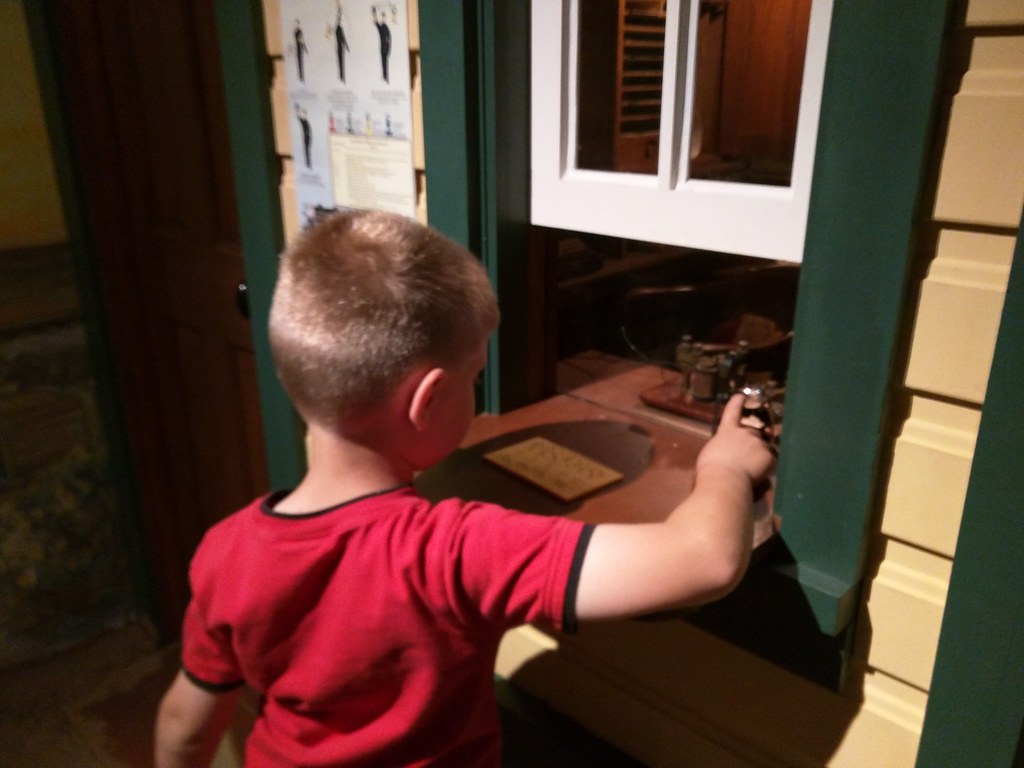
We love to go exploring as a family. Last year, we gave Jacob and Oliver a theme: find places older than Grandpa. They got creative really quick, realizing that any state park counts ( dirt is older than grandpa! ) as did pretty much any museum. Probably our hit from last year was the visit to the tunnels under Ellinwood, KS. Beatrice, NE This year, our theme is places we can fly to . A couple of weeks ago, Laura had a conference in the beautiful small town of Beatrice, NE. So all four of us flew up, and Jacob, Oliver, and I found fun activities while Laura was at her conference. IMG_20160423_125238 We walked around Beatrice a bit, and I noticed this rails-to-trails area. Jacob and Oliver were immediately interested (since it was railroad-related). They quickly turned it into a game of kick-the-dandelion, trying to kick dandelions off their stems and see how high in the air they could get them. The answer: pretty high. IMG_20160423_082343 Of course, you can t go wrong with swimming. Here s Oliver getting ready for some swimming. IMG_20160423_132125 Right near Beatrice is the Homestead National Monument. Of course, the bales decorated like a minion got their attention. IMG_20160423_135141 Like the other national parks, this one has a junior ranger program. You complete a few things in an activity book and take a pledge to protect the park, and then you get a badge and some stickers. Here s Oliver proudly taking his pledge, holding the new raccoon he bought in their gift shop. Canyon, TX Laura and I have been to Canyon, TX, twice the first was for our honeymoon. Yes, we did get some strange looks when we told people we were going to Amarillo for our honeymoon. But it was absolutely perfect for us. We both enjoy the simple gifts of nature. We kept thinking we ve got to take the boys here . So this weekend, we did. We flew a Cessna out there. IMG_20160505_180409 Almost every little general aviation airport seems to have a bowl of candy, a plate of cookies, or some such thing for people that are flying through. I often let Jacob and Oliver choose ONE item. They hit the jackpot when we stopped at West Woodward, Oklahoma for fuel and a break. Two whole fridges stocked with stuff: cans of pop in one, and all sorts of snacks in the other. In typical GA fashion, there was a jar in the fridge asking for $1 if you took something. And it clearly hadn t been emptied in awhile. They also had a nice lounge and a patio. Perfect for munching while watching the activities on the ramp. IMG_20160505_211110 After landing at the beautiful little Tradewind Airport in Amarillo, we ate dinner at Feldman s Wrong-Way Diner in Canyon, TX. Oh my, was that ever popular with the boys. The eagerly looked around to find anything that was wrong a plane hanging upside down from the ceiling, a direction sign saying Tattoine 30 parsecs , movie posters hung upside down, whatever it might be. The fact that model trains were whirring past overhead certainly didn t hurt either. IMG_20160505_214127 They had a giant bin of crayons by the entrance. Jacob and Oliver each grabbed a fistful, and decided it would be fun to do some math problems while we wait. Oliver particularly got into that, and was quite accurate on his large addition problems. Impressive for a first-grader! IMG_20160506_163801 Of course, the big highlight of the area is Palo Duro Canyon. Jacob and Oliver were so eager to explore the canyon that they were just about bubbling over with excitement the night before. They decided that we should explore one of the most difficult trails in the canyon one that would take us from the bottom of the canyon all the way to the top and back, about 2.5 miles each way. P5060008 And they LOVED it. We d stop every few minutes to climb on some rocks, smash up some pieces of sandstone, munch on a snack, or even watch a lizard scurry past. P5060003 IMG_20160506_203218 At the trading post in the canyon, both boys explored the gift shop. Jacob happily purchased a Texas magnet and Palo Duro Canyon keychain, which he carried around the rest of the weekend. Oliver loves stuffed animals, and he bought a cuddly little (but long) snake. When we got back to the hotel, he tied a couple of knots in it, and it became snake airlines . Here is the snake airline taking off. He named it Rattletail the friendly snake , which I thought was a pretty nifty name. IMG_20160507_075730 The hotel s waffle maker made Texas-shaped waffles, clearly a hit! IMG_20160507_101653 Saturday, we explored the absolutely massive Panhandle-Plains Historical Museum. (How does something that huge wind up in Canyon, TX?) Both boys enjoyed spending hours there. Here s Oliver in Pioneer Town (an indoor recreation of a 1900s town) sending a telegraph message. Oliver wanted to help with the plane. He helped me tie it down in Amarillo, helped check it over during preflight, basically got involved in every part of it. Jacob studied aviation maps (sectionals) with me, planning our flight, figuring out how fast we d go. I loaded Avare (an Android app) on an old tablet for him, so he had aviation maps in the cockpit just like me. He would be telling us how fast we were going every so often, pointing out landmarks, etc. When it was time to head back home, both boys wanted to stay longer a sure sign of a good trip. They wanted to hike another trail in the canyon, go back to the museum, and eat at Feldman s 18 more times. (We got there twice, which was plenty for Laura and me!) On our drive home, Oliver said, Dad-o, will you teach me to be a pilot? You should be my flight instructor. Then I could fly everywhere with you. Now that just makes a dad s day.

30 April 2016

Chris Lamb: Free software activities in April 2016

Here is my monthly update covering a large part of what I have been doing in the free software world (previously):
Debian My work in the Reproducible Builds project was covered in our weekly reports. (#48, #49, #50, #51 & #52)
Uploads
  • redis (2:3.0.7-3) Adding, amongst some other changes, systemd LimitNOFILE support to allow a higher number of open file descriptors.


FTP Team

As a Debian FTP assistant I ACCEPTed 135 packages: aptitude, asm, beagle, blends, btrfs-progs, camitk, cegui-mk2, cmor-tables, containerd, debian-science, debops, debops-playbooks, designate-dashboard, efitools, facedetect, flask-testing, fstl, ganeti-os-noop, gnupg, golang-fsnotify, golang-github-appc-goaci, golang-github-benbjohnson-tmpl, golang-github-dchest-safefile, golang-github-docker-go, golang-github-dylanmei-winrmtest, golang-github-hawkular-hawkular-client-go, golang-github-hlandau-degoutils, golang-github-hpcloud-tail, golang-github-klauspost-pgzip, golang-github-kyokomi-emoji, golang-github-masterminds-semver-dev, golang-github-masterminds-vcs-dev, golang-github-masterzen-xmlpath, golang-github-mitchellh-ioprogress, golang-github-smartystreets-assertions, golang-gopkg-hlandau-configurable.v1, golang-gopkg-hlandau-easyconfig.v1, golang-gopkg-hlandau-service.v2, golang-objx, golang-pty, golang-text, gpaste, gradle-plugin-protobuf, grip, haskell-brick, haskell-hledger-ui, haskell-lambdabot-haskell-plugins, haskell-text-zipper, haskell-werewolf, hkgerman, howdoi, jupyter-client, jupyter-core, letsencrypt.sh, libbpp-phyl, libbpp-raa, libbpp-seq, libbpp-seq-omics, libcbor-xs-perl, libdancer-plugin-email-perl, libdata-page-pageset-perl, libevt, libevtx, libgit-version-compare-perl, libgovirt, libmsiecf, libnet-ldap-server-test-perl, libpgobject-type-datetime-perl, libpgobject-type-json-perl, libpng1.6, librest-client-perl, libsecp256k1, libsmali-java, libtemplates-parser, libtest-requires-git-perl, libtext-xslate-perl, linux, linux-signed, mandelbulber2, netlib-java, nginx, node-rc, node-utml, nvidia-cuda-toolkit, openfst, openjdk-9, openssl, php-cache-integration-tests, pulseaudio, pyfr, pygccxml, pytest-runner, python-adventure, python-arrayfire, python-django-feincms, python-fastimport, python-fitsio, python-imagesize, python-lib389, python-libtrace, python-neovim-gui, python3-proselint, pythonpy, pyzo, r-cran-ca, r-cran-fitbitscraper, r-cran-goftest, r-cran-rnexml, r-cran-rprotobuf, rrdtool, ruby-proxifier, ruby-seamless-database-pool, ruby-syslog-logger, rustc, s5, sahara-dashboard, salt-formula-ceilometer, salt-formula-cinder, salt-formula-glance, salt-formula-heat, salt-formula-horizon, salt-formula-keystone, salt-formula-neutron, salt-formula-nova, seer, simplejson, smrtanalysis, tiles-autotag, tqdm, tran, trove-dashboard, vim, vulkan, xapian-bindings & xapian-core.

28 April 2016

Michal Čihař: Weblate 2.6

Going back to faster release cycle, Weblate 2.6 has been just released. There is improved support for Python 3 or brand new HTTP REST API. Full list of changes for 2.6: If you are upgrading from older version, please follow our upgrading instructions. You can find more information about Weblate on https://weblate.org, the code is hosted on Github. If you are curious how it looks, you can try it out on demo server. You can login there with demo account using demo password or register your own user. Weblate is also being used https://hosted.weblate.org/ as official translating service for phpMyAdmin, OsmAnd, Aptoide, FreedomBox, Weblate itself and many other projects. Should you be looking for hosting of translations for your project, I'm happy to host them for you or help with setting it up on your infrastructure. Further development of Weblate would not be possible without people providing donations, thanks to everybody who have helped so far! The roadmap for next release is just being prepared, you can influence this by expressing support for individual issues either by comments or by providing bounty for them.

Filed under: English phpMyAdmin SUSE Weblate 0 comments

13 April 2016

Petter Reinholdtsen: I.F. Stone - an inspiration for us all

I first got to know I.F. Stone when I came across an article by Jon Schwarz on The Intercept about his extraordinary contribution to investigative journalism in USA. The article is about a new documentary in two parts (part one is 12 minutes and part two is 30 minutes), and I found both truly fascinating. It is amazing what he was able to find by digging up public sources and government papers. He documented lots of government abuse and cover ups, and I find his weekly news letters inspiring to read even today.
All governments are run by liars and nothing they say should be believed.
- I. F. Stone
His starting point was that reporters should not assume governments and corporations are telling the truth, but verify all their claims as much as possible. I wonder how many Norwegian reporters can be said to follow the principles of I. F. Stone. They are definitely in short supply. If you, like me half a year ago, have never heard of him, check him out.

11 April 2016

Thomas Goirand: Announcing validated Debian packages for Mitaka

Greetings! This is a (4 days delay) copy of the announce I made on the openstack-dev@lists.openstack.org on the 8th of April 2016. I am overjoyed, thrilled and delighted to announce the release of the Debian packages for Mitaka. All of the DefCore packages were validated successfully this morning through our package-only-based Tempest CI. Content of this release
This release includes the following 23 services:
aodh 2.0.0
barbican 2.0.0
ceilometer 6.0.0
cinder 8.0.0
congress 3.0.0+dfsg1
designate 2.0.0
glance 12.0.0
gnocchi 2.0.2
heat 6.0.0
horizon 9.0.0
ironic 5.1.0
keystone 9.0.0
magnum 2.0.0
manila 2.0.0
mistral 2.0.0
murano 2.0.0
neutron 8.0.0
nova 13.0.0
trove 5.0.0
sahara 4.0.0
senlin 1.0.0
swift 2.7.0
zaqar 2.0.0 Where to find these packages
1/ Sid
All of Mitaka was uploaded to Debian Sid this week. You can use Debian Sid directly to use them. 2/ Official jessie-backports
As soon as everything migrates to Debian Testing (currently aka: Stretch), in 5 days if no RC bug is reported, it will be possible to upload all of Mitaka to the Debian official jessie-backports. 3/ Non-official Jessie and Trusty backports
In the meantime, the packages are available through Mirantis Jenkins automatic Debian Jessie backport repository. The full sources.list is available here: http://mitaka-jessie.pkgs.mirantis.com/ You can use the Trusty backports as well: http://mitaka-trusty.pkgs.mirantis.com/ To use these repositories, simply add the described sources.list to (for example) /etc/apt/sources.list.d/openstack.list, and run apt-get update. If you want to install the GPG key of the repositories, you can either install the mitaka-jessie-archive-keyring or mitaka-trusty-archive-keyring package (depending on your distribution of choice). Alternatively apt-key add the public key available at /debian/dists/pukey.gpg in these repositories. As a reminder, the URLs above contain the word Mirantis only because the service is sponsored by my employer. These repositories are straight backports from what is available in Debian Sid, without any modification. Remember that the packages listed below are maintained separately in Debian and Ubuntu, and therefore, packages are different in these distributions:
aodh, barbican, ceilometer, cinder, designate, glance, heat, horizon, ironic, keystone, manila, neutron, nova, trove, swift. All other packages (including all OpenStack libraries like Oslo and python-*clients) are maintained in Debian, with the contribution of Canonical, and then synced to Ubuntu, so they are the exact same packages (or at least, with a minimal difference). I hope we can further improve collaboration between Debian and Canonical during the Newton cycle. Bug reporting
As always, bug reports are welcome, and considered as high value contributions. Please follow the instructions available at https://www.debian.org/Bugs/Reporting to report bugs to the Debian BTS. Moving forward with higher QA and the Packaging-deb project in Newton
Currently, DefCore packages are tested through a package-only (ie: no puppet, chef, you-name-it system management involved) Tempest CI. Results can be seen at:
https://mitaka-jessie.pkgs.mirantis.com/job/openstack-tempest-ci/ Though not all packages are included in this CI. It is my intention, during the Newton cycle, to also include services like Designate, Trove, Barbican, Congress, in this CI. Individual upstream team for these services are more than welcome to approach us to get this happen quicker. Also, as we re slowing starting to get the Packaging-Deb project (ie: packaging using upstream OpenStack gerrit and gating), it is also in the pipe to use the above mentioned tempest CI system as a gate system for the packaging. Hopefully, this will lead us to a full CI/CD working from trunk. We also hope to be able to use these packages to help the Puppet team to test packaged OpenStack from trunk. Greetings
On each release, I ask myself who I should thank. This time, I would like to thank everyone, because this release was overall very nice and working well. The whole OpenStack community is always very helpful and understand the requirements of downstream distributions. Guys, you re awesome, I love my work, and I love working with you all! Cheers,

30 March 2016

Julien Danjou: The OpenStack Schizophrenia

When I started contributing to OpenStack, almost five years ago, it was a small ecosystem. There were no foundation, a handful of projects and you could understand the code base in a few days. Fast forward 2016, and it is a totally different beast. The project grew to no less than 54 teams, each team providing one or more deliverable. For example, the Nova and Swift team each one produces one service and its client, whereas the Telemetry team produces 3 services and 3 different clients. In 5 years, OpenStack went to a few IaaS projects, to 54 different teams tackling different areas related to cloud computing. Once upon a time, OpenStack was all about starting some virtual machines on a network, backed by images and volumes. Nowadays, it's also about orchestrating your network deployment over containers, while managing your application life-cycle using a database service, everything being metered and billed for. This exponential growth has been made possible with the decision of the OpenStack Technical Committee to open the gates with the project structure reform voted at the end of 2014. This amendment suppresses the old OpenStack model of "integrated projects" (i.e. Nova, Glance, Swift ). The big tent, as it's called, allowed OpenStack to land new projects every month, growing from the 20 project teams of December 2014 to the 54 we have today multiplying the number of projects by 2.7 in a little more than a year. Amazing growth, right? And this was clearly a good change. I sat at the Technical Committee in 2013, when projects were trying to apply to be "integrated", after Ceilometer and Heat were. It was painful to see how the Technical Committee was trying to assess whether new projects should be brought in or not. But what I notice these days, is how OpenStack is still stuck between its old and new models. On one side, it accepted a lot of new teams, but on the other side, many are considered as second-class citizens. Efforts are made to continue to build an OpenStack project that does not exist anymore. For example, there is a team trying to define what's OpenStack core, named DefCore. That is looking to define which projects are, somehow, actually OpenStack. This leads to weird situations, such as having non-DefCore projects seeing their doc rejected from installation guides. Again, I reiterated my proposal to publish documentation as part of each project code to solve that dishonest situation and put everything on a level playing field Some cross-projects specs are also pushed without implication of all OpenStack projects. For example, The deprecate-cli spec which proposes to deprecate command-line interface tools proposed by each project had a lot of sense in the old OpenStack sense, where the goal was to build a unified and ubiquitous cloud platform. But when you now have tens of projects with largely different scopes, this start making less sense. Still, this spec was merged by the OpenStack Technical Committee this cycle. Keystone is the first project to proudly force users to rely on openstack-client, removing its old keystone command line tool. I find it odd to push that specs when it's pretty clear that some projects (e.g. Swift, Gnocchi ) have no intention to go down that path. Unfortunately, most specs pushed by the Technical Committee are in the realm of wishful thinking. It somehow makes sense, since only a few of the members are actively contributing to OpenStack projects, and they can't by themselves implement all of that magically. But OpenStack is no exception in the free software world and remains a do-ocracy. There is good cross-project content in OpenStack, such as the API working group. While the work done should probably not be OpenStack specific, there's a lot that teams have learned by building various HTTP REST API with different frameworks. Compiling this knowledge and offering it as a guidance to various teams is a great help. My fellow developer Chris Dent wrote a post about what he would do on the Technical Committee. In this article, he points to a lot of the shortcomings I described here, and his confusion between OpenStack being a product or being a kit is quite understandable. Indeed, the message broadcasted by OpenStack is still very confusing after the big tent openness. There's no enough user experience improvement being done. The OpenStack Technical Committee election is opened for April 2016, and from what I read so far, many candidates are proposing to now clean up the big tent, kicking out projects that do not match certain criteria anymore. This is probably a good idea, there is some inactive project laying around. But I don't think that will be enough to solve the identity crisis that OpenStack is experiencing. So this is why, once again this cycle, I will throw my hat in the ring and submit my candidacy for OpenStack Technical Committee.

11 March 2016

Dirk Eddelbuettel: Rcpp now used by 600 CRAN packages

600 Rcpp packages Earlier this morning, Rcpp reached another milestone: 600 packages on CRAN now depend on it (as measured by Depends, Imports and LinkingTo declarations). The graph is on the left depicts the growth of Rcpp usage over time. Rcpp cleared 300 packages in November 2014. It passed 400 packages in June of last year (when I only tweeted about it) and then 500 packages in late October. The chart now extends to the very beginning as I manually compiled some more data from the CRANberries checked with crandb. Then next part uses manually saved entries, and the final and largest part of the data set was generated semi-automatically via a short script appending updates to a small file-based backend. A list of user package is kept on this page. Also displayed in the graph is the relative proportion of CRAN packages using Rcpp. The four per-cent hurdle was cleared just before useR! 2014 where I showed a similar graph (as two distinct graphs) in my invited talk. We passed five percent in December of 2014, six percent last July, seven percent just before Christmas and now stands at 7.31 percent, or a little less than one in thirteen R packages. 600 user packages is truly humbling, a staggering number and a big responsibility. We continue to try our best try to keep Rcpp as performant and reliable as it has been so that the next set of packages can rely on it---just like these 600 do. So with that a very big Thank You! to all users and contributors of Rcpp for help, suggestions, bug reports, documentation or, of course, code.

This post by Dirk Eddelbuettel originated on his Thinking inside the box blog. Please report excessive re-aggregation in third-party for-profit settings.

Next.

Previous.