Search Results: "rul"

1 October 2024

Guido G nther: Free Software Activities September 2024

Another short status update of what happened on my side last month. Besides the usual amount of housekeeping last month was a lot about getting old issues resolved by finishing some stale merge requests and work in pogress MRs. I also pushed out the Phosh 0.42.0 Release phosh phoc phosh-mobile-settings libphosh-rs phosh-osk-stub phosh-wallpapers meta-phosh Debian ModemManager Calls bluez gnome-text-editor feedbackd Chatty libcall-ui glib wlr-protocols git-buildpackage iio-sensor-proxy Fotema Help Development If you want to support my work see donations. This includes a list of hardware we want to improve support for. Thanks a lot to all current and past donors.

29 September 2024

Reproducible Builds: Supporter spotlight: Kees Cook on Linux kernel security

The Reproducible Builds project relies on several projects, supporters and sponsors for financial support, but they are also valued as ambassadors who spread the word about our project and the work that we do. This is the eighth installment in a series featuring the projects, companies and individuals who support the Reproducible Builds project. We started this series by featuring the Civil Infrastructure Platform project, and followed this up with a post about the Ford Foundation as well as recent ones about ARDC, the Google Open Source Security Team (GOSST), Bootstrappable Builds, the F-Droid project, David A. Wheeler and Simon Butler. Today, however, we will be talking with Kees Cook, founder of the Kernel Self-Protection Project.

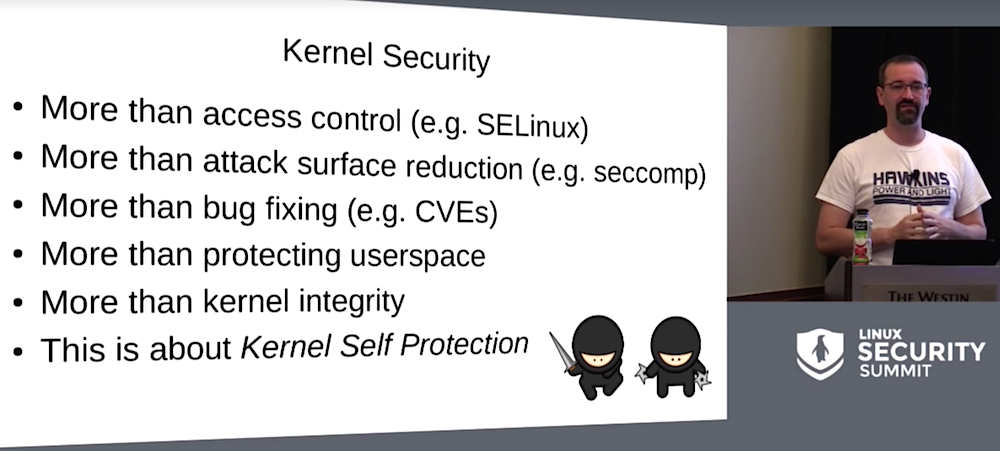
Vagrant Cascadian: Could you tell me a bit about yourself? What sort of things do you work on? Kees Cook: I m a Free Software junkie living in Portland, Oregon, USA. I have been focusing on the upstream Linux kernel s protection of itself. There is a lot of support that the kernel provides userspace to defend itself, but when I first started focusing on this there was not as much attention given to the kernel protecting itself. As userspace got more hardened the kernel itself became a bigger target. Almost 9 years ago I formally announced the Kernel Self-Protection Project because the work necessary was way more than my time and expertise could do alone. So I just try to get people to help as much as possible; people who understand the ARM architecture, people who understand the memory management subsystem to help, people who understand how to make the kernel less buggy.
Vagrant: Could you describe the path that lead you to working on this sort of thing? Kees: I have always been interested in security through the aspect of exploitable flaws. I always thought it was like a magic trick to make a computer do something that it was very much not designed to do and seeing how easy it is to subvert bugs. I wanted to improve that fragility. In 2006, I started working at Canonical on Ubuntu and was mainly focusing on bringing Debian and Ubuntu up to what was the state of the art for Fedora and Gentoo s security hardening efforts. Both had really pioneered a lot of userspace hardening with compiler flags and ELF stuff and many other things for hardened binaries. On the whole, Debian had not really paid attention to it. Debian s packaging building process at the time was sort of a chaotic free-for-all as there wasn t centralized build methodology for defining things. Luckily that did slowly change over the years. In Ubuntu we had the opportunity to apply top down build rules for hardening all the packages. In 2011 Chrome OS was following along and took advantage of a bunch of the security hardening work as they were based on ebuild out of Gentoo and when they looked for someone to help out they reached out to me. We recognized the Linux kernel was pretty much the weakest link in the Chrome OS security posture and I joined them to help solve that. Their userspace was pretty well handled but the kernel had a lot of weaknesses, so focusing on hardening was the next place to go. When I compared notes with other users of the Linux kernel within Google there were a number of common concerns and desires. Chrome OS already had an upstream first requirement, so I tried to consolidate the concerns and solve them upstream. It was challenging to land anything in other kernel team repos at Google, as they (correctly) wanted to minimize their delta from upstream, so I needed to work on any major improvements entirely in upstream and had a lot of support from Google to do that. As such, my focus shifted further from working directly on Chrome OS into being entirely upstream and being more of a consultant to internal teams, helping with integration or sometimes backporting. Since the volume of needed work was so gigantic I needed to find ways to inspire other developers (both inside and outside of Google) to help. Once I had a budget I tried to get folks paid (or hired) to work on these areas when it wasn t already their job.
Vagrant: So my understanding of some of your recent work is basically defining undefined behavior in the language or compiler? Kees: I ve found the term undefined behavior to have a really strict meaning within the compiler community, so I have tried to redefine my goal as eliminating unexpected behavior or ambiguous language constructs . At the end of the day ambiguity leads to bugs, and bugs lead to exploitable security flaws. I ve been taking a four-pronged approach: supporting the work people are doing to get rid of ambiguity, identify new areas where ambiguity needs to be removed, actually removing that ambiguity from the C language, and then dealing with any needed refactoring in the Linux kernel source to adapt to the new constraints. None of this is particularly novel; people have recognized how dangerous some of these language constructs are for decades and decades but I think it is a combination of hard problems and a lot of refactoring that nobody has the interest/resources to do. So, we have been incrementally going after the lowest hanging fruit. One clear example in recent years was the elimination of C s implicit fall-through in switch statements. The language would just fall through between adjacent cases if a break (or other code flow directive) wasn t present. But this is ambiguous: is the code meant to fall-through, or did the author just forget a break statement? By defining the [[fallthrough]] statement, and requiring its use in Linux, all switch statements now have explicit code flow, and the entire class of bugs disappeared. During our refactoring we actually found that 1 in 10 added [[fallthrough]] statements were actually missing break statements. This was an extraordinarily common bug! So getting rid of that ambiguity is where we have been. Another area I ve been spending a bit of time on lately is looking at how defensive security work has challenges associated with metrics. How do you measure your defensive security impact? You can t say because we installed locks on the doors, 20% fewer break-ins have happened. Much of our signal is always secondary or retrospective, which is frustrating: This class of flaw was used X much over the last decade so, and if we have eliminated that class of flaw and will never see it again, what is the impact? Is the impact infinity? Attackers will just move to the next easiest thing. But it means that exploitation gets incrementally more difficult. As attack surfaces are reduced, the expense of exploitation goes up.
Vagrant: So it is hard to identify how effective this is how bad would it be if people just gave up? Kees: I think it would be pretty bad, because as we have seen, using secondary factors, the work we have done in the industry at large, not just the Linux kernel, has had an impact. What we, Microsoft, Apple, and everyone else is doing for their respective software ecosystems, has shown that the price of functional exploits in the black market has gone up. Especially for really egregious stuff like a zero-click remote code execution. If those were cheap then obviously we are not doing something right, and it becomes clear that it s trivial for anyone to attack the infrastructure that our lives depend on. But thankfully we have seen over the last two decades that prices for exploits keep going up and up into millions of dollars. I think it is important to keep working on that because, as a central piece of modern computer infrastructure, the Linux kernel has a giant target painted on it. If we give up, we have to accept that our computers are not doing what they were designed to do, which I can t accept. The safety of my grandparents shouldn t be any different from the safety of journalists, and political activists, and anyone else who might be the target of attacks. We need to be able to trust our devices otherwise why use them at all?
Vagrant: What has been your biggest success in recent years? Kees: I think with all these things I am not the only actor. Almost everything that we have been successful at has been because of a lot of people s work, and one of the big ones that has been coordinated across the ecosystem and across compilers was initializing stack variables to 0 by default. This feature was added in Clang, GCC, and MSVC across the board even though there were a lot of fears about forking the C language. The worry was that developers would come to depend on zero-initialized stack variables, but this hasn t been the case because we still warn about uninitialized variables when the compiler can figure that out. So you still still get the warnings at compile time but now you can count on the contents of your stack at run-time and we drop an entire class of uninitialized variable flaws. While the exploitation of this class has mostly been around memory content exposure, it has also been used for control flow attacks. So that was politically and technically a large challenge: convincing people it was necessary, showing its utility, and implementing it in a way that everyone would be happy with, resulting in the elimination of a large and persistent class of flaws in C.
Vagrant: In a world where things are generally Reproducible do you see ways in which that might affect your work? Kees: One of the questions I frequently get is, What version of the Linux kernel has feature $foo? If I know how things are built, I can answer with just a version number. In a Reproducible Builds scenario I can count on the compiler version, compiler flags, kernel configuration, etc. all those things are known, so I can actually answer definitively that a certain feature exists. So that is an area where Reproducible Builds affects me most directly. Indirectly, it is just being able to trust the binaries you are running are going to behave the same for the same build environment is critical for sane testing.
Vagrant: Have you used diffoscope? Kees: I have! One subset of tree-wide refactoring that we do when getting rid of ambiguous language usage in the kernel is when we have to make source level changes to satisfy some new compiler requirement but where the binary output is not expected to change at all. It is mostly about getting the compiler to understand what is happening, what is intended in the cases where the old ambiguity does actually match the new unambiguous description of what is intended. The binary shouldn t change. We have used diffoscope to compare the before and after binaries to confirm that yep, there is no change in binary .
Vagrant: You cannot just use checksums for that? Kees: For the most part, we need to only compare the text segments. We try to hold as much stable as we can, following the Reproducible Builds documentation for the kernel, but there are macros in the kernel that are sensitive to source line numbers and as a result those will change the layout of the data segment (and sometimes the text segment too). With diffoscope there s flexibility where I can exclude or include different comparisons. Sometimes I just go look at what diffoscope is doing and do that manually, because I can tweak that a little harder, but diffoscope is definitely the default. Diffoscope is awesome!
Vagrant: Where has reproducible builds affected you? Kees: One of the notable wins of reproducible builds lately was dealing with the fallout of the XZ backdoor and just being able to ask the question is my build environment running the expected code? and to be able to compare the output generated from one install that never had a vulnerable XZ and one that did have a vulnerable XZ and compare the results of what you get. That was important for kernel builds because the XZ threat actor was working to expand their influence and capabilities to include Linux kernel builds, but they didn t finish their work before they were noticed. I think what happened with Debian proving the build infrastructure was not affected is an important example of how people would have needed to verify the kernel builds too.
Vagrant: What do you want to see for the near or distant future in security work? Kees: For reproducible builds in the kernel, in the work that has been going on in the ClangBuiltLinux project, one of the driving forces of code and usability quality has been the continuous integration work. As soon as something breaks, on the kernel side, the Clang side, or something in between the two, we get a fast signal and can chase it and fix the bugs quickly. I would like to see someone with funding to maintain a reproducible kernel build CI. There have been places where there are certain architecture configurations or certain build configuration where we lose reproducibility and right now we have sort of a standard open source development feedback loop where those things get fixed but the time in between introduction and fix can be large. Getting a CI for reproducible kernels would give us the opportunity to shorten that time.
Vagrant: Well, thanks for that! Any last closing thoughts? Kees: I am a big fan of reproducible builds, thank you for all your work. The world is a safer place because of it.
Vagrant: Likewise for your work!


For more information about the Reproducible Builds project, please see our website at reproducible-builds.org. If you are interested in ensuring the ongoing security of the software that underpins our civilisation and wish to sponsor the Reproducible Builds project, please reach out to the project by emailing contact@reproducible-builds.org.

28 September 2024

Dave Hibberd: EuroBSDCon 2024 Report

This year I attended EuroBSDCon 2024 in Dublin. I always appreciate an excuse to head over to Ireland, and this seemed like a great chance to spend some time in Dublin and learn new things. Due to constraints on my time I didn t go to the 2 day devsummit that precedes the conference, only the main event itself.

The Event EuroBSDCon was attended by about 200-250 people, the hardcore of the BSD community! Attendees came from all over, I met Canadians, USAians, Germanians, Belgians and Irelandians amongst other nationalities! The event was at UCD Dublin, which is a gorgeous university campus about 10km south of Dublin proper in Stillorgan. The speaker hotel was a 20 minute walk (at my ~9min/km pace) from the hotel, or a quick bus journey. It was a pleasant walk, through the leafy campus and then along some pretty broad pavements, albeit beside a dual carriageway. The cycle infrastructure was pretty excellent too, but I sadly was unable to lease a city bike and make my way around on 2 wheels - Dublinbikes don t extend that far out the city. Lunch each day was Irish themed food - Saturday was beef stew (a Frenchman asked me what it was called - his only equivalent words were Beef Bourguignon ) and Sunday was Bangers & Mash! The kitchen struggled a bit - food was brought out in bowls in waves, and that ensured there was artificial scarcity that clearly left anxiety for some that they weren t going to be fed! Everyone I met was friendly from the day I arrived, and that set me very much at ease and made the event much more enjoyable - things are better shared with others. Big shout out to dch and Blake Willis for spending a lot of time talking to me over the weekend!

Talks I Attended

Keynote: Evidence based Policy formation in the EU Tom Smyth This talk given by Tom Smyth was an interesting look into his work with EU Policymakers in ensuring fair competition for his small, Irish ISP. It was an enlightening look into the workings of the EU and the various bodies that set, and manage policy. It truly is a complicated beast, but the feeling I left with was that there are people all through the organisation who are desperate to do the right thing for EU citizens at all costs. Sadly none of it is directly applicable to me living in the UK, but I still get to have a say on policy and vote in polls as an Irish citizen abroad.

10(ish) years of FreeBSD/arm64 Andrew Turner I have been a fan of ARM platforms for a long, long time. I had an early ARM Chromebook and have been equal measures excited and frustrated by the raspberry pi since first contact. I tend to find other ARM people at events and this was no exception! It was an interesting view into one person s dedication to making arm64 a platform for FreeBSD, starting out with no documentation or hardware to becoming a first-class platform. It s interesting to see the roadmap and things upcoming too and makes me hopeful for the future of arm64 in various OSes!

1-800-RC(8)-HELP: Dial Into FreeBSD Service Scripts Mastery! Mateusz Piotrowski rc scripts and startup applications scare me a bit. I m better at systemd units than sysvinit scripts, but that isn t really a transferable skill! This was a deep dive into lots of the functionality that FreeBSD s RC offers, and highlighted things that I only thought were limited to Linux s systemd. I am much more aware of what it s capable of now, but I m still scared to take it on! Afterwards I had a great chat in the hallway with Mateusz about our OS s different approaches to this problem and was impressed with the pragmatic view he had on startup, systemd, rc and the future!

Package management without borders. Using Ravenports on multiple BSDs Michael Reim Ports on the BSDs interest me, but I hadn t realised that outside of each major BSD s collection there were other, cross platform ports collections offered. Ravenports is one of these under developments, and it was good to understand the hows, why and what s happenings of the system. Plus, with my hibbian obsession on building other people s software as my own packages, it s interesting to see how others are doing it!

Building a Modern Packet Radio Network using Open Software me I spoke for 45 minutes to share my passion and frustration for amateur radio, packet radio, the law, the technology and what we re doing in the UK Packet network. This was a lot of fun - it felt like I had a busy room, lots of people interested in the stupid stuff I do with technology and I had lots of conversations after the fact about radio, telecoms, networking and at one point was cornered by what I describe as the Erlang Mafia to talk about how they could help!

Hacking - 30 years ago Walter Belgers This unrecorded talk looked at the history of the Dutch hacker scene, and a young group of hackers explorations of the early internet before modern security was a thing. It was exciting, enrapturing, well presented and a great story of a well spent youth in front of computers.

Social By 1730 I was pretty drained so I took myself back to the hotel missing the last talks, had some down time, and got the DART train to the social event at Brewdog. This invovled about an hour s walking and some train time and that was a nice time to reset my head and just watch the world. The train I was on had a particularly interesting feature where when the motors were not loaded (slowdown or coasting) the lights slowly flickered dim-bright-dim. I don t know if this is across the fleet or just this one, but it was fun to pontificate as I looked out the window at South Dublin passing by. The social was good - a few beer tokens (cider in my case, trying to avoid beer-driven hangovers still), some pleasant junk food and plenty of good company to talk to, lots of people wanting to talk about radio and packet to me! Brewdog struggled a bit - both in bar speed (a linear queue formed despite the staff preferring the crowd-around method of queue) and buffet food appeared in somewhat disjointed waves, meaning that people loitered around the food tables and cleared the plates of wings, sliders, fries, onion rings, mac & cheese as they appeared 4-5 plates at a time. Perhaps a few hundred hungry bodies was a bit too much for them to feed at once. They had shuffleboard that was played all night by various groups! I caught the last bus home, which was relatively painless!

Is our software sustainable? Kent Inge Fagerland Simonsen This was an interesting look into reducing the footprint of software to make it a net benefit. Lots of examples of how little changes can barrel up to big, gigawatthour changes when aggregated over the entire installbase of android or iOS!

A Packet s Journey Through the OpenBSD Network Stack Alexander Bluhm This was an analysis of what happens at each stage of networking in OpenBSD and was pretty interesting to see. Lots of it was out my depth, but it s cool to get an explanation and appreciation for various elements of how software handles each packet that arrives and the differences in the ipv4 and ipv6 stack!

FreeBSD at 30 Years: Its Secrets to Success Kirk McKusick This was a great statistical breakdown of FreeBSD since inception, including top committers, why certain parts of the system and community work so well and what has given it staying power compared to some projects on the internet that peter out after just a few years! Kirk s excitement and passion for the project really shone through, and I want to read his similarly titled article in the FreeBSD Journal now!

Building an open native FreeBSD CI system from scratch with lua, C, jails & zfs Dave Cottlehuber Dave spoke pretty excitedly about his work on a CI system using tools that FreeBSD ships with, and introduced me to the integration of C and Lua which I wasn t fully aware of before. Or I was, and my brain forgot it! With my interest in software build this year, it was quite a timely look at how others are thinking of doing things (I am doing similar stuff with zfs!). I look forward to playing with it when it finally is released to the Real World!

Building an Appliance Allan Jude This was an interesting look into the tools that FreeBSD provides which can be used to make immutable, appliance OSes without too much overhead. Fail safe upgrades and boots with ZFS, running approved code with secure boot, factory resetting and more were discussed! I have had thoughts around this in the recent past, so it was good to have some ideas validated, some challenged and gave me food for thought.

Experience as a speaker I really enjoyed being a speaker at the event! I ve spoken at other things before, but this really was a cut above. The event having money to provide me a hotel was a really welcome surprise, and also receiving a gorgeous scarf as a speaker gift was a great surprise (and it has already been worn with the change of temperature here in Scotland this week!). I would definitely consider returning, either as an attendee or as a speaker. The community of attendees were pragmatic, interesting, engaging and welcoming, the organising committee were spot-on in their work making it happen and the whole event, while turning my brain to mush with all the information, was really enjoyable and I left energised and excited by things instead of ground down and tired.

23 September 2024

Jonathan McDowell: The (lack of a) return-to-office conspiracy

During COVID companies suddenly found themselves able to offer remote working where it hadn t previously been on offer. That s changed over the past 2 or so years, with most places I m aware of moving back from a fully remote situation to either some sort of hybrid, or even full time office attendance. For example last week Amazon announced a full return to office, having already pulled remote-hired workers in for 3 days a week. I ve seen a lot of folk stating they ll never work in an office again, and that RTO is insanity. Despite being lucky enough to work fully remotely (for a role I d been approached about before, but was never prepared to relocate for), I feel the objections from those who are pro-remote often fail to consider the nuances involved. So let s talk about some of the reasons why companies might want to enforce some sort of RTO.

Real estate value Let s clear this one up first. It s not about real estate value, for most companies. City planners and real estate investors might care, but even if your average company owned their building they d close it in an instant all other things being equal. An unoccupied building costs a lot less to maintain. And plenty of companies rent and would save money even if there s a substantial exit fee.

Occupancy levels That said, once you have anyone in the building the equation changes. If you re having to provide power, heating, internet, security/front desk staff etc, you want to make sure you re getting your money s worth. There s no point heating a building that can seat 100 for only 10 people present. One option is to downsize the building, but that leads to not being able to assign everyone a desk, for example. No one I know likes hot desking. There are also scheduling problems about ensuring there are enough desks for everyone who might turn up on a certain day, and you ve ruled out the option of company/office wide events.

Coexistence builds relationships As a remote worker I wish it wasn t true that most people find it easier to form relationships in person, but it is. Some of this can be worked on with specific teambuilding style events, rather than in office working, but I know plenty of folk who hate those as much as they hate the idea of being in the office. I am lucky in that I work with a bunch of folk who are terminally online, so it s much easier to have those casual conversations even being remote, but I also accept I miss out on some things because I m just not in the office regularly enough. You might not care about this ( I just need to put my head down and code, not talk to people ), but don t discount it as a valid reason why companies might want their workers to be in the office. This often matters even more for folk at the start of their career, where having a bunch of experience folk around to help them learn and figure things out ends up working much better in person (my first job offered to let me go mostly remote when I moved to Norwich, but I said no as I knew I wasn t ready for it yet).

Coexistence allows for unexpected interactions People hate the phrase water cooler chat , and I get that, but it covers the idea of casual conversations that just won t happen the same way when people are remote. I experienced this while running Black Cat; every time Simon and I met up in person we had a bunch of useful conversations even though we were on IRC together normally, and had a VoIP setup that meant we regularly talked too. Equally when I was at Nebulon there were conversations I overheard in the office where I was able to correct a misconception or provide extra context. Some of this can be replicated with the right online chat culture, but I ve found many places end up with folk taking conversations to DMs, or they happen in private channels. It happens more naturally in an office environment.

It s easier for bad managers to manage bad performers Again, this falls into the category of things that shouldn t be true, but are. Remote working has increased the ability for people who want to slack off to do so without being easily detected. Ideally what you want is that these folk, if they fail to perform, are then performance managed out of the organisation. That s hard though, there are (rightly) a bunch of rights workers have (I m writing from a UK perspective) around the procedure that needs to be followed. Managers need organisational support in this to make sure they get it right (and folk are given a chance to improve), which is often lacking.

Summary Look, I get there are strong reasons why offering remote is a great thing from the company perspective, but what I ve tried to outline here is that a return-to-office mandate can have some compelling reasons behind it too. Some of those might be things that wouldn t exist in an ideal world, but unfortunately fixing them is a bigger issue than just changing where folk work from. Not acknowledging that just makes any reaction against office work seem ill-informed, to me.

17 September 2024

Russ Allbery: Review: The Book That Broke the World

Review: The Book That Broke the World, by Mark Lawrence
Series: Library Trilogy #2
Publisher: Ace
Copyright: 2024
ISBN: 0-593-43796-9
Format: Kindle
Pages: 366
The Book That Broke the World is high fantasy and a direct sequel to The Book That Wouldn't Burn. You should not start here. In a delightful break from normal practice, the author provides a useful summary of the previous volume at the start of this book to jog your memory. At the end of The Book That Wouldn't Burn, the characters were scattered and in various states of corporeality after some major revelations about the nature of the Library and the first appearance of the insectile Skeer. The Book That Wouldn't Burn picks up where it left off, and there is a lot more contact with the Skeer, but my guess that they would be the next viewpoint characters does not pan out. Instead, we get a new group and a new protagonist: Celcha, whose sees angels who come to visit her brother. I have complaints, but before I launch into those, I should say that I liked this book apart from the totally unnecessary cannibalism. (I'll get to that.) Livira is a bit sidelined, which is regrettable, but Celcha and her brother are interesting new characters, and both Arpix and Clovis, supporting characters in the first book, get some excellent character development. Similar to the first book, this is a puzzle box story full of world-building tidbits with intellectually-satisfying interactions. Lawrence elaborates and complicates his setting in ways that don't contradict earlier parts of the story but create more room and depth for the characters to be creative. I came away still invested in this world and eager to find out how Lawrence pulls the world-building and narrative threads together. The biggest drawback of this book is that it's not new. My thought after finishing the first book of the series was that if Lawrence had enough world-building ideas to fill three books to that same level of density, this had the potential of being one of my favorite fantasy series of all time. By the end of the second book, I concluded that this is not the case. Instead of showing us new twists and complications the way the first book did throughout, The Book That Broke the World mostly covers the same thematic ground from some new angles. It felt like Lawrence was worried the reader of the first book may not have understood the theme or the world-building, so he spent most of the second book nailing down anything that moved. I found that frustrating. One of the best parts of The Book That Wouldn't Burn was that Lawrence trusted the reader to keep up, which for me hit the glorious but rare sweet spot of pacing where I was figuring out the world at roughly the same pace as the characters. It surprised me in some very enjoyable ways. The Book That Broke the World did not surprise me. There are a few new things, which I enjoyed, and a few elaborations and developments of ideas, which I mostly enjoyed, but I saw the big plot twist coming at least fifty pages before it happened and found the aftermath more annoying than revelatory. It doesn't help that the plot rests on character misunderstandings, one of my least favorite tropes. One of the other disappointments of this book is that the characters stop using the Library as a library. The Library at the center of this series is a truly marvelous piece of world-building with numerous fascinating features that are unrelated to its contents, but Livira used it first and foremost as a repository of books. The first book was full of characters solving problems by finding a relevant book and reading it. In The Book That Broke the World, sadly, this is mostly gone. The Library is mostly reduced to a complicated Big Dumb Object setting. It's still a delightful bit of world-building, and we learn about a few new features, but I only remember two places where the actual books are important to the story. Even the book referenced in the title is mostly important as an artifact with properties unrelated to the words that it contains or to the act of reading it. I think this is a huge lost opportunity and something I hope Lawrence fixes in the last book of the trilogy. This book instead focuses on the politics around the existence of the Library itself. Here I'm cautiously optimistic, although a lot is going to depend on the third book. Lawrence has set up a three-sided argument between groups that I will uncharitably describe as the libertarian techbros, the "burn it all down" reactionaries, and the neoliberal centrist technocrats. All three of those positions suck, and Lawrence had better be setting the stage for Livira to find a different path. Her unwillingness to commit to any of those sides gives me hope, but bringing this plot to a satisfying conclusion is going to be tricky. I hope I like what Lawrence comes up with, but it feels far from certain. It doesn't help that he's started delivering some points with a sledgehammer, and that's where we get to the unnecessary cannibalism. Thankfully this is a fairly small part of the tail end of the book, but it was an unpleasant surprise that I did not want in this novel and that I don't think made the story any better. It's tempting to call the cannibalism gratuitous, but it does fit one of the main themes of this story, namely that humans are depressingly good at using any rule-based object in unexpected and nasty ways that are contrary to the best intentions of the designer. This is the fundamental challenge of the Library as a whole and the question that I suspect the third book will be devoted to addressing, so I understand why Lawrence wanted to emphasize his point. The reason why there is cannibalism here is directly related to a profound misunderstanding of the properties of the library, and I detected an echo of one of C.S. Lewis's arguments in The Last Battle about the nature of Hell. The problem, though, is that this is Satanic baby-killerism, to borrow a term from Fred Clark. There are numerous ways to show this type of perversion of well-intended systems, which I know because Lawrence used other ones in the first book that were more subtle but equally effective. One of the best parts of The Book That Wouldn't Burn is that there were few real villains. The conflict was structural, all sides had valid perspectives, and the ethical points of that story were made with some care and nuance. The problem with cannibalism as it's used here is not merely that it's gross and disgusting and off-putting to the reader, although it is all of those things. If I wanted to read horror, I would read horror novels. I don't appreciate surprise horror used for shock value in regular fantasy. But worse, it's an abandonment of moral nuance. The function of cannibalism in this story is like the function of Satanic baby-killers: it's to signal that these people are wholly and irredeemably evil. They are the Villains, they are Wrong, and they cease to be characters and become symbols of what the protagonists are fighting. This is destructive to the story because it's designed to provoke a visceral short-circuit in the reader and let the author get away with sloppy story-telling. If the author needs to use tactics like this to point out who is the villain, they have failed to set up their moral quandary properly. The worst part is that this was entirely unnecessary because Lawrence's story-telling wasn't sloppy and he set up his moral quandary just fine. No one was confused about the ethical point here. I as the reader was following without difficulty, and had appreciated the subtlety with which Lawrence posed the question. But apparently he thought he was too subtle and decided to come back to the point with a pile-driver. I think that seriously injured the story. The ethical argument here is much more engaging and thought-provoking when it's more finely balanced. That's a lot of complaints, mostly because this is a good book that I badly wanted to be a great book but which kept tripping over its own feet. A lot of trilogies have weak second books. Hopefully this is another example of the mid-story sag, and the finale will be worthy of the start of the story. But I have to admit the moral short-circuiting and the de-emphasis of the actual books in the library has me a bit nervous. I want a lot out of the third book, and I hope I'm not asking this author for too much. If you liked the first book, I think you'll like this one too, with the caveat that it's quite a bit darker and more violent in places, even apart from the surprise cannibalism. But if you've not started this series, you may want to wait for the third book to see if Lawrence can pull off the ending. Followed by The Book That Held Her Heart, currently scheduled for publication in April of 2025. Rating: 7 out of 10

16 September 2024

Russ Allbery: Review: The Wings Upon Her Back

Review: The Wings Upon Her Back, by Samantha Mills
Publisher: Tachyon
Copyright: 2024
ISBN: 1-61696-415-4
Format: Kindle
Pages: 394
The Wings Upon Her Back is a political steampunk science fantasy novel. If the author's name sounds familiar, it may be because Samantha Mills's short story "Rabbit Test" won Nebula, Locus, Hugo, and Sturgeon awards. This is her first novel. Winged Zemolai is a soldier of the mecha god and the protege of Mecha Vodaya, the Voice. She has served the city-state of Radezhda by defending it against all enemies, foreign and domestic, for twenty-six years. Despite that, it takes only a moment of errant mercy for her entire life to come crashing down. On a whim, she spares a kitchen worker who was concealing a statue of the scholar god, meaning that he was only pretending to worship the worker god like all workers should. Vodaya is unforgiving and uncompromising, as is the sleeping mecha god. Zemolai's wings are ripped from her back and crushed in the hand of the god, and she's left on the ground to die of mechalin withdrawal. The Wings Upon Her Back is told in two alternating timelines. The main one follows Zemolai after her exile as she is rescued by a young group of revolutionaries who think she may be useful in their plans. The other thread starts with Zemolai's childhood and shows the reader how she became Winged Zemolai: her scholar family, her obsession with flying, her true devotion to the mecha god, and the critical early years when she became Vodaya's protege. Mills maintains the separate timelines through the book and wraps them up in a rather neat piece of symbolic parallelism in the epilogue. I picked up this book on a recommendation from C.L. Clark, and yes, indeed, I can see why she liked this book. It's a story about a political awakening, in which Zemolai slowly realizes that she has been manipulated and lied to and that she may, in fact, be one of the baddies. The Wings Upon Her Back is more personal than some other books with that theme, since Zemolai was specifically (and abusively) groomed for her role by Vodaya. Much of the book is Zemolai trying to pull out the hooks that Vodaya put in her or, in the flashback timeline, the reader watching Vodaya install those hooks. The flashback timeline is difficult reading. I don't think Mills could have left it out, but she says in the afterword that it was the hardest part of the book to write and it was also the hardest part of the book to read. It fills in some interesting bits of world-building and backstory, and Mills does a great job pacing the story revelations so that both threads contribute equally, but mostly it's a story of manipulative abuse. We know from the main storyline that Vodaya's tactics work, which gives those scenes the feel of a slow-motion train wreck. You know what's going to happen, you know it will be bad, and yet you can't look away. It occurred to me while reading this that Emily Tesh's Some Desperate Glory told a similar type of story without the flashback structure, which eliminates the stifling feeling of inevitability. I don't think that would not have worked for this story. If you simply rearranged the chapters of The Wings Upon Her Back into a linear narrative, I would have bailed on the book. Watching Zemolai being manipulated would have been too depressing and awful for me to make it to the payoff without the forward-looking hope of the main timeline. It gave me new appreciation for the difficulty of what Tesh pulled off. Mills uses this interwoven structure well, though. At about 90% through this book I had no idea how it could end in the space remaining, but it reaches a surprising and satisfying conclusion. Mills uses a type of ending that normally bothers me, but she does it by handling the psychological impact so well that I couldn't help but admire it. I'm avoiding specifics because I think it worked better when I wasn't expecting it, but it ties beautifully into the thematic point of the book. I do have one structural objection, though. It's one of those problems I didn't notice while reading, but that started bothering me when I thought back through the story from a political lens. The Wings Upon Her Back is Zemolai's story, her redemption arc, and that means she drives the plot. The band of revolutionaries are great characters (particularly Galiana), but they're supporting characters. Zemolai is older, more experienced, and knows critical information they don't have, and she uses it to effectively take over. As setup for her character arc, I see why Mills did this. As political praxis, I have issues. There is a tendency in politics to believe that political skill is portable and repurposable. Converting opposing operatives to the cause is welcomed not only because they indicate added support, but also because they can use their political skill to help you win instead. To an extent this is not wrong, and is probably the most true of combat skills (which Zemolai has in abundance). But there's an underlying assumption that politics is symmetric, and a critical reason why I hold many of the political positions that I do hold is that I don't think politics is symmetric. If someone has been successfully stoking resentment and xenophobia in support of authoritarians, converts to an anti-authoritarian cause, and then produces propaganda stoking resentment and xenophobia against authoritarians, this is in some sense an improvement. But if one believes that resentment and xenophobia are inherently wrong, if one's politics are aimed at reducing the resentment and xenophobia in the world, then in a way this person has not truly converted. Worse, because this is an effective manipulation tactic, there is a strong tendency to put this type of political convert into a leadership position, where they will, intentionally or not, start turning the anti-authoritarian movement into a copy of the authoritarian movement they left. They haven't actually changed their politics because they haven't understood (or simply don't believe in) the fundamental asymmetry in the positions. It's the same criticism that I have of realpolitik: the ends do not justify the means because the means corrupt the ends. Nothing that happens in this book is as egregious as my example, but the more I thought about the plot structure, the more it bothered me that Zemolai never listens to the revolutionaries she joins long enough to wrestle with why she became an agent of an authoritarian state and they didn't. They got something fundamentally right that she got wrong, and perhaps that should have been reflected in who got to make future decisions. Zemolai made very poor choices and yet continues to be the sole main character of the story, the one whose decisions and actions truly matter. Maybe being wrong about everything should be disqualifying for being the main character, at least for a while, even if you think you've understood why you were wrong. That problem aside, I enjoyed this. Both timelines were compelling and quite difficult to put down, even when they got rather dark. I could have done with less body horror and a few fewer fight scenes, but I'm glad I read it. Science fiction readers should be warned that the world-building, despite having an intricate and fascinating surface, is mostly vibes. I started the book wondering how people with giant metal wings on their back can literally fly, and thought the mentions of neural ports, high-tech materials, and immune-suppressing drugs might mean that we'd get some sort of explanation. We do not: heavier-than-air flight works because it looks really cool and serves some thematic purposes. There are enough hints of technology indistinguishable from magic that you could make up your own explanations if you wanted to, but that's not something this book is interested in. There's not a thing wrong with that, but don't get caught by surprise if you were in the mood for a neat scientific explanation of apparent magic. Recommended if you like somewhat-harrowing character development with a heavy political lens and steampunk vibes, although it's not the sort of book that I'd press into the hands of everyone I know. The Wings Upon Her Back is a complete story in a single novel. Content warning: the main character is a victim of physical and emotional abuse, so some of that is a lot. Also surgical gore, some torture, and genocide. Rating: 7 out of 10

11 September 2024

Jamie McClelland: MariaDB mystery

I keep getting an error in our backup logs:
Sep 11 05:08:03 Warning: mysqldump: Error 2013: Lost connection to server during query when dumping table  1C4Uonkwhe_options  at row: 1402
Sep 11 05:08:03 Warning: Failed to dump mysql databases ic_wp
It s a WordPress database having trouble dumping the options table. The error log has a corresponding message:
Sep 11 13:50:11 mysql007 mariadbd[580]: 2024-09-11 13:50:11 69577 [Warning] Aborted connection 69577 to db: 'ic_wp' user: 'root' host: 'localhost' (Got an error writing communication packets)
The Internet is full of suggestions, almost all of which either focus on the network connection between the client and the server or the FEDERATED plugin. We aren t using the federated plugin and this error happens when conneting via the socket. Check it out - what is better than a consistently reproducible problem! It happens if I try to select all the values in the table:
root@mysql007:~# mysql --protocol=socket -e 'select * from 1C4Uonkwhe_options' ic_wp > /dev/null
ERROR 2013 (HY000) at line 1: Lost connection to server during query
root@mysql007:~#
It happens when I specifiy one specific offset:
root@mysql007:~# mysql --protocol=socket -e 'select * from 1C4Uonkwhe_options limit 1 offset 1402' ic_wp
ERROR 2013 (HY000) at line 1: Lost connection to server during query
root@mysql007:~#
It happens if I specify the field name explicitly:
root@mysql007:~# mysql --protocol=socket -e 'select option_id,option_name,option_value,autoload from 1C4Uonkwhe_options limit 1 offset 1402' ic_wp
ERROR 2013 (HY000) at line 1: Lost connection to server during query
root@mysql007:~#
It doesn t happen if I specify the key field:
root@mysql007:~# mysql --protocol=socket -e 'select option_id from 1C4Uonkwhe_options limit 1 offset 1402' ic_wp
+-----------+
  option_id  
+-----------+
   16296351  
+-----------+
root@mysql007:~#
It does happen if I specify the value field:
root@mysql007:~# mysql --protocol=socket -e 'select option_value from 1C4Uonkwhe_options limit 1 offset 1402' ic_wp
ERROR 2013 (HY000) at line 1: Lost connection to server during query
root@mysql007:~#
It doesn t happen if I query the specific row by key field:
root@mysql007:~# mysql --protocol=socket -e 'select * from 1C4Uonkwhe_options where option_id = 16296351' ic_wp
+-----------+----------------------+--------------+----------+
  option_id   option_name            option_value   autoload  
+-----------+----------------------+--------------+----------+
   16296351   z_taxonomy_image8905                  yes       
+-----------+----------------------+--------------+----------+
root@mysql007:~#
Hm. Surely there is some funky non-printing character in that option_value right?
root@mysql007:~# mysql --protocol=socket -e 'select CHAR_LENGTH(option_value) from 1C4Uonkwhe_options where option_id = 16296351' ic_wp
+---------------------------+
  CHAR_LENGTH(option_value)  
+---------------------------+
                          0  
+---------------------------+
root@mysql007:~# mysql --protocol=socket -e 'select HEX(option_value) from 1C4Uonkwhe_options where option_id = 16296351' ic_wp
+-------------------+
  HEX(option_value)  
+-------------------+
                     
+-------------------+
root@mysql007:~#
Resetting the value to an empty value doesn t make a difference:
root@mysql007:~# mysql --protocol=socket -e 'update 1C4Uonkwhe_options set option_value = "" where option_id = 16296351' ic_wp
root@mysql007:~# mysql --protocol=socket -e 'select * from 1C4Uonkwhe_options' ic_wp > /dev/null
ERROR 2013 (HY000) at line 1: Lost connection to server during query
root@mysql007:~#
Deleting the row in question causes the error to specify a new offset:
root@mysql007:~# mysql --protocol=socket -e 'delete from 1C4Uonkwhe_options where option_id = 16296351' ic_wp
root@mysql007:~# mysql --protocol=socket -e 'select * from 1C4Uonkwhe_options' ic_wp > /dev/null
ERROR 2013 (HY000) at line 1: Lost connection to server during query
root@mysql007:~# mysqldump ic_wp > /dev/null
mysqldump: Error 2013: Lost connection to server during query when dumping table  1C4Uonkwhe_options  at row: 1401
root@mysql007:~#
If I put the record I deleted back in, we return to the old offset:
root@mysql007:~# mysql --protocol=socket -e 'insert into 1C4Uonkwhe_options VALUES(16296351,"z_taxonomy_image8905","","yes");' ic_wp 
root@mysql007:~# mysqldump ic_wp > /dev/null
mysqldump: Error 2013: Lost connection to server during query when dumping table  1C4Uonkwhe_options  at row: 1402
root@mysql007:~#
I m losing my little mind. Let s get drastic and create a whole new table, copy over the data delicately working around the deadly offset:
oot@mysql007:~# mysql --protocol=socket -e 'create table 1C4Uonkwhe_new_options like 1C4Uonkwhe_options;' ic_wp 
root@mysql007:~# mysql --protocol=socket -e 'insert into 1C4Uonkwhe_new_options select * from 1C4Uonkwhe_options limit 1402 offset 0;' ic_wp 
--- There is only 33 more records, not sure how to specify unlimited limit but 100 does the trick.
root@mysql007:~# mysql --protocol=socket -e 'insert into 1C4Uonkwhe_new_options select * from 1C4Uonkwhe_options limit 100 offset 1403;' ic_wp 
Now let s make sure all is working properly:
root@mysql007:~# mysql --protocol=socket -e 'select * from 1C4Uonkwhe_new_options' ic_wp >/dev/null;
Now let s examine which row we are missing:
root@mysql007:~# mysql --protocol=socket -e 'select option_id from 1C4Uonkwhe_options where option_id not in (select option_id from 1C4Uonkwhe_new_options) ;' ic_wp 
+-----------+
  option_id  
+-----------+
   18405297  
+-----------+
root@mysql007:~#
Wait, what? I was expecting option_id 16296351. Oh, now we are getting somewhere. And I see my mistake: when using offsets, you need to use ORDER BY or you won t get consistent results.
root@mysql007:~# mysql --protocol=socket -e 'select option_id from 1C4Uonkwhe_options order by option_id limit 1 offset 1402' ic_wp ;
+-----------+
  option_id  
+-----------+
   18405297  
+-----------+
root@mysql007:~#
Now that I have the correct row what is in it:
root@mysql007:~# mysql --protocol=socket -e 'select * from 1C4Uonkwhe_options where option_id = 18405297' ic_wp ;
ERROR 2013 (HY000) at line 1: Lost connection to server during query
root@mysql007:~#
Well, that makes a lot more sense. Let s start over with examining the value:
root@mysql007:~# mysql --protocol=socket -e 'select CHAR_LENGTH(option_value) from 1C4Uonkwhe_options where option_id = 18405297' ic_wp ;
+---------------------------+
  CHAR_LENGTH(option_value)  
+---------------------------+
                   50814767  
+---------------------------+
root@mysql007:~#
Wow, that s a lot of characters. If it were a book, it would be 35,000 pages long (I just discovered this site). It s a LONGTEXT field so it should be able to handle it. But now I have a better idea of what could be going wrong. The name of the option is rewrite_rules so it seems like something is going wrong with the generation of that option. I imagine there is some tweak I can make to allow MariaDB to cough up the value (read_buffer_size? tmp_table_size?). But I ll start with checking in with the database owner because I don t think 35,000 pages of rewrite rules is appropriate for any site.

9 September 2024

Ben Hutchings: FOSS activity in July 2024

8 September 2024

Thorsten Alteholz: My Debian Activities in August 2024

FTP master This month I accepted 441 and rejected 15 packages. The overall number of packages that got accepted was 442. I am ashamed of some occurrences that happened this month and I apologize for this. Unfortunately I have no idea how to prevent this in the future without becoming a solo entertainer. Debian LTS This was my hundred-twenty-second month that I did some work for the Debian LTS initiative, started by Raphael Hertzog at Freexian. Unfortunately Bullseye was not handed over to LTS in August. So I only prepared new packages of asterisk, libvirt and tinyproxy and will upload them next month. Last but not least I did a week of FD this month. Debian ELTS This month was the seventy-third ELTS month. During my allocated time I uploaded or worked on: I also did a week of FD. Debian Printing This month I uploaded This work is generously funded by Freexian! Debian Astro This month I uploaded a new upstream or bugfix version of: Debian Mobcom The following packages have been prepared by the GSoC student Nathan: It was so much fun working with Nathan. Unfortunately GSoC is over now, but Nathan will continue working in Debian and become a Debian Maintainer. misc This month I uploaded new upstream or bugfix versions of: I also filed an RM bug against meep-openmpi. As Adrian made me ware, this package is no longer needed.

Dima Kogan: GNU Make: details regarding intermediate files

Suppose I have this Makefile:
a: b
      touch $@
b:
      touch $@
# A common chain of build steps
%-GENERATED.c: %-generate
      touch $@
%.o: %.c
      touch $@
%.so: %-GENERATED.o
      touch $@
xxx-GENERATED.o: CFLAGS += adsf
# Imitates .d files created with "gcc -MMD". Does not exist on the initial build
ifneq ($(wildcard xxx.so),)
xxx-GENERATED.o: xxx-GENERATED.c
endif
This is all very simple build-system stuff. Let's see how it works:
$ rm -rf a b xxx-GENERATED.c xxx-GENERATED.o xxx.so
  [start from a clean slate]
$ touch xxx-generate xxx.h
  [Files that would be available in a project exist; xxx-generate is some tool]
  [that would generate xxx-GENERATED.c                                        ]
$ touch a
  ["a" exists but the file "b" it depends on does not]
$ make a xxx.so
  touch b
  touch a
  touch xxx-GENERATED.c
  touch xxx-GENERATED.o
  touch xxx.so
  rm xxx-GENERATED.c
  [It built everything, but then deleted xxx-GENERATED.c]
$ make a xxx.so
  remake: 'a' is up to date.
  touch xxx-GENERATED.c
  touch xxx-GENERATED.o
  touch xxx.so
  [It knew to not rebuild "a", but the missing xxx-GENERATED.c caused it to]
  [re-build stuff                                                          ]
Well that's not good. What if we add .SECONDARY: to the end of the Makefile to mark everything as a secondary file?
$ rm -rf a b xxx-GENERATED.c xxx-GENERATED.o xxx.so
$ touch xxx-generate xxx.h
$ touch a
$ make a xxx.so
  remake: 'a' is up to date.
  touch xxx-GENERATED.c
  touch xxx-GENERATED.o
  touch xxx.so
  [It didn't bother rebuilding "a" even though its prerequisites "b" doesn't]
  [exist. But it didn't delete the xxx-GENERATED.c at least                 ]
$ make a xxx.so
  remake: 'a' is up to date.
  remake: 'xxx.so' is up to date.
  [It knew to not rebuild anything. Great.]
So it doesn't work right with or without .SECONDARY:, but it's much closer with it. The solution is to mark everything as not an intermediate file. mrbuild cannot do this without a bleeding-edge version of GNU Make, but users of mrbuild can do this by explicitly mentioning specific files in rules. This would suffice:
___dummy___: file1 file2
Detailed notes are in a commit in mrbuild (mrbuild 1.13) and in a post to LKML by Masahiro Yamada.

Jacob Adams: Linux's Bedtime Routine

How does Linux move from an awake machine to a hibernating one? How does it then manage to restore all state? These questions led me to read way too much C in trying to figure out how this particular hardware/software boundary is navigated. This investigation will be split into a few parts, with the first one going from invocation of hibernation to synchronizing all filesystems to disk. This article has been written using Linux version 6.9.9, the source of which can be found in many places, but can be navigated easily through the Bootlin Elixir Cross-Referencer: https://elixir.bootlin.com/linux/v6.9.9/source Each code snippet will begin with a link to the above giving the file path and the line number of the beginning of the snippet.

A Starting Point for Investigation: /sys/power/state and /sys/power/disk These two system files exist to allow debugging of hibernation, and thus control the exact state used directly. Writing specific values to the state file controls the exact sleep mode used and disk controls the specific hibernation mode1. This is extremely handy as an entry point to understand how these systems work, since we can just follow what happens when they are written to.

Show and Store Functions These two files are defined using the power_attr macro: kernel/power/power.h:80
#define power_attr(_name) \
static struct kobj_attribute _name##_attr =     \
    .attr   =               \
        .name = __stringify(_name), \
        .mode = 0644,           \
     ,                  \
    .show   = _name##_show,         \
    .store  = _name##_store,        \
 
show is called on reads and store on writes. state_show is a little boring for our purposes, as it just prints all the available sleep states. kernel/power/main.c:657
/*
 * state - control system sleep states.
 *
 * show() returns available sleep state labels, which may be "mem", "standby",
 * "freeze" and "disk" (hibernation).
 * See Documentation/admin-guide/pm/sleep-states.rst for a description of
 * what they mean.
 *
 * store() accepts one of those strings, translates it into the proper
 * enumerated value, and initiates a suspend transition.
 */
static ssize_t state_show(struct kobject *kobj, struct kobj_attribute *attr,
			  char *buf)
 
	char *s = buf;
#ifdef CONFIG_SUSPEND
	suspend_state_t i;
	for (i = PM_SUSPEND_MIN; i < PM_SUSPEND_MAX; i++)
		if (pm_states[i])
			s += sprintf(s,"%s ", pm_states[i]);
#endif
	if (hibernation_available())
		s += sprintf(s, "disk ");
	if (s != buf)
		/* convert the last space to a newline */
		*(s-1) = '\n';
	return (s - buf);
 
state_store, however, provides our entry point. If the string disk is written to the state file, it calls hibernate(). This is our entry point. kernel/power/main.c:715
static ssize_t state_store(struct kobject *kobj, struct kobj_attribute *attr,
			   const char *buf, size_t n)
 
	suspend_state_t state;
	int error;
	error = pm_autosleep_lock();
	if (error)
		return error;
	if (pm_autosleep_state() > PM_SUSPEND_ON)  
		error = -EBUSY;
		goto out;
	 
	state = decode_state(buf, n);
	if (state < PM_SUSPEND_MAX)  
		if (state == PM_SUSPEND_MEM)
			state = mem_sleep_current;
		error = pm_suspend(state);
	  else if (state == PM_SUSPEND_MAX)  
		error = hibernate();
	  else  
		error = -EINVAL;
	 
 out:
	pm_autosleep_unlock();
	return error ? error : n;
 
kernel/power/main.c:688
static suspend_state_t decode_state(const char *buf, size_t n)
 
#ifdef CONFIG_SUSPEND
	suspend_state_t state;
#endif
	char *p;
	int len;
	p = memchr(buf, '\n', n);
	len = p ? p - buf : n;
	/* Check hibernation first. */
	if (len == 4 && str_has_prefix(buf, "disk"))
		return PM_SUSPEND_MAX;
#ifdef CONFIG_SUSPEND
	for (state = PM_SUSPEND_MIN; state < PM_SUSPEND_MAX; state++)  
		const char *label = pm_states[state];
		if (label && len == strlen(label) && !strncmp(buf, label, len))
			return state;
	 
#endif
	return PM_SUSPEND_ON;
 
Could we have figured this out just via function names? Sure, but this way we know for sure that nothing else is happening before this function is called.

Autosleep Our first detour is into the autosleep system. When checking the state above, you may notice that the kernel grabs the pm_autosleep_lock before checking the current state. autosleep is a mechanism originally from Android that sends the entire system to either suspend or hibernate whenever it is not actively working on anything. This is not enabled for most desktop configurations, since it s primarily for mobile systems and inverts the standard suspend and hibernate interactions. This system is implemented as a workqueue2 that checks the current number of wakeup events, processes and drivers that need to run3, and if there aren t any, then the system is put into the autosleep state, typically suspend. However, it could be hibernate if configured that way via /sys/power/autosleep in a similar manner to using /sys/power/state to manually enable hibernation. kernel/power/main.c:841
static ssize_t autosleep_store(struct kobject *kobj,
			       struct kobj_attribute *attr,
			       const char *buf, size_t n)
 
	suspend_state_t state = decode_state(buf, n);
	int error;
	if (state == PM_SUSPEND_ON
	    && strcmp(buf, "off") && strcmp(buf, "off\n"))
		return -EINVAL;
	if (state == PM_SUSPEND_MEM)
		state = mem_sleep_current;
	error = pm_autosleep_set_state(state);
	return error ? error : n;
 
power_attr(autosleep);
#endif /* CONFIG_PM_AUTOSLEEP */
kernel/power/autosleep.c:24
static DEFINE_MUTEX(autosleep_lock);
static struct wakeup_source *autosleep_ws;
static void try_to_suspend(struct work_struct *work)
 
	unsigned int initial_count, final_count;
	if (!pm_get_wakeup_count(&initial_count, true))
		goto out;
	mutex_lock(&autosleep_lock);
	if (!pm_save_wakeup_count(initial_count)  
		system_state != SYSTEM_RUNNING)  
		mutex_unlock(&autosleep_lock);
		goto out;
	 
	if (autosleep_state == PM_SUSPEND_ON)  
		mutex_unlock(&autosleep_lock);
		return;
	 
	if (autosleep_state >= PM_SUSPEND_MAX)
		hibernate();
	else
		pm_suspend(autosleep_state);
	mutex_unlock(&autosleep_lock);
	if (!pm_get_wakeup_count(&final_count, false))
		goto out;
	/*
	 * If the wakeup occurred for an unknown reason, wait to prevent the
	 * system from trying to suspend and waking up in a tight loop.
	 */
	if (final_count == initial_count)
		schedule_timeout_uninterruptible(HZ / 2);
 out:
	queue_up_suspend_work();
 
static DECLARE_WORK(suspend_work, try_to_suspend);
void queue_up_suspend_work(void)
 
	if (autosleep_state > PM_SUSPEND_ON)
		queue_work(autosleep_wq, &suspend_work);
 

The Steps of Hibernation

Hibernation Kernel Config It s important to note that most of the hibernate-specific functions below do nothing unless you ve defined CONFIG_HIBERNATION in your Kconfig4. As an example, hibernate itself is defined as the following if CONFIG_HIBERNATE is not set. include/linux/suspend.h:407
static inline int hibernate(void)   return -ENOSYS;  

Check if Hibernation is Available We begin by confirming that we actually can perform hibernation, via the hibernation_available function. kernel/power/hibernate.c:742
if (!hibernation_available())  
	pm_pr_dbg("Hibernation not available.\n");
	return -EPERM;
 
kernel/power/hibernate.c:92
bool hibernation_available(void)
 
	return nohibernate == 0 &&
		!security_locked_down(LOCKDOWN_HIBERNATION) &&
		!secretmem_active() && !cxl_mem_active();
 
nohibernate is controlled by the kernel command line, it s set via either nohibernate or hibernate=no. security_locked_down is a hook for Linux Security Modules to prevent hibernation. This is used to prevent hibernating to an unencrypted storage device, as specified in the manual page kernel_lockdown(7). Interestingly, either level of lockdown, integrity or confidentiality, locks down hibernation because with the ability to hibernate you can extract bascially anything from memory and even reboot into a modified kernel image. secretmem_active checks whether there is any active use of memfd_secret, and if so it prevents hibernation. memfd_secret returns a file descriptor that can be mapped into a process but is specifically unmapped from the kernel s memory space. Hibernating with memory that not even the kernel is supposed to access would expose that memory to whoever could access the hibernation image. This particular feature of secret memory was apparently controversial, though not as controversial as performance concerns around fragmentation when unmapping kernel memory (which did not end up being a real problem). cxl_mem_active just checks whether any CXL memory is active. A full explanation is provided in the commit introducing this check but there s also a shortened explanation from cxl_mem_probe that sets the relevant flag when initializing a CXL memory device. drivers/cxl/mem.c:186
* The kernel may be operating out of CXL memory on this device,
* there is no spec defined way to determine whether this device
* preserves contents over suspend, and there is no simple way
* to arrange for the suspend image to avoid CXL memory which
* would setup a circular dependency between PCI resume and save
* state restoration.

Check Compression The next check is for whether compression support is enabled, and if so whether the requested algorithm is enabled. kernel/power/hibernate.c:747
/*
 * Query for the compression algorithm support if compression is enabled.
 */
if (!nocompress)  
	strscpy(hib_comp_algo, hibernate_compressor, sizeof(hib_comp_algo));
	if (crypto_has_comp(hib_comp_algo, 0, 0) != 1)  
		pr_err("%s compression is not available\n", hib_comp_algo);
		return -EOPNOTSUPP;
	 
 
The nocompress flag is set via the hibernate command line parameter, setting hibernate=nocompress. If compression is enabled, then hibernate_compressor is copied to hib_comp_algo. This synchronizes the current requested compression setting (hibernate_compressor) with the current compression setting (hib_comp_algo). Both values are character arrays of size CRYPTO_MAX_ALG_NAME (128 in this kernel). kernel/power/hibernate.c:50
static char hibernate_compressor[CRYPTO_MAX_ALG_NAME] = CONFIG_HIBERNATION_DEF_COMP;
/*
 * Compression/decompression algorithm to be used while saving/loading
 * image to/from disk. This would later be used in 'kernel/power/swap.c'
 * to allocate comp streams.
 */
char hib_comp_algo[CRYPTO_MAX_ALG_NAME];
hibernate_compressor defaults to lzo if that algorithm is enabled, otherwise to lz4 if enabled5. It can be overwritten using the hibernate.compressor setting to either lzo or lz4. kernel/power/Kconfig:95
choice
	prompt "Default compressor"
	default HIBERNATION_COMP_LZO
	depends on HIBERNATION
config HIBERNATION_COMP_LZO
	bool "lzo"
	depends on CRYPTO_LZO
config HIBERNATION_COMP_LZ4
	bool "lz4"
	depends on CRYPTO_LZ4
endchoice
config HIBERNATION_DEF_COMP
	string
	default "lzo" if HIBERNATION_COMP_LZO
	default "lz4" if HIBERNATION_COMP_LZ4
	help
	  Default compressor to be used for hibernation.
kernel/power/hibernate.c:1425
static const char * const comp_alg_enabled[] =  
#if IS_ENABLED(CONFIG_CRYPTO_LZO)
	COMPRESSION_ALGO_LZO,
#endif
#if IS_ENABLED(CONFIG_CRYPTO_LZ4)
	COMPRESSION_ALGO_LZ4,
#endif
 ;
static int hibernate_compressor_param_set(const char *compressor,
		const struct kernel_param *kp)
 
	unsigned int sleep_flags;
	int index, ret;
	sleep_flags = lock_system_sleep();
	index = sysfs_match_string(comp_alg_enabled, compressor);
	if (index >= 0)  
		ret = param_set_copystring(comp_alg_enabled[index], kp);
		if (!ret)
			strscpy(hib_comp_algo, comp_alg_enabled[index],
				sizeof(hib_comp_algo));
	  else  
		ret = index;
	 
	unlock_system_sleep(sleep_flags);
	if (ret)
		pr_debug("Cannot set specified compressor %s\n",
			 compressor);
	return ret;
 
static const struct kernel_param_ops hibernate_compressor_param_ops =  
	.set    = hibernate_compressor_param_set,
	.get    = param_get_string,
 ;
static struct kparam_string hibernate_compressor_param_string =  
	.maxlen = sizeof(hibernate_compressor),
	.string = hibernate_compressor,
 ;
We then check whether the requested algorithm is supported via crypto_has_comp. If not, we bail out of the whole operation with EOPNOTSUPP. As part of crypto_has_comp we perform any needed initialization of the algorithm, loading kernel modules and running initialization code as needed6.

Grab Locks The next step is to grab the sleep and hibernation locks via lock_system_sleep and hibernate_acquire. kernel/power/hibernate.c:758
sleep_flags = lock_system_sleep();
/* The snapshot device should not be opened while we're running */
if (!hibernate_acquire())  
	error = -EBUSY;
	goto Unlock;
 
First, lock_system_sleep marks the current thread as not freezable, which will be important later7. It then grabs the system_transistion_mutex, which locks taking snapshots or modifying how they are taken, resuming from a hibernation image, entering any suspend state, or rebooting.

The GFP Mask The kernel also issues a warning if the gfp mask is changed via either pm_restore_gfp_mask or pm_restrict_gfp_mask without holding the system_transistion_mutex. GFP flags tell the kernel how it is permitted to handle a request for memory. include/linux/gfp_types.h:12
 * GFP flags are commonly used throughout Linux to indicate how memory
 * should be allocated.  The GFP acronym stands for get_free_pages(),
 * the underlying memory allocation function.  Not every GFP flag is
 * supported by every function which may allocate memory.
In the case of hibernation specifically we care about the IO and FS flags, which are reclaim operators, ways the system is permitted to attempt to free up memory in order to satisfy a specific request for memory. include/linux/gfp_types.h:176
 * Reclaim modifiers
 * -----------------
 * Please note that all the following flags are only applicable to sleepable
 * allocations (e.g. %GFP_NOWAIT and %GFP_ATOMIC will ignore them).
 *
 * %__GFP_IO can start physical IO.
 *
 * %__GFP_FS can call down to the low-level FS. Clearing the flag avoids the
 * allocator recursing into the filesystem which might already be holding
 * locks.
gfp_allowed_mask sets which flags are permitted to be set at the current time. As the comment below outlines, preventing these flags from being set avoids situations where the kernel needs to do I/O to allocate memory (e.g. read/writing swap8) but the devices it needs to read/write to/from are not currently available. kernel/power/main.c:24
/*
 * The following functions are used by the suspend/hibernate code to temporarily
 * change gfp_allowed_mask in order to avoid using I/O during memory allocations
 * while devices are suspended.  To avoid races with the suspend/hibernate code,
 * they should always be called with system_transition_mutex held
 * (gfp_allowed_mask also should only be modified with system_transition_mutex
 * held, unless the suspend/hibernate code is guaranteed not to run in parallel
 * with that modification).
 */
static gfp_t saved_gfp_mask;
void pm_restore_gfp_mask(void)
 
	WARN_ON(!mutex_is_locked(&system_transition_mutex));
	if (saved_gfp_mask)  
		gfp_allowed_mask = saved_gfp_mask;
		saved_gfp_mask = 0;
	 
 
void pm_restrict_gfp_mask(void)
 
	WARN_ON(!mutex_is_locked(&system_transition_mutex));
	WARN_ON(saved_gfp_mask);
	saved_gfp_mask = gfp_allowed_mask;
	gfp_allowed_mask &= ~(__GFP_IO   __GFP_FS);
 

Sleep Flags After grabbing the system_transition_mutex the kernel then returns and captures the previous state of the threads flags in sleep_flags. This is used later to remove PF_NOFREEZE if it wasn t previously set on the current thread. kernel/power/main.c:52
unsigned int lock_system_sleep(void)
 
	unsigned int flags = current->flags;
	current->flags  = PF_NOFREEZE;
	mutex_lock(&system_transition_mutex);
	return flags;
 
EXPORT_SYMBOL_GPL(lock_system_sleep);
include/linux/sched.h:1633
#define PF_NOFREEZE		0x00008000	/* This thread should not be frozen */
Then we grab the hibernate-specific semaphore to ensure no one can open a snapshot or resume from it while we perform hibernation. Additionally this lock is used to prevent hibernate_quiet_exec, which is used by the nvdimm driver to active its firmware with all processes and devices frozen, ensuring it is the only thing running at that time9. kernel/power/hibernate.c:82
bool hibernate_acquire(void)
 
	return atomic_add_unless(&hibernate_atomic, -1, 0);
 

Prepare Console The kernel next calls pm_prepare_console. This function only does anything if CONFIG_VT_CONSOLE_SLEEP has been set. This prepares the virtual terminal for a suspend state, switching away to a console used only for the suspend state if needed. kernel/power/console.c:130
void pm_prepare_console(void)
 
	if (!pm_vt_switch())
		return;
	orig_fgconsole = vt_move_to_console(SUSPEND_CONSOLE, 1);
	if (orig_fgconsole < 0)
		return;
	orig_kmsg = vt_kmsg_redirect(SUSPEND_CONSOLE);
	return;
 
The first thing is to check whether we actually need to switch the VT kernel/power/console.c:94
/*
 * There are three cases when a VT switch on suspend/resume are required:
 *   1) no driver has indicated a requirement one way or another, so preserve
 *      the old behavior
 *   2) console suspend is disabled, we want to see debug messages across
 *      suspend/resume
 *   3) any registered driver indicates it needs a VT switch
 *
 * If none of these conditions is present, meaning we have at least one driver
 * that doesn't need the switch, and none that do, we can avoid it to make
 * resume look a little prettier (and suspend too, but that's usually hidden,
 * e.g. when closing the lid on a laptop).
 */
static bool pm_vt_switch(void)
 
	struct pm_vt_switch *entry;
	bool ret = true;
	mutex_lock(&vt_switch_mutex);
	if (list_empty(&pm_vt_switch_list))
		goto out;
	if (!console_suspend_enabled)
		goto out;
	list_for_each_entry(entry, &pm_vt_switch_list, head)  
		if (entry->required)
			goto out;
	 
	ret = false;
out:
	mutex_unlock(&vt_switch_mutex);
	return ret;
 
There is an explanation of the conditions under which a switch is performed in the comment above the function, but we ll also walk through the steps here. Firstly we grab the vt_switch_mutex to ensure nothing will modify the list while we re looking at it. We then examine the pm_vt_switch_list. This list is used to indicate the drivers that require a switch during suspend. They register this requirement, or the lack thereof, via pm_vt_switch_required. kernel/power/console.c:31
/**
 * pm_vt_switch_required - indicate VT switch at suspend requirements
 * @dev: device
 * @required: if true, caller needs VT switch at suspend/resume time
 *
 * The different console drivers may or may not require VT switches across
 * suspend/resume, depending on how they handle restoring video state and
 * what may be running.
 *
 * Drivers can indicate support for switchless suspend/resume, which can
 * save time and flicker, by using this routine and passing 'false' as
 * the argument.  If any loaded driver needs VT switching, or the
 * no_console_suspend argument has been passed on the command line, VT
 * switches will occur.
 */
void pm_vt_switch_required(struct device *dev, bool required)
Next, we check console_suspend_enabled. This is set to false by the kernel parameter no_console_suspend, but defaults to true. Finally, if there are any entries in the pm_vt_switch_list, then we check to see if any of them require a VT switch. Only if none of these conditions apply, then we return false. If a VT switch is in fact required, then we move first the currently active virtual terminal/console10 (vt_move_to_console) and then the current location of kernel messages (vt_kmsg_redirect) to the SUSPEND_CONSOLE. The SUSPEND_CONSOLE is the last entry in the list of possible consoles, and appears to just be a black hole to throw away messages. kernel/power/console.c:16
#define SUSPEND_CONSOLE	(MAX_NR_CONSOLES-1)
Interestingly, these are separate functions because you can use TIOCL_SETKMSGREDIRECT (an ioctl11) to send kernel messages to a specific virtual terminal, but by default its the same as the currently active console. The locations of the previously active console and the previous kernel messages location are stored in orig_fgconsole and orig_kmsg, to restore the state of the console and kernel messages after the machine wakes up again. Interestingly, this means orig_fgconsole also ends up storing any errors, so has to be checked to ensure it s not less than zero before we try to do anything with the kernel messages on both suspend and resume. drivers/tty/vt/vt_ioctl.c:1268
/* Perform a kernel triggered VT switch for suspend/resume */
static int disable_vt_switch;
int vt_move_to_console(unsigned int vt, int alloc)
 
	int prev;
	console_lock();
	/* Graphics mode - up to X */
	if (disable_vt_switch)  
		console_unlock();
		return 0;
	 
	prev = fg_console;
	if (alloc && vc_allocate(vt))  
		/* we can't have a free VC for now. Too bad,
		 * we don't want to mess the screen for now. */
		console_unlock();
		return -ENOSPC;
	 
	if (set_console(vt))  
		/*
		 * We're unable to switch to the SUSPEND_CONSOLE.
		 * Let the calling function know so it can decide
		 * what to do.
		 */
		console_unlock();
		return -EIO;
	 
	console_unlock();
	if (vt_waitactive(vt + 1))  
		pr_debug("Suspend: Can't switch VCs.");
		return -EINTR;
	 
	return prev;
 
Unlike most other locking functions we ve seen so far, console_lock needs to be careful to ensure nothing else is panicking and needs to dump to the console before grabbing the semaphore for the console and setting a couple flags.

Panics Panics are tracked via an atomic integer set to the id of the processor currently panicking. kernel/printk/printk.c:2649
/**
 * console_lock - block the console subsystem from printing
 *
 * Acquires a lock which guarantees that no consoles will
 * be in or enter their write() callback.
 *
 * Can sleep, returns nothing.
 */
void console_lock(void)
 
	might_sleep();
	/* On panic, the console_lock must be left to the panic cpu. */
	while (other_cpu_in_panic())
		msleep(1000);
	down_console_sem();
	console_locked = 1;
	console_may_schedule = 1;
 
EXPORT_SYMBOL(console_lock);
kernel/printk/printk.c:362
/*
 * Return true if a panic is in progress on a remote CPU.
 *
 * On true, the local CPU should immediately release any printing resources
 * that may be needed by the panic CPU.
 */
bool other_cpu_in_panic(void)
 
	return (panic_in_progress() && !this_cpu_in_panic());
 
kernel/printk/printk.c:345
static bool panic_in_progress(void)
 
	return unlikely(atomic_read(&panic_cpu) != PANIC_CPU_INVALID);
 
kernel/printk/printk.c:350
/* Return true if a panic is in progress on the current CPU. */
bool this_cpu_in_panic(void)
 
	/*
	 * We can use raw_smp_processor_id() here because it is impossible for
	 * the task to be migrated to the panic_cpu, or away from it. If
	 * panic_cpu has already been set, and we're not currently executing on
	 * that CPU, then we never will be.
	 */
	return unlikely(atomic_read(&panic_cpu) == raw_smp_processor_id());
 
console_locked is a debug value, used to indicate that the lock should be held, and our first indication that this whole virtual terminal system is more complex than might initially be expected. kernel/printk/printk.c:373
/*
 * This is used for debugging the mess that is the VT code by
 * keeping track if we have the console semaphore held. It's
 * definitely not the perfect debug tool (we don't know if _WE_
 * hold it and are racing, but it helps tracking those weird code
 * paths in the console code where we end up in places I want
 * locked without the console semaphore held).
 */
static int console_locked;
console_may_schedule is used to see if we are permitted to sleep and schedule other work while we hold this lock. As we ll see later, the virtual terminal subsystem is not re-entrant, so there s all sorts of hacks in here to ensure we don t leave important code sections that can t be safely resumed.

Disable VT Switch As the comment below lays out, when another program is handling graphical display anyway, there s no need to do any of this, so the kernel provides a switch to turn the whole thing off. Interestingly, this appears to only be used by three drivers, so the specific hardware support required must not be particularly common.
drivers/gpu/drm/omapdrm/dss
drivers/video/fbdev/geode
drivers/video/fbdev/omap2
drivers/tty/vt/vt_ioctl.c:1308
/*
 * Normally during a suspend, we allocate a new console and switch to it.
 * When we resume, we switch back to the original console.  This switch
 * can be slow, so on systems where the framebuffer can handle restoration
 * of video registers anyways, there's little point in doing the console
 * switch.  This function allows you to disable it by passing it '0'.
 */
void pm_set_vt_switch(int do_switch)
 
	console_lock();
	disable_vt_switch = !do_switch;
	console_unlock();
 
EXPORT_SYMBOL(pm_set_vt_switch);
The rest of the vt_switch_console function is pretty normal, however, simply allocating space if needed to create the requested virtual terminal and then setting the current virtual terminal via set_console.

Virtual Terminal Set Console With set_console, we begin (as if we haven t been already) to enter the madness that is the virtual terminal subsystem. As mentioned previously, modifications to its state must be made very carefully, as other stuff happening at the same time could create complete messes. All this to say, calling set_console does not actually perform any work to change the state of the current console. Instead it indicates what changes it wants and then schedules that work. drivers/tty/vt/vt.c:3153
int set_console(int nr)
 
	struct vc_data *vc = vc_cons[fg_console].d;
	if (!vc_cons_allocated(nr)   vt_dont_switch  
		(vc->vt_mode.mode == VT_AUTO && vc->vc_mode == KD_GRAPHICS))  
		/*
		 * Console switch will fail in console_callback() or
		 * change_console() so there is no point scheduling
		 * the callback
		 *
		 * Existing set_console() users don't check the return
		 * value so this shouldn't break anything
		 */
		return -EINVAL;
	 
	want_console = nr;
	schedule_console_callback();
	return 0;
 
The check for vc->vc_mode == KD_GRAPHICS is where most end-user graphical desktops will bail out of this change, as they re in graphics mode and don t need to switch away to the suspend console. vt_dont_switch is a flag used by the ioctls11 VT_LOCKSWITCH and VT_UNLOCKSWITCH to prevent the system from switching virtual terminal devices when the user has explicitly locked it. VT_AUTO is a flag indicating that automatic virtual terminal switching is enabled12, and thus deliberate switching to a suspend terminal is not required. However, if you do run your machine from a virtual terminal, then we indicate to the system that we want to change to the requested virtual terminal via the want_console variable and schedule a callback via schedule_console_callback. drivers/tty/vt/vt.c:315
void schedule_console_callback(void)
 
	schedule_work(&console_work);
 
console_work is a workqueue2 that will execute the given task asynchronously.

Console Callback drivers/tty/vt/vt.c:3109
/*
 * This is the console switching callback.
 *
 * Doing console switching in a process context allows
 * us to do the switches asynchronously (needed when we want
 * to switch due to a keyboard interrupt).  Synchronization
 * with other console code and prevention of re-entrancy is
 * ensured with console_lock.
 */
static void console_callback(struct work_struct *ignored)
 
	console_lock();
	if (want_console >= 0)  
		if (want_console != fg_console &&
		    vc_cons_allocated(want_console))  
			hide_cursor(vc_cons[fg_console].d);
			change_console(vc_cons[want_console].d);
			/* we only changed when the console had already
			   been allocated - a new console is not created
			   in an interrupt routine */
		 
		want_console = -1;
	 
...
console_callback first looks to see if there is a console change wanted via want_console and then changes to it if it s not the current console and has been allocated already. We do first remove any cursor state with hide_cursor. drivers/tty/vt/vt.c:841
static void hide_cursor(struct vc_data *vc)
 
	if (vc_is_sel(vc))
		clear_selection();
	vc->vc_sw->con_cursor(vc, false);
	hide_softcursor(vc);
 
A full dive into the tty driver is a task for another time, but this should give a general sense of how this system interacts with hibernation.

Notify Power Management Call Chain kernel/power/hibernate.c:767
pm_notifier_call_chain_robust(PM_HIBERNATION_PREPARE, PM_POST_HIBERNATION)
This will call a chain of power management callbacks, passing first PM_HIBERNATION_PREPARE and then PM_POST_HIBERNATION on startup or on error with another callback. kernel/power/main.c:98
int pm_notifier_call_chain_robust(unsigned long val_up, unsigned long val_down)
 
	int ret;
	ret = blocking_notifier_call_chain_robust(&pm_chain_head, val_up, val_down, NULL);
	return notifier_to_errno(ret);
 
The power management notifier is a blocking notifier chain, which means it has the following properties. include/linux/notifier.h:23
 *	Blocking notifier chains: Chain callbacks run in process context.
 *		Callouts are allowed to block.
The callback chain is a linked list with each entry containing a priority and a function to call. The function technically takes in a data value, but it is always NULL for the power management chain. include/linux/notifier.h:49
struct notifier_block;
typedef	int (*notifier_fn_t)(struct notifier_block *nb,
			unsigned long action, void *data);
struct notifier_block  
	notifier_fn_t notifier_call;
	struct notifier_block __rcu *next;
	int priority;
 ;
The head of the linked list is protected by a read-write semaphore. include/linux/notifier.h:65
struct blocking_notifier_head  
	struct rw_semaphore rwsem;
	struct notifier_block __rcu *head;
 ;
Because it is prioritized, appending to the list requires walking it until an item with lower13 priority is found to insert the current item before. kernel/notifier.c:252
/*
 *	Blocking notifier chain routines.  All access to the chain is
 *	synchronized by an rwsem.
 */
static int __blocking_notifier_chain_register(struct blocking_notifier_head *nh,
					      struct notifier_block *n,
					      bool unique_priority)
 
	int ret;
	/*
	 * This code gets used during boot-up, when task switching is
	 * not yet working and interrupts must remain disabled.  At
	 * such times we must not call down_write().
	 */
	if (unlikely(system_state == SYSTEM_BOOTING))
		return notifier_chain_register(&nh->head, n, unique_priority);
	down_write(&nh->rwsem);
	ret = notifier_chain_register(&nh->head, n, unique_priority);
	up_write(&nh->rwsem);
	return ret;
 
kernel/notifier.c:20
/*
 *	Notifier chain core routines.  The exported routines below
 *	are layered on top of these, with appropriate locking added.
 */
static int notifier_chain_register(struct notifier_block **nl,
				   struct notifier_block *n,
				   bool unique_priority)
 
	while ((*nl) != NULL)  
		if (unlikely((*nl) == n))  
			WARN(1, "notifier callback %ps already registered",
			     n->notifier_call);
			return -EEXIST;
		 
		if (n->priority > (*nl)->priority)
			break;
		if (n->priority == (*nl)->priority && unique_priority)
			return -EBUSY;
		nl = &((*nl)->next);
	 
	n->next = *nl;
	rcu_assign_pointer(*nl, n);
	trace_notifier_register((void *)n->notifier_call);
	return 0;
 
Each callback can return one of a series of options. include/linux/notifier.h:18
#define NOTIFY_DONE		0x0000		/* Don't care */
#define NOTIFY_OK		0x0001		/* Suits me */
#define NOTIFY_STOP_MASK	0x8000		/* Don't call further */
#define NOTIFY_BAD		(NOTIFY_STOP_MASK 0x0002)
						/* Bad/Veto action */
When notifying the chain, if a function returns STOP or BAD then the previous parts of the chain are called again with PM_POST_HIBERNATION14 and an error is returned. kernel/notifier.c:107
/**
 * notifier_call_chain_robust - Inform the registered notifiers about an event
 *                              and rollback on error.
 * @nl:		Pointer to head of the blocking notifier chain
 * @val_up:	Value passed unmodified to the notifier function
 * @val_down:	Value passed unmodified to the notifier function when recovering
 *              from an error on @val_up
 * @v:		Pointer passed unmodified to the notifier function
 *
 * NOTE:	It is important the @nl chain doesn't change between the two
 *		invocations of notifier_call_chain() such that we visit the
 *		exact same notifier callbacks; this rules out any RCU usage.
 *
 * Return:	the return value of the @val_up call.
 */
static int notifier_call_chain_robust(struct notifier_block **nl,
				     unsigned long val_up, unsigned long val_down,
				     void *v)
 
	int ret, nr = 0;
	ret = notifier_call_chain(nl, val_up, v, -1, &nr);
	if (ret & NOTIFY_STOP_MASK)
		notifier_call_chain(nl, val_down, v, nr-1, NULL);
	return ret;
 
Each of these callbacks tends to be quite driver-specific, so we ll cease discussion of this here.

Sync Filesystems The next step is to ensure all filesystems have been synchronized to disk. This is performed via a simple helper function that times how long the full synchronize operation, ksys_sync takes. kernel/power/main.c:69
void ksys_sync_helper(void)
 
	ktime_t start;
	long elapsed_msecs;
	start = ktime_get();
	ksys_sync();
	elapsed_msecs = ktime_to_ms(ktime_sub(ktime_get(), start));
	pr_info("Filesystems sync: %ld.%03ld seconds\n",
		elapsed_msecs / MSEC_PER_SEC, elapsed_msecs % MSEC_PER_SEC);
 
EXPORT_SYMBOL_GPL(ksys_sync_helper);
ksys_sync wakes and instructs a set of flusher threads to write out every filesystem, first their inodes15, then the full filesystem, and then finally all block devices, to ensure all pages are written out to disk. fs/sync.c:87
/*
 * Sync everything. We start by waking flusher threads so that most of
 * writeback runs on all devices in parallel. Then we sync all inodes reliably
 * which effectively also waits for all flusher threads to finish doing
 * writeback. At this point all data is on disk so metadata should be stable
 * and we tell filesystems to sync their metadata via ->sync_fs() calls.
 * Finally, we writeout all block devices because some filesystems (e.g. ext2)
 * just write metadata (such as inodes or bitmaps) to block device page cache
 * and do not sync it on their own in ->sync_fs().
 */
void ksys_sync(void)
 
	int nowait = 0, wait = 1;
	wakeup_flusher_threads(WB_REASON_SYNC);
	iterate_supers(sync_inodes_one_sb, NULL);
	iterate_supers(sync_fs_one_sb, &nowait);
	iterate_supers(sync_fs_one_sb, &wait);
	sync_bdevs(false);
	sync_bdevs(true);
	if (unlikely(laptop_mode))
		laptop_sync_completion();
 
It follows an interesting pattern of using iterate_supers to run both sync_inodes_one_sb and then sync_fs_one_sb on each known filesystem16. It also calls both sync_fs_one_sb and sync_bdevs twice, first without waiting for any operations to complete and then again waiting for completion17. When laptop_mode is enabled the system runs additional filesystem synchronization operations after the specified delay without any writes. mm/page-writeback.c:111
/*
 * Flag that puts the machine in "laptop mode". Doubles as a timeout in jiffies:
 * a full sync is triggered after this time elapses without any disk activity.
 */
int laptop_mode;
EXPORT_SYMBOL(laptop_mode);
However, when running a filesystem synchronization operation, the system will add an additional timer to schedule more writes after the laptop_mode delay. We don t want the state of the system to change at all while performing hibernation, so we cancel those timers. mm/page-writeback.c:2198
/*
 * We're in laptop mode and we've just synced. The sync's writes will have
 * caused another writeback to be scheduled by laptop_io_completion.
 * Nothing needs to be written back anymore, so we unschedule the writeback.
 */
void laptop_sync_completion(void)
 
	struct backing_dev_info *bdi;
	rcu_read_lock();
	list_for_each_entry_rcu(bdi, &bdi_list, bdi_list)
		del_timer(&bdi->laptop_mode_wb_timer);
	rcu_read_unlock();
 
As a side note, the ksys_sync function is simply called when the system call sync is used. fs/sync.c:111
SYSCALL_DEFINE0(sync)
 
	ksys_sync();
	return 0;
 

The End of Preparation With that the system has finished preparations for hibernation. This is a somewhat arbitrary cutoff, but next the system will begin a full freeze of userspace to then dump memory out to an image and finally to perform hibernation. All this will be covered in future articles!
  1. Hibernation modes are outside of scope for this article, see the previous article for a high-level description of the different types of hibernation.
  2. Workqueues are a mechanism for running asynchronous tasks. A full description of them is a task for another time, but the kernel documentation on them is available here: https://www.kernel.org/doc/html/v6.9/core-api/workqueue.html 2
  3. This is a bit of an oversimplification, but since this isn t the main focus of this article this description has been kept to a higher level.
  4. Kconfig is Linux s build configuration system that sets many different macros to enable/disable various features.
  5. Kconfig defaults to the first default found
  6. Including checking whether the algorithm is larval? Which appears to indicate that it requires additional setup, but is an interesting choice of name for such a state.
  7. Specifically when we get to process freezing, which we ll get to in the next article in this series.
  8. Swap space is outside the scope of this article, but in short it is a buffer on disk that the kernel uses to store memory not current in use to free up space for other things. See Swap Management for more details.
  9. The code for this is lengthy and tangential, thus it has not been included here. If you re curious about the details of this, see kernel/power/hibernate.c:858 for the details of hibernate_quiet_exec, and drivers/nvdimm/core.c:451 for how it is used in nvdimm.
  10. Annoyingly this code appears to use the terms console and virtual terminal interchangeably.
  11. ioctls are special device-specific I/O operations that permit performing actions outside of the standard file interactions of read/write/seek/etc. 2
  12. I m not entirely clear on how this flag works, this subsystem is particularly complex.
  13. In this case a higher number is higher priority.
  14. Or whatever the caller passes as val_down, but in this case we re specifically looking at how this is used in hibernation.
  15. An inode refers to a particular file or directory within the filesystem. See Wikipedia for more details.
  16. Each active filesystem is registed with the kernel through a structure known as a superblock, which contains references to all the inodes contained within the filesystem, as well as function pointers to perform the various required operations, like sync.
  17. I m including minimal code in this section, as I m not looking to deep dive into the filesystem code at this time.

1 September 2024

Guido G nther: Free Software Activities August 2024

Another short status update of what happened on my side last month. Quite a bit of time went into helping organize the FrOSCon FOSS on Mobile dev room (day 1, day 2, summary) but that was all worth it and fun - so was releasing Phosh 0.41.0 (which incidetally happened right before FrOScon). A three years old MR to xdg-spec to add call categories landed (thanks Matthias) allowing us to finally provide proper feedback for e.g. IM calls too. The rest was some OSK improvements (around Indic language support via varnam and layout configuration), some Cell Broadcast advancements (thanks to NGI0 for supporting this) but also some fixes. Here's the details: Phosh Phoc phosh-mobile-settings libphosh-rs phosh-osk-stub phosh-wallpapers meta-phosh phosh-recipes Debian Mobian ModemManager Calls gnome-bluetooth gnome-settings-daemon feedbackd Chatty Libcmatrix Eigenvalue kunifiedpush gir-rustdoc python-dbusmock matrix spec sound-theme spec varname-schemes FroSCon Help Development If you want to support my work see donations. This includes a list of hardware we want to improve support for. Thanks a lot to all current and past donors.

31 August 2024

Vincent Bernat: Fixing layout shifts caused by web fonts

In 2020, Google introduced Core Web Vitals metrics to measure some aspects of real-world user experience on the web. This blog has consistently achieved good scores for two of these metrics: Largest Contentful Paint and Interaction to Next Paint. However, optimizing the third metric, Cumulative Layout Shift, which measures unexpected layout changes, has been more challenging. Let s face it: optimizing for this metric is not really useful for a site like this one. But getting a better score is always a good distraction. To prevent the flash of invisible text when using web fonts, developers should set the font-display property to swap in @font-face rules. This method allows browsers to initially render text using a fallback font, then replace it with the web font after loading. While this improves the LCP score, it causes content reflow and layout shifts if the fallback and web fonts are not metrically compatible. These shifts negatively affect the CLS score. CSS provides properties to address this issue by overriding font metrics when using fallback fonts: size-adjust, ascent-override, descent-override, and line-gap-override. Two comprehensive articles explain each property and their computation methods in detail: Creating Perfect Font Fallbacks in CSS and Improved font fallbacks.

Interactive tuning tool Instead of computing each property from font average metrics, I put together a tool for interactively tuning fallback fonts.1

Instructions
  1. Load your custom font.
  2. Select a fallback font to tune.
  3. Adjust the size-adjust property to match the width of your custom font with the fallback font. With a proportional font, it is not possible to achieve a perfect match.
  4. Fine-tune the ascent-override property. Aim to align the final dot of the last paragraph while monitoring the font s baseline. For more precise adjustment, disable the option.
  5. Modify the descent-override property. The goal is to make the two boxes match. You may need to alternate between this and the previous property for optimal results.
  6. If necessary, adjust the line-gap-override property. This step is typically not required.
The process needs to be repeated for each fallback font. Some platforms may not include certain fonts. Notably, Android lacks most fonts found in other operating systems. It replaces Georgia with Noto Serif, which is not metrically-compatible.

Tool

This tool is not available from the Atom feed.

Results For the body text of this blog, I get the following CSS definition:
@font-face  
  font-family: Merriweather;
  font-style: normal;
  font-weight: 400;
  src: url("../fonts/merriweather.woff2") format("woff2");
  font-display: swap;
 
@font-face  
  font-family: "Fallback for Merriweather";
  src: local("Noto Serif"), local("Droid Serif");
  size-adjust: 98.3%;
  ascent-override: 99%;
  descent-override: 27%;
 
@font-face  
  font-family: "Fallback for Merriweather";
  src: local("Georgia");
  size-adjust: 106%;
  ascent-override: 90.4%;
  descent-override: 27.3%;
 
font-family: Merriweather, "Fallback for Merriweather", serif;
After a month, the CLS metric improved to 0:
Core Web Vitals scores for vincent.bernat.ch showing all 6 metrics as green. Notably the Cumulative Layout Shift is 0.
Recent Core Web Vitals scores for vincent.bernat.ch

About custom fonts Using safe web fonts or a modern font stack is often simpler. However, I prefer custom web fonts. Merriweather and Iosevka, which are used in this blog, enhance the reading experience. An alternative approach could be to use Georgia as a serif option. Unfortunately, most default monospace fonts are ugly. Furthermore, paragraphs that combine proportional and monospace fonts can create visual disruption. This occurs due to mismatched vertical metrics or weights. To address this issue, I adjust Iosevka s metrics and weight to align with Merriweather s characteristics.

  1. Similar tools already exist, like the Fallback Font Generator, but they were missing a few features, such as the ability to load the fallback font or to have decimals for the CSS properties. And no source code.

27 August 2024

Russ Allbery: Review: Dark Horse

Review: Dark Horse, by Michelle Diener
Series: Class 5 #1
Publisher: Eclipse
Copyright: June 2015
ISBN: 0-9924559-3-6
Format: Kindle
Pages: 366
Dark Horse is a science fiction romance novel, the first of a five book series as of this writing. It is self-published, although it is sufficiently well-edited and packaged that I had to do some searching to confirm that. Rose was abducted by aliens. The Tecrans picked her up along with a selection of Earth animals, kept her in a cell in their starship, and experimented on her. As the book opens, she has managed to make her escape with the aid of an AI named Sazo who was also imprisoned on the Tecran ship. Sazo dealt with the Tecrans, dropped the ship in the middle of Grih territory, and then got Rose and most of the animals on shuttles to a nearby planet. Dav Jallan is the commander of the ship the Grih sent to investigate the unexplained appearance of a Class 5 Tecran warship in the middle of their territory. The Grih and the Tecran, along with three other species, are members of the United Council, which means in theory they're all at peace. With the Tecran, that theory is often strained. Dav is not going to turn down one of their highly-advanced Class 5 warships delivered to him on a silver platter. There is only the matter of the unexpected cargo, the first orange dots (indicating unknown life forms) that most of the Grih have ever seen. There is a romance. That romance did not work for me. I thought it was highly unprofessional on Dav's part and a bit too obviously constructed on the author's part. It also leans on the subgenre convention that aliens can be remarkably physically similar and sexually compatible, which always causes problems for my suspension of disbelief even though I know it's no less plausible than faster-than-light travel. Despite that, I had so much fun with this book! It was absolutely delightful and weirdly grabby in a way that caught me by surprise. I was skimming some parts of it to write this review and found myself re-reading multiple pages before I dragged myself back on task. I think the most charming part of this book is that the United Council has a law called the Sentient Beings Agreement that makes what the Tecran were doing extremely illegal, and the Grih and the other non-Tecran aliens take this very seriously and with a refreshing lack of cynicism. Rose has a typical human reaction to ending up in a place where she doesn't know the rules and isn't entirely an expected guest. She almost reflexively smoothes over miscommunications and tensions, trying to adapt to their expectations. And then, repeatedly, the Grih realize how much work she's doing to adapt to them, feel enraged at the Tecran and upset that they didn't understand or properly explain something, and find some way to make Rose feel more comfortable. It's surprisingly soothing and comforting to read. It occurred to me in several places that Dark Horse could be read as a wish-fulfillment fantasy of what life as a woman could be like if men took their fair share of the mental load. (This concept is usually applied to housework, but I think it generalizes to other social and communication contexts.) I suspect this was not an accident. There is a lot of wish fulfillment in this book. The Grih are very human-like but hunky, which is convenient for the romance subplot. They struggle to sing, value music exceptionally highly, and consider Rose's speaking voice beautifully musical. Her typical human habit of singing to herself is a source of immediate and almost overwhelming fascination. The supplies Rose takes from the Tecran ship when she flees just happen to be absurdly expensive scented shampoo and equally expensive luxury adaptable clothing. The world she lands on, and the Grih ship, are low-gravity compared to Earth, so Rose is unusually strong for her size. Grih military camouflage has no effect on her human vision. The book is set up to make Rose special. If that type of wish fulfillment is going to grate, wait on this book until you're more in the mood for it. But I like wish fulfillment books when they're done well. Part of why I like to read is to imagine a better world. And Rose isn't doted on; despite their hospitality, she's constantly underestimated by the Grih. Even with their deep belief in the Sentient Beings Agreement, they find it hard to believe that an unknown sentient, even an advanced sentient, is really their equal. Their concern at the start is somewhat patronizing, so watching Rose constantly surprise them delighted the part of my brain that likes both competence porn and deserved reversals, even though the competence here is often due to accidents of biology. It helps that Diener tells the story in alternating perspectives, so the reader first watches Rose do something practical and straightforward from her perspective and then gets to enjoy the profound surprise and chagrin of the aliens. There is a plot beneath this first contact story, and beyond the political problem of figuring out what to do with Rose and the Tecran. Sazo, Rose's AI friend, does not want the Grih to know he exists. He has a history that Rose does not know about and may not be entirely safe. As the political situation with the Tecran escalates, Sazo is pursuing goals of his own, and Rose has a firm opinion about where her loyalties should lie. The resolution is nothing ground-breaking as far as SF goes, but I thought it was satisfyingly tense and complex. Dark Horse leaves obvious room for a sequel, but it comes to a satisfying conclusion. The writing is serviceable, particularly once you get into the story. I would not call it great, and it's not going to win any literary awards, but it didn't interfere with my enjoyment of the story. This is not the sort of book that will make anyone's award list, but it is easily in the top five of books I had the most fun reading this year. Maybe save it for when you're looking for something light and wholesome and don't mind some rather obvious tropes, but if you're in the mood for imagining people who take laws seriously and sincerely try to help other people, I found this an utterly delightful way to pass the time. I immediately bought the sequel. Recommended. Followed by Dark Deeds. Rating: 8 out of 10

21 August 2024

Russ Allbery: Review: These Burning Stars

Review: These Burning Stars, by Bethany Jacobs
Series: Kindom Trilogy #1
Publisher: Orbit
Copyright: October 2023
ISBN: 0-316-46342-6
Format: Kindle
Pages: 430
These Burning Stars is a science fiction thriller with cyberpunk vibes. It is Bethany Jacobs's first novel and the first of an expected trilogy, and won the 2024 Philip K. Dick Award for the best SF paperback original published in the US. Generation starships brought humanity to the three star systems of the Treble, where they've built a new and thriving culture of billions. The Treble is ruled by the Kindom, a tripartite government structure built around the worship of six gods and the aristocratic power of the First Families. The Clerisy handle religion, the Secretaries run the bureaucracy, and the Cloaksaan enforce the decisions of the other branches. The Nightfoots are one of the First Families. They control sevite, the propellant required to move between the systems of the Treble now that the moon Jeve and the sole source of natural jevite has been destroyed. Esek Nightfoot is a cleric, theoretically following the rules of the Clerisy, but she has made a career of training cloaksaan. She is is mercurial, powerful, ruthless, ambitious, politically well-connected, and greatly feared. She is also obsessed with a person named Six: an orphan she first encountered at a training school who was too young to have a gender or a name but who was already one of the best fighters in the school. In the sort of manipulative challenge typical of Esek, she dangled the offer of a place as a student and challenged the child to learn enough to do something impressive. The subsequent twenty years of elusive taunts and mysterious gifts from the impossible-to-locate Six have driven Esek wild. Cleric Chono was beside Esek for much of that time. One of Six's classmates and another of Esek's rescues, Chono is the rare student who became a cleric rather than a cloaksaan. She is pious, cautious, and careful, the opposite of Esek's mercurial rage, but it's impossible to spend that much time around the woman and not be affected and manipulated by her. As this story opens, Chono is summoned by the First Cleric to join Esek on an assignment: recover a data coin that was stolen from a pirate raid on the Nightfoot compound. He refuses to tell them what data is on it, only saying that he believes it could be used to undermine public trust in the Nightfoot family. Jun is a hacker with considerably fewer connections to power or government and no desire to meet any of these people. She and her partner Liis make a dubiously legal living from smaller, quieter jobs. Buying a collection of stolen data coins for an archivist consortium is riskier than she prefers, but she's been tracking down rumors of this coin for months. The deal is worth a lot of money, enough to make a huge difference for her family. This is the second book I've read recently with strong cyberpunk vibes, although These Burning Stars mixes them with political thriller. This is a messy world with complicated political and religious systems, a lot of contentious history, and vast inequality. The story is told in two interleaved time sequences: the present-day fight over the data coin and the information that it contains, and a sequence of flashbacks telling the history of Esek's relationship with Six and Chono. Jun's story is the most cyberpunk and the one I found the most enjoyable to read, but Chono is a good viewpoint character for Esek's vicious energy and abusive charisma. Six is not a viewpoint character. For most of the book, they're present mostly in shadows, glimpses, and consequences, but they're the strongest character of the book. Both Esek and Six are larger than life, creatures of legend stuffed into mundane politics but too full of strong emotions, both good and bad, to play by any of the rules. Esek has the power base and access to the levers of government, but Six's quiet competence and mercilessly targeted morality may make them the more dangerous of the pair. I found the twisty political thriller part of this book engrossing and very difficult to put down, but it was also a bit too much drama for me in places. Jacobs has some surprises in store, one of which I did not expect at all, and they're set up beautifully and well-done within the story, but Esek and Six become an emotional star that the other characters orbit around and are in danger of getting pulled into. Chono is an accomplished and powerful character in her own right, but she's also an abuse victim, and while those parts are realistic, I didn't entirely enjoy reading them. There is quiet competence here alongside the drama, but I think I wanted the balance of emotion to tip a bit more towards the competence. There is one thing that Jacobs does with the end of the book that greatly impressed me. Unfortunately I can't even hint at it for fear of spoilers, but the ending is unsettling in a way that I found surprising and thought-provoking. I think what I can say is that this book respects the intelligence and skill of secondary characters in a way that I think is rare in a story with such overwhelming protagonists. I'm still thinking about that, and it's going to pull me right into the sequel. This is not going to be to everyone's taste. Esek is a viewpoint character and she can be very nasty. There's a lot of violence and abuse, including one rather graphic fight scene that I thought dragged on much longer than it needed to. But it's a satisfying, complex story with a true variety of characters and some real surprises. I'm glad I read it. Followed by On Vicious Worlds, not yet published as I write this. Content warnings: emotional and physical abuse, graphic violence, off-screen rape and sexual abuse of minors. Rating: 7 out of 10

15 August 2024

Joerg Jaspert: Electric Car, Vacation trip

Electric Car A while ago I got my hands on an electric car - after not having owned a car for most of my life (there really is not much need here). It wasn t planned nor a goal of mine, but it kind of came out of talks with my boss , so now it s there. Due to some special rules in the german tax system it turns out really cheap for me - it comes from the company, which allows personal use. So I have to pay taxes on the value of it plus whichever amount of kilometers I have to drive to work. And the latter is what is good for me - I have homeoffice in my contract, so no drive to work, except maybe once a year for something. So no regular trip to calculate, only if I ever really have to do a trip to the office. And it being an electric car, running costs are also cheap. Way below the outdated tech that needs gas to run, is annoyingly loud and stinks.

The car In the past I used either car sharing or renting a car when I needed one, depending on what I actually needed. Last times renting I already tried electric variants, so I could compare this with. What I have now is a Citroen e-Berlingo XL from 2023 (so not the latest change from 2024), which is on the huge size for space, but small for battery. It has 7 seats (though I have the last 2 currently taken out, no daily need) and more storage space than I need even on a vacation trip. The engine (or well, it s battery) is on the small side - a capacity of 50 kWh means it only has 278km reach according to WLTP. That actually is a good bit less - as usual, those numbers are lying for the producer. Turns out that on highways in a more realistic mode than WLTP (read: real driving) it s somewhat around 120km before one wants a charger again. But, looking around, at least in Germany that is not a big problem, there are more than enough chargers available.

Driving Actually driving experience is good. It sure is a huge car (4.7m long, 1.85m high/wide) and feels more like driving a (small) bus, but it is easy to handle. Maximum speed is limited (or the small battery would suck even more) to 135km/h, but that is more than enough. Even on german highways. Did my vacation trip with cruise control set to 115km/h and very few times only went above that manually. Real relaxed driving that was.

Vacation trip So we had a vacation just recently, and instead of renting a car for the trip we, of course, wanted to take the e-Berlingo. Distance was about double what the car can (realistically!) do, so one charging stop in the middle somewhere was a must. Not having had to charge on highways yet - and entirely new with this car - that made for a bit of nervousness, but it all turned out really good. There are really nice tools like ABRP to plan your trip including charging, which can take live data of availability of charging points into the planning. And it turned out nice - we reached our planned charging point and found a long queue of cars waiting. But turns out it was all those poor folks that need actual gasoline for their outdated combustion engines. The charging points for EV cars still had enough free space, so we could bypass the queue and directly start charging. We also did not need to repark the car after just a few minutes, we could directly start our break. With a charging time of approx. 30 minutes using the fast charger, such a break is long enough to get enough energy for the next part of the trip and short enough to not be annoying.

Charging prices At home it depends. If one has some photovoltaic system to get power, charging is basically free. If not it depends on whichever contract one has, costs will be somewhat between 0 and ~30cent per kWh. Not much, and way below gasoline costs. Outside, using a fast charger, prices vary depending on where you charge - and with what charging card. Prices between 40 and 70cent / kWh, and the same charging point can vary, just from the card one uses. That is a thing that the EU could actually go and better regulate, similar to the phone regulations it took. Still, the costs are still way below gasoline.

Charging cards There is a huge amount of different providers available, and all do their own things in pricing and how one can use them. They do have standards (say, the plugs are standardized, by now the way to start charging also), and that enables roaming (use a charging card of one provider at a charging point of another), but other than that, it seems to be random. That is - if you use card A on a charging point of Provider B you may pay 0.49cents, if you use card C on the same point, it may charge you 0.79cents. And card D isn t taken at all. Some (the newer ones) you can pay directly by credit card, many you can t. Some may allow paypal or Google/Apple Pay. So in the end you need more than just one charging card - I collected 8 free ones by now - just to be sure you can find a combination that isn t hugely overpriced.

10 August 2024

Bits from Debian: DebConf24 closes in Busan and DebConf25 dates announced

DebConf24 group photo - click to enlarge On Saturday 3 August 2024, the annual Debian Developers and Contributors Conference came to a close. Over 339 attendees representing 48 countries from around the world came together for a combined 108 events made up of more than 50 Talks and Discussions, 37 Birds of a Feather (BoF informal meeting between developers and users) sessions, 12 workshops, and activities in support of furthering our distribution and free software (25 patches submitted to the Linux kernel), learning from our mentors and peers, building our community, and having a bit of fun. The conference was preceded by the annual DebCamp hacking session held July 21st through July 27th where Debian Developers and Contributors convened to focus on their Individual Debian-related projects or work in team sprints geared toward in-person collaboration in developing Debian. This year featured a BootCamp that was held for newcomers with a GPG Workshop and a focus on Introduction to creating .deb files (Debian packaging) staged by a team of dedicated mentors who shared hands-on experience in Debian and offered a deeper understanding of how to work in and contribute to the community. The actual Debian Developers Conference started on Sunday July 28 2024. In addition to the traditional 'Bits from the DPL' talk, the continuous key-signing party, lightning talks and the announcement of next year's DebConf25, there were several update sessions shared by internal projects and teams. Many of the hosted discussion sessions were presented by our technical core teams with the usual and useful meet the Technical Committee and the ftpteam and a set of BoFs about packaging policy and Debian infrastructure, including talk about APT and Debian Installer and an overview about the first eleven years of Reproducible Builds. Internationalization and localization have been subject of several talks. The Python, Perl, Ruby, and Go programming language teams, as well as Med team, also shared updates on their work and efforts. More than fifteen BoFs and talks about community, diversity and local outreach highlighted the work of various team involved in the social aspect of our community. This year again, Debian Brazil shared strategy and action to attract and retain new contributors and members and opportunities both in Debian and F/OSS. The schedule was updated each day with planned and ad-hoc activities introduced by attendees over the course of the conference. Several traditional activities took place: a job fair, a poetry performance, the traditional Cheese and Wine party, the group photos and the Day Trips. For those who were not able to attend, most of the talks and sessions were broadcast live and recorded and the videos made available through a link in their summary in the schedule. Almost all of the sessions facilitated remote participation via IRC messaging apps or online collaborative text documents which allowed remote attendees to 'be in the room' to ask questions or share comments with the speaker or assembled audience. DebConf24 saw over 6.8 TiB (4.3 TiB in 2023) of data streamed, 91.25 hours (55 in 2023) of scheduled talks, 20 network access points, 1.6 km fibers (1 broken fiber...) and 2.2 km UTP cable deployed, more than 20 country Geoip viewers, 354 T-shirts, 3 day trips, and up to 200 meals planned per day. All of these events, activities, conversations, and streams coupled with our love, interest, and participation in Debian and F/OSS certainly made this conference an overall success both here in Busan, South Korea and online around the world. The DebConf24 website will remain active for archival purposes and will continue to offer links to the presentations and videos of talks and events. Next year, DebConf25 will be held in Brest, France, from Monday, July 7 to Monday, July 21, 2025. As tradition follows before the next DebConf the local organizers in France will start the conference activities with DebCamp with particular focus on individual and team work towards improving the distribution. DebConf is committed to a safe and welcome environment for all participants. See the web page about the Code of Conduct in DebConf24 website for more details on this. Debian thanks the commitment of numerous sponsors to support DebConf24, particularly our Platinum Sponsors: Infomaniak, Proxmox, and Wind River. We also wish to thank our Video and Infrastructure teams, the DebConf24 and DebConf committees, our host nation of South Korea, and each and every person who helped contribute to this event and to Debian overall. Thank you all for your work in helping Debian continue to be "The Universal Operating System". See you next year! About Debian The Debian Project was founded in 1993 by Ian Murdock to be a truly free community project. Since then the project has grown to be one of the largest and most influential open source projects. Thousands of volunteers from all over the world work together to create and maintain Debian software. Available in 70 languages, and supporting a huge range of computer types, Debian calls itself the universal operating system. About DebConf DebConf is the Debian Project's developer conference. In addition to a full schedule of technical, social and policy talks, DebConf provides an opportunity for developers, contributors and other interested people to meet in person and work together more closely. It has taken place annually since 2000 in locations as varied as Scotland, Argentina, Bosnia and Herzegovina, and India. More information about DebConf is available from https://debconf.org/. About Infomaniak Infomaniak is an independent cloud service provider recognized throughout Europe for its commitment to privacy, the local economy and the environment. Recording growth of 18% in 2023, the company is developing a suite of online collaborative tools and cloud hosting, streaming, marketing and events solutions. Infomaniak uses exclusively renewable energy, builds its own data centers and develops its solutions in Switzerland, without relocating. The company powers the website of the Belgian radio and TV service (RTBF) and provides streaming for more than 3,000 TV and radio stations in Europe. About Proxmox Proxmox provides powerful and user-friendly Open Source server software. Enterprises of all sizes and industries use Proxmox solutions to deploy efficient and simplified IT infrastructures, minimize total cost of ownership, and avoid vendor lock-in. Proxmox also offers commercial support, training services, and an extensive partner ecosystem to ensure business continuity for its customers. Proxmox Server Solutions GmbH was established in 2005 and is headquartered in Vienna, Austria. Proxmox builds its product offerings on top of the Debian operating system. About Wind River Wind River For nearly 20 years, Wind River has led in commercial Open Source Linux solutions for mission-critical enterprise edge computing. With expertise across aerospace, automotive, industrial, telecom, and more, the company is committed to Open Source through initiatives like eLxr, Yocto, Zephyr, and StarlingX. Contact Information For further information, please visit the DebConf24 web page at https://debconf24.debconf.org/ or send mail to press@debian.org.

Russell Coker: PineTime Status

Since my last blog post about the PineTime [1] I haven t done anything exciting with it. I ve been wearing it every day and it s working reasonably well for me. It s been working better since I changed to a Samsung Galaxy Note 9 as my main phone [2], so it seems that the Huawei Mate 10 Pro has some issues with Bluetooth that were making it unreliable. A relative also has one which is working well for them but which had some problems, I only discovered that holding the button down for a long time (longer than usual for device reset) makes a PineTime reboot because of their issues. I also once had their device get into a bad state where the only thing I could do was flash a newer firmware which fortunately fixed the problem. My latest issue is the battery life. Recently it has been taking ages to get above about 90% charge when charging and the time taken to go down to ~70% when I charge it seems to be decreasing. Yesterday it suddenly went to 13% after being 73% the previous night. Then it stayed at 13% all day. It seems quite inaccurate. But also it doesn t seem to be lasting as long as before. Generally it seems to me that Pine64 products are almost great. I won t rule out the possibility of a newer firmware for the PineTime alleviating the battery issues (or at least reporting the status accurately) and making Bluetooth connectivity more reliable (even on older phones). For the PinePhonePro an update to Mobian could reduce power wasting from user space (there s an issue that I have reported in Plasma Mobile but no-one is interested on working on this before KDE 6), and a kernel update could improve things. But I don t think there s a possibility of it ever having the battery last a day while polling Matrix and Jabber servers which is something that every Android phone can do without problems.

9 August 2024

Kalyani Kenekar: One Backpack, One Passport: My First Solo Trip

Planing A Self Organized Solo Trip You know the movie Queen? The actor Kangana Ranaut plays in that movie the role of Rani Mehra, a 24-year-old Punjabi woman, who was a simple, homely girl that was always reliant on her family. Similar to Rani I too rarely ventured out without my parents and often needed my younger sibling by my side. Inspired by her transformation, I decided it was time to take control of my own story and discover who I truly am. Queen movie picture Of Kangana

Trip Requirements

My First Passport The journey began with a significant first step: Obtaining my first passport Never having had one before, I scheduled the nearest available interview date on June 29 2022. This meant traveling to Solapur, a city 309 km from my hometown, accompanied by my father. After successfully completing the interview, I received my passport on July 14 2022.

Select A Country, Booking Flights And Accommodation Excited and ready to embark on my adventure, I planed trip to Albania and booked the flight tickets. Why? I had heard from friends that it was a beautiful European country with beaches and other attractions, and importantly, it didn t require a visa for Indian citizens and was more affordable than other European destinations. Before heading to Albania, I planned a overnight stop in Abu Dhabi with a transit visa, thanks to friend who knew the process for obtaining it. Some of my friends did travel also to Europe at the same time and quite close to my plannings, but that I realized just later the trip.

Day 1, Starting The Experience On July 20, 2022, I started my journey by traveling from Pune, Maharashtra, to Delhi, where my brother lives. He came to see me off at the airport, adding a touch of warmth and support to the beginning of my solo adventure. Upon arriving in Delhi, with my next flight scheduled for July 21, I stayed at a backpacker hostel named Zostel, Paharganj, Delhi to rest. During my stay, I noticed that many travelers at the hostel carried rucksacks, which sparked a desire in me to get one for my own trip to Europe. Up until then, I had always shopped with my mom and had never bought anything on my own. Inspired by the travelers, I set out to find a suitable rucksack. I traveled alone by metro from Paharganj to Rohini to visit a Decathlon store, where I purchased a 50-liter rucksack. This was a significant step in preparing for my European adventure and marked a milestone in my journey of self reliance. Rucksack description tag Kalyani s packpacker

Day 2, Flying To Abu Dhabi The following day, July 21 2024, I had a flight to Abu Dhabi. I spent the night at the hostel to rest before my journey. On the day of the flight, I needed to reach the airport by 3 PM, and a friend kindly came to drop me off. With my rucksack packed and excitement building, I was ready for the next leg of my adventure. When we arrived at the airport, my friend saw me off, marking the start of my international journey. With mom made spices, chutneys, and chilly flakes packed for comfort, I completed my immigration process in about two and a half hours. I then settled at the gate for my flight, feeling a mix of excitement and anxiety as thoughts raced through my mind. mom-made spices Passport and boarding pass To ease my nerves, I struck up a conversation with a man seated nearby who was also traveling to Abu Dhabi for work. He provided helpful information about safety and transportation in Abu Dhabi, which reassured me. With the boarding process complete and my anxiety somewhat eased. I found my window seat on the flight and settled in, excited for the journey ahead. Next to me was a young man from Ranchi(Zarkhand, India), heading to Abu Dhabi for work at a mining factory. We had an engaging conversation about work culture in Abu Dhabi and recruitment from India. Upon arriving in Abu Dhabi, I completed my transit, collected my luggage, and began finding my way to the hotel Premier Inn AbuDhabi, which was in the airport area. To my surprise, I ran into the same man from the flight, now in a cab. He kindly offered to drop me at my hotel, which I gladly accepted since navigating an unfamiliar city with a short acquaintance felt safer. At the hotel gate, he asked if I had local currency (Dirhams) for payment, as sometimes online transactions can fail. That hadn t crossed my mind, and I realized I might be left stranded if a transaction failed. Recognizing his help as a godsend, I asked if he could lend me some Dirhams, promising to transfer the amount later. He kindly assured me to pay him back once I reached the hotel room. With that relief, I checked into the hotel, feeling deeply grateful for the unexpected assistance and transferred the money to him after getting to my room. dhiramm money hotel room Kalyani in hotel room

Day 3, Flying And Arrive In Tirana Once in the hotel room, I found it hard to sleep, anxious about waking up on time for my flight. I set an alarm to wake up early, but my subconscious mind kept me alert, and I woke up before the alarm went off. I got freshened up and went down for breakfast, where I found some vegetarian options like Idli-Sambar and bread with butter, along with some morning tea. After breakfast, I headed back to the airport, ready to catch my flight to my final destination: Tirana, Albania. Breakfast at hotel Airport area I reached Tirana, Albania after a six hours flight, feeling exhausted and I was suffering from a headache. The air pressure had blocked my ears, and jet lag added to my fatigue. After collecting my checked luggage, I headed to the first ATM machine at the airport. Struggling to insert my card, I asked a nearby gentleman for help. He tried his best, but my card got stuck inside the machine. Panic set in as I worried about how I would survive without money. Taking a deep breath, I found an airport employee and explained the situation. The gentleman stayed with me, offering support and repeatedly apologizing for his mistake. However, it wasn t his fault, the ATM was out of order, which I hadn t noticed. My focus was solely on retrieving my ATM card. The airport employee worked diligently, using a hairpin to carefully extract my card. Finally, the card was freed, and I felt an immense sense of relief, grateful for the help of these kind strangers. I used another ATM, successfully withdrew money, and then went to an airport mobile SIM shop to buy a new SIM card for local internet and connectivity. sim plans

Day 4, Arriving In Tirana, Facing Challenges In A Foreign Country I had booked a stay at a backpacker hostel near the city center of Tirana. After sorting out the ATM and SIM card issues, I searched for a bus or any transport to get there. It was quite late, around 8:30 PM, and being in a new city, I was in a hurry. I saw a bus nearly leaving the airport, stopped it, and asked if it went to the city center. They gave me the green flag, so I boarded the airport service bus and reached the city center. Feeling very tired, I discovered that the hostel was about an hour and a half away by walking. Deciding to take a cab, I faced a challenge as the driver couldn t understand my English or accent. Using a mobile translator to convert my address from English to Albanian, I finally communicated my destination to him. With that sorted out, I headed to the Blue Door Backpacker Hostel and arrived around 9 PM, relieved to have finally reached my destination and I checked in. Hostel gate Street in Tirana I found my top bunk bed, only to realize I had booked a mixed-gender dormitory. This detail had completely escaped my notice during the booking process. I felt unsure about how to handle the situation. Coincidentally, my experience mirrored what Kangana faced in the movie Queen . Feeling acidic due to an empty stomach and the exhaustion of heavy traveling, I wasn t up to cooking in the hostel s kitchen. I asked the front desk about the nearest restaurant. It was nearly 9:30 PM, and the streets were deserted. To avoid any mishaps like in the movie Queen, I kept my passport securely locked in my bag, ensuring it wouldn t be a victim of theft. Venturing out for dinner, I felt uneasy on the quiet streets. I eventually found a restaurant recommended by the hostel, but the menu was almost entirely non-vegetarian. I struggled to ask about vegetarian options and was uncertain if any dishes contained eggs, as some people consider eggs to be vegetarian. Feeling frustrated and unsure, I left the restaurant without eating. I noticed a nearby grocery store that was about to close and managed to get a few extra minutes to shop. I bought some snacks, wafers, milk, and tea bags (though I couldn t find tea powder to make Indian-style tea). Returning to the hostel, I made do with wafers, cookies, and milk for dinner. That day was incredibly tough for me, I filled with exhaustion and struggle in a new country, I was on the verge of tears . I made a video call home before sleeping on the top bunk bed. It was a new experience for me, sharing a room with both unknown men and women. I kept my passport safe inside my purse and under my pillow while sleeping, staying very conscious about its security.

Day 5, Exploring Nearby Places I woke up the next day at noon. After having some coffee, the hostel management girl asked if I wanted breakfast. She offered curd with cornflakes, which I refused because I don t like curd. Instead, I ordered a pizza from a vegetarian pizza place with her help, and I started feeling better. I met some people in the hostel, some from Syria and others from Italy. I struggled to understand their accents but kept pushing myself to get involved in their discussions. Despite the challenges, I felt more at ease and was slowly adapting to my new environment. I went out from the hostel in the evening to buy some vegetables to cook something. I searched for shops and found some potatoes, tomatoes, and rice. I decided to cook Khichdi, an Indian dish made with rice, and added some chili flakes I brought from home. After preparing my dinner, I ate and then went to sleep again. vegetable shop cooking in kitchen Food

Day 6, Tiranas Recent History The next day, I planned to explore the city and visited Bunkart-1, a fascinating museum in a massive underground bunker from the communist era. Originally built as a shelter for Albania s political and military elite, it now offers a unique glimpse into the country s history under Enver Hoxha s oppressive regime. The museum s exhibits include historical artifacts, photographs, and multimedia displays that detail the lives of Albanians during that time. Walking through the dimly lit corridors, I felt the weight of history and gained a deeper understanding of Albania s past. Bunkart Bunkart Bunkart Bunkart Bunkart Bunkart Bunkar Bunkart Bunkart Bunkart Bunkart

Day 7-8, Meeting Friends From India The next day, I accidentally met with Chirag, who was returning from the Debian Conference 2022 held in Prizren, Kosovo, and staying at the same hostel. When I encountered him, he was talking on the phone, and I recognized he was Indian by his accent. I introduced myself, and we discovered we had some mutual friends. Chirag told me that our common friend, Raju, was also coming to stay at the hostel the next day. This news made me feel relaxed and happy to have known people around. When Raju arrived, the three of us, Chirag, Raju, and I planned to have dinner at an Indian restaurant and explore Tirana city. I had a great time talking and enjoying their company. Friends on street

Day 9-10, Meeting More Friends Raju had a ticket to leave soon, so Chirag and I made a plan to visit Shkod r and the nearby Komani Lake for kayaking. We started our journey early in the morning by bus and reached Shkod r. There, we met new friends from the conference, Pavit and Abraham, who were already there. We had dinner together and enjoyed an ice cream treat from Chirag. Friends on dinner

Day 12, Kayaking And Say Good Bye To Friends The next day, Pavit and Abraham had a flight back to India, so Chirag and I went to Komani Lake. We had an adventurous time kayaking, even though neither of us knew how to swim. We took a ferry through the backwaters to the island on Komani Lake and enjoyed a fantastic adventure together. After our trip, Chirag returned to Tirana for his flight back to India, leaving me to continue my journey alone. Lake with mountain Kayak

Day 13, Climbing Rozafa Castel By stopping at Shkod r, I visited Rozafa Castle. Despite the language barrier, as most locals only spoke Albanian, people around me guided me correctly on how to get there. At times, I used applications like Google Translate to communicate. To read signs or hotel menus, I used Google Photos' language converter. I even used the audio converter to understand and speak some basic Albanian phrases. View from top of Castel Rozafa castel I took a bus from Shkod r to the southern part of Albania, heading to Sarand . The journey lasted about five to six hours, and I had booked a stay at Mona s Hostel. Upon arrival, I met Eliza from America, and we went together to Ksamil Beach, spending a wonderful day there.

Day 14, Vlora Beach: Beach Side Cycling Next, I traveled to Vlor , where I stayed for one day. During my time there, I enjoyed beach side cycling with a cycle provided by the hostel owner and spent some time feeding fish. I also met a fellow traveler from Delhi who had brought along some preserved Indian curry. He kindly shared it with me, which was a welcome change after nearly 15 days without authentic Indian cuisine, except for what I had cooked myself in various hostels. Sunset on BeachKalyani on Beach Beach with streetBeach side cycling

Day 15-16 Visiting Durress, Travelling Back To Tirana I then visited Durr s, exploring its beautiful beaches, before heading back to Tirana one day before my flight home. On the day of my flight, my alarm didn t go off, and I woke up late at the hostel. In a frantic rush, I packed everything in just five minutes and dashed toward the city center to catch the bus to the airport. If I had been just five minutes later, I would have missed the bus. Thankfully, I managed to stop it just in time and began my journey back home, reflecting on the incredible adventure I had experienced. Fortunately, I wasn t late; I arrived at the airport just in time. After clearing immigration, I boarded my flight, which had a layover in Warsaw, Poland. The journey from Tirana to Warsaw took about two and a half hours, followed by a seven to eight-hour flight from Poland back to India. Once I arrived in Delhi, I returned to Zostel and booked a train ticket to Aurangabad for the next three days.

Backview This trip was an incredible adventure for me. I never imagined I could accomplish something like this, but I did. Meeting diverse people, experiencing different cultures, and learning so much made this journey truly unforgettable. Looking back, I realize how much I ve grown from this experience. Although I may have more opportunities to travel abroad in the future, this trip will always hold a special place in my heart. The memories I made and the incredible people I met along the way are irreplaceable. This experience goes beyond what I can express through this blog or words; it was incredibly precious to me. Every moment of this journey is etched in my memory, and I am grateful for every part of it.

31 July 2024

Russ Allbery: Review: The Book That Wouldn't Burn

Review: The Book That Wouldn't Burn, by Mark Lawrence
Series: Library Trilogy #1
Publisher: Ace
Copyright: 2023
ISBN: 0-593-43793-4
Format: Kindle
Pages: 561
The Book That Wouldn't Burn is apparently high fantasy, but of the crunchy sort that could easily instead be science fiction. It is the first of a trilogy. Livira is a young girl, named after a weed, who lives in a tiny settlement in the Dust. She is the sort of endlessly curious and irrepressible girl who can be more annoying than delightful to adults who are barely keeping everyone alive. Her settlement is not the sort of place that's large enough to have a name; only their well keeps them alive in the desert and the ever-present dust. There is a city somewhere relatively near, which Livira dreams of seeing, but people from the settlement don't go there. When someone is spotted on the horizon approaching the settlement, it's the first time Livira has ever seen a stranger. It's also not a good sign. There's only one reason for someone to seek them out in the Dust: to take. Livira and the other children are, in short order, prisoners of the humanoid dog-like sabbers, being dragged off to an unknown fate. Evar lives in the library and has for his entire life. Specifically, he lives in a square room two miles to a side, with a ceiling so high that it may as well be a stone sky. He lived there with his family before he was lost in the Mechanism. Years later, the Mechanism spit him out alongside four other similarly-lost kids, all from the same library in different times. None of them had apparently aged, but everyone else was dead. Now, years later, they live a strange and claustrophobic life with way too much social contact between way too few people. Evar's siblings, as he considers them, were each in the Mechanism with a book. During their years in the Mechanism they absorbed that book until it became their focus and to some extent their personality. His brothers are an assassin, a psychologist, and a historian. His sister, the last to enter the Mechanism and a refugee from the sabber attack that killed everyone else, is a warrior. Evar... well, presumably he had a book, since that's how the Mechanism works. But he can't remember anything about it except the feeling that there was a woman. Evar lives in a library in the sense that it's a room full of books, but those books are not on shelves. They're stacked in piles and massive columns, with no organizational system that any of them could discern. There are four doors, all of which are closed and apparently impenetrable. In front of one of them is a hundred yards of char and burned book remnants, but that door is just as impenetrable as the others. There is a pool in the center of the room, crops surrounding it, and two creatures they call the Soldier and the Assistant. That is the entirety of Evar's world. As you might guess from the title, this book is about a library. Evar's perspective of the library is quite odd and unexplained until well into the book, and Livira's discovery of the library and subsequent explorations are central to her story, so I'm going to avoid going into too many details about its exact nature. What I will say is that I have read a lot of fantasy novels that are based around a library, but I don't think I've ever read one that was this satisfying. I think the world of The Book That Wouldn't Burn is fantasy, in that there are fundamental aspects of this world that don't seem amenable to an explanation consistent with our laws of physics. It is, however, the type of fantasy with discoverable rules. Even better, it's the type of fantasy where discovering the rules is central to the story, for both the characters and the readers, and the rules are worth the effort. This is a world-building tour de force: one of the most engrossing and deeply satisfying slow revelations that I have read in a long time. This book is well over 500 pages, the plot never flags, new bits of understanding were still slotting into place in the last chapter, and there are lots of things I am desperately curious about that Lawrence left for the rest of the series. If you like puzzling out the history and rules of an invented world and you have anything close to my taste in characters and setting, you are going to love this book. (Also, there is at least one C.S. Lewis homage that I will not spoil but that I thought was beautifully done and delightfully elaborated, and I am fairly sure there is a conversation happening between this book and Philip Pullman's His Dark Materials series that I didn't quite untangle but that I am intrigued by.) I do need to offer a disclaimer: Livira is precisely the type of character I love reading about. She's stubborn, curious, courageous, persistent, egalitarian, insatiable, and extremely sharp. I have a particular soft spot for exactly this protagonist, so adjust the weight of my opinion accordingly. But Lawrence also makes excellent use of her as a spotlight to illuminate the world-building. More than anything else in the world, Livira wants to understand, and there is so much here to understand. There is an explanation for nearly everything in this book, and those explanations usually both make sense and prompt more questions. This is such a tricky balance for the writer to pull off! A lot of world-building of this sort fails either by having the explanations not live up to the mysteries or by tying everything together so neatly that the stakes of the world collapse into a puzzle box. Lawrence avoids both failures. This world made sense to me but remained sufficiently messy to feel like humans were living in it. I also thought the pacing and timing were impeccable: I figured things out at roughly the same pace as the characters, and several twists and turns caught me entirely by surprise. I do have one minor complaint and one caveat. The minor complaint is that I thought one critical aspect of the ending was a little bit too neat and closed. It was the one time in the book where I thought Lawrence simplified his plot structure rather than complicated it, and I didn't like the effect it had on the character dynamics. There is, thankfully, the promise of significant new complications in the next book. The caveat is a bit harder to put my finger on, but a comparison to Alaya Dawn Johnson's The Library of Broken Worlds might help. That book was also about a library, featured a protagonist thrown into the deep end of complex world-building, and put discovery of the history and rules at the center of the story. I found the rules structure of The Book That Wouldn't Burn more satisfyingly complicated and layered, in a way that made puzzle pieces fit together in my head in a thoroughly enjoyable way. But Johnson's book is about very large questions of identity, history, sacrifice, and pain, and it's full of murky ambiguity and emotions that are only approached via metaphor and symbolism. Lawrence's book is far more accessible, but the emotional themes are shallower and more straightforward. There is a satisfying emotional through-line, and there are some larger issues at stake, but it won't challenge your sense of morality and justice the way that The Library of Broken Worlds might. I think which of those books one finds better will depend on what mood you're in and what reading experience you're looking for. Personally, I was looking for a scrappy, indomitable character who would channel her anger into overcoming every obstacle in the way of thoroughly understanding her world, and that's exactly what I got. This was my most enjoyable reading experience of the year to date and the best book I've read since Some Desperate Glory. Fantastic stuff, highly recommended. Followed by The Book That Broke the World, and the ending is a bit of a cliffhanger so you may want to have that on hand. Be warned that the third book in the series won't be published until 2025. Rating: 9 out of 10

Next.

Previous.
