Search Results: "rui"

1 February 2016

Raphaël Hertzog: My Free Software Activities in January 2016

My monthly report covers a large part of what I have been doing in the free software world. I write it for my donators (thanks to them!) but also for the wider Debian community because it can give ideas to newcomers and it s one of the best ways to find volunteers to work with me on projects that matter to me. Debian LTS I did not ask for any paid hours this month and won t be requesting paid hours for the next 5 months as I have a big project to handle with a deadline in June. That said I still did a few LTS related tasks: Distro Tracker Due to many nights spent on playing Splatoon (I m at level 33, rank B+, anyone else playing it?), I did not do much work on Distro Tracker. After having received the bug report #809211, I investigated the reasons why SQLite was no longer working satisfactorily in Django 1.9 and I opened the upstream ticket 26063 and I had a long discussion with two upstream developers to find out the best fix. The next point release (1.9.2) will fix that annoying regression. I also merged a couple of contributions (two patches from Christophe Siraut, one adding descriptions to keywords, cf #754413, one making it more obvious that chevrons in action items are actionable to show more data, a patch from Balasankar C in #810226 fixing a bad URL in an action item). I fixed a small bug in the unsubscribe command of the mail bot, it was not properly recognizing source packages. I updated the task notifying of new upstream versions to use the data generated by UDD (instead of the data generated by Christoph Berg s mole-based implementation which was suffering from a few bugs). Debian Packaging Testing experimental sbuild. While following the work of Johannes Schauer on sbuild, I installed the version from experimental to support his work and give him some feedback. In the process I uncovered #810248. Python sponsorship. I reviewed and uploaded many packages for Daniel Stender who keeps doing great work maintaining prospector and all its recursive dependencies: pylint-common, python-requirements-detector, sphinx-argparse, pylint-django, prospector. He also prepared an upload of python-bcrypt which I requested last month for Django. Django packaging. I uploaded Django 1.8.8 to jessie-backports.
My stable updates for Django 1.7.11 was not handled before the release of Debian 8.3 even though it was filed more than 1.5 months before. Misc stuff. My stable update for debian-handbook has been accepted fairly shortly after my last monthly report (thank you Adam!) so I uploaded the package once acked by a release manager. I also sponsor a backports upload of zim prepared by Joerg Desch. Kali related work Kernel work. The switch to Linux 4.3 in Kali resulted in a few bug reports that I investigated with the help of #debian-kernel and where I reported my findings back so that the Debian kernel could also benefit from the fixes I uploaded to Kali: first we included a patch for a regression in the vmwgfx video driver used by VMWare virtual machines (which broke the gdm login screen), then we fixed the input-modules udeb to fix support of some Logitech keyboards in debian-installer (see #796096). Misc work. I made a non-maintainer upload of python-maxminddb to fix #805689 which had been removed from stretch and that we needed in Kali. I also had to NMU libmaxminddb since it was no longer available on armel and we actually support armel in Kali. During that NMU, it occurred to me that dh-exec could offer a feature of optional install , that is installing a file that exists but not failing if it doesn t exist. I filed this as #811064 and it stirred up quite some debate. Thanks See you next month for a new summary of my activities.

No comment Liked this article? Click here. My blog is Flattr-enabled.

31 January 2016

Daniel Silverstone: The Beer'o'Meter project

As some of you may know, I have been working on a small hardware project called the Beer'o'Meter whose purpose is to allow us to extend Ye Olde Vic's beer board to indicate the approximate fullness of each cask. For some time now, we've been operating an electronic beer board at the Vic which you may see tweeted out from time to time. The pumpotron has become very popular with the visitors to the pub, especially that it can be viewed online in a basic textual form. Of course, as many of you who visit pubs know only too well. That a beer is "on" is no indication of whether or not you need to get there sharpish to have a pint, or if you can take your time and have a curry first. As a result, some of us have noticed a particular beer on, come to the pub after dinner, and then been very sad that if only we'd come 30 minutes previously, we'd have had a chance at the very beer we were excited about. Combine this kind of sadness with a two week break at Christmas, and I started to develop a Beer'o'Meter to extend the pumpotron with an indication of how much of a given beer had already been served. Recently my boards came back from Elecrow along with various bits and bobs, and I have spent some time today building one up for test purposes. As always, it's important to start with some prep work to collect all the necessary components. I like to use cake cases as you may have noticed on the posting yesterday about the oscilloscope I built. Component prep for the Beer'o'Meter Naturally, after prep comes the various stages of assembly. You start with the lowest-height components, so here's the board after I fitted the ceramic capacitors: Step 1, ceramic capacitors And here's after I fitted the lying-down electrolytic decoupling capacitor for the 3.3 volt line: Step 2, capacitors which lie down Next I should have fitted the six transitors from the middle cake case, but I discovered that I'd used the wrong pinout for them. Even after weeks of verification by myself and others, I'd made a mistake. My good friend Vincent Sanders recently posted about how creativity is allowing yourself to make mistakes and here I had made a doozy I hadn't spotted until I tried to assemble the board. Fortunately TO-92 transistors have nice long legs and I have a pair of tweezers and some electrical tape. As such I soon had six transistors doing the river dance: Transistors doing the river-dance With that done, I noticed that the transistors now stood taller than the pins (previously I had been intending to fit the transistors before the pins) so I had to shuffle things around and fit all my 0.1" pins and sockets next: Step 3, pins and sockets Then I could fit my dancing transistors: Step 4, transistors We're almost finished now, just one more capacitor to provide some input decoupling on the 9v power supply: Finished -- decoupling fitted Of course, it wouldn't be complete without the ESP8266Huzzah I acquired from AdaFruit though I have to say that I'm unlikely to use these again, but rather I might design in the surface-mount version of the module instead. Fitted with the module And since this is the very first Beer'o'Meter to be made, I had to go and put a 1 on the serial-number space on the back of the board. I then tried to sign my name in the box, made a hash of it, so scribbled in the gap :-) The back of the finished module Finally I got to fit all six of my flow meters ready for some testing. I may post again about testing the unit, but for now, here's a big spider of a flow meter for beer: The Beer'o'Meter spider This has been quite a learning experience for me, and I hope in the future to be able to share more of my hardware projects, perhaps from an earlier stage. I have plans for a DAC board, and perhaps some other things.

27 January 2016

John Goerzen: Bach, Dot Matrix Printers, and Dinner

Dinner last night started out all normal. Then Jacob and Oliver started asking me about printers. First they wanted to know how an ink jet printer works. Then they wanted to know how a laser printer works. Then they wanted to know what would happen if you d put ink in a laser printer or toner in an ink jet. They were fascinated as I described the various kinds of clogging and ruining that would inevitably occur. Then these words: What other kinds of printers are there? So our dinner conversation started to resolve around printers. I talked about daisy wheel printers, line printers, dot matrix printers. I explained the type chain of line printers, the pins of dot matrix. More printers! I had to dig deeper into my memory: wax transfer printers, thermal printers, dye sublimation, always describing a bit about how each one worked except for dye sublimation, which I couldn t remember many details about. More printers! So we went onwards towards the printing press, offset printing, screen printing, mimeograph, and photocopiers. Although I could give them plenty of details about most of the printers, I also failed under their barrage of questions about offset printing. So I finally capitulated, and said should I go get my phone and look it up while you finish eating? YEAH! So I looked up the misty details of dye sublimation and offset printing and described how they worked. That seemed to satisfy them. Then they asked me what my favorite kind of printer was. I said dot matrix, because it makes the best sound. That had their attention. They stopped eating to ask the vitally important question: Dad, what sound does it make? At this point, I did my best dot matrix impression at the dinner table, to much laughter and delight. Before long, they wanted to see videos of dot matrix printers. They were fascinated by them. And then I found this gem of a dot matrix printer playing a famous Bach tune, which fascinated me also: I guess it must have all sunk in, because this morning before school Jacob all of a sudden begged to see the fuser in my laser printer. So we turned it around, opened up the back panel to his obvious excitement and then I pointed to the fuser, with its hot label. I even heard a breathy wow from him.

14 January 2016

Vincent Sanders: Ampere was the Newton of Electricity.

I think Maxwell was probably right, certainly the unit of current Ampere gives his name to has been a concern of mine recently.

Regular readers may have possibly noticed my unhealthy obsession with single board computers. I have recently rehomed all the systems into my rack which threw up a small issue of powering them all. I had been using an ad-hoc selection of USB wall warts and adapters but this ended up needing nine mains sockets and short of purchasing a very expensive PDU for the rack would have needed a lot of space.

Additionally having nine separate convertors from mains AC to low voltage DC was consuming over 60Watts for 20W of load! The majority of these supplies were simply delivering 5V either via micro USB or DC barrel jack.

Initially I considered using a ten port powered USB hub but this seemed expensive as I was not going to use the data connections, it also had a limit of 5W per port and some of my systems could potentially use more power than that so I decided to build my own supply.

PSU module from ebay
A quick look on ebay revealed that a 150W (30A at 5V) switching supply could be had from a UK vendor for 9.99 which seemed about right. An enclosure, fused and switched IEC inlet, ammeter/voltmeter with shunt and suitable cables were acquired for another 15

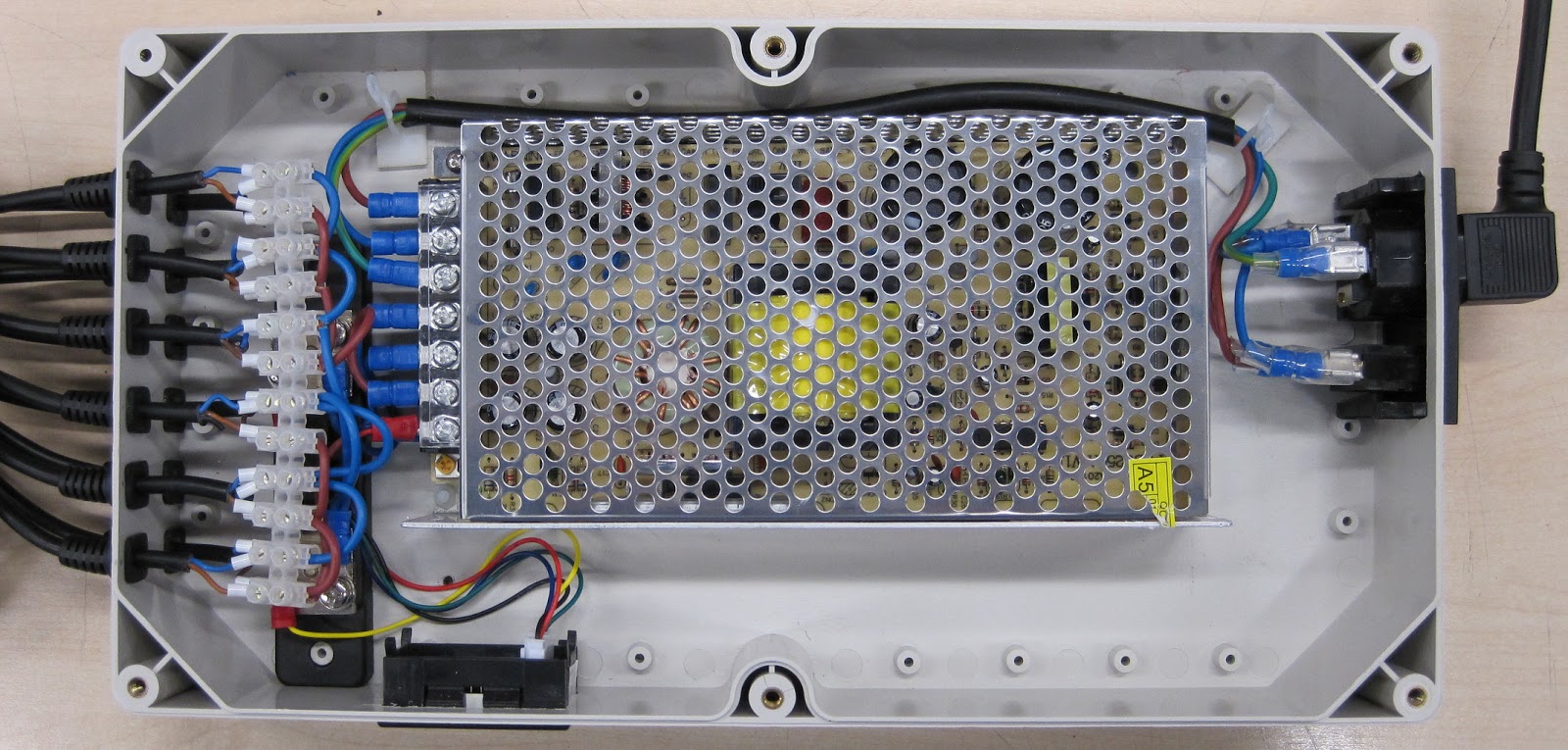
Top view of the supply all wired up
A little careful drilling and cutting of the enclosure made openings for the inlets, cables and display. These were then wired together with crimped and insulated spade and ring connectors. I wanted this build to be safe and reliable so care was taken to get the neatest layout I could manage with good separation between the low and high voltage cabling.

Completed supply with all twelve outputs wired up
The result is a neat supply with twelve outputs which i can easily extend to eighteen if needed. I was pleasantly surprised to discover that even with twelve SBC connected generating 20W load the power drawn by the supply was 25W or about 80% efficiency instead of the 33% previously achieved.

The inbuilt meter allows me to easily see the load on the supply which so far has not risen above 5A even at peak draw, despite the cubitruck and BananaPi having spinning rust hard drives attached, so there is plenty of room for my SBC addiction to grow (I already pledged for a Pine64).

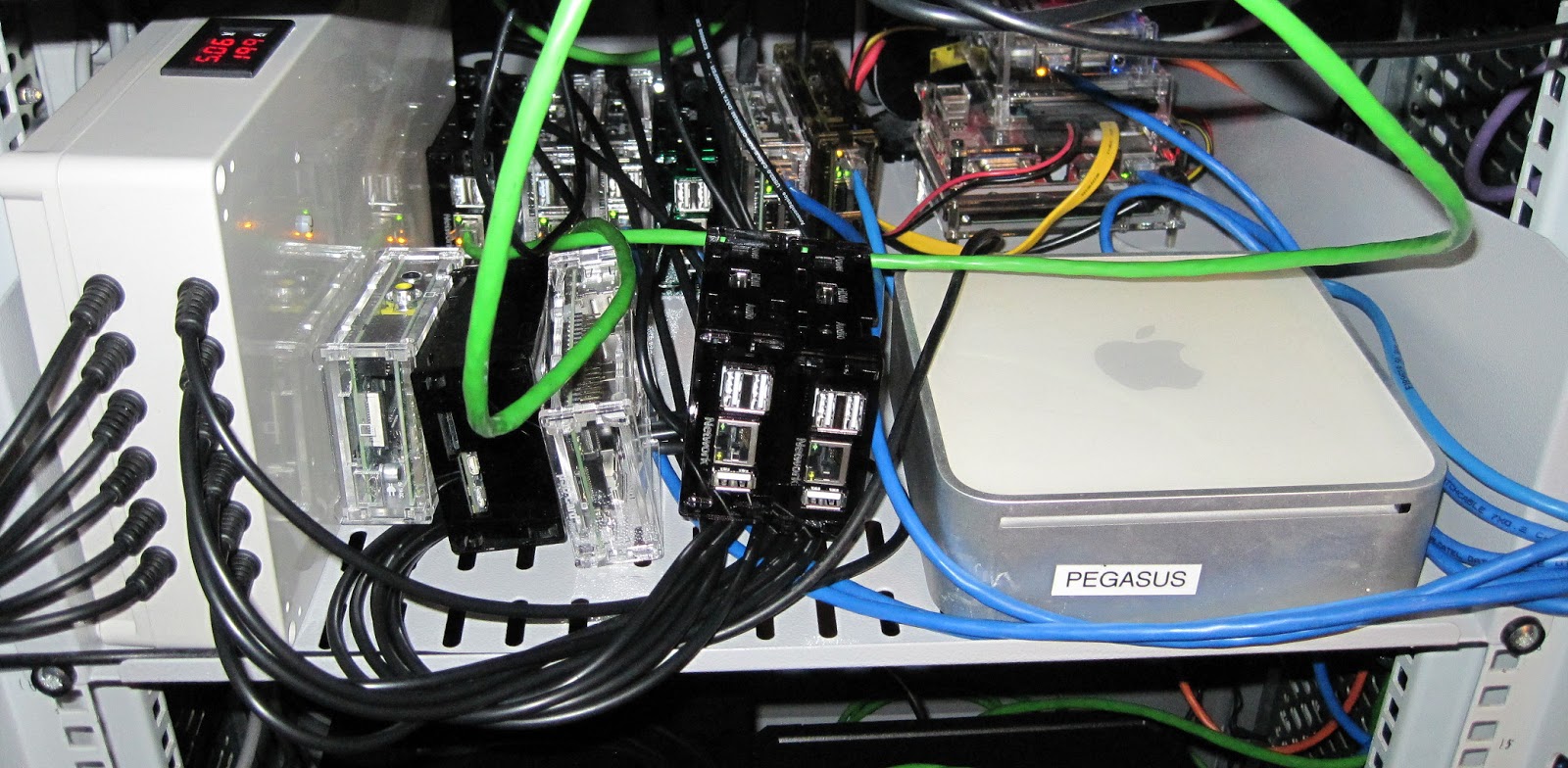
Supply installed in the rack with some of the SBC connected
Overall I am pleased with how this turned out and while there are no detailed design files for this project it should be easy to follow if you want to repeat it. One note of caution though, this project has mains wiring and while I am confident in my own capabilities dealing with potentially lethal voltages I cannot be responsible for anyone else so caveat emptor!

13 January 2016

Norbert Preining: Ian Buruma: Wages of Guilt

Since moving to Japan, I got more and more interested in history, especially the recent history of the 20th century. The book I just finished, Ian Buruma (Wiki, home page) Wages of Guilt Memories of War in Germany and Japan (Independent, NYRB), has been a revelation for me. As an Austrian living in Japan, I am experiencing the discrepancy between these two countries with respect to their treatment of war legacy practically daily, and many of my blog entries revolve around the topic of Japanese non-reconciliation.
Willy Brandt went down on his knees in the Warsaw ghetto, after a functioning democracy had been established in the Federal Republic of Germany, not before. But Japan, shielded from the evil world, has grown into an Oskar Matzerath: opportunistic, stunted, and haunted by demons, which it tries to ignore by burying them in the sand, like Oskar s drum.
Ian Buruma, Wages of Guilt, Clearing Up the Ruins
Buruma-Wages_of_Guilt The comparison of Germany and Japan with respect to their recent history as laid out in Buruma s book throws a spotlight on various aspects of the psychology of German and Japanese population, while at the same time not falling into the easy trap of explaining everything with difference in the guilt culture. A book of great depth and broad insights everyone having even the slightest interest in these topics should read.
This difference between (West) German and Japanese textbooks is not just a matter of detail; it shows a gap in perception.
Ian Buruma, Wages of Guilt, Romance of the Ruins
Only thinking about giving a halfway full account of this book is something impossible for me. The sheer amount of information, both on the German and Japanese side, is impressive. His incredible background (studies of Chinese literature and Japanese movie!) and long years as journalist, editor, etc, enriches the book with facets normally not available: In particular his knowledge of both the German and Japanese movie history, and the reflection of history in movies, were complete new aspects for me (see my recent post (in Japanese)). The book is comprised of four parts: The first with the chapters War Against the West and Romance of the Ruins; the second with the chapters Auschwitz, Hiroshima, and Nanking; the third with History on Trial, Textbook Resistance, and Memorials, Museums, and Monuments; and the last part with A Normal Country, Two Normal Towns, and Clearing Up the Ruins. Let us look at the chapters in turn: The boook somehow left me with a bleak impression of Japanese post-war times as well as Japanese future. Having read other books about the political ignorance in Japan (Norma Field s In the realm of a dying emperor, or the Chibana history), Buruma s characterization of Japanese politics is striking. He couldn t foresee the recent changes in legislation pushed through by the Abe government actually breaking the constitution, or the rewriting of history currently going on with respect to comfort women and Nanking. But reading his statement about Article Nine of the constitution and looking at the changes in political attitude, I am scared about where Japan is heading to:
The Nanking Massacre, for leftists and many liberals too, is the main symbol of Japanese militarism, supported by the imperial (and imperialist) cult. Which is why it is a keystone of postwar pacifism. Article Nine of the constitution is necessary to avoid another Nanking Massacre. The nationalist right takes the opposite view. To restore the true identity of Japan, the emperor must be reinstated as a religious head of state, and Article Nine must be revised to make Japan a legitimate military power again. For this reason, the Nanking Massacre, or any other example of extreme Japanese aggression, has to be ignored, softened, or denied.
Ian Buruma, Wages of Guilt, Nanking
While there are signs of resistance in the streets of Japan (Okinawa and the Hanako bay, the demonstrations against secrecy law and reversion of the constitution), we are still to see a change influenced by the people in a country ruled and distributed by oligarchs. I don t think there will be another Nanking Massacre in the near future, but Buruma s books shows that we are heading back to a nationalistic regime similar to pre-war times, just covered with a democratic veil to distract critics.
I close with several other quotes from the book that caught my attention: In the preface and introduction:
[ ] mainstream conservatives made a deliberate attempt to distract people s attention from war and politics by concentrating on economic growth.
The curious thing was that much of what attracted Japanese to Germany before the war Prussian authoritarianism, romantic nationalism, pseudo-scientific racialism had lingered in Japan while becoming distinctly unfashionable in Germany.
In Romance of the Ruins:
The point of all this is that Ikeda s promise of riches was the final stage of what came to be known as the reverse course, the turn away from a leftist, pacifist, neutral Japan a Japan that would never again be involved in any wars, that would resist any form of imperialism, that had, in short, turned its back for good on its bloody past. The Double Your Incomes policy was a deliberate ploy to draw public attention away from constitutional issues.
In Hiroshima:
The citizens of Hiroshima were indeed victims, primarily of their own military rulers. But when a local group of peace activists petitioned the city of Hiroshima in 1987 to incorporate the history of Japanese aggression into the Peace Memorial Museum, the request was turned down. The petition for an Aggressors Corner was prompted by junior high school students from Osaka, who had embarrassed Peace Museum officials by asking for an explanation about Japanese responsibility for the war.
The history of the war, or indeed any history, is indeed not what the Hiroshima spirit is about. This is why Auschwitz is the only comparison that is officially condoned. Anything else is too controversial, too much part of the flow of history .
In Nanking, by the governmental pseudo-historian Tanaka:
Unlike in Europe or China, writes Tanaka, you won t find one instance of planned, systematic murder in the entire history of Japan. This is because the Japanese have a different sense of values from the Chinese or the Westerners.
In History on Trial:
In 1950, Becker wrote that few things have done more to hinder true historical self-knowledge in Germany than the war crimes trials. He stuck to this belief. Becker must be taken seriously, for he is not a right-wing apologist for the Nazi past, but an eminent liberal.
There never were any Japanese war crimes trials, nor is there a Japanese Ludwigsburg. This is partly because there was no exact equivalent of the Holocaust. Even though the behavior of Japanese troops was often barbarous, and the psychological consequences of State Shinto and emperor worship were frequently as hysterical as Nazism, Japanese atrocities were part of a military campaign, not a planned genocide of a people that included the country s own citizens. And besides, those aspects of the war that were most revolting and furthest removed from actual combat, such as the medical experiments on human guinea pigs (known as logs ) carried out by Unit 731 in Manchuria, were passed over during the Tokyo trial. The knowledge compiled by the doctors of Unit 731 of freezing experiments, injection of deadly diseases, vivisections, among other things was considered so valuable by the Americans in 1945 that the doctors responsible were allowed to go free in exchange for their data.
Some Japanese have suggested that they should have conducted their own war crimes trials. The historian Hata Ikuhiko thought the Japanese leaders should have been tried according to existing Japanese laws, either in military or in civil courts. The Japanese judges, he believed, might well have been more severe than the Allied tribunal in Tokyo. And the consequences would have been healthier. If found guilty, the spirits of the defendants would not have ended up being enshrined at Yasukuni. The Tokyo trial, he said, purified the crimes of the accused and turned them into martyrs. If they had been tried in domestic courts, there is a good chance the real criminals would have been flushed out.
After it was over, the Nippon Times pointed out the flaws of the trial, but added that the Japanese people must ponder over why it is that there has been such a discrepancy between what they thought and what the rest of the world accepted almost as common knowledge. This is at the root of the tragedy which Japan brought upon herself.
Emperor Hirohito was not Hitler; Hitler was no mere Shrine. But the lethal consequences of the emperor-worshipping system of irresponsibilities did emerge during the Tokyo trial. The savagery of Japanese troops was legitimized, if not driven, by an ideology that did not include a Final Solution but was as racialist as Hider s National Socialism. The Japanese were the Asian Herrenvolk, descended from the gods.
Emperor Hirohito, the shadowy figure who changed after the war from navy uniforms to gray suits, was not personally comparable to Hitler, but his psychological role was remarkably similar.
In fact, MacArthur behaved like a traditional Japanese strongman (and was admired for doing so by many Japanese), using the imperial symbol to enhance his own power. As a result, he hurt the chances of a working Japanese democracy and seriously distorted history. For to keep the emperor in place (he could at least have been made to resign), Hirohito s past had to be freed from any blemish; the symbol had to be, so to speak, cleansed from what had been done in its name.
In Memorials, Museums, and Monuments:
If one disregards, for a moment, the differences in style between Shinto and Christianity, the Yasukuni Shrine, with its relics, its sacred ground, its bronze paeans to noble sacrifice, is not so very different from many European memorials after World War I. By and large, World War II memorials in Europe and the United States (though not the Soviet Union) no longer glorify the sacrifice of the fallen soldier. The sacrificial cult and the romantic elevation of war to a higher spiritual plane no longer seemed appropriate after Auschwitz. The Christian knight, bearing the cross of king and country, was not resurrected. But in Japan, where the war was still truly a war (not a Holocaust), and the symbolism still redolent of religious exultation, such shrines as Yasukuni still carry the torch of nineteenth-century nationalism. Hence the image of the nation owing its restoration to the sacrifice of fallen soldiers.
In A Normal Country:
The mayor received a letter from a Shinto priest in which the priest pointed out that it was un-Japanese to demand any more moral responsibility from the emperor than he had already taken. Had the emperor not demonstrated his deep sorrow every year, on the anniversary of Japan s surrender? Besides, he wrote, it was wrong to have spoken about the emperor in such a manner, even as the entire nation was deeply worried about his health. Then he came to the main point: It is a common error among Christians and people with Western inclinations, including so-called intellectuals, to fail to grasp that Western societies and Japanese society are based on fundamentally different religious concepts . . . Forgetting this premise, they attempt to place a Western structure on a Japanese foundation. I think this kind of mistake explains the demand for the emperor to bear full responsibility.
In Two Normal Towns:
The bust of the man caught my attention, but not because it was in any way unusual; such busts of prominent local figures can be seen everywhere in Japan. This one, however, was particularly grandiose. Smiling across the yard, with a look of deep satisfaction over his many achievements, was Hatazawa Kyoichi. His various functions and titles were inscribed below his bust. He had been an important provincial bureaucrat, a pillar of the sumo wrestling establishment, a member of various Olympic committees, and the recipient of some of the highest honors in Japan. The song engraved on the smooth stone was composed in praise of his rich life. There was just one small gap in Hatazawa s life story as related on his monument: the years from 1941 to 1945 were missing. Yet he had not been idle then, for he was the man in charge of labor at the Hanaoka mines.
In Clearing Up the Ruins:
But the question in American minds was understandable: could one trust a nation whose official spokesmen still refused to admit that their country had been responsible for starting a war? In these Japanese evasions there was something of the petulant child, stamping its foot, shouting that it had done nothing wrong, because everybody did it.
Japan seems at times not so much a nation of twelve-year-olds, to repeat General MacArthur s phrase, as a nation of people longing to be twelve-year-olds, or even younger, to be at that golden age when everything was secure and responsibility and conformity were not yet required.
For General MacArthur was right: in 1945, the Japanese people were political children. Until then, they had been forced into a position of complete submission to a state run by authoritarian bureaucrats and military men, and to a religious cult whose high priest was also formally chief of the armed forces and supreme monarch of the empire.
I saw Jew S ss that same year, at a screening for students of the film academy in Berlin. This showing, too, was followed by a discussion. The students, mostly from western Germany, but some from the east, were in their early twenties. They were dressed in the international uniform of jeans, anoraks, and work shirts. The professor was a man in his forties, a 68er named Karsten Witte. He began the discussion by saying that he wanted the students to concentrate on the aesthetics of the film more than the story. To describe the propaganda, he said, would simply be banal: We all know the what, so let s talk about the how. I thought of my fellow students at the film school in Tokyo more than fifteen years before. How many of them knew the what of the Japanese war in Asia.

12 January 2016

Russell Coker: Sociological Images 2015

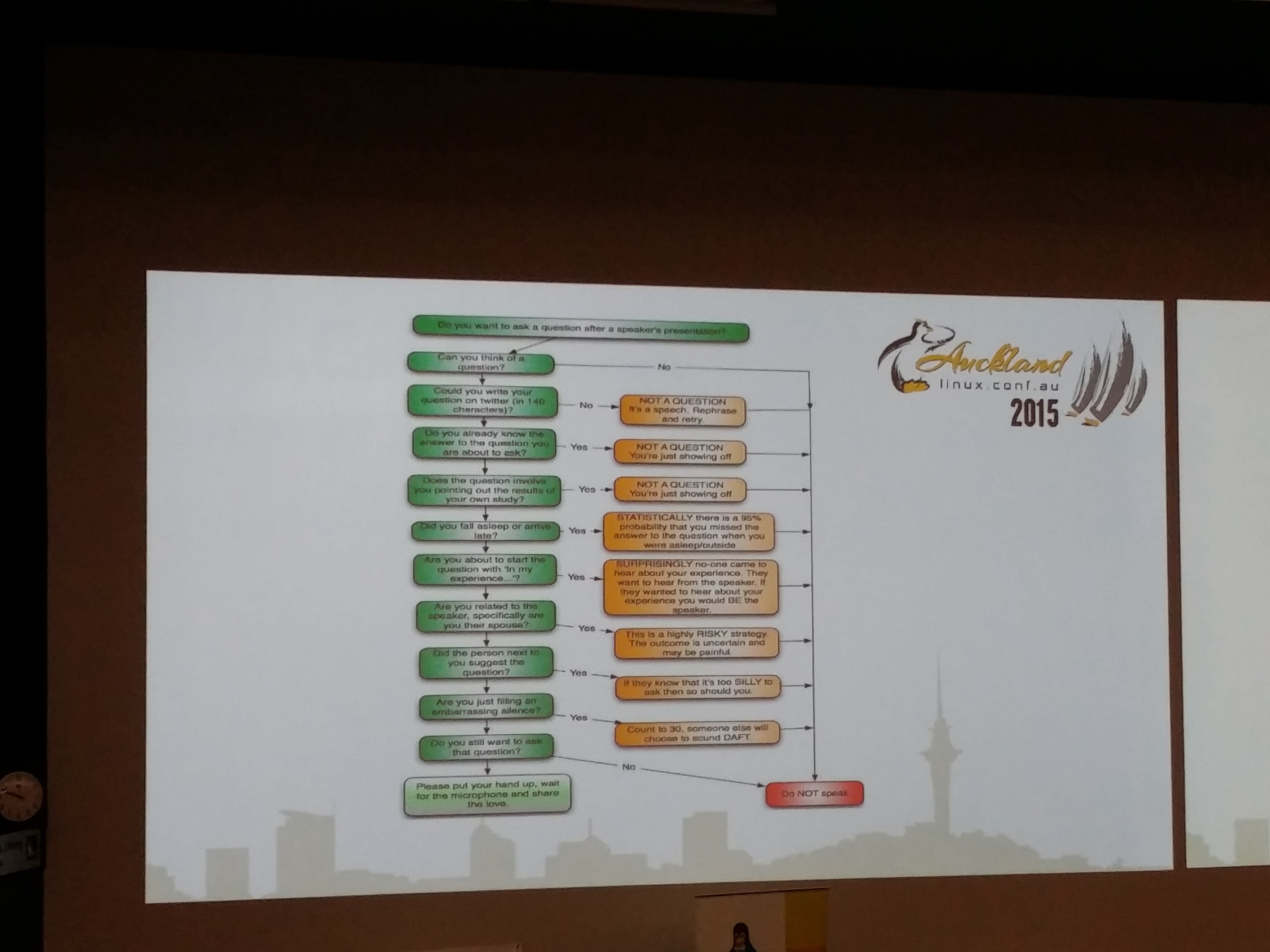
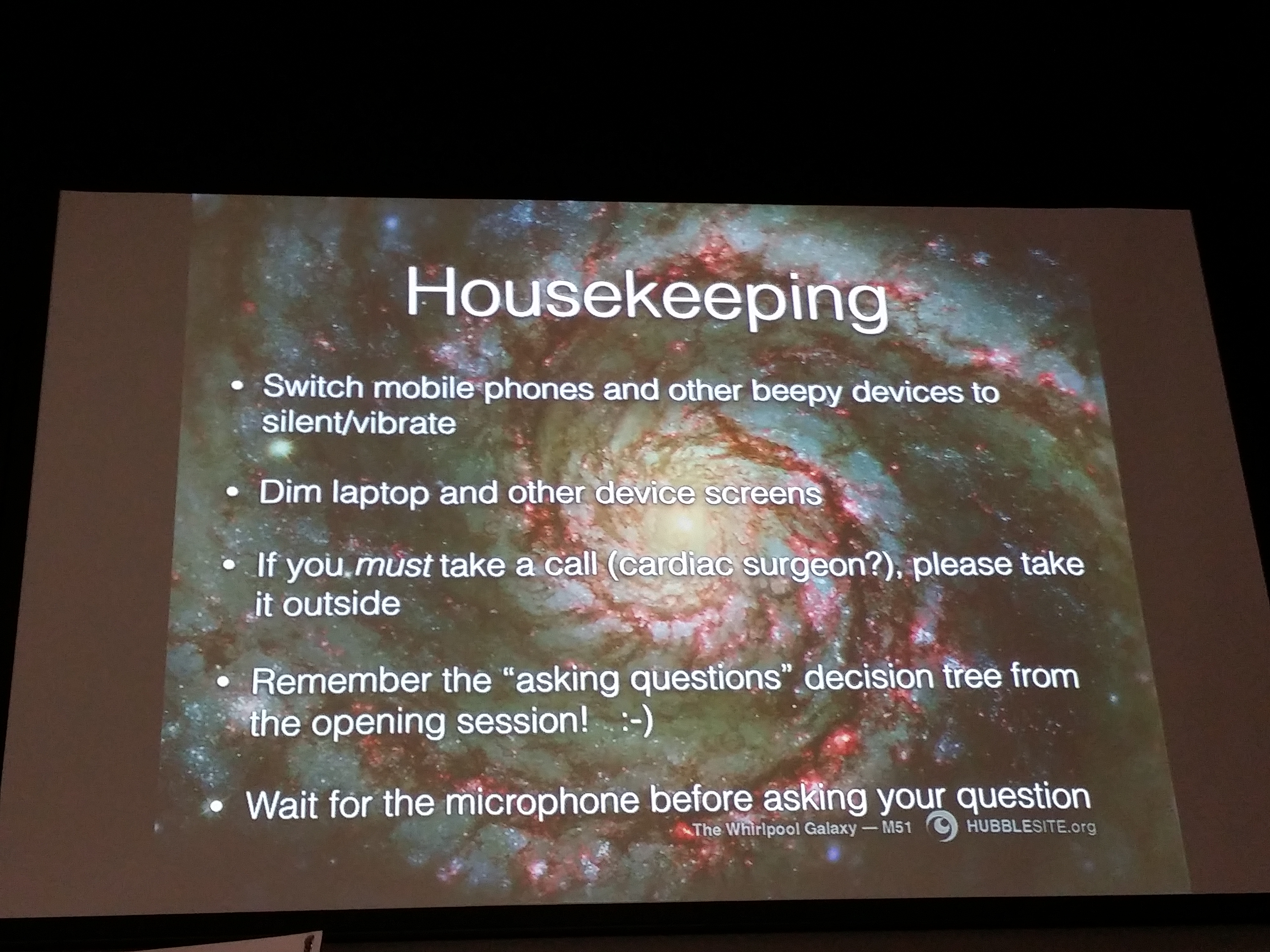
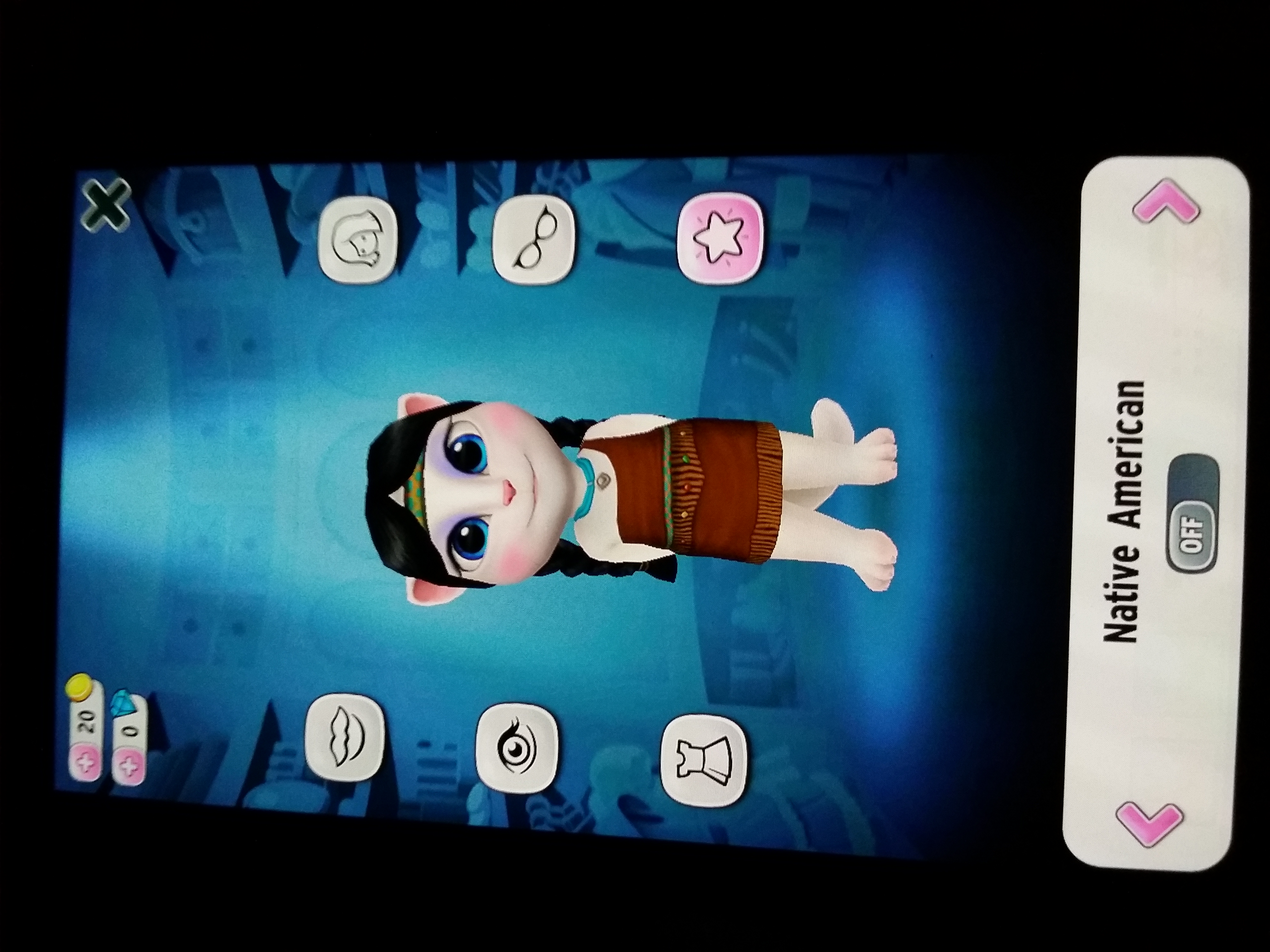
3 men 1 women on lift sign The above sign was at the Melbourne Docks in December 2014 when I was returning from a cruise. I have no idea why there are 3 men and 1 woman on the sign (and a dock worker was also surprised when I explained why I was photographing it). I wonder whether a sign that had 3 women and 1 man would ever have been installed or not noticed if it was installed. rules for asking questions at LCA2015 At the start of the first day of LCA 2015 the above was displayed at the keynote as a flow-chart for whether someone should ask a question at a lecture. Given that the first real item in the list is that a question should fit in a tweet I think it was inspired by my blog post about the length of conference questions [1]. Astronomy Miniconf suggestions for delegates At the introduction to the Astronomy Miniconf the above slide was displayed. In addition to referencing the flow-chart for asking questions it recommends dimming laptop screens (among other things). sign saying men to the left because women are always right The above sign was at a restaurant in Auckland in January 2015. I thought that sort of sexist joke went out of fashion a few decades ago. gendered nerf weaponary The above photo is from a Melbourne department store in February 2015. Why gender a nerf gun? That just doesn t make sense. Also it appeared that the only nerf crossbow was the purple/pink one, is a crossbow considered feminine nowadays? Picture of Angela appropriating Native American clothing The above picture is a screen-shot of one of the Talking Angela series of Android games from March. Appropriating the traditional clothing of marginalised groups is a bad thing. People of Native American heritage who want to wear their traditional clothing face discrimination when they do so, when white people play dress-up in clothing that is a parody of Native American style it s really offensive. The site Racialicious.com has a tag for articles about appropriation [2]. The above was in a library advertising an Ebook reader. In this case they didn t even have pointlessly gendered products they just had pointlessly gendered adverts for the same product. They also perpetuate the myth that only girls read vampire books and only boys read about space. Also why is the girl lying down to read while the boy is sitting up? Above is an Advent calendar on sale in a petrol station. Having end of year holiday presents that have nothing to do with religious festivals makes sense. But Advent is a religious observance. I think this would be a better candidate for war on Christmas paranoia than a coffee cup of the wrong colour. The above photo is of boys and girls pipette suckers. Pointlessly gendered recreational products like Nerf guns is one thing, but I think that doing it to scientific equipment is a bigger problem. Are scientists going to stop work if they can t find a pipette sucker of the desired gender? Is worrying about this going to distract them from their research (really bad if working with infectious or carcinogenic solutions). The Integra advertising claims to be doing this to promote breast cancer research which is also bogus. Here is a Sociological Images article about the problems of using pink to market breast cancer research [3] and the Sociological Images post about pinkwashing (boobies against breast cancer) is also worth reading [4]. As an aside I made a mistake in putting a pipette sucker over the woman s chest in that picture. The way that Integra portreyed her chest is relevant to analysis of this advert. But unfortunately I didn t photograph that. Here is a link to my sociological images post from 2014 [5].

4 January 2016

John Goerzen: Hiking a mountain with Ian Murdock

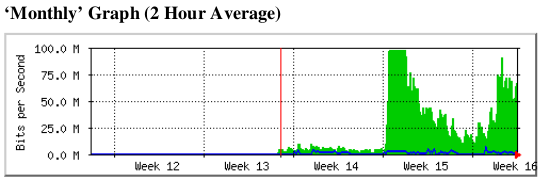
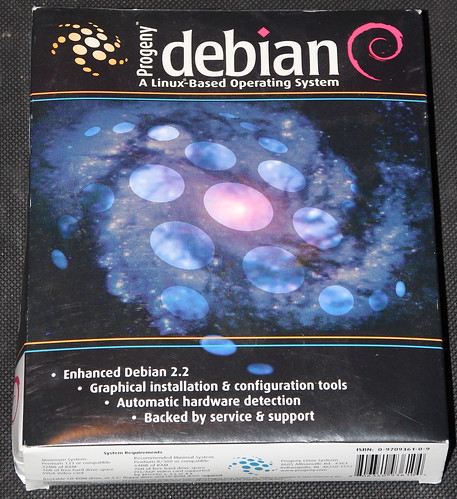
Would you like to hike a mountain? That question caught me by surprise. It was early in 2000, and I had flown to Tucson for a job interview. Ian Murdock was starting a new company, Progeny, and I was being interviewed for their first hire. Well, I thought, hiking will be fun. So we rode a bus or something to the top of the mountain and then hiked down. Our hike was full of well, everything. Ian talked about Tucson and the mountains, about his time as the Debian project leader, about his college days. I asked about the plants and such we were walking past. We talked about the plans for Progeny, my background, how I might fit in. It was part interview, part hike, part two geeks chatting. Ian had no HR telling him you can t go hiking down a mountain with a job candidate, as I m sure HR would have. And I am glad of it, because even 16 years later, that is still by far the best time I ever had at a job interview, despite the fact that it ruined the only pair of shoes I had brought along I had foolishly brought dress shoes for a, well, job interview. I guess it worked, too, because I was hired. Ian wanted to start up the company in Indianapolis, so over the next little while there was the busy work of moving myself and setting up an office. I remember those early days Ian and I went computer shopping at a local shop more than once to get the first workstations and servers for the company. Somehow he had found a deal on some office space in a high-rent office building. I still remember the puzzlement on the faces of accountants and lawyers dressed up in suits riding in the elevators with us in our shorts and sandals, or tie-die, next to them. Progeny s story was to be a complicated one. We set out to rock the world. We didn t. We didn t set out to make lasting friendships, but we often did. We set out to accomplish great things, and we did some of that, too. We experienced a full range of emotions there elation when we got hardware auto-detection working well or when our downloads looked very popular, despair when our funding didn t come through as we had hoped, being lost when our strategy had to change multiple times. And, as is the case everywhere, none of us were perfect. I still remember the excitement after we published our first release on the Internet. Our little server that could got pegged at 100Mb of outbound bandwidth (that was something for a small company in those days.) The moment must have meant something, because I still have the mrtg chart from that day on my computer, 15 years later. Progeny's Bandwidth Chart We made a good Linux distribution, an excellent Debian derivative, but commercial success did not flow from it. In the succeeding months, Ian and the company tried hard to find a strategy that would stick and make our big break. But that never happened. We had several rounds of layoffs when hoped-for funding never materialized. Ian eventually lost control of the company, and despite a few years of Itanium contract work after I left, closed for good. Looking back, Progeny was life compressed. During the good times, we had joy, sense of accomplishment, a sense of purpose at doing something well that was worth doing. I had what was my dream job back then: working on Debian as I loved to do, making the world a better place through Free Software, and getting paid to do it. And during the bad times, different people at Progeny experienced anger, cynicism, apathy, sorrow for the loss of our friends or plans, or simply a feeling to soldier on. All of the emotions, good or bad, were warranted in their own way. Bruce Byfield, one of my co-workers at Progeny, recently wrote a wonderful memoriam of Ian. He wrote, More than anything, he wanted to repeat his accomplishment with Debian, and, naturally he wondered if he could live up to his own expectations of himself. That, I think, was Ian s personal tragedy that he had succeeded early in life, and nothing else he did with his life could quite measure up to his expectations and memories. Ian was not the only one to have some guilt over Progeny. I, for years, wondered if I should have done more for the company, could have saved things by doing something more, or different. But I always came back to the conclusion I had at the time: that there was nothing I could do a terribly sad realization. In the years since, I watched Ubuntu take the mantle of easy-to-install Debian derivative. I saw them reprise some of the ideas we had, and even some of our mistakes. But by that time, Progeny was so thoroughly forgotten that I doubt they even realized they were doing it. I had long looked at our work at Progeny as a failure. Our main goal was never accomplished, our big product never sold many copies, our company eventually shuttered, our rock-the-world plan crumpled and forgotten. And by those traditional measurements, you could say it was a failure. But I have come to learn in the years since that success is a lot more that those things. Success is also about finding meaning and purpose through our work. As a programmer, success is nailing that algorithm that lets the application scale 10x more than before, or solving that difficult problem. As a manager, success is helping team members thrive, watching pieces come together on projects that no one person could ever do themselves. And as a person, success comes from learning from our experiences, and especially our mistakes. As J. Michael Straczynski wrote in a Babylon 5 episode, loosely paraphrased: Maybe this experience will be a good lesson. Too bad it was so painful, but there ain t no other kind. The thing about Progeny is this Ian built a group of people that wanted to change the world for the better. We gave it our all. And there s nothing wrong with that. Progeny did change the world. As us Progeny alumni have scattered around the country, we benefit from the lessons we learned there. And many of us were different , sort of out of place before Progeny, and there we found others that loved C compilers, bootloaders, and GPL licenses just as much as we did. We belonged, not just online but in life, and we went on to pull confidence and skill out of our experience at Progeny and use them in all sorts of ways over the years. And so did Ian. Who could have imagined the founder of Debian and Progeny would one day lead the cause of an old-guard Unix turning Open Source? I run ZFS on my Debian system today, and Ian is partly responsible for that and his time at Progeny is too. So I can remember Ian, and Progeny, as a success. And I leave you with a photo of my best memento from the time there: an original unopened boxed copy of Progeny Linux. IMG_6197_v1

17 December 2015

Steinar H. Gunderson: sRGB weirdness: Doing the right thing causes a worse result

A while back, I wrote about how you should always do image calculations in linear light, not gamma space; since then, Tom Forsythe has come out with a much better metaphor than I could cough up myself, namely that you should look at sRGB value as compressed values, not integers. So naturally, when I needed a deinterlacing filter for Movit, my GPU filter library, I wanted to do it in linear light. (In fact, all pixel processing in Movit is in linear light, except in the cases where it's 100% equivalent to do it on the gamma-encoded values and the conversion can be skipped for speed.) After some deliberations, I made an implementation of Martin Weston's three-field deinterlacing filter, known in ffmpeg as w3fdif. I won't discuss deinterlacing in detail here since it's really hard, but I'll note that w3fdif works by way of applying two filters; low-frequency components are estimated from the current field, and high-frequency from the previous and next fields. (This makes intuitive sense; you cannot get the HF information from the current field since you don't have the lines you need for that, but you can hope it hasn't changed too much.) Aha! A filter. Brilliant, that's exactly when linear light means the most, too. But when implementing it, I found that it sometimes looked weird -- and ffmpeg's implementation (which works directly on the sRGB values, which we already established is wrong) didn't. After lots of tweaking back and forth, I decided to set up a synthetic test to settle this once and for all; I took a static test picture (eliminating everything related to video capture, codecs, frame rates, etc.) and compared to ffmpeg. Of course, deinterlacing is all about movement, but this would do to try to nail things down. So after lots of fruitless debugging, I did a last-ditch: What if I turned off the gamma conversions? This gave me a huge surprise; indeed it looked better! I'll provide some upscaled versions; left is the original image, middle is deinterlaced in sRGB space and right is deinterlaced in linear light: Original picture Deinterlaced in sRGB space Deinterlaced in linear light If that's not dramatic enough for you (trust me, you'll notice it when it's animated as you flicker through the two different fields), here's an even more high-contrast example (same ordering): Original picture Deinterlaced in sRGB space Deinterlaced in linear light I guess it's obvious in retrospect what happens; the HF filter picks up residue from its outer edges, and even if the coefficient is just 0.031 (well, times two; it adds that value from both the previous and next field), 3% the photons of a fully lit pixel (which is what you get when working in linear light) is actually quite a bit, whereas a 3% gray is only pixel value 8 or so, which is barely visible. So what am I to make of this? I'm honestly not sure. Maybe it's somehow related to that these filter values were chosen in 1988, where they were relatively unlikely to do this in linear light (although if they did it with analog circuitry, perhaps they could?) and it was tweaked to look good despite doing the wrong thing. Or maybe I need to change my approach here entirely. It always sucks when your fundamental assumptions are challenged, but I think it shows once again that if you notice something funny in your output, you really ought to investigate, because you never know how deep the rabbit hole goes. :-/

1 December 2015

Enrico Zini: akonadi-fails-to-sync

When Akonadi silently fails to sync your calendar... Bug severity: seriously ruining my life. Try to use korganizer to create a calendar entry when the server is not reachable (say, you are offline, or you typed the wrong password), and you may find that you end up with no error messages, an entry that shows up perfectly fine, but that will never be synced to the server, ever again. I use korganizer, radicale and caldav for important things. The practical ramifications of me inserting entries in korganizer, seeing that everything looks ok, and then not finding them on my phone while on the go, are scary. Think of things like importing .ics files with flight schedules, entering tax deadlines, time and places for customer meetings, time and places of arrival of loved ones I'm supposed to pick up. I spent time setting up my own infrastructure for this exactly because I care that all of this works reliably. And now I urgently took a morning off work to find a way to detect those entries that Akonadi is refusing to update, The whole thing is cumbersome to run, but if you are using kdepim-based tools to manage your calendars and sync them across devices, you may want to give it a go every once in a while. You can find the script and the notes I took so far on the issue at https://github.com/spanezz/akonadi-workarounds.

25 November 2015

Daniel Pocock: Drone strikes coming to Molenbeek?

The St Denis siege last week and the Brussels lockdown this week provides all of us in Europe with an opportunity to reflect on why over ten thousand refugees per day have been coming here from the middle east, especially Syria. At this moment, French warplanes and American drones are striking cities and villages in Syria, killing whole families in their effort to shortcut the justice system and execute a small number of very bad people without putting them on trial. Some observers estimate air strikes and drones kill twenty innocent people for every one bad guy. Women, children, the sick, elderly and even pets are most vulnerable. The leak of the collateral murder video simultaneously brought Wikileaks into the public eye and demonstrated how the crew of a US attack helicopter had butchered unarmed civilians and journalists like they were playing a video game. Just imagine that the French president had sent the fighter jets to St Denis and Molenbeek instead of using law enforcement. After all, how are the terrorists there any better or worse than those in Syria, don't they deserve the same fate? Or what if Obama had offered to help out with a few drone strikes on suburban Brussels? After all, if the drones are such a credible solution for Syria's future, why won't they solve Brussels' (perceived) problems too? If the aerial bombing "solution" had been attempted in a western country, it would have lead to chaos. Half the population of Paris and Brussels would find themselves camping at the migrant camps in Calais, hoping to sneak into the UK in the back of a truck. Over a hundred years ago, Russian leaders proposed a treaty agreeing never to drop bombs from balloons and the US and UK happily signed it. Sadly, the treaty wasn't updated after the invention of fighter jets, attack helicopters, rockets, inter-continental ballistic missiles, satellites and drones. The reality is that asymmetric warfare hasn't worked and never will work in the middle east and as long as it is continued, experts warn that Europe may continue to face the consequences of refugees, terrorists and those who sympathize with their methods. By definition, these people can easily move from place to place and it is ordinary citizens and small businesses who will suffer a lot more under lockdowns and other security measures. In our modern world, people often look to technology for shortcuts. The use of drones in the middle east is a shortcut from a country that spent enormous money on ground invasions of Iraq and Afghanistan and doesn't want to do it again. Unfortunately, technological shortcuts can't always replace the role played by real human beings, whether it is bringing law and order to the streets or in any other domain. Aerial bombardment - by warplane or by drone - carries an implicitly racist message, that the people abused by these drone attacks are not equivalent to the rest of us, they can't benefit from the normal procedures of justice, they don't have rights, they are not innocent until proven guilty and they are expendable. The French police deserve significant credit for the relatively low loss of life in the St Denis siege. If their methods and results were replicated in Syria and other middle eastern hotspots, would it be more likely to improve the situation in the long term than drone strikes?

20 November 2015

Sylvain Beucler: Rebuilding Android proprietary SDK binaries

Going back to Android recently, I saw that all tools binaries from the Android project are now click-wrapped by a quite ugly proprietary license, among others an anti-fork clause (details below). Apparently those T&C are years old, but the click-wrapping is newer. This applies to the SDK, the NDK, Android Studio, and all the essentials you download through the Android SDK Manager. Since I keep my hands clean of smelly EULAs, I'm working on rebuilding the Android tools I need.
We're talking about hours-long, quad-core + 8GB-RAM + 100GB-disk-eating builds here, so I'd like to publish them as part of a project who cares. As a proof-of-concept, the Replicant project ships a 4.2 SDK and I contributed build instructions for ADT and NDK (which I now use daily). (Replicant is currently stuck to a 2013 code base though.) I also have in-progress instructions on my hard-drive to rebuild various newer versions of the SDK/API levels, and for the NDK whose releases are quite hard to reproduce (no git tags, requires fixes committed after the release, updates are partial rebuilds, etc.) - not to mention that Google doesn't publish the source code until after the official release (closed development) :/ And in some cases like Android Support Repository [not Library] I didn't even find the proper source code, only an old prebuilt. Would you be interested in contributing, and would you recommend a structure that would promote Free, rebuilt Android *DK? The legalese Anti-fork clause:
3.4 You agree that you will not take any actions that may cause or result in the fragmentation of Android, including but not limited to distributing, participating in the creation of, or promoting in any way a software development kit derived from the SDK.
So basically the source is Apache 2 + GPL, but the binaries are non-free. By the way this is not a GPL violation because right after:
3.5 Use, reproduction and distribution of components of the SDK licensed under an open source software license are governed solely by the terms of that open source software license and not this License Agreement.
Still, AFAIU by clicking "Accept" to get the binary you still accept the non-free "Terms and Conditions". (Incidentally, if Google wanted SDK forks to spread and increase fragmentation, introducing an obnoxious EULA is probably the first thing I'd have recommended. What was its legal team thinking?) Indemnification clause:
12.1 To the maximum extent permitted by law, you agree to defend, indemnify and hold harmless Google, its affiliates and their respective directors, officers, employees and agents from and against any and all claims, actions, suits or proceedings, as well as any and all losses, liabilities, damages, costs and expenses (including reasonable attorneys fees) arising out of or accruing from (a) your use of the SDK, (b) any application you develop on the SDK that infringes any copyright, trademark, trade secret, trade dress, patent or other intellectual property right of any person or defames any person or violates their rights of publicity or privacy, and (c) any non-compliance by you with this License Agreement.
Usage restriction:
3.1 Subject to the terms of this License Agreement, Google grants you a limited, worldwide, royalty-free, non-assignable and non-exclusive license to use the SDK solely to develop applications to run on the Android platform. 3.3 You may not use the SDK for any purpose not expressly permitted by this License Agreement. Except to the extent required by applicable third party licenses, you may not: (a) copy (except for backup purposes), modify, adapt, redistribute, decompile, reverse engineer, disassemble, or create derivative works of the SDK or any part of the SDK; or (b) load any part of the SDK onto a mobile handset or any other hardware device except a personal computer, combine any part of the SDK with other software, or distribute any software or device incorporating a part of the SDK.
If you know the URLs, you can still direct-download some of the binaries which don't embed the license, but all this feels fishy. GNU licensing didn't answer me (yet). Maybe debian-legal has an opinion? In any case, the difficulty to reproduce the *DK builds is worrying enough to warrant an independent rebuild. Did you notice this?

19 November 2015

Miriam Ruiz: Projects, Conflicts and Emotions

The Debian Project includes many people, groups and teams with different goals, priorities and ways of doing things. Diversity is a good thing, and the results of the continuous interaction, cooperation and competition among different points of view and components make up a successful developing framework both in Debian and in other Free / Libre / Open Source Software communities. The cost of this evolutionary paradigm is that sometimes there are subprojects that might have been extremely successful and useful that are surpassed by newer approaches, or that have to compete with alternative approaches that were not there before, and which might pursue different goals or have a different way of doing things that their developers find preferable in terms of modularity, scalability, stability, maintenance, aesthetics or any other reason. Whenever this happens, the emotional impact on the person or group of people that are behind the established component (or process, or organizational structure), that is being questioned and put under test by the newer approach can be important, particularly when they have invested a lot of time and effort and a considerable amount of emotional energy doing a great job for many years. Something they should be thanked for. This might be particularly hard when -for whatever reason- the communication between both teams is not too fluent or constant, and sometimes the author or authors of the solution that was considered mainstream until then might feel left out and their territory stolen. As generally development teams and technical people in the Free / Libre / Open Source world are more focused on results than on relationships, projects are generally not too good at managing this (emotional, relational) situations, even though they (we) are gradually learning and improving. What has happened with the Debian Live Project is indeed a hurtful situation, even though it s probably an unavoidable one. The Debian Live Project has done a great job for many years and it is sad to see it dying abruptly. A new competing approach is on its way with a different set of priorities and different way of doing things, and all that can be done at the moment is to thank Daniel for all his work, as well as everyone who has made the Debian Live Project successful for so many years, also thank the people who are investing their time and effort in developing something that might be even better. Lets wait and see. Source of the image: Conflict Modes and Managerial Styles by Ed Batista

13 November 2015

Jaldhar Vyas: New Year Resolutions

Now this could just be the prodigious amounts of sugar and ghee I've been eating the past few days, but I'm bursting with energy for working on Debian so here is a list of things I want to do in the upcoming year. This will happen soon. Sooner if you people will stop filing bugs all the time. The rest of the items are more long term. To keep all of this on track, I shall adopt the practice lately seen on Debian Planet of periodically posting a report of my Debian activities.

9 November 2015

Jonathan McDowell: The Joy of Recruiters

Last week Simon retweeted a link to Don t Feed the Beast the Great Tech Recruiter Infestation. Which reminded me I d been meaning to comment on my own experiences from earlier in the year. I don t entertain the same level of bile as displayed in the post, but I do have a significant level of disappointment in the recruitment industry. I had conversations with 3 different agencies, all of whom were geographically relevant. One contacted me, the other 2 (one I d dealt with before, one that was recommended to me) I contacted myself. All managed to fail to communicate with any level of acceptability. The agency hat contacted me eventually went quiet, after having asked if they could put my CV forward for a role and pushing very hard about when I could interview. The contact in the agency I d dealt with before replied to say I was being passed to someone else who would get in contact. Who of course didn t. And the final agency, who had been recommended, passed me between 3 different people, said they were confident they could find me something, and then went dark except for signing me up to their generic jobs list which failed to have anything of relevance on it. As it happens my availability and skill set were not conducive to results at that point in time, so my beef isn t with the inability to find a role. Instead it s with the poor levels of communication presented by an industry which seems, to me, to have communication as part of the core value it should be offering. If anyone had said at the start Look, it s going to be tricky, we ll see what we can do or Look, that s not what we really deal in, we can t help , that would have been fine. I m fine with explanations. I get really miffed when I m just left hanging. I d love to be able to say I ll never deal with a recruiter again, but the fact of the matter is they do serve a purpose. There s only so far a company can get with word of mouth recruitment; eventually that network of personal connections from existing employees who are considering moving dries up. Advertising might get you some more people, but it can also result in people who are hugely inappropriate for the role. From the company point of view recruiters nominally fulfil 2 roles. Firstly they connect the prospective employer with a potentially wider base of candidates. Secondly they should be able to do some sort of, at least basic, filtering of whether a candidate is appropriate for a role. From the candidate point of view the recruiter hopefully has a better knowledge of what roles are out there. However the incentives to please each side are hugely unbalanced. The candidate isn t paying the recruiter. If you re not paying for it, you re the product may be bandied around too often, but I believe this is one of the instances where it s very applicable. A recruiter is paid by their ability to deliver viable candidates to prospective employers. The delivery of these candidates is the service. Whether or not the candidate is happy with the job is irrelevant beyond them staying long enough that the placement fee can be claimed. The lengthy commercial relationship is ideally between the company and the recruitment agency, not the candidate and the agency. A recruiter wants to be able to say Look at the fine candidate I provided last time, you should always come to me first in future . There s a certain element of wanting the candidate to come back if/when they are looking for a new role, but it s not a primary concern. It is notable that the recommendations I d received were from people who had been on the hiring side of things. The recruiter has a vested interest in keeping the employer happy, in the hope of a sustained relationship. There is little motivation for keeping the candidate happy, as long as you don t manage to scare them off. And, in fact, if you scare some off, who cares? A recruiter doesn t get paid for providing the best possible candidate. Or indeed a candidate who will fully engage with the role. All they re required to provide is a hire-able candidate who takes the role. I m not sure what the resolution is to this. Word of mouth only scales so far for both employer and candidate. Many of the big job websites seem to be full of recruiters rather than real employers. And I m sure there are some decent recruiters out there doing a good job, keeping both sides happy and earning their significant cut. I m sad to say I can t foresee any big change any time soon. [Note I m not currently looking for employment.] [No recruitment agencies were harmed in the writing of this post. I have deliberately tried to avoid outing anyone in particular.]

16 October 2015

Vincent Sanders: Raspberries are not the only fruit

I have worked with ARM based systems for longer than I care to admit to myself. From the Acorn Archimedes 305 in 1987 through to modern 64bit systems I have seen many many changes in the ARM community. One big change has been the rise of the inexpensive single board computer (SBC).

Arguably the Raspberry Pi (RPi) was responsible for starting this trend. Before RPi there were small development boards available, I was even involved in producing some of them, none of these really became a big thing and were principally vehicles for silicon vendors to showcase their SoC in an accessible way. When I say accessible I mean for silicon vendors who were previously used to charging many thousands of pounds for their development boards now only charging hundreds.

Raspberry Pi 2 B+ in my case
In my opinion the RPi was a complete disruption to the SBC market. In early 2012 a complete ARM computer system could now be purchased for $35 ( 25) which was substantially cheaper than the best contemporary competitor the Beaglebone $89 ( 60)

To be clear, the reason the RPi succeeded (millions sold, household name) was not on price alone but also the large amount of good supporting software and how easy it was made for teachers and makers to use.

There were several areas that the RPi managed to change perceived issues into opportunities for using what was already available or third parties to provide. There were also several issues raised about the original RPi:
Some of these have been addressed since release as the foundation now sells cases, hardware revisions with much more powerful processors, pre-configured storage, cameras and displays. The important thing to note here though is the RPi has made the bare SBC a much more widely accepted product where all the non critical parts are considered "extras" and a lot is forgiven because of the price.

With that acceptance there have been many, many new SBC coming to market with better peripherals and increasingly competitive pricing. These are technically not clones as none of them use the Broadcom processor of the RPi but they often share many features and possibly even a compatible expansion header.

Banana pi in my case with a 2.5inch drive bay
The Banana Pi was one of these copycats which I acquired for a similar price as an RPi in 2014. The main processor of this system was a 1Ghz dual core Allwinner A20 processor (a considerable advance on the 700MHz single core of the original RPi) coupled to a gigabyte of memory. Additionally the board benefited from having SATA and gigabit Ethernet MAC which made for a much more versatile system. Various third parties filled in the missing peripherals including my own attempt at a case.

I acquired a cubietruck for the NetSurf project to use as a build node in their CI system this is again based on the A20 but with more memory and somewhat better peripheral support but at a substantial cost over the Banana Pi.

The most recent addition to this form factor is the introduction by Xunlong Software of the Orange Pi PC. This little board is the same footprint as the RPi2 B+ design but with differing connector placement. The processor is a quad core 1.6GHz Allwinner H3 with a gigabyte of memory and has has Ethernet and USB but no SATA.

Pile of Orange Pi PC in my cases
The big news about this board though is the price, at $15 ( 10) it resets the price expectations just as the RPi did before it. I was initially sceptical of the quality of the product (or if it would arrive at all) but I have acquired five of these boards and every one of them came well packaged, boxed and in a static bag, just like the RPi does, and they all worked.

I created a case design based on my RPi slimline case so they would be protected when piled up with all the other boards. The use of a DC barrel jack instead of micro USB for power is better in that the connector is more robust and intended for higher current draws but does mean additional leads are needed. There are, however, two flies in the ointment, neither are showstoppers but make the board a little more difficult to use.

Orange Pi in my case with heatsinkOne is a simple necessity of a substantial heatsink on the H3 processor. Initially I used a small 20 x 20mm copper heatsink (around 800mm square surface area) but this was insufficient under full load. I did not want to have to use a fan so I milled some slots into copper round bar, then cut off sections and faced them on a lathe. The completed design had more than 2200 square mm surface area and cost around $2.5 ( 1.5) in material (and a couple of hours in the workshop but that was fun and I made something)

The second issue and arguably much more serious is that of software. Let me be honest, it is dreadful, I mean very bad indeed. The images provided from the Orange Pi website are some of the worst examples of "do something quick" I have experienced.

Fortunately a user on the forums named loboris decided to create scripts that generate a Debian (and Ubuntu and Fedora) distribution images that can be installed from SD card. He relies on a somewhat patched 3.4 kernel full of Allwinner vendor changes and the inevitable binary blobs for the Marli GPU but the result does work.

I have had a few units acting as distcc compiler slaves for two weeks now at 100% CPU loading and they are still running. The processor does not get overly warm with the heatsink installed and Debian behaves just fine. The main caveat being that it is definitely not going to work if you try and update the kernel through packaging.

My ARM build farm as a pile of SBC
The state of software support and Xunlong Software relying on a forum user to complete their product does tarnish an otherwise impressive and possibly market changing SBC.

Perhaps I expect too much for fifteen bucks? I guess when the cost of the case, heatsink, cables and memory storage card is similar to the rest of the computer there is simply no margin left for anything else.

In conclusion hopefully this brief overview has provided some insight into what is available in this market and that the Raspberry Pi is indeed not the only option.

I finish with an image is of my ARM build farm consisting of every SBC I mention here (including a couple of RPi)

14 October 2015

Norbert Preining: On Lars Wirzenius, Mart n Ferrari, and Debian

Now that the tsunami that followed my recent blog post has passed, I can read through all the nice comments and blogs of other people. I didn t expect that just writing up some links to posts on LKML, plus adding my personal opinion on what has happened and about my interpretation concerning Debian could gather so much attention. Anyway, let us look at the blog posts written in the aftermath. debian-newspeak-coc In particular do I want to answer to two blogs: Lars Wirzenius blog and Mart n Ferrari s blog, both of which are excellent examples of insults. I also want to mention that although the previous two are bad examples, there are fortunately also those who are able to resist primitive insults, in particular Gunnar Wolf (direct link to the blog does not work), and Miriam Ruiz blog, which contradict my blog and propose a different view, without pulling the knife. Lars Wirzenius Let us start with Lars (ah sorry, I have to call him Wirzenius here, strange custom has suddenly popped up in Debian!):
I think Preining mis-characterises what happens on the Linux kernel mailing list, and in Debian, in free software development in general, and what Sarah Sharp has said and done. I continue to think he is wrong about everything on this topic.
I am very surprised that Lars^WWirzenius is in possession of a crystal ball that allows him to see and evaluate my attitude towards all these items, considering that I have presented links to posts on the LKML, and yes, my interpretation of the matter. Mind that the whole text amounts to about 130 lines on my screen, while my personal opinion was stated in two paragraphs of total 9 lines plus some interspersed comments. And in these maybe 20 lines I didn t make general statements about open source, kernel development etc etc. Lars, I know you have closed your blog for comments so I couldn t ask you but please, can you send me one of your crystal balls if you have more of them? At least he has managed to keep a bit of proper writing and disagreed with my statement on Debian (whether there is fun or not in Debian). He is of course free to do that, but please, don t rob me the right to state that I think Debian has changed. All this dispute centers around people not being capable to distinguish two things: One, being against the Code of Conduct due to the inclusion of administrative actions without clear definitions, and Two, being pro offensive behavior and and insults. Now, dear Lars^WWirzenius, please listen: I never advocated abusive behavior or insults, nor do I defend it. (Did you hear that!) I simply opposed the Code of Conduct as ruling instrument. And what kind of emails I got due to my opposition was far outside the Code of Conduct you are so strongly defending. So please, stay at the facts, and stop insulting me. Thanks. Mart n Ferrari Concerning Mart n I don t have much to say but please, stop spreading lies. You stated:
Once again, he s complaining about how the fun from Debian has been lost because making sexist jokes, or treating other people like shit is not allowed any more.
Could you please come up with a reference to this? Or are you just interpreting? I am very disappointed about this level of discussion between Debian Developers. You not even cared to answer my comment on your blog. Should I say something clear here you should be happy that this has not been written on a Debian mailing list, otherwise I hope the Code of Conduct hammer would hit you.
So yes, it seems that at least these two blogs underline exactly what my opinion is: Communication culture in Debian has changed to be more company-like. Probably due to the ever increasing amount of developers that are paid for their work on Debian (Ubuntu), the pressure to follow US company codes has taken a firm grip, so firm that even stating my diverging opinion is already enough to get branded. Good Future!

9 October 2015

Miriam Ruiz: Thick Skin (within Free/Open Source communities)

The definition of thick-skinned in different dictionaries ranges from not easily offended to largely unaffected by the needs and feelings of other people; insensitive , going through able to ignore personal criticism , ability to withstand criticism and show no signs of any criticism you may receive getting to you , an insensitive nature or impervious to criticism . It essentially describes an emotionally detached attitude regarding one s social environment, the capacity or ignoring or minimizing the effects of others criticism and the priorization of the protection of one s current state over the capacity of empathizing and taking into account what others may say that don t conform to one s current way of thinking. It is essentially setting up barriers against whatever others may do that might provoke any kind of crisis or change in you. There are a few underlying assumptions in the use of this term as a something good to have, when it comes to interactions with your own community: In the first place, it assumes that your own community is essentially hostile to you, and you will have to be constantly in guard against them. It assumes that it is better to set up barriers against the influence of others within your own comunity, because in fact your own peers are out there essentially to hurt you. Or, at least, they do not care a damn about you. In second place, it assumes that changes are wrong, that personal evolution is wrong, and that the more insensitive you are to your peer s opinions, the best, because they really have nothing to contribute to help you grow as a person. I m smart; you re dumb. I m big; you re little. I m right; you re wrong; And there s nothing you can do about it. (from the film Matilda). Matilda s dad is in fact the first reference that comes to my mind when we re talking about really thick skin. Scene of the film Matilda: I'm smart, You're dumb. I'm big, You're little. I'm right, You're wrong When the main recommendation when the level of aggressiveness within a community is that someone has to make their skin thicker, they are assuming that a bullying environment will help the results. This is nothing new. It s the same theoretical base that you can see in hazing and in other activities involving harassment, abuse or humiliation in college, when initiating a person into some groups. It s supposed to build character, to make someone closer to the alpha male stereotype and, in essence, make us better men (yes, I am using the word men on purpose, because insensitiveness is not usually seen as a positive trait in females). The assumption is that a community with a hard environment and individuals prepared for the war is more effective than a more civilized one. Luckily, that s not the point of view of most members of the Debian Community, and many other Free/Open Source projects. The Code of Conduct is very explicit when it says that a community in which people feel threatened is not a healthy community , and that is good. The Debian Project welcomes and encourages participation by everyone (Diversity Statement), including those with a thin skin, and I m happy about that. There are still a lot of things to improve, of course, but I have the feeling that -despite the occasional complains that having to be respectful to others take the fun away- we re moving in the right direction. The best tip I can give you on thickening your skin = don t. That is, don t thicken your skin. Having a thin skin means you re letting the world in, you re letting what s out there affect what s in you. It means you re connected. You re open. You re considerate and you ll consider it whatever it might be. Having a thin skin may be dangerous, sure, because you might take in so much that you pop, like that blueberry girl from Willy Wonka. But life is dangerous. A thick skin protects you from everything, but it also protects you from everything from the gentle touches of life, from the subtle emotions of others, the deep connections, the meaningful interactions. (Top Ten Tips on how to Thicken your Skin).

2 October 2015

Daniel Pocock: Want to be selected for Google Summer of Code 2016?

I've mentored a number of students in 2013, 2014 and 2015 for Debian and Ganglia and most of the companies I've worked with have run internships and graduate programs from time to time. GSoC 2015 has just finished and with all the excitement, many students are already asking what they can do to prepare and be selected for Outreachy or GSoC in 2016. My own observation is that the more time the organization has to get to know the student, the more confident they can be selecting that student. Furthermore, the more time that the student has spent getting to know the free software community, the more easily they can complete GSoC. Here I present a list of things that students can do to maximize their chance of selection and career opportunities at the same time. These tips are useful for people applying for GSoC itself and related programs such as GNOME's Outreachy or graduate placements in companies. Disclaimers There is no guarantee that Google will run the program again in 2016 or any future year until the Google announcement. There is no guarantee that any organization or mentor (including myself) will be involved until the official list of organizations is published by Google. Do not follow the advice of web sites that invite you to send pizza or anything else of value to prospective mentors. Following the steps in this page doesn't guarantee selection. That said, people who do follow these steps are much more likely to be considered and interviewed than somebody who hasn't done any of the things in this list. Understand what free software really is You may hear terms like free software and open source software used interchangeably. They don't mean exactly the same thing and many people use the term free software for the wrong things. Not all projects declaring themselves to be "free" or "open source" meet the definition of free software. Those that don't, usually as a result of deficiencies in their licenses, are fundamentally incompatible with the majority of software that does use genuinely free licenses. Google Summer of Code is about both writing and publishing your code and it is also about community. It is fundamental that you know the basics of licensing and how to choose a free license that empowers the community to collaborate on your code well after GSoC has finished. Please review the definition of free software early on and come back and review it from time to time. The The GNU Project / Free Software Foundation have excellent resources to help you understand what a free software license is and how it works to maximize community collaboration. Don't look for shortcuts There is no shortcut to GSoC selection and there is no shortcut to GSoC completion. The student stipend (USD $5,500 in 2014) is not paid to students unless they complete a minimum amount of valid code. This means that even if a student did find some shortcut to selection, it is unlikely they would be paid without completing meaningful work. If you are the right candidate for GSoC, you will not need a shortcut anyway. Are you the sort of person who can't leave a coding problem until you really feel it is fixed, even if you keep going all night? Have you ever woken up in the night with a dream about writing code still in your head? Do you become irritated by tedious or repetitive tasks and often think of ways to write code to eliminate such tasks? Does your family get cross with you because you take your laptop to Christmas dinner or some other significant occasion and start coding? If some of these statements summarize the way you think or feel you are probably a natural fit for GSoC. An opportunity money can't buy The GSoC stipend will not make you rich. It is intended to make sure you have enough money to survive through the summer and focus on your project. Professional developers make this much money in a week in leading business centers like New York, London and Singapore. When you get to that stage in 3-5 years, you will not even be thinking about exactly how much you made during internships. GSoC gives you an edge over other internships because it involves publicly promoting your work. Many companies still try to hide the potential of their best recruits for fear they will be poached or that they will be able to demand higher salaries. Everything you complete in GSoC is intended to be published and you get full credit for it. Imagine a young musician getting the opportunity to perform on the main stage at a rock festival. This is how the free software community works. It is a meritocracy and there is nobody to hold you back. Having a portfolio of free software that you have created or collaborated on and a wide network of professional contacts that you develop before, during and after GSoC will continue to pay you back for years to come. While other graduates are being screened through group interviews and testing days run by employers, people with a track record in a free software project often find they go straight to the final interview round. Register your domain name and make a permanent email address Free software is all about community and collaboration. Register your own domain name as this will become a focal point for your work and for people to get to know you as you become part of the community. This is sound advice for anybody working in IT, not just programmers. It gives the impression that you are confident and have a long term interest in a technology career. Choosing the provider: as a minimum, you want a provider that offers DNS management, static web site hosting, email forwarding and XMPP services all linked to your domain. You do not need to choose the provider that is linked to your internet connection at home and that is often not the best choice anyway. The XMPP foundation maintains a list of providers known to support XMPP. Create an email address within your domain name. The most basic domain hosting providers will let you forward the email address to a webmail or university email account of your choice. Configure your webmail to send replies using your personalized email address in the From header. Update your ~/.gitconfig file to use your personalized email address in your Git commits. Create a web site and blog Start writing a blog. Host it using your domain name. Some people blog every day, other people just blog once every two or three months. Create links from your web site to your other profiles, such as a Github profile page. This helps reinforce the pages/profiles that are genuinely related to you and avoid confusion with the pages of other developers. Many mentors are keen to see their students writing a weekly report on a blog during GSoC so starting a blog now gives you a head start. Mentors look at blogs during the selection process to try and gain insight into which topics a student is most suitable for. Create a profile on Github Github is one of the most widely used software development web sites. Github makes it quick and easy for you to publish your work and collaborate on the work of other people. Create an account today and get in the habbit of forking other projects, improving them, committing your changes and pushing the work back into your Github account. Github will quickly build a profile of your commits and this allows mentors to see and understand your interests and your strengths. In your Github profile, add a link to your web site/blog and make sure the email address you are using for Git commits (in the ~/.gitconfig file) is based on your personal domain. Start using PGP Pretty Good Privacy (PGP) is the industry standard in protecting your identity online. All serious free software projects use PGP to sign tags in Git, to sign official emails and to sign official release files. The most common way to start using PGP is with the GnuPG (GNU Privacy Guard) utility. It is installed by the package manager on most Linux systems. When you create your own PGP key, use the email address involving your domain name. This is the most permanent and stable solution. Print your key fingerprint using the gpg-key2ps command, it is in the signing-party package on most Linux systems. Keep copies of the fingerprint slips with you. This is what my own PGP fingerprint slip looks like. You can also print the key fingerprint on a business card for a more professional look. Using PGP, it is recommend that you sign any important messages you send but you do not have to encrypt the messages you send, especially if some of the people you send messages to (like family and friends) do not yet have the PGP software to decrypt them. If using the Thunderbird (Icedove) email client from Mozilla, you can easily send signed messages and validate the messages you receive using the Enigmail plugin. Get your PGP key signed Once you have a PGP key, you will need to find other developers to sign it. For people I mentor personally in GSoC, I'm keen to see that you try and find another Debian Developer in your area to sign your key as early as possible. Free software events Try and find all the free software events in your area in the months between now and the end of the next Google Summer of Code season. Aim to attend at least two of them before GSoC. Look closely at the schedules and find out about the individual speakers, the companies and the free software projects that are participating. For events that span more than one day, find out about the dinners, pub nights and other social parts of the event. Try and identify people who will attend the event who have been GSoC mentors or who intend to be. Contact them before the event, if you are keen to work on something in their domain they may be able to make time to discuss it with you in person. Take your PGP fingerprint slips. Even if you don't participate in a formal key-signing party at the event, you will still find some developers to sign your PGP key individually. You must take a photo ID document (such as your passport) for the other developer to check the name on your fingerprint but you do not give them a copy of the ID document. Events come in all shapes and sizes. FOSDEM is an example of one of the bigger events in Europe, linux.conf.au is a similarly large event in Australia. There are many, many more local events such as the Debian UK mini-DebConf in Cambridge, November 2015. Many events are either free or free for students but please check carefully if there is a requirement to register before attending. On your blog, discuss which events you are attending and which sessions interest you. Write a blog during or after the event too, including photos. Quantcast generously hosted the Ganglia community meeting in San Francisco, October 2013. We had a wild time in their offices with mini-scooters, burgers, beers and the Ganglia book. That's me on the pink mini-scooter and Bernard Li, one of the other Ganglia GSoC 2014 admins is on the right. Install Linux GSoC is fundamentally about free software. Linux is to free software what a tree is to the forest. Using Linux every day on your personal computer dramatically increases your ability to interact with the free software community and increases the number of potential GSoC projects that you can participate in. This is not to say that people using Mac OS or Windows are unwelcome. I have worked with some great developers who were not Linux users. Linux gives you an edge though and the best time to gain that edge is now, while you are a student and well before you apply for GSoC. If you must run Windows for some applications used in your course, it will run just fine in a virtual machine using Virtual Box, a free software solution for desktop virtualization. Use Linux as the primary operating system. Here are links to download ISO DVD (and CD) images for some of the main Linux distributions: If you are nervous about getting started with Linux, install it on a spare PC or in a virtual machine before you install it on your main PC or laptop. Linux is much less demanding on the hardware than Windows so you can easily run it on a machine that is 5-10 years old. Having just 4GB of RAM and 20GB of hard disk is usually more than enough for a basic graphical desktop environment although having better hardware makes it faster. Your experiences installing and running Linux, especially if it requires some special effort to make it work with some of your hardware, make interesting topics for your blog. Decide which technologies you know best Personally, I have mentored students working with C, C++, Java, Python and JavaScript/HTML5. In a GSoC program, you will typically do most of your work in just one of these languages. From the outset, decide which language you will focus on and do everything you can to improve your competence with that language. For example, if you have already used Java in most of your course, plan on using Java in GSoC and make sure you read Effective Java (2nd Edition) by Joshua Bloch. Decide which themes appeal to you Find a topic that has long-term appeal for you. Maybe the topic relates to your course or maybe you already know what type of company you would like to work in. Here is a list of some topics and some of the relevant software projects:



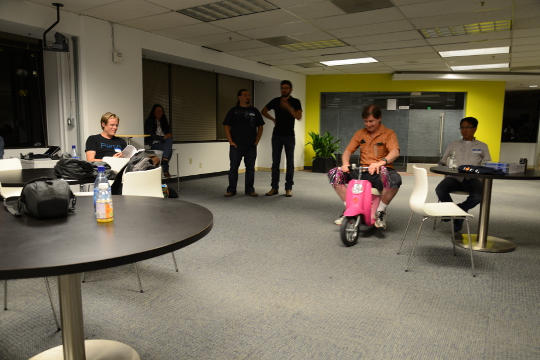
  • System administration, servers and networking: consider projects involving monitoring, automation, packaging. Ganglia is a great community to get involved with and you will encounter the Ganglia software in many large companies and academic/research networks. Contributing to a Linux distribution like Debian or Fedora packaging is another great way to get into system administration.
  • Desktop and user interface: consider projects involving window managers and desktop tools or adding to the user interface of just about any other software.
  • Big data and data science: this can apply to just about any other theme. For example, data science techniques are frequently used now to improve system administration.
  • Business and accounting: consider accounting, CRM and ERP software.
  • Finance and trading: consider projects like R, market data software like OpenMAMA and connectivity software (Apache Camel)
  • Real-time communication (RTC), VoIP, webcam and chat: look at the JSCommunicator or the Jitsi project
  • Web (JavaScript, HTML5): look at the JSCommunicator
Before the GSoC application process begins, you should aim to learn as much as possible about the theme you prefer and also gain practical experience using the software relating to that theme. For example, if you are attracted to the business and accounting theme, install the PostBooks suite and get to know it. Maybe you know somebody who runs a small business: help them to upgrade to PostBooks and use it to prepare some reports. Make something Make some small project, less than two week's work, to demonstrate your skills. It is important to make something that somebody will use for a practical purpose, this will help you gain experience communicating with other users through Github. For an example, see the servlet Juliana Louback created for fixing phone numbers in December 2013. It has since been used as part of the Lumicall web site and Juliana was selected for a GSoC 2014 project with Debian. There is no better way to demonstrate to a prospective mentor that you are ready for GSoC than by completing and publishing some small project like this yourself. If you don't have any immediate project ideas, many developers will also be able to give you tips on small projects like this that you can attempt, just come and ask us on one of the mailing lists. Ideally, the project will be something that you would use anyway even if you do not end up participating in GSoC. Such projects are the most motivating and rewarding and usually end up becoming an example of your best work. To continue the example of somebody with a preference for business and accounting software, a small project you might create is a plugin or extension for PostBooks. Getting to know prospective mentors Many web sites provide useful information about the developers who contribute to free software projects. Some of these developers may be willing to be a GSoC mentor. For example, look through some of the following: Getting on the mentor's shortlist Once you have identified projects that are interesting to you and developers who work on those projects, it is important to get yourself on the developer's shortlist. Basically, the shortlist is a list of all students who the developer believes can complete the project. If I feel that a student is unlikely to complete a project or if I don't have enough information to judge a student's probability of success, that student will not be on my shortlist. If I don't have any student on my shortlist, then a project will not go ahead at all. If there are multiple students on the shortlist, then I will be looking more closely at each of them to try and work out who is the best match. One way to get a developer's attention is to look at bug reports they have created. Github makes it easy to see complaints or bug reports they have made about their own projects or other projects they depend on. Another way to do this is to search through their code for strings like FIXME and TODO. Projects with standalone bug trackers like the Debian bug tracker also provide an easy way to search for bug reports that a specific person has created or commented on. Once you find some relevant bug reports, email the developer. Ask if anybody else is working on those issues. Try and start with an issue that is particularly easy and where the solution is interesting for you. This will help you learn to compile and test the program before you try to fix any more complicated bugs. It may even be something you can work on as part of your academic program. Find successful projects from the previous year Contact organizations and ask them which GSoC projects were most successful. In many organizations, you can find the past students' project plans and their final reports published on the web. Read through the plans submitted by the students who were chosen. Then read through the final reports by the same students and see how they compare to the original plans. Start building your project proposal now Don't wait for the application period to begin. Start writing a project proposal now. When writing a proposal, it is important to include several things:
  • Think big: what is the goal at the end of the project? Does your work help the greater good in some way, such as increasing the market share of Linux on the desktop?
  • Details: what are specific challenges? What tools will you use?
  • Time management: what will you do each week? Are there weeks where you will not work on GSoC due to vacation or other events? These things are permitted but they must be in your plan if you know them in advance. If an accident or death in the family cut a week out of your GSoC project, which work would you skip and would your project still be useful without that? Having two weeks of flexible time in your plan makes it more resilient against interruptions.
  • Communication: are you on mailing lists, IRC and XMPP chat? Will you make a weekly report on your blog?
  • Users: who will benefit from your work?
  • Testing: who will test and validate your work throughout the project? Ideally, this should involve more than just the mentor.
If your project plan is good enough, could you put it on Kickstarter or another crowdfunding site? This is a good test of whether or not a project is going to be supported by a GSoC mentor. Learn about packaging and distributing software Packaging is a vital part of the free software lifecycle. It is very easy to upload a project to Github but it takes more effort to have it become an official package in systems like Debian, Fedora and Ubuntu. Packaging and the communities around Linux distributions help you reach out to users of your software and get valuable feedback and new contributors. This boosts the impact of your work. To start with, you may want to help the maintainer of an existing package. Debian packaging teams are existing communities that work in a team and welcome new contributors. The Debian Mentors initiative is another great starting place. In the Fedora world, the place to start may be in one of the Special Interest Groups (SIGs). Think from the mentor's perspective After the application deadline, mentors have just 2 or 3 weeks to choose the students. This is actually not a lot of time to be certain if a particular student is capable of completing a project. If the student has a published history of free software activity, the mentor feels a lot more confident about choosing the student. Some mentors have more than one good student while other mentors receive no applications from capable students. In this situation, it is very common for mentors to send each other details of students who may be suitable. Once again, if a student has a good Github profile and a blog, it is much easier for mentors to try and match that student with another project. GSoC logo generic Conclusion Getting into the world of software engineering is much like joining any other profession or even joining a new hobby or sporting activity. If you run, you probably have various types of shoe and a running watch and you may even spend a couple of nights at the track each week. If you enjoy playing a musical instrument, you probably have a collection of sheet music, accessories for your instrument and you may even aspire to build a recording studio in your garage (or you probably know somebody else who already did that). The things listed on this page will not just help you walk the walk and talk the talk of a software developer, they will put you on a track to being one of the leaders. If you look over the profiles of other software developers on the Internet, you will find they are doing most of the things on this page already. Even if you are not selected for GSoC at all or decide not to apply, working through the steps on this page will help you clarify your own ideas about your career and help you make new friends in the software engineering community.


18 September 2015

Russ Allbery: Review: The Three-Body Problem

Review: The Three-Body Problem, by Cixin Liu & Ken Liu
Series: Three-Body Problem #1
Author: Liu Cixin ( )
Translator: Ken Liu
Publisher: Tor
Copyright: 2006, 2014
Printing: November 2014
ISBN: 1-4668-5344-1
Format: Kindle
Pages: 399
Liu Cixin ( ) is one of the best-known and most popular SF authors in China, but, due to the paucity of translated SF in the English-speaking world, was largely unknown to English-speaking SF readers. That made this translation by Ken Liu (no relation) highly anticipated: a window into a large world of SF by authors most of us have never read. And Ken Liu is an excellent writer in his own right (see, for instance, "The Literomancer" or "Altogether Elsewhere, Vast Herds of Reindeer"), which was a hopeful sign for a good translation. Indeed, the translation is very good. One can tell that the book comes from a different literary tradition, but primarily from unusual (to US readers, at least) emotional focal points for the characters and lots of Chinese history that the author feels little need to explain. (Ken Liu adds translator notes for the bits most likely to lose non-Chinese audiences.) I found the characters a bit odd and occasionally hard to identify with, but I didn't mind: it added to the feeling of exploring a slightly different literary tradition with different character conventions. Unfortunately, the end of the book went entirely off the rails, at least for me. The Three-Body Problem opens during the Cultural Revolution, with the murder of Ye Wenjie's father, a physics professor, and the suicide of her advisor and friend. Two years later, she's at a work camp in inner Mongolia, cutting trees, numb, keeping her head down. But a traveling journalist smuggles in a secret copy of Silent Spring and gives it to her. The book both hardens her own belief in the evil of humanity and gets her into deeper trouble when she agrees to recopy a draft of a letter to the central leadership about the environmental devastation caused by the logging. Ye Wenjie is forced to choose permanent exile to an experimental radar facility on a remote mountain in Mongolia. Ye Wenjie is vital to the slowly-developing plot of the book, but this is the last the reader sees of her for some time. Part II jumps to present time and to a different protagonist: Wang Miao, a distinguished nanotechnology researcher who is recruited by the PLA and the police into a secret war room. Distinguished scientists are killing themselves in frighteningly large numbers, including one that Wang Miao had a crush on. She left a suicide note before overdosing on sleeping pills, one that says only, cryptically, that physics doesn't exist. The government is desperate to figure out what's going on. The "radar" facility and the suicide of scientists are linked, of course, but it takes much of the book for Wang Miao and his colleagues to piece together how. Key clues come in the form of an odd puzzle virtual reality MMORPG that becomes a popular sensation. In it, players find themselves on an alien world whose suns rise and set at strange and unpredictable intervals: sometimes far too far away and horribly cold, sometimes far too close and destructively hot, and sometimes not seen for long periods of time. The players can somehow dehydrate themselves and the rest of the population to weather the worst seasons, but life is a constant struggle against apparently unpredictable elements. Despite that, players slowly find ways to build civilizations and attempt to predict the strange cycles of heat and cold. It takes the characters a long time to understand what's happening. Readers will probably be much faster, since they have out-of-band information the characters don't. At first, this game seems entirely unrelated to the suicides of the scientists or, for that matter, to Ye Wenjie, who is easy to almost forget. But they all weave together in a way that's almost compelling. I say almost because the motivations of the characters are quite tangled and interesting, but the science is... awful. Those who have read my other book reviews know that I don't insist on hard science in my SF. Usually I'm willing to roll with it, and I can read past even obvious scientific nonsense. But science is critical to the plot of this book; some very specific actions, with a detailed in-book scientific justifications, are the underpinning of the entire plot. And they make utter nonsense of physics. I've rarely had science in a novel destroy my suspension of disbelief this thoroughly. Physics isn't even alone: biology, chemistry, computing, and astronomy are all in for it as Liu reveals the causes of the book's events. I wanted to be engaged by the conflict of ethics and philosophy that drive the plot, and some of that conflict is quite interesting. But every other page would have another colossal pile of scientific nonsense that would throw me out of the book again, usually in the service of a set piece that missed grand and landed on absurdly silly. Be warned that this book also ends on a bit of a cliff-hanger, and there are two more books in the series. The second has been released in a translated edition, but with a different translator, which is disappointing (Ken Liu did an excellent job); the third isn't out yet. If you can get past the awful science, The Three-Body Problem is doing some interesting things. The characters are a bit wooden and forgettable, but the philosophical problems they encounter are ones I don't see often in western SF. This a refreshing change, and I'm interested enough that I'm still considering picking up the sequels. But the science hurts the book so badly. Followed by The Dark Forest. Rating: 6 out of 10

8 September 2015

Russ Allbery: Review: Dark Currents

Review: Dark Currents, by Jacqueline Carey
Series: Agent of Hel #1
Publisher: Roc
Copyright: 2012
Printing: October 2013
ISBN: 0-451-41483-7
Format: Mass market
Pages: 399
This is another much-belated review. Hopefully I can remember the book well enough to do it justice. Daisy Johanssen has normal urban fantasy problems: her father was an incubus who (somewhat unsurprisingly) didn't stick around, she has to keep careful control of her own demonic side, her father occasionally tries to tempt her to invoke demonic power, and it's possible that she could breach the walls protecting the world from demons and bring about Armageddon. The typical sort of thing. Also, there's an unexplained murder in her home town, a mid-western US resort town whose image does not go well with eldritch murders. Daisy's only official role with the town police department is as a part-time file clerk, but this is urban fantasy, so you know the protagonist is going to be hip-deep in some sort of crime investigation. In this case, that's because the Norse goddess Hel (as distinct from the origin of Daisy's father entirely different thing) also lives here, in a manner of speaking, and Daisy is her liaison. In this case, Hel decides she's the one who should dispense justice. Carey previously has primarily been an epic fantasy writer, and this is her first foray into urban fantasy. (Well, arguably Santa Olivia and its sequel count, but those felt closer to superhero fiction to me.) The language and tone of her epic fantasy is far different than the conventions of either urban fantasy or superhero fiction, and I thought Santa Olivia was somewhat awkward in places. (None of the profanity quite worked, for instance.) Dark Currents felt smoother and more comfortable, aided by a charming mid-western feel. A few of Daisy's first-person narrative quirks wore poorly, such as every reference to "the Seven Deadlies," but Carey did a solid job with a typical out-of-her-depth urban fantasy protagonist. I'm pretty tired of the standard mythology of urban fantasy, and that is a bit of a drawback here: vampires and werewolves both feature, and I think I could happily go ten years before reading another story about vampires or hunky werewolves. Carey adds her own take on ghouls, but it's still pretty similar to lots (and lots) of other series. Thankfully, there's a bit of Norse mythology, a bit of fairy, and one extremely memorable lamia (of the serpent-tail-below-the-waist variety, at least some of the time). Lurine, a reclusive, retired starlet, a friend of Daisy's mother, and Daisy's childhood babysitter, is the lamia in question. She absolutely steals the show. The dynamic between her and Daisy is perfect: Carey resists the urge to ruin it with dark hints or falling-outs to increase tension. Instead, she lets it be a bit quirky, a bit complicated, but full of the reliability of a deep friendship. And Lurine is a wonderful character, the kind that only works as a supporting character because she's best seen through other people's eyes. Daisy's mother just makes the dynamic better. The reader can believe she's the sort of person who would have an ill-advised fling with an incubus, but also the sort of person who could raise a daughter like Daisy without many resources other than sheer grit. She never loses her optimistic outlook on the world, but has enough backbone behind it to make Lurine's friendship with her entirely believable. The plot here is nothing particularly special. Daisy unravels various clues, gets deeper into complicated relationships between various factions, occasionally finds herself in serious trouble, and relies on the help of friends and allies. I would have enjoyed the book more with a lot less Cody and more of the less typical mythology. But the relationships between the female characters, and the sheer persistence of mid-western normality and ordinary life challenges in the face of so much supernatural meddling, help this book stand out from the crowd. Dark Currents is different from most of what Carey has written, and you may be a bit disappointed if you were hoping for the epic sweep of the Kushiel series. But I found myself charmed by it, and will be reading the next book of the series. Followed by Autumn Bones. Rating: 7 out of 10

Next.

Previous.