Search Results: "robert"

8 October 2013

Raphael Geissert: Faster, more stable and new opportunities

A new version of the code behind http.debian.net was deployed a few days ago. It has proved to be far more stable, faster, and scalable compared to the previous mod_perl-based deployment.

There were a couple of glitches during the earlier roll-out for IPv6 users, fixed thanks to the reports by Cyril Brulebois, Michael Stapelberg and Robert Drake.

What's behind?
The redirector is now a plack application (with no middlewere) running under the Starman server with an apache fronted. Requests are processed faster than before and there mod_perl-induced system overload is finally gone.

The redirector is now easier to test and develop. Deploying the live instance is not yet fully streamlined, but it has seen a lot of improvement. Some important changes to the way the redirector works are already on their way to see the light and I am going to be announcing them when they do. Fork the repository and hack a few changes, contributions are welcome :)

It's probably time to move it under debian.org, and finish making it the default everywhere. It's even made its way into the installation manual.

15 September 2013

Robert Millan: Rooting the LG Optimus L3 (and just about any Android model, really)

I recently purchased an LG Optimus L3 ( e400 ) mobile phone. I ve to admit it would be a perfectly fine purchase if it wasn t for the huge amount of time I had to invest in order for this thing to recognize me as its master. Even though I wanted to install CyanogenMod in it, the device blocked my attempts to install it through ROM Manager. Yes, for some awkward reason LG kept on thinking they still owned the device even after they sold it to me. Anyway, as none of the rooting instructions for LG Optimus L3 I found on the net worked for me, I figured I should try with the recently-discovered master key vulnerability. A bit of research shows there s very extensive documentation on this hole and how to exploit it, as well as proof-of-concept exploits. But unfortunately, I haven t been able to find any complete solution to implement this in easy steps. On the soulders of giants After running through the whole manual setup of this exploit (and succesfully rooting my LG Optimus L3), I figured it would be useful if I put the pieces together into a unified script. So here it is, an exploit for the Android master key vulnerability which will give you root access to almost every Android device in existance: https://github.com/robertmillan/mkbreak Enjoy. Oh and btw: fuck you LG.

1 September 2013

Robert Collins: Subunit and subtests

Python 3 recently introduced a nice feature subtests. When I was putting subunit version 2 together I tried to cater for this via a heuristic approach permitting the already known requirement that some tests which are reported are not runnable be combined with substring matching to identify subtests. However that has panned out poorly, when I went to integrate this with testr the code started to get fugly. So, I m going to extend the StreamResult API to know about subtests, and issue a subunit protocol bump to 2.1 to add a new field for labelling subtest events. My plan is to make this build a recursive tree structure that is given test test_foo with subtest i=3 which the Python subtest code would identify as test_foo (i=3) , they should be identified in StreamResult as test_id test_foo (i=3) and parent_test_id test_foo . This can then nest arbitrarily deep if test runners decide to do that, and the individual runnability becomes up to the test runner, not testrepository / subunit / StreamResult.

27 August 2013

Robert Collins: Using vanilla novaclient with Rackspace cloud

The Rackspace docs describe how to use rackspace s custom extensions, but not how to use plain ol nova. Using plain nova is important if you want cloud portability in your scripts. So for future reference these are the settings:

export OS_AUTH_URL=https://identity.api.rackspacecloud.com/v2.0/
export OS_REGION_NAME=DFW
export OS_USERNAME=<username>
export OS_TENANT_NAME=<clientid>
export OS_PASSWORD=<password>
export OS_PROJECT_ID=<clientid>
export OS_NO_CACHE=1
unset NOVA_RAX_AUTH
unset OS_AUTH_SYSTEM

30 July 2013

Rob Bradford: The Waylanders are coming

This GUADEC there will be a couple of sessions on Friday afternoon from 2pm about Wayland. I ll be giving a presentation with a brief introduction to what Wayland is, what new features we ve worked on in the last cycle as well as what s planned for the next one. As this is GUADEC i ll of course be covering how we re doing with getting Wayland integrated into GNOME. There will also be a Wayland panel discussion where you can ask your tricky questions of myself, Owen Taylor, Robert Bragg and Kristian H gsberg to get things started i ve got some already prepared! And if that s not enough Wayland for you, on Monday we ll be BoF ing between 10am and 2pm in room A218. It would be great to see you there.

15 July 2013

Rob Bradford: Clutter & Cogl Wayland update

Lots of us over at Intel towers are working hard to bring you a great new Wayland powered experience. Cogl and Clutter have now been updated to work with the latest Wayland master. You need to compile master Cogl with: ./configure --enable-wayland-egl-platform=yes --enable-gl And then to run any applications using Cogl on Wayland you need to setup the environment variable COGL_RENDERER=egl_wayland then you can run cogl-crate! For Clutter you need to compile Clutter master with: ./configure --enable-wayland-backend You also need to set an environment variable to choose the Clutter backend too in this case it s CLUTTER_BACKEND=wayland (and you need to set COGL_RENDERER too) then you can run test-actors! Or just look at the video below :-) <iframe allowfullscreen="allowFullScreen" frameborder="0" height="300" mozallowfullscreen="mozallowfullscreen" src="http://player.vimeo.com/video/33734847?title=0&amp;byline=0&amp;portrait=0" webkitallowfullscreen="webkitAllowFullScreen" width="400"></iframe> Direct Vimeo link! A big kudos needs to go to Robert Bragg, Neil Roberts and Emmanuele Bassi for helping make this happen. The Clutter client side support is basically complete so i ve now moved onto working on GTK and MX watch this space for updates!

28 June 2013

Russ Allbery: Review: This Alien Shore

Review: This Alien Shore, by C.S. Friedman
Publisher: DAW
Copyright: 1998
Printing: July 1999
ISBN: 0-88677-799-2
Format: Mass market
Pages: 564
Jamisia is an orphan taken in by the Shido corporation, but she has a fairly comfortable and happy life in Shido Station. She lives in the care of her tutor, has friends, has something that feels like a relatively normal life. Then the station is attacked and destroyed by a rival corporation and she barely escapes in a one-person lifeboat, sent inexplicably by her tutor with a fake identity to rendezvous with a spaceship heading for the up-and-out. That begins a long and quite confusing flight away from everything she's known, and a discovery that her life is far more complicated than she thought. Meanwhile, far from the backwater of corporate tyranny that Earth has become, a new computer virus is wreaking havoc on Guild outpilots. The Guild navigate the ainniq: a sort of subspace that allows ships to slip between nodes without regard to distance. This is the only acceptable method of interstellar travel now that humans know that the more conventional Hausman Drive causes massive genetic mutations, and only Guerans have the secret of navigating it safely. But a virus of a sophistication no one has seen before appears to be targeting outpilot brains through their implants. This Alien Shore is told in two threads but multiple characters and viewpoints. Jamisia (yes, I stumbled over that name the entire book) spends nearly the whole book running while discovering that her head is a very complicated place for very bad reasons. Meanwhile, various other people (most notably the careful and meticulous Kio Masada) are analyzing and tracing the virus, which is of deep concern to the powers that be in the Guaran-controlled network of human colonies. The threads do come together eventually, helped by a young and much more impulsive hacker named Phoenix who is also on the trail of the virus, but it takes much longer than I expected. The book is a bit of cyberpunk, a bit of space opera, and is stuffed to the brim with world-building ideas. There's always something that feels slightly emotionally off about C.S. Friedman novels. Her characters are a bit too intense, a bit too full of primary colors and inherent natures. They don't do a lot of changing; they're just a little too much purely themselves to feel quite accurate. Sometimes it matters and sometimes it doesn't. This is one of the books where it mostly doesn't, partly because it's full of such an amazing variety of characters, and partly because Friedman does a great job adding situational complexity by playing them off of each other and showing them through each other's eyes. Pyschological realism, though, this isn't, nor would I look to Friedman for that. That's somewhat unfortunate given how central psychology is to this book. The focus that slowly emerges from this novel is the whole-hearted embrace of psychological difference as a force for creativity, power, and perspective. Acceptance, respect for, and integration of difference borders on a religious belief for Guerans, which makes this book one of the most wholeheartedly inclusive stories (at least for psychology) I've read. I loved that message enough to overlook the fact that those psychological differences are not treated with much subtlety. The most central of the differences (a very mild spoiler, but one that's essentially given away on the back cover and that is easy to guess early in the book) is multiple personalities. Sadly, I thought that was also the least successful. Friedman treats the topic respectfully and as a difficult asset, which I liked, but it's bog-standard fictional multiple personalities. The presentation owes much more to popular fiction than to the reality of disassociative identity, and the notes that Friedman hits (and the characteristics that the multiples embody) are predictable. However, her second major psychological idea is simply brilliant. The Guerans have developed a coding system for people to communicate their psychological profile to anyone who sees them, and all of the Gueran characters in the novel actively engage with that system and make extensive use of it. Friedman hints at a great deal of subtlety: a wealth of primary patterns (many of which are described in quite enjoyable animal metaphors as chapter epigraphs), secondary patterns that can be layered underneath, and a complex interaction of base patterns and patterns for daily mood. Here, I think Friedman's mild tendency towards archetypal characters helps, since it makes the psychological coding system clearer for the reader. I wish it had been more central to the story and explained further, although I can see the risk of turning the novel into an RPG sourcebook. (Although, now that I mention it, I would love to read an RPG sourcebook for this universe.) The other point for which I have to give Friedman huge credit is that at least half of the book is about a computer virus, the analysis of that virus, and the hacking culture of her future universe, and at no point during the story did I want to start throwing things. There are no completely unbelievable magic computer programs, the sense of movement of data and virtual presence through computer networks seemed vaguely plausible and less steeped in unrealistic VR metaphors, the sense of aesthetics of code is captured remarkably well for a story of this sort, and Friedman even brings some variety to her computer-savvy characters. There are a few mildly stereotyped young hackers (although even those have a tendency to have more depth than the stereotype), but Friedman also populates her electronic world with the other types you rarely see in these novels: thoughtful, brilliant, but meticulous researchers, competent technicians who don't engage as much on the aesthetic aspects, and even moderately-intelligent users who pay attention to the computers their lives are built around. I could actually believe in both these people and the software they use with only the suspension of disbelief required for any future SF. That's not to say there are no flaws, quibbles, or places where computers probably won't ever work that way. But that's part of what makes me so impressed. Friedman is still using computers and hacking in the direct service of a fairly typical SF plot to achieve specific dramatic ends and to create a mystery. She's not building the story around actual technology; she's staying fairly close to the sort of technology and plots that a lot of cyberpunk and hacking novels have. And yet she manages not to make the computing entirely stupid or unbelievable. It's existence proof that an SF author can pay attention to experts and research without compromising the story they want to tell. I want to take this book and smack Robert Sawyer upside the head with it. This is a great idea book with a heavily computer-driven plot strand that I quite enjoyed. It is, however, not without its flaws. The virus-hunting part of the plot is significantly more interesting than Jamisia's flight, particularly given that she keeps running, and running, and running, encountering various people who seem important and end up not being important at all. It takes more than half the book before anything particularly interesting happens to her; up until then, I was dragging myself through her segments so that I could get back to Masada and the other Guerans. She's also annoyingly dim about some things. I figured out what the deep secret in her brain was within the first four or five chapters (it's entirely obvious from the political structure of Friedman's universe), and I have no idea why it took everyone else so long to figure it out. There is also, as mentioned, the slightly off feeling of the characters that I find typical of Friedman, and a cut-throat power struggle at the heart of the book that just didn't have enough psychological believability to fully engage me. But the ideas are wonderful: technology-driven political structures, corporate-controlled states, ideological clashes, lots of believable cultural interactions, and a neat two-option interstellar travel system (even if the nature of the Hausman Drive damage bears no resemblence to any genetic science known to our reality). And that's on top of a wonderful visual language of psychology and discussions of computer security that I actually enjoyed reading. Friedman's the sort of author who won't be to everyone's tastes. You have to have some tolerance for her tendency to write grand clashes of power between highly flawed, aggressively emotional people. Sometimes you have to put up with rather a lot of setup. But I really liked this novel. I suspect I'm editing out a lot of the boring bits in my memory, but I fondly remember that edited version as a ton of fun. Rating: 8 out of 10

16 June 2013

Daniel Pocock: Monitoring with Ganglia: an O'Reilly community book project

I recently had the opportunity to contribute to an O'Reilly community book project, developing the book Monitoring with Ganglia in collaboration with other members of the Ganglia team

The project itself, as a community book, pays no royalties back to the contributors, as we have chosen to donate all proceeds to charity. People who contributed to the book include
Robert Alexander, Jeff Buchbinder, Frederiko Costa, Alex Dean, Dave Josephsen, Bernard Li, Matt Massie, Brad Nicholes, Peter Phaal and Vladimir Vuksan and we also had generous assistance from various members of the open source community who assisted in the review process. Ganglia itself started at University of California, Berkeley as an initiative of Matt Massie, for monitoring HPC cloud infrastructure My own contact with Ganglia only began in 2008 when I was offered the opportunity to work full-time on the enterprise-wide monitoring systems for a large investment bank. Ganglia had been chosen for this huge project due to it's small footprint, support for many platforms and it's ability to work on a heterogeneous network as well as providing dedicated features for the bank's HPC grid. This brings me to one important point about Ganglia: it's not just about HPC any more. While it is extremely useful for clusters, grids and clouds, it is also quite suitable for a mixed network of web servers, mail servers, databases and all the other applications you may find in a small business, education or ISP environment. Instantly up and running with packages One of the most compelling features, even for small sites with less than 10 nodes, is the ease of installation: install the packages on Debian, Ubuntu, Fedora, OpenCSW and some other platforms, and it just works. Ganglia nodes will find each other over multicast, instantly, no manual configuration changes necessary. On one of the nodes, the web interface must be installed for viewing the statistics. Dare I say it: it is so easy, you hardly even need the book for a small installation. Where the book is really compelling is if you have hundreds or thousands of nodes, if you want custom charts or custom metrics or anything else beyond just installing the package. If monitoring is more than 10% of your job, the book is probably a must-have. Excellent open source architecture Ganglia's simplicity is largely thanks to the way it leverages other open source projects such as Tobi Oetiker's RRDtool and PHP Anybody familiar with these tools will find Ganglia is particularly easy to work with and customise. Custom metrics: IO service times One of my own contributions to the project has been the creation of ganglia-modules-linux, some plugins for Linux-specific metrics and ganglia-modules-solaris providing some similar metrics for Solaris. These projects on github provide an excellent base for people to fork and implement their own custom metrics in C or C++ The book provides a more detailed account of how to work with the various APIs for Python, C/C++, gmetric (command line/shell scripts) and Java. The new web interface For people who had tried earlier versions of Ganglia (and for those people who installed versions < 3.3.0 and still haven't updated), the new web interface is a major improvement and well worth the effort to install. It is available on the most recent packages (for example, it is in Debian 7 (wheezy) but not in Debian 6.) It was originally promoted as a standalone project (code-named gweb2) but was adopted as the official Ganglia web interface around the release of Ganglia 3.3.0. This web page provides a useful overview of what has changed and here is the original release announcement.

1 May 2013

Rapha&#235;l Hertzog: My Free Software Activities in April 2013

This is my monthly summary of my free software related activities. If you re among the people who made a donation to support my work (102.70 , thanks everybody!), then you can learn how I spent your money. Otherwise it s just an interesting status update on my various projects. Debian France Work on Galette. I spent quite some time on Debian France s galette installation (the web application handling its member database), first converting its Postgres database to UTF-8, then upgrading to 0.7.4 while working-around many known problems. I also created Debian packages of three Galette plugins that we have been using (galette-plugin-paypal, galette-plugin-admintools, galette-plugin-fullcard). But every time I use galette, I tend to find something to report. This month I filed 5 tickets: I tested quite some fixes prepared by the upstream author (3 of the above bugs are already fixed) and this lead to the 0.7.4.1 bugfix release. Preliminary work on new bylaws. I have setup a git repository to make it easier to collaborate on new versions of our bylaws and internal rules. The goal is to make Debian France a trusted organization of Debian and to update everything to be compliant with the association 1901 law (we currently have a special statute reserved to associations from Alsace/Moselle). Kali Linux Improve accessibility support in Debian Wheezy. Offensive Security wanted Kali Linux to be fully accessible to disabled people. Since Wheezy was suffering from some serious regressions in that area, we hired Emilio Pozuelo Monfort to fix #680636 and #689559 in gdm3. On my side, I updated debian-installer s finish-install to correctly pre-configure the system when you make an install with speech synthesis (patch submitted in #705599).
Thanks to accommodating release managers, this work has already been integrated in Wheezy and won t have to wait the first point release. Fix bugs in Debian s live desktop installer. We also wanted to enable the desktop installer in the Kali live DVD. While our first tries a few months ago failed, this time it worked almost out of the box (thanks to Ben Armstrong who fixed it). I still identified a few issues that I fixed in debian-installer-launcher s git repository. Packaging and misc Debian work I also spent a significant number of hours to answer questions of students who want to participate in Google s summer of code and who are interested by the rewrite of the Package Tracking System with Python and Django. Some of the discussions happened on debian-qa@lists.debian.org. Thanks See you next month for a new summary of my activities.

One comment Liked this article? Click here. My blog is Flattr-enabled.

11 April 2013

Russ Allbery: Review: Familiar

Review: Familiar, by J. Robert Lennon
Publisher: Greywolf
Copyright: 2012
ISBN: 1-55597-535-6
Format: Hardcover
Pages: 205
This is the first book of an experiment. I'm fairly well-read in science fiction and fantasy and increasingly well-read in non-fiction of interest (although there's always far more of that than I'll get to in a lifetime), but woefully unfamiliar with what's called "mainstream" literature. Under the principal that things people are excited about are probably exciting, I've wanted to read more and understand the appeal. Powell's, which I like to support anyway, has a very nice (albeit somewhat expensive) book club called Indiespensable, which sends its subscribers very nice editions of new works that Powell's thinks are interesting, with a special focus on independent publishers. So I signed up and hope to stick with it for at least a year. (The trick will be fitting these books in amongst my regular reading.) Familiar is the first feature selection I received. Elisa Brown is a mother with a dead son and a living one, a failing marriage, an affair, and a life that is, in short, falling apart. Then, while driving back from her annual pilgrimage from her son's grave, the world seems to twist and change. She finds herself dressed for business, wearing a nametag and apparently coming back from a work-related convention, driving a car that's entirely unfamiliar to her. When she gets home, everything else has changed too: her marriage seems to be on firmer ground, but based on rules she doesn't understand. She has a different job, different clothes, a different body in some subtle ways. And both of her sons are alive. I'm going to have to have a long argument with myself about where to (meaninglessly) categorize this on my review site, since in construction it is an alternate reality story and therefore a standard SF trope. Any SF reader is going to immediately assume Elisa has somehow been transported into an alternate reality with a key divergence point from her own. But that's not Lennon's focus. He stays ambiguous on the question of whether this is really happening or whether Elisa had some sort of nervous breakdown, and while some amount of investigation of the situation does take place, it's the sort of investigation that an average person with no access to special resources or scientific knowledge and a completely unbelievable story would be able to do: Internet conspiracy chatrooms and some rather dodgy characters. The focus is instead on Elisa's reaction to the situation, her choices about how to treat this new life, and on how she processes her complex emotions about her family and herself. I had profoundly mixed feelings about this book when I finished it, and revisiting it to review it, I still do. The writing is excellent: spare, evocative, and enjoyable to read. Lennon has a knack for subjective description of emotion and physical experience. The reader feels Elisa's deep discomfort with her changed body and her changed car, her swings between closed-off emotions and sudden emotional connection with a specific situation, and her struggle with the baffling question of how to come to terms with a whole new life. The part of the book from about the middle to nearly the end is excellent. Video games make an appearance and are handled surprisingly well. And when Elisa starts being blunt with people, I found myself both liking her and caring about what happens to her. On the other hand, Familiar also has some serious problems, and one of the biggest is the reaction I feared I'd have to mainstream literature: until Elisa started opening up and taking action, I found it extremely difficult to care about anyone in this book. They're all so profoundly petty, so closed off and engrossed in what seem like depressing and utterly boring lives. I'm sure that some of this is intentional and is there to lay the groundwork for Elisa's own self-discovery, but even towards the end of that self-discovery, everything here is so relentlessly middle-class suburbia that I felt stifled just reading about it. I think it's telling that no one in this book ever seems to have any substantial problem with money, or even with work. Elisa walks into a job that she's never done before and within a few weeks is doing it so well that she can take large amounts of time to wander around for plot purposes. This is a book about highly privileged people being miserable in a bubble. While those people certainly do exist, and I can believe that they act like this, I'm not sure how much I want to read about them. Thankfully, the plot does lead Elisa to poke some holes in that bubble, if never get out of it entirely. This is also another one of those stories in which every character has massive communication problems. Now, this deserves some caveats: Elisa's communication problems with her husband are part of the problem that starts the book and are clearly intentional, as are her communication difficulties with her children. And she's not really close enough to anyone to confide in them. But even with those caveats, no one in this book really talks to anyone else. It's amazing that anyone forms any connections at all, given how many walls and barriers they have around themselves. As someone with a bit of a thing for communication, this drove me nuts to read about, particularly in the first half of the book. But the worst problem is that Lennon completely blows the ending. And by that I don't just mean that I disliked the ending. I mean the ending is so unbelievable and so contrary to the entire rest of the book, at least the way I was reading and understanding it, that I think Familiar is a much better novel if you just remove the final scene entirely. It was such a bizarre and unnecessary twist that I found it infuriating. I don't want to spoil an ending, even a bad ending, so I'll only say this: it felt to me like Lennon just wasn't comfortable with his setting and plot driver and couldn't leave it alone. I think an experienced SF author wouldn't have made this mistake. There were two obvious possible conclusions to draw from the setting, plus a few interesting combinations, and I think someone comfortable with this sort of alternate reality story would have taken one of those options, any of which would have been a reasonable dismount for the plot. Alternately, they could have left it entirely ambiguous to the end and explored why the explanation may not actually matter. But Lennon seemed to me to have a tin ear for plausibility and for the normal flow of this sort of story and seems to have taken it as license for arbitrary events, thus completely violating the internal consistency and emergent rules that he'd spent the rest of the book building. I've mostly talked about my reactions to the characters and the writing and have not said much about the plot. That's somewhat intentional, since figuring out where the story will go is one of the best parts of this book. It's surprisingly tense and well-crafted for not having that much inherent dramatic tension. The excellent writing kept me reading through the first part, when I hated everyone in the story, and then Elisa started taking responsibility for her own life and actions and I started really enjoying the book while being constantly surprised. I think it's the sort of story that's best to take without too much foreknowledge of where it's going. I'm going to call this first experiment a qualfied success. Familiar was certainly interesting to read, and quite different from what I normally read despite the SF premise. If it weren't for the ending, I'd be recommending it to other people. Rating: 6 out of 10

28 March 2013

Russ Allbery: wallet 1.0

Finally. The wallet is a system management tool for storing and retrieving secure data. I originally wrote it as part of our Kerberos v5 migration project to replace the old Kerberos v4 system we had for distributing srvtabs. It's still mostly used at Stanford for distributing keytabs, but it's extensible and supports storing arbitrary secure data. We also use it internally for storing database passwords, SSL private keys, and anything else that needs to be kept secure and retrieved later. It supports a rich ACL mechanism and namespace enforcement and is built on top of remctl for security and confidentiality. I did a bunch of development on it originally in 2006 and 2007, but then it solved our immediate problems and I didn't have much time to work on it. I used pre-1.0 versions because there was so much more on it that I wanted to do. But we've been running it in production for years, and while there's still tons more work that needs to be done, it really deserves a 1.0 version. Jon Robertson converted the database backend to DBIx::Class (which added PostreSQL support) and implemented schema upgrading, which were two of the major things that were keeping me from putting a 1.0 version on it. So it's time. Other new features since the previous release include a change to the default ACLs so that owners of objects can destroy them by default, a new ldap-attr ACL type that checks whether the caller has a particular attribute set in LDAP (which will let us use our entitlement system to control access), and support for storing and managing key rotation for WebAuth keyrings. There's also a new acl check command to determine whether an ACL exists and a new comment field and command to store an arbitrary comment about an object. Our local naming policy has also gotten much more complex, so I turned it into a module to provide an example to others of how to implement some reasonably detailed namespace and object autocreation controls. You can get the latest version from the wallet distribution page. I'm going to upgrade Debian packages to experimental or unstable (depending on the freeze status) as soon as I get a chance to write a bit more documentation and hopefully figure out debconf integration with the database setup support inside Debian for the server piece.

4 March 2013

Robert Collins: subunit version 2 progress

Subunit V2 is coming along very well. Current status: Remaining things to do:

25 February 2013

Robert Collins: El cheapo 10Gbps networking

I ve been hitting the limits of gigabit ethernet at home for quite a while now, and as I spend more time working with cloud technologies this started to frustrate me. I d heard of other folk getting good results with second hand Infiniband cards and decided to give it a go myself. I bought two Voltaire dual-port Infiniband adapters a 4X SDR PCI-E x4 card. And in a 2 metre 8470 cable, and we re in business. There are other, more comprehensive guides around to setting this up e.g. http://davidhunt.ie/wp/?p=2291 or http://pkg-ofed.alioth.debian.org/howto/infiniband-howto-4.html On ubuntu the hardware was autodetected; all I needed to do was:
modprobe ib_ipoib
sudo apt-get install opensm # on one machine
And configure /etc/network/interfaces e.g.:
iface ib1 inet static
address 192.168.2.3
netmask 255.255.255.0
network 192.168.2.0
up echo connected > find /sys -name mode   grep ib1 
up echo 65520 > find /sys -name mtu   grep ib1 
With no further tuning I was able to get 2Gbps doing linear file copies via Samba, which I suspect is rather pushing the limits of my circa 2007 home server I ll investigate futher to identify where the bottlenecks are, but the networking itself I suspect is ok netperf got me 6.7Gbps in a trivial test.

23 February 2013

Robert Collins: Simpler is better a single event type for StreamResult

StreamResult, covered in my last few blog posts, has panned out pretty well. Until that is, that I sat down to do a serialised version of it. It became fairly clear that the wire protocol can be very simple just one event type that has a bunch of optional fields test ids, routing code, file data, mime-type etc. It is up to the recipient at the far end of a stream to derive semantic meaning, which means that encoding a lot of rules (such as a data packet can have either a test status or file data) into the wire protocol isn t called for. If the wire protocol doesn t have those rules, Python parsers that convert a bytestream into StreamResult API calls will have to manually split packets that have both status() and file() data in them this means it would be impossible to create many legitimate bytestreams via the normal StreamResult API. That seems to be an unnecessary restriction, and thinking about it, having a very simple here is an event about a test run API that carries any information we have and maps down a very simple wire protocol should be about as easy to work with as the current file or status API. Most combinations of file+status parameters is trivially interpretable, but there is one that had no prior definition a test_status with no test id specified. Files with no testid are easily considered as global scope for their source, so perhaps test_status should be treated the same way? [Feedback in comments or email please]. For now I m going to leave the meaning undefined and unconstrained. So I m preparing a change to my patchset for StreamResult to: This will make the API trivially serialisable (both to JSON or protobufs or whatever, or to the custom binary format I m considering for subunit), and equally trivially parsable, which I think is a good thing.

19 February 2013

Robert Collins: First experience implementing StreamResult

My last two blog posts were largely about the needs of subunit, but a key result of any protocol is how easy working with it in a high level language is. In the weekend and evenings I ve done an implementation of a new set of classes StreamResult and friends that provides: So far the code has been uniformly simple to write. I started with an API that included an estimate function, which I ve since removed I don t believe the complexity is justified; enumeration is not significantly more expensive than counting, and runners that want to be efficient can either not enumerate or remember the enumeration from prior runs. The documentation in the linked pull request is a good place to start to get a handle on the API; I d love feedback. Next steps for me are to do a subunit protocol revision that maps to the Python API, both parser and generator and see how it feels. One wrinkle there is that the reason for doing this is to fix intrinsic limits in the existing protocol so doing forward and backward wire protocol compatibility would defeat the point. However we can make the output side explicitly choose a protocol version, and if we can autodetect the protocol version in the parser, even if we cannot handle mixed streams we can get the benefits of the new protocol once data has been detected. That said, I think we can start without autodetection during prototyping, and add it later. Without autodetection, programs like TestRepository will need configuration options to control what protocol variant to expect. This could be done by requiring this new protocol and providing a stream filter that can be deployed when needed.

15 February 2013

Robert Collins: More subunit needs

Of course, as happens sadly often, the scope creeps.. Additional pain points Zope s test runner runs things that are not tests, but which users want to know about layers . At the moment these are reported as individual tests, but this is problematic in a couple of ways. Firstly, the same test runs on multiple backend runners, so timing and stats get more complex. Secondly, if a layer fails to setup or teardown, tools like testrepository that have watched the stream will think a test failed, and on the next run try to explicitly run that test but that test doesn t really exist, so it won t run [unless an actual test that needs the layer is being run]. Openstack uses python coverage to gather coverage statistics during test runs. Each worker running tests needs to gather and return such statistics. The current subunit protocol has no space to hand this around, without it pretending to be a test [see a pattern here?]. And that has the same negative side effect test runners like testrepository will try to run that test . While testrepository doesn t want to know about coverage itself, it would be nice to be able to pass everything around and have a local hook handle the aggregation of that data. The way TAP is reflected into subunit today is to mangle each tap test into a subunit test , but for full benefits subunit tests have a higher bar they are individually addressable and runnable. So a TAP test script is much more equivalent to a subunit test. A similar concept is landing in Python s unittest soon subtests which will give very lightweight additional assertions within a larger test concept. Many C test runners that emit individual tests as simple assertions have this property as well there may be 5 or 10 executables each with dozens of assertions, but only the executables are individually addressable there is no way to run just one assertion from an executable as a test . It would be nice to avoid the friction that currently exists when dealing with that situation. Minimum requirements to support these Layers can be supported via timestamped stdout output, or fake tests. Neither is compelling, as the former requires special casing in subunit processors to data mine it, and the latter confuses test runners. A way to record something that is structured like a test (has an id the layer, an outcome in progress / ok / failed, and attachment data for showing failure details) but isn t a test would allow the data to flow around without causing confusion in the system. TAP support could change to just show the entire output as progress on one test and then fail or not at the end. This would result in a cognitive mismatch for folk from the TAP world, as TAP runners report each assertion as a test , and this would be hidden from subunit. Having a way to record something that is associated with an actual test, and has a name, status, attachment content for the TAP comments field that would let subunit processors report both the addressable tests (each TAP script) and the individual items, but know that only the overall scripts are runnable. Python subtests could use a unique test for each subtest, but that has the same issue has layers. Python will ensure a top level test errors if a subtest errors, so strictly speaking we probably don t need an associated-with concept, but we do need to be able to say that a test-like thing happened that isn t actually addressable. Coverage information could be about a single test, or even a subtest, or it could be about the entire work undertaken by the test process. I don t think we need a single standardised format for Coverage data (though that might be an excellent project for someone to undertake). It is also possible to overthink things :) . We have the idea of arbitrary attachments for tests. Perhaps arbitrary attachments outside of test scope would be better than specifying stdout/stderr as specific things. On the other hand stdout and stderr are well known things. Proposal version 2 A packetised length prefixed binary protocol, with each packet containing a small signature, length, routing code, a binary timestamp in UTC, a set of UTF8 tags (active only, no negative tags), a content tag one of (estimate + number, stdin, stdout, stderr, file, test), test-id, runnable, test-status (one of exists/inprogress/xfail/xsuccess/success/fail/skip), an attachment name, mime type, a last-block marker and a block of bytes. The std/stdout/stderr content tags are gone, replaced with file. The names stdin,stdout,stderr can be placed in the attachment name field to signal those well known files, and any other files that the test process wants to hand over can be simply embedded. Processors that don t expect them can just pass them on. Runnable is a boolean, indicating whether this packet is describing a test that can be executed deliberately (vs an individual TAP assertion, Python sub-test etc). This permits describing things like zope layers which are top level test-like things (they start, stop and can error) though they cannot be run.. and it doesn t explicitly model the setup/teardown aspect that they have. Should we do that? Testid is for identifying tests. With the runnable flag to indicate whether a test really is a test, subtests can just be namespaced by the generator reporters can choose whether to be naive and report every test , or whether to use simple string prefix-with-non-character-seperator to infer child elements. Impact on Python API If we change the API to:
class TestInfo(object):
    id = unicode
    status = ('exists', 'inprogress', 'xfail', 'xsuccess', 'success', 'fail', 'error', 'skip')
    runnable = boolean
class StreamingResult(object):
    def startTestRun(self):
        pass
    def stopTestRun(self):
        passs
    def estimate(self, count, route_code=None, timestamp=None):
        pass
    def file(self, name, bytes, eof=False, mime=None, test_info=None, route_code=None, timestamp=None):
        """Inform the result about the contents of an attachment."""
    def status(self, test_info, route_code=None, timestamp=None):
        """Inform the result about a test status with no attached data."""
This would permit the full semantics of a subunit stream to be represented I think, while being a narrow interface that should be easy to implement. Please provide feedback! I ll probably start implementing this soon.

14 February 2013

Robert Collins: Time to revise the subunit protocol

Subunit is seven and a half years old now Conrad Parker and I first sketched it up at a CodeCon camping and coding, a brilliant combination in mid 2005.
revno: 1
committer: Robert Collins <robertc@robertcollins.net>
timestamp: Sat 2005-08-27 15:01:20 +1000
message:  design up a protocol with kfish
It has proved remarkably resilient as a protocol the basic nature hasn t changed at all, even though we ve added tags, timestamps, support for attachments of arbitrary size. However a growing number of irritations have been building up with it. I think it is time to design another iteration of the protocol, one that will retain the positive qualities of the current protocol, while helping it become suitable for the next 7 years. Ideally we can keep compatibility and make it possible for a single stream to be represented in any format. Existing design The existing design is a mostly human readable line orientated protocol that can be sniffed out from the regular output of make or other build systems. Binary attachments are done using HTTP chunking, and the parser has to maintain state about the current test, tags, timing data and test progression [a simple stack of progress counters]. How to arrange subunit output is undefined, how to select tests to run is undefined. This makes writing a parser quite easy, and the tagging and timestamp facility allow multiplexing streams from two or more concurrent test runs into one with good fidelity but also requires that state be buffered until the end of a test, as two tests cannot be executing at once. Dealing with debuggers The initial protocol was intended to support dropping into a debugger just pass each line read through to stdout, and connect stdin to the test process, and voila, you have a working debugger connection. This works, but the current line based parsers make using it tedious the line buffered nature of it makes feedback on what has been typed fiddly, and stdout tends to be buffered, leading to an inability to see print statements and the like. All in-principle fixable, right ? When running two or more test processes, which test process should stdin be connected to? What if two or more drop into a debugger at once? What is being typed to which process is more luck than anything else. We ve added some idioms in testrepository that control test execution by a similar but different format one test per line to list tests, and have runners permit listing and selecting by a list. This works well, but the inconsistency with subunit itself is a little annoying you need two parsers, and two output formats. Good points The current protocol is extremely easy to implement for emitters, and the arbitrary attachments and tagging features have worked extremely well. There is a comprehensive Python parser which maps everything into Python unittest API calls (an extended version of the standard, with good backwards compatibility). Pain points The debugging support was a total failure, and the way the parser depraminates it s toys when a test process corrupts an outcome line is extremely frustrating. (other tests execute but the parser sees them as non-subunit chatter and passes the lines on through stdout). Dealing with concurrency The original design didn t cater for concurrency. There are three concurrency issues the corruption issue (see below for more detail) and multiplexing. Consider two levels of nested concurrency: A supervisor process such as testrepository starts 2 (or more but 2 is sufficient to reason about the issue) subsidiary worker processes (I1 and I2), each of which starts 2 subsidiary processes of their own (W1, W2, W3, W4). Each of the 4 leaf processes is outputting subunit which gets multiplexed in the 2 intermediary processes, and then again in the supervisor. Why would there be two layers? A concrete example is using testrepository to coordinate test runs on multiple machines at once, with each machine running a local testrepository to broker tests amongst the local CPUs. This could be done with 4 separate ssh sessions and no intermediaries, but that only removes a fraction of the issues. What issues? Well, consider some stdout chatter that W1 outputs. That will get passed to I1 and from there to the supervisor and captured. But there is nothing marking the chatter as belonging to W1: there is no way to tell where it came from. If W1 happened to fail, and there was a diagnostic message printed, we ve lost information. Or at best muddled it all up. Secondly, buffering imagine that a test on W1 hangs. I1 will know that W1 is running a test, but has no way to tell the supervisor (and thus the user) that this is the case, without writing to stdout [and causing a *lot* of noise if that happens a lot]. We could have I1 write to stdout only if W1 s test is taking more than 5 seconds or something but this is a workaround for a limitation of the protocol. Adding to the confusion, the clock on W1 and W3 may be very skewed, so timestamps for everything have to be carefully synchronised by the multiplexer. Thirdly, scheduling if W1/W2 are on a faster machine than W3/W4 then a partition of equal-timed tests onto each machine will lead one idle before the other finishes. It would be nice to be able to pass tests to run to the faster machine when it goes idle, rather than having to start a new runner each time. Lastly, what to do when W1 and W2 both wait for user input on stdin (e.g. passphrases, debugger input, $other). Naively connecting stdin to all processes doesn t work well. A GUI supervisor could connect a separate fd to each of I1 and I2, but that doesn t help when it is W1 and W2 reading from stdin. So additional requirement over baseline subunit:
  1. make it possible for stdout and stderr output to be captured from W1 and routed through I1 to the supervisor without losing its origin. It might be chatter from a noisy test, or it might be build output. Either way, the user probably will benefit if we can capture it and show it to them later when they review the test run. The supervisor should probably show it immediately as well the protocol doesn t need to care about that, just make it possible.
  2. make it possible to pass information about tests that have not completed through one subunit stream while they are still incomplete.
  3. make it possible (but optional) to pass tests to run to a running process that accepts subunit.
  4. make it possible to route stdin to a specific currently process like W1. This and point 3 suggest that we need a bidirectional protocol rather than the solely unidirectional protocol we have today. I don t know of a reliable portable way to tell when some process is seeking such input, so that will be up to the user I think. (e.g. printing (pdb) to stdout might be a sufficiently good indicator.)
Dealing with corruption Consider the following subunit fragment:
test: foo
starting serversuccess:foo
This is a classic example of corruption: the test foo started a server and helpfully wrote to stdout explaining that it did that, but missed the newline. As a result the success message for the test wasn t printed on a line of its own, and the subunit parser will believe that foo never completed. Every subsequent test is then ignored. This is usually easy to identify and fix, but its a head-scratcher when it happens. Another way it can happen is when a build tool like make runs tests in parallel, and they output subunit onto the same stdout file handle. A third way is when a build tool like make runs two separate test scripts serially, and the first one starts a test but errors hard and doesn t finish it. That looks like:
test: foo
test: bar
success: bar
One way that this sort of corruption can be mitigated is to put subunit on it s own file descriptor, but this has several caveats: it is harder to tunnel through things like ssh and it doesn t solve the failing test script case. I think it is unreasonable to require a protocol where arbitrary interleaving of bytes between different test runner streams will work so the make -j2 case can be ignored at the wire level though we should create a simple way to safely mux the output from such tests when the execute. The root of the issue is that a dropped update leaves bad state in the parser and it never recovers. So some way to recover, or less state to carry in the parser, would neatly solve things. I favour reducing parser state as that should shift stateful complexity onto end nodes / complex processors, rather than being carried by every node in the transmission path. Dependencies Various suggestions have been made JSON, Protobufs, etc A key design goal of the first subunit was a low barrier to entry. We keep that by being backward compatible, but being easy to work with for the new revision is also a worthy goal. High level proposal A packetised length prefixed binary protocol, with each packet containing a small signature, length, routing code, a binary timestamp in UTC, a set of UTF8 tags (active only, no negative tags), a content tag one of (estimate + number, stdin, stdout, stderr, test- + test id), test status (one of exists/inprogress/xfail/xsuccess/success/fail/skip), an attachment name, mime type, a last-block marker and a block of bytes. The content tags: Test status values are pretty ordinary. Exists is used to indicate a test that can be run when listing tests, and inprogress is used to report a test that has started but not necessarily completed. Attachment names must be unique per routing code + testid. So how does this line up? Interleaving and recovery We could dispense with interleaving and say the streams are wholly binary, or we can say that packets can start either after a \n or directly after another packet. If we say that binary-only is the approach to take, it would be possible to write a filter that would apply the newline heuristic (or even look for packet headers at every byte offset. I think mandating adjacent to a packet or after \n is a small concession to make and will avoid tools like testrepository forcing users to always configure a heuristic filter. Non-subunit content can be wrapped in subunit for forwarding (the I1 in W1->I1->Supervisor chain would do the wrapping). This won t eliminate corruption but it will localise it and permit the stream to recover: the test that was corrupted will show up as incomplete, or with incomplete attachment data. listing Test listing would emit many small non-timestamped packets. It may be useful to have a wrapper packet for bulk amounts of fine grained data like listing is, or for multiplexers with many input streams that will often have multiple data packets available to write at once. Selecting tests to run Same as for listing while passing regexes down to the test runner to select groups of tests is a valid use case, thats not something subunit needs to worry about : if the selection is not the result of the supervisor selecting by test id, then it is known at the start of the test run and can just be a command line parameter to the backend : subunit is relevant for passing instructions to a runner mid-execution. Because the supervisor cannot just hand out some tests and wait for the thing it ran to report that it can accept incremental tests on stdin, supervisor processes will need to be informed about that out of band. Debugging Debugging is straight forward . The parser can read the first 4 or so bytes of a packet one at a time to determine if it is a packet or a line of stdout/stderr, and then either read to end of line, or the binary length of the packet. So, we combine a few things; non-subunit output should be wrapped and presented to the user. Subunit that is being multiplexed and forwarded should prepend a routing code to the packet (e.g. I1 would append 1 or 2 to select which of W1/W2 the content came from, and then forward the packet. S would append 1 or 2 to indicate I1/I2 the routing code is a path through the tree of forwarding processes). The UI the user is using needs to supply some means to switch where stdin is attached. And stdin input should be routed via stdin packets. When there is no routing code left, the packet should be entirely unwrapped and presented as raw bytes to the process in question. Multiplexing Very straight forward unwrap the outer layer of the packet, add or adjust the routing code, serialise a header + adjusted length + rest of packet as-is. No buffering is needed, so the supervisor can show in-progress tests (and how long they have been running for). Parsing / representation in Python or other languages The parser should be very simple to write. Once parsed, this will be fundamentally different to the existing Python TestCase->TestResult API that is in used today. However it should be easy to write two adapters: old-style <-> this new-style. old-style -> new-style is useful for running existing tests suites and generating subunit, because thats way the subunit generation is transparent. new-style->old-style is useful for using existing test reporting facilities (such as junitxml or html TestResult objects) with subunit streams. Importantly though, a new TestResult style that supports the features of this protocol would enable some useful features for regular Python test suites: The API might be something like:
class StreamingResult(object):
    def startTestRun(self):
        pass
    def stopTestRun(self):
        pass
    def estimate(self, count, route_code=None):
        pass
    def stdin(self, bytes, route_code=None):
        pass
    def stdout(self, bytes, route_code=None):
        pass
    def test(self, test_id, status, attachment_name=None, attachment_mime=None, attachment_eof=None, attachment_bytes=None):
        pass
This would support just-in-time debugging by wiring up pdb to the stdin/stdout handlers of the result object, rather than actual stdin/stdout of the process a simple matter once written. Alternatively, the test runner could replace sys.stdin/stdout etc with thunk file-like objects, which might be a good idea anyway to capture spurious output happening during a test run. That would permit pdb to Just Work (even if the test process is internally running concurrent tests.. until it has two pdb objects running concurrently :) Generation new streams Should be very easy in anything except shell. For shell, we can have a command line tool that when invoked outputs a subunit stream for one instruction. E.g. test foo completed + some attachments or test foo starting .

5 February 2013

Joey Hess: LCA2013 wrapup

After 27 hours of travel, I'm finally back from my first Linux.conf.au. This was a great conference! Some of my favorite highlights:
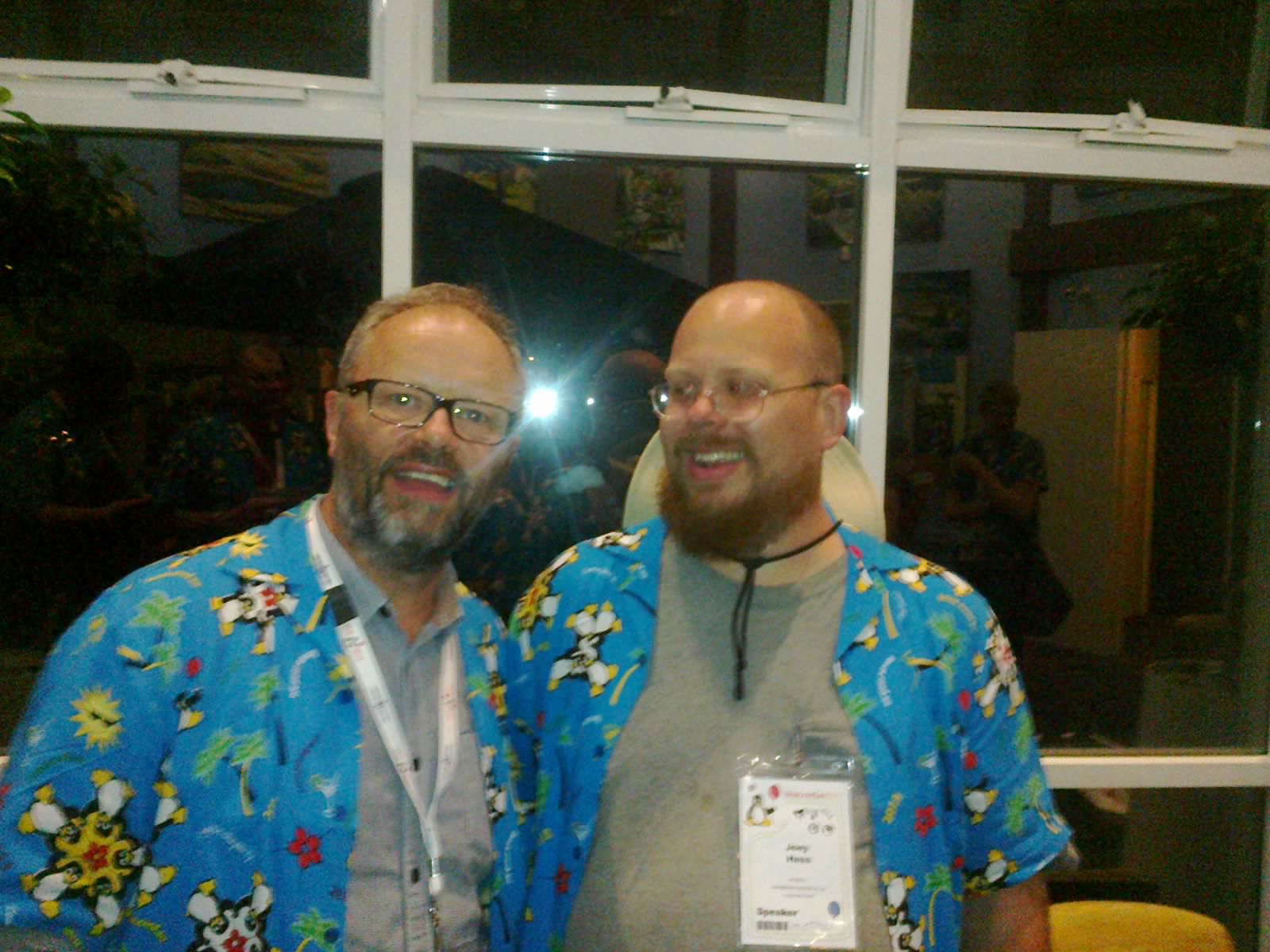
My git-annex talk went ok, despite technical problems with the video output, which the video team did a great job of working around. The first demo went well, and the Q&A was excellent. The demo of the git-annex assistant webapp was marred by, apparently, a bad build of the webapp -- which I ironically used rather than my usual development build because I assumed it'd be less likely to fail. At least I may have a way to reproduce that hang somewhat reliably now, so I can get on with debugging it. I will be redoing a demo of the webapp as a screencast.
Here are some of the best talks I attended. (I have quite a lot more queued up to watch still, and had to cut several due to space.) Click titles for videos, or browse all the videos.

1 February 2013

James Bromberger: LCA 2013

LCA Past Organisers

Previous core organisers of Linux.conf.au, taken at Mt Stromolo Observatory during LCA 2013 (pic by Josh Stewart); except one of these people organised CALU, and another hasn t organised one at all!

Thanks to all the people at LCA2013 in Canberra; it was a blast! So good to see old friends and chat freely on what s hot and happening. Radia (known for STP, TRILL), Sir Tim (the web) and old friend Bdale (Debian, SPI, Freedom Box) were inspiring. As was Robert Llewellyn (Kryten, Red Dwarf), who was a complete pleasure he wandered back and talked for a while with the volunteer video crew. Hats off to Pia for organising the TBL tour, to Mary Gardner for being awarded the Rusty Wrench, and to the team from PLUG (Euan, Jason, Leon, Luke) who stepped up to help with the video team and to Paul who graciously accepted the help. Next up LCA2014 Perth! Y all come back now.. it s been a decade.

24 January 2013

Robert Collins: Launchpadlib without gnome-keyring

Recently I ve been doing my personal development SSH d into my personal laptop. I found that launchpadlib (which various projects use for release automation) was failing the gnome keyring API threw an error because the keyring was locked, and python-keyring didn t try to unlock it. I needed a workaround to be able to release stuff, and with a bit of digging and help from #launchpad, came up with this: mkdir ~/.cache/keyring
mkdir ~/.local/share/python_keyring
echo > ~/.local/share/python_keyring/keyringrc.cfg << EOF
[backend]
default-keyring=keyring.backend.UncryptedFileKeyring
keyring-path=/home/robertc/.cache/keyring/
EOF (There is already encryption in place, so I chose an uncrypted store read the keyring source to find other alternatives). With this done, I can now use lp-shell etc over SSH, for when I m not physically at my machine.

Next.

Previous.

