Search Results: "rmh"

13 January 2013

Bernhard R. Link: some signature basics

While almost everyone has already worked with cryptographic signatures, they are usually only used as black boxes, without taking a closer look. This article intends to shed some lights behind the scenes. Let's take a look at some signature. In ascii-armoured form or behind a clearsigned message one often does only see something like this:
-----BEGIN PGP SIGNATURE-----
Version: GnuPG v1.4.12 (GNU/Linux)
iQIcBAABAgAGBQJQ8qxQAAoJEH8RcgMj+wLc1QwP+gLQFEvNSwVonSwSCq/Dn2Zy
fHofviINC1z2d/voYea3YFENNqFE+Vw/KMEBw+l4kIdJ7rii1DqRegsWQ2ftpno4
BFhXo74vzkFkTVjo1s05Hmj+kGy+v9aofnX7CA9D/x4RRImzkYzqWKQPLrAEUxpa
xWIije/XlD/INuhmx71xdj954MHjDSCI+9yqfl64xK00+8NFUqEh5oYmOC24NjO1
qqyMXvUO1Thkt6pLKYUtDrnA2GurttK2maodWpNBUHfx9MIMGwOa66U7CbMHReY8
nkLa/1SMp0fHCjpzjvOs95LJv2nlS3xhgw+40LtxJBW6xI3JvMbrNYlVrMhC/p6U
AL+ZcJprcUlVi/LCVWuSYLvUdNQOhv/Z+ZYLDGNROmuciKnvqHb7n/Jai9D89HM7
NUXu4CLdpEEwpzclMG1qwHuywLpDLAgfAGp6+0OJS5hUYCAZiE0Gst0sEvg2OyL5
dq/ggUS6GDxI0qUJisBpR2Wct64r7fyvEoT2Asb8zQ+0gQvOvikBxPej2WhwWxqC
FBYLuz+ToVxdVBgCvIfMi/2JEE3x8MaGzqnBicxNPycTZqIXjiPAGkODkiQ6lMbK
bXnR+mPGInAAbelQKmfsNQQN5DZ5fLu+kQRd1HJ7zNyUmzutpjqJ7nynHr7OAeqa
ybdIb5QeGDP+CTyNbsPa
=kHtn
-----END PGP SIGNATURE-----
This is actually only a form of base64 encoded data stream. It can be translated to the actual byte stream using gpg's --enarmor and --dearmour commands (Can be quite useful if some tool only expects one BEGIN SIGNATURE/END SIGNATURE block but you want to include multiple signatures but cannot generate them with a single gpg invocation because the keys are stored too securely in different places). Reading byte streams manually is not much fun, so I wrote gpg2txt some years ago, which can give you some more information. Above signature looks like the following:
89 02 1C -- packet type 2 (signature) length 540
        04 00 -- version 4 sigclass 0
        01 -- pubkey 1 (RSA)
        02 -- digest 2 (SHA1)
        00 06 -- hashed data of 6 bytes
                05 02 -- subpacket type 2 (signature creation time) length 4
                        50 F2 AC 50 -- created 1358081104 (2013-01-13 12:45:04)
        00 0A -- unhashed data of 10 bytes
                09 10 -- subpacket type 16 (issuer key ID) length 8
                        7F 11 72 03 23 FB 02 DC -- issuer 7F11720323FB02DC
        D5 0C -- digeststart 213,12
        0F FA -- integer with 4090 bits
                02 D0 [....]
Now, what does this mean. First all gpg data (signatures, keyrings, ...) is stored as a series of blocks (which makes it trivial to concatenate public keys, keyrings or signatures). Each block has a type and a length. A single signature is a single block. If you create multiple signatures at once (by giving multiple -u to gpg) there are simple multiple blocks one after the other. Then there is a version and a signature class. Version 4 is the current format, some really old stuff (or things wanting to be compatible with very old stuff) sometimes still have version 3. The signature class means what kind of signature it is. There are roughly two signature classes: A verbatim signature (like this one), or a signature of a clearsigned signature. With a clearsigned signature not the file itself is hashed, but instead a normalized form that is supposed to be invariant under usual modifications by mailers. (This is done so people can still read the text of a mail but the recipient can still verify it even if there were some slight distortions on the way.) Then the type of the key used and the digest algorithm used for creating this signature. The digest algorithm (together with the signclass, see above) describes which hashing algorithm is used. (You never sign a message, you only sign a hashsum. (Otherwise your signature would be as big as your message and it would take ages to create a signature, as asymetric keys are necessarily very slow)). This example uses SHA1, which is no longer recommended: As SHA1 has shown some weaknesses, it may get broken in the not too distant future. And then it might be possible to take this signature and claim it is the signature of something else. (If your signatures are still using SHA1, you might want to edit your key preferences and/or set a digest algorithm to use in your ~/.gnupg/gpg.conf. Then there are some more information about this signature: the time it was generated on and the key it was generated with. Then, after the first 2 bytes of the message digest (I suppose it was added in cleartext to allow checking if the message is OK before starting with expensive cryptograhic stuff, but it might not checked anywhere at all), there is the actual signature. Format-wise the signature itself is the most boring stuff. It's simply one big number for RSA or two smaller numbers for DSA. Some little detail is still missing: What is this "hashed data" and "unhashed data" about? If the signed digest would only be a digest of the message text, then having a timestamp in the signature would not make much sense, as anyone could edit it without making the signature invalid. That's why the digest is not only signed message, but also parts of the information about the signature (those are the hashed parts) but not everything (not the unhashed parts).

7 January 2013

Raphaël Hertzog: My Free Software Activities in December 2012

This is my monthly summary of my free software related activities. If you re among the people who made a donation to support my work (836.78 , thanks everybody!), then you can learn how I spent your money. Otherwise it s just an interesting status update on my various projects. Debian Packaging I uploaded Zim 0.58, WordPress 3.5 (and I had to file a ticket about the availability of sources of minified javascript files again) and another security update for python-django (696535). Speaking of python-django, I forwarded one bug report of Anders Kaseorg concerning Django s bash completion (#695811). I also sponsored the upload of ledgersmb 1.3.25-1. Other Debian work I contributed some patches to improve debian-installer support in live-build. I also added a work-around for bug #652946 in live-installer and committed a fix for this same bug in a jessie branch of partman-target. I also prepared a bugfix for a counter-productive behavior of choose-mirror (#695261, it was not possible to override the codename of the release to install via preseed if you install from a CD with a full base system). I discovered an oddity in the Packages.diff/Index file for the architectures armhf and s390x, I reported it to ftpmasters in #696792. (All those issues were discovered while working for a customer) Debian France I spent quite some time on Debian France this month again. I started by setting up an internal gitolite to manage our accounting/administrative documents. Then I updated galette, the web application that we are using to manage our database of members. In the process, I filed two bugs that we discovered. I immediately tested Galette by registering 4 members that joined during the former mini-Debconf in Paris. We have plans to automate the membership renewal process so we have opened a Paypal account. This month we also cleared the last steps so that I and Sylvestre Ledru have full control on the Debian France bank account. I also registered the new officers at the Tribunal d instance de Sarreguemines . Salt bug reports During the last mini-debconf, I discovered Salt (thanks to Julien Cristau!) and since I had to switch some servers of mine, I took this opportunity to upgrade to wheezy and try out salt at the same time. It took much more time than expected but the result is pleasant. The configuration of all my servers is now well documented/specified in a central Git repository, and moving services is much easier than before. In the process, I filed quite some bugs (#2865, #2851, #2866 and #2875), most of them have been fixed in the 0.11.1 release that just happened. Thanks I wish you a happy new year and all the best for 2013! See you next month for a new summary of my activities.

4 comments Liked this article? Click here. My blog is Flattr-enabled.

13 December 2012

Neil Williams: perl-cross-debian is ready!

This is the listing for my local cross-build-only repository for perl:

perl 5.14.2-16 unstable armel, source
perl 5.16.2-1 experimental armel, source

Prior to this, 5.14.2-15 also cross-built.

I've just pushed the update which fixes 5.16 from current Debian experimental.

This means that I'm ready to push perl-cross-debian into experimental via NEW. Whilst the package is in NEW, I will be approaching perl upstream about the necessary changes for Makefile.SH and updating the existing bug reports #285559 and #633884 with the necessary changes for debian/rules.

In the meantime, the changes for Makefile.SH and debian/rules exist within the perl-cross-debian source code - the patch for 5.14.2 is the same as I used for 5.16.2 and I don't see a need, yet, for this to be any different with current perl upstream. Equally, the patch for debian/rules works equally well for 5.14.2 and 5.16.2. All the version-specific (and architecture-specific) data lives in perl-cross-debian.

So it's time to tag perl-cross-debian 0.0.1 and upload to ftp-master as a native package aimed at experimental.

What's left to do? TESTING!

I've only tested with armel using the Emdebian cross-building toolchains from Squeeze using the old dpkg-cross style cross-dependency installation paths. There is outline code for armhf and arm64 but these need testing. The code also needs testing using the latest MultiArch cross-building toolchains. This should be a simple matter of checking if the dpkg-cross style paths exist and looking for MultiArch if not.

Right now, all of this is "worksforme" grade. It needs others to have a go and file bugs. Until the package is through NEW, feel free to use the issue tracker on the perl-cross-debian github site.

Please read through the documentation in the source code and the manpages in the package (xml in the source code) and tell me if some of it isn't clear.

18 November 2012

Neil Williams: Long term maintenance of perl cross-build support in Debian

After prompts from Wookey and Steve McIntyre, I decided to look at #285559 and #633884 for perl cross-build support and then port that support forward to the current perl in Wheezy and on to the version of perl currently in experimental. The first patch is for perl 5.8, the second for perl 5.12, neither of which is available currently in Debian. snapshot.debian.org provided the 5.12 source but then that no longer cross-builds with the patch.

The problem, as with any cross build, is that the build must avoid trying to execute binaries compiled within the build to achieve the test results required by ./configure (or in the case of perl, Configure). dpkg-cross has one collection of cache values but the intention was always to migrate the package-specific support data into the packages themselves and keep the architecture-specific data in dpkg-cross or dpkg-dev. Therefore, the approach taken in #633884 would be correct, if only there was a way of ensuring that the cached values remain in sync with the relevant Debian package.

I'll note here that I am aware of other ways of cross-building perl, this is particularly concerned with cross-building the Debian configuration of perl as a Debian package and using Debian or Emdebian cross-compilers. After all, the objective is to support bootstrapping Debian onto new architectures. However, I fully expect this to be just as usable with Ubuntu packages of perl compiled with, e.g. Linaro cross-compilers but I haven't yet looked at the differences between perl in Debian vs Ubuntu in any detail.

I've just got perl 5.14.2 cross-building for armel using the Emdebian gcc-4.4 cross-compiler (4.4.5-8) on a Debian sid amd64 machine without errors (it needs testing, which I'll look at later), so now is the time to document how it is done and what needs to be fixed. I've already discussed part of this with the current perl maintainers in Debian and, subject to just how the update mechanism works, have outline approval for pushing these changes into the Debian package and working with upstream where appropriate. The cache data itself might live in a separate source package which will use a strict dependency on perl to ensure that it remains in sync with the version which it can cross-build. Alternatively, if I can correctly partition the cache data between architecture-specific (and therefore generated from the existing files) and package_$version specific, then it may be possible to push a much smaller patch into the Debian perl package. This would start with some common data, calculate the arch-specific data and then look for some version-specific data, gleaned from Debian porter boxes whilst the version is in Debian experimental.

The key point is that I've offered to provide this support for the long term, ensuring that we don't end up with future stable releases of Debian having a perl package which cannot be cross-built. (To achieve that, we will also end up with versions of perl in Debian testing which also cross-build.)

This cross-build is still using dpkg-cross paths, not MultiArch paths, and this will need to be changed eventually. (e.g. by the source package providing two binaries, one which uses MultiArch and one which expects dpkg-cross paths.) The changes include patches for the upstream Makefile.SH, debian/rules and the cache data itself. Depending on where the cache data finally lives, the new support might or might not use the upstream Cross/ directory as the current contents date from the Zaurus support and don't appear to be that useful for current versions of perl.

The cache data itself has several problems:

  1. It is tightly tied to the version of perl which generated it.

  2. It is, as expected, architecture-dependent

  3. It is, unfortunately, very sensitive to the specific configuration used by the distribution itself


That last point is important because it means that the cache data is not useful upstream as a block. It also means that generating the cache data for a specific Debian package means running the generation code on the native architecture with all of the Debian build-dependencies installed for the full perl build. This is going to complicate the use of this method for new architectures like arm64.

My objective for the long term maintenance of this code is to create sufficient data that a new architecture can be bootstrapped by judicious use of some form of template. Quite how that works out, only time will tell. I expect that this will involve isolating the data which is truly architecture-specific which doesn't change between perl versions from the data which is related to the tests for build-dependencies which does change between perl versions and then work out how to deal with any remainder. A new architecture for a specific perl version should then just be a case of populating the arch-specific data such as the size of a pointer/char and the format specifiers for long long etc. alongside the existing (and correct) data for the current version of perl.

Generating the cache data natively

The perl build repeats twice (three builds in total) and each build provides and requires slightly different cache data - static, debug and shared. Therefore, the maintenance code will need to provide a script which can run the correct configuration step for each mode, copy out the cache data for each one and clean up. The script will need to run inside a buildd chroot on a porter box (I'm looking at using abel.debian.org and harris.debian.org for this work so far) so that the derived data matches what the corresponding Debian native build would use. The data then needs slight modification - typically to replace the absolute paths with PERL_BUILD_DIR. It may also be necessary to change the value of cc, ranlib and other compiler-related values to the relevant cross-compiler executables. That should be possible to arrange within the build of the cache data support package itself, allowing new cache files to be dropped in directly from the porter box.

The configuration step may need to be optimised within debian/rules of perl itself as it currently proceeds on from the bare configuration to do some actual building but I need to compare the data to see if a bare config is modified later. The test step can be omitted already. Each step is performed as:

DEB_BUILD_OPTIONS="nocheck" fakeroot debian/rules perl.static


That is repeated for perl.debug and libperl.so.$(VERSION) where $VERSION comes from :

/bin/bash debian/config.debian --full-version


The files to be copied out are:


There is a lot of scope for templating of some form here, e.g. config.h.debug is 4,686 lines long but only 41 of those lines differ between amd64 and armhf for the same version of perl (and some of those can be identified from existing architecture-specific constants) which should make for a much smaller patch.

Architecture-specific cache data for perl

So far, the existing patches only deal with armel and armhf. If I compare the differences between armel & armhf, it comes down to:

  1. compiler names (config.h.*)

  2. architecture names (config.sh.*)

  3. architecture-based paths (config.sh.*)


However, comparing armel and armhf doesn't provide sufficient info for deriving arm64 or mips etc. Comparing the same versions for armhf and amd64 shows the range of differences more clearly. Typical architecture differences exist like the size of a long, flags to denote if the compiler can cast negative floats to 32bit ints and the sprintf format specifier strings for handling floats and doubles. The data also includes some less expected ones like:

armhf: #define Netdb_host_t const void * /**/
amd64: #define Netdb_host_t char * /**/


I'm not at all sure why that is arch-specific - if anyone knows, email codehelp @ d.o - same address if anyone fancies helping out ....

Cross-builds and debclean

When playing with the cross-build, remember to use the cross-build clean support, not just debclean:


dpkg-architecture -aarmel -c fakeroot debian/rules clean


That wasted quite a bit of my time initially with having to blow away the entire tree, unpack it from original apt sources and repatch it. (Once Wheezy is out, may actually investigate getting debclean to support the -a switch).

OK, that's an introduction, I'm planning on pushing the cross-build support code onto github soon-ish and doing some testing of the cross-built perl binaries in a chroot on an armel box. I'll detail that in another blog post when it's available.

Next step is to look at perl 5.16 and then current perl upstream git to see how to get Makefile.SH fixed for the long term.

28 October 2012

Timo Jyrinki: UDS GTA04 Hacking

I'm sitting at the Bella Sky lobby bar while UDS people keep pouring in. I guess I have to start this UDS with some hacking (and a little beer)! I bootstrapped an Ubuntu armhf rootfs and coupled it with QtMoko's kernel already earlier after I received my GTA04 but it didn't boot right away so I had nothing to report. I wanted armhf so I chose QtMoko's 'experimental' Debian armhf rootfs + boot files as the reference to look at while working on the Ubuntu rootfs. I now went through again some of the configuration files, and voil :


Now running apt-get install unity over SSH :) It will require OpenGL ES 2.0 hw acceleration to run, now that the support was integrated in Ubuntu 12.10. I will therefore need to tinker what kind of OMAP3 armhf binary blobs there are available, and what's again the situation with X.org DDX driver as well. I always feel that the fun starts at this point for me, when I've the device booting and I can SSH in. That's why I'm happy the work from Golden Delicious GmbH and QtMoko helped me to get here...

15 October 2012

Pietro Abate: Improved dose-builddebcheck

The new release of dose, apart from a few bug fixes, ships a new and improved version of dose-builddebcheck (man page). All the improvements done to dose-builddebcheck are from a set of patches submitted by Johannes Schauer in the context of the Bootstrap GSoC. We are still actively working on this. I invite you to read josh's recent blog post on the topic. For more background and discussion, you can have a look at the archives of this mailing list. Dose-builddebcheck (or buildcheck for short) is similar in intent to dose-debcheck but for source packages. Buildcheck allows you to check, just by looking at the Source and Packages files, if all the dependencies can be satisfied and installed, all this in a matter of seconds (less then 30 secs to test all the source packages in sid on my laptop). A simple example :
deb-buildcheck.native \
--deb-native-arch=amd64 \
tests/DebianPackages/Sid-amd64-Packages-050812.bz2
tests/DebianPackages/Sid-Sources-050812.bz2

native-architecture: amd64
background-packages: 55945
foreground-packages: 18175
broken-packages: 64

real 0m22.223s
user 0m21.937s
sys 0m0.204s
This will check for all source packages in the Source file if their build dependencies can satisfied on amd64 given the Packages binary file. This is nice but nothing new. A script based on the old edos tools has been around for quite a long time. We want more ! The new exciting feature brought by Johannes is the capability of checking source packages for cross-compilation :
dose-builddebcheck -f -e -s --checkonly picolisp \
--deb-native-arch=amd64 \
--deb-foreign-archs=armel \
--deb-host-arch=armel \
tests/DebianPackages/Sid-amd64-Packages-050812.bz2 \
tests/DebianPackages/Sid-armel-Packages-050812.bz2 \
tests/DebianPackages/Sid-Sources-050812.bz2

(I)Sources: Parsing Sources file tests/DebianPackages/Sid-Sources-single-version-050812.bz2...
(I)Format822: total packages 17723
(I)Format822: Merging repositories
(I)Packages: Parsing Packages file tests/DebianPackages/Sid-armel-Packages-050812.bz2...
(I)Packages: Parsing Packages file tests/DebianPackages/Sid-amd64-Packages-050812.bz2...
(I)Format822: total packages 58095

native-architecture: amd64
foreign-architecture: armel
host-architecture: armel
report:
-
package: src:apicolisp
version: 3.1.0.7-1
architecture: kopensolaris-amd64,solaris-amd64,amd64,any-i386,any-armel,any-armeb,any-arm,any-avr32,any-hppa,any-m32r,any-m68k,any-mips,any-mipsel,any-powerpc,any-s390,any-sh3,any-sh3eb,any-sh4,any-sh4eb,any-sparc,any-armhf
source: picolisp (= 3.1.0.7-1)
status: ok

background-packages: 75818
foreground-packages: 17723
broken-packages: 0
This will check, if the source package 'picolisp' in the Sources file can be cross compiled for 'armel' on the native architecture 'amd64' given the list of binary packages in the Packages file. The generated report is, as for dose-debcheck, encoded in yaml and it can be simply parsed using an off-the-shelf library. Apt is the canonical tool that can be used to check if a package can be cross compiled. Josh found a few discrepancies between dose and apt results. This was a very good test for both tools: Bug #683786 is a very interesting read... Dose 3.1.1 (the latest release) should land soon in experimental. Otherwise you can get it from our (new) project homepage.

13 August 2012

John Goerzen: Summer

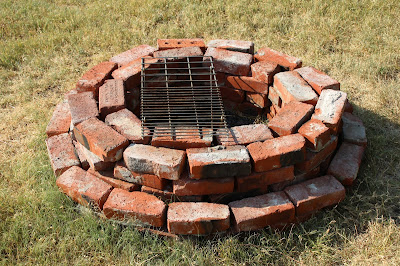
It s been a hot year in Kansas this year. Really hot. Our average high for July was 101F / 38C. It s also been extremely dry. So we haven t had too many pleasant opportunities to enjoy a bit of an upcycling project I had with the boys. When we renovated our old farmhouse, we had two chimneys removed. The bricks were saved in a large pile out back, and we haven t really touched them in the last 5 years. I got the idea at some point that it would be nice to have a fire ring on our yard. The boys love campfire-style cooking, and enjoy helping gather kindling and watching the fire grow. I had looked at fire rings in stores, but just couldn t bring myself to pay $60 or $100 or even more for what was really a piece of round metal. I decided we would find a way to build our own fire ring. So the idea of chimney bricks seemed perfect. Some of these bricks still have mortar on them, so the result is imperfect, but it is functional. More importantly, the boys helped. They picked out bricks one at a time, set them in the wheelbarrow (or even carried a few themselves, as Jacob insisted on doing sometimes.) Then we d dump them out on the ground, and I d make some attempt at making the thing round, while the boys would put them on the pile. We did this over the course of several evenings, with me filling in on some of it after they lost interest. When we got it done, they of course loved cooking outside. I made sure that we placed it in a place that will be in the shade every summer evening so we d be comfortable. I made no attempt to mortar it in; this way, it s easy to move or resize. And it s safer for the boys than a metal one, since the outer edge never even gets warm to the touch. Anyhow, it finally got a little cooler last week, so we cooked out there for dinner two days in a row. One day, after eating, the boys came back out to help put out the fire with the hose. After that, Jacob and I went out there to eat dessert. He sat on the grass, and I sat down next to him. He scooted over a bit to be closer to me. Pretty soon, Oliver came running out too, and sat on my lap. The three of us just sat there on the grass, eating our desserts and enjoying the evening. It s the kind of moment that makes a dad happy. The other evening, they again helped me put out the fire with a hose. They d been active that day, so after I finished hosing down the fire ring, I gave them each a small spray with the hose. After a brief flicker of indecision, they both decided this was hilarious. Jacob took off running, yelling You ll never catch me! (And clearly hoping I would.) Oliver copied him, and so I proceeded to chase them around the yard with a hose for quite awhile. There was much laughter from them, and they wound up totally soaked and happy. Another good evening. You never know what will happen outdoors, but so often it is very good.

2 July 2012

Thibaut Girka: apt-get install gcc-4.7-arm-linux-gnueabihf

Hi! As you may know, I'm working on multiarch cross-toolchains as part of the Google summer of Code (see my previous post for details), and although there is still a lot to do, the project is doing fairly well, and a cross-gcc is already installable and working. I'll proceed with detailed instructions on how to install the cross-compiler, along with some explanations on multiarch itself, and how to build cross-toolchains from source. Prerequisites First, you need specific versions apt (>= 0.9.6) and dpkg (>= 1.16.5).
This is because the cross-toolchains packages I'm working on depend on specific cross-arch dependencies, such as libc6:armhf. Support for such dependencies has been added in the aforementioned versions of apt and dpkg. This means you should be running unstable, or at least use dpkg from unstable. Adding a foreign architecture Adding a foreign architecture is straightforward, but I've seen users do overcomplicated, or just plain wrong things. So, let's do this step by step (well, there are only two of them), with some explanations.
  1. Tell dpkg to handle an additional architecture by typing dpkg --add-architecture armhf. There isn't much to say. It will only add an architecture to the list of architectures dpkg would accept to handle.
  2. Update APT's database. You need to run apt-get update after adding or removing an architecture to get package lists for all wanted architectures and rebuild APT's database, including the implicit cross-arch dependencies/conflicts brought by multiarch.
And that's it for the common case. Now, a word on architecture restrictions: a common misconception about multiarch seems to be that you have to tell APT which architectures you want from the mirrors by modifying your sources.list file(s). This is not true, as, by default, APT gets the list of accepted architectures from dpkg, and gets the correct package lists from the mirrors configured in the sources.list. You only need to use arch restrictions ( deb [arch=arch1,arch2,...] ... ) when you want to get packages from a mirror only for a subset of your accepted architectures. This is very unlikely, and in the general you do not need to modify your sources.list, at all. Getting the cross-compilers from my repository I provide compiled versions of gcc-4.7-arm-linux-gnueabihf for i386 and amd64 in my repository. If you have followed the previous paragraphs, nothing should be easier than adding a deb http://emdebian.org/~thibg/repo/ sid main line to your sources.list and doing the following:
# apt-get update
[...]
# apt-get --no-install-recommends install gcc-4.7-arm-linux-gnueabihf
Reading package lists... Done
Building dependency tree       
Reading state information... Done
The following extra packages will be installed:
  binutils-arm-linux-gnueabihf cpp-4.7-arm-linux-gnueabihf gcc-4.7-arm-linux-gnueabihf-base gcc-4.7-base:armhf libc6:armhf libgcc1:armhf
  libgmp10 libgomp1:armhf libmpc2 libmpfr4
Suggested packages:
  binutils-doc gcc-4.7-locales libmudflap0-4.7-dev:armhf gcc-4.7-doc libgcc1-dbg:armhf libgomp1-dbg:armhf libitm1-dbg:armhf
  libquadmath-dbg:armhf libmudflap0-dbg:armhf binutils-gold glibc-doc:armhf locales:armhf
Recommended packages:
  libc6-dev:armhf
The following NEW packages will be installed:
  binutils-arm-linux-gnueabihf cpp-4.7-arm-linux-gnueabihf gcc-4.7-arm-linux-gnueabihf gcc-4.7-arm-linux-gnueabihf-base gcc-4.7-base:armhf
  libc6:armhf libgcc1:armhf libgmp10 libgomp1:armhf libmpc2 libmpfr4
0 upgraded, 11 newly installed, 0 to remove and 0 not upgraded.
Need to get 23.5 MB of archives.
After this operation, 57.2 MB of additional disk space will be used.
Do you want to continue [Y/n]?
I've disabled the recommends since, libc6-dev:armhf would recommend gcc:armhf itself, which is not co-installable with your native gcc if you have it installed. Building the cross-toolchain yourselves If you don't trust the repository above, or simply want to rebuild the toolchain yourself, it is rather simple: get my gcc-4.7 patches and:
$ apt-get source binutils
$ cd binutils-*/
$ TARGET=arm-linux-gnueabihf dpkg-buildpackage -uc -us -b
$ cd ../
# dpkg -i binutils*arm-linux-gnueabihf*.deb
$ apt-get source gcc-4.7
$ cd gcc-4.7/
$ for patch in path/to/the/patches/*.patch; do patch -p1 < $patch ; done
$ GCC_TARGET=armhf debian/rules control
$ GCC_TARGET=armhf dpkg-buildpackage -uc -us -b
Using the cross-compiler It's easy, but there is a trick, and dpkg-buildpackage -aarmhf won't work out of the box yet, as gcc-4.7-arm-linux-gnueabihf provides the arm-linux-gnueabihf-gcc-4.7 executable, but no arm-linux-gnueabihf-gcc symlink. So, for the moment:
$ cat > test.c << __EOF__
#include <stdio.h>
int main(void)
 
  printf("Hello world\\n");
  return 0;
 
__EOF__
$ arm-linux-gnueabihf-gcc-4.7 test.c
$ qemu-arm ./a.out 
Hello world
Conclusion The toolchain is not complete yet (there is some more work to do on binutils and libstdc++, and equivalents to the gcc , cpp , and build-essential packages to provide), but it should still be useful to cross-compile C programs. Multi-arch cross-toolchains for wheezy can definitely be hosted at emdebian, and I hope to clean up the build process so that it could get included in the archive for wheezy+1.

30 June 2012

Luca Falavigna: FTP Team stats during Wheezy development

Already chilled by Wheezy freeze? It s been a long ride since the release of Squeeze, and your beloved FTP Team tried to assist our tireless developers and contributors at its best. Here are some hot stats to give you a figure about what happened behind the scenes. Since the release of Squeeze, 7462 .changes files with NEW components were processed by dak, with an average of 14.660 NEW packages per day. On the FTP Team side, we had 6877 accepts (13.511 per day), 641 rejects (1.259 per day) and 280 comments to maintainers (0.550 per day). This table represents the activity by single team member:
Login Accepts Rejects Comments
ansgar 407 accepts (0.800 per day) 71 rejects (0.139 per day) 53 comments (0.104 per day)
dak 12 accepts (0.024 per day) 1 rejects (0.002 per day) 0 comments (0.000 per day)
dktrkranz 4319 accepts (8.485 per day) 381 rejects (0.749 per day) 104 comments (0.204 per day)
joerg 100 accepts (0.196 per day) 12 rejects (0.024 per day) 1 comments (0.002 per day)
mhy 214 accepts (0.420 per day) 14 rejects (0.028 per day) 5 comments (0.010 per day)
stew 67 accepts (0.132 per day) 16 rejects (0.031 per day) 7 comments (0.014 per day)
tolimar 1480 accepts (2.908 per day) 93 rejects (0.183 per day) 84 comments (0.165 per day)
twerner 278 accepts (0.546 per day) 53 rejects (0.104 per day) 26 comments (0.051 per day)


Who were the most prolific maintainers who got a NEW processing? Here is our special top ten:
  1. Debian Perl Group (559 accepts)
  2. Debian Haskell Group (491 accepts)
  3. Debian Ruby Extras Maintainers (285 accepts)
  4. Debian Java Maintainers (257 accepts)
  5. Debian Med Packaging Team (164 accepts)
  6. Debian Multimedia Maintainers (160 accepts)
  7. Debian Fonts Task Force (156 accepts)
  8. Debian Javascript Maintainers (137 accepts)
  9. Debian Python Modules Team (129 accepts)
  10. Debian Qt/KDE Maintainers (98 accepts)
That doesn t reflect the real developers, though. Here s our Changed-By top ten:
  1. Clint Adams (216 accepts)
  2. Jonas Smedegaard (208 accepts)
  3. Ben Hutchings (203 accepts)
  4. Joachim Breitner (153 accepts)
  5. TANIGUCHI Takaki (112 accepts)
  6. Alessio Treglia (101 accepts)
  7. David Paleino (95 accepts)
  8. Nicholas Bamber (76 accepts)
  9. Mathieu Parent (68 accepts)
  10. Jeff Breidenbach (63 accepts)
Clint rocks with tons of Haskell packages, followed by Jonas (mostly Perl packages), and Ben (kernel uploads). Italian cabal stands still, with Alessio and David respectively at 6th and 7th place ;)


How long does a package stay in NEW? Some more, some less, but the average is 3 days, 15 minutes and 21 seconds. Now go and check your dak mails to see whether you had a fast processing or not :) liblog4ada 1.2-1 surely had, as it was accepted after 30 seconds! gsoap 2.7.17-1 was not so lucky, it took 103 days, 8 hours, 20 minutes and 43 seconds to clear NEW, but then made its way to the archive. Better late than never ;)


FTP Team is not just accepting NEW packages, but also removing obsolete ones. Here are some details about this task:

FTP Team also took care of override changes:

22 June 2012

Michael Casadevall: Announcement of Calxeda Highbank Images for Quantal

Hello all,

As many of you are aware, Canonical, in coordination with Calxeda and others have been working to bring Ubuntu to this new class of high-performance cluster yet low power-consumption computers built around ARM processors. Many of you who were in attendance at UDS in Oakland may remember seeing Calxeda's talks and demonstration live, and the exciting news that this represents. The full presentation is available here.

In line of this work, I'm am extremely pleased to announce that the initial images for the Calxeda Highbank platform are now available for download, with installation instructions available here. Please remember that Quantal is still in alpha development, and is not currently recommended for use in a production environment. As development of 12.10 continues, we will continue to refine these images, and our tools to fully embrace MAAS on ARM, and make 12.10 to be our best release yet.


As an additional note, Highbank support for Ubuntu 12.04 LTS will be released as part of the 12.04.1 update in mid-August and will join our support for ArmadaXP from Marvell, which was released as part of 12.04.

---
Michael Casadevall
ARM Server Tech Lead
Professional Engineering and Services, Canonical
michael.casadevall@canonical.com

4 June 2012

Steve McIntyre: Linaro Connect in Hong Kong, 2012: Ruby bug squashed!

Connect logoSometimes conferences can be dull and boring, but sometimes they can be just awesome in terms of finding the right people to collaborate with. Linaro Connect in Hong Kong last week was definitely one of the great ones! I chaired my my usual sessions (armhf status and cross-distro ARM) and we had some lively discussion in both. We're probably just about done with the armhf sessions, as most distros have accepted a hard-float ARMv7 port now and there's not so much specific work left there now that future sessions will be necessary. The cross-distro work for ARM ports is likely to continue into the future, but we're going to be concentrating on bootstrapping work for ARMv8 soon. Talking v8, there were a lot of meetings discussing the various work topics for this new 64-bit ARM architecture: kernel, toolchains, bootstrapping etc. More to come on that soon! On top of all this useful discussion and planning, we also found time during the week for some hacking. This was the highlight of the week for me, as I found some expert help to solve my long-standing Ruby on ARM bug (Debian bug #652674, ruby1.9.1: FTBFS on armhf: test suite segfaults). Ulrich Weigand (an IBM toolchain wizard seconded into the Linaro team) sat with me for a couple of hours while we worked through reproducing the problem, only to find that he could not reproduce it! The crash had looked very much like a pthreads locking bug, which was scaring me. After some digging, we worked out where the problem was, and how it was now fixed. For a long time on ARM, the Linux getcontext/setcontext system calls have never been implemented; apparently nobody really missed them, so they have never been a priority. In Ruby 1.9.x, the implementation of the new "fiber" primitive wanted to use getcontext/setcontext to control stack state etc. in different threads of control. In cases where they are not available or known not to work well, Ruby has fallback code to implement similar functionality. It seems that fallback code is buggy. Maybe it was correct at some point and has bit-rotted due to not being exercised, or maybe it was buggy as written, but it clearly does not work correctly for us now. In the last few months, getcontext/setcontext have finally been implemented for ARM in glibc trunk (by Michael Hope, also in the Linaro toolchain team!) and backported into current Debian and Ubuntu eglibc versions. Re-running configure and rebuilding Ruby against the most recent code in both Sid and Precise fixed the test suite crash we were seeing earlier. Yay! We could also provoke the bug again at will by quickly hacking around the Ruby source to force it to switch back to the fallback code, thereby verifying the fix. Why does this matter? As we're expecting ARM servers to enter the market soon, web apps written in Ruby on Rails are going to be an important part of the software stack that customers will want to run. Broken fibers and threading would not help here! It's great to meet up and work with talented folks like this; Linaro Connect is an excellent event for getting stuff done!

28 May 2012

Thibaut Girka: Multiarch Cross-toolchains

Hi! I have been selected to work on multiarch cross-toolchains as part of the Google summer of Code. Although coding officially started last week, I have been busy with exams and other uni stuff at the time. Anyway, let's talk about the project itself, that is, multiarch cross-toolchains. What is multiarch? In order to understand what the project is about, one need to know what multiarch is. I'll quickly describe it, and I invite anyone interested to read the spec (really, it's interesting, and not that long). Basically, multiarch lets you install binary packages for multiple architectures on one system, and let package managers resolve dependencies as one would expect. This works by identifying four sets of packages: Anyway, multiarch is an amazing thing that may be of use in various cases, such as running i386-only software on an amd64 system, running armel software on an armhf system, running i386 software on an armhf system using qemu-user-static and binfmt, cross-grading (switching, for instance, from i386 to amd64 on a running system), and, in our case, easing cross-compilation. State of cross-toolchains in Debian There aren't really cross-toolchains available in Debian (although some can be built from source packages), but they are available in emdebian's repositories. However, those packages predate multiarch, and don't make use of it. Instead, they depend on special packages converted using dpkg-cross. Such packages are merely arch: all versions of foreign packages, with files moved to arch-qualified paths to prevent conflicts with normal packages. Such packages thus have to be generated from real packages, either manually or using some sort of automation. In addition, this additional step brings several issues, like keeping in sync converted packages with real packages from the archive. With multiarch, such packages are rendered useless, and may in fact bring additional problems, since converted and multiarch packages may share the same files, and thus may not be co-installable. Switching from dpkg-cross to cross-arch deps Cross-toolchains packages currently depend on a few packages converted using dpkg-cross (ex: libc6-$ARCH-cross and libc6-dev-$ARCH-cross for some packages). They need to depend on the real package with the right arch (ex: libc6:$ARCH, libc6-dev:$ARCH). The obvious way to do so is by annotating the dependency with a specific arch qualifier (ex: Depends: libc6:armhf ). This is, however, not covered by the multiarch spec. Note that some lib*-$ARCH-cross packages will remain (for instance, libgcc1-armhf-cross). Indeed, those packages are different from the packages mentioned above in that they are of the architecture of the build system and actually part of the toolchain itself.
The above isn't actually true. Indeed, those packages are runtime library cross-built during gcc's build. Likewise, cross-toolchains may build-depend on foreign packages (ex: libc6-dev). Thus, specific arch qualifiers must be handled in the Build-Depends source package field too. Changing dpkg and apt to support that should be fairly straightforward. In fact, I already have a few patches, but I need to refresh them, maybe clean them up a little, and push them a little harder to get them accepted!

27 April 2012

Riku Voipio

Cross Compiling with MultiArch Congrats to the Ubuntu Folk for the new LTS release. Incidentally this is also the first release where our work on MultiArch bears fruit. We can now cross-compile relatively easily without resorting to hacks like scratchbox, qemu chroot or dpkg-cross/xdeb. Lets show short practical guide on cross-building Qemu for armhf. The instructions refer to precise, but the goodiness is on the way to Debian as well. Biggest missing piece being the cross-compiler packages, which we have an Summer of Code project. The example is operated in a chroot to avoid potentially messing up your working machine. Qemu-linaro is not a shining example, as cross-building it doesn't work out of box. But that is educational, it allows me to show what kind of issues you can bump into, and how to fix them.

$ sudo debootstrap --variant=buildd precise /srv/precise
Edit the /srv/precise/etc/apt.sources.list to the following (replace amd64 with i386 if you made an i386 chroot)

deb [arch=amd64] http://archive.ubuntu.com/ubuntu precise main universe
deb [arch=armhf] http://ports.ubuntu.com/ubuntu-ports precise main universe
deb-src http://archive.ubuntu.com/ubuntu precise main universe
Edit the /srv/precise/etc/dpkg/dpkg.cfg.d/multiarch by adding the following line:

foreign-architecture armhf
Finally disable install of recommends by editing /srv/precise/etc/apt/apt.conf.d/10local:

APT::Install-Recommends "0";
APT::Install-Suggests "0";
Install the armhf crosscompiler the chroot

$ sudo chroot /srv/precise/
# unset LANG LANGUAGE
# mount -t proc proc /proc
# apt-get update
# apt-get install g++-arm-linux-gnueabihf pkg-config-arm-linux-gnueabihf
Get the sources and try to install the cross-buildeps:

# cd /tmp
# apt-get source qemu-linaro
# cd qemu-linaro-*
# apt-get build-dep -aarmhf qemu-linaro
As we see, the build-dep bombs out ugly, with a them of "perl" being unable to be installed. This is because apt-get can't figure out if we should install and armhf or amd64 version of perl. We don't use the required syntax yet in Build-Dep line, "perl:any", as dpkg and apt in previous released don't support it. Thus back porting would no longer be possible. One way to fix it, would be to drop perl build-dep, as perl is already pulled by other build-deps. But lets instead show howto install it the build-deps manually. First we build system build-deps, then target architecture ones:

# apt-get install debhelper texinfo
# apt-get install zlib1g-dev:armhf libasound2-dev:armhf libsdl1.2-dev:armhf libx11-dev:armhf libpulse-dev:armhf libncurses5-dev:armhf libbrlapi-dev:armhf libcurl4-gnutls-dev:armhf libgnutls-dev:armhf libsasl2-dev:armhf uuid-dev:armhf libvdeplug2-dev:armhf libbluetooth-dev:armhf
And try the build[1]:

# dpkg-buildpackage -aarmhf -B
Which sadly errors out. Turns out the cross-build support in debian/rules is broken. Instead of --cc we need to feed an --cross-prefix to the ./configure of qemu. Edit the debian/rules with replacing

- conf_arch += --cc=$(DEB_HOST_GNU_TYPE)-gcc --cpu=$(QEMU_CPU)
+ conf_arch += --cross-prefix=$(DEB_HOST_GNU_TYPE)-
Optional: Since we are cross-compiling from a multicore machine, lets also add parallel building support, by changing the override_dh_auto_build: rule to have --parallel flags in debian/rules as well:

override_dh_auto_build:
# system build
dh_auto_build -B system-build --parallel
ifeq ($(DEB_HOST_ARCH_OS),linux)
# user build
dh_auto_build -B user-build --parallel

# static user build
dh_auto_build -B user-static-build --parallel

Try the build again:

# export DEB_BUILD_OPTIONS=parallel=4 # I have dual-core hyperthreading machine, build with all four threads
# time dpkg-buildpackage -aarmhf -B
...
dpkg-buildpackage: binary only upload (no source included)

real 18m53.425s
user 65m42.570s
sys 2m50.383s
The Native build of qemu-linaro took 4h 11min. [1] You should not build as root - but to keep instructions short, I'm not explaining howto add and use a unprivileged user in a chroot. Do as I *say*, not as I *do*!

26 March 2012

Vincent Sanders: NetSurf Developer Workshop

NetSurf DevelopersOver the weekend we held the NetSurf developer workshop. The event was kindly hosted by Collabora at their Cambridge offices. The provided facilities were agreed to be excellent and contributed to the success of the event.

Five developers managed to attend from around the UK John-Mark Bell, Vincent Sanders, Michael Drake, Daniel Silverstone and Rob Kendrick. In addition James Shaw, one of the project founders, made a special appearance on Saturday.

Starting from Friday afternoon we each put in over 25 hours of actual useful work and made almost 170 commits changing over 350 files, added 10,000 new lines of code and altered another 18,000.

The main aim of the event was to make the transition from using libxml2 to our own libdom library for the browser DOM tree. This was done to improve the browsers performance and size when manipulating the DOM but also gives us the ability to extend the browsers features to include dynamic rendering and Javascript

We also took the opportunity to discuss and plan other issues including:
  • User interface message handling and translation.
  • User preference handling.
  • Toolchain support.
  • Disc caching.
  • Javascript binding
  • Electronic book content handler.
Rob tackled the first parts of the messages conversion from numerous separate files into a single easy to handle file which will in future allow for easier translation and reduce message proliferation.

We made decisions on the ongoing rework of user preference handling which will be implemented in future.

The decision on the toolchain was slightly changed to be that any core or library code (non frontend/toolkit specific parts) are required to conform to the C99 standard. Frontends are permitted to recommend and use whatever tools their maintainer selects but they cannot enforce those restrictions on core code. This issue is principly because the BeOS maintainer is compiling NetSurf with g++ 2.95 which is missing several important language features we wish to use.

Developers at workThe recurring issue of disc caching was raised again and we have come up with what we hope is a reasonably elegant solution to be implemented over the forthcoming months.

Now there is a suitable DOM to bind against, the existing Javascript engine support will be properly integrated and should result in basic script support before the 3.0 release. This support will remain a build time option so NetSurf can continue to be used on platforms where the interpreter is too resource intensive to be used.

A short discussion about the possibility of integrating a basic page based content handler for epub and mobi type documents was discussed and while the idea was well received no decisions on implementation were made.

Overall the event was a resounding success and we are left with only a small handful of regressions which appear straightforward to solve. We also have a clear set of decisions on what we need to do to improve the browser.

28 January 2012

Russ Allbery: Summary of C++ symbols experience

This is a follow-up to my previous post about the way that Debian's library symbols analysis support interacts with C++ libraries, based on further debian-devel discussion. The primary outcome of that discussion was to point me at the pkg-kde-tools utilities for handling maintenance of these files, which solved a bunch of my problems. As before, this was also posted on debian-devel, which is where I expect most of the discussion to be. First of all, for those who haven't explored the pkg-kde-tools infrastructure for this, it looks like the effective process goes something like this:
  1. Do a local build of the package and then generate an initial symbols template for that architecture. So, for example, I did:
        fakeroot debian/rules build install
        pkgkde-gensymbols -plibxml-security-c16 -v1.6.1 -Osymbols.i386 \
            -edebian/libxml-security-c16/usr/lib/*/libxml-security-c.so.*.*
        pkgkde-symbolshelper create -o debian/libxml-security-c16.symbols \
            -v 1.6.1 symbols.i386
    
    This generates an initial symbols file that will work for i386.
  2. Build and upload this version of the package. Now wait for all the buildds to fail (because they will, on probably nearly every other architecture than your local one).
  3. Download all of the build logs and feed them back into pkgkde-symbolshelper so that it can adjust your symbols template for all of the architecture variations. So, for example, I did:
        pkgkde-getbuildlogs
        pkgkde-symbolshelper batchpatch -v 1.6.1 *_unstable_logs/*.build
    
    This will generate rather nice annotated symbols files with appropriate arch lists and using subst tags where appropriately (such as when an argument to a function is a size_t).
  4. Modify your package to use pkg-kde-tools during the build, because subst tags are a really nice way to handle a lot of C++ symbol patterns but #533916 against dpkg-dev is wontfix, so you need the pkg-kde-tools replacement for dpkg-gensymbols. I added a dependency on pkg-kde-tools and then added the (undocumented) pkgkde_symbolshelper add-on to my dh --with flag.
  5. Build and upload the package again. Now it will hopefully build on all architectures.
This is, as you might expect, a fair bit of work, but it does work, and what comes out the other end is a symbols file that works across the current buildd architectures and detects any mistakes by upstream that change the symbols exported. However, it does have some problems, some obvious, and some more subtle. Here's a list of the issues that I see:
  1. It feels like this symbols file is still likely to be fragile. While pkg-kde-tools detects a lot of template instances and marks them optional, I was still seeing a lot of "leaked" symbols from other C++ libraries that my package build-depends on, and which I suspect may also disappear. There's also the problem of optimizers eliminating some things that are inlined; for example, that appears to be the variation that my package sees on arm. And for a substantial C++ library, the symbols file is HUGE. Over 12,000 lines for one of my libraries. It's kind of scary to think of how many fragility landmines are buried under there.
  2. By the nature of this process, it's very sensitive to the current supported architectures. I expect any package with a symbols template built this way stands a good chance of FTBFS on a new architecture. For example, my symbols file has a lot of !armel !armhf patterns, which don't appear to be anything unique to arm except that the C++ compiler behaves slightly differently there due to inlining, and those are the only two architectures in the current set with that pattern.
  3. The lack of dpkg-gensymbols support for subst is very unfortunate, since it's used by the pkg-kde-tools utilities and it's the Right Thing To Do for symbols that take, for example, size_t as an argument. I would strongly encourage the dpkg maintainers to accept the work in #533916 except maybe for the vt work, since the alternative is to generate regexes that are significantly worse at capturing mistakes (since they're going to accept either int or long, rather than only whatever one corresponds to size_t, for example), or to embed a lot of specific architecture restrictions listing, for instance, all 64-bit architectures and guarantee FTBFS for every new architecture.
  4. It's a little hard on the infrastructure, since adding a symbols file requires uploading a package that's guaranteed to fail to build almost everywhere just so that you can get all the build logs to feed into the machinery. I always feel guilty about doing that.
  5. It's still not clear that the benefit is worth the amount of effort, since I expect most C++ libraries to require frequent SONAME changes anyway, which means that the long-term binary compatibility angle of symbols is probably futile. Mostly, all of this is to give you a tool to do ABI checking, which will catch some mistakes but not all of them. And I'm guessing it's going to be substantially more work than maintaining symbols for a C library if one actually does it properly and checks every missing symbol and change in new builds.
I'm going to try this for the Shibboleth packages for a while since I want to see what it's like across a new upstream release, but I'm still very much not convinced that this is a useful use of a packager's time.

23 January 2012

Neil Williams: Emdebian Grip automated dependency resolution

The script isn't fully automated yet, I'm running it manually and watching for errors, but I do now have a simple script (~100 lines of perl) which runs edos-debcheck against each of the supported Emdebian architectures for unstable-grip and picks out those packages which are missing from the subset of packages which Emdebian monitors for Grip.

I was hoping to make these scripts into a normal Debian package but there are some limitations in that the scripts need to assume various pieces of Debian infrastructure. e.g. I started off using rsync to pull in the Packages files (along with Release and Sources) because apt has annoying behaviours with multiple architectures. (Emdebian Grip processes 7 architectures simultaneously on blavet.debian.org). Peter Palfrader kindly arranged for a local mirror to be available and now the entire Packages processing can be done using symlinks. Much, much better.

Actual package movement data comes directly from dak via projectb - something else which makes packaging these scripts for use on non debian.org boxes a bit hard.

Once again, I am indebted to the EDOS team (please, please keep working on edos-debcheck - it hasn't had uploads recently) because I tried to get this working with germinate but failed. (Colin - I'll be looking to borrow some of your time to work out what was going wrong.)

The dependency resolution script now means that I can meet release team requirements that when foo is updated in sid to depend on libbar2 but Emdebian Grip only has libbar1, the scripts will automatically pick up libbar2 and add it to Emdebian Grip. The current sid version gets pulled in and (the theory goes) will migrate into testing-grip as an almost automatically valid candidate. Processing of the dependency can happen within hours of the updated version of foo arriving in Emdebian Grip but as long as it happens within a few days I think everyone will be fine with it.

I've got a sync script too which can periodically run across the entire suite and check for packages which have slipped the net. I'll have to see how often that needs to run but once a week doesn't sound too painful.

Processing for Emdebian Grip is very fast. Most of the time is taken uploading:

2012-01-23 22:24:42 add sid-grip deb main armhf libfltk-images1.3 1.3.0-5em1
2012-01-23 22:24:52 add sid-grip deb main i386 libfltk-images1.3 1.3.0-5em1
2012-01-23 22:25:07 add sid-grip deb main mips libfltk-images1.3 1.3.0-5em1
2012-01-23 22:25:25 add sid-grip deb main powerpc libfltk-images1.3 1.3.0-5em1
2012-01-23 22:26:00 add sid-grip deb main amd64 libstdc++6-4.5-dev 4.5.3-12em1
2012-01-23 22:26:34 add sid-grip deb main armel libstdc++6-4.5-dev 4.5.3-12em1


(It was a lot longer, comparatively, when I was having to rsync and then dget instead of just read from the local filesystem.)

I've also been working on an init script which will gradually work through the subset of packages by order of Priority - approximately what a new architecture (like armhf) would do. Note that Emdebian Grip supports armhf already. The only slight concern is whether the init script needs to be throttled back to not flood the queues with hundreds of uploads an hour (which it could end up doing, at least for the first 24 hours).

Logs of package movements are available: http://www.emdebian.org/grip/logs.php

Packages can be searched too: http://www.emdebian.org/grip/search.php

More on Emdebian Integration on the Debian wiki: http://wiki.debian.org/EmdebianIntegration

Now all I need is a fix for #655919 :-) FTP team?

18 January 2012

Sylvestre Ledru: Major changes in the Debian HDF5 packages

Yesterday, I uploaded hdf5 1.8.8 in unstable. This new version, which has been available in experimental for a while, is a major step in the HDF5 packaging. For those who are using this package, besides the switch from version 1.8.6 to 1.8.8, the changes are the following: More information about the transition:
http://release.debian.org/transitions/html/hdf5.html TODO: Fix the FTBFS (Fail To Build From Sources) under sparc & ia64.

13 January 2012

Rapha&#235;l Hertzog: People Behind Debian: Steve McIntyre, debian-cd maintainer, former Debian Project Leader

Steve McIntyre has been contributing to Debian since 1996, 2 years before I joined! But I quickly stumbled upon Steve: in 1999, he was struggling with getting his debian-cd script to produce 2 ISO images (it was the first time that Debian did no longer fit on a single CD), I helped him by rewriting debian-cd with a robust system to split packages on as many ISO images as required. I remember those times very well because Steve was very supportive of my efforts and it was a real pleasure to get this done. His friendly nature probably also explains why he got elected Debian Project Leader twice! Anyway, enough history, check out his interview to learn more about the great work he s doing nowadays. My questions are in bold, the rest is by Steve. Raphael: Who are you? Steve: I m a professional software engineer, 37, living in Cambridge (England) with my new wife Jo. I studied for the EIST degree at the University of Cambridge, then (like many people here, it seems) I just forgot to go home again afterwards and settled here. I spent more of my study time playing with Linux than working on my degree, so I guess I m lucky that it worked and I found a career in that area! Raphael: How did you start contributing to Debian? Steve: During my time in college, I started hacking on software in my free time, using Slackware as my first Linux distribution from the middle of 1994. After encountering more and more problems with Slackware, I was encouraged by a number of friends to make the jump over to Debian and in October 1996 I did. The installation process back then was much harder than anything people see today, but after a long weekend I finally had my Debian system up and running. I was already one of the main upstream developers for the Mikmod music player at that time, so that very same weekend I applied to be a DD so I could maintain it in Debian too. Back then, the NM process was much simpler: I just mailed a key to Bruce and he set me up with an account almost immediately! I then found that Joey Hess had beaten me to it and already packaged Mikmod. Grrr! :-) Raphael: What s your biggest achievement within Debian? Steve: Without a doubt, my proudest achievement within Debian is being elected Project Leader for 2 years by the other developers. It s a great feeling to have earned the trust of your friends and peers, and also a great responsibility to go and help Debian where needed: talking to the press about Debian, assisting wherever problems crop up, etc. The DPL job is certainly a lot of hard work, and I have nothing but respect for anybody who volunteers for it.
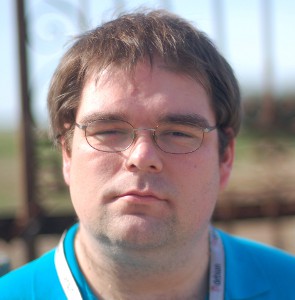
It s a great feeling to have earned the trust of your friends and peers.
Elsewhere, I ve been leading the Debian CD team for years too, both doing most of the maintenance of the debian-cd package and producing and testing the regular installation CDs and DVDs that we ship to the world. Again, this is a time-consuming job but it needs doing and it s worthwhile. Raphael: You re currently employed by ARM. What are you working on and are they supportive of your Debian involvement? Steve: The situation within ARM is very interesting; I m employed in PDSW (Processor Division, SoftWare), a new group founded just a couple of years back to help improve the state of software on ARM. Most of the people in the group are working on Free Software at this stage (e.g. toolchains, browsers, Linux kernel), which is lovely. Some of the engineers have also been seconded into a new non-profit company Linaro, which is a collaboration between ARM and a number of other companies investing in core Linux software and tools for ARM-based CPUs. I m one of the ARM engineers in Linaro, and I m a Technical Architect in the Office of the CTO. My role includes looking at future projects for Linaro to help with (e.g. ARM servers), but for the last few months I ve been concentrating on the new armhf architecture in Debian, Ubuntu and elsewhere. armhf is a new architecture in Debian and Ubuntu terms, but it s not strictly a new type of hardware. Instead, it s a new ABI. We have two reasons for doing this work:
  1. It targets the latest version of 32-bit ARM CPUs (v7) and makes better use of the hardware, for better performance. Compare targetting i686 instead of i386, for example. We ll still support the older armel port for the foreseeable future for users with older hardware that can t run armhf.
  2. More importantly: we are standardising on the ABI / compiler options / hardware support for future users.
In the past, there has been a huge amount of specialisation (aka fragmentation) in the ARM Linux environment, and that worked OK for specialised devices that only ever ran the software shipped with them. ARM CPUs are now becoming more and more mainstream, so people will expect to be able to install generic software on their machines. That gives a requirement for a standard base platform, and armhf (arm-linux-gnueabihf in GNU triplet terms) is that standard that we are pushing in the community. Debian, Ubuntu, Fedora, Suse and others are all going to use this, making compatibility possible. I ve been working with a small team of people to make armhf happen, helping where needed: putting together build machines; patching Debian packages directly; discussing and fixing toolchain issues with Ubuntu folks; agreeing ABI specifications with people from Fedora; advising people from other distros bootstrapping their new ARM ports. ARM and Linaro are very supportive of this work, and it s been lovely being sponsored to work directly on Free Software like this. It s work that will directly benefit ARM and its partners (of course!), but it s also helping out more generally too: Debian QA work, cross-build support, bootstrapping efforts, multi-arch. More and more of the ARM market is driven by Free Software, and companies are acknowledging that. I should probably also mention that we re hiring ! :-) Raphael: What are your plans for Debian Wheezy? Steve: There are three main tracks here. Obviously, I m interested in seeing armhf release with Wheezy. We ve just been added to Testing last weekend, so that s going well. We ve got over 90% of the archive built now, and we re mopping up the remaining issues. I m the primary maintainer of cdrkit at this point, but I d prefer to have it go away. Xorriso and the associated software in libisoburn is almost capable of replacing all the aging cdrtools-derived software that we have in Debian, The only missing feature that I m aware of is creating the HFS hybrid filesystems that we use for installations on Mac systems. I ve been talking with the upstream folks about this for some time already, and I m hoping we can finish this soon enough that we can get it into Wheezy. Finally, I ve got the ever-growing wishlist of things for debian-cd. We ve got the beginnings of an automated test suite that Mart n Ferrari has written, but it needs integrating and improving. I want to help get regular weekly/daily/release debian-live builds running on the main CD build machine. There s work needed if we want to make good installation media for the new multi-arch world, too. The Emdebian people are asking for help making CD images The list goes on :-) Raphael: The ARM community seems to be very interested in multi-arch. Can you explain why? Steve: There are a number of reasons for ARM people to be interested in multi-arch; two really stand out for me:
This is potentially the killer app for multi-arch: simply install the libraries for the target architecture [ ], install a simple cross-gcc package [ ] and you re all set.
Raphael: What s the biggest problem of Debian? Steve: For me, Debian s biggest problem has been the same for a long time: we are forever short of enough people to do the work that we re trying to do. That might sound like a weird thing to claim when Debian is one of the largest Free Software projects on the planet, but it s more a statement of just how huge our goals are. Many of the largest things in Debian are developed or controlled by very small teams working very hard, and there s always a risk of losing people due to burnout in those situations.
We are forever short of enough people to do the work that we re trying to do.
Some of the tasks that should be easy given our large membership (e.g. large-scale packaging transitions) can often instead take a very long time. We are fortunate to have more people wanting to join in Debian s work all the time, but we also need to be careful to keep on promoting what we re doing and recruiting new contributors, encouraging them to get more and more involved in core work. Debian gets ever bigger in terms of the size and the number of packages we distribute; we re not currently matching that growth rate elsewhere. Raphael: What motivates you to continue to contribute year after year? Steve: This one is much easier to answer! The thing that first attracted me to Debian was the fact that I could help to develop it, help to decide how things could and should be done within it. Instead of being forced to accept what some corporation decided I could do with my computer, I could change the software to suit my needs and preferences. Alongside that, I could get involved with a strong community of similar people all over the world, all with their own strong opinions about how software should work. I joined in and found it was great fun and very rewarding. That hasn t changed for me in the intervening years, and that s why I m still around. I work on Debian because it helps me to get the OS that I want to use. It seems that lots of people around the world find it useful too, and that s awesome. :-) Raphael: Do you believe that Stefano Zacchiroli will be the first DPL who managed to stay 3 consecutive years on the seat? Would you like him to candidate again? Steve: To be honest, I would be very surprised if Zack stood again for DPL this year. He told me himself that he wasn t planning on it, and I can understand that decision. He s been an awesome DPL in my opinion, and I m glad that he took the job. But: it is also a very difficult and time-consuming task that would be enough to wear down anybody. If Zack does decide to stand again, I would support him 100%. But I know that we also have lots of other good people in Debian who would be ready to take up the challenge next. Raphael: Is there someone in Debian that you admire for their contributions? Steve: There are lots of people I admire in Debian, so many so that I almost don t want to list individuals here for fear of missing people out. But :-) Bdale Garbee has been an inspiration to many of us, for many years. He s technically excellent, a great friend to many of us, an endless source of sage advice and (last but not least) he has some wonderful stories to tell about his experiences over the years. On top of that, he s just cool. :-) Christian Perrier is another exceptional developer, in my eyes he s great at co-ordinating people in translations, working tirelessly to make this very important part of Debian work better and better with every release. He s also a really nice guy and we all love him. I also have to mention Joey Hess here, whether he likes it or not. *grin* He s been responsible for so many good things in Debian over the years, even if he did steal my first package Finally, the teams of people who make sure that Debian is always working: the security team and DSA. The rest of us can choose to take time off from Debian to go and do other things, but these people need to cover things every day. That s a major responsibility, and I salute them for taking on that challenge.
Thank you to Steve for the time spent answering my questions. I hope you enjoyed reading his answers as I did. Note that you can find older interviews on http://wiki.debian.org/PeopleBehindDebian.

Subscribe to my newsletter to get my monthly summary of the Debian/Ubuntu news and to not miss further interviews. You can also follow along on Identi.ca, Google+, Twitter and Facebook.

One comment Liked this article? Click here. My blog is Flattr-enabled.

9 January 2012

Steve McIntyre: Armhf buildds and status in Debian

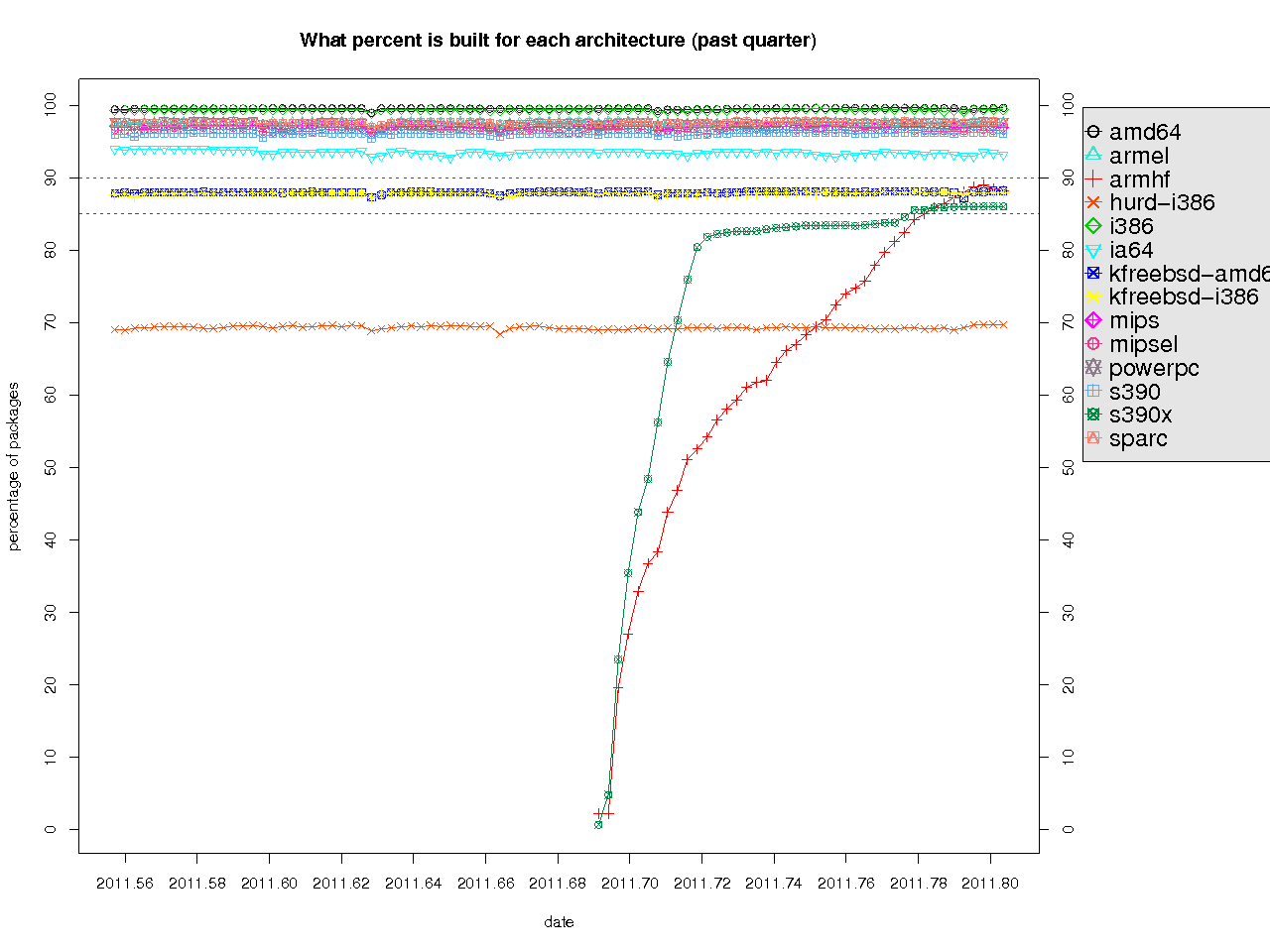
Current status Back in September, I wrote about the machines that I set up to help bootstrap the new armhf port in Debian. Basing on Konstantinos' huge efforts in bringing up the new "architecture" in debian-ports, we started importing armhf into the main Debian archive on the 24th of November. Since then, those builders have been churning away night and day to build the huge collection of software that makes up the Debian archive. The current state can be seen on the armhf buildd status page, and there's a nice graph showing how quickly we've managed to run from 0 to over 90% of the archive here. (Click on the image for a larger version, or visit https://buildd.debian.org/stats/ for other versions. We overtook hurd-i386 quickly and are now ahead of the kfreebsd-* architectures. armhf bootstrap graph We've recently brought 3 more similar build machines online (hildegard, howells and hummel), again sponsored by the nice folks at Linaro but now hosted at the York NeuroImaging Centre at the University of York. This gives us both more build horsepower to keep up with building more different bits of Debian (experimental, updates etc.) and more redundancy in case of problems. We now have the vast majority of the archive built, and now a number of us are concentrating on fixing the remaining issues: language bootstraps and bugs. Also, on the 7th of January we were just added into testing, the next step on our path for inclusion as a Debian release architecture. Setting up the machines A lot of people have been asking me about the physical setup I showed in my last blog about these machines, so here's more details for those who are interested. Mount the 6 boards into the mini-rack, connect up the Molex power connectors to each board, attach ethernet cables and turn it all on! Each board comes with a micro-SD card containing uboot and an Ubuntu installation. I've configured uboot to boot off the hard drive directly, but leaving configuration available to use the Ubuntu on the micro-SD as a simple rescue system should the need arise. The Quickstart boards are not ideal physically for two reasons: the lack of SATA power, plus you need to push a power button on each board to boot it - they don't boot automatically the moment power is applied. However, they're quite inexpensive little machines and have done a great job of building the Debian archive so far! The ideal machines for us would also include more RAM at this point. CPU on these is adequate, but the larger C++ packages (yay webkit!) use a huge amount of memory at link time. Linking in swap is not the best thing, performance-wise... :-( UPDATE 2012-01-12: Ian tells me that the newer Quickstart-R boards apparently have a different power controller; these now boot up straight away without needing you to push a button. That sounds useful.

5 January 2012

Michal &#268;iha&#345;: ColorHug client in unstable

It took me much more uploads than I expected, but ColorHug client is finally in unstable. I was fighting with various bugs, which I could not reproduce locally and of course with my own stupidity in configuring pbuilder. Anyway the buildds overview now shows mostly green, so this is good. The remaining ones mostly wait for libgusb, which needs build on armhf and needs to be ported to non Linux (or rather libusb needs to exist there). One of things I've learned on the way is that docbook-utils is not enough to convert docbook to man pages, you need docbook package as well. Still I don't understand why this did locally work for me... The one outstanding issue is that client code assumes it runs on little endian host (or rather same endianity as the ColorHug device) and thus will break on PPC and other big endian machines. The upstream is aware of that an I even managed to produce patch which should fix it, though I have no means to test it (lack of big endian hardware and lack of the ColorHug device itself).
Filed under: Debian English 4 comments Flattr this!

Next.

Previous.