Search Results: "phil"

24 February 2021

Rog rio Brito: Alternatives to ikiwiki?

It's been quite a long time since I last posted anything on this blog and I can say that one of the reasons for that I don't feel comfortable using ikiwiki anymore. I am actively looking for alternatives to ikiwiki that allow me, mainly, to write blog posts with the following characteristics (not necessarily in order of importance): Connected to the fact that I only can have static sites (no CGI, no forms, nothing else), I am, at this time, using Disqus to host the comments of my blog. I am also thinking of alternatives to this, like sending people to Twitter (or mastodon or email) or some site similar to Disqus, but with more of a Free Software inclination. Anyway, I am almost ready for any kind of transition, since I have already converted most posts (of course, not yet this one ) with some Python scripts to a format that I feel is a bit more format-agnostic than what ikiwiki uses.

  1. That's not to mention the myriad of hugo themes and theme authors that try to bribe you into using their hosted solutions (despite branding everything as "open source! OMG!"), like "wowchemy" you will have a hard time untangling the instructions of their so bloated themes to be usable on your local computer; so much so to the point that you give up with their convoluted configuration (which, potentially, doesn't "transfer" to other themes, if you are worried about possibly changing themes in the future).
  2. I like the style of fenced blocks that GitHub used, where you prefix the code with the name of the language to give a hint of how to highlight the code snipped.

21 February 2021

Louis-Philippe V ronneau: dput-ng or: How I Learned to Stop Worrying and Love the Hooks

As my contributions to Debian continue to grow in number, I find myself uploading to the archive more and more often. Although I'm pretty happy with my current sbuild-based workflow, twice in the past few weeks I inadvertently made a binary upload instead of a source-only one.1 As it turns out, I am not the only DD who has had this problem before. As Nicolas Dandrimont kindly pointed to me, dput-ng supports pre and post upload hooks that can be used to lint your uploads. Even better, it also ships with a check-debs hook that lets you block binary uploads. Pretty neat, right? In a perfect world, enabling the hook would only be a matter of adding it in the hook list of /etc/dput.d/metas/debian.json and using the following defaults:
"check-debs":  
    "enforce": "source",
    "skip": false
 ,
Sadly, bug #983160 currently makes this whole setup more complex than it should be and forces me to use two different dput-ng profiles pointing to two different files in /etc/dput.d/metas: a default source-only one (ftp-master) and a binary upload one (ftp-master-binary). Otherwise, one could use a single profile that disallows binary uploads and when needed, override the hook using something like this:
$ dput --override "check-debs.enforce=debs" foo_1.0.0-1_amd64.changes
I did start debugging the --override issue in dput-ng, but I'm not sure I'll have time to submit a patch anytime soon. In the meantime, I'm happy to report I shouldn't be uploading the wrong .changes file by mistake again!

  1. Thanks to Holger Levsen and Adrian Bunk for catching those and notifying me.

17 February 2021

Louis-Philippe V ronneau: What are the incentive structures of Free Software?

When I started my Master's degree in January 2018, I was confident I would be done in a year and half. After all, I only had one year of classes and I figured 6 months to write a thesis would be plenty. Three years later, I'm finally done: the final version of my thesis was accepted on January 22nd 2021. My thesis, entitled What are the incentive structures of Free Software? An economic analysis of Free Software's specific development model, can be found here 1. If you care about such things, both the data and the final document can be built from source with the code in this git repository. Results and analysis My thesis is divided in four main sections:
  1. an introduction to FOSS
  2. a chapter discussing the incentive structures of Free Software (and arguing the so called Tragedy of the Commons isn't inevitable)
  3. a chapter trying to use empirical data to validate the theories presented in the previous chapter
  4. an annex on the various FOSS business models
If you're reading this blog post, chances are you'll find both section 1 and 4 a tad boring, as you might already be familiar with these concepts. Incentives So, why do people contribute to Free Software? Unsurprisingly, it's complicated. Many economists have studied this topic, but for some reason, most research happened in the early 2000s. Although papers don't all agree with each other and most importantly, about the variables' importance, the main incentives2 can be summarized by: Giving weights to these variables is not an easy thing: the FOSS ecosystem is highly heterogeneous and thus, people tend to write FOSS for different reasons. Moreover, incentives tend to shift with time as the ecosystem does. People writing Free Software in the 1990s probably did it for different reasons than people in 2021. These four variables can also be divided in two general categories: extrinsic and intrinsic incentives. Monetary gain expectancy is an extrinsic incentive (its value is delayed and mediated), whereas the three other ones are intrinsic (they have an immediate value by themselves). Empirical analysis Theory is nice, but it's even better when you can back it up with data. Sadly, most of the papers on the economic incentives of FOSS are either purely theoretical, or use sample sizes so small they could as well be. Using the data from the StackOverflow 2018 survey, I thus tried to see if I could somehow confirm my previous assumptions. With 129 questions and more than 100 000 respondents (which after statistical processing yields between 28 000 and 39 000 observations per variable of interest), the StackOverflow 2018 survey is a very large dataset compared to what economists are used to work with. Sadly, it wasn't entirely enough to come up with hard answers. There is a strong and significant correlation between writing Free Software and having a higher salary, but endogeneity problems3 made it hard to give a reliable estimate of how much money this would represent. Same goes for writing code has a hobby: it seems there is a strong and significant correlation, but the exact numbers I came up with cannot really be trusted. The results on community as an incentive to writing FOSS were the ones that surprised me the most. Although I expected the relation to be quite strong, the coefficients predicted were in fact quite small. I theorise this is partly due to only 8% of the respondents declaring they didn't feel like they belonged in the IT community. With such a high level of adherence, the margin for improvement has to be smaller. As for altruism, I wasn't able get any meaningful results. In my opinion this is mostly due to the fact there was no explicit survey question on this topic and I tried to make up for it by cobbling data together. Kinda anti-climatic, isn't it? I would've loved to come up with decisive conclusions on this topic, but if there's one thing I learned while writing this thesis, it is I don't know much after all.

  1. Note that the thesis is written in French.
  2. Of course, life is complex and so are people's motivations. One could come up with dozen more reasons why people contribute to Free Software. The "fun" of theoretical modelisation is trying to make complex things somewhat simpler.
  3. I'll spare you the details, but this means there is no way to know if this correlation is the result of a causal link between the two variables. There are ways to deal with this problem (using an instrumental variables model is a very popular one), but again, the survey didn't provide the proper instruments to do so. For example, it could very well be the correlation is due to omitted variables. If you are interested in this topic (and can read French), I talk about this issue in section 3.2.8.

14 February 2021

Chris Lamb: The Silence of the Lambs: 30 Years On

No doubt it was someone's idea of a joke to release Silence of the Lambs on Valentine's Day, thirty years ago today. Although it references Valentines at one point and hints at a deeper relationship between Starling and Lecter, it was clearly too tempting to jeopardise so many date nights. After all, how many couples were going to enjoy their ribeyes medium-rare after watching this? Given the muted success of Manhunter (1986), Silence of the Lambs was our first real introduction to Dr. Lecter. Indeed, many of the best scenes in this film are introductions: Starling's first encounter with Lecter is probably the best introduction in the whole of cinema, but our preceding introduction to the asylum's factotum carries a lot of cultural weight too, if only because the camera's measured pan around the environment before alighting on Barney has been emulated by so many first-person video games since.
We first see Buffalo Bill at the thirty-two minute mark. (Or, more tellingly, he sees us.) Delaying the viewer's introduction to the film's villain is the mark of a secure and confident screenplay, even if it was popularised by the budget-restricted Jaws (1975) which hides the eponymous shark for one hour and 21 minutes.
It is no mistake that the first thing we see of Starling do is, quite literally, pull herself up out of the unknown. With all of the focus on the Starling Lecter repartee, the viewer's first introduction to Starling is as underappreciated as she herself is to the FBI. Indeed, even before Starling tells Lecter her innermost dreams, we learn almost everything we need to about Starling in the first few minutes: we see her training on an obstacle course in the forest, the unused rope telling us that she is here entirely voluntarily. And we can surely guess why; the passing grade for a woman in the FBI is to top of the class, and Starling's not going to let an early February in Virginia get in the way of that. We need to wait a full three minutes before we get our first line of dialogue, and in just eight words ("Crawford wants to see you in his office...") we get our confirmation about the FBI too. With no other information other than he can send a messenger out into the cold, we can intuit that Crawford tends to get what Crawford wants. It's just plain "Crawford" too; everyone knows his actual title, his power, "his" office. The opening minutes also introduce us to the film's use of visual hierarchy. Our Hermes towers above Starling throughout the brief exchange (she must push herself even to stay within the camera's frame). Later, Starling always descends to meet her demons: to the asylum's basement to visit Lecter and down the stairs to meet Buffalo Bill. Conversely, she feels safe enough to reveal her innermost self to Lecter on the fifth floor of the courthouse. (Bong Joon-ho's Parasite (2019) uses elevation in an analogous way, although a little more subtly.)
The messenger turns to watch Starling run off to Crawford. Are his eyes involuntarily following the movement or he is impressed by Starling's gumption? Or, almost two decades after John Berger's male gaze, is he simply checking her out? The film, thankfully, leaves it to us.
Crawford is our next real introduction, and our glimpse into the film's sympathetic treatment of law enforcement. Note that the first thing that the head of the FBI's Behavioral Science Unit does is to lie to Starling about the reason to interview Lecter, despite it being coded as justified within the film's logic. We learn in the book that even Barney deceives Starling, recording her conversations with Lecter and selling her out to the press. (Buffalo Bill always lies to Starling, of course, but I think we can forgive him for that.) Crawford's quasi-compliment of "You grilled me pretty hard on the Bureau's civil rights record in the Hoover years..." then encourages the viewer to conclude that the FBI's has been a paragon of virtue since 1972... All this (as well as her stellar academic record, Crawford's wielding of Starling's fragile femininity at the funeral home and the cool reception she receives from a power-suited Senator Ruth Martin), Starling must be constantly asking herself what it must take for anyone to take her seriously. Indeed, it would be unsurprising if she takes unnecessary risks to make that happen.
The cold open of Hannibal (2001) makes for a worthy comparison. The audience remembers they loved the dialogue between Starling and Lecter, so it is clumsily mentioned. We remember Barney too, so he is shoehorned in as well. Lacking the confidence to introduce new signifiers to its universe, Red Dragon (2002) aside, the hollow, 'clip show' feel of Hannibal is a taste of the zero-calorie sequels to come in the next two decades.
The film is not perfect, and likely never was. Much has been written on the fairly transparent transphobia in Buffalo Bill's desire to wear a suit made out of women's skin, but the film then doubles down on its unflattering portrayal by trying to have it both ways. Starling tells the camera that "there's no correlation between transsexualism and violence," and Lecter (the film's psychoanalytic authority, remember) assures us that Buffalo Bill is "not a real transsexual" anyway. Yet despite those caveats, we are continually shown a TERFy cartoon of a man in a wig tucking his "precious" between his legs and an absurdly phallic gun. And, just we didn't quite get the message, a decent collection of Nazi memorabilia. The film's director repeated the novel's contention that Buffalo Bill is not actually transgender, but someone so damaged that they are seeking some kind of transformation. This, for a brief moment, almost sounds true, and the film's deranged depiction of what it might be like to be transgender combined with its ambivalence feels distinctly disingenuous to me, especially given that on an audience and Oscar-adjusted basis Silence of the Lambs may very well be the most transphobic film to come out of Hollywood. Still, I remain torn on the death of the author, especially when I discover that Jonathan Demme went on to direct Philadelphia (1993), likely the most positive film about homophobia and HIV.

Nevertheless, as an adaption of Thomas Harris' original novel, the movie is almost flawless. The screenplay excises red herrings and tuns down the volume on some secondary characters. Crucially for the format, it amplifies Lecter's genius by not revealing that he knew everything all along and cuts Buffalo Bill's origin story for good measure too good horror, after all, does not achieve its effect on the screen, but in the mind of the viewer. The added benefit of removing material from the original means that the film has time to slowly ratchet up the tension, and can remain patient and respectful of the viewer's intelligence throughout: it is, you could almost say, "Ready when you are, Sgt. Pembury". Otherwise, the film does not deviate too far from the original, taking the most liberty when it interleaves two narratives for the famous 'two doorbells' feint.
Dr. Lecter's upright stance when we meet him reminds me of the third act of Alfred Hitchcock's Notorious (1946), another picture freighted with meaningful stairs. Stanley Kubrick's The Killing (1956) began the now-shopworn trope of concealing a weapon in a flower box.
Two other points of deviation from the novel might be worthy of mention. In the book, a great deal is made of Dr. Lecter's penchant for Bach's Goldberg Variations, inducing a cultural resonance with other cinematic villains who have a taste for high art. It is also stressed in the book that it is the Canadian pianist Glenn Gould's recording too, although this is likely an attempt by Harris to demonstrate his own refined sensibilities Lecter would surely have prefered a more historically-informed performance on the harpsichord. Yet it is glaringly obvious that it isn't Gould playing in the film at all; Gould's hypercanonical 1955 recording is faster and focused, whilst his 1981 release is much slower and contemplative. No doubt tedious issues around rights prevented the use of either recording, but I like to imagine that Gould himself nixed the idea. The second change revolves around the film's most iconic quote. Deep underground, Dr. Lecter tries to spook Starling:
A census taker once tried to test me. I ate his liver with some fava beans and a nice Chianti.
The novel has this as "some fava beans and a big Amarone". No doubt the movie-going audience could not be trusted to know what an Amarone was, just as they were not to capable of recognising a philosopher. Nevertheless, substituting Chianti works better here as it cleverly foreshadows Tuscany (we discover that Lecter is living in Florence in the sequel), and it avoids the un-Lecterian tautology of 'big' Amarone's, I am reliably informed, are big-bodied wines. Like Buffalo Bill's victims. Yet that's not all. "The audience", according to TV Tropes:
... believe Lecter is merely confessing to one of his crimes. What most people would not know is that a common treatment for Lecter's "brand of crazy" is to use drugs of a class known as MAOIs (monoamine oxidase inhibitors). There are several things one must not eat when taking MAOIs, as they can case fatally low blood pressure, and as a physician and psychiatrist himself, Dr. Lecter would be well aware of this. These things include liver, fava beans, and red wine. In short, Lecter was telling Clarice that he was off his medication.
I could write more, but as they say, I'm having an old friend for dinner. The starling may be a common bird, but The Silence of the Lambs is that extremely rara avis indeed the film that's better than the book. Ta ta...

7 February 2021

Chris Lamb: Favourite books of 2020

I won't reveal precisely how many books I read in 2020, but it was definitely an improvement on 74 in 2019, 53 in 2018 and 50 in 2017. But not only did I read more in a quantitative sense, the quality seemed higher as well. There were certainly fewer disappointments: given its cultural resonance, I was nonplussed by Nick Hornby's Fever Pitch and whilst Ian Fleming's The Man with the Golden Gun was a little thin (again, given the obvious influence of the Bond franchise) the booked lacked 'thinness' in a way that made it interesting to critique. The weakest novel I read this year was probably J. M. Berger's Optimal, but even this hybrid of Ready Player One late-period Black Mirror wasn't that cringeworthy, all things considered. Alas, graphic novels continue to not quite be my thing, I'm afraid. I perhaps experienced more disappointments in the non-fiction section. Paul Bloom's Against Empathy was frustrating, particularly in that it expended unnecessary energy battling its misleading title and accepted terminology, and it could so easily have been an 20-minute video essay instead). (Elsewhere in the social sciences, David and Goliath will likely be the last Malcolm Gladwell book I voluntarily read.) After so many positive citations, I was also more than a little underwhelmed by Shoshana Zuboff's The Age of Surveillance Capitalism, and after Ryan Holiday's many engaging reboots of Stoic philosophy, his Conspiracy (on Peter Thiel and Hulk Hogan taking on Gawker) was slightly wide of the mark for me. Anyway, here follows a selection of my favourites from 2020, in no particular order:

Fiction Wolf Hall & Bring Up the Bodies & The Mirror and the Light Hilary Mantel During the early weeks of 2020, I re-read the first two parts of Hilary Mantel's Thomas Cromwell trilogy in time for the March release of The Mirror and the Light. I had actually spent the last few years eagerly following any news of the final instalment, feigning outrage whenever Mantel appeared to be spending time on other projects. Wolf Hall turned out to be an even better book than I remembered, and when The Mirror and the Light finally landed at midnight on 5th March, I began in earnest the next morning. Note that date carefully; this was early 2020, and the book swiftly became something of a heavy-handed allegory about the world at the time. That is to say and without claiming that I am Monsieur Cromuel in any meaningful sense it was an uneasy experience to be reading about a man whose confident grasp on his world, friends and life was slipping beyond his control, and at least in Cromwell's case, was heading inexorably towards its denouement. The final instalment in Mantel's trilogy is not perfect, and despite my love of her writing I would concur with the judges who decided against awarding her a third Booker Prize. For instance, there is something of the longueur that readers dislike in the second novel, although this might not be entirely Mantel's fault after all, the rise of the "ugly" Anne of Cleves and laborious trade negotiations for an uninspiring mineral (this is no Herbertian 'spice') will never match the court intrigues of Anne Boleyn, Jane Seymour and that man for all seasons, Thomas More. Still, I am already looking forward to returning to the verbal sparring between King Henry and Cromwell when I read the entire trilogy once again, tentatively planned for 2022.

The Fault in Our Stars John Green I came across John Green's The Fault in Our Stars via a fantastic video by Lindsay Ellis discussing Roland Barthes famous 1967 essay on authorial intent. However, I might have eventually come across The Fault in Our Stars regardless, not because of Green's status as an internet celebrity of sorts but because I'm a complete sucker for this kind of emotionally-manipulative bildungsroman, likely due to reading Philip Pullman's His Dark Materials a few too many times in my teens. Although its title is taken from Shakespeare's Julius Caesar, The Fault in Our Stars is actually more Romeo & Juliet. Hazel, a 16-year-old cancer patient falls in love with Gus, an equally ill teen from her cancer support group. Hazel and Gus share the same acerbic (and distinctly unteenage) wit and a love of books, centred around Hazel's obsession of An Imperial Affliction, a novel by the meta-fictional author Peter Van Houten. Through a kind of American version of Jim'll Fix It, Gus and Hazel go and visit Van Houten in Amsterdam. I'm afraid it's even cheesier than I'm describing it. Yet just as there is a time and a place for Michelin stars and Haribo Starmix, there's surely a place for this kind of well-constructed but altogether maudlin literature. One test for emotionally manipulative works like this is how well it can mask its internal contradictions while Green's story focuses on the universalities of love, fate and the shortness of life (as do almost all of his works, it seems), The Fault in Our Stars manages to hide, for example, that this is an exceedingly favourable treatment of terminal illness that is only possible for the better off. The 2014 film adaptation does somewhat worse in peddling this fantasy (and has a much weaker treatment of the relationship between the teens' parents too, an underappreciated subtlety of the book). The novel, however, is pretty slick stuff, and it is difficult to fault it for what it is. For some comparison, I later read Green's Looking for Alaska and Paper Towns which, as I mention, tug at many of the same strings, but they don't come together nearly as well as The Fault in Our Stars. James Joyce claimed that "sentimentality is unearned emotion", and in this respect, The Fault in Our Stars really does earn it.

The Plague Albert Camus P. D. James' The Children of Men, George Orwell's Nineteen Eighty-Four, Arthur Koestler's Darkness at Noon ... dystopian fiction was already a theme of my reading in 2020, so given world events it was an inevitability that I would end up with Camus's novel about a plague that swept through the Algerian city of Oran. Is The Plague an allegory about the Nazi occupation of France during World War Two? Where are all the female characters? Where are the Arab ones? Since its original publication in 1947, there's been so much written about The Plague that it's hard to say anything new today. Nevertheless, I was taken aback by how well it captured so much of the nuance of 2020. Whilst we were saying just how 'unprecedented' these times were, it was eerie how a novel written in the 1940s could accurately how many of us were feeling well over seventy years on later: the attitudes of the people; the confident declarations from the institutions; the misaligned conversations that led to accidental misunderstandings. The disconnected lovers. The only thing that perhaps did not work for me in The Plague was the 'character' of the church. Although I could appreciate most of the allusion and metaphor, it was difficult for me to relate to the significance of Father Paneloux, particularly regarding his change of view on the doctrinal implications of the virus, and spoiler alert that he finally died of a "doubtful case" of the disease, beyond the idea that Paneloux's beliefs are in themselves "doubtful". Answers on a postcard, perhaps. The Plague even seemed to predict how we, at least speaking of the UK, would react when the waves of the virus waxed and waned as well:
The disease stiffened and carried off three or four patients who were expected to recover. These were the unfortunates of the plague, those whom it killed when hope was high
It somehow captured the nostalgic yearning for high-definition videos of cities and public transport; one character even visits the completely deserted railway station in Oman simply to read the timetables on the wall.

Tinker, Tailor, Soldier, Spy John le Carr There's absolutely none of the Mad Men glamour of James Bond in John le Carr 's icy world of Cold War spies:
Small, podgy, and at best middle-aged, Smiley was by appearance one of London's meek who do not inherit the earth. His legs were short, his gait anything but agile, his dress costly, ill-fitting, and extremely wet.
Almost a direct rebuttal to Ian Fleming's 007, Tinker, Tailor has broken-down cars, bad clothes, women with their own internal and external lives (!), pathetically primitive gadgets, and (contra Mad Men) hangovers that significantly longer than ten minutes. In fact, the main aspect that the mostly excellent 2011 film adaption doesn't really capture is the smoggy and run-down nature of 1970s London this is not your proto-Cool Britannia of Austin Powers or GTA:1969, the city is truly 'gritty' in the sense there is a thin film of dirt and grime on every surface imaginable. Another angle that the film cannot capture well is just how purposefully the novel does not mention the United States. Despite the US obviously being the dominant power, the British vacillate between pretending it doesn't exist or implying its irrelevance to the matter at hand. This is no mistake on Le Carr 's part, as careful readers are rewarded by finding this denial of US hegemony in metaphor throughout --pace Ian Fleming, there is no obvious Felix Leiter to loudly throw money at the problem or a Sheriff Pepper to serve as cartoon racist for the Brits to feel superior about. By contrast, I recall that a clever allusion to "dusty teabags" is subtly mirrored a few paragraphs later with a reference to the installation of a coffee machine in the office, likely symbolic of the omnipresent and unavoidable influence of America. (The officer class convince themselves that coffee is a European import.) Indeed, Le Carr communicates a feeling of being surrounded on all sides by the peeling wallpaper of Empire. Oftentimes, the writing style matches the graceless and inelegance of the world it depicts. The sentences are dense and you find your brain performing a fair amount of mid-flight sentence reconstruction, reparsing clauses, commas and conjunctions to interpret Le Carr 's intended meaning. In fact, in his eulogy-cum-analysis of Le Carr 's writing style, William Boyd, himself a ventrioquilist of Ian Fleming, named this intentional technique 'staccato'. Like the musical term, I suspect the effect of this literary staccato is as much about the impact it makes on a sentence as the imperceptible space it generates after it. Lastly, the large cast in this sprawling novel is completely believable, all the way from the Russian spymaster Karla to minor schoolboy Roach the latter possibly a stand-in for Le Carr himself. I got through the 500-odd pages in just a few days, somehow managing to hold the almost-absurdly complicated plot in my head. This is one of those classic books of the genre that made me wonder why I had not got around to it before.

The Nickel Boys Colson Whitehead According to the judges who awarded it the Pulitzer Prize for Fiction, The Nickel Boys is "a devastating exploration of abuse at a reform school in Jim Crow-era Florida" that serves as a "powerful tale of human perseverance, dignity and redemption". But whilst there is plenty of this perseverance and dignity on display, I found little redemption in this deeply cynical novel. It could almost be read as a follow-up book to Whitehead's popular The Underground Railroad, which itself won the Pulitzer Prize in 2017. Indeed, each book focuses on a young protagonist who might be euphemistically referred to as 'downtrodden'. But The Nickel Boys is not only far darker in tone, it feels much closer and more connected to us today. Perhaps this is unsurprising, given that it is based on the story of the Dozier School in northern Florida which operated for over a century before its long history of institutional abuse and racism was exposed a 2012 investigation. Nevertheless, if you liked the social commentary in The Underground Railroad, then there is much more of that in The Nickel Boys:
Perhaps his life might have veered elsewhere if the US government had opened the country to colored advancement like they opened the army. But it was one thing to allow someone to kill for you and another to let him live next door.
Sardonic aper us of this kind are pretty relentless throughout the book, but it never tips its hand too far into on nihilism, especially when some of the visual metaphors are often first-rate: "An American flag sighed on a pole" is one I can easily recall from memory. In general though, The Nickel Boys is not only more world-weary in tenor than his previous novel, the United States it describes seems almost too beaten down to have the energy conjure up the Swiftian magical realism that prevented The Underground Railroad from being overly lachrymose. Indeed, even we Whitehead transports us a present-day New York City, we can't indulge in another kind of fantasy, the one where America has solved its problems:
The Daily News review described the [Manhattan restaurant] as nouveau Southern, "down-home plates with a twist." What was the twist that it was soul food made by white people?
It might be overly reductionist to connect Whitehead's tonal downshift with the racial justice movements of the past few years, but whatever the reason, we've ended up with a hard-hitting, crushing and frankly excellent book.

True Grit & No Country for Old Men Charles Portis & Cormac McCarthy It's one of the most tedious cliches to claim the book is better than the film, but these two books are of such high quality that even the Coen Brothers at their best cannot transcend them. I'm grouping these books together here though, not because their respective adaptations will exemplify some of the best cinema of the 21st century, but because of their superb treatment of language. Take the use of dialogue. Cormac McCarthy famously does not use any punctuation "I believe in periods, in capitals, in the occasional comma, and that's it" but the conversations in No Country for Old Men together feel familiar and commonplace, despite being relayed through this unconventional technique. In lesser hands, McCarthy's written-out Texan drawl would be the novelistic equivalent of white rap or Jar Jar Binks, but not only is the effect entirely gripping, it helps you to believe you are physically present in the many intimate and domestic conversations that hold this book together. Perhaps the cinematic familiarity helps, as you can almost hear Tommy Lee Jones' voice as Sheriff Bell from the opening page to the last. Charles Portis' True Grit excels in its dialogue too, but in this book it is not so much in how it flows (although that is delightful in its own way) but in how forthright and sardonic Maddie Ross is:
"Earlier tonight I gave some thought to stealing a kiss from you, though you are very young, and sick and unattractive to boot, but now I am of a mind to give you five or six good licks with my belt." "One would be as unpleasant as the other."
Perhaps this should be unsurprising. Maddie, a fourteen-year-old girl from Yell County, Arkansas, can barely fire her father's heavy pistol, so she can only has words to wield as her weapon. Anyway, it's not just me who treasures this book. In her encomium that presages most modern editions, Donna Tartt of The Secret History fame traces the novels origins through Huckleberry Finn, praising its elegance and economy: "The plot of True Grit is uncomplicated and as pure in its way as one of the Canterbury Tales". I've read any Chaucer, but I am inclined to agree. Tartt also recalls that True Grit vanished almost entirely from the public eye after the release of John Wayne's flimsy cinematic vehicle in 1969 this earlier film was, Tartt believes, "good enough, but doesn't do the book justice". As it happens, reading a book with its big screen adaptation as a chaser has been a minor theme of my 2020, including P. D. James' The Children of Men, Kazuo Ishiguro's Never Let Me Go, Patricia Highsmith's Strangers on a Train, James Ellroy's The Black Dahlia, John Green's The Fault in Our Stars, John le Carr 's Tinker, Tailor Soldier, Spy and even a staged production of Charles Dicken's A Christmas Carol streamed from The Old Vic. For an autodidact with no academic background in literature or cinema, I've been finding this an effective and enjoyable means of getting closer to these fine books and films it is precisely where they deviate (or perhaps where they are deficient) that offers a means by which one can see how they were constructed. I've also found that adaptations can also tell you a lot about the culture in which they were made: take the 'straightwashing' in the film version of Strangers on a Train (1951) compared to the original novel, for example. It is certainly true that adaptions rarely (as Tartt put it) "do the book justice", but she might be also right to alight on a legal metaphor, for as the saying goes, to judge a movie in comparison to the book is to do both a disservice.

The Glass Hotel Emily St. John Mandel In The Glass Hotel, Mandel somehow pulls off the impossible; writing a loose roman- -clef on Bernie Madoff, a Ponzi scheme and the ephemeral nature of finance capital that is tranquil and shimmeringly beautiful. Indeed, don't get the wrong idea about the subject matter; this is no over over-caffeinated The Big Short, as The Glass Hotel is less about a Madoff or coked-up financebros but the fragile unreality of the late 2010s, a time which was, as we indeed discovered in 2020, one event away from almost shattering completely. Mandel's prose has that translucent, phantom quality to it where the chapters slip through your fingers when you try to grasp at them, and the plot is like a ghost ship that that slips silently, like the Mary Celeste, onto the Canadian water next to which the eponymous 'Glass Hotel' resides. Indeed, not unlike The Overlook Hotel, the novel so overflows with symbolism so that even the title needs to evoke the idea of impermanence permanently living in a hotel might serve as a house, but it won't provide a home. It's risky to generalise about such things post-2016, but the whole story sits in that the infinitesimally small distance between perception and reality, a self-constructed culture that is not so much 'post truth' but between them. There's something to consider in almost every character too. Take the stand-in for Bernie Madoff: no caricature of Wall Street out of a 1920s political cartoon or Brechtian satire, Jonathan Alkaitis has none of the oleaginous sleaze of a Dominic Strauss-Kahn, the cold sociopathy of a Marcus Halberstam nor the well-exercised sinuses of, say, Jordan Belford. Alkaitis is dare I say it? eminently likeable, and the book is all the better for it. Even the C-level characters have something to say: Enrico, trivially escaping from the regulators (who are pathetically late to the fraud without Mandel ever telling us explicitly), is daydreaming about the girlfriend he abandoned in New York: "He wished he'd realised he loved her before he left". What was in his previous life that prevented him from doing so? Perhaps he was never in love at all, or is love itself just as transient as the imaginary money in all those bank accounts? Maybe he fell in love just as he crossed safely into Mexico? When, precisely, do we fall in love anyway? I went on to read Mandel's Last Night in Montreal, an early work where you can feel her reaching for that other-worldly quality that she so masterfully achieves in The Glass Hotel. Her f ted Station Eleven is on my must-read list for 2021. "What is truth?" asked Pontius Pilate. Not even Mandel cannot give us the answer, but this will certainly do for now.

Running the Light Sam Tallent Although it trades in all of the clich s and stereotypes of the stand-up comedian (the triumvirate of drink, drugs and divorce), Sam Tallent's debut novel depicts an extremely convincing fictional account of a touring road comic. The comedian Doug Stanhope (who himself released a fairly decent No Encore for the Donkey memoir in 2020) hyped Sam's book relentlessly on his podcast during lockdown... and justifiably so. I ripped through Running the Light in a few short hours, the only disappointment being that I can't seem to find videos online of Sam that come anywhere close to match up to his writing style. If you liked the rollercoaster energy of Paul Beatty's The Sellout, the cynicism of George Carlin and the car-crash invertibility of final season Breaking Bad, check this great book out.

Non-fiction Inside Story Martin Amis This was my first introduction to Martin Amis's work after hearing that his "novelised autobiography" contained a fair amount about Christopher Hitchens, an author with whom I had a one of those rather clich d parasocial relationship with in the early days of YouTube. (Hey, it could have been much worse.) Amis calls his book a "novelised autobiography", and just as much has been made of its quasi-fictional nature as the many diversions into didactic writing advice that betwixt each chapter: "Not content with being a novel, this book also wants to tell you how to write novels", complained Tim Adams in The Guardian. I suspect that reviewers who grew up with Martin since his debut book in 1973 rolled their eyes at yet another demonstration of his manifest cleverness, but as my first exposure to Amis's gift of observation, I confess that I was thought it was actually kinda clever. Try, for example, "it remains a maddening truth that both sexual success and sexual failure are steeply self-perpetuating" or "a hospital gym is a contradiction like a young Conservative", etc. Then again, perhaps I was experiencing a form of nostalgia for a pre-Gamergate YouTube, when everything in the world was a lot simpler... or at least things could be solved by articulate gentlemen who honed their art of rhetoric at the Oxford Union. I went on to read Martin's first novel, The Rachel Papers (is it 'arrogance' if you are, indeed, that confident?), as well as his 1997 Night Train. I plan to read more of him in the future.

The Collected Essays, Journalism and Letters: Volume 1 & Volume 2 & Volume 3 & Volume 4 George Orwell These deceptively bulky four volumes contain all of George Orwell's essays, reviews and correspondence, from his teenage letters sent to local newspapers to notes to his literary executor on his deathbed in 1950. Reading this was part of a larger, multi-year project of mine to cover the entirety of his output. By including this here, however, I'm not recommending that you read everything that came out of Orwell's typewriter. The letters to friends and publishers will only be interesting to biographers or hardcore fans (although I would recommend Dorian Lynskey's The Ministry of Truth: A Biography of George Orwell's 1984 first). Furthermore, many of his book reviews will be of little interest today. Still, some insights can be gleaned; if there is any inconsistency in this huge corpus is that his best work is almost 'too' good and too impactful, making his merely-average writing appear like hackwork. There are some gems that don't make the usual essay collections too, and some of Orwell's most astute social commentary came out of series of articles he wrote for the left-leaning newspaper Tribune, related in many ways to the US Jacobin. You can also see some of his most famous ideas start to take shape years if not decades before they appear in his novels in these prototype blog posts. I also read Dennis Glover's novelised account of the writing of Nineteen-Eighty Four called The Last Man in Europe, and I plan to re-read some of Orwell's earlier novels during 2021 too, including A Clergyman's Daughter and his 'antebellum' Coming Up for Air that he wrote just before the Second World War; his most under-rated novel in my estimation. As it happens, and with the exception of the US and Spain, copyright in the works published in his lifetime ends on 1st January 2021. Make of that what you will.

Capitalist Realism & Chavs: The Demonisation of the Working Class Mark Fisher & Owen Jones These two books are not natural companions to one another and there is likely much that Jones and Fisher would vehemently disagree on, but I am pairing these books together here because they represent the best of the 'political' books I read in 2020. Mark Fisher was a dedicated leftist whose first book, Capitalist Realism, marked an important contribution to political philosophy in the UK. However, since his suicide in early 2017, the currency of his writing has markedly risen, and Fisher is now frequently referenced due to his belief that the prevalence of mental health conditions in modern life is a side-effect of various material conditions, rather than a natural or unalterable fact "like weather". (Of course, our 'weather' is being increasingly determined by a combination of politics, economics and petrochemistry than pure randomness.) Still, Fisher wrote on all manner of topics, from the 2012 London Olympics and "weird and eerie" electronic music that yearns for a lost future that will never arrive, possibly prefiguring or influencing the Fallout video game series. Saying that, I suspect Fisher will resonate better with a UK audience more than one across the Atlantic, not necessarily because he was minded to write about the parochial politics and culture of Britain, but because his writing often carries some exasperation at the suppression of class in favour of identity-oriented politics, a viewpoint not entirely prevalent in the United States outside of, say, Tour F. Reed or the late Michael Brooks. (Indeed, Fisher is likely best known in the US as the author of his controversial 2013 essay, Exiting the Vampire Castle, but that does not figure greatly in this book). Regardless, Capitalist Realism is an insightful, damning and deeply unoptimistic book, best enjoyed in the warm sunshine I found it an ironic compliment that I had quoted so many paragraphs that my Kindle's copy protection routines prevented me from clipping any further. Owen Jones needs no introduction to anyone who regularly reads a British newspaper, especially since 2015 where he unofficially served as a proxy and punching bag for expressing frustrations with the then-Labour leader, Jeremy Corbyn. However, as the subtitle of Jones' 2012 book suggests, Chavs attempts to reveal the "demonisation of the working class" in post-financial crisis Britain. Indeed, the timing of the book is central to Jones' analysis, specifically that the stereotype of the "chav" is used by government and the media as a convenient figleaf to avoid meaningful engagement with economic and social problems on an austerity ridden island. (I'm not quite sure what the US equivalent to 'chav' might be. Perhaps Florida Man without the implications of mental health.) Anyway, Jones certainly has a point. From Vicky Pollard to the attacks on Jade Goody, there is an ignorance and prejudice at the heart of the 'chav' backlash, and that would be bad enough even if it was not being co-opted or criminalised for ideological ends. Elsewhere in political science, I also caught Michael Brooks' Against the Web and David Graeber's Bullshit Jobs, although they are not quite methodical enough to recommend here. However, Graeber's award-winning Debt: The First 5000 Years will be read in 2021. Matt Taibbi's Hate Inc: Why Today's Media Makes Us Despise One Another is worth a brief mention here though, but its sprawling nature felt very much like I was reading a set of Substack articles loosely edited together. And, indeed, I was.

The Golden Thread: The Story of Writing Ewan Clayton A recommendation from a dear friend, Ewan Clayton's The Golden Thread is a journey through the long history of the writing from the Dawn of Man to present day. Whether you are a linguist, a graphic designer, a visual artist, a typographer, an archaeologist or 'just' a reader, there is probably something in here for you. I was already dipping my quill into calligraphy this year so I suspect I would have liked this book in any case, but highlights would definitely include the changing role of writing due to the influence of textual forms in the workplace as well as digression on ergonomic desks employed by monks and scribes in the Middle Ages. A lot of books by otherwise-sensible authors overstretch themselves when they write about computers or other technology from the Information Age, at best resulting in bizarre non-sequiturs and dangerously Panglossian viewpoints at worst. But Clayton surprised me by writing extremely cogently and accurate on the role of text in this new and unpredictable era. After finishing it I realised why for a number of years, Clayton was a consultant for the legendary Xerox PARC where he worked in a group focusing on documents and contemporary communications whilst his colleagues were busy inventing the graphical user interface, laser printing, text editors and the computer mouse.

New Dark Age & Radical Technologies: The Design of Everyday Life James Bridle & Adam Greenfield I struggled to describe these two books to friends, so I doubt I will suddenly do a better job here. Allow me to quote from Will Self's review of James Bridle's New Dark Age in the Guardian:
We're accustomed to worrying about AI systems being built that will either "go rogue" and attack us, or succeed us in a bizarre evolution of, um, evolution what we didn't reckon on is the sheer inscrutability of these manufactured minds. And minds is not a misnomer. How else should we think about the neural network Google has built so its translator can model the interrelation of all words in all languages, in a kind of three-dimensional "semantic space"?
New Dark Age also turns its attention to the weird, algorithmically-derived products offered for sale on Amazon as well as the disturbing and abusive videos that are automatically uploaded by bots to YouTube. It should, by rights, be a mess of disparate ideas and concerns, but Bridle has a flair for introducing topics which reveals he comes to computer science from another discipline altogether; indeed, on a four-part series he made for Radio 4, he's primarily referred to as "an artist". Whilst New Dark Age has rather abstract section topics, Adam Greenfield's Radical Technologies is a rather different book altogether. Each chapter dissects one of the so-called 'radical' technologies that condition the choices available to us, asking how do they work, what challenges do they present to us and who ultimately benefits from their adoption. Greenfield takes his scalpel to smartphones, machine learning, cryptocurrencies, artificial intelligence, etc., and I don't think it would be unfair to say that starts and ends with a cynical point of view. He is no reactionary Luddite, though, and this is both informed and extremely well-explained, and it also lacks the lazy, affected and Private Eye-like cynicism of, say, Attack of the 50 Foot Blockchain. The books aren't a natural pair, for Bridle's writing contains quite a bit of air in places, ironically mimics the very 'clouds' he inveighs against. Greenfield's book, by contrast, as little air and much lower pH value. Still, it was more than refreshing to read two technology books that do not limit themselves to platitudinal booleans, be those dangerously naive (e.g. Kevin Kelly's The Inevitable) or relentlessly nihilistic (Shoshana Zuboff's The Age of Surveillance Capitalism). Sure, they are both anti-technology screeds, but they tend to make arguments about systems of power rather than specific companies and avoid being too anti-'Big Tech' through a narrower, Silicon Valley obsessed lens for that (dipping into some other 2020 reading of mine) I might suggest Wendy Liu's Abolish Silicon Valley or Scott Galloway's The Four. Still, both books are superlatively written. In fact, Adam Greenfield has some of the best non-fiction writing around, both in terms of how he can explain complicated concepts (particularly the smart contract mechanism of the Ethereum cryptocurrency) as well as in the extremely finely-crafted sentences I often felt that the writing style almost had no need to be that poetic, and I particularly enjoyed his fictional scenarios at the end of the book.

The Algebra of Happiness & Indistractable: How to Control Your Attention and Choose Your Life Scott Galloway & Nir Eyal A cocktail of insight, informality and abrasiveness makes NYU Professor Scott Galloway uncannily appealing to guys around my age. Although Galloway definitely has his own wisdom and experience, similar to Joe Rogan I suspect that a crucial part of Galloway's appeal is that you feel you are learning right alongside him. Thankfully, 'Prof G' is far less err problematic than Rogan (Galloway is more of a well-meaning, spirited centrist), although he, too, has some pretty awful takes at time. This is a shame, because removed from the whirlwind of social media he can be really quite considered, such as in this long-form interview with Stephanie Ruhle. In fact, it is this kind of sentiment that he captured in his 2019 Algebra of Happiness. When I look over my highlighted sections, it's clear that it's rather schmaltzy out of context ("Things you hate become just inconveniences in the presence of people you love..."), but his one-two punch of cynicism and saccharine ("Ask somebody who purchased a home in 2007 if their 'American Dream' came true...") is weirdly effective, especially when he uses his own family experiences as part of his story:
A better proxy for your life isn't your first home, but your last. Where you draw your last breath is more meaningful, as it's a reflection of your success and, more important, the number of people who care about your well-being. Your first house signals the meaningful your future and possibility. Your last home signals the profound the people who love you. Where you die, and who is around you at the end, is a strong signal of your success or failure in life.
Nir Eyal's Indistractable, however, is a totally different kind of 'self-help' book. The important background story is that Eyal was the author of the widely-read Hooked which turned into a secular Bible of so-called 'addictive design'. (If you've ever been cornered by a techbro wielding a Wikipedia-thin knowledge of B. F. Skinner's behaviourist psychology and how it can get you to click 'Like' more often, it ultimately came from Hooked.) However, Eyal's latest effort is actually an extended mea culpa for his previous sin and he offers both high and low-level palliative advice on how to avoid falling for the tricks he so studiously espoused before. I suppose we should be thankful to capitalism for selling both cause and cure. Speaking of markets, there appears to be a growing appetite for books in this 'anti-distraction' category, and whilst I cannot claim to have done an exhausting study of this nascent field, Indistractable argues its points well without relying on accurate-but-dry "studies show..." or, worse, Gladwellian gotchas. My main criticism, however, would be that Eyal doesn't acknowledge the limits of a self-help approach to this problem; it seems that many of the issues he outlines are an inescapable part of the alienation in modern Western society, and the only way one can really avoid distraction is to move up the income ladder or move out to a 500-acre ranch.

23 January 2021

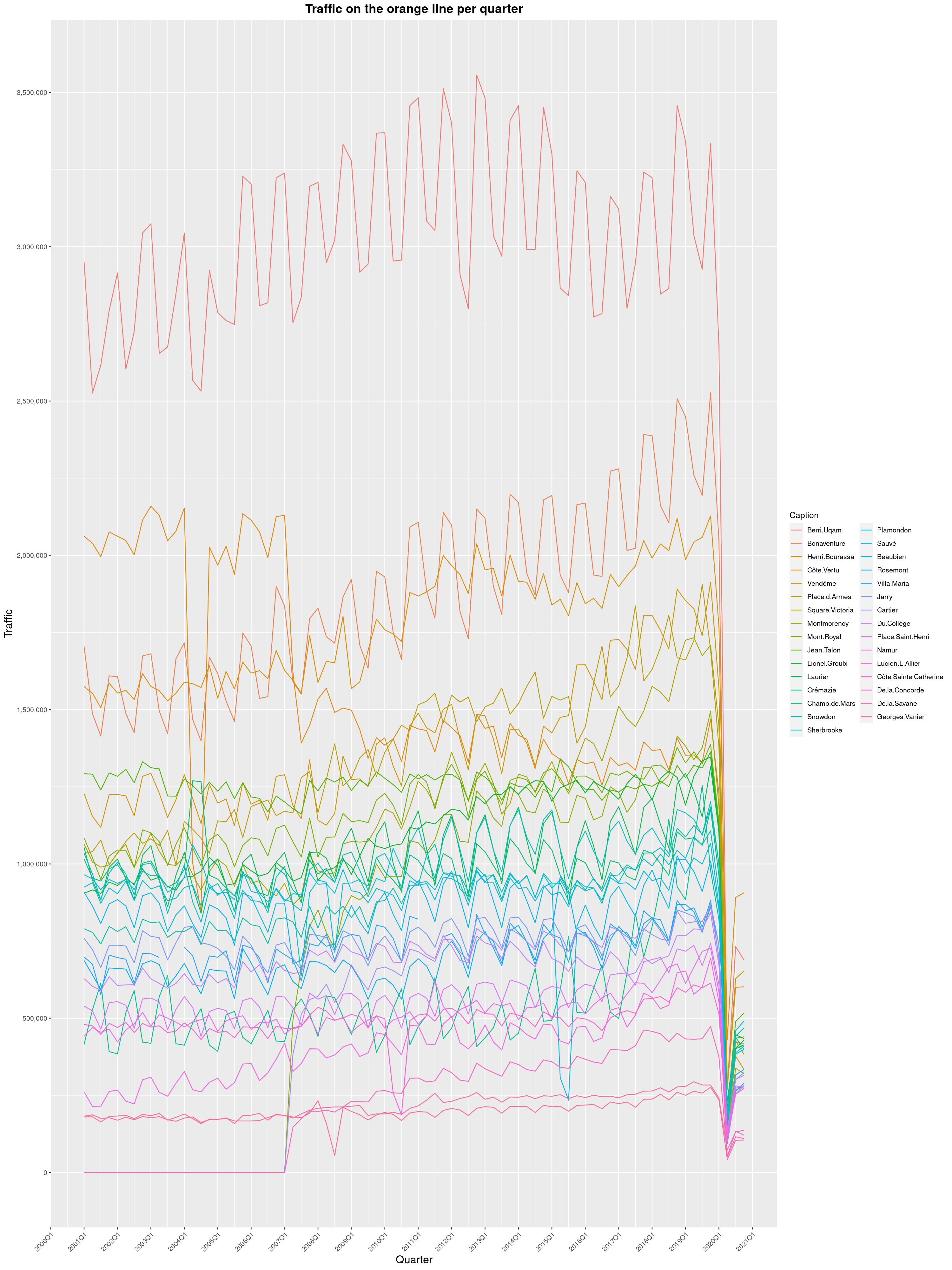
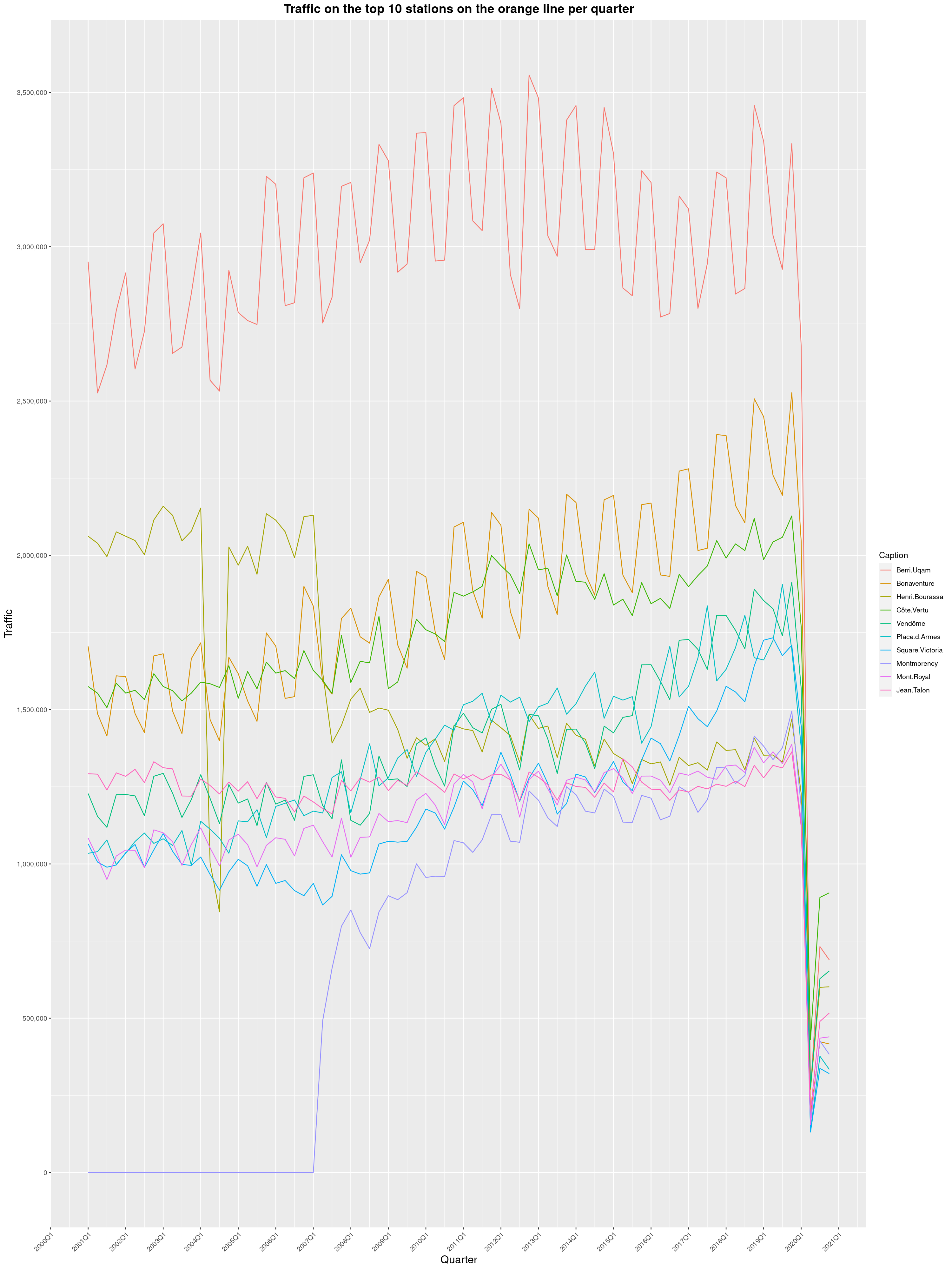
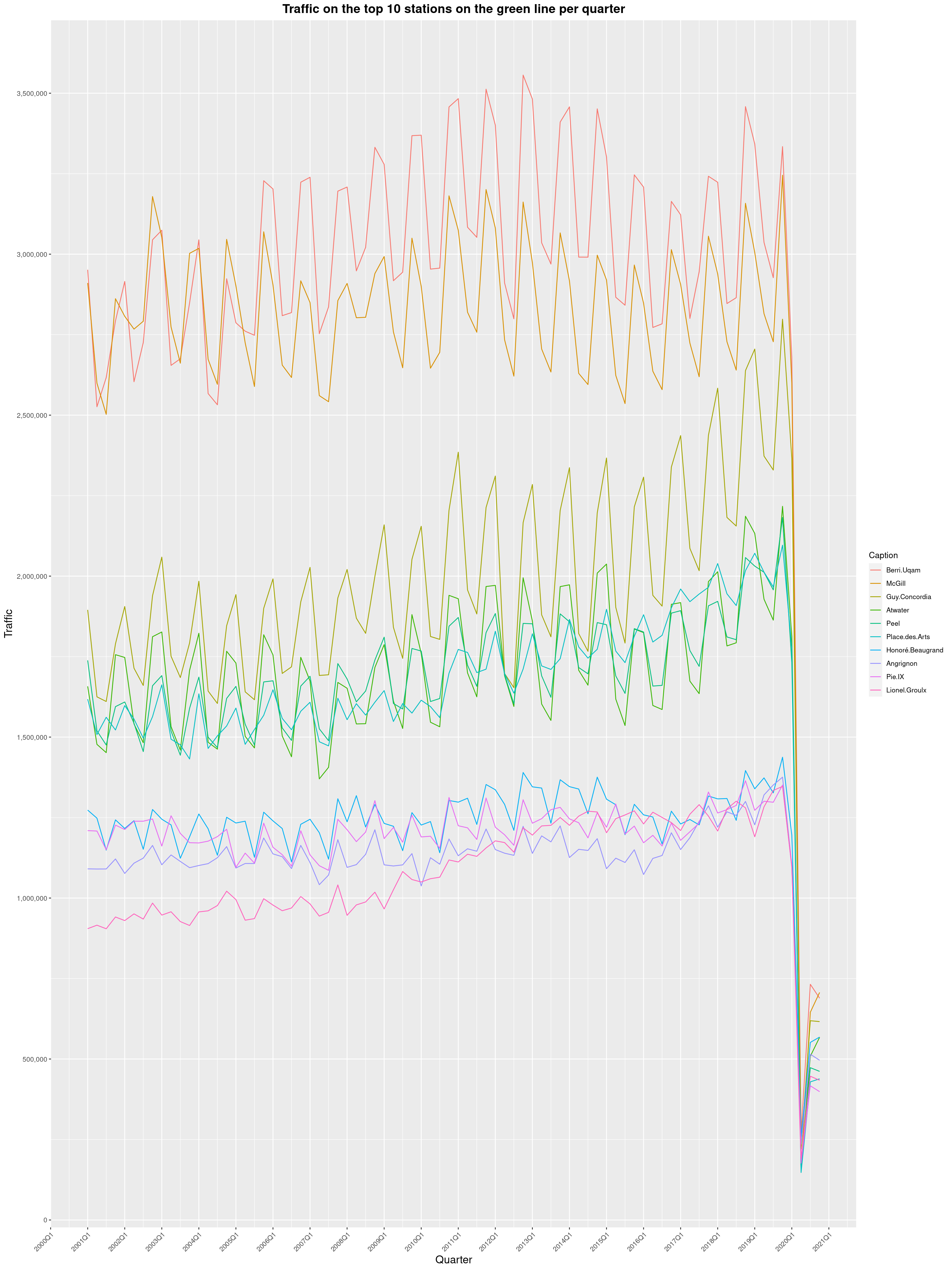
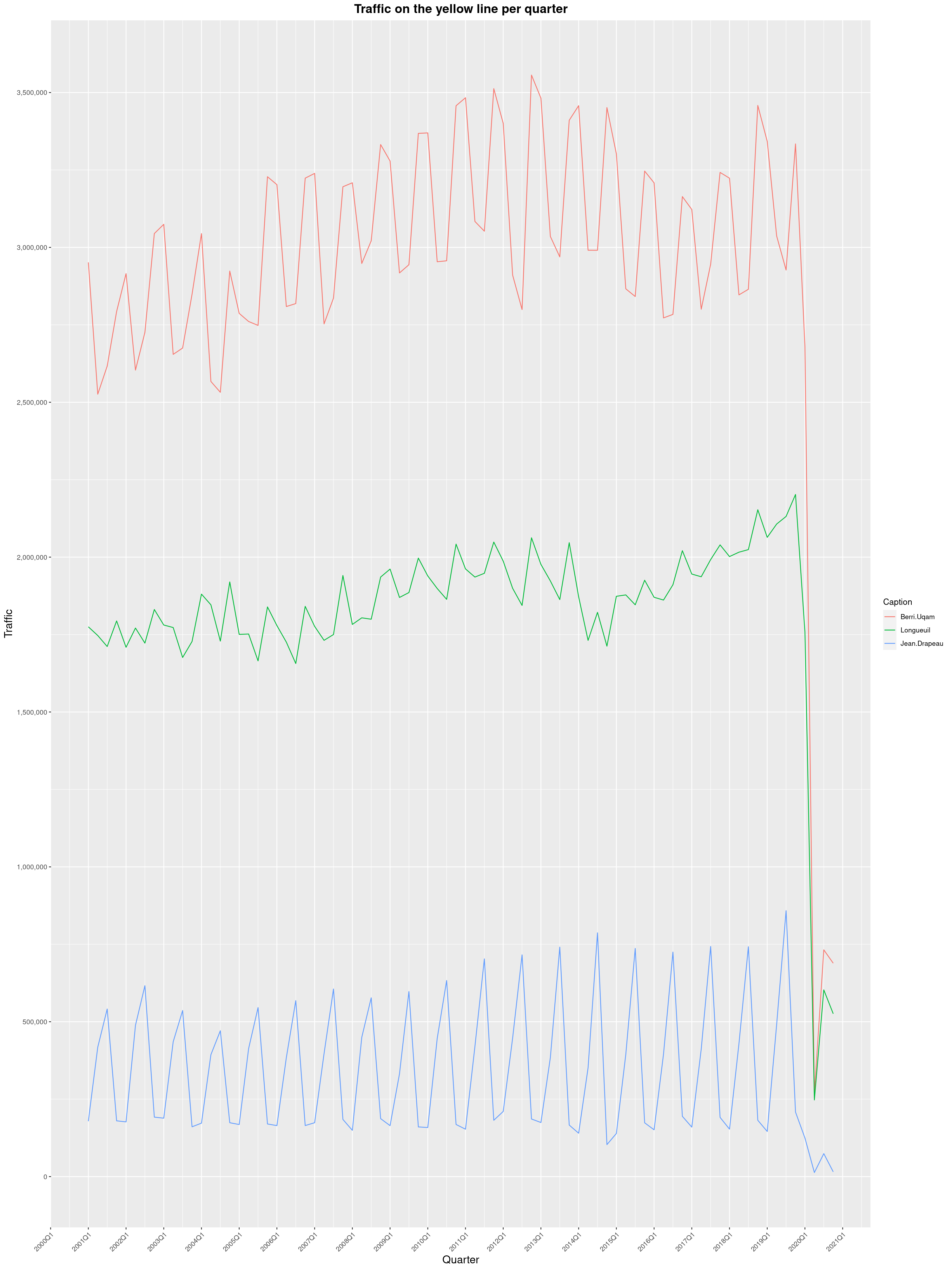
Louis-Philippe V ronneau: Montreal Subway Foot Traffic Data, Revisited

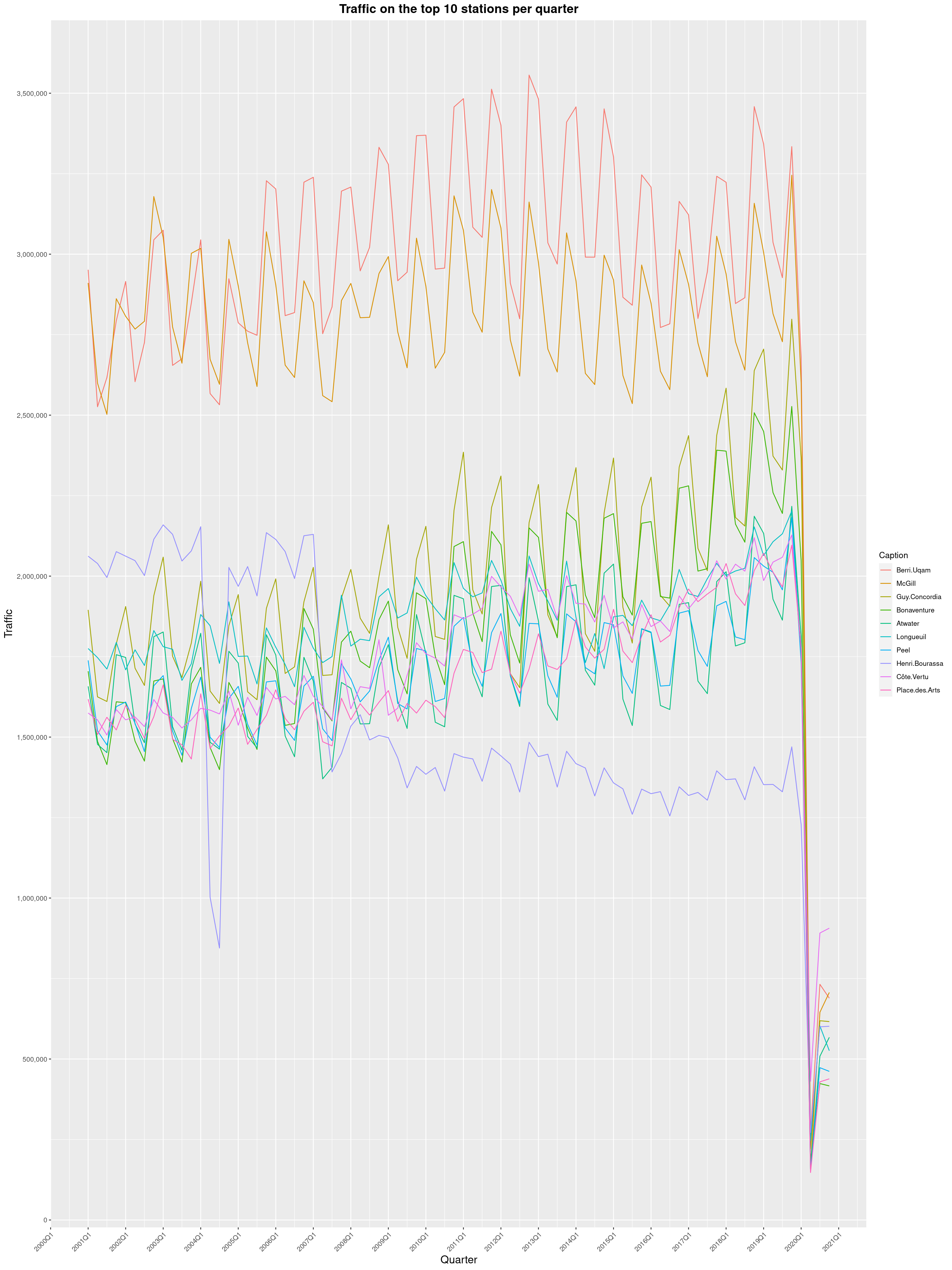
In 2019, I got curious and asked Soci t de Transport de Montr al, Montreal's transit agency, for the foot traffic data of Montreal's subway. Since then, two years has passed and with COVID-19 still going strong, I wanted to see what impact the pandemic had had. And oh boy, what an impact it is. So here it is, data from 2001 to 2020, graphed the same way as in the original 2019 blog post. I could certainly juice this data, graph the pandemic using daily figures and come up with a long and interesting blog post analysing the main trends. I start teaching next Monday though and I still have prep work to do, so I'll leave that to someone else. By clicking on a subway station, you'll be redirected to a graph of the station's foot traffic. Interactive Map of Montreal's Subway Licences

18 January 2021

Evgeni Golov: building a simple KVM switch for 30

Prompted by tweets from Lesley and Dave, I thought about KVM switches again and came up with a rather cheap solution to my individual situation (YMMY, as usual). As I've written last year, my desk has one monitor, keyboard and mouse and two computers. Since writing that post I got a new (bigger) monitor, but also an USB switch again (a DIGITUS USB 3.0 Sharing Switch) - this time one that doesn't freak out my dock \o/ However, having to switch the used computer in two places (USB and monitor) is rather inconvenient, but also getting an KVM switch that can do 4K@60Hz was out of question. Luckily, hackers gonna hack, everything, and not only receipt printers ( ). There is a tool called ddcutil that can talk to your monitor and change various settings. And udev can execute commands when (USB) devices connect You see where this is going? After installing the package (available both in Debian and Fedora), we can inspect our system with ddcutil detect. You might have to load the i2c_dev module (thanks Philip!) before this works -- it seems to be loaded automatically on my Fedora, but you never know .
$ sudo ddcutil detect
Invalid display
   I2C bus:             /dev/i2c-4
   EDID synopsis:
      Mfg id:           BOE
      Model:
      Serial number:
      Manufacture year: 2017
      EDID version:     1.4
   DDC communication failed
   This is an eDP laptop display. Laptop displays do not support DDC/CI.
Invalid display
   I2C bus:             /dev/i2c-5
   EDID synopsis:
      Mfg id:           AOC
      Model:            U2790B
      Serial number:
      Manufacture year: 2020
      EDID version:     1.4
   DDC communication failed
Display 1
   I2C bus:             /dev/i2c-7
   EDID synopsis:
      Mfg id:           AOC
      Model:            U2790B
      Serial number:
      Manufacture year: 2020
      EDID version:     1.4
   VCP version:         2.2
The first detected display is the built-in one in my laptop, and those don't support DDC anyways. The second one is a ghost (see ddcutil#160) which we can ignore. But the third one is the one we can (and will control). As this is the only valid display ddcutil found, we don't need to specify which display to talk to in the following commands. Otherwise we'd have to add something like --display 1 to them. A ddcutil capabilities will show us what the monitor is capable of (or what it thinks, I've heard some give rather buggy output here) -- we're mostly interested in the "Input Source" feature (Virtual Control Panel (VCP) code 0x60):
$ sudo ddcutil capabilities
 
   Feature: 60 (Input Source)
      Values:
         0f: DisplayPort-1
         11: HDMI-1
         12: HDMI-2
 
Seems mine supports it, and I should be able to switch the inputs by jumping between 0x0f, 0x11 and 0x12. You can see other values defined by the spec in ddcutil vcpinfo 60 --verbose, some monitors are using wrong values for their inputs . Let's see if ddcutil getvcp agrees that I'm using DisplayPort now:
$ sudo ddcutil getvcp 0x60
VCP code 0x60 (Input Source                  ): DisplayPort-1 (sl=0x0f)
And try switching to HDMI-1 using ddcutil setvcp:
$ sudo ddcutil setvcp 0x60 0x11
Cool, cool. So now we just need a way to trigger input source switching based on some event There are three devices connected to my USB switch: my keyboard, my mouse and my Yubikey. I do use the mouse and the Yubikey while the laptop is not docked too, so these are not good indicators that the switch has been turned to the laptop. But the keyboard is! Let's see what vendor and product IDs it has, so we can write an udev rule for it:
$ lsusb
 
Bus 005 Device 006: ID 17ef:6047 Lenovo ThinkPad Compact Keyboard with TrackPoint
 
Okay, so let's call ddcutil setvcp 0x60 0x0f when the USB device 0x17ef:0x6047 is added to the system:
ACTION=="add", SUBSYSTEM=="usb", ATTR idVendor =="17ef", ATTR idProduct =="6047", RUN+="/usr/bin/ddcutil setvcp 0x60 0x0f"
$ sudo vim /etc/udev/rules.d/99-ddcutil.rules
$ sudo udevadm control --reload
And done! Whenever I connect my keyboard now, it will force my screen to use DisplayPort-1. On my workstation, I deployed the same rule, but with ddcutil setvcp 0x60 0x11 to switch to HDMI-1 and my cheap not-really-KVM-but-in-the-end-KVM-USB-switch is done, for the price of one USB switch (~30 ). Note: if you want to use ddcutil with a Lenovo Thunderbolt 3 Dock (or any other dock using Displayport Multi-Stream Transport (MST)), you'll need kernel 5.10 or newer, which fixes a bug that prevents ddcutil from talking to the monitor using I C.

9 January 2021

Louis-Philippe V ronneau: puppetserver 6: a Debian packaging post-mortem

I have been a Puppet user for a couple of years now, first at work, and eventually for my personal servers and computers. Although it can have a steep learning curve, I find Puppet both nimble and very powerful. I also prefer it to Ansible for its speed and the agent-server model it uses. Sadly, Puppet Labs hasn't been the most supportive upstream and tends to move pretty fast. Major versions rarely last for a whole Debian Stable release and the upstream .deb packages are full of vendored libraries.1 Since 2017, Apollon Oikonomopoulos has been the one doing most of the work on Puppet in Debian. Sadly, he's had less time for that lately and with Puppet 5 being deprecated in January 2021, Thomas Goirand, Utkarsh Gupta and I have been trying to package Puppet 6 in Debian for the last 6 months. With Puppet 6, the old ruby Puppet server using Passenger is not supported anymore and has been replaced by puppetserver, written in Clojure and running on the JVM. That's quite a large change and although puppetserver does reuse some of the Clojure libraries puppetdb (already in Debian) uses, packaging it meant quite a lot of work. Work in the Clojure team As part of my efforts to package puppetserver, I had the pleasure to join the Clojure team and learn a lot about the Clojure ecosystem. As I mentioned earlier, a lot of the Clojure dependencies needed for puppetserver were already in the archive. Unfortunately, when Apollon Oikonomopoulos packaged them, the leiningen build tool hadn't been packaged yet. This meant I had to rebuild a lot of packages, on top of packaging some new ones. Since then, thanks to the efforts of Elana Hashman, leiningen has been packaged and lets us run the upstream testsuites and create .jar artifacts closer to those upstream releases. During my work on puppetserver, I worked on the following packages:
List of packages
  • backport9
  • bidi-clojure
  • clj-digest-clojure
  • clj-helper
  • clj-time-clojure
  • clj-yaml-clojure
  • cljx-clojure
  • core-async-clojure
  • core-cache-clojure
  • core-match-clojure
  • cpath-clojure
  • crypto-equality-clojure
  • crypto-random-clojure
  • data-csv-clojure
  • data-json-clojure
  • data-priority-map-clojure
  • java-classpath-clojure
  • jnr-constants
  • jnr-enxio
  • jruby
  • jruby-utils-clojure
  • kitchensink-clojure
  • lazymap-clojure
  • liberator-clojure
  • ordered-clojure
  • pathetic-clojure
  • potemkin-clojure
  • prismatic-plumbing-clojure
  • prismatic-schema-clojure
  • puppetlabs-http-client-clojure
  • puppetlabs-i18n-clojure
  • puppetlabs-ring-middleware-clojure
  • puppetserver
  • raynes-fs-clojure
  • riddley-clojure
  • ring-basic-authentication-clojure
  • ring-clojure
  • ring-codec-clojure
  • shell-utils-clojure
  • ssl-utils-clojure
  • test-check-clojure
  • tools-analyzer-clojure
  • tools-analyzer-jvm-clojure
  • tools-cli-clojure
  • tools-reader-clojure
  • trapperkeeper-authorization-clojure
  • trapperkeeper-clojure
  • trapperkeeper-filesystem-watcher-clojure
  • trapperkeeper-metrics-clojure
  • trapperkeeper-scheduler-clojure
  • trapperkeeper-webserver-jetty9-clojure
  • url-clojure
  • useful-clojure
  • watchtower-clojure
If you want to learn more about packaging Clojure libraries and applications, I rewrote the Debian Clojure packaging tutorial and added a section about the quirks of using leiningen without a dedicated dh_lein tool. Work left to get puppetserver 6 in the archive Unfortunately, I was not able to finish the puppetserver 6 packaging work. It is thus unlikely it will make it in Debian Bullseye. If the issues described below are fixed, it would be possible to to package puppetserver in bullseye-backports though. So what's left? jruby Although I tried my best (kudos to Utkarsh Gupta and Thomas Goirand for the help), jruby in Debian is still broken. It does build properly, but the testsuite fails with multiple errors: jruby testsuite failures aside, I have not been able to use the jruby.deb the package currently builds in jruby-utils-clojure (testsuite failure). I had the same exact failure with the (more broken) jruby version that is currently in the archive, which leads me to think this is a LOAD_PATH issue in jruby-utils-clojure. More on that below. To try to bypass these issues, I tried to vendor jruby into jruby-utils-clojure. At first I understood vendoring meant including upstream pre-built artifacts (jruby-complete.jar) and shipping them directly. After talking with people on the #debian-mentors and #debian-ftp IRC channels, I now understand why this isn't a good idea (and why it's not permitted in Debian). Many thanks to the people who were patient and kind enough to discuss this with me and give me alternatives. As far as I now understand it, vendoring in Debian means "to have an embedded copy of the source code in another package". Code shipped that way still needs to be built from source. This means we need to build jruby ourselves, one way or another. Vendoring jruby in another package thus isn't terribly helpful. If fixing jruby the proper way isn't possible, I would suggest trying to build the package using embedded code copies of the external libraries jruby needs to build, instead of trying to use the Debian libraries.2 This should make it easier to replicate what upstream does and to have a final .jar that can be used. jruby-utils-clojure This package is a first-level dependency for puppetserver and is the glue between jruby and puppetserver. It builds fine, but the testsuite fails when using the Debian jruby package. I think the problem is caused by a jruby LOAD_PATH issue. The Debian jruby package plays with the LOAD_PATH a little to try use Debian packages instead of downloading gems from the web, as upstream jruby does. This seems to clash with the gem-home, gem-path, and jruby-load-path variables in the jruby-utils-clojure package. The testsuite plays around with these variables and some Ruby libraries can't be found. I tried to fix this, but failed. Using the upstream jruby-complete.jar instead of the Debian jruby package, the testsuite passes fine. This package could clearly be uploaded to NEW right now by ignoring the testsuite failures (we're just packaging static .clj source files in the proper location in a .jar). puppetserver jruby issues aside, packaging puppetserver itself is 80% done. Using the upstream jruby-complete.jar artifact, the testsuite fails with a weird Clojure error I'm not sure I understand, but I haven't debugged it for very long. Upstream uses git submodules to vendor puppet (agent), hiera (3), facter and puppet-resource-api for the testsuite to run properly. I haven't touched that, but I believe we can either: Without the testsuite actually running, it's hard to know what files are needed in those packages. What now Puppet 5 is now deprecated. If you or your organisation cares about Puppet in Debian,3 puppetserver really isn't far away from making it in the archive. Very talented Debian Developers are always eager to work on these issues and can be contracted for very reasonable rates. If you're interested in contracting someone to help iron out the last issues, don't hesitate to reach out via one of the following: As for I, I'm happy to say I got a new contract and will go back to teaching Economics for the Winter 2021 session. I might help out with some general Debian packaging work from time to time, but it'll be as a hobby instead of a job. Thanks The work I did during the last 6 weeks would be not have been possible without the support of the Wikimedia Foundation, who were gracious enough to contract me. My particular thanks to Faidon Liambotis, Moritz M hlenhoff and John Bond. Many, many thanks to Rob Browning, Thomas Goirand, Elana Hashman, Utkarsh Gupta and Apollon Oikonomopoulos for their direct and indirect help, without which all of this wouldn't have been possible.

  1. For example, the upstream package for the Puppet Agent vendors OpenSSL.
  2. One of the problems of using Ruby libraries already packaged in Debian is that jruby currently only supports Ruby 2.5. Ruby libraries in Debian are currently expected to work with Ruby 2.7, with the transition to Ruby 3.0 planned after the Bullseye release.
  3. If you run Puppet, you clearly should care: the .deb packages upstream publishes really aren't great and I would not recommend using them.

26 December 2020

Russ Allbery: Review: The Biggest Bluff

Review: The Biggest Bluff, by Maria Konnikova
Publisher: Penguin Press
Copyright: 2020
ISBN: 0-525-52263-8
Format: Kindle
Pages: 335
After a particularly unlucky year for her family, Maria Konnikova was reading about the balance between luck and control in life and discovered, to her surprise, that John von Neumann, one of the foundational thinkers of computer science, was fascinated by poker. He found most card games boring because they relied on luck. Poker, however, he thought was the perfect balance between luck and skill: enough skill to make its effect undeniable, but enough luck that one could not control the game fully regardless of skill. Konnikova decided on a research project: spend one year learning No Limit Texas Hold'em from one of the best poker players in the world, with a goal of competing in the World Series of Poker. She had studied the description-experience gap during her doctoral research in psychology and wanted to see if the experience of randomness in poker would teach her something the description of the randomness of life could not. Before starting this project, she didn't know the basic rules and had never watched a game. Erik Seidel agreed to mentor her, and The Biggest Bluff is her account of that experience. This book is simultaneously frustrating and fascinating in ways that I don't think can be untangled without making it a far different book. Fitting, I suppose, for a book about how our brains entangle luck and skill. First, if you're looking for a book about poker play, this is not one. Konnikova rarely talks about specific hands or tournaments in more detail than her overall trajectory. That was a disappointment. In the few places she does describe some of her betting decisions, analysis of the other players, and tournament strategy, her accounts are engrossing and suspenseful. I would have happily read a book chronicling her poker tournaments and the decisions she made, but this is not that book. What The Biggest Bluff is instead is a psychological and philosophical examination of the process of learning poker. Konnikova uses her experiences as launching points into philosophical digressions. Even the lessons that have limited surface utility outside of poker, such as learning to suppress body language to avoid giving away information, turn into digressions about interpersonal dynamics and personality types. There are interesting tidbits here, but I've read a lot of popular psychology and was more interested in the poker. My frequent reading experience was impatiently waiting for Konnikova to finish lecturing and get back to her narrative. What Konnikova does do though, at a level that I haven't seen before before in a book of this type, is be brutally honest about her mistakes and her learning process. And I do mean brutally: The book opens with her throwing up in a casino bathroom. (This is not a fun book to read if you don't like reading about stress reactions and medical problems. There aren't many of them, but they're... memorable.) Konnikova knows and can explain the psychological state she's trying to reach, but still finds it hard to do in the moment. Correctly reacting to probabilities, cutting losses, and neither being too over-confident or too scared is very hard. Most books of this type elide over the repeated failures in a sort of training montage, which makes the process look easier than it feels. Konnikova tries to realistically show the setbacks and failures, and I think succeeds. That relentless introspection and critical honesty is the best part of this book, but I think it's also behind the stream of consciousness digressions about psychology and philosophy. It's a true portrayal of how Konnikova makes sense of the world. A more polished and streamlined book about the poker would have been more dramatically engrossing, but it might have lost the deep examination of how she combines poker with her knowledge of psychology to change her thinking. The one place where I think that self-reflection may fall a bit short, which I want to mention because I thought it was a missed opportunity, is around knowledge of hand probabilities. Konnikova makes a point, early in the book, of not approaching poker through the memorization and mathematics route and instead trying to find a play style that focuses on analyzing the other players and controlling her own emotions. This is a good hook, but by the end of the book it's not entirely true. The point that I think she was trying to make is that her edge against other poker players at her same level comes more from psychology than from calculation of precise odds in rare situations. This is true. But by the time she reaches high levels of play, she is using statistical simulators, practice tools, and intensive study just like any professional poker player. There is a minimum level of pure knowledge and memorization required that cannot be avoided. It's clear from the few things she says about this that those tools became more interesting to her as she became better at poker, and I wish she would have dug more into why and how that happened. How much of her newfound ability to make decisions and stick to a plan comes from emotional changes, and how much from that background store of confident knowledge? Or maybe those are different ways of looking at the same change? I did appreciate Konnikova's explicit acknowledgment at the end of the book that poker did not, in the end, provide some deep insight into the balance of luck and skill in real life. Learning poker instead gave Konnikova more personal ability to make a plan for the things that she can control and let go of the things she can't. I'm glad that worked for her, but since reading this book I have noticed former poker players who think life is more knowable than it is. Poker combines random chance with psychological play against other people, but it does so in a way and to an extent that is quantifiable. You can make the correct play and still lose a hand, but you can also know when this has happened. When you're used to analyzing the world through that frame and real life fails to provide that certainty, it's tempting to impose it anyway and insist your simplified models are more accurate because they're more comprehensible. But poker is a game, not a model; being more predictable and more constrained than real life is part of what makes it fun. The skill that Konnikova learned from it has a potential downside that she doesn't talk about. I'm not sure how to sum up this book. Konnikova's internal analysis and honesty is truly admirable and illuminating, but it left me wanting to read a different book that was more focused on poker narration. I know there are lots of those books out there, but I doubt they would be written with Konnikova's self-awareness and lack of ego. However, they would probably also lack the moments that made me cringe or that were deeply uncomfortable to read. My feelings are mixed. But if you want popular psychology wrapped around a deeply honest account of the process of learning poker, I suspect this book is one of a kind. Rating: 7 out of 10

4 December 2020

Jonathan Dowland: Toronto

selfie skating at night
Nathan Phillips Square rink at night
view over Nathan Phillips Square rink
skaters by day
This time a year ago, I visited Toronto, Canada for my first (and hopefully not last) time, for the Red Hat Java team's face-to-face meetings. The hotel we were staying in was right next to Nathan Phillip's Square, which is an open-air Ice Rink for the winter months. I love Ice Skating and rarely took opportunities to do it (even before Covid-19) so I decided to take full advantage of the locality. Skating was free, but boot rental was not, so I bought some new skates. That meant an interesting problem getting them home on the plane. I think I got out there about 5 times over 5 days. It was busy during the day and very quiet at other times. 8am worked pretty well. My local Ice Rink has been intermittently open over the year as and when the Lockdown rules have allowed it, but the combination of cold air, indoor circulation and strenuous activity seem to me to be very unsafe, so I won't risk it. In Newcastle, the Centre for Life usually puts an outdoor rink on around Christmas, which is very expensive to skate on. Unfortunately they've decided against it this year. Toronto was great for more than just Ice Skating! I had a fantastic time meeting my team members; good food, good drink (especially Ice Wine); The CN Tower; a funky music instrument shop, and the first Teenage Engineering OP-1 I've ever seen in the flesh; not much Maple syrup, which surprised me. Good coffee. A comfortable-feeling city. It'll probably be a long while before I travel for work (or anything else) quite like this again. I'm glad to have made the most of it, whilst I could!
me, covered in snow

27 November 2020

Arturo Borrero Gonz lez: Netfilter virtual workshop 2020 summary

Netfilter logo Once a year folks interested in Netfilter technologies gather together to discuss past, ongoing and future works. The Netfilter Workshop is an opportunity to share and discuss new ideas, the state of the project, bring people together to work & hack and to put faces to people who otherwise are just email names. This is an event that has been happening since at least 2001, so we are talking about a genuine community thing here. It was decided there would be an online format, split in 3 short meetings, once per week on Fridays. I was unable to attend the first session on 2020-11-06 due to scheduling conflict, but I made it to the sessions on 2020-11-13 and 2020-11-20. I would say the sessions were joined by about 8 to 10 people, depending on the day. This post is a summary with some notes on what happened in this edition, with no special order. Pablo did the classical review of all the changes and updates that happened in all the Netfilter project software components since last workshop. I was unable to watch this presentation, so I have nothing special to comment. However, I ve been following the development of the project very closely, and there are several interesting things going on, some of them commented below. Florian Westphal brought to the table status on some open/pending work for mptcp option matching, systemd integration and finally interfacing from nft with cgroupv2. I was unable to participate in the talk for the first two items, so I cannot comment a lot more. On the cgroupv2 side, several options were evaluated to how to match them, identification methods, the hierarchical tree that cgroups present, etc. We will have to wait a bit more to see how the final implementation looks like. Also, Florian presented his concerns on conntrack hash collisions. There are no real-world known issues at the moment, but there is an old paper that suggests we should keep and eye on this and introduce improvements to prevent future DoS attack vectors. Florian mentioned these attacks are not practical at the moment, but who knows in a few years. He wants to explore introducing RB trees for conntrack. It will probably be a rbtree structure of hash tables in order to keep supporting parallel insertions. He was encouraged by others to go ahead and play/explore with this. Phil Sutter shared his past and future iptables development efforts. He highlighted fixed bugs and his short/midterm TODO list. I know Phil has been busy lately fixing iptables-legacy/iptables-nft incompatibilities. Basically addressing annoying bugs discovered by all ruleset managers out there (kubernetes, docker, openstack neutron, etc). Lots of work has been done to improve the situation; moreover I myself reported, or forwarded from the Debian bug tracker, several bugs. Anyway I was unable to attend this talk, only learnt a few bits in the following sessions, so I don t have a lot to comment here. But when I was fully present, I was asked by Phil about the status of netfilter components in Debian, and future plans. I shared my information. The idea for the next Debian stable release is to don t include iptables in the installer, and include nftables instead. Since Debian Buster, nftables is the default firewalling tool anyway. He shared the plans for the RedHat-related ecosystem, and we were able to confirm that we are basically in sync. Pablo commented on the latest Netfilter flowtable enhancements happening. Using the flowtable infrastructure, one can create kernel network bypasses to speed up packet throughput. The latest changes are aimed for bridge and VLAN enabled setups. The flowtable component will now know how to bypass in these 2 network architectures as well as the previously supported ingress hook. This is basically aimed for virtual machines and containers scenarios. There was some debate on use cases and supported setups. I commented that a bunch of virtual machines connected to a classic linux bridge and then doing NAT is basically what Openstack Neutron does, specifically in DVR setups. Same can be found in some container-based environments. Early/simple benchmarks done by Pablo suggest there could be huge performance improvements for those use cases. There was some inevitable comparison of this approach to what others, like DPDK/XDP can do. A point was raised about this being a more generic and operating system-integrated solution, which should make it more extensible and easier to use. flowtable for bridges Stefano Bravio commented on several open topics for nftables that he is interested on working on. One of them, issues related to concatenations + vmap issues. He also addressed concerns with people s expectations when migrating from ipset to nftables. There are several corner features in ipset that aren t currently supported in nftables, and we should document them. Stefano is also wondering about some tools to help in the migration. A translation layer like there is in place for iptables. Eric Gaver commented there are a couple of semantics that will not be suitable for translation, such as global sets, or sets of sets. But ipset is way simpler than iptables, so a translation mechanism should probably be created. In any case, there was agreement that anything that helps people migrate is more than welcome, even if it doesn t support 100% of the use cases. Stefano is planning to write documentation in the nftables wiki on how the pipapo algorithm works and the supported use cases. Other plans by Stefano include to work on some optimisations for faster matches. He mentioned using architecture specific instruction to speed up sets operations, like lookups. Finally, he commented that some folks working with eBPF have showed interest in reusing some parts of the nftables sets infrastructure (pipapo) because they have detected performance issues in their own data structures in some cases. It is not clear how to best achieve it, how to better bridge the two things together. Probably the ideal is to generalize the pipapo data structures and integrate it into the generic bitmap library or something which can be used by anyone. Anyway, he hopes to get some more time to focus on Netfilter stuff begining with the next year, in a couple of months. Moving a bit away from the pure software development topics, Pablo commented on the netfilter.org infrastructure. Right now the servers are running on gandi.net, on virtual machines that are being basically donated to us. He pointed that the plan is to simplify the infrastructure. For that reason, for example, FTP services has been shut down. Rsync services have been shut down as well, so basically we no longer have a mirrors infrastructure. The bugzilla and wikis we have need some attention, given they are old software pieces, and we need to migrate them to be more modern. Finally, the new logo that was created was presented. Later on, we spent a good chunk of the meeting discussing options on how to address the inevitable iptables deprecation situation. There are some open questions, and we discussed several approaches. From doing nothing at all, which means keeping the current status-quo, to setting a deadline date for the deprecation like the python community did with python2. I personally like this deadline idea, but it is perceived like a negative push by other. We all agree that the current do nothing approach is not sustainable either. Probably the way to go is basically to be more informative. We need to clearly communicate that choosing iptables for anything in 2020 is a bad idea. There are additional initiatives to help on this topic, without being too aggressive. A FAQ will probably be introduced. Eric Garver suggested we should bring nftables front and center. Given the website still mentions iptables everywhere, we will probably refresh the web content, introduce additional informative banners and similar things. There was an interesting talk on the topic of nft table ownership. The idea is to attach a table, and all the child objects, to a process. Then, we prevent any modifications to the table or the child objects by external entities. Basically, allocating and locking a table for a certain netlink socket. This is a nice way for ruleset managers, like firewalld, to ensure they have full control of what s happening to their ruleset, reducing the chances for ending with an inconsistent configuration. There is a proof-of-concept patch by Pablo to support this, and Eric mentioned he is pretty much interested in any improvements to support this use case. The final time block in the final session day was dedicated to talk about the next workshop. We are all very happy we could meet. Meeting virtually is way easier (and cheaper) than in person. Perhaps we can make it online every 3 or 6 months instead of, or in addition to, one big annual physical event. We will see what happens next year. That s all on my side!
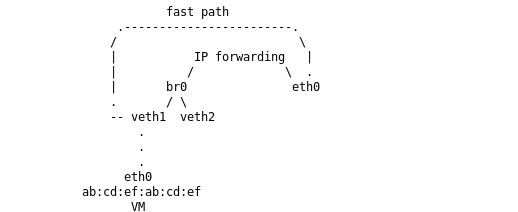
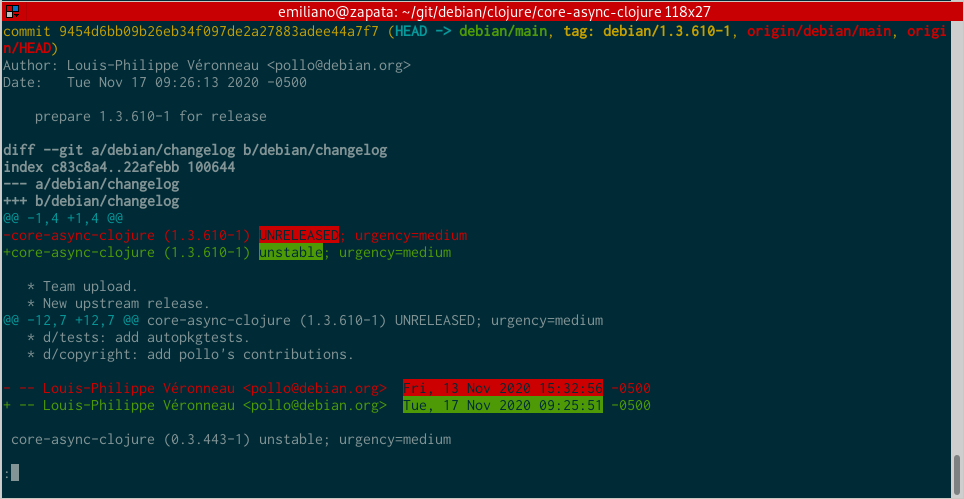
17 November 2020

Louis-Philippe V ronneau: A better git diff

A few days ago I wrote a quick patch and missed a dumb mistake that made the program crash. When reviewing the merge request on Salsa, the problem became immediately apparent; Gitlab's diff is much better than what git diff shows by default in a terminal. Well, it turns out since version 2.9, git bundles a better pager, diff-highlight. la Gitlab, it will highlight what changed in the line. The output of git diff using diff-highlight Sadly, even though diff-highlight comes with the git package in Debian, it is not built by default (925288). You will need to:
$ sudo make --directory /usr/share/doc/git/contrib/diff-highlight
You can then add this line to your .gitconfig file:
[core]
  pager = /usr/share/doc/git/contrib/diff-highlight/diff-highlight   less --tabs=4 -RFX
If you use tig, you'll also need to add this line in your tigrc:
set diff-highlight = /usr/share/doc/git/contrib/diff-highlight/diff-highlight

6 November 2020

Louis-Philippe V ronneau: Book Review: Working in Public by Nadia Eghbal

I have a lot of respect for Nadia Eghbal, partly because I can't help to be jealous of her work on the economics of Free Software1. If you are not already familiar with Eghbal, she is the author of Roads and Bridges: The Unseen Labor Behind Our Digital Infrastructure, a great technical report published for the Ford Foundation in 2016. You may also have caught her excellent keynote at LCA 2017, entitled Consider the Maintainer. Her latest book, Working in Public: The Making and Maintenance of Open Source Software, published by Stripe Press a few months ago, is a great read and if this topic interests you, I highly recommend it. The book itself is simply gorgeous; bright orange, textured hardcover binding, thick paper, wonderful typesetting it has everything to please. Well, nearly everything. Sadly, it is only available on Amazon, exclusively in the United States. A real let down for a book on Free and Open Source Software. The book is divided in five chapters, namely:
  1. Github as a Platform
  2. The Structure of an Open Source Project
  3. Roles, Incentives and Relationships
  4. The Work Required by Software
  5. Managing the Costs of Production
A picture of the book cover Contrary to what I was expecting, the book feels more like an extension of the LCA keynote I previously mentioned than Roads and Bridges. Indeed, as made apparent by the following quote, Eghbal doesn't believe funding to be the primary problem of FOSS anymore:

We still don't have a common understanding about who's doing the work, why they do it, and what work needs to be done. Only when we understand the underlying behavioral dynamics of open source today, and how it differs from its early origins, can we figure out where money fits in. Otherwise, we're just flinging wet paper towels at a brick wall, hoping that something sticks. p.184
That is to say, the behavior of maintainers and the challenges they face not the eternal money problem is the real topic of this book. And it feels refreshing. When was the last time you read something on the economics of Free Software without it being mostly about what licences projects should pick and how business models can be tacked on them? I certainly can't. To be clear, I'm not sure I agree with Eghbal on this. Her having worked at Github for a few years and having interviewed mostly people in the Ruby on Rails and Javascript communities certainly shows in the form of a strong selection bias. As she herself admits, this is a book on how software on Github is produced. As much as this choice irks me (the Free Software community certainly cannot be reduced to Github), this exercise had the merit of forcing me to look at my own selection biases. As such, reading Working in Public did to me something I wasn't expecting it to do: it broke my Free Software echo chamber. Although I consider myself very familiar with the world of Free and Open Source Software, I now understand my somewhat ill-advised contempt for certain programming languages mostly JS skewed my understanding of what FOSS in 2020 really is. My Free Software world very much revolves around Debian, a project with a strong and opinionated view of Free Software, rooted in a historical and political understanding of the term. This, Eghbal argues, is not the case for a large swat of developers anymore. They are The Github Generation, people attached to Github as a platform first and foremost, and who feel "Open Source" is just a convenient way to make things. Although I could intellectualise this, before reading the book, I didn't really grok how communities akin to npm have been reshaping the modern FOSS ecosystem and how different they are from Debian itself. To be honest, I am not sure I like this tangent and it is certainly part of the reason why I had a tendency to dismiss it as a fringe movement I could safely ignore. Thanks to Nadia Eghbal, I come out of this reading more humble and certainly reminded that FOSS' heterogeneity is real and should not be idly dismissed. This book is rich in content and although I could go on (my personal notes clock-in at around 2000 words and I certainly disagree with a number of things), I'll stop here for now. Go and grab a copy already!

  1. She insists on using the term open source, but I won't :)

19 October 2020

Louis-Philippe V ronneau: Musings on long-term software support and economic incentives

Although I still read a lot, during my college sophomore years my reading habits shifted from novels to more academic works. Indeed, reading dry textbooks and economic papers for classes often kept me from reading anything else substantial. Nowadays, I tend to binge read novels: I won't touch a book for months on end, and suddenly, I'll read 10 novels back to back1. At the start of a novel binge, I always follow the same ritual: I take out my e-reader from its storage box, marvel at the fact the battery is still pretty full, turn on the WiFi and check if there are OS updates. And I have to admit, Kobo Inc. (now Rakuten Kobo) has done a stellar job of keeping my e-reader up to date. I've owned this model (a Kobo Aura 1st generation) for 7 years now and I'm still running the latest version of Kobo's Linux-based OS. Having recently had trouble updating my Nexus 5 (also manufactured 7 years ago) to Android 102, I asked myself:
Why is my e-reader still getting regular OS updates, while Google stopped issuing security patches for my smartphone four years ago?
To try to answer this, let us turn to economic incentives theory. Although not the be-all and end-all some think it is3, incentives theory is not a bad tool to analyse this particular problem. Executives at Google most likely followed a very business-centric logic when they decided to drop support for the Nexus 5. Likewise, Rakuten Kobo's decision to continue updating older devices certainly had very little to do with ethics or loyalty to their user base. So, what are the incentives that keep Kobo updating devices and why are they different than smartphone manufacturers'? A portrait of the current long-term software support offerings for smartphones and e-readers Before delving deeper in economic theory, let's talk data. I'll be focusing on 2 brands of e-readers, Amazon's Kindle and Rakuten's Kobo. Although the e-reader market is highly segmented and differs a lot based on geography, Amazon was in 2015 the clear worldwide leader with 53% of the worldwide e-reader sales, followed by Rakuten Kobo at 13%4. On the smartphone side, I'll be differentiating between Apple's iPhones and Android devices, taking Google as the barometer for that ecosystem. As mentioned below, Google is sadly the leader in long-term Android software support. Rakuten Kobo According to their website and to this Wikipedia table, the only e-readers Kobo has deprecated are the original Kobo eReader and the Kobo WiFi N289, both released in 2010. This makes their oldest still supported device the Kobo Touch, released in 2011. In my book, that's a pretty good track record. Long-term software support does not seem to be advertised or to be a clear selling point in their marketing. Amazon According to their website, Amazon has dropped support for all 8 devices produced before the Kindle Paperwhite 2nd generation, first sold in 2013. To put things in perspective, the first Kindle came out in 2007, 3 years before Kobo started selling devices. Like Rakuten Kobo, Amazon does not make promises of long-term software support as part of their marketing. Apple Apple has a very clear software support policy for all their devices:
Owners of iPhone, iPad, iPod or Mac products may obtain a service and parts from Apple or Apple service providers for five years after the product is no longer sold or longer, where required by law.
This means in the worst-case scenario of buying an iPhone model just as it is discontinued, one would get a minimum of 5 years of software support. Android Google's policy for their Android devices is to provide software support for 3 years after the launch date. If you buy a Pixel device just before the new one launches, you could theoretically only get 2 years of support. In 2018, Google decided OEMs would have to provide security updates for at least 2 years after launch, threatening not to license Google Apps and the Play Store if they didn't comply. A question of cost structure From the previous section, we can conclude that in general, e-readers seem to be supported longer than smartphones, and that Apple does a better job than Android OEMs, providing support for about twice as long. Even Fairphone, who's entire business is to build phones designed to last and to be repaired was not able to keep the Fairphone 1 (2013) updated for more than a couple years and seems to be struggling to keep the Fairphone 2 (2015) running an up to date version of Android. Anyone who has ever worked in IT will tell you: maintaining software over time is hard work and hard work by specialised workers is expensive. Most commercial electronic devices are sold and developed by for-profit enterprises and software support all comes down to a question of cost structure. If companies like Google or Fairphone are to be expected to provide long-term support for the devices they manufacture, they have to be able to fund their work somehow. In a perfect world, people would be paying for the cost of said long-term support, as it would likely be cheaper then buying new devices every few years and would certainly be better for the planet. Problem is, manufacturers aren't making them pay for it. Economists call this type of problem externalities: things that should be part of the cost of a good, but aren't for one a reason or another. A classic example of an externality is pollution. Clearly pollution is bad and leads to horrendous consequences, like climate change. Sane people agree we should drastically cut our greenhouse gas emissions, and yet, we aren't. Neo-classical economic theory argues the way to fix externalities like pollution is to internalise these costs, in other words, to make people pay for the "real price" of the goods they buy. In the case of climate change and pollution, neo-classical economic theory is plain wrong (spoiler alert: it often is), but this is where band-aids like the carbon tax comes from. Still, coming back to long-term software support, let's see what would happen if we were to try to internalise software maintenance costs. We can do this multiple ways. 1 - Include the price of software maintenance in the cost of the device This is the choice Fairphone makes. This might somewhat work out for them since they are a very small company, but it cannot scale for the following reasons:
  1. This strategy relies on you giving your money to an enterprise now, and trusting them to "Do the right thing" years later. As the years go by, they will eventually look at their books, see how much ongoing maintenance is costing them, drop support for the device, apologise and move on. That is to say, enterprises have a clear economic incentive to promise long-term support and not deliver. One could argue a company's reputation would suffer from this kind of behaviour. Maybe sometime it does, but most often people forget. Political promises are a great example of this.
  2. Enterprises go bankrupt all the time. Even if company X promises 15 years of software support for their devices, if they cease to exist, your device will stop getting updates. The internet is full of stories of IoT devices getting bricked when the parent company goes bankrupt and their servers disappear. This is related to point number 1: to some degree, you have a disincentive to pay for long-term support in advance, as the future is uncertain and there are chances you won't get the support you paid for.
  3. Selling your devices at a higher price to cover maintenance costs does not necessarily mean you will make more money overall raising more money to fund maintenance costs being the goal here. To a certain point, smartphone models are substitute goods and prices higher than market prices will tend to drive consumers to buy cheaper ones. There is thus a disincentive to include the price of software maintenance in the cost of the device.
  4. People tend to be bad at rationalising the total cost of ownership over a long period of time. Economists call this phenomenon hyperbolic discounting. In our case, it means people are far more likely to buy a 500$ phone each 3 years than a 1000$ phone each 10 years. Again, this means OEMs have a clear disincentive to include the price of long-term software maintenance in their devices.
Clearly, life is more complex than how I portrayed it: enterprises are not perfect rational agents, altruism exists, not all enterprises aim solely for profit maximisation, etc. Still, in a capitalist economy, enterprises wanting to charge for software maintenance upfront have to overcome these hurdles one way or another if they want to avoid failing. 2 - The subscription model Another way companies can try to internalise support costs is to rely on a subscription-based revenue model. This has multiple advantages over the previous option, mainly:
  1. It does not affect the initial purchase price of the device, making it easier to sell them at a competitive price.
  2. It provides a stable source of income, something that is very valuable to enterprises, as it reduces overall risks. This in return creates an incentive to continue providing software support as long as people are paying.
If this model is so interesting from an economic incentives point of view, why isn't any smartphone manufacturer offering that kind of program? The answer is, they are, but not explicitly5. Apple and Google can fund part of their smartphone software support via the 30% cut they take out of their respective app stores. A report from Sensor Tower shows that in 2019, Apple made an estimated US$ 16 billion from the App Store, while Google raked in US$ 9 billion from the Google Play Store. Although the Fortune 500 ranking tells us this respectively is "only" 5.6% and 6.5% of their gross annual revenue for 2019, the profit margins in this category are certainly higher than any of their other products. This means Google and Apple have an important incentive to keep your device updated for some time: if your device works well and is updated, you are more likely to keep buying apps from their store. When software support for a device stops, there is a risk paying customers will buy a competitor device and leave their ecosystem. This also explains why OEMs who don't own app stores tend not to provide software support for very long periods of time. Most of them only make money when you buy a new phone. Providing long-term software support thus becomes a disincentive, as it directly reduces their sale revenues. Same goes for Kindles and Kobos: the longer your device works, the more money they make with their electronic book stores. In my opinion, it's likely Amazon and Rakuten Kobo produce quarterly cost-benefit reports to decide when to drop support for older devices, based on ongoing support costs and the recurring revenues these devices bring in. Rakuten Kobo is also in a more precarious situation than Amazon is: considering Amazon's very important market share, if your device stops getting new updates, there is a greater chance people will replace their old Kobo with a Kindle. Again, they have an important economic incentive to keep devices running as long as they are profitable. Can Free Software fix this? Yes and no. Free Software certainly isn't a magic wand one can wave to make everything better, but does provide major advantages in terms of security, user freedom and sometimes costs. The last piece of the puzzle explaining why Rakuten Kobo's software support is better than Google's is technological choices. Smartphones are incredibly complex devices and have become the main computing platform of many. Similar to the web, there is a race for features and complexity that tends to create bloat and make older devices slow and painful to use. On the other hand, e-readers are simpler devices built for a single task: display electronic books. Control over the platform is also a key aspect of the cost structure of providing software updates. Whereas Apple controls both the software and hardware side of iPhones, Android is a sad mess of drivers and SoCs, all providing different levels of support over time6. If you take a look at the platforms the Kindle and Kobo are built on, you'll quickly see they both use Freescale I.MX SoCs. These processors are well known for their excellent upstream support in the Linux kernel and their relative longevity, chips being produced for either 10 or 15 years. This in turn makes updates much easier and less expensive to provide. So clearly, open architectures, free drivers and open hardware helps tremendously, but aren't enough on their own. One of the lessons we must learn from the (amazing) LineageOS project is how lack of funding hurts everyone. If there is no one to do the volunteer work required to maintain a version of LOS for your device, it won't be supported. Worse, when purchasing a new device, users cannot know in advance how many years of LOS support they will get. This makes buying new devices a frustrating hit-and-miss experience. If you are lucky, you will get many years of support. Otherwise, you risk your device becoming an expensive insecure paperweight. So how do we fix this? Anyone with a brain understands throwing away perfectly good devices each 2 years is not sustainable. Government regulations enforcing a minimum support life would be a step in the right direction, but at the end of the day, Capitalism is to blame. Like the aforementioned carbon tax, band-aid solutions can make things somewhat better, but won't fix our current economic system's underlying problems. For now though, I'll leave fixing the problem of Capitalism to someone else.

  1. My most recent novel binge has been focused on re-reading the Dune franchise. I first read the 6 novels written by Frank Herbert when I was 13 years old and only had vague and pleasant memories of his work. Great stuff.
  2. I'm back on LineageOS! Nice folks released an unofficial LOS 17.1 port for the Nexus 5 last January and have kept it updated since then. If you are to use it, I would also recommend updating TWRP to this version specifically patched for the Nexus 5.
  3. Very few serious economists actually believe neo-classical rational agent theory is a satisfactory explanation of human behavior. In my opinion, it's merely a (mostly flawed) lens to try to interpret certain behaviors, a tool amongst others that needs to be used carefully, preferably as part of a pluralism of approaches.
  4. Good data on the e-reader market is hard to come by and is mainly produced by specialised market research companies selling their findings at very high prices. Those particular statistics come from a MarketWatch analysis.
  5. If they were to tell people: You need to pay us 5$/month if you want to receive software updates, I'm sure most people would not pay. Would you?
  6. Coming back to Fairphones, if they had so much problems providing an Android 9 build for the Fairphone 2, it's because Qualcomm never provided Android 7+ support for the Snapdragon 801 SoC it uses.

8 October 2020

Molly de Blanc: COVID and Reflections on Jessica Flanigan

One of the points Flanigan makes in her piece Seat Belt Mandates and Paternalism is that we re conditioned to use seat belts from a very early age. It s a thing we internalize and build into our understanding of the world. People feel bad when they don t wear a seat belt.(1) They re unsettled. They feel unsafe. They feel like they re doing something wrong. Masks have started to fit into this model as well. Not wearing a mask feels wrong. An acquaintance shared a story of crying after realizing they had left the house without a mask. For some people, mask wearing has been deeply internalized. We have regular COVID tests at NYU. Every other week I spit into a tube and then am told whether I am safe or sick. This allows me to hang out with my friends more confident than I would feel otherwise. This allows me to be closer to people than I would be otherwise. It also means that if I got sick, I would know, even if I was asymptomatic. If this happened, I would need to tell my friends. I would trace the places I ve been, the people I ve seen, and admit to them that I got sick. I would feel shame because something I did put me in that position. There were (are?) calls to market mask wearing and COVID protection with the same techniques we use around sex: wear protection, get tested, think before you act, ask consent before touching, be honest and open with the people around you about your risk factors. This is effective, at least among a swath of the population, but COVID has effectively become another STD. It s a socially transmitted disease that we have tabooified into creating shame in people who have it. The problem with this is, of course, that COVID isn t treatable in the same way syphilis and chlamydia are. Still, I would ask whether people don t report, or get tested, or even wear masks, because of shame? In some communities, wearing a mask is a sign that you re sick. It s stigmatizing.(2) I think talking about COVID the way we talk about sex is not the right approach because, in my experience, the ways I learned about sex were everything from factually wrong to deeply harmful. If what we re doing doesn t work, what does? (1) Yes, I know not everyone. (2) Many men who don t wear masks cite it as feeling emasculating, rather than stigmatizing.

6 October 2020

Iustin Pop: Late report for Nationalpark Bike Marathon 2020

I don t have to mention that 2020 is a special year, so all the normal race plan was out the window, and I was very happy and fortunate to be able to do even one race. And only delayed 3 weeks to write this race report :/ So, here s the story

Preparing for the race Because it was a special year, and everything was crazy, I actually managed to do more sports than usual, at least up to end of July. So my fitness, and even body weight, was relatively fine, so I subscribed to the mid-distance race (official numbers: 78km distance, 1570 meters altitude), and then off it went to a proper summer vacation in a hotel, even. And while I did do some bike rides during that vacation, from then on my training regime went just off? I did train, I did ride, I did get significant PRs, but it didn t click anymore. Plus, due to well, actually not sure what, work or coffee or something my sleep regime also got completely ruined On top of that, I didn t think about the fact that the race was going to be mid-September, and that high up in the mountains, the weather could have be bad enough (I mean, in 2018 the weather was really bad even in August ) such that I d need to seriously think about clothing.

Race week I arrive in Scuol two days before the race, very tired (I think I got only 6 hours of sleep the night before), and definitely not in a good shape. I was feeling bad enough that I was not quite sure I was going to race. At least weather was OK, such that normal summer clothing would suffice. But the race info was mentioning dangerous segments, to be very careful, etc. etc. so I was quite anxious. Note 1: my wife says, this was not the first time, and likely not the last time that two days before the race I feel like quitting. And as I m currently on-and-off reading the interesting The Brave Athlete: Calm the Fuck Down and Rise to the Occasion book (by Lesley Paterson and Simon Marshall; it s an interesting book, not sure if I recommend it or not), I am beginning to think that this is my reaction to races where I have overshot my usual distance. Or, in general, races where I fear the altitude gain. Not quite sure, but I think it is indeed the actual cause. So I spend Thursday evening feeling unwell, and thinking I ll see how Friday goes. Friday comes, and having slept reasonably well entire night, I pick up my race number, then I take another nap in the afternoon - in total, I ve slept around 13 hours that day. So I felt much better, and was looking forward to the race. Saturday morning comes, I manage to wake up early, and get ready in time; almost didn t panic at all that I m going to be late. Note 2: my wife also says that this is the usual way I behave. Hence, it must be most of it a mental issue, rather than real physical one

Race I reach the train station in time, I get on the train, and by the time the train reached Zernez, I fully calm down. There was am entire hour wait though before the race, and it was quite chilly. Of course I didn t bring anything beside what I was wearing, relying on temperature getting better later in the day. During the wait, there were two interesting things happening. First, we actually got there (in Zernez) before the first people from the long distance passed by, both men and women. Seeing them pass by was cool, thinking they already had ~1 200m altitude in just 30-ish kilometres. The second thing was, as this was the middle and not the shortest distance, the people in the group looked differently than in previous years. More precisely, they were looking very fit, and I was feeling fat. Well, I am overweight, so it was expected, but I was feeling it even more than usual. I think only one or two in ten people were looking as fit as me or less And of course, the pictures post-race show me even less fit-looking than I thought. Ah, self-deception is a sweet thing And yes, we all had to wear masks, up until the last minute. It was interesting, but not actually annoying - and small enough price for being able to race! Then the race starts, and as opposed to many other years, it starts slow. I didn t feel that rush of people starting fast, it was reasonable?

First part of the race (good) Thus started the first part of the race, on a new route that I was unfamiliar with. There was not too much climbing, to be honest, and there was some tricky single-trail through the woods, with lots of the roots. I actually had to get off the bike and push it, since it was too difficult to pedal uphill on that path. Other than that, I was managing so far to adjust my efforts well enough that my usual problems related to climbing (lower back pain) didn t yet appear, even as the overall climbed meters were increasing. I was quite happy at that, and had lots of reserves. To my (pleasant) surprise, two positive things happened:
  • I was never alone, a sign that I wasn t too far back.
  • I was passing/being passed by people, both on climbs but also on descents! It s rare, but I did overtake a few people on a difficult trail downhill.
With all the back and forth, a few people became familiar (or at least their kit), and it was fun seeing who is better uphill vs. downhill.

And second part (not so good) I finally get to (around) S-chanf, on a very nice but small descent, and on flat roads, and start the normal route for the short race. Something was off though - I knew from past years that these last ~47km have around 700-800m altitude, but I had already done around 1000m. So the promised 1571m were likely to be off, by at least 100-150m. I set myself a new target of 1700m, and adjust my efforts based on that. And then, like clockwork on the 3:00:00 mark, the route exited the forest, the sun got out of the clouds, and the temperature started to increase from 16-17 C to 26 +, with peaks of 31 C. I m not joking: at 2:58:43, temp was 16 , at 3:00:00, it was 18 , at 3:05:45, it was 26 . Heat and climbing are my two nemeses, and after having a pretty good race for the first 3 hours and almost exactly 1200m of climbing, I started feeling quite miserable. Well, it was not all bad. There were some nice stretches of flat, where I knew I can pedal strongly and keep up with other people, until my chain dropped, so I had to stop, re-set it, and lose 2 minutes. Sigh. But, at least, I was familiar with this race, or so I thought. I completely mis-remembered the last ~20km as a two-punch climb, Guarda and Ftan, whereas it is actually a three-punch one: Guarda, Ardez, and only then Ftan. Doesn t help that Ardez has the nice ruins that I was remembering and which threw me off. The saddest part of the day was here, on one of the last climbs - not sure if to Guarda or to Arddez, where a guy overtakes me, and tells me he s glad he finally caught up with me, he almost got me five or six times (!), but I always managed to break off. Always, until now. Now, this was sad (I was huffing and puffing like a steam locomotive now), but also positive, as I never had that before. One good, one bad? And of course, it was more than 1 700m altitude, it was 1 816m. And the descent to Scuol shorter and it didn t end as usual with the small but sharp climb which I just love, due to Covid changes. But, I finished, and without any actual issues, and no dangerous segments as far as I saw. I was anxious for no good reason

Conclusion (or confusion?) So this race was interesting: three hours (to the minute) in which I went 43.5km, climbed 1200m, felt great, and was able to push and push. And then the second part, only ~32km, climbed only 600m, but which felt quite miserable. I don t know if it was mainly heat, mainly my body giving up after that much climbing (or time?), or both. But it s clear that I can t reliably race for more than around these numbers: 3 hours, ~1000+m altitude, in >20 C temperature. One thing that I managed to achieve though: except due to the technically complex trail at the beginning where I pushed the bike, I did not ever stop and push the bike uphill because I was too tired. Instead, I managed (badly) to do the switch sitting/standing as much as I could motivate myself, and thus continue pushing uphill. This is an achievement for me, since mentally it s oh so easy to stop and push the bike, so I was quite glad. As to the race results, they were quite atrocious:
  • age category (men), 38 out of 52 finishers, 4h54m, with first finisher doing 3h09m, so 50% slower (!)
  • overall (men), 138 out of 173 finishers, with first finisher 2h53m.
These results clearly don t align with my feeling of a good first half of the race, so either it was purely subjective, or maybe in this special year, only really strong people registered for the race, or something else One positive aspect though, compared to most other years, was the consistency of my placement (age and overall):
  • Zuoz: 38 / 141
  • S-Chanf: 39 / 141
  • Zernez: 39 / 141
  • Guarda: 38 / 138
  • Ftan: 38 / 138
  • ( next - whatever this is): 38 / 138
  • Finish: 38 / 138
So despite all my ranting above, and all the stats I m pulling out of my own race, it looks like my position in the race was fully settled in the really first part, and I didn t gain nor lose practically anything afterwards. I did dip one place but then gained it back (on the climb to Guarda, even). The split times (per-segment rankings) are a bit more variable, and show that I was actually fast on the climbs but losing speed on the descents, which I really don t understand anymore:
  • Zernez-Zuoz (unclear type): 38 / 141
  • Zuoz-S-Chanf (unclear type): 40 / 141
  • S-Chanf-Zernez (mostly downhill): 39 / 143
  • Zernez-Guarda (mostly uphill): 37 / 136
  • Guarda-Ftan (mostly uphill): 37 / 131
  • Ftan-Scuol (mostly downhill): 43 / 156
The difference at the end is striking. I m visually matching the map positions to km and then use VeloViewer for computing the altitude gain, but Zernez to Guarda is 420m altitude, and Guarda to Ftan is 200m altitude gain, and yet on both, I was faster than my final place, and by quite a few places on overall, only to lose that on the descent (Ftan-Scuol), and by a large margin. So, amongst all the confusion here, I think the story overall is:
  • indeed I was quite fit for me, so the climbs were better than my place in the race (if that makes sense).
  • however, I m not actually good at climbing nor fit (watts/kg), so I m still way back in the pack (oops!).
  • and I do suck at descending, both me (skills) and possible my bike setup as well (too high tyre pressure, etc.) so I lose even more time here
As usual, the final take-away points are: lose the extra weight that is not needed, get better skills, get better core to be better at climbing. I ll finish here with one pic, taken in Guarda (4 hours into the race, more or less):
Climbing in Guarda Climbing in Guarda
Until next year!

21 September 2020

Russ Allbery: Review: Lower Ed

Review: Lower Ed, by Tressie McMillan Cottom
Publisher: The New Press
Copyright: 2017
Printing: 2018
ISBN: 1-62097-472-X
Format: Kindle
Pages: 217
Lower Ed (subtitled The Troubling Rise of For-Profit Colleges in the New Economy) is the first book by sociologist Tressie McMillan Cottom. (I previously reviewed her second book, the excellent essay collection Thick.) It is a deep look at the sociology of for-profit higher education in the United States based on interviews with students and executives, analysis of Wall Street filings, tests of the admissions process, and her own personal experiences working for two of the schools. One of the questions that McMillan Cottom tries to answer is why students choose to enroll in these institutions, particularly the newer type of institution funded by federal student loans and notorious for being more expensive and less valuable than non-profit colleges and universities. I was hesitant to read this book because I find for-profit schools depressing. I grew up with the ubiquitous commercials, watched the backlash develop, and have a strongly negative impression of the industry, partly influenced by having worked in traditional non-profit higher education for two decades. The prevailing opinion in my social group is that they're a con job. I was half-expecting a reinforcement of that opinion by example, and I don't like reading infuriating stories about people being defrauded. I need not have worried. This is not that sort of book (nor, in retrospect, do I think McMillan Cottom would approach a topic from that angle). Sociology is broader than reporting. Lower Ed positions for-profit colleges within a larger social structure of education, credentialing, and changes in workplace expectations; takes a deep look at why they are attractive to their students; and humanizes and complicates the motives and incentives of everyone involved, including administrators and employees of for-profit colleges as well as the students. McMillan Cottom does of course talk about the profit motive and the deceptions surrounding that, but the context is less that of fraud that people are unable to see through and more a balancing of the drawbacks of a set of poor choices embedded in institutional failures. One of my metrics for a good non-fiction book is whether it introduces me to a new idea that changes how I analyze the world. Lower Ed does that twice. The first idea is the view of higher education through the lens of risk shifting. It used to be common for employers to hire people without prior job-specific training and do the training in-house, possibly through an apprenticeship structure. More notably, once one was employed by a particular company, the company routinely arranged or provided ongoing training. This went hand-in-hand with a workplace culture of long tenure, internal promotion, attempts to avoid layoffs, and some degree of mutual loyalty. Companies expected to invest significantly in an employee over their career and thus also had an incentive to retain that employee rather than train someone for a competitor. However, from a purely financial perspective, this is a risk and an inefficiency, similar to the risk of carrying a large inventory of parts and components. Companies have responded to investor-driven focus on profits and efficiency by reducing overhead and shifting risk. This leads to the lean supply chain, where no one pays for parts to sit around in warehouses and companies aren't caught with large stockpiles of now-useless components, but which is more sensitive to any disruption (such as from a global pandemic). And, for employment, it leads to a desire to hire pre-trained workers, retain only enough workers to do the current amount of work, and replace them with new workers who already have appropriate training rather than retrain them. The effect of the corporate decision to only hire pre-trained employees is to shift the risk and expense of training from the company to the prospective employee. The individual has to seek out training at their own expense in the hope (not guarantee) that at the conclusion of that training they will get or retain a job. People therefore turn to higher education to both provide that training and to help them decide what type of training will eventually be valuable. This has a long history with certain professional fields (doctors and lawyers, for example), but the requirements for completing training in those fields are relatively clear (a professional license to practice) and the compensation reflects the risk. What's new is the shift of training risk to the individual in more mundane jobs, without any corresponding increase in compensation. This, McMillan Cottom explains, is the background for the growth in demand for higher education in general and the the type of education offered by for-profit colleges in particular. Workers who in previous eras would be trained by their employers are now responsible for their own training. That training is no longer judged by the standards of a specific workplace, but is instead evaluated by a hiring process that expects constant job-shifting. This leads to increased demand by both workers and employers for credentials: some simple-to-check certificate of completion of training that says that this person has the skills to immediately start doing some job. It also leads to a demand for more flexible class hours, since the student is now often someone older with a job and a family to balance. Their ongoing training used to be considered a cost of business and happen during their work hours; now it is something they have to fit around the contours of their life because their employer has shifted that risk to them. The risk-shifting frame makes sense of the "investment" language so common in for-profit education. In this job economy, education as investment is not a weird metaphor for the classic benefits of a liberal arts education: broadened perspective, deeper grounding in philosophy and ethics, or heightened aesthetic appreciation. It's an investment in the literal financial sense; it is money that you spend now in order to get a financial benefit (a job) in the future. People have to invest in their own training because employers are no longer doing so, but still require the outcome of that investment. And, worse, it's primarily a station-keeping investment. Rather than an optional expenditure that could reap greater benefits later, it's a mandatory expenditure to prevent, at best, stagnation in a job paying poverty wages, and at worst the disaster of unemployment. This explains renewed demand for higher education, but why for-profit colleges? We know they cost more and have a worse reputation (and therefore their credentials have less value) than traditional non-profit colleges. Flexible hours and class scheduling explains some of this but not all of it. That leads to the second perspective-shifting idea I got from Lower Ed: for-profit colleges are very good at what they focus time and resources on, and they focus on enrolling students. It is hard to enroll in a university! More precisely, enrolling in a university requires bureaucracy navigation skills, and those skills are class-coded. The people who need them the most are the least likely to have them. Universities do not reach out to you, nor do they guide you through the process. You have to go to them and discover how to apply, something that is often made harder by the confusing state of many university web sites. The language and process is opaque unless other people in your family have experience with universities and can explain it. There might be someone you can reach on the phone to ask questions, but they're highly unlikely to proactively guide you through the remaining steps. It's your responsibility to understand deadlines, timing, and sequence of operations, and if you miss any of the steps (due to, for example, the overscheduled life of someone in need of better education for better job prospects), the penalty in time and sometimes money can be substantial. And admission is just the start; navigating financial aid, which most students will need, is an order of magnitude more daunting. Community colleges are somewhat easier (and certainly cheaper) than universities, but still have similar obstacles (and often even worse web sites). It's easy for people like me, who have long professional expertise with bureaucracies, family experience with higher education, and a support network of people to nag me about deadlines, to underestimate this. But the application experience at a for-profit college is entirely different in ways far more profound than I had realized. McMillan Cottom documents this in detail from her own experience working for two different for-profit colleges and from an experiment where she indicated interest in multiple for-profit colleges and then stopped responding before signing admission paperwork. A for-profit college is fully invested in helping a student both apply and get financial aid, devotes someone to helping them through that process, does not expect them to understand how to navigate bureaucracies or decipher forms on their own, does not punish unexpected delays or missed appointments, and goes to considerable lengths to try to keep anyone from falling out of the process before they are enrolled. They do not expect their students to already have the skills that one learns from working in white-collar jobs or from being surrounded by people who do. They provide the kind of support that an educational institution should provide to people who, by definition, don't understand something and need to learn. Reading about this was infuriating. Obviously, this effort to help people enroll is largely for predatory reasons. For-profit schools make their money off federal loans and they don't get that money unless they can get someone to enroll and fill out financial paperwork (and to some extent keep them enrolled), so admissions is their cash cow and they act accordingly. But that's not why I found it infuriating; that's just predictable capitalism. What I think is inexcusable is that nothing they do is that difficult. We could being doing the same thing for prospective community college students but have made the societal choice not to. We believe that education is valuable, we constantly advocate that people get more job training and higher education, and yet we demand prospective students navigate an unnecessarily baroque and confusing application process with very little help, and then stereotype and blame them for failing to do so. This admission support is not a question of resources. For-profit colleges are funded almost entirely by federally-guaranteed student loans. We are paying them to help people apply. It is, in McMillan Cottom's term, a negative social insurance program. Rather than buffering people against the negative effects of risk-shifting of employers by helping them into the least-expensive and most-effective training programs (non-profit community colleges and universities), we are spending tax dollars to enrich the shareholders of for-profit colleges while underfunding the alternatives. We are choosing to create a gap that routes government support to the institution that provides worse training at higher cost but is very good at helping people apply. It's as if the unemployment system required one to use payday lenders to get one's unemployment check. There is more in this book I want to talk about, but this review is already long enough. Suffice it to say that McMillan Cottom's analysis does not stop with market forces and the admission process, and the parts of her analysis that touch on my own personal experience as someone with a somewhat unusual college path ring very true. Speaking as a former community college student, the discussion of class credit transfer policies and the way that institutional prestige gatekeeping and the desire to push back against low-quality instruction becomes a trap that keeps students in the for-profit system deserves another review this length. So do the implications of risk-shifting and credentialism on the morality of "cheating" on schoolwork. As one would expect from the author of the essay "Thick" about bringing context to sociology, Lower Ed is personal and grounded. McMillan Cottom doesn't shy away from including her own experiences and being explicit about her sources and research. This is backed up by one of the best methodological notes sections I've seen in a book. One of the things I love about McMillan Cottom's writing is that it's solidly academic, not in the sense of being opaque or full of jargon (the text can be a bit dense, but I rarely found it hard to follow), but in the sense of being clear about the sources of knowledge and her methods of extrapolation and analysis. She brings her receipts in a refreshingly concrete way. I do have a few caveats. First, I had trouble following a structure and line of reasoning through the whole book. Each individual point is meticulously argued and supported, but they are not always organized into a clear progression or framework. That made Lower Ed feel at times like a collection of high-quality but somewhat unrelated observations about credentials, higher education, for-profit colleges, their student populations, their business models, and their relationships with non-profit schools. Second, there are some related topics that McMillan Cottom touches on but doesn't expand sufficiently for me to be certain I understood them. One of the big ones is credentialism. This is apparently a hot topic in sociology and is obviously important to this book, but it's referenced somewhat glancingly and was not satisfyingly defined (at least for me). There are a few similar places where I almost but didn't quite follow a line of reasoning because the book structure didn't lay enough foundation. Caveats aside, though, this was meaty, thought-provoking, and eye-opening, and I'm very glad that I read it. This is a topic that I care more about than most people, but if you have watched for-profit colleges with distaste but without deep understanding, I highly recommend Lower Ed. Rating: 8 out of 10

15 September 2020

Molly de Blanc: Actions, Inactions, and Consequences: Doctrine of Doing and Allowing W. Quinn

There are a lot of interesting and valid things to say about the philosophy and actual arguments of the Actions, Inactions, and Consequences: Doctrine of Doing and Allowing by Warren Quinn. Unfortunately for me, none of them are things I feel particularly inspired by. I m much more attracted to the many things implied in this paper. Among them are the role of social responsibility in making moral decisions. At various points in the text, Quinn makes brief comments about how we have roles that we need to fulfill for the sake of society. These roles carry with them responsibilities that may supersede our regular moral responsibilities. Examples Quinn makes include being a private life guard (and being responsible for the life of one particular person) and being a trolley driver (and your responsibility is to make sure the train doesn t kill anyone). This is part of what has led to me brushing Quinn off as another classist. Still, I am interested in the question of whether social responsibilities are more important than moral ones or whether there are times when this might occur. One of the things I maintain is that we cannot be the best versions of ourselves because we are not living in societies that value our best selves. We survive capitalism. We negotiate climate change. We make decisions to trade the ideal for the functional. For me, this frequently means I click through terms of service, agree to surveillance, and partake in the use and proliferation of oppressive technology. I also buy an iced coffee that comes in a single use plastic cup; I shop at the store with questionable labor practices; I use Facebook. But also, I don t give money to panhandlers. I see suffering and I let it pass. I do not get involved or take action in many situations because I have a pass to not. These things make society work as it is, and it makes me work within society. This is a self-perpetuating, mutually-abusive, co-dependent relationship. I must tell myself stories about how it is okay that I am preferring the status quo, that I am buying into the system, because I need to do it to survive within it and that people are relying on the system as it stands to survive, because that is how they know to survive. Among other things, I am worried about the psychic damage this causes us. When we view ourselves as social actors rather than moral actors, we tell ourselves it is okay to take non-moral actions (or in-actions); however, we carry within ourselves intuitions and feelings about what is right, just, and moral. We ignore these in order to act in our social roles. From the perspective of the individual, we re hurting ourselves and suffering for the sake of benefiting and perpetuating an caustic society. From the perspective of society, we are perpetuating something that is not just less than ideal, but actually not good because it is based on allowing suffering.[1] [1] This is for the sake of this text. I don t know if I actually feel that this is correct. My goal was to make this only 500 words, so I am going to stop here.

14 September 2020

Russ Allbery: Review: Who Do You Serve, Who Do You Protect?

Review: Who Do You Serve, Who Do You Protect?, edited by Maya Schenwar, et al.
Editor: Maya Schenwar
Editor: Joe Macar
Editor: Alana Yu-lan Price
Publisher: Haymarket Books
Copyright: June 2016
ISBN: 1-60846-684-1
Format: Kindle
Pages: 250
Who Do You Serve, Who Do You Protect? is an anthology of essays about policing in the United States. It's divided into two sections: one that enumerates ways that police are failing to serve or protect communities, and one that describes how communities are building resistance and alternatives. Haymarket Books (a progressive press in Chicago) has made it available for free in the aftermath of the George Floyd killing and resulting protests in the United States. I'm going to be a bit unfair to this book, so let me start by admitting that the mismatch between it and the book I was looking for is not entirely its fault. My primary goal was to orient myself in the discussion on the left about alternatives to policing. I also wanted to sample something from Haymarket Books; a free book was a good way to do that. I was hoping for a collection of short introductions to current lines of thinking that I could selectively follow in longer writing, and an essay collection seemed ideal for that. What I had not realized (which was my fault for not doing simple research) is that this is a compilation of articles previously published by Truthout, a non-profit progressive journalism site, in 2014 and 2015. The essays are a mix of reporting and opinion but lean towards reporting. The earliest pieces in this book date from shortly after the police killing of Michael Brown, when racist police violence was (again) reaching national white attention. The first half of the book is therefore devoted to providing evidence of police abuse and violence. This is important to do, but it's sadly no longer as revelatory in 2020, when most of us have seen similar things on video, as it was to white America in 2014. If you live in the United States today, while you may not be aware of the specific events described here, you're unlikely to be surprised that Detroit police paid off jailhouse informants to provide false testimony ("Ring of Snitches" by Aaron Miguel Cant ), or that Chicago police routinely use excessive deadly force with no consequences ("Amid Shootings, Chicago Police Department Upholds Culture of Impunity" by Sarah Macaraeg and Alison Flowers), or that there is a long history of police abuse and degradation of pregnant women ("Your Pregnancy May Subject You to Even More Law Enforcement Violence" by Victoria Law). There are about eight essays along those lines. Unfortunately, the people who excuse or disbelieve these stories are rarely willing to seek out new evidence, let alone read a book like this. That raises the question of intended audience for the catalog of horrors part of this book. The answer to that question may also be the publication date; in 2014, the base of evidence and example for discussion had not been fully constructed. This sort of reporting is also obviously relevant in the original publication context of web-based journalism, where people may encounter these accounts individually through social media or other news coverage. In 2020, they offer reinforcement and rhetorical evidence, but I'm dubious that the people who would benefit from this knowledge will ever see it in this form. Those of us who will are already sickened, angry, and depressed. My primary interest was therefore in the second half of the book: the section on how communities are building resistance and alternatives. This is where I'm going to be somewhat unfair because the state of that conversation may have been different in 2015 than it is now in 2020. But these essays were lacking the depth of analysis that I was looking for. There is a human tendency, when one becomes aware of an obvious wrong, to simply publicize the horrible thing that is happening and expect someone to do something about it. It's obviously and egregiously wrong, so if more people knew about it, certainly it would be stopped! That has happened repeatedly with racial violence in the United States. It's also part of the common (and school-taught) understanding of the Civil Rights movement in the 1960s: activists succeeded in getting the violence on the cover of newspapers and on television, people were shocked and appalled, and the backlash against the violence created political change. Putting aside the fact that this is too simplistic of a picture of the Civil Rights era, it's abundantly clear at this point in 2020 that publicizing racist and violent policing isn't going to stop it. We're going to have to do something more than draw attention to the problem. Deciding what to do requires political and social analysis, not just of the better world that we want to see but of how our current world can become that world. There is very little in that direction in this book. Who Do You Serve, Who Do You Protect? does not answer the question of its title beyond "not us" and "white supremacy." While those answers are not exactly wrong, they're also not pushing the analysis in the direction that I wanted to read. For example (and this is a long-standing pet peeve of mine in US political writing), it would be hard to tell from most of the essays in this book that any country besides the United States exists. One essay ("Killing Africa" by William C. Anderson) talks about colonialism and draws comparisons between police violence in the United States and international treatment of African and other majority-Black countries. One essay talks about US military behavior oversees ("Beyond Homan Square" by Adam Hudson). That's about it for international perspective. Notably, there is no analysis here of what other countries might be doing better. Police violence against out-groups is not unique to the United States. No one has entirely solved this problem, but versions of this problem have been handled with far more success than here. The US has a comparatively appalling record; many countries in the world, particularly among comparable liberal democracies in Europe, are doing far better on metrics of racial oppression by agents of the government and of law enforcement violence. And yet it's common to approach these problems as if we have to develop a solution de novo, rather than ask what other countries are doing differently and if we could do some of those things. The US has some unique challenges, both historical and with the nature of endemic violence in the country, so perhaps such an analysis would turn up too many US-specific factors to copy other people's solutions. But we need to do the analysis, not give up before we start. Novel solutions can lead to novel new problems; other countries have tested, working improvements that could provide a starting framework and some map of potential pitfalls. More fundamentally, only the last two essays of this book propose solutions more complex than "stop." The authors are very clear about what the police are doing, seem less interested in why, and are nearly silent on how to change it. I suspect I am largely in political agreement with most of the authors, but obviously a substantial portion of the country (let alone its power structures) is not, and therefore nothing is changing. Part of the project of ending police violence is understanding why the violence exists, picking apart the motives and potential fracture lines in the political forces supporting the status quo, and building a strategy to change the politics. That isn't even attempted here. For example, the "who do you serve?" question of the book's title is more interesting than the essays give it credit. Police are not a monolith. Why do Black people become police officers? What are their experiences? Are there police forces in the United States that are doing better than others? What makes them different? Why do police act with violence in the moment? What set of cultural expectations, training experiences, anxieties, and fears lead to that outcome? How do we change those factors? Or, to take another tack, why are police not held accountable even when there is substantial public outrage? What political coalition supports that immunity from consequences, what are its fault lines and internal frictions, and what portions of that coalition could be broken off, pealed away, or removed from power? To whom, institutionally, are police forces accountable? What public offices can aspiring candidates run for that would give them oversight capability? This varies wildly throughout the United States; political approaches that work in large cities may not work in small towns, or with county sheriffs, or with the FBI, or with prison guards. To treat these organizations as a monolith and their motives as uniform is bad political tactics. It gives up points of leverage. I thought the best essays of this collection were the last two. "Community Groups Work to Provide Emergency Medical Alternatives, Separate from Police," by Candice Bernd, is a profile of several local emergency response systems that divert emergency calls from the police to paramedics, mental health experts, or social workers. This is an idea that's now relatively mainstream, and it seems to be finding modest success where it has been tried. It's more of a harm mitigation strategy than an attempt to deal with the root problem, but we're going to need both. The last essay, "Building Community Safety" by Ejeris Dixon, is the only essay in this book that is pushing in the direction that I was hoping to read. Dixon describes building an alternative system that can intervene in violent situations without using the police. This is fascinating and I'm glad that I read it. It's also frustrating in context because Dixon's essay should be part of a discussion. Dixon describes spending years learning de-escalation techniques, doing hard work of community discussion and collective decision-making, and making deep investment in the skills required to handle violence without calling in a dangerous outside force. I greatly admire this approach (also common in parts of the anarchist community) and the people who are willing to commit to it. But it's an immense amount of work, and as Dixon points out, that work often falls on the people who are least able to afford it. Marginalized communities, for whom the police are often dangerous, are also likely to lack both time and energy to invest in this type of skill training. And many people simply will not do this work even if they do have the resources to do it. More fundamentally, this approach conflicts somewhat with division of labor. De-escalation and social work are both professional skills that require significant time and practice to hone, and as much as I too would love to live in a world where everyone knows how to do some amount of this work, I find it hard to imagine scaling this approach without trained professionals. The point of paying someone to do this work as their job is that the money frees up their time to focus on learning those skills at a level that is difficult to do in one's free time. But once you have an organized group of professionals who do this work, you have to find a way to keep them from falling prey to the problems that plague the police, which requires understanding the origins of those problems. And that's putting aside the question of how large the residual of dangerous crime that cannot be addressed through any form of de-escalation might be, and what organization we should use to address it. Dixon's essay is great; I wouldn't change anything about it. But I wanted to see the next essay engaging with Dixon's perspective and looking for weaknesses and scaling concerns, and then the next essay that attempts to shore up those weaknesses, and yet another essay that grapples with the challenging philosophical question of a government monopoly on force and how that can and should come into play in violent crime. And then essays on grass-roots organizing in the context of police reform or abolition, and on restorative justice, and on the experience of attempting police reform from the inside, and on how to support public defenders, and on the merits and weaknesses of focusing on electing reform-minded district attorneys. Unfortunately, none of those are here. Overall, Who Do You Serve, Who Do You Protect? was a disappointment. It was free, so I suppose I got what I paid for, and I may have had a different reaction if I read it in 2015. But if you're looking for a deep discussion on the trade-offs and challenges of stopping police violence in 2020, I don't think this is the place to start. Rating: 3 out of 10

11 September 2020

Louis-Philippe V ronneau: Hire me!

I'm happy to announce I handed out my Master's Thesis last Monday. I'm not publishing the final copy just yet1, as it still needs to go through the approval committee. If everything goes well, I should have my Master of Economics diploma before Christmas! It sure hasn't been easy, and although I regret nothing, I'm also happy to be done with university. Looking for a job What an odd time to be looking for a job, right? Turns out for the first time in 12 years, I don't have an employer. It's oddly freeing, but also a little scary. I'm certainly not bitter about it though and it's nice to have some time on my hands to work on various projects and read things other than academic papers. Look out for my next blog posts on using the NeTV2 as an OSHW HDMI capture card, on hacking at security tokens and much more! I'm not looking for anything long term (I'm hoping to teach Economics again next Winter), but for the next few months, my calendar is wide open. For the last 6 years, I worked as Linux system administrator, mostly using a LAMP stack in conjunction with Puppet, Shell and Python. Although I'm most comfortable with Puppet, I also have decent experience with Ansible, thanks to my work in the DebConf Videoteam. I'm not the most seasoned Debian Developer, but I have some experience packaging Python applications and libraries. Although I'm no expert at it, lately I've also been working on Clojure packages, as I'm trying to get Puppet 6 in Debian in time for the Bullseye freeze. At the rate it's going though, I doubt we're going to make it... If your company depends on Puppet and cares about having a version in Debian 11 that is maintained (Puppet 5 is EOL in November 2020), I'm your guy! Oh, and I guess I'm a soon-to-be Master of Economics specialising in Free and Open Source Software business models and incentives theory. Not sure I'll ever get paid putting that in application, but hey, who knows. If any of that resonates with you, contact me and let's have a chat! I promise I don't bite :)

  1. The title of the thesis is What are the incentive structures of Free Software? An economic analysis of Free Software's specific development model. Once the final copy is approved, I'll be sure to write a longer blog post about my findings here.

Next.

Previous.