Search Results: "nomeata"

24 December 2008

Joachim Breitner: 19 month of laptop battery data

In June 2007, I bought a new 9-cell-battery for my ThinkPad notebook. Since then, I recorded, via a cron job, every five minutes these bits of information:I had planned to make some detailed analysis of this, but I haven t gotten around to do more than this graph (warning, large), of which the following iis a cut out. Since I now got a new laptop (with a new battery), I ll share my records.
I find it interesting that the last-full-state sometimes jumps up, closer to the design state. This could be re-calibration. Or the battery, after a while, re-scales iits output to appear less degraded. This might be checked by comparing the speed of discharge and charge at various points in time.If you want to do some analysis of your own, you can download the raw data (44354 data points). It has been anonymised by starting the time counter at zero, and shortening any gap of more than four hours to four hours. If you want to do some analysis in Haskell, you can take some code from my anonymizer script to parse the data. If you happen to find something interesting, appropriate crediting is appreciated.

Joachim Breitner: 19 months of laptop battery data

In June 2007, I bought a new 9-cell-battery for my ThinkPad notebook. Since then, I recorded, via a cron job, every five minutes these bits of information:I had planned to make some detailed analysis of this, but I haven t gotten around to do more than this graph (warning, large), of which the following is a cut out. Since I now got a new laptop (with a new battery), I ll share my records.
I find it interesting that the last-full-state sometimes jumps up, closer to the design state. This could be re-calibration. Or the battery, after a while, re-scales iits output to appear less degraded. This might be checked by comparing the speed of discharge and charge at various points in time.If you want to do some analysis of your own, you can download the raw data (44354 data points). It has been anonymised by starting the time counter at zero, and shortening any gap of more than four hours to four hours. If you want to do some analysis in Haskell, you can take some code from my anonymizer script to parse the data. If you happen to find something interesting, appropriate crediting is appreciated.

5 December 2008

Joachim Breitner: Good LaTex Font Overview

I just discovered the nice Survey of Free Math Fonts for TeX and LaTeX (PDF-Version) by Stephen G. Hartke a good overview of the common font packages, with examples, useful for those who have seen enough Computer Modern by now.What I m still missing is a good style guide: When should I use Palatino, when is Utopia a good choice? What are good reasons to use a sans-serif font for the text, and when is that not a good idea? They all look nice to me, but I doubt that the professional typographist leave it all to personal preference.

Joachim Breitner: Good LaTeX Font Overview

I just discovered the nice Survey of Free Math Fonts for TeX and LaTeX (PDF-Version) by Stephen G. Hartke a good overview of the common font packages, with examples, useful for those who have seen enough Computer Modern by now.What I m still missing is a good style guide: When should I use Palatino, when is Utopia a good choice? What are good reasons to use a sans-serif font for the text, and when is that not a good idea? They all look nice to me, but I doubt that the professional typographist leave it all to personal preference.

25 November 2008

Joachim Breitner: Linux Journal on the Neo FreeRunner

A fellow lodger of my student dormatory just popped in and gave me the December issue of Linux Journal as a gift from his trip to the US (thanks for that!). When I skimmed the front page, I immediatelly noticed the line Reviewed: OpenMoko s Neo FreeRunner. The four page article by Cory Wright contains some general notes on the FreeRunner, a list of things he doesn t like and to my surprise installation instructions for Debian on the FreeRunner! It s nice to see one s work used in such public places. I especially liked the line I must say, the Debian installers sure have improved a lot since the Potato days. (Of course, the installer for the FreeRunner is mostly a dumb script that can not be compared to the great official debian-installer that you can use on a PC.)

12 November 2008

Joachim Breitner: My very first font

For a project of mine I needed the pictograms for man and woman (as also known from toilette doors), in two different sizes, once filled and once as an outline. I coud not find these as a LaTeX symbol nor as a defined unicode character, so I searched the internet. I found some material as vector graphics (EPS), which I was using first, imported into my LaTeX document as images. But it felt wrong to use images for something that s a symbol in the text.So I installed fontforge, the apparently usual tool for that, imported the EPS files and with surprisingly reasonable effort created a TrueType font with these nice eight glyphs:
Quite a while ago I wrote here how to use single glyphs from a TrueType font in LaTeX. Based on that I created the neccessary files to use these in LaTex with these commands, in the order of the picture: \Mansym, \mansym, \Womansym, \womansym, \Boysym, \boysym, \Girlsym, \girlsym. Here are the files: ManPictograms.ttf T1ManPictograms.fd ManPictograms.tfm ManPictograms.enc ManPictograms.sty. If anyone feels like turning them into a more proper LaTeX font package, they are welcome.

15 October 2008

Joachim Breitner: Infinite loops in Haskell

Just some small thoughts about cyclic lists in Haskell. Every Haskell beginner knows that you can use infinite lists, as long as you don t fully evalute them. So, this is perfectly valid
endless = [0..] -- All natural numbers!
main = print (endless !! 10)
It will not crash, but print "10" as the list has not been fully used.What happens if we take a piece of the list further down, let s say at position 1000000000:
endles = [0..]
main = print (endless !! (10^9) )
If you try this at home, better run "ulimit -S -v 1000000" before, because then you ll get "test: out of memory (requested 1048576 bytes)" instead of a sluggishly swapping machine. What happened? The long list will be evaluated, and fills the memory. Does this mean that we can not use arbitrary long lists? Let s try a special case: A list that is infinitely long, but repeating the same values all over again:
list = "Oh, happy day! Oh, happy day. "
cycle' list = list ++ cycle' list
main = do let rlist = cycle' list
print ( rlist !! (10^9), rlist !! 0 )
We repeat the (finite) list endlessly, and then try to pick the 1000000000th element. We also pick the first element again, to make sure the compiler does not cheat by forgetting the first 999999999 elements (It s actually pretty nice that the compiler will forget these elements, but not what I want to demonstrate here). Running that code, sure enough, fills up the memory.But maybe I was coding badly. At least I have re-implemented a function that already exists, which is bad practice. Let s try with Haskell s own cycle:
list = "Oh, happy day! Oh, happy day. "
main = do let rlist = cycle list
print ( rlist !! (10^9), rlist !! 0 )
Now it takes a while, but surprisingly, the memory gauge does not skyrocket, and in the end I m told that the 1000000000th character in my infinite character string is 'd'. This leads me to the conclusion that the Haskell library uses black magic. Or does it? Here is the definition of cycle:
cycle xs = xs' where xs' = xs ++ xs'
What is the difference to our cycle'? Here, the result is given a name (xs'), which is used again inside the function. So while our cycle' appends the list over and over again, filling up the RAM, their cycle ties a loop and makes the end of the list refer to it s beginning. And my list lookup will no longer evaluate the list up to infinity, but just run around in, well, cycles until it has counted down from 1000000000. I could even ask for the last element of this list, and it will not use any more RAM than a small, finite list, while endlessly searching for the end of the list.Despite Haskell being a very high level language, I sometimes wonder how my data will look like on the physical memory. And as you can see, it can make a difference. Some more thoughts on this were written down by Duncan Coutts.

8 October 2008

Joachim Breitner: Haskell work in Dresden

Since Saturday, I m in Dresden, to work for Janis Voigtl nder at the TU Dresden on some of his projects. I m mostly working with his code from Bidirectionalization for Free : QuickCheck-Properties, statstics, a web interface. I ll do this for just two weeks, and then return to Karlsruhe.So if someone wants to meet me, maybe for some Keysigning (since DebConf8, I m on Rank 31, so it s worth it :-)), just drop me a note.

5 September 2008

Joachim Breitner: vm.overcommit_memory = 2, vm.overcommit_ratio = 0

Do you know this experience: A program, in my case subversion, has a bug and starts to eat memory. You can not interact with your system any more, only watch the memory and swap run full (if you have a display for that). Then it takes a while, while the kernel kills the (hopefully right) program. Things start to move again, until they are fully recovered from the swap and you can continue your work. Or the kernel does somehow not kill the right program, and you are screwed.During regular work, though, your swap is hardy ever needed. Only after a while, a few megabytes of never-used RAM is swapped out, to make space for using the RAM as a file cache.I d like to see the kernel not give out more memory to processes than there is physical memory, because that s plenty for normal work, and if there is more requested, then that s most likely wrong. But I still want the kernel to use the rest of the memory for caching files, and also move some unused RAM pages to the swap file.Unfortunately, there does not seem to be a settings that achieves this directly. But if you happen to have the swap about the same size as your RAM, then these settings, when written to /etc/sysctl.d/vm.conf, will do the job:
vm.overcommit_memory = 2
vm.overcommit_ratio = 0
The first one is to make sure the kernel does not hand out more memory than you tell it to, and the second is to make sure that it only hands out (swap size + 0 * RAM size) to processes.Beware that things go wrong if you happen to have no swap any more for some reason, beause then the kernel will hand out zero memory! Therefore, you need to make sure that these settings are applied after swap was enabled. On a Debian machine, rename /etc/rcS.d/S30procps to /etc/rcS.d/S37procps. This would not be possible if you could also specify the ration of swap memory to be used. Then I could set that to zero and the RAM ratio to 100.If anyone knows better ways to achieve this, I m interested to hear them.Update: For my qemu based armel package builder, this is not enough it seems. I m now running it with overcommit_ratio = 50.

15 August 2008

Joachim Breitner: Debian on the FreeRunner

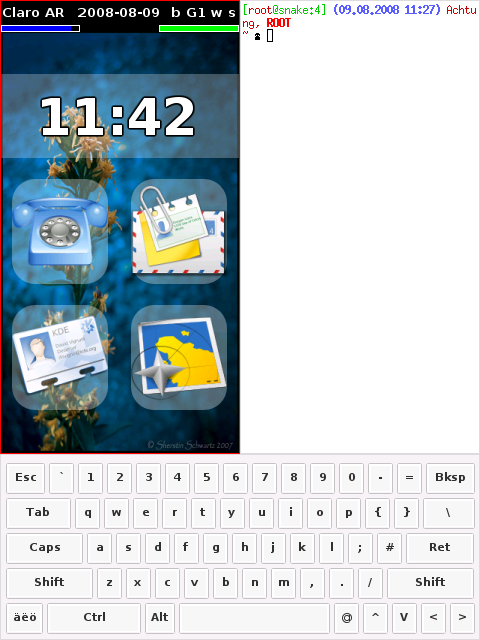
I ve been at DebConf for almost two week, but haven t blogged a lot about it. It s mostly because we ve been working on getting Debian to run on the OpenMoko FreeRunner. Today we finally sent out the official annoucement for this, because it seems that the installer script and packages seem to work so far.Great thing about this is the sheer amount of software that s now available on my phone. I already blogged about running Xmonad on it, and I have also ran my screen-message program, on it, as can be seen here. I only did minimal testing of the phone features, because it would be relatively expensive here in Argentinia with my German SIM card, but it seems to work as well.

9 August 2008

Junichi Uekawa: debugging qemubuilder armel.

debugging qemubuilder armel. nomeata wondered why it's not working, and after having added basic support for it, it wasn't working. Debugging why it isn't working at all now. I have figured out that armel kernel doesn't need initrd to bootstrap qemubuilder session; the kernel has support for ext3 built-in. The initrd for armel reads 'init=' and parses it as a command for the initrd to process, and tries to invoke that command within the ramdisk. qemubuilder expects that harddisk is mounted and passes init=/pbuilder-run, and that's not found on the initrd, and the error happens. If I didn't specify the initrd, things seem to work fine. It just runs as versatile architecture. My pbuilderrc for qemu-armel.

Joachim Breitner: Xmonad on my mobile phone

Here at DebConf 8 in Argentinia, I m working on getting Debian to work on the OpenMoko Freerunner Smartphone. We are progressing quite nicely, soon having the same features as the official freesmartphone.org image. See the pkg-fso wiki page for more on that. And why do we want to do that? Because we can use everything in the Debian archive on our phones!
This is the xmonad window manager, programmed in Haskell and usually running on my Desktop, now on my mobile phone! And it s almost usable. Only problem is that the screen keyboard, metacity-keyboard, gets the focus by xmonad, so I can t actually type into other windows. This could be fixed by configuring xmonad, but for that, I need to install ghc and I do not have these 280MB left on my SD card...

7 August 2008

Joachim Breitner: pam-dbus: authentication by bubbles

Imagine you have a device, such as a linux phone, that allows login via ssh, e.g. when on a wireless network. You don t want to set a password with the (limited) phone UI. On the other hand, you don t want to allow passwordless root logins into your phone. But you do want the ability to login via ssh, after all that s why you have bought a linux smartphone. This led me to the idea of a pam module and corresponding UI piece that asks the currently logged in user: Hey, someone tries to login. Is that ok or not? This might also be useful for guest accounts on regular laptops. For more on that, see my last blog post.So I hacked it together (actually twice, due to some unfortunate use of rm at some point), invested most of the time in learning more about the python garbage collector vs. callbacks, explicitly marked global variables and proper automake stuff. In the end I got, well, just what I wanted. A simple pam module, dubbed pam-dbus that sends a request via the dbus system bus and an autostart program (written in python for now, but I might re-implement it in C) that uses notification-daemon to get confirmation from the user.You are welcome to try the sources and binary debian packages or have a look at the darcs repository for pam-dbus (with debian/ directory, repository browser). This will end up in Debian later, I guess.Update: Erik Johansson pointed out that if you want to use this with ssh, you need to set UsePAM yes in /etc/ssh/ssd_config.

Joachim Breitner: Flow control with pam configuration

Usually, files in /etc/pam.d/ are simple, linear descriptions of how a user should be authenticated, e.g. Try to authenticate him against ldap, and then against the local data base . But sometimes, you want something more advanced, for example If the user is called guest, please authenticate him with pam_dbus, otherwise use regular pam_unix. This is possible, and here I ll note down how to do that.There are actually two problems to solve: How to detect the username, and then how to do the flow control.For the first problem, I recently discovered the pam_succeed_if module, that allows for relatively advanced logic for checking uids, usernames, hostnames and group membership. For our case, the line would read
auth ? pam_succeed_if.so quiet user = guest
Now what next? If we just wanted to allow unrestricted access to guest, we could put sufficient for the questionmark. But we need something like if..then..else. Unfortunately (and I hope this will be fixed eventually), the only flow control available is skip the next n lines . So we can skip to pam_unix when this module fails (i.e. the user was someone else but guest), and if we did not skip, we can run the guest-specific module and then skip over pam_unix. So here is the complete snippet:
auth [default=2 success=ignore] pam_succeed_if.so quiet user = guest
auth [success=ok new_authtok_reqd=done ignore=ignore default=die] pam_dbus.so
auth [default=1] pam_permit.so
auth required pam_unix.so
You can read more about this advanced configuration in the PAM Administration guide. And here is the corresponding configuration for gdm, where guest can always login:
auth [default=2 success=ignore] pam_succeed_if.so quiet user = guest
auth required pam_permit.so
auth [default=1] pam_permit.so
auth required pam_unix.so
So I have a guest account with a locked password and I can allow ssh logins with a mouse click and use it directly with gdm. I probably should put the gdm configuration also in xscreensaver to not lock me out.

21 July 2008

Joachim Breitner: One Week with an OpenMoko Freerunner

About one week ago, I received my OpenMoko Freerunner. This is an openly developed mobile phone that runs purely on Free Software. So this is what I have to tell about it.The hardwareIt was smaller than I thought, and is quite light. My girlfriend says it s ugly, but I m fine with the look of it. Besides being a GSM-phone, it comes with some nice gimmics: GPS, accelerometer, WLAN. The touchscreen works fine, although I don t have anything to compare it with.The softwareThe system it comes with, even after upgrading, is still very rough. It mostly works for doing phone calls and SMSs, but there are a number of unsolved quirks that prevent me from using the Freerunner as my sole phone for now. The suspend mode is left too often, resulting in a battery life of about eight hours, and there are issues with the audio for the conversation partners, who will hear static and echoes. But, as this is free software, there is hope that this will be fixed eventually.DevelopmentThe OpenMoko distribution is based on Openembedded, which uses bitbake for building software. So if I got it right, and this is not sure, because documentation is rare and spread, there is the git repository at git.openmoko.org, which is a copy of the openembedded git repository. This contains bitbake recipies for all the packages, which includes where they can be downloaded, the package metadata (such as dependencies and version numbers) and sometimes patches. These recipies reference upstream tarballs or subversion URLs. For the native OpenMoko applications, the source is in the OpenMoko subversion repository.One of the suggested ways of compiling software for the FreeRunner is by using a toolchain tarball, that can easily be extracted somewhere and used to build the software from the subversion repository, or other (hopefully autoconf ed) software. This builds the binaries, but does not produce proper .ipk files, so no version number or dependencies.The other way is the full openembedded setup, made easy using the MokoMakefile. This, automatically, fetches and builds everything needed for the cross compiliation and all available packages, producing the same output as can be found on the openmoko servers. Setting this up requires about 6 gigabytes of storage and takes over a day the first time, but then hacking the phone is relatively painless, as it resolves dependencies and is self-contained.The communityFor a free software project, the state of the community is very important. The OpenMoko seems to suffer from a rush of interested people on the mailing lists, so it s hard to follow real development in a mass of frequently asked questions and nice ideas from people who have neither an OpenMoko phone nor wil do any coding.On the other hand, it s not easy for new contributers. I have written some code that make sure the phone can handle numbers such as 0172/123 456 instead of the official +49172123456 in the phonebook and the SMS app, something that other users have complained about as well. But no one could tell me where and how I should submit my patches, and the mail to the mailing list with the patches and the bug report is unanswered. It is not clear, at least to me, who is responsible for what part of the project quite different to what I m used to from Debian, where there is a clear list of maintainers for each package, and a well known way of submitting patches (by going through bugs.debian.org).For interested users, I have published my branch of the git repository at git.nomeata.de, and I will hopefully add more features and bugfixes later at least when I find out how to properly contribute to OpenMoko.

17 June 2008

Philipp Kern: I'm going to DebConf 8!

http://media.debconf.org/dc8/images/debconf8-going-to.png This will be my first DebConf ever and I'm excited. I just booked my flights together with nomeata:
2008-08-03: Frankfurt (10:20) -> Buenos Aires (19:05) [LH510]
2008-08-03/04: Buenos Aires (21:30) -> Mar del Plata (3:20) [Bus]
2008-08-17: Mar del Plata (12:00) -> Buenos Aires (18:00) [Bus]
2008-08-18: Buenos Aires (20:55) -> Frankfurt (15:00) [LH511]

27 May 2008

Joachim Breitner: My first OpenStreetMap Contribution

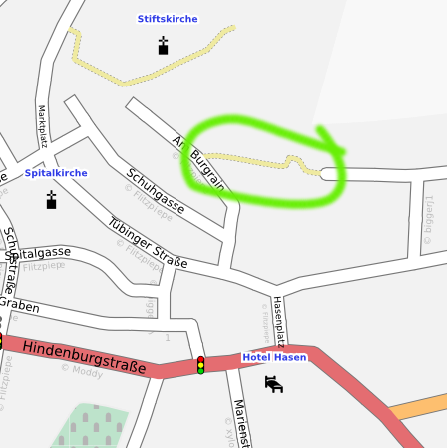
Yesterday I was visiting the Open Source Expo Karlsruhe, a new, quite small conference, at which the guys from OpenStreetMap hat a booth. I was amazed by the progress of OpenStreetMap while I wasn t looking (which is just a few months, I guess); their level of detail in some places like Karlsruhe is astonishing.Anyways, I got hooked and started to try out some of the tools and websites and finally, by tracing the Yahoo satellite image, added my first way to the map: A small footpath in Herrenberg that I know quite well:
The live data can also be seen on the OpenStreetMap map, of course.Unfortunately, there is not much to map around where I live in Karlsruhe, even the driveway to my dorm is included, but maybe I can do some proper mapping (with a GPS device) in Herrenberg someday.

17 May 2008

Joachim Breitner: FrakView: An Haskell Renderer for Iterated Function Systems

For a recent university seminar, I wrote a haskell program to render and edit iterated function systems (IFS), which generates a certain class of fractals, namely self-similar sets. I think the result is quite nice, so I m sharing the code.
FrakView screenshot
With FrakView you can view a rendering of the attraktor of the IFS, whith a choice of two algorithms (a straight forward, and a probabilistic), configurable depth and anti-aliasing. You can also modify the IFS by dragging the colored boxes with arrows you see on the screenshot. For the academically inclined, there is also support to visualize cylinder sets and otherwise explore the coding space of the IFS a bit.The program is written in haskell and uses gtk2hs, the gtk bindings for haskell. It might be interesting for other gtk2hs programmers to see how FrakView solves some issues: For example, it uses the CoroutineT monad transformer I recently blogged about check out the pausingForM_ function in GUI.hs. Also, the current state of the screen is in one algebraic data type (ScreenConfig) that supports equality checks, so when the user interacts, the code recomputes the new ScreenConfig (using getRenderer), but only redraws the screen if it differs from the previous. This is much easier and more robust than having to decide for each possible user interaction whether it changes what s on the screen.You can get the source from the FrakView darcs repository.

24 April 2008

Joachim Breitner: Pausable IO actions for better GUI responsiveness

For a university seminar I m currently writing a GUI program to view fractals based on simple iterated function systems (only similaritudes allowed). It supports three different drawing algorithms and you can edit the IFS by dragging squares around on the screen. But this post is not about this program (I might present it later), but how Haskell allowed me to solve a problem very nicely:The first instances of the code had a problem that a lot of GUI programmers know: The drawing of the fractal took quite some time, and during that time the gtk main loop is blocked and the program becomes unresponsive. At first I avoided this problem by manually splitting the drawing function (e.g. by repeatedly increasing the resolution) and kept re-drawing it at higher resolutions in an idle handler, so at least I could interact whenever one resolution has finished drawing. It worked somewhat but it was not easily done for the other, not pixel based, algorithms and it was ugly.So I wanted a way to (a) pause the drawing at any convenient point, to resume it later, and (b) safely abort the drawing if what I m drawing has changed and I need to restart.A common solution to this would be to do the drawing in a separate thread, so (a) is actually not needed, but I did not know if I can safely do (b), and I have heard that threads cause problems with gtk.So I tried to dig deeper for the hidden treasures of advanced haskell programming: I need a monad transformer! I expected the infamous ContT monad transformer to help, but I couldn t figure out how, and I started to create my own monad transformer, called CoroutineT.I tried to figure out what an action of type (CoroutineT IO a) should do, and I came up with this type signature:
pausingAction :: IO (Either (CoroutineT IO a) a)
which means that after the pausingAction is done, it is Either paused (and I get back another pausingAction to run when I want it), or it is done (and I get the result). Note that I m writing IO here, but it can be any monad.The definition of the datatype and the monad instance came mostly from trying to make this type work (yay to haskell s type system, less thinking required), and looks like this:
data CoroutineT m a = CoroutineT  unCoroutineT :: (m (Either (CoroutineT m a) a))  

instance (Monad m) => Monad (CoroutineT m) where
return v = CoroutineT (return (Right v))
a >>= b = CoroutineT $ do
r <- unCoroutineT a
case r of
Left paused -> return $ Left (paused >>= b)
Right unpaused -> unCoroutineT (b unpaused)
This translates to english like this: A call to return is not paused. When an action is already paused, further actions should be run after the paused action is resumed. When an action is not paused, further actions can happen now.Like every well behaving monad transfomer, I also need a "runCoroutineT" function to start the coroutine. I probably could have used unCoroutineT directly, but for my use case (GUI drawing) I did not need a return value, so this function is more handy:
runCoroutineT :: Monad m => CoroutineT m () -> m (Maybe (CoroutineT m ()))
runCoroutineT a = either (Just) (const Nothing) liftM unCoroutineT a
Nothing surprising here, basically just turning the Either into a Maybe. So it becomes clear how to do (b): We can just throw away the resume action returned by runCoroutineT (if any). The more interesting thing is how we do (a): We need a pause action of type (Coroutine m ()). But how should it work? I did not really try to understand why it works, but by looking at the types, I came up with this:
pause :: Monad m => CoroutineT m ()
pause = CoroutineT (return (Left (CoroutineT (return (Right ())))))
Yes, it sounds like some dance step instructions (read the second line out aloud!), but it works somehow.So here is some example code: I have a pausable IO action that counts from one to ten, pausing after each number. I also have function that resumes an pausable action up to n times:
example n = keepGoingFor n $ do
        liftIO $ putStrLn "This is the coroutine"
        forM_ [1..10] $ \i -> do
            liftIO $ putStrLn $ "Counting to "++ show i ++" while you keep calling it"
            pause
  where --keepGoing :: Monad m => CoroutineT m () -> m ()
      keepGoingFor 0 _   = putStrLn "Here I just abort the run"
      keepGoingFor n cor = do
        resume <- runCoroutineT cor
        case resume of
            Just runAgain -> keepGoingFor (n-1) runAgain
            Nothing       -> putStrLn "Finally stopped"
And here is the output of two different runs:
*CouroutineT> example 5
This is the coroutine
Counting to 1 while you keep calling it
Counting to 2 while you keep calling it
Counting to 3 while you keep calling it
Counting to 4 while you keep calling it
Counting to 5 while you keep calling it
Here I just abort the run
*CouroutineT> example 14
This is the coroutine
Counting to 1 while you keep calling it
Counting to 2 while you keep calling it
Counting to 3 while you keep calling it
Counting to 4 while you keep calling it
Counting to 5 while you keep calling it
Counting to 6 while you keep calling it
Counting to 7 while you keep calling it
Counting to 8 while you keep calling it
Counting to 9 while you keep calling it
Counting to 10 while you keep calling it
Finally stopped
So it does really works fine, and it proved very useful in my GUI drawing problem. For that, I created this nice control structure which works like mapM_, but calls pause every n iterations, and therefore hides the pausing stuff almost completely:
pausingForM_ :: Monad m => Int -> [a] -> (a -> CoroutineT m ()) -> CoroutineT m ()
pausingForM_ period list action = pausing' 0 list
where pausing' _ [] = return ()
pausing' n (x:xs) = do action x
if n==period then pause >> pausing' 0 xs
else pausing' (n+1) xs
I have put the complete module (including instances omitted here) in the darcs repository that might later also contain the fractal drawing program.

17 April 2008

Joachim Breitner: Announcing DarcsWatch

A lot of haskell-related projects use the darcs version control system. Darcs has the nice feature that you can easily submit a patch by e-mail, usually sent to the project maintainer or a mailing list. What has bothered me in the past was that I had to manually check whether my patch was applied yet.So this week, I wrote DarcsWatch. DarcsWatch receives submitted patches and compares them to the repositories it knows about, whether the patch is missing there or not. You either send your patches to DarcsWeb directly when submitting them, using CC, or DarcsWatch is subscribed to the project mailing list itself, which is the case for the darcs-devel and xmonad lists. Other than that, not much is to do, and you ll find a nice overview of your patches, like this overview of my patches, with diffs and download links.If you want to use DarcsWatch for your contributions to other projects, or for your own projects, have a look the documentation. There are probably still bugs around, and the problem of marking patches as obsolete is not really solved yet, so if you have ideas about it, mail me, comment here, or come to #darcs on freenode. Patches are always welcome, you can get the source from DarcsWatch s repository.

Next.

Previous.