Search Results: "mats"

26 July 2015

Lunar: Reproducible builds: week 12 in Stretch cycle

What happened in the reproducible builds effort this week: Toolchain fixes Eric Dorlan uploaded automake-1.15/1:1.15-2 which makes the output of mdate-sh deterministic. Original patch by Reiner Herrmann. Kenneth J. Pronovici uploaded epydoc/3.0.1+dfsg-8 which now honors SOURCE_DATE_EPOCH. Original patch by Reiner Herrmann. Chris Lamb submitted a patch to dh-python to make the order of the generated maintainer scripts deterministic. Chris also offered a fix for a source of non-determinism in dpkg-shlibdeps when packages have alternative dependencies. Dhole provided a patch to add support for SOURCE_DATE_EPOCH to gettext. Packages fixed The following 78 packages became reproducible in our setup due to changes in their build dependencies: chemical-mime-data, clojure-contrib, cobertura-maven-plugin, cpm, davical, debian-security-support, dfc, diction, dvdwizard, galternatives, gentlyweb-utils, gifticlib, gmtkbabel, gnuplot-mode, gplanarity, gpodder, gtg-trace, gyoto, highlight.js, htp, ibus-table, impressive, jags, jansi-native, jnr-constants, jthread, jwm, khronos-api, latex-coffee-stains, latex-make, latex2rtf, latexdiff, libcrcutil, libdc0, libdc1394-22, libidn2-0, libint, libjava-jdbc-clojure, libkryo-java, libphone-ui-shr, libpicocontainer-java, libraw1394, librostlab-blast, librostlab, libshevek, libstxxl, libtools-logging-clojure, libtools-macro-clojure, litl, londonlaw, ltsp, macsyfinder, mapnik, maven-compiler-plugin, mc, microdc2, miniupnpd, monajat, navit, pdmenu, pirl, plm, scikit-learn, snp-sites, sra-sdk, sunpinyin, tilda, vdr-plugin-dvd, vdr-plugin-epgsearch, vdr-plugin-remote, vdr-plugin-spider, vdr-plugin-streamdev, vdr-plugin-sudoku, vdr-plugin-xineliboutput, veromix, voxbo, xaos, xbae. The following packages became reproducible after getting fixed: Some uploads fixed some reproducibility issues but not all of them: Patches submitted which have not made their way to the archive yet: reproducible.debian.net The statistics on the main page of reproducible.debian.net are now updated every five minutes. A random unreviewed package is suggested in the look at a package form on every build. (h01ger) A new package set based new on the Core Internet Infrastructure census has been added. (h01ger) Testing of FreeBSD has started, though no results yet. More details have been posted to the freebsd-hackers mailing list. The build is run on a new virtual machine running FreeBSD 10.1 with 3 cores and 6 GB of RAM, also sponsored by Profitbricks. strip-nondeterminism development Andrew Ayer released version 0.009 of strip-nondeterminism. The new version will strip locales from Javadoc, include the name of files causing errors, and ignore unhandled (but rare) zip64 archives. debbindiff development Lunar continued its major refactoring to enhance code reuse and pave the way to fuzzy-matching and parallel processing. Most file comparators have now been converted to the new class hierarchy. In order to support for archive formats, work has started on packaging Python bindings for libarchive. While getting support for more archive formats with a common interface is very nice, libarchive is a stream oriented library and might have bad performance with how debbindiff currently works. Time will tell if better solutions need to be found. Documentation update Lunar started a Reproducible builds HOWTO intended to explain the different aspects of making software build reproducibly to the different audiences that might have to get involved like software authors, producers of binary packages, and distributors. Package reviews 17 obsolete reviews have been removed, 212 added and 46 updated this week. 15 new bugs for packages failing to build from sources have been reported by Chris West (Faux), and Mattia Rizzolo. Presentations Lunar presented Debian efforts and some recipes on making software build reproducibly at Libre Software Meeting 2015. Slides and a video recording are available. Misc. h01ger, dkg, and Lunar attended a Core Infrastructure Initiative meeting. The progress and tools mode for the Debian efforts were shown. Several discussions also helped getting a better understanding of the needs of other free software projects regarding reproducible builds. The idea of a global append only log, similar to the logs used for Certificate Transparency, came up on multiple occasions. Using such append only logs for keeping records of sources and build results has gotten the name Binary Transparency Logs . They would at least help identifying a compromised software signing key. Whether the benefits in using such logs justify the costs need more research.

25 July 2015

Dirk Eddelbuettel: Rcpp 0.12.0: Now with more Big Data!

big-data image A new release 0.12.0 of Rcpp arrived on the CRAN network for GNU R this morning, and I also pushed a Debian package upload. Rcpp has become the most popular way of enhancing GNU R with C++ code. As of today, 423 packages on CRAN depend on Rcpp for making analyses go faster and further. Note that this is 60 more packages since the last release in May! Also, BioConductor adds another 57 packages, and casual searches on GitHub suggests many more. And according to Andrie De Vries, Rcpp has now page rank of one on CRAN as well! And with this release, Rcpp also becomes ready for Big Data, or, as they call it in Texas, Data. Thanks to a lot of work and several pull requests by Qiang Kou, support for R_xlen_t has been added. That means we can now do stunts like
R> library(Rcpp)
R> big <- 2^31-1
R> bigM <- rep(NA, big)
R> bigM2 <- c(bigM, bigM)
R> cppFunction("double getSz(LogicalVector x)   return x.length();  ")
R> getSz(bigM)
[1] 2147483647
R> getSz(bigM2)
[1] 4294967294
R>
where prior versions of Rcpp would just have said
> getSz(bigM2)
Error in getSz(bigM2) :
  long vectors not supported yet: ../../src/include/Rinlinedfuns.h:137
>
which is clearly not Texas-style. Another wellcome change, also thanks to Qiang Kou, adds encoding support for strings. A lot of other things got polished. We are still improving exception handling as we still get the odd curveballs in a corner cases. Matt Dziubinski corrected the var() computation to use the proper two-pass method and added better support for lambda functions in Sugar expression using sapply(), Qiang Kou added more pull requests mostly for string initialization, and Romain added a pull request which made data frame creation a little more robust, and JJ was his usual self in tirelessly looking after all aspects of Rcpp Attributes. As always, you can follow the development via the GitHub repo and particularly the Issue tickets and Pull Requests. And any discussions, questions, ... regarding Rcpp are always welcome at the rcpp-devel mailing list. Last but not least, we are also extremely pleased to annouce that Qiang Kou has joined us in the Rcpp-Core team. We are looking forward to a lot more awesome! See below for a detailed list of changes extracted from the NEWS file.
Changes in Rcpp version 0.12.0 (2015-07-24)
  • Changes in Rcpp API:
    • Rcpp_eval() no longer uses R_ToplevelExec when evaluating R expressions; this should resolve errors where calling handlers (e.g. through suppressMessages()) were not properly respected.
    • All internal length variables have been changed from R_len_t to R_xlen_t to support vectors longer than 2^31-1 elements (via pull request 303 by Qiang Kou).
    • The sugar function sapply now supports lambda functions (addressing issue 213 thanks to Matt Dziubinski)
    • The var sugar function now uses a more robust two-pass method, supports complex numbers, with new unit tests added (via pull request 320 by Matt Dziubinski)
    • String constructors now allow encodings (via pull request 310 by Qiang Kou)
    • String objects are preserving the underlying SEXP objects better, and are more careful about initializations (via pull requests 322 and 329 by Qiang Kou)
    • DataFrame constructors are now a little more careful (via pull request 301 by Romain Francois)
    • For R 3.2.0 or newer, Rf_installChar() is used instead of Rf_install(CHAR()) (via pull request 332).
  • Changes in Rcpp Attributes:
    • Use more robust method of ensuring unique paths for generated shared libraries.
    • The evalCpp function now also supports the plugins argument.
    • Correctly handle signature termination characters (' ' or ';') contained in quotes.
  • Changes in Rcpp Documentation:
    • The Rcpp-FAQ vignette was once again updated with respect to OS X issues and Fortran libraries needed for e.g. RcppArmadillo.
    • The included Rcpp.bib bibtex file (which is also used by other Rcpp* packages) was updated with respect to its CRAN references.
Thanks to CRANberries, you can also look at a diff to the previous release As always, even fuller details are on the Rcpp Changelog page and the Rcpp page which also leads to the downloads page, the browseable doxygen docs and zip files of doxygen output for the standard formats. A local directory has source and documentation too. Questions, comments etc should go to the rcpp-devel mailing list off the R-Forge page.

This post by Dirk Eddelbuettel originated on his Thinking inside the box blog. Please report excessive re-aggregation in third-party for-profit settings.

2 July 2015

Lars Wirzenius: Obnam 1.10 released (backup software)

I have just released version 1.10 of Obnam, my backup program. See the website at http://obnam.org for details on what it does. The new version is available from git (see http://git.liw.fi) and as Debian packages from http://code.liw.fi/debian, and uploaded to Debian, hopefully soon in unstable. The NEWS file extract below gives the highlights of what's new in this version. Version 1.10, released 2015-07-01 Major bug fixes: Minor new features: Minor fixes:

20 June 2015

Lunar: Reproducible builds: week 4 in Stretch cycle

What happened about the reproducible builds effort for this week: Toolchain fixes Lunar rebased our custom dpkg on the new release, removing a now unneeded patch identified by Guillem Jover. An extra sort in the buildinfo generator prevented a stable order and was quickly fixed once identified. Mattia Rizzolo also rebased our custom debhelper on the latest release. Packages fixed The following 30 packages became reproducible due to changes in their build dependencies: animal-sniffer, asciidoctor, autodock-vina, camping, cookie-monster, downthemall, flashblock, gamera, httpcomponents-core, https-finder, icedove-l10n, istack-commons, jdeb, libmodule-build-perl, libur-perl, livehttpheaders, maven-dependency-plugin, maven-ejb-plugin, mozilla-noscript, nosquint, requestpolicy, ruby-benchmark-ips, ruby-benchmark-suite, ruby-expression-parser, ruby-github-markup, ruby-http-connection, ruby-settingslogic, ruby-uuidtools, webkit2gtk, wot. The following packages became reproducible after getting fixed: Some uploads fixed some reproducibility issues but not all of them: Patches submitted which did not make their way to the archive yet: Also, the following bugs have been reported: reproducible.debian.net Holger Levsen made several small bug fixes and a few more visible changes: strip-nondeterminism Version 0.007-1 of strip-nondeterminism the tool to post-process various file formats to normalize them has been uploaded by Holger Levsen. Version 0.006-1 was already in the reproducible repository, the new version mainly improve the detection of Maven's pom.properties files. debbindiff development At the request of Emmanuel Bourg, Reiner Herrmann added a comparator for Java .class files. Documentation update Christoph Berg created a new page for the timestamps in manpages created by Doxygen. Package reviews 93 obsolete reviews have been removed, 76 added and 43 updated this week. New identified issues: timestamps in manpages generated by Doxygen, modification time differences in files extracted by unzip, tstamp task used in Ant build.xml, timestamps in documentation generated by ASDocGen. The description for build id related issues has been clarified. Meetings Holger Levsen announced a first meeting on Wednesday, June 3rd, 2015, 19:00 UTC. The agenda is amendable on the wiki. Misc. Lunar worked on a proof-of-concept script to import the build environment found in .buildinfo files to UDD. Lucas Nussbaum has positively reviewed the proposed schema. Holger Levsen cleaned up various experimental toolchain repositories, marking merged brances as such.

11 June 2015

Daniel Silverstone: In defence of curl sudo bash -

Long ago, in days of yore, we assumed that any software worth having would be packaged by the operating system we used. Debian with its enormous pile of software (over 20,000 sources last time I looked) looked to basically contain every piece of free software ever. However as more and more people have come to Linux-based and BSD-based systems, and the proliferation of *NIX-based systems has become even more diverse, it has become harder and harder to ensure that everyone has access to all of the software they might choose to use. Couple that with the rapid development of new projects, who clearly want to get users involved well before the next release cycle of a Linux-based distribution such as Debian, and you end up with this recommendation to bypass the operating system's packaging system and simply curl sudo bash -. We, the OS-development literati, have come out in droves to say "eww, nasty, don't do that please" and yet we have brought this upon ourselves. Our tendency to invent, and reinvent, at the very basic levels of distributions has resulted in so many operating systems and so many ways to package software (if not in underlying package format then in policy and process) that third party application authors simply cannot keep up. Couple that with the desire of the consumers to not have their chosen platform discounted, and if you provide Debian packages, you end up needing to provide for Fedora, RHEL, SuSE, SLES, CentOS, Mint, Gentoo, Arch, etc.etc; let alone supporting all the various BSDs. This leads to the simple expedience of curl sudo bash -. Nobody, not even those who are most vehemently against this mechanism of installing software, can claim that it is not quick, simple for users, easy to copy/paste out of a web-page, and leaves all the icky complexity of sorting things out up to a script which the computer can run, rather than the nascent user of the software in question. As a result, many varieties of software have ended up using this as a simple installation mechanism, from games to orchestration frameworks - everyone can acknowledge how easy it is to use. Now, some providers are wising up a little and ensuring that the url you are curling is at least an https:// one. Some even omit the sudo from the copy/paste space and have it in the script, allowing them to display some basic information and prompting the user that this will occur as root before going ahead and elevating. All of these myriad little tweaks to the fundamental idea improve matters but are ultimately just putting lipstick on a fairly sad looking pig. So, what can be done? Well we (again the OS-development literati) got ourselves into this horrendous mess, so it's up to us to get ourselves back out. We're all too entrenched in our chosen packaging methodologies, processes, and policies, to back out of those; yet we're clearly not properly servicing a non-trivial segment of our userbase. We need to do better. Not everyone who currently honours a curl sudo bash - is capable of understanding why it's such a bad idea to do so. Some education may reduce that number but it will never eliminate it. For a long time I advocated a switch to wget && review && sudo ./script approach instead, but the above comment, about people who don't understand why it might be a bad idea, really applies to show how few of those users would even be capable of starting to review a script they downloaded, let alone able to usefully judge for themselves if it is really safe to run. Instead we need something better, something collaborative, something capable of solving the accessibility issues which led to the curl sudo bash - revolt in the first place.
I don't pretend to know what that solution might be, and I don't pretend to think I might be the one to come up with it, but I can hilight a few things I think we'll need to solve to get there:
  1. Any solution to this problem must be as easy as curl sudo bash - or easier. This might mean a particular URI format which can have os-specific ways to handle standardised inputs, or it might mean a pervasive tool which does something like that.
  2. Any solution must do its best to securely acquire the content the user actually wanted. This means things like validating SSL certificates, presenting information to the user which a layman stands a chance of evaluating to decide if the content is likely to be what they wanted, and then acting smoothly and cleanly to get that content onto the user's system.
  3. Any solution should not introduce complex file formats or reliance on any particular implementation of a tool. Ideally it would be as easy to implement the solution on FreeBSD in shell, or on Ubuntu as whizzy 3D GUIs written in Haskell. (modulo the pain of working in shell of course)
  4. The solution must be arrived at in a multi-partisan way. For such a mechanism to be as usefully pervasive as curl sudo bash - as many platforms as possible need to get involved. This means not only Debian, Ubuntu, Fedora and SuSE; but also Arch, FreeBSD, NetBSD, CentOS etc. Maybe even the OpenSolaris/Illumos people need to get involved.
Given the above, no solution can be "just get all the apps developers to learn how to package software for all the OS distributions they want their app to run on" since that way madness lies. I'm sure there are other minor, and major, requirements on any useful solution but the simple fact of the matter is that until and unless we have something which at least meets the above, we will never be rid of curl sudo bash - :- just like we can never seem to be rid of that one odd person at the party, noone knows who invited them, and noone wants to tell them to leave because they do fill a needed role, but noone really seems to like. Until then, let's suck it up and while we might not like it, let's just let people keep on curl sudo bash -ing until someone gets hurt.
P.S. I hate curl sudo bash - for the record.

Petter Reinholdtsen: Measuring and adjusting the loudness of a TV channel using bs1770gain

Television loudness is the source of frustration for viewers everywhere. Some channels are very load, others are less loud, and ads tend to shout very high to get the attention of the viewers, and the viewers do not like this. This fact is well known to the TV channels. See for example the BBC white paper "Terminology for loudness and level dBTP, LU, and all that" from 2011 for a summary of the problem domain. To better address the need for even loadness, the TV channels got together several years ago to agree on a new way to measure loudness in digital files as one step in standardizing loudness. From this came the ITU-R standard BS.1770, "Algorithms to measure audio programme loudness and true-peak audio level". The ITU-R BS.1770 specification describe an algorithm to measure loadness in LUFS (Loudness Units, referenced to Full Scale). But having a way to measure is not enough. To get the same loudness across TV channels, one also need to decide which value to standardize on. For European TV channels, this was done in the EBU Recommondaton R128, "Loudness normalisation and permitted maximum level of audio signals", which specifies a recommended level of -23 LUFS. In Norway, I have been told that NRK, TV2, MTG and SBS have decided among themselves to follow the R128 recommondation for playout from 2016-03-01. There are free software available to measure and adjust the loudness level using the LUFS. In Debian, I am aware of a library named libebur128 able to measure the loudness and since yesterday morning a new binary named bs1770gain capable of both measuring and adjusting was uploaded and is waiting for NEW processing. I plan to maintain the latter in Debian under the Debian multimedia umbrella. The free software based TV channel I am involved in, Frikanalen, plan to follow the R128 recommondation ourself as soon as we can adjust the software to do so, and the bs1770gain tool seem like a good fit for that part of the puzzle to measure loudness on new video uploaded to Frikanalen. Personally, I plan to use bs1770gain to adjust the loudness of videos I upload to Frikanalen on behalf of the NUUG member organisation. The program seem to be able to measure the LUFS value of any media file handled by ffmpeg, but I've only successfully adjusted the LUFS value of WAV files. I suspect it should be able to adjust it for all the formats handled by ffmpeg.

9 June 2015

Norbert Preining: Debian/TeX Live 2015 the new layout

While updating the TeX Live package for Debian for the upcoming 2015 release, one of my aims was to convert as much as possible of the TeX configuration infrastructure to use dpkg triggers. We used the trigger mechanism already for the update of the font map configuration file (calls to updmap-sys), but till now neither for files installed into texmf trees, nor for format generation. In this blog I will describe the new management of all TeX related configuration files, while in the following one I will describe how things have been implemented with dpkg triggers. In due time this information will also be codified in the Debian TeX sub-policy. Debian - TeX Live 2015 Let us start with recalling the different actions that have to be taken when TeX packages are installed, removed, or updated. Required actions for TeX packages Filename database The simplest case are packages that only include files ment to be loaded while running TeX or Metafont or similar programs. In this case the file name database of TeX (and the one of ConTeXt) needs to be updated. Usually this is done by calling mktexlsr on the changed trees, plus, if ConTeXt is installed, running mtxrun --generate. Font map activation More complicated are font packages that provide PostScript fonts. These packages need to ship a so called map file which maps TeX font names to PostScript fonts names. Examples are lm.map which defines this mapping for the Latin Modern fonts. All these map files have to be collected in one or more updmap.cfg files, and then a call to updmap(-sys) is necessary to generate configuration files for dvips, pdftex, and some other programs. Format and hyphenation definitions Even more complicated is the case of additional hyphenation patterns and additional format definitions. At the moment, hyphenation patterns are only shipped from the TeX Live packages itself, but additional format definitions are already provided by other packages than the TeX Live ones. Again, in both cases all the different format and hyphenation pattern definitions must be combined, into configuration files fmtutil.cnf and several language.* files, respectively. After this some incantation of fmtutil(-sys) is necessary to update the format dumps of TeX. Status up to Debian/TeX Live 2014 Up to now most of these actions are done in the postinstall script of the providing packages, generated by dh_installtex. The tex-common package shipped besides the program dh_installtex also postinstall and postrm snippets that took care of all the necessary steps, and ensuring that configuration succeeds even if some of the programs were missing. While this worked quite nicely for many years, I saw several disadvantages: Furthermore, /etc/texmf/ was filled with snippet-configuration directories, e.g., /etc/texmf/hyphen.d/ and /etc/texmf/fmt.d/ where the standard configuration of TeX was saved, and system administrators could change the necessary settings. While this is a good thing, i.e., to give system administrators the chance to change their configuration, it carries a big risk: most system administrators, most users, have not the blankest idea how to write a proper format definition for TeX, nor a proper entry for a hyphenation pattern. And the TeX engines are not forgiving in this respect and will bail out immediately. Finally, having so many configuration files hanging around in /etc/texmf/ makes it complicated to update between releases, where these files might have changed completely, files might have been added or removed. New layout for Debian/TeX Live 2015 and onward Thanks to a rewrite of fmtutil in Perl (also one of my endeavors), and adding the capability to read multiple fmtutil.cnf files in the same way updmap can read multiple updmap.cfg files, starting with Debian/TeX Live 2015 we can finally do the following: So let us dive into the details, following the above order: Filename database Update of the filename databases is now done automatically via a trigger on the two directories that are searched by kpathsea and used by Debian packages: /usr/share/texlive/texmf-dist/ (for TeX Live packages) and /usr/share/texmf/ (for all other packages). Thus, if a Debian package installs files into one of these directories, automatically mktexlsr (and, if ConTeXt is installed also mtxrun) is run from the tex-common trigger action. As a consequence for package maintainers of TeX related packages, if you are not adding font maps, formats, or hyphens, there is no need anymore to call dh_installtex or do anything TeX specific besides installing the files into the proper locations. Font map activation Here nothing has changed from the previous status, I just repeat that map snippets should be installed into /var/lib/tex-common/fontmap-cfg/texlive/ (for TeX Live packages) and /var/lib/tex-common/fontmap-cfg/texmf/ (for all other packages). One snippet can contain arbitrary many Map or MixedMap lines. Example: /var/lib/tex-common/fontmap-cfg/texmf/tex-gyre.cfg:

Map qag.map
Map qbk.map
Map qcr.map
Map qcs.map
Map qhv.map
Map qpl.map
Map qtm.map
Map qzc.map
There is a necessary action to be taken in postinst and postrm, which is calling update-texmf-conf map (but take care when writing your own code in postrm, as update-texmf-conf might not be available!). Format and hyphenation definitions Format definitions and hyphenations are now treated in the very same way as font maps. That is: Package maintainers are advised to use dh_installtex as it also caters for the removal of format dumps under /var/lib/texmf/web2c. Format of the configuration files Files under /var/lib/tex-common/fmtutil-cnf/ must consist of syntactically correct lines for fmtutil.cnf, that is white-space separated entries where the first word is the name of the format, the second the name of the engine, the third the respective hyphenation configuration file or a literal if none, and the rest of the line are additional arguments to the respective initex program, where the last entry is the ini-file. A typical example would be /var/lib/tex-common/fmtutil-cnf/texlive/texlive-omega.cnf:
aleph aleph - *aleph.ini
lamed aleph language.dat *lambda.ini
Files under /var/lib/tex-common/hyphen-cnf have a slightly changed syntax from the ones we used to have back in /etc/texmf/hyphen.d. The new syntax is taken directly from the TeX Live database, execute statement AddHyphen. That is one line of key=value pairs, where the following keys are allowed: name, synonyms, lefthyphenmin, righthyphenmin, file, file_patterns, file_exceptions, and luaspecial. A typical example would be /var/lib/tex-common/hyphen-cnf/texlive/texlive-lang-polish.cnf:
name=polish lefthyphenmin=2 righthyphenmin=2 file=loadhyph-pl.tex file_patterns=hyph-pl.pat.txt file_exceptions=hyph-pl.hyp.txt
In addition, package maintainers that have shipped files in /etc/texmf/fmt.d or /etc/texmf/hyphen.d are advised to remove them on package upgrade, using PACKAGE.maintscript and the proper rm_conffile directive (see the musixtex package for an example. Overriding system settings In case an administrator wants to override any of the default setting, it has become much easier in case of font maps and formats, due to the multi-feature of the respective programs. For hyphenations a separate configuration file needs to be provided. Overriding font maps and formats This can be handled by dropping a updmap.cfg or fmtutil.cnf file, respectively, into either /etc/texmf/web2c/ or /usr/local/share/texmf/web2c/ (both will work). The new files will be evaluated by the respective programs (updmap(-sys) and fmtutil(-sys), respectively), and allow by default to override entries in other files. Please see the manual page of the two programs for details, or this entry for updmap and this entry for fmtutil. Overriding hyphenation patterns When generating the various language.* files, update-language evaluates last the file /etc/texmf/web2c/local-hyphen.cnf, which should contain hyphenation patterns in the very same format as described above. Using this entry one can add additional patterns, or override given ones. Current status of uploads Several packages have already been uploaded to experimental: tex-common, musixtex, context, texinfo. What remains are the TeX Live packages itself, but here we are facing two problems: So, in case you cannot wait for the next century to happen (or, that all the packages are accepted), and still want to give it a shot, here are the apt-get lines:
deb http://people.debian.org/~preining/TeX/ exp/
deb-src http://people.debian.org/~preining/TeX/ exp/
but be warned, there might be more changes coming in. Warnings: First, in case you have already texlive-binaries 2015.20150524.37493-2 installed, please downgrade to the new version -1 which is now on the server. They are the same packages, only the version number has changed. Yes, and if you test it, don t be surprised if suddenly you are left with a not-working TeX system. Don t tell me I didn t warn you  Anyway, I hope to hear some feedback and installation reports. Conclusion While packaging has become easier for maintainers, and there is less clutter in /etc/texmf/, we now are depending on dpkg to call the tex-common triggers. Thus, if this happens rather often, then especially fmtutil-sys --all will be called several times. This is a slight regression from the previous setup, but paid off (IMNSHO) by the arguments given in the beginning. That said, there will be of course a certain time of transition until the new setup has proven its merits, and bugs are ironed out. But having bugs that need to be mostly fixed only in one package, namely tex-common, seems like an easier task to me. Enjoy.

29 May 2015

Roland Mas: FusionForge 6.0 final release available

Hi all, After 4 release candidates, the FusionForge community is proud to announce the new major Fusionforge 6.0 final release. The major changes in this version are: Here is a more detailed list of visible changes: Standard features: Tracker roadmap of the 6.0 release: roadmap. Some metrics about 6.0: FusionForge 6.0 can be downloaded in source form from our file release system. Packages will be available in some distributions soon. Enjoy! Your feedback to fusionforge-general@lists.fusionforge.org is welcome! For more information on FusionForge, refer to FusionForge.org. -- The FusionForge community

26 May 2015

Norbert Preining: Debian/TeX Live 2015 preparations

I have uploaded a preliminary version of the texlive-bin based on the 2015 sources (plus the first fixes) to the Debian archive, targeting experimental. As there are four new packages built from the sources (libtexlua52, -dev, libtexluajit2, -dev) the packages have to go through the NEW queue, which at the moment is an impressive 500+ entries long (nearly top in total history). But ftp-masters are currently very active and I hope they continue for some time. Debian - TeX Live 2015 Anyway, there are still many things to work out, especially a rework of tex-common for the new fmtutil, in the same way we did some time ago for updmap That also means that all packages shipping formats will need to be rebuild with the new tex-common. Fortunately there are not many additional formats shipped, I think all of them are under my control, so that should be easy. For those who want to peak at the current packages, here they are compiled for amd64. Also available as apt-sources:
deb http://people.debian.org/~preining/TeX/ exp/
deb-src http://people.debian.org/~preining/TeX/ exp/
WARNING Do not try to actually run these binaries unless you know what you are doing  In case you have some spare time and bit of programming experience, the Debian TeX Team is looking for a bit of support in these days.

22 May 2015

Michal &#268;iha&#345;: Weblate 2.3

Weblate 2.3 has been released today. It comes with better features for project owners, better file formats support and more configuration options for users. Full list of changes for 2.3: You can find more information about Weblate on http://weblate.org, the code is hosted on Github. If you are curious how it looks, you can try it out on demo server. You can login there with demo account using demo password or register your own user. Weblate is also being used https://hosted.weblate.org/ as official translating service for phpMyAdmin, Gammu, Weblate itself and other projects. If you are free software project which would like to use Weblate, I'm happy to help you with set up or even host Weblate for you. Further development of Weblate would not be possible without people providing donations, thanks to everybody who have helped so far! PS: The roadmap for next release is just being prepared, you can influence this by expressing support for individual issues either by comments or by providing bounty for them.

Filed under: English phpMyAdmin SUSE Weblate 0 comments

2 May 2015

Dirk Eddelbuettel: Rcpp 0.11.6

The new release 0.11.5 of Rcpp arrived on the CRAN network for GNU R yesterday; the corresponding Debian package has also been uploaded. Rcpp has become the most popular way of enhancing GNU R with C++ code. As of today, 373 packages on CRAN depend on Rcpp for making analyses go faster and further; BioConductor adds another 57 packages, and casual searches on GitHub suggests many more. This version adds a little more polish and refinement around things we worked on previous releases to solidify builds, installation and the run-time experience. It does not bring anything new or majorrelease continues the 0.11.* release cycle, adding another large number of small bug fixes, polishes and enhancements. As always, you can follow the development via the GitHub repo and particularly the Issue tickets and Pull Requests. And any discussions, questions, ... regarding Rcpp are always welcome at the rcpp-devel mailing list. See below for a detailed list of changes extracted from the NEWS file.
Changes in Rcpp version 0.11.6 (2015-05-01)
  • Changes in Rcpp API:
    • The unwinding of exceptions was refined to protect against inadvertent memory leaks.
    • Header files now try even harder not to let macro definitions leak.
    • Matrices have a new default constructor for zero-by-zero dimension matrices (via a pull request by Dmitrii Meleshko).
    • A new empty() string constructor was added (via another pull request).
    • Better support for Vectors with a storage policy different from the default, i.e. NoProtectStorage, was added.
  • Changes in Rcpp Attributes:
    • Rtools 3.3 is now supported.
Thanks to CRANberries, you can also look at a diff to the previous release As always, even fuller details are on the Rcpp Changelog page and the Rcpp page which also leads to the downloads page, the browseable doxygen docs and zip files of doxygen output for the standard formats. A local directory has source and documentation too. Questions, comments etc should go to the rcpp-devel mailing list off the R-Forge page.

This post by Dirk Eddelbuettel originated on his Thinking inside the box blog. Please report excessive re-aggregation in third-party for-profit settings.

24 April 2015

Michael Prokop: The #newinjessie game: new forensic packages in Debian/jessie

Repeating what I did for the last Debian release with the #newinwheezy game it s time for the #newinjessie game: Debian/jessie AKA Debian 8.0 includes a bunch of packages for people interested in digital forensics. The packages maintained within the Debian Forensics team which are new in the Debian/jessie stable release as compared to Debian/wheezy (and ignoring wheezy-backports): Join the #newinjessie game and present packages which are new in Debian/jessie.

2 April 2015

Ben Hutchings: Debian LTS work, March 2015

This was my fourth month working on Debian LTS. I was assigned 14.5 hours by Freexian's Debian LTS initiative, but I only worked 11.5 as I had a week's holiday and then was ill for part of this week. eglibc My first task was to complete the eglibc update that I began at the end of February. There were a few unexpected failures in the regression test suite, but on inspection these turned out to be quirks of the build environment: With those changes, the regression test results are the same as for previous package versions. (There is still one 'unexpected' failure, but I didn't investigate because it is not a regression within squeeze.) I reviewed the backported patches again to check as well as I could that they did not depend on other upstream changes, and they did not seem to. I also received positive feedback from further testing - I can't find the message now, but I think it was that the Univention application test suite passed with the updated eglibc package installed. With that confirmation and no regressions reported, I uploaded eglibc 2.11.3-4+deb6u5 and issued DLA 165-1. freetype A large number of vulnerabilities in font file parsing in Freetype were reported by Mateusz Jurczyk. I think these were less critical in squeeze than in wheezy, because while current web browsers use Freetype to render untrusted 'web fonts' we don't support any web browsers in squeeze LTS. But it seemed like they ought to be fixed anyway, and it was not too hard to backport the patches included in the wheezy security update. Freetype doesn't have a regression test suite and I didn't have samples of the broken fonts, so I came up with some ad hoc tests for regressions. I viewed several of each of the affected font formats with the ftview demo application. I then wrote a script to match up the dependencies of a package (in this case, libfreetype6) with those used by Freexian's customers; the top results were fontconfig, xfonts-utils and imagemagick. So I ran some basic tests against each of the affected formats with each of these (fc-list, mkfontscale, and the simple text label recipe for ImageMagick) and found no regression. Uploaded freetype 2.4.2-2.1+squeeze5 and issued DLA 185-1.

22 March 2015

Lars Wirzenius: Obnam 1.9 released (backup software)

I have just released version 1.9 of Obnam, my backup program. See the website at http://obnam.org for details. The new version is available from git (see http://git.liw.fi) and as Debian packages from http://code.liw.fi/debian. Due to the freeze of Debian for the jessie release, I've not uploaded this version to Debian yet (not experimental and not backports). This is the first Obnam release since May 13, 2014, 313 days ago. That's a long time. I make no excuses: Obnam is a hobby project, which I work on when I have the time and energy. The past year has been very /interesting/ year for me, in all sorts of stressful ways: I've changed jobs, moved to another country, and dealt with the loss of a close relative. Because of this, I've not been able to spend as much time on Obnam as I'd like. The NEWS file extract below gives the highlights of what has happened to Obnam during this time. There's been a lot of things, actually. My plans for Obnam next are mainly centered around performance. This will require developing a new repository format, to allow things that are not possible with the current format. For example, the current format stores each data chunk in its own file in the repository, and that is quite wasteful when live data files (and therefore their chunks) are quite small. As preparation for this work, the silly-looking "simple" format has been added, mostly to make sure the internal code infrastructure is ready to support multiple repository formats in the same Obnam version. Those interested in discussing ways to make Obnam fast should join the obnam-dev mailing list. Version 1.9, released 2015-03-22 New features: Minor changes: Bug fixes:

18 March 2015

Mario Lang: Call for Help: BMC -- Braille Music Compiler

Since 2009, I am persuing a personal programming project. As I am not a professional programmer, I have spent quite a lot of that time exploring options. I have thrown out about three or four prototype implementations already. My last implementation seems to contain enough accumulated wisdom to be actually useful. I am far from finished, but the path I am walking now seems relatively sound. So, what is this project about? I have set myself a rather ambitious goal: I am trying to implement a two-way bridge between visual music notation and braille music code. It is called BMC (Braille Music Compiler). My problem: I am, as some of you might remember, 100% blind. So I am trying to write a translator between something I will never see directly, and its counterpart representation in a tactile encoding I had to learn from scratch to be able to work on this project. Braille music code is probably the most cryptic thing I have ever tried to learn. It basically is a method to represent a 2-dimensional structure like staff-notation as a stream of characters encoded in 6-dot braille. As the goal above states, I am ultimately trying to implement a converter that works both ways. One of my prototypes already implemented reading digital staff notation (MusicXML) and transcribing it to Braille. However, to be able to actually understand all the concepts involved, I ended up starting from the other end of the spectrum with my new implementation: parsing braille music code and emitting digital staff notation (LilyPond and MusicXML). This is a rather unique feature, since while there is commercial (and very expensive) software out there to convert MusicXML to braille music code, there is, as far as I know, no system that allows to input un-annotated braille music code and have it automatically converted to sighted music notation. So the current state of things is, that we are able to read certain braille music code formats, and output either reformatted (to new line-width) braille music code, LilyPond or MusicXML. The ultimate goal is to also implement a MusicXML reader, and convert the data to something that can be output as braille music code. While the initial description might not sound very hard, there are a lot of complications arising from how braille music code works, which make this quite a programming challenge. For one, braille music note and rest values are ambigious. A braille music note or rest that looks like a whole can mean a whole or 16th. A braille music note or rest that looks like a half can mean a half or a 32nd. And so on. So each braille music code value can have two meanings. The actual value can be caluclated with a recursive algorithm that I have worked out from scratch over the years. The original implementation was inspired by Samuel Thibault (thanks!) and has since then evolved into something that does what we need, while trying to do that very fast. Most input documents can be processed in almost no time, however, time signatures with a value > 1 (such as 12/8) tend to make the number of possible choices exploed quite heavily. I have found so far one piece from J.S. Bach (BWV988 Variation 3) which takes about 1.5s on my 3GHz AMD (and the code is already using several CPU cores). Additionally, braille music code supports a form of "micro"-repetitions which are not present in visual staff notation which effectively allow certain musical patterns to be compressed if represented in braille. Another algorithmically interesting part of BMC that I have started to taclke just recently is the linebreaking problem. Braille music code has some peculiar rules when it comes to breaking a measure of musical material into several lines. I ended up adapting Donald E. Knuth's algorithm from Breaking Paragraphs into Lines for fixed-width text. In other words, I am ignoring the stretch/shrink factors, while making use of different penalty values to find the perfect solution for the problem of breaking a paragraph of braille music code into several lines. One thing that I have learnt from my perivous prototype (which was apparently useful enough to already acquire some users) is that it is not enough to just transcribe one format to another. I ultimately want to store meta information about the braille that is presented to the user such that I can implement interactive querying and editing features. Braille music code is complicated, and one of the original motivations to work on software to deal with it was to ease the learning curve. A user of BMC should be able to ask the system for a description of a character at a certain position. The user interface (not implemented yet) should allow to play a certain note interactively, or play the measure under the cursor, or play the whole document, and if possible, have the cursor scroll along while playback plays notes. These features are not implemented in BMC yet, but they have been impleemnted in the previous prototype and their usefulness is apparent. Also, when viewing a MusicXML document in braille music code, certain non-structural changes like adding/removing fingering annotations should be possible while preserving unhandled features of the original MusicXML document. This also has been implemented in the previous prototype, and is a goal for BMC.
I need your help The reason why I am explaining all of this here is that I need your help for this project to succeed. Helping the blind to more easily work with traditional music notation is a worthwhile goal to persue. There is no free system around that really tries to adhere to the braille music code standard, and aims to cover converting both ways. I have reached a level of conformance that surpasses every implementation of the same problem that I have seen so far on the net. However, the primary audience of this software is going to be using Windows. We desperately need a port to that OS, and a user interface resembling NotePad with a lot fewer menu entires. We also need a GTK interface that does the same thing on Linux. wxWindows is unfortunately out of question, since it does not provide the same level of Accessibility on all the platforms it supports. Ideally, we'd also have a Cocoa interface for OS X. I am afraid there is no platform independent GUI framework that offers the same level of Accessibility on all supported platforms. And since much of our audience is going to rely on working Accessibility, it looks like we need to implement three user interfaces to achieve this goal :-(. I also desperately need code reviews and inspiration from fellow programmers. BMC is a C++11 project heavily making use of Boost. If you are into one of these things, please give it a whirl, and emit pull requests, no matter how small they are. While I have learnt a lot in the last years, I am sure there are many places that could use some fresh winds of thought by people that are not me. I am suffering from what I call "the lone coder syndrome". I also need (technical) writers to help me complete the pieces of documentation that are already lying around. I have started to write a braille music tutorial based on the underlying capabilities of BMC. In other words, the tutorial includes examples which are being typeset in braille and staff notation, using LilyPond as a rendering engine. However, something like a user manual is missing, basically, because the user interface is missing. BMC is currently "just" a command-line tool (well enough for me) that transcribes input files to STDOUT. This is very good for testing the backend, which is all that has been important to me in the last years. However, BMC has reached a stage now where its functionality is likely useful enough to be exposed to users. While I try to improve things steadily as I can, I realize that I really need to put out this call for help to make any useful progress in a foreseeable time. If you think it is a worthwhile goal to help the blind to more easily work with music notation, and also enable communication between blind and sighted musicians in both ways, please take the time and consider how you could help this project to advance. My email address can be found on my GitHub page. Oh, and while you are over at GitHub, make sure to star BMC if you think it is a nice project. It would be nice if we could produce a end-user oriented release before the end of this year.

6 March 2015

Dirk Eddelbuettel: Rcpp 0.11.5

The new release 0.11.5 of Rcpp just reached the CRAN network for GNU R, and a Debian package has also been be uploaded. Rcpp has become the most popular way of enhancing GNU R with C++ code. As of today, 345 packages on CRAN depend on Rcpp for making analyses go faster and further; BioConductor adds another 41 packages, and casual searches on GitHub suggests dozens mores. This release continues the 0.11.* release cycle, adding another large number of small bug fixes, polishes and enhancements. Since the previous release in January, we incorporated a number of pull requests and changes from several contributors. This time, JJ deserves a special mention as he is responsible for a metric ton of the changes listed below, making Rcpp Attributes even more awesome. As always, you can follow the development via the GitHub repo and particularly the Issue tickets and Pull Requests. And any discussions, questions, ... regarding Rcpp are always welcome at the rcpp-devel mailing list. See below for a detailed list of changes extracted from the NEWS file.
Changes in Rcpp version 0.11.5 (2015-03-04)
  • Changes in Rcpp API:
    • An error handler for tinyformat was defined to prevent the assert() macro from spilling.
    • The Rcpp::warning function was added as a wrapper for Rf_warning.
    • The XPtr class was extended with new checked_get and release functions as well as improved behavior (throw an exception rather than crash) when a NULL external pointer is dereferenced.
    • R code is evaluated within an R_toplevelExec block to prevent user interrupts from bypassing C++ destructors on the stack.
    • The Rcpp::Environment constructor can now use a supplied parent environment.
    • The Rcpp::Function constructor can now use a supplied environment or namespace.
    • The attributes_hidden macro from R is used to shield internal functions; the R_ext/Visibility.h header is now included as well.
    • A Rcpp::print function was added as a wrapper around Rf_PrintValue.
  • Changes in Rcpp Attributes:
    • The pkg_types.h file is now included in RcppExports.cpp if it is present in either the inst/include or src.
    • sourceCpp was modified to allow includes of local files (e.g. #include "foo.hpp"). Implementation files (.cc; .cpp) corresponding to local includes are also automatically built if they exist.
    • The generated attributes code was simplified with respect to RNGScope and now uses RObject and its destructor rather than SEXP protect/unprotect.
    • Support addition of the rng parameter in Rcpp::export to suppress the otherwise automatic inclusion of RNGScope in generated code.
    • Attributes code was made more robust and can e.g. no longer recurse.
    • Version 3.2 of the Rtools is now correctly detected as well.
    • Allow 'R' to come immediately after '***' for defining embedded R code chunks in sourceCpp.
    • The attributes vignette has been updated with documentation on new features added over the past several releases.
  • Changes in Rcpp tests:
    • On Travis CI, all build dependencies are installed as binary .deb packages resulting in faster tests.
  • Thanks to CRANberries, you can also look at a diff to the previous release As always, even fuller details are on the Rcpp Changelog page and the Rcpp page which also leads to the downloads page, the browseable doxygen docs and zip files of doxygen output for the standard formats. A local directory has source and documentation too. Questions, comments etc should go to the rcpp-devel mailing list off the R-Forge page.

    This post by Dirk Eddelbuettel originated on his Thinking inside the box blog. Please report excessive re-aggregation in third-party for-profit settings.

    4 March 2015

    Zlatan Todori : Interviews with FLOSS developers: Paul Wise

    After starting with Joey Hess, we continue with Paul Wise. What makes his star to shine are many things such as being a DSA (Debian System Administrator), a helpful hand on mailings list, encouraging people to join Debian teams but most of all - he has encyclopedia knowledge on Debian as a whole which he gladly shares with anyone who asks (very fast response on IRC channels). It is almost impossible for any single person to count all Debian teams, work and places - to know most of those things, you can image the vast knowledge which Paul has. The legend says that his brain has better and faster search engine algorithm on Debian related queries than all other engines combined. So lets see what he has to share with world. me: Who are you? pabs: Paul Wise (pabs) and I have to say that I'm no-where near as knowledgeable as your intro suggests. me: How did you start programming? pabs: Messing around with fractals and graphics things in MS BASIC. me: How would you now advise others to start programming? pabs: Pick an issue in a tool you use, investigate how the tool works and how you can change it, fix that and contribute the change back to the project that created that tool. In the process you will learn skills, interact with the community and contribute to the project. me: Setup of your development machine? pabs: Lenovo Thinkpad with external monitor, Debian testing and some tweaks me What is your preferable language (for hacking)? Why? How do you compare it to other languages? pabs: I currently prefer Python for its readability. It still has some rough edges though the documentation covers them fairly well. I generally pick up new languages when working on projects written in them. Haskell is next on the horizon due to Nikki and the Robots. me: Describe your current most memorable situation as software developer/hacker? pabs: I had a great time creating fractals in BASIC, learning about the Mandelbrot set, L-systems and more. My days and nights of hacking on frhed (a GPLed hex editor for Windows) to help me cheat at Civilisation were pretty memorable. frhed led to my work on reverse engineering the CHM file format (a documentation format for Windows programs). A stand-out moment during my time with Debian was hacking on the derivates census patch generation code during the Debian UK BBQ weekend, surrounded by geeks playing Portal, cooking things, hacking on Debian and generally having a good time (thanks Steve!). me: Some memorable moments from Debian conferences? pabs: There are so many; meeting Debian folks, playing Mao once and then never again, late night games of werewolf, both delectably delicious and hideously disgusting cheeses, fried insects, day trips to beautiful landscapes, inspiring keynotes, exciting BoFs, secret IRC channels for planning surprise birthday parties, blue hair, wet air, blocks of fried cheese, a vast quantity of icecream, pants, geeks in the surf, volcanoes, hiking, a wonderful view, a uni-cycling stormtrooper & more. me: How do you see future of Debian development? pabs: I hope we will continue to exist and uphold our principles for the foreseeable future. I don't have any crystal balls though. me: You recently became member of Debian DSA - what is that like, what roles do you have and what tasks are in front of DSA? pabs: We wrote a bit of text about that for DPN recently. me: You have large knowledge on Debian and you share it with anyone who wants to know more. What motivates you to do so? pabs: I want the operating system I personally rely on to exist into the future, helping folks work on and join Debian can help with that. me: Why should developers and users join Debian community? What makes Debian a great and happy place? pabs: Every Debian contributor has different reasons for joining the community. Personally the Social Contract, the DFSG and the spirit and culture behind them are the main reason to be involved. I also like our many efforts towards technical excellence and correctness. Of course I've made a number of good friends over the years, especially as a result of attending DebConf every year since 2007. me: You are member of Debian publicity team which writes Debian news - do you need more people to join that team and how can they start? pabs: Since there is an infinite amount of work to do, pretty much every part of Debian always needs help, that includes the publicity team. We published a post about ways to help here. me: If someone wants to contribute to Debian in terms of packaging, can they do it anonymously (for example over Tor network, does Debian have .onion address)? pabs: Due to Debian's penchant for transparency it is harder but there are definitely package maintainers who have built up a reputation for good work under a pseudonym over the years and become Debian contributors as a result. I'm not aware of completely anonymous package maintainers but there are definitely people who file bugs using one-off pseudonyms, which is almost the same thing as anonymously. There are definitely Debian contributors and members who use Tor while contributing to Debian. In fact, as Debian is very highly dependent on OpenPGP and the best practices for OpenPGP include refreshing your keyring slowly over Tor, so probably quite a number of Debian contributors use Tor. As far as I know Debian itself does not run any Tor relays or onion services. me: What are places that non-packaging developers and people could join and help spread Debian even more? pabs: There are many ways to help Debian, including non-technical ones. Unfortunately our web page about helping Debian isn't quite up-to-date with all of them but a few more are to volunteer at DebConf, helo with artwork requests, speak about Debian at events or even come up with ideas for projects. Whatever skills you have, Debian can probably make use of them. If you aren't sure where to start, jump on the debian-mentors mailing list or IRC channel and we can probably guide you to the right place within Debian. Don't worry about not being skilled enough, everyone starts somewhere. me: How do you see Debian will manage webapps? pabs: Personally I prefer locally installed software, standard data formats and standard data transfer protocols to the wild webapps world but I understand they are becoming very popular to produce and use due to the ubiquity of the web browser platform. Antonio Terceiro is mentoring a project for this year's newcomer mentorship programs (outreachy/gsoc) that aims to improve support for installing web apps on Debian installations. I hope it succeeds as it could help make Debian more popular on servers and home servers in particular. me: How would you advise Debian (and other FLOSS users) to setup their machine in terms of security and anonymity? pabs: All technology has upsides and downsides. I would advise anyone to analyse their situation and protect themselves accordingly. For example if you have a bad memory, full disk encryption, which is based on pass-phrases might lead to data loss and physical security might be a better choice for protecting your data. The right choices around technology are very much a personal thing. me: Is it better to setup xmonad (because it is Haskell based WM) with small dependency chain or GNOME (because it is getting sandboxed apps) in term of security and privacy implications? pabs: Again, the right choices around technology are very much a personal thing. Due to the design of X11, both of these are approximately equivalent from a window-manager security properties point of view, that is to say, pretty bad. Wayland is one of the possible X11 successors and offers much better security properties. GNOME folks are working on switching to Wayland. Ultimately though it comes down to how each person uses their window manager and which software they run under it. me: Should Debian join Tor project as distro that installs Tor relays by default - should it offer that as option in installer in Debian 9? pabs: Running a Tor relay requires a reasonably fast and reliable Internet connection and should be a conscious decision on behalf of the sysadmin for a computer so Debian probably shouldn't install them by default. If tasksel gets support for installing tasks from Debian Pure Blends, then we could add a Tor relay task to the Debian Sanctuary Pure Blend. me: Have you ever considered joining initiatives such as FreedomBox? pabs: I was quite moved by Eben Moglen's talk at DebConf10 in New York and the resulting BoF. It seemed like a very ambitious project but I didn't really have the knowledge, skills or time to contribute yet. me: Are you a gamer? Valve Steam games are offered for free to Debian Developers - do you use steam and play Valve games? Your thoughts on Steam and non-free Linux gaming? pabs: I play computer games occasionally, all from Debian main or ones that I'm packaging. 0ad is my current go-to for a bit of gaming. I don't have any experience with Steam or non-free games on Linux. me: Is there something you would change in FLOSS ecosystem? pabs: Various folks have highlighted new and ongoing challenges for the FLOSS ecosystem in various places in recent years. Something that I would like to highlight that does not get talked about enough is the choices we make around our digital artefacts. This is the discussion around "preferred form for modification" or "source". The "source" for a particular digital artefact is a deliberate choice on behalf of the authors. Often generated files are distributed alongside the "source" without any instructions for reproducing the generated files from the "source". It sometimes happens that FLOSS contributors forget to distriute what they have chosen as "source", instead just distributing the generated files. This is a fairly well known issue but still happens. What isn't thought about quite as much is that the choice of "source" has consequences for future development possibilities of that "source". Some forms of "source" are more expressive than others, can be modified in a wider variety of ways and are better choices in general. Sometimes the consequences of choosing less expressive forms are mild and other times they are quite important. I hope more people will start to think about these choices. Some examples where, in my opinion, various people could have made better choices are listed in the mail I sent to the games team list last year. Another thing I would like to highlight is the work that organisations like Software Freedom Conservancy and Software in the Public Interest do to protect, defend, promote and support FLOSS projects. It is very important work that needs our interest and support. me: Can FLOSS world create great alternatives to Viber, Dropbox, WhatsUp, Facebook, Skype and other non-free services? pabs: I think that the FLOSS world has already created alternatives to all of those. The success of non-free services doesn't take these alternatives away but it does mean some of them are less useful because some of them are the kind of tools that become more useful with a larger amount of people using them. I don't know what it would take for the FLOSS alternatives to achieve similar success as network effects are hard to overcome. Hopefully mako is right and the network effects are overrated. me: Your thoughts and compare Cloud, IaaS, PaaS, SaaSS? To what should the FLOSS world pay more attention and energy? pabs: Initially I dismissed these as buzzwords and a threat to Free Software. These days I view them as potential opportunities for Free Software. Cloud-related technologies such as OpenStack and virtual machines can make private compute farm hardware more flexible and useful to their owners. IaaS providers can be used to run Debian more simply and cheaply and therefore bring Debian to more people than possible with hardware. PaaS providers can be used to run Free Software services. SaaSS can be based entirely on Free Software and respect users. Of course, just like running Free Software on hardware (proprietary or libre), cloud technology, IaaS, PaaS and SaaSS all come with downsides. The FLOSS world should aim to inform users of our software of these downsides. For example, the Debian installer could note that it is running on Intel CPUs with a proprietary BIOS and various proprietary software running, that it is running on a mobile phone with a locked bootloader, that it is running in a Xen VM on machines owned by Amazon. Free Software services could note they are running on Google App Engine etc. Free Software web browsers, chat clients etc could note when they are connecting to proprietary network services. All these notes could inform users about the downsides present in the particular situation encountered. There is also much work to be done making it easier to run Free Software on top of or use Free Software to connect to all manner of platforms from lowRISC to UEFI to VMware to Google App Engine to GitHub to Facebook. The more places Free Software can reach, the more people will be exposed to the philosophy behind it and the more potential there is for folks to join the community. While co-option of the FLOSS world is a dangerous certainty, co-option of proprietary platforms might be able to expand the reach of the philosophy behind Free Software. me: Your thoughts on Purism (the open hardware laptop initiative that got recently funded on CrowdSupply)? pabs: I don't know enough about that to comment but personally I am more interested in a laptop based on a libre CPU architecture. The RISC-V ISA and the lowRISC project seems to be one of the more promising possibilities at this point in time. me: Did you watch Citizenfour - comments on it? pabs: I've seen the trailer and look forward to watching it at some point, I read there might be a screening at DebConf15.

    15 February 2015

    Sergio Talens-Oliag: Retooling

    I haven't blogged for a long time, but I've decided that I'm going to try to write again, at least about technical stuff. My plan was to blog about the projects I've been working on lately, the main one being the setup of the latest version of Kolab with the systems we already have at work, but I'll do that on the next days. Today I'm just going to make a list of the tools I use on a daily basis and my plans to start using additional ones in the near future. Shells, Terminals and Text Editors I do almost all my work on Z Shell sessions running inside tmux; for terminal emulation I use gnome-terminal on X, VX ConnectBot on Android systems and iTerm2 on Mac OS X. For text editing I've been using Vim for a long time (even on Mobile devices) and while I'm aware I don't know half of the things it can do, what I know is good enough for my day to day needs. In the past I also used Emacs as a programming editor and my main tool to write HTML, SGML and XML, but since I haven't really needed an IDE for a long time and I mainly use Lightweight Markup Languages I haven't used it for a long time (I briefly tried to use Org mode, but for some reason I ended up leaving it). Documentation formats and tools Since a long time ago I've been an advocate of Lightweight Markup Languages; I started to use LaTeX and Lout, then moved to SGML/XML formats (LinuxDoc and DocBook) and finally moved to plain text based formats. I started using Wiki formats (parsewiki) and soon moved to reStructuredText; I also use other markup languages like Markdown (for this blog, aka ikiwiki) and tried MultiMarkdown to replace reStructuredText for general use, but as I never liked Markdown syntax I didn't liked an extended version of it. While I've been using ReStructuredText for a long time, I recently found Asciidoctor and the Asciidoc format and I guess I'll be using it instead of rst whenever I can (I still need to try the slide backends and conversions to ODT, but if that works I guess I'll write all my new documents using Asciidoc). Programming languages I'm not a developer, but I read and patch a lot of free software code written on a lot of different programming languages (I wouldn't be able to write whole programs on most of them, but thanks to Stack Overflow I'm usually able to fix what I need). Anyway, I'm able to program in some languages; I write a lot of shell scripts and I go for Python and C when I need something more complicated. On the near future I plan to read about javascript programming and nodejs (I'll probably need it at work) and I already started looking at Haskell (I guess it was time to learn about functional programming and after reading about it, it looks like haskell is the way to go for me). Version Control For a long time I've been a Subversion user, at least for my own projects, but seems that everything has moved to git now and I finally started to use it (I even opened a github account) and plan to move all my personal subversion repositories at home and at work to git, including the move of all my debian packages from svn-buildpackage to git-buildpackage. Further Reading With the previous plans in mind, I've started reading a couple of interesting books: Now I just need to get enough time to finish reading them ... ;)

    13 February 2015

    Daniel Leidert: Motion picture capturing: Debian + motion + Logitech C910 - part II

    In my recent attempt to setup a motion detection camera I was disappointed, that my camera, which should be able to record with 30 fps in 720p mode only reached 10 fps using the software motion. Now I got a bit further. This seems to be an issue with the format used by motion. I've check the output of v4l2-ctl ...
    $ v4l2-ctl -d /dev/video1 --list-formats-ext
    [..]
    ioctl: VIDIOC_ENUM_FMT
    Index : 0
    Type : Video Capture
    Pixel Format: 'YUYV'
    Name : YUV 4:2:2 (YUYV)
    [..]
    Size: Discrete 1280x720
    Interval: Discrete 0.100s (10.000 fps)
    Interval: Discrete 0.133s (7.500 fps)
    Interval: Discrete 0.200s (5.000 fps)
    [..]

    Index : 1
    Type : Video Capture
    Pixel Format: 'MJPG' (compressed)
    Name : MJPEG
    [..]
    Size: Discrete 1280x720
    Interval: Discrete 0.033s (30.000 fps)
    Interval: Discrete 0.042s (24.000 fps)
    Interval: Discrete 0.050s (20.000 fps)
    Interval: Discrete 0.067s (15.000 fps)
    Interval: Discrete 0.100s (10.000 fps)
    Interval: Discrete 0.133s (7.500 fps)
    Interval: Discrete 0.200s (5.000 fps)
    [..]
    ... and motion:
    $ motion
    [..]
    [1] [NTC] [VID] v4l2_set_pix_format: Config palette index 17 (YU12) doesn't work.
    [1] [NTC] [VID] v4l2_set_pix_format: Supported palettes:
    [1] [NTC] [VID] v4l2_set_pix_format: (0) YUYV (YUV 4:2:2 (YUYV))
    [1] [NTC] [VID] v4l2_set_pix_format: 0 - YUV 4:2:2 (YUYV) (compressed : 0) (0x56595559)
    [1] [NTC] [VID] v4l2_set_pix_format: (1) MJPG (MJPEG)
    [1] [NTC] [VID] v4l2_set_pix_format: 1 - MJPEG (compressed : 1) (0x47504a4d)
    [1] [NTC] [VID] v4l2_set_pix_format Selected palette YUYV
    [1] [NTC] [VID] v4l2_do_set_pix_format: Testing palette YUYV (1280x720)
    [1] [NTC] [VID] v4l2_do_set_pix_format: Using palette YUYV (1280x720) bytesperlines 2560 sizeimage 1843200 colorspace 00000008
    [..]
    Ok, so both formats YUYV and MJPG are supported and recognized and I can choose both via the v4l2palette configuration variable, citing motion.conf:
    # v4l2_palette allows to choose preferable palette to be use by motion
    # to capture from those supported by your videodevice. (default: 17)
    # E.g. if your videodevice supports both V4L2_PIX_FMT_SBGGR8 and
    # V4L2_PIX_FMT_MJPEG then motion will by default use V4L2_PIX_FMT_MJPEG.
    # Setting v4l2_palette to 2 forces motion to use V4L2_PIX_FMT_SBGGR8
    # instead.
    #
    # Values :
    # V4L2_PIX_FMT_SN9C10X : 0 'S910'
    # V4L2_PIX_FMT_SBGGR16 : 1 'BYR2'
    # V4L2_PIX_FMT_SBGGR8 : 2 'BA81'
    # V4L2_PIX_FMT_SPCA561 : 3 'S561'
    # V4L2_PIX_FMT_SGBRG8 : 4 'GBRG'
    # V4L2_PIX_FMT_SGRBG8 : 5 'GRBG'
    # V4L2_PIX_FMT_PAC207 : 6 'P207'
    # V4L2_PIX_FMT_PJPG : 7 'PJPG'
    # V4L2_PIX_FMT_MJPEG : 8 'MJPEG'
    # V4L2_PIX_FMT_JPEG : 9 'JPEG'
    # V4L2_PIX_FMT_RGB24 : 10 'RGB3'
    # V4L2_PIX_FMT_SPCA501 : 11 'S501'
    # V4L2_PIX_FMT_SPCA505 : 12 'S505'
    # V4L2_PIX_FMT_SPCA508 : 13 'S508'
    # V4L2_PIX_FMT_UYVY : 14 'UYVY'
    # V4L2_PIX_FMT_YUYV : 15 'YUYV'
    # V4L2_PIX_FMT_YUV422P : 16 '422P'
    # V4L2_PIX_FMT_YUV420 : 17 'YU12'
    #
    v4l2_palette 17
    Now motion uses YUYV as default mode as shown by its output. So it seems that all I have to do is to choose MJPEG in my motion.conf:
    v4l2_palette 8
    Testing again ...
    $ motion
    [..]
    [1] [NTC] [VID] vid_v4lx_start: Using V4L2
    [1] [NTC] [ALL] image_ring_resize: Resizing pre_capture buffer to 1 items
    [1] [NTC] [VID] v4l2_set_control: setting control "Brightness" to 25 (ret 0 )
    Corrupt JPEG data: 5 extraneous bytes before marker 0xd6
    [1] [CRT] [VID] mjpegtoyuv420p: Corrupt image ... continue
    [1] [NTC] [VID] v4l2_set_control: setting control "Brightness" to 14 (ret 0 )
    Corrupt JPEG data: 1 extraneous bytes before marker 0xd5
    [1] [CRT] [VID] mjpegtoyuv420p: Corrupt image ... continue
    [1] [NTC] [VID] v4l2_set_control: setting control "Brightness" to 36 (ret 0 )
    Corrupt JPEG data: 3 extraneous bytes before marker 0xd2
    [1] [CRT] [VID] mjpegtoyuv420p: Corrupt image ... continue
    [1] [NTC] [VID] v4l2_set_control: setting control "Brightness" to 58 (ret 0 )
    Corrupt JPEG data: 1 extraneous bytes before marker 0xd7
    [1] [CRT] [VID] mjpegtoyuv420p: Corrupt image ... continue
    [1] [NTC] [VID] v4l2_set_control: setting control "Brightness" to 80 (ret 0 )
    Corrupt JPEG data: 4 extraneous bytes before marker 0xd7
    [1] [CRT] [VID] mjpegtoyuv420p: Corrupt image ... continue
    [1] [ERR] [ALL] motion_init: Error capturing first image
    [1] [NTC] [ALL] image_ring_resize: Resizing pre_capture buffer to 16 items
    Corrupt JPEG data: 4 extraneous bytes before marker 0xd1
    [1] [CRT] [VID] mjpegtoyuv420p: Corrupt image ... continue
    Corrupt JPEG data: 11 extraneous bytes before marker 0xd1
    [1] [CRT] [VID] mjpegtoyuv420p: Corrupt image ... continue
    Corrupt JPEG data: 3 extraneous bytes before marker 0xd4
    [1] [CRT] [VID] mjpegtoyuv420p: Corrupt image ... continue
    Corrupt JPEG data: 7 extraneous bytes before marker 0xd1
    [..]
    ... and another issue is turning up :( The output above goes on and on and on and there is no video capturing. So accordingly to $searchengine the above happens to a lot of people. I just found one often suggested fix: pre-load v4l2convert.so from libv4l-0:
    $ LD_PRELOAD=/usr/lib/x86_64-linux-gnu/libv4l/v4l2convert.so motion
    But the problem persists and I'm out of ideas :( So atm it lokks like I cannot use the MJPEG format and don't get 30 fps at 1280x720 pixels. During writing I then discovered a solution by good old trial-and-error: Leaving the v4l2_palette variable at its default value 17 (YU12) and pre-loading v4l2convert.so makes use of YU12 and the framerate at least raises to 24 fps:
    $ LD_PRELOAD=/usr/lib/x86_64-linux-gnu/libv4lg/v4l2convert.so motion
    [..]
    [1] [NTC] [VID] v4l2_do_set_pix_format: Testing palette YU12 (1280x720)
    [1] [NTC] [VID] v4l2_do_set_pix_format: Using palette YU12 (1280x720) bytesperlines 1280 sizeimage 1382400 colorspace 00000008
    [..]
    [1] [NTC] [EVT] event_new_video FPS 24
    [..]
    Finally! :) The results are nice. It would maybe even be a good idea to limit the framerate a bit, to e.g. 20. So that is a tested configuration for the Logitech C910 running at a resolution of 1280x720 pixels:
    v4l2_palette 17
    width 1280
    height 720
    framerate 20
    minimum_frame_time 0
    pre_capture 10 # 0,5 seconds pre-recording
    post_capture 50 # 2,5 seconds after-recording
    auto_brightness on
    ffmpeg_variable_bitrate 2 # best quality
    Now all this made me curious, which framerate is possible at a resolution of 1920x1080 pixels now and how the results look like. Although I get 24 fps too, the resulting movie suffers of jumps every few frames. So here I got pretty good results with a more conservative setting. By increasing framerate - tested up to 15 fps with good results - pre_capture needed to be decreased accordingly to values between 1..3 to minimize jumps:
    v4l2_palette 17
    width 1920
    height 1080
    framerate 12
    minimum_frame_time 0
    pre_capture 6 # 0,5 seconds pre-recording
    post_capture 30 # 2,5 seconds after-recording
    auto_brightness on
    ffmpeg_variable_bitrate 2 # best quality
    Both configurations lead to satisfying results. Of course the latter will easily fill your hardrive :) TODOI guess, the results can be optimzed further by playing around with ffmpeg_bps and ffmpeg_variable_bitrate. Maybe then it is possible to record without jumps at higher framerates too(?). I also didn't test the various norm settings (PAL, NTSC, etc.).

    5 February 2015

    Daniel Pocock: Debian Maintainer Dashboard now provides iCalendar feeds

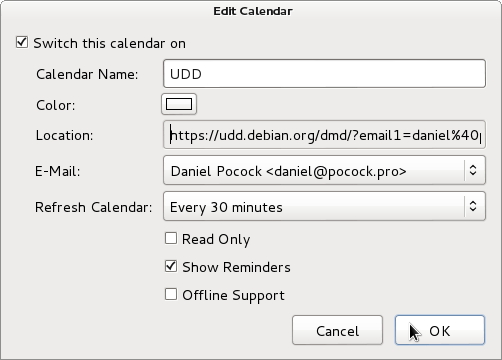
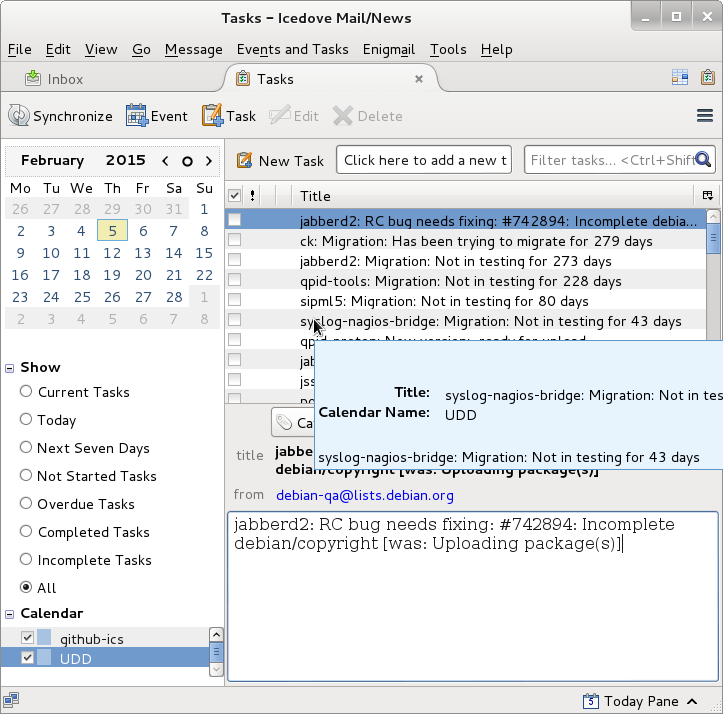
    Contributors to Debian can now monitor their list of pending activities using iCalendar clients on their desktop or mobile device. Thanks to the tremendous work of the Debian QA team, the Ultimate Debian Database has been scooping up data from all around the Debian universe and storing it in a PostgreSQL back-end. The Debian Maintainer Dashboard allows developers to see a summary of outstanding issues across all their packages in a range of different formats. With today's update, an aggregated list of Debian tasks and to-dos can now be rendered in iCalendar format and loaded into a range of productivity tools. Using the iCalendar URL Many productivity tools like Mozilla Lightning (Iceowl extension on Debian) allow you to poll any calendar or task list just using a URL. For UDD iCalendar feeds, the URLs look like this:
    https://udd.debian.org/dmd/?format=ics&email1=daniel%40pocock.pro
    
    You can also get the data by visiting the Debian Maintainer Dashboard, filling out the form and selecting the iCalendar output format. Next steps Currently, the priority and deadline attributes are not set on any of the tasks in the feed. The strategy of prioritizing issues has been raised in bug #777112. iCalendar also supports other possibilities such as categories and reminders/alarms. It is likely that each developer has their own personal preferences about using these features. Giving feedback through the Debian QA mailing list or the bug tracker is welcome. Screenshots

    Next.

    Previous.