Search Results: "lucas"

4 May 2011

Lucas Nussbaum: Debian Packaging Tutorial update

As previously announced, I ve been working on a Debian packaging tutorial. It is composed of about 60 slides providing a throughout overview of Debian packaging. It now reached the point where I consider it ready for use, and I am looking forward to reviews and comments.
The document is split into 4 different PDFs: And of course, it can be found on git.debian.org:
git clone git://git.debian.org/~lucas/packaging-tutorial.git

3 May 2011

Josselin Mouette: Rolling release

Since this has been a major request from users for a long time, I can only cool with the idea of seeing the Debian project support a rolling release. However I m not pleased with the proposed ideas, since they don t actually include any serious plan to make this happen. Sorry guys, but a big GR that says We want a pony rolling release to happen doesn t achieve anything. Let me elaborate. First of all, discussions have focused a lot on what to do when we re in a freeze phase. Numerous cool ideas have been proposed, including PPAs (which again, won t happen until someone implements them). This is all good, but this is only the tip of the iceberg. Above all, before wondering what can happen in a freeze that lasts 20% of the time, let s wonder what can happen for the 80% remaining time. Once you have something that works in the regular development phase, you can tune it to make it happen, even if in a less optimal way, when the distribution is frozen. So let s not put the cart before the horse. There are three options if you want to make a rolling release happen.
  1. Make unstable usable. to make it happen, you have to prevent the disasters that rarely but unavoidably happen here. You don t want to make all rolling systems unusable because someone broke grub or uploaded a new version of udev that doesn t work with the kernel.
  2. Make testing usable. This sounds easy since RC-buggy packages are already prevented from migrating, but actually it is not. A large number of RC bugs are discovered at the time of testing migration, when some packages migrate and others don t. Worst of all, they require several days to be fixed, and it is very often that they require several months, when one of the packages gets entangled in a transition.
  3. Create a new suite for rolling usage.
The proponents of the CUT project obviously believe in option 2. Unfortunately, I haven t seen many things that could make it happen. A possible way to fix the situation would be to run large-scale regression testing on several upgrade paths. I don t know if there are volunteers for this, but that won t be me. That would also imply to make a lot of important bugs RC, since they could have a major effect on usability, but the release team will not be keen to make it happen. Because of the testing situation, when someone asks me for a rolling release, I point her to unstable with apt-listbugs. As of today, this is the closest thing we have to a rolling release, so we should probably examine more deeply option 1. Is it that complicated to write a tool to prevent upgrades to broken packages? A 2-day delay in mirror propagation and a simple list of broken packages/versions (like the #debian-devel topic, would be enough. Add an overlay archive, that works like experimental, and you can now handle freezes smoothly. Wait isn t that aptosid? We would probably gain a lot of insight from the people who invented this, instead of trying to reinvent the wheel. Finally, option 3 could open new horizons. There s a risk that it might drive users away from the testing and unstable suites, and this makes us wonder how we could have proper testing for our packages. Still, build a process that would (and that s really only an example) freeze unstable every month, give people 10 days to fix the most blatant issues, add a way to make security updates flow in from unstable, and you have a really nice rolling distribution. So overall, it only requires people to make things happen. You want option 2 to happen? Instead of working on GR drafts, start working with maintainers and release managers on ways to avoid breakage in testing. You want option 3 to happen? Start it as a new .debian.net service and see how it works. Personally, I d be in favor of offering aptosid developers to become DDs and offer their solution as a Debian service. It would bring in new people rather than driving away existing developers from working on our releases.

Raphaël Hertzog: My Debian activities in April 2011

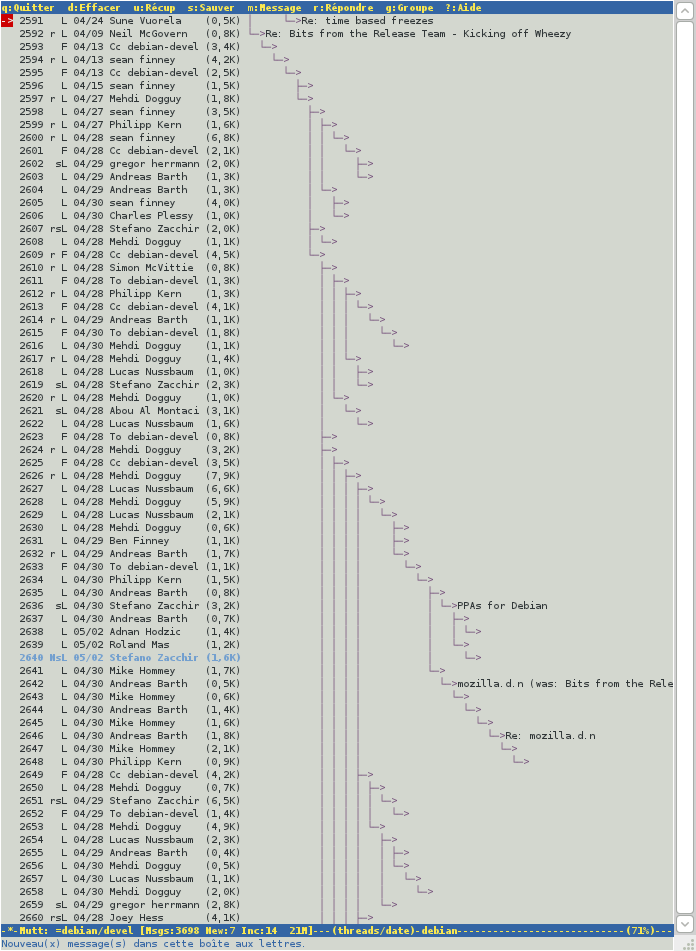
This is my monthly summary of my Debian related activities. If you re among the people who support my work, then you can learn how I spent your money. Otherwise it s just an interesting status update on my various projects. GNOME 3 packaging Right after the GNOME 3 release, I was eager to try it out so I helped the pkg-gnome team to update some of the packages. I did some uploads of totem, totem-pl-parser, gvfs, mutter, gnome-shell, gnome-screensaver. I also kept people informed via my blog and prepared a pinning file for adventurous users who wanted to try it out from experimental (like me). One month later, I m still using GNOME 3. There are rough edges still, but not so many. And I m starting to get used to it. Debian Rolling planning Debian Rolling is a project on my TODO list for quite some time. I decided it was time to do something about it and started a series of articles to help clarify my ideas while getting some early feedback. My goal was to prepare a somewhat polished proposal before posting it to a Debian mailing list. But as usual with Murphy s law, my plan did not work out as expected. Almost immediately after my first post the discussion started on debian-devel:
At this point it s a discussion thread of several hundreds of messages (there are several screens of messages like the one above). Many of the sub-threads have been interesting, but the general discussions mixed too many different things so that there s no clear outcome yet. Lucas Nussbaum tried to make a summary. Obviously I must adjust my plan, there s lots of feedback to process. I accepted to drive a DEP together with Sean Finney to help structure the part of the discussion that focuses on allowing development to continue during freezes. But I m also eager to fix the marketing problem of testing and have the project recognize that testing is a product in itself and that end-users should be encouraged to use it. Package Tracking System maintenance The Package Tracking System is an important tool for Debian developers, and it has been broken by some change on the Bug Tracking System. I worked around it quite quickly so that few people noticed the problem but Cron kept reminding me that I had to properly fix it. I ended up doing it last week-end. While working on the PTS, I took the opportunity to merge a patch from Jan Dittberner to enhance the news RSS feed that the PTS provides. And I also integrated information from backports.debian.org (thanks to Mehdi Dogguy for reminding me #549115). Multiarch update Not much new this month. I fixed two bugs in the multiarch dpkg branch thanks to bug reports from Ubuntu users (LP 767634, LP 756381). I m still waiting on Guillem Jover finishing his review of the multiarch branch. I m pinging him from time to time but it looks like multi-arch is no longer in his short term priority list. :-( I ve been running this code for more than 2 months and it works fine. I want to see it merged. I m ready to update my code should anything need to be changed to please Guillem. But without any feedback we re in a deadlock. Misc dpkg work While fixing a bug in update-alternatives (found in one of the valid reports on launchpad), I noticed that there was room for improvements in the error messages output by update-alternatives. I changed them to reuse the same strings that were already used in other parts of dpkg. The result is that there are a few strings less to translate (always a nice thing for the poor translators who have to deal with the thousands of strings that dpkg contains). I also tried to fix some of the most cryptic error messages in dpkg (see #621763) but that work is stalled at the request of Guillem. Book update We (me and Roland Mas) are almost done with the update of our French book for Debian Squeeze. It will hit the shelves in July or September. I m starting to prepare the fundraising campaign to make an English translation of it. We ll use ulule.com for this. On my blog I have been pleased to interview Meike Reichle, it s the first women that I have interviewed in the series but it s certainly not the last one. I also interviewed Adam D. Barratt, one of our tireless release managers. Thanks Many thanks to the people who gave me 180.35 in March and 235.37 in April. That represents 1.5 and 2 days of work for those months. See you next month for a new summary of my activities.

8 comments Liked this article? Click here. My blog is Flattr-enabled.

2 May 2011

Michal Čihař: PPA for Debian

There seem to be lot of momentum in discussions about making Debian testing more attractive to users on debian-devel mailing list (see Lucas's summary for summary of the lengthy discussion). One of the raised points there is that Debian misses equivalent of Ubuntu's PPA or openSUSE build service. As Debian is usually about do-ocracy, it will be there once it will be implemented, but I still don't think it is always useful to have such thing. The problem with both (but this is especially the case for openSUSE build service) is that you need to add dozens of home: projects with questionable quality of the software. This usually leads to horrible mess, especially in case of incompatible libraries with different build options (anybody using wxWidgets?). It can definitely lower barrier for people to create packages for the distro, but is it really good to lower barrier that much? I'd really prefer new things to be uploaded to Debian itself without need to use any external repositories, it would ensure at least some level of quality and compatibility with other packages.

Filed under: Debian English Suse 5 comments Flattr this!

Lucas Nussbaum: Debian rolling discussion on -devel@

Here is my attempt at a summary of the rolling discussion currently happening on debian-devel@. It might not be complete, it s probably a bit biased, but I hope that it s still better than nothing. It was also posted on debian-devel@. If you are involved in Debian development, please discuss it on debian-devel@, rather than in the comments of this blog. If you want to provide feedback about the Debian rolling idea, use this Doodle poll and/or the comments of this blog.
Update : Someone had the good idea to vandalize the poll, and remove all the votes from people in favor of rolling. Before the vadalism (log), the results were:
37 votes: I am a Debian user, I use testing or unstable, and I would like rolling to happen.
6 votes: I am a Debian user, I use testing or unstable, and I DON T want rolling to happen.
17 votes: I am a Debian user, I use stable, and I would like rolling to happen.
3 votes: I am a Debian user, I use stable, and I DON T want rolling to happen.
7 votes: I am NOT a Debian user, but I would probably use it if rolling happened.
1 vote: I am NOT a Debian user, and I don t care about rolling. Motivations There s some user demand for rolling releases. For evidence, one can look at the usage of Debian testing or unstable which clearly goes further than the Debian development community. Or at the quickly growing market share of ArchLinux. Or at the interest in LinuxMint and Aptosid. Or at the DPL s report of his interactions with the press. Debian s only official product is its stable releases. While it s a clearly great and useful product, many users and developers don t recognize themselves in it: it contains software that is too old for their needs. The success of Ubuntu is related to this problem: Ubuntu proposes a different compromise between stability and up-to-date-ness. While concurrencing Ubuntu with more frequent stable releases (released every 6-months, for example) doesn t look like the right thing to do, Debian is in a perfect position to provide a rolling release with marginal additional work, since Debian already has testing (and unstable) to build on. The rolling discussion investigates how we could endorse the concept of a rolling release, provided as a product in addition to stable releases. This rolling release would be based on the current testing branch. Benefits for Debian: Current proposed plan for rolling (Disclaimer: this is mostly my view. It is shared by others, but some details might not be) rolling is mostly about (external) communication. It is not expected to change our development processes fundamentally.
It would be a statement by the project (through a GR, for example). A very preliminary draft was proposed by Raphael Hertzog:
Title: Debian endorses usage of testing by end-users, and renames it to rolling The Debian project recognizes that the Debian testing distribution initially created to make it easier to prepare and test the next stable release has become a useful product of its own. It satisfies the needs of users who are looking for the latest stable versions of software and who can cope (or even appreciate) a system that s constantly evolving. The Debian project decides to endorse this usage and will strive to provide a good experience to users of testing . To better communicate this policy change to our users, testing will be renamed rolling .
Yes, it s mostly PR bullshit , and I don t expect it to significantly change Debian development processes. However, communication is necessary if we want to attract new users. What would change is more attention from developers to what happens in testing/rolling, which is a good thing since a better testing/rolling makes it easier to create stable releases from it. Open questions Most of the discussion is about the influence of the introduction of rolling on Debian development processes, and in particular, on the painful process resulting in stable releases. Many fear that, with rolling , it will be harder to get stable releases out. The root question is: if we do rolling, what do we do during freezes? Several options have been mentioned in the thread:
  1. We could decide not to do anything special: just freeze rolling for ~6 months, as we used to freeze testing. That might bore people who like the constant flux of new upstream releases, but if we decide that it s the only way to ensure high-quality stable releases, so be it.
  2. We could decide to fork a frozen branch when we freeze, and continue to manage rolling using migrations from unstable.
  3. We could mix both solutions: freeze rolling for 3 months, so that most of the stabilization work occurs with a single active branch, and then, for the final release preparation, fork frozen off rolling, and unfreeze rolling.
Two kinds of objections have been raised: Other things that were discussed: Tentative personal conclusion I have the impression that advertising testing as a rolling release usable by end-users is generally considered a good thing.
The renaming of testing to rolling is not as consensual, but most opponents have a whatever ; if you want position. How we deal with freezes is the hard point in this discussion. I m personnally in favor of the freeze rolling for 3 months, then fork frozen and unfreeze rolling plan, though it has some problems too (it is not clear whether the required manpower really decreases at the end of freezes). Where do we go from there? After another round of discussion, we might postpone the how to deal with freezes question to later, and proceed with a GR to measure the support for the testing for end-users + s/testing/rolling/ proposal.

29 April 2011

Raphaël Hertzog: Do we need project-wide support for Debian rolling?

The discussion about Debian rolling started sooner than expected on debian-devel (see the thread here). I initially wanted to iron out the biggest problems through discussions on my blog and try to submit a somewhat polished proposal instead we ended up discussing the same things both on -devel and on my blog. That said it s not that bad (except for the time I lost to have similar conversations in both places) because the debian-devel discussions included members of the release team and it looks like they are not fundamentally opposed to the idea. Despite this, the introduction of a frozen suite branched off from testing/rolling is not really consensual (yet?). But the idea of officially supporting testing on a best-effort basis appears to have almost no opposition. While some will undoubtedly believe that this is a useless exercise, I believe it would help if the project stated this in a somewhat official manner. My answer to the question in the title is thus: YES I am thus considering to submit a general resolution to that effect. My current draft is below.
Title: Debian endorses usage of testing by end-users, and renames it to rolling The Debian project recognizes that the Debian testing distribution initially created to make it easier to prepare and test the next stable release has become a useful product of its own. It satisfies the needs of users who are looking for the latest stable versions of software and who can cope (or even appreciate) a system that s constantly evolving. The Debian project decides to endorse this usage and will strive to provide a good experience to users of testing . To better communicate this policy change to our users, testing will be renamed rolling . While we believe that this is a good move, we would like to remind our users that Debian is a volunteer project and that our resources are not infinite. Package maintainers are contributing to Debian on a best-effort basis. This means that they might not be able to properly support their package(s) in all distributions. In that case, the project recommends that maintainers apply the following priorities:
  1. Support in stable (security updates, release critical bugs)
  2. Preparation of the next stable release
  3. Support in rolling
Note that this general resolution could have amendments with s/rolling/current/ and that would solve the bikeshedding over the name that started several times already. I deliberately separated Preparation of the next stable release and Support in rolling so that priorities are clear even if we decide to not freeze rolling and to introduce a frozen distribution to finalize the next stable release. I also did not go into too much details on the implications that it might have, it s best to leave that up to each contributor/team/etc. I hesitated to add a paragraph stating that we want to try to gradually improve the usability of testing but in the end I think it would be somewhat redundant. We re always trying to do our best when we decide to take on something. All comments welcome (even if you just agree and would be willing to second such a GR). Update: I will tweak the draft included in this article when I get good suggestions. Thanks to Lucas Nussbaum for the first one.

10 comments Liked this article? Click here. My blog is Flattr-enabled.

14 March 2011

Russell Coker: Effective Computers for Schools

Sam Varghese has written an article that is very skeptical of the educational value of the OLPC project [1].Are Laptops Any Good for Schools?Sam cites an article in the New York Times by Winnie Hu about schools removing laptop programs due to a lack of success [2]. Winnie s article gives an example of a school shutting a program because of getting new teachers who lacked computer skills and some examples of schools which had issues with the repair cost. The solution to that would be computers that are more robust and easier to use by all accounts the OLPC systems are solidly constructed and easy to use!It is claimed that using laptops doesn t increase test scores. Using only test scores to compare educational methods is a way to lose, probably any school which does nothing other than try to increase test scores is worth avoiding. One example from Winnie s article is a report by Mr. Warschauer of students at a middle school in Yarmouth, Me., who used their laptops to create a Spanish book for poor children in Guatemala and debate Supreme Court cases found online . What value can you place on having students develop books for poor children in other countries and debate Supreme Court cases? If this sort of program became popular then it would lead to the countries which do it becoming better places to live in future decades!Mr. Warschauer also claims that If the goal is to get kids up to basic standard levels, then maybe laptops are not the tool. But if the goal is to create the George Lucas and Steve Jobs of the future, then laptops are extremely useful . I would go further than that, I think that providing the educational environment that involves international charity work and analysis of important court cases would lead to students having the skills to become good engineers, designers, and artists who work for people like George Lucas and Steve Jobs. No matter what you might do the vast majority of children will not grow up to be like George Lucas and Steve Jobs, there is a very limited number of positions for such people. But those people employ a huge number of creative people who do interesting and enjoyable work for good pay.I don t think that Winnie s article supports criticism of the OLPC project. I don t think that Winnie s article even contains sufficient evidence to match the headline.Playing GamesSam also cites an article about the misuse of school computers for playing games [3]. Of course there are ways of limiting access to games based on time etc. For a Linux system you could have a root cron job that runs chmod on /usr/games at various times, and preventing users from easily running programs that they install isn t difficult.Not that games are all bad, the flash-based games on www.physicsgames.net do teach kids some things about physics although I admit that much of that could be learned by playing with balls, skate-boards, etc.The Problem with the OLPC ProjectI think that the policy change to make OLPC systems only available to disadvantaged children was a mistake. The give one get one program was a great idea, maybe not the most effective way of getting funding but good for getting developers. While the new Sugar on a Stick project to put the OLPC GUI on a bootable USB device [4] it doesn t compare well to having dedicated hardware IMHO.Minimal Use of ComputersI have previously written about the weight of school bags and how laptops can alleviate the risk of health problems related to carrying heavy text books [5]. Since that time ebook readers and tablets have become incredibly cheap. Ebook readers are really light and the recent tablets are also very light (particularly the smaller ones). It seems to me that every school should at least be moving towards every student having an ebook reader and to use ebooks for all books that are part of the curriculum.At the moment there are a bunch of tablets on sale for about $150, that includes tablets that can access the Internet via Wifi or via 3G and a cheap 3G plan costs less than $150 per annum. If tablets were used for some of the computer tasks related to schools then a lot of the difficulty of repairing hardware would be removed. Tablets don t offer as many options for messing up the software configuration and if the hardware breaks it s easy to transfer the data onto a new tablet from the cloud with a maximum cost of $150 to replace the hardware.Also a cloud-based computing model could permit students to access all the same data from school and home while using desktop computers at both locations.Current SuccessNatalie Craig wrote an interesting article for The Age about The Lab a drop-in computer center for kids on the Autism Spectrum run by Dale Linegar and Stefan Schutt [6]. The fact that kids who have communication difficulties can find it easier to communicate electronically should be fairly obvious to everyone in the free software community, but the creation of an organisation to support such kids is noteworthy I think that such centers should be funded by the government and run in every city.Salman Khan gave an interesting TED talk about his project the Khan Academy [7] which is an online video-based teaching system that evolved from some Youtube videos he produced to tutor his cousins. Salman pointed out that his cousins said that they would rather watch his videos than have him teach them in person, it seems that they liked being able to pause and rewind the talk as well as avoiding the pressure of human interaction. The Khan Academy has videos in Adobe flash format, but conveniently they have download links so those of us who don t have the Flash plugin can still view the content [8].One of the interesting things about the Khan Academy is that in school use the videos are being assigned to kids as homework and the class time is used for teaching children to do worked examples what has traditionally been homework.So it seems that there are real examples of special-needs kids and average kids benefiting from different types of electronic learning.ConclusionI think that almost everything about the education system is broken. I also think that in many ways the education system has reached a local maximum, so there is no small way of improving things, and adding computers without making any of the significant changes needed to fix the big problems probably can t do a lot of good. In spite of this computers can provide some real benefits and I expect that those benefits can be better than the benefits of other potential ways of spending the money (IE it s worth the opportunity cost). I also have no doubt that almost anything can give a negative result if done badly enough, so I don t interpret examples of computer use failing in a school as anything other than evidence of a failing school.While the Khan Academy has some results that seem very positive I think that s only the first step of what needs to be done. It also seems to be based around users who have good Internet access which often isn t the case in places where the OLPC is being deployed. This implies that we need to get systems like the Khan Academy designed to operate in a disconnected manner, maybe with a remote server that s not connected to the Internet. This should be possible if funding is available.Sam suggested that there needs to be a scientific study of the effectiveness of the OLPC. I think that every project which involves significant amounts of public funding should be researched to ensure that it s an effective use of resources. 400,000 laptops is going to cost something more than $40,000,000 so it seems reasonable to devote a few person-years of research to determine how effective they are and which of the possible ways of using an OLPC will give the best results.I am confident that a good study of the effectiveness of the OLPC would demonstrate that it provides real educational benefits when correctly incorporated into an educational program. I also expect that such a study would show some significant differences in the effectiveness of various ways of using them. But we shouldn t be relying on confidence, we need some test results.

2 March 2011

Lucas Nussbaum: Banshee and Ubuntu

[ If you haven't heard of this debate yet, you probably want to read Vincent Untz's and Mark Shuttleworth's blog posts. ] Last year, I gave a talk at FOSDEM about Debian and Ubuntu (slides of a slightly updated version). One of my points was that Debian has better values, being a volunteer-driven project where decisions are taken in the open. In contrast, Ubuntu is a project managed and controlled by Canonical, and recent history has shown that Canonical had no problem imposing some decisions to the developers community: first with the inclusion of UbuntuOne, then the switch from Google to Yahoo! to Google as the default search engine, both to increase revenue streams. So one should not be surprised by the Banshee story. I find Mark s justification quite difficult to buy, and similar to Apple s model where 30% of the revenues from the App Store go to Apple, and 70% to the seller of the application. For those wondering how much work was done by Canonical directly on the Banshee package: the banshee package in Ubuntu natty is based on the package currently in Debian experimental. The package is mainly maintained in Debian by an Ubuntu developer not paid by Canonical AFAIK, Chow Loong Jin. There are some differences between the Debian package and the Ubuntu package, which are fairly limited (full diff here) and mainly about enabling UbuntuOne and disabling the other music stores. That patch itself apparently was provided by Jo Shields, who doesn t seem to be a canonical employee. (Feel free to correct me) I think that one of the conclusions to draw from this story is that we now have several proofs that Ubuntu isn t a volunteer-driven project, and that volunteer contributors should really decide whether they are OK with working for free for Canonical, or if their free time would be better spent on other projects where they actually have a chance to influence decisions. From the Debian POV, I m still convinced that we should take the feedback that we receive from Ubuntu in consideration to improve our Debian packages (by looking at patches made by Ubuntu, or at bugs reported in Launchpad). But my motivation for contributing to Ubuntu directly has just diminished a bit more (not that it was very high before).

25 February 2011

Lucas Nussbaum: Debian is changing

I ve been playing with snapshot.d.o, which is a fantastic resource to look at how Debian has been changing over the years.
Below are some preliminary results about various aspects of source packages: format, packaging helpers, and patch systems.
For clarification: Random comments: If you have other ideas of things to investigate using snapshot.d.o, don t hesitate to ask in comments.

21 February 2011

Lucas Nussbaum: Debian Spring Cleanup

We have many orphaned packages in Debian. Those are packages that no longer have a maintainer willing to care for them. They are a problem for several reasons. Often, there have better alternatives (that s often why the maintainer gave up maintenance), but users keep installing them because they show up in apt-cache search. Or, they might be broken, without anybody noticing because they only have a few users. Also, developers need to take them into account. They might slow down transitions, have RC bugs that need fixing, etc. So, there are good reasons to remove some of the orphaned packages from the Debian archive. Not all of them. But those that have been orphaned for a long time without anybody stepping up to take over the maintenance, have very few users according to popcon, etc. Removing some of them also makes it easier to expose the ones that should really find an adopter. Also, that removal is not final. The good reason to do this now is that we are at the beginning of a release cycle, and that it will be easy to reintroduce packages that are really needed during the next two years. Also, packages (both source and binaries) are still available on snapshot.debian.org, so users can still install them from there, and re-uploading them to Debian is very easy if someone wants to adopt them. So, how do I proceed? I use bapase, and go through specific sets of packages (using a custom version of bapase to restrict the list to those packages). For example, orphaned packages that have a popcon lower than 50, have been orphaned for more than 500 days, and whose orphaning bugs have not been modified in the last 100 days. Then, I read the bug log, and decide if there s a reason to keep the package. If there s not, I request the removal. As of today, there are 471 orphaned packages in Debian. The goal is not to get down to zero, but it s certainly possible to get down to 200 or 250. How can you help? Start from the list, and find some easy targets. You can take a look at bug #483252 if you want to re-use my template. Also, one thing that is currently missing in the process is that orphaned packages that have reverse-dependencies should not be removed without removing their dependencies (if appropriate). An easy and efficient way to know if a given package has reverse (build-)?dependencies would be great, so I could integrate this info into bapase and exclude those packages from the list, or mark them somehow.

16 February 2011

Lucas Nussbaum: Introducing the Debian packaging tutorial

One of the common complains about Debian packaging is that it s hard to learn because, while there is quite a lot of high-quality documentation, it is often written more as a reference manual than as a tutorial: it s great if you already know everything and want to check some detail, but not so great if you want to learn everything from scratch. I have been volunteered (i.e, someone decided I volunteered) for a Debian packaging tutorial at work, so I decided to give a try at tackling this issue. I also volunteered (voluntarily this time) for a similar talk at RMLL 2011 to make sure I would be forced to do the work and prepare the actual tutorial. I m also considering teaching this next year in Licence Pro ASRALL, but I haven t made up my mind about it yet. The result is a work in progress (hey, I still have a lot of time), but in the release-early-release-often tradition, I m making it public now in the hope that someone will pick up the idea and do all the work for me (you never know). I ve decided to create a set of slides using Latex Beamer. The current version can be found here. The sources are available in a git repository, and all contributions are welcomed (including plain comments or suggestions). The last slide is the current TODO list.

15 February 2011

Torsten Werner: Are we slaves?

We still have more than 300 new packages in Debian that needs manual checks and we have a lot of open bugs. I don t get paid for working on dak (the Debian Archive Kit) nor do I feel a deep passion on doing such work. I am contributing to Debian because it is a great project and because contributing is my way to say Thank you to all who made (and still make) it possible. BUT: are we slaves that are supposed to do any stuff for other people? Yesterday someone asked for an enhancement for dak via IRC. I ve kindly asked him: do you want to send a patch? (words are copied from the IRC session). Instead of answering no he sent a patch for 2 plain text files within 4 minutes after I told him the URL to dak s git repository. I could not do it faster by myself and I ve got many other open tasks. I ve applied the patch and activated it on ftp-master.debian.org. But today he ranted about my rudeness and he did not even managed to quote me correctly ( Please send a patch ).

Lucas Nussbaum: Re: please send a patch

It seems that Matthew Palmer misread my blog post as a complaint against developers asking for patches in exchange of pet feature requests. He really should pay more attention, since I gave pet feature requests as an example of case where it would be appropriate to ask for a patch:
Of course, there are cases where it s perfectly reasonable to ask for a patch: when the task is expected to take hours, or when the result is of limited interest to everybody except the demander.
But even then, it s not clear. This morning I got an email from a someone involved in PHP packages maintenance, who said that Bugs Search @ UDD was a great tool, but that he would love to have a way to list all bugs affecting packages with the implemented-in::php debtag.
To produce a working patch for this would probably take him at least an hour. You need to set up a copy of the CGI on alioth, understand the DB structure, dig into the code, etc. If you don t understand SQL and Ruby, it could be a really difficult process. Also, it s probably quite uninteresting for him to do that, since he is unlikely to stick around developing UDD.
Instead, it didn t take me more than 5 minutes to produce a one-liner.
The net result for Debian in that case? 55 minutes saved by a developer. Update:
Torsten Werner wrote an angry reply to my post. It s true that yesterday s episode triggered my blog post, because I felt quite frustrated to have to provide a patch for something that simple, and would have preferred to use the time for a Debian task where I would be more efficient. But I was not particularly angry at that episode, since that s something I ve seen on several occasions. That s also why I did not mention any team in particular.
The feature request I was making was reasonable, and cannot really be considered a pet feature request (though I might be biased with my QA hat on): mentionning in the dak templates used for bug closure that packages removed from Debian can still be found on snapshot.d.o. The fact that he thinks that addressing this himself turns him into a slave raises interesting questions.

Matthew Palmer: "Please send a patch"

On the other hand, Lucas, remember that each time you ask someone to take some time to implement your pet feature request, you take some time away from her that could be used to contribute something in an area where she gives a damn. (This has been a Public Service Announcement from the "Scratch your own itch" foundation, with the grateful assistance of the "Paddle your own f**king canoe" committee.)

Lucas Nussbaum: Please send a patch

There s a frequent pattern in the Debian community where someone would suggest an improvement to some package or service, and the person responsible for it would reply with please send a patch . Of course, there are cases where it s perfectly reasonable to ask for a patch: when the task is expected to take hours, or when the result is of limited interest to everybody except the demander.
But often, it would be much more efficient for the person responsible for the service to take 5 or 10 minutes to make the change, than for the demander to spend half an hour learning how to contribute to this service, writing an untestable patch, and sending it back to the person responsible for the service for integration. It is important to see this problem as the issue of maximizing the usefulness of the resources we have. Often, we are in a situation where we could either: It would be much better if, instead of saying Please send a patch , people would say Are you interested in contributing a patch, or should I make the change myself? . Remember that each time you ask someone to take some time to contribute a patch in an area where he is not an efficient contributor, you take some time away from him that could be used to contribute something in an area where he is efficient.

6 February 2011

Lucas Nussbaum: mutt + notmuch = perfect mail setup?

Following Our Leader, I ve just switched to using notmuch with mutt for searching (instead of maildir-utils, previously). I strongly recommend this setup to all mutt users. As a bonus, accented characters ( , , ) are now handled correctly while searching, which is quite useful in french.

25 January 2011

Paul van Tilburg: Also Giving up on Ruby Packaging

I have just sent a mail to the Debian/Ruby Extras mailing list stating that I will also give up most of my Ruby packaging efforts and reduce my involvement in the team. I am following Lucas Nussbaum in his decision. Although our reasons are slightly different, I subscribe most of what he says in his blog post. Besides that, I haven t done much Ruby programming in the past years, making me lose the motivation for the huge load of packages I am responsible for and thus subconsciously perceive that as a burden, as I feel guilty not having/making time to work on them. So, what does this mean? I will handover (co)maintainership of over 50 libraries. Many of which have dead upstream, unfortunately. Also will I be looking for someone to take over the administrative tasks of heading the team such as mailing list moderation and Alioth repository access. I will keep maintaining some programs that I still use, such as Camping, and am approachable for (mentor) uploads. Meanwhile I will continue my work on my PhD thesis, which is progressing well and should lead to my defence (hopefully) somewhere around September this year. That said, I will try to keep tinkering with Ruby and other F/OSS projects. Oh, and also to get more motivated and some inspiration

6 January 2011

Gunnar Wolf: Back with Ruby on Debian polemics

Once again, a polemic regarding how to properly integrate the Ruby language and libraries with the Debian distribution has been ignited. Similar arguments were presented in November and December 2008 and September 2010 And excuse me for just refering to my own blog, but there are links to some other posts from there... and there will surely be many others I just missed. There were even nice collaboration attempts (such as DebGem, announced in January 2009... But which apparently never stuck on, as it is still listed as in its public Beta period and lists only support for Debian 4.0 and Ubuntu 8.04 and 8.10). Some days ago, while I was on vacation, I received a mail from Lucas Nussbaum expressing the burnout he had been suffering from this situation. Some days after that, he posted a corresponding blog post - Giving up on Ruby packaging. The comments following his post are most interesting The one comment I'd like to highlight (noting I skimmed a whole deal of them) is by Paul Brannan, one of the original RubyGems authors. Yes, possibly the design criteria for Gems included some mutually-conflicting goals, and they cover some of Debian's goals. Unfortunately, this conflicting criteria... Was resolved to the opposite way we would have wanted (specifically, that a sysadmin should be able to install software with the same tools he was already familiar with). And of course, there are deeper disagreements, which are rightly stemmed from different priorities: Debian (+derivatives) is meant to make user's and sysadmin's lifes simpler. Gems are meant to make developers' lifes simpler. And while all developers are some sort of users, and sysadminsthe reverse is (obviously) not so. A developer maintaining several different codebases will surely suffer (well, this particular developer has surely suffered) if he has to maintain them all using coherent versions of system libraries. When a system is programmed, its developers want to use the greatest, latest tools to offer the best experience and functionality. And it's natural for libraries to evolve over time. However, any sysadmin will grind their teeth at the prospect of having many different versions of libraries, as the Gem model proposes. Why? Well, I was bitten by a minor example of it Bug fixes do not get backported. Of course, if simple bugs are not backported, security and stability of the system as a whole suffers. Often, new software versions will not only add functionality, but improve on how things are done. Not only bugs get corrected, but we get better response times, better memory handling, etc. It might sound harsh to say this, and even more, as a developer it feels I am talking against myself But while development time should be minimized during the system design/implementation, once systems are in production, it should be used to allow for friendlier sysadmin relations. I have to wear both hats at my real-life job. So, what is my take on this? Of course, blaming myself for choosing the wrong version is a no-go. When evaluating a library before using it in my projects, I try to look at its history and API-stability. APIs that change often speak about immature libraries which are still trying to get the right way to implement their functionality; just-started projects might be great and revolutionary, but they do not yet show any kind of long-term committment... And can lead (and have often led me) to painful rewrites when the Next Big Thing is reached. As for the users: Even if your favorite language has the best and friendliest distribution method, users just do not care about what language was a particular piece of software implemented in. Users want to be able to install and uninstall with their system's usual tools. Directly using Gems, CPAN, PEAR and whatnot is just unnatural for users, however convenient they are for developers. Distributions offer a non-technical advantage in this regard as well: A human filter. As an example, as I write this there are 19392 Ruby Gems and 19092 Perl modules in CPAN (note that CPAN stores some older versions but discourages authors from keeping too many - So no, they are still very different in size). Debian has around 30,000 packages. Why is that? Because all Debian packages _must_ be human-generated, human-reviewed, human-submitted. This means, a person must think each packaged piece of code is worth packaging, is stable enough and provides value to users as it is, and is fit for being part of a stable release. I am not saying with this that 90% of CPAN and Gems are crap I am saying that they are probably early implementations, to be installed, tested and improved by developers, and still not apt for general public use. Or maybe not interesting enough to be packaged as a service for the non-techie public at large. Oh, and one last point: Ruby is not a new language anymore. It is a mature, powerful language with different implementations, every time more stable... But it is a language deeply affected by the (not so new anymore either) the appearance of Rails. Why do I say this? Because although the language is in no way tied to Web development, many of its strongest uses are Web-oriented. How does this affect the current discussion? Well, because many people argue that users are no longer needed to install the software. Web systems are installed by sysadmins and used via a Web browser, and sysadmins are expected be more skilled than casual users. Still, in Debian (and in other distributions, surely) we try to make sysadmin's lives simpler I have (again, talking out of personal experience) installed several webapps (and system tools, and whatnot) for which I never followed any instructions besides aptitude install foo Using different languages, frameworks, and so on. Can I troubleshoot their installs? Probably, as there is a common logic for how the distribution I have chosen and specialized in works. Can I find causes for bugs in them? Possibly, although there are some languages and frameworks I dare not touch. Can I get help on getting them out of a tight spot? Surely, as there is a central bug tracking system for my distribution And one of the maintainer's tasks is to separate the problems related to the distribution (packaging, installing, simple user questions and misconceptions) to those derived from real bugs upstream. Anyway I am not saying that our way is the best way. No, by a long shot. Again, developers should have an easy, convenient way for installing whatever they want to play with. And to publish it without jumping through hoops. With this post, I'm only trying to express again why Debian works the way it does. And hope for better cooperation in the future. And as for several comments of what I read in Lucas' post, I think that there is interest for this synergy among some of the most committed Ruby people.

2 January 2011

Lucas Nussbaum: Giving up on Ruby packaging

I have finally reached a decision regarding my involvement in the Debian Ruby packaging efforts. I have decided to stop. This has been a very hard decision to make. I have invested huge amounts of time in that work over the years. I still love the language, and will continue to use it on a daily basis for my own developments. I still hope that it will succeed. I know that some people will be disappointed by that decision (and that others will think your work was useless anyway, people should use RVM and rubygems ). But I also know that I won t be able to push for all the required changes alone. I just don t have the time, nor the motivation. For the record, here are the changes I would have liked to see in the Ruby community. The core Ruby development community should mature.
The core Ruby development community is still dominated by Japanese developers. While not a bad thing in itself, it is easily explained by the fact that the main development mailing list, where most of the important decisions are taken, is in japanese. ruby-dev@ should be closed, and all the technical discussions should happen on the english-speaking ruby-core@ list instead. The release management process should also improve. Currently, it looks like a total mess. The following Ruby development branches are actively maintained:
ruby_1_8 (106 commits over the last six months)
ruby_1_8_6 (4 commits over the last six months)
ruby_1_8_7 (35 commits over the last six months)
ruby_1_9_1 (4 commits over the last six months)
ruby_1_9_2 (227 commits over the last six months)
trunk (1543 commits over the last six months) While the state of the ruby_1_8_6 and ruby_1_9_1 branches is clear (very important bugfixes only), the state of all of the other branches is rather unclear.
What s the stable Ruby branch? 1.8 or 1.9? If it s 1.9, why are people still actively developing in the ruby_1_8 branch? How long will they continue to be maintained in parallel, dividing the manpower? Is a Ruby 1.8.8 release to be expected? Will it be ABI/API compatible with 1.8.7? Is the ruby_1_8_7 branch really bugfixes-only? How much testing of it has been done? If it s bugfixes-only and regression-free, I should push it to Debian squeeze, due to be released in a few weeks. But would you recommend that? Due to past breakages in the ruby_1_8_7 branch, it s unlikely that we will do it.
Is the ruby_1_9_2 a regression-free, bugfix-only branch? If yes, isn t 227 commits over 6 months a lot? What will be the version of the next release of trunk ? When is it expected? Will it be ABI-compatible with the current ruby_1_9_2 branch? API-compatible?
New releases in the 1.8.7 and 1.9.2 branches were done on december 25th. Why were they no betas or RCs allowing wider testing? How much testing has been done behind the scenes? Most of those questions have no clear answer. The Ruby development community should build a common understanding of the status of the various branches, and of their release expectations. Releasing on december 25th of each year sounds fun, but is releasing when everybody is on vacation really a good idea? It would be fantastic to have something similar to Python Enhancement Proposals in the Ruby community. But having open discussions in english about the major issues would already be great. Ruby is not just the interpreter.
The Ruby development community should clearly define what the Ruby platform is. There are some big players, like Rails, and newer interpreter releases should not be done before ensuring that those big players still work. Also, since we have alternative Ruby interpreters, like JRuby, Rubinius and MacRuby, we need a clear process on how they integrate with the rest of the ecosystem. For example, having each of them rely on their own outdated fork of the whole stdlib is ridiculous, since it s not where they compete. The Ruby community should acknowledge that RVM and Rubygems are not for everybody. People who say so should be laughed at. Of course, RVM and Rubygems are nice tools for some people. But it is completely wrong to believe that compiling from source using RVM should be the standard way of installing Ruby, or that all people interested in installing Redmine should know that Ruby has its own specific packaging system. The Ruby community should work with their target platforms to improve how Ruby is distributed instead of reinventing the wheel. That includes Debian, but also RedHat-based distros, for example. It is likely that it won t be possible to reach a one-size-fits-all situation. But that s real life. Some people in the Ruby community should stop behaving like assholes. As one of the Debian Ruby maintainers, I have been routinely accused of creating crippled packages on purpose (FTR, I don t think that the Debian packages are crippled, despite what the rumors says). Debian is not the only target of that. Just yesterday, someone called for abandonning YARV (the new Ruby VM in Ruby 1.9), calling it Yet Another Random Vailure. This kind of comments is really hurting the people who are investing their free time in Ruby, and is turning away people who consider getting involved. In Debian, we have had a lot of problems getting people to help with Ruby maintenance since they are getting shit from the community all the time. So, what s the future for Ruby in Debian? Update: there s also a number of interesting comments about this post on this site.
Update 2: First, thanks a lot for all the interesting comments. I will make some follow-up posts trying to summarize what was said. It seems that this post also triggered some reactions on ruby-core@, with Charles Olivier explaining the JRuby stdlib fork, and Yui Naruse clarifying that all questions are welcomed on ruby-core@. This is great, really.

25 December 2010

Lucas Nussbaum: Trouble connecting with Nokia N900 as 3G modem?

If you are having trouble connecting to the Internet using your Nokia N900 as a 3G modem with Network Manager, you should check those bugs. (In short: bug fixed upstream, but affecting the version in Debian. Using the package from Ubuntu works.)

Next.

Previous.