Daniel Pocock: Some further observations on init replacement

My blog about replacements for SysV init received a significant number of comments Monday, revealing a solid base of community support for systemd. One reader was even generous enough to contribute a pull request fixing the reSIProcate package systemd artifact
The blog wasn't intended to disparage any of the init replacements or suggest that these types of issues are show-stoppers. Rather, it was simply to demonstrate the fact that developers need to divert attention from other activities (like bug fixing, new features, etc) to correctly adapt things and support the wide range of init replacements that have emerged. As revealed in some comments like this one, systemd can even assist with privileged port assignments: it's nice a feature, but also likely to require more development time to integrate.
None of these things are difficult though, they just take time.
The real challenge
The biggest headache is that it becomes tedious for any upstream developer to start getting into that much depth learning about each system they want to support. That is before we even start talking about how daemons and other services are managed in cloud deployments (e.g. the Juju charms from Ubuntu). For a developer to seriously integrate and test their daemon in all of these environments and make maximum use of all their features could easily take a month: without adding any new features to the application itself.
In the last five years, I have personally come across all of these platforms and formal packaging systems:
- Debian
- Fedora
- RHEL/EPEL
- Solaris - in particular, using OpenCSW
- OpenWRT
- CRAN
- Android (Google Play)
- Android (F-Droid tools)
- Java (Maven)
- Java (Ivy)
- and even some MSI for Windows (using Wix) - deploying Ganglia in a large corporate environment
 Today I held a lightning talk at the
 Last Friday, I spent and hour and a half clamping a landline phone to the
side of my head, while also wearing a headset. I was recording an interview
on the

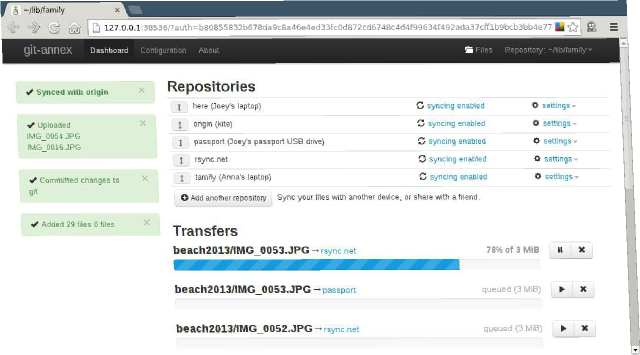
 It was pointed out to me that some requests on

 As previously mentioned I was looking to package pwsafe for Wheezy, as this is one of the few tools that I rely upon which isn't present.
There are now
 Thanks to Joey's
 Seeing what has been posted recently in planet.d.o, I would like to share as well my thoughts and work-flow, and tell that I do agree with Joey Hess on many of his arguments. Especially when he tells that Debian fetishises upstream tarballs. We re in 2013, at the age of Internet, and more and more upstream authors are using Git, and more and more they don t care about releasing tarballs. I ve seen some upstream authors who simply stopped doing so completely, as a Git tag is really enough. I also fully agree than disk space and network speed isn t much of a problem these days.
When there are tags available, I use the following debian/gbp.conf: