Search Results: "joachim"

24 June 2010

Joachim Breitner: nagstamon forklet necessary

A while ago, I discovered nagstamon, a very useful piece of software by Henri Wahl. This program sits in the notification area of your desktop and alerts you when your nagios-monitored services have problems. Using nagstamon allows me to keep my servers under close surveillance, and it also adds another channel besides e-mail alerts, which will be helpful in case my mail server has problems. The wish I am not a full time sysadmin, I only monitor very few hosts and the services rarely have problems. Therefore, I do not want nagstamon to constantly sit in the notification area but only use it when there is something, well, to notify me about. It turned out that nagstamon did not support this mode of operation, so I created a ticket and asked whether this feature could be added. The author raised two points, one being that then the user would not know when nagios crashed and the other being that you would not be able to configure nagstamon because you do not see it. He also indicated that he does not have the resources to work on it and asked if I could find the time. The patch Since I really liked nagstamon, but really want to keep my panel uncluttered, I found the time: I created a series of self-containing patches, adding an option for the feature, adding code to prevent more than one instance of nagstamon running in parallel and adding a "nagstamon --settings" flag that would signal the running instance to show the settings similar to how mail-notification is been behaving. The author then raised the valid point that some people run more than one instances in parallel, with different configuration options. I then extended the patch to cater for that. The rebuff The author remained reserved, did not answer my last commend on the ticket and then, six weeks later, closed the bug without explanation and turned off the possibility to add comments. I can understand when people are reluctant to add contributed features to their code, I often feel the same way. But completely blocking more comments is not a nice way of communicating with possible contributors. The fork(let) So I m left with no option but patching each released version with my changes and building my own package. As I have to do this work anyways, I d like to share it. You can find my branch in my git repository. If you happen to want this feature as well and are using a Debian-based distribution, please let me know: I am building modified Debian packages anyways and can publish them as well. As I don t want to maintain this fork of nagstamon I don t plan to diverge any more from Henri s code, so if you have other feature requests, please talk to him first.

12 June 2010

Joachim Breitner: bluetile in Debian

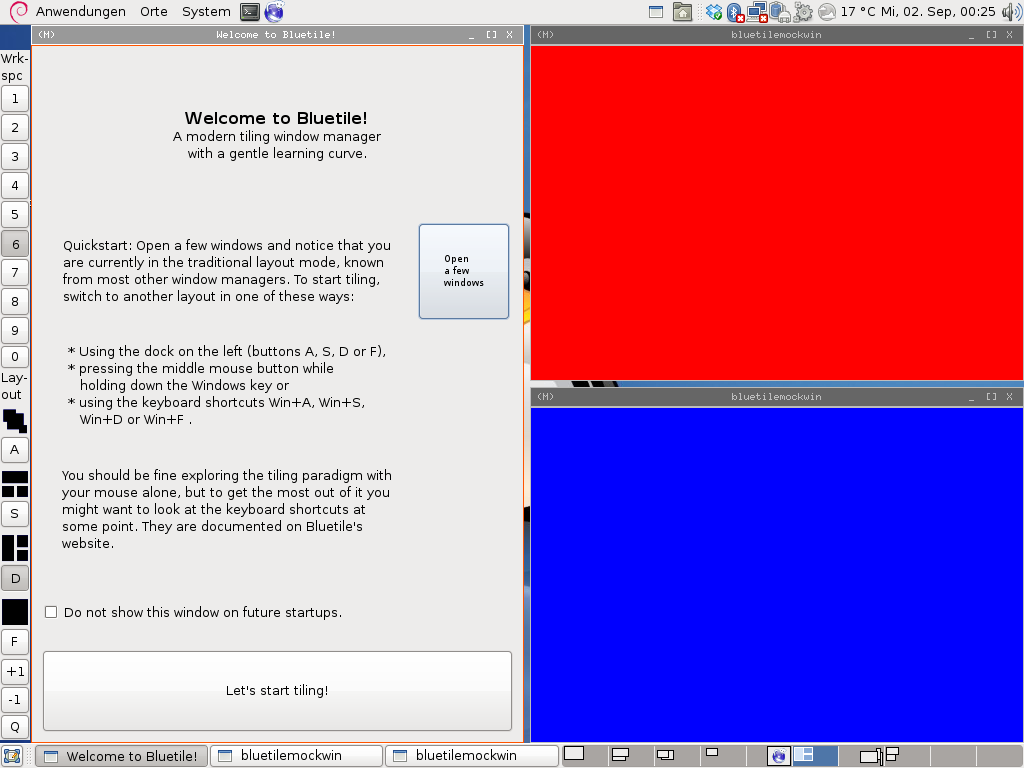
I just packaged and uploaded Jan Vornberger s window manager bluetile to Debian. This very nice piece of software brings the benefits of a tiling window manager to users who prefer to use the mouse and who don t want to learn a new programing language to configure their window manager. Bluetile uses the xmonad libraries and extends them with an easy to use and discoverable user interface.

23 April 2010

Joachim Breitner: Making dictionary passting explicit in Haskell

Haskell provides type classes to support polymorphism. A type class defines a few methods, which can then be implemented for a concrete type in the type class instance. This is a powerful system, but it also has it drawbacks. Most notably, each type can have at most one implementation of the type class. But sometimes you need to use a different implementation. If, for example, you used the Binary class to store data on disk. Now you changed your data type and the binary instance, and you can not read the old data any more. One solution is to re-name your type using newtype and implement another type instance for that. Often, this is enough. But still, instances are not first-class-citizens. You can not pass them around or modify them, as you can pass around and modify data and functions. Under the hood of the compiler, things look different. The ghc puts the methods of the instance in a dictionary and passes that implicitly to any functions having a (Class a) constraint. (Other implementations exist though) If one could make that behavior explicit, one could easily modify the instance before passing it to the function. But this is unfortunately not possible. But it is possible to pass an explicit dictionary along the data. I use the Monoid class as an example, and define a representation of the dictionary to-be-passed, as well as the dictionary of the default instance:
data MonoidDict a = MonoidDict
    ed_mempty :: a
  , ed_mappend :: a -> a -> a
   
monoidDict :: Monoid a => MonoidDict a
monoidDict = MonoidDict mempty mappend
(For conciseness, I ignore the mconcat method.) My first idea was to pass this instance along with data: (MonoidDict a, a). But this would not work because there are methods, such as mempty, who need the dictionary without getting passed a value to use. Therefore, I need to put the dictionary both in the covariant and the contravariant position:
newtype WithMonoidDict a = WithMonoidDict (MonoidDict a -> (MonoidDict a, a))
We need functions to clamp a dictionary to a value, and to extract it again:
wrapWithCustomMonoidDict :: MonoidDict a -> a -> WithMonoidDict a
wrapWithCustomMonoidDict dict val = WithMonoidDict $ const (dict, val)
extractFromCustomMonoidDict :: MonoidDict a -> WithMonoidDict a -> a
extractFromCustomMonoidDict dict (WithMonoidDict f) = snd (f dict)
Note that both expect the dictionary, so that it can be fed into WithMonoidDict from both sides . For convenience, we can define variants that use the standard instance:
wrapWithMonoidDict :: Monoid a => a -> WithMonoidDict a
wrapWithMonoidDict = wrapWithCustomMonoidDict monoidDict
extractFromMonoidDict :: Monoid a => WithMonoidDict a -> a
extractFromMonoidDict = extractFromCustomMonoidDict monoidDict
We want to be able to pass the wrapped values as any other value with a Monoid instance, so we need to declare that:
instance Monoid (WithMonoidDict a) where
  mempty = WithMonoidDict (\d -> (d, ed_mempty d))
  mappend (WithMonoidDict f1) (WithMonoidDict f2) = WithMonoidDict $ \d ->
  let (d1,v1) = f1 d
  (d2,v2) = f2 d
  in  (d1, ed_mappend d1 v1 v2)
Note that mappend has the choice between three dictionaries This is not a good sign, but let s hope that they are all the same. Does it work? Let s see:
listInstance :: MonoidDict [a]
listInstance = monoidDict
reverseInstance :: MonoidDict [a]
reverseInstance = monoidDict   ed_mappend = \l1 l2 -> l2 ++ l1  
examples = do
  let l1 = [1,2,3]
  let l2 = [4,5,6]
  putStrLn $ "Example lists: " ++ show l1 ++ " " ++ show l2
  putStrLn $ "l1 ++ l2: " ++ show (l1 ++ l2) 
  putStrLn $ "l1  mappend  l2: " ++ show (l1  mappend  l2) 
  putStrLn $ "Wrapped with default instance:"
  putStrLn $ "l1  mappend  l2: " ++ show (
  extractFromMonoidDict $ wrapWithMonoidDict l1  mappend  wrapWithMonoidDict l2)
  putStrLn $ "Same with reversed monoid instance:"
  putStrLn $ "l1  mappend  l2: " ++ show (
  extractFromCustomMonoidDict reverseInstance $
  wrapWithCustomMonoidDict reverseInstance l1  mappend 
  wrapWithCustomMonoidDict reverseInstance l2)
Running examples gives this output:
Example lists: [1,2,3] [4,5,6]
l1 ++ l2: [1,2,3,4,5,6]
l1  mappend  l2: [1,2,3,4,5,6]
Wrapped with default instance:
l1  mappend  l2: [1,2,3,4,5,6]
Same with reversed monoid instance:
l1  mappend  l2: [4,5,6,1,2,3]
Indeed it works. Unfortunately, this approach is not sufficient for all cases. It is perfectly valid to have functions with signature (Monoid a => Int -> Int). Obviously, this function would have no access to the explicit dictionary, because no value of type a is passed to or from it.<monoid a="a"> I wonder if it would be possible to extend the syntax somehow to be able to properly pass an alternative dictionary to such functions. But given that not all compilers use dictionary passing, my hopes are low.

Joachim Breitner: Making dictionary passing explicit in Haskell

Haskell provides type classes to support polymorphism. A type class defines a few methods, which can then be implemented for a concrete type in the type class instance. This is a powerful system, but it also has it drawbacks. Most notably, each type can have at most one implementation of the type class. But sometimes you need to use a different implementation. If, for example, you used the Binary class to store data on disk. Now you changed your data type and the binary instance, and you can not read the old data any more. One solution is to re-name your type using newtype and implement another type instance for that. Often, this is enough. But still, instances are not first-class-citizens. You can not pass them around or modify them, as you can pass around and modify data and functions. Under the hood of the compiler, things look different. The ghc puts the methods of the instance in a dictionary and passes that implicitly to any functions having a (Class a) constraint. (Other implementations exist though) If one could make that behavior explicit, one could easily modify the instance before passing it to the function. But this is unfortunately not possible. But it is possible to pass an explicit dictionary along the data. I use the Monoid class as an example, and define a representation of the dictionary to-be-passed, as well as the dictionary of the default instance:
data MonoidDict a = MonoidDict
    ed_mempty :: a
  , ed_mappend :: a -> a -> a
   
monoidDict :: Monoid a => MonoidDict a
monoidDict = MonoidDict mempty mappend
(For conciseness, I ignore the mconcat method.) My first idea was to pass this instance along with data: (MonoidDict a, a). But this would not work because there are methods, such as mempty, who need the dictionary without getting passed a value to use. Therefore, I need to put the dictionary both in the covariant and the contravariant position:
newtype WithMonoidDict a = WithMonoidDict (MonoidDict a -> (MonoidDict a, a))
We need functions to clamp a dictionary to a value, and to extract it again:
wrapWithCustomMonoidDict :: MonoidDict a -> a -> WithMonoidDict a
wrapWithCustomMonoidDict dict val = WithMonoidDict $ const (dict, val)
extractFromCustomMonoidDict :: MonoidDict a -> WithMonoidDict a -> a
extractFromCustomMonoidDict dict (WithMonoidDict f) = snd (f dict)
Note that both expect the dictionary, so that it can be fed into WithMonoidDict from both sides . For convenience, we can define variants that use the standard instance:
wrapWithMonoidDict :: Monoid a => a -> WithMonoidDict a
wrapWithMonoidDict = wrapWithCustomMonoidDict monoidDict
extractFromMonoidDict :: Monoid a => WithMonoidDict a -> a
extractFromMonoidDict = extractFromCustomMonoidDict monoidDict
We want to be able to pass the wrapped values as any other value with a Monoid instance, so we need to declare that:
instance Monoid (WithMonoidDict a) where
  mempty = WithMonoidDict (\d -> (d, ed_mempty d))
  mappend (WithMonoidDict f1) (WithMonoidDict f2) = WithMonoidDict $ \d ->
  let (d1,v1) = f1 d
  (d2,v2) = f2 d
  in  (d1, ed_mappend d1 v1 v2)
Note that mappend has the choice between three dictionaries This is not a good sign, but let s hope that they are all the same. Does it work? Let s see:
listInstance :: MonoidDict [a]
listInstance = monoidDict
reverseInstance :: MonoidDict [a]
reverseInstance = monoidDict   ed_mappend = \l1 l2 -> l2 ++ l1  
examples = do
  let l1 = [1,2,3]
  let l2 = [4,5,6]
  putStrLn $ "Example lists: " ++ show l1 ++ " " ++ show l2
  putStrLn $ "l1 ++ l2: " ++ show (l1 ++ l2) 
  putStrLn $ "l1  mappend  l2: " ++ show (l1  mappend  l2) 
  putStrLn $ "Wrapped with default instance:"
  putStrLn $ "l1  mappend  l2: " ++ show (
  extractFromMonoidDict $ wrapWithMonoidDict l1  mappend  wrapWithMonoidDict l2)
  putStrLn $ "Same with reversed monoid instance:"
  putStrLn $ "l1  mappend  l2: " ++ show (
  extractFromCustomMonoidDict reverseInstance $
  wrapWithCustomMonoidDict reverseInstance l1  mappend 
  wrapWithCustomMonoidDict reverseInstance l2)
Running examples gives this output:
Example lists: [1,2,3] [4,5,6]
l1 ++ l2: [1,2,3,4,5,6]
l1  mappend  l2: [1,2,3,4,5,6]
Wrapped with default instance:
l1  mappend  l2: [1,2,3,4,5,6]
Same with reversed monoid instance:
l1  mappend  l2: [4,5,6,1,2,3]
Indeed it works. Unfortunately, this approach is not sufficient for all cases. It is perfectly valid to have a function with signature (Monoid a => Maybe a -> Maybe a), whose behavior depends on the instance of a, even when being passed Nothing and returning Nothing. Such a function woul<monoid a="a">d have a problem here, because the dictionary would not be passed to the function.
</monoid> I wonder if it would be possible to extend the Haskell language somehow to be able to properly pass an alternative dictionary to such functions. But given that not all compilers use dictionary passing, my hopes are low.

15 April 2010

Joachim Breitner: A mathematician s status symbol

While writing my diploma thesis, I often wished I had a blackboard in my room: A place to quickly scribble some ideas on, somewhere where I can easily erease and replace stuff. Also, somewhere where you can literally (and not just figuratively) step back from and look at from the distance. For my 25th birthday, my parents organized a discharged part of a blackboard from my old scool, and yesterday, we installed it in my room in Karlsruhe:
A blackboard in my room
Although my diploma thesis is finished, I m sure it will be a nice and useful piece of furniture, and if only to draw funny things on (as my girlfriend did on this picture).

Joachim Breitner: zpub article in Linux-Magazin

The 05/2010 issue of the German Linux-Magazin contains an article of mine about DocBook, Subversion and zpub. I was quite surprised to find it there I submitted it in January and did not receive any feedback. But of course it is a nice surprise to find out it was accepted! The article, the zpub website and zpub itself is only available in German so far, but there is an English blog post describing zpub.

18 March 2010

Joachim Breitner: libnss-gw-name: A stable name for your gateway

I often find myself running /sbin/route to get the IP address of the current gateway, especially when using a wireless LAN while traveling. For example, if the Internet does not work I usually ping the local gateway to see where the connectivity problem lies. I also need the IP if I want to access the routers configuration web interface. This is somewhat tedious, so I wrote libnss-gw-name, and now:
$ sudo apt-get install libnss-gw-name
[...]
$ ping gateway.current
PING gateway.current (172.20.239.1) 56(84) bytes of data.
64 bytes from hhicalvin.stud.uni-karlsruhe.de (172.20.239.1): icmp_seq=1 ttl=64 time=2.16 ms
64 bytes from hhicalvin.stud.uni-karlsruhe.de (172.20.239.1): icmp_seq=2 ttl=64 time=1.48 ms
64 bytes from hhicalvin.stud.uni-karlsruhe.de (172.20.239.1): icmp_seq=3 ttl=64 time=2.73 ms
^C
--- gateway.current ping statistics ---
3 packets transmitted, 3 received, 0% packet loss, time 2003ms
rtt min/avg/max/mdev = 1.482/2.129/2.739/0.513 ms
Once libnss-gw-name is installed, it hooks into the system s Name Service Switch, which is, among other things, responsible for resolving hostnames to ip addresses. It will only react on the name gateway.current , checking the system s routing table and returning the IP address of the current default gateway. It s a pretty simple and small tool, but it could well prove very handy to the power user. I uploaded libnss-gw-name to Debian sid, you can download the source code or access the git repository. Update: Changed the name to gateway.localhost, as that is within a reserved top-level-domain.

Joachim Breitner: Video of my CeBIT talk online

As tolimar already said, videos of talks at the Linux New Media booth at CeBIT are online now, including mine about how to submit patches. It is in German, though.

16 March 2010

Joachim Breitner: kexec saved my day

Yesterday evening, when returning from a two-day trip with no connectivity, I found my server to be broken. I still reacted on ping, but no service would respond. I tried to restart it using my hoster s web interface, but it would not come back up. I booted into the recovery system and checked the hard disk, but could not find any issues. File system checks went through without a hitch. But it would still not boot. Unfortunately, my hoster does not provide access to the system console, so I had no idea what was going wrong. I never did anything with kexec, (a relatively new feature of the Linux kernel to act as a bootloader to load another system) and I was very positively surprised to find that it works out-of-the-box and flawlessly: I was able to load my system s kernel and initrd from the recovery system and successfully booted it. I then ran lilo and rebooted right again, which now worked. I m not sure if running lilo fixed it, or the clean shut-down, nor do I know what caused the problem in the first place, but kexec saved my day here.

2 March 2010

Joachim Breitner: Talking at CeBIT tomorrow

Today, I arrived at the CeBIT conference in Hannover, and had a first look around. I find trade fairs like that quickly boring, and I was glad to meet some some other Debian folk and listen to some of the talks at the CeBIT Open Source Forum in hall 2, including tolimar s talk about Debian GNU/kFreeBSD. Tomorrow (Wednesday), I will talk at the same place at 13:45, explaining some basic stuff about patches and bug tracker. The target audience are users of Free Software who modify it for their private or company-wide use and would like to see their changes included in the official project. There will be a live stream of the talk, which I am officially holding as an employee of the ITOMIG GmbH.

1 March 2010

Joachim Breitner: Teeth fashion

Has anyone ever considered wearing his teeth consistent with the rest of ones cloths?

28 February 2010

Joachim Breitner: Exploiting sharing in arbtt

My automatic rule-based time tracker (arbtt), which is written in Haskell, collects every minute a data sample consisting mainly of the list of currently open windows (window title and program name). Naturally, this log grows rather large. Since October of last year, I collected 70,000 samples. I already went from a text-based file format to a binary format using Data.Binary, which gave a big performance boost.
But by now, I was afraid that this is not enough. My log file is now 30MB large. Looking at the memory graph of gnome-panel, it is taking up more than half of my memory. When running arbtt-stats, the Haskell run time system reports 569 MB total memory in use and the command finishes after 28.5 seconds. Naturally, the log file is highly redundant: Compressing it with bzip2 shrinks it to 1.6MB. But as I would like to preserve the ability to just append samples at the end, without having to read the file, I chose not just to add bzip2 or gzip compression. Rather, I am now exploiting a very obvious redundancy: Two adjacent samples usually list exactly the same windows, and a focus change only changes a flag. So now, when storing a string that is part of a sample, it will check if this string was already present in the previous sample and, in this case, just store the number of that string (one byte). Only if the string was not present it will write a zero byte and then the string. When reading the sample, the process is reversed. This greatly reduces the file size: It is down to 6.2MB. It also improves the memory consumption, due to Haskell s abilities with regard to sharing: When a reference to a string in a previous sample is read, then only one instance of this string is in memory, even if it occurs several times in the log. This brings the memory consumption down to 264 MB and the runtime to 17 seconds. I released the changes as version 0.4.5.1 to Hackage, Debian and as a Windows installer. The log file is not automatically converted, but new samples will be written in the compressed format. If you want to convert your whole file, you have to stop arbtt-capture, run arbtt-recover, and then move the hopefully noticeable smaller ~/.arbtt/capture.log.recovered to ~/.arbtt/capture.log.
The required code changes were not too big. I somewhat isolated the relevant code in the Data.Binary.StringRef module. Unfortunately, I have to use OverlappingInstances to be able to provide the special instance for String is there a cleaner way (besides the trick used for the Show class)?

11 February 2010

Joachim Breitner: Diploma Thesis Finished

Earlier today, I went to a local copy shop and had my diploma thesis printed. This afternoon, I will hand it in. The title is Loop subgroups of Fr and the images of their stabilizer subgroups in GLr( ) and discusses a group-theoretical result. I assume that very few readers care about the content of the thesis, but maybe some are interested in a few assorted LaTeX hints. I m also publishing the full TeX source code, maybe someone can make use of it. Less chatty varioref I m using the varioref package, in conjunction with the cleveref package. This provides a command \vref fig:S3S4l which will expand to, for example, to Figure 1 on page 11 . But if the referenced figure is actually on the current page, the next page, the previous page or the facing page (in two-side layouts), it will say so: Figure 1 on this page. This is very nice, but I assume that the reader of my thesis is able to find Figure 1 when it is visible, i.e. on the current or facing page. One can remove the referencing texts with the commands \def\reftextfaceafter , \def\reftextfacebefore and \def\reftextcurrent . But because varioref puts a space between Figure 1 and this text, we will get a superfluous space even before punctuation. The remedy is the command \unskip, which removes this space again. So I use in my preamble:
\def\reftextfaceafter  \unskip %
\def\reftextfacebefore \unskip %
\def\reftextcurrent    \unskip %
Palatino and extra leading I chose the Palatino font for my thesis, using the mathpazo package. Various sources (such as the KOMA-Script manual) suggest to use 5% extra leading:
\linespread 1.05 
Counting figures independently from chapters I don t have too many figures and tables in my thesis, and I want them to be numbered simple 1, 2, ... By default, LaTeX would say 1.1, 1.2, 2.1, ... This can be fixed using the remreset package and these commands:
\makeatletter
\@removefromreset figure chapter 
\renewcommand \thefigure \arabic figure 
\@removefromreset table chapter 
\renewcommand \thetable \arabic table 
\makeatother
No widows and club lines LaTeX already avoids these, but I wanted to get rid of them completely. This can be done with:
% Disable single lines at the start of a paragraph (Schusterjungen)
\clubpenalty = 10000
% Disable single lines at the end of a paragraph (Hurenkinder)
\widowpenalty = 10000 \displaywidowpenalty = 1000
Struck table lines I had to typeset tables with some lines struck, and I could not find a ready command for that. I used the following definition, based on the code for \hline. Note that it probably does not adjust well to other font sizes and needs to be adjusted manually:
\makeatletter
\def\stline %
  \noalign \vskip-.7em\vskip-\arrayrulewidth\hrule \@height \arrayrulewidth\vskip.7em 
\makeatother
Title page in one-sided layout According to the KOMA manual, the title page as set by LaTeX is not meant to be the cover of a publication, and therefore has to be set with the margins of a right page i.e. a larger right margin and a smaller left margin. But when printing cheaply, one often just put a transparent sheet on top of the print, so the title page is the cover. You can convince KOMA that you are right by using
\KOMAoptions twoside=false 
\begin titlepage 
...
\end titlepage 
\KOMAoptions twoside=true 
Not flushing the page for chapter heads LaTeX would put the list of algorithms on a new right page. I found this a waste of paper for my few algorithms, and preferred to put the list right after the table of contents. You can override the LaTeX behavior using:
\tableofcontents
 
\let\cleardoublepage\relax  % book
\let\clearpage\relax  % report
\let\chapter\section
\listofalgorithms
 
This code also reduces the size of the heading to that of a section. The same trick also works with \chapter. Math in headings vs. PDF bookmarks LaTeX with the hyperref package creates nice PDF bookmarks from your chapter and section titles. Unfortunately, PDF bookmark names can only be plain strings, while the titles in the document might contain some math symbols. You can make both happy with \texorpdfstring:
\section Stabilizer subgroups in \texorpdfstring $\GL_r(\Z/2\Z)$ GL\_r(Z/2Z) 
Setting lines for the signature The diploma thesis contains a small note which I have to sign, saying that I created it on my own etc. Below that, I put two labeled lines for date and signature, using the tabbing environment:
\begin tabbing 
\rule 4cm .4pt \hspace 1cm  \= \rule 7cm .4pt  \\
Ort, Datum \> Unterschrift
\end tabbing 

7 February 2010

Joachim Breitner: If I were a caricaturist

I d draw a caricature involving a Toyota car, representing capitalism, with a stuck gas petal and Barack Obama trying to fix it. But as I cannot draw very well, especially recognizable people, I created this collage:
The photo of Obama was created by Beth Rankin.

4 February 2010

Joachim Breitner: FontForge-Article in the German Linux-Magazin

Yesterday, I found the 3/10-issue of the German Linux-Magazin in my mailbox. (I don t dare to call it the March issue they are a bit off schedule...) On page 62, you can find my 3 page article about creating a symbol font with FontForge. I briefly covered the topic on my blog and later thought that it would made a nice article, even though I m not an expert on this area. The article will be freely available in about three years.This is already my third publication, after my article on the Cross-Site-Authentication attack that was published in the same magazine (circulation ~63.000) and in its international counterpart in 2005 and my recent article in the freeX magazine (circulation ~15.000). Looks like I ll have to add a Publications section to my website soon...

2 February 2010

Marco T&uacute;lio Gontijo e Silva: Hi Debian Planet!


Hi Debian Planet! Finally I became a Debian Developer on saturday. Some time after that I sent my first e-mail @debian.org, and today I uploaded my first package: haskell-qio, a sponsored upload for Iain Lane. I d like to thanks everyone that have helped me in the process:
  • Joachim Breitner: for being my sponsor, telling me to look into NM, advocating me in NM and DM, helping me with packaging and other things.
  • Gustavo Noronha: for advocating me in DM, helping me with packaging and agreeing that packaging is not an easy to learn task.
  • Enrico Zini: for being a very nice to work with and helpful AM.
  • Marcelo Vieira: for the chats about the process, which made it pass faster.
  • Ian Costa de Andrade: for not complaining too much about me spending the whole day in the computer, and for all support and encouragement.
  • Marina Gontijo Andrade: for existing.
  • Wagner Meira and Fernando Pereira: for allowing me to work on Debian and giving me a scholarship for it.
  • Thadeu Cascardo and Samuel Vale: for giving me a Debian-related job which made me study about the system.
I m absolutely sure I m forgetting about someone, but I m also sure I ll never remember everyone and I ll always have this sensation. Being a Debian Developer is something I wanted for a long time, and I m very happy to have made it now. Currently I m working mostly in the Debian Haskell Group. These days I m checking if it s possible to make ghci be built in all architectures, and trying to make the newer versions of ghc6, from sid (6.10.4-1) and experimental (6.12.1-4), build in ia64, hurd-i386 and m68k. Any help is welcome. By the way, while I was reading the instructions to migrate some things to the new account, I ve not paid very much attention that I should only change the submitter of the unarchived e-mail, and I made a script, which I posted on the wiki, to change it for all the bugs. Neil Williams commented that this was not necessary, and Sandro Tosi pointed that I could have done this using only one mail to do all commands. Yves-Alexis Perez said that even with the unarchived bug this may not be a good idea, because of the generated noise. So I update the script in the wiki, following these tips, thanks for them. Special thanks for Jimmy Klapowitz, who was nice and supportive in a moment people were not being very nice to me. Sorry for the maintainers that received a lot of e-mails because of this, specially to the people who sign the pkg-haskell-maintainers mailling list, which received the biggest ammount of mail.

30 January 2010

Joachim Breitner: pidgin-blinklight goes subliminal

A long while ago I wrote a plugin for gaim called gaim-thinklight that blinks ones ThinkPad ThinkLight when a new message arrives. By now it is called pidgin-blinklight and supports some other hardware as well, but has not changed since over a year. Today, I implemented a new feature, and I m curious if it will actually work: Until now, the blink pattern was hardcoded: ON, wait 150ms, OFF, wait 125ms, ON, wait 150ms, OFF. Since version 0.11, pidgin-blinklight will calculate these three delay times based on the contacts login name. So different contacts will have very slightly different blinking patterns. The idea is that, after a while, you start to recognize your frequent buddies already by the blinking. The wait times are from the range from 50ms to 250ms, I hope that range works well.
Users of Debian unstable will get the new version automatically. If you want to compile pidgin-blinklight from source, you will have to grab it from the debian ftp server. The source is in the pidgin-blinklight Darcs repository.

25 January 2010

Joachim Breitner: Serna XML editor uploaded to Debian

The XML-Editor Serna by Syntext has been published as Free Software a few months ago. This was very good news, because there was a lack of a good free XML editors with a good graphical view on DocBook documents, which I needed to recommend to users of zpub. Therefore, I investigated packaging Serna for Debian. I had to patch a few things to make it compile on and64 and to use components shipped by Debian where possible. Today, I could finally close the RFP bug filed by W. Martin Borgert, as the serna package was accepted by the ftp-masters. The first bug (SEGFAULT on startup on lenny) is already filed. I hope this is a good sign, as it shows that there is interest in the package. For my packaging workflow, I used git-svn to import the upstream SVN branch into a git repository. I then use git-dpm by Bernhard R. Link to manage my changes as patches in the new 3.0 (quilt) debian source package. I must say that I prefer this approach to git-buildpackage, as there is only one git branch to publish. I hope that Bernhard uploads git-dpm to Debian soon. Serna is quite a big software project and uses stuff that I know little about (Qt, C++ with python interaction etc.). Also, the package currently bundles the DITA-OT package, which should rather be packaged separately. Therefore, I d be glad if co-maintainers would join the effort.

9 January 2010

Joachim Breitner: DebConf mugshots view statistics

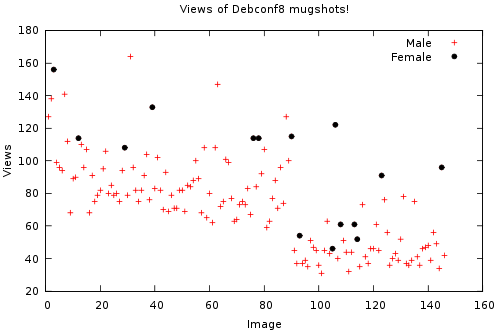
In a comment to my previous blog post, I linked to the DebConf photo gallery page with the DebConf8 mugshots. Felix Brandt, a friend of mine, noticed the per-picture view statistics there and plotted them, differentiating between male and female. He finds that the number of views on an image gives a fairly good indication of the sex (or gender?) of the person in question:
The most notable exception is the image of bubulle. He does not even look feminine. Maybe it s because he s like a mother to us Debianers, always kind and always helpful? :-) This observation fits my experience when I created a top-100-statistic of individual picture page views of my personal gallery: I got a collection of pretty much all pictures of girls in bikinis, lying at some beach, across the various pages and years, and hardly any other picture. I won t post these top-100 here, as I don t want to additionally increase the effect...

7 January 2010

Joachim Breitner: screen-message ported to Windows

Over the holidays I investigated how to cross-compile GTK applications for Windows, and managed to port screen-message. I also created an Inno Setup based installer for it that includes the necessary GTK DLLs. You can grab it from the screen-message homepage. The installer optionally binds screen-messages to the key combination Alt-Ctrl-S.
I would have published the binary much earlier if starting the application had not always given the error message
The application failed to initialize properly (0xc000007b). Click on OK to terminate the application.
on Windows, while it worked fine under WINE. It took me a while to find the cause, as there seems to be only one mention of it in the internet: One must not use MinGW s strip.exe utility on DLLs not created with MinGW, it seems. I added a make installer target to the Makefile to create the installer. If you are curious about how that works, have a look at the source.

Next.

Previous.